The broader impacts of war

Vancouver Peace Poppies co-founder Teresa Gagné at the White Poppy Memorial in 2018. (photo by Diane Donaldson)

A local group is hoping to broaden the scope of Remembrance Day as more than an occasion to honour the brave men and women who have died while serving for their country. Through the distribution of white poppies, the Vancouver Peace Poppies (VPP) movement strives to extend the focus on Nov. 11 to all those who have suffered as a result of military conflicts.

Teresa Gagné, who co-founded VPP with Denis Laplante in 2008, stresses that the group intends no disrespect towards soldiers. Instead, they wish to bring more awareness to the toll warfare has on the whole population, whether it be the loss of life or other trauma experienced. Beyond representing the victims of war, civilian and military, the white poppy, according to VPP, also challenges the beliefs, values and institutions that create the view that war is unavoidable.

“I have always had respect and sympathy for veterans, who put their life, health and family on the line to serve,” Gagné said. “I believe they deserve recognition and support, but, for years, I was uncomfortable wearing a red poppy, because of the undercurrent of promotion and recruitment for present and future wars that I detect in many public events around the topic of supporting veterans. The white poppy attracts questions, and gives me a chance to explain the nuances of my support.”

A 2016 study by Alexandre Marc, a specialist in conflict and violence for the World Bank, brought to light the overwhelmingly disproportionate number of casualties among non-combatants as opposed to combatants in recent decades. According to some reports, civilians constitute 90% of wartime fatalities, a ratio that has existed since the mid-1950s.

What’s more, Marc’s research points out that global poverty is increasingly concentrated in countries affected by violence and that prolonged conflict keeps countries poor.

Gagné and Laplante have been active in the peace movement since their teens. Their 2008 launch of VPP began by distributing handmade white poppies as a way to promote discussion and a broader focus for Remembrance Day. The following year, while still a “kitchen table” operation, they imported 500 cloth poppies from Britain. VPP now sends out more than 5,000 poppies across Canada annually.

Since 2016, VPP has partnered with the B.C. Humanist Association to host Let Peace Be Their Memorial, an annual Remembrance Day wreath-laying ceremony that includes peace songs, short presentations and poetry. This year, the Multifaith Action Society is also a co-host. The event poster highlights, “The time and location of the ceremony has been chosen to avoid any appearance of competition with, or disrespect for, veteran-focused events.”

Holocaust remembrance

As in previous years, this year’s ceremony at Seaforth Peace Park on Nov. 11, 2:30 p.m., will include a special wreath laid in memory of Holocaust victims.

Two members of the Vancouver Jewish community, Marcy Cohen and Gyda Chud, are engaged in the local movement. In 2017, Cohen attended her first Let Peace Be Their Memorial and then sought to get others in the community involved.

photo - Henry Grayman and Deborah Ross-Grayman with the Holocaust wreath at the memorial last year
Henry Grayman and Deborah Ross-Grayman with the Holocaust wreath at the memorial last year. (photo by Diane Donaldson)

“I was far more affected emotionally than I anticipated,” said Cohen of the occasion.

After learning of the history, values and focus of VPP, Chud recently joined the committee, and seeks to profile their work in the larger Jewish community. She represented Pacific Immigrant Resource Society (PIRS), a local refugee service group, in laying the refugee wreath in 2017 and 2018.

“The memorial serves as a powerful and compelling call to action for everything we can and must do to create a more peaceful world,” said Chud.

Last year’s Holocaust wreath was laid by Henry Grayman and Deborah Ross-Grayman, both children of Holocaust survivors. Having each experienced the intergenerational effects of trauma, the couple, both therapists, are facilitators for the Second Generation Group, an organization in Vancouver comprised of children of Holocaust survivors sharing their experiences among peers.

The people laying the Holocaust wreath at this year’s Let Peace Be Their Memorial have yet to be announced.

Poppies’ history

The red poppy widely worn today first appeared in 1921 on what was then called Armistice Day. In 1926, the No More War Movement, a British pacifist organization, came up with the idea for the white poppy and, in 1933, the Co-Operative Women’s Guild in the United Kingdom sold the first white poppies as a means of remembering that women had lost husbands, sons and fathers during wartime.

The wreaths that Vancouver Peace Poppies and other groups make, a mix of white and red poppies, highlight the amount of civilian suffering. VPP also distributes white poppies in schools in an effort to teach students that wars mostly kill non-military people, pollute the environment and send the message that violence as a means to settle disputes, even for adults, is acceptable.

VPP hands out its poppies by donation to increase awareness of its cause and not as a fundraiser. Poppies cost $1.25 each, of which 95 cents goes to the Peace Pledge Union, a pacifist organization based in London, England, which, since 1934, has advocated for nonviolent solutions to global problems. A $1 or $2 donation allows VPP to provide subsidized poppies for classroom use and free poppies to disadvantaged groups.

For poppies and more information, visit peacepoppies.ca or call 604-437-4453.

Sam Margolis has written for the Globe and Mail, the National Post, UPI and MSNBC.

Pot roast for Rosh Hashanah

There’s no denying that food is an insanely large part of Jewish life. Whether we’re cooking it, eating it or writing about it, our lives inexorably orbit around it. It’s true that most religions celebrate their holidays, at least partially, through food. But we Jews have taken the concept to nosebleed-worthy stratospheric heights. If someone tells you their son is becoming bar mitzvah, our first question is not “Which shul?” but “What are you serving?” A bris? We don’t ask: “What time?” but rather, “What can I make?”

It’s not that modern-day Yiddishkeit revolves around food, but it kinda does. I’m fully aware that we’re supposed to focus on blessing and elevating the food we eat, since it is meaningless on its own. From a religious perspective, food is merely the vehicle to give us the strength to do mitzvahs and study Torah. I get it. But how can you ignore the deliciousness of a rock-star chicken soup or a melt-in-your-mouth brisket?

When you pair Rosh Hashanah and food, what do you get? Pure joy. And maybe a little indigestion, if there’s excess onion and garlic on the guest list. We all know that the High Holidays are a time to relax with family, eat lovingly prepared meals and go to shul. And, while shul is certainly important, for some, the highlight is the food.

From many years of observation, I’ve deduced that there are three main contenders at the Ashkenazi Rosh Hashanah table: matzah ball soup, brisket and gefilte fish. And maybe chicken. Or salmon, if you’re a true Vancouverite. Anything else is considered “alternative.” Seriously, when was the last time someone served tofu or sunomono at Rosh Hashanah dinner? Asked and answered.

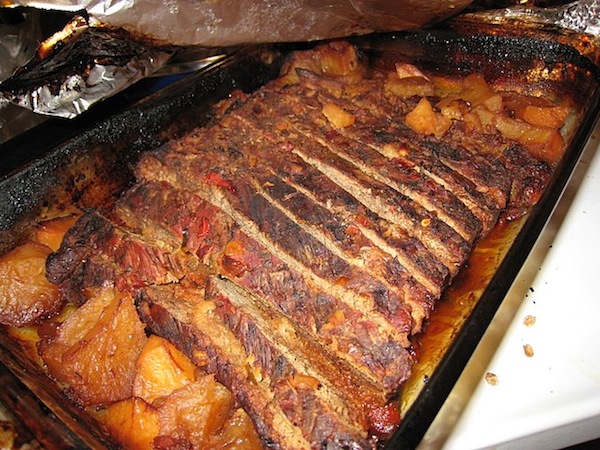
Being firmly entrenched in the carnivore camp, I decided I’m going to make a pot roast for Rosh Hashanah this year. Being a pot roast virgin, until recently I knew next to nothing about this cut of meat or how to cook it. How did I get to be 63 years old without knowing these things? Rhetorical question. Anyway, I did what any self-respecting Accidental Balabusta would do – I Googled it. I found a recipe from the Food Network by Ree Drummond, called Perfect Pot Roast! I followed the recipe religiously (OK, minus the sheitel), except I made a mini-roast (one-and-three-quarter pounds) in case I screwed it up. And I used beef blade roast, which is the same as chuck roast, apparently. I cooked it at 275˚F for two-and-a-half hours. It turned out as scrumptious as something a bubbe would make. Only better. Modesty, wherefore art thou?

Over the years, I’ve heard gossip about pot roast: that it calls for a cheap, tough cut of meat (true); that it’s not really a Jewish cut of meat (see Snobbery 101); and that only goyim eat it (see Racism 101). I’m living proof that pot roast is a very Jewish thing. And, excuse me if I brag, but my newfound pot roast is beyond delicious. Or, to use the vernacular, a mechaye.

I feel compelled to mention something a little odd at this juncture. When I brought my first pot roast and took it out of the package, I noticed it had heavy twine wrapped around it. I wondered whether I’d purchased the B&D variety by mistake. Googling the twine part set my mind at ease. I mean, who wants to serve a kinky Rosh Hashanah pot roast?

Call me clairvoyant or, on second thought, don’t (that’s really not a Jewish thing), but I think you might be chomping at the bit for this recipe. Wait no longer. Allow me to introduce you to the Perfect Pot Roast by Ree Drummond. BTW, it calls for a Dutch oven, but any deep, covered roasting pan will do just fine. (Don’t feel bad, I had to Google Dutch oven, too.) Go ahead, cook it and tell me if this doesn’t taste Jewish.

PERFECT POT ROAST

Salt and ground black pepper
One 3-5 pound chuck roast (same as beef blade roast)
2-3 tbsp olive oil
2 whole onions, peeled and halved
6-8 whole carrots, peeled and cut into 2-inch pieces
1 cup red wine (doesn’t need to be anything fancy)
3 cups beef broth
2-3 sprigs fresh rosemary
2-3 sprigs fresh thyme
2-3 potatoes, peeled and cut into pieces

  1. Preheat oven to 275˚F.
  2. Generously salt and pepper the roast.
  3. Heat the olive oil in a large fry pan or Dutch oven over medium-high heat. Add the halved onions to the pot, browning them on both sides. Remove the onions to a plate.
  4. Throw the carrots into the same fry pan or Dutch oven and toss them around a bit until slightly browned. Set aside the carrots with the onions.
  5. If needed, add a bit more olive oil to the fry pan or Dutch oven. Place the meat in the fry pan or Dutch oven and sear it for about a minute on all sides, until it is nice and brown all over. Remove the roast to a plate.
  6. With the burner still on medium-high, use either red wine or beef broth (about one cup) to deglaze the fry pan or Dutch oven, scraping the bottom with a whisk. Put the roast back into the Dutch oven (or deep, covered roasting pan) and add enough beef broth to cover the meat halfway.
  7. Add in the onions and the carrots, along with the fresh herbs. Add potatoes, too (optional).
  8. Put the lid on, then roast it.
  9. The original recipe says to roast a three-pound roast for three hours or a four-to-five-pound roast for four hours. I personally don’t think this is nearly time enough. When I cooked two two-pound roasts in a single roaster at once, it took six-and-a-half hours to cook. The roast is ready when it’s fall-apart tender. I think the longer you cook it, the more tender it gets. It’s hard to screw this up, unless you undercook it.

Important note: don’t get too close to your Dutch oven when you lift the lid during cooking or you’ll get what I call the “pot roast facial.” I’m not sure your pores will appreciate all that meaty steam. But who am I to say? Just don’t blame me if you get third-degree facial burns. Bon appetit! Or, eat it and weep. From joy, that is.

May you all have a happy, healthy, prosperous and peaceful New Year!

Shelley Civkin, aka the Accidental Balabusta, is a happily retired librarian and communications officer. For 17 years, she wrote a weekly book review column for the Richmond Review, and currently writes a bi-weekly column about retirement for the Richmond News.

Holidays as a child

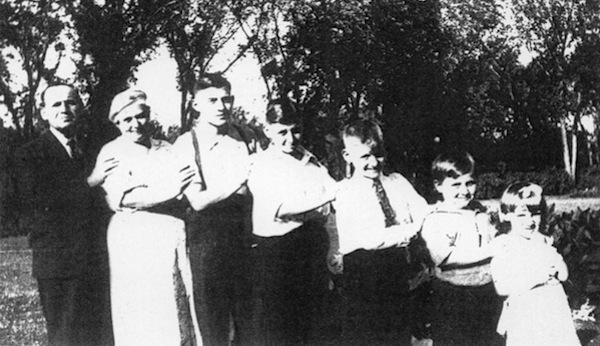
A Klein family portrait. (photo from Libby Simon)

As I get older, I look forward to my childhood memories of the High Holidays with my original family. This year, Rosh Hashanah begins before sundown on Sept. 29 and ends on nightfall Oct. 1, Yom Kippur.

My parents, four older brothers and I had moved to several rental houses after our arrival in Winnipeg’s legendary North End, but the one on Robinson Street is the earliest in my awareness as a preschooler. The neighbourhood was refuge for a host of other immigrant Jewish families who came from the same geographical area and shared the same culture, language and religion. This bond and kinship brought these landsleit together and they congregated around the Talmud Torah Hebrew Free School, where my father taught the children, and the Chevra Mishnayes Synagogue, directly across from our house, giving us the opportunity to attend services in a building that also acted as an unofficial community centre.

Papa attended all Shabbat services at the shul, which was the centre of many family weddings, bar mitzvahs and funerals. Since we observed the Orthodox Jewish religion, women and men did not sit together, so, while the men were seated on the main floor, the women were sequestered in an upstairs oval-shaped balcony overlooking the activity below. Not particularly interested in the liturgy, they tended to talk to one another about their children, their homes and other areas of interest, especially cooking on the High Holidays. This “noise” often interfered with the men as they recited the prayers. At some point, the shamas (the person running the service) would look upward, pound on the podium and shout “Schveig, viber!” (“Quiet, women!”) as if we were all one big family. Things subdued for awhile until the chatter swelled again, requiring intermittent reminders with more pounding, and a commanding, “SHHAA!”

Our old, wood-framed house had a screened veranda where I played and sometimes slept on warm summer nights. Once I was old enough, on Saturday mornings, I was allowed to cross the street to join Papa after a bar mitzvah celebration. There were always treats after the service, and he would prepare a small plate of schmaltz herring and chickpeas for me, and a piece of honey cake for dessert. I loved schmaltz herring and would devour it quickly while Papa looked on with a broad, proud smile.

But clouds of the Great Depression hung heavy over this North End community and there was widespread poverty. Most women did not work outside the home and, like many other men, my father lost his teaching job for a period during the Depression.

When I accompanied Mama to the grocery store or the kosher butcher shop, I didn’t understand why her face flushed and her eyes looked away as she stammered out in Yiddish, “I need food for the children. Can you put this on credit? We will pay you as soon as we can.” Her embarrassment and humiliation collided with my father’s shame, and resulted in many heated arguments between them over money.

The stress was particularly hard on Mama because she wasn’t well and had a large family to care for. She developed a “milk leg” while pregnant with my youngest older brother, Matty. It created a painful swelling of the leg after giving birth, which caused inflammation and clotting in the veins and affects some postpartum women. I vividly recall the too-numerous times when an ambulance came tearing down Robinson Street to our house with wailing warnings. Big men dressed in white would rush in, lift Mama onto a stretcher and take her away amid the shrieking sirens that were now competing with the high-pitched howls of her two frightened preschoolers, Matty and me.

Back then, children were not allowed to visit in hospitals, for fear of transmitting disease, so we could not see our mother for intermittent periods. On one such occasion, my father had enough money to take us to the ice cream store a few blocks away. Holding Papa’s hand on one side, with Matty on the other, I felt safe as we all walked together. And the tears subsided.

Canada declared war on Germany in September 1939 after Hitler invaded Poland, and, although my parents’ family was safe in Canada, their hearts and minds were with the loved ones they had left behind. Yet, our home was filled with joy and laughter.

My mother played happy, lively Russian, Yiddish and Hebrew songs at the black upright piano that held a place of honour among the flowery wallpaper and sagging couches of our living room. The eldest of the five children would lead us in a conga line with me at the other end, and we would dance from room to room, up and down the stairs, and all around the house. Sometimes, he would pick me up, throw me over his shoulder and call out “A zekele zaltz!” like a peddler. “A sack of salt, I have a sack of salt for sale! Who wants to buy my little sack of salt?” Or sometimes I was “potatoes.” Whether salt or potatoes, he would haggle with whichever of my other brothers offered to “buy” me.

Although I was still a preschooler, I knew that Papa was listening to “the news on the radio.” The worry was in his eyes, his face, his body, and his words expressed his extreme concern for our families back in the homeland. But the true catastrophic human saga that was unfolding, even as he listened, would not emerge until the war ended. We would learn much later that most of the relatives left behind, including my maternal grandfather, died in the Holocaust.

Even Papa’s fears could not have fathomed such destruction. The radio had become so much a central focus and source of news that, when the war ended in 1945, I recall asking, “Papa, now that the war is over, will they close the radio?”

“Why do you think they will close the radio?” he asked with a puzzled look.

“Because what else would they have to talk about?”

Libby Simon, MSW, worked in child welfare services prior to joining the Child Guidance Clinic in Winnipeg as a school social worker and parent educator for 20 years. Also a freelance writer, her writing has appeared in Canada, the United States, and internationally, in such outlets as Canadian Living, CBC, Winnipeg Free Press, PsychCentral and Cardus, a Canadian research and educational public policy think tank.

Rosh Hashanah’s many foods

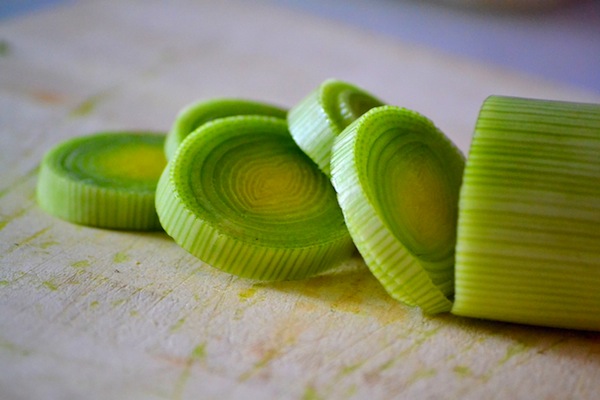
At a Sephardi Rosh Hashanah seder, one of blessings, over leeks (or cabbage) is the request, may “our enemies be destroyed.” (photo from Wikimedia)

Food customs differ among Ashkenazi and Sephardi Jews. For example, whereas Ashkenazim dip apple in honey at Rosh Hashanah, some Sephardim traditionally serve mansanada, an apple compote, as an appetizer or dessert, according to The World of Jewish Desserts by Gil Marks, z”l.

Just as gefilte fish became a classic dish for Ashkenazi Jews, baked sheep’s head became a Rosh Hashanah symbol for many Sephardi Jews, dating back to the Middle Ages. Some groups serve sheep brains or tongue or a fish with head, probably for the same reasons, for fruitfulness and prosperity and wishes for the New Year of knowledge or leadership.

The Talmud mentions the foods to be eaten on Rosh Hashanah as fenugreek, leeks, beets, dates and gourds, although various Jewish communities interpret these differently.

According to Rabbi Robert Sternberg, in The Sephardic Kitchen, Sephardi Jews have a special ceremony called the Yehi Ratsones (Hebrew for “May it be Thy will”), where each food is blessed. There are foods that symbolically recognize God’s sovereignty and our hope He will hear our pleas for a good and prosperous year.

The Hebrew word for gourds is kara, which sounds like both the word for “read/proclaim” and the word for “tear.” When we eat the gourd or pumpkin, there are two possible Yehi Ratzons that can be said. The first one goes: “May it be your will, Hashem, that our merits be read/proclaimed before you.” The other is that the decree of our sentence should be torn up.

The second food mentioned is fenugreek, or rubia, which sounds like yirbu, the Hebrew word for “increase.” Therefore, we say a Yehi Ratzon that contains the request, may “our merits increase.”

The word for the third food, leeks or cabbage, is karsi, krusha or kruv, which sounds like kares, or the Aramaic word karti, to cut off or destroy. The Yehi Ratzon asks, may “our enemies be destroyed.”

The fourth food, beets or beet greens, silka or selek, sounds like siluk, meaning removal, or she’yistalqu, to be removed, or the Aramaic word silki. The Yehi Ratzon requests that “our adversaries be removed.”

The last food is dates, tamri or tamar, which sounds like the Hebrew word sheyitamu and the Aramaic word tamri, to consume. Hence, we say a Yehi Ratzon that asks, may “our enemies be consumed.”

image - For many Jewish cultures, the fish head is a symbol on the Rosh Hashanah table
For many Jewish cultures, the fish head is a symbol on the Rosh Hashanah table. (image from chabad.org)

All of these foods, which grow rapidly, are also symbols of fertility, abundance and prosperity. Among other items that might be on a Sephardi table at Rosh Hashanah, Sternberg includes baked apples dipped in honey or baked as a compote with a special syrup; dates, which were among the seven species found in Israel; pomegranates, which have many seeds, or black-eyed peas, to represent our hoped-for merits; rodanchas, a pastry filled with pumpkin whose spiral shape symbolizes the unending cycle of life; and a fish head, symbolizing a wish to be the head in life, a leader, and not the tail. The main course might feature stuffed vegetables, symbolizing a year full of blessings and prosperity.

Some communities ban sharp, bitter or black foods for Rosh Hashanah, such as black olives, eggplant, chocolate or coffee.

In The Classic Cuisine of the Italian Jews, Edda Servi Machlin, z”l, who grew up in Pitigliano, Tuscany, explains that her father held a seder for Rosh Hashanah around the theme of growth, prosperity and sweetness. On the seder plate were a round challah, a boiled rooster’s head, fish such as anchovies, boiled beets, figs and pomegranates. In the centre was a dried, round, sourdough cake with an impression of her father’s right palm and fingers, and fennel weed growing on each side.

The foods were then blessed – “May we grow and multiply like fish in the ocean, like the seeds of a pomegranate, like the leavening, grain and fennel of the bread. May the year be sweet like beets and figs.”

The meal consisted of soup, fish, salad, chicken and fruit. Italian Jews also often serve at Rosh Hashanah desserts made with honey and nuts; stick or diamond-shaped cookies; strufali, cookies made of fried dough balls in honey; or ceciarchiata, cookies that resemble chickpeas and are made from bits of dough like the Ashkenazi teiglach.

A Greek cookbook writer from Ioannina (Yahnina) wrote that the people of her area made koliva, a thick porridge of wheat berries flavoured with cloves, cinnamon, walnuts and honey for eating on the eve of Rosh Hashanah. According to Marks in The World of Jewish Desserts, wheat berries are unprocessed whole wheat with the outer husk removed, leaving a nutty flavour and chewy texture. Jews of Yahnina also ate kaltsoounakia, a half-moon-shaped cake stuffed with ground walnuts, honey, cinnamon and cloves. For the main course, dishes in Yahnina were influenced by the Turkish occupation and included stuffed tomatoes, stuffed squash and stuffed vine leaves – filled with lamb, rice and parsley, as well as okra stewed with chicken.

photo - Instead of honey cake, Greek Jews might have baklava for Rosh Hashanah dessert
Instead of honey cake, Greek Jews might have baklava for Rosh Hashanah dessert. (photo from Wikimedia)

Other Jews of Greece have different customs. Nicholas Stavroulakis, author of Cookbook of the Jews of Greece, writes that some people soak apples in honey or eat quince or rose petals cooked in syrup as the New Year sweet. Fish is often the main course and, in place of honey cake for dessert, Greek Jews use almonds or pumpkin in making turnovers, as a symbol of abundance. Other desserts include semolina cake in syrup, pastry triangles filled with nuts or dried fruit, or baklava.

Among Jews of Syria, sugar or honey is substituted for salt at the table, and many families do not serve any dishes that are sour. For the second night Shehechiyanu blessing, the fruit used may be quince, prickly pear, star fruit or figs. Instead of, or in addition to, dipping apples in honey, Jews of Syria often dip dates in honey.

Many Jews from Muslim countries also eat autumn foods cooked with sugar and cinnamon; the food names contain a symbolic allusion to prayers in Aramaic and, through alliteration, are recited over the vegetables and fruits. Syrian Jews use the same prayers but over different vegetables: leek, Swiss chard, squash, black-eyed peas, pomegranate and the head of an animal. This idea of wanting people to be smart, as symbolized by the head or brain, is observed by Jews of Tunisia in their serving of a cake made with chicken and calves brains.

Moroccan Jews take sesame seeds, warm them in the oven and eat them with apple dipped in honey to symbolize that Jews should be fruitful and multiply like the seeds and have the sweet year. They also eat the pomegranate because of its alleged 613 seeds, which symbolize the 613 mitzvot. Moroccan Jews identify the seven autumnal foods as pumpkin, zucchini, turnip, leek, onion, quince and Chinese celery, and sprinkle these with sugar and cinnamon to eat at the beginning of the meal.

Some Moroccan Jews also serve cooked lamb head as an appetizer for Rosh Hashanah. Other lamb dishes served might be lamb with prunes and almonds or lamb intestines filled with rice, meat and tomato, seasoned with cinnamon and cardamom.

Another popular dish served by Moroccans for Rosh Hashanah is couscous, the traditional North African grain, or farina. It is steamed above a stew made with meat or chicken, chickpeas, pumpkin, carrots, cinnamon and raisins. Baked fish with the head, made with tomatoes and garlic, tongue with olives, or meat and rice rolled in Swiss chard are other Moroccan New Year’s dishes. Two soups that may be served are vegetable soup with pastels, a meat-filled turnover similar to kreplach, and potakhe de potiron, a yellow, split-pea and pumpkin soup. The evening may be completed with honey-dipped “cigars,” filled with ground almonds and traditional hot mint tea.

“Cigars” are traditional for Moroccan events and can be made sweet or savoury. The sweet version is a slim roll of Phyllo pastry filled with almonds, pistachio nuts or walnuts, baked or deep fried and sprinkled with confectioner’s sugar. Savoury cigars may be filled with cheese, chicken, meat, potatoes or tuna.

For Rosh Hashanah, Jews of Egypt make loubia, a black-eyed pea stew with lamb or veal, to symbolize fertility.

Jews of Iraq cook apples with water and sugar like applesauce, as a symbol of a sweet New Year. Some also prepare a special, pale-green bottle-shaped squash, which they eat with whole apple jam and sugar. They also make the blessings over leek, squash, dates, pomegranate and peas and place the head of a lamb on their Rosh Hashanah table.

Yemenite Jews, who do not consider themselves Ashkenazi or Sephardi, dip dates in honey instead of apples; others mix sesame seeds and anise seeds with powdered sugar and dip dates in this mixture. They also eat the beet, leek, pomegranate and pumpkin, as well as a salted fish head. The main meal for Yemenites would be a soup made of chicken or meat, carrots, potatoes and the spice hawaj (a combination of black pepper, cumin, coriander and turmeric). Meat stew, cooked chicken, rice, dried fruit and nuts complete the meal.

Whatever your family’s origins, why not try something from another Jewish culture this Rosh Hashanah?

Sybil Kaplan is a journalist, lecturer, book reviewer and food writer in Jerusalem. She created and leads the weekly English-language Shuk Walks in Machane Yehuda, she has compiled and edited nine kosher cookbooks, and is the author of Witness to History: Ten Years as a Woman Journalist in Israel.

Value of is and ought

Ought is one of the 3,000 most frequently used words in English. We say one ought to do something as an indication that some action is good, proper, expected or owed. The word should carries many of the same implications. In recent years, should and ought have been criticized as being negative words, engendering guilt and removing individual initiative from people. People have begun to say, “I don’t like shoulds” or “Religion is too full of shoulds.”

The contemporary psychological pushback against ought and should is rooted in efforts to help people feel better about themselves. Moreover, it is suggested that, to liberate ourselves from should statements, we must more clearly express what we want and why we want it. It is important to fill in the gap between, “You should take out the garbage,” with the reasons why such an action is desired.

In many ways, the contemporary discussion is based in the work of David Hume (1711–1776), the great Scottish philosopher. He noted that many people make factual observations, describing events or people, and then make a casual transition from statements about what is to claims about what ought to be. In his Treatise of Human Nature, Hume cautioned against using descriptive statements (about what is) as the basis for prescriptive statements (about what ought to be). For example, the observation that locally grown produce is readily available in the market and the claim that one ought to eat local are not connected. What is missing is the explanation of why eating local might be environmentally beneficial, economically justified and morally desirable. The present situation may be described as it is. But if we think that something should (according to our values) be changed, we can begin to think about how to change things that are into what we believe they ought to be.

The claim that there is a smaller Jewish community now because of the Holocaust does not immediately lead to the conclusion that one should financially and politically support the state of Israel. Making the moral claim is not enough. We must be able to give reasons to fill in the gap between the demographic implications of the deaths of so many Jews and the importance of Israel to the continuation and rebuilding of the Jewish people.

Yet ought and should are also ways of thinking aspirationally, articulating what we hope or want to be. My colleague, Rabbi Harold Schulweis, has written about the is/ought dilemma in a way that reminds us of the power and possibility of ought (and should):

“Think ought. Not what is a Jew, but what ought a Jew to be. Not what is a synagogue, but what ought a synagogue to be. Not what prayer is, but what prayer ought to be. Not what ritual is, but what ritual ought to be.

“Focus from is to ought, and our mindset is affected. Is faces me toward the present; ought turns me to the future. Ought challenges my creative imagination, opens me to the realm of possibilities and to responsibilities to realize yesterday’s dream.

“Ought and is are complementary. Without an is, the genius of our past and present collective wisdom is forgotten. Without an ought, the great visions of tomorrow fade. Ought demands not only a knowledge of history but of exciting expectation. Is is a being, ought is a becoming. Ought emancipates me from status quo thinking. Ought is the freedom of spirit.”

The Torah tradition is built around the idea of ought and should. “Barukh atah … Praised are You who commanded us” is a core concept of Judaism, critical to who we are as Jews. This idea is at odds with contemporary sensibilities that seek to discard shoulds and oughts. We recognize responsibilities, obligations, mitzvot, as essential to the building of individual character and collective community. Whether those obligations are interpersonal or directed toward the Holy One, they encourage us to look beyond ourselves to see a greater good.

Many times during the Days of Awe, we will use the words should and ought. Instead of thinking of these words as ways of placing guilt on others, let us try to explain why something – attending shul with the family, marrying within the Jewish community, giving tzedakah – is important. Let’s try to fill in the reasons for our claims of should and ought.

As well, the Yamim Nora’im lead us to see statements of should and ought as moral claims that extend beyond past history. We might hear such comments as indications of our responsible aspirations and our hopeful desires. Then should and ought can be motivational terms. They push us forward toward making the world, our society, our family and our closest relationships a bit better.

Rabbi Baruch Frydman-Kohl is rabbi emeritus of Beth Tzedec Congregation in Toronto and is a rabbinic fellow of the Shalom Hartman Institute of Jerusalem. He is the author of scholarly articles in the area of Jewish philosophy and mysticism. For more articles from the SHI, visit hartman.org.il.

Feminine aspects of repentance

At Rosh Hashanah, the new moon is revealed.

The Zohar, that classic mystical text from the 13th century, describes the High Holidays as a developmental process of female empowerment, which culminates in Yom Kippur.

According to the Zohar, the place we return to when we repent is our supreme mother, the Sephira, and we receive understanding from the Tree of the Ten Sephirot. Returning to our mother means to be gathered to the mother’s womb, a sort of death in order to be reborn, a self-nullification for gaining a new life.

This inversion has to do with the complex relationship between a mother and her children: she gives them life and they establish her motherly essence; she gives them life and they mark the beginning of her end, as “one generation passes and another generation comes.” Children return to their mother to understand their origin, and thus reveal their future.

Thanks to these paradoxical relationships between the generations, the mother has the power to heal, to sweeten and to explain every question and shattering in our lives.

“Returning to the mother” is not always an absolute, unequivocal and affixed teshuvah (repentance). It is a teshuvah that is coming into being, the same way that the world to come is coming into being, and the status of which is always (a world) “to come.”

According to Shaarei Orah by Rabbi Joseph ben Abraham Gikatilla, “the world to come” is also another name of the sephira (kabbalistic attribute) Understanding. Understanding is constantly giving birth to souls and, thanks to her, we are renewed and recreated every day, especially at the beginning of the year, at Rosh Hashanah.

At Rosh Hashanah, the new moon is revealed. The year begins with coverage and concealment, due to a cloud that covers the sun. In the kabbalah, the sun is the male. The moon, which is usually identified as the Shechinah (divine presence) and is also the lowest sephira, called Malchut (kingship), gets her light from him. When the sun is not shining, the Shechinah is hidden as well, and our world is in darkness. How can the light of Genesis be lit? The Zohar says:

“… Through teshuvah and the sound of the shofar, as it is written: Happy the people who know the blast. Then, O YHVH, they will walk in the light of Your presence (Psalms 89:16).

“Come and see: on this day, the moon is covered and does not shine until the 10th day, when Israel turns back in complete teshuvah and Supernal Mother returns, illumining Her. On this day, Mother embarks on Her journey and joy prevails everywhere.

“Thus it is written, Yom ha-kippurim hu, it is the Day of Atonement (Leviticus 23:27) … the verse should read Yamim Kippurim, Days of Atonements … because two radiances shine as one, Upper Lamp illumining Lower Lamp. This day, She shines from the upper light, not from light of the sun; so it is written, ba-keseh le-yom haggenu, on the covering until our festival day.”

The Zohar emphasizes that the only way to cleave the cloud is with the sound of shofar and teshuvah – both mental and supernatural ways to reach the supreme source and attract new life out of it. The Zohar teaches, symbolically, that this task is assigned on every New Year: to cleave the cloud with repentance, to cancel the decree by the voice of the shofar.

Only then, after the 10 days of repentance, will the light illumine Yom ha-Kippurim. It is a double light: that of the supernal mother (Understanding) which illumines her daughter (Shechinah), and the two will reunite into one. That is why this day is called Yom ha-Kippurim, the day of two feminine lights illumining together, without the aid of any masculine light from the outside.

According to another commentary in the Zohar, unlike at Rosh Hashanah, when the masculine God appears, exposing and lifting His left hand in a gesture of sentence and vengeance, on Yom ha-Kippurim, we realize that this same hand is meant to support Shechinah and lift her from the dust, as is written in the first part of Song of Songs: “Let His left hand be under my head.” (2:6) On this day, Shechinah, the female hero, appears as a bride and we all are her bridesmaids, accompanying her to “Mother river” of the sephira Understanding, to immerse in it and clean her from our sins.

Finally, after being atoned, the dance of sephirot culminates in Sukkot, and the celestial couple is united. The second part of the verse – “and His right hand embrace me” – is implemented, and light and happiness fill the world. At Rosh Hashanah and Yom ha-Kippurim, we pray facing Shechinah and Understanding, and their light envelops and shields us after the cloud is cleaved.

***

The Book of Zohar sees King David as “The Hero with a Thousand Faces”: the archetypal sinner, the court jester and, eventually, also the partner of teshuvah herself. In Psalms 130, King David says: “Out of the depths I cry to you, Lord / Lord, hear my voice / Let your ears be attentive / to my cry for mercy / If you, Lord, kept a record of sins / Lord, who could stand? / But with you there is forgiveness / so that we can, with reverence, serve you / I wait for the Lord, my whole being waits / and in his word I put my hope / I wait for the Lord / more than watchmen wait for the morning / Yea, more than watchmen wait for the morning / Israel, put your hope in the Lord / for with the Lord is unfailing love / and with him is full redemption / He himself will redeem Israel / from all its sins.”

This psalm begins with calling to God out of the depth, continues with asking God’s forgiveness, ends with yearning and anticipation that grow out of God’s absolution, and reaches the point of redemption and salvation. There are hidden words of praise to God and, as in other psalms, David’s ability to turn his supplications into poetry and to converse with his soul, so bound up with the divine soul, is outstanding.

According to King David, forgiveness is possible only when we are “with God,” and the mercy and redemption are in Him and “with Him” and, therefore, are in us, when we are attached to Him. The space that enables us to undergo the process of “making teshuvah” is created, and we are able to “return to the place” that is our origin and the root of our soul.

King David is not only a great poet, but also the archetypal sinner who, according to our sages, was born to set up “the yoke of repentance.” The sages deal a lot with David’s sins, justify him and even declare radically: “Whoever says that David sinned is merely erring.” (BT Shabbat 56a)

At one point, a scene is described in which David enters the Beit Midrash during a dispute about the world to come, the scholars taunt him about Batsheva and he reproaches them about a flaw in their morality: “… when they are engaged in studying the four deaths inflicted by beit din [court], they interrupt their studies and taunt me [saying], ‘David, what is the death penalty for he who seduces a married woman?’ I reply to them, ‘He who commits adultery with a married woman is executed by strangulation, yet he has a portion in the world to come. But he who publicly puts his neighbour to shame has no portion in the world to come.’” (BT Sanhedrin 107a)

It is evident that our sages were deeply engaged with questions of evil inclination, reward and punishment and, mostly, they identified with King David’s image. This colourful hero – the fighter, the fallen, the worldly, the dancer, the poet – seems to them the most likely to repent and to be fully pardoned either by men or by God. In fact, it might be said that each generation has its own King David. They see him in a different light and cast upon him their own personal traits, their fractures and their hopes to be redeemed.

The Zohar regards David as the hero with a thousand faces. David of the Zohar is poor and deficient, empty and, therefore, filling up and being a penitent (ba’al teshuvah). He knows how a man’s bruised and low soul can be elevated from the depths to a level of joy and thankfulness.

According to the Zohar, the place we return to when we repent is our Supreme Mother, the Sephira, and we receive understanding from the Tree of the Ten Sephirot. Returning to our mother means to be gathered to the mother’s womb, a sort of death in order to be reborn, a self-nullification for gaining a new life.

And what has King David to do with this feminine process? Surprisingly, the Zohar identifies King David as the Shechinah, the same Shechinah that seemingly has nothing of her own, even though the other sephirot depend on her, and she is the most concentrated and colourful of them all. David is like a hero returning from a voyage, radiating myriad lights collected from all his sins and fractures. Had they remained in the form of fractures alone, darkness would have prevailed in the world. Thanks to Understanding – the mother and the wife – they have turned into a spectacular kaleidoscope of lights.

David refuses to hide his sins. After having confessed, acknowledging his deeds and admitting them, the sin loses its form, returns into its raw essence and finally turns into praise to the Lord. God, on his part, forgives our sin and gathers us to Him. Thus, David turns his soul into a lever of teshuvah out of love. Precisely these factors – his feminine side, his majestic quality and his skill to turn a confession into praise – enable David to ascend to mother Understanding and immerse us in the river of forgiveness.

Dr. Ruth Kara-Ivanov Kaniel is a research fellow at the Shalom Hartman Institute and was ordained as a rabba by the Hartman-HaMidrasha at Oranim Beit Midrash for Israeli Rabbis in 2016. These articles are based on her originals in Hebrew and are meant to be read together. For more articles from the SHI, visit hartman.org.il.

Zohar expert’s Selichot talks

Dr. Daniel Matt will speak in Vancouver at Or Shalom over Selichot, Sept. 20-21. (photo from Or Shalom)

Even one of the world’s leading authorities on kabbalah has felt lost in the study of Jewish mysticism.

Dr. Daniel Matt began studying the Zohar, the central text of kabbalah, on a one-year exchange at the Hebrew University in Jerusalem. “Knowing that I had just one year there, I decided to take both Beginning Zohar and Advanced Zohar simultaneously,” he recalled. “I felt somewhat lost in Advanced Zohar, but that didn’t really matter, because I also felt somewhat lost in Beginning Zohar!”

His first book, his PhD dissertation, was a scholarly edition of the first translation of the Zohar: The Book of Mirrors by Rabbi David ben Yehudah he-Hasid, composed in the 14th century. He then taught at the Graduate Theological Union in Berkeley, Calif., for two decades and spent as many years translating the most authoritative English translation of the Zohar. Matt, who will be in Vancouver Sept. 19-21, has become a preeminent scholar of the text.

In the mid-1990s, Matt was approached by Margot Pritzker – of the family who owns the Hyatt hotel chain – to produce a comprehensive English translation of the 700-year-old Zohar from the original Aramaic manuscripts.

Knowing the importance of the project, Matt agreed. “The Zohar was the only Jewish classic that had never been adequately translated,” he said.

The Zohar: Pritzker Edition was published in its completion in 2018. The 12-volume set, of which Matt translated and annotated the first nine, took 18 years to complete. For the feat, he received the National Jewish Book Award and the Koret Jewish Book Award, the latter calling his translation “a monumental contribution to the history of Jewish thought.”

The honour “was thrilling,” Matt said. The actual process of completing the translation, however, was at times grueling. “I basically restructured my life so that I could stay focused on this immense project without burning out,” he explained. “I started each day with a walk in the Berkeley Hills, then worked for five hours, then went for a swim, then rested and did some prep for the next day’s adventure.”

A major challenge was that, over the centuries, scribes who copied out Zohar manuscripts made changes to the text, meaning that an accurate version of the original was hard to find. “They added explanations, simplified the unruly Aramaic, deleted erotic descriptions or difficult – or invented – words and phrases,” Matt said.

Previous English translations of the Zohar were based on printed versions that, in Matt’s view, did not reflect the original writings. But, early in his process, he came upon manuscripts from the 14th to 16th centuries that he considered superior to the printed ones. To produce a “more authentic and poetic version,” he first reconstructed an Aramaic text from those manuscripts so he could build his English translation with it and, ultimately, share that artistry with a new audience.

“It is a treasure not just of Jewish literature, but of world literature, hidden away in an Aramaic vault for 700 years,” he said.

For the past year, Matt has taught an online Zohar course and has had more than 500 students, both Jewish and otherwise, from all over the world. He has found it gratifying to see “how eager people are to find personal meaning within Judaism, to explore and challenge the traditional understanding of God and Torah.

“I find that many folks are amazed to see that what they believe most deeply has been expressed by the mystics hundreds of years ago, or what they have stumbled across in Buddhism or other spiritual teachings is right there in our own tradition, hidden for too long.”

What Matt impresses on his students, both beginner and advanced, about the Zohar is how it goes beyond the literal meaning of the Torah. “It challenges our normal ways of making sense and reveals a radically new conception of God,” he said. “God is not a bearded man up in heaven who runs the show. God is infinity. At the same time, God is equally female and male, and the feminine half of God (Shekhinah) is perhaps the greatest contribution of the Zohar.

“All of Western religion is dominated by the masculine description of God, which has influenced our culture tremendously and left us with an imbalanced view of our own human nature.” Shekhinah, he said, “helps us realize that God embraces both the feminine and the masculine realms, though ultimately God is beyond gender.”

Matt’s Vancouver visit will include a vegetarian potluck at Or Shalom on Sept. 20, after which he will talk on Shekhinah. On Sept. 21, he will present the talk How Kabbalah Can Stimulate Us to Renew Our Lives, which will include songs on the theme of yearning to join with the One and meditation led by the synagogue’s Rabbi Hannah Dresner. Program details and registration are available via orshalom.ca/selichot.

Shelley Stein-Wotten is a freelance journalist and comedy writer. She has won awards for her creative non-fiction and screenwriting and enjoys writing about the arts and environmental issues. She is based on Vancouver Island.

Why dairy on Shavuot? Oh, and cheescake recipes

On the second day of Passover, we begin to count the omer (sheaves of a harvested crop). The counting concludes seven weeks later, with Shavuot (the Feast of Weeks), which has different names, but is associated with one type of food: dairy products. Hence, my sharing a few cheesecake recipes.

Song of Songs Chapter 4 reads, “honey and milk are under thy tongue,” a reference to the Torah being as nourishing as milk and as sweet as honey. Thus, on the holiday celebrating the giving of the Torah, it became traditional to eat foods with milk and honey.

Interpreters of the Tanach liked to use gematria (Jewish system of assigning numerical values to words and phrases, based on their letters). For example, Psalm 68 is read on Shavuot and, in verse 16, it reads: “A mount of G-d is the mountain of Bashan.” The Hebrew for peaks is gavnuneem, which sounds like gveeneh (cheese). One could interpret this to mean that, on Shavuot, we should eat mountains of cheese.

Another example: the values of the Hebrew letters in chalav (milk) sum to 40. Moses spent 40 days on Mount Sinai, so we eat foods with milk.

As well, there is a legend that says, until Moses descended with the Torah, kashrut was unknown so, rather than prepare the meat as per the new rules, the people ate dairy. Pragmatically, since Shavuot is a summer festival and Israel is hot, it was logical to eat light, dairy foods. Also, sheep give birth around this time, so milk and cheese are plentiful.

In the Shulchan Aruch (code of Jewish law), Rabbi Moses Isserles wrote: “It is a universal custom to eat dairy food on the first day of Shavuot.”

CRUSTLESS CHEESECAKE

1 cup cream cheese
1 1/2 cups creamed cottage cheese
1/2 cup sugar
2 eggs
1 tsp vanilla
1 cup sour cream

  1. Preheat oven to 350°F. Spray vegetable shortening in a nine-inch round cake pan.
  2. Mix together cream cheese, creamed cottage cheese, sugar, eggs and vanilla. Pour into pan.
  3. Bake 35-40 minutes or until centre firm.
  4. Remove from oven and spread with sour cream while cake is hot. Cool then refrigerate.

BLENDER CHEESECAKE

crust:
15 graham crackers
1 tbsp sugar
1/2 tsp cinnamon
1/4 cup melted margarine or 3 tbsp vegetable oil

filling:
1 envelope unflavoured gelatin
1 tbsp lemon juice
grated peel of 1 lemon
1/2 cup hot water or milk
1/3 cup sugar
2 egg yolks
1 package cream cheese
1 heaping cup crushed ice
1 cup sour cream

  1. Break five crackers into quarters, blend to crumbs. Empty into bowl. Repeat twice more.
  2. Stir in sugar and cinnamon. Add melted margarine or oil and mix until crumbs are moist. Grease a spring form pan. Press crust against sides and chill.
  3. Mix in blender gelatin, lemon juice, lemon peel, hot water or milk 40 seconds.
  4. Add sugar, egg yolks and cream cheese and blend 10 seconds. Add ice and sour cream and blend 15 seconds.
  5. Pour onto crumb crust and chill.

MY MOM’S (Z”L) SCRUMPTIOUS CHEESE CAKE

crust:
2 cups graham cracker crumbs
1/2 cup butter or margarine or 1/4 cup plus 2 tbsp oil
1/4 cup sugar
dash cinnamon

filling:
1 1/2 cups cream cheese
2 eggs
1/2 cup sugar
1/4 tsp vanilla

topping:
2 cups sour cream
2 tbsp sugar
1/2 tsp vanilla

  1. Preheat oven to 350°F.
  2. Combine crushed crackers, butter, margarine or oil, sugar and cinnamon and press into spring form pan.
  3. Bake 10 minutes.
  4. Combine the filling’s cream cheese, eggs, sugar and vanilla with a mixer until fluffy. Pour into crust and bake 30 minutes.
  5. Beat topping’s sour cream, sugar and vanilla. When cake is done, remove from oven and spread topping on it. Return to oven and bake 10 minutes.
  6. Serve with cherries, crushed pineapple or strawberries on top.

 Sybil Kaplan is a journalist, lecturer, book reviewer and food writer in Jerusalem. She created and leads the weekly English-language Shuk Walks in Machane Yehuda, she has compiled and edited nine kosher cookbooks, and is the author of Witness to History: Ten Years as a Woman Journalist in Israel.

Memories and miracles

Dr. Robert Krell with Grade 12 King David High School students Gali Goldman, left, and Edden Av-Gay. (photo by Shula Klinger)

On May 2, King David High School marked Yom Hashoah at its annual assembly commemorating those lost in the Holocaust. This year, for the first time, the school hosted Grade 10 students from Alpha Secondary School in Burnaby.

The morning began with prayers for the victims of the recent Poway shooting in San Diego. After a minute’s silence, the assembly commenced with a procession led by child Holocaust survivor Dr. Robert Krell. Each of the five KHDS students in the procession carried a candle.

Originally from The Hague, Krell is founding president of the Vancouver Holocaust Education Centre and an educator and advocate for the centre’s programs. He is also professor emeritus, department of psychiatry, University of British Columbia, and distinguished life fellow of the American Psychiatric Association. He was introduced by KDHS students Estie Kallner and Mattea Lewis, his granddaughters. They spoke of their grandfather, thanking him for the “privilege” of hearing firsthand stories of the Holocaust.

Krell began his talk holding up a black and white photograph of himself as a baby. “Who was the enemy of the Third Reich?” he asked the audience. “This,” he said.

Krell was born when Holland was already occupied by Nazi forces. Indeed, the hospital he was born in was already partially confiscated by the Gestapo. He described how restrictions were imposed rapidly, every mundane aspect of Jewish life being placed under more and more stringent rules. Deportations began in 1942. Speaking of the local Jewish population being assembled for the euphemistically named “resettlement in the east,” he said, “No one panicked sufficiently.”

Krell went on to describe how, as family friends began to disappear, his “rather astute” parents fled their home, taking few possessions. “What would you grab?” he asked. His parents abandoned their photo albums because, in enemy hands, they would give away too much personal information.

Placed in the care of a local Dutch Christian family, Krell learned to call the parents Mother and Father. He described them as “the most wonderful people on earth.” With them, he said, his life was “comparatively normal.” That said, with the ever-present risk of betrayal, as a dark-haired child in a sea of blond heads, he was very noticeable. He was not allowed to look out of the apartment windows; there were Dutch Nazi sympathisers living within sight of his adoptive home.

One of the most powerful aspects of the lecture were Krell’s insights on human memory and identity under conditions of extreme stress. He described his recollections as “fragmented, not fully formed” and, while his young mind didn’t appreciate the extent of the horrors being committed outside, he said, “I knew something was wrong because I was part of another family.” His mother, he explained, remembered nothing of that period. Having given her young son over to a Dutch Christian, he said, “She was in shock for three months.” He spoke in the present tense of how his real identity vanished in hiding. “I melt into the family.”

As an adult, his adoptive sister, Nora, also buried some memories, which led to a conflict with Krell. He recalled being taken to visit his mother by Nora but Nora said she had never done that. This was a way of “denying me my memory,” he said, adding that this denial causes grievous harm to the psyche. Even though we have fragmented memories, he said, “we don’t want to give them up because they are part of who we are.”

In the end, the disagreement was resolved. Nora had indeed taken Krell to see his mother. Twice, he was nearly discovered and twice he narrowly escaped, first by covering his head with a blanket and, the second time, by hiding under a bed.

His years in hiding were characterized by unease, a looming sense of fear and constant hyper-vigilance. After the war, his family moved to Vancouver, leaving behind Holland, which he said he viewed as “a place of death.” He described himself as “the most eager immigrant-in-waiting that ever existed.”

Once in Canada, Krell reinvented himself, hiding his shyness behind outward charm and sociability. He said he became resilient, ignoring illness and pain, striving to forge a new life, a family and career for himself.

He spoke of the medical advice he received when dealing with overwhelming feelings – “You should get rid of your obsession with the Holocaust.” Instead, he helped found the Holocaust Symposium for high school students and facilitated the recording of 140 testimonies from survivors.

Following the lecture at KDHS, Krell answered questions from students, concerning Holocaust education today, as well as why it is that some people hid Jews and put their own lives at risk. Krell referred to “common decency,” adding that his own rescuers “didn’t know the precise nature of the unfolding danger, but once they had me, they were committed.” He told the students that, in spite of the “showcase” of the Nuremberg trials, “there is no justice.” And, are we at risk today? “Massively.”

photo - Left to right: KDHS students Gali Goldman and Edden Av-Gay, Dr. Robert Krell’s daughter Simone Kallner, Dr. Robert Krell and his granddaughters Estie Kallner and Mattea Lewis
Left to right: KDHS students Gali Goldman and Edden Av-Gay, Dr. Robert Krell’s daughter Simone Kallner, Dr. Robert Krell and his granddaughters Estie Kallner and Mattea Lewis. (photo by Shula Klinger)

In his closing comments, Krell shifted from storyteller to teacher, using the narrative of his life to guide the students in theirs. “Learn your history,” he said. “In it lies everything to secure the safety of your children and grandchildren.”

He said, “Without engaging with the Holocaust, you are at great risk of becoming an under-educated person, and that makes you vulnerable. This mass murder took doctors, lawyers. Physicians were killing children in 1938. It was the doctors, engineers, architects. Each of the professions we trust for our safety. They all worked in the service of mass murder. Safeguard your professions from sliding into the abyss. It happens so quickly.”

Grade 12 students Edden Av-Gay and Gali Goldman spoke with Krell after his talk. Av-Gay was struck by how “one person could experience so many miracles in his life, especially someone born into such hardship” and said, “His story is truly amazing.”

Goldman, who had recently given a class presentation on youth movements during the Holocaust, had heard Krell tell his story before. She said she was still touched by how “he lost so much but he has devoted his life to teaching about what he went through, even though it was horrific. He can still find parts of his story that were miracles.”

Asked about Krell’s decision to speak about his past, Av-Gay said, “I think it’s not a matter of him being comfortable telling his story, I think he feels obligated to do it, to share his past, to show what happened to six million Jewish people.”

Alpha Secondary Grade 10 student Amy Ricker said she found Krell “motivating and inspiring.” Ricker, who hopes to become a humanitarian lawyer, said she “teared up because he showed me how in the dark I have been, and how much I want to help people.”

One perhaps surprising message in his talk was a warning about tolerance.

“If Jews were ‘tolerated’ in Holland, and the result was the deaths of over 80% of the Jewish population,” he said, “then we have to do much better than just tolerance.”

As he finished his lecture, he said, “Realize what you have. Thank your parents and tell your irritating siblings that you love them. I urge you – be kind.”

Shula Klinger is an author and journalist living in North Vancouver. Find out more at shulaklinger.com.

Honouring our heroes

Elad Pelleg and his grandmother, Dvora. Pelleg shared his family’s story during the community’s Yom Hazikaron ceremony May 7. (photo from Elad Pelleg)

The sacrifices Israeli families have made for 71 years were marked in Vancouver last week during Yom Hazikaron ceremonies. The tragic losses of life in wars, intifadas and terror attacks were memorialized by hundreds of attendees at the Jewish Community Centre of Greater Vancouver May 7.

The annual ceremony, led by Geoffrey Druker, specifically acknowledges family members and friends of local community members who have died defending Israel. The impacts of the losses were individualized through the stories of particular families, including numerous who lost more than one member, often across generations and in different wars.

Elad Pelleg, the Dror Israel youth movement shaliach (emissary) to Camp Miriam, shared the story of his grandmother, Dvora Pelleg, a narrative of Zionist longing, loss and rededication.

Dvora was born in Hungary, in 1921, the second daughter in an Orthodox family of seven children.

“As a teenager, she joined a Zionist youth movement, where she discovered a new world, and a new yearning was born: to live in the land of Israel,” her grandson told the audience in the Wosk Auditorium.

He recounted the story as his grandmother had told it to him: “One day, we were invited to see a movie about the chalutzim (pioneers) … I asked my mother to join me, to see for herself what Zionism was all about, and understand my dream of moving there. She came from a very Orthodox family. This was not an easy request for her to fulfil. She deliberated and, in order not to disappoint me, decided to come. She did not want to be recognized, so she disguised herself and joined me for the movie. At a time when antisemitism was rampant, seeing a movie that showed the freedom and spirit of living in the land of Israel brought her to tears.”

Dvora went on to become a Zionist youth leader and received additional training, hachshara, in preparation for aliyah to the land of Israel.

“In the hachshara, she met my grandfather, Yosef,” Pelleg said. “In 1939, the war broke out and their lives changed completely. My grandparents, Dvora and Yosef, decided to move to the capital, Budapest, in an attempt to migrate to Israel illegally. They failed to make this journey, stayed in Budapest and got married in 1942. On the 22nd of August, 1943, their son Michael was born.”

photo - Dvora Pelleg holding baby Michael
Dvora Pelleg holding baby Michael. (photo from Elad Pelleg)

When the Nazis invaded Hungary, Yosef was sent to a labour camp, while Dvora fought to survive with baby Michael.

“She had to keep moving between cellars and attics; she suffered from hunger, and ended up surviving only due to her tremendous effort,” said Pelleg. “My grandfather survived a number of labour camps and a death march. After the war, he returned to Budapest to reunite with my grandmother and Michael.”

Dvora lost her parents, Hanna and Yitzchak, as well as three siblings, all murdered in Auschwitz.

“The only thing left from her mother is a single photo she carried on her throughout the war,” Pelleg said. “Being refugees in their own country, they sought a way to Eretz Israel. In 1947, they boarded an unauthorized ship, Geula, with many other Holocaust survivors. The British, who at that time governed the land of Israel, stopped the ship and sent them to an internment camp in Cyprus, where they were held for almost a year.

“It was there, behind barbed wire, that they heard [about] the establishment of the state of Israel, on May 15, 1948,” Pelleg said. “Later that year, they finally made it to Israel, where two sons were born: Shimon and my father, Eli.” The couple Hebraized their named to Pelleg from Pollock when they began working for the Israeli government.

Michael grew up in Israel, graduated high school with honours and served in the army as a combat medic. Following his army service, he enrolled in university and studied accounting. In 1966, he married the love of his life, Ester.

“In 1967, the Six Day War broke out,” Pelleg recounted. “Michael did not receive an army call-up, but his heart commanded him to pack a bag and join his unit. Before leaving the house for the last time in his life, he said to his mother, ‘I can’t stay in the classroom while the army is fighting to defend our country.’

“When he reached his unit, he found that they already had a medic in place, yet he insisted on joining them anyway. On the first day of the war, June 5, 1967, in a fierce battle on the outskirts of Rafiah, his armoured vehicle was hit. Michael Pollock, the uncle I never met, was killed.

“My grandmother had to bear the heavy burden on her shoulders and in her soul, of not only being a Holocaust survivor, but also a bereaved mother. Her family was murdered on European soil and her son died in battle in Israel and, this time, she could not save him.

“When I was born, my parents gave me the middle name Michael, in his memory,” said Pelleg. “Being my grandmother’s first grandson, we have a very special connection and she is a very significant figure in my life. As a child, visiting her in her house, I would ask her many questions: about her family, about the events of the Holocaust, about Michael and why he died in the war. Slowly and with great difficulty, she opened up and shared with me her story, the story of our family.”

When Pelleg was 13, the year of his bar mitzvah, he started participating in Yom Hazikaron memorial ceremonies with his family, and described a typical commemoration.

“We start in the evening with a ceremony at Beit Yad L’Banim, the memorial home for fallen soldiers, in the city of Ramat Gan,” he said. “In the ceremony, they read the names of all the fallen soldiers of the city, sing a few songs and read passages about mourning, bereavement and love that will never be fulfilled. When Michael’s name is called, we light a candle in his memory and listen quietly to Savta crying softly at the end of the row.

“On Yom Hazikaron, the following morning, we meet at the military cemetery at Kiriyat shul. There are thousands of graves there and, around each one of them, a family like mine gathers. We all stand together and listen to the chazzan recite El Maleh Rachamim.”

Despite all this, Pelleg said his grandmother’s story is not only a story of mourning and bereavement but also of strength and resilience.

“In memory of their son, my grandparents decided to dedicate the rest of their lives in service of the state of Israel,” he said. “My grandfather worked first as a civilian in the army, and then in the Ministry of Defence. My grandmother worked in the Mossad, the national intelligence agency, until she retired. After my grandfather passed away, she chose to volunteer at a nonprofit called Yad Sarah, which provides medical equipment for those in need.”

Now 98 years old, Dvora is no longer able to attend the memorial ceremonies. On her 90th birthday, Pelleg told her: “Your life shapes my identity, my choices in life, and is expressed through my middle name, Michael, which I carry proudly.”

The JCC Choir, led by Noa Cohen, as well as Ellen Silverman on piano and Kinneret Sieradzky on violin, provided musical tributes. Rabbi Shlomo Gabay chanted El Maleh Rachamim. Rabbi Philip Gibbs said Kaddish. If’at Eilon-Heiber lit a yahrzeit candle for her friend Yaacov Koma and Samuel Heller lit a candle for his friend Adero Ahonim. Yoni Rechter, who was the featured performer at the next night’s celebration of Israel’s independence day, sang his hit song “Tears of Angels.” The event was co-sponsored by the Jewish Community Centre of Greater Vancouver and the Jewish Federation of Greater Vancouver.

Druker marked the end of Yom Hazikaron at the Chan Centre just prior to the beginning of the community’s Yom Ha’atzmaut celebration. The festivities opened with the singing of O Canada and Hatikvah by the King David High School Choir, directed by Johnny Seguin, and included remarks by Karen James, Candace Kwinter and this year’s shinshinim (volunteer emissaries) from Israel, Or Aharoni and Ofir Gady, as well as a video of greetings from previous shinshinim and a call for hosts for next year’s volunteers. The JCC’s Orr Chadash and Orr Atid dancers, under the leadership of Noga Vieman, performed, as did the Juice Band, before Rechter and his fellow musicians took to the stage. The annual Yom Ha’atzmaut celebration is presented by Jewish Federation, with hotel sponsor Georgian Court, media sponsor Jewish Independent and 45 other community partners. For an interview with Rechter, see jewishindependent.ca/israeli-music-icon-sings-here.