Once at the Queen E.

Zander Meisner is a swing in the touring production of Once that will be in Vancouver Nov. 17-22. (photo by Once Tour Company © Joan Marcus)

Most of us can only dream about what it would be like to have a role in a Broadway production. Illinois-born Jewish community member Zander Meisner has four in the touring production of Once: The Musical, being presented in Vancouver by Broadway Across Canada Nov. 17-22 at Queen Elizabeth Theatre.

Meisner is a swing for the roles of Andrej, a Czech immigrant working in a fast-food joint; Svec, Andrej’s brother; Eamon, the manager of a recording studio; and Emcee, the host of a bar’s open mic night. This means that he has to be prepared to step into any one of these parts (“tracks”) on any given night – he has to know all of their music (including the playing of multiple instruments), choreography, dialogue, blocking onstage, manoeuvring backstage, and has to be able to pull off convincing Czech and Irish accents.

photo - Zander Meisner
Zander Meisner (photo from Broadway Across Canada)

“My method was a three- to five-month freak-out period in rehearsals in the first few months of tour in 2013, where I practised my face off,” explained Meisner in an email interview with the Independent. This was “followed by my first performances, which gave me the confidence to continue honing my musical skills and polish each character – and getting more and more excited (and less and less nervous) for my future performances. I go on a lot more frequently than I did on the beginning of tour, and these shows keep me sharp.”

In his early 30s, Meisner has been a musician and actor since his youth. He was born and raised in Deerfield, about an hour’s drive north of Chicago. His first role was a part in his high school’s production of Gypsy.

Gypsy was more a transition from music to theatre than just my first show. I had played clarinet for six years at that point, and the small role I was cast in had me playing the clarinet onstage. Then I simply fell in love with theatre. High school gave me the opportunity to do musicals without any ‘nerdy’ choir prerequisites (which I ended up doing anyways). I pursued vocal performance and theatre at the Jacobs School of Music at Indiana University.”

A singer/songwriter, Meisner still performs on occasion despite being on tour with Once. “I book evenings called Zander and Friends,” wherein he and a “handful of super-talented friends” take over a bar for the night. “I’m the goofball emcee and headliner,” he said. “It’s beyond fun, and a great opportunity to do some music outside of Once. I have one scheduled in Raleigh, N.C., and I hope to have one in Boston.”

Meisner also tries to maintain a level of religious observance while on the road. “I do follow Judaism,” he said, “as I was raised Conservative, and try and follow tradition as best as possible with my crazy schedule (though not as well as my mother would like).”

This tour of Once closes on Dec. 27 in Boston. “It will have been 2.5 years!” noted Meisner, who will be doing Peter and the Starcatcher in January/February in Ithaca, N.Y., before heading back to New York City.

Once: The Musical is loosely based on the Academy Award-winning film about the whirlwind romance of an Irish musician and a Czech immigrant, “drawn together by their shared love of music.” It is award-winning in its own right, garnering eight Tonys, including best musical, for which it was also honored by the New York Drama Critics’ Circle, Drama Desk and Drama League, among others.

Tickets for Once at Queen E. start at $25 (plus service charges), and are available from ticketmaster.ca or 1-855-985-5000.

What kind of Jew are you?

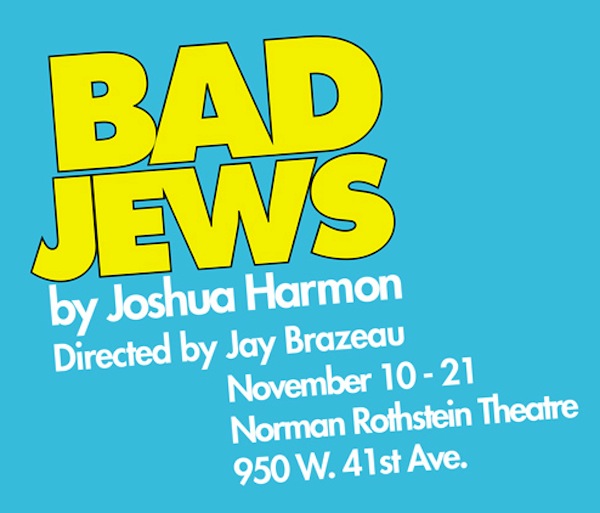
Imagine finding a play so funny and thought-provoking that you just had to mount a production of it in your hometown – and you actually had the talent and wherewithal to do it.

Famous Artists Limited’s Bill Allman saw Joshua Harmon’s Bad Jews in London. He’s bringing it to Rothstein Theatre Nov. 10-21, directed by Jay Brazeau and starring two other members of the Jewish community, Amitai Marmorstein and Goldie Hoffman. Rounding out the cast are Alex Rose and Kayla Dunbar.

photo - Bill Allman
Bill Allman (photo from Famous Artists Limited)

“It’s really difficult to pick one or two moments of hilarity or emotion from a play that kept me laughing and thinking for its entire duration,” said Allman, “but I loved the raucous interaction between [cousins] Liam and Daphna and, in particular, watching Melody (that’s Liam’s shiksa girlfriend) react to them. The loudness and the verbal vitriol looks completely insane to her and yet the three cousins are sort of saying, ‘What? This is how people talk!’

“As for deep thought, much of the script gives the audience a chance to think about where faith and culture intersect and how these values affect daily life and interaction with others. The great thing about the play is that the characters are drawn in such a way as to illustrate a wide range of human experience and it doesn’t matter where you fall on the spectrum – there will be something in one or more of the characters that makes you say, ‘I’m like that.’ And you may laugh or you may wince but, inevitably, you’ll laugh because 10 seconds later, it’s somebody else’s turn to wince!”

Secular Liam, his “Jew-ish” brother Jonah and their staunch Zionist and Orthodox cousin Daphna fight over the right to their grandfather’s chai necklace after he dies; he had managed to get it (and himself) through the Holocaust, and they each attribute a different importance and symbolism to it. Witnessing the mayhem, as Allman noted, is Liam’s non-Jewish girlfriend, Melody.

“Which one of them is the ‘best’ Jew?” reads the promotional material. “Is it the religious and cultural zealot Daphna, who changed her name from Diana? What about her privileged cousin Liam, who missed Poppy’s funeral to go skiing with his non-Jewish girlfriend Melody? Or perhaps Liam’s brother, Jonah, the quiet one who would prefer not to get involved in the fight?”

photo - Amitai Marmorstein
Amitai Marmorstein (photo from Famous Artists Limited)

Marmorstein, who plays Jonah, was emailed by Brazeau with a request to read the script. “I’ve known Jay for awhile and have always been a very big fan of his,” Marmorstein told the Independent. “He arranged for Goldie and I to come in and read and talk about the play. He kept saying it wasn’t an audition even though it sort of was. I think he just didn’t want us to get nervous or anything. But the ‘non-audition’ went well, I guess, and Goldie and I were both offered roles.”

Director, writer, actor and producer Ben Ratner recommended Hoffman (who plays Daphna) to Brazeau. “Ben runs and teaches at Haven Studio, and I’ve trained with him a lot, working on many intense plays and scripts in multiple genres. So, it’s really thanks to Ben that I got this part,” she said, “both because of his recommendation and also thanks to his training.”

Hoffman was asked by Brazeau and Allman to read with Marmorstein, and she also recalled being told, “‘Don’t think of this as an audition, Goldie …’ they said and, as I jokingly thought to myself, the unsaid continuation of that line was, ‘… but this read will likely affect whether or not you get the part.’

Fortunately, I got the part, and I’m thrilled and truly honored to be playing such a fun role and being part of this ensemble.”

Characters that are a “type” can come off as superficial. When asked in what ways they infuse their characters with humanity and depth, Marmorstein said, “The best way to never be a stereotype is to work with great writing. Joshua Harmon has written such honest, original, devastating characters that our job becomes much, much easier. I think creating real, non-stereotypical characters is precisely what the art of acting is, so we just try to be creative and honest and hope people connect to it.”

photo - Goldie Hoffman
Goldie Hoffman (photo from Famous Artists Limited)

Hoffman went into more detail. “I think it’s important not to judge your character as good or bad, right or wrong,” she said. “Humans are complex individuals and it’s important to remember that when you portray any character. In fact, generally in real life, we don’t set out to be wrong or behave badly. Most of us try to go through life making good choices, and when we make bad ones or hurt people, we often don’t intend to or don’t even realize the impact of our words and actions. When playing a character, I try to portray their point of view, as best as I can understand it. In fact, after first reading the play, I was actually offended when first seeing Daphna described as a ‘zealot’ in online play reviews and synopses, because I see that term as quite negative, and I didn’t see (or want to see) her that way.

“I feel I really understand where Daphna is coming from, even if I don’t share all her views. In fact, I’d go as far as to say, this is a character that is closest to me of all the roles I’ve ever portrayed – to the point where it’s scary and even embarrassing. As for playing a certain ‘type,’ it’s true there is a certain stereotype and similarity many Jewish girls and women share and, yes, a lot of it does apply to me: brunette, outspoken, loud, animated and, yes, also stubborn and annoying – but also spunky, fun, caring, intelligent and funny (and clearly modest). Hey, let’s face it, get a bunch of Jewish girls in the room, and I challenge you to tell me many don’t look and sound like sisters. Daphna shares these qualities, too, but, at the same time, we’re of course all individuals, and so our views and outlooks on life can be extremely different.

“As far as her being real,” Hoffman continued, “to me, Daphna already is a real person, and I can completely see and hear her, so I only hope I can translate that successfully to the audience. Aside from the parts of her that I relate to, I even know several ‘Daphnas,’ especially being raised Jewish in both N.Y. and Montreal and now being in L.A. a lot, all big ‘Jew-towns.’ There is a unique experience that Jewish girls and women have, which I relate to. For example, facing certain sexist traditions and customs (especially if raised Orthodox), family dynamics, rivalries, pressures and high expectations and, of course, last but not least, we are aware of our brethren’s love of ‘shiksappeal,’ which my character’s cousin Liam has. Though, on that subject, having dated several non-Jewish guys, I say, ‘It’s all good, boys, ’cause it goes both ways.’”

Speaking of which, where would Hoffman put herself on the spectrum of the “bad Jews” depicted in the play?

“In many ways, I think the play is actually poking fun at that very notion of being a ‘bad Jew,’ as there’s really no such thing – or, if there is, well then, we’re all ‘bad Jews’ in one way or another. There is no right way to be Jewish, either religiously or culturally, and, as Jews, we grapple with what that identity means to us and how much we want it to affect our lives and sense of self,” she said.

That being said, Hoffman compared herself to aspects of both Daphna and Liam. “My experience and views about my ‘Jewishness’ continue to change and evolve, so I’ve been all over the map. For instance, as a kid, I was raised Chassidic, and then, as a teen, I became non-observant, but was still a believer. Then, I identified as ‘spiritually Jewish.’ Now, I no longer believe in Judaism, and I’m a secular humanist, but culturally or ethnically, I am definitely Jewish (whether I like it or not). I think this is something a lot of non-Jews have trouble understanding, because the term Jew can apply to both the religion Judaism, but also the Jewish culture, ethnicity, nation and community, as we are such an old people that we predate these modern terms.

“As for Israel, as you know, that’s such a sensitive and ambivalent issue for the Jewish community and something we all have different views on. For my character Daphna, Israel is extremely important and she plans to make her life there. I used to share her fervent Zionism as a teen, and even considered going to Israel as well, either to a kibbutz or to do one of their volunteer programs with Magen David Adom (their national emergency medical disaster, ambulance and blood-bank services as well as national aid society).

“I am still a supporter of Israel, though not without my criticism, just like with other countries; but, unlike Daphna, I don’t support Israel from a religious standpoint and don’t believe in the existence of holy lands. I can speak, read and write Hebrew (also some Arabic), and tend to really like and get along with Israelis and have a few friends and acquaintances in Tel Aviv who are in the arts scene. I think Israeli Jews are such a unique, interesting and strong people, and they’re very different from North American Jews. If I’m fully honest, I think they’re our cooler cousins, because they’re people who just ‘happen’ to be Jewish, versus we here who are taught our Jewish identity and worry about how it squares up with our national one, and who are, by and large, much more sheltered and privileged than they are. I also think Israelis are better looking than we are, but I know that’s up for debate. But c’mon, all those people mixing from all those different countries and backgrounds? You can’t compete with that!”

Turning more serious, Hoffman said she struggles “with the paradoxical dilemma of how to continue the survival of the Jewish people and Israel, while still supporting humanism, secularism, democracy and the belief that mixing is a great thing for humanity. I think this is a major theme the play deals with and questions, and something most Jews can relate to, as well as many non-Jews with strong cultural and ethnic identities and communities.”

Allman is an example of the latter. “I was baptized Presbyterian, but fall very squarely into the religiously lapsed category – I have 50 years of Christmas trees that far outnumber my appearances in an actual church,” he admitted. “The themes in Bad Jews are universal – they’re struggles with personal identity, with philosophy and with both the intimacy and disconnect that everyone struggles with in regards to the religion and culture of their ancestors.”

He added, “[T]here is a very intellectual aspect to Judaism that I find extremely compelling – and that aspect doesn’t exist in a vacuum, it’s tied to practical living. It is certainly behind our initiative to have Rabbi [Jonathan] Infeld come in on Nov. 19 for a talkback with the audience and cast after the show. We’re going to go after the issues behind the story! I love the deeply thoughtful traditions that can give birth to a work like Bad Jews – a work like this comes from inner turmoil and passion. Now that’s living!”

For tickets, click here or visit famousartists.ca. For the full interview with Goldie Hoffman, click here.


An interview with Goldie Hoffman

Goldie Hoffman is set to play the character of Daphna in Bad Jews, a play by Joshua Harmon. It will be in Vancouver at Rothstein Theatre from Nov. 10-21, directed by Jay Brazeau and produced by Famous Artists Limited. For the Jewish Independent article on the play, which includes portions of the interview below, click here. For tickets, click here.

JI: How hard was it for you to put yourself into your “bad” shoes, or in what ways are you similar and different with respect to the Jewish spectrum than your character?

GH: I’m wearing my “bad Jew” shoes as we speak! In many ways, I think the play is actually poking fun at that very notion of being a “bad Jew,” as there’s really no such thing – or, if there is, well then, we’re all “bad Jews” in one way or another. There is no right way to be Jewish, either religiously or culturally and, as Jews, we grapple with what that identity means to us and how much we want it to affect our lives and sense of self.

photo - Goldie Hoffman
Goldie Hoffman (photo from Famous Artists Limited)

That reminds me of the Jewish saying, “two Jews, three opinions,” and that’s something that I think aptly describes Jews, but is something we should be proud of – that we accept and even thrive on debate, discussion, questions and, of course, the fact that we can openly poke fun at the religion and culture. There’s definitely something very Fiddler on the Roof-esque about this play and the characters – each character deals with their Jewish identity, changing times, and the weight of historical and cultural legacy and community, in their own way.

With respect to my character, in some ways I’m both my character Daphna and her cousin Liam, or at least have been aspects of both of them at one time or another. My experience and views about my “Jewishness” continue to change and evolve, so I’ve been all over the map. For instance, as a kid, I was raised Chassidic, and then as a teen I became non-observant, but was still a believer. Then I identified as “spiritually Jewish.” Now I no longer believe in Judaism, and I’m a secular humanist, but culturally or ethnically, I am definitely Jewish (whether I like it or not). I think this is something a lot of non-Jews have trouble understanding, because the term Jew can apply to both the religion Judaism, but also the Jewish culture, ethnicity, nation, and community, as we are such an old people that we predate these modern terms.

As for Israel, as you know, that’s such a sensitive and ambivalent issue for the Jewish community and something we all have different views on. For my character Daphna, Israel is extremely important and she plans to make her life there. I used to share her fervent Zionism as a teen, and even considered going to Israel as well, either to a kibbutz or to do one of their volunteer programs with Magon David Adom (their national emergency medical disaster, ambulance, and blood bank services as well as national aid society).

I am still a supporter of Israel, though not without my criticism, just like with other countries; but unlike Daphna, I don’t support Israel from a religious standpoint and don’t believe in the existence of holy lands. I can speak, read and write Hebrew (also some Arabic), and tend to really like and get along with Israelis and have a few friends and acquaintances in Tel Aviv who are in the arts scene. I think Israeli Jews are such a unique, interesting and strong people, and they’re very different from North American Jews. If I’m fully honest, I think they’re our cooler cousins, because they’re people who just “happen to be Jewish,” versus we here who are taught our Jewish identity and worry about how it squares up with our national one, and who are by and large much more sheltered and privileged than they are. I also think Israelis are better looking than we are, but I know that’s up for debate. But c’mon, all those people mixing from all those different countries and backgrounds? – you can’t compete with that!

I realize I’m sounding a lot like Daphna now in my praise of Israelis, but again, it’s from a different angle. As an artist, I’m specifically very impressed with Israel’s amazing and thriving arts, culture and film scene, especially given all they deal with on the international and domestic front. As I said, I’m not without criticism, but I do feel Israel is unfairly castigated and vilified in the world and held to unfair double standards. I’m unfortunately disillusioned about the possibility of peace there, and can’t help but think of Israel and that entire region with a tinge of sadness. Still, I’m definitely overdue for a visit and would love to perform live there or work on an Israeli film.

However, all that said, I struggle with the paradoxical dilemma of how to continue the survival of the Jewish people and Israel, while still supporting humanism, secularism, democracy, and the belief that mixing is a great thing for humanity. I think this is a major theme the play deals with and questions, and something most Jews can relate to, as well as many non-Jews with strong cultural and ethnic identities and communities.

JI: Characters that are a “type” can come off as superficial. In what ways have you tried to infuse your character with reality/humanity to prevent them from becoming stereotypes?

GH: I think it’s important not to judge your character as good or bad/ right or wrong. Humans are complex individuals and it’s important to remember that when you portray any character. In fact, generally in real life, we don’t set out to be wrong or behave badly. Most of us try to go through life making good choices, and when we make bad ones or hurt people, we often don’t intend to or don’t even realize the impact of our words and actions. When playing a character, I try to portray their point of view, as best as I can understand it. In fact, after first reading the play, I was actually offended when first seeing Daphna described as a “zealot” in online play reviews and synopses, because I see that term as quite negative, and I didn’t see (or want to see) her that way.

I feel I really understand where Daphna is coming from, even if I don’t share all her views. In fact, I’d go as far as to say, this is a character that is closest to me of all the roles I’ve ever portrayed – to the point where it’s scary and even embarrassing. As for playing a certain “type,” it’s true there is a certain stereotype and similarity many Jewish girls and women share, and yes, a lot of it does apply to me: brunette, outspoken, loud, animated, and yes, also stubborn and annoying – but also spunky, fun, caring, intelligent and funny (and clearly modest). Hey, let’s face it, get a bunch of Jewish girls in the room, and I challenge you to tell me many don’t look and sound like sisters. Daphna shares these qualities, too, but at the same time, we’re of course all individuals, and so our views and outlooks on life can be extremely different.

As far as her being real, to me Daphna already is a real person, and I can completely see and hear her, so I only hope I can translate that successfully to the audience. Aside from the parts of her that I relate to, I even know several “Daphnas,” especially being raised Jewish in both N.Y. and Montreal and now being in L.A. a lot – all big “Jew-towns.” There is a unique experience that Jewish girls and women have, which I relate to. For example, facing certain sexist traditions and customs (especially if raised Orthodox), family dynamics, rivalries, pressures and high expectations, and, of course, last but not least, we are aware of our brethren’s love of “shiksappeal,” which my character’s cousin Liam has. Though on that subject, having dated several non-Jewish guys, I say, “It’s all good, boys, ’cause it goes both ways.”

JI: How did you come to hear about Bad Jews and audition for it?

GH: Our director, Jay Brazeau, contacted me after speaking with director, writer, actor, producer Ben Ratner, who recommended me to him. Ben runs and teaches at Haven Studio, and I’ve trained with him a lot, working on many intense plays and scripts in multiple genres. So, it’s really thanks to Ben that I got this part, both because of his recommendation and also thanks to his training. I was then asked to read with Amitai (who plays Jonah) in front of Jay and our producer Bill Allman in an informal non-audition audition. “Don’t think of this as an audition, Goldie …” they said, and as I jokingly thought to myself, the unsaid continuation of that line was, “… but this read will likely affect whether or not you get the part.” Fortunately, I got the part, and I’m thrilled and truly honored to be playing such a fun role and being part of this ensemble.

JI: Are you going to get a perm to play Daphna?

GH: Oh no, you’ve just outed me as a straight-haired chick! I’m honestly still debating if I should get a perm or not. I’ve had friends with the real “Jew-fro,” and used to be jealous of them, even with their complicated product-regimen they had to wrestle with, and, of course they were jealous of my straight locks. We want what we don’t have, right? I may curl my hair each night, and I’ve been experimenting, burning my fingers, while I curl my hair trying to get it just right so it looks realistic and doesn’t have that “fake curls look.” I know some actors have used extensions for this part, but I want to be able to use my hair in the scene. So, as I write this now, I’m leaning towards a perm, but we’ll see.

JI: As I don’t think we’ve had the pleasure of interviewing before, can you share a bit about your background? How you’re a dual citizen, and split your time between Vancouver and LA? In what other shows Vancouverites might have seen you recently? Whatever else you might like to add.

GH: Ah, now to sum up myself and my background quickly. As you can tell, I’ve clearly mastered the art of being concise.

Long story short, I don’t have the typical North American Jewish experience, because I was raised in more than one. I was born in Brooklyn, N.Y., into a Chassidic family. My mother was from Montreal, my father from San Diego, and their youthful act of rebellion was to leave their secular Jewish lives, and join an ultra-Orthodox Chassidic movement in N.Y., much to the dismay of their families. Talk about being “bad Jews” and trying to define what that means.

They had us 10 kids quickly, one after the other, and I spent my childhood growing up extremely religious with strict kosher rules, dress codes, and no television, secular music or books (though we were sometimes “bad Chassidic Jews” and cheated with books, and also went as a family to see some movies in Manhattan) – a time I now refer to as the fun “cult days.”

Their experiment with ultra-Orthodox Judaism ultimately didn’t work out for us, and my parents divorced. My mother went back to Montreal to be with her family, and we kids along with her. My father is still Chassidic actually, but I’d say he has his own version of it, and he lives in Vegas now. He is quite a character, and that’s putting it mildly, as is my mother, even more so than in the “typical Jewish parents” way.

In Montreal, we re-integrated into “normal” North American Jewish lifestyles, starting out as Modern Orthodox, but then with varying and changing levels of observance, and each of us being allowed to do our own thing. When I graduated, I was actually going to study law, like all good, smart Jewish girls, but changed my mind at the last second about having a stable life in order to pursue performance and the arts instead.

I got accepted into Studio 58’s professional theatre acting program, so that’s what brought me out here. It was pretty scary because I knew nothing about Vancouver, I knew no one here, and had no money to scout out the city beforehand. After studying, I decided to stay here and started acting and doing comedy. Having been here for several years and because I’m a dual American-Canadian citizen, I recently decided to make the jump to L.A., too, since there is more opportunity there – and, of course, because you can’t beat all that sun and ocean. I love being on the West Coast, though I poke fun at it often, because in many ways I’ll always be a bit of a fish out of water here as an ex-East Coaster. My aim is to try to juggle both cities, L.A. and Vancouver, as much as possible taking advantage of the acting and comedy opportunities both cities have to offer.

As far as other performances Vancouverites may have seen me in, I played Connie in Raving Theatre’s production of My Big Gay Italian Wedding, which was put on at the Cultch. I also played Natalie, in the local independent feature dark comedy, Thirty One Scenes About Nothing, which won best picture at the Oregon Independent Film Festival (OIFF) in Portland. I also perform lots of live stand-up and sketch around town. Last year, I ran a weekly comedy variety show, called The Comedy Cabaret, along with co-host Ruven Klausner, in which we performed various comedy characters and acts. We formed a comedic partnership, previously called Schtuptown (a nod towards our Jewish heritage), now called The Goldie & Ruven Show, in which we perform live and create comedy shorts which are published online.

You can follow me online at goldiehoffman.com, imdb.goldiehoffman.com, @theMizzGoldie or facebook.com/GoldieHoffman.

A sentimental journey

Stephen Aberle as Dan and Annabel Kershaw as Sue reflect on their life together in Snapshots: A Musical Scrapbook, at Presentation House Theatre Oct. 28-Nov. 8. (photo by Megan Verhey, Megan Verhey Photography)

Theatre often allows us, the audience, a safe place in which to experience feelings that we are more guarded about showing in daily life. It can offer a way in which to reflect on our own lives and actions without the vulnerability that such introspection usually entails in “real life.” We can learn from what we witness on stage, whether a comedy, a drama or something in between. At the least, we can escape from our own cares for a time, immersing ourselves in someone else’s joys and pains. A perfect example? Snapshots: A Musical Scrapbook.

So popular was last year’s Canadian première of the show in Vancouver at Studio 1398, that WRS Productions – Ron and Wendy Stuart – is bringing it back for 12-day run at North Vancouver’s Presentation House Theatre, Oct. 28-Nov. 8.

“The response was amazing,” Wendy Bross Stuart told the Independent about last year’s production. “People laughed. People wept. Tissues were in short supply. The actors were very moved by the content and the music of Snapshots. The last five shows were completely sold out; people were turned away at the door. It was at that point that Ron and I decided we would seek the opportunity to remount the show.”

In Snapshots, Sue is set to leave her husband Dan after 30 years of marriage. While she is going through the attic, Dan comes home. A box of photographs (snapshots) falls open, leading the couple to reflect on their life together.

Conceived by Michael Scheman and David Stern, composer/lyricist Stephen Schwartz adapted music from his stage shows, feature films and original CDs to mesh with the book by Stern, which takes the audience back to Dan and Sue’s earlier days.

In the WRS Productions’ show, Dan and Sue are portrayed by Stephen Aberle and Annabel Kershaw; Daniel and Susan, by Steve Maddock and Jocelyn Gauthier; Danny and Susie, by Daniel Johnston and Georgia Swinton.

About the ways in which he personally related – or not – to Dan throughout the character’s life, Aberle said, “Hmm, well, younger Danny/Daniel has a winning way with women. Many, many women. I was definitely not like that growing up; I was shy and repressed and a bit of a goob, I guess.

“On the other hand, when Dan truly falls in love, he falls hard and he stays fallen. I identify with that. While he has this playboy past, he’s careful about where he really gives his heart, and he finds it hard to put the truth of his love into words. I think that’s the central struggle in the play for him. Casual physical intimacy comes easily to him (unlike me!), but he’s scared by commitment and emotional intimacy. He’s experienced deep hurt in the past, and he fears opening up too far because he doesn’t want to get hurt like that again. I get that.

“Details from the past – talismans, little triggers for powerful memories – really get to him. I guess they get to all of us one way or another, so it’s not necessarily a specific character thing, but it resonates for me.”

Like Aberle, most of the actors are reprising their roles, but there have been changes, and not only in casting.

“Last year’s Snapshots was in a ‘black box’ theatre,” explained Stuart. “This gave us the opportunity to configure the show ‘in the round.’ The set design was done by Jessica Oostergo.

“This year, we are working in partnership with Presentation House Theatre in North Vancouver. We are in a traditional theatre space. This meant the show needed to be completely reconfigured. With the experienced hand of Pam Johnson, we have a brilliant set – full of secret entrances and exits. This design is in conjunction with our new director and choreographer, one of Canada’s most sought-after and experienced, Max Reimer, former artistic director at the Vancouver Playhouse. The show will look very different.

“In addition, we have two new cast members: Daniel is played by Steve Maddock and Susie is played by Georgia Swinton. The rehearsals are very exciting; we have a chance, now, to add new interpretation and shape to the music. The sound of the ensemble is thrilling!”

Aberle spoke about the ensemble and what it feels like to have different actors “all playing aspects of the same role.”

“The other performers playing Danny and Daniel – my character’s younger selves – give me ideas about Dan that I wouldn’t necessarily have come up with on my own,” he explained. “There’s a lot of give and take. We have an opportunity to develop a shared physical vocabulary, for example: postural or gestural or vocal details that stay with the character as he grows older. That’s a lot of fun to explore.

“We’re all, all six of us – along with the band and the creative team – sharing the task of bringing this decades-long, deep relationship to life. One intriguing consequence is that I get to fall in love on stage with not just one woman but three. I have a lot of interplay with all three of Sue, Susan and Susie. When I’m watching them, the younger selves of the love of my life, remembering how we met as kids and how much we meant and gave to each other, it’s profoundly moving.

“It’s interesting,” he continued, “to relate on stage to my character’s younger selves. We don’t get a lot of direct connection but there are important moments, of both frustration and understanding. In real life, we don’t get to say to our younger self, ‘You idiot! Not that way, this way!’ It’s refreshing. It’s also illuminating to see how patterns set in youth change, or don’t change, in later life.”

And what is it about Schwartz’s music that touches people so much?

“I will speak more specifically about the music in Snapshots,” said Stuart, who also wears the music director and pianist hats in this production. “Here, we have examples of Stephen Schwartz’s music from as early as 1971 (Godspell) and as recently as Wicked (2003)…. Schwartz chose the songs to move the new story (book by David Stern) forward in the most compelling way. About 85% of the story is told in music.

“This plot line allows two characters to each communicate with themselves at different stages of their lives. Stated differently, we have a story that takes place 1) in the present, 2) in the past and 3) in one’s interior life. The music is not simply one song after another, it is multi-layered, with (formerly unrelated) songs performed simultaneously in gorgeous counterpoint with one another.

“I truly feel that the music and lyrics (often changed by Schwartz himself to fit the arc of the new story) can simply be enjoyed for their depth of meaning, their melodic interest and their beautiful harmonies. However, for those who know Stephen Schwartz’s music, the complexity and brilliance of the multi-layered nature of this work are simply breathtaking.”

Stuart added, “Yesterday at rehearsal, we had many moments when we simply had to stop. The actors were so ferklempt (choked up with emotion), they were unable to continue. I feel the same way.”

For tickets to Snapshots, visit phtheatre.org, call 604-990-3474 or drop by Presentation House Theatre, at 333 Chesterfield Ave.

Help save us from zombies

Alien Contagion: Rise of the Zombie Syndrome tasks audiences with finding a downed UFO that has crashed on earth. Virtual Stage’s interactive adventure runs to Nov. 1. (photo from Virtual Stage)

For anyone who has dreamed of saving the world, now’s your chance. All you have to do is take part in Virtual Stage’s Alien Contagion: Rise of the Zombie Syndrome, which runs until Nov. 1.

Several shows have already sold out, with people keen to take on their mission. “This year, audiences are tasked to respond to a highly confidential NASA report about a downed unidentified flying object that has crashed on earth. The exact location is unknown,” reads the promotional material. “To add to the mystery, the alien pilot is reportedly injured, has escaped and is hiding in Vancouver. Furthermore, every NASA official sent to locate the UFO has returned in a zombie-like state … brave and adventurous audience members must find the downed spacecraft, quell the nearby zombie uprising and, ultimately, save the human race from the brink of extinction.”

This is the fourth annual interactive, smartphone-enabled theatre experience produced for the Halloween season by Virtual Stage.

photo - Zombie Syndrome series creator Andy Thompson
Zombie Syndrome series creator Andy Thompson. (photo by Rob Gilbert)

“The idea originated four or five years ago after I went to the West End in London, England, to see a bunch of theatre,” creator Andy Thompson told the Independent. “I saw all sorts of plays in many different styles of venues. I went to very fancy theatres. I went to small, edgy, Fringe-type theatres. I was even lucky to witness rare performances including Kevin Spacey playing Richard III, as well as the ‘real-life’ theatrical event of Rupert Murdoch getting pied in the face in the British House of Commons.

“The most engaged I felt as an audience member, however, was during an interactive play called The Accomplice. It took place on the streets of London and involved the audience being endowed as key figures in an adventure to recover stolen loot. It was so much fun! The piece was basically a crime drama, but I wondered how a horror-genre show could use a similar format. Add to the mix my interest in technology and smartphones and I quickly developed an idea for a smartphone-enabled, site-specific, roving, zombie-themed theatre adventure with audience members tasked with saving the world.”

Thompson said the series, which premièred in 2012, wasn’t meant be an annual event. “It was a huge creative risk ‘one-off’ event and I thought it could easily flop,” he said. “Needless to say, it came as quite a pleasant surprise when the show was so well received, selling out almost shortly after we opened. People just loved it. After I realized the popular appeal, I looked at how it could be designed as an annual series that is completely new each year.”

This is not Thompson’s first foray into science fiction. The Jewish community member’s credits include – but are in no way limited to – the three previous Zombie Syndromes, SPANK!, 1984 (an adaptation of George Orwell’s novel) and the sex-comedy musical Broken Sex Doll, which featured original music by fellow Jewish community member Anton Lipovetsky, as well as episodes of TV’s Fringe.

“It is so much fun to imagine the seemingly endless possibilities in the universe,” said Thompson about his interest in science fiction. “I often contemplate our reality on planet earth, which often feels like a far-fetched science fiction story idea. Consider: we are on a small planet, whipping through space, revolving around a star. Our star is merely one of billions of stars in the Milky Way galaxy. And, if that’s not all, there are billions of galaxies in the universe. So, by my rough math, that means there are at least 1,000,000,000,000,000,000 stars in the universe. Earth and our existence seem extremely small when put into this perspective. And that’s just when we look at ‘third-dimensional’ reality. I am convinced that there are tangible, intelligent realities on other vibrational frequencies that we are unaware of. Like the sound of a dog whistle, humans are just not currently attuned to be aware of them. Without a doubt, what Shakespeare said in Hamlet is certainly true: ‘There are more things in heaven and earth, Horatio, than are dreamt of in your philosophy.’

“Life is pretty mind-blowing when you really think about it. Science fiction allows us to imagine the possibilities. And, half the time, because our existence is so vast, we get to explore far-fetched ideas that cannot be definitively refuted. To me, it’s a great deal of fun.”

And a great deal of work. Alien Contagion: Rise of the Zombie Syndrome features “about 45 performers this year, as well as about a dozen crew and designers,” said Thompson. “The logistics are mind-numbing, but we have a great team and a lot of experience under our belts. We generally start planning the show a year in advance. Things progressively kick into higher gears over the spring and summer. The storylines are often collaborative. This year, my stepson Finn [Ghosh-Leudke] co-authored the story with Tyler Clarke and myself. I then wrote the script based on that story.”

The show is fully wheelchair accessible. However, it is rated PG-13 because of the subject matter, and children under 13 must be accompanied by a parent or guardian. For tickets and more information, visit thevirtualstage.org/tickets.

Adaptation beneficial

Camille Legg as Romeo, left, and Adelleh Furseth as Juliet share an intimate moment in Studio 58’s Romeo and Juliet. (photo by David Cooper)

Shakespeare’s Romeo and Juliet is such a well-known play, done so many times on stage and on screen, it’s hard to imagine an original interpretation, but Studio 58 of Langara College manages to shine new light on this ageless tale.

This production marks the beginning of the studio’s 50th season and director Anita Rochon has incorporated that into her vision of the play, setting it in 1965, the year Studio 58 was born. Music from the 1960s – the catchy tunes of Velvet Underground, Rolling Stones, Turtles and others – permeates the show. Older audience members will recognize their youth in these songs, as well as in the clothing, but these are only frills. The core of the play remains unaltered – the immortal and tragic love story between Romeo and Juliet.

However, there is one profound adjustment to the classical version: Romeo is a girl. Accordingly, the pronouns are switched in the text, and a son becomes a daughter. Other than that, the text is more or less authentic, albeit abridged, for the student performance, and the young actors handle the 500-year-old verses with professional panache.

The change benefits the show. For most people in 21st-century North America, family feuds – to the death, anyway – are the stuff of legend, while parental resistance to their kids’ gay or lesbian inclinations is still all too real. Some experience it firsthand or have friends who did; others are on the parents’ side of the equation or know someone who was. But everyone in the audience could relate to this aspect of Romeo and Juliet’s forbidden love.

Everyone could also feel the wonder, the breathtaking discovery of their first encounter. Highlighted by the expressive and inventive choreography of Jewish community member Tara Cheyenne Friedenberg, the first meeting of the lovers felt almost like a ballet, a lyrical and beautiful duet, with the corps providing a counterpoint. The visual echoes from such classical ballets as Giselle or Swan Lake were unmistakable.

On the other hand, the fight scenes by David Bloom, who also happens to be a Jewish community member, were ferocious, with some really scary moments, especially when Mercutio swings a broken bottle at Tybalt. Both young actors, Conor Stinson-O’Gorman (Mercutio) and Kamyar Pazandeh (Tybalt), infuse their stage duel with energy, but all I could think about was, What if someone missteps and hurts his friend? Fortunately, no accidents occurred, and both combatants expired safely.

Of course, the two female stars of the show deserve mention – both acted brilliantly.

Camille Legg, who played Romeo, excelled in her part. Her Romeo was young and naive, a girl on the brink of adulthood, and her wide-eyed innocence made her character’s belief in the power of love plausible. Romeo’s love is radiant and boundless; her grief, all-encompassing.

Adelleh Furseth as Juliet, while strong overall, lacked enough of the child-like nature that I attribute to the character. She portrayed a more mature, more sexy Juliet, more a woman than a girl. At times, she struck me as a character actor or comedian, funny rather than naively exuberant.

The humming chorus during the play’s last scene, the young lovers’ double suicide, was inspired and poignant.

In the director’s notes, Rochon writes: “… there are real people all over the real world who are falling in love as you read this, in spite of all kinds of opposition arising because of their gender, nationality, political affiliation or otherwise. Familiar stories, but each with its own beating heart.”

Romeo and Juliet runs at Studio 58 until Oct. 18. For tickets, visit langara.ca/studio-58.

Olga Livshin is a Vancouver freelance writer. She can be reached at olgagodim@gmail.com.

Healing after trauma

A screenshot of Dr. Gabor Maté and Rita Bozi in The Damage is Done, from video by Patrick McLaughlin.

The Cultch often presents non-traditional shows that confront uncomfortable questions. This year, one such show, The Damage is Done by Rita Bozi, brings to the stage an examination of trauma and its psychological impact on individuals and families.

The Damage is Done combines theatre, dialogue, essay, video, music and dance. It features two performers: Bozi, and physician and author Dr. Gabor Maté, who has written on various psychological issues, including addiction. Bozi plays several characters in the show, while Maté plays himself.

photo - Gabor Maté plays himself in Rita Bozi’s The Damage is Done
Gabor Maté plays himself in Rita Bozi’s The Damage is Done. (photo by Farah Nosh)

“I comment on Rita’s actions on stage, like a Greek chorus,” Maté said in an interview with the Independent. “We are trying to find some meaning to the trauma endured in the past, the traumas our families went through, and to learn from it. If we don’t process trauma, it will control our lives. The after-effects of trauma influence how we see ourselves: either as victims, or it makes us overcompensate, try to appear more powerful than we are. Sometimes, people try to get away from the pain with drugs – that’s where addiction comes from.”

Maté explained that deep trauma is often transmitted through generations. It affects social units and families as well as individuals. “The children of Holocaust survivors often have elevated stress hormone levels. When a young mother is depressed, her baby suffers, even though everyone loves the baby and nobody wants it hurt…. The play is an exploration of how trauma works and how we can find liberation from it. Before we heal, we must find the problem, acknowledge it.”

He accepted this project despite a busy schedule and multiple speaking engagements because it touches on issues about which he has been advocating for years. “Medical schools don’t teach students about trauma and its psychological impact. When the young doctors start working, they feel the lack of that knowledge. They want a guidance of how to connect physical and emotional healing, and not many people talk about the subject.”

So, many professionals turn to Maté. His seminars are in such demand across North America that sometimes he spends days on the road. “In the last week, I had eight speaking engagements,” he said. In various American and Canadian cities, addiction workers, trauma specialists, therapists and educators, as well as family members and others, comprise Maté’s audience.

“I’m trying to answer the question, ‘Why?,’ the same question Rita asks in her play, so I provide the framework for her story. I think it’s very important. So many people suffer from trauma, physical and psychological. It’s impossible to separate the two. I’m not going to launch a second career as an actor, of course,” he added with a smile, “but it was an interesting challenge, something different. Besides, I like Rita.”

Bozi also spoke with the Independent. She explained that the show was years in development. Its most recent version premièred in Yukon last year. “This show is ultimately about compassions for ourselves and others,” she said.

Maté’s involvement in the project was paramount to her. “I attended several workshops with Gabor and I read his books. He once said, ‘We need to be asking not why the addiction but why the pain?’ As a therapist and a child of immigrant Hungarian parents who lived through the war, the Soviet occupation and the revolution, I have long been concerned with inherited historical trauma and its effect on families and offspring.”

She continued, “I wanted Gabor a part of it. Why mention him if I could have him? I had already been making a connection with Gabor through email over our shared Hungarian backgrounds…. He felt like kin. We were speaking the same language (apart from Hungarian) and we both felt the power of the mind-body connection affecting our lives.”

It took Bozi 12 years from the seed of the idea to the show itself. “I play out my family drama, and Gabor plays the poetic counterpoint. He helps my character come back to ‘self.’ He helps her understand her own experience of the family situation, her part in it and how to begin to transform the inherited pain. He brings his razor-sharp insights to the show and his ability to be concise about what is happening. He sees what is hidden, cuts to the chase and helps guide one to the pieces of self that were lost when trauma occurred.”

According to Bozi and Maté, healing comes from the ability to look at traumatic events from infancy and early childhood with humor and compassion – even though the damage is done, we can defuse its impact.

The Damage is Done will be performed at the Cultch from Oct. 20-24. Before that, Bozi and Maté are taking the show to Banff, where both their evening shows are already sold out. For more information about the local production, visit thecultch.com/events/the-damage-is-done-a-true-story.

Olga Livshin is a Vancouver freelance writer. She can be reached at olgagodim@gmail.com.

A dinner to remember

Kyra Zagorsky as Emily and Patrick Sabongui as Amir in Arts Club’s Disgraced. (photo by David Cooper)

Politics and religion generally are considered taboo topics for discussion. But, sometimes, they can’t be avoided. This is the case in Ayad Akhtar’s Disgraced, now playing at the Stanley.

Akhtar puts four Manhattan 30-somethings – secular Muslim corporate lawyer Amir, his upwardly mobile artist Caucasian wife Emily, his African American female colleague Jory and her Jewish art gallery curator husband Isaac – together for what is intended as a celebratory meal with cocktails, fennel and anchovy salad, and designer dessert.

The progression to the fateful dinner starts rather innocently. The curtain rises on a very well- but half-dressed Amir (Patrick Sabongui) posing for Emily (Kyra Zagorsky, Sabongui’s real-life spouse) as she paints his portrait based on her inspirations from Middle Eastern art. The cozy domestic scene is interrupted by Amir’s nephew, Abe (Conor Wylie), previously known as Hussein Malik – he ditched his name to make life easier.

Abe entreats his uncle to assist a local imam who has been jailed, accused of helping finance Hamas. Amir, a self-declared apostate and proud of his apparent assimilation into Western society, wants no part of it, avowing his disdain for Islam and its culture. However, Emily and Abe pressure him into attending the court hearing, where his presence is noted by the media. Amir’s reported connection to an accused terrorist does not bode well for his partnership track at his firm of Leibowitz, Bernstein and Harris. Strike one.

As well, his law partners discover that he has misrepresented himself by saying that he was born in India instead of Pakistan and by giving his name as Kapoor instead of Abdullah. Strike two.

photo - Marci T. House as Jory and Robert Moloney as Isaac in Disgraced
Marci T. House as Jory and Robert Moloney as Isaac in Disgraced. (photo by David Cooper)

The fading chance of a partnership for Amir provides the background for the dinner party. The conversation starts with discussions about Emily’s new works that will be exhibited in Isaac’s gallery, the Whitney, but soon disintegrates into heated arguments over Islam. Emily defends the religion and culture while Amir declares it to be tribal, violent and totalitarian. He calls the Koran, “one long hate mail letter to humanity” and yet, in the next breath, he admits he felt some pride during the 9/11 attacks because it showed that, “we were finally winning.” Oh, oh, shades of an identity crisis … and strike three soon follows.

The play is very much a Greek tragedy with the hero’s downfall and the destruction of his “American dream.” Director Janet Wright noted in a media release that it “really hits you in the gut emotionally and leaves you questioning your own ideas and how you fit into our complicated society.”

All of the actors are very good. Sabongui is a standout as the suave, initially confident protagonist. Zagorsky develops her character from one of naivety to understanding with ease. Marci T. House and Robert Moloney provide some comic relief – and other food for thought – as Jory and Isaac, and Wylie competently portrays the confusion of a conflicted teen. The set is a swanky Upper East Side apartment with a view of the New York skyline – the mood lighting and easy music complete the effect. All in all, Disgraced is 80 uninterrupted minutes of intelligent, thought-provoking theatre that literally packs a mean punch.

Akhtar was brave to have written this critical piece, which appears to be somewhat autobiographical, and his courage and tough-minded approach have been rewarded with the play enjoying successful Broadway and West End runs and garnering the 2013 Pulitzer Prize for drama. Now, it is here for us to see, ponder and discuss – maybe over Shabbat dinner.

Disgraced runs until Oct. 18. For tickets and more information, visit artsclub.com or call 604-687-1644.

Tova Kornfeld is a Vancouver freelance writer and lawyer.

Podcast evolves into musical

Left to right: Playwright Vern Thiessen, composers Anton Lipovetsky and Ben Elliott and novelist Terry Fallis, whose The Best Laid Plans will see its musical première at York Theatre on Sept. 19. (photo from terryfallis.com)

It’s going to be a busy fall for author Terry Fallis. Already working on his sixth novel, his fifth is due in bookstores this October. And his first novel – which saw a CBC television adaptation in 2014 – will have its première as a musical at Vancouver’s York Theatre Sept. 19-Oct. 3.

For anyone who has dreams of being a successful author, Fallis is a beacon of hope. While the best laid plans of mice and men may often go awry, or “gang aft a-gley,” as wrote Scottish poet Robert Burns, Fallis’ rise in publishing is a tale about the good places to which awry can lead you. Many in the industry point to the internet as the main cause of publishing’s demise, yet that’s where Fallis’ The Best Laid Plans (McLelland and Stewart Ltd., 2007) – and his novelist career – got started.

A public relations professional, Fallis and a colleague created a podcast in 2006 called Inside PR. It occurred to him, he said in a phone interview from his office in Toronto, that, “in this emerging world of social media, where we are our own program managers … I would try that in the publishing world. When I couldn’t find anyone to take an interest in my first novel – I didn’t even get rejection letters, I was greeted with a deafening silence, perhaps because I’d written a satirical novel of Canadian politics – I decided to try and build an audience for it on my own. That’s when I decided to podcast the whole thing for free and give it away on iTunes and on my blog, just as a way to gather some kind of a following and to see whether or not I had written a novel because I honestly didn’t know whether I’d written a novel, so I was looking for objective feedback from anybody I could interest in listening to it.”

McLelland and Stewart Ltd. have since published every one of Fallis’ novels, all bestsellers, critically acclaimed and award nominees or winners. He remains loyal, he said, “to the podcast listeners and blog readers who were there right at the very beginning, who gave me that feedback and were encouraging. Without that support, it’s an open question of whether or not I would have self-published the novel. And, if I hadn’t self-published the novel, none of the rest of these wonderful things would have happened.”

In his continued appreciation, Fallis still shares content for free and listens to what people think of it. “Now, generally the book is finished by the time I podcast it,” he said, “so, to be clear, when I’m looking for feedback, it’s not so much that I want advice on how to change the novel, it’s more that I think it’s important for authors to be accessible to their readers. When the reader’s interested, you can actually have a contact, and I find that an important part of being a writer.”

Fallis said he loves both the “isolated solitude that comes when you’re in writing mode” and also gets “a charge out of traveling around and meeting readers and talking about the books, and talking to other writers. And I teach as well,” he added, “at the University of Toronto, in the writing program, and I like all of that stuff and I feel lucky that I happen to have both sides of that working for me.”

With more people reading these days than ever before, Fallis has hope in the publishing industry’s future. Acknowledging that people are “finding their content in many more places than were available 20 years ago,” he said, “I think this new world opens up a whole bunch of opportunities for writers and for publisher alike, and the ones who are surviving have embraced that which is new…. So, I think there are real opportunities, and writers can get their work in front of more eyes than ever before, even if they’re not published. There are websites and apps available, and communities online that will welcome new writers, and it’s sometimes a route to traditional publishing as, in a way, it was for me.”

When Touchstone Theatre’s Katrina Dunn contacted him and his agent about the possibility of adapting The Best Laid Plans into a musical, Fallis said, “We were really quite impressed with Katrina and Touchstone and Patrick Street Productions and what they had done in the past, and their vision for the musical, so it seemed like the right way to go – and we’ve been thrilled ever since.”

While he has yet to see the show, he has heard a few of the songs and read a portion of the script. Last fall, at the Vancouver Writers Festival, Fallis participated in a session with Dunn, playwright Vern Thiessen, composers Anton Lipovetksy (a member of the Jewish community) and Ben Elliott and director Peter Jorgensen of Patrick Street Productions. “They had a singer as well, and Anton and Ben both sing,” said Fallis. “And, for the first time ever, while I’m sitting on stage in front of this packed hall, I was hearing the songs for the first time, at least a few of them, and that was strange. I was very conscious of – people are watching you now as you’re reacting to the song, make sure that you’re polite, and I loved the songs, there was no need to be concerned, they were terrific. It was a great experience, and quite surreal to hear someone singing about characters I had created and carted around in my brainpan for so many years.”

While many of Fallis’ characters do indeed face challenges that arise from plans gone wrong, his novels are humor-filled and uplifting. He said that he is, by nature, an optimistic person.

“I think I see the world through relatively clear eyes,” he said, “but, I figure, if we have some choice in the matter, of crying or trying to find the thin, little sliver of goodwill somewhere in the story, I will go there. I don’t usually have much trouble finding humor in it. I grew up in a family where humor was just a daily staple.

“I think there’s a certain engineer’s logic in how I think about things, as well,” added Fallis, who got a degree in engineering before being lured into politics, where he worked in various capacities before entering the PR world, eventually co-founding Thornley Fallis. “If something happens and it can’t be changed, and we have no control over it, I don’t spend a lot of time wondering why it happened. You just move on, and I try not to dwell on it.”

Fallis credits growing up with an identical twin for helping form this positive attitude. He also has a younger sister – “We all get along wonderfully,” he said, “It’s rather an idyllic little family” – but “having someone you’re exactly the same age as and [who is] exactly like you, there is always someone to goof around with … having a twin brother to trigger that at every moment of every day was part of that, for sure.”

As is his innate curiosity. “I’m fascinated by so many things,” he said. When he was interested in something as a boy, he “would read every book around” on it and his mother would say, “’Terry’s on one of his kicks’ … you can’t imagine how many things I was interested in for short bursts of time, and I’ve maintained an interest in most of them, but not with the same intensity. The library became my friend and I find it stimulating and fulfilling.”

Curiosity is something, he said, that he and his wife have encouraged in their sons, now 23 and 20, who will be joining them on the trip to Vancouver for the première. “Curiosity is a wonderful gift,” said Fallis, “and I feel sorry for those who don’t have it in the same amount that I do.”

Now in the midst of plotting out his next book, which is going to be about twins – though the protagonist “doesn’t know he’s an identical twin until some ways into the book” – Fallis explained his creative process. Describing himself as “a heavy outliner,” he said, “The last thing I ever do is write the manuscript, and that’s right at the tail end of the process. The last four months I spend writing the manuscript, the previous year I spend thinking about it, mapping out the story, plotting it, developing the characters, and then doing a chapter by chapter outline. That’s the engineer in me – I need a blueprint for my novel before I can build it.”

For tickets and more information about The Best Laid Plans: A Musical, visit tickets.thecultch.com or call 604-251-1363.

Going solo at Fringe

Susan Freedman was inspired by her parents’ love letters. (photo from Susan Freedman)

Among this year’s Vancouver Fringe Festival offerings are several one- person shows, including Spilling Family Secrets by Susan Freedman and The Inventor of All Things by Jem Rolls – both of which have had soldout performances and received high praise on the Fringe circuit. The Independent spoke with each artist about their creation.

Spilling Family Secrets is Susan Freedman’s fourth one-woman Fringe show. Its basis is love letters that her parents wrote to each other between 1927 and 1937, which she melds with stories of her own “marital misadventures.”

JI: You’ve performed Spilling Family Secrets at other Fringes. What has some of the audience feedback been?

photo - Susan Freedman
Susan Freedman, creator of Spilling Family Secrets. (photo from Susan Freedman)

SF: I’ve had terrific audience feedback on this show – and a lot of it! People talk to me about the letters themselves. They are very touched by them. People tell me about how they have seen/found their parents’ or great-grandparents’ love letters. Sometimes the letters have been burned! Sometimes people tell me they’re going to go back and look at them again.

I’ve had many people talk to me after the show about their marital and family issues. It’s an intimate show and people sometimes feel that because I’ve shared my stories, they are comfortable sharing theirs. There is lots of laughter in the show and often some teary-eyed audience members at the end. Yesterday, I had a woman (in Edmonton) run up and give me a huge hug. I’d never seen her before but she was very emotional and positive about the show and felt comfortable coming up to me like that. Pretty lovely!

JI: Sometimes in performing a role more than once, different understandings develop along the way. Have new revelations about your parents, your “marital misadventures” or other parts of the material arisen over the last year-plus?

SF: I am struck by how patient my parents were and how impetuous I was in my love life. More and more, as I do the show, I realize the great benefit in really getting to know the person you are going to marry – before you marry them! I’m more grateful than ever that my parents had such great values, and I realize my good fortune in having had them as parents. I love doing this show and when I mentioned that to my daughter, she said: “Of course you do. You get to spend time with your parents at their best.” It’s true. In their letters, they were young and hopeful and, as my father said in a letter written to Brownie in 1929: “I don’t think we will ever grow old.”

JI: Could you give a brief overview of your creative process, taking the letters from, well, letters, to a performance?

SF: [In the program, it explains:] “My parents’ love letters filled 75 pages – single-spaced – when I transcribed them in 2012. I did it because Brownie and Sam’s 80-year-old letters were too fragile to pass around and I wanted a record of their love story for the family. The letters were long, intimate and wonderful to read. But I do Fringe shows, so I wanted to use the letters in a show. Reading letters on stage is a challenge, so I edited – a lot. I hope what’s left gives you a flavor of Brownie and Sam’s personalities and their relationship….”

That’s what happened. And then I started to combine and add the events from my own life (and my daughter’s) that related to love, the letters and the milestones in the letters. I worked with a wonderful dramaturg-playwright, Lucia Frangione, and she pushed me, asked the right questions and helped so much. Everyone needs a great editor, right? She is mine. I worked with her until I had a good “rehearsal script,” a year ago April.

By now, I’ve done 18 drafts … and I’m pretty pleased with it. It’s just 45 minutes (including time for laughs) and it seems to be a very simple show. It took me a very long time to make it look simple!

I have continued to make small changes and, if I do it again next year (I’d still like to do Montreal and Ottawa Fringes), who knows, maybe more changes.

* * *

photo - Jem Rolls introduces Fringe audiences to Hungarian Jew Leo Szilard (1898-1964), who Rolls believes is a hero
Jem Rolls introduces Fringe audiences to Hungarian Jew Leo Szilard (1898-1964), who Rolls believes is a hero. (photo from facebook.com/jem.rolls.1)

Jem Rolls’ The Inventor of All Things is based on the life of Hungarian Jew Leo Szilard (1898-1964): “peacemaker, physicist, refugee, celebrity, Martian, and more. And very funny. Hated by generals, first to think of the atom bomb, and too good to flush his own toilet.”

JI: When did you first “discover” Szilard? What went into creating Inventor?

JR: I was stuck in Dauphin, Man., one Christmas with nothing to read but a cheesy book on Nazi science, which led me to [Austrian Jewish physicist] Lise Meitner and her nephew Otto Frisch, who have a bunch of great stories I could imagine telling, most notably the famous walk in the snow on Christmas eve of 1938 at Kungälv, where she’s just escaped the Nazis by the skin of her teeth, and Auntie Lise and Nephew Otto discuss the strange results in Berlin and suddenly realize that they have all already been splitting the atom in their labs for years – a massive realization which opened everything up.

And that looked like a great story, but then it led me to the funniest, craziest guy of them all – Leo Szilard … he’d thought of the nuclear chain reaction and, so, the bomb, five years before, when he escaped the Nazis in 1933 and was stateless in London.

If he wasn’t so funny, and so preposterously eccentric, I wouldn’t have a show – it would be too dry and hefty. And the fact he’s forgotten just made it all the better to do, especially as the chief reason he’s forgotten is an antisemitic American general deliberately deleting him from history and the fact it’s such a big story of real historical reach. It’s like Frankenstein’s monster: he is the man who forced the atomic bomb genie out of the bottle – because of his fear of the Nazis – and then desperately tried to get it back in again when the German defeat was certain.

I have been thinking about the show for years, and I would explain my ideas to loads of people on the Fringe tour and they all said, “You should do a show about this,” so, in the end, I have.

I’m a performance poet by trade and, though I’m loath to leave that for awhile, the change has been great and, as it’s storytelling, I’ve had to make myself coherent and completely understandable, which has never quite been a priority before. Plus, performance poetry is a very good place to venture into storytelling from. I have all manner of vocal and physical and linguistic tricks I am thoroughly enjoying deploying in a tight historical narrative.

JI: When and where did you first perform Inventor? What are some of the ways in which you have adapted your performance or the content, if at all, as you’ve performed it?

JR: I wrote the show in Cyprus … having been thinking about it for years, and I edited it and learnt it up the Rio Negro in the Brazilian Amazon, in a lovely small town no one goes to called Barcelos and on the front of the slow boats which ply the reaches of the Amazon…. The journeys take days and I would sit on the front all day watching the unchanging jungle go by and muttering the script to myself as the sun arced the unchanging sky.

The process is a long one: years of thinking and reading/researching, a quick first draft and then a long four-month process of learning and editing to get the story in shape, which involves months of agonizing times, throwing bits out of the show that I really like till I have a tight, coherent thing which still has to be performed.

I always open in Montreal, and only then do I find what the show really is, and then there’s weeks of battle to get a show I am happy with and which my performance is doing justice to. It’s also a struggle to make oneself physically and mentally tough enough to give the show what it needs day in and day out.

Doing the show has forced the horrible realities of the times upon me. I know all the history, of course, but to follow the life of this guy who escaped the antisemitic reaction in Hungary in 1919, then the Nazis, who did so much to help his fellow Jews, who never finished any work because he’d always already had another brilliant idea … I really like the guy. I tell the audience I think he’s a hero, that I’m going to prove he’s a hero. Everyone likes their forgotten heroes and, when I show the audience that he was the chief wrecker of the Nazi bomb, I get a huge round of applause for the guy. One can make the claim that a Jew doomed Hitler – and that man is Szilard. And the forgotten-ness of the story is shocking – why hasn’t [Steven] Spielberg made a movie out of him?

I’ve had some very nice times with the show. I’ve been blessed in Hebrew by an old singer. I’ve had very respectable, well-dressed young men come up to me and shake my hand and say, “Well, I’m a Hungarian Jew and no one ever told me that story,” and I had a professor emeritus of physics from Toronto literally bouncing up and down in glee after show, Bob Logan, a Brooklyn Jewish guy who actually met Leo in ’57 and loved the show. I’ve had an Einstein scholar who had to go back and check his research and see that, yes, I was right, and he’d never realized certain things about Einstein because I am putting together Szilard’s story in a way that no one ever has – I am going for the drama, for the cliffhangers, for the big moments, and there a number of very big moments from 1933-1945.

***

Among the one-person shows at this year’s Vancouver Fringe Festival, which runs from Sept. 10-20, are also:

photo - Comedienne Windy Wynazz takes a unique view of the life of a showgirl in UnCouth
Comedienne Windy Wynazz takes a unique view of the life of a showgirl in UnCouth. (photo by Lynne Fried)

UnCouth (14+), created by Windy Wynazz with Dan Griffiths, and performed by Wynazz. The show is “a bawdy, campy, comedy cabaret, drawing for inspiration on real-life experiences of being teased in school, falling in with a ‘bad crowd,’ and heteronormative gender expectations,” Wynazz told the JI. The 2014 San Francisco Comedienne of the Year “uses contemporary clowning to dig deeper into the underbelly of humanity, all while providing subversive comic relief on the human condition.” UnCouth is also at the Victoria Fringe Festival till Sept. 4.

photo - Roy Horovitz brings the English version of Benny Barbash’s play My First Sony (which is based on Barbash’s 1994 novel of the same name) to this year’s Fringe
Roy Horovitz brings the English version of Benny Barbash’s play My First Sony (which is based on Barbash’s 1994 novel of the same name) to this year’s Fringe. (photo by Erez Schwarzbaum)

Roy Horovitz brings the English version of Benny Barbash’s play My First Sony (which is based on Barbash’s 1994 novel of the same name) to this year’s Fringe. The play is told from the perspective of Yotam, an 11-year-old who records everything on his tape recorder, “my first Sony,” including some of the painful moments in his life, such as his parents’ separation.

For tickets and the full schedule, visit vancouverfringe.com.