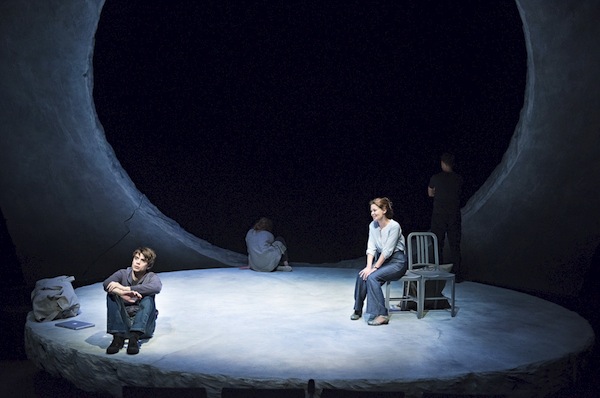
Is life all about luck?

Colleen Wheeler and Scott Bellis in Good People. (photo by Emily Cooper)

It’s always a treat to see Colleen Wheeler on stage, as her performances never disappoint. And she keeps the track record going in Good People at the Arts Club. However, the overall feel I came away with after the play didn’t match the level of enjoyment I had for the acting.

Wheeler plays Margaret, a feisty, mile-a-minute talker who can finagle her way into anything, except work.

Living in South Boston, a dense, lower-class neighborhood, Marg blames her situation on bad luck – growing up without the guidance of parents, not being able to go to a better school or get a better job. She fears she will end up like former classmate Cookie McDermot, an alcoholic living on the street.

As the play opens, Marg is being fired from a cashier’s job at a dollar store after coming late several times. The single mother is often late because she has to tend to a daughter who has mental health issues – a daughter for whom she gets no child support and who may or may not be the child of a former high school flame.

She commiserates about life over McCafés in bingo parlors with her friend Jeanne (Jenn Griffin), former supervisor Stevie (Ben Elliott) and landlord Dottie (Patti Allan), who is supposed to watch Marg’s daughter but often forgets to show up. One day, Jeanne mentions that she ran into Mike, an old boyfriend of Marg’s who has become a doctor, so Marg sets out to talk her way into a job.

Within minutes of walking into Mike’s office, she profanely insults his secretary and comments on her physical appearance. She insults Mike himself, saying he’s not a “Southie” anymore, that he now lives “lace curtain.” And she passive-aggressively follows up every abuse with the disclaimer, “Awww, I’m just bustin’ your balls.”

Despite all of this, her mastery at twisting Mike’s words and actually making him feel guilty for the altercations get her invited to an upcoming party. When Mike calls her later that week to cancel because his daughter is sick, Marg begins to think he doesn’t want her to attend – and goes anyway. It is in this scene where Marg, Mike and his wife, Kate, face one another that the skeletons of the past are unleashed.

It starts out as a respectful interaction, with Kate being the gracious host, despite Marg’s rough demeanor and colorful language.

“How’s the wine?” Kate politely asks.

“How the f–– should I know?” Marg retorts, almost laughing at the ridiculousness of the question.

But the discussion deteriorates, as expected, as Mike tries desperately to get Marg to leave. When details of past affairs and questions of “Who’s the baby’s father?” come up, Marg pulls out the claws and tries to tear strips off Mike, lashing out at him for having had the luck he needed to rise out of the South End, the luck to have parents who pushed him, the luck never to have to really struggle.

In much of the play, we are listening to people arguing, complaining and name-calling, which gets tedious. At one level, Marg is a likeable, even inspirational, character. Consider how often we pretend to be aficionados of art or wine or food, just to be accepted. Marg makes no apologies for not knowing how wine should taste.

But, for most of the play, Marg is insufferable. Her constant stream of talking is exhausting. She resorts to, “I’m just bustin’ your balls,” to cover up insults based on her true feelings. And she is stuck blaming everyone and everything around her for her situation. We should be provoked into asking ourselves, how much does luck actually play in success in life? The problem was, I didn’t care by the end, and I think it’s because I just disliked Marg.

However, I did like the set. Wonderfully thought out and detailed, the modular rooms rotate into, out of and around the stage, with beautiful precision. You could hear the audience’s “oohs” and “aahs” as the curtain rose on the second act.

Good People was written by David Lindsay-Abaire and is directed by Rachel Ditor. It runs until April 24 at the Stanley (artsclub.com).

Baila Lazarus is a freelance writer and media trainer in Vancouver. Her consulting work can be seen at phase2coaching.com.


Royal City welcomes Tevye

Jewish community members in Royal City Musical Theatre’s production of Fiddler on the Roof, left to right: Erin Palm, Warren Kimmel and Zach Wolfman, with Michael Wilkinson in front. The show runs April 7-23 at Massey Theatre. (photo by Tim Matheson)

This year’s Royal City Musical Theatre production is Fiddler on the Roof. Playing the legendary lead character of Tevye the Milkman is Jewish community member Warren Kimmel.

Addressing the community, Kimmel acknowledged that Fiddler is “one of those pieces of art that have just become part of the culture almost by osmosis.” But, he added, “Fiddler on the Roof is an intensely Jewish musical and, although musical theatre is hugely populated by Jewish composers and performers, Fiddler is perhaps the only mainstream musical that deals directly with the Jewish experience. So, although your children might know ‘If I Were a Rich Man’ by cultural absorption, I would urge you to bring them all to see this piece. It’s a fundamental part of who we are and I think it’s going to be a great production.”

Directing and choreographing the RCMT show is Valerie Easton and the musical director is James Bryson, who will lead a full orchestra. Kimmel will be joined by three other Jewish community members on stage: Michael Wilkinson (Fiddler), Zack Wolfman (Perchik) and Erin Palm (Fruma Sarah). They and the rest of the cast have a challenge in making their iconic characters their own.

“I have made the character my own by growing a real beard!” said Kimmel, noting that it took three months to grow and has changed his life. “Seriously though, the fact that the role is iconic has been a real issue for me because I actually grew up watching that movie and I think that it is not for no reason that Topol is world-famous from only one identifiable role. I think it’s a brilliant movie and a landmark performance, so it has been quite difficult not to copy what he’s doing. At the same time, I think what would be worse would be to try and do something different just for the sake of being different. So, what I’ve tried to do, and I guess what I always try to do, is find the truth of the story for that character and play that. But they are big boots to fill, no doubt, and an even bigger beard!”

“It’s definitely hard when there is a fixed idea of how a character should be,” Wolfman said. “I am steering clear of the trap by approaching the role like I would any other. I look at the words on the page and the circumstances the character finds himself in. The show is iconic because the characters and story are well written, and it makes our jobs easier as actors because that information is all on the page for us to use…. When I say the same words in the same order, it is the character, and I suppose it will become my own when it comes out of my mouth!”

For her part, Palm said she loves “when an actor really takes risks and brings new life to the characters they play. I think I make Fruma Sarah my own by really trying to understand what she wants, in the most honest way possible.”

Fiddler on the Roof was one of the first musicals Palm ever saw. “It made a huge impact on me,” she said. So, for her, part of the fun of being in this production “comes out of years of being excited about the opportunity to do the show and then getting a chance to do it. I love the music and the story.”

Part of the challenge is to convey the time and place of the action. Based on Tevye and his Daughters and other stories by Sholem Aleichem, Fiddler is set in 1905 in Anatevka, a fictional Russian village. It centres around Tevye and his efforts to maintain Jewish traditions while trying to keep his wife and five daughters happy and safe.

“Being that we don’t live in Anatevka and it is 2016,” said Palm, “it’s relating to those social and economic differences and times that makes it a challenge … capturing the old world feeling in a way that is truthful and heartwarming, that’s what sweeps you away to Anatevka, that’s the charm of the show.”

For Wolfman, “Having the opportunity to play a character that is playing against the traditional values of the characters in the play is fun. Perchik has more modern sensibilities and, in a way, he acts as a proxy for the audience to see the differences in beliefs on stage. It is fun to play a character with a strong point of view who is willing to fight for what he believes in…. The challenge for me has been finding the balance between the Perchik who is warm and loving, and the hard-nosed revolutionary. Of course, both sides exist within the character, so it’s interesting to grapple with what comes out at what times. It’s an ongoing question for me so, as my old acting professor Stephen Heatley would say, I’m ‘keeping the questions open and active.’”

In a somewhat similar vein – trying to find balance within a character – Wilkinson said, “It’s been very fun and exciting for me to find the way the Fiddler fits in as a metaphor in Tevye’s mind but also has a personality and character of his own.”

Not only does Wilkinson have to figure that out, but he is also playing a Russian dancer in the song “To Life.” He said that Easton “has given us wonderful choreography and the Russian dancing is particularly fun, but also challenging – especially since most of us don’t have training in Russian dance!”

Kimmel described Easton as “one of the real jewels of this city’s theatre community and we have worked together enough times now that I know I can allow her to guide me in my performance and that, if I trust her, she will make it a better one. That’s meant to be the director’s job, I guess, and it’s what you always hope for as an actor, but it doesn’t happen nearly as often as you would hope.”

Last year, Kimmel worked with both Easton and Bryson on RCMT’s My Fair Lady. “Both brilliant,” he said. “Also, there are a few cast members from My Fair Lady that have reappeared in Yiddish garb and large beards and it’s always great to be on stage with people you know and trust. However, all the people I have close relationships with in the piece – my wife and five daughters – are all performers I’ve never worked with before and that’s quite exciting.”

It is also Wilkinson’s second production with Easton, Bryson and RCMT. He was in the ensemble of Annie in 2014. “The Vancouver theatre community isn’t huge, so usually there are some familiar faces when a new production starts rehearsals. I’ve met a bunch of new wonderful people in this production, as well as a few with whom I’ve worked before.”

Wolfman was at the University of British Columbia with a couple of the other leads, including Jenika Schofield, and has acted before with several members of the cast. “In fact,” he noted, “Jenika actually played my love interest in Titus: The Light and Delightful Musical Comedy and now she’s playing Hodel, who falls in love with Perchik. Crazy, right?!”

While this is his first time working with Easton and Bryson, Wolfman said, “Patrick Ray, our piano player, accompanied a show I did in the past, and maybe saved my life musically more than once.”

Palm worked with Easton right after graduating from Capilano University. It was in an Arts Club on Tour production of the musical The Thing About Men, where, she said, “I played 13 different characters, that was a highlight of my career. I just love her as a director. She’s just so present and physical in her directing skills. She’s very giving, she’s very much an actor’s director…. Also, I am a big fan of female directors. There are so few of them and so, when you get an opportunity to work with a director with such a clear vision who is a woman, I celebrate that.”

Palm also knows some of Fiddler’s cast from previous acting work, she took voice lessons for awhile with Sylvia Zaradic (Yente) and did a video with Natasha Zacher (Tzeitel) and others called Finding Face Time: A YouTube Musical!, which is online.

In the casting process, Palm was called back for two different roles: Tzeitel and Fruma. She said she is grateful to have been chosen “as part of the vision of the show and cast as Fruma Sarah.”

“I think the casting is very well put together and I couldn’t imagine the show being cast any other way,” she said. “We really have worked together as a collective, the chorus is really strong. There are a lot of talented actors and singers in this show, lots of young and up-and-coming talent, too, who really bring something special, new and exciting to the roles they play.”

Initially, Wolfman wasn’t sure for which role he would audition. During Oliver! at Theatre Under the Stars last summer, he said, “[M]any of the cast members in the show were buzzing about Fiddler on the Roof auditions during the run. A fellow cast mate, Kat Palmer, said I should go out for Perchik if I got a chance, so the show fell on my radar. When I first auditioned, I was thinking about Motel and Fyedka as possible roles, but after re-reading the script, I definitely had my heart set on Perchik and that’s what happened!”

When Wilkinson auditioned, he said, “I had to sing a song in front of the directing team and take part in the group dance call. I didn’t go in with a specific role in mind and was just hoping to be a part of the show in some capacity. It worked out well and I’m having a great time being a part of the production.”

As for the patriarch of the show, Kimmel said, “I originally auditioned for the role of Yente the Matchmaker but I lost that role, unfortunately, and had to settle for Tevye. No, in reality, I think Tevye has always been one of the roles that I felt I would have to do at some point or other, being Jewish for a start, and just loving this play since I was a child. So, I asked Val if I could audition. Honestly, I thought I was a bit young for the role and I still feel I struggle with the [emotional] weight of Tevye…. Also, there are a few performers in town that have been very successful playing the role and I was pretty sure they would be offered it, but it seems my audition – together with a large cheque made out to Val – clinched it for me.”

RCMT’s Fiddler on the Roof takes place at Massey Theatre, 735 Eighth Ave., in New Westminster, Wednesday-Sunday, April 7-23. Ticket are $47 ($38 seniors/students, $29 children 13 and under) from ticketsnw.ca and 604-521-5050.

Mamma Mia! in town

Yael Reich understudies the role of Sophie and is in the ensemble of Mamma Mia!, which is at Queen Elizabeth Theatre until Sunday. (photo from Broadway Across Canada)

Yael Reich is making her national tour debut with Broadway Across Canada’s Mamma Mia!, which has returned to the Queen Elizabeth Theatre stage, and runs to Sunday.

Featuring more than 20 ABBA songs, Mamma Mia! is set on an island in Greece. Bride-to-be Sophie wants to find her father, who she has never met, so that he might walk her down the aisle. From her mother’s diary, she narrows her search to three men, all of whom she invites to the wedding to figure out which one is her dad. The situation threatens both her relationship with her mom, and her wedding.

Reich understudies the role of Sophie and is also in the ensemble of the tour, produced by Work Light Productions, that has made its way to Vancouver.

“Being an understudy is one of the most incredible things I have had the privilege to do,” Reich told the Independent. “It’s both challenging and rewarding. Probably one of the most challenging parts of being an understudy is maintaining focus on your own role in the show while becoming fluent in your understudy role.

“I’ve been a part of companies before where we’ve had to do four and five shows at a time in repertory – a different show each night – which can be confusing. I’ve actually found it more challenging to maintain two roles in one show because, often times, my ensemble character will be on stage at the same time as Sophie.

“I’ve had the privilege of going on for Sophie a few times so far and have had an absolute blast!” she continued. “It is extraordinarily rewarding to finally get the chance to embody a role that has been encompassing my headspace for months. It was particularly special getting to do the role with this company. The artists we are surrounded by in the cast and crew are all beyond supportive and encouraging, and it was incredible to have the opportunity to exchange dialogue, intention and creativity with them.”

Reich made her professional theatre debut with Bigfork Summer Playhouse in Montana. She played Anita in West Side Story in the summer of 2014 and returned to play Aldonza in Man of La Mancha and Lily St. Regis in Annie in 2015. “Between those two professional engagements,” she said, “I had the privilege of making my debut at the Hippodrome Theatre in Gainesville as part of their winter season.”

Reich received her bachelor of fine arts in musical theatre summa cum laude from the University of Florida in May 2015. By that time, she had already been working for more than 15 years.

“I began singing jingles for my father in 1999 and have been a lead vocalist for his advertising company, Sound Branding Ideas, ever since,” she said. “I got my start in theatre at age 8 with the Galaxy Centre for the Arts in Seminole, Fla. My training there ranged from pop voice, piano, percussion, studio recording and dance, alongside the shows we would put on. I auditioned for the arts magnet program and attended the Pinellas County Centre for the Arts for high school, majoring in musical theatre. Having specific major coursework at that age was incredibly valuable because it instilled a sense of purpose and perseverance in me, which has proven instrumental in the cutthroat professional world.”

Also instilling a sense of purpose and a strong foundation from which to face the world is her upbringing.

“Both Judaism and Jewish culture have always played a significant role in my life,” she said. “Coming from an incredibly traditional and religious family, I was brought up with strong beliefs. I spent most of my time in the synagogue and Jewish day school studying Judaics and practising Jewish rituals, most of which involved singing. I actually managed to lead every service involved in my bat mitzvah weekend, including the majority of the Torah portions and the Haftorah.

“Recently, having spent so much time focusing on my career and training, I have devoted much less attention to the religious aspect of Judaism, but have come to find a much greater appreciation for the cultural aspect. The Jewish people are such an incredibly resilient, eclectic and unique people. Their sense of community and commitment to the people as a whole is what I find most important.”

Remaining performances of Mamma Mia! include shows Friday and Saturday, 8 p.m.; Saturday and Sunday, 2 p.m.; and Sunday, 7:30 p.m. Tickets start at $35 and are available through ticketmaster.ca or 1-855-985-5000.

Understanding Onegin

Lauren Jackson as Olga Larin and Josh Epstein as Vladimir Lensky in Arts Club’s Onegin. (photo by David Cooper)

Generally, I don’t think background research is something that should be required in order to fully enjoy a performance; but every now and then a play really needs context, and the viewer becomes lost without it.

So, I would suggest – even to those with extensive Russian literature under your belts – if you have not read Alexander Pushkin’s dramatic poem, “Eugene Onegin,” start there before you see the musical Onegin. The poem contains descriptions of the characters, homes and countryside that add depth of interest that could simply not be communicated on stage.

That’s not to say that Onegin (pronounced “Onyegin”), the musical interpretation of the poem, can’t stand on its own. The singular creation by Veda Hille and Amiel Gladstone, combining the poetry of Pushkin and the opera of Tchaikovsky, is highly entertaining from start to finish.

The supremely talented group of seven performers, including the Jewish community’s own Josh Epstein, executes so many complex harmonies and moving solos, I certainly wasn’t walking out at intermission.

Set in 1819 St. Petersburg, the poem centres on four main characters: a self-proclaimed rakish womanizer, Eugene Onegin; Vladimir Lensky, a romantic poet; Vladimir’s love interest, Olga; and Tatyana, Olga’s sister, who’s in love with Onegin.

At first, Onegin rejects Tatyana, breaking her heart, and turns his attention to Olga, incurring Vladimir’s jealousy and bringing about a duel. Years later, after extensive traveling, Onegin returns to St. Petersburg and wants to be with Tatyana. But, by then, she’s already married, and Onegin realizes he’s wasted his life chasing women he doesn’t care about.

Taking place primarily in rural vacation homes, these well-to-do look for anything to “deal with the boredom of long winters” and come up with hunting, dancing, dueling and falling in and out of love.

The script includes quite a bit of play-by-play, where explanations of who’s who and what’s going on are interspersed with the action on stage. One by one, we’re introduced, in song, to the characters, with tongue-in-cheek descriptions. At one point, even the details of an impending pistol duel are sung to audience – just in case we were a little rough on the regulations.

These “asides” help with the background and also offer some great comedic breaks, often picking up on the satire that winds its way through Pushkin’s original work.

As an added bonus, guests are encouraged to bring their alcoholic drinks into the theatre and raise a glass for a sip every time someone says lebov (love in Russian). This is even facilitated by the cast handing out cups of vodka during the performance.

But there are also some bizarre non-sequiturs, such as when a singer in what looks like a boudoir is given a mic and electric guitar to continue her performance. Though it provided a chuckle, the reason for that choice went over my head.

While the script tries to provide the context I mentioned, it simply can’t make up for what’s lost from the poem, and I couldn’t help feeling “left out” of the framework.

For example, according to one translation of the poem, Onegin’s house is described: “All of the rooms were wide and lofty/ Silk wall paper embellished the drawing room/ And portraits of czars hung on the walls / The stoves were bright with ceramic tiles / There was no need for these things at all / Because he would yawn with equal distraction / At an ancient pile or a modern mansion.”

This paints such a great picture of the lifestyle and ennui of the main character, but not one that I caught onto in the musical.

Besides detailed description of scenery, the poem delves extensively into philosophical discussions, particularly about love, that would come across far better on stage as verbal jousting rather than a sing-song.

Onegin runs until April 10 at BMO Theatre Centre. Visit artsclub.com.

Baila Lazarus is a freelance writer and media trainer in Vancouver. Her consulting work can be seen at phase2coaching.com.

Keeping the ballet dancing

Sam Steinfeld works with Royal Winnipeg Ballet apprentice Jesse Petrie. He is traveling with the ballet on their current tour, which arrives in Vancouver April 7. (photo by Amy Simoes)

The Royal Winnipeg Ballet is currently making its way across Western Canada and will present the Vancouver première of Going Home Star – Truth and Reconciliation at Queen Elizabeth Theatre April 7-9.

Commissioned by RWB, with support from the Truth and Reconciliation Commission, Going Home Star was first performed in Winnipeg in 2014, as part of RWB’s 75th season. Conceived by RWB artistic director André Lewis and the late Cree elder Mary Richard, the ballet was created by novelist Joseph Boyden, choreographer Mark Godden and composer Christos Hatzis. It features the music of Inuk throat singer Tanya Tagaq, and Steve Wood and the Northern Cree Singers.

Traveling with the ballet is physiotherapist Sam Steinfeld, who spoke to the Independent during the company’s bus ride to Brandon, Man., the tour’s first stop.

photo - Sam Steinfeld
Sam Steinfeld (photo by Amy Simoes)

Born and raised in Winnipeg, Steinfeld graduated from the University of Manitoba. He did a science degree and considered doing a master’s in physiology but, between the poor job prospects for science grads at the time and a friend who was finishing up his training in physiotherapy, Steinfeld decided to change his path.

After his training, he worked in a hospital setting for several years before going into private practice. He has been a consultant to professional sport teams in Winnipeg, including the Jets and the Fury, and, in 1998, he started working with RWB. He also teaches for the Neuro Orthopedic Institute, which is based in Australia.

Steinfeld has been a physiotherapist for more than 35 years. “Every day’s a little different,” he said. “There are always new challenges, especially working in an environment like this, with the ballet and going on tour. It’s one thing when you’re working, say, in your clinic or at home and in the ballet’s clinic, things are a little more predictable. But, when you’re on the road, you never know what you’re going to encounter … that, for me, keeps it interesting. Certainly working with different people, too, the different dancers we’ve had over the years, different clients. Everybody brings their own way of managing and dealing with their injuries, and you have to be able to adapt and work with those people and find ways to get them going again.”

It’s never the same, he said. “Treating two ankle sprains doesn’t necessarily mean you approach them in the same way, for instance, just because of the individual or what the individual’s going to have to do.”

There are two physiotherapists who work with RWB – the other is Kevin Dyck – and the two split up the tours, said Steinfeld. When in Winnipeg, Steinfeld is at the ballet’s clinic Tuesday and Thursday afternoons and evenings, and Dyck works the other hours Monday to Friday. For shows in the city, they try to divide the time at the concert hall evenly.

“We’re looking after not just the company, but we look after the professional division students of the RWB school,” explained Steinfeld. “I’m treating the recreational division students, as well, and we look after all the administrative staff, the teachers, the stage crew that works for us. We’re responsible for all those people.”

Dancers don’t generally get injured during a performance, he said. “Most of the injuries we see are overuse things and, usually, with some modification of activity, some treatment, we can keep them going. Our main thing is to make sure they’re going to be safe and we work closely with the ballet masters and artistic director. If we feel somebody can still perform but perhaps in a lesser role, or modify their choreography somewhat, they’re good at adapting things for the dancer and are able sometimes to keep somebody in. But there are always situations where somebody just can’t do it, period, because of the nature of their injury or the severity of it. Then we have to work around that, and that sometimes means somebody else picking up an extra part or, if we’re on the road, bringing somebody from Winnipeg out to meet us and take over that part.”

Every physical activity stresses the body in a unique way. When he started working with the ballet, he said, “it became quickly apparent that I was working with artistic athletes and I had to learn more about dance and the technique and what’s involved and how they work because, in order to make decisions about whether it’s safe for someone with an injury to return, I have to understand what it is they’re doing.”

Compared to hockey or soccer, for example, dancers – and especially those who do pointe work – have more “forefoot and ankle problems that you don’t normally see, say, in a hockey player who wears a skate,” said Steinfeld. A foot doesn’t move much inside of a skate. However, he said, “you look at a dancer in a pointe shoe and the load they’re putting on their foot, and the very different way they load their foot, right through their toes, for instance, when they’re on pointe, is unique…. So, we’ll see more things like stress fractures in the foot, metatarsal stress fractures or mid-foot stress fractures, certainly more mid-foot and forefoot sprains and that sort of thing that you don’t often see in something like hockey. You might see them in soccer, though, with the amount of running.”

Steinfeld is the son of Holocaust survivors who came to Canada three years after the war. He has two older brothers.

“My parents set an amazing example in terms of their ability to overcome adversities, how they dealt with other people and … how they still had a lot of positive feelings towards other people. I think that helped me in terms of my development as a person and, ultimately, as a caregiver, in … having a little more empathy with people when they’re in trouble and understanding that, with hard work and perseverance, you can overcome a lot of adversities…. The courage they showed in starting a life anew after everything they’d been through, I think it all trickled down to myself, my brothers. I’m quite proud of that as far as my Jewish upbringing.”

Working with the ballet was never in his career plans, he said. “I actually went in there to replace the therapist who was ill and I was only supposed to work for about four or six weeks there, till this person came back. It turned out, unfortunately, they weren’t able to return to work, so the ballet said to me, do you want to carry on with us and I said OK, and here I am, 18 years later.”

Steinfeld said he is fortunate to have understanding colleagues and that the other physiotherapists in his practice help absorb his caseload when he travels with the ballet. He also voiced appreciation for his family’s tolerance of his absences and their support of his work. “I’ve been a lucky guy, I think, to have had this opportunity,” he said.

Steinfeld’s wife, Karen, is also a physiotherapist – she specializes in hands and the upper extremities, and he’ll sometimes confer with her. Their two daughters are now adults, the oldest is a cardiac surgery resident in Winnipeg and the youngest is a lawyer in Ottawa.

***

Going Home Star is at Queen E April 7-9, at 8 p.m., with pre-show talks at 7 p.m. Ticket are $29 to $89 and can be purchased from ticketmaster.ca or 1-855-985-ARTS (2787).

Little Shop fills the Rothstein

The full cast of King David Players’ Little Shop of Horrors. (all photos from King David High School)

On March 16 and 17, the Rothstein Theatre was alive with music and a giant flesh-eating plant, as the King David Players presented this year’s theatre production, Little Shop of Horrors. Featuring a cast of students from every grade, the actors and musicians brought to life the dark comedy/musical. They played to full houses both nights.

Teachers Aron Rosenberg, Johnny Seguin and Anna-Mae Wiesenthal created the production, which involved 50 students, as well as other staff, parents and community supporters.

“When deciding what play to explore this year, we were looking for a musical that was light and fun and that was not too heavily based around social commentary (as is my usual inclination),” said Rosenberg in his director’s note. “I looked through a list of musicals and, remembering childhood evenings watching Little Shop of Horrors with Rick Moranis, Steve Martin and Bill Murray, I sent an e-mail to the administration ensuring it would be an appropriate choice.”

On closer look, the musical wasn’t that light.

“Three of the most problematic characters are Mushnik – the caricature of a greedy Jewish merchant – Audrey – the caricature of a helpless victim in an abusive relationship – and Orin – Audrey’s abusive boyfriend, and a caricature of a dentist with a self-acknowledged appetite for causing pain,” noted Rosenberg. “Perhaps this play’s innocuous reputation comes from an outdated attitude that treated ethnic stereotypes as playful, sexual violence as bland and dentists as inevitably painful. However, in 2016, our modern sensibilities force this play to take on a new life. The dark and irreverent humor of the play remains but, along with it, our cast has worked to uncover a respectful and critical look at the struggles of ethnic shop-owners in low-income neighborhoods, the horrors of domestic abuse and the ridiculousness of gender-inequity in relationships (not to mention the reality that dentists are no longer painful … usually).

“With all the creative commitment and hard work from our cast, crew and community, we are left with something not unlike our original goal…. The plot may not be light but the musical numbers are. And, as for social commentary and all this hullabaloo about the self-destructiveness of greed and power, you can take it or leave it. However, if you leave it, don’t be surprised when a giant human-eating plant comes a-knocking….”

photo - Seymour (Daniel Shuchat) and Audrey (Sydney Freedman)
Seymour (Daniel Shuchat) and Audrey (Sydney Freedman).
photo - Audrey II, played by Alisa Bressler and Hannah Marliss
Audrey II, played by Alisa Bressler and Hannah Marliss.
photo - Stage managers Rachel Pekeles and Matty Flader
Stage managers Rachel Pekeles and Matty Flader.


Saying what he wants

Ari Shaffir was in Vancouver Feb. 18-20 as part of Just for Laughs NorthWest. (photo from Ari Shaffir)

Ari Shaffir is a long, long way from his yeshivah. The 42-year-old stand-up comedian and actor who lives in New York and Los Angeles appeared in Vancouver Feb. 18-20 as part of Just for Laughs NorthWest and entertained packed audiences with his deep baritone and casual conversation, drawing plenty of laughter.

Shaffir grew up Orthodox and shomer Shabbat in Kemp Mill, Md., attending Hebrew academy and the Jewish day school before spending two years at Beth Midrash HaTorah, a now defunct yeshivah in Jerusalem. When he returned, he enrolled at Yeshiva University in New York. That was the year he lost his religion.

“Mostly it was inward reflection that caused me to turn away,” he said. “I was doing these religious things because I was expected to, and I was succeeding, but I’d never stopped to think why I was doing them. When I really thought about it, I didn’t see a belief inside me. It just wasn’t there.”

At 20, he left Yeshiva University for the University of Maryland, taking arts courses like English and screenwriting. His parents and friends were dismayed by his change in lifestyle. “My friends tried to talk me out of it,” he said. “They would be happier if I were dating a Jewish girl who was a completely worthless human being as opposed to Mother Teresa. When I thought about it, I started feeling mad and decided this is not the way I should live my life.”

When a friend moved to California, Shaffir decided to join him. “I’d done stand-up once in college and had always thought about it, because I was one of the funnier guys at school, but it didn’t seem like a legitimate career,” he said. “Initially, I tried to find a fun regular job, but couldn’t, so I did an open mic one time in California and that was it. I was totally focused.”

Shaffir’s career has been on an upward swing in recent years. His stand-up album Revenge for the Holocaust was released in 2012 and went to No. 1 on iTunes and amazon.com the week of its première. His show Passive Aggressive premièred on chill.com in 2013 and on Comedy Central in 2015, while his weekly storytelling series This is Not Happening premièred on Comedy Central in 2015. Season 2 of This is Not Happening will air this year, and it was recently picked up for a third season on Comedy Central. He hosts the podcast The Skeptic Tank, a weekly interview show that averages more than 100,000 downloads per week, and he just shot a feature film, Keeping Up with the Joneses, slated for release this spring.

He didn’t completely lose his cultural identity, if his performance on Feb. 18 was anything to go by. In one part of his show, he joked about visiting Germany and urinating outdoors anywhere he could, hoping to pee on Hitler’s grave. “If anyone tried to stop me, I’d play the Jew card,” he said. (The part about urinating outdoors was no joke, he admitted in a telephone interview. “I did that.”)

Shaffir says the Bible is now his least favorite book: “There’s a lot of holes in the story.”

He enjoys using material he learned in his religious life in a completely opposite way than how it was intended. “I get joy out of that,” he said. “For example, the Torah says if someone is coming to kill or rob you, you’re allowed to defend yourself up to the point of killing them. A child cost $500,000 to raise and they’re going to take that from you, so the Torah would tell you to kill them to protect your income.”

Defying his parents’ expectations and leaving the community of Kemp Mill wasn’t easy, and there are still things Shaffir misses from that life. “It took my parents years to get over it. My mother was more concerned with me losing the culture of Judaism, the songs on Pesach, the camaraderie. My dad was angry. He had swayed from religion for a little while, but I swayed way further. Years later, he realized he didn’t want to lose me as a son and we were able to move on.”

Shaffir’s casual, unassuming storytelling style accounts for his popularity. His stand-up routine is peppered with sex and toilet jokes, rants on why he hates kids and anecdotes from his travels. Throughout his routine, he appeared relaxed and at ease, and his hour-long performance went by quickly.

If he has any remaining link to his Jewish life, it’s cultural, Shaffir said. “When I hear a news story come on about Israel, my ears perk up a little more than they would about another country. Otherwise, I have nothing left to do with the religion. But I miss the community I had in Kemp Mill, where everyone knew me. You had this gigantic family that you’d see in synagogue every weekend. To lose all that – now I’m on my own and I’m just floating. You lose those friends. You can’t go to restaurants with them because we’re into different things. They’re into family and religion, I’m not into either.”

A page on his website is called Shroomfest and, on it, Shaffir has taken time to write everything he feels others should know about mushrooms. “That’s not a joke, it’s real, and I do it a few times a year,” he said. “I took a lot of time to write that and it helps a lot of people take mushrooms the right way.”

Shaffir described feeling free on stage to say what he wants, but when it catches up with him in a private setting, he feels some guilt and embarrassment. “I feel guilty about all sorts of stuff, not committing to women, not being monogamous. If I’m at a dinner party and it comes up that I had a threesome last week, then, yes, I’m embarrassed.

“I’m proud that I’m a free comedian,” he reflected. “I say and do what I want, what I feel is correct creatively, and both criticism and praise are irrelevant to me. I’m living as a stand-up comedian! It’s one of the coolest jobs in the world and I have an apartment I pay for, just by doing that!”

For a link to his podcast visit arishaffir.com/category/podcast.

Lauren Kramer, an award-winning writer and editor, lives in Richmond. To read her work online, visit laurenkramer.net.

Stand-up rabbi returns

Rabbi Bob Alper will perform as part of Congregation Beth Israel’s Purim festivities on March 23. (photo by Sultan Khan)

It’s too good not to lead with – Pope Frances’ honorary comedic advisor, Rabbi Bob Alper, will be bringing his comic stylings to Congregation Beth Israel on erev Purim March 23.

A professional comedian for some 30 years now, Alper said his life hasn’t changed that much since he became the papal advisor last fall. “I now drive my very own popemobile in my hometown in Vermont,” he said. “It gets 150 miles to the gallon, but is not great in blizzards. Otherwise, nothing has changed, though I do ‘use’ the title whenever I can. It’s a great story.”

No doubt, Alper will be flying to Vancouver. He was invited by the congregation, “people who obviously know how to make Purim rock,” he said.

He’s been here twice before, “once for a show at Temple Sholom and, earlier, for a Federation event. One of the most difficult of my career, since it fell just two weeks after 9/11.

“I’ll only be in Vancouver for a day or two,” he added about this month’s trip, “but I hope to do the highlights. The best part of every trip, for me, is performing!”

Alper won the title of honorary comedic advisor to the Pope in a contest held by the Pontifical Mission Societies in honor of the Pope’s September 2015 visit to the United States and to raise awareness and money for three pontifical missions. He beat out more than 4,000 people from 47 countries, including fellow American funnymen like Bill Murray and Conan O’Brien. You can watch his video, as well as those of the other contestants, at jokewiththepope.org, but the joke is: “My wife and I have been married for over 46 years, and our lives are totally in sync. For example, at the same time I got a hearing aid, she stopped mumbling.”

“I grew up in a religious Reform family for whom our synagogue was central, and my uncle was a Reform rabbi,” said Alper of his background. “My father loved humor, and told long ‘shaggy dog’ stories, which, naturally, prompted me to take the opposite route into the quick-hit world of stand-up. Bob Newhart, Shelley Berman and Mel Brooks records were my childhood companions and, in Jewish youth group, in high school, I would memorize and perform their routines at regional convention talent nights, thereby attracting the hottest girls. Comedy is good.”

Nonetheless, Alper was ordained as a rabbi in 1972 and then worked in congregations for 14 years. It was another contest that led him to become a comedian.

“In 1986, living in a Philadelphia suburb and armed with a doctoral degree from Princeton Theological Seminary, Bob was charting a different path, trading congregational life for a counseling practice,” writes editor David Crumm in the introduction to Alper’s book Thanks. I Needed That. And Other Stories of the Spirit (Read the Spirit Books, 2013). “But, at that same time, comedy reared its ugly head in the form of a ‘Jewish Comic of the Year Contest.’ Bob entered, came in third behind a chiropractor and a lawyer, and went on to make stand-up a full-time career.”

Alper’s wife, Sherri, is a psychotherapist. On his website, it notes, “Professionally, he makes people laugh, while she helps people cry.”

With literally thousands of shows under his belt, Alper has made a lot of people laugh. “It gets easier and easier,” he said about performing. “That’s how comedy works. I agonized before I did my first five minutes in 1986. Now performing is a delight and, since stand-up is cumulative, I have tons of material from which to choose.”

Among Alper’s shows are duos with Muslim comedians.

“My Muslim colleagues include Ahmed Ahmed, of Egyptian background, Azhar Usman, of Indian background, and Mo Amer, a Palestinian born in Kuwait,” writes Alper in Thanks. I Needed That. “We do Muslim-Jewish shows, frequently enhanced by the addition of a Baptist minister, Rev. Susan Sparks. And we have so much fun at each performance, it’s almost criminal.

“We call our shows Laugh in Peace.

“Back in late 2001, Ahmed and I were brought together as a gimmick by a savvy publicist,” he continues. “Our relationship quickly developed into a friendship based on the camaraderie of fellow artists and the breezy banter of guys who really enjoy one another’s company. We laugh together a lot.”

Alper began working with Usman when Ahmed became more focused on acting, and he also works with Amer quite often.

He admits, “No question, Laugh in Peace was conceived initially as a way to further our comedy careers, to book more gigs, to raise our visibility. It would be disingenuous to suggest anything else. But as the act and our personal relationships evolved, we quickly understood how Laugh in Peace brought a sense of hope and relief and healing that shared laughter, especially shared laughter between communities in frequent tension, can provide.”

Alper is also the author of Life Doesn’t Get Any Better Than This, a collection of stories, and the cartoon book A Rabbi Confesses, and he has produced two CDs and a DVD. For more information and a five-minute demo of Alper’s comedy, visit bobalper.com. Readers can also watch the video “Rabbi Bob Alper’s dog respects religions” and many others on YouTube.com.

Beth Israel’s Purim celebration starts at 6:15 p.m. on March 23 with a kid-friendly Megillah reading and costume parade, followed by carnival activities. The full Megillah reading and comedy by Rabbi Bob Alper starts about 8:15 p.m. Food will be for sale during the evening. Visit bethisrael.ca for more information and to register for the kids events.

Replace your fear with hope

David Diamond, Theatre for Living, directs Reclaiming Hope. (collage graphic design by Dafne Blanco, photos by Wolfgang Rappel)

Starting on March 10, Theatre for Living (formerly Headlines Theatre) will be presenting a new event. Called Reclaiming Hope, it will “engage communities in identifying and transforming the narrative of fear that permeates our culture.”

Reclaiming Hope, led by Theatre for Living’s co-founder and artistic director David Diamond, will take place 12 times from March 10 to April 2 at various locations.

“The work that I do is really based in using theatre as a way to create dialogue in the community. We are a professional theatre company, but one that is really committed to collaborations with people in all communities,” said Diamond.

Diamond originally trained as a professional actor and came out of theatre school in 1975. He worked in professional theatre, radio, television and film for a few years before creating Theatre for Living with some of his peers.

“A number of us, writers, directors, actors, became frustrated in the late ’70s with the kind of work we were being asked to do. We wanted to do some kind of theatre work that was socially relevant. After complaining about that for a very long time, we decided we would stop sitting around and complaining, and we would do something about it.”

In 1981, Diamond and his peers created a play about affordable housing. It was a hit, and thus began the establishment of Theatre for Living.

Reclaiming Hope, Theatre for Living’s newest work, was born out of an unexpected turn of events. Diamond and company were initially planning a new project entitled Freedom, which would focus on the idea that corporations may unethically possess the freedom to generate exceptional wealth. But, as Theatre for Living was raising money for this production, the Canadian federal election took place.

“The impulse for that project was grounded, frankly, in Harperism. It isn’t that those issues have now gone away, the issues still exist out there, but the juice of it changed dramatically. Changing the government hasn’t solved all of those problems, but changing the government has changed the perception of those problems.

“We had to really reframe the project. Added to that, we were having trouble raising money for that project, because it was really challenging the financial structures that we have built around us. One of the elements of Freedom that we decided to focus on in Reclaiming Hope is that we are being asked to be afraid, we are being asked to live in fear from so many different sectors,” said Diamond.

Theatre for Living decided they would mount a series of theatrical events that would look at the different ways that various communities are experiencing being asked to live in fear. They would use theatre to identify those voices of fear that take up residence in the community’s psyche. They would also use theatre to try to change the community’s relationship to those voices, so that, according to Diamond, society could move into a more actively hopeful realm.

“‘Hope’ is a verb. ‘Hope’ isn’t just sitting in your living room wishing things were different. ‘Hope’ is getting up off your ass and doing something to make our communities safer in a really human type of way for everybody.

“Somehow,” he said, “we have decided on this little blue speck of a planet, that there is a ‘them.’ That decision that there is a ‘them’ out there, that there is more than just ‘us’ living here is fueled by voices of fear.”

Diamond believes that he and his peers are not inventing something new, but rather reaching back into something ancient. Moreover, he intends to bring back the ancient idea that art itself can once again be seen as the psyche of the community.

Diamond and his company believe that the community may reclaim its collective hope through art.

“Years ago, both as an artist and as an activist, I got really tired of working against a world that I did not want. I made a real choice to work towards a world that I do want. So, at the heart of our theatre work, is the sense of reclaiming positive action,” he said.

An audience member unfamiliar with Theatre for Living’s style should expect to be very active when attending Reclaiming Hope. The event, though structured, will be different every night, as it unfolds with the stories of its nightly participants. As each show will be sponsored by different co-hosts, Diamond anticipates that the chemistry of the audience will be different every night. (For the schedule and tickets, visit theatreforliving.com.)

Diamond will begin each show with a discussion about the idea of living in fear. The audience will then choose one story that resonates the most. The person whose story that is will assume a role on stage, interacting with other audience members who will act out the voices of fear found in the story.

“Audience members will come to play those characters not because they want to play a theatre game,” said Diamond, “but because they have information to share, they understand the ‘voice.’”

Each event will be highly improvisational, and Diamond expects both funny and profound moments to occur. Judging by past events, Diamond expects about 60 to 150 people per night.

On April 3, the series of events will culminate in a day of action planning. This day will only be open to individuals who have attended at least one of the Reclaiming Hope performances. The daylong session will consist of a facilitated workshop where people will form groups based on ideas gathered from Reclaiming Hope. These groups will then make concrete plans for actions that will be the ultimate realizations of Reclaiming Hope.

“On some level,” said Diamond, “I think it is important as a culture, as an over-arching Canadian culture, that we understand and reclaim this idea that culture is not a commodity, that theatre is not a commodity, but it is a language, and we are all supposed to speak. And if we were all of us in our daily lives speaking more art, we would be living in a healthier world.”

Jonathan Dick is a freelance writer living in Toronto. His writing has appeared in the Canadian Jewish News, and various other publications in Canada and the United States.

Miller’s urgency to create

Gallim Dance performs the Canadian première of Wonderland at Chutzpah! March 10-13. (photo by Yaniv Schulman)

Gallim Dance’s Wonderland premières in Canada at the Chutzpah! Festival March 10-13. It was inspired by artist Cai Guo-Qiang’s Head On, which is an awe-inspiring installation even when viewed only in photos. Ninety-nine wolves run into the sky, an arc of animals intent on moving forward and fast – right into a glass wall.

“I like this dance very much, which isn’t true of all my earlier works,” Andrea Miller, Gallim Dance founder and artistic director, told the Independent. “It’s the first of my works that I built like a story. It’s an absurdist narrative but a story nonetheless. I created four archetypal characters that depict the dangers of pack mentality. I use a broad range of music, from the Chordettes’ 1954 ‘Mr. Sandman,’ to Chopin, to indie singer-songwriter Johanna Newsom, to minimalist electronic music inspired by the circus.

“Seeing Head On at the Guggenheim Bilbao consolidated my mixed feelings about the war in Iraq,” she added. “As I was looking at the installation, I was making the dance in my head.”

The archetypes are “the fool, death, the lovers and Cassandra,” according to Gallim’s website. They “evolve in a universe influenced by the imagery of the American atomic age. Behind the smiles of an Esther Williams dream world, Wonderland reveals psychological and physical episodes of a herd acting as a unit through the uncoordinated behavior of self-serving individuals. Although pack mentality is a natural and ongoing strategy in the animal kingdom, among humans it can indicate a vicious, desensitized brutality and disregard for humanity – a concept that is at the core of Wonderland.”

Head On was part of Cai’s first solo show in Germany, at the Deutsche Guggenheim in Berlin in 2006. While communicating a universal message, the danger of people blindly following others, among its themes are the rise and fall of Hitler – Wolf’s Lair was one of Hitler’s headquarters – and the rise and fall of communism, as symbolized by the Berlin Wall.

Such heady source material is not unusual for Miller. The writings of Raymond Carver and Albert Camus, for example, were inspirations for Fold Here and Sit, Kneel, Stand, respectively.

“I used to read a lot,” said Miller, “but now I feel like I’ve replaced books with work emails and video. I’m currently in a literary desert, but I love reading. Anything can inspire me, not just books; I’m available for being influenced and inspired by what I live and see happening to people in the world.”

Mama Call was directly related to her Sephardi heritage.

photo - Gallim Dance founder and artistic director Andrea Miller
Gallim Dance founder and artistic director Andrea Miller. (photo by Peggy Jarrell Kaplan)

“I grew up in a Conservative Jewish home. My father grew up Orthodox and eventually became atheist and my mother was Catholic and converted to Judaism,” she said about her background. “Because we lived in Salt Lake City, one could feel, as Jews, like we were in a minority and the synagogue became a really important place for feeling part of a community. I guess because of that, Judaism has always been a strong presence in my life. I currently attend Shabbat services with my two children whenever we aren’t on tour. We also attend Catholic services with my boyfriend, their father. Truthfully, I can’t exactly delineate the contours of what is exactly Jewish in me, but I feel that it is a latent presence in my life. In any case, that’s ultimately a personal circumstance; everybody has their own personal circumstances.

“I feel that, in order to relate to humanity, to each other, to art, we must understand that our personal circumstances are just departure points, which we should be ready to transcend. In this sense, I am more drawn to the universal human condition than restricting my artistic research to my personal circumstances, whatever they may be (nationality, age, cultural background, ethnicity or spiritual beliefs). Mama Call began its inspiration with the Jewish Diaspora and eventually became a story of home for any immigrant or displaced person.”

Miller’s professional journey began in Salt Lake City at the Children’s Dance Theatre, which was developed by a Doris Humphrey disciple, she explained. “The philosophy behind the training was in discovering movement through improvisation and dramatic play, and I loved it.

“We moved to Connecticut when I was 9 and, by pure coincidence, I ended up dancing with another Humphrey master, Ernestine Stodelle, and learned the technique and repertory of Doris Humphrey and Charles Weidman. At that time, I became sort of a young expert in pioneering modern dance, hungry to interpret the works of [Martha] Graham, [José] Limón and choreographers of that era.

“I got into Juilliard, which baffles me to this day considering I had very little ballet training. In my first year at Juilliard, the director Benjamin Harkarvy would work often with me, imploring me to undo myself, my body, from the 1930’s esthetics. It took a year of identity crisis and it was then that I started obsessing over living choreographers and contemporary art. I met Ohad Naharin at Juilliard and, after graduating, joined the ensemble Batsheva.”

It was during her time with Batsheva, she said, that “choreography changed from a passion to an urgency.” When she left the ensemble, she started creating her own work. Back in New York, she founded Gallim in 2007.

“Early rehearsals of the company were at Juilliard between 9 p.m. (when the students typically had to leave the studios to rest) and midnight,” she said. “My first piece was a quarter evening called Snow. I made it for a performance by video application at Joyce SoHo. It went well and they invited us back for a solo week for which I created my first full evening, I Can See Myself in Your Pupil. After that, we were invited back for two weeks, where we repeated Pupil and premièred Blush. Ella Baff from Jacob’s Pillow saw it and booked it for the summer festival. Everything started moving from there. The next year, we were asked to open Fall for Dance and perform at the Joyce.”

Gallim Dance has become an internationally renowned company. Miller has won multiple honors and her work has been commissioned around the world. Also of note is the company’s financial viability and continued growth. According to its 2014 annual report, that year ended “with a balanced budget just over $700,000 and an increase in net assets of more than $46,000.” In addition to looking after itself, the company invests in community programs in its Brooklyn neighborhood and beyond.

“I don’t feel I have any innate talent in the hard skills of business but I seem to have an intuition for the soft ones,” said Miller when asked about her apparent business savvy. “One of my understandings for both my business and my choreography is that progress is incremental and incremental steps take giant leaps of creativity, risk, strategy, planning and commitment. I think I have a combination of chutzpah and common sense that helps me push us forward without threatening our sustainability. I’ve learned a lot about leadership and business from my dancers, staff and board.”

Early in the company’s history, Miller articulated her vision for Gallim Dance: “to play inside the imagination, to find juxtapositions in the mind and body that resonate in the soul, to investigate our limitations and pleasures, and to realize the endless human capacity for inspiration.”

“It describes where everything begins for me and how I relate to all art, not just mine,” she told the Independent. “I think this vision captures both the values I hold for the process of making dances, as well as the larger impetus for making dances at all.”

Gallim Dance performs Wonderland March 10-13, at Rothstein Theatre. For tickets ($29/$25/$21), call 604-257-5145 or visit chutzpahfestival.com.