Bard play becomes musical

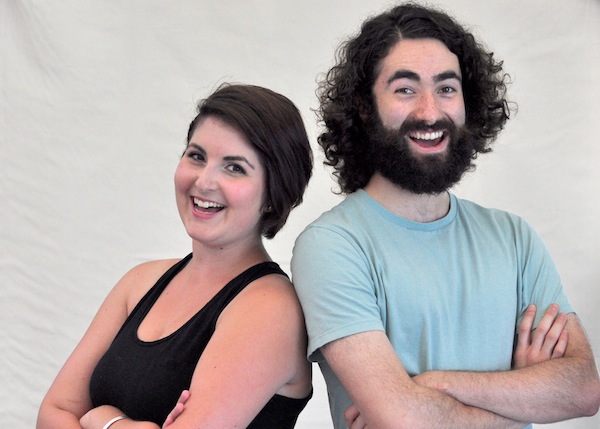
Erika Babins, choreographer, and Zach Wolfman, actor, in Awkward Stage Productions’ Titus, written by Andrew Wade and Jenny Andersen. (photo by Corwin Ferguson)

In its sixth appearance at the Vancouver Fringe Festival, Awkward Stage Productions is presenting its first original work: Titus: The Light and Delightful Musical Comedy of Titus Andronicus, written by Andrew Wade and Jenny Andersen.

“Young William Shakespeare wants a hit,” reads the musical’s description. “After cutesy romances and sweeping histories, the young bard is attempting to fold together another blockbuster. He bemoans that no one seems to care for his Titus Andronicus! It seems the violence is not what people want – or at least they won’t admit it. Perhaps it just needs to be presented a little more lightly and delightfully?” Enter Wade and Andersen.

The idea came to Wade when he was acting in a fundraiser production of Titus Andronicus at the University of Victoria.

“I was playing Aemilius and Quintus, and it struck me as so ridiculous how there is a scene where people around him are deciding his fate – accusing him of murder and then sentencing him to be beheaded – and he doesn’t have a single line in his own defence,” Wade told the Independent. “The original play is full of strange, silly moments like that…. During the closing night gathering for that show, I sketched out a one-page brainstorm of ideas if the silly elements to this deeply tragic play were to be highlighted and set to music. I then put that page in a folder and left it alone for four years. And then I pitched the show to Awkward Stage.

Titus Andronicus has been an excellent vehicle for lampooning [or] sending-up musicals, Shakespeare and our society’s selective obsession with violence as entertainment. The Shakespearean play is so riddled with issues, plot holes and strange character choices, and yet it is also so very, very compelling and touching and human. And what a strange and wonderful musical comedy it turns out to be.”

This is the first writing collaboration between Wade and Andersen, though they have acted together previously.

“While a part of that show,” said Wade, “she mentioned how she might want to write music for a musical at some point.” He made a note to follow up on that discussion and, when he started the first draft of Titus with a different composer and it wasn’t working out, Andersen came aboard, “and our styles clicked.”

“For most of the music, I started by writing some lyrics and sent them her way,” he explained. “Some songs, I added a little voice recording of what it ‘could’ sound like. For others, I included little taglines like ‘sounds like an instructional song from The Sound of Music, but sexier.’ A few of the songs, all I sent her were the words, and Jenny created musical masterpieces from those words, which blew me away.

“And then we would massage the lyrics back and forth for musicality and staging purposes, her telling me I need to cut or add a stanza here or there, me realizing the character needs to elaborate more here and there – a solid, near-egoless workshopping experience. We both dearly treasure what we have created, but we are also both willing to get rid of whatever isn’t working, or fix whatever needs tweaking. I am super-happy with how the collaborative process has gone thus far.”

When Andersen came on board, she said, “a first draft of the book/lyrics had already been written, and I was asked to set it musically.” So, she had no input into the musical’s topic and, she admitted, “a work from the Shakespearean canon would not have been the text I’d have settled on for my first foray into musical theatre composition.”

However, as she has worked with the story, she said, “I’m increasingly realizing the genius in picking this specific play. I think if we had made a musical comedy out of any other Shakespearean work, we would have received polite nods and moderate interest. When we say we’re setting Titus Andronicus as a musical, however, the (nearly universal) response is, ‘That play? How do you make a musical comedy out of that play?!’

“The fact that it’s widely recognized as Shakespeare’s darkest tragedy gives us a few advantages. Of course, people are curious to see how the original text is turned on its ear. More importantly, I think it serves as a statement of what we as a society find funny, what we find acceptable and what we still find as gruesome as we did in Shakespearean times. Why can we often find ourselves laughing at violence, mutilation, murder as comedic tropes, when other issues are still off limits as comedic fodder? Why should any of it be funny, really? What does that say about ourselves as a society?”

Since Andersen came later into the creative process, she said, “For the most part, in my first musical draft, I took Andrew’s lyrics, edited them slightly for smoother musical form/phrasing/syllabic purposes and tried to capture the overall mood of plot and character. We then sat down and parsed out the lyrics to make them universally relevant, to clean up the form and to make sure they were saying what we needed them to say about each situation. For the music, that meant everything from small lyrical tweaks to brand new sections and complete rewrites of certain songs. We went back and forth after that point (often electronically; I think we were in the same room a total of three or four days!) to finesse the flow of the piece. (We literally wrote one of the songs two days before rehearsal started for Fringe!)”

Awkward Stage was created in 2010 “to fill a perceived void of real-life performance and production opportunities for youth in that awkward transition from play acting to professional employment.” As with all its productions, Titus features a cast, crew and creative team “aged 15 to 30ish.”

Titus has a wide range of ages and experience levels in the show and it’s great to be able to watch them all come together as a cast,” said Awkward artistic associate Erika Babins, who choreographed the musical. “The teenagers in the show are fearless and dive right into the comedic and dramatic high points in the text. During any down time in the rehearsal hall, you’ll find cast members lending their strengths to each other to bring up the overall level of the show.”

When asked about any highlights she could share, she said, “It’s hard to describe some of the funniest moments of choreography without giving away a whole bunch of spoilers but there is a super-serious rhythmic gymnastic dance (as serious as you can be while flitting about with a ribbon), communication through tap dancing, and both life-size and miniature deer prancing around the forest.”

Zach Wolfman plays Bassianus, the late emperor Caesar’s son, younger brother to Saturninus. For the role, he said, “I definitely draw inspiration from my relationship to my brother Jake, who is two years younger than me, and into everything that I’m not – he’s the athlete, sport guy, and I’m the theatrical one. We are both kind of fighting for attention from our parents: my parents divide their time between watching him and my sister in sports games, and me in theatre.

“Professionally, I had a fair amount of Shakespeare training at UBC and through Canada’s National Voice Intensive. It’s fun to examine the Shakespearean qualities that permeate through Andrew Wade’s script, and then go back and look at Shakespeare’s original play.

“I’ve played a lot of wimpy, ineffective princes, who are fighting to prove themselves in some manner or another, and that helps,” he added. “The idealism of Bassianus and the fantasy world that he lives in remind me of a lot of other roles I’ve played – characters falling in love for the first time, young love in a really tender, awkward stage. That kind of new romance seems to breed a certain over-optimistic viewpoint, or rose-tinted perspective in people. Things are new and fresh and awesome, so it’s easy to forget that everyone around you wants to kill you.

“The most challenging aspect of this show is finding the balance between truth and comedy. The show is so fast and funny that you have to fight hard to keep up while you’re laughing. It helps a lot that Andy Toth, our director, is on the side of finding the real heart and truth in this show. Andy opened a rehearsal one day by showing us a great TED Talk by Peter McGraw called What Makes Things Funny. McGraw basically says that, for something to stand out as funny, it needs to step outside of the norm, or background of normal, everyday reality. This show is a roller coaster that goes far off the rails, but is still grounded in characters with real wants, desires and ambitions. Although the show is very dark, at the core, it is a delightful comedy.”

About the most fun aspect of the show, Wolfman said, it “lies in the people I get to work with. Working on this show with three other classmates from UBC is a treat. I feel lucky to be learning so much from Jenny Anderson and Andy Toth every day in rehearsal. Andy drops wisdom bombs left, right and centre and is the perfect person to be directing new work because he asks the tough questions. Andy, Jenny and Erika Babins really bring Andrew Wade’s script to life. Everyone is crazy talented, and I am often in flux between laughter and utter shock.”

Titus is at the Firehall Arts Centre Sept. 10-20. For times, tickets ($14 plus one-time $5 Fringe membership) and the full Fringe schedule, visit vancouverfringe.com.

At home anywhere in world

Playwright, cyclist and world traveler Ira Cooper. Among his many endeavors has been teaching English in China. (photo from Ira Cooper)

“I lust to travel, to see places, to meet people and do theatre,” said Ira Cooper.

In everything he does, he forges his own path; he is not one for conforming to the rules. Even his professional definition is sprouting in all directions. He is an actor and a playwright, an educator and a world traveler, a poet and a filmmaker. In the few years since he graduated from the University of British Columbia theatre program, he has worked with children at the Jewish Community Centre of Greater Vancouver, taught English in China, worked as an actor in the Czech Republic, produced films and written plays.

“I have been writing for a long time, poems and short stories,” he said in an interview with the Jewish Independent. “I never tried to publish anything. If you do, everyone could see who you are.

“Then, after university, I worked as an actor for the Nelson Historical Theatre Society. In 2007, we produced a play about Charlie Chaplin, and there was a gap in the play. The director asked me if I could write a scene for it, and I agreed. It was produced and well received.”

His latest play, Sid: The Handsome Bum, a one-woman show about homelessness in Vancouver, was written and first performed in 2014. The play will be part of this year’s Victoria Fringe Festival.

“I wanted to show that homelessness is not general, it’s personal,” Cooper said. “We listen to Sid because she is in a show. Would we listen to her otherwise?… I was privileged growing up, but not everyone is. I talked to homeless people in downtown, wanted to figure out who they are. My mom taught me that there is no ‘us’ and ‘them.’ It’s all ‘us.’ One of the problems homeless people face is that nobody is listening to them. They want to talk, and I listened. There is a community there, like everywhere else. There is beauty there, not just ugliness.”

The play germinated in his head for several years. In 2014, Cooper and two friends, both UBC graduates, Joanna Rannelli and Hilary Fillier, organized a new theatre company – Spec Theatre – to produce the play.

“We wanted this theatre to be for a non-theatre audience. Everybody should be able to enjoy a theatre, but not everybody can afford expensive venues. A theatre could perform anywhere: in a bedroom, in a garden, in non-theatre spaces. Our theatre is accessible to everybody.”

However, theatre is a tough way to generate an income, he acknowledged. “Our theatre is a labor of love. It’s fulfilling. It’s somewhere between a hobby and a profession. I’d say, I have a relationship with theatre, not a career.”

Like Spec Theatre, the play was a collaborative effort.

“We traded ideas,” Cooper explained. “I would receive feedback from Joanna and Hilary and rewrite. In the beginning, I planned it for a male actor, but later that changed. Joanna is playing the title role, which includes five different characters. We hired the director, Kayla Doerksen, and first performed the show in 2014, in the Little Mountain Studio. It’s a small space, 45 seats, but it was sold out most nights.”

This year, Spec is remounting the play for a bigger audience at the Victoria Fringe. “I don’t know anyone there,” Cooper confided. “It’s terrifying. Here, in Vancouver, many friends came to the show, but there, we have to promote.”

They also have to do all the other jobs a play requires besides acting and directing: lighting, stage management, producing and so on. As in any relationship, in Cooper’s relationship with theatre, no job is too small, and collaboration is extremely important.

“I always wanted to collaborate with passionate people on our own projects, not jump into the industry at the entry level and work my way to the top.”

Cooper’s interests are broad, and he doesn’t confine himself to one area of the arts. In the last few years, he also has created several short films, taught English in China, and traveled by bicycle to Mexico and through Europe.

His enthusiasm for cycling is comparatively recent. “It happened around 2010,” he said. “My mom and I talked, and she said that I was smart but not very physical. I wanted to be physical, too, and I thought biking would be right for me. I did some research and joined a group bicycle trip from Amsterdam to Istanbul. But I had to prepare for such a long trip, so I biked from Vancouver to Mexico. It took about two months. I stopped where I wanted, talked to people. It was all about exploration, not the destination.”

His next long bicycle trip will happen in a couple of years – he will be going to Beijing.

“I’m planning parts of the trip now,” he said. “I will bike from Vancouver to Newfoundland, and from there to Argentina. Then, I’ll take a ship to South Africa and, from there, travel north on my bike, through Africa and the Middle East, tentatively Russia, to China. I started a special website and blog for the trip, and I want my readers to suggest where I should go next. It will be an interactive trip.” (His bicycle trip website is pedaleachmile.com.)

Cooper is also planning to stop and work along the way. One of his more definitive plans is to teach English in Saudi Arabia.

“There is a stigma attached to traveling through Africa or Muslim countries,” he said, “and, in part, that’s what my trip is about: removing the stigmas from people, cultures and places. The same about homelessness – I wanted to remove the stigma. They are just people, like everyone else.”

Sid: The Handsome Bum will be performed Aug. 29 to Sept. 5 in Victoria. For more information, visit spectheatre.wordpress.com.

Olga Livshin is a Vancouver freelance writer. She can be reached at olgagodim@gmail.com.

Rumshinsky operetta rediscovered

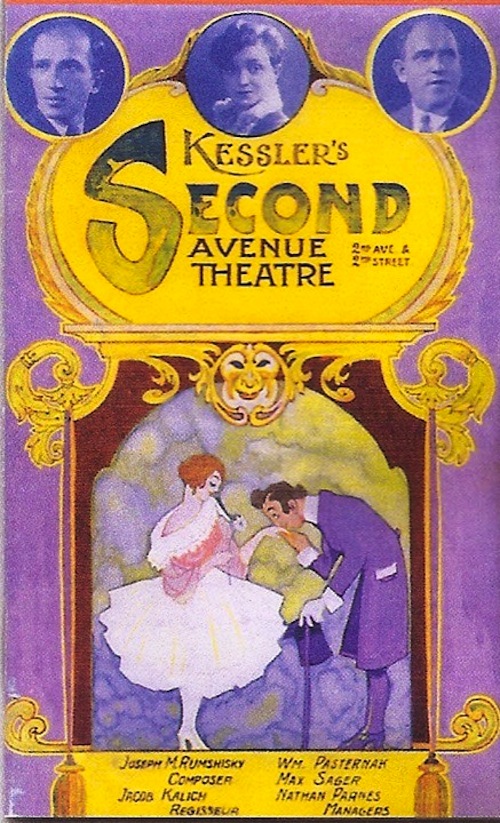
Joseph Rumshinsky’s Yiddish operetta Di Goldene Kale premièred 92 years ago at Kessler’s Second Avenue Theatre in New York, and was still being performed as late as 1948. The Aug. 5 perfomance at Nicholas Music Centre was the first since then. (image from masongross.rutgers.edu)

It is not often that a neglected or forgotten artistic treasure is rediscovered. But it happened recently at a theatre in New Brunswick, N.J. – a concert version, with full orchestra, of Joseph Rumshinsky’s 1923 musical comedy Di Goldene Kale (The Golden Bride). This joyful, melodically blessed operetta was co-presented with Mason Gross School of the Arts by another treasure, the National Yiddish Theatre Folksbiene, the oldest continuous theatre in New York. Founded in 1915 on the Lower East Side, the theatre is now celebrating its centenary.

Di Goldene Kale’s plot is above the usual standard banal fare of Yiddish plays: it involves a young woman who is heir to a fortune and now has several suitors after her and her money. But she loves Misha and ends up with him, after the usual ups and downs of musical comedy narrative.

Rumshinsky (1881-1956), one of the giants of Yiddish theatre during its heyday in the 1920s and ’30s, continued to work and compose until the year of his death. His operetta is full of memorable tunes, which the audience took to immediately. His musical traditions include influences from the Yiddish theatre, American musicals, European operettas and American popular music, most notably the opening chorus of George M. Cohan’s 1917 First World War song, “Over There.” Yiddish theatre was known for having at least one joyous religious occasion onstage, often a wedding, which nostalgically brought back an aspect of traditional Yiddishkeit to now-secular Jews, who were usually watching the performance on a Friday night, and Di Goldene Kale has a very moving Friday night Kiddush, a lovely melody that the soloists and chorus expand via theme and variations.

After its 1923 première, Di Goldene Kale toured the United States, Europe and South America. It was still being performed as late as 1948. The Aug. 5 show at Nicholas Music Centre was the first performance in Yiddish (with English and Russian supertitles) and full orchestra in 70 years.

The stunning cast was led by the gorgeous operatic voice of Dani Marcus, who plays Goldie, the goldene kale, and the fine baritone, Eyal Sherf – a trained cantor – who plays her boyfriend, Misha. The producer and director was Motl Didner, and Michael Ochs edited the orchestral score from manuscripts dating back to the 1923 première. National Yiddish Theatre Folksbiene artistic director Zalmen Mlotek conducted the young, attractive cast, all seasoned in singing, acting and comedy. To find first-rate singers who also act superbly and know Yiddish was a minor miracle and a major achievement. At the show’s end, the full house stood up and applauded. The orchestra and cast then reprised one of the operetta’s songs and everybody went out singing.

***

Classical American Yiddish theatre was also recently the subject of a program hosted by Michael Tilson Thomas, music director of the San Francisco Orchestra, who celebrated the career of his legendary grandparents, Boris Thomashefsky (1868-1939) and Bessie Thomashefsky (1873-1962), who were illustrious Yiddish theatre personalities.

image - poster, Bessie and Boris Thomashefsky, the legendary grandparents of Michael Tilson Thomas, music director of the San Francisco Orchestra, are the focus of the show The Thomashevksys: Music and Memories of a Life in the Yiddish Theatre
Bessie and Boris Thomashefsky, the legendary grandparents of Michael Tilson Thomas, music director of the San Francisco Orchestra, are the focus of the show The Thomashevksys: Music and Memories of a Life in the Yiddish Theatre. (image from thomashefsky.org)

Titled The Thomashevksys: Music and Memories of a Life in the Yiddish Theatre, the show included four singer/actors and members of the Boston Symphony Orchestra at Tanglewood playing selections from Yiddish theatre music.

On the morning after his program, I walked down from our room at the Apple Tree Inn across the street to the Tanglewood grounds, where I met Thomas. I began in Yiddish: “Reb Mekhl” – the name his bobbe Bessie used for him – “ken ikh mit eykh redn a bisl vegn ayer program?” (“Reb Michael, can I talk to you a bit about your program?”)

By speaking Yiddish I wanted a) to know if he understood Yiddish and b) to separate myself from a group of people near him. Born in 1944, Thomas – his father shortened the original name – never met his famous grandfather, but the conductor told me that Grandma Bessie spent her old age near the family in California. Since she lived to be 89, she was a presence in Michael’s life until he was 18.

“She would show me around in Hollywood and take me to screenings,” Thomas recalled. “She called me Mekhl or Mekhele and would often jibe at my parents: ‘You’re too conventional. But Mekhele is not going to be that way.’”

When Boris’ infidelities became too intolerable, Bessie simply walked out on him in 1912 (she never did divorce him) and opened a rival theatre and became a success on her own.

“My grandmother used to say of her marriage to Boris: ‘We were a mistake – but a beautiful mistake,’” shared Thomas.

One of the most touching of personal anecdotes is Thomas’ strudel story.

“How did my grandmother make strudel? Here is her recipe: ‘You go home, you put on a clean apron, you wash your hands and you bake a strudel.’ And that’s what I do when I prepare for a concert. I make my way to the hall, I put on a clean tux, I wash my hands and I go out there and bake a strudel.”

The Tanglewood program also included a slide show that added lustre to the narration and a brief clip from the only film that Boris ever made, wherein he sings a Yiddish song. Along with sparkling orchestral numbers, the conductor and four singers offered musical selections and scenes from the couple’s real-life drama.

When Franz Kafka, early in the 20th century, brought a Yiddish troupe to Prague and told his audience, “Ladies and gentlemen, you know Yiddish better than you think,” he may have had the Tanglewood audience in mind for, with every Yiddish joke, most of them broke into laughter.

The highlight of the program was Thomas singing the once-popular song “Thomashefsky,” about the actor himself. The conductor pranced on stage, doing all the riffs and gestures of a veteran Yiddish music hall star, with the song’s memorable refrain, “Who do you think is going to marry my sister?” No doubt Grandma Bessie’s spirit was guiding her einikl in performing this enchanting song.

Curt Leviant’s most recent book is Zix Zexy Ztories. His ninth novel, King of Yiddish, will be published in December.

Thirty years and counting

Warren Kimmel as Javert in Arts Club Theatre’s Les Misérables. (photo by Ross den Otter)

This October will mark the 30th anniversary of one of the most adored, reproduced, translated and recorded performances of our time.

If you are one of the few who has not seen Les Misérables, take the opportunity now and head down to the Arts Club presentation, which is on at the Stanley Industrial Alliance Stage until Aug. 16. Even if you have seen Les Mis before, this production is worth catching for a number of reasons, not the least of which is seeing Warren Kimmel display his musical prowess on stage.

Les Mis opened in London with the Royal Shakespeare Company in 1985 and has been seen by more than 70 million people worldwide. In the Arts Club version, Kimmel stars as the policeman Javert who has committed his life to capturing prisoner Jean Valjean. Kimmel reveals on his website that he is surprised that this is the role he ended up in, but happy to be finally doing the show.

“It was the thing to see when I was leaving school and going to university … and, when I graduated from drama school, it was top of my list,” he writes. “For one reason or another, I have either declined, missed or chosen not to be a part of many productions. All of those decisions were mistakes in my opinion but I have finally been sucked into the vortex. And, to boot, I am playing the last character I ever imagined I would be. Great hat though!”

The award-winning Kimmel is one of a stellar cast of singers who hardly have a fault among them, and their performances are stirring – from the mournful “I Dreamed a Dream” to the rousing “Do You Hear the People Sing?” to the plaintive “Bring Him Home.” (I dare you not to shed a tear during this heartrending rendition by Kieran Martin Murphy.)

Even a tiny bit by ensemble member Kevin Michael Cripps as Bishop Myriel stands out as a memorable performance. And Kimmel’s interpretation of “Stars” certainly holds its own against that of any of the other Javerts in the musical’s history.

Many people think that Les Misérables was written about the French Revolution of 1789. In fact, the story centres on a lesser-known republican rebellion that took place in 1832. Like a fire that appears to have been squelched but comes back to life after a time, the 1832 insurrection was a reigniting of leftover anger from a larger rebellion in July 1830 that saw the overthrow of the Bourbon monarchy.

The story’s author, Victor Hugo, was on his way home when he was caught in the crossfire in 1832, stuck in an alley behind the barricades that are a key element in the musical. Though originally a staunch monarchist, he became a republican supporter and, 30 years after his experience, he wrote the novel, which is still required reading in many French schools.

So popular has this story been that the musical has been translated into 22 languages. For a taste of some of these, including songs in Swedish, Japanese, Polish and Norwegian, watch “Do you hear the people sing: Sung by 17 Valjeans from around the world” on YouTube.

Though it’s normally performed in large theatres with the capacity for several thousand, the production translates very well onto a smaller stage, and I think the intimate location makes for an even better experience. It has been six years since it played at the Arts Club, and who knows when it will be back? Don’t miss the opportunity.

Baila Lazarus is a freelance writer and media trainer in Vancouver. Her consulting work can be seen at phase2coaching.com.

TUTS takes on light and dark

Dustin Freeland as Link Larkin, Erin E. Walker as Tracy Turnblad, Hannah Williams as Penny Pingleton and ensemble members in Hairspray. (photo by Tim Matheson)

When Theatre Under the Stars announced its lineup earlier this year, I was excited. I’d enjoyed the movie Hairspray, but not seen the stage version, and the last (and only) time I had seen Oliver! was at Winnipeg’s Rainbow Stage when I was just shy of 9 years old. The brutality in that production, in particular Nancy’s death at the hands of Bill Sykes, stayed with me, and I was curious to see how TUTS would handle it.

But first, Hairspray. “Good Morning, Baltimore” is one of the greatest songs. So cheerful and optimistic, its driving beat setting the tone and pace of the entire musical. If only we could all carry such confidence and positive energy out into the world. But I digress. The broad expanse of the movie, in which heroine Tracy Turnblad, sings and dances her way to school through the city that she loves is, of course, not possible on stage, and the added sparseness of Brian Ball’s TUTS set – basically tiered, multi-colored stages with the odd extra prop or flourish – took a little adjustment in perspective. But once I scaled my expectations, I came to appreciate the room his choices made for the dancers. And what dancing! Julie Tomaino’s choreography was not only fabulous, but it was professionally executed by the mainly amateur cast.

Many of the cast members are at least triple threats. Starting with the lead, Erin E. Walker does a commendable job as the boundless Tracy, who, in 1962 Baltimore, sets out to be a dancer on The Corny Collins Show despite her relative largesse, and ends up not only winning a spot on the show but getting its Elvis-like heartthrob Link Larkin (perfectly played by Dustin Freeland) to fall in love with her. Oh, and she also inspires significant social change along the way, succeeding in racially integrating her favorite show. And, she convinces her mother – a pleasantly understated performance by Andy Toth – to come out of the house after a decades-long, self-imposed imprisonment out of shame over her weight.

On her mission(s), Tracy is supported by her best friend, Penny Pingleton, played by the obviously talented Hannah Williams, though the accent she chooses for the role makes her sound incredibly stupid. Thankfully, she sings more than talks. I also had a problem with a couple of the other accent choices – Ryan Purdy as Tracy’s dad sounds like a complete moron, rather than the tenderhearted, somewhat nerdy guy he is; and I’m still trying to figure out how a German prison matron made it to 1962 Baltimore.

For the most part, however, director Sarah Rodgers’ pacing and style are spot on; the costumes by Chris Sinosich are colorful and suit the characters and period; and music director Chris D. King, whose orchestra is fantastic, does an excellent job as Corny Collins. And three other standouts cannot go without mention: Cecilly Day as Motormouth Maybelle and, as Maybelle’s children, David Lindo-Reid as Seaweed J. Stubbs and Marisa Gold as Little Inez.

Oliver! is a much more uneven performance. TUTS valiantly tries to evoke 1843 England beyond the stage and, by the time the show starts, kids (and older folk) have had the chance to see a Punch and Judy show, compete in a 20-yard dash, show their strength in a bell-ringer contest and watch some comedic but able strongmen. While the “village fair” is a lot of fun and a great idea in concept, it sets the wrong tone for the musical – poor orphan Oliver, after all, left in a workhouse after his mother dies giving birth to him, does not get to have much fun.

The first few musical numbers also struggle to respect the darkness of the story. At the workhouse, the main “problem” is the portrayal of Mr. Bumble, who is played much too loudly and vulgarly by Damon Calderwood. At the undertaker’s (to whom Oliver is sold), dancing zombies and more overacting detract one’s attention from Oliver’s plight. A rushed rendition of the beautiful ballad “Where is Love” is a lost opportunity to latch on and care for Oliver, who is well-played by Carly Ronning.

It is only when Oliver manages to walk himself to London and find a home with Fagin’s gang of thieves that director Shel Piercy’s vision becomes more uniform and appropriate to the subject matter.

photo - Stephen Aberle as Fagin, Carly Ronning as Oliver (centre, on floor) and the young cast of Oliver!
Stephen Aberle as Fagin, Carly Ronning as Oliver (centre, on floor) and the young cast of Oliver! (photo by Tim Matheson)

The young Nathan Piasecki as the Artful Dodger is one of the highlights of this production, as is his boss, Fagin, played by Jewish community member Stephen Aberle. The connection I felt some 36 years ago to Nancy just wasn’t there, however. Calderwood fares better as the evil Bill Sykes than Mr. Bumble, but again without any refinement, so it is hard to understand why Nancy, played ably by Elizabeth Marie West, would love him. She also was dressed quite fancily and seemed like a lady, so it was a wonder that she would be involved with him and Fagin in the first place. I had to stop myself from rolling my eyes during her rendition of “As Long As He Needs Me,” when I should have been sympathizing with her predicament – to be loyal to her (dangerous) man or risk her life to save Oliver. While the character’s death may have semi-traumatized me as a child, I can say this – it was both moving and memorable, neither of which applies as much to this version.

All that said, it is worth repeating that, from the moment Oliver meets the Artful Dodger just over halfway through Act 1, and is encouraged to consider himself part of Fagin’s “family,” TUTS’s Oliver! is a solid, enjoyable production. The ensemble – which includes community members Kat Palmer and Julian Lokash – are an incredibly talented and energetic group well worth seeing and hearing in action. They land the choreography of Keri Minty and Shelley Stewart Hunt and are in perfect tune with the orchestra, led by music director Kerry O’Donovan.

Theatre Under the Stars presents Hairspray and Oliver! on alternate evenings at Malkin Bowl in Stanley Park until Aug. 22 (tuts.ca or 1-877-840-0457).

Shakespeare musical

Left to right, Jay Hindle, Josh Epstein and Daniel Doheny in Bard on the Beach’s Love’s Labor’s Lost. (photo by David Blue)

How do you get more people interested in Shakespeare? Give ’em what they want – music, song, dance, comedy and words that are easy on the ears. Bard on the Beach has incorporated all these elements into its production of Love’s Labor’s Lost, set in a speakeasy in Chicago in the Roaring Twenties.

Think Prohibition, gangsters, molls, spats, fedoras, shoulder holsters, Cole Porter, flappers, the Charleston and vaudeville, all in glorious Technicolor, and you get an inkling of what is to come. Set on the intimate Howard Family Stage in the Douglas Campbell Studio, the fun begins the minute you walk through the tent flaps, as cast members accompany you to your seats with song and dance (and martinis – theirs, not yours). It continues with introductory remarks by a ventriloquist dummy that looks (and sounds) a lot like artistic director Christopher Gaze.

Ferdinand, aka “the king” of the gangsters (Jay Hindle), decides to shut down his nightclub, Navarre, devote three years of his life strictly to academic study and abstain from all vices including women (ouch!). He talks his friends Berowne (Jewish community member Josh Epstein) and Dumain (Daniel Doheny) into joining him in this escapade and the three sign a pact. However, just as they embark on their chaste journey, they meet blond bombshell Princess (Lindsey Angell) and her two friends, Rosaline (Luisa Jojic) and Katherine (Sereana Malani), each of whom catches the fancy of one of the potential abstainers.

To woo their respective ladies, the smitten men write secret letters and have a messenger, the resident clown Costard (Andrew Cownden), deliver them to the objects of their affection. Meanwhile, a fourth love story is brewing during all of this action, that of Don Amato (Andrew McNee), Ferdinand’s Italian house guest, who has fallen for Jaquenetta (Dawn Petten), one of the Navarre flappers – who has also written a letter to be delivered by Costard. A mix-up occurs (naturally) and what happens next is an hilarious musical romp through courtship interruptus with the men disguised and the women masked.

Princess’ chaperone, Boyet (Anna Galvin), gets into the game as the go between the men holed up in Navarre and the women forced to camp outside the building. Witty repartee abounds as the battle of the sexes heats up, and we all know who eventually wins that battle.

As musical director, Ben Elliott (with Jewish community member Anton Lipovetsky as his assistant) has done a great job of bringing iconic hits from the ’20s into this show. The jazz band (piano, bass, trumpet and drums) is the perfect background for the actors who, during an intense soliloquy, suddenly break into songs like, “It Had to Be You,” “Ain’t Misbehavin’,” “Second Hand Rose” and “Blue Skies.”

Epstein – who is the face of this production with Jojic on the season poster – wows with his voice in every number he sings and is certainly one of the standouts along with McNee, who sports a soprano-like gangsta accent and puts on a daring one- “woman” show (accompanied by his sidekick, Moth, played by Lili Beaudoin), and Petten, with her nasal voice and horizontal dance rendition (she rolls down the stairs and right back up).

This is the same cast that performs A Comedy of Errors on the BMO Mainstage (reviewed in the July 3 Independent) and it is a credit to their collective comedic acting talents that they can pull off both shows with success.

The set and lighting provide the feel of an underground Chicago speakeasy. The costumes by Rebekka Sorensen-Kjelstrup are simply divine, sparkly, fringed sheath dresses, rolled-up silk stockings, beautiful headdresses and glamorous fur stoles for the women; snappy suits, hats and Oxfords for the men. Valerie Easton’s peppy choreography is spot on.

Some will say that this production goes too far, and is not really Shakespeare – after all, Shakespeare: The Musical, who would have thought it possible? As with Bard on the Beach’s Comedy this year, purists are going to lament the loss of classical productions but, on Love’s opening night, audience members were humming along with the songs, tapping their feet to the catchy tunes and they jumped up in unison for a standing ovation before the last note was sung in the closing song, “Dream a Little Dream of Me.”

You have to give Gaze credit for taking a chance on director Daryl Cloran’s vision, which includes cutting half of the original text and omitting some characters. As he writes in the director’s notes, “Ultimately, that’s what’s so exciting to me about adapting a script – the process of exploring, shedding and inventing to get to the heart of the story and find a way of telling it so that it resonates with a contemporary audience.” It is a safe bet that even old Will himself would be doing the Charleston Stratford-on-Avon way if he saw this version of his play. If you are a lover of jazz and showmanship, this production is a must-see. While it runs until Sept. 20, word on the street is that shows are selling out quickly so don’t wait too long to book your tickets (bardonthebeach.org or 604-739-0559).

Tova Kornfeld is a Vancouver freelance writer and lawyer.

Community talent in TUTS

Left to right: Nathan Piasecki (Artful Dodger), E. Marie West (Nancy) and Stephen Aberle (Fagin) in Theatre Under the Stars’ production of Oliver! Aberle also plays Mr. Brownlow. (photo by Tim Matheson)

Actor Steven Aberle describes Theatre Under the Stars as “a thrilling combination of enthusiastic, amazingly talented youth and, as they say, ‘seasoned’ pros.” In this instance, Aberle – who plays both Fagin and Mr. Brownlow in TUTS’s Oliver! – counts among the seasoned pros, while fellow Jewish community member Kathryn Palmer, who plays Strawberry Seller and is in the ensemble, is one of the talented youth, though Aberle and the other seasoned pros also have plenty of that, of course. The Independent caught up with both actors by email earlier this month.

More than just luck

JI: You’re a relative newcomer to the Vancouver stage. Could you share some of your performing background?

photo - Kathryn Palmer is Strawberry Seller / ensemble in Oliver!
Kathryn Palmer is Strawberry Seller / ensemble in Oliver! (photo from TUTS)

Kathryn Palmer: I have always had a deep-seated passion for music and performing. When my home life started getting rocky, my Auntie Kathryn, who was a professional opera singer, seized the opportunity to get me out of the house for a few hours a week and into her studio for voice lessons. I was hooked and completely inspired! It wasn’t long before I was accepted into the voice program at Canterbury Arts High School, taking Royal Conservatory Exams, singing in choirs, competing in music festivals across Canada and performing in as many musicals as I could.

JI: You’re a graduate of the Canadian College of Performing Arts in Victoria. Are you from Victoria? Can you share some of your personal background, including what role, if any, Judaism or Jewish culture or community has played (plays) in your life?

KP: Born and raised in Ottawa, I moved to Victoria to study at the Canadian College of Performing Arts. I was very fortunate to graduate with about two years of paid theatre work … beginner’s luck, I call it.

At school, we were always told to use what makes us different and unique. One of the things my auntie had taught me was all about Jewish folk music. Being able to sing folk songs in Yiddish and Ladino was definitely something that made me unique but also grounded me. Being Jewish doesn’t exclusively impact the work I choose to do but it definitely infuses it. When I’m doing these musicals that are set in the past, I always wonder that would my life be like a young Jewish woman during this time. I also get excited to perform in shows with a more Jewish theme, like Hodel in Fiddler on the Roof at the Gateway Theatre or Louise Philo in Girl Rabbi at Congregation Emanu-El in Victoria.

JI: What are some of your aspirations regarding a career in performance?

KP: I adore theatre. I love musical theatre. I also love working with kids. I want to go back to school within the next few years and do my ECE [early childhood education]. I’m hoping to one day move back to Ottawa and start a theatre school there. Hopefully, I can inspire children the same way my auntie inspired me.

Not just the beard

JI: You seem to have been very busy on stage in the last couple of years. Can you share with readers some of your performance highlights since the JI last spoke with you in December 2013 about Uncle Vanya?

Stephen Aberle: I have been blessed with busy-ness these past several years, yes, kein ayin hara [no evil eye]. I guess I’m at that stage in my career where, if one remains alive, willing and (unfortunate but still true in today’s theatre) male, opportunities arise. Since

Uncle Vanya, I’ve had the good fortune to perform in Snapshots: A Musical Scrapbook, with music by Stephen Schwartz (of Godspell and Wicked fame) at Studio 1398 on Granville Island last fall. That was an opportunity to work on some amazing material with a wonderful company, including director Chris McGregor and Wendy Bross Stuart as music director.

I’ve been fortunate to perform with Wendy many times, including a couple of shows together at TUTS. We’ll be doing Snapshots again this coming fall [late October, early November], at Presentation House in North Vancouver, this time to be directed by Max Reimer.

I got to be part of a workshop of Hamelin: A New Fable by Leslie Mildiner (another member of the Jewish community) for Axis Theatre, although, unfortunately, scheduling didn’t make it possible for me to be in the touring production. And, earlier this year, I was in What You’re Missing, a lovely new play by Vancouver-born playwright Tamara Micner (she’s now based in London), at the Chutzpah! Festival.

JI: What most attracts you to, and repels you about, the character of Fagin? How are you approaching the role?

SA: Well, Fagin is one of the great characters of 19th-century literature – and, in Dickens’ novel at least, one of the great antisemitic caricatures of all time. That kinda sums up both the attraction and the repulsion: the character and his motives and passions are grand, fascinating, delicious for both performers and audiences; he’s also, let’s not mince words, a brutal travesty – again, as Dickens originally conceived and presented him in the novel Oliver Twist.

I want to rise to the level of the challenges the character offers. He’s big, and I need to honor and own that and, at the same time, find the truths in the character and his situation. Lionel Bart, who was Jewish and who created the musical Oliver!, trod a careful line in dealing with Fagin. There are no explicit references in the play to Fagin’s being a Jew, but Bart wove klezmerish themes into a lot of his music. The late great Ron Moody, also Jewish, who originated the role in London and who played it in the movie, followed that line, playing into Jewish nuances in the music and in the character’s accent.

The story of Oliver Twist and of the musical Oliver! deals with some dark themes – themes that are very much still with us, here and now. Grinding poverty rubbing shoulders with enormous wealth and privilege; love, hatred, loyalty and betrayal; violence against women; criminality, justice and injustice; prejudice; legitimacy and illegitimacy and the arbitrariness of those categories. Our director, Shel Piercy, is not shying away from that darkness, and I’m interested in his approach, his color palette. There can be a tendency, sometimes, for musical comedy to be cutesy, all fun and games and sweetness and light; that’s not the intention with this production. So, I’m looking for ways to explore Fagin’s breadth and depth. He’s devious, avaricious, by turns fearful and bold, can be selfish and brutal; he’s also probably the closest thing to a parent most of his gang of little thieves have ever known. He uses them, but he also feeds them and shelters them and plays with them and teaches them the only way he knows how to make a living, which happens to be thieving.

Shel has made some intriguing casting choices. One actor – Damon Calderwood – plays both Mr. Bumble and Bill Sykes, and Shel has me playing both Fagin and Mr. Brownlow, the kind gentleman who strives to rescue Oliver from Fagin’s clutches. I get to play both the wicked and good father (or grandfather) figures, if you like. A practical consequence of that choice is that I spend a lot of time on stage, so one important goal for me as an actor will be to remain upright. It’s going to be a workout.

JI: You were Buffalo Bill in a prior TUTS season. How did you come to start auditioning with TUTS, and have there been other roles? Does performing on an outdoor stage present unique challenges?

SA: I first worked at TUTS (in those days it was called Theatre in the Park, or TITPark) in the mid-’70s as a carpenter and stagehand, and I’ve had the pleasure of performing there each decade since – in Anything Goes in ’87, as Tevye in Fiddler on the Roof in ’97 and as Buffalo Bill in Annie Get Your Gun in 2008.

I started auditioning for TUTS soon after I graduated from Studio 58, and I keep auditioning there when I’m free and I think there might be a role for me. I love it there. The people are great, a thrilling combination of enthusiastic, amazingly talented youth and, as they say, “seasoned” pros. There’s a lot of love around the place. A special smell pervades the atmosphere, although it no longer carries as much of the whiff of pigeon droppings as it had in the old days. I’ve probably been just about everywhere it’s possible for a human being to get to in that building, including all over way up in the gridwork, where I spent a great deal of my time during those summers in the ’70s.

Playing outdoors presents some curious and inspiring challenges, yes indeed. There are obvious ones, like wildlife, for example. You never know when you might be joined on the stage by a raccoon or a squirrel or a crazed moth, and every actor knows that small children and animals – even insects – are far more interesting to watch on stage than we are because they’re unselfconscious and unpredictable.

We’re playing in Vancouver in the summer and the days are long, so the first half or so of the show is hard to light – you can’t use light to draw the audience’s attention very effectively because it’s hard to compete with the sun. Shel pointed this out to us in rehearsal: “Your movement is my spotlight.” We as performers need to provide focus through our actions, positions, motions and stillnesses. We’re also quite far away from the audience, so we have to use our bodies fully. Someone in the 20th or 30th row may barely be able to make out my features, so I need to release my thoughts and emotions into my body: to smile and frown and laugh and wonder, not just from the neck up but with all of me….

JI: If there is anything else you’d like to share with readers, please do.

SA: Well, there is one other thing. It’s interesting to me that, especially in the last few years, so many of the characters I’ve played have been Jewish. Tevye in Fiddler, Jacob in Joseph … plays at the Chutzpah! Festival, now Fagin. I think I get called to audition for most of the film and TV rabbi parts that come into town.

I guess it’s the beard.

Oliver! alternates evenings with Hairspray from July 10-Aug. 22 at Malkin Bowl (tuts.ca).

No errors in Comedy

Josh Epstein, left, and Andrew Cownden in Bard on the Beach’s production of The Comedy of Errors. (photo by David Blue)

It’s summer in Vancouver and with it comes sun, surf and Shakespeare – that is, Bard on the Beach under the iconic red and white tents at Vanier Park. Celebrating its 26th season, the festival serves up an interesting mix this year: A Comedy of Errors, Love’s Labor’s Lost and King Lear, from the pen of the Bard himself, and a contemporary piece, Shakespeare’s Rebel, by local author Chris Humphreys.

Opening night of Comedy of Errors on June 13 saw the always dapper artistic director Christopher Gaze welcoming the crowd under the big tent of the BMO Stage and, for the first time in the history of the festival, acknowledging that the land upon which the tents are pitched for their annual sojourn is ancestral, traditional and unceded aboriginal territory. Deborah Baker of the Squamish Nation gave greetings and performed a traditional drum song.

Comedy of Errors is one of Shakespeare’s earliest works, the shortest in his repertoire, and it contains the zaniest of his plots. It is the tale of two sets of identical twins, one aristocratic, the other, their boy servants, with the pairs separated in the aftermath of a shipwreck. The family patriarch, Egeon, has spent years looking for his lost progeny and servants. His search takes him to the town of Ephesus, where he is captured and sentenced to death (no one is supposed to come to Ephesus without permission) but receives a last-minute reprieve to look for his sons and to find money to pay the fine.

It just so happens that one of the sons and his servant ended up in Ephesus while the other two ended up in Syracuse. Both sons are named Antipholus and both their servants, Dromio – all of this sets the stage for a frenzied journey through mistaken identities, hilarious hi-jinks and the ultimate sibling reunification when the Syracuse pair show up in Ephesus.

But what a journey. Think Edward Scissorhands meets Little Shop of Horrors meets Metropolis, and you have director Scott Bellis’ (who does double duty as Egeon) fantastical steampunk version of this production. What is steampunk? A mix of sci-fi electronics and gadgets set against a pseudo-Victorian era background as stylized by authors like Jules Verne, H.G. Wells and Mary Shelley.

The production is a bit over the top with its madcap bits and bobs – a hand-eating Venus fly trap, a communal lobotomy by a mad scientist, a creature trying to escape from a boiling soup pot, a Michael Jackson-like moonwalk, a bubble-shooting gun and a flatulation moment – and its frenetic pace. It is mostly fluffy fun although if you are looking for some meaning, there are three love stories intertwined with the humor. Shakespeare purists will probably cringe in their seats. But the opening night crowd was eating it up and this unique approach should bring in younger audiences and make the Bard’s words more accessible to a wider demographic. This reviewer loved it!

The acting is solid from the ensemble cast, many of whom do double and even triple duty in various roles: Ben Elliott as one Antipholus, Jay Hindle as the other, Jeff Gladstone as the mad Dr. Pinch, Andrew McNee as the grunting cook Nell, Daniel Doheny as the chambermaid, Lilli Beaudoin as the foxy courtesan, Jewish community member Josh Epstein as the smuggler, Andrew Cownden as the goldsmith, Sereana Malani as the Ephesean Antipholus’ overbearing wife, Lindsey Angell as her nerdy sister and Anna Galvin as the abbess, who makes her first appearance on stage in stilts. But it is the pint-sized Dromios, played by Dawn Petten and Luisa Jojic, who give the standout performances of the production. In their aviator hats and goggles, they really do look like identical twins. Petten, in particular, takes her role and runs with it with impeccable comedic timing and one of the best “ad lib” lines in the play, “Call before you dig.”

What really makes this production sublime are the visuals. The set is fantastic, a wall of steam-powered widgets, sprockets and gears dominated by a one-handed clock with a mind of its own, all kept in working order by shadowy, silent engineers constantly tweaking the machinery with wrenches and hammers. The play begins with one of the engineers pushing a big red button and, all of a sudden, the empty stage becomes a mélange of color and activity as the cast appears through a smoky haze, some through the many trapdoors in the floor, some out of the bowels of the machines, some appearing to drop out of the sky – all courtesy of community member Tara Cheyenne Friedenberg’s terrific choreography.

This dreamlike mechanical dance sets the tone for the whole evening. Mara Gottler has outdone herself with the costumes – lots of leather, lace-up boots, corsets, garters, black lace and accessories like aviator goggles, gas masks and leather bat wings. Gerald King’s lighting and Malcolm Dow’s sound design are the icing on this macabre cake.

Just as the action starts with a push of a button so does it end, with the shutting down of the machinery after the final revelations. This is one production that you can just sit back and enjoy, pure and simple fun.

Comedy runs to Sept. 26. For the full Bard schedule and tickets for any of this season’s offerings, visit bardonthebeach.org or call the box office at 604-739-0559.

Tova Kornfeld is a Vancouver freelance writer and lawyer.

The same old stories

Aubrey Joy Maddock as John the Baptist, left, Andrew Cohen as Judas and Jennifer Copping as Jesus in Arts Club Theatre’s Godspell. (photo by David Cooper)

Before I attended Godspell, I was not familiar with the story or with the parables of the Gospel of Matthew, from which much of the content is taken. I did, however, know what a parable was, I knew that the play has been extraordinarily successful and I recognized the name of at least one song – “Day by Day” – so I assumed I had nothing to worry about.

I was wrong. By the end, I still didn’t get why this play has been so popular.

Godspell is essentially a series of vignettes that draw analogies between Matthew’s words and day-to-day life. It includes lessons such as, “Judge not, lest ye be judged,” “He that is without sin among you, …” the Prodigal Son, etc. Jesus relates these didactic stories to a group consisting of nine people that include a police officer, a waitress, an architect and a vamp. Judas and John the Baptist round out the cast of 12.

In each presentation of Godspell, the setting of the play, the costumes and some of the characters change. Updated scripts allow for the inclusion of cultural or geographic references that are familiar to the audience.

In the Arts Club production, the cast meet in a train station and the play unfolds as a game show where contestants participate based on the color of the shoes they’ve been given. Gospel analogies are acted out using modern story lines, including characters from Star Wars or rap songs.

To me, the play came across as a bunch of children’s shows that had been stitched together. I felt like I was back in elementary school, only instead of Smokey the Bear talking about forest fires, it’s Jesus and he wants you to avoid being stoned to death.

I found some of the skits infantile. In one case, the cast sing and talk like goats; in another scene, an audience member is pulled up to participate on stage resulting in some bad improv. And don’t get me started on the slapstick.

Godspell was an instant hit. It went from being a college student performance at Carnegie Mellon University to an experimental theatre production in Greenwich Village to being re-scored and opening off Broadway in 1971. John-Michael Tebelak originally wrote the play for his master’s thesis, having become enamored with the Gospels. Stephen Schwartz, a Carnegie Mellon alumnus was brought in to score. The award-winning Schwartz has become famous for his work in Wicked, as well as Enchanted and The Prince of Egypt. Tebelak was actually named most promising director of 1971 by the New York Drama Desk, but passed away at age 35 of a heart attack.

The show ran for five years off Broadway with an astounding 2,100 performances. The 2015 run in Vancouver is its sixth revival.

It had a particularly famous yearlong run in Toronto in 1972 with a cast that included Victor Garber, Gilda Radner (in her stage debut), Martin Short, Paul Shaffer, Eugene Levy, Andrea Martin and Dave Thomas. When I read about this production, I thought what an amazing show it must have been – staged at the Royal Alexandra Theatre, with that magnitude of talent. Maybe a show about the Bible needs a venue of biblical proportions, along with fire-and-brimstone effects that stun the audience with shock and awe. Perhaps the performance at the Arts Club was just too small.

Either way, despite my lack of interest in this particular telling of the parables, I have to tip my hat to the high calibre of quadruple-threat talent (singing, acting, dancing and, in many cases, playing an instrument) on stage. Andrew Cohen in particular stands out in his supporting role of Judas.

Godspell runs at the Arts Club Granville Island stage until Aug. 1 (artsclub.com).

Baila Lazarus is a freelance writer and media trainer in Vancouver. Her consulting work can be seen at phase2coaching.com.

Choreographers on the edge

Tara Cheyenne Performance’s how to be, part of Dancing on the Edge. (photo by Wendy D Photography)

This year’s Dancing on the Edge festival, which runs July 2-11, once again features the talents of many Jewish community members. The Jewish Independent asked several of them to describe the work they are presenting in the festival and to explain what makes it “edgy.” Their responses appear in the order in which their work appears in the festival.

photo - Vanessa Goodman
Vanessa Goodman (photo by Jeff Pelletier)

Container, choreographed and performed by Vanessa Goodman, with original sound composition by Loscil, is a new work “that explores heritage, culture and resilience.” (Part of Edge 1, July 3 and 4, 9 p.m., at Firehall Arts Centre.)

“What makes the work ‘edgy’? Well, I am not 100% sure that I would categorize the work as edgy,” said Goodman. “However, I would say that the physicality/embodiment shifts between different extreme states, taking the witness/audience on a journey of my experience within the work.”

Re:Play: a duet choreographed by Naomi Brand and performed by Hilary Maxwell and Walter Kubanek. (Part of Edge Up, July 5 and 6, 8 p.m., at Firehall Arts Centre.)

“The piece is a playful exploration of the space between two bodies in dialogue,” said Brand. “It looks at what we choose to display and disclose and what gets hidden and smoothed over in conversation. The element of play is a theme that drives the duet as the dancers show and tell, watch and listen, repeat, respond and react to one another. The piece is set to a sound score that brings the process to light, with dancer Walter Kubanek practising Chopin’s Nocturne Op. 9 No. 1 on piano, and sound clips of the dancers in rehearsal. Playing on the edge between cooperation and competition, the dancers engage in a dynamic negotiation of space.”

photo - Hilary Maxwell and Walter Kubanek in Re:Play
Hilary Maxwell and Walter Kubanek in Re:Play. (photo by Chris Randle)

Feasting on Famine: choreographed by Shay Kuebler, Radical System Art. (Part of Edge 5, July 9 and 11, 7 p.m., at Firehall Arts Centre.)

“This performance looks into the extremes of bodybuilding culture and how it references capitalism and the corporatization of the human body – growth edges out all other aspects of self. One man’s physically charged journey into the depths of extreme health and fitness will leave the audience on the edge of their seat.

“The work combines theatre, dance, and martial arts to construct an edgy and modern look at the extremes of society,” said Kuebler.

Duck Dances “promises to be a whimsical exploration of curious imagery, woven together with the color red to reveal a charming tableau of events within the framework of Dusk Dances,” reads the description on Dancing on the Edge’s website. (July 9, 10 and 11, 7 p.m., at Portside Park.)

“I am creating a piece in collaboration with Jennifer Mascall and Susan MacKenzie for Dusk Dances. We’re calling it Duck Dances,” Amber Funk Barton told the Independent. “For me, this work is ‘edgy’ because I have never created a site-specific work and our intention is that our performers will also be all ages and abilities. Using Crab Park as a studio instead of a studio is not only inspiring but challenging me to work outside of my comfort zones and creativity.

how to be is “the latest ensemble creation to emerge from the strange mind of Tara Cheyenne Friedenberg (Tara Cheyenne Performance). The piece examines how we think we should ‘be,’ how we think others should be and how impossible and futile it all is. Using ideas found in malignant social media, cultural restrictions, and the ceaseless voices in our heads, how to be traces five characters as they navigate how to be.” (Part of Edge 6, July 10, 7 p.m., and July 11, 9 p.m., at Firehall Arts Centre.)

“I consider this piece ‘edgy’ because it plays with text, audience relationship, what is ‘appropriate’ in life and in performance,” said Friedenberg. “This is not a typical dance piece, but it is a piece only highly trained dancers could do. I expect to tiptoe very near the edge of extremely uncomfortable and deliciously funny.”

For the festival’s full schedule, visit dancingontheedge.org.