Lokash cast in musical’s title role

Julian Lokash plays the title character in Carousel Theatre’s James and the Giant Peach. (photo by Tim Matheson)

When asked how long he’s been an actor, 11-year-old Julian Lokash didn’t hesitate. “Since I was born!” was his immediate response.

The young actor is the star of the upcoming Carousel Theatre production of James and the Giant Peach. As James, he’s in every scene, which has meant that he has been in rehearsals for two months, from 9-5 each day, except on Mondays, when he has the chance to go to school like other children his age. He is in Grade 6, in the French immersion program École Jules Quesnel in Point Grey.

Julian is not only an actor. He is what the theatre world calls a triple threat. “I dance and sing as well,” he said. “When I was just 1 or 2 years old, I was always dancing around and singing, even before I could talk,” he explained when asked about how his parents knew he was interested in the performing arts.

Julian shook his head emphatically (perhaps even a bit theatrically) when asked whether anyone else in his immediate family has any talent for musical theatre. He did say that his father’s cousin works for Dreamworks and that his dad also has an aunt who played in an orchestra but, as far as Julian is concerned, he’s an anomaly in his family.

Looking outside of the family for performance role models, Julian said he is a big fan of many of the actors on the TV show Glee because he thinks they have great voices. He also loves the Disney movie Frozen and, specifically, Idina Menzel, the voice of Elsa.

When he was younger, Julian was involved in Stage Coach, a theatre arts program that developed his interest and talent for musical theatre. More recently, he spent his last two summers in the Jewish Community Centre of Greater Vancouver’s Gotta Sing! Gotta Dance! musical theatre summer school run by Perry Ehrlich. “Perry was the one who told me to try out for James and the Giant Peach,” said Julian. “He’s sort of like a musical theatre agent because he’s watching out for things for me.”

In fact, Julian has had an acting agent in the past. Through that agent, he did a commercial for Crayola. “I’m at a pause right now because I don’t have time for TV or commercials right now,” he said. He admitted that, at this point in his life, he prefers musical theatre but thinks that, in the future, he may have to do some TV. He’s confident that he’s found his calling and already has part of his acceptance speech ready for his Tony or his Oscar. “My friends wanted me to tell you that they are really supportive. My family is so supportive, too,” he said.

With theatre such a big part of his life, Julian does ballet, tap and jazz dancing, as well as voice lessons. The busy schedule of rehearsals, not only for James and the Giant Peach, but for any production, requires strong family backing. Luckily, his parents are happy to see their son doing what makes him happy.

It’s not all about the arts, however. Julian likes to be active and he gets that through dance as well as regular family ski weekends at Whistler. “I love to ski but I think this winter my brother and I are both going to tone it down and maybe only ski Saturdays,” he said. He admitted that he’d like a bit more time to spend with his friends.

Despite his busy schedule, Julian has found time to participate in a Jewish education class organized by a number of parents in his neighborhood. All of the students are kids living in Point Grey who attend public school and whose parents want their children to have some Jewish education without formalizing a connection to a synagogue. He mentioned that he’s not very religious but he does like to celebrate the Jewish holidays.

James and the Giant Peach tickets are available through Carousel Theatre for Young People. The musical adaptation of Roald Dahl’s classic children’s novel is at the Waterfront Theatre on Granville Island from Dec. 6 to Jan. 4, after which Julian will return to the life of a regular, but talented, Grade 6 student.

Michelle Dodek is a freelance writer and community volunteer living in Vancouver.

Urine the right place

Left to right: Andrew Wheeler, David Adams, Anton Lipovetsky and Chris Cochrane. (photo by David Cooper)

If Saturday night’s performance of Urinetown was any indication, the Jewish community has two rising stars in its midst.

Triple-threats Anton Lipovetsky and Andrew Cohen are actors to watch; and the latest production at the Firehall is a perfect opportunity to see them show off their singing, acting and dancing talent.

Despite its unfortunate name, which gives rise to equally unfortunate double-entendres in theatre reviews, Urinetown did live up to the hype that’s labeled it a Broadway hit. Not one for musicals, I’m happy to say this one kept me entertained throughout the performance, due in no small part to the fancy footwork directed by Tara Cheyenne Friedenberg and Tony Award-winning lyrics by Mark Hollmann and Greg Kotis.

Urinetown takes place in a “town like any town you might find in a musical,” according to the narrator (who jumps periodically out of his role as Police Officer Lockstock to educate the audience about the workings of a play). The year is some point in the middle of a long drought, water is scarce and free toilets have been overburdened in what have become known as the “stink years.”

Facilities are now owned by private companies who charge people for their use. Thus the request, “A penny for a pee?” becomes the begging mantra of street people looking to relieve themselves. If they can’t afford the few cents to get in the doors, their only recourse is to do their business in a public space, for which they will get arrested and sent to Urinetown. The audience doesn’t get to see Urinetown until the second act, so we’ll avoid the spoiler here. Suffice to say, it’s known as a really undesirable spot, and one to avoid at all costs. So paying a fee to pee is really the only option.

In the rather stale part of this “town like any town,” a group of homeless people around “Amenity #9” start to revolt against a new fee hike. The group is led by Bobby Strong (Lipovetsky), who happens to be in love with Hope (aptly named, of course), the daughter of Caldwell B. Cladwell (stage veteran Andrew Wheeler). Cladwell is CEO of Urine Good Co., which owns the private toilets. In this case, the love interest doesn’t get in the way of a good revolution, thankfully, and eventually the impoverished cast free themselves from the shackles of the tinkle toll. Is it a time for celebration? You’ll have to see the play to find out.

The role Lipovetsky has been given in this play serves to highlight his incredible singing talent, comedic flair and even his ability to direct the cast in a choir-like ensemble near the end.

The play only demonstrates a few of Lipovetsky’s skills, actually. The gifted 24-year-old has already won a Jessie Award for outstanding composition for the musical Broken Sex Doll (currently on its second run, playing until Nov. 22 at the Cultch’s York Theatre) and he shared the 2011 Mayor’s Arts Award in Theatre with Bard on the Beach artistic director Christopher Gaze. Lipovetsky won for best emerging actor and playwright.

For his part, Cohen has also been busy in the B.C. theatre scene, appearing in Chicago, Fiddler on the Roof and The Laramie Project, as well as becoming one of the finalists on CBC’s Triple Sensation TV show and performing in the 2010 Olympic Games Closing Ceremonies. He also does sound design and composes. (See “A next gen of theatre artists,” Nov. 7, jewishindependent.ca.)

Besides these fabulous contributors are Wheeler as the nasty, money-grubbing CEO, David Adams as the singing/dancing/narrating officer and Michelle Bardach as Hope. As well, numerous quirky directorial choices, such as having Strong freeze with an expression as though he’d been stung by a bee every time he has a flashback, and Little Sally (Tracey Power) jumping in and out of character to ask the narrator questions about the play, meld to create a surprisingly fun, witty and thoroughly enjoyable production.

Urinetown is at the Firehall Arts Centre until Nov. 27.

Baila Lazarus is a freelance writer, painter and photographer. Her work can be seen at orchiddesigns.net.

Next gen of theatre artists

From Nov. 12-15, Rumble Theatre’s Tremors presents three different plays – Trainspotting by Harry Gibson, The 4th Graders Present an Unnamed Love-Suicide by Sean Graney and This is War by Hannah Moscovitch. They will take place simultaneously in different parts of the Russian Hall. After each night’s performances, the entertainment will continue, with an after-party to which everyone is invited.

Part of Rumble Theatre’s mission is to foster “meaningful interactions between emerging and established artists,” and Tremors does just that. From start to finish, each of the plays is mounted by a group of relative newcomers to the professional theatre world. Knowing Rumble Theatre either directly or indirectly through colleagues, both Andrew Cohen and Naomi Vogt leapt at the opportunity to be involved when the call for artists went out.

photo - Andrew Cohen
Andrew Cohen is doing sound design for Trainspotting. (photo from Rumble Theatre)

“I have been interested in music composition and sound design for a long time,” said Cohen. “When I watch – or hear – a show, the moments I can connect to most are the ones where the sound is used to mirror the action onstage. I’m excited to have started exploring and establishing myself as a composer and designer in addition to performing.”

Cohen will be in charge of sound design for Trainspotting. “I submitted to Stephen Drover, artistic director of Rumble Theatre not knowing which plays were being mounted,” he said. “When we all submitted, we were asked which types of shows we were interested in working on and why. They paired all the designers and directors with their respective shows based on similar theatrical esthetics and tastes.”

Rumble’s mandate to mentor newcomers means that “all Tremors artists are assigned mentors, who are helping us to navigate this challenging material,” said Vogt, who was a student ambassador for the organization in her final year of theatre school.

“I promoted Rumble Theatre’s work, especially their phenomenal show Penelope, and co-produced a 48-hour play-building experiment called The Crockpot, which featured one representative from Vancouver’s theatre training facilities: UBC, Studio 58, Douglas, Capilano, Trinity Western and SFU. The goal of the project was to inspire students at these schools to connect with each other. There’s a tendency among theatre students to work only with their peers, even after graduation. It’s important to maintain those contacts from school, but it’s also important to expand into the larger community of Vancouver artists.”

Vogt will be acting in The 4th Graders, which “is about a class of fourth-grade students who honor their classmate Johnny with a play he wrote, following his suicide,” she explained. “The play details Johnny’s version of the series of events that led to his suicide. I play Rachel, an unpopular 10-year-old who is bullied for being overweight. Rachel and Johnny were ‘boyfriend/girlfriend,’ but Rachel ends the relationship because she believes she’s not deserving of Johnny’s love. The 4th Graders Present an Unnamed Love-Suicide is dark, but it’s so hilarious, too. It explores serious themes of love, betrayal and revenge, but through the lens of a 9-year-old, which I hope resonates with audience members of all ages.

Her past experience should help in her portrayal.

“I started performing in elementary school,” she explained, “when I was given special permission to dramatize Shel Silverstein poems during ‘reading hour’ with a friend. We weren’t popular girls, but our classmates thought our skits were funny – plus, we got out of reading hour! We kept going, eventually developing a sketch series of Oprah Winfrey Show parodies, which we’d perform almost daily to our Grade 4 classmates. I, an overgrown poofy-haired 8-year-old, played Oprah. My friend Allison, a tiny bespectacled thing, played our various idols: Michael Jordan, Michael Jackson, Shania Twain and others. We were a hit.”

photo - Naomi Vogt
Naomi Vogt plays Rachel The 4th Graders Present an Unnamed Love-Suicide. (photo from Rumble Theatre)

It was then that Vogt knew she wanted to be an actor. “It offered some respect and acknowledgment I otherwise didn’t receive in the social arena,” she said. “I knew it was a job grown-ups had, so I thought, ‘Perfect, got that whole what-do-you-want-to-be-when-you-grow-up business sorted. I’m going to take acting classes, hang up some Destiny’s Child posters and things are going to fall into place for me.’ Obviously, a career in the arts is different than my fourth-grade mind dreamed it would be. I’ve only just transitioned into the professional world, and things are difficult sometimes, but my grade school dream is still alive!”

Flourishing, actually. Vogt just completed the bachelor of fine arts acting program at the University of British Columbia, where she won the Evelyn Harden Award. “It’s an award that the UBC theatre faculty gives to a graduating theatre student and, happily, it accompanies a cheque,” she explained. “It’s made available annually through the generosity of Dr. Evelyn Harden. I was so grateful to be the recipient among my class and it helped me make it through my final year.”

Vogt also expressed gratitude for her connection to the Jewish community. “Like theatre,” she said, “my affiliation with Judaism gave me a cultural anchor. In the rocky seas of adolescence, I knew I was a Jewish theatre nerd and, whenever I felt lame, ostracized or unusual, I could feel confident about those two things. It’s still a big part of my life, and so it features pretty largely in my improv and sketch comedy. I often find myself muttering broken Hebrew prayers or referencing Jewish holidays or practices onstage.”

Describing herself as a “‘character’ type within a pool of ingénues,” Vogt said she “often played one of the following roles: old women, very old women, and men. And, I honestly wouldn’t have it any other way. I’m unusual, so I get to play interesting people. For example, in my final show at UBC, I had the fantastic opportunity to play the murderous king Pere Ubu in an all-female version of Alfred Jarry’s masterpiece Ubu Roi, and I couldn’t have asked for a weirder, bigger, more joyful undertaking.”

Cohen, who has been featured in the Jewish Independent on more than one occasion, is also engaged in several interesting and meaningful undertakings. He was in the JI just a few months ago, when he was interviewed about his involvement as part of the faculty of Gotta Sing! Gotta Dance!, which celebrated its 20th anniversary this past summer.

Over the last couple of years, Cohen said he has spent most of his time out of Vancouver, performing in plays and musicals in Calgary, Edmonton, Toronto and Halifax.

“I spent several months traveling around the Americas to work with the Broadway organization Artists Striving to End Poverty. They commissioned me to direct and musically arrange an international music video featuring some of the students from their schools around the world, and some of their celebrity teachers (like cast members from Netflix’s Orange is the New Black, HBO’s Looking, Wicked’s Kristin Chenoweth and others).

“Most recently, I have been working on re-imagining and rearranging the Joni Mitchell canon for a new show co-created with my beautiful, talented fiancé Anna Kuman. Our show, Circle Game, for the Untitled Theatre Company, was developed as part of the inaugural residency with Capilano University. Anna and I are excited to have been granted another development residence, this time with a professional theatre company in the city. We are also very excited to have New York and Stratford director Robert McQueen helm our next workshop.”

Cohen is part of the tech team for Firehall Arts Centre’s presentation of Urinetown, which runs until Nov. 29. This month, he also “will be workshopping a new musical with Axis Theatre that tours around Western Canada in the new year. Following that will be the next development phase of my show Circle Game…. And then, next summer, I will be playing Judas in the Arts Club Theatre’s production of Godspell. After that, I’ve booked the biggest, most exciting gig of my life: marrying the incredible Anna Kuman!”

As for Vogt, she said about her future plans, “It’s scary to be released out of the safety of theatre school, but it’s exciting to work in the professional community, too. I’m teaching with the Vancouver Youth Theatre right now, which is especially fun because I took their classes as a child. I’m also experimenting with physical theatre and puppetry and, right now, I’m taking a clowning class with the remarkable Gina Bastone. Traveling is a big part of my immediate plans, too – I’m hoping to go to Israel in the spring. But, until then, feel free to hire me!”

Tickets for Tremors ($15 for each play) can be purchased via rumble.org. Since the plays take place simultaneously, it is only possible to see one play per night.

Preparing for her next role

In Late Company, Kerry Sandomirsky and Michael Kopsa are a couple who has lost a son to bullying. (photo by David Cooper)

“One year after a tragedy, two couples sit down to dinner. Far from finding the closure they seek, the dinner strips bare their good intentions to reveal layers of parental, sexual and political hypocrisy.”

So begins the promotional material for the award-winning play Late Company, being presented by Touchstone Theatre later this month. It continues, “Loosely based on the true story of the son of a Tory politician who killed himself after being extensively bullied, Late Company imagines what a restorative justice dinner held a year later might have looked like between the parents of a dead gay son, his chief tormentor and that boy’s parents.”

Kerry Sandomirsky takes on the role of the grieving mother. She spoke with the Jewish Independent about the part – and other topics – via email.

JI: The subject matter – and small cast – of Late Company combine to make what seems like a very heavy, intense role. How do you prepare for such roles in general and this one in particular, especially as a mother yourself?

KS: I put my attention on the things that are important to the character, and the world starts to inform you via synchronicity. I was riding on a bus to Kerrisdale and I saw an ad above me for the Josh Platzer Society. It’s for teen suicide prevention and awareness. I contacted them and I’m now communicating with a mother who lost her son. I am also using their recommended reading list for research.

At the same time, my character is a sculptor so I’m reading a biography of Barbara Hepworth.

Earlier this year, I did a similar maternal role in Clybourne Park for the Citadel Theatre in Edmonton. When it comes to intense parts, your nervous system doesn’t know that the grief on stage isn’t real, so there’s a cost. Your adrenal system gets depleted. Being a mom, you have to guard against the play contaminating your life.

I got through Clybourne Park by exercising every day and not drinking any wine. Maybe for this one I’ll have to do the opposite.

JI: The last time the JI spoke with you was in 2011, before The Philanderer. At that time, you were returning to the stage after a two-plus-year hiatus to recover from a head injury. In what ways did that period of being away from theatre change your work/life?

KS: I became a teacher at Studio 58, I accepted an offer to direct, and I decided to take more holidays! I also gave myself permission to be a writer. I turned down playing Cleopatra for Bard on the Beach and instead attended SFU Writers Studio to work with Ivan E. Coyote. After that, I was chosen to go to the Banff Playwrights Colony to work on my one-woman play called Wobble.

JI: Your directorial debut (… didn’t see that coming) was a Pick of the Fringe this year. What were some of the highlights and challenges of directing? Can you see yourself doing more directing?

KS: It was a delight to direct one of my favorite people on the planet, Beverley Elliott, and we had Bill Costin doing our music. So, it was a privilege being in the same room with that much talent for almost a month. I’d definitely do it again. I loved not having to learn all those lines.

JI: When I met you at a recent Museum of Vancouver event, you mentioned having just filmed with Denys Arcand. Is there anything about that you can share?

KS: When you work with someone that gifted, there’s no fear on the set. There’s no ego. There’s just creative collaboration. Denys Arcand and the director Adad Hannah both welcomed input from their actors. Denys is quick to laugh. He was a joy to be around.

JI: What are some of the projects on which you’re currently working?

KS: I want to finish writing Wobble. And, of course, doing another new Canadian play is always fulfilling. I dream of collaborating with Crystal Pite. I’m not a dancer, but I did a workshop with her anyway. I was a troll among the whippets. And I’m hoping to work with Jovanni Sy, the new artistic director of Gateway Theatre. I met him at the Playwrights Colony. He’s a great addition to our Vancouver theatre community.

JI: In what part of the process from idea to stage is Wobble?

KS: Katrina Dunn, the director of Late Company, came to Banff and helped me workshop it. We’ve got a solid first draft. I value her intelligence, her feminism and her compassion. As the artistic director of Touchstone Theatre, she champions new Canadian work. The playwright for Late Company, Jordan Tannahill, just got nominated for a Governor General’s Award, but Katrina chose do a play by him long before that. Her instincts are superb. This will be our fifth production together. It’s a treat to be directed by her.

***

Late Company is at the Cultch, Vancity Culture Lab, 1895 Venables St., from Nov. 21-30, 8 p.m. (Tuesdays to Sundays), plus Nov. 22, 29 and 30, 2 p.m. There is a two-for-one preview Nov. 20, 8 p.m. Tickets ($27/$22) are available from the Cultch, 604-251-1363 or tickets.thecultch.com.


Bigger, better Broken Sex Doll

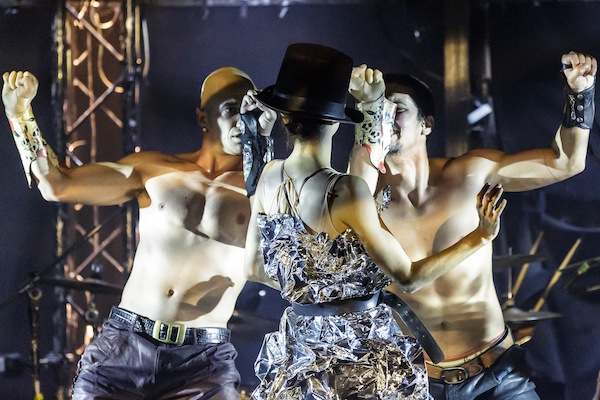
Co-creator Andy Thompson directs the sci-fi musical that is being remounted at the Cultch’s York Theatre Nov. 12-22. (photo from the Virutal Stage)

Broken Sex Doll is back. A hit at the Cultch in 2013, it ventured out to Halifax for the 2014 Magnetic North Festival, and returns to Vancouver Nov. 12-22, where it will play at the Cultch’s York Theatre as part of a national tour. The production will then head to the Yukon for four shows, returning to the Lower Mainland for a run at Coquitlam’s Evergreen Cultural Centre (Dec. 16-20).

Produced by the Virtual Stage, the sci-fi musical is the creation of Jewish community members Andy Thompson (director, book, lyrics) and Anton Lipovetsky (composer). The new production is being billed as “bigger and better.”

“We have a new set. A new lighting design. New costumes. Re-tooled songs. Some new performers. And the script has been tinkered with a little bit,” the award-winning director and writer Thompson told the Independent. “Refining a show is not something you always get to do, so the process feels somewhat luxurious. Rolling up our sleeves together and chiseling out details on a show like this is a lot of fun. Just today we were refining choreography and songs to a level of detail rarely explored in the rehearsal process. Often in the past I have found myself relieved just to get a show on its feet, but where we are currently at with Broken Sex Doll is altogether different. And installing it at the gorgeous York Theatre has been such an honor and delight.”

About the challenges and benefits of remounting a production, Thompson said, “This has been a wonderful opportunity to take another look at the show and make refinements, with the experience and knowledge gleaned from previous incarnations of what worked and what could be improved upon. The challenges vary from the artistic to the technical. My aim with this production is to raise the bar as high as I possibly can and produce as close to a Broadway-calibre musical as possible. Making the show tourable has also been a significant challenge.”

Broken Sex Doll comes with a content warning, and the evening performances are for audiences 19 and older. But is it as risqué as the title makes it sound?

“I think that depends on your perspective,” said Thompson. “It could be ‘too much’ for some and ‘not enough’ for others. For example, I chose not to include any nudity in excess of a male bum or two. Female nudity was off the table. I knew anything more than what we’re doing could cause discomfort within some audience members, ‘taking them out’ of the experience of the story. It’s a fine line that I’m walking. In the world of the show, social morality as we know it has more or less collapsed. And, while that’s been freeing to me a playwright to explore, I know that there are certain lines that, when crossed, are counterproductive. Pushing the boundaries in the rehearsal process was a hoot, to say the least. There’s a lot of simulated sex in the show. And, if done ‘tastefully’ on stage, sex can be entertaining. And even hilarious.”

The 2013 incarnation of Broken Sex Doll garnered seven Jessie Richardson Theatre Award nominations, including outstanding production and outstanding direction for Thompson, who is also an award-winning actor, filmmaker and teacher.

Born and raised in Chillwack, the Studio 58 graduate is founder of the Virtual Stage. Another of his sci-fi (and Jessie-nominated) creations is The Zombie Syndrome, “in which audience members with smartphones are endowed as elite agents on a mission to save the world from a deadly zombie plague.” The Virtual Stage-produced annual event, which began in 2012, generated a 2013 sequel called The Zombie Syndrome: On Death Island.

Broken Sex Doll opens at York Theatre, 639 Commercial Dr., on Nov. 12, 8 p.m. It runs Nov. 13-16, 18-22, 8 p.m.; and Nov. 15, 16, 22, 2 p.m. All 8 p.m. performances are 19+ only. There are Q&A sessions after the Nov. 13, 16 (2 p.m.) and 18 shows. Tickets (starting at $19) are available from 604-251-1363 or tickets.thecultch.com.

L-E-V: Part of the changing world

Israel’s L-E-V is at the Playhouse Nov. 14-15. (photo by Gadi Dagon)

It feels like it’s all been leading up to this. In 2009, Israel’s Batsheva Dance Company performed at DanceHouse. In 2013, Norway’s Carte Blanche brought Corps de Walk, a work commissioned from former Batsheva dancer and choreographer Sharon Eyal and her partner Gai Behar, to DanceHouse. And, in two weeks, Eyal and Behar’s own troupe, L-E-V, will be at DanceHouse to perform House, a piece originally imagined for Batsheva.

The multiple-award-winning Eyal danced with Batsheva from 1990 until 2008, served as its associate artistic director from 2003-2004 and as house choreographer from 2005-2012. She began choreographing works for other companies in 2009, including Killer Pig (2009) and Corps de Walk (2011) for Carte Blanche. Eyal and Behar launched L-E-V in 2013, with musician, drummer and DJ Ori Lichtik an integral part of the creative team.

“I first saw the work of Sharon Eyal and Gai Behar in 2011 at Jacob’s Pillow Dance Festival [in Becket, Mass.], and it was unlike anything else I have seen before – and I have seen a lot of dance,” said Jim Smith, producer at DanceHouse, in an interview with the Independent.

“When L-E-V had its U.S. debut, the New York Times referred to House as ‘a Hieronymous Bosch painting of an extraterrestrial rave.’ Visually, you can see these two very contrasting images at play together.

“I think the work being created by Sharon Eyal and Gai Behar is very much of our time, as they appear to represent a cross-disciplinary confluence of movement, music, lighting, fashion, art and technology. And this very much appears to be part of the changing world around us.”

DanceHouse, which has “has taken on presenting larger scale dance works (i.e. larger number of performers and/or work requiring a significant level of technical support) that are recognized to be touring internationally,” presents “a mix of both Canadian and international companies and artists,” said Smith. “We are part of a larger national dance touring network that includes such organizations as Danse Danse in Montreal, the National Arts Centre in Ottawa and Harborfront in Toronto.”

Before its arrival in Vancouver on this fall tour, L-E-V will have performed House in Mexico (Guanajuato, Mérida and León), Calgary and Ottawa. After Vancouver, it heads to Los Angeles.

The blurb on the DanceHouse website reads: “With a sensibility seen here in 2013’s Corps de Walk, House’s fiercely talented dancers move with expressive precision as they explore what a house truly is: a home, a club, an asylum, a way station.”

House was first commissioned by the Batsheva Dance Company in 2011. It has developed since then.

“Changes always happen in the piece; it can only be an eye, movement or breathing, but there will always be more layers and renewals,” Eyal told the Independent. “The work is dynamic and alive, so is the music. You can always grow and add a new dimension, it is our fun. It’s not like in a museum – the ones who make it are people and each moment they feel something new.”

A combination of “a lot of talent” and “exhausting work alongside endless happiness,” L-E-V is seeing success. “The company is currently touring many places in the world and receives recognition and a lot of love,” said Eyal.

“In terms of the dancers, we began with eight dancers and reduced it to six. Now we have become more exact and effective. The dancers are wonderful and do not cease to amaze, develop and become more sophisticated. Each one of them is a different star in heaven.”

“The opportunity to present the work of Eyal with her own company of dancers is a way of giving a great range of exposure to her for Vancouver audiences,” said Smith. “She is of a generation and stage of development in her career as such dance artists as Barak Marshall, Wayne McGregor, Benjamin Millepied, Hofesh Shechter, and even Vancouver’s own Crystal Pite, all of whom are making big waves in the international world of dance, and all of whom have been presented on the DanceHouse stage in the past.

“In a relatively short time since leaving Batsheva, Eyal has enjoyed a meteoric rise both as a choreographer for hire and also with her new company of dancers, many of whom are ex-Batsheva dancers. In 2013, Eyal’s company made its North American debut [with House] at Jacob’s Pillow and this past summer was programmed at the prestigious Montpellier Danse festival in France.”

DanceHouse generally presents four productions a season at the Vancouver Playhouse and one in partnership with other presenters at the Fei and Milton Wong Experimental Theatre at Simon Fraser University, explained Smith.

“DanceHouse aims to reflect the range and diversity of the different stylistic approaches being seen in the development of dance as an art form. In many ways, we think about DanceHouse as providing a window on the international world of dance – with dance being a reflection on the world we live – like other art forms.”

House is at the Vancouver Playhouse Nov. 14 and 15, 8 p.m., with a pre-show talk at 7:15 p.m. For more information and tickets, as well as information on other DanceHouse offerings, visit dancehouse.ca.

Live doc portrays famous idealist

Buckminster Fuller in front of the Montreal World’s Fair geodesic dome. (photo from Magnum Photos)

Most of us know Richard Buckminster Fuller as “the dome guy” or, more formally, as the 20th-century genius whose life and vision eventually led to the creation of that most unusual architectural form, the geodesic dome. His early architectural designs, set in the 1970s, would go on to win him worldwide acclaim as an early pioneer in environmental stewardship.

Although it’s no surprise in a city that has always lauded ingenuity, that vision would eventually help remake both Vancouver’s skyline and our concept of enduring, smart, contemporary architecture. But what many 21st-century Vancouverites may not know is that Bucky – as he was equally affectionately called by friends and even strangers – was much more than an architect and a futuristic designer. He was a utopist, a scientist, an idealist, a linguist and probably one of the world’s earliest pioneers in sustainable living.

photo - Sam Green
Sam Green (photo by Joanna Eldredge Morrissey)

In fact, he was more than that, says filmmaker Sam Green. Green, who received an Academy Award nomination for his documentary on the Weather Underground in 2003, will be presenting his live documentary of Fuller’s life and accomplishments, The Love Song of R. Buckminster Fuller, at the Vogue Theatre on Nov. 12. Green spent several years pouring through the archives of Bucky’s famous Dymaxion Chronofile to compile this synthesis of the futurist’s life, a legacy that is euphemistically reflected in the title of the film.

Fuller, Green said, “spent almost every waking moment trying to make the world a better place,” a vision that was reflective of the immense affection he carried for the world around him. “There was something about him that struck me as very loving about his enormous amount of energy he put into his projects.”

It’s vigor that seems incredibly relevant to today’s sustainability movement, and our increasing focus on climate change. “I was very struck by the fact that he had these conflicting set[s] of messages,” said Green. “His whole life, or the entire 50 years he spent working on this project [what Green sums up simply as his effort to make the world a better place] are more relevant now than they have ever been.” Doing more with less, smart design, harnessing our resources, “and at the core of all of that is this idea that we have all the resources now to make a high standard of living for everybody on the planet.” It was a viewpoint that not only reflected his unbridled idealism, but his intuitive understanding of the precarious balance of life on what he referred to as “spaceship earth.”

“He was a great poet,” said Green. Fuller instinctually understood the power of allusion. “[He] definitely had a fantastic way with words. A lot of his books have just the most wonderful titles.” Poems with names like “God is a Verb,” whose title might have seemed irreverent at the time, captured the drive of a nascent environmental movement. The name of early work An Operating Manual for Spaceship Earth “would have been a cool title in 1975,” said Green. The treatise clearly showed he was ahead of his time when it was first published as a scientific paper in 1967, and it took readers by storm when it was published as a book a year later. His poems, literary works and uncanny insights into human nature have stood just as much the test of time as his many inventions and forays into architectural design.

Green’s live documentary is an exploration into form and allusion in itself. While this isn’t the first time that the filmmaker has combined live narrative with a pre-recorded film to tell a compelling story, the unorthodox format he uses seems to lend itself to the tale of a man who was clearly not afraid to step outside of the bounds of convention. Green’s personal narration, combined with the live accompaniment by American indie rock band Yo La Tengo, seems to resonate with viewers who, like Green, seek the intimate experience of that old pre-digital-age theatre production.

“One of the reasons I like this form is it keeps the experience in the realm of a kind of cinematic context,” Green explained. “You come to the theatre – we’re going to travel all the way from New York – you’ll buy a ticket and come to the theatre. Everybody will turn their phones off [and] we’ll all experience this piece together. It’ll never be the same way twice, and there is something just wonderful and magic about that.”

For Green, who identifies himself as “culturally Jewish,” Fuller’s story resonates with an element that he finds drives much of his cinematic work: “a kind of yearning quality to it,” he said, “a combination of idealism and yearning, and a little bit of heartbreak that I think is very Jewish.”

It’s the same essence he said that drew him to Yo La Tengo’s emotive work. “I very much wanted to work with them because they had the sound that expresses that. Their sound is beautiful. They make beautiful songs with a little bit of yearning and melancholy to them. And that kind of emotional palate to me is very Jewish.”

Green’s earlier cinematic work includes Utopia in Four Movements, which was featured at the San Francisco Jewish Film Festival in 2010; The Weather Underground (2003), which premièred at the Sundance Film Festival and was nominated for an Academy Award; and Rainbow Man/John 3:16 (1997), detailing the tragic story of unusual sports fan Rockin’ Rollen Stewart. His most recent live documentary, The Measure of All Things (2014) about the Guinness Book of World Records, has also been featured at the Sundance Festival.

But, to be sure, The Love Song of R. Buckminster Fuller isn’t just about an American idealist who helped broaden global viewpoints. The Vancouver première, said Green, is also about Vancouver’s intimate relationship with Bucky and the vision he helped create when he visited the city in 1976.

“There are some great Buckminster Fuller connections to Vancouver,” Green acknowledged, noting that Fuller was a frequent visitor to the city that would eventually lay claim to a geodesic dome of its own – today’s Telus World of Science (better known as Science World), one of this city’s most enduring symbols.

The Love Song of R. Buckminster Fuller will be presented by the PuSh International Performing Arts Festival Nov. 12, 8 p.m., at Vogue Theatre. Tickets, $30.50, can be purchased at voguetheatre.com or by calling Northern Tickets at 1-855-551-9747.

Jan Lee’s articles have been published in B’nai B’rith Magazine, thedailyrabbi.com and Voices of Conservative and Masorti Judaism. She also writes on sustainable business practices for TriplePundit.com. Her blog can be found at multiculturaljew.polestarpassages.com.

Facts: A well-crafted crafted play

Left to right, Jerry Wasserman, James Gill and Mehdi Darvish star in United Players’ production of Facts. (photo by Doug Williams)

United Players is set to present Canadian Jewish playwright Arthur Milner’s provocative political drama Facts, loosely based on the true story of the 1992 murder of an American archeologist in the West Bank and the joint Israeli/Palestinian police investigation that followed.

The play has been produced in Ontario and the United Kingdom and was translated into Arabic for a tour of various West Bank cities in 2012. The United Players’ production marks the play’s Western Canadian première, with Jerry Wasserman as Yossi, the hot-headed Israeli detective; Mehdi Darvish as Khalid, Yossi’s Palestinian counterpart; and James Gill as Danny, the fervent settler accused of the murder. Adam Henderson helms this production as it navigates its way through some rough waters, exploring not only the Israeli-Palestinian conflict but also the religious-secular divide between Jews within Israel. The action takes place in a cramped, hot interrogation room in the West Bank and, as the story unfolds, it is revealed that the archeologist was unearthing facts that brought into question some accepted historical beliefs fundamental to Judaism.

The Jewish Independent sat down with Wasserman, Henderson and Darvish one morning before a rehearsal.

Wasserman – who is also a theatre critic and head of the theatre and film department at the University of British Columbia – described himself as an American Jew brought up by liberal Jewish thinkers. He said his research and immersion into this play angered him, but made him see the Middle East conflict in a new light. “This play really presses a lot of emotional buttons for me,” he said. “It digs down through layers into very specific details of [the] lives of people and, through this complexity, we see things more clearly.”

As to his character, Wasserman said, “Yossi’s father was a Zionist who had a dream of a state which has been compromised by the new wave of radical settlers who he sees as having a medieval way of thinking…. This has changed the state of Israel that Yossi loves. The real conflict in this story is not between Yossi and Khalid, but between Yossi and Danny.

“Because Yossi operates at a high emotional temperature, I had to find the proper rhythms and the right places to come up and go down so that I did not peak too early. There were many challenges, but it was infinitely fascinating. You don’t get too many chances to play a role like this.”

The heart of the story is the investigation, as the two detectives sift through various pieces of evidence and theories on the murder.

“I have acted in over 100 police dramas, both television and cinema, and I have to say that this, by far, is the most complex, sophisticated and confusing ones I have ever been involved in,” said Wasserman. “The research has been very detailed and the play is very accurate, re: police investigation and techniques. It is a tremendous intellectual puzzle. The evidence is circumstantial and we never find the smoking gun. The dialogue is an emotional mine field that we, as actors, all have to move through.”

Police dramas often feature a good cop/bad cop relationship. As to whether or not audiences will get to see that dynamic, Wasserman said, “Yossi tries to act the good cop but he is the bad cop by nature. He has lots of emotional buttons to press. The great thing about this play is that everyone’s buttons get pressed. Everyone has a turn to make impassioned monologues and everyone gets to lay his emotional/political cards on the table.”

Gill finds his role of Danny an interesting challenge. “While so much of his absolutist approach to his faith and his politics is antithetical to my own liberalism, nonetheless, being a Jew gives me an empathy for where his faith and politics are grounded,” he said in an email. “That gives me a starting point from which I can start to encompass the character.”

He sees the essence of the play as “the way in which these three men both conform to and transcend their stereotypes. We start with the ‘facts’ of an Israeli, a Palestinian and a settler and, on one level, each of these men is true to those simplistic profiles, but we discover that each of them is much more complicated.”

For Darvish, his involvement in the play also gave him new insights into the conflict. “I came to understand the Israeli position from an emotional perspective better as a result of working on this play,” he said, “but I also see more deeply the Palestinian position. I see the characters often acting like children throwing tantrums instead of sitting down and logically dealing with the situation. It saddens me because right now I do not see a resolution to the dilemma.”

Henderson said he enjoys working with a small cast and a modern-day setting, which contains no idiosyncrasies as to period or language. With an all-male cast, the action is testosterone driven and reflective of the politics of the Middle East, he said.

Henderson expressed surprise that more Canadians do not know about Milner, whose work he has come to appreciate more during the course of his research and preparation for this production.

“Milner has taken a very sensitive subject and effected meticulous research to create a platform to encourage serious dialogue,” he said. “His position is Socratic – he wants to encourage discussion versus making a point and this is brought home by his equivocal ending.”

Henderson acknowledged that the play is likely to be controversial but stressed that, “the key to theatre is that it is a thought experiment where we can do dangerous things with no consequences except people might have their perspectives broadened. If that is what happens in this play, then we will have accomplished something.”

He added, “As the news media move toward ‘infotainment,’ and the sound bites become faster and shallower, the longer form of theatre allows us to look a little deeper at things. For me, it is critical to protect ourselves from merely having our prejudices reinforced. Theatre was invented as a public forum, and we need to gather, to discuss, now more than ever.”

As to why Vancouverites should see the play, Henderson said, “It is an unusually well-crafted play. It is funny, witty, challenging and surprising, and you won’t find anything like it on television. Also, this is a great opportunity to dress up, go out and mingle with community and exercise the soul. Parking is easy and you come out after the show by the beautiful Jericho Beach with something new to talk about.”

Facts is at Jericho Arts Centre from Nov. 7-30. As an added feature, there will be a reading of Masada, Milner’s companion piece to Facts, after every Friday performance. Milner will be in Vancouver the week of Nov. 11 and will be attending performances during that time. For tickets and more information, visit unitedplayers.com.

Tova Kornfeld is a Vancouver freelance writer and lawyer.

Maya Tenzer joins Ballet BC’s 29th

Maya Tenzer joins Ballet BC for its 2014/15 season. (photo by Michael Slobodian)

Earlier this year, Ballet BC welcomed five new company members, bringing the total to 14, and four new apprentices. Now part of this intimate group is Maya Tenzer, who has joined the company as an apprentice for its 29th season, which begins Nov. 6 with No. 29.

No. 29 features the world première of White Act by Fernando Hernando Magadan, the Ballet BC première of An Instant by Lesley Telford and the reprisal of A.U.R.A. by Jacopo Godani.

“With this program, we will have commissioned 29 new works over the past five years by dance makers from around the world,” said Emily Molnar, Ballet BC artistic director, in a press release. “No. 29 is an evening that will showcase a dynamic and versatile range of dance while offering an engaging experience for audiences. It will grab you, excite you and challenge your ideas of ballet.”

Tenzer, 20, should fit in well with Ballet BC, which prides itself on being “grounded in the rigor and artistry of classical ballet, with an emphasis on innovation and the immediacy of the 21st century.” She joins the company from Arts Umbrella, with whom she studied and worked – with countless choreographers – from age 10.

“I was led to Arts Umbrella through a friend who did the summer intensive there and loved it,” Tenzer told the Independent. “I had begun to dance one year before in Paris, France, where my family had been living for the year. I started out taking one class a week, but I knew the following year I wanted to be doing more. In the many years to come of my training at Arts Umbrella, the school became my home and provided me with invaluable training. At Arts Umbrella, I was given the tools to joy and success in dance and in the world.”

She also trained at the San Francisco Conservatory of Dance. In a four-week summer intensive, she said, “I danced six days a week with demanding classes and a high level of commitment always demanded. The training there was vital to me. I was exposed to Gaga (a movement language created by Ohad Naharin, the director of Batsheva Dance Company in Tel Aviv) and all the studios there have no mirrors, so I learned to love the freedom of not having the mirror as a distraction while dancing. I felt my individuality and ownership as a dancer take off while there.”

Locally, Tenzer apprenticed, in 2013, with choreographer Justine A. Chambers in the creation of Sphinx, “a solo created in collaboration with contemporary gamelan composer, Michael Tenzer,” according to Chambers’ website.

“For that project, being an apprentice meant acting as a body Justine could look at her movement on,” Tenzer told the JI. “It sometimes meant developing movement with her, and it was above all an amazing opportunity to work alongside Justine, who is an intelligent and generous artist.

“Also, Michael Tenzer is my father! Both my parents are music teachers – my dad at UBC and my mom at Suncrest Elementary School in Burnaby. The creative arts have always been an irreplaceable part of my daily life.”

As has Judaism, “in bringing together … family in a special way. I was never strongly religious but I love the bonds that the traditions of Judaism have made for me,” she said.

On the international front, Tenzer has toured with Arts Umbrella Dance Company, an experience she described as “a joy.”

“I thrive on the relentless schedule and the new experiences,” she said. “Last year, we spent one week in Holland and one week in Italy, taking workshops, rehearsing with NDT (Netherlands Dance Theatre), and preparing our own show. Being tired was a constant but, often, being at your end can be a catalyst for the best kinds of change and improvement.”

And that brings us back to Ballet BC. “Being an apprentice means I have the same schedule and opportunities to work with the incredible people that come to Ballet BC, but that often I will be an understudy for a piece instead of dancing in the first cast,” she explained. “This gives me a chance to learn from the artists of Ballet BC as they work to create the powerful art we see onstage.”

Tenzer spoke of dance as allowing her to connect body and mind. “To practise aligning the two daily, as my job, is a gift and an inspiration,” she said. “The environment at Ballet BC is supportive of being vulnerable and taking risks in order to enter new territory, and this is exciting and a privilege to be a part of.”

No. 29 is at the Queen Elizabeth Theatre Nov. 6-8, 8 p.m. Tickets range from $30 to $80 (including service charges) and can be purchased from Ticketmaster at 1-855-985-2787 or ticketmaster.ca.

My Rabbi – about us, not others

Joel Bernbaum and Kayvon Kelly are good friends who’ve drifted apart in My Rabbi. (photo by Derek Ford)

Religion, family, even something as innocuous as a book club or a sports team – any group to which we belong creates an “us” and a “them.” Conversely, for most of us, not belonging anywhere, with anyone, leads to feelings of isolation, desperation. Finding space for “the other,” being secure in oneself, these basic building blocks of healthy relationships, are at the core of My Rabbi.

When interviewed last month by the Jewish Independent (jewishindependent.ca/at-foundation-of-my-rabbi-is-friendship) co-creators Kayvon Kelly and Joel Bernbaum expressed the hope that their two-man play would raise more questions than it answers. It certainly does.

The opening scene shows both men praying, Arya (played by Kelly) on his knees to Allah, Jacob (Bernbaum) adorned in tallit and tefillin to Hashem. Arya and Jacob are not religious extremists, however. Both have turned to religion in part because of the relationship they had with their respective fathers, they are both seeking meaning, but both still live in Canada, by choice – in Toronto no less, one of Canada’s most multicultural cities – Jacob a Conservative rabbi, Arya still searching. They have drifted apart by the time the play begins and, when they happen to bump into each other again, the timing could not be worse – a synagogue in Toronto has just been bombed.

This awkward reintroduction leads to a reunion over coffee and flashbacks to earlier, happier days of their friendship. Frat-boy humor offers breathing room in this intense 60-minute play, as, in addition to the current-day tensions, we see Arya and Jacob interacting with their fathers (each played by the other actor) in some emotional, identity-defining scenes. We witness how/why Jacob becomes a rabbi with a strong sense of religious affiliation and Arya becomes more of a lost soul, his sense of identity not as clear.

There is little female presence in this play. We find out that, while Arya’s father was Muslim, his mother was Catholic, but other than sexist jokes at the pub about bar conquests, and catching up on the latest girlfriend status, women don’t play a large role in these men’s lives.

The easiest assumption to make between this play and the larger world is that it is a commentary on the Israeli-Palestinian conflict or the larger “clash of civilizations” between extremist Islam and the rest of Islam and the West. However, these characters could belong to any group (religious or not) that leans to the insular.

And, it’s not really about this group versus that group, but about human beings in general, how a question asked at the wrong moment can end a years-long friendship, how selfish we can be in our own fear. It’s about how we relate to each other, our susceptibility to outside forces, our evaluation of our self-worth.

While based on Kelly and Bernbaum’s own cultural backgrounds, it almost would have been nice if they had chosen characters that didn’t already come with so much baggage. As the discussion after a Victoria show proved, we come to the play – as we come to anything else – with our own preconceptions, and even though the play is intended to elicit openness, some will find it hard to empathize with Jacob (i.e. Jews) or Arya (i.e. Muslims). There is such a strong human tendency, it seems, to lay blame.

The title of the play doesn’t help in this regard, as it sets viewers’ expectations higher for the rabbi. And, it’s misleading, as the play is not more about Jacob than Arya, Judaism over Islam. It’s about two friends, any two friends, and it would be a shame if the play were considered relevant only to the Middle East conflict or how Jews and Muslims as groups may interact. Kelly and Bernbaum are asking us to consider our own personal motivations, actions and reactions, and are asking us to put ourselves not only in Jacob and Arya’s places and consider what we would have done, but what we – not someone else – should have done.

My Rabbi is at Firehall Arts Centre from Oct. 7-18.