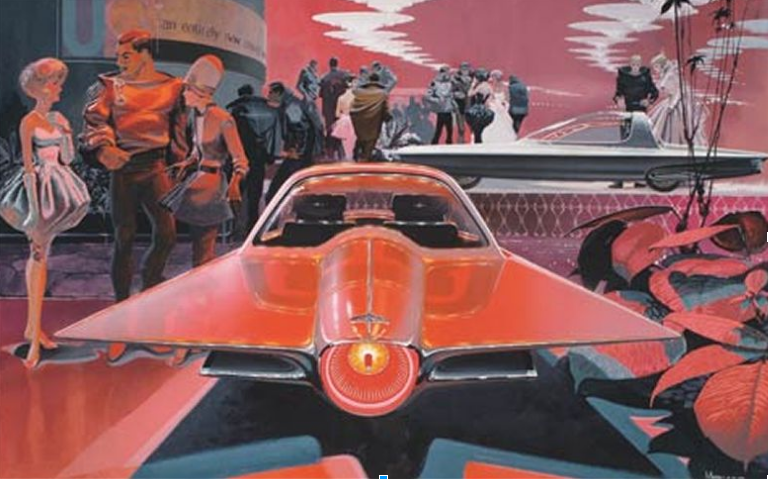
It’s 50 years in the future. You’re in your landspeeder, zipping along the desert horizon to the Langara oasis for the opening production of Studio 58’s 2065 season! It features the usual outstanding student acting and production talent, plus a very special guest sponsored by the Studio 58 Legacy Fund, which you helped start back in 2015. “Who’d they bring in this year?” you wonder, doing a portal scan through the virtual implants in your right eye. “Ah, they’ve got Antony Holland again. Bravo!”
Holland founded Studio 58 in 1965 (at 94, he is Canada’s oldest working actor) and the Studio 58 Legacy Fund was created to celebrate the school’s 50th anniversary and help carry on its tradition of excellence. The fund will help expand the scope of Studio 58’s productions by providing exceptional practical learning opportunities not otherwise available within the program’s regular operating budget, allowing the hiring of guest artists to work on productions, and permitting the program to offer special workshops, mentorships, etc.
The fundraiser’s goal? To establish an endowment of at least $250,000 – and Langara College will match every dollar raised before March 31, 2015.
Performances play a crucial part within the total program. In the past – through special grant funding or partnerships with outside agencies and companies – Studio 58 was able to enhance the student experience through co-productions, special workshops and mentorships. Sadly, the financial landscape has changed hugely since 1965, which is why the school is now reaching out for help.
Studio 58 has never done anything like this, and is unlikely to again. Donors will receive a charitable tax receipt for any donation, whether made online at langara.bc.ca/studio-58/learn-about-us/legacy-fund.html or by cheque to Langara College Foundation, 100 West 49th Ave., Vancouver, B.C., V5Y 2Z6. Please specify Studio 58 Legacy Fund with your donation.
Left to right, Carl Kennedy, Tom Pickett and Giovanni Mocibob hold a seder in The Whipping Man. The symbolism of Passover is an integral part of Matthew Lopez’s play. (photo by Emily Cooper)
On April 9, 1865, the day before erev Passover, General Robert E. Lee surrendered his Confederate troops to the Union Army’s General Ulysses S. Grant at Appomattox, Va., ending the four-year American Civil War and setting the stage for the emancipation of African Americans. This intersection of events forms the backdrop of award-winning playwright Matthew Lopez’s powerful three-person drama The Whipping Man, currently at Pacific Theatre. The play, now one of the most produced dramas in America, is a searing exploration of family, friends, faith and freedom.
There were approximately 50,000 Jews in the South at the beginning of the Civil War. Their sons fought for the confederacy. Many of the families were successful and owned slaves. The Whipping Man is the story of one such family, the DeLeons of Richmond, Va.
The play opens on a stormy night with scion Caleb DeLeon (Giovanni Mocibob) returning in defeat from war to find his family’s mansion ransacked and all the slaves gone except for faithful old retainer Simon (Tom Pickett), who has remained to protect the premises and await the return of his wife and daughter. Another slave returns that night, John (Carl Kennedy), who was raised with Caleb – they are like “two peas in a pod,” according to Simon.
John has been on one of his forays, “liberating” food, utensils and other items from abandoned mansions in the area. He returns to find an injured Caleb, whose gangrenous leg needs to be amputated below the knee. Caleb’s refusal to go to the hospital means that Simon, aided by John, must perform the operation. Especially in the intimate space of Pacific Theatre, the intense, bloody scene, where the protagonists are fueled by whiskey and courage, is not for the faint-hearted, even though a judicious lighting cue takes some sting out of the visceral moment.
It was common for slaves to take the religion of their owners and to learn the customs and the rituals of their adopted faith, so, for Passover, Simon decides they need to have a seder. He sets about to find appropriate items for the seder plate from what little is left after the war: collard greens instead of bitter herbs, small squares of hardtack military ration as matzah, and the shank bone of Caleb’s dead horse, all to be accompanied by the requisite cups of (stolen) wine.
As the three sit among the ruins of the home that connects them, the words and songs of the Haggadah, celebrating the delivery of the Jews from bondage in Egypt, take on new meaning. Simon and John are now no longer slaves; Caleb is not anyone’s master. All three men are presumably equal and the interpersonal dynamics shift. Simon declares to Caleb at one point, “You don’t tell me what to do anymore, you ask me.” Each character must grapple with the upheaval of their world and the new freedom and responsibilities that it brings. As they work through their angst, secrets are disclosed that will forever change their lives.
The acting in this production is sublime. All three men give riveting performances, along with respectable southern accents.
Mocibob, who spends most of the time immobilized under a blanket on the stage – his leg having been amputated – peels away at the layers of his character, who has lost his faith, both literally and figuratively, during the years of war and who faces a moral conundrum regarding his family’s ownership of slaves, which, of course, affects his relationships to John and to Simon and his family.
Kennedy hits the right balance of pathos and anger in his portrayal of the young self-educated slave John, his experiences with the whipping man (a white man to whom Caleb’s father and other slave owners would send their slaves to be punished with lashings from a bull whip) and his slow acceptance of the reality of a crime he has committed.
But it is Pickett who really shines, as the wise old man who has seen it all and yet somehow remains unjaded. He infuses a majestic calmness into the role of Simon. We hear the heartbreaking recollection of Simon’s own whippings and the physical and emotional scars they left behind. We witness his stoicism when he receives news of the death of beloved “Father Abraham” (Abraham Lincoln, the “American Moses”) and hears of the fate of his family.
The set of The Whipping Man is appropriately dark and ominous. Fallen bricks and broken floorboards are set off with shadowy blue lighting and the glow of candlelight; the sound design is a mournful mix of rain and thunder. The shabby costumes add to the grit and desperation of the story. Together, the visual and audio serve as metaphors for the postwar devastation and confusion.
The play, while set more than 150 years ago, is still vitally relevant for contemporary audiences. Slavery, sadly, still exists and The Whipping Man program contains some data on modern-day slavery; hopefully, the play will encourage discussion about and involvement in combating it.
Theatre does not get much better than this – our attention is completely absorbed and we are transported to another time and place, yet by material that speaks to issues with which we still wrestle. There are Jessies on the horizon for this production.
Tickets for The Whipping Man, which runs until March 21, are available at pacifictheatre.org and 604-731-5518. The show is not suitable for children.
Tova Kornfeldis a Vancouver freelance writer and lawyer.
Caitlin McCarthy and Amitai Marmorstein co-star in What You’re Missing by Tamara Micner, which is at Chutzpah! March 10-15. (photo by Tim Matheson)
Playwright Tamara Micner returns to Vancouver in March for the North American première at Chutzpah! of What You’re Missing, a play based on her family’s stories, but in which we will all, no doubt, see aspects of our own experience.
Tamara Micner returns to Vancouver for the North American première at Chutzpah! of What You’re Missing, a play based on her family’s stories. (photo from Tamara Micner)
Micner left Vancouver in 2003 for Yale, where she earned her bachelor of arts in English literature. She worked with Google for a few years, which took her to San Francisco and Toronto, then studied at Cambridge, receiving her master’s of philosophy in 2011. When she last spoke with the Independent, she was on her way to London, England, because, as she told the JI, “for plays, London is the best city in the world.” There, she has continued learning and working, not only in theatre, but also as a journalist and copywriter. The JI caught up with Micner earlier this month.
JI: When the JI last spoke with you, Fantasmagoriana was at the Edinburgh Festival Fringe, and you also had two new plays in the works, one of which was called Highlight. Could you share some aspects of its development, from its première at Cambridge in 2011 as Highlight to its run last year as What You’re Missing at King’s Head Theatre in London, to its upcoming production at Chutzpah?
TM: What You’re Missing has been in the works for four years, and hopefully it will continue to live after Chutzpah as well.
We started developing the play during my master’s degree at Cambridge, with a rehearsed reading and a run at the main student theatre. I then left it for awhile and worked on other projects, and gave myself time to come back to it with greater distance and a clearer head.
In 2013, I did more rewrites and started submitting it to theatres in London, including the King’s Head, which accepted it for final development. By the time we performed it last year, it was pretty well “finished.”
It’s gone through many rounds of changes. It started out more purely comedic and, over time, it’s gotten more political and more serious, alongside the comedy that (hopefully) pervades the piece.
JI: You described Highlight in the 2011 JI interview as being based on the beginning of your parents’ relationship, and as “a dysfunctional family comedy.” In general, what has been the reaction of family (and friends) to the plays in which they see themselves represented? Do you have any advice for aspiring writers as to how to use family/friend elements without causing (too many) hard feelings?
TM: My sense is that my relatives who inspired the characters in What You’re Missing have enjoyed seeing versions of themselves and their experiences represented onstage. (Or they’ve just been polite.) The play is critical and truthful, but it’s also a dramatization, and it’s written from a place of love and affection, which I think comes through. I wasn’t alive in the 1970s, when this play is set, so it’s drawing from elements of my family’s stories – from a specific time, place and set of experiences – to explore broader questions about family, love, politics, religion, gender and so on.
When we debuted the play in London, people of different nationalities, religions and backgrounds said that they related to the story and characters, and saw themselves or their lives reflected in the piece in some way. That response really pleased me (and was a relief!) because that was my hope. I see theatre as, among other things, a way to bring people together and remind us of the things we share.
I think artists need to share their truths, and personal experience is where a lot of our truths come from. That might cause hard feelings. But, if we’re honest and nuanced, rather than heavy-handed, people will respond and connect to the work, and the truth in it will come through.
JI: In 2011, you said that you chose to move to London for its theatre presence and because you loved the city. Has the city lived up to your expectations? Do you plan on staying for the foreseeable future?
TM: I’m very happy living in London. I’ve found a neighborhood and communities that I feel at home in, including easy access to pita, dates and baklava, and I’m still discovering more of the city and the country. I was approved for Polish citizenship last year, so assuming the U.K. doesn’t vote to leave the EU, I plan to stay here indefinitely.
JI: Will you be coming to Vancouver for the Chutzpah shows? If so, how much input, if any, will you have into this production? Did you have any hand in casting?
TM: Yes, I will be in Vancouver for the run. I’ve met with the director, John Cooper, in person and on Skype, and we’ve talked about the origins and development of the play and his vision for the production. He oversaw the casting, and I trust his instincts and judgment. It’s exciting to see how other people interpret your work and bring it to life, sometimes in surprising ways.
JI: Are there any projects you have currently on the go, or that you’re considering undertaking, that you would like to share with JI readers?
TM: I’m developing a new show, Wink the Other Eye, with two actors and a musician. It’s about music hall, a major genre of British entertainment from the mid-19th century until about the ’20s (when ragtime and revue, and radio, started taking over). For example, if you know the song “Daisy Bell,” that’s actually from music hall.
The show is devised – collaboratively created and written – which is a new style of working for me. We plan to do some showings of the piece in the spring, working toward a production later this year. We’ve been approved for funding from Arts Council England to finish development, which is a big help and a stamp of credibility.
Our show looks at Marie Lloyd, one of the most famous performers of her day, who toured the British Empire (South Africa, Australia, North America) and sang from the age of 15 until she died aged 52. She had a story similar to Whitney Houston’s, Judy Garland’s: an insatiable entertainer who lived to perform and had a pretty awful life offstage (including domestic abuse and alcoholism). The show combines live performances of her songs with important moments from her private life, and the actor who plays her is related to her. (We’ve put some of the music and comedy from the show online: soundcloud.com/winktheothereye.)
What You’re Missing is at the Rothstein Theatre from March 10-15. The other theatre offering is Kafka and Son, performed by Alon Nashman, on March 2. Visit chutzpahfestival.com for more information on these and other productions.
Rafaella Rabinovich’s designs from Sherlock Holmes and the Case of the Jersey Lily directed by William B. Davis at the Jericho Arts Centre. (photo by Steven Hooper)
Rafaella Rabinovich always knew that she wanted to be a theatrical designer, and she became one – and a successful one at that, without many detours or hiccups.
“When I was 12, my father gave me a camera,” she said. “I photographed lots of shows and I knew I wanted to frame the stage myself.”
Rafaella Rabinovich’s costumes sing on stage. (photo from Rafaella Rabinovich)
After graduating from a high school for the arts in Israel and the mandatory army service, she enrolled in the set and costume design program at Rakefet Levy Design School for the Performing Arts in Tel Aviv. Upon finishing the program in 2010, she came to British Columbia. Today, she is a respected local set and costume designer, doing what she loves and living in a place she adores.
Of course, nothing was as easy or simple as it seems from a brief review of her resumé. “I wanted to make sets. I didn’t care about costumes,” she admitted, “but the design school where I studied only offered a combined program, so I took both. Now, I do more costumes than sets; it’s easier for me as a woman, but I still love doing sets.”
When she first came to British Columbia, she didn’t plan on staying. It helped that she was born in Canada and had Canadian citizenship. “I did have a Canadian passport so I wanted to look around and then travel to Africa,” she recalled. “I loved it here so I stayed. I still haven’t gotten to Africa, but it’s in my plans.”
To justify staying, she applied for a job, with Cirque du Soleil, no less. “I didn’t expect to be hired,” she said laughing, “but they got back to me. I ended up doing two jobs for them. After adding that to my resumé, it was easier to look for design jobs here. In the beginning, I worked as a waitress a lot. Now, I sustain myself with theatrical designs. I feel lucky.”
Unlike many costume designers, she doesn’t wish and never did wish to work in fashion. “I interned with a fashion firm and I learned a lot from them, but fashion doesn’t make my heart sing the way theatre does.”
She enjoys the variety her chosen profession offers, and she doesn’t shy from the smallest jobs. Circus and movies, commercials and theatre – they are all significant to her. From a couple costumes for a display at Science World to the set and costumes for the cast of 27 for her latest production, Fiddler on the Roof at Abbotsford’s Gallery 7, she has done it all. In the five years since she settled in Canada, she has worked on about 20 projects and, she is actively seeking more.
Rabinovich said she relishes every aspect of her work, from research to the final audience applause.
When she does her research for a show, she reads a lot. “For historical shows, classical paintings are great references. And, of course, I do a lot of research online,” she said. “I also read the plays. I need to know the story, the characters. We might have two stories set at the same time, but if the stories are different, the costumes and sets are different too. Think Oliver Twist and Napoleonic France: about the same time, but different places and different stories, different characters. I always need to know the character. Who she is, why she is wearing this hat, this dress. The costume has to complement her personality.”
One of Rabinovich’s past projects was a play that took place at the end of the 19th century, the same time period as Fiddler. “For that project, we wanted the costumes to be true to the times. But for Fiddler, I chose Marc Chagall as my inspiration.”
At times, she has collaborated with a director in her artistic decisions. “If he has a vision of the show, I would respect it,” she said. “He might say: ‘I want it sad’ or ‘It should be happy,’ and I would accommodate his suggestions in my designs.”
The sources of the costume materials and sets she creates vary greatly. Some pieces she buys in thrift or regular stores, others she designs from scratch or rents. “I’m not a seamstress but I know how to sew. Sometimes, if the project is on a low budget, I can sew the costumes myself, but usually, I have a seamstress. I know which vintage store in B.C. would be likely to have a fur coat of a certain color or a special type of curtains.”
She makes all her designs by hand, not on computer like some of her contemporaries. “I’m old- fashioned,” she joked. “I like feeling the fabrics, the textures.” She also likes incorporating lighting into her designs.
Each project she works on presents a different challenge, she explained, but all of them embrace their own rewards. “Seeing your vision come to life, take shape on stage, is wonderful. When you hit the right note, when you think, ‘Yes, that’s it!’ its feels good. And of course I love it when the audience applauds, when the actors wearing my costumes are happy. I’m behind the stage, invisible to the public, and I like it that way, but I’m part of it. They applaud my costumes, too.”
Gallery 7 Theatre’s performance of Fiddler on the Roof is on stage March 13- 21 at the Abbotsford Arts Centre. For more information, visit gallery7theatre.com.
Olga Livshinis a Vancouver freelance writer. She can be reached at olgagodim@gmail.com.
Heather Hermant in ribcage, which will be at the Firehall Arts Centre March 3-8. (photo by Tim Matheson)
As a graduate student, Toronto spoken word artist Heather Hermant took a workshop taught by Diane Roberts, a former artistic director of Vancouver’s urban ink productions. Roberts asked her students to research and embody an ancestor, and Hermant chose her great-great-grandmother Riva. The process eventually led to the multimedia theatrical project ribcage: this wide passage, which comes to Vancouver’s Firehall Arts Centre next month.
ribcage centres on Esther Brandeau, a Jewish woman who, posing as Jacques La Farge, a male Christian laborer, came to Canada from France in 1738. Said to be the first Jew to ever set foot in Canada, she was discovered, interrogated and later deported when she wouldn’t convert to Catholicism. Writes Hermant in a 2013 Canadian Theatre Review article, “Riva stepped aside as I followed an archival labyrinth – in Ottawa, Montreal and Quebec City, and in every place that Brandeau was purported to have worked as a young man over five years across France.”
The 2005 workshop was Hermant’s introduction to Roberts’ Personal Legacy process and, writes Hermant in the CTR, it is “the first performance to move from idea to production through the Personal Legacy process. It was workshopped and presented in Vancouver as part of the 2010 Tremors Festival. The full production premièred at Le MAI in Montreal in October 2010.” A French version of the performance has also been created: thorax: une cage en éclats, translated by Quebec performer and scholar Nadine Desrochers.
“I began as a spoken word performer, and thought I would approach this performance as a series of spoken word pieces. In other words, what I usually did but longer, more material,” said Hermant, who is now a performer across several genres, as well as being a curator, scholar and educator. “When I began to work, I discovered that spoken word poetry as I knew it would not do it with this story. Partly, this had to do with language. I was working with French language archives and yet I write in English. On top of or because of that, a lot of the material I was creating was physical – gesture, movement. A lot of it was video. These were things that were unexpected and new for me since what I thought I was aiming for was spoken word poetry. So, it was a bit scary.
“But, in studio work with Diane Roberts, who directs the show and who has been there from the beginning of its creation, this is where you start. Starting with movement, for example, is a key to storytelling. According to Diane, working from the body first forces a kind of honesty that is difficult to achieve when using language. Luckily, it was in a performance class with Diane where I first discovered the story of Esther Brandeau. Words came late, which is odd for a poet, but in a way this was part of the story. It was as if an impossibility to fully know stood at the centre, and required all sorts of different approaches to do just that: to approach the story, which demanded its own form.”
As her research continued, Hermant realized the production would need a musical dimension. “I began to hear live fiddle and see live mixed video installation. When we came together in collaboration with composer/fiddle player Jaron Freeman-Fox, he composed most of the material in studio (as in dance/theatre studio) with me, working from my movement and the rhythms of some of my text.”
The video in the production, she explained, derives from her research in various countries, “often collected as a way of journaling” her work. “A bunch of the video material is from site-specific reenactments filmed by Melina Young. VJ Kaija Siirala and I worked in studio together to make all this eclectic rich footage into a mixed installation concept…. The video installations operate as a kind of memory space, their own kind of eye on what’s transpiring. Interdisciplinarity in this piece allows for different witness positions to come through, I think. Different ways of looking.”
Hermant doesn’t consider ribcage a play. “It is somewhere between spoken word and storytelling, physical theatre, a series of interdisciplinary tableaux, a performance installation, all of it in a theatre. I just understand it all as poetry, regardless of whether words are involved or not.”
As diverse as are the performance aspects, so too are ribcage’s themes: identity and sexuality, belonging and personal history, established roles and genders as well as rebellion against them. “Thematically,” explained Hermant, “ribcage is a confrontation with the meaning of history and how we know the past. It is about how we work and translate across languages, eras and bodies. It confronts holes and gaps and unknowns in any written record, and works from a place of longing, desire to know and to feel belonging and to understand the present moment. I created this piece because I was compelled by the personal resonances I found with the story of Esther Brandeau…. My show is about my own ancestral and personal histories, and the journey of my research, as much as it is about the story of Esther Brandeau/Jacques La Fargue. All of these stories enter into ribcage: this wide passage, through the different media and forms that I integrate.”
Heather Hermant in ribcage (photo by Tim Matheson)
Hermant noted that women passing as men, “especially in Europe in the 17th and 18th centuries … was far more common than the exceptional cases seem to suggest. In addition to the most popular assumption and representations – that the primary motive for women who passed as men was to follow their male lovers, which circulates through pop culture across many eras, and of which there are indeed many documented historical examples – there were many cases of passers who did so out of economic necessity, there were many cases of passers who did so in order to partner with women, or a combination of these.”
For Hermant, the historical record must be regarded with care. “The important thing to me is to ask how a story is recorded, how it comes to us, what are the stakes for the person outed. In other words, it is vital to read askance and to distrust the document, even as the document gives us the story.
“What is particularly interesting for me in this case,” she continued, “is this is purportedly a case of a female passing as a male and a Jewish person passing as a Christian. I like to call this person a multicrosser. I find we need to challenge the assumption that passing is simply a ruse. Classical literature is full of titillating stories of passers, titillating primarily for straight male audiences. My queer positionality perhaps makes more available to me a knowledge that changing gender can be a profoundly sacred process, that sexuality may or may not have anything to do with it, and that queerness as many of us know ourselves today has history. This doesn’t mean sameness across time. That last sentence is vital. In other words, how people understand themselves today and the terms through which they do so are not the same as how people understood themselves 200 or 300 years ago. This is an inherent challenge to reading, understanding and representing things as they were long ago. It’s partly why I have not chosen to create a work that takes place only contained in a long ago era.”
Describing ribcage as “a midrash on the archive,” Hermant explained, “It’s a meditation, a questioning, a digging in deep into the idea of archive, into archives themselves, into memory and telling, loss, desire, the written word and its troubles, a need to understand belonging, compelled by questioning and not by a need or a belief in the possibility or utility of resolution. In fact, to me, such a stance is an ethical stance, and some might say a profoundly Jewish one – though of course not exclusively so – i.e. the imperative of the question. So, yes, of course, my Jew-ish-ness (hyphenation intentional) is important to me and to my show. ‘Jewishness,’ however defined … and a grappling thereof, informs the piece profoundly. As does my non-Jew-ish-ness, my queerness, my experiences of gender, my feminist leanings, my francophone ancestry, my being a settler ally working with an aboriginal and intercultural theatre company on unceded Coast Salish territory, my work as a scholar in gender studies, colonial history and historiography, my teaching, my concern for land and water…. The list goes on. It is all important to me, all profoundly inform the show, and none of these is mutually exclusive!”
And these are not the only aspects informing the show. “Dealing with difficult histories does not preclude humor, playfulness or joy. In fact,” said Hermant, “these are essential precisely for dealing with difficult histories. I choose the topics I choose – or they choose me – because I feel a responsibility and a call to do so. And because, very simply, they compel me.”
ribcage, produced by urban ink productions, will be at the Firehall Arts Centre March 3-8. Freeman-Fox’s original music will be performed by Vancouver musician Elliot Vaughan.
Olga Livshinis a Vancouver freelance writer. She can be reached at olgagodim@gmail.com.
Maria Kong opens this year’s Chutzpah! festival on Feb. 19. (photo by Guy Prives)
The 15th season of Chutzpah! kicks off Feb. 19 with Tel Aviv-based dance troupe Maria Kong. Founded in 2008 by former Batsheva Dance Co. members, Maria Kong combines dance with art, sound, light, visual effects and technology. And, for the opening of Chutzpah! they take their performance off the stage and into the audience – or, rather, they bring the audience “backstage.”
The JI spoke with Israel’s Talia Landa, Maria Kong performer, artistic director and co-founder (with Anderson Braz from Brazil), in anticipation of the presentation in Vancouver of Backstage, which will take place at Red Room Ultra Bar.
JI: From where does the name Maria Kong come? What is its significance?
TL: We are “Virgin Marias” and “King Kongs” (not necessarily defined by gender). Together, we make Maria Kong.
JI: There is so much innovative dance coming from Israel. What makes the dance scene so “fertile” there?
TL: There could be many reasons why that happens; some more obvious than others. Israel is a great place where people from all over the world meet, connect and meld their talents in order to create magic. It’s a place where creativity and innovation are a driving force in our lives, hearts and souls. We have our fair share of challenges, so we are pushed to approach them with unique solutions. It’s no secret that Israel is the land of high-tech and start-ups; it only makes sense that this creative research and innovation would spread to the world of dance. We have a drive to do things passionately and intuitively, triggered by an inner impulse to never stop moving.
JI: Your vision centres on teamwork. How does Maria Kong’s creative process work in general? How is it decided what ends up in a performance? As artistic director, do you have “final” say?
TL: Maria Kong’s creative process works like this:
1) An idea is born.
2) The idea is placed on the table.
3) The team members from all of the different divisions (dance, music, light, sound and technology) come together to share their unique input and express their particular perspective.
4) The idea transforms from a 2-D piece of paper on the table, to a three-dimensional creation, which we continue to develop together.
Yes, perhaps I have the “final” say, but each creation undergoes many stages of dialogue before the concluding decision is made.
JI: The show planned for Chutzpah!, Backstage, is choreographed for “off the dancer’s stage,” so to speak. In what ways, if any, is the performers’ (and technical crew’s) preparation different for this type of show from that for a stage-based performance? And is there anything the audience should do to prepare?
TL:Backstage is unique in the way that it takes any given space and transforms it into a stage, but not in the conventional manner where the performers are on stage and the audience takes their seats. In Backstage, the members of the audience can grab a beer, join friends at the opposite end of the venue, change views, and experience the performance from a number of different angles.
The audience, time and space are a fundamental element of Backstage. Every venue has its unique infrastructure and particular vibe. In order to prepare for our performance for Chutzpah!, we inserted the Red Room Ultra Bar’s measurements and properties into our computer programs, as we aim to ensure that the graphics and choreography fit the venue and our energies can dance with the people of Vancouver. We reshape our bodies, mind and soul in order to create a tailor-made unique experience in each performance.
Should the audience do anything to prepare? Bring an open heart and wear comfortable shoes.
JI:Backstage, and other Maria Kong pieces, have featured live musical performances, including known vocalists. Will the Vancouver show feature live vocals? If so, can you share from whom?
TL: We are very lucky to have great friends with great talents who are happy to join us on our journey to this great festival. I don’t want to give it all away, but I will share that one of the special guests we are bringing is very close to my heart, and happens to have Canadian roots.
JI: For the simple fact of being an Israel-based group of artists, there was a call by some in India to boycott your performance there in November. How do you respond to such efforts?
TL: Maria Kong is a team of artists with a shared vision: a vision of common values. Our artistic creations are a result of open dialogue and passionate collaboration between the Israeli, French, Brazilian, Russian and Japanese members. We strongly believe in the language of movement: a language that knows no border and holds no passport. It is boundless, endless, holds no limits – a language of human connection, a language of physical and spiritual communication, traveling through all forms of artistic creation. Think of yourself, right now, as you read this text. You are probably in a room, inside a building, within a city, territorially bound by a country, on this wild earth that contains us all. As you continue going through this text, our wonderful earth is dancing in perfect synchronization with our sun, infinitely spinning within our endless universe. The beautiful language of movement is our core – it is fundamental to our survival, and an inseparable element of our existence.
JI: If there is anything else you’d like to add, please do.
TL: I would just like to say that the artistic director of Chutzpah!, Mary-Louise [Albert], along with her team, are the coolest people ever to have believed in us and chosen us to come and share our magic in Vancouver. We are really looking forward to it. So thank you, and see you soon!
Backstage will be at Red Room Ultra Bar Feb. 19, 21 and 22, 8 p.m., and Feb. 22, 4 p.m. Tickets are $29/$25/$20. By way of dance, Chutzpah! 2015 will also feature Shay Kuebler Radical System Art, Idan Sharabi and Dancers with Vanessa Goodman, Bodytraffic, ’Namgis T’sasala Cultural Group and, in Chutzpah!Plus, Serge Bannathan/Les Productions Figlio. For the full schedule of performances, tickets and other information, visit chutzpahfestival.com.
Left to right: Andrew McNee as Francis and Martin Happer as Stanley Stubbers in One Man, Two Guvnors at the Arts Club Stanley Theatre. (photo by David Cooper)
It’s always disconcerting when sitting in a theatre listening to everyone laughing while thinking, “What’s so funny?”
That was my experience at the media opening of One Man, Two Guvnors Jan. 28. I’m thinking, therefore, that this review is going to be controversial. Judging by the audience response to the play, I was, with the dozen or so others who left at intermission, clearly in the minority.
Perhaps the problem was that reading the name of the play and about its background, and having been to British period comedies in the past, I had high expectations. I anticipated caustic wit and clever verbal jousting; instead, I was witness to very lame jokes and antiquated slapstick comedy.
Slapstick? Really?
For much of Guvnors, I felt as though I was in a studio audience watching a bad sitcom. It hearkened back to when, as a child, I watched my parents roll in laughter at the likes of Wayne and Schuster’s antics – certainly performances that would draw yawns today.
Now, just in case I’m coming across as a humorless Scrooge who wouldn’t release a guffaw unless I was on laughing gas, let me remind readers of previous reviews. I have snickered at the wit in The Philanderer, joined the multitudes who guffawed to The Producers and fell off my seat convulsing in laughter during Dirty Rotten Scoundrels. But those plays were smart. Witty.
Guvnors seems to play to the lowest common denominator of predictable, parochial humor at the level of arm-pit noises and fart jokes. The main character Francis is compared by the director to Will Ferrell. ‘Nuf said.
Now, before I continue on my rant, let me delve into the plot for some context. The play takes place in 1963 in England, starting in London where Pauline and Allan are preparing for a marriage that looks like it’s going to be thwarted: Pauline’s former fiancé, Roscoe, appears to have come back from the dead. It turns out that Roscoe is, in fact, Rachel, Roscoe’s twin sister, who must keep up the sham that Roscoe is alive until she can collect on the 6,000 pounds Pauline’s father is supposed to give him/her, at which point Rachel plans to run away to Australia with her lover Stanley, who is actually Roscoe’s murderer. Rachel and Stanley become the two “guvnors” to Francis, a poor sod who’s either starving for food or starving for love.
The story picks up in Brighton where the farce of mistaken identities really takes off. Francis, who is the consistent backbone to the plot, finds himself serving both guvnors in one hotel, trying to keep them apart, not knowing their hidden connections. In the end, there is a “happy” ending, with two avoided suicides and three marriages.
In an unusual twist, the performance is introduced by a quartet of musicians, a guitarist, a banjo player, stand-up bass and washboard – the first I’ve seen at the Stanley – that introduces the first and second acts and intersperses the play with fun tunes and singing.
As well, during the show, a few audience members are coerced to come on stage and be part of the performance. (Don’t worry, it’s all part of the act.)
At intermission, I was told by friends enjoying the performance that it is supposed to be silly. Indeed, the director’s notes state that it pays tribute to the vaudeville era of entertainment, the play itself being an adaptation of the beloved 18th-century Italian playwright Carlo Osvaldo Goldoni’s A Servant of Two Masters, which itself is based on the commedia dell’arte of the 16th century.
But so what? In a play where the comedy is predictable, does it really matter if it’s due to bad actors doing a bad job versus good actors intentionally doing a bad job? What’s the difference between a show that recreates outdated theatrics well and one that is simply outdated?
In fact, the play itself suggests there is no difference. In one conversation one character asks, “Does he smell of horses or does he smell like horses?” Suggesting the difference is that a man who smells of horses might have been riding them and, therefore, comes from good stock; whereas a man who smells like horses just smells bad.
His counterpart responds, “Well, it’s all the same in the end, isn’t it?”
Quite so.
Guvnors runs until Feb. 22 at the Stanley Theatre. The Jewish community’s multitalented Anton Lipovetsky is not only the musical director and lead-guitar player in the quartet but also has a small part in the play. Another bright community talent, Ryan Beil, plays the love-struck Allan Dangle. Israeli Vancouverite Amir Ofek designed the sets that hearken back to the Stanley’s original life as a vaudeville house.
Baila Lazarus is a freelance writer, painter and photographer. Her work can be seen at orchiddesigns.net.
Leanna Brodie plays spinster Ms. Fitt (and the boy Jerry) in Blackbird Theatre’s Canadian première of Samuel Beckett’s All That Fall, at the Cultch until Jan. 24. (photo from Leanna Brodie)
She is an actor, playwright, librettist, feminist, social activist – bilingual on top of all that – and just landed a coveted role in Blackbird Theatre’s Canadian première of Nobel laureate Samuel Beckett’s All That Fall, running at the Cultch until Jan. 24. Leanna Brodie is one talented person.
On a rainy Saturday afternoon, she sat down with the JI to talk shop during a rehearsal break.
Born and raised in rural Ontario, Brodie said, “I am a bit of an odd duck as far as Judaism goes, my father was Jewish but my mother was not. She came from rural Ontario. My upbringing was secular but I have a Jewish soul. My family always communicated through jokes, something that I see as being steeped in Jewish culture. I also see curiosity as part of my Jewish heritage, which is a good thing because you understand thought processes better, which I think I bring to my work.”
She went to drama school at the University of Guelph and was able to support herself as an actor in her first years at the job. As she got older, however, there were fewer roles available and she reconsidered her future. She had never before pictured herself as a playwright. “I was chatting with a bunch of girlfriends one day and we were complaining that there were no acting parts for women in their 30s and 40s. So, I thought, I am not going to sit around, wait by the phone until I get called for a part, I am going to write something for women. I finished my first play in five weeks. Since that time, I have written over 50 roles for women.”
Brodie now has three successful plays and one opera to her credit. Her topics are often motivated by contemporary social issues – homophobia, fundamentalism, the environment, to name a few. In The Book of Esther, she explores some of these issues through the eyes of a young country girl coming to the big city. “I think that play was the most autobiographical for me even though there is a little bit of you in everything you write. Here I was coming from rural Ontario to Toronto and I had a phobia of subways.”
She actually took on one of the roles in The Book of Esther. “That was like an out-of-body experience for me. Once you are in a scene, then it is like any other gig and you do your bit and walk on and off, but, when not in a scene, I could not resist the temptation to be in the wings and listen to the audience reaction to my play.”
As an actor, she has appeared across Canada and, in one of her first jobs in Vancouver – a role in Pi Theatre’s Terminus – she was nominated for a Jessie award.
Her writing is done in her down time from being on stage. “Acting is all-consuming, all your antennae are out for anything that will help your performance, any creative juice. During rehearsal, you are entirely focused. You can act in more than one show at a time but you cannot write at the same time.”
Brodie is on a temporary hiatus from writing as she hones her thespian skills with All That Fall, a bucolic play – a perverse combination of comedy and tragedy – that Beckett wrote for radio audiences. He wanted the words to come “out of the dark,” to be an auditory experience, not a visual one. He resisted attempts to have the play transformed into a stage production (even Sir Laurence Olivier and Ingmar Bergman could not get his permission to produce the play on stage). It was only recently that his estate, at the urging of British director Trevor Nunn, allowed a London production, which played to critical acclaim and ultimately crossed the pond to Broadway. Now, Canadian audiences are in for a treat from this Irish wordsmith.
The story is as follows. A 70ish, garrulous, overweight Mrs. Rooney trudges the Irish country roads to meet her blind husband’s train at the station. On the way, she encounters an assortment of quirky characters who are using various modes of transportation – a cart, a bicycle, an automobile – to go about their daily business. Against this backdrop, they pass the time exchanging droll comments that border on the absurd, reflective of Beckett’s existential angst. The train is late. On the walk back home, as the old couple verbally spar, the audience begins to sense that there is a mystery lurking behind the dialogue.
This is the first Beckett work that has a woman as the main character. That, along with the radio format, drew Brodie to the play. “Beckett is on every actor’s bucket list,” she said. “There are so very few opportunities in his repertoire to land a female role.”
Brodie actually plays two characters: a religious spinster, Miss Fitt, and a young boy, Jerry. “This play is fresh and interesting and full of Irish humor. Usually with Beckett you have those unforgettable stark images, like two trashcans or a dead tree. Here, the dynamics are different. There is more lushness than in any [other] Beckett play because of the demands of radio, and there is more of a sense of a real place. You get the impression that Beckett sees the traditional Irish life dying around him and he uses very black humor to protect himself from this perceived dark abyss.”
She added, “Unlike Beckett’s iconic Waiting for Godot, where they say nothing happens twice, in All That Fall, something is always happening and what the person, the protagonist, is waiting for actually appears.”
“Part of the allure of the format is the fact that the audience becomes the collaborator with you and creates the world, it becomes a cooperative venture between the actors and the audience.”
Brodie has the radio bug in her blood. Her father had a morning show called Breakfast with Brodie and was a voice artist. She has worked in radio drama for the CBC. “I was wistful about losing the radio show format in Canada and was atoning for the fact that I feel like I killed radio drama in this country, as one show I worked on, The Seeds of Our Destruction, was the last stand-alone radio show CBC aired. So, I really wanted to do this show to sort of redeem myself. Part of the allure of the format is the fact that the audience becomes the collaborator with you and creates the world, it becomes a cooperative venture between the actors and the audience.”
About why Vancouver audiences should see this play, Brodie said, “Beckett is arguably the greatest writer of the 20th century and this play is done from an aspect never seen or heard before and who knows if we will ever have this chance again. Also, you get to see an extremely talented professional cast [William Samples, Lee Van Paassen, Adam Henderson and Gerard Plunkett], who get it right.”
This writer had the good fortune to sit in on the first read-through of the play. Director Duncan Fraser put the five actors through their paces, scripts in hand at separate microphones on the stage. The actors also are responsible for all of the sound effects, the rattling wind, a bothersome wasp, the opening and closing of doors, the crunching of feet on gravelly roads, the whistle of the train. Just watching the props used to create the noises was an experience. However, the real experience is being immersed in this lost world of radio drama where for 75 uninterrupted minutes you can let your imagination soar.
For tickets, visit thecultch.com or call 604-251-1363.
Tova Kornfeld is a Vancouver freelance writer and lawyer.
Claire Hesselgrave as D in Wide Awake Hearts. (photo by Eric Chad)
“I want love. I want only love,” confesses C, a playboy, amid a lengthy list of his shortcomings. A rare, vulnerable moment of honesty? Or is he merely reciting his lines in a movie scene?
Such is the nature of Wide Awake Hearts by Brendan Gall, now playing at Little Mountain Gallery. One is never certain of what is real, or personal, and what is being acted for public consumption.
Of course, being a play, everything is scripted and for entertainment, however, within Wide Awake Hearts are four characters whose professional and personal lives overlap to an indistinguishable degree. Apparently named according to when they first speak/appear, A (Sean Harris Oliver) is married to B (Genevieve Fleming) and he hires his best friend C (Robert Salvador) to perform opposite her in a new movie that he has written and is producing. By the time D (Claire Hesselgrave) arrives on the scene to replace a recently fired editor, the tensions are high, and the line between what is part of the film and what is “actually” happening between the characters is well and truly blurred.
Despite being an editor, part of whose job, as D states, is to make sense out of the senseless, D’s presence only adds to reality’s murkiness. First of all, editors can only work with what they are given, what’s been shot; they can’t create anything, she explains, they can only interpret. And she’s not an objective outsider, which makes her job that much more difficult. D has been in a long-running on-and-off-again relationship with C. Meanwhile, C is in love with B, and A is jealous of what he believes is happening between C and B. As D laments, “Sometimes, the mess wins.”
That mess is life, not Wide Awake Hearts, which is a sharply written, insightful play. Tempers and desires run hot and C’s confession is one of the few quiet, calm moments that, along with the occasional biting (funny) comment, break the tension. Each character has a monologue that also serves to narrow the focus, slowing the pace before it once again ramps up.
All four actors do an excellent job of working in the intimate space of Little Mountain Gallery, sometimes a foot or two away from the audience as they perform, for example, a raucous sex scene. Director Brian Cochrane and stage manager Breanne Jackson deserve kudos for that, too, as does Sabrina Evertt for her set and props, as well as for her costumes; sound designer Jay Clift’s work is only noticeable when it should be. For the most part, everything comes together such that being in the audience is like being a voyeur, part of the action yet removed from it.
The production team being so small, it would a shame not to mention Eric Chad (projection designer), whose talents could have been exploited more; assistant director Jamie King; and publicity and front of house, Angie Descalzi. This combined Hardline Productions and Twenty Something Theatre effort, in which everyone involved seems to be doing double or even triple duty, delivers as much or more than many larger, more flush productions.
Wide Awake Hearts is at Little Mountain Gallery, 195 East 26th Ave., until Dec. 20, Tues-Sat, 8 p.m. Tickets are $22 plus service charge from brownpapertickets.com, with $15 matinées Dec. 13, 14 and 20, 2 p.m. For more information about the production companies, visit hardlineproductions.ca and twentysomethingtheatre.com.
Left to right, Josh Drebit, Donna Soares, Allan Zinyk and James Long in Cinderella: An East Van Panto. (photo by Emily Cooper)
If Canada wants to be an energy super power, it’s going to have to run some pipelines through some plays. Well, some pantos. Starting with Cinderella: An East Van Panto, now on at the York Theatre until Dec. 28.
As with the inaugural East Van Panto last year, which took Jack & the Beanstalk to strange and hilarious new heights, this Cinderella is only loosely based on the fairy tale. In this version, Ella – Cinderella is only a mean nickname given to her by her wicked step-hipsters (not a typo) – loses her mother in a tragic food truck accident. Her father directs his grief to improving safety standards and is awarded for his efforts with the Mike Duffy Food Truck Safety Award, or something along those lines. He falls in love with the Government of Canada representative who presents him the medal. Marriage soon follows, the father is offered a senatorship, which takes him to Ottawa, leaving his beloved Ella – played wonderfully as the straight man to everyone else’s wackiness by Donna Soares – in the hands of her stepmother.
In true panto fashion, Ella’s new family is played by Allan Zinyk as the matriarch and Josh Drebit and James Long as her sisters. As they order Cinderella about, the audience gets to boo every meanness, and cheer Cinderella’s every win. While Jewish community member Drebit ably pulls off the fishnets, his comedic talents really shine as Feral Cat. Drebit, Long (as Rat) and Dawn Petten (as Old Crow) are about as far away from Disney cartoon birds and other forest animals as one can get, but “the other vermin,” three young actors as mice, are absolutely adorable – and, in a panto, the audience is allowed to “ooh and ahh” at their cuteness.
Zinyk also plays bad guy Ronald Grump, costumed in a business suit and an awful wig that’s only marginally worse than that worn by the character’s inspiration, Donald Trump. King Grump decides to hold a ball (there are lots of ball jokes, FYI) to celebrate the opening of Grump Towers (plural, even though there’s only one). At the ball, there will be a beauty pageant – a speed-dating marathon, actually – to find a wife for his son, played by Petten channeling Justin Bieber. (Petten also plays the hippy narrator/canvasser, Len Til, to perfection.)
And this brings us back to pipelines, and the spills that the suit-wearing, hard-hatted forewoman notes “only happen in movies and on the news.” As the chorus (pipe)line is passing through Cinderella’s family home, sadly, there is a spill – a spill that Cinderella must clean up before she can go to the ball. With the help of her vermin friends and, in one of the funniest scenarios to be conceived, a vacuum-harmonica-playing David Suzuki (played by Zinyk, you have to see it to believe it) and her B.C. Ferry Godmother, the belle gets to the ball.
But does she marry her prince? You’ll have to go to the panto for the answer – and for all the witty, weird, Vancouver-specific humor, the inventive costumes (Cinderella’s gown appears like magic), the charming music, the fitting choreography, the inspired sets and props, the bold and beautiful backdrops.
With Cinderella, the creative team of playwright Charles Demers, musician Veda Hille and director Amiel Gladstone have improved on what was already an intelligent, silly, energetic, crowd-pleasing formula. The lead actors in this year’s production are joined by the very talented chorus of Bailey Soleil Creed, Sean Sonier (who rocks a tutu) and Alexandra Wever, as well as the children who share the roles of the mice.
If you’re wondering what to give that person on your Chanukah list who has everything, at least 99 percent of non-Grumps would enjoy this show. For times and tickets, visit thecultch.com or call 604-251-1363.