Artist reflects on career

Imre Székely, left, gives his artwork to then-prime minister Jean Chrétien. (photo from szekelygallery.com)

From his hometown of Győr, Hungary, a city halfway between Vienna and Budapest along the Danube River, to his studio in Victoria’s Chinatown, Jewish community member Imre Székely has been creating art for more than five decades, primarily in the linocut/monotype style of printmaking.

Linocut, also known as lino print, is a design carved in relief in linoleum. The art form was popularized in the early part of the 20th century. In monotype, an artist presses ink directly onto a plate. The plate is then pressed against paper to transfer the ink.

photo - As Imre Székely’s approaches 70 years old, he looks back at his career
As Imre Székely’s approaches 70 years old, he looks back at his career. (photo by Kor Gable)

Székely discovered his calling early in life, under the tutelage of Imre Krausz and István Tóvári-Tóth, both distinguished artists in Hungary. However, Hungary in the 1970s and 1980s was no place for anyone whose views differed from those of the regime. 

“The communist regime at the time did not have a role for a forward-thinking, modern artist. There wasn’t much chance of self-actualization,” Székely told the Independent.

Thus, in 1987, he said goodbye to his family and jumped on a westward-bound bus. His first stop was a refugee camp in Austria, then on to France, the Netherlands and, finally, Canada, in 1988. After stops in Winnipeg and Toronto, he set off west where, in 1991, he settled in Victoria, finding the provincial capital to be an ideal spot for his professional and private life. His wife and children joined him shortly after he arrived in British Columbia.

Székely describes himself as a hyper-surrealist artist, who blends “a variety of colours, patterns and shapes that are the spices of life.”

Throughout his career, he has donated his works and given them to people who couldn’t otherwise afford a work of art. He also has presented his artwork to provincial ministers, foreign dignitaries and prime ministers. 

In 1999, for example, he traveled to Rome for a personal audience with Pope John Paul II, to donate his work “Abba Pater” to the Vatican.

In 2001, he showed his gratitude to his adopted homeland by donating his art-deco-styled piece “Canada: Past, Present and Future,” to then-prime minister Jean Chrétien, who accepted it on behalf of the government of Canada.

“This occasion was especially meaningful to me, as it presented a way to express my thanks to Canada for accepting so many refugees to this country with open arms,” said Székely, who has also presented a work to Prime Minister Justin Trudeau. 

“Gifting Justin Trudeau with one of my art pieces was a highlight in my life … this kind of event was impossible in my home country under communist rule,” he told Senior Living Magazine in 2021.

One of the works of which he is most proud, “Hungarian Conquest (Honfoglalás),” was presented to the Hungarian parliament in Budapest. When, in 2010, Pecs, Hungary, was chosen as the European Capital of Culture, Székely provided the city with 31 of his works for a solo exhibition. His hometown Győr’s city hall houses his artwork and he has donated his works locally, to the City of Victoria and to the Hungarian consulate in Vancouver.
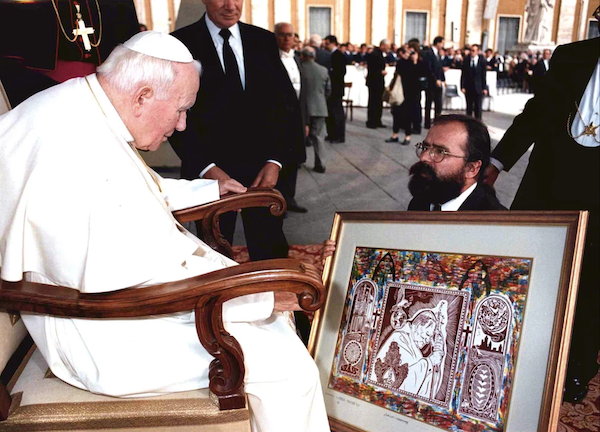
photo - Imre Székely at the Vatican in 1999, giving one of his artworks to Pope John Paul II
Imre Székely at the Vatican in 1999, giving one of his artworks to Pope John Paul II. (photo from szekelygallery.com)

At the height of the COVID-19 lockdowns in 2020, retreating to his studio, Székely produced “Satan Sneers,” a work in which, as an artist, he detaches himself from shared circumstances to show pity for the human race as it confronts an undetermined fate.

Székely sent a photo of the work to Dr. Tedros Adhanom Ghebreyesu, director-general of the World Health Organization, in the hope of donating the work. According to Székely, Dr. Tedros (his preferred moniker) liked the piece very much.

“Unfortunately, I couldn’t personally hand it over to him in Geneva at the time because the two-week quarantine was introduced before my departure,” Székely recalled. 

In 2021, the artist created a work entitled “Hope and Genius,” dedicated to Katalin Karikó, the biochemist and researcher at the University of Pennsylvania, who, together with Drew Weissman, took home the 2023 Nobel Prize in medicine for work leading to the discovery of mRNA vaccines to fight COVID-19.

“She deserves lots of thanks and appreciation from us all,” he said. “My work is recognition and homage to her human and scientific greatness.”

At present, Székely is working on several projects, one of which is called “Magical Artificial Intelligence,” a surrealistic piece on what he views as the issue that offers the most positive potential for humanity – and the most danger.

He hopes to donate works to other notable people in the political and business worlds, such as Bill Gates, Kamala Harris and Ernő Rubik, a fellow Hungarian who invented the Rubik’s Cube.

As he approaches his 70th birthday in December, Székely said he feels freer now than at any time in the past, drawing strength from family, friends and art.

“Artistic creation is the outflow of strength, good mood and joy of life. A true artist enjoys his own creative power. Creation is one of the most difficult things in the world, creating from nothing,” he said.

“I am convinced that art and culture will unite the world again. I know that artistic ability can be viewed as a blessing, but it is worthless without creative work and humility.” 

For more on Székely, visit szekelygallery.com. 

Sam Margolis has written for the Globe and Mail, the National Post, UPI and MSNBC.

Processing the tragedy

On Sept. 28, Temple Sholom unveiled a new group exhibition in its gallery. “This is not a regular art show,” curator Rina Vizer told the Independent. “It is a commemoration of Oct. 7, of its hope and memories.”

Vizer has wanted to organize a show that would act as a fundraiser since the horrific terror attack on Israel last year.

“It has been the theme of my art from the moment I heard about the attack. I couldn’t process it in any other way than through my painting,” she said. “Last year, in September, we couldn’t even imagine that such an atrocity was possible. I wanted the other artists to do the same, to express what was beyond words through their paintings and share it with viewers.”

image - “HaTikvah” by Rina Lederer-Vizer is part of the Memory and Hope exhibit at Temple Sholom that Vizer curated to commemorate the terror attacks of Oct. 7, 2023
“HaTikvah” by Rina Lederer-Vizer is part of the Memory and Hope exhibit at Temple Sholom that Vizer curated to commemorate the terror attacks of Oct. 7, 2023. (image from Rina Vizer)

At first, she contemplated the Zack Gallery as a venue but it had a schedule to maintain, and its shows were booked well in advance. “Then I discussed with our rabbi some other art installation, and I asked him: ‘What about a show commemorating Oct. 7?’ And he agreed that it was a great idea to reflect on this calamity through art.”  

The timeline to find other contributors was very tight. “I started the process at the end of August,” she said. “My only condition [to the artists] was: it had to be new art, created as a reaction to Oct. 7. Nothing old would work.” 

Vizer contacted several people she knew personally, including Vivienne Davicioni, Sidi Schaffer and Glenda Leznoff. “I’ve also seen the art of Olga Campbell, and I had heard about Zohar Hagbi and her intuitive art studio. I was sure both of them would be a good fit for this show. The Zack Gallery director, Hope [Forstenzer], recommended Brian Gleckman, who agreed to participate. In all, we have seven Vancouver artists in this show.”

image - “Tikun Olam” by Brian Gleckman is part of the Memory and Hope exhibit, which is at Temple Sholom until Oct. 28
“Tikun Olam” by Brian Gleckman is part of the Memory and Hope exhibit, which is at Temple Sholom until Oct. 28. (image from Rina Vizer)

Vizer and Hagbi were born in Israel, Gleckman hails from the United States, Schaffer was born in Romania, Campbell in Iran, Davicioni in South Africa and Leznoff in Canada. Regardless of their countries of origin, all of them dedicated their artwork for this show to Israel, and all of the pieces reflect the traumatic impacts of Oct. 7.

Vizer’s paintings are not large, but they pack a punch. She signs her art as Rina Lederer-Vizer. “Lederer is my family name,” she explained. “But I only have one sister. When we go, the name will disappear. This way, I hope to keep it a bit longer.” Her painting “HaTikvah” is full of hope and despair in equal measure. A woman gazes up, her palms together in prayer, but her eyes are sad, her expression stark. Is she praying for the hostages’ return? Is she a hostage herself?

Another of her paintings, similar at first glance, is called “101 Days of Awe.” The woman in the foreground is from the diaspora, but her solidarity with the suffering in Israel is unmistakable. Like the figure in her painting, Vizer stalwartly expresses her solidarity with Israel.

“I have been attending the ‘Bring Them Home’ rallies every Sunday since last October,” she said. “We meet at the Vancouver Art Gallery at 2 o’clock. At first, there were thousands of people there each week. Now, it is a hundred or so, but I go.” 

At one of the rallies, Vizer carried a banner with the name and image of one of the hostages, Carmel Gat, a therapist from Tel Aviv. Vizer was so moved by Gat’s plight she used the portrait at her family seder. “I was shocked and angry when I learned on Sept. 1 that Gat was executed in a tunnel,” she said. That was when she painted “Light in Tunnel.” There are darkness and death in those tunnels, but, contends Vizer, light always comes after darkness.

image - “I See You” by Olga Campbell
“I See You” by Olga Campbell. (image from Rina Vizer)

Like Vizer, Campbell’s paintings are mostly figurative. “I See You” depicts a face, fearful and anxious. There is a catastrophe unfolding in front of this person, and they are helpless to prevent it. Another of Campbell’s paintings, a number of shadowed figures on a foggy background, bears a fateful title: “I Didn’t Get a Chance to Say Goodbye.” Campbell’s third painting, a black and white collage reminiscent of an old-fashioned newspaper, has an even more explicit title: “October 7.” 

The same title applies to one of Schaffer’s paintings. In a short email exchange with the Independent, she said about that horrible day: “The event had and still is impacting me very much. Early every morning, the first thing I do is turn on the TV to hear what’s happening in Israel. I am a child survivor of the Holocaust, and I hoped nothing like that would happen again, but the reality of today is different.”

Schaffer has two paintings in the show, and she explained her symbolism. “The small one is titled ‘October 7.’ It’s a collage. I have done it this year, not long ago. You can see prayer hands and a memory candle for those we lost. There is a child’s wooden rocking horse left without a child. In one of the videos after the horror, I saw a house totally destroyed. Only this horse alone remained on the front lawn.

“The second work is bigger and is titled ‘The Phoenix Reborn from Ashes.’ I worked on it for a few years, but, this year, inspired by the October tragedy, I finished it. I feel it gives hope of renewal, of better days to come, of freedom and joy.”

Leznoff, who is also a writer, talked about her experience joining this show. “I was invited to participate by Rina Vizer, who I met about a decade ago at Israeli dancing. This year, I have been very active writing letters to governments and organizations about antisemitism in Canada since Oct. 7. I had an op-ed in the National Post last January, when two British Columbia theatres canceled the play The Runner. Rina knew me as both an artist and a writer. She knew I have been very moved by the events, both in Israel and in Canada, so she asked me to contribute works I’ve done in response to the war.”

Leznoff’s two pieces in the exhibit are titled “Shattered” and “Morning Light.”

“The first painting is a mixed media piece that uses black ink and paint, yellow paint, a photo, dried flowers from my garden, and charcoal. The painting is abstract, however, there is a sense of something explosive and raw with the black paint,” she said. “For me, the yellow is a sign of hope, and the falling flowers are in memory of the tragedy of the flower children at the music festival.

“The other piece,” she continued, “is connected to a poem I wrote called ‘Winter Light’ that accompanies the painting. The poem is framed with the painting, and it’s about how the hostages and soldiers are always on our minds, and we are not giving up. Ironically, although I am a published writer, I hardly ever write poetry. I think both abstract painting and poetry handle emotional issues that are sometimes difficult to convey in a straight narrative.”

The Memory and Hope exhibit will be displayed at Temple Sholom until Oct. 28. The art is for sale and all proceeds from the sales will go to Hostages and Missing Families Forum: Bring Them Home Now, and Magen David Adom in Israel. 

Olga Livshin is a Vancouver freelance writer. She can be reached at olgagodim@gmail.com.

Who holds power over you?

Jeremy Goldstein, centre, and volunteer participants in the Newcastle, Australia, performance of Truth to Power Café earlier this month. Members of the Vancouver community will participate in the event here on Nov. 3. (photo by Cassandra Hannagan)

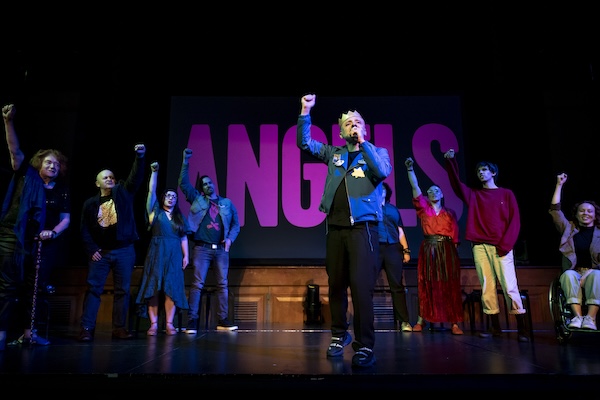
“Who has power over you and what do you want to say to them?” This is the question at the centre of Jeremy Goldstein’s Truth to Power Café, which he will present – with the help of local community members – Nov. 3 at the Rothstein Theatre as part of the Chutzpah! Festival.

“As with all our events, we invite participants to sign up to the project through a combination of open call and personal invites, which we send out in close collaboration with our presenter, who, in this case, is the wonderful Chutzpah! Festival,” explained Goldstein. “We don’t normally confirm the line-up until a week or two before the performance, so it’s a little early to say what people will speak about, but we’re looking for Vancouverites willing to engage in a process of compassionate truth-telling. When we combine this with my own memoir, told through poetry, image, film and music, it makes for fantastic theatre.”

The deadline was earlier this week for local community members of all ages, experiences and backgrounds to apply to be a part of the event. Selected participants will present a short monologue related to the question of who has power over them and what they want to say to that person, whoever it may be, a parent, sibling, boss, politician, neighbour, friend. In a 2022 Total Theatre Magazine article, Goldstein wrote, “Participants’ voices are heard and understood through the political and philosophical beliefs of Harold Pinter and his Hackney Gang.”

“Nobel Prize-winning playwright Harold Pinter wrote about power and occupation. His inner circle, the Hackney Gang, were a group of working-class lads who met in 1947,” Goldstein explained to the Independent. “They knocked about London’s East End in the 1950s, where they took on the bullies and fought with antisemitic fascists. The gang included my late father, Mick Goldstein, and the late poet/actor Henry Woolf, who became known as the ‘King of the Avant Garde,’ and with whom I co-created the show directed by Jen Heyes.

“For 60 years, the Hackney Gang held firm in their belief of an independent media and in speaking their truth to power,” said Goldstein. “They remained on the side of the occupied and the disempowered and their allies. These are the people we invite to appear in the show with me.

“Ultimately,” he added, “the show has become a love letter to the memory of my father Mick, and his friends of 60 years, Henry Woolf and Harold Pinter.”

Goldstein started Truth to Power Café eight years ago.

“Back in 2016, I was presenting New York’s queen of the underground and former Andy Warhol Factory superstar Penny Arcade at Soho Theatre in London,” he said. “I wanted to stage a pre-show event so I opened up my address book and invited 24 Londoners to respond to the question, ‘Who has power over you, and what do you want to say to them?’ Over four nights, I saw the theatre come alive with raw and compassionate truth-telling and was compelled to make a show out of it.”

But there were unexpected challenges.

photo - Jeremy Goldstein brings his Truth to Power Café to the Chutzpah! Festival Nov. 3
Jeremy Goldstein brings his Truth to Power Café to the Chutzpah! Festival Nov. 3. (photo by Cassandra Hannagan)

“Two weeks before the first night, my face became numb and the doctors told me I had a stage 4 lymphoma,” shared Goldstein. “At the time, I didn’t know if I would live, let alone make it to the Soho Theatre performances. Eighteen months and a stem cell transplant later, I was cured and premièred the show at Festival 18, the arts and culture program for the Gold Coast Commonwealth Games in Australia.

“I’ve been on the road with it ever since, playing everywhere from poor working-class mining communities in the north of England to remote townships in the Australian outback to Queer Zagreb in Croatia and on to Lincoln Centre in New York – Truth to Power Café is a genuine global hit.”

Since it began, the show has had some 800 diverse participants taking part in eight countries.

“Some participants are established writers, artists and community activists, whereas others have never spoken up in public before, let alone centre-stage, under lights in their local theatre, sharing intensely personal life stories in front of their friends and family,” said Goldstein. “I’ve become a vessel through which these stories are told. It’s a very privileged position to be in and I don’t take it for granted. I want people taking part to have a positive experience, so I’m very aware of people’s well-being as part of the process leading up to each performance, and into the show itself. I check in with everyone after the show. Many of our participants have become my friends.”

He is well aware of how confronting power can put a person in a vulnerable position.

“The basic rule in life is don’t rock the boat or to tell a white lie to keep the peace, so whether you choose to speak from the personal, political, professional or even all three, speaking truth to power can put you at risk,” he said. “We, therefore, make the show in a safe space or, in the words of one our recent participants, Ed Wright: ‘To talk truth to power, to find our own power, we need to be able to feel safe. To have our power returned to us when it has gone missing, we need to know we have been listened to.’”

The question being asked – “Who has power over you and what do you want to say to them?” – is meant to challenge ideas of power and give voice to people who don’t normally have a chance to speak out, said Goldstein.

“People from marginalized communities tend to talk about progressive change, whereas those with privilege and power want to maintain the status quo and have more power,” he said. “We live in the post-truth age of the demagogue, where fake news is the new norm. In politics, the oppressed often have to fight for the right to simply say what they are experiencing and, in personal relationships, that artificial barrier is also in place. If you have an approach to allowing the conversation to happen, the chances of change occurring are much higher.”

The Nov. 3 Chutzpah! show is Truth to Power Café’s Canadian première and its 60th performance.

“It’s extremely rare to have two significant milestones back-to-back,” said Goldstein, “so I can’t wait to celebrate this with the good people of Vancouver.”

Chutzpah! runs Nov. 1-10. For the full lineup and tickets, visit chutzpahfestival.com or call 604-257-5145. 

New this year for the Chutzpah! Festival: Jewish Community Centre of Greater Vancouver members receive discounted ticket prices and concession purchases at the theatre. Select Student/Senior/JCC Member tickets and ChutzPacks and bring your membership card to the theatre.

Space for love amid messy

Chutzpah! resident artists Livona Ellis, left, and Rebecca Margolick in their debut collaborative piece, Fortress, which is part of a double bill at the Dance Centre next month. (photo by Benjamin Peralta)

Strength, vulnerability, love, pain, joy, healing, creation. Two world premières at this year’s Chutzpah! Festival explore these and other aspects of what it means to be human. The Nov. 8-9 double bill of Fortress and About Time are being presented with the festival’s community partner, the Dance Centre.

Fortress is the debut collaborative piece by Chutzpah! resident artists Rebecca Margolick and Livona Ellis. In it, the dancers and choreographers contemplate femininity, what it means to be strong, what it means to be vulnerable and the balance between the two.

“I draw strength from the resilience and emotional intelligence of the women in my life. My mom, Mary-Louise Albert, and my grandmothers, Phyllis Margolick and June Albert, are key inspirations,” Margolick told the Independent. “I also think of my great-great-grandmother, Rivka Margolick, who fled the pogroms in Latvia in the late 1800s with her nine children. She died a week after arriving in Montreal, but her bravery continues to inspire me. I often think about how that one lucky and bold move to escape and to come to Canada has led to me here, now.”

Margolick’s heritage infuses her creative life.

“Jewish culture encourages asking questions and exploring ideas from multiple perspectives, which mirrors my creative process,” she explained. “I constantly question the work I’m building, not out of doubt, but as a way to deepen and refine it. This openness to possibilities, paired with a focus on collaborative exploration, is something I see as a direct reflection of my Jewish values, and one that I connect to strongly in my culture, my work, and the overall way I operate in the world.”

Born and raised in British Columbia, Margolick recently returned to Vancouver.

“I officially moved back in July, but I had been coming back here more often since the pandemic,” she said. “I was based in New York City for 14 years. For the last 18 months, I was nomadic and traveling around for work without a home base. I chose to settle back in Vancouver to be closer to family, have better access to nature, have a calmer lifestyle, and to strengthen the community and close friendships I have here.”

Margolick’s choreographic work has been presented around the world, and she has danced with various artists and companies, including Sidra Bell Dance New York from 2012 to 2016. She joined Andrea Peña & Artists this year.

Ellis has performed with several groups, including 11 seasons with Ballet BC, and has create works for many companies. She received the Vancouver Mayor’s Arts Award for Emerging Artist in 2017 and the inaugural Louise Bentall Award for Emerging Choreographer in 2023. She is also a dance educator.

The Jewish Independent first wrote about Fortress and Margolick and Ellis’s collaboration in 2021 (jewishindependent.ca/four-solos-and-a-duet). 

“It has almost completely changed!” said Margolick of the work’s evolution since then. “We took some base movement ideas from the original work, for example, rocking, and then extrapolated on it. Our themes and original inspiration for the work have remained similar. We’ve let ideas breathe more, creating space for simplicity to stretch, and allowing the work to feel more spacious and exploratory.”

Margolick described how she and Ellis work together.

“Like a lot of creative processes, it feels like we’re building a puzzle,” she said. “We start with throwing out a bunch of ideas (puzzle pieces), trying them out, placing them next to other ideas, and seeing how they work together. Some ideas fit, while some don’t. It’s a constant process of refining, editing and reworking until the picture becomes clear. We aim to craft an arc that makes sense but still leaves room for mystery and space for the audience to create their own experience.”

As for her own journey with femininity, strength and vulnerability, Margolick shared, “Over time, I’ve grown more comfortable in my own skin, learning to embrace my imperfections and express my emotions more freely. I’ve come to understand that there is great power in vulnerability. As I’ve matured, I’ve also leaned into dialectical and critical thinking, which has helped me appreciate the complexity of femininity. Working on Fortress has reinforced for me that true strength lies in allowing space for tenderness and care, even when it feels messy.”

***

About Time choreographer Idan Cohen has also come to better understand messiness – the countless disparate ideas, feelings and events that co-exist at any given moment – in his exploration of time via Philip Glass’s solo piano études.

“It’s been very challenging to create throughout this traumatic year,” he acknowledged. “It feels like, since Oct. 7, one faces two major options: there are those who break and those who assemble, constructing something out of the pain and confusion. I chose to create About Time as a commentary on the ways we consume information, form opinions and lose empathy. Time goes on whether we want it to or not. The question is, with what do we fill that space, the time we are given. My time is filled with both love and pain. I break, but I also feel the urge to create, provoke thought and promote healing.”

Born and raised in Israel, but now an established Vancouverite, Cohen’s career includes seven seasons with Kibbutz Contemporary Dance Company and various international tours, residencies and scholarships. A multiple-awarding-winning performer and choreographer/director, he is founder and artistic director of Ne.Sans Opera & Dance.

The original idea to create a piece to Glass’s études came from Cohen’s colleague and friend, conductor and pianist Leslie Dala, back in 2020. 

photo - Will Jessup in Idan Cohen’s About Time, an exploration of time through Philip Glass’s solo piano études. In this year’s Chutzpah! Festival, Jessup and Benjamin DeFaria perform the piece with pianist Leslie Dala at the Dance Centre Nov. 8-9
Will Jessup in Idan Cohen’s About Time, an exploration of time through Philip Glass’s solo piano études. In this year’s Chutzpah! Festival, Jessup and Benjamin DeFaria perform the piece with pianist Leslie Dala at the Dance Centre Nov. 8-9. (photo by Chris Randle)

“Even now, between other projects, I find myself continually returning to Glass’s études,” said Cohen. “I have to understand the core of the music. It is more than just the composer’s intention – it’s about tracking and studying their identity, which makes them a cultural phenomenon, that deep essence through which they form a perspective, their cultural DNA. Glass is such a fascinating artist, and I have a tendency to obsess and study things over time – it is a friendship. I am immersed in Glass’s unique understanding and appreciation of time, and in the way he engages with philosophies and perspectives.”

Cohen has learned a few things from this immersion. In particular, he said, “In order to survive, I had to remind myself that no timeline is more important than another – joy and pleasure exist in any given moment, alongside tragedy, weakness and pain. There are multiple realities, and the worst atrocities happen simultaneously with moments of celebration and joy.”

While the music is the foremost inspiration, Cohen said it serves as “the gateway through which a creative world is assembled.”

“In a creative process,” he said, “I need to find my interpretation of the music, to discover where the core connection lies between the music and myself. It is an act of artistic communication – between artists, between Glass and me, the dancers, Leslie Dala, the designers and everyone involved. I find the act of art-making to be an important practice in both creation and healing.”

Dala will perform Glass’s études live during About Time, which features dancers Will Jessup and Benjamin DeFaria.

To the community, “who have endured unbearable pain this year,” Cohen said, “I dedicate every movement and every step of this creation to you, sending you strength and love. I am praying for better times to come.”

***

The Fortress and About Time double bill will take place at Scotiabank Dance Centre. For the full Chutzpah! Festival lineup and tickets, visit chutzpahfestival.com. 

New this year for the Chutzpah! Festival: Jewish Community Centre of Greater Vancouver members receive discounted ticket prices and concession purchases at the theatre. Select Student/Senior/JCC Member tickets and ChutzPacks and bring your membership card to the theatre.

Shining a light on early music

The new season of Early Music Vancouver started with a presentation of the Goldberg Variations and continues with DanteNova: Music from Dante’s Commedia Oct. 25.

From the wailing cries and silences of Inferno to the angelic concerts of Paradiso, this program revisits the pages of Dante’s Divine Comedy, where music resounds throughout. Dante wrote Comedy around the time when a new musical style, the Ars Nova (New Art) spread throughout France and Italy. La Fonte Musica, directed by Michele Pasotti, is an ensemble whose artistic journey is to unveil the roots of the music composed during the transition from the Middle Ages to Renaissance humanism. They will take listeners on a musical journey through the Ars Nova and Dante’s timeless masterpiece, to Heaven from Hell, as Bill Richardson provides the narration.

Bahauddin Dagar, world master of the rudra veena, an ancient classical musical instrument of India, makes his Vancouver debut Nov. 23. 

Countertenor Iestyn Davies joins the viol consort Fretwork, directed by Richard Boothby, in an exploration of the lament on Nov. 26. A genre of the Baroque era, the lamento’s origins lay in early 17th-century Italian opera, before finding its way into sacred music. It was quickly embraced by German sacred composers and Johann Christoph Bach’s Ach, dass ich Wassers gnug hätte, his best-known work that laments the sinfulness of humanity, forms the foundation of this program.

Blessed Echoes: Elizabethan Lute Songs is next on the lineup, on Dec. 5. Robin Pharo and the ensemble Près de votre oreille (Close to Your Ear) offer a dive into English lute song during the reign of Queen Elizabeth I. Blessed Echoes brings to light other treasures of Elizabethan and Jacobean song in one, two, three or four voices, which still remain unknown or poorly known, composed by famous poets and composers like Thomas Campion or Philip Rosseter.

The first part of Early Music Vancouver’s new season rounds up with Festive Cantatas: Bach & Zelenka, with performances in Victoria Dec. 21 and in Vancouver Dec. 22.

Festive Cantatas returns with a pairing of the Gloria in excelsis Deo cantata BWV 191 by Johann Sebastian Bach with Czech composer Jan Dismas Zelenka’s Missa Nativitatis Domini (ZWV 8) of 1726. The only Bach church cantata set to a Latin text, BWV 191 is based entirely on the “Gloria” from the B Minor Mass (BWV 232), with an unusual première in Leipzig on Christmas Day to celebrate the Peace of Dresden (1745).

Zelenka (1679-1745), whose output consisted mainly of sacred music for the Catholic court at Dresden, was the most important Bohemian composer before Christoph Willibald Gluck. His Missa Nativitatis Domini was found in Carl Philipp Emannuel Bach’s personal effects, giving us a clue that the piece was known to J.S. Bach.

Festive Cantatas will be performed by Hélène Brunet and Suzie LeBlanc, sopranos; Cecilia Duarte, alto; James Reese, tenor; William Kraushaar, bass; Vancouver Chamber Choir and Pacific Baroque Orchestra, directed by Alexander Weimann.

For more information on these performances and the rest of the Early Music Vancouver season, visit earlymusic.bc.ca. 

– Courtesy Early Music Vancouver

Heart of the City tribute

Actor Kieran Sequoia (Breaking Bad, Disney’s Night at the Museum) is one of the performers in The Keep It Raw Cabaret: A Tribute to Jay Hamburger, co-presented by the Heart of the City Festival and Theatre in the Raw on Nov. 9 at Russian Hall (photo by Katie Keaveny)

Guided by the theme “Threads of Connection,” the 21st annual Downtown Eastside Heart of the City Festival takes place Oct. 30-Nov. 10, with more than 100 events throughout the Downtown Eastside and online. Several members of the Jewish community are involved.

The festival opens Oct. 30, 2 p.m., at Carnegie Community Centre Theatre with co-founders Terry Hunter and Savannah Walling as they reflect on their 21-year history with the festival, express gratitude to fellow artists, residents and organizations, and “pass the paddle” to new leadership. Special guests include, among others, Bob Baker/S7aplek (Squamish Nation); Chinese-Canadian rap artist Gerry Sung (Scope G), who is also a cast member of Props Master’s Dream, which is part of the festival offerings; Pavel Rhyzlovsky (accordion) and Leonard Chokroun (violin), from Strathcona’s Ukrainian Hall; and grass dancers Larissa Healey and Pavel Desjarlais. 

Jewish community member Itai Erdal is the lighting designer for The Prop Master’s Dream, which takes place Nov. 2, 2 p.m. and 7 p.m., at Vancouver Playhouse (tickets: bit.ly/3B8rO0w).

This fusion opera produced by Vancouver Cantonese Opera is inspired by the true-life story of Wah-Kwan Gwan (1929-2000), a little-known Chinese opera performer and prop master born to a local Chinese father and Indigenous mother. The Cantonese Opera cast is joined by Sung and Haudenosaunee/Irish actress and singer Cheri Maracle, and features projections by filmmaker Anthony Lee.

photo - Counselor and stand-up comic David Granirer will be joined by comedians from Stand Up for Mental Health on Nov. 2 for a Heart of the City Festival show at Carnegie Theatre
Counselor and stand-up comic David Granirer will be joined by comedians from Stand Up for Mental Health on Nov. 2 for a Heart of the City Festival show at Carnegie Theatre. (photo from Heart of the City Festival)

Also on Nov. 2 – at Carnegie Theatre, 4 p.m. – is Funny Side Up: Stand Up for Mental Health. Counselor and stand-up comic David Granirer will be joined by comedians from Stand Up for Mental Health, to look at the lighter side of taking meds, seeing counselors, getting diagnosed and surviving the mental health system. Jewish community member Granirer’s Stand Up for Mental Health teaches stand-up comedy to people with mental illness. This event is one of the festival’s many free offerings.

On Nov. 9, 8 p.m., at Russian Hall, the festival honours Jewish community member Jay Hamburger, who died earlier this year. Hamburger was a beloved teacher, political activist, radio host and artistic director of Theatre in the Raw, which is co-presenting the event (tickets: bit.ly/4eqs3Cu).

The Keep It Raw Cabaret: A Tribute to Jay Hamburger features choral singers, stand-up comedy, staged theatrical surprises, a taste of Hamburger’s original poetry and writings, and more. Among the participants are Jewish community members Stephen Aberle and Hamburger’s son, Sylvan Hamburger.

The Heart of the City Festival is presented by Vancouver Moving Theatre in association with the Carnegie Community Centre and the Association of United Ukrainian Canadians and a host of community partners. The festival works with, for and about the Downtown Eastside community to carry forward the area community’s stories, ancestral memory, cultural traditions, lived experiences and artistic processes to illuminate pathways of resistance and resilience. For the full lineup and other information, visit heartofthecityfestival.com. 

– Courtesy Heart of the City

Eclectic season for Ballet BC

Opening Ballet BC’s 2024/25 season Nov. 7-9 is the world première of Dawn, from French choreographer Pierre Pontvianne. Also featured in the season opener are Heart Drive, from Dutch choreographic duo Imre and Marne van Opstal, with music by Israel-born Amos Ben-Tal, and Frontier, by British Columbia’s own Crystal Pite.

Dawn is Pontvianne’s first work for North American audiences. Known for defying genre and expectation, his movement language is intimate and organic, with a strong capacity for political resonance.

The primal and electric Heart Drive, which had its world première in the 2022/23 Ballet BC season, returns to the stage, inviting audiences to acknowledge the fundamental energies we all possess, energies that allow us to form bonds by entertaining our fantasies of love, commitment and pleasure.

Rounding out the program, Pite’s Frontier is the characterization of dark matter, the personification of shadows. “As a creator, I find a pleasing parallel between what we don’t know about the universe, and what we don’t know about consciousness,” said Pite. “Creation, for me, is about venturing into unknown territory and being in a generative relationship with doubt.” Featuring the full Ballet BC company, this is a rare chance to experience a large-scale work by Pite.

The season continues March 6-8 with an evening featuring a world première by Bogota-born, Montreal-based Andrea Peña, winner of the 2024 Ballet BC Emily Molnar Emerging Choreographer Award; Swedish choreographer and longtime Ballet BC collaborator Johan Inger’s PASSING, set to an original score by Ben-Tal, as well as selections from Erik Enocksson and Moondog, which was commissioned by Ballet BC in the 2022/23 season; and a new commission from Spanish choreographer Fernando Hernando Magadan.

The season closes May 8-10 with a piece created for Ballet BC by Bobbi Jene Smith and Or Schraiber, alums of Israel’s Batsheva Dance Company, founding members of the American Modern Opera Company and current artists-in-residence with LA Dance Project. The duo is known for reflecting everyday experiences through their intense, unexpected and expressive creations, and for their reverence of and collaborations with the world of cinema.

The closing program also features a remount of German choreographer Marco Goecke’s Woke Up Blind, in which seven dancers move through a world of sound highlighted by the guitar licks and vocals of late American musician Jeff Buckley; and a world première by Ballet BC artistic director Medhi Walerski, who is known for movement language that embodies the essence of the human spirit through intimate partnering and dynamic group work.

Royal Winnipeg Ballet returns this season, bringing Nutcracker to Queen Elizabeth Theatre Dec. 13-15 and, for the first time, Surrey’s Bell Performing Arts Centre (Nov. 23-24). And Ballet BC Annex returns, a collaboration with Arts Umbrella and Modus Operandi that tours regionally, bringing performances and workshops to schools across the province. The main company will also tour, performing large ensemble works, such as Pite’s Frontier, Shahar Binyamini’s 50-dancer BOLERO X and Walerski’s Chamber, in cities such as Montreal, Ottawa and Los Angeles. The company will continue its MOVE adult classes, and series in dance, pilates and yoga. 

For more information, visit balletbc.com. 

– Courtesy Ballet BC

International music mix

The Israeli Chamber Project’s semi-staged production of Arnold Schoenberg’s Pierrot Lunaire features soprano Hila Baggio. The Vancouver Recital Society presents the production on Dec. 1. (photo from Israeli Chamber Project)

Celebrating the 150th birth year of Arnold Schoenberg, the Israeli Chamber Project will present a semi-staged production of his expressionist cabaret Pierrot Lunaire on Dec. 1 at Vancouver Playhouse, hosted by the Vancouver Recital Society.

A collaboration with Israeli Opera star Hila Baggio and stage director Shirit Lee Weiss, this production premièred in 2016. The program also includes Igor Stravinsky’s Scenes from Petrushka and Maurice Ravel’s La Valse, both arranged by Yuval Shapiro into chamber versions created especially for the Israeli Chamber Project. Joining Baggio (soprano) in the performance will be Guy Eshed (flute), Tibi Cziger (clarinet), Daniel Bard (violin/viola), Sivan Magen (harp), Michal Korman (cello) and Assaff Weisman (piano).

The Vancouver Recital Society’s 2024-2025 season, which started in September, features performances from a diverse group of artists from Canada and around the world. The next event – Oct. 20 at the Playhouse – features pianist Tamara Stefanovich, whose broad repertoire reaches from before Johann Sebastian Bach to beyond Pierre Boulez.

A two-concert Brahms Fest Nov. 3 at Vancouver Playhouse brings together eight musicians from three countries to celebrate the work of Johannes Brahms. The Castalian String Quartet, violist Timothy Ridout, cellist Zlatomir Fung and pianists Angela Cheng and Benjamin Hochman join forces in various groupings to play iconic works such as the String Sextet No. 2 in G major, and the Piano Quintet in F minor.

Guitarist Raphaël Feuillâtre – born in Djibouti, on the northeastern coast of Africa, and raised in the small city of Cholet in Western France – makes his Vancouver debut Nov. 24 at the Playhouse. Meanwhile, Montenegrin guitar virtuoso Miloš returns to the VRS Jan. 26, also at the Playhouse.

Grammy Award-winning Canadian soprano and conductor Barbara Hannigan will make her VRS debut with French pianist Bertrand Chamayou. At the Chan Centre for the Performing Arts Nov. 30, her performance will feature works by Olivier Messiaen, Alexander Scriabin and John Zorn.

photo - Evgeny Kissin in 2021. The Russian-born Jewish pianist performs here April 16
Evgeny Kissin in 2021. The Russian-born Jewish pianist performs here April 16. (internet photo)

Pianist Tom Borrow made his Canadian debut on the VRS stage in 2023 and wowed the VRS audience with his talent. He returns Feb. 16 for a concert at the Playhouse. And, on Feb. 23,  tenThing, an all-female brass ensemble from Norway, led by trumpeter Tine Thing Helseth, will blow the roof off the Playhouse when they play a varied program that includes works by Edvard Greig, George Gershwin and Astor Piazzolla. 

South Korean pianist Yuncham Lim will make his Vancouver debut playing Bach’s Goldberg Variations at the Orpheum March 2, while Swedish/Norwegian violinist Johan Dalene, with pianist Sahun Sam Hong, makes his Canadian debut March 23 at the Playhouse.

British pianist Steven Osborne comes to the Playhouse March 30, and cellist Jean-Guihen Queyras and pianist Alexander Melnikov perform there April 6.

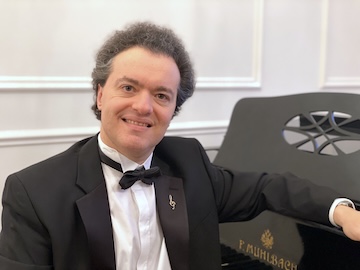
Pianist Evgeny Kissin’s April 16 performance at the Chan Centre will feature works by Ludwig von Beethoven, Frédéric Chopin and Dmitri Shostakovich. And, when cellist Yo-Yo Ma returns to the VRS May 6 at the Orpheum, he will play a selection of his favourite pieces and share stories about an extraordinary life dedicated to music.

Full details of the VRS 2024-2025 performances are available online at vanrecital.com. Tickets start at $28 and can be purchased on the website or by phone at 604-602-0363. 

– Courtesy Vancouver Recital Society

Virtuoso musician, impresario

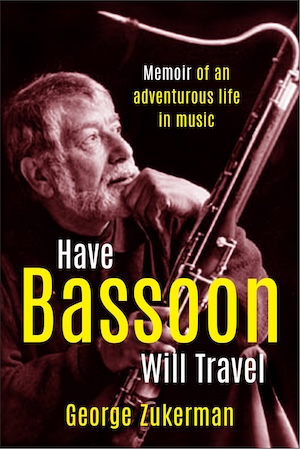
The reasons why Wendy Atkinson, who owns Ronsdale Press, wanted to publish Have Bassoon Will Travel: Memoir of an Adventurous Life in Music by the late George Zukerman, are the reasons people should read it. Zukerman had a long and impressive solo career as a bassoonist, was a pioneer in organizing concerts and tours, and gave remote communities across Canada the rare chance to hear classical music performed live. 

“She recognized that his anecdotes capture a vital period in Canada’s musical history and are vivid reminders of the lengths musicians will go to tour our vast country,” reads the afterword. “George’s memoirs go beyond simply capturing a life. He expanded the cultural reach of classical music in Canada; no small feat and Canada is better for it.”

image - Have Bassoon Will Travel book coverHow Zukerman’s memoir came to be is an example of the communities he created in his life. When he died Feb. 1, 2023, in White Rock, the manuscript had been written, but it took several volunteers – each with their own connections – to bring it to publication quality and get it printed. After reading Have Bassoon Will Travel, you will know why they did it. Not only was Zukerman a world-class musician and impresario, but he was a world-class human being: humble, funny, innovative, hardworking, fairness-driven, adventuresome, the list goes on.

Zukerman was born in London, England, on Feb. 22, 1927. Well into the book he talks about how he never liked his name, George – his parents, both American citizens living abroad, named him after the United States’ first president, George Washington. His middle name, Benedict, was in honour of 17th-century Jewish philosopher Baruch (Benedict) Spinoza, who was expelled by his community for his ideas. Zukerman also discusses his surname, the spelling of which differs across family thanks to the North American melting pot. There is something to be said about living up to one’s name, and Zukerman certainly was a leader in his fields of music, both as performer and impresario; he certainly forged his own path, uplifting the place of the bassoon in the orchestral world, creating opportunities for fellow musicians to perform and bringing classical music to the remotest of areas; and he lived in several places and traveled, mostly for work, around the world.

It is incredible how much of life is directed by (seeming) happenstance. Zukerman’s first encounter with the bassoon was at 11-and-a-half years of age. It was an accidental meeting, as his older brother showed him around the London prep school Zukerman was about to attend.

“We wandered past the windows of a basement chapel and glanced down to where an orchestra was rehearsing,” writes Zukerman. “A row of tall pipes seemed to reach for the ceiling. I could see and hear very little through the moss-covered stone walls and grimy opaque windows of the old school, and I wondered what on earth these strange-looking instruments were. My brother, already in Form IV, authority on much, including most musical matters, declared them to be bassoons, and the piece in rehearsal the annual Messiah. We walked on to explore my new school, and any awareness that I would spend my life playing that instrument would have been uncannily prescient. The bassoon remained buried deep among early memories.”

His next encounter was as random. As the Second World War began, the family – less Zukerman’s journalist father, who joined later – left London for New York City. There, Zukerman attended the newly established High School of Music and Art. 

“By way of an audition,” he shares, “I played [on the piano] my one and only party piece (a simple Beethoven sonatina). To my surprise as much as anyone else’s, I was admitted to the class of 1940! Dare I suspect that my acceptance had as much to do with short pants and an English accent as with any evident musical skill?”

On the first day of school, the kids were told to pick an instrument. “No British prep school could have readied me for such democratic and independent action, so I hesitated,” writes Zukerman. “On all sides of me, the pushy American kids ran furiously and grasped what they could most easily identify. The violins, clarinets, flutes, trumpets, cellos and drums disappeared into groping hands. When I finally reached the shelf, all that remained was an anonymous black box. I lifted it gently and carried it toward a teacher standing nearby. ‘Excuse me, Sir,’ I asked timidly, ‘but what is this?’

“He looked down, and a broad smile covered his face. ‘Why, you are our bassoonist!’ he declared.”

With faint remembrance of the tour with his brother, he thought, “Was I now going to play such an instrument?”

Indeed, he was, and to eventual great acclaim, both as part of orchestras and as a soloist. But, as you can imagine, bassoonist was not exactly a living-wage career, at least not in Zukerman’s time, and his parallel career arose from a need for more work. Having learned during his time with the St. Louis Sinfonietta in the 1940s about community concerts – where money was raised in advance through subscriptions rather than individual ticket sales, and no contracts were signed until the money to pay for everything had been raised – Zukerman, who was by then living in Vancouver, brought the idea to Canada. His offer to an American company to be their representative here declined, Zukerman decided to do it on his own. 

“Canada was coming of age, and Canadian communities were ready to make their own concert plans and to welcome Canadian groups and soloists, even if at the time they were equally unknown,” he writes. “Within a decade, Maclean’s magazine would write that I had successfully outsmarted the Americans at their own game.”

It is fascinating to read of Zukerman’s efforts to expand the reach of classical music in Canada and other countries – he visited the Soviet Union eight times between 1971 and 1992, as performer and concert organizer, and brought Soviet musicians to Canada to tour. Decades earlier, he spent a year-plus in Israel, part of the nascent Israel Philharmonic. He was also part of the Vancouver Symphony Orchestra in its early days, and of the Vancouver Jewish community – Abe Arnold, publisher of the Jewish Independent’s predecessor, the Jewish Western Bulletin, had a small but notable impact on Zukerman’s life.

Have Bassoon Will Travel is a truly engaging read. The way in which Zukerman writes is like how he would have spoken, though likely more concise and organized. The effect is that we the reader are having a chat with him, reminiscing. We get a feel for what life was like back in the day for a musician and entrepreneur. We feel nostalgia for a time many of us never experienced personally.

Ari’s Theme opens VIFF

Ari Kinarthy’s nightmare before the live recording session. (screenshot from Salazar Film)

The 43rd Vancouver International Film Festival (VIFF) officially opens Sept. 26 with the screening of Ari’s Theme, a TELUS original feature documentary about local composer Ari Kinarthy by local filmmakers Jeff Lee Petry and Nathan Drillot, who run Salazar Film.

Jewish Independent readers will be familiar with all three creatives, who will attend both VIFF screenings, ready to answer audience questions, as well as participate in a panel discussion.

Sam Margolis first wrote about Victoria Jewish community member Kinarthy in 2020 – Kinarthy, 30 years old at the time, had released two albums, won an international music competition and was looking for people who might want original music for a project they were working on.

“I create all my music entirely with the computer,” he told the Independent. “Sometimes, I will have access to a guitar player or singer but normally the music will be all done by the samples I use. I usually start with just piano and sometimes will write out a score. I think of a melody and/or harmony and continue from there. I love making themes.”

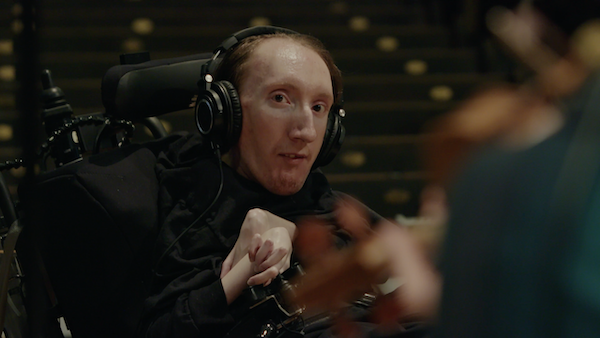
Kinarthy uses a special computer system to record his music, as he has spinal muscular atrophy type 2, a symptom of which is worsening muscle weakness.

When Margolis interviewed Kinarthy a second time for the Independent, it was because Ari’s Theme was about to première at Toronto’s Hot Docs Film Festival. In the article, which was published in April, the filmmakers share that the documentary was inspired by the first JI article.

“We hired Vaka Street Casting to help find us subjects for potential documentaries. They found the JI article while searching for individuals with unique stories,” Drillot told the Independent in an interview last week.

Drillot said the number one factor he and Petry look for in possible documentary subjects is that the individual has a unique perspective – “You’ve got to be an outside the box thinker,” he said, “which Ari most definitely is.”

“As we learned more about Ari’s story, we thought about how interesting it would be to work with a composer like Ari, who has a very particular life experience, and ask him to compose music about the most impactful moments, dreams and experiences of his life and let us create cinematic scenes around them,” Petry told the Independent in April.

It was hard to imagine just how Petry and Drillot would create those scenes and how Kinarthy would not only choose the times in his life to highlight, but be able to compose the music to accompany those emotional times. We learn in the film that Kinarthy doesn’t just want to write any song – he wants to leave a legacy, to make an impact on the world, so that his life will have been, in his words, “worth it.”

screenshot - Ari Kinarthy in a recording session with musicians at the Alix Goolden Performance Hal
Ari Kinarthy in a recording session with musicians at the Alix Goolden Performance Hall. (screenshot from Salazar Film)

Kinarthy’s honesty with his feelings, fears and ambitions, is remarkable. He undergoes a transformation during the film. His physical challenges and the dangers to his health if he gets sick have led to him being isolated for much of his life, relying on a few key caregivers and his parents. He is mentally strong, though, and this is made clear as he questions the walls he has built to protect himself and as he lives seemingly at peace with his limitations, while also knowing what he is capable of beyond them. That he allows the filmmakers – and us – to see just how vulnerable he is, is proof of his sheer strength.

“Watching Ari go through the process of making the film was incredibly rewarding,” said Drillot. “He overcame a lot of creative obstacles and consistently impressed the whole filmmaking team with his drive, determination and creativity. Personally seeing him watch the footage in the movie theatre was the most impactful. It’s a very unique experience to sit in a movie theatre and see your life reflected back at you. I really have a lot of respect for Ari for trusting the process and for constantly rising to the occasion.”

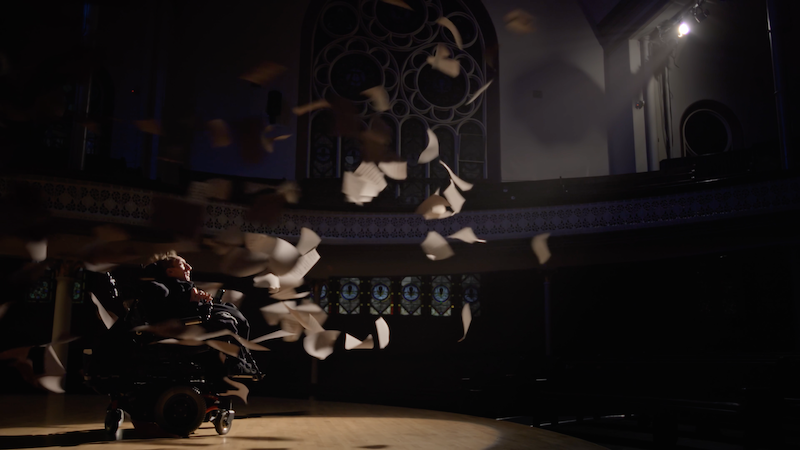
Kinarthy opens himself up creatively in ways even he may have thought not possible. We see him working with fellow musicians Allan Slade and Johannes Winkler, who provide feedback and guidance, and help him translate his vision into reality. It is in these scenes that we witness both Kinarthy’s confidence and anxiety, and the filmmakers capture it incredibly well, unobtrusively filming the men creating together, with other shots of Kinarthy talking about the process. There is an especially powerful scene, where Kinarthy sits alone in the Alix Goolden Performance Hall, on stage, as pages of music swirl madly about him.

Ari’s Theme uses such special effects, as well as animation and reenactments, to help tell Kinarthy’s story. There are home videos of Kinarthy and his family, and it is so moving to hear him talk about his family – describing his sister as a drum, driving him to enjoy himself; his dad as a cello, supporting from the background; and his mom as a piano, providing the strong underlying cords binding the family together. “And then there was me. I was a flute,” he says. “A little sound that would come in and out. I wasn’t integral to the song, but I added something unique. I often miss that version of myself, when life was expanding, free of concern and anxiety. As I’ve gotten older, these memories have become more and more important to me.”

In the film, Kinarthy questions whether other people will be interested in his memories. Anyone who sees the documentary will likely respond with a resounding, yes! Not only interested in the memories, but inspired by the man who shared them and the man who created their impressive soundtrack. 

Passages of that soundtrack will be performed live at the opening event by members of the Vancouver Symphony Orchestra. For tickets to either screening of Ari’s Theme (Sept. 26 or 28) and any other VIFF offerings, visit viff.org. The festival runs to Oct. 6.