Inspiring with chutzpah

image - Chutzpah Girls book coverMost of us could benefit from a little more chutzpah, as defined by Julie Esther Silverstein and Tami Schlossberg Pruwer, authors of Chutzpah Girls: 100 Tales of Daring Jewish Women (The Toby Press, 2024). 

According to Silverstein and Pruwer, chutzpah is: “ A Jewish superpower: the daring to speak when silenced, to take action when others won’t, to try when they say it’s impossible, to persevere in times of doubt, to be yourself when it’s easier to conform, to stand tall when made to feel small, to believe when it all feels hopeless, to shine your light in the face of darkness.”

With Chutzpah Girls, Silverstein and Pruwer “hope to power up a generation of knowledgeable and confident Jewish kids by zooming in on Jewish women with extraordinary stories across the diverse Jewish experience.”

Chances are that many of the adults reading these stories will also be inspired, learning about several, if not a dozen or more, Jewish women they’d never heard of before: brave and action-oriented women from all over the world, from ancient Israel (1500-587 BCE) to the 21st century.

image - Prophetess Abigail,  from Ancient Israel, whose portrait was created by Rinat Hadar
Prophetess Abigail,  from Ancient Israel, whose portrait was created by Rinat Hadar.

The 100 are listed alphabetically by first name, rather than chronologically, which gives a timelessness to the feats of each woman. Whether one is a prophetess in ancient Israel, a philanthropist in the early modern era, a trade unionist in the emancipation era, a human rights activist in the 20th century or an intelligence and cybersecurity official in 2024 is mostly irrelevant to the courage one can show.

There is a timeline at the beginning of the book that outlines the eight time periods into which each of the 100 Chutzpah “girls” is placed. Near the end of the book is a map, showing their global and historic presence: Argentina, Bahrain, Ethiopia, Germany, Kurdistan, Mesopotamia, Persia, Russia, Ukraine, the United States, Yemen, and others.

There are three Canadians who made it into Chutzpah Girls: Judy Feld Carr, Lori Palatnik and Rosalie Silberman Abella. And they illustrate how people who are just like us can do impressive things and step up when need be.

Carr was a musicologist, she had a young family. Then, she read an article about Syrian Jews who, after Israel won the Six Day War against its Arab neighbours, were suffering. “Although she was far away, she wanted to help,” write Silverstein and Pruwer. “She reached a rabbi in Syria’s capital city of Damascus by telegram and began sending boxes of needed supplies, including religious books.”

Even after the sudden death of her husband left Carr a single mother, she continued to help, recruiting volunteers from her synagogue. “Using religious terms as coded messages, they started a secret communication system with the Syrian Jewish community. Judy’s home turned into the hub of an underground escape network to help the Syrian Jews flee to safety…. She negotiated ransoms, planned elaborate escapes, and even smuggled people across heavily guarded borders.”

Carr helped save more than 3,000 Jews.

Palatnik is founding director of Momentum, a global organization that connects women to Jewish values and to Israel, and encourages them to take action to promote unity that embraces difference.

“One day, Lori was asked if she’d donate her kidney to a stranger,” write Silverstein and Pruwer. “Hesitant at first, she drew on her sense of achrayut, the responsibility we have for one another. ‘For someone I don’t know?’ she wondered hesitantly. ‘But someone knows her. This is someone’s wife, mother, daughter, friend. Why would I pass up this mitzvah just because I don’t know her?’” (Years earlier, Palatnik had been willing to donate a kidney to a friend, but hadn’t been a match.)

Abella (née Silberman) was the daughter of Holocaust survivors. Born in a displaced persons camp in Germany, she was 4 years old when the family “immigrated to Canada with little more than hope for a better future.” She became “the first Jewish female judge in Canada and the youngest in the country’s history,” never trying to hide that she was Jewish to succeed, write Silverstein and Pruwer.

“In her career, Rosalie worked tirelessly to eliminate the disadvantages faced by people with disabilities, women, people of colour, and the native aboriginal community. After 25 years as a champion of human rights and equality, Justice Rosie became the first Jewish woman to sit on the Supreme Court of Canada.”

Written in a concise, clear manner, there is a lot to learn about some amazing people in Chutzpah Girls. Every entry comprises the name of the woman, her era, when she was born and in what country, her job or title, a writeup about one of her chutzpah aspects, and a quote from the woman that reflects what she did or general words of wisdom. 
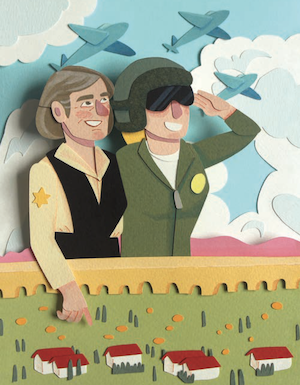
image - Jewish defenders Zivia Lubetkin, who helped command the Warsaw Ghetto Uprising, and her granddaughter, Roni Zuckerman, an Israeli fighter pilot, as envisioned by Shiri Algor
Jewish defenders Zivia Lubetkin, who helped command the Warsaw Ghetto Uprising, and her granddaughter, Roni Zuckerman, an Israeli fighter pilot, as envisioned by Shiri Algor.

Alongside the text for each woman is a beautiful, colourful, expressive portrait created by one of the dozen-plus illustrators and graphic artists that Silverstein and Pruwer enlisted for this book. The styles are so varied, but all are bold and capture the essence of the woman portrayed.

The last story and portrait in the book are left blank for the young (or old) reader to add their tale of chutzpah and a drawing of themselves.

But the book isn’t the end of it. Readers are encouraged to let Silverstein and Pruwer know who you’d like people to know more about – “a favourite figure from the Torah, a changemaker in your local community, or a leading lady in your own family. It’s even possible our next Chutzpah Girl is you!” 

To send your suggestion(s), email info@chutzpahgirls.com. To learn more about the writers and the artists, visit chutzpahgirls.com. 
Knowing how precious life is

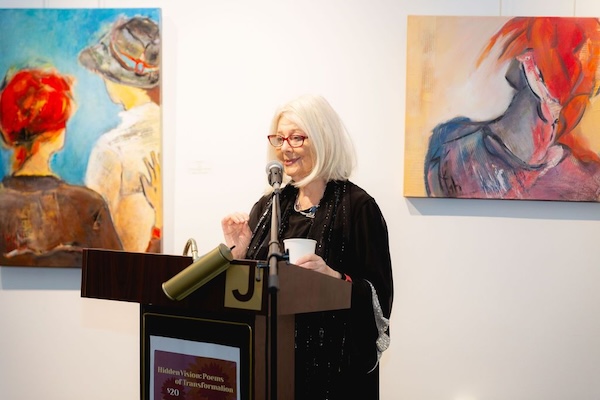
Lillian Boraks-Nemetz speaks at the Nov. 24 launch of her latest book, Hidden Vision: Poems of Transformation, which she wrote under the name Jagna Boraks. (photo by Rhonda Dent)

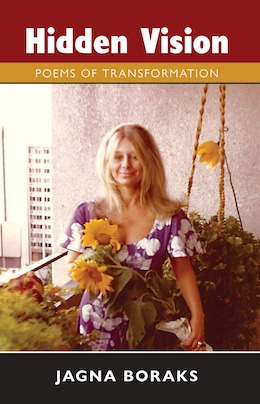
Lillian Boraks-Nemetz launched her latest book, Hidden Vision: Poems of Transformation, written under the name Jagna Boraks, at the Sidney and Gertrude Zack Gallery Nov. 24. Co-presented by the Vancouver Holocaust Education Centre and the JCC Jewish Book Festival, the event featured Boraks-Nemetz sharing some of her poems – on themes of identity, resilience and remembrance – with musical accompaniment by Wendy Bross Stuart.

Divided into six sections, the poems in Hidden Vision travel from the Holocaust to after the pandemic, from a nadir of human experience to a zenith of hope and gratitude. 

image - Hidden Vision book coverIn her introduction, composed shortly after the Oct. 7 Hamas attacks, Boraks writes, “Destruction is the opposite of creation. To survive in this world, in any crisis or situation, we need to strengthen ourselves and each other – spiritually. We begin by respecting ourselves and others.

“Understanding that each human life matters, and that each culture and creed are all a part of the world’s flowing river. There is greater strength in this belief than hatred and intolerance.”

The book begins in the spring of 2020, when the world was in the throes of COVID-19 and all that it brought – isolation, fright, shifts in personal and professional behaviour, and, of course, widespread sickness. In the poem “My Street,” written on March 29, 2020, Boraks confronts these issues:

“I will not wait like the brides / I will unlock my door and step outside / where the air feels fresh and crisp / breathing deeply I will begin my walk / towards life.”

Further on, she looks towards her literary influences, one of whom is Adam Mickiewicz, regarded by many as the national poet of Poland, but who also had an impact on the literature of neighbouring countries. In “The Autumn Muse,” inspired by Mickiewicz, Boraks asks: “has anyone ever written an ode / to old age – when the bird of youth / becomes time’s vulture / lurking in mid-air / its malevolent claws seeking to destroy?”

Within the later sets of poems, there is a poignant tribute to Alex Buckman, who, like Boraks-Nemetz, had been an ardent campaigner for Holocaust education in British Columbia. Buckman passed away in Warsaw in 2023 while on a March of the Living trip, where he served as a mentor to young students. In a tribute titled “In Memoriam for a Friend,” Boraks writes: “you chanted your life’s song / like the thorn bird / which sings till his heart might break / you chanted your fear of the dark / as you sang to the children / to appease their fear / as you sang to the students / to teach them lessons / of those barbaric times / when human life was cheap.…”

Despite countless social ills, personal struggles and humankind’s propensity for cruelty, Boraks ends the compilation on an upbeat note. For example, her poem “Hope” reads: “but father time in tune with God / will move the frozen earth into the sun / there – flooded by the light / a new earth will bear fruit / a new man woman and child / will behold the magic of a spring day.”

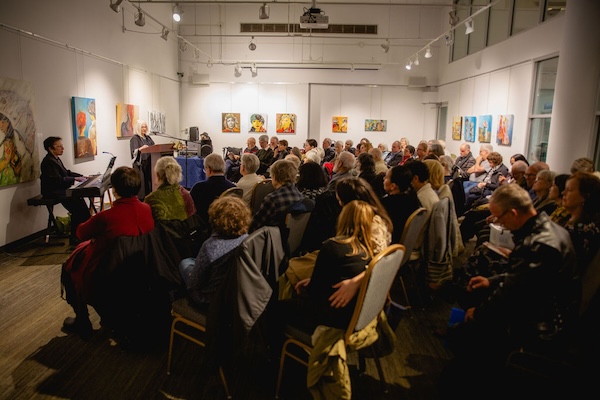
photo - The launch of Hidden Vision at the Zack Gallery drew a standing-room-only crowd
The launch of Hidden Vision at the Zack Gallery drew a standing-room-only crowd. (photo by Rhonda Dent)

Born in Warsaw, Boraks-Nemetz is a child survivor of the Holocaust. She lived in and escaped the Warsaw Ghetto, then hid in Polish villages under a false identity. Her family came to Canada in 1949.

Boraks-Nemetz graduated from St. Margaret’s School in Victoria, going on to study at the University of British Columbia, where she earned a bachelor of arts, then a master’s in comparative literature. Upon earning a certificate in ESL from George Brown College, she taught English, before eventually teaching creative writing at UBC’s Writing Centre, from 1980 until 2015.

Boraks-Nemetz’s previous volumes of poetry are Out of the Dark, Garden of Steel and Ghost Children. She has also penned three award-winning young adult novels: The Old Brown Suitcase, Sunflower Diary and The Lenski File. The Old Brown Suitcase was placed on the recommended reading list for BC schools.

In 2017, Boraks-Nemetz published Mouth of Truth, a novel exploring a family’s past and the trauma of the Holocaust. She has also translated the works of Polish poets Andrzej Busza (Astrologer in the Underground) and Waclaw Iwaniuk (Dark Times).

To order Hidden Vision, contact the Vancouver Holocaust Education Centre at info@vhec.org and 604-264-0499. 

Sam Margolis has written for the Globe and Mail, the National Post, UPI and MSNBC.

A voice that’s missed

Four years have passed since the loss of Rabbi Lord Jonathan Sacks (1948-2020), and more than one year since the outbreak of the Iron Swords conflict. In these turbulent times, we can only imagine the wisdom that Sacks – who was a global religious leader, philosopher, award-winning author and respected moral voice – might have shared, the guidance he would have offered. His voice is profoundly missed, especially now, when his words could have offered clarity and hope. This longing to “hear” his perspective propelled me on a journey.

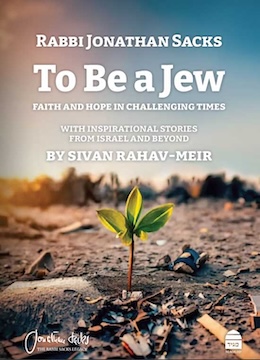
image - To Be a Jew book coverTo Be a Jew is a booklet that was born from a deep desire to find meaning in the current historic moment. Distributed freely across the globe, with more than a quarter of a million copies printed in Hebrew and English – and soon to be available in additional languages – it shares the timeless lessons of Rabbi Sacks with all who seek them. Below is a small selection of his enduring wisdom. For the full booklet, available as a free download, visit sivanrahavmeir.com/to-be-a-Jew. 

Growth from crisis

Every tragedy in Jewish history was followed by a new wave of creativity. The destruction of the First Temple led to the renewal of the Torah in the life of the nation, exemplified by the work of Ezra and Nehemiah. The destruction of the Second Temple led to the great works of the oral tradition, Midrash, Mishnah and the two Talmuds. The massacres of Jewish communities in northern Europe during the First Crusade led to the emergence of Hassidei Ashkenaz, the German-Jewish pietists. 

The medieval encounter with Christianity led to a renewal of Bible commentary. The meeting with Islam inspired a renaissance of Jewish philosophy. The Spanish Expulsion was followed by the mystical revival in Safed in the 16th century. The greatest catastrophe of all led to the greatest rebirth: a mere three years after standing eyeball to eyeball with the angel of death at Auschwitz, Bergen-Belsen and Treblinka, the Jewish people responded by their greatest collective affirmation of life in 2,000 years, with the proclamation of the state of Israel.… Jews [do not] give way to defeat or despair. They are the people of hope.

The Chinese ideogram for “crisis” also means “opportunity.” Perhaps that is why Chinese civilization has survived for so long. Hebrew, however, is more hopeful still. The word for crisis, mashber, also means a “childbirth chair.” The Jewish reflex is to see difficult times as birth pangs. Something new is being born.

(Sacks, Future Tense, pp. 54-55)

Response to terrorism

The first prime minister of Israel, David Ben-Gurion, said, “In Israel, to be a realist you have to believe in miracles.” For Jews, faith is as necessary as life itself. Without it, the Jewish people would simply not have survived. 

In 2001, after the Oslo peace process had broken down and the suicide bombings had begun, I told the then-Israeli ambassador: “In the past, Israel’s enemies have tried to put it in a military crisis and failed. Then they tried to put it in a political crisis and failed. Now they are about to put it in a spiritual crisis, and they may succeed.” 

That, ultimately, is what 21st-century terror is about, and Israel has been its most consistent target. The suicide bombings brought war from the battlefront to the buses of Haifa, the shops of Tel Aviv and the restaurants of Jerusalem. There were times when Jewish parents sent their children on the school bus not knowing whether they would see them alive again. The missiles of Hezbollah and Hamas placed two-thirds of Israel – the north and south – within their range. As I write, there are 7-year-old children in Sderot who have only known safety in a bomb shelter. The delegitimization of Israel among some media, academic and NGO circles has left its people feeling abandoned and alone. The aim is to intimidate and create despair, and it needs immense resources of faith and courage not to be affected. That is the spiritual crisis.

(Sacks, Future Tense, pp. 18-19)

Where is man?

When I first stood at Auschwitz-Birkenau, the question that haunted me was not, “Where was God?” God was in the command, “You shall not murder.” God was in the words, “You shall not oppress the stranger.” God was saying to humanity, “Your brother’s blood is crying to Me from the ground.” God did not stop the first humans eating forbidden fruit. He did not stop Cain committing murder. He did not stop the Egyptians enslaving the Israelites. God does not save us from ourselves. That, according to the Talmud, is why creating man was such a risk that the angels advised against it. The question that haunts me after the Holocaust, as it does today in this new age of chaos, is “Where is man?” 

(Sacks, Judaism’s Life-Changing Ideas, p. 7)

Everything has purpose

Life is meaningful. We are not mere accidents of matter, generated by a universe that came into being for no reason and will one day, for no reason, cease to be. We are here because a loving God brought the universe, and life, and us, into existence – a God who knows our fears, hears our prayers, believes in us more than we believe in ourselves, who forgives us when we fail, lifts us when we fall and gives us the strength to overcome despair. The historian Paul Johnson once wrote: “No people has ever insisted more firmly than the Jews that history has a purpose and humanity a destiny.” 

(Sacks, Ceremony & Celebration, p. 22)

Everyone has a mission

God enters our lives as a call from the future. It is as if we hear him beckoning to us from the far horizon of time, urging us to take a journey and undertake a task that, in ways we cannot fully understand, we were created for. That is the meaning of the word vocation, literally “a calling,” a mission, a task to which we are summoned.

We are not here by accident. We are here because God wanted us to be, and because there is a task we were meant to fulfil. Discovering what that is, is not easy, and often takes many years and false starts.

(Sacks, Studies in Spirituality, p. 24) 

Sivan Rahav-Meir is a primetime news anchor who lives in Jerusalem. She has a weekly podcast on Tablet, called Sivan Says, and has published several books in English. Her “Daily Thought” on social media has hundreds of thousands of followers and is translated into 17 languages.

Jewish Mexican food excites

Paletas can be made in many flavours. Sabor Judío includes a recipe that uses Manischewitz wine. (photo by Ilan Rabchinskey)

The minute I saw the cover, I wanted to try some of the recipes in Sabor Judío: The Jewish Mexican Cookbook by Ilan Stavans and Margaret E. Boyle. Not only did I learn how to make some very tasty food, but I learned a bit about the Jewish community in Mexico and its history.

image - Sabor Judío cookbook coverPublished by the University of North Carolina Press, with hunger-inducing colour photographs by Ilan Rabchinskey, and written by two Jewish Mexican scholars (now living in the United States), Sabor Judío was a cultural experience for me, never having been to Mexico before and only ever having made a basic burrito at home. Of course, I’ve eaten at many Mexican restaurants over the years, but Sabor Judío features recipes you won’t necessarily find in a restaurant here in Vancouver, or even in Canada, though local Jewish community members with Mexican roots might make some of these dishes at home.

There were two very important inspirations for Sabor Judío.

One was Stavans’ grandmother, Bobe Miriam, whose recipe book, written in a mix of Yiddish and Spanish, was started in the 1920s, after she immigrated to Mexico from Poland. It evolved over decades, as she figured out what worked and what didn’t, and as ingredients changed. The notebook “wasn’t just about cooking; it was also a time capsule that chronicled, through dishes, the Jewish family’s process of assimilation into Mexico and the way La Comunidad, as the Jewish Mexican community is known, showcases its personality to the world.”

The other was Boyle’s great-grandmother, Baba Malka, also a Polish immigrant to Mexico: “While Baba Malka was still actively cooking, her children, grandchildren and great-grandchildren took turns observing and documenting her work in the kitchen in Mexico City, filling the notebook’s pages with notes and adaptations in Spanish, Hebrew and English as the family generations expanded across Mexico and into the United States.”

The recipes in Sabor Judío are “dishes collected from grandmothers and other beloved home cooks, professional chefs and bakers, and a variety of historical sources,” writes cookbook author Leah Koenig in the preface. Even she came across ingredients she had never used before. “I learned the hard way that nopales (cactus paddles) should always be handled wearing gloves, lest the prickly spines leave your hands stinging for the rest of the day.”

The recipe for Cactus Tomato Salad does include a note about the proper handling of cactus leaves. But, not sure of where I could buy cactus here, I inadvertently saved myself the trouble of removing the spines, boiling the cactus and cutting it into 1/4-inch pieces by buying a jar of cactus that was already prepared in that way. This substantially eased the process of making this salad, which was very good, though I’m sure fresh cactus would have made it even better.

I chose what to make from Sabor Judío by looking at what the cookbook authors recommended as a festive Hanukkah meal, which includes the Cactus Tomato Salad. I had already singled out the Falafel Taquitos because I liked the idea of mixing Mexican and Middle Eastern flavours. In the end, there was a bit of a disconnect for me between the taste of the falafel centre and that of the corn tortilla shell. In eating leftovers the next day, I greatly enhanced the enjoyment of this dish by adding some fresh-cut tomatoes and cucumber.

I also had already eyed Agua de Horchata because of the first sentence in its description, which says that the rice-milk drink – which is believed to have 11th-century North African origins – “accompanies a good Mexican Jewish meal.” I was very pleased with how it turned out. I will definitely make it again.

The Latkes con Mole were as labour-intensive (grating potatoes and onion) and delicious as other latkes I’ve had, and I would happily swap out my usual apple sauce every so often for mole and crumbled queso fresco, even though it takes a lot of time to make mole.

I tried a second fried item, it being for Hanukkah and all, and the Sor Juana’s Ricotta Buñuelos were so good, if that’s a thing. The anise really made them pop, and I ate way too many.

Lastly, knowing how much I like paletas, I couldn’t resist making the frozen treats using Manischewitz. The wine most definitely tastes better frozen, after being steeped in cinnamon, cloves and orange.

There are other Hanukkah – Janucá – meals, as well as suggested menus for other Jewish holidays. In total, there are about 100 recipes in Sabor Judío, including desserts. One thing you’ll learn from this cookbook is that the Canadian and Mexican concepts of breakfast, lunch and dinner differ somewhat. You’ll learn some Spanish, some history and more. You’ll be introduced to some new-to-you ingredients and ways to combine those ingredients.

As Stavans and Boyle wish readers at the end of their book’s introduction, perfectly capturing the fusions taking place throughout it: “¡Buen provecho! Mit a gutn apetit! Kome kon gana!” Enjoy your meal(s).

FALAFEL TAQUITOS
(serves 6; prep takes 30 minutes plus overnight soaking and a 30-minute chilling time; 20 minutes to bake)

for the taquitos:
1/2 lb dried chickpeas, soaked overnight in water, then rinsed and drained
1/2 medium yellow onion, roughly chopped
2 tbsp fresh parsley, roughly chopped
2 tbsp cilantro, roughly chopped
2 medium garlic cloves, roughly chopped
1 tsp kosher salt, plus more as needed
1 tsp ground cumin
1/2 tsp ground coriander
1/8 tsp cayenne
vegetable oil, for brushing
12 (6-inch) corn tortillas

for the tahini sauce:
1/2 cup well-stirred tahini
1/4 cup fresh lemon juice
1/4 cup cold water

1. Add the chickpeas to a food processor bowl along with the onion, parsley, cilantro, garlic, salt, cumin, coriander and cayenne. Pulse, scraping down the sides of the bowl as needed until a textured paste forms. Taste and add more salt, if needed. Transfer to a bowl and refrigerate the mixture for 30 minutes.

2. Heat the oven to 400˚F and brush a 9-by-13-inch baking dish with about 1 tablespoon of oil. Lay one tortilla on a flat surface and place a scant 1/4 cup of the filling along one edge, nudging it into a line. Roll up the tortilla tightly and place it seam-side down in the prepared backing dish. Repeat the process with the remaining tortillas and filling.

3. Brush the tops of the tortillas with more oil and bake until crispy and golden, 15-20 minutes. Meanwhile, whisk together the tahini, lemon juice and water. Serve the taquitos hot, drizzled with tahini sauce.

AGUA DE HORCHATA
(serves 8-10; prep takes 10 minutes, plus overnight soaking and a 4-hour chilling time)

2 cups long-grain white rice, rinsed well and drained
1 cinnamon stick
6 cups room-temperature water, divided, plus more as needed
3/4 cup granulated sugar
2 cups whole milk
2 tsp vanilla extract
ice, for serving (optional)

1. Place the rice and cinnamon stick in a large glass bowl and add 4 cups of the water. Cover the bowl and let the mixture soak overnight at room temperature (at least 8 hours).

2. Pour the soaked rice mixture into a high-powered blender along with the sugar and blend until smooth. (You can tear the cinnamon stick into smaller pieces to facilitate its blending.) Pour the mixture through a fine mesh sieve into a large wide-mouth pitcher, stirring and pressing the mixture with a spoon, if needed, to help the liquid pass through the sieve. (Discard any remaining solids.)

3. Whisk in the milk, the remaining 2 cups of water, and vanilla. Cover the pitcher and chill the horchata in the refrigerator until cold, at least 4 hours. (The mixture will continue to thicken as it chills.)

4. Just before serving, stir the horchata well and pour into glasses (over ice, if desired). If the horchata gets too thick, you can thin it with a little more water.

SOR JUANA’S RICOTTA BUÑUELOS
(makes 10-15 fritters; prep takes 40 minutes, plus 1-hour resting time; 30 minutes to cook)

1 cup ricotta cheese
6 egg yolks
1/4 cup granulated sugar, plus more for serving
2 1/2 tsp ground anise
3 cups all-purpose flour, plus more for rolling
1 1/2 tsp baking powder
vegetable oil, for frying
jam, for serving

1. Combine the ricotta, egg yolks, sugar and ground anise in the bowl of a stand mixer and beat on low until combined. Whisk together the flour and baking powder in a medium-sized bowl.

2. Add the flour mixture to the ricotta mixture in stages, beating on low and scraping down the sides of the bowl as necessary, until a thick and sticky dough forms. Cover the mixing bowl and let rest at room temperature for 1 hour. 

3. On a large, floured work surface using a floured rolling pin, roll out the dough to a 1/8-inch thickness. Use a sharp knife and a plate or bowl with a 4-to-5-inch diameter to cut out circles. Gather the scraps and repeat the rolling and cutting process, if desired.

4. Heat 1/4 inch of oil in a medium frying pan set over medium heat until it reaches 350˚F on a digital thermometer, and line a large baking sheet with paper towels. Working with one circle of dough at a time, slip it into the hot oil and fry, turning once, until puffed and golden, 30 to 60 seconds per side.

5. Transfer the fritters to the paper towels to drain and cool slightly. Serve warm, sprinkled with more sugar or dolloped with jam.

PALETAS MANISCHEWITZ
(makes 6; prep takes 40 minutes; freeze 5 hours)

1 (750-ml) bottle Manischewitz sweet red wine
3 wide strips orange peel
4 whole cloves
1 cinnamon stick
2 cups water
thinly sliced limes and tangerines (optional)

1. Add the wine, orange peel, cloves and cinnamon stick to a medium saucepan set over medium-high heat. Bring the mixture to a boil, then lower the heat to medium and cook, stirring occasionally, until the liquid reduces to 1 cup, 30-35 minutes. Remove from the heat and let cool, then strain out and discard the spices and orange peel.

2. Stir the water into the strained wine syrup, then divide the mixture evenly among 6 paleta or flat popsicle molds. If desired, add a slice of lime or tangerine into each mold. Freeze until solid, at least 5 hours. 

Blue Rodeo is thriving at 40

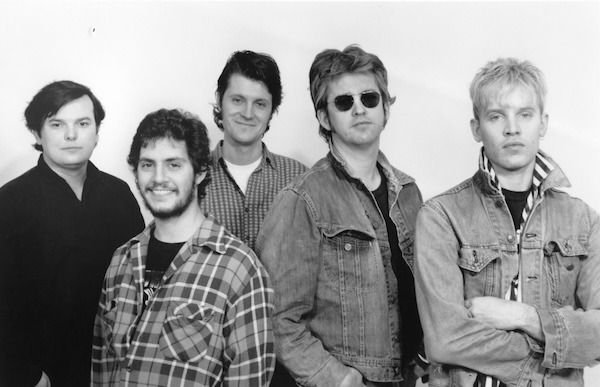
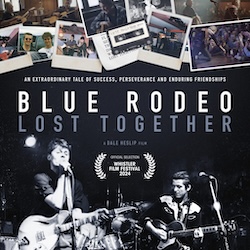
A 1989 PR photo for Blue Rodeo’s Diamond Mine album. Left to right are Bazil Donovan, Bob Wiseman, Jim Cuddy, Greg Keelor and Mark French. The documentary Blue Rodeo: Lost Together (left) has its world premiere at the Whistler Film Festival. (photo by Andrew MacNaughtan / bluerodeo.com)

The world premiere of Blue Rodeo: Lost Together, which gives viewers a glimpse into the rise of this iconic Canadian band, was so anticipated that the first screening of the documentary at the Whistler Film Festival sold out – a second screening has been added.  

The Whistler Film Festival runs Dec. 4-8, offering several programs, including feature-length films, shorts and its “Mountain Culture” series of films, après events and Q&As. The WFF24 Content Summit, which runs Dec. 4-7 in person and Dec. 10-12 online, presents speakers, panel discussions, workshops and other opportunities to learn and connect. 

Looking through the festival lineup, I came across Blue Rodeo: Lost Together and requested the screener for a few reasons. First, I grew up with Blue Rodeo’s music and knew many of their songs. Second, given the challenges of being recording and touring musicians – and Canadian to boot – I find it remarkable that the band is as popular as ever 40 years after high school friends Jim Cuddy and Greg Keelor started it. Lastly, founding members included Bazil Donovan (bass), Cleave Anderson (drums) and, most interestingly from my perspective, Bob Wiseman (keyboards). Wiseman is my second cousin and, though I’ve never met him, I have always been proud to let people know that I had a relative in Blue Rodeo. Wiseman was part of the group from 1984 to 1992.

image - Blue Rodeo: Lost Together posterBlue Rodeo: Lost Together delicately covers the comings and goings of musicians, and the sometimes-difficult friendship and professional collaboration of Cuddy and Keelor. It is frank about the band’s challenges in becoming a commercial success, starting as it did in the era of hard rock, but also dealing with some producers who had a different vision than Cuddy and/or Keelor of what would lead to that success. It is always fascinating to see how creative people balance their very personal drive with taking other people’s feelings and opinions into consideration (or not) and the need to feed and clothe themselves.

Overall, Blue Rodeo seems to have avoided any huge drama, though marriages and partnerships were tested by the rigorous tour schedule once the group broke into the international music scene. Some member partings were clearly amicable, such as when Anderson returned to his postman job after taking a five-year hiatus to play with the band – he had a family to support and wanted to be present for them. Other separations were more fraught: Wiseman wanted to leave a good year at least before he did, his unhappiness seeming to have started – from what I understand from the documentary – with the making of the album Casino, which was released in 1990. To make Blue Rodeo fit a more market-friendly mould, so it could become popular in the United States, Wiseman’s innate energy and expressive performance style was tamped down. “That was really traumatic for me,” he says in the film.

Despite creative differences and some tough times, all the interviewees in the documentary speak of one another and their experiences with great respect and gratitude. It is uplifting to see people treating one another kindly, even as they disagree. Hopefully, it isn’t just for show. Their affection seems genuine. The bonds these musicians have created between themselves and with their listeners seem strong. With all the bad that happens in the world, this is reason enough to watch this documentary – and, if you haven’t already, check out the music of Blue Rodeo.

At press time, there were tickets left for the Dec. 8 screening of Blue Rodeo: Lost Together. Of course, the festival features many other movies during its Dec. 4-8 run, including September 5 on Dec. 5 and 8. The thriller is based on the hostage-taking of Israeli athletes at the 1972 Munich Olympics. The description reads: “At the heart of the story is Geoff, a young producer eager to prove himself to his legendary boss, Roone Arledge. Teaming with Marianne, a German interpreter, Geoff unexpectedly takes the reins of the broadcast. As tensions rise, conflicting reports swirl and the lives of the hostages hang in the balance, Geoff faces difficult decisions that test his skills and moral compass.”

For tickets to the Whistler Film Festival and the full lineup of movies, visit whistlerfilmfestival.com. 

In honour of Arnold Schoenberg

The Israeli Chamber Project ensemble (PR photo)

Celebrating the 150th birth year of Arnold Schoenberg, the Israeli Chamber Project ensemble presents a semi-staged production of his expressionist cabaret Pierrot Lunaire with soprano Hila Baggio as the sad clown. Stravinsky’s Petrushka and Ravel’s La Valse complete the exploration of early 20th-century masterworks.

Two Clowns: Pierrot Meets Petrushka, presented by the Vancouver Recital Society, is at the Vancouver Playhouse this Sunday, Dec. 1, 3 p.m. For tickets, visit vanrecital.com or call 604-602-0363.

– Courtesy Vancouver Recital Society


Book a cautionary tale

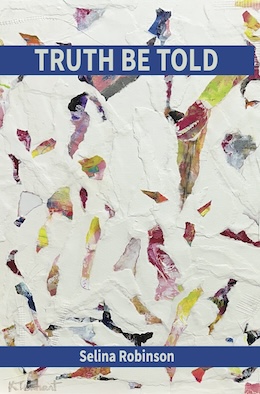
Selina Robinson will release her memoir, Truth Be Told, in a special launch event on Dec. 18. Robinson, who served in senior cabinet portfolios in British Columbia’s government, was fired earlier this year after offhand remarks about the land on which Israel was founded.

image - Truth Be Told book coverIn Truth Be Told, Robinson tells the behind-the-scenes story of what happened as she worked with the Jewish community to confront the antisemitism that erupted after the Oct. 7, 2023, Hamas terror attacks on Israel. Dubbing herself the “Jew in the Crew,” Robinson was the voice of the BC Jewish community in government.

Then, when anti-Israel protesters and a group of Muslim clergy threatened the government unless Robinson was fired, Premier David Eby called a meeting of the entire New Democrat caucus – except for Robinson herself – and immediately afterwards she was told that she needed to resign.

The book is a cautionary story of the dangers to ethnocultural communities, multiculturalism and democracy itself when leaders stay silent – or worse, capitulate – in the face of coercion and place expediency ahead of principles.

Robinson will launch the book in conversation with Global BC legislative reporter Richard Zussman at 7:30 p.m. on Wednesday, Dec. 18, in Vancouver. The specific location will be shared the morning of the event for security reasons.

There is no charge to attend the event, but registration is required at selinarobinson.ca. Copies of the book can be reserved on the website and will also be on sale at the event, with Robinson on hand to sign copies. 

– Courtesy Pat Johnson

Join Pacific Theatre in Shire

Peter Carlone, left, and Tim Carlson in Pacific Theatre’s production of The Hobbit (photo by Chelsey Stuyt)

Need a break from reality? On now at Pacific Theatre is The Hobbit, based on JRR Tolkien’s book, with all its adventure, wizardry, fantastical creatures, and more. The tale is brought to life by two actors “and a dragon’s hoard of theatre magic.”

A world premiere, Pacific Theatre’s The Hobbit was adapted by Kim Selody, with additional dialogue by Tim Carlson and Peter Carlone, the two actors who play multiple characters in the production. The Jewish Independent spoke with stage manager Julia Lank before the show opened on Nov. 15.

“We’re less than a week into rehearsal and already our performers, Tim and Peter, have made me tear up laughing with their creative solutions,” said Lank when asked what her most fun problem-solving moment had been so far. “Telling a story designed for dozens of characters with just two actors poses obvious challenges, and the entire team – including our designers – have jumped in with both feet,” she said. “The room is incredibly playful (this morning we were testing out rolling beer can ‘barrels’ down the aisles of the theatre) and our director, Laura [McLean] is also keeping the magic and wonder of Middle Earth at the forefront. The show is going to be full of surprises, and it feels great to be a part of creating something new together.”

photo - Julia Lank, stage manager of The Hobbit
Julia Lank, stage manager of The Hobbit. (photo from Pacific Theatre)

Lank is a self-taught stage manager, though she does have a degree in film production and worked as a first assistant director for several years, which, she said, is the film world’s equivalent of a stage manager.

“Stage management is one of those niche jobs that won’t be on a high school career counselor’s radar, but it’s perfect for me – a mix of technical theatre magic, caretaking, and lots of spreadsheets,” she said. “If you’re interested in how the theatrical sausage gets made and you’re unflappable, stage management might be for you.”

Lank’s recent credits include other Pacific Theatre (PT) productions (Gramma and The Cake), as well as Tuck Everlasting (Arts Umbrella), On Behalf (Fringe), L’Elisir d’Amore (Burnaby Lyric Opera), Jasper in Deadland (Awkward Stage) and City of Angels (the PIT Collective), among others.

“I worked as PT’s marketing assistant and later marketing director from 2017 to 2023,” she said. “I left last June to pursue stage management full-time, but I consider Pacific a theatre home and love the work and people there dearly. I’m also a self-taught marketer, but it’s easy to advocate for an artistic space when you genuinely believe in the work they’re doing. Many of my favourite theatre experiences, both behind the scenes and as an audience member, have been at PT.”

How she prepares for a new project differs, but, in general, she said, “I like to familiarize myself with the script and score well before a show begins so I can anticipate areas that may need extra support or take more time to come together. The director will be doing this work, too, and you want to be in the best possible position to help them execute their vision. And you definitely don’t want to be in a position where you didn’t realize there was going to be a live goat onstage until the first read.”

A good follow-up question would have been whether Lank was referring to The Hobbit when talking about an acting goat, but the JI missed that opportunity. Instead, we asked about how The Hobbit fits into Pacific Theatre’s aspiration “to delight, provoke and stimulate dialogue by producing theatre that rigorously explores the spiritual aspects of human existence.”

“Tolkien was famously opposed to religious allegorical readings of his work, but the Pacific Theatre community has a fondness for his work that stems from his personal religious background,” explained Lank. “Regardless, if you’re a person of faith or not, I think the values of compassion, the rejection of greed and needless violence in favour of communal care and quiet contentment and imagination in this interpretation of the story make Hobbit a perfect PT show.”

As for Lank, she was raised in the local Jewish community and attends Or Shalom.

“Judaism honours my curiosity and taught me that questioning a system can only improve it,” she said. “My Jewish identity calls me to care for the vulnerable, stand up for communities whose voices have been suppressed, and honour the natural world. It’s very important to me.”

Turning back to less serious matters, Lank said of The Hobbit: “It’s going to be a marvelous, silly, scary adventure – you’ll be very welcome to join us in the Shire.”

The Hobbit runs to Dec. 21 at Pacific Theatre. Performance times are Wednesday-Thursday, 7:30 p.m.; Friday-Saturday, 8 p.m.; and Saturday-Sunday, 2 p.m. For tickets, which start at $20, visit pacifictheatre.org or call 604-731-5518. 

Jweekly a model of success

Ieden Wall and Susan Minuk’s contrasting styles balance JWeekly Canada perfectly. (photo from JWeekly Canada)

JWeekly Canada made its Season 5 debut in September, becoming the longest-running Jewish TV talk show in Canada.

Friends and colleagues warned Ieden Wall – the show’s creator, co-host, writer, director and executive producer – that he might be making a mistake by signing on with Omni TV, the multicultural TV channel owned and operated by Rogers Sports and Media. Wall, however, insisted that traditional cable TV, based in a North American major market, is a lemon with a surprising amount of juice to be squeezed out of it – if one plays their cards right. 

The data seem to support caution. Approximately 42% of adults now opt for streaming services, with 35% accessing streaming content through their TV sets and 7% using personal devices. Roku predicts that this trend will persist and that an estimated 75% of all Canadian households will cut the cord by 2026.

But JWeekly Canada, which Wall co-hosts with Canadian journalist Susan Minuk, has made lemonade.

Rogers Sports and Media runs Hudson & Rex on its CityTV platform in the same Saturday primetime slot as JWeekly Canada. It is hard to image that JWeekly Canada could compete digitally with the heavily marketed hit, which airs on Omni’s sister station. And, by all accounts, its budget of $9,000 per episode should not allow it to compete. Yet it does – JWeekly Canada reaches some 100,000 viewers a week and more than half a million viewers a month. The half-hour program airs three times per week on television, is posted on a handful of social media channels and streams on JWeekly’s website.

JWeekly Canada has found its audience.

Cable TV reaches 97.3% of the over-55 population but only 29% of the 18-34 demographic in Canada each week. Wall highlighted what he considers an overlooked statistic in a 2024 Statista survey: 79.6% of Canadians between the ages of 45-54 watch cable TV within their primetime leisure window. 

“There is a surprisingly large subsection of men and women in their mid-to-late 40s who search out desirable content on cable TV during their nightly leisure window,” Wall said. “This group was crucial in us building our core audience.”

While Wall shares the JWeekly Canada screen with Minuk, the two seldom appear together. Their contrasting styles balance the production perfectly. Minuk is the soft-spoken interviewer and Wall is the playful provocateur. Together they offer up a little something for everyone it seems. 

JWeekly Canada is a Jewish-themed talk show, but with broader appeal. It has avoided being ethnocentric, offering content that smiles with Jewish pride, while still welcoming a multitude of cultures. To emphasize this point, JWeekly Canada’s current audience is only 31% Jewish. 

When asked about the show’s diverse viewers, Wall said, “Listen, our guests are some of the most intriguing and accomplished people in our country. The fact that they are Jewish is ancillary to the merit of their talent and success.

“If you are talking to a genius scientist who just invented a revolutionary heart procedure, which augments human arteries with lizard skin, it doesn’t matter if he/she happens to be Chinese, Indian or Jewish. Right? Great TV is great TV.”

The show’s format is a hybrid of in-studio interviews, conducted by Wall and Minuk, and Wall’s field segments. His daring and quirky remote pieces have allowed JWeekly Canada to reach outside Omni TV’s boomer demographic and attract a younger audience. 

His recent incarnation is the creation of a Jewish AI system called Chat JPT. In this segment, Wall tries out a pre-market Jewish AI system designed by Dr. Shecky Kravitz. Wall develops an unlikely friendship with Hershel, one of the platform’s avatars, and quickly finds out that letting his all-knowing avatar tag along for daily activities is both a blessing and curse. Well, probably more of a curse. 

In JWeekly Canada’s second season, Wall did 12 segments from a residential elevator at a luxury highrise. He called the segment “The Elevator Show.” For it, he put an elevator on “service,” took it to a floor of his choice and did on-the-spot interviews. Residents from the building gathered outside the open cabin, on bridge chairs, to watch. It was pretty darn cool.

“I have always considered Ieden to be ingenious,” said talk show legend Dini Petty. “I really hope Ieden finds the financial resources and marketing support he deserves because his ideas are truly pioneering.”

Wall has plans to come to Vancouver in the spring for a three-part documentary series called Solid Gold, about the life and times of 19th-century businessman Louis Gold, who settled here from the US with his family and helped build the city. Wall’s vision is to document the rich Jewish history in all major cities across Canada.

And he is hoping to soon reach more BC Jews with JWeekly Canada. With increased viewership from West Coast Jewry online, Rogers Sports and Media is considering running the program on its Omni Pacific Channel next September. In the meantime, the program is streamed and podcast every week on jweekly.ca. 

Louis Mann is a retired psychotherapist living in Boston. He grew up in the Bathurst Manor district of Toronto and continues to take an avid interest in Jewish causes in Toronto and throughout Canada.

Two great books for giving – Tali and the Toucan & Oy, Santa!

Honestly, I think adults would benefit from reading children’s books, even if they don’t have kids. Generally, the books impart good messages, like how to overcome challenges or be proud of who you are, and their illustrations are works of art. The two I reviewed for this issue of the Jewish Independent are prime examples.

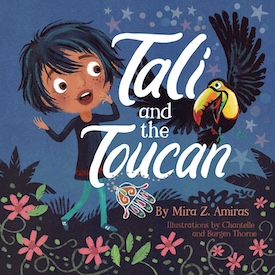
image - Tali and the Toucan book coverTali and the Toucan by writer Mira Z. Amiras and illustrators Chantelle and Burgen Thorne (Collective Book Studio) is set in San Francisco. The young protagonist, Tali, longs to tumble, swing and cartwheel like other kids, and she would love to take martial arts. But she is debilitated by fear – that the world will shatter, that she will break into a million pieces, that she will get hurt. Then, one night, she has a dream. At first, it’s kind of a scary dream, with a storm raging, chickens flapping about. One chicken makes it to the roof, pecks a hole in the window glass, and transforms into a toucan. The colourful-beaked bird teaches Tali how to tumble and soar in the sky. She awakes with new spirit and courage, no longer feeling like a chicken but like a toucan, ready to fly – and fall – with the other kids.

While not spelled out in the story, at the end of the book, there’s a note that explains that Tali’s fear of the world shattering “is taken from Jewish teachings that the world is indeed broken and that our job, called in Hebrew tikkun olam, is to put it back together again – starting with ourselves.” In addition to the “hamsa she wears – an amulet common to peoples of the  Middle East worn to protect children – her dreams lead her to conquer her fears, begin her tikkun and follow the path of Aikido, the Japanese martial art of nonviolence that teaches harmony, mutual assistance and peaceful resolutions to conflict.”

Other than the fact that Tali wants to do martial arts, the text of Tali and the Toucan doesn’t touch upon ideas like multiculturalism, cooperation or what a well-functioning society looks like, but rather expresses these concepts through the artwork. There’s a lot to look at in the illustrations and they beautifully capture Tali’s emotional journey.

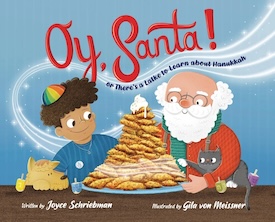
image - Oy, Santa! book coverOy, Santa!, or There’s a Latke to Learn about Hanukkah by writer Joyce Schriebman and illustrator Gil von Meissner (Intergalactic Afikoman) also expresses so much with its artwork. Whereas Tali’s hamsa makes an appearance on almost every page of her book, different kinds of light run through Oy, Santa! – white swirls full of stars, hanukkiyot with candles lit, strings of Christmas lights and exploding fireworks. While Tali and the Toucan only hints at multiculturalism and doesn’t explicitly talk about Judaism, Oy, Santa! puts both topics front and centre.

On Christmas Eve, young Oliver Overstreet writes an email to Santa: “I know you’re busy making toys, so I won’t write much. But I’m Jewish. And that means you don’t have to come down my chimney on Christmas Eve. I just wanna make sure you know.”

And so begins a delightful – and educational – email exchange between Oliver and Santa, who assures Oliver that he knows that both Oliver, and Oliver’s friend Ibrahim, do not celebrate Christmas. Oliver rails at Santa’s signoff, wishing Oliver a “Happy Chrismukkah!”

“Dear Santa,” he writes. “I know you’re still very busy. But please don’t write Chrismukkah. That’s not my holiday. I celebrate HANUKKAH. And Hanukkah and Christmas are different….” Oliver goes on to explain the story of Hanukkah and some of the fun ways the holiday is celebrated.

Santa and Oliver talk about many things in subsequent emails, from elves getting time off to celebrate whatever holidays are in their culture, to miracles and how reindeers fly, to whether it’s acceptable to put ketchup on latkes, and more. The conversation even gets a little heated, but – spoiler alert – Oliver and Santa work things out.

Oy, Santa! is a wonderful read, with lots of humour, fun illustrations, and great takeaways about identity, diversity, culture, civil discourse and friendship.