Unique in style, rich in culture

Kommuna Lux (photo by Maria Dmytrenko)

[Editor’s Note: Due to unforeseen circumstances related to flight restrictions, the Chutzpah! Festival must postpone Yamma Ensemble’s performances to March. However, the festival has found a vibrant alternative for Nov. 5: Itamar Erez Trio and special guests. Click here for more.]

Original music that honours the culture and traditions of its creators. Unique songs that you’d have to travel thousands of kilometres to see and hear live. Or, you could buy tickets to Chutzpah! The Lisa Nemetz Festival of International Jewish Performing Arts, which runs Nov. 1-10.

Kommuna Lux from Ukraine brings its unique “Odesa Gangsta Folk” – which they describe as “thrilling klezmer music and common gangster folk songs from their hometown, all with a dose of rocket fuel” – to Vancouver to open the festival Nov. 2, 7 p.m., at the Pearl. The event is presented in partnership with Caravan World Rhythms. The group will also travel to Victoria, for a Nov. 1 show at the Edelweiss Club.

Kommuna Lux’s music is specific to their part of the world, Volodymyr Gitin (clarinet) told the Independent. 

“What I like most about this style is the special energy that charges both us and our listeners,” he said. “But I also really like how diverse our music is, because it includes almost everything related to the cultural heritage of Odesa.”

Similarly, Yamma Ensemble from Israel brings its unique heritage-rich music to Chutzpah! – on Nov. 5, 7 p.m., at Rothstein Theatre. They also give an intergenerational matinee performance Nov. 4, geared to school and seniors groups, in which they will “include as many explanations as possible about the ancient musical instruments, about the Jewish communities around the world, about the songs,” lead vocalist Talya G.A Solan told the Independent.

“We wish to celebrate and enjoy the richness and the immense beauty of the Jewish culture and our origins,” she said. “We mainly bring out the mix of Jewish cultures, the mix of our different backgrounds and the fact that we came together into an organic and whole music ensemble…. So, in our music, you can hear the music of Spanish Jews from Thessaloniki and Spanish Jews from Turkey, the singing of psalms by the Jews in Iraq and the singing of religious poems from Yemen.”
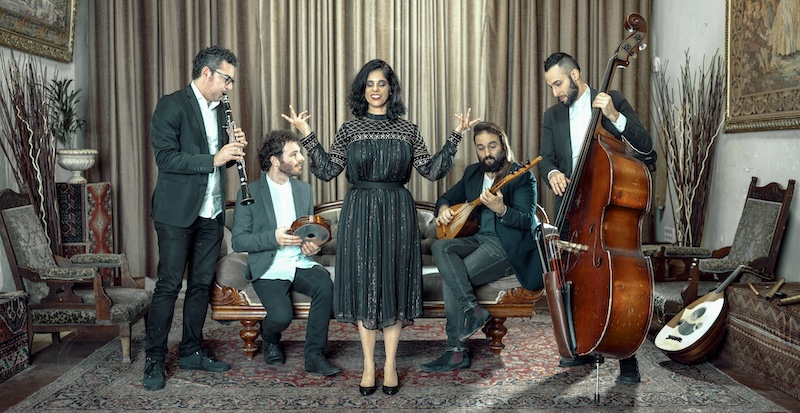
photo - Yamma Ensemble
Yamma Ensemble (photo by Zohar Ron)

On the group’s website, they note that Yamma means “toward the sea” in Hebrew and “mother” in Arabic.

“The connection between Hebrew and Arabic is not only a connection between two very similar Semitic languages, but also a connection between the countries of origin of the Jews who lived in Arab countries and their descendants, who were born here and grew up in Israel,” explained Solan. “Our musical heritage, like our origins, is connected to the Jewish communities in the Middle East who immigrated to Israel with the language they spoke, the Arabic language in its many dialects (Yemeni, Iraqi, Moroccan, etc.). They came to Israel and had to speak the local language – Hebrew.”

Hebrew is a central element of the ensemble’s repertoire, directly tied to the members’ identity as Israeli musicians.

“Hebrew is our mother tongue, the language we were born into and the language in which we dream and communicate,” said Solan. “It is an ancient, gorgeous and special language that became extinct and was revived in the 20th century. We try to perform mostly in Hebrew. We mix between our own original creations (always Hebrew) and traditional music (Sephardic, Yemenite).

“There is no Israeli music group that performs out of Israel and has been active for a long time [mainly] performing Hebrew music,” she continued. “This fact is odd and crazy, since Hebrew is the spoken language in Israel, but none of the Israeli musicians active abroad focus on this magnetizing and beautiful ancient language.

“One of the reasons that Yamma Ensemble’s YouTube channel is the most viewed channel of Hebrew music for foreign audiences,” she said, is “the accessibility of Hebrew for foreign audiences who do not speak it. We translate all the songs, so people can watch them with English translation. We receive daily messages from all over the world from people who write us that they learn Hebrew with the songs, that they get closer to their Judaism through the songs. It feels like a serious task that we didn’t ask to take on, and it happened naturally.”

Yamma Ensemble has four albums – Yamma (2011), Basket Full of Stars (2017), Rose of the Winds (2020) and To Awaken Love (2023) – the last of which comprises entirely original music, inspired by traditional sounds, said Solan.

The group is working on an album of psalms. Their performance of Psalm 104 is “the most viewed Jewish chant on YouTube, [in the] category of live and traditional music,” she said. “It has already passed 10 million views! So, we need to record this psalms album.”

However, to produce a recording is an expensive undertaking, and that’s one thing when the music will have a relatively large market. For music “that is not commercial and does not carry profits or compensation, there must be a budgetary basis or significant support,” said Solan. People who are interested may support the psalms project via the ensemble’s website, yammaensemble.com.

Coincidentally, Kommuna Lux’s original name also has to do with the financial side of the music business. 

Dengi Vpered means ‘Money Forward’ or ‘Cash in Advance,’” explained Gitin. “This name appeared before I was in the group. One day, the guys didn’t get paid for a performance and, since then, they started taking money in advance. At the same time, they named the group that way, with a bit of Odesa humour, and also so that it would be immediately clear how they do business.

“After six incredible years of being together, it so happened that our vocalist decided to go his own way and we needed to figure out how and with whom to continue our journey. Also, for various reasons, we felt that it was necessary to change the name…. So, first we found [singer] Bagrat [Tsurkan], who quickly became a valuable member of our team, and then the name itself came along, which resonated with us very much.

Kommuna Lux has several meanings,” he said. “One of them is ‘the Commune,’ which is united by the common idea of bringing light and joy to people. But ‘Kommuna’ can also mean a communal apartment in which several families live. In such apartments, there is a shared kitchen and sometimes a bathroom, and people need to agree with each other to live in peace and harmony. And ‘Lux’ in this case has another meaning, as a sign of the quality of how we look and sound on stage, the quality of the luxury level.”

Gitin joined the band, which has one album to date (OdesaFM), in 2014.

“I was attracted by the idea of reviving Odesa songs and Jewish folklore in a new, modern way,” he said. “Everything was created and performed with great enthusiasm and a desire to share positive emotions with people. We felt that we were doing something special.”

And they do something extra special in some of their performances – they raise money for Ukrainians affected by the ongoing war with Russia. 

“Mostly, we collect money for 110 Brigade, they always need different vehicles for different goals,” said Gitin. “Also, during our last tour, we [participated in a] joint initiative of Rotary E-Club of Ukraine to buy beds for burn victims, for a hospital in the city of Kramatorsk in Donetsk region.

“Our whole life is connected with our home and we feel that every Ukrainian joined to help our people,” he said. “So, our reasons are the same, we can’t just watch, we feel that we should do what we can.”

He added, “Music is very important, especially in such periods, because, through it, it is possible to express the whole spectrum of feelings. Music can raise the spirit, unite everyone around a common idea, and also help people experience deep feelings, especially when they lose loved ones.”

Rounding out the musical offerings at Chutzpah! this year is New Orleans multi-instrumentalist Mark Rubin, “offering Southern Americana from a Jewish, socially conscious point-of-view.” Jacob Samuel headlines a comedy night hosted by Kyle Berger, and Jeremy Goldstein’s Truth to Power Café includes stories from Vancouverites in response to the question, “Who has power over you and what do you want to say to them?” A dance double bill features Fortress (Rebecca Margolick and Livona Ellis) and About Time (Ne.Sans Opera & Dance, Idan Cohen). Canadian Yiddishist Michael Wex brings The Last Night at the Cabaret Yitesh (di letste nakht baym yitesh) to the festival, and the Vancouver Jewish Film Festival and Chutzpah! co-present the screening of Gimpel the Fool Returns to Poland by Nephesh Theatre artistic director Howard Rypp, which “follows the show’s journey throughout different towns of Poland, while tracing [Gimpel writer Isaac Bashevis] Singer’s escape from the Holocaust, finally finding refuge in the USA.” 

For tickets to any of the festival events, visit chutzpahfestival.com or call 604-257-5145.

New this year for the Chutzpah! Festival: Jewish Community Centre of Greater Vancouver members receive discounted ticket prices and concession purchases at the theatre. Select Student/Senior/JCC Member tickets and ChutzPacks and bring your membership card to the theatre.
A harrowing survival story

Almost every Holocaust survivor’s narrative involves some combination of extraordinary coincidence, righteous humanity amid dystopia or a series of chance events that astonishingly result in survival against all odds. The number of such flukes in the life of Vancouver woman Malka Pischanitskaya may convince readers of the author’s conclusion that survival was her destiny.

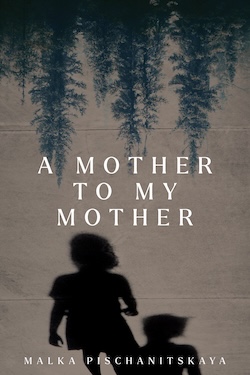
image - A Mother to My Mother book coverPischanitskaya’s memoir, A Mother to My Mother, is one of the latest releases in the Azrieli Foundation’s Holocaust Survivor Memoirs Program. Begun in 2005, the program has now published scores of firsthand testimonies of Canadian Holocaust survivors, many in both official languages, and all of them available free of charge to educational institutions.

Pischanitskaya’s Ukrainian Jewish family knew its share of misery before the emergence of Nazism and war. Her father abandoned her mother before Malka was born, in 1931, and she was raised in grinding poverty by her grandmother and great-aunt while her mother worked in a nearby village and saw Malka some weekends. 

The Stalinist-induced Ukrainian famine of the 1930s killed between three and five million people. The Nazi invasion of the Soviet Union, and its perpetration of the “Holocaust by bullets,” killed 1.5 million Jews, mostly shot at close range and buried in mass graves.

Young Malka’s earliest life, despite hardships, was not without happy memories of Jewish holidays and the changing of the seasons. These are tempered with stark recollections. Without electricity or anything but firewood for heat, she recalls Ukrainian winters so cold the ink at school would freeze solid.

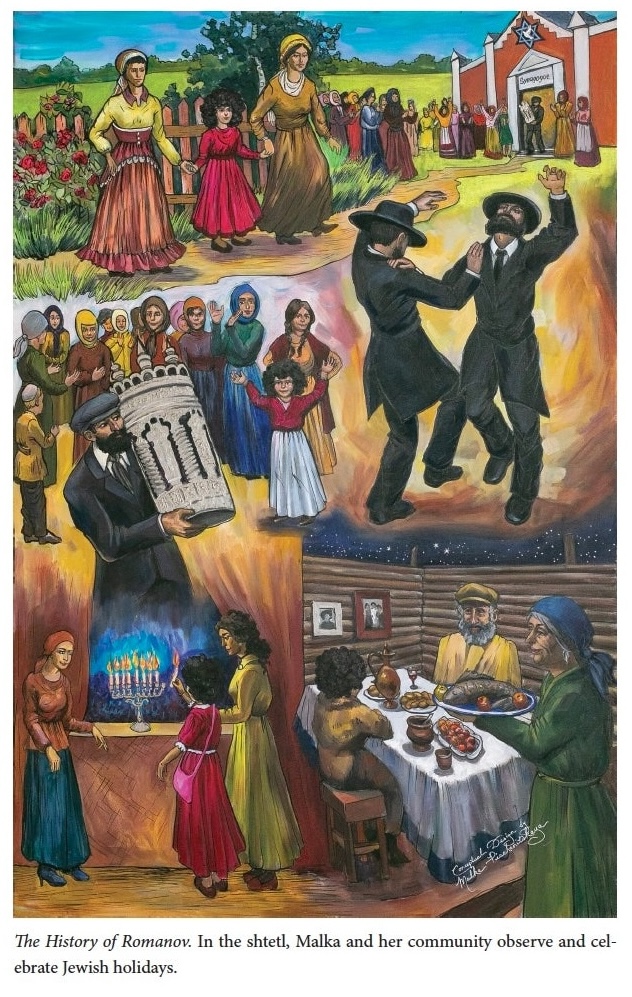
image - A page from Malka Pischanitskaya’s memoir A Mother to My Mother, which includes paintings that she created for a 2019 exhibition
A page from Malka Pischanitskaya’s memoir A Mother to My Mother, which includes paintings that she created for a 2019 exhibition.

After the Nazi invasion of Poland and the beginning of the war, in 1939, five refugee families from Poland arrived in Romaniv (alternatively: Romanov). 

“I have often wondered how much my community found out from these refugee families about what was happening under the Nazis in Poland and whether this made them more aware of the disaster that was to come,” writes Pischanitskaya. 

What was to come was beyond imagining – which may help explain why Malka and her family remained in Romaniv when some other Jews fled further east into the Soviet Union.

“We were not ready – there had been no mental preparation for this moment – so we did not accept the offers to escape,” she writes.

Soon, the Nazis arrived and young Malka witnessed Jews being killed in the streets. The randomness of those murders was replaced with methodical mass executions. The story, starkly told, is predictably shocking, and differs significantly from what happened further west. Rather than ghettos and concentration camps, the Holocaust in the east was typified by summary roundups and mass killings of entire communities, usually in adjacent forests. 

On Aug. 25, 1941, Ukrainian police gave Romaniv’s Jews 30 minutes to congregate in the centre of town.

“Those who were unable to walk had been taken out of their homes on stretchers,” she writes, disabusing Jews of the desperate idea they were being assembled to perform forced labour.

“We walked toward the beautiful park located a couple kilometres from the centre of town,” writes Pischanitskaya. “The crowd of close to 2,000 walked with visible sadness, expressions of disbelief.

“Men were rounded up, separated from their families, and then marched deeper into the forest where, previously, pits both massive and deep, had been dug. Women, children and the elderly were forced into rooms in the military building. Crowded in, there was hardly space to stand. Windows were locked. No fresh air; no water; no washrooms. People screamed, fainted, losing their minds; children were scared and restless.

“One by one, several groups of Jewish people were taken to slaughter. While we were kept in the building, waiting our turns, the heavy ring of machine gun fire instilled extreme fear and terror in all. The slaughter of the Jews from the Romaniv community continued from early morning until dusk – the sun had faded from our lives forever.” 

Then: the first of the miracles that spared the life of Malka and her mother.

“Eventually, mothers with children were let go from the building,” she writes. “Perhaps the murderers were tired from their orgy of death and torture, or perhaps there was no room in the pits for the rest of us, but those who had to remain were slaughtered. We left them, still alive, when we had the chance to run for our lives.”

Here, Pischanitskaya catalogues the names of the many family members killed that day. She goes into grim detail about what witnesses reported from the pits.

Thus began years of hiding – and a succession of near-misses, any one of which would likely have been fatal.

The relationship that gives the book its title, of young Malka mothering her mother, is a story of a parent so paralyzed by events that she becomes almost incapacitated. Malka’s astonishing and perilous actions to ensure their survival form the bulk of the book. She begs door to door in the villages where they hide, often receiving small portions of food. At one home, she sees her own portrait on the wall, apparently pillaged from Malka’s family home after they fled – an uncanny and grotesque coincidence.

When, after the war, they returned to Romaniv, “Almost nothing remained except for memories.”

“Adult survivors went to the mass graves to pray for and memorialize their loved ones, and to bear witness,” writes Pischanitskaya. 

Of all the people who survived and showed up alive after the war was Malka’s “so-called father,” as she calls him, a man whose sadistic cruelty Malka and her mother would have been better off without.

In a twist, the mother who had been “a dependent child” transformed into a courageous woman who pursued Polish and Ukrainian police for war crimes.

Like so many survivors, Pischanitskaya demonstrated improbable resilience, marrying, becoming a teacher, becoming a mother, escaping the Soviet Union, migrating to Canada and raising a successful family that continues to contribute to Vancouver’s Jewish and broader community. 

A Mother to My Mother is illustrated with harrowing, moving paintings that Pischanitskaya created for an exhibition titled Romanov: A Vanished Shtetl, which was presented at the conference of the World Federation of Jewish Child Survivors of the Holocaust and their Descendants, held in 2019 in Vancouver.

To order a copy of A Mother to My Mother in print or ebook format, or any other survivor memoir, visit memoirs.azrielifoundation.org.

The first of many Shabbats

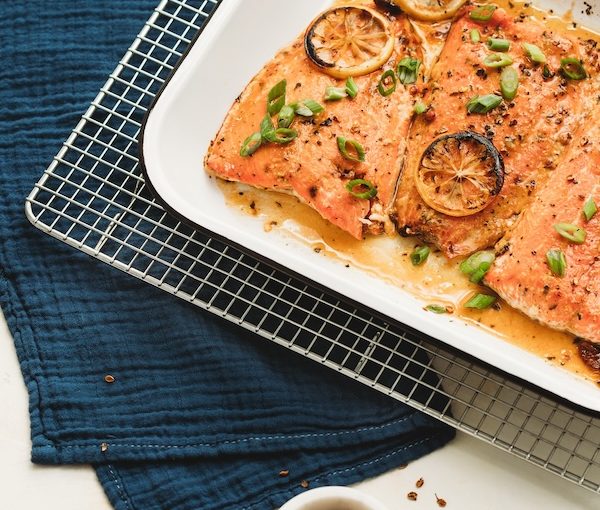
Faith Kramer’s Roasted Salmon with Citrus-honey Sauce. (photo by Clara Rice)

Somehow, I missed the cookbook 52 Shabbats: Friday Night Dinners Inspired by a Global Jewish Kitchen by Faith Kramer when it was published by the Collective Book Studio in 2021. Well, I now have a copy and, in an ideal world, my next year of 52 Shabbat dinners would all be cooked à la Kramer. Instead, it’ll probably take me several years to make all the special meals in this informative, well-laid-out, easy-to-follow cookbook – but at least I’ve gotten a head start.

In this last month of the Jewish year 5784, I made two of Kramer’s main dishes, a salad dressing and a dessert. Each recipe is prefaced with a blurb containing more information about the dish. Many recipes have suggestions of what to serve together (starter, main, dessert, etc.) to elevate the meal for Shabbat, as well as suggested variations and what can be made in advance. Kramer also provides explanations of lesser-known ingredients.

52 Shabbats begins with some discussion of different Jewish traditions around Shabbat and various Jewish communities’ ways of cooking food and the ingredients they use. Kramer gives a brief overview of Jewish dietary laws and shares her preferences for the common ingredients she uses throughout. The book is divided into the four seasons, plus chapters on side dishes and accompaniments, desserts, and fundamentals (sauces, etc.). There are additional resources listed near the end, as well as measurement conversions.

I chose the recipes to make from the fall section, focusing on Rosh Hashanah. I made a carrot and lentil main because, as Kramer writes: “Carrots are symbolic in Judaism of asking for prosperity and for our blessings to multiply. Combined with the sweetness of silan [date syrup] … or honey, they make an edible wish for a Happy New Year at Rosh Hashanah.” I also made a fish main, because fish is another symbol of Rosh Hashanah, with the hope that we be the head and not the tail, ie. a leader rather than a follower.

Kramer recommended mini cheesecakes as the dessert for both of these mains, so I made those as well. I also made the Lemon, Za’atar and Garlic Dressing for a green salad, but much preferred the dressing as a marinade for blanched green beans. For space reasons, I’ve not included the recipe intros or the “make it in advance” suggestions, nor have I included the dressing recipe. The three recipes here will hopefully inspire you to get a copy of the cookbook, and perhaps start some new Shabbat traditions this year.

SWEET-AND-TART SILAN-ROASTED CARROTS WITH LENTILS
(serves 4 as a main, 8 as a side)

for the lentils:
1 cup green or brown lentils
3 cups vegetable broth
1/4 tsp ground black pepper
1/4 tsp ground cumin
1/4 tsp paprika
1/2 cup chopped fennel or celery
1/2 cup chopped onion
1 tsp minced garlic
1 tsp minced jalapeño, optional
1/4 tsp salt, plus more if desired 

for the carrots:
2 tbsp olive oil, plus more for baking sheet
1 cup silan, honey or agave syrup
1/4 cup water
2 tbsp fresh lemon juice
1/4 tsp ground cumin
1/4 tsp ground cardamom
1/4 tsp cayenne pepper or paprika
1/8 tsp ground cloves
1 lb multicoloured carrots, peeled (cut large carrots into thirds)
1 tsp coarse sea salt
2 tbsp tahini
2 tbsp chopped fresh mint or flat-leaf parsley

In a large saucepan, stir together the lentils, vegetable broth, black pepper, cumin and paprika and bring to a simmer over medium heat. Stir in the fennel, onion, garlic and jalapeño (if using) and return to a simmer. Cover and cook, lowering the heat as needed to maintain a gentle simmer, until the lentils are tender and the liquid is absorbed, 15 to 20 minutes. Add the salt and stir well. Taste and adjust the seasoning, if desired. Remove from the heat, drain any excess liquid, and set aside while you make the carrots. 

Preheat the oven to 450°F. Line a rimmed baking sheet with parchment paper or aluminum foil. Grease the parchment paper with olive oil. 

In a wide, flat dish, whisk together the silan, water, olive oil, lemon juice, cumin, cardamom, cayenne and cloves. Add the carrots and toss until evenly coated.

Place the carrots in a single layer on the prepared baking sheet. Set aside any left-over silan mixture. 

Lower the oven temperature to 400°F. Roast the carrots for 40 to 50 minutes, or until tender and browned, tossing in the pan juices every 10 to 15 minutes.

Reheat the lentils, if desired, or keep them at room temperature. Add any leftover silan mixture to the lentils and stir to combine. Transfer the lentils to a large serving dish and top with the roasted carrots. Sprinkle with the coarse salt, drizzle with the tahini and garnish with the fresh mint.

ROAST SALMON WITH CITRUS-HONEY SAUCE
(serves 4-6 as a main, 8-10 as a starter)

1/3 cup fresh orange juice
1/2 cup light-coloured honey
1/2 tsp dried mint
1/4 tsp salt
1/4 tsp cayenne pepper or paprika
1/4 tsp ground black pepper
1/2 to 1 tsp Sichuan peppercorns, lightly crushed, optional
vegetable oil for baking sheet
1 1/2 to 2 lbs salmon fillet
6 tbsp thinly sliced green onions

In a small bowl, mix together the orange juice, honey, mint, salt, cayenne, black pepper and crushed Sichuan peppercorns (if using) to make a marinade. Set aside half of the marinade to use later for the sauce.

photo - Faith Kramer’s Roasted Salmon with Citrus-honey Sauce
(photo by Clara Rice)

Grease a rimmed baking sheet with oil. Place the salmon, skin side down, in the pan and brush the top of the salmon with some of the marinade. Let sit for at least 30 minutes or up to 60 minutes, brushing often with the marinade. 

Preheat the oven to 350°F. 

While the fish is marinating, pour the reserved marinade into a small saucepan over medium heat and bring to a boil. Lower the heat to low and simmer, uncovered, stirring occasionally, until the liquid is reduced by two-thirds, 15 to 20 minutes. Taste, and adjust the salt and other seasonings, if desired. Set the sauce aside.

Brush or spoon the remaining marinade over the salmon. Roast for 15 to 20 minutes, basting with the pan juices after 10 minutes, until the salmon is cooked to the desired doneness. For fully cooked fish, it should read 145°F when an instant-read thermometer is placed in the thickest part of the fillet. The flesh should be opaque all the way through but still be very moist. 

Transfer the salmon to a platter and spoon the sauce over the fish. Sprinkle with green onions and serve warm, at room temperature, or chilled.

MANGO AND CARDAMOM MINI CHEESECAKES
(makes 24 individual cheesecakes)

24 ginger snaps, lemon snaps or wafers, or vanilla wafers
1 1/2 cup fresh or defrosted frozen mango chunks, divided
3 (8-ounce) packages regular or light cream cheese, at room temperature
3 large eggs, beaten
1 cup sugar
1/2 tsp ground cardamom
1/4 tsp salt
1/4 tsp ground ginger
1 1/2 tsp vanilla extract
1 tsp fresh lemon juice

Preheat the oven to 375°F. Line two 12-cup cupcake pans with paper or foil liners. (If you don’t have enough tins, use foil cupcake liners on a baking sheet.)

Put a cookie in the bottom of each liner. Break cookies to fit and cover the bottom of the liner, if necessary.

In a blender, purée 3/4 cup of mango chunks until smooth. Set aside.

Cut the cream cheese into 1-inch chunks. In a large bowl, combine the eggs, sugar, cardamom, salt, ginger, vanilla extract and lemon juice and beat with an electric hand or stand mixer until light and lemony in colour, 1 to 2 minutes. Add the cream cheese chunks in 3 batches, incorporating each batch before adding the next. Beat on medium-high speed until totally smooth, 3 to 4 minutes. 

Fill each cupcake liner two-thirds full. Place 1 teaspoon of the mango purée in the centre of each cake. Using a knife, swirl the purée through the batter to create a marbleized look. 

Bake for 20 minutes, or until the centres of the cheesecakes are a bit loose and jiggly, puffed up and pale in colour. Turn off the oven, open the oven door and leave the cheesecakes there for 30 minutes. Transfer the cheesecakes to a wire rack and let cool. (The tops of the cakes will collapse.) Place the cheesecakes in the refrigerator until chilled. 

To serve, remove the cheesecakes from the liners, if desired. Chop the remaining 3/4 cup of mango and spoon it onto the cheesecakes. Serve cold or cool. 

Songs with a biblical touch

Of course, not everyone in Israel is religious. Yet, there is a rich heritage of Hebrew songs with lyrics taken either directly from the Hebrew Bible or inspired by it. Over the years, these songs have been tremendously popular with the Israeli public.

The first example – a song taken from Deuteronomy Chapter 30, verse 19 – unfortunately has special meaning in Israel today, as thousands of residents from both the northern and southern parts of the country have been forced to live away from their homes for almost a year now.

“Because man is a tree of the field” – this verse has been variously understood to mean human beings are like a tree planted on their land. While it has been recorded by more than one Israeli singer, a version I really like is the one with extended lyrics taken from a poem by the late Nathan Zach. It can be found at nli.org.il, if you know Hebrew.

Early in the daily morning prayer service and on holidays, including Rosh Hashanah, there is a section meant to put us in the mood for prayer, but is not prayer itself. In p’sukei d’zimra, we recite “Adonai [G-d] is my strength and my might; G-d is my deliverance.” These words are taken from the Song of the Sea, which is in the Book of Exodus, Chapter 15, verse 2. It was not only a popular Israeli song, but it was sung as part of the morning prayers by the Women of the Wall, which is fighting for women’s right to pray aloud, with Torah scrolls and tefillin, at the Western Wall (the Kotel). A version of it, sung by Naomi Zuri, is on YouTube.

From the same Song of the Sea comes a song of thanksgiving by Amir Benayoun. Found in the Book of Exodus 15:1-15 and 15:20-21, the text describes how the Israelites successfully crossed the Red Sea, leaving Pharaoh and his chariots to their fate when the sea closes back up. It’s on YouTube as well.

Another popular song is based on an event in the Book of Numbers 20:11, though it doesn’t use the exact wording of the biblical text. In the story, Moses hits a rock twice in frustration, water gushes out, and the Israelites and their animals drink. G-d apparently refused Moses entry into the Land of Canaan because of this angry action. According to the late Rabbi Lord Jonathan Sacks, Moses failed to understand that times had changed and he was facing a new generation. The people he confronted the first time were those who had spent much of their lives as slaves in Egypt. Those he now faced were born in freedom in the wilderness.

Rabbi Sacks clarified what that meant: slaves respond to orders, free people do not. Free people must be taught; otherwise, they will not learn to take responsibility. Slaves understand that a stick is used for striking, but free human beings must not be struck. Hence, Sacks suggested that, for this lack of understanding, Moses was punished.

There is a video on YouTube of Aviva Semadar singing “Mosheh hikah al sela” (“And Moses Struck a Rock”) and there is also a video of “Ya’aleh v’Yavo” (“He Will Go Up and He Will Come”), performed by Gidi Gov, who first sang Yoram Taharlev’s song in a 1973 song contest. In the first stanza, Moses has climbed Mount Nebo to look at the Promised Land. While no one knows for sure where Moses is buried, many claim he died on Mount Nebo and G-d Himself is said to have buried him. 

Curiously, these words – “Ya’aleh v’Yavo” – also appear in the Amidah. And, those who are familiar with the Grace after Meals will note that this phrase is added on Rosh Chodesh and holidays. It is chanted right before the section dealing with the [re]building of Jerusalem. 

Significantly, on Rosh Hashanah, we sing a verse from the Book of Jeremiah (31:19) during the Zikhronot section (which, according to Mahzor Lev Shalem, recalls the covenantal relationship between G-d and humanity) of the musaf Amidah for Rosh Hashanah:

“‘Is not Ephraim, my dear son, my precious child, whom I remember fondly even when I speak against him? So, my heart reaches out to him, and I always feel compassion for him,’ declares Adonai.”

image - Miri Aloni album coverYou can listen to Israeli singer Miri Aloni sing “Haben Yakir Li” (“My Dear Son”) at matchlyric.com.

There are several songs taken from the Song of Songs. One of the older well-known pieces is “Dodi Li,” “My Beloved is Mine,” sung by Sharona Aron, which is on YouTube, as are two other pieces from the Song of Songs, which have been composed more recently.

The first is performed by the Yamma Ensemble – a group that records in both Hebrew (ancient or modern) as well as in Ladino and Arabic dialects – which is coming to Vancouver for Chutzpah! (For story, click here.)

The lyrics are: “As a lily among thorns, so is my love among the daughters.  My beloved spoke and said unto me: ‘Rise up, my love, my fair one, and come away. For, lo, the winter is past, the rain is over and gone.”

The other piece from the Song of Songs is performed by singer Hadar Nehemya: “Many waters cannot quench love, neither can the floods drown it; if a man would give all the substance of his house for love, he would utterly be condemned / As a lily among thorns, so is my love among the daughters / My beloved spoke, and said unto me: ‘Rise up, my love, my fair one, and come away.’”

image - Yehoshua Engelman’s The Collection album coverSince Rosh Hashanah is approaching, I will end with an optimistic song, Yehoshua Engelman’s “Eliyahu (Elijah),” which can be heard on Spotify. Eliyahu is mentioned in numerous places in the Hebrew Bible and takes on numerous roles, though we don’t ever learn much about him. He is a bit of a mystery man, supposedly the harbinger of the Messiah. At the end of Havdalah, the ceremony marking the end of either Shabbat or holidays, we sing to Eliyahu, asking him to bring us redemption.

We could certainly use it. 

Deborah Rubin Fields is an Israel-based features writer. She is also the author of Take a Peek Inside: A Child’s Guide to Radiology Exams, published in English, Hebrew and Arabic.

Artist’s portals to elsewhere

Artist Amy J. Dyck sits amid her work “Bed Desk,” one of the pieces in her solo exhibit, Portals to Elsewhere, which opened at the Zack Gallery last month. (photo by Byron Dauncey)

The art of Amy J. Dyck is surreal and enigmatic. Her solo show Portals to Elsewhere opened on Aug. 25 at the Zack Gallery. Like any portal, it allows a viewer a glimpse into the artist’s sophisticated and contradictory inner world. 

“I loved drawing when I was young,” Dyck said in an interview with the Independent. “I liked little details: earrings, shoelaces. It was easy, like a game. Then I had a son and, like every young mother, I was always tired. Creating art at that point stopped just being fun. I needed to concentrate, to find time for my art, to figure out whether I wanted to spend that time. That was when I became a real artist.” 

That wasn’t the only time life challenged her. “I wanted to be a designer,” she said. “I started at design school but, after one year, I became too sick and had to drop out.” 

But she never abandoned learning – she taught herself, read textbooks and took occasional classes. And she never stopped creating – paintings and drawings, mixed-media collages and soft sculptures, ceramics and wood installations dominated her life, as she juggled being an artist with her non-artistic jobs, family and chronic illness.

Multilayered and metaphorical, Dyck’s collages and sculptures could be seen as a self-portrait of an artist battling a chronic disability.

“I’m often sick and can’t move much,” she said. “Sometimes, I spend several months in bed. That’s why I make soft sculptures. It’s easier when I’m in bed and can’t go to my studio. I have to be flexible with my materials and techniques to accommodate my illness.”

Despite the hardships associated with her ill health, Dyck’s works don’t display any bitterness or resentment. Instead, the artist is on a journey of self-discovery.

“I have to learn how to live in a body that’s broken,” she explained. “That’s what my art is about. My soft pieces are something I want to wrap around myself, to counteract my anxiety.”

All the sculptures on display at the gallery present complex knots of fabric, pipes stuffed with soft fillings. Combined with ceramic elements, leather, wood, feathers and other materials, these ouroboros reflect the artist’s struggles and her determination to live as fully as she can. Her philosophical piece “Blame Mosquito” is a fur ball with half a dozen ceramic hands coming out of it, pointing in all directions. “When I was young,” she recalled, “there was a traumatic event in my life. I blamed everyone – like those fingers pointing everywhere – until I realized that I myself carried some of the blame. That’s why one of the hands points back at me.”     

“Yellow Polka-dot Tail” also has sharp, dark spikes coming out of the soft, colourful tangle and pointing everywhere. “Those spikes are like my anger. They help me feel powerful,” she said.

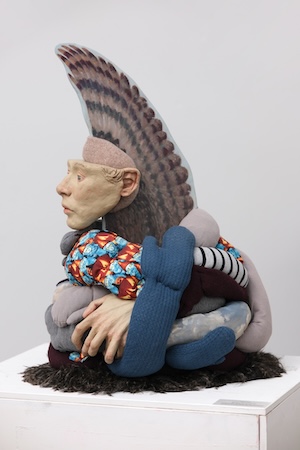
Another piece, “Wing Head,” introduces a strange single wing decorating the sculpture’s head. “The wing is not functional,” she said. “Just like parts of my body. It is a possibility of flight, an idea, not a reality.” 

Dyck explores a body that doesn’t work well by creating allegorical figures with faulty anatomy, with the wrong number of fingers on a hand or mangled joints or tiny wings in the wrong places. “I’m processing my disability through symbolism,” she said.   

She uses second-hand materials for her sculptures. “I buy old clothing at thrift stores or internet marketplaces. The leather came from our old couch. My kids helped me dismantle it and cut out the pieces I could use,” she said.   

photo - “Wing Head” by Amy J. Dyck can be seen at the Zack Gallery until Oct. 1
“Wing Head” by Amy J. Dyck can be seen at the Zack Gallery until Oct. 1. (photo by Byron Dauncey)

The theme of a body disrupted, of limbs disconnected, continues in her painting-like mixed-media collages. Many of them have images of open doors, windows or arches. “They are my portals to elsewhere,” she said. “When I’m in bed, when I can’t move,  I look out of my window and imagine myself out there. I like being outdoors.”

The images are uncomfortable and deformed, but there is optimism, a strange equilibrium of what might be considered ugly and beautiful. Body parts surrounded by butterflies. Too many hands counterbalanced by birds and ghosts, black and white charcoal drawings incorporating splashes of real gold. All of them speak of a deep need to understand our own bodies, how they work and why they sometimes don’t. The style of the artist is unique and instantly recognizable, and that is what Dyck teaches aspiring artists – she offers classes at community centres and retirement homes. “I try to teach my students how to find their own voices,” she said. 

One of the most interesting examples of Dyck’s art is an installation called “Bed Desk.” Dyck explained its etymology.

“I promised the gallery a sculptural installation, but then I became very sick and couldn’t leave my bed,” she said. “My husband is a builder. He made those wooden stands that surround the circular space and act as frames for my drawings. He also made me a bed desk where I could draw while in bed, but I could only create pieces of the same shape and size as the desk surface. I channeled my longing to move, to feel strong into those drawings. The figures I drew are broken, like me, but they move, they grow, they adapt and evolve. The installation was funded by a Canada Council for the Arts grant. When you step into its circle to view the drawings, you enter your own portal to elsewhere.”

Dyck’s show will be at the Zack Gallery until Oct. 1. To learn more about the artist and her work, visit her website, amyjdyck.com. 

Olga Livshin is a Vancouver freelance writer. She can be reached at olgagodim@gmail.com.

Victoria film fest set to start

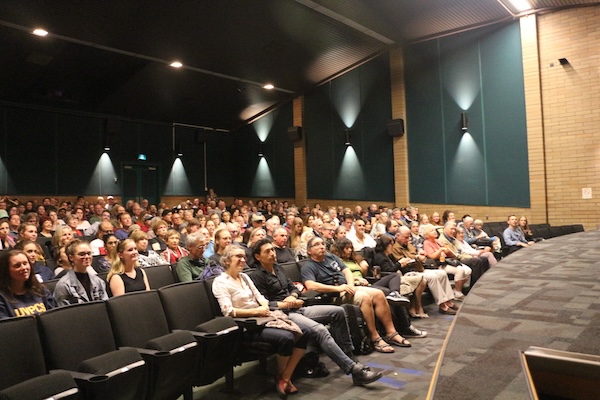
The Latin American and Spanish Film Week returns to Cinecenta, on the campus of the University of Victoria, Sept. 19-22. (photos courtesy Dan Russek)

The Latin American and Spanish Film Week returns to Cinecenta, on the campus of the University of Victoria, from Sept. 19 to 22. Now in its 14th season, this year’s event will offer movies from Argentina, Mexico and Spain, with all screenings taking place at 7 p.m. Each showing will have English subtitles.

The cinematic fiesta is put together by the Hispanic Film Society of Victoria. The society’s mandate is to promote Latin American and Spanish films in the city through the annual film festival. It also aims to further the knowledge and enjoyment of Spanish-language films through cultural and academic events to benefit the community.

Jewish community member Prof. Dan Russek, the organizer of the event, which began in 2010, said, “As part of the UVic faculty and a member of the Hispanic community, I am proud to bring this cultural event to Victoria again. It should interest folks not only from Latin America and Spain but also members of the community at large.

“There is no need to speak Spanish to understand the movies,” Russek added. “They all feature contemporary, relatable stories, and they function as windows to the diverse societies, cultures, histories and politics of the Spanish world. Our mission is to expand the horizons of our audience, and we believe, at the society, that we have achieved this goal again.”

The week will actually start on Sept. 18 at Caffe Fantastico (965 Kings Rd.) at 6 p.m. with a presentation from the society that will feature five local artists, all of whom hail from Latin America. They will discuss their experiences as migrants to Canada, their process of adaptation and their artistic practices.

Cuban pianist Pablo Cardenas, Mexican classical violinist Pablo Diemecke and Mercedes Batiz-Benet, a Mexican writer, theatre director and producer, will start the evening. They will be followed by Cuban trumpeter Miguelito Valdes and Chilean actress and theatre producer Lina de Guevara. The event is free, though audience members are encouraged to purchase food and drinks. 

The first film offering, on Sept. 19, is Totem, a Mexican movie from director Lila Aviles. The family drama focuses on 7-year-old Sol, who bears witness to the preparations of a party in honour of her cancer-stricken father, Tona. 

Totem was Mexico’s entry for best foreign feature for the 2023 Academy Awards. It picked up the Ecumenical Award for Best Film at the 2023 Berlin International Film Festival, and Aviles received an award for best director at the 2023 Jerusalem Film Festival.

Puán, an Argentine-Italian-French-German-Brazilian international co-production, will hit the screen on Sept.20. The 2023 comedy-drama from Maria Alché and Benjamin Naishtat tells the tale of Marcelo, a philosophy professor in Buenos Aires who sees his plans upended upon the arrival of his former colleague, who is based in Germany – the charismatic Rafael. Their conflict is set amid the crisis in Argentina’s education sector.

“The hapless but deeply lovable and tragically self-aware Marcelo needs and deserves a psychological makeover, and Naishtat and Alché are too fond of him to deny him one. How and where it happens is a treat,” Jessica Kiang wrote in Variety.

Lillian Torres’s Mamifera will represent Spain on Sept. 21. The 2024 film tells the story of Lola, who, along with her partner, Bruno, enjoys a happy life until an unexpected pregnancy turns everything upside down. Her previous determination not to be a mother is challenged by social expectations and the inner fears she faces. In a review for the Austin Chronicle, Jessi Cape wrote that the film “tackles an endlessly complicated, often excruciating, sometimes beautiful topic with grace, humour and easily relatable characters.”

The festival concludes Sept. 22 with Bernardo Arsuaga’s 2023 documentary The Michoacán File, which traces the history of Mexican food and the efforts of a group of diplomats, chefs and intellectuals to make the country’s cuisine an Intangible Cultural Heritage of Humanity, an acknowledgement granted by UNESCO. After the film, the public is invited to stay for a conversation and Q&A about Mexican food with Israel Alverez Molina, owner and chef of Victoria’s MaiiZ Nixtamal Eatery and Tortilleria, and Maria Elena Cuervo-Lorens, the author of two cookbooks on Mexican cuisine.

For more information about the Latin American and Spanish Film Week, visit the Hispanic Film Society of Victoria website, hispfilmvic.ca.

Sam Margolis has written for the Globe and Mail, the National Post, UPI and MSNBC.

Fundraiser for Emanu-El @ 160

(photos courtesy Emanu-El)

Gregor Craigie, host of CBC Radio One’s On the Island, interviews Eleanor Wachtel at Congregation Emanu-El on Sept. 15, at 2 p.m., about her career helming the CBC’s premier literary program, Writers & Company.  During her 33-year tenure with the show, Wachtel spoke with a Who’s Who of authors, including Saul Bellow, Michael Ondaatje, Mordecai Richler, John le Carré and Kazuo Ishiguro.

“[Eleanor’s] sense of respect, her tact, her utter lack of obsequiousness . . . and her uncanny ability to ask difficult questions have endeared her to readers and listeners,” said Canadian writer Carol Shields, whose book, The Stone Diaries, won the Pulitzer Prize for fiction in 1995.

Craigie is both an author and an expert interviewer in his own right. A journalist for more than 25 years, his most recent book, Our Crumbling Foundation, which examines Canada’s housing crisis, is a national bestseller.

The event is part of Emanu-El’s 160th anniversary celebrations, and is a fundraiser for the synagogue, which is undergoing structural and other renovations. Tickets ($36) can be purchased at ticketowl.io/cevbc.

– Courtesy Congregation Emanu-El

Fringe Fest coming soon

Jem Rolls’ The Kid Was a Spy is part of this year’s Vancouver Fringe Festival, which runs Sept 5-15. Other Jewish community members with shows include Rita Sheena, with Everybody Knows: Leonard Cohen Dance Theatre, and Theatre Terrific artistic director Laen Hershler and Susan Bertoia co-direct Proximity: The Space Between Us, which was co-created by an all-abilities cast. For the full festival lineup and tickets, visit vancouverfringe.com.

Enjoy Bach with a twist

Alon Sariel is Early Music Vancouver’s artist in residence for this summer’s festival. (photo by Suzette Vorster-Van Acker)

‘We are thrilled to offer audiences an adventurous program of some of Bach’s seminal works, but with a twist,” said Early Music Vancouver artistic and executive director Suzie LeBlanc in a press release announcing this summer’s early music festival. “From traditional compositions reworked for unique instruments, such as mandolin and oud, to the introduction of vocal improvisation, inspired by Bach’s own customary practice of instrumental extemporization, Bach Untamed welcomes listeners to seek out new perspectives of Bach’s well-known and beloved classics.”

This year’s festival – which runs July 30-Aug. 8 at various venues – features almost 50 emerging and established early music artists from around the world, including mandolinist and multi-instrumentalist Alon Sariel, who is EMV’s 2024 Summer Festival Artist in Residence. 

In addition to headlining two concerts – Alon Sariel: Plucked Bach at Congregation Beth Israel on July 31, in which he will premiere his own Bach-inspired Mandolin Partita, and EMV’s festival finale at the Vancouver Playhouse, which features the Canadian premiere of Amit Weiner’s 2019 reconstruction of Bach’s Italian Concerto – Sariel will perform in several other festival concerts, as well as teach a workshop on Bach for plucked instruments.

Sariel, who was born and raised in Beersheba, Israel, met LeBlanc at the Utrecht Early Music Festival, in the Netherlands, last fall. 

“I was playing there with friends from Profeti della Quinta, an Israeli vocal ensemble based in Switzerland, who was already a guest of EMV in the past,” Sariel told the Independent. “Suzie and I had a chat and it turned out I had some very different programs to offer and that a residency could be a lovely idea to feature a few of those.”

Sariel’s first visit to Vancouver was more than 30 years ago, as a kid, with his family. He’s excited to return. He arrived July 24 and will be staying until Aug. 9 – “the final concert, Bach & the Mandolin, with the Pacific Baroque Orchestra, is on Aug. 8,” he said.

“The program looks really splendid (a huge shout out to Suzie!) and I’m very glad and proud to wear the artist-in-residence hat this summer – can’t wait really!” said Sariel.

LeBlanc started the artist-in-residence program in 2021 “to create more exchanges between EMV’s guests and the local community.”

“EMV has under its wing a local baroque orchestra – the Pacific Baroque Orchestra, led by Alexander Weimann – and a Baroque Mentorship Orchestra Program (BOMP) at UBC for students and community players,” she explained. “In addition to his own concerts in the summer festival, Alon will collaborate with these ensembles, working with professionals, students and community players, going beyond concert performances and delivering a collaborative and educational experience. 

“He will also lead a three-day course called ‘Unconventional Bach,’ which focuses on playing and arranging Bach’s works for different instruments,” she said, noting, “Alon is also a composer and his guiding principle is ‘giving new life to existing material, as well as creating completely new works.’ We’re excited to have an artist in residence who shares this philosophy with EMV and will be so present beyond the concert stage.”

LeBlanc described Sariel’s Bach solos on mandolin as “captivating and very personal.”

“He fully deserves his notoriety as one of the most versatile and gifted mandolin players, lutenists and ensemble directors of today,” she said.

A soloist, chamber player and artistic director, Sariel has performed more than 1,000 concerts in more than 35 countries, according to his bio. In his Plucked Bach recordings (Pentatone), he interprets Bach’s solo music and creates new arrangements for mandolin and lute, the baroque guitar and the oud. His album Telemandolin (Berlin Classics) was awarded an OPUS KLASSIK, making Sariel the first mandolinist to earn the honour. But the path to professional success hasn’t been easy and, said Sariel, “there are still many obstacles in the way of a mandolin player.”

“For any violinist, pianist, conductor, etc., there are many competitions which could serve as a jump step to a musical career – the mandolin has none,” he explained. “I attended several competitions which were open to all instruments and won them all and, even then, I kept getting lines like, ‘Thank you very much for getting in touch, we’ll contact you shall we be interested in the future.’ Booking agencies, record labels and concert halls can still be very suspicious when it comes to the mandolin, that’s why I feel a great responsibility in every concert that I play. It’s not only about me getting re-invited, but it’s about convincing this or that director and, of course, the audience, to give a chance to something new. The theatres could always go for another Rachmaninoff piano concerto or another Beethoven symphony, they don’t have to ‘take a risk’ with a mandolin player, that’s why I really have to stand out in my artistic profile in order to get the chance.”

LeBlanc first heard about Sariel from Renaud Loranger, the artistic director of the Festival de Lanaudière in Québec. When she met Sariel at the Utrecht Early Music Festival, she said, “Our meeting was very pleasant – his playing was fabulous – and I immediately saw that he would be a great and versatile artist in residence. Also, I knew that Vancouverites love the mandolin player Avi Avital, who has played many times in Vancouver. What perhaps they don’t know is that Alon has collaborated with Avi on a recording of Vivaldi’s concerto for two mandolins (Deutsche Grammophon, 2020). I hope all mandolin lovers will come out to hear Alon – he has brought to light many works for the mandolin from centuries past and commissioned composers to write new pieces for him.”

And to think that Sariel wanted to play the electric guitar when he was a kid.

“I wished to learn e-guitar, but I was much too young for that,” he recalled. “The director of the conservatory gave me a little basic test – I had to clap some rhythms and sing some tones, etc. She suggested I should take the violin, but I wasn’t excited. Then she said there’s also the mandolin – which I didn’t know at all – and that it’s in fact ‘very similar’ to the guitar, you hold it pretty much the same way, but the size would be perfect for an 8-year-old. She mentioned the mandolin orchestra and the fact it gets to represent the city occasionally, even abroad, so I agreed to give it a try and thought I’d shift to e-guitar later on. Very soon I forgot about the guitar and was all invested in the mandolin, I absolutely loved it!”

LeBlanc chooses EMV’s artists in residence “first and foremost for their great artistry, for their extensive knowledge of historical performance practice, and their ability to share their ideas and knowledge generously,” she said. Previous artists in residence have been Cree-Métis baritone Jonathon Adams (2021); Scottish Baroque specialists David Greenberg and David McGuiness, violin and keyboard (2022); and Catalina Vicens, keyboard and curator of the Tagliavini Collection of ancient musical instruments in Bologna, Italy (2023). 

“It has been extremely rewarding to watch the program grow over the past few years, and hear the enthusiastic audience feedback to our different artists in residence,” she said.

For more information about and tickets to this summer’s festival, visit earlymusic.bc.ca. 

Music for better world

Novelist Milan Kundera said of Jews in the 20th century that they “were the principal cosmopolitan, integrating element in Central Europe: they were its intellectual cement, a condensed version of its spirit, creators of its spiritual unity. That’s why I love Jews and cling to their heritage with as much passion and nostalgia as though it were my own.”

I love reading these words, it helps me keep my head up. And motivated. I think of them often as I work on two major concerts which celebrate multiple aspects of Jewish heritage and history, the devastating impacts of hate, and the need for more love and compassion in the world today. 

You may remember my last endeavour, Project Tehillim, which was about the salvation of the Bulgarian Jews during the Second World War. (See jewishindependent.ca/music-to-say-thank-you.) I grew up in Bulgaria and, while I never experienced the antisemitism, I knew about it from history books. This is why I am shocked and horrified at what is going on around the world, including here in Vancouver. One of my friends said: “The evil is shocking. The willingness of this evil to parade itself is even more shocking.” 

I can only respond with what I know best: the power of music and art. The arts have the incredible ability to affect people more profoundly than plain facts. It is personal stories, artistically presented, that have an emotional impact.

I am the artistic director, with fellow pianist Jane Hayes, of Yarilo Contemporary Music Society, which is dedicated to high-quality professional music performances. The Yarilo ensemble has performed in Zurich, Moscow, Sofia and Tel Aviv, and the society has commissioned a number of Canadian composers: Jocelyn Morlock, Kelly-Marie Murphy, Jordan Nobles, John Burke, Colin MacDonald, Michael Conway Baker and Farangis Nurulla-Khoja. We work with members of the Vancouver Symphony Orchestra and we collaborate with Leslie Dala, the conductor of the Vancouver Opera and the Bach Choir.

Because government and other funding for the arts is in huge decline, I am turning to you, my fellow Jewish community members, for help in realizing Yarilo’s next project: Compassion Above All.

The first concert of the project, To Hope and Back, is a chamber music event that will take place this year on Nov. 10, 2 p.m. and 7:30 p.m., at Orpheum Annex. The budget is $10,000.

To Hope and Back is based on the book of the same name by Kathy Kacer, the daughter of a Holocaust survivor. The book tells the story of the SS St. Louis through the eyes of two children on board the ship that sailed from Germany in 1939 carrying nearly 1,000 Jewish refugees and was refused the right to land by every country, including Canada, forcing it to return to Europe, where many of the passengers were murdered in the Holocaust. The November concert will include two child actors reading excerpts from the book and Kacer has confirmed that she would like to come for the event from Toronto. It will include the music of Philip Glass, Steve Reich, Iman Habibi and Gheorghi Arnaoudov. Steve Reich’s work, “Different Trains,” includes archival recordings from the trains going to Auschwitz.

The second concert, The Tale of Esther in Our Time, is a symphony music concert conducted by Dala, and it will take place in 2025, on March 29, 7:30 p.m., at Christ Church Cathedral. Its budget is between $60,000 and $80,000.

The featured work of The Tale of Esther in Our Time is Iman Habibi’s “Shāhīn-nāmeh,” which was nominated for a Juno and won the Azrieli Foundation award for Jewish music in 2022. Based on the poetry of 14th-century Judeo-Persian poet Shahin Shirazi, the composition depicts the tale of Esther and delves into the themes of love, spiritual struggle and devotion. “Shāhīn-nāmeh” calls out for love and compassion; it brings the heart of humanity into focus.

Also on the program will be Arvo Part (“Tabula Raza”), Peteris Vasks (“The Message”) and Kelly-Marie Murphy (“En El Escuro Es Todo Uno,” “In the Darkness We Are One”).

Please feel free to ask any questions. I will also happily take any advice for funding opportunities. Any donation, even the smallest one, is a great support, financial and moral.

For more information about Yarilo, visit yarilomusic.com. To donate, go to gofundme.com.