Get ready to rock at TUTS

School ofRock cast members, left to right: Crosby Mark, Casey Trotter, Colin Sheen, Mya Forrest, Fumi Okochi and Thailey Roberge. Matthew Rossoff is choreographer of the production. (photo by Emily Cooper)

Matthew Rossoff has returned to Theatre Under the Stars – to choreograph his first production for TUTS, School of Rock. The musical, which alternates with Cats at the Malkin Bowl in Stanley Park, previews July 7-8 and opens July 11.

“Over a year ago, I responded to a posting seeking new creative team members to join the upcoming season and thought it would be a great way to reconnect with the TUTS community,” said Rossoff, who grew up in Richmond and performed in TUTS shows in his younger days. “I was actually on my honeymoon when I received the initial call and am thrilled it all worked out!”

Rossoff, who is a member of the Jewish community, has performed in two TUTS productions: South Pacific in 2000 and Joseph and the Amazing Technicolour Dreamcoat in 2002.

“For several reasons, both of these productions and experiences were huge influences in my career as an emerging artist,” Rossoff told the Independent. “After a long performing hiatus, South Pacific was my first musical after I graduated high school and it was a dream to perform at the Malkin Bowl. Joseph was directed and choreographed by my childhood idol, Jeff Hyslop, and this production catapulted me into my professional career as a dancer and actor, making my CAEA [Canadian Actors’ Equity Association] debut in Fiddler on the Roof at the Vancouver Playhouse later that fall.”

While earning his bachelor of arts at the University of British Columbia, majoring in theatre and minoring in English literature, Rossoff was also doing work in film and traveling across Canada performing in theatrical productions. In 2006, he followed through on his dream to move to New York. There, he performed in several shows, and made his Stratford Shakespeare Festival debut in Camelot and Jesus Christ Superstar.

Jesus Christ Superstar gained critical acclaim and, eventually, the entire Canadian cast transferred to Broadway in March 2012,” Rossoff said. “I was fortunate to make my Broadway debut, as the dance captain and swing. Our production became a Tony Award nominee for best revival, which offered me a once-in-a-lifetime opportunity to perform on the Tony Awards!”

And to think, Rossoff’s career began in elementary school, when he saw one of his sister’s dance classes. “I was amazed,” he said, knowing it “was something I needed to do. Very much in line with the character Mike from A Chorus Line, I told my parents, ‘I can do that!’

“Tap dancing evoked a passion and spark in my soul so bright that I continued on with it all throughout elementary school,” Rossoff said. “During high school, I decided to put up my dancing shoes for a bit and tried other sports and school activities, but it was after my first show at TUTS, South Pacific in 2000, when I bought a new pair of shoes and reignited my passion for tap dancing. Luckily I did because my career took off and I’ve been so fulfilled and blessed with such amazing dance and performance opportunities.”

He got his first theatre work about the time he started tap dancing, in Grade 3. He played an orphan and one of Fagin’s boys, Mouse, in Oliver!

“My sister was in the production with me and I remember getting bit by the theatre bug,” said Rossoff. “There was a sense of community being created with the cast that I loved being a part of and, of course, the excitement of performing and dancing under the lights.”
photo - Matthew Rossoff choreographs his first production for TUTS this summer – School of Rock
Matthew Rossoff choreographs his first production for TUTS this summer – School of Rock. (photo from Matthew Rossoff)

After 10 years living and working in New York City, Rossoff decided to follow another impulse – “to go back to school and deepen my training as a performer, artist and educator.”

He moved to Toronto to attend York University, earning a master’s of fine arts in the school’s performance (acting) program, with a specialization in teaching.

“Those two years changed me at the core of my artistry and revealed a new sense of how I wanted to move forward in my artistic journey,” he told the Independent. “Along with my long-time dance background, my focus became voice, speech and mindfulness work. I quickly became a faculty member at several post-secondary schools and universities in Toronto – teaching voice, speech and movement at York University, Randolph College, Sheridan College, Brock University and, most recently, Toronto Metropolitan University.

“Knowing that choreography and dance were at the base of my creative foundation, I stepped onto the creative team side of the table and began my director/choreographer journey. Shortly after my time at TUTS this summer, I will be returning to Toronto and stepping into the world of Disney as a resident creative team/dance supervisor for Disney Cruise Lines.”

Rossoff’s body presence, mindfulness and yoga work are at the core of his artistic practice and choreography. 

“This work stemmed from my training and perhaps lack of intersection between dance and how to connect to the breath and emotional journey as an actor and storyteller,” he said. “Dance is an extraordinary universal language of embodiment, but in musical theatre you also have to put the text onto your full voice and hold space in the body to support and reveal the emotional, physical, intellectual and imaginative journey the character moves through.

“I’m always curious how can an actor lead from the internal impulses and connections to what’s happening in the scene and put it fully into their body through external gesture and movement. To play a truthful human experience, an actor must use the breath to spark the imagination, the senses and full range of expression with their whole sense of self.”

While Rossoff puts his whole self into his work, collaboration is the cornerstone of his creative process.

“Working alongside the director and honouring their vision and design of the show, a movement esthetic and point of view is cultivated,” he explained.

“In my own pre-production work, I start with the words off the page from the playwrights, composers and lyricists: the storytelling. I’m curious, What’s the primary narrative being told and how can movement from the actors elevate and further the storytelling in a compelling and exciting way?”

For productions such as School of Rock, Rossoff said, “I listen to the music over and over again and I daydream and imagine ways to bring this … story to life. Once the show is cast and we’re in the rehearsal hall, I come prepared with an overall structure of how the choreography will unfold or, if the story seeks personalized gestures or movement, bring in exercises to draw out embodied movement from the actors. For example, School of Rock has 13 incredible young performers and their energy brings out creative ideas, movements and impulses [and] I try to hold space for them to join in on the collaborative journey. They certainly inform and bring a unique point of view through their personalized storytelling.

“Choreographing a musical is not all about big production dance numbers,” he added, “but also about sorting out the transitions and the moments in between, as they become key to the flow and momentum of the story. As the show gets closer to opening night, it becomes about the details of precision, economy and relaxation in the movement so that each actor feels at ease and ready to perform with unconscious competence and joy!”

For tickets to School of Rock and Cats, which previews July 5-6 and opens July 10, visit tuts.ca. Cats runs to Aug. 21 and School of Rock to Aug. 22. For tickets, visit tuts.ca.
Obliquestra plays at folk fest

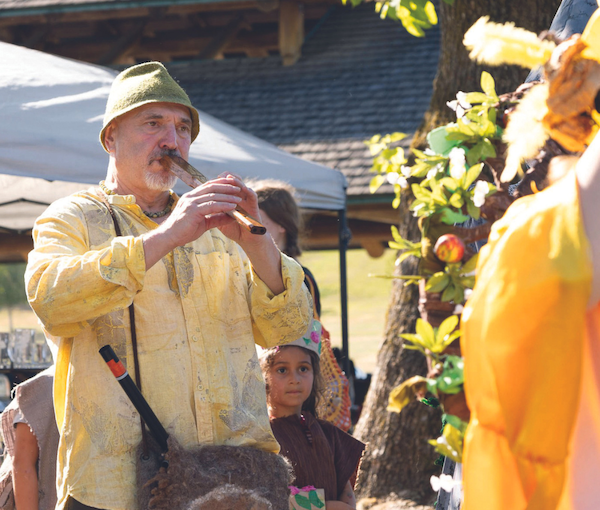
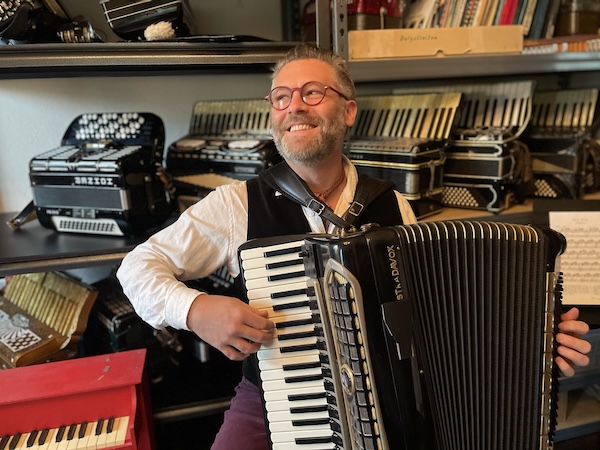
The accordion “has gradually and sneakily taken over my life,” says musician David Symons, member of the group Obliquestra. (photo by Stephanie Reed)

“Klezmer, choro, Tin Pan Alley, French musette, German songs, Russian waltzes, and so on” … Obliquestra plays the music they “most wanted to play after being isolated at home for so long” during the pandemic, David Symons told the Independent. The accordionist, singer and composer is one of the three members of the band who will be playing at the Vancouver Folk Music Festival, which takes place July 19-21 at Jericho Beach Park.

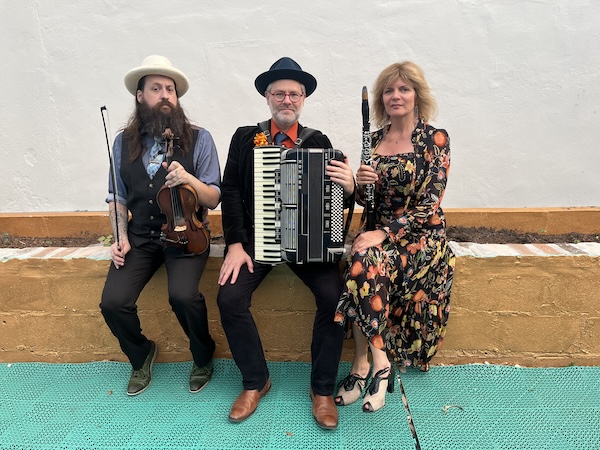
Symons will be joined at the festival by Dr. Sick on violin, guitar and musical saw, and Susanne Ortner on clarinet. It will be their first time performing together in Vancouver.

Obliquestra started when live music started returning in 2021, explained Symons. “Dr. Sick, who I had worked with for years in my band The Salt Wives (and one of the most unfairly talented musicians in town) called me up and said there was a new bar opening next door to his house and it would be amazingly convenient to play there every Saturday. I called Susanne Ortner, who I hadn’t played with, but who I knew was a master klezmer clarinetist, though she mainly does Brazilian choro and jazz now.” 

They started playing together in Symons’ backyard with banjoist Aaron Gunn and bassist Stoo Odom, “without any concept, really,” said Symons, just playing what they wanted to play.

“I’ve sort of always had this eclectic approach,” he said. “Discreet genres of music are mostly a marketing convenience. Musicians have always played and been influenced by whatever they heard, whatever was available, and whatever the public would pay them to play. Klezmer is a good example of this, being an amalgam of various musical styles from central and eastern Europe and, later, America. I doubt those old school musikers (you wouldn’t call someone a klezmer in those days unless you were trying to get punched) were concerned with notions of ‘authenticity’ or genre. They were playing what they heard and liked, and what their public wanted to hear. We are at least doing the first part of that.”

photo - Obliquestra – Dr. Sick, left, David Symons and Susanne Ortner – play at the Vancouver Folk Music Festival on July 21
Obliquestra – Dr. Sick, left, David Symons and Susanne Ortner – play at the Vancouver Folk Music Festival on July 21. (photo by Stephanie Reed)

While Symon has “gotten away from klezmer a bit these last few years, really since the pandemic started, mostly for lack of people to play it with,” he said “it’s still the music closest to my heart.”

Why that’s the case, and why he’s also been interested in Yiddish music, despite not being Jewish, is hard to put into words, he said. “In fact, if I could put it into words, maybe we wouldn’t need music. It makes me feel good?”

He said many people assume that a person is Jewish if they play klezmer, and even that it’s a strange thing for a non-Jew to do. 

“I’ve always felt this attitude contains an implicit condescension toward the music,” said Symons. “It would never occur to anyone that if someone plays Rachmaninoff they must be Russian, or if they play bluegrass they must be a hillbilly, etc. The music stands on its own merits, whatever one’s ethnic background. Most of the Jewish klezmorim I have known didn’t grow up with the music any more than I did. Still, you have to be careful and respectful. I used to do a lot of Yiddish song and, though I love it, I do less of that now because I realized that, unless I am prepared to devote a few years of my life to learning the language, there’s a lot of nuance that I’m going to miss, no matter how much I work on my pronunciation.”

Symons grew up in rural New Hampshire. “My father plays Latin percussion and guitar, but my folks were divorced and I didn’t see him much, and I had very little interest in music until about 15,” he said. “I was into theatre and acting. Then, I more or less simultaneously discovered Tom Waits and classical music, particularly Beethoven, and suddenly fell in love with music. 

“I played guitar for a few years, but the Waits album Frank’s Wild Years convinced me to get an accordion. This was pre-internet in rural New Hampshire, so I put an ad in the local paper asking if anyone had an accordion I could buy. It turned out a lot of people did, and I was very lucky to get something playable. Then, the accordion more or less sat around decoratively for the next couple of years until I happened to see Itzhak Perlman on David Letterman’s show with a bunch of klezmer musicians. He had just released a klezmer album with the top American klezmer bands at the time, and I became obsessed with this music and went down a deep rabbit hole for the next 25 years or so. I taught myself accordion to play klezmer, largely while working in a parking garage in Burlington, Vt., which had nice, cathedral-like acoustics.”

Symons acknowledged, “Of course, no one is truly self-taught – that just means I’ve learned a lot of little things from a lot of different people, without ever having any one teacher or mentor. As for my relationship with the accordion, the damn thing has gradually and sneakily taken over my life. They’ll tell you that you can just pick it up for fun once and awhile and put it down whenever you want, no harm done, but don’t believe them, kids! For many years, I tried to resist accordion clichés and now, in my middle age, I own not one, but two pairs of lederhosen. I started fixing accordions when I moved to New Orleans and there was no one doing it here. Twelve years later, I am sitting in a room in my home with somewhere between 40 and 50 accordions around me, in various states of functionality. The accordions have won.”

About the move to New Orleans, Symons said, “I lived in Vermont for 15 years and was ready for something new. Or, in the case of New Orleans, something old and dirty. I had spent a month in here in 2003 when I was traveling around the country busking in this tiny, ancient Toyota camper. I always thought about going back and trying to live there. Loving New Orleans is like loving a complicated, brilliant, yet self-destructive person. Someone who might be utterly charming one day and destroy a hotel bathroom the next. I still feel like an outsider here most of the time, but I’ve come to terms with that. I’m happy that I’m able to make myself useful to my fellow accordionists by keeping their instruments in working order.”

Symons and his fellow Obliquestra musicians – “Mini-Obliquestra or Obliquestrio,” as Symons quipped – play the folk festival’s South Stage July 21, 11:50 a.m.-12:40 p.m. For the weekend’s full lineup and tickets, visit thefestival.bc.ca.

Pride in his Jewish identity

Brian Gleckman in front of his work, “The Judgment of Solomon (Psak Din: Judgment).” Psak din is a ruling given by a beit din, a Jewish court. (photo by Olga Livshin)

Brian Gleckman’s first show at the Zack Gallery, Abstracted Identity, opened on June 18. 

The artist has loved art since childhood. “I grew up in Los Angeles,” he said in an interview with the Jewish Independent. “It is a vibrant city for visual arts. There are an endless number of art galleries and museums, and I was always there. And, of course, I always drew and painted.” 

After getting his degree in visual art and history from California State University, Gleckman traveled extensively around Europe, before settling in Vancouver more than 30 years ago. But traveling has remained his passion and, during his travels, he invariably focuses on art and art history, museums and galleries. 

“When I first visited Europe, I fell in love with Rococo and Baroque,” he said. Baroque and Rococo are both highly ornamental styles, which infused the art and architecture of post-Renaissance Europe.

Later, he drifted towards more contemporary styles, both as an art connoisseur and in his own work. “I suppose I can call my art abstract expressionism,” he said.   

“Colour for me is a vehicle that allows me to play with shapes and space,” Gleckman explained. “Spatial relationships and composition of the images are of the utmost importance to me. I’m also concerned with depth and texture. I aim to create visual tension in my paintings. I think art shouldn’t be too easy or too comfortable. I want my viewers to engage, to ask questions. ‘What did he mean by that?’ ‘How does it make me feel?’ My viewers might not arrive at the same inner realization I conceived, but their explorations are more important than my answers. When people interact with my art, they become part of the creation process.” 

With his current show, Gleckman seeks to “portray things that lie beyond the tangible – that is, beyond the figurative, beyond the readily recognized narrative. The paintings in this exhibit are expressions of the inspiration I derive from biblical stories, religious thought, as well as rudimentary ideas within kabbalah. Selected from the portfolios of my professional artwork, these paintings are reflections of how I personalize the intangibles of Judaism.… These paintings are abstractions of my Jewish identity, an identity that is the product not so much of formal religious practice but the summative effect of intellectual and emotional sensibilities of my Jewishness.”

Of course, the Jewish Community Centre of Greater Vancouver, which is home to the Sidney and Gertrude Zack Gallery, felt like the perfect venue for such a show, but there was an additional reason why Gleckman wanted to exhibit at the Zack. 

“After Oct. 7, I wanted to do something that had meaning,” he said. “I wanted to share my pride in my Jewish identity. At the same time, I wanted to be part of the effort to help Israel, to make my own contribution. But I am an artist. I create art. I thought maybe my art could inspire someone to do something for Israel, to help in some way.” 

He approached the gallery with the idea of a show and offered to donate any proceeds from the sales of his paintings.

“I’m going to donate whatever I get to two organizations: ASI-Canada (Association for the Soldiers of Israel), which supports active-duty IDF soldiers, and Magen David Adom, which is Israel’s emergency response service. To promote the sales, I’m also offering 30% discount off my website prices for all my paintings.”    

The exhibit comprises 27 paintings from several of Gleckman’s established series. “For this exhibition, I have included paintings that are accompanied by titles … for fuller comprehension,” he said.

“The titles invite viewers to search for and reflect on the nuances of their own understanding of the selected stories, themes and ideas,” the artist explained. “I’m not trying to dictate my own interpretations to viewers. Instead, with the titles, I try to nudge viewers in the right direction. The titles are sort of guidelines for understanding the images, their conceptual representation.”

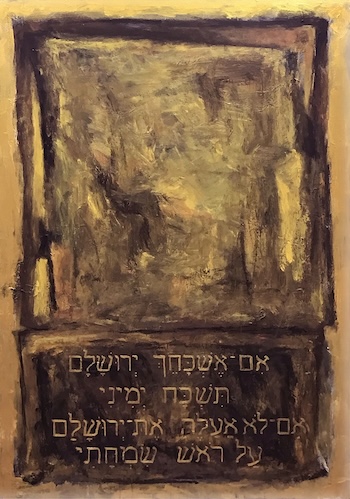
image - “Yerushalayim (Jerusalem)” by Brian Gleckman. The Hebrew words in the painting are from Psalm 137: “If I forget you, O Jerusalem, may my right hand forget ...  if I do not bring up Jerusalem at the beginning of my joy.”
“Yerushalayim (Jerusalem)” by Brian Gleckman. The Hebrew words in the painting are from Psalm 137: “If I forget you, O Jerusalem, may my right hand forget …  if I do not bring up Jerusalem at the beginning of my joy.”

Most of the titles are in Hebrew, spelled phonetically in the English alphabet. Some are in English, but they represent Jewish customs and stories. For example, the large painting “Tikkun Olam” is a field of life-affirming blue, while “Shiva” is bleak and dark, a painting of grief and despair, but both will generate different feelings for everyone.

A few other paintings are linked to grief and death, but many sport bright colors, like “Aytz Chaim” – blue and gold and triumphant – which proclaims the artist’s vision of the Tree of Life. The painting, tall and narrow, is framed by golden words. 

Another tall and narrow painting, “Tefillah” (a prayer), contains this one word in Hebrew, as well as 10 bright gold stars dancing on the blue background below, representing a minyan, the quorum of 10 men (in Orthodox Judaism) or people needed for Jewish communal prayers.

Another painting with words and colours woven together is “Yerushalayim.” Its golden-brown palette is reminiscent of the ancient city of Jerusalem, its modernity and its millennia of history, including conflict.   

Then there are calligraphed Hebrew letters, each magnified manifold on its own black and white canvas. “Their shapes are still recognizable,” said Gleckman, “but I wanted to explore the possibilities, the situation where something we know becomes something else, something to investigate and find a new meaning.” Each of these letter-paintings is like a road, curling capriciously according to the letter’s design, leading the viewers towards the unknown. 

Abstracted Identity runs until July 18. To learn more, visit the artist’s website, briangleckman.com.

Olga Livshin is a Vancouver freelance writer. She can be reached at olgagodim@gmail.com.

Rise and fall of a hacktivist

Nobody Wants to Talk About Jacob Appelbaum opens at VIFF Centre June 14.

Jacob Appelbaum was an influential internet freedom, privacy and free speech activist. He collaborated with Julian Assange and WikiLeaks, which Assange founded in 2006 to publish leaked documents and information. He helped the journalists with whom whistleblower Edward Snowden shared documents make the stories public. And he was prominent in the TOR Project (aka “the dark web”). Then, suddenly, Appelbaum took himself out of the spotlight.

Writer, director and producer Jamie Kastner wanted to know why. He also wanted to know more about this well-known yet little-known “hacktivist” and the subculture in which Appelbaum operated. The result is the documentary Nobody Wants to Talk About Jacob Appelbaum, which screens at VIFF Centre June 14-17 and June 20.

“I first saw Appelbaum in another documentary about WikiLeaks, in which he was playing a supporting role,” Kastner told the Independent. “He jumped off the screen both for his charisma and his clear-eyed and apparently fearless political commitment. I learned about the broad strokes of the scandal in which he was later involved, became intrigued not only by what had happened with him, but by this whole activist community about which I had known little.”

After being accused of sexual abuse in 2016, Appelbaum left the United States for Germany. It is there, reads the documentary’s PR material, that Kastner “finds him, adamant that he is the victim of government black ops, ‘canceled’ without legal process or recourse, punished for who he is, and for what he represents.”

“Though I’m sure even he would not claim that all the work he has done has been flawless,” said Kastner, “to me there remains at least an aspect to the work he’s done, regardless of what may or may not have come later, that represents a fearless standing up to authority, taking significant personal risks to expose abuses of power and to help improve people’s lives by making them better informed about governments and surveillance.”

He continued, “As lawyer Margaret Ratner Kunstler explains in the film, in an era in which journalism has shrunk and become ever more controlled by government and/or large corporations, the significance of so-called leakers and hackers has grown to become one of our last sources of unfiltered news and information.”

Kastner gave the examples of WikiLeaks having “released Chelsea Manning’s leaks, including the ‘Collateral Murder’ video of American drones killing civilians and journalists in Iraq in 2007, and a trove of Hillary Clinton’s emails in 2016, among many other controversial releases.”

In 2013, Snowden, “a former contractor for the National Security Agency, America’s cyber-intelligence gathering service … leaked a vast trove of documents revealing the information gathering practices of the US and its ‘Five Eyes’ allies countries, including how data was gathered covertly on their own citizens,” said Kastner.

With Snowden, the filmmaker added, Appelbaum “helped the journalists to whom Snowden leaked his documents both manage the technology involved, and investigate and disseminate stories arising from Snowden’s leaks, including penning a cover story in German newsmagazine Der Speigel revealing that the US was spying on Chancellor Angela Merkel’s cellphone.”

Nobody Wants to Talk About Jacob Appelbaum was about five years in the making. 

“It was a slow and wary process, once contact was made, of gaining access to Appelbaum and establishing trust on both sides,” explained Kastner. “I knew he was a controversial, brilliant and at times troubled figure, but I approached the story with an open mind. It struck me as a fascinating story in which one person’s trajectory tracked the rise and fall of a movement that, for a time, was rocking the world. 

“I worked with a team of researchers to gain necessary context and try to build relationships within this very wary community. I worked extensively – features, in my experience, take six months or so in editing – with my collaborator Michael Hannan in the edit suite, to try to craft a film that would make the audience experience the real-life spy quality I experienced in entering into Appelbaum’s world, in which things, at times, seem too fantastical to be true – but sufficient evidence is there to suggest they are not false.”

Kastner’s many credits – through his and wife Laura Baron Kastner’s Cave 7 Productions – include The Skyjacker’s Tale (2016), There Are No Fakes (2019) and Charlotte’s Castle (2023). Cave 7 documentaries have not only garnered award recognition but inspired action. There Are No Fakes, for example, helped launch “a criminal investigation into widespread fraudulent production of and distribution of Indigenous art,” leading to “eight arrests, 40 charges laid and 1,000 paintings seized,” notes the company.

As a documentarian, Kastner is especially aware of the evasiveness of “the truth” and its often-subjective nature. While he said, “I still admire the same qualities about Appelbaum that first drew me to the subject, his political spirit and work,” the making of the documentary took him to all sorts of places he hadn’t expected.

“Learning about the community from which he and Assange sprung made me realize the film was about a larger story, larger issues which the narrative of Appelbaum’s life raises,” said Kastner. “You don’t have to like him, the film is not an apologia or a hagiography. I investigate the accusations as extensively as possible. Ultimately, as the title suggests, the film equally became about the people who don’t want to talk about him, and the many reasons for that. I don’t think I had fixed ideas about the ‘truth’ going into this film. I don’t pretend the film leaves with any one conclusion, but rather hopefully, is the jumping-off point for further discussion.”

For tickets to a screening, visit viff.org/whats-on/nobody-talk-jacob-appelbaum. The documentary will start streaming on CBC Gem on June 26. 

Traditional yet contemporary

Boris Sichon, above, and Jesse Waldman return to this year’s Mission Folk Music Festival, which takes place July 26-28 at Fraser River Heritage Park. (photo from missionfolkmusicfestival.ca)

“I know that people are going to find that new-to-them artist that changes their world. I know that new friendships will be forged among volunteers. And I know that people will just enjoy being together in the park in community,” said Michelle Demers Shaevitz, artistic and executive director of the Mission Folk Music Festival, about the upcoming weekend-long event. “That’s what I look forward to the most.”

Joining Demers Shaevitz at this year’s festival, which takes place July 26-28 at Fraser River Heritage Park, will be fellow Jewish community members Boris Sichon and Jesse Waldman. Both musicians are returning artists to the festival, but will be performing new material.

Sichon will be leading the interactive Recychestra, an orchestra that uses musical instruments made from recycled objects. The performance is the last part of an instrument-building program offered through the City of Mission next month.

The idea for Recychestra came from a meeting with Mark Haney, a composer and musician working for the City of Mission, said Sichon. The program comprises seven sessions between July 6 and 26 at the Mission Leisure Centre, culminating in the July 28 performance at the Mission Folk Music Festival – though Sichon would like the program to carry on.

“I hope we’re going to continue this project after the festival,” he told the Independent.

Anyone who is interested in participating can do so via mission.ca/culture or by emailing culture@mission.ca.

“We don’t know yet who’s going to sign up,” Sichon said. “Kids love to create musical instruments more than playing instruments, while adults enjoy both activities. It would be great to have some musician friends from the Mission community.”

Even if someone hasn’t attended the program, they will be welcome to join the orchestra at the festival performance, said Sichon. “We will have enough recycled instruments. It will be a very friendly atmosphere, joyful. Play and dance!”

Waldman is also looking forward to performing at the Mission Folk Music Festival.

“We’ve got some great new songs to share and a couple tricks up our sleeves, too!” said Waldman, who will perform in several music sessions, including in concert with Beau Wheeler on the Sunday afternoon of the festival. The collaboration with Wheeler has been a long time in the making.

“I’d seen Beau perform at an art space in East Van nearly 20 years ago and was blown away,” said Waldman. “Many moons passed, until 2018, where I was performing in the Monica Lee Band and we shared a bill with Beau at Pat’s Pub. Beau caught our set with Monica and invited the band to stay on stage and join him and it was a magical moment. We decided we should get together again and that’s how it all started. We have a lot of the same taste in music and are both very emotional players. I try and add memorable and atmospheric parts to fit the feeling of Beau’s amazing songs.”

Waldman has been busy since the Independent spoke with him in advance of last year’s Mission folk festival. Among the highlights, he said, are “[t]he completion of a new full-length album entitled The Shimmering Divide, set for release September 2024 [and an] outstanding full band performance at Or Shalom Synagogue featuring a rendition of ‘Papirosen,’ where the band played along with my grandmother’s voice from a tape from 1957.”

The video of that performance can be viewed at youtube.com/watch?v=5F5GNRMf1fQ. For more about the song, visit jewishindependent.ca/a-great-grandmothers-song.

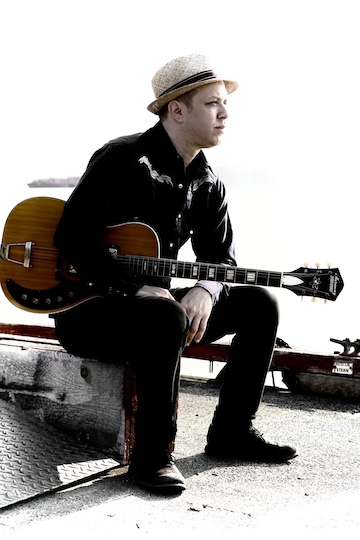
photo - Jesse Waldman
Jesse Waldman (photo from jessewaldmanmusic.com)

Following Waldman’s first album, Mansion Full Of Ghosts, The Shimmering Divide “sees an even more introspective songwriting exploration by Waldman with lyrics that are both confessional and poetic, vulnerable and hopeful, spanning the personal and the universal,” notes the PR material.

“For me, the title The Shimmering Divide represents the age-old battle between good and evil, which path to take to do the right thing in your life – those points in your life are charged with possibilities that can change it forever,” said Waldman.

In all, some 30 artists from around the world will be participating in this year’s Mission Folk Music Festival. In selecting performers, Demers Shaevitz tends to focus on a theme. 

“This year,” she said, “I was digging into this idea of tradition and looking for artists that are grounded in their tradition. What that means for me is finding artists who can emphasize a through line in their music. Who can take the best parts of their culture, genre, community or language, for example, and bring it to audiences in new and or exciting ways. This is key to me when I consider folk traditions: I want contemporary takes on this heritage artform. We’ll hear that in Moira & Claire and their Maritime song tradition. We’ll hear that in how PIQSIQ presents Inuit throat singing in a contemporary context. And we’ll hear (and dance) to how Kobo Town takes traditional Trinidadian sounds and modernizes them for today’s audiences.”

For more information about the festival, including the schedule and tickets, visit missionfolkmusicfestival.ca. 

Windows into the shul

The Beth Israel Mural Project goes beyond the synagogue’s parkade, with a website that features each artwork, as well as information about the holiday depicted, and more. (screenshot)

Windows into the synagogue, windows into Judaism. The Beth Israel Mural Project features 13 works of art, each based on a Jewish holiday. Adorning the shul’s parkade, they welcome visitors.

“During COVID, Sy Brown started the Good Times Club at the BI. The goal was to bring in new programming into the shul for the over-50 crowd,” explained project manager Reisa Schwartzman. “We have had blood drives, book clubs and walking clubs. I came up with the idea to do a mural in the garage.

“At first, the idea was to do one large mural. The challenge was that there are parking signs that could not be removed so it motivated us to think out of the box a bit. The smaller framed murals allowed it to have the effect of being windows into the shul.

photo - Ramona Josephson was the lead artist on one of the two murals portraying Shabbat
Ramona Josephson was the lead artist on one of the two murals portraying Shabbat. (photo from Beth Israel Mural Project)

“The next steps were to call out to the congregation to see who would like to participate. At this time, all meetings were held on Zoom due to COVID. Once the committee had the members, we then went out to the congregation – we wanted the entire membership to feel included, to see what they wanted to see in the garage. The overwhelming feedback was the holidays.”

Volunteers were assigned a holiday and the committee helped with each image. “This is when the real work began,” said Schwartzman. “But, up to this point between COVID and summer holidays, it was two years.

“With Peter Sarganis, an amazing artist himself but also an art teacher, he guided us on the steps required to take our wonderful images through the multiple steps to get each image on the boards. Once the boards were ready to go, we met each Sunday afternoon for painting for several months. There were committed painters who would come in during the week to work as well. This was a labour of love! The energy in the room when we were painting was fabulous. Focused artists and painters working together to bring these works to fruition.”

Sarganis answered the callout to members because, he said, “As an artist, I thought it would be a creative way to combine my love of Judaism, the Beth Israel Synagogue, collaboration and painting.”

Sarganis became the project’s art director and a lead artist and designer of one of the two Shabbat works.

“I love Shabbat. From Friday evening family dinners; to Shabbat morning services; to the candles, wine, challah and artifacts used – I can simply say I love it,” Sarganis said of his choice of holiday to portray. “The Shabbat panel I designed and painted is an abstracted representation of our family’s candle holders, Kiddush cup and challah cover.”

About the project, he said, “We had a wide range of expertise, from those who don’t paint at all to those who paint a lot. The common thread that kept us going and made this a beautiful group to be a part of was everyone’s passion for the project. 

“As a professional artist and someone who has taught at a fine arts school for the past 29 years, it seemed the role of me becoming art director happened organically, it was not something that was there at the start of the project,” he added. “This included helping the designers of the panels with their designs, bringing in tools and equipment to help facilitate the transferring of the designs onto the large panels, advising the groups of painters on the painting process and/or techniques, figuring out (with Reisa) the placement of the panels in the parkade.”

“I really believe that we can beautify the most simple areas to make them more impactful,” said Schwartzman. “Having these windows in the garage makes the experience of going to the BI start right from parking your car. But we didn’t stop there. Krystine McInnes came up with the idea that we should add QR codes to each image so that people could open their phones and learn more about each holiday, the customs and history. We hope we can use these to fight antisemitism as well, or just to help educate. We decided to paint on boards rather than the wall itself so, if needed, we could have them traveling.

“One thing different about our art is that none of the pieces are signed. This was with the commitment that the works were collective, designed and inspired by several artists and painted by the community we built. It is a community effort for our shul.”

While the lead artists aren’t indicated on the murals in the garage, they are credited on the project’s website, bethisraelartproject.com: Beryl Israel (Purim and Tu b’Shevat), Sheila Romalis (Hanukkah), Ramona Josephson (Rosh Hashanah, Sukkot and Shabbat), Debby Koffman (Simchat Torah), Janice Masur (Shavuot), Luca Carati (Yom Hashoah and Yom Yerushalayim), Nassa Selwyn (Pesach and Yom Kippur) and Adele Lewin (Simchat Torah). In addition to the QR code integration, McInnes designed the project website, which features information on the holidays, their history and customs from several sources, including work done by Jean Gerber and Jonathan Berkowitz and a dozen or so websites.

The paint was donated by Benjamin Moore Paint and the boards and framing by Burton Mouldings, said Esther Moses, Beth Israel executive director. Ralph (z’l) and Elaine Schwartzman donated to help make the project possible, she said.

“My parents believe in supporting our community and have always been supporters of several Jewish agencies here and abroad,” explained Schwartzman. “Once they heard about what I wanted to do, my mom called the shul and made a donation to make sure we could complete the project. Supporting the shul, the arts, community and engagement for people are all reasons they stepped forward.”

image - Beryl Israel was the lead artist on the Tu b’Shevat mural
Beryl Israel was the lead artist on the Tu b’Shevat mural. (photo from Beth Israel Mural Project)

“I am so proud of Beth Israel and our members who worked on the murals. They are strikingly beautiful,” said Rabbi Jonathan Infeld, the synagogue’s senior spiritual leader. “They bring light to our congregation and are a great educational tool. They brought people together for an important common cause. The murals are another way that we help bring Jews closer to God, Torah and Israel at Beth Israel.”

While he helped, for example, with the Hebrew on one of the works, Infeld admitted, “I am involved in many different aspects and programs of the synagogue, this is one that I did not play a large role in though. Yes, I helped with some of the Jewish content. But anyone who knows my artistic abilities knows why I left this project to others to accomplish.”

The project – which took a total of three years from conception to installation – “was a great way to add colour to our parkade in a meaningful and Jewish way,” said the rabbi. “The murals are educational and exceptionally beautiful. But, most importantly, they created community amongst people of all ages.”

Overall, it has been a huge success, he said. “People love seeing [the murals] when they enter the parkade. They love looking at them and learning from them. I know that the participants loved making them.”

“This project was really a labour of love by all who participated,” agreed Schwartzman. “Peter was incredibly supportive with his knowledge and guidance. There were so many amazing artists that we all learned from each other, helped each other and celebrated together. We really hope that these images bring the shul much enjoyment and support them in any of their programming when possible.”

“This project took a lot of time and work – and was worth every moment,” said Sarganis. “I met some wonderful people, and got to know people I already knew even better. A beautiful community project.” 

Goldstein removed from exhibit

Dina Goldstein stands in front of two of the 10 works that comprise her In the Dollhouse series featuring Barbie and Ken. (photo from Dina Goldstein)

Dina Goldstein had her work pulled from a Vancouver exhibition just days before it was set to open – in what she has described as “a blatant act of antisemitism.” But the gallery is claiming its decision to cut the Israeli-Canadian artist from the show was based on financial considerations, despite a recent news report and documentation from Goldstein that suggest there may have been other reasons.

An internationally acclaimed artist, Goldstein was scheduled to have her works shown at the Vancouver Centre of International Contemporary Art (CICA) from May 9 to June 29 as part of a group exhibition titled Toy Story, a look at the world of toys as seen through the eyes of artists from around the world. Goldstein, who received widespread attention for her Fallen Princesses and In the Dollhouse series of tableaux, was listed as recently as late April on the CICA website among the artists whose works would appear in the exhibit.

According to a report on Stir, a Vancouver website covering art news, Goldstein was notified by the gallery’s curator, Viahsta Yuan, on April 30 that her works – three pieces from the 10-image In the Dollhouse series – would not be shown during the exhibition. (Goldstein earlier had arranged for the gallery to pick them up on May 2.)

Regarding her agreement with CICA after a studio visit by the curator on April 26, Goldstein said, two large pieces and two medium pieces were confirmed, available at the studio, framed and ready to be installed.

“One medium piece had to be produced because it is a diptych with a missing partner. This she requested I get going on. The other selections would be printed in small format. I was waiting to hear about the production of the small version. [The curator] wanted to show all 10 images if possible,” Goldstein said.

But then, in Goldstein’s account, which was sent to the CJN, Yuan disclosed to her that the gallery had received an email from a small group of Vancouver artists who wanted her excluded because she supported Israel. The unnamed artists, in Goldstein’s words, felt that she did not deserve to exhibit her work during this time of war. Goldstein was offered an alternate solo exhibition within a year or two, or when the situation in Israel and Gaza might subside.

Yuan had, as Goldstein recalled, agreed that punishing an artist because of their Jewish identity was unjustifiable. Goldstein asked the curator to relay this message to the gallery committee, as well as the importance of standing up to discrimination. When she reached out to Yuan for an update on her meeting with the gallery committee, Goldstein received an email that cited, as she says, “a sudden budgetary issue as the reason for her removal. This explanation contradicted the previous acknowledgment of discrimination, with the decision now framed as a last-minute ‘creative choice.’”

“This experience takes me back to the times we may have had in our youth and being bullied. This is part of what antisemitism feels like,” Goldstein told the CJN, noting that the works in question have nothing to do with Gaza or Israel.

Goldstein, too, recounted that, unlike most people associated with the exhibition, she had been to Gaza and the West Bank while on an assignment in 1999, photographing Palestinians alongside her pictures from Jerusalem and Tel Aviv. She has shared those memories on Instagram in recent months.

In the Dollhouse, which was created by Goldstein in 2012, features a pink, adult-size dollhouse in which Barbie and Ken reside. The series offers satirical situations around the house, sometimes with a risqué approach to social commentary. Notes about the images on Goldstein’s website say that, in them, Barbie represents the notion that beauty is the ultimate trait and is necessary “to attain power and happiness.” Meanwhile, Ken discovers and expresses his true self after four decades of being “trapped in an imposed marriage.”

In the invitation to participate in the exhibition, CICA wrote that Goldstein’s dollhouse series “offers an intricate exploration of identity, conventional values, gender equality and beauty. The inclusion will not only enrich the depth of the exhibition but also provide viewers with a fresh and unique reflection on the toy that has influenced a generation of people.

“We believe that the inclusion of In the Dollhouse will offer a unique perspective and contribute significantly to the exhibition’s dialogue on the transformative power of toys as symbols within our lives.”

In Yuan’s version of events, as reported by Stir, after consultation with others at the gallery, CICA had originally selected five pieces from the series. After visiting Goldstein’s studio, she said only three of the pieces were ready.

Yuan then had another discussion with the gallery committee, and it was decided that CICA did not have the budget for production costs. Further, another artist was showing a piece about a dollhouse, and the gallery believed showing two works in dollhouses would be excessive.

CICA released a statement on May 4 in which it denied its decision to pull Goldstein’s work from the exhibition was based on “religious and cultural affiliation” but rather was related to financial considerations. Works by two other artists, Roby Dwi Antono and Aya Takano, CICA said, were also removed from the lineup. The organization emphasized its desire “to cultivate artistic dialogue and community engagement while emphasizing inclusivity and representation.”

“As a woman and BIPOC-led organization, prioritizing diversity is not just a goal but a guiding principle that informs every aspect of our work,” the statement from CICA read. “Since our inception, we have been dedicated to showcase a pluralistic range of contemporary art and ideas through our multidisciplinary exhibitions and programming.

“We are grateful to have collaborated with a distinguished group of over 35 local and international artists, with more than two-thirds from visible minority backgrounds. These cross-cultural collaborations are a testament to our commitment to platforming diversity while fostering a safe and accessible environment for all.”

CICA stressed that, like many nonprofit arts organizations, it faced budgetary constraints and, with limited resources, it needed to make difficult decisions. As a result, three artists were not shown because of limited finances, a short time frame and “curatorial direction.”

The cultural and religious background of an artist would never warrant exclusion from the gallery, CICA went on to say, and that decisions were made only on artistic merit and how a work would fit into an exhibition.

“Discrimination of any kind has no place within our organization, and we remain steadfast in our commitment to platforming 

diversity and ensuring equitable representation in everything we do. Looking ahead, we will continue to embed the values of equity, inclusion and diversity into every facet of our operations,” CICA said.

Established in 2021, CICA is a nonprofit, multidisciplinary arts organization. According to its website, it provides “a forum for everyone to step into the art and learn while having fun” and aims “to enhance public engagement in the arts and bridge local and international artists for idea exchange, knowledge sharing, and collaboration.” 

Sam Margolis has written for the Globe and Mail, the National Post, UPI and MSNBC. This article was originally published on thecjn.ca.

Chutzpah! needs your help

Chutzpah! Festival acting managing director Jessica Gutteridge. (photo by Tallulah Photography)

After nearly 25 years at the forefront of Jewish arts and culture in Western Canada, Vancouver’s international performing arts festival, Chutzpah!, faces an urgent financial crisis. And it needs your help to keep the stage lights on.

Shifting priorities in government arts funding, as well as the impacts of Oct. 7 and the war in Gaza, have created a perfect storm resulting in a dramatic drop in revenue.

How did this happen?

Chutzpah! depends significantly on government grants. Presently, the stagnant pool of arts funding, alongside a growing number of applications, means fierce competition for fewer dollars. In addition, Jewish arts programming officially falls outside of funders’ “designated priority groups.” Funders have told the festival that, this year, only 15-20% of proposals will be approved, and Chutzpah! has already been declined for several grants that it has received historically.

“The arts community, generally, is facing difficulties with sustainable government arts funding, as the funding pool has returned to pre-pandemic levels with more applicants seeking funding,” explained artistic managing director Jessica Gutteridge. “But there are compounded challenges that Jewish performing arts and artists are facing, especially as tensions escalate locally in response to the war in Israel. Jewish organizations and events require additional security and access to funding is hampered by the fact that Jewish artists are excluded from funding priority categories, due to a misunderstanding that Jews are a marginalized ethnocultural group, and not solely a religious group.”

Adding to the financial challenges, Chutzpah! opened last year within weeks of the Hamas attacks and war in Gaza, within an atmosphere of rising anti-Jewish hate that has been felt both globally and locally. Despite the festival’s efforts to ensure the safety of performers, audience and staff, ticket sales suffered dramatically. With Jewish arts organizations and events in Vancouver, across Canada and elsewhere targeted with petitions and protests, the erasure of Jewish language, art and culture is, once again, a real threat. As a community, we cannot allow this to happen.

This is why Chutzpah! urgently needs support. The challenges the festival faces are serious, but not insurmountable, and organizers are taking several steps to try and secure its future.

Chutzpah! is speaking with new philanthropic foundations, exploring capacity-building needs in the short- and long-term. Increasing its capacity would give the organization more resources to diversify and grow revenue through grants, audience development plans, sponsorships, private donations, and more.

As well, the festival has established a circle of advisors – a few community members who are passionate about the arts, the Jewish community and Chutzpah! With their help, the festival hopes to strengthen its base of individual donors and identify prospective program sponsors and partners.

Chutzpah! is also reaching out directly to its community of patrons and supporters to share the challenges it is facing and ask for support.

“We’ve been so heartened by the response to our campaign to date. We’ve nearly reached 50% of our goal,” said Gutteridge.

The goal is to raise $60,000 by May 31. There are five ways people can help:

1. Contribute to the campaign. You can donate online directly and securely through CanadaHelps (or by cheque to Vancouver West Side Theatre Society). 

2. Help Chutzpah! grow its network of support by sharing information about the situation with like-minded friends/colleagues. Add a brief note explaining why you support the festival and ask them if they might consider doing the same.

3. If you or your contacts donate before May 31, campaign co-chair Emet Davis will match all gifts, up to a maximum of $10,000.

4. Increase your own impact by offering a formal or informal matching gift challenge within your personal or professional networks. Simply direct friends and colleagues to the festival’s donations page, confirm gifts, then issue your matching gift. Let the festival know if you do this.

5. Be a sponsor. Sponsorships subsidize production and associated costs for festival performances. There is a range of giving levels, recognition and other benefits. 

“With rising costs for artists, staff and production expenses, all needed to bring the high-quality work that Chutzpah! audiences are accustomed to, we are looking to gather a small but mighty group of philanthropists and arts lovers to support us – producer-level supporters,” said Gutteridge. “This group will help offset the challenges we’re facing with limited government arts funding and rising costs, by financing specific content for the festival and joining us to share those programs with their networks. We can match their artistic interests to our programming – for example, help produce a series of Israeli artists, or step up to support an evening of klezmer music.”

“Until several years ago, I only attended Chutzpah! occasionally,” said Davis. “To be honest, I think I took for granted that it was a permanent fixture in our community. But, when I made a decision a few years ago to engage more meaningfully in Jewish community, the festival became part of my journey – it has deepened my knowledge and my sense of pride in my identity. Chutzpah! is about something much more than entertainment – it’s about the preservation and celebration of our language, art and culture. Now more than ever, I’m reminded we can’t take that for granted.”

Donate via chutzpahfestival.com or save Chutzpah! the processing fees and give by cheque to Vancouver West Side Theatre Society, mailed to 950 West 41st Ave., Vancouver, BC, V5Z 2N7. 

– Courtesy Chutzpah! Festival

DOTE happens in June

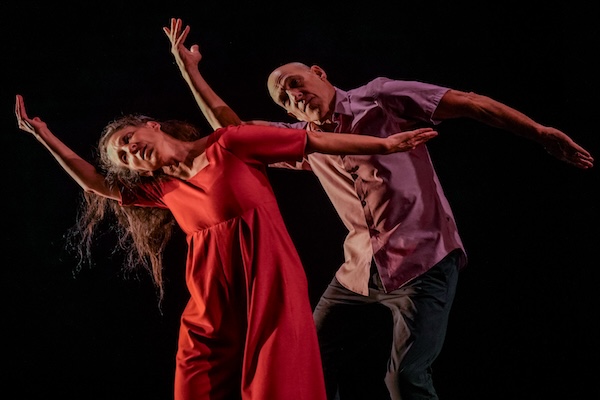
Karen Kaeja and Allen Kaeja in Lasterday. (photo by Kendra Epik)

Featuring more than 30 performances June 13-22, Dancing on the Edge audiences will see world premières, Western Canadian debuts and works-in-progress. This year’s lineup includes the Vancouver première of Lasterday, with choreography by Hanna Kiel, music by Adam Campbell, lighting by Gavin McDonald and performances by Kaeja d’Dance, Toronto Jewish community members Karen and Allen Kaeja.

Lasterday is part of EDGE 1, which also features Tiger Princess Dance Projects and Calder White. Performances are June 16 and 17, 7 p.m., at the Firehall Arts Centre.

Lasterday delves into the relationship of two individuals who carry different memories and perceptions of the same events from their past – sense of timeline, emotional impacts and interactions – revealing how they remember and interpret their shared history. Lasterday is part of the Kaeja d’Dance’s lifeDUET commissioning series. The works explore the Kaejas’ creative and personal partnership. Many duets have toured across the world through Canada and to Spain, India, England, Japan, Mexico, Venezuela and Israel. (For more, see jewishindependent.ca/life-stories-told-in-dance.)

Kiel is a Dora Award-winning artist hailing from Seoul, South Korea, who made Vancouver her home in 1996. Founder and artistic director of Human Body Expression, Kiel is also a resident choreographer at Canada’s JörgenDance.

Campbell is a sound designer, composer, percussionist and singer-songwriter. Originally from Summerside, PEI, and currently living in Stratford, Ont., he has worked as sound designer/composer with many festivals.

McDonald has designed lighting for more than 25 years, across North America and the United Kingdom, and teaches lighting and media design at York University.

Karen Kaeja is an award-winning choreographer, performer and educator. The heart of her research, creation and writing concentrates on the agency of touch. She develops platforms for collaborative relationships between dancers and everyday people, highlighted in her Porch View Dances festival and concept. She is currently co-choreographing with Roshanak Jaberi for Jaberi Dance Theatre’s international collaboration with Sweden – Architecture of Violence.

Allen Kaeja is an award-winning choreographer and dance film director. The child of a refugee and Holocaust survivor, he has created 30 years of Holocaust-inspired stage and film works. He has created more than 210 stage works and choreographed/directed 35 films. His works have been featured in commercials, films and festivals around the world. He teaches Kaeja Elevations and Dance Film master classes worldwide. 

About the overall DOTE program this year, the festival’s artistic producer, Donna Spencer, said, “This year, we are pleased to honour one of Canada’s great dance and contact improvisation creators, Peter Bingham, and share his work with the presentation of EDAM’s Dead Weighting. Peter’s body of work has had such an impactful ripple on many of the artists participating in this year’s festival. We are also excited to offer what was a work-in-progress at last year’s festival as a world première this year with Company 605’s lossy; and to bring new choreographic voices such as Anya Saugstad, Clala Dance Project and Simran Sachar to the festival. Stirring things up is in DOTE’s DNA, and we can’t wait for audiences to experience this year’s lineup.” 

The complete festival schedule is available at dancingontheedge.org. Tickets can be purchased online via the website or by phone at 604-689-0926. 

– Courtesy Dancing on the Edge

Stand Up celebrates 20th

Stand Up for Mental Health founder David Granirer. (photo from smhcomedysociety.org)

Stand Up for Mental Health (SMH), a program started in Vancouver that teaches stand-up comedy to people with mental health issues as a form of therapy and to destigmatize mental illness, celebrated its 20th anniversary this spring. 

“It feels like such an accomplishment. Helping so many people has been the highlight of my life,” said David Granirer, the founder of SMH. “One thing I am really good at is making other people into stars, and I feel like I have done that a lot. Over the past 20 years, I have trained about 700 comics. So, that’s a lot of stars.

“I had no idea what I was doing when I started out, so I had no expectations about the program being successful or not. I could never have imagined this,” he said.

Granirer, a counselor by profession, as well as a stand-up comic, told the Independent that the two-decade journey has been unforgettable. “Everything stands out,” he said. “Every show, every comic I have ever trained, every laugh we have gotten.”

When considering some of the more memorable bits over the years, he recalled writing a mental health version of the Beatles song “While My Guitar Gently Weeps.” In Granirer’s rendition, the guitar has dizziness, dry mouth and is too depressed to get out of bed.

Granirer, who is open about his own struggles with mental illness, has trained groups in more than 50 cities, in Canada, the United States and Australia, in partnership with various mental health organizations. He plans to continue the program and run it in more cities in the coming years.

The idea for SMH originated from a course Granirer has been teaching at Langara College since 1998 called Stand-Up Comedy Clinic. Occasionally, he would see people have life-changing experiences by getting on stage and using comedy to tell a club full of people who they were.

“One woman had a fear of flying and told me that the day after our event she had to get on a plane and she said, ‘My fear was gone. I felt like once I’d done stand-up I could do anything,’” Granirer said. “And I thought, wouldn’t it be amazing to be able to give this experience to people who wanted to do comedy but who also wanted to change their lives? And since I work in mental health and I also have a mental illness, I thought that would be the perfect place to start.”

For Filomena Black, a graduate of the course, SMH has been a lifeline. An introvert by nature, she said she has been able to be more comfortable around people.

“I’ve lost my self-conscious focus and become more engaged in enjoying other people’s company. I’m now looking forward to successfully meeting challenges in all aspects of my life rather than avoiding them,” Black said.

Asked to tell one of the jokes in her repertoire, Black responded, “I used to run away from home a lot, but my kids always found me.”

Another SMH graduate, April Soon, also speaks highly of the program, lauding Granirer for shining a light on what people with mental health issues can do and not letting finances be a barrier to participation.

Soon, a veteran of public speaking through Toastmasters, did not find standing up before a crowd as intimidating as others might have and, these days, she not only performs at SMH gigs but at other venues around Vancouver.

“When bad things happen to me now, I wonder how I can use it as material,” said Soon. “SMH has helped reframe my thinking and provided good resilience training.”

On a lighter note, she added, “Being involved with SMH has exposed me to many other mental illnesses I want to try out.”

Kevin Scow similarly expresses his gratitude, saying the program has given him his voice and was vital to his recovery.

“This came to me at exactly the right time,” he said. “Instead of seeming strange … now they know I am strange … and they love me all the more for it. Thanks to David and my fellow alumni for nurturing my voice and helping with making it funny. My First Nations side says thanks.”

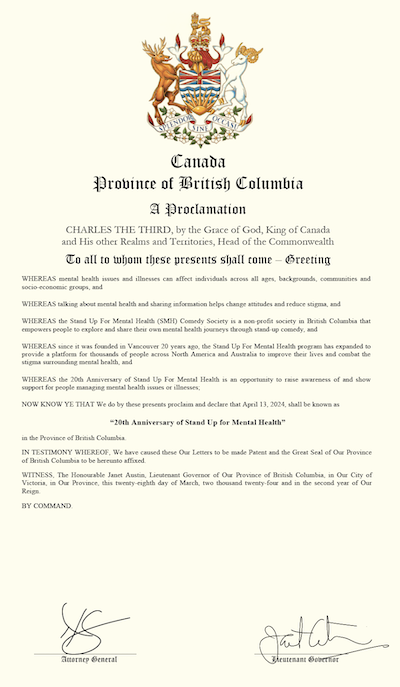
image - SMH’s 20th anniversary was recognized last month with a proclamation from the Province of British Columbia declaring April 13 as Stand-Up for Mental Health Day
SMH’s 20th anniversary was recognized last month with a proclamation from the Province of British Columbia declaring April 13 as Stand-Up for Mental Health Day.

SMH’s 20th anniversary was recognized last month with a proclamation from the Province of British Columbia declaring April 13 as Stand-Up for Mental Health Day. The proclamation reads, in part, that SMH provides a program for thousands of people “to improve their lives and combat the stigma surrounding mental health and … is an opportunity to raise awareness of and show support for people managing mental health issues or illnesses.”

Since 2004, Granirer and his comics have performed more than 500 shows for mental health organizations, government departments, corporations, universities, correctional facilities and the military. Granirer also gives “laughter in the workplace presentations” to organizations across North America, helping them use humour to lower stress, improve wellness and cope with change. Granirer, too, is the author of The Happy Neurotic: How Fear and Angst Can Lead to Happiness and Success.

SMH’s classes in Vancouver last for six months and students step on stage for two shows, a debut and a graduating performance. As Granirer says, “The comics go from knowing nothing about stand-up to killing it.”

Stand Up for Mental Health is currently recruiting for its next class, which starts July 30. For more information, visit smhcomedysociety.org. 

Sam Margolis has written for the Globe and Mail, the National Post, UPI and MSNBC.