Tova Krentzman’s Fire Tower is a documentary about the people stationed high above the ground in the Yukon and Alberta, who are looking for smoke or signs of a wildfire. (photo fromTova Krentzman)
Tova Krentzman’s Fire Tower, a documentary about the people stationed high above the ground checking for wildfires in the Yukon and Alberta, has been covering the film festival circuit. Most recently, it was shown in February at the Available Light Film Festival in Whitehorse, where the director resides.
The idea for the film arose when Krentzman was working as a cook at a firefighting camp one spring. Several lookouts, the people who comprise the first line of defence in battling wildfires, stayed at the camp as they were getting ready to head to their respective towers.
“I had a chance to talk to them and hear their stories. I even got to visit one of them. I was completely fascinated. The seed was planted there,” she told the Independent.
Krentzman’s diverse background includes experience as a geologist, cook, medic and merchant seafarer. She is also a photographer. Initially, she thought chronicling the stories of the lookouts would make an interesting photography book. However, when the pandemic struck, she became increasingly involved with video and turned the subject into a film.
For the documentary, she featured several different types of people who are lookouts, with ages ranging from young adults to seniors. Nonetheless, Krentzman said, they share a certain trait in common: the ability to be with themselves and thrive alone.
She was struck by the ability of the lookouts to climb a 100-foot tower every day, often many times a day, and to stay focused throughout the months they were on duty. In Alberta, where the season can last for six months, from spring to fall, lookouts work long hours without any breaks. In the Yukon, though the season is shorter, the job also requires a particular fortitude.
“It is definitely a certain kind of inner physical and mental strength to be able to do this job. When you are alone, everything you have ever done in your life comes into your mind, all your mistakes, everything,” she said. “You have to be the kind of person who can manage themselves. But these are also people who are able to feel very connected to their surroundings and derive a lot of pleasure of being connected to nature and what they are looking at.”
After spending large amounts of time with the lookouts, Krentzman observed how content they were with what they were doing. There was no drama, no breakdowns. Instead, the film raises the issue of how, in a hyper-connected world, solitude can inspire a different kind of connection with not only nature but community and one’s creativity.
“I think the film does get into what the struggles and challenges are. And so, people reflect on things and have some quiet reflective moments that they discuss and they are personal. I would say, overall, they are pretty satisfied with what they are doing,” she said.
A scene from Fire Tower. To do their fire spotting, lookouts must climb a 100-foot tower every day, often many times a day. (photo from Tova Krentzman)
Krentzman hopes that, through watching the 47-minute film, more people will realize that the towers exist. She also hopes that the film will draw attention to the dozens of people perched in the air on the lookout for potential danger. While wildfire events can blanket the news cycle during summer months, the towers are not widely known and most provinces no longer have them, she said.
“It is important to realize all the steps that go into fire protection and prevention. The lookouts spot many of the smokes and call it in when it is a little wisp of smoke – that is when you can actually prevent it from becoming bigger. The idea is to catch it before it is a big fire,” Krentzman said. “If you can see a fire from a satellite, then it is too big – that is not prevention.
“They are really there to protect, as a first line of defence, and then they call in the fire agencies and there is a back-and-forth going on. It is quite incredible what goes on behind the scenes when it comes to fires.”
In the time since the documentary was made, Krentzman said, the fire seasons have started so early that she likely would not have been able to gain as much filming access to the towers because of liability concerns.
Originally from Montreal, Krentzman has lived in different places, including Israel, where many in her family still live. Yet, she was drawn to the Yukon and has spent several years there.
“The Yukon is one of those places that, as a Canadian, you have to see what it is,” she said.
Fire Tower debuted at the Hot Docs Festival in Toronto last April and has appeared on screens in the United States, Asia and Europe. The documentary was to have been shown in British Columbia last summer at the ArtsWells Festival in Wells, but the event was postponed due to a wildfire.
For more information and to ask about a group screening of the film, visit underwirefilms.com.
Sam Margolis has written for the Globe and Mail, the National Post, UPI and MSNBC.
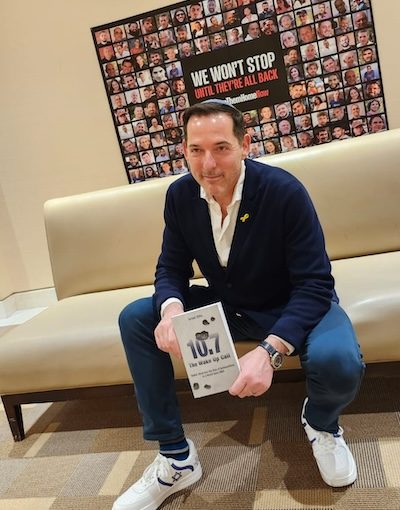
Author Israel Ellis with his new book, The Wake Up Call, after a Feb. 10 talk at Beth Tikvah Synagogue in Toronto, where he joined journalist Dave Gordon in conversation. (photo by Dave Gordon)
In his new book, The Wake Up Call: Global Jihad and the Rise of Antisemitism in a World Gone MAD, author Israel Ellis brings the events of Oct. 7, 2023, into a compelling, fact-based and easy-to-read focus.
Backed up by scores of footnotes and references, the book is a no-nonsense look at the Hamas terror attack of Oct. 7 and, poignantly, the attack on democracy Ellis believes happened in the months prior to them. The addition of personal stories from Oct. 7 survivors and family members adds another level of documentation to an already all-encompassing book.
Ellis weaves in his own lived experience and perspective as a Jewish Canadian in the diaspora with firsthand accounts of contemporary antisemitism and his reflections on being the father of an Israel Defence Forces lone soldier fighting in Gaza. His personal observations allow the reader to connect with him, as well as better understand the interconnectedness of Jews, no matter where they live, and Israel.
For non-Jews, it can be daunting to begin learning about what happened on Oct. 7, and the global repercussions. Many non-Jews do not know the history of the Middle East, how the state of Israel fits into this history, or what the definition of “antisemitism” is. Ellis helps fill in these blanks, and this is why I am so excited to introduce this book to my friends.
Since Oct. 7, 2023, Canadians (and people from other countries) have seen large pro-Palestine protests in the streets of all the major cities and in academic spaces, with large university encampments set up across the country. Most people in the Jewish community see these protests for what they are: pro-terror and anti-democratic. But, for a Canadian with little knowledge of what the Israeli/Palestinian conflict is, these protests and encampments can look like a fight for human rights. No doubt, some individuals believe they are marching for human rights while chanting“intifada revolution,” but many are there to show support for Hamas, to some degree or another. This is why the knowledge, geopolitical insight and historical context Ellis brings with his writing is so vitally important.
I read a lot of books on Israel, as a non-Jewish Canadian interested in educating myself, and Ellis’s new book has become a favourite. One of the reasons is that Ellis writes about many protests and political events that are still fresh in our minds. He discusses protests that took place in Toronto and the encampments at McGill University (and others). He shows the utter incompetence of Canadian politicians, such as Toronto Mayor Olivia Chow, in handling the rise of radical Islam. He strongly condemns Canada’s minister of foreign affairs, Mélanie Joly, who shook the hand of Mahmoud Abbas, leader of the Palestinian Authority, in what is a now-famous Ramallah photo-op. These events, along with many others, are documented in Ellis’s book, illustrating a pattern of political complicity and complacency that he says has contributed to the eroding of Canada’s moral backbone.
As a Canadian university student, I have experienced firsthand my peers sympathizing with and rallying for terrorist organizations. The university institutions have been complacent in protecting neutral academic spaces, allowing terrorist propaganda to infiltrate our lectures and giving some professors the ability to promote hatred of Israel and the Jewish people.
A quote from The Wake Up Call that gave me chills reads: “There is no coming invasion. It is already here. Jihad has already been invited into our universities, professions, communities and public institutions. October 7 was a wake-up call. It is an example of the hunger for Global Jihad, and what can happen if it is allowed to be satiated. To think that these events are restricted to a narrow strip on the Mediterranean is a complete miscalculation of reality.”
The Wake Up Call should be read by anyone – uninformed or well-informed, Jew or non-Jew – who wants to better understand the political, social and historical context behind the current rise in anti-democratic, pro-terror narratives that have taken over many Western spaces.
Zara Nybo, a fourth-year student at the University of British Columbia, is a StandWithUs Canada Emerson Fellow. Connect with her via Instagram: @zaranybo.
Tamar Eisenman, left, and Sagit Shir bring their children’s music project, City Birds, to Vancouver for a March 23 concert at the Rothstein Theatre, as part of Chutzpah! Plus. (photo by Javier Ortega)
Looking for fun, positive music for your kids that will get you moving to the beat and singing along with them? Check out City Birds on March 23, 11 a.m., at the Rothstein Theatre.
The creative and talented duo with seemingly boundless energy is coming to Vancouver for the Chutzpah! Plus Spring Edition, which runs March 19-23.
“Our goal is to weave a musical tapestry that captivates the imagination of the children and to accompany them on their mammoth journey of growing up, while also resonating with the hearts of older kids and parents,” write Tamar Eisenman and Sagit Shir on their City Birds website. “Our work is a celebration of families and about telling stories where children and parents find comfort, joy and inclusion.”
Even people without kids will appreciate the music’s playfulness, its folk and rock rhythms, and unique lyrics, all intended to uplift.
“It’s a lot of fun, and the inclusive elements are a key part of our craft – whether it’s mentioning all types of families, using different pronouns, or embracing a creative, childlike perspective that also serves as a wonderful reminder for grownups,” Eisenman told the Independent.
Both Eisenman and Shir are accomplished musicians. Eisenman has released multiple albums over the years and is currently touring with a couple of shows, including City Birds. Shir is the co-founder of the indie rock duo Hank & Cupcakes, and she teaches music and songwriting, specializing in early childhood music education. They each have some 20 years of music writing and touring to their credit.
“We met through Ariel, Sagit’s husband/partner,” said Eisenman. “Ariel and I went to high school together, and we’ve been really good friends ever since. I think I was about 18 or 19 when I first saw Sagit perform. She was singing with her trio in small music venues around Jerusalem, covering my favourite songs by Tori Amos, Suzanne Vega and others. Her voice and performance completely blew me away!”
“I remember that cover band!” said Shir. “Tamar was always a musical presence I was aware of beyond her years-long friendship with Ariel (who was also her bassist at some point). I remember being in awe of her musical and performative talents and generally admired how she ‘had it together’ at an age where I was just starting to seriously explore my musical tendencies.”
After Shir and her family moved back to New York City, she and Eisenman reconnected and started meeting up more often, sometimes with their kids.
“If I remember correctly, in September 2023, Sagit invited me to a friend’s show in the Lower East Side, where we first talked about the idea of writing and composing songs for kids and families, with LGBTQ awareness at the core. I personally felt there was a gap in family entertainment in that space,” said Eisenman.
“Sagit had her ukulele with her and, after the show, we hung out outside the club, brainstorming our first ideas for the project. From there, we each worked individually on some concepts, exchanging demo recordings, lyrics and ideas back and forth. As the songs took shape, we rehearsed, and, once we had about six songs ready, we performed at our daughters’ schools for the first time.”
The feedback was wonderful, said Eisenman. “That’s when we knew we wanted to keep folk Americana as the foundation of our sound – while adding some punk rock, of course. We wanted the music to feel close to home, reflecting the styles we personally connect with,” she said.
“It was also important to keep it organic and live, creating something that we, as adults, could relate to just as much as kids,” she continued. “The music is for everyone – it exists in that ‘in-between’ space: for kids growing up, for parents who were once kids, and for all of us witnessing that journey. It’s a fascinating timeline when you think about it. And then there’s our secret ingredient – Ariel. He’s such an incredible musician and he plays bass and other instruments on the record.”
While the meeting at the club may have been the first time the two musicians sat down together and brainstormed about writing and performing music geared towards children, Shir said the idea for City Birds came earlier.
“Tamar brought it up when our families went on a small vacation in upstate New York some time before,” said Shir, “and I was so excited at the prospect of collaborating with Tamar, whom I secretly admired, that I wrote the first lines of ‘The Family Song’ that very night.”
That Shir had worked on some songs already helped when the two started working together. For those pieces, Eisenman said, “we refined the lyrics, arranged the music together and made adjustments as needed.
“Other times, we each brought in songs, fragments or ideas and we’d have a little creative ‘ping-pong’ session to develop them,” she added. “For example, I wrote the verse of a lullaby I was working on, and Sagit added the B section musically, then we expanded the lyrics together from there. There’s really no single format or structure; we try to keep the process open, flexible.”
While their being Jewish doesn’t necessarily inform their music, Eisenman said their cultural heritage is an inherent part of who they are – “both in a traditional sense and as part of our roots,” she said. “The Hebrew language is, of course, dear to our hearts and, as my native language, it’s especially meaningful to me. Being able to incorporate it into our songs is a lot of fun as well.”
Shir’s background in early childhood music education no doubt plays a key role in their songs’ appeal.
The daughter of two teachers, Shir said, “I’ve found myself specializing in teaching language through music, especially Hebrew. I find that, with very young students, teaching them Hebrew through music almost works like magic. They find themselves learning important basic concepts such as colours, body parts and feelings without even realizing it’s happening. Music makes the language-learning process effortless and fun. I started the company Global Kids Music LLC a year ago and feel lucky to have found my calling.”
The March 23 Chutzpah! show will be City Birds’ Canadian premiere. The two musicians are “so happy for the opportunity to share our music with the Vancouver community and go on this musical journey together,” said Eisenman. “We’ve got a few surprises planned – including a special tribute to the music from back home.”
Chutzpah! Plus Spring Edition includes theatre March 19 (Iris Bahr), comedy March 20 (Talia Reese), dance March 21-22 (Belle Spirale Dance Projects & Fernando Hernando Magadan) and music March 22 (Yamma Ensemble).
The creative team of Bema Productions’ staging of Rite of Passage, with director Zelda Dean (centre). (photo from Bema Productions)
Victoria’s Bema Productions is staging Rite of Passage, a story of family, grief and coming of age by Los Angeles-based playwright Izzy Salant, at Congregation Emanu-El’s Black Box Theatre March 19-30.
The play centres on Harold, an autistic youth preparing for his bar mitzvah. His mother is suddenly absent and others are not sharing with him why she is not there. Harold’s father struggles with whether he should tell Harold the truth.
“The complex and incredibly human characters go through terribly hard times, yet handle it with grace and humour, even when things are in turmoil and the stakes are high,” Dean told the Independent.
At a young age, Jesse Wilson, who plays Harold, became involved in the local theatre scene that worked with the Victoria Society for Children with Autism. Noticing his passion for the arts, his mother encouraged and supported him in taking classes and performing.
Wilson appeared in Bema’s 2019 production of O My God, in which he played the autistic son of the lead character. He has also performed with a Victoria-based summer Shakespeare company.
“Because autism presents in such a diverse way, depending on the individual, I worked closely with Jesse, who is on the spectrum, to ensure that we portrayed the character in an honest way,” Dean said.
Salant, who will be in Victoria for opening night, said the play follows his family’s story. His mother died by suicide in 2007, and he had written extensively about the experience and his grief. But, he said, he had not explored his family’s grief as well.
“I sat down with my father and aunt for around six hours in the fall of 2016 and, later that same year, I wrote the first draft of the play in a playwriting class as a sophomore at the University of Massachusetts Amherst,” Salant, a journalist and social media manager at Jewish News Syndicate, told the Independent.
Rite of Passage playwright Izzy Salant. (photo from jns.org/writers/izzy-salant)
At the time, the play was called From the Point of View of a Journalist. Several drafts later, it became Rite of Passage. After numerous workshops and rewrites, the work remains focused on the central premise of how to move forward amid grief.
In 2020, at the start of the pandemic, Salant and his writing partner, Ryan Dunn, posted Peace Talks on New Play Exchange, a digital library. Written in 2019, the play explored the Arab-Israeli conflict and how it extended to college campuses.
Shortly afterward, Dean reached out to them asking about rights. Bema performed the piece on Zoom and, later, live at the Victoria Fringe Festival in 2022.
“My working relationship with Zelda has been amazing and she’s served not only as an amazing confidant and director, but mentor,” Salant said. “So, when I told her about Rite of Passage, she was overjoyed. She watched a live reading of it via Zoom back in 2022 and told me she wanted to do the play, and, three years later, after many rewrites and discussions, here we are.”
The first full reading of Rite of Passage took place at the University of Massachusetts in 2018, and Salant produced it the same year. During the pandemic, he met Noah Greenstein, an actor and theatre producer from Boston, and sent him the script. Punctuate4, a company for which Greenstein associate produced, liked the script and organized different readings throughout the United States.
Regarding the Victoria production, Salant said, “I’ve been incredibly involved from a writing standpoint. I’ve had almost weekly calls with Zelda about what’s working, what may need to be tweaked, rewritten, etc. The script has gone through around three draft changes from the time Zelda told me she was going to perform it this season to the show that you’ll see live.
“I’m incredibly grateful to Zelda for putting on this production, as I am to Punctuate4 for all their work, in part because numerous other theatres in my career have told me they loved the play but don’t know if they could realistically stage it, somewhat because Harold is autistic.”
Besides Rite of Passage and Peace Talks, Salant has written Balagan, The Scenic View and Unrequited. He also has penned several short plays and one-act plays, including 2082, which follows two best friends on a road trip to New Mexico in the aftermath of a breakup. It premiered in 2023.
Currently, Salant is putting together a piece titled Catatonic, which his friends have called “Zionist Angels in America.” It’s a two-part play about the post-Oct. 7 world and Salant’s experience covering it as a journalist.
Salant is a member of the Dramatists Guild and the Alliance of Jewish Theatre. He is a graduate of the Kennedy Centre Playwriting Intensive and an Abby Freeman Artist in Residence at the Braid, a nonprofit Jewish literary organization in Santa Monica, Calif.
“I consider myself a Jewish artist through and through. Judaism is a core of my identity and I never want to shy away from expressing it,” Salant said.
Tickets for Rite of Passage can be purchased through the Bema Productions website at bemaproductions.com.
Sam Margolishas written for the Globe and Mail, the National Post, UPI and MSNBC.
“As I think many of us are right now, I am feeling sense of trepidation, endangerment and uncertainty about the future that I have honestly never felt before in this way. My faith in the future and humanity’s ability to call in a future that I want (for myself and also for future generations) has been shaken to the core,” Alexis Fletcher told the Independent. “And yet, my spirit knows that hope, togetherness, connection – they are all necessary. Indeed, they are what propel the world, evolution, the cosmos and each other forward. Everything and Nothing asks what hope and resiliency mean to me – as a woman, as an artist, as a citizen – at this moment in history.”
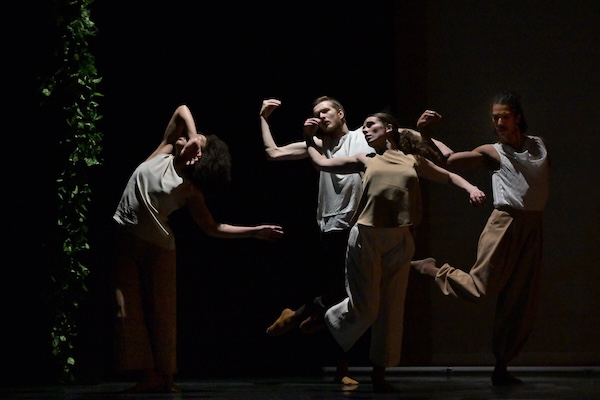
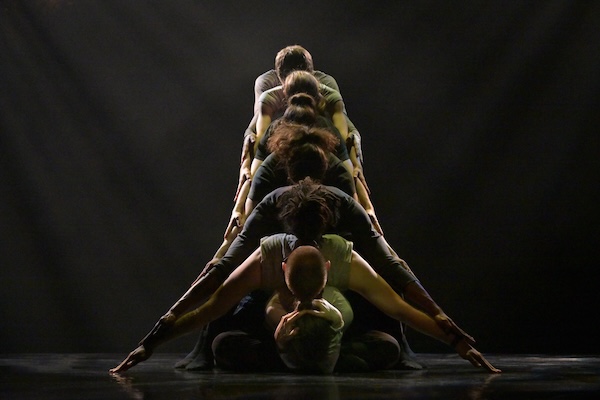
Fletcher is co-director with Sylvain Senez of Belle Spirale Dance Projects. Their March 21-22, 8 p.m., Chutzpah! Festival dance double-bill at the Vancouver Playhouse, called Universus, also features Fernando Hernando Magadan’s Statera.
The title of Belle Spirale’s Everything and Nothing comes from a poem Fletcher wrote several years ago, “exploring the idea that we are at once both the entire universe and a tiny speck of almost nothingness within the vastness of that universe. That we are both ‘everything and nothing in the same split-instant,’” she said.
Acknowledging that this was a broad place from which to start, she and the dancers asked themselves, “Who are the leaders of the future that we actually want? How can we create an imagination-based, artistic response to these important questions and feelings? I see so many qualities of this leadership in each and every person who is making Universus with us,” said Fletcher. “I have been curious about what the archetypes, or the energetic qualities, these future leaders would embody, and how could they usher the world forward into a new and more hopeful paradigm.”
To explore these questions, Fletcher came to the studio with “movement phrases,” she said. “The dancers then took these movements and made new sequences which combined the original phrases with their own responses to the text, images and perceptions about the subject matter.
“We also use structured improvisation to explore different states of being and allow those to inform the choreography,” she added. “Then, everything gets layered together and composed into different sections, working with the music, the design aspects, and how that all relates in space and time to where the audience will be. It is a truly collaborative process, with each artist contributing hugely to the final outcome.”
This includes “the images of the natural world and the cosmos that Sylvain has so exquisitely crafted with his visual design,” said Fletcher. “These images, to me, represent our shared origin point in the cosmos, reminding us that our journey is mystical as well as concrete or tangible. While this is all explored in an abstract way very open to interpretation, we hope to evoke a sense of possibility, of awe and wonder with this work.”
Another important collaborator is Marisa Gold, who Fletcher and Senez met some time ago. “Immediately, I was compelled by her stage presence and the insightful, kind, courageous way she conducts herself in the world,” said Fletcher, noting that Gold has been part of Everything and Nothing from its beginnings in 2023. As the piece has developed, Fletcher felt that a live, spoken-word element “could act as a counterpoint to the inherently more abstract and image-driven metaphor of the dancing body and the choreography.
“Inside of this desire for text, I had a gut feeling that it wasn’t supposed to be my voice or my writing,” said Fletcher. “I needed to bring a different voice into the mix, with different lived experience and perceptions than my own. What came out of this was expanding and amplifying Marisa’s role within the work by commissioning her to create and perform original poetry and spoken word throughout Everything and Nothing. And … she still does a phenomenal amount of dancing, and she is incredible in that too! I can’t wait for everyone to share in her journey. What Marisa has created is truly special – profound and insightful. I gain something new from the text every day.”
For Gold, Everything and Nothing has a powerful message.
“Personally,” she said, “the subject matter and poetry of Everything and Nothing align very closely to my interests as an artist and human being in a volatile world. As a collective humanity, the depth of our connection to Earth is reflected in our ability to deeply connect with ourselves and each other. This work addresses not only our inner/personal world, it also drives home the mirroring effect and metaphor which surrounds us in nature. From my perspective, these images are incredibly supportive to the healing so needed on our planet today.”
The scope of the work wouldn’t have been possible, said Fletcher, if she and Senez weren’t artists in residence at the Chutzpah! Festival.
“We have been fortunate to receive residency, creation and presentation support from the Chutzpah! Festival since 2019,” she said. “Each of these years provided us with stage creation time, financial contributions to our projects and the opportunity to premiere new works; this relationship has been instrumental to our artistic practice.
“Theatre and studio residencies are critical to artists collaborating and developing their craft. In addition,
having a presenter invest in a project from research to presentation creates an environment grounded in solidity and consistency,” she said.
“I really cannot over-emphasize not only how rare, but also how needed and important it is, what Chutzpah! is doing with their residency program.”
This season, Belle Spirale had a couple weeks on stage to rehearse and create, then a two-week, full time technical residency, where the visual and lighting design for the performance was created, so the company could mount the show at the Playhouse.
“The art we make together is a way of life for us, and inseparable from our relationship,” said Fletcher about husband and fellow artist in residence Senez. “While we have different strengths that make us a great team, we also share a profound kinship with regards to our artistic sensibilities and reverence for this art form.”
The two were with Ballet BC for many years, and started creating and producing work together in 2015.
“As a couple – both in our personal story of coming together and in our creative partnership – we have always made each other brave, right from the start, dreaming big and diving into creative ventures without fully realizing the scale they would eventually take,” said Fletcher.
“Tackling meaningful subjects and focusing on the humanity that touches us all, we initially began with quite intimate work,” she said. But, as their exploration continued, so did their desire to integrate other creative voices alongside their own. Formally bringing Belle Spirale into being “became a necessary next step,” and the company was launched in July 2023. The not-for-profit structure allows them to create community networks and garner the support they need. “This comes in the form of our board of directors, and our partnerships with like-minded creative spirits such as our sister company Dance//Novella,” said Fletcher.
“Most importantly,” she said, “Belle Spirale was born from our desire to expand our ability to support a range of artistic voices through commissioning new work, creating our own work, fostering and celebrating Vancouver’s exceptional freelance artists, and presenting/producing both our own, and others’, creations…. We truly believe in the power of the live performing arts to bring people together, to create community and a lifeline for the spirit – a space to contemplate, reflect and be moved – during these complex times we live in.”
One of the aspects Fletcher and Senez like most about cross-disciplinary work is the ability “to reach a broader demographic of audience members,” said Fletcher. “Every person feels connected, or has their heart opened, in different ways by different things. Human beings are layered and complex, and we use different mediums, such as film, set design, text and lighting design, to reflect this complexity in our stage environments.
“We love to create textured, visually impactful and theatrical settings which are completely immersive for the dancers,” she continued. “Everything is crafted to highlight the humanity, athleticism and journey of the dancing body – this human instrument is always the focus of our work…. In my pieces, I work co-creatively with the dancers, with Sylvain as visual/set/film designer and with Belle Spirale’s lighting designer Victoria Hunter Bell.”
In Universus, Fletcher also has gotten to work with Magadan – she co-created and dances in Statera.
“Sylvain and I both met Fernando in 2014, when he created White Act for Ballet BC,” Fletcher explained. “I was an original cast member of this work and Sylvain was his rehearsal director, as well as assisted with some of the visual design. We all just clicked … and it has always been a dream of ours to work with Fernando again. When we commission work at Belle Spirale, I am fortunate to get to be one of the performers we bring together.”
Universus would not exist, said Fletcher, without Belle Spirale’s partnership with Chutzpah! She also noted that, thanks to the company’s partnership with Vancouver International Dance Festival, they are able to offer general admission and sliding scale ticket prices, which start at $25. Visit chutzpahfestival.com.
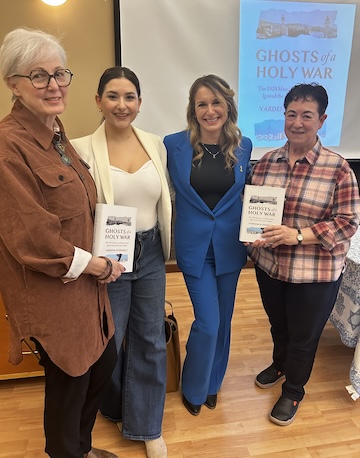
The White Rock/South Surrey Jewish Community Centre hosted Yardena Schwartz, author of Ghosts of a Holy War: The 1929 Massacre in Palestine that Ignited the Arab-Israeli Conflict, on Feb. 23.
Left to right: Gay Cohen, organizer of the White Rock/South Surrey Jewish Community Centre Book Club; Helen Mann of the Jewish Federation of Greater Vancouver; author and journalist Yardena Schwartz; and WRSS JCC president Adele Ritch. (photo by Chloe Heuchert)
At the event, held in partnership with the Jewish Federation of Greater Vancouver and the Cherie Smith JCC Jewish Book Festival, Schwartz – an award-winning producer and journalist – spoke about her book and then answered some questions from the audience.
Schwartz has worked for NBC, among other organizations, and reported for many publications, including the Wall Street Journal, New York Times and Foreign Policy. She lived in Israel from 2013 to 2023.
While working as a freelance journalist in Tel Aviv, Schwartz was introduced to a family from Memphis, Tenn., who had a box of letters written by their late uncle, David Shainberg, who was one of the 70 Jews killed by some of the Arab residents of Hebron during the massacre in 1929. He had sailed to Palestine in 1928, and studied at Hebron Yeshivah; he wrote hundreds of letters to his family about how Jews and Arabs were living together, coexisting, peacefully. Schwartz spoke about those letters, and the massacre and how it relates to Oct. 7.
Helen Mann, who works with the Jewish Federation and is also a part of the White Rock/South Surrey Jewish community, told the Independent that reading Schwartz’s book amid growing antisemitism was empowering, that “it felt more important than ever to spread the historical truth of our people and this contentious and tiny piece of land, especially in such a tiny Jewish community we are in, of White Rock/South Surrey.”
Mann said there is so much misinformation being disseminated, on social media in particular.
“Yardena has meticulously delved through and cited sources to do the work for us, and weave that history into a page-turner,” she said. “While I hope this book gets into the hands of anyone who wishes to speak on the current conflict and politics, it’s of high priority that we as a Jewish community are educated on our own history; to know who we are in order to know where we are going.”
The Jewish Independent spoke with Schwartz after the event.
JI: What types of research did you do for the book?
YS: My research started with interviews in Hebron with Palestinians and Israelis living there. And then, from there, I focused on the period of history that preceded the massacre, so 1928 and 1929. That involved looking at archival newspaper articles in places like the Palestine Post and the New York Times, and Arabic press… There’s an archive in Hebron that I spent a lot of time in, archives in Jerusalem, and Hagana Archives in Tel Aviv. This was during COVID, so I couldn’t go to the London archives, but some other authors who had been there and got materials were kind enough to share them with me.
It was a lot of archival research, a lot of interviews: hundreds of hours of interviews with Israelis and Palestinians in Hebron between 2019 and 2023.
I also read as many books as I could that were focused on that period. There were two books that were really helpful in my research. One was Hillel Cohen’s Year Zero of the Arab Israeli Conflict, which tells the story not just of the Hebron massacre, but of the riots of 1929. And it’s very succinct, it just focuses on the riots, like none of the history before or after. Then, a book by Orin Kessler, Palestine 1936, which focused on the Great Arab Revolt from 1936 to 1939.
JI:During your research, did you find any information that surprised you in a way?
YS: Well, the letters that David Shainberg wrote to his family were really eye-opening for me in painting a picture of what Hebron was like before the massacre and what Hebron was like during the British Mandate before the massacre…. I had never known that Jews and Muslims had lived side by side in peace in Hebron and owned businesses and drank coffee together. That was really surprising to me, given what Hebron is today.
But I think what shocked me most during my research was what I discovered about the mufti, the grand mufti, Amin al-Husseini, who was the first leader of the Palestinian people, and, specifically, his role during the Holocaust, his affiliation with the Nazis, his role as a Nazi, and his role in recruiting tens of thousands of Muslims to fight for the Nazis – and the fact that he lived the rest of his life out in the open. I mean, he was wanted for Nazi war crimes and yet he didn’t have to live out the rest of his life in hiding, like so many Nazis did…. He was never arrested, never was prosecuted or put on trial for his crimes.
JI: Since this is your first book, how was the overall experience, and what challenged you the most?
YS: I think what challenged me the most was giving birth to two children during the course of writing this book. I honestly still have no idea how I wrote a book while raising two kids – my kids are now 2 and 4-and-a-half. I was pregnant with my first child when I started this research … and it was really difficult to write about such a depressing, heavy subject while bringing new life into this world. It was really difficult.
It had always been a dream of mine to write a book. I’d been a journalist for years, but I don’t think I could grasp, until writing this book, just how difficult writing a book is, especially something that covers 100 years of history. So, it was … a tremendous undertaking. Sometimes, it was torturous, but other times it was really fulfilling and especially now that it’s out there in the world, and hearing from readers is just like an incomparable experience…. I feel really blessed that I was entrusted with these lettersby these families. Without them, this book wouldn’t have come to fruition, basically.
JI: What key message do you want readers to take from the book?
YS: I think my key message is that we will never be able to resolve this conflict if we can’t agree on the facts that drive it and the history that precedes this tragic moment we’re in. And, I think, to anyone who wants to see peace in Israel, peace between Israel and Palestinians, I hope they’ll read this book. I hope they’ll learn the lessons of history, so that we can stop repeating the mistakes of the past.
Chloe Heuchertis an historian specializing in Canadian Jewish history. During her master’s program at Trinity Western University, she focused on Jewish internment in Quebec during the Second World War.
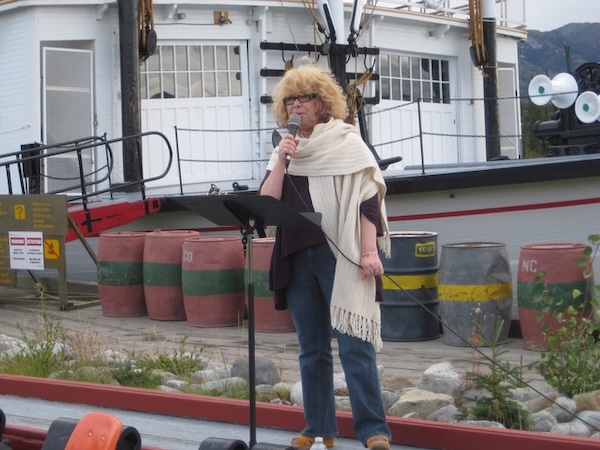
Photos from the book include Joy Karp speaking to a group of people at a Terry Fox Run in Whitehorse. (photo from Rick Karp)
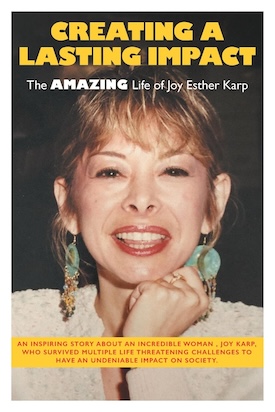
Creating a Lasting Impact: The Amazing Life of Joy Esther Karp was recently published.
Written by Rick Karp, who was married to Joy for 49 years – many of them spent in the Yukon – the account tells of her determination to make a difference and how she made numerous contributions to society, while having to overcome life-threatening issues every few years.
Joy Karp died in 2017.
“I promised Joy a few weeks before she passed that I would ‘tell her story,’ and that is what I have done. People need to know who she was, what she accomplished throughout her life, how caring and supportive she was for others,” Rick Karp told the Independent.
Two of the setbacks Joy Karp faced were a heart attack, after giving birth to twins in her early 20s, and a car accident, in which she was thrown from the vehicle onto a frozen Lake Ontario, smashing the bones in her left foot; she had to wear specially made shoes thereafter.
In 1986, the Karps moved from Ottawa to Whitehorse, where they brought the first McDonald’s to the North and were deeply involved in the economic, social and cultural fabric of the Yukon. But this didn’t protect the couple from life’s vicissitudes.
Joy was kidnapped in 1992 and buried in her car for close to 17 hours.The kidnappers shackled her wrists and ankles, blindfolded her, put a bag over her head and left her there without needed medication, despite knowing she had heart issues.
“After the kidnapping, Joy suffered horribly for years from PTSD and, a couple of years later, her heart gave out and she had to have a quadruple bypass operation,” Rick Karp said.
In addition, Joy’s foot was severely damaged after the kidnapping, and doctors considered amputation. The Karps, though, demanded that the doctors pursue another course, which allowed her to keep her foot.
A few years later, Joy had her first case of cancer and required operations, chemotherapy and radiation. The cancer returned after several years and proved incurable.
“The doctors thought it was a heart issue and all that Joy needed was a pacemaker,” Karp said. “The X-rays that they did to determine the positioning of the pacemaker showed that the issue was a cancerous growth that had developed in her right lung and had reached out and attached to her heart.
Rick Karp’s book about his wife, Joy, was recently released. (photo from Rick Karp)
“They said that it was inoperable and that Joy only had about three months left, but she survived for close to 11 months.”
Despite all these adversities, Joy had an innate ability to understand and see the potential in others, to learn what they needed, and then make things happen for them, said Karp. People were always drawn to her, he said.
“This was one of the amazing things about Joy. She thought of others. She was a great listener. As a student, she helped her fellow students with assignments, and she had the ability to resolve issues.”
One of Joy Karp’s legacies is the McDonald’s Hands-On Business Training Program. The story begins in Ontario in the 1970s, with a job she had helping an owner-operator grow to five stores, and managing the head office. Confronted with a high turnover rate in some towns, the owner approached Joy for a solution.
She created a training program in 1978 and implemented it at local McDonald’s restaurants. By the early 1980s, according to Karp, the program was used throughout the fast-food chain.
“This is a three-year program that takes employees, or others that apply, through training and development that solidifies their knowledge of all of the stations in McDonald’s, training in customer service, and all aspects of how the restaurant operates,” he said.
“Then, to the right people, the program offers the chance to rise from crew person to crew trainer, to swing manager, to assistant manager and to manager – it offers career opportunities. Also, embedded in the program is the concept of ‘promote from within,’ which has been adopted by businesses, well, everywhere.”
Among other accomplishments, Joy organized service and customer satisfaction workshops for the Whitehorse Chamber of Commerce when the city played host to the Canada Winter Games in 2007. Her efforts, Karp said, were recognized by the event’s organizers.
Additionally, she played a key role in bringing the Special Olympics to Whitehorse, helped arrange for an outdoor play area and training computers at the Yukon Child Development Centre, and was pivotal in obtaining funding to make the Yukon Arts Centre wheelchair accessible. In 2013, she wrote The Power of Service: Service Through the Eyes of Customers, a book that emphasizes the importance for businesses to develop relationships and trust with those they serve.
Creating a Lasting Impact can be purchased on the Bookstore page at rwkarp.ca. A signed copy can be ordered by emailing Karp at rickkarp46@gmail.com.
Sam Margolishas written for the Globe and Mail, the National Post, UPI and MSNBC.
Ever wondered what your leather-bound journal thinks about you? Your menorah? The bowl you made in a pottery class? What astrological sign your keepsakes might be? How they’d like to be handled, cared for? Where they’d like to be in your home?
For most of us, the answer is probably no … to all of the above. But Elisabeth Saake has thought of all these things. And, after reading her latest book, Tchotchkes and their F*cked-Up Thoughts: The Messed-Up Minds of Your Trinkets and Treasures (Collective Book Studio), you will too. It’s a follow-up to her 2023 Houseplants and Their F*cked-Up Thoughts: PS, They Hate You, which she wrote with Carlyle Christoff.
Divided into five sections, no knickknack is spared. Saake covers the whimsical (lava lamp, rubber chicken, etc.), vintage and collectibles (antique compass, souvenir spoon, etc.), cultural and artisanal (woven tapestry, ceramic urn, etc.), spiritual and mystical (worry stone, crystal ball, etc.) and functional and decorative (novelty salt and pepper shakers, participation trophy, etc.).
About your journal, don’t worry, it thinks “your poetry is profound” and is “totally listening and deeply moved”; it only appears to be setting itself on fire.
But your menorah would like to be treated as more than a “fancy candleholder”: “Fill my branches with holy oil from trees grown on the Mount of Olives, just a day’s worth, and watch me burn for eight! Or cram in cheap candles from your big box store’s Hanukkah display. That works, too. Way to honour your ancestors, nudnik.”
And your handmade pottery is a “real bowl,” even if it “was made in a beginner’s night class at the community college”: “I’m round enough, I’m stable enough and, doggone it, people like me!” Though, it’s “a bit wobbly,” so perhaps no soup … maybe just display it on a kitchen shelf, as the “mantel is for the perfect porcelain.”
Tchotchkes and their F*cked-Up Thoughts would make a great gift to any friend (with a sense of humour) who’s a collector of things, or to any friend who has judged others’ collections of things. It’s snarky, a little dark at times, but will bring many chuckles and laughs, even if every joke doesn’t land. It’s colourful and beautifully put together. Hopefully, it will think as highly of you, its place in your home and how you care for it – and have an astrological sign that’s compatible with yours.
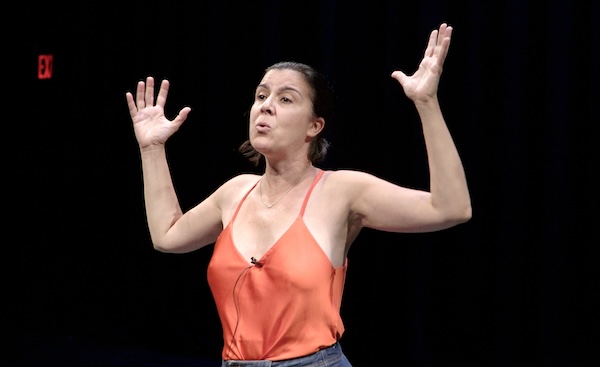
Iris Bahr opens the Chutzpah! Plus Spring Edition on March 19 with Stories from the Brink: My Festive Near-Death Adventures. (photo from Chutzpah! Festival)
The Chutzpah! Plus Spring Edition kicks off with comedy, though the laughs will mix with thoughtful moments of reflection on life, family, being Jewish, and more. Live, all the way from New York, Iris Bahr will perform at the Rothstein Theatre on March 19, and Talia Reese will be on stage there March 20.
Bahr is coming to Chutzpah! with her show Stories from the Brink: My Festive Near-Death Adventures.
“I don’t want to give anything away,” Bahr told the Independent. “Let’s just say I talk about my childhood in the Bronx, where I had to lead a double life. My bacon-eating parents sent me to an Orthodox yeshivah, which, as you can imagine, was extremely stressful. I was also stung by an entire beehive. But there’s a lot more. Just come and see. I really look forward to sharing the story and coming back to the theatre. I’ve missed it. Vancouver’s one of my favourite places to perform.”
Bahr explained why she has ventured into the non-fiction realm with her performance work.
“Some very significant events happened in my life, like my mom’s stroke, which was the basis of my previous show See You Tomorrow, that I performed in Vancouver a few years ago,” she said. “I felt a need to not only share the story because it was a very dramatic story, but, even more so, as I was in the depths of caregiving for my mom [in Israel], first with a stroke and then with dementia, I realized how isolating it was, especially with a loved one with dementia. And I realized how important it was, as an artist, to create a new piece about it, because so many people undergo similar caregiving trials and tribulations. I’ve been doing that show for over three years, and the amount of people that come up to me after, thanking me and hugging me and telling me they found comfort and were also entertained and were able to find the humour thanks to the show, is truly the reason I keep doing it.
“With my current show, Stories from the Brink, I had been exploring this theme of near-death experiences for awhile, first on a podcast that I created and then near-death-themed stand-up shows, with guests sharing their own stories,” continued Bahr. “But, after Oct. 7 and my experience in Israel on that morning, which was obviously terrifying and gut-wrenching, and the rise in antisemitism and extreme anti-Israel sentiment, it was very important for me to create a show that was framed by that experience that I knew would reach people from all persuasions and attitudes. But that is only one small piece of the mosaic of the show which is also filled with a lot of other life shmutz and a lot of humour.”
For Bahr, humour is one of the ways in which she handles challenges.
“Any coping mechanism that can find light amongst the darkness is a highly effective one,” she said. “And, as someone who has always reveled in the world of humour and made it a living, it seems like an obvious go-to when dealing with dark times. It’s not even a conscious decision, it just exists as a muscle, an internal reflex.”
While See You Tomorrow was written as a long-form story, Stories from the Brink comprises vignettes. Bahr explained that See You Tomorrow “takes everyone on a ride and hyper focuses on one aspect of a story. There are some tangents there, but it really is this one event that has a clear beginning, middle and end in a finite time.”
She took a different approach with Stories from the Brink because, she said, “I have a larger theme that I’m trying to explore from many different facets. The vignettes kind of tackle that theme from different angles and ways. And, it’s also a very colourful way to put a show together. It’s like a mosaic and there’s something beautiful about a mosaic, as well. Mixes it up a bit, especially for those audience members that have short attention spans.”
But audiences don’t have to be concerned about remaining focused on Bahr, who is an accomplished storyteller. Being an engaging performer, she said, “comes from physicality to voice to emotional presence and being authentic, being in the moment. Especially with storytelling, you have to have that combination of performance and authenticity and live in the present as you are recounting these stories. Otherwise, you’re just kind of giving a clinical recap, as I tell my students. You also have to really paint a picture and create a world and you have to depict the characters, including yourself, in a very full manner.”
Reese, who went from being a comedian to being lawyer and back to being a comedian, agrees about the importance of being a good storyteller. It has served her well both as a lawyer and as a stand-up comedian.
“So, this is random, but I’m a really good summarizer,” she said. “At the law firms, my thing was summarizing case law for memoranda and stating the facts of a case succinctly but informatively in a pleading,” she explained. “I think I took that skill to joke writing. Word cutting is so important, saying just enough to get to your punchline then move on to the next.
“I also really enjoy telling stories, which is helpful in law and in comedy. I can tell a good story, ya know? That’s why Ihave a low tolerance for stories that dwell on unnecessary details. I zone out fast, which is why I think I was so tough on teachers. But I’m all about entertainment value. Entertain me or go away.”
Comedian Talia Reese takes to the Rothstein Stage on March 20. (photo by Limor Garfinkle)
Reese shared that she was the “class clown” growing up, which meant she was “thrown out of class a lot.”
“It really depended on the teacher though,” she said. “I was just so bored in middle school and most of high school and the teachers were such characters. Getting to act in plays was a saving grace for me. I enjoyed doing Neil Simon comedies so much. I wish I was still doing that.”
In high school, Reese said, “I was all about acting in comedies and then, in college, I was the director of a comedy troupe where I wrote all the sketches and played many wacky characters. Coming out of U of Penn, I felt tremendous pressure to choose a more traditional career path, so I did the law thing. Law school was an amazing education but the all-encompassing practice was not the life I would have ever envisioned for myself, so I took a stand-up class on a lark and wound up sticking with that.”
Coming from an acting and then sketch comedy background, Reese wasn’t sure she’d be good at stand-up. “But,” she said, “it was the only way to do comedy on my own schedule, after putting the kids to bed. I’d go to open mics and talk about my life, try out jokes, build setups around lines that I thought were funny. One by one my stories would pop, or a joke would come to life, and it was the most exciting thing since college, when I wrote those sketches. I think I found my voice, and am still finding it, when I started to talk more about my actual life, telling specific stories. And it always amazes me when something so random that struck a chord in me will get an audience going too. It validates that I’m not crazy. Or that I am, but everyone else is too.”
Reese, who describes herself as Modern Orthodox, grew up in a Reform environment, “but we always had a traditional Friday night Shabbat dinner at my savta and sabbah’s house,” she said. “I think, given that my father is Israeli and of Sephardic descent, having Shabbat with my grandparents and cousins every week gave me a strong sense of Jewish identity. Also, my grandparents on my mother’s side survived the Holocaust and I have childhood memories of being in the room when they played cards with their friends, most of whom were Polish and some had numbers on their arms.
“My ‘Jewishness’ played such a strong role in forming my personal identity that it wasn’t a stretch to become more religious for me, or for my parents and siblings, who consider themselves baal teshuva as well.”
She adapts her comedy routine to the situation, she said. “I try to be respectful of religious institutions that hire me to do a night of clean comedy. I know where that line is and I’ll go right up to it and then walk it back. I like to play with an audience’s expectations. Like I talk about my two failed marriages. Then mention that I’m still in one of them. As far as getting to know my audience, at a live show, I’ll usually do some crowd work to see what I’m working with, or throw questions out up top.”
As for how she works, she said, “If I make myself laugh with a thought, I write it down. If I make my friends laugh with a story, I write it down. Then comes the development. Will this be good for the stage? Are there enough moments in the build-up that keep it funny? Like, I was thinking about how my daughter’s name is too long for how much I have to yell at her. Isabella, too many syllables, it’s exhausting. So, just abbreviate. Isabreakfast! Isabedtime! Who knows, maybe that will make it into the act!”
* * *
Spring Chutzpah! Plus
The Jewish Independent interviewed Jessica Gutteridge, artistic managing director of the Chutzpah! Festival and the Rothstein Theatre, in advance of the March 19-23 Chutzpah! Plus Spring Edition.
JI: Why has Chutzpah! decided to do a spring edition?
JG: Chutzpah! has for many years presented special programming outside of the main festival through our Chutzpah! Plus program. It has been a goal of the festival to expand this programming in order to deepen our engagement with audiences and to take advantage of artists’ touring schedules that bring them to the area throughout the year. In late winter 2024, we were delighted to offer a Winter Weekend of programming. Now, with a shorter fall festival, we are able to shift some of our programming into the spring, offering opportunities throughout the arts season for audiences to enjoy what the festival has to offer.
JI: Last fall, there was concern about the future of Chutzpah! How is it looking now?
JG: We were gratified to see the community come together to support Chutzpah! at a time of crisis, contributing generously and expressing a shared commitment to Jewish arts and culture. Adjusting our festival schedule to a shorter fall flagship festival plus our spring edition has also aided our sustainability. Important capacity-building support has come from philanthropic organizations like the Diamond Foundation and the Azrieli Foundation.
But significant challenges remain. The grant-funding landscape has not improved appreciably and, with more organizations competing for less funding, costs rising and the general economy precarious, it’s critical that we keep the momentum going. Not only is it important that the community continue to sustain us as donors and sponsors, we need audiences to “vote with their feet” and come out to festival shows and events – and bring friends. Showing support and getting to enjoy fantastic artists – it’s a win-win!
The Chutzpah! Plus Spring Edition runs March 19-23. Universus, a dance double-bill by Belle Spirale Dance Projects and Fernando Hernando Magadan is at Vancouver Playhouse March 21-22, 8 p.m.; Yamma Ensemble is at Rothstein Theatre March 21, 10 a.m., and March 22, 7 p.m. (for more about Yamma, see jewishindependent.ca/unique-in-style-rich-in-culture); and City Birds, a new project in the tradition of Americana by Tamar Eisenman and Sagit Shir, will perform music for families March 23, 11 a.m., at Rothstein Theatre. For tickets, visit chutzpahfestival.com or call 604-257-5145.
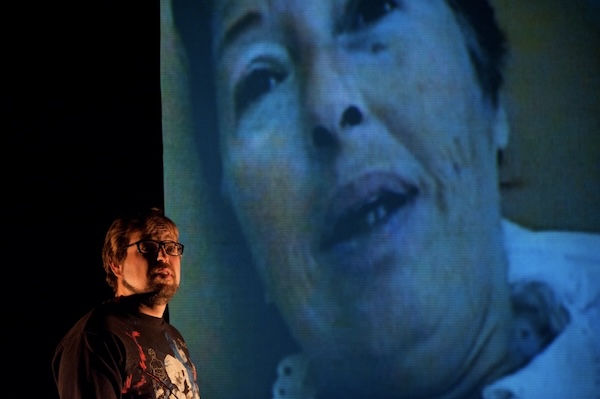
Itai Erdal, with his mom, Mery Erdal, z”l, on screen, in How to Disappear Completely, which opens at the Historic Theatre in Vancouver March 15. (photo from The Chop Theatre)
Itai Erdal’s award-winning How to Disappear Completely, which has toured the globe, will be at the Historic Theatre in Vancouver March 15-22.
Created by Erdal, with James Long, Anita Rochon and Emelia Symington Fedy, How to Disappear Completely premiered at the 2011 Chutzpah! Festival. The one-man show then toured internationally, being performed in more than two dozen cities around the world before COVID hit. The March run marks its first remount since the pandemic.
“It’s been a dream come true,” said Erdal about traveling with the production. “Performing this show is the closest thing I have to hanging out with my mom, so being able to introduce my mom to so many people around the world has been wonderful. I also got to do it in Hebrew – I performed the show in Jerusalem and Tel Aviv and many of the people in the audience knew my mom so that was really special.”
Erdal immigrated to Canada from Israel in 1999. The following year, he found out his mother had been diagnosed with lung cancer and only had months to live. He returned to Israel to be with her as much as possible and, during that time, encouraged by his mother to do so, he shot hours of film and took hundreds of photos.
“We laughed a lot, and you can see it in the show,” Erdal told the Independent in 2012, when How to Disappear Completely had its first remount. “It’s a tragedy turned to joyful memories,” he said about the piece, which also focuses on his approach to theatrical lighting. Erdal is amultiple-award-winning expert in lighting design.
“This was the first show I wrote and the first time I performed, so we had to come up with a theatrical device to explain why a lighting designer is standing on stage and telling this story,” Erdal told the Independent in an email interview earlier this month. “So, the premise was that this was a lecture about lighting design, and I ran all the lights from the stage. The connection between my mother’s story and lighting design wasn’t obvious at first, but when we started doing workshops, the audience loved all the lighting stuff and responded very strongly to it. I wanted to show how a PAR [parabolic aluminized reflector] can get warmer as it dims, so I took it down one percent at a time, and people got emotional because they thought about the life leaving my mom’s body. The show is full of these accidental metaphors, and the lighting became the emotional heartbeat of the show.”
Over the 14 years since he first wrote and performed How to Disappear Completely, Erdal – who founded the Elbow Theatre – has co-written and performed several other works: Soldiers of Tomorrow, Hyperlink, This is Not a Conversation and A Very Narrow Bridge. So, while How to Disappear Completely hasn’t changed much since it was written, Erdal said, “I am much more relaxed as a performer, so the show got better.”
He added, “The main thing that’s changed in the past 14 years is that I have become a father and I understand better why my mother said it was so important to be a parent. I often think about what a great grandmother my mom would’ve been and I wonder how she would’ve handled some tough parenting moments.”
Erdal doesn’t tire of performing How to Disappear Completely, and he sees how affected audiences continue to be.
“Creating this show has been the most exciting and rewarding thing I’ve ever done,” he said. “You would think that reliving the hardest moment of your life on stage every night would be a daunting task, but it’s a joyful experience. My mother was smart and funny and her personality really shines through. Every time I perform the show, there is a lineup of people waiting to talk to me after, wanting to tell me their stories about finding love and about losing their parents, and I love connecting with them and feeling that my show might help them a bit with their grief.”
And that’s what makes this very personal show widely popular.
“Unfortunately, almost everyone in the world knows someone who died from cancer, and the grief of losing a parent is something almost everyone can relate to, so the show has many universal themes,” said Erdal. “It also deals with loneliness and the search for love, which are also very relatable themes.”