Unique book group

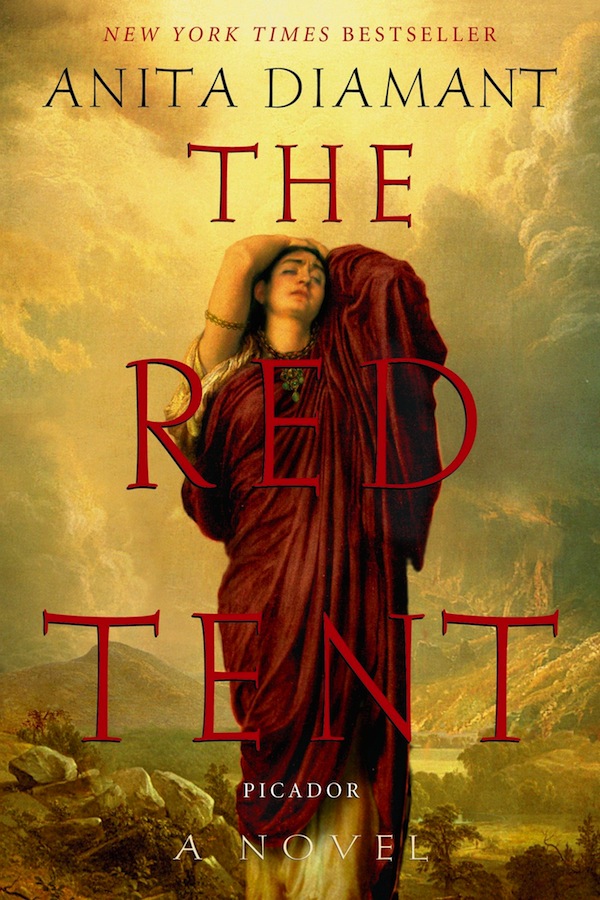
The next novel up for discussion at the Jewish-Muslim women’s book group is The Red Tent.

One Sunday in July led to several new experiences for yours truly, a 23-year-old Jew living on Vancouver’s North Shore. For starters, it was my first time in a mosque, it was my first time in Delta and it was without a doubt my first Jewish-Muslim book gathering. Thankfully, it wasn’t my first time reading a book in less than 24 hours, as my decision to attend the gathering after seeing it mentioned in this very newspaper, was pretty spur of the moment.

The book group’s second-ever session was held at Baitur Rahman Mosque, a building that, upon first impressions, was slightly imposing – British Columbia’s largest mosque, dwarfing any synagogue I’ve come across – but which proved home to an incredible amount of warmth. The warmth began with smiles when I entered the room late – it was a longer journey than I expected – and continued through the entire two-hour session about the book (I Am Malala by Malala Yousafzai with Christina Lamb), and well into the snacks and chats afterwards.

Having been greeted by 30 or so women from both Jewish and Muslim backgrounds, there was the classic ice-breaker – going round in a circle, saying one’s name, a little bit about yourself and an interesting fact. I may not have been able to beat one woman’s fact (she used to be a stilt walker) but my relatively young age meant I stood out.

This lengthy introduction introduced me well to the thoughtful, kind group. In true Canadian spirit, they were from so many different places and cultures. The Muslim women in particular had a heartening appreciation for their country. One said she “liked Canada very much”; another one-upped her, exclaiming, “I am one of the luckiest people alive” for having been welcomed here. There’s no doubt that the women from both religions were of a progressive stance – the bulk of Jews was from egalitarian Or Shalom synagogue, while the Muslim women were part of the Ahmadiyya community, which has been persecuted relentlessly by more orthodox Muslim groups.

As conversation began about the book, it became clear that everyone was so lovely – was I the only person who hadn’t helped Syrian refugees settle in Canada? – that I began to wonder if the group was a case of “preaching to the converted.” Surely the people most ignorant, and most in need of education about other religions, weren’t the type who would turn up to this group? A cynic by nature, this worry stayed with me during the (fairly fleeting) discussions about the book and the (much longer) follow-up conversation about the link between religion and education, how and whether you can teach critical thinking, and other thought-provoking questions.

So, I reached out to the organizers from both sides. The email chains that followed gave me insight into two great communities and their prior interfaith ties, as well as into two pioneering women: Tiferet Welch from the Jewish community and Aisha Naveed from the Ahmadiyya Muslim Jama’at. They provided some strikingly similar answers to my questions, illustrating how much common ground can be found between the two religions (religions that, evidently, don’t always see eye to eye).

About why the book group came about, it seemed that the books were simply a way of facilitating discussion about religion itself. Welch said she decided to make the group happen after meeting some of the Muslim women, who “stated their knowledge of Judaism and, hence, Jews, was extremely limited,” but they were “fueled with a strong desire to know more.” Naveed said “the book club was initiated to remove common misconceptions between the Jewish and Islamic faith,” explaining to me how her community believes in interfaith dialogue to “encourage learning” and “prevent ignorance.”

The women were also on the same wavelength about the group’s future – Naveed called it “an organic venture” and Welch said “we want to see it progress organically.” They were both proud of what it had accomplished in such a short time: Naveed proclaimed it “a huge success,” while Welch described the discussions as “open” and “honest.”

And what did they have to say to my “preaching to the converted” angst? Naveed said that, because interfaith gatherings “are a form of open and safe space,” they mean you learn a great deal about one another. Welch said “there needs to be a distinction made between being open and being knowledgeable.” In layman’s terms: those who attend the group are open, but that doesn’t mean they’re knowledgeable, and the group aims to educate.

Welch also pointed out that, because the event is promoted, for instance, via Or Shalom’s electronic bulletin, geography is a non-issue. Theoretically, people all around the globe can subscribe to the group and see how progressive it is. And, she reminded me that, once this article is published, other Jews will know about it, and thus the group’s potential for change is increased.

With that in mind – how to sell the group to someone reading this? I’ll break it down, simply and honestly, into three points.

First off, the reading material is quality. The first session the group discussed the book Faithfully Feminist: Jewish, Christian and Muslim Feminists on Why We Stay, edited by Amy Levin, Gina Messina-Dysert and Jennifer Zobair. It led to a worthwhile discussion on how both religions are traditionally patriarchal, and what this has meant for female faith in male-dominated arenas. For me, having started off dubious about I Am Malala, the second session’s read proved a powerful one. The youngest-ever Nobel Peace Prize winner’s account is both humble and knowledgeable, a memoir that explains well the Taliban’s rise, Pakistan’s history and politics, and the monumental importance of educating girls.

Second, the discussions that stem from the books are as intelligent as they are interesting. The two-hour discussion flew by at the mosque – the only thing I can compare it to is a dream university seminar or tutorial; i.e. one not ruined by hung-over students unable even to blag the required reading. Participants were incredibly educated and respectful. We covered moral values and where they should be learned, we discussed the media’s portrayal of religion and our internal prejudices, and I gained a ton of insight into a religion that many of us could, and should, know more about. Their actual definition of jihad – as education; a clear rejection of terrorism – which hung proudly in the room, struck me as particularly vital in this day and age.

Third, the post-discussion food is fantastic. The informal portion of the event, where we stood eating (delicious snacks) and chatting, was where we all connected more personally and more deeply. I found out what it’s like to be judged immediately and constantly for wearing a hijab, and how it feels to be asked where you’re from, to reply saying “Canada,” and then receive a demanding “No, but where are you really from?” On a more light-hearted note, I found out how pleasing it is to interact with people outside my usual social circle, to do something new and to spend a Sunday afternoon with a group of thoughtful, inspiring women from all over. Oh, and did I mention how good the food is?

The group’s next meeting – about The Red Tent by Anita Diamant – is scheduled for Dec. 18, 2-4 p.m., at Or Shalom. Women interested in attending are advised to follow Or Shalom’s web page or subscribe to its email list, and to RSVP Welch at twilla.welch.1@gmail.com.

Rebecca Shapiro is the associate editor of vivalifestyleandtravel.com and a travel blogger at thethoughtfultraveller.com. She’s been published in the Guardian, Elle Canada and the Huffington Post, as well as various other Jewish newspapers in the United Kingdom and Canada. She currently resides in Vancouver, having previously lived in London, Shanghai and Toronto.

Sharing Muller’s table

Our Table is a beautiful hostess gift for that special occasion or that friend who loves cooking and never tires of inspiring culinary reads.

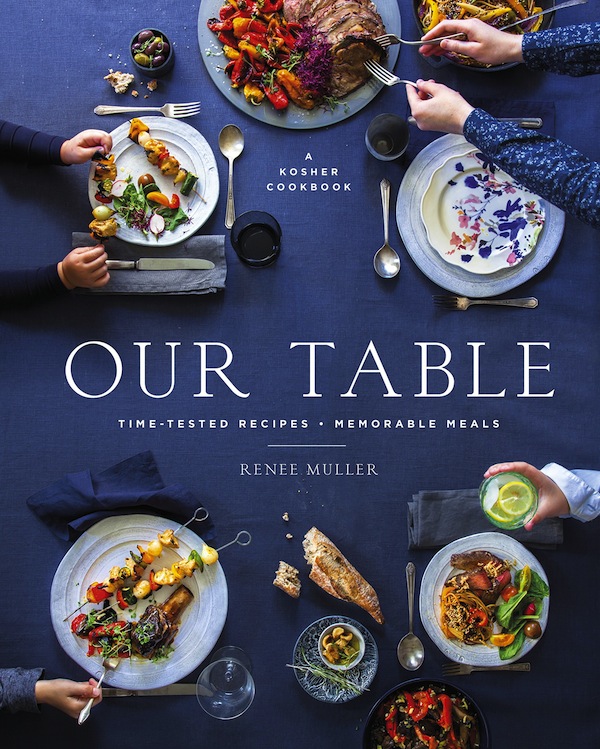
There are cookbooks you whip out of your kitchen cupboard 45 minutes before dinner in search of something easy, bright and new, and there are cookbooks you take to bed with you for reading pleasure. Our Table (Artscroll, 2016) by Renee Muller falls into the latter category, not because you won’t want to try her recipes, but because there’s a lot of reading involved in many of them.

Muller is a Swiss native who moved to the United States in 2002 and, by winning a recipe contest, landed a regular column in Whisk, a pullout food feature of the national Jewish weekly Ami Magazine. Our Table is a compendium of her favorite kosher recipes, “a cuisine that is heimish yet laced with aromas of my youth,” she writes in the introduction.

The dishes encompass all the usual categories – soups, salads, appetizers, fish and dairy, meat, chicken, snacks, desserts and breads. Many of them are laced with stories about family secrets related to the particular recipe, or how the recipe came into being. For her fragrant standing rib roast recipe, for example, there’s an essay on how and why she created the recipe, as well as tips on how far in advance to make it and how to prevent it from drying out. Her Sugo Della Nonna (Italian-style tomato sauce) contains a half page on the definition of comfort food and the feeling it delivers when she makes it. “I see myself, sitting at Nonna’s table, as a child, feeling nourished and happy,” she writes.

Muller’s insights are written in a conversational style with lots of anecdotes about her family thrown in. By the time you’re finished reading this book, you feel like you know her personally – and you can’t help but like this impassioned chef who adores cooking for her family and friends. That’s because Muller’s enthusiasm is contagious, but also because some of her dishes go way beyond the usual suspects. There is a recipe for onion crisps, a whole page on the art of roasting chestnuts, one on toffee apples, one titled “Really, really good whole wheat challah” and another for brown buttered pear salad. And the pictures? Whoa. They are amazing, mouthwatering bites of full-page color that will leave you salivating as you plan your next dinner party. Most of the recipes are not terribly complex either, they’re just new combinations of ingredients most of us know well and use regularly.

Muller is that friend we all want in our lives – the one whose cooking is fabulous, who isn’t shy about sharing her recipes and whose conversation is full of funny stories, notes from her past and sage bits of wisdom. There are times when the essays feel perhaps a tad too long but, nonetheless, Our Table is a 270-page hardcover recipe book worth having, a beautiful hostess gift for that special occasion (Chanukah?) or that friend who loves cooking and never tires of inspiring culinary reads.

Lauren Kramer, an award-winning writer and editor, lives in Richmond. To read her work online, visit laurenkramer.net.

Scholar talks at Peretz

Prof. Ester Reiter, author of A Future Without Hate or Need, points to the U.S. election as a warning that the issues the Canadian Jewish left dealt with are as timely as ever. (photo from Ester Reiter)

On Dec. 1, Prof. Ester Reiter will speak at the Peretz Centre for Secular Jewish Culture to launch her new book A Future Without Hate or Need: The Promise of the Jewish Left in Canada (Between the Lines, 2016).

Reiter’s book documents “the varied political and cultural activities of those who were part of the secular Jewish left” – the movements in which many Yiddish-speaking immigrants and their children took part during the first half of the last century, made up of Yiddish schools, theatres, choirs, dance troupes, drama groups, sports leagues, union activism, newspapers, women’s groups and summer camps. Their members were animated by a vision of what many of them would have called a shenere, besere velt (a more beautiful, better world). There were groups throughout the country, with the strongest ones in Montreal, Toronto and Winnipeg.

Many of these groups came together nationally in the United Jewish People’s Order (UJPO), founded in 1945. The book launch is being undertaken to commemorate the 90th anniversary of the founding of the Labor League – which later became part of UJPO – in Toronto in 1926. The launch is sponsored by UJPO, and co-sponsored by the Peretz Centre and the Shaya Kirman Memorial Foundation for Yiddish Culture. It will start at the Peretz Centre at 4 p.m.

Reiter, a sociologist by training and a senior scholar at York University in Toronto, grew up in New York in a milieu similar to the one she describes. “I grew up in the New York left, the sister version of the Canadian Jewish left. I was a child in the Yiddish shule [school] in Brooklyn and later the mittlshul [middle school] in Manhattan during the Cold War. Many of my teachers were well known in Canada – they were in the summer camps in Montreal and Toronto, and taught in Canada. The politics were virtually the same and shule materials used in Canada were produced in New York, particularly in the early years, the 1930s.”

This community was at its strongest from the 1920s to the 1950s. Yiddish-speaking immigrants were immersed in the secular Yiddish culture and literature that emerged in the late 19th century. “The Jewish left was the equivalent of a university for working-class women and men. The cultural activities – dance, choirs, orchestras – were accessible to both women and men. People working in the needle trades with no time to learn to read music would sing classical works in the choirs, learning them by heart.”

Reiter says of the Yiddish Arbeter Froyen Fareyn (Jewish Women’s Labor League) that, “the very act of getting together changed many of the women,” particularly in women-only groups, “where women felt more comfortable, they described how they learned to speak in meetings. Their political commitments, which involved activities such as walking picket lines, raising money for various causes, necessitated engaging in public life in a way that required and reinforced self-confidence. This participation in the wider world was empowering. They supported each other, made close friendships and had a lot of fun.”

Jews on the left in Canada, as elsewhere, were diverse – they included social democrats, Bundists, anarchists, Labor Zionists and Marxists. Reiter focuses on those whose outlook was Marxist and supported the Soviet Union after the 1917 October Revolution.

book cover - A Future Without Hate or NeedReiter emphasizes that this sector of the Jewish left had a life of its own distinct from the Communist party. “The leadership were Communist party members, but approximately 95% of the membership of the UJPO and its predecessors were not. One could think and say what one felt in the Jewish left without concern over whether it was the ‘correct’ position. Many people came [to the Jewish left] because of the liveliness of the community, as well as the politics.”

Initially, Yiddish schools saw their purpose as conveying ideological values, but this later shifted to transmitting the Yiddish language and Jewish cultural identity for their own sake, including secularized versions of Jewish holidays and rituals. “In the early period, a Yiddish education in the shule was to ensure that the children learned they were the children of workers, and needed to care about racism and class exploitation. After Hitler came to power and antisemitism was growing, Yiddish was valued as an end in itself, and there was more acceptance of the different ways of identifying as a Jew. The community developed secular ceremonies around the bar/bat mitzvah, the High Holidays, Rosh Hashanah and Yom Kippur.”

The Jewish left experienced government harassment during the Cold War, especially in Quebec under premier Maurice Duplessis. Reiter notes that Canadian Jewish Congress defended civil liberties in the face of repression, but “dealing with pro-communist groups in their midst was a different matter.” UJPO was expelled from CJC in 1952 for dissenting from the Cold War consensus by opposing the postwar rearmament of West Germany and supporting the Stockholm peace petition.

The Jewish left for a long time saw the Soviet Union as a hope for a better society, in its outlawing of antisemitism and support for Yiddish culture in the 1920s, but their hope was shattered by the Stalin regime’s murder of Yiddish artists in the late 1940s and early 1950s. “For many years, people projected their idealism on[to] the USSR. When they found out about Stalin’s suppression of Jewish life, it was shocking. Most of the Jewish [Communist party] leadership from UJPO left the party. However, the rank and file in UJPO were never actually party people, so many felt that, although the USSR under Stalin was terrible, their activities in Canada – helping the unemployed, union support – were important and valuable.”

Reiter describes various factors in the shrinking of the Canadian Jewish left – Cold War persecution, disillusionment with Stalinism, the erosion of Yiddish by assimilation. However, UJPO itself has survived the disappearance of the milieu that gave birth to it, and has even attracted new members. Reiter reflects, “There certainly is a need. Our politics mean that we are inclusive of different kinds of families – gay, straight, trans, mixed racial and religious origin. Yiddish has pretty well disappeared, but the progressive politics remain. With respect to Middle East politics, there are a variety of views in the UJPO, but we all agree that criticizing the actions of the Israeli government does not mean that one is a self-hating Jew. We also continue with trade union support, First Nations solidarity, environmental activism. We exist because we have a community that has a good time together. As the organized Jewish community has moved to the right, we provide a place where one can have a Jewish identity and be progressive. Secular left Jews now have to think about what we have in common, not what separates us.”

Reiter points to the Nov. 8 U.S. election as a warning that the issues the Canadian Jewish left dealt with are as timely as ever. “The struggle against racism, sexism, homophobia and all this meanness and narrowness is an ongoing one – a call to remember and honor and value our own history and where we came from.”

Carl Rosenberg is a member of the United Jewish People’s Order and Independent Jewish Voices Canada. For many years, he edited Outlook: Canada’s Progressive Jewish Magazine.

Acoca launches book here

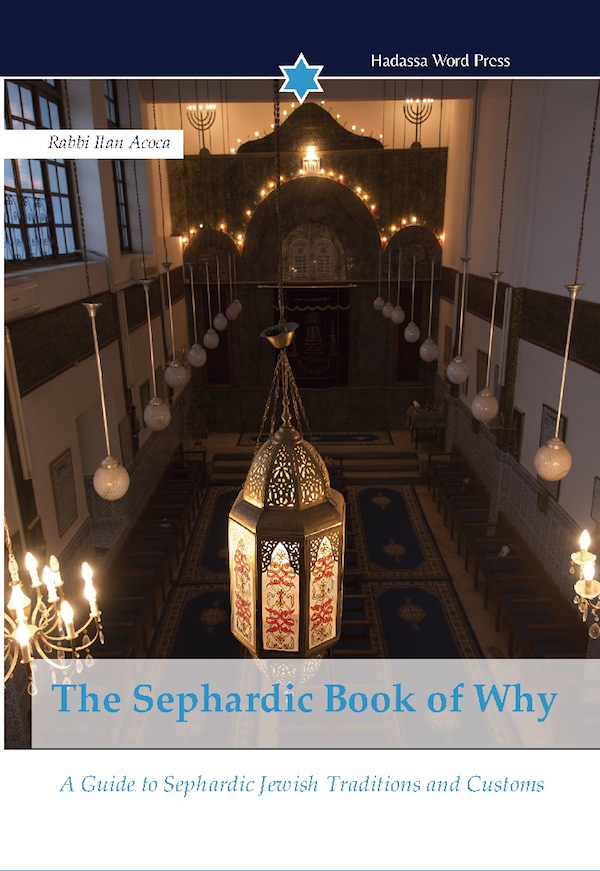
Rabbi Ilan Acoca has published his first book, The Sephardic Book of Why (Hadassa Word Press, 2016).

Why is a set of Sephardi tefillin different from an Ashkenazi pair? Why do Sephardim laugh during Havdalah, after reciting the blessing over the wine? Why do Sephardim not use the shamash to light the Chanukah candles? Why do Sephardim celebrate with henna before a wedding? These and so many other questions are answered by Rabbi Ilan Acoca in his book The Sephardic Book of Why: A Guide to Sephardic Jewish Traditions and Customs, just published by Hadassa Word Press.

The spiritual leader of Congregation Beth Hamidrash for 17 years, Acoca will return to the synagogue for the book’s local launch on Dec. 10, as part of a larger tour. Acoca and his wife Dina have been rabbi and rebbetzin of the Sephardic Congregation of Fort Lee, N.J., since they left Vancouver in August, and Rabbi Acoca is also rabbi-in-residence of Yeshivat Ben Porat Yosef, in Paramus, N.J.

photo - Rabbi Ilan Acoca will be back in Vancouver for the Dec. 10 book launch
Rabbi Ilan Acoca will be back in Vancouver for the Dec. 10 book launch. (photo from Hadassa Word Press)

“I would like to invite the entire community to the book launch,” Acoca told the Independent, “where I will explain what triggered me to write the book, as well as some singing and shmoozing.”

The rabbi shared a little of his motivation for writing The Sephardic Book of Why, which, he said, took three years to put together.

“Through the years, many people (Sephardim and Ashkenazim alike) asked me questions about Sephardic customs, trying to understand where each originated and what is the significance. At times, I had an answer and, at times, it intrigued me to research and find out more. One day, I was invited to a wedding as a guest and saw that the officiating rabbi had a Chabad rabbi’s guide. I knew that the RCA [Rabbinical Council of America] had an Ashkenazi rabbi’s guide so I thought to write one for Sephardic rabbis. A few days later, I sat down with my friend David Litvak and shared my idea with him. He thought about it for a moment and suggested a book that would include the entire Jewish and non-Jewish world. Immediately after the meeting, I opened my email and saw one from Hadassa press telling me they saw some of my classes on YouTube and were interested for me to publish a book with them. For me, that was a sign from heaven that I could not ignore.”

Adorned by a cover featuring the interior of Lazama Synagogue in Marrakesh, Morocco, The Sephardic Book of Why – Acoca’s first book – is divided into five chapters: Daily Rituals, Shabbat and Holidays, Lifecycle Events, Sephardic Culture, and Rabbi’s Musing. The last chapter comprises a selection of articles by Acoca that were originally published in the Canadian Jewish News. They cover a range of topics, including essays on “the middle path,” unity and the importance of diversity. So, having arrived in the United States from Vancouver only months before the presidential election, the Independent asked him if he had any advice to offer to Jews living in the United States (or Canada) about the polarity and divisions that were highlighted in the campaigns.

“It is pretty simple,” he said. “In order to move forward, we have to find things in common. There are so many things that unite but we often concentrate on what divides us. By finding things in common, we could understand each other, communicate and move forward.”

While there are a couple of other books on Sephardi customs, Acoca said, “My book is the only book that is in a question-answer format. It is more condensed, short, to the point, with sources.”

“The book is very thorough, yet easy to read,” writes Rabbi Elie Abadie, MD, of New York City’s Edmond J. Safra Synagogue and director of the Jacob E. Safra Institute of Sephardic Studies, Yeshiva University, in the book’s foreword. “It will please scholars and students equally, with good source material and footnotes. It covers the entire year-cycle of holidays and the lifetime milestones. It is a perfect book for Sephardim who, unfortunately, are just beginning to learn about their own traditions and for Ashkenazim who have just begun to interact with and learn about the Sephardim and their ‘different’ customs.”

Abadie puts quotes around the word different because, he notes, “In the overwhelming majority of minhagim [customs], the ‘Sephardi way’ was the ‘original and standard way’ of fulfilling a commandment, and the Ashkenazi community throughout the ages veered from the original minhagim and traditions, given the geographic region that they lived in and the circumstances that surrounded them.”

For those wanting to learn more about the “original” ways of Jewish practice, or to see a good friend while he’s in town, the Dec. 10 book launch, talk and signing starts at 8 p.m. People can also order a copy of the book from Hadassa Word Press.

Meditating mindfully

Or Shalom is hosting one of the leading innovators in the field of Jewish meditation next weekend – Rabbi Jeff Roth of the Awakened Heart Project will lead a half-day retreat at the synagogue on Dec. 4.

Roth, who has been practising and teaching meditation for decades, teaches his own synthesis of Eastern techniques with a Jewish heart, which he calls Jewish mindfulness meditation.

photo - Rabbi Jeff Roth of the Awakened Heart Project will lead a half-day retreat at Or Shalom on Dec. 4
Rabbi Jeff Roth of the Awakened Heart Project will lead a half-day retreat at Or Shalom on Dec. 4. (photo from Jeff Roth)

“I was already a rabbi when I started studying Asian meditation,” he explained. “Everything I learned, I learned through a Jewish lens. I never took on a practice without altering it slightly.”

When asked if anyone has objected to his synthesis of Jewish spirituality with Asian contemplative techniques, the rabbi said, “What I integrate is the truth of the nature of mind and no one has any objection to that. I ask questions like, What is the influence of conceptual thinking on the mind? What are the effects of different thoughts?”

Roth teaches a type of meditation that involves experiencing the mind and body with a healing, nonjudgmental awareness. It is rooted in the mindfulness movement first brought to North America in the 1970s, which has steadily grown in popularity, even finding a significant place in new medical treatments and corporate environments. And Jews have played a large role in the movement, demonstrated by leading teachers like Jack Kornfield, Joseph Goldstein, Sharon Salzberg, Jon Kabat-Zinn and others.

Drawn to the mystical teachings of Judaism as a young rabbi, Roth said they remained “intellectual” for him until he began practising meditation. “In the quiet, in the silence, I became a mystic,” he said. “It became a direct experiential realization.”

Among his students now are many rabbis. “I teach rabbis they need to come to the silence, the witnessing, to have a deeper spiritual experience,” said Roth, referring to the practice of “just witnessing” that characterizes mindfulness meditation. By just witnessing thoughts, feelings and sensations, say its exponents, mindfulness meditation calms the body and mind and allows deeper, non-conceptual awareness of experience. “From a Jewish perspective, ‘just witnessing’ is not enough, however,” he said. “You need to be the compassionate witness.”

Roth said he draws his central inspirations from the teachings of the Chassidic masters, especially the Baal Shem Tov – Rabbi Israel ben Eliezer, 1698-1760, founder of the Chassidic movement.

“The Baal Shem Tov said ‘everything is God and nothing but God,’” Roth explained. “The whole thing to do is to align ourselves with the truth of being, which in the Torah is expressed as ‘ein od milvado’ (‘there is nothing else besides God’).”

A turning point in Roth’s development came in 1981 when he received teachings from Reb Zalman Schachter-Shalomi, the founder of the Jewish Renewal movement, which became the scaffolding of his theology of contemplation.

“Reb Zalman taught me about the four worlds, or levels of manifestation, that occur within the Holy One of Being,” said Roth. The contemplation of how the four levels of manifestation happen in our minds and bodies can guide our mindful exploration of experience, he said. “The four worlds have become a central metaphor in my teaching. I have been working out that teaching for the last 35 years.”

book cover - Me, Myself and GodRoth’s latest iteration of that “working out” can be seen in his recent book, Me, Myself and God: A Jewish Theology of Mindfulness (Jewish Lights, 2016), from which he will be presenting practices and Torah teachings at the Dec. 4 session.

“We’re trying to understand the fundamental forces that alienate us in our experience of life, in order that we might live more from a place of awakened heart, which is connected to all experience and allows us to manifest with more love and compassion in our daily lives,” said Roth. “I want to emphasize that acting with love and compassion – that’s where we’re going with the whole thing.”

For more information on the retreat, which will take place from 2:30-5:45 p.m., and be followed by a potluck meal, visit orshalom.ca.

Matthew Gindin is a freelance journalist, writer and lecturer. He writes regularly for the Forward and All That Is Interesting, and has been published in Religion Dispatches, Situate Magazine, Tikkun and elsewhere. He can be found on Medium and Twitter.

Yiddish food’s long history

Michael Wex, author of Rhapsody in Schmaltz (St. Martin’s Press, 2016), will close the Cherie Smith JCC Jewish Book Festival on Dec. 1.

“Heavy, unsubtle and, once it emerged from Eastern Europe, redolent of an elsewhere that nobody missed, the food of Yiddish speakers and their descendants is a cuisine that none dares call haute, the gastronomic complement to the language in which so many generations grumbled about it and its effects,” writes Michael Wex in the introduction of his latest book, Rhapsody in Schmaltz: Yiddish Food and Why We Can’t Stop Eating It.

“This vernacular food continues to turn up in vernacular form in the mouths of people who have never eaten it, or who don’t always realize the Jewish origin of the strawberry swirl bagel onto which they’re spreading their Marmite,” he writes. “We’ll be looking at the aftertaste of Ashkenazi food as much as at the cuisine itself. But before we can do so, we have to go back to the Bible to see why Jewish food exists and what it really is.”

Toronto-based Wex – who is the author of many books, including Born to Kvetch: Yiddish Language and Culture in All of Its Moods and How to Be a Mentsh (& Not a Shmuck) – will close the Cherie Smith JCC Jewish Book Festival on Dec. 1. His topic, appropriately enough, is Jews and Food.

In Rhapsody in Schmaltz, Wex takes readers from the Exodus from Egypt – “Most national cuisines owe their character to flora and fauna, crops and quarry, domesticated animals and international trade. Jewish food starts off with a plague” – to the modern delicatessen, which “might no longer be the social hub it was for earlier generations, but the food that it serves is still recognized as Jewish, even when the ingredients are combined in ways that can’t help but pain an observant Jew.”

photo - Michael Wex
Michael Wex (photo by Zoe Gemelli / St. Martin’s Press)

While written in a tongue-in-cheek manner, Wex’s love of Yiddish culture, if not of Yiddish (aka Ashkenazi) food, is apparent in every page. And each page is packed with information – that he somehow compiled on his own, without research assistants.

“Although all of my non-fiction is rooted in subjects with which I was already quite familiar, I’ve found that it’s the research itself, the jump from one source to the next, that tends to produce the sparks that lead to the better ideas,” he explained to the Independent of his creative process. “I don’t think summarized works or lists of facts provided by an assistant would allow for the immersion that I, at least, need in order to write a book.

“It generally takes me about a year to research and write a book – maybe 18 months, if you count the preliminary research that usually goes into preparing a proposal for a publisher. I generally start with a specific, if somewhat vague, question and then try to answer it: What makes Yiddish different from other languages? Why do Jewish people go on eating traditional Jewish food even when they spend most of their time finding fault with it and have abandoned the rituals and ceremonies with which such dishes were associated?”

With nine pages of endnotes and a 13-page bibliography, one might assume that Rhapsody in Schmaltz is a dry read. It is anything but – Wex’s style is completely irreverent. For example, in writing about the formation of the dietary laws, he comments, “the Israelites aren’t supposed to feel any more deprived of the right to eat certain creatures than most of us usually do about the right to get high on crystal meth or pee in the street.” He openly discusses over-the-top kosher practices, bodily functions, etc. Perhaps surprisingly, his writing hasn’t ever gotten him into trouble with his religious compatriots.

“The only ‘trouble’ I’ve encountered has arisen from misunderstanding,” he said. “For instance, I received a vehemently condemnatory email from a woman who objected to my having used the phrase ‘goat or kid’ in describing the Passover sacrifice; she was afraid that non-Jews might take the word ‘kid’ as proof that we really murder gentile children and use their blood to bake matzah. Otherwise, though, the response has been quite positive. A number of rabbis – Orthodox, Conservative and Reform – have written to tell me that they’ve used material from my books in their sermons; Born to Kvetch is frequently cited in the language column of Hamodia, an English-language ultra-Orthodox paper published in Brooklyn.

“Most feedback about Rhapsody in Schmaltz has focused either on readers’ memories of the foods mentioned or on the ritual or halachic reasons behind the forms they’ve assumed or the occasions on which they are eaten, including questions relating to their viability in a world in which most Jews are not religiously observant.”

For many readers, some of Rhapsody in Schmaltz will serve as a memory refresher of the origins of certain rules of kashrut or the types of meals that are traditionally prepared for various holidays. But there is much readers will learn and, while Yiddish food may have been a topic with which Wex was familiar before he began his research, there were a few findings that surprised him.

“The whole Crisco-Manischewitz nexus and the things that grew out of it was probably the main thing I learned; I’d known how important Crisco was for kosher marketing, but until I looked into it, had no idea of why,” said Wex. “The other thing that really shocked me when reading through cookbook after cookbook was the surprising popularity of brain latkes at one time – I knew that brains were once popular, but had never heard of consuming them in latke form.”

Tickets to the closing of the book festival, which takes place at the Jewish Community Centre of Greater Vancouver, are $24 and the event features a food reception – brain latkes not included. To order, call 604-257-5111, drop by the JCCGV or visit jewishbookfestival.ca.

Best books for children

The top three picks of B.C. teachers for elementary school students.

As part of the B.C. Teachers’ Federation’s 100th anniversary, the BCTF encouraged members to recommend their favorite kids books to celebrate literacy and lifelong learning. It asked teachers: “What are the books you believe every student should read before graduating?” The result is a list of 100 books each for elementary and secondary students with an accompanying online resource and poster set to promote the books and the love of reading.

image - The top three picks of B.C. teachers for secondary school students
The top three picks of B.C. teachers for secondary school students.

“The BCTF received thousands of submissions from teachers throughout the province to make these best books lists,” said BCTF president Glen Hansman. “Some teachers told us they chose books that inspire, books that resonate with their students, and books that stand the test of time. Other submissions were made based on the outstanding quality of writing or the compelling stories told. The list is by no means exhaustive or scientific, but it reflects the enthusiasm and passion teachers have for literacy and reading.”

BCTF has created a new web page called bctf.ca/100bestbooks, which has links to every book to help visitors access descriptions and the publishers’ information. The release of the two lists in September coincided with International Literacy Day, which was Sept. 8.

“I encourage all teachers and others who love a great read to explore these best book lists,” said Hansman. “There is some excellent diversity represented and it shows how rich the genres of children’s and young adult literature are. Thank you to all the authors out there creating such wonderful stories!”


Israel’s complexities

Noa Baum, one of the presenters at this year’s Cherie Smith JCC Jewish Book Festival, is a professional storyteller who, in recent years, has dedicated herself to promoting peace between Israelis and Palestinians. She has taken a long road to get to where she is today.

Baum was born in the late 1950s in Israel and grew up in the “golden age” of Zionism, where, despite the many challenges and flaws of the young state, the shadow of controversial wars and of the occupation had not yet darkened the Israeli self-image.

book cover - A Land Twice PromisedAs recounted in her 2016 debut work A Land Twice Promised: An Israeli Woman’s Quest for Peace, Baum grew up with both a deep love of Israel and a keen sense of Jewish vulnerability and the wounds of the Holocaust. The narrative she grew up with about Israel centred on the heroism of its citizen army (“our boys,” she repeatedly calls them) standing up to the bewildering, relentless hatred of the Arab countries. She was deeply shaped by the experience of living through the 1967 Six Day War and the 1973 Yom Kippur War as a child.

Over the years, she developed a more nuanced view. She came to face the existence of a hateful, right-wing extreme in Israel and was bitterly disappointed by the actions of the Israeli government in the 1982 Lebanon War, particularly Israeli complicity in the Sabra and Shatila massacre. Her brother, himself named after an uncle who died defending Israel, also suffered post-traumatic stress syndrome from the Lebanon War, leading to a lifelong struggle with mental illness.

When Baum left Israel to move with her husband to the United States to support his career, she left with her simplistic narratives shattered, but an enduring deep love of Israel and the Jewish people.

In her youth, Baum had passionately loved acting and storytelling and, in the United States, she became a professional storyteller. As a tale-spinner, she played it safe, however, presenting upbeat material and folktales and not touching on the conflicts and contradictions of modern Israel. All of that began to change when she nurtured a relationship with another mother, a Palestinian she calls “Jamuna” in the book. As a result of their friendship and the advice of storytelling mentors that she needed to stop shying away from difficult material, Baum began listening to Jamuna’s heart-wrenching stories of growing up Palestinian in the land of Baum’s dreams, with an eye to telling Jamuna’s stories.

“Hearing how the soldiers of the IDF, ‘our boys,’ were to a young Jamuna the source of terror and hatred, was heartwrenching,” Baum told the Independent.

Baum began touring with a one-woman play called A Land Twice Promised, wherein she delivered monologues from the perspectives of herself, her mother, Jamuna and Jamuna’s mother. The show aimed to bring healing and be a contribution toward peace. As one would expect, it was received in many different ways. Baum was called a “traitor” and told she “should be ashamed” of herself; others said she had described their own Israeli or Palestinian experience perfectly. Both Israelis and Palestinians said the show was not balanced enough. One woman from Nigeria said the show made her realize Jews were human beings; others said they’d never felt compassion for Israelis before seeing the show. Some said it was the first time they empathized with Palestinians.

“In the beginning, it was terrifying,” said Baum. “Audience reactions would throw me into bouts of anxiety.”

Gradually, she developed the ability to process the diverse reactions and became confident in what she was doing, and she continued to actively evolve the show based on audience feedback that she solicited.

In 2015, after doing the show for 14 years, Baum was approached by someone interested in making it into a book. It was an offer she couldn’t refuse, though she had never written before. “I’m not really a writer,” she said. “I come from the world of performance, I’m a speaking artist.”

Despite Baum’s lack of writing experience, A Land Twice Promised is a moving, lucid memoir that powerfully evokes the Israeli experience in the last decades, and Baum’s personal and familial struggles to come to terms with it.

The book provokes empathy and insight, and will lead most readers to embrace a view of Israel and the Palestinian conflict that is both complex and compassionate. The book has received favorable reviews and even won many commendations, including one from Pulitzer Prize-winning author David Shipler, writer of Arab and Jew: Wounded Spirits in the Promised Land.

Baum will speak at the book festival on Nov 29 at 6:30 p.m. For tickets and the full festival schedule, visit jccgv.com/content/jewish-book-fest.

Matthew Gindin is a freelance journalist, writer and lecturer. He writes regularly for the Forward and All That Is Interesting, and has been published in Religion Dispatches, Situate Magazine, Tikkun and elsewhere. He can be found on Medium and Twitter.

What made your list?

Robin Esrock contemplating ancient wonders in Turkey. (photo by Paul Vance/EWM)

Read about Robin Esrock’s visit to a fountain of youth in Colombia, his rail journey across Siberia, his diving lessons in Papua New Guinea. Esrock has traveled to more than 100 countries and, as he writes in the introduction to The Great Global Bucket List, the hybrid guidebook and essay collection “draws together the best of these adventures.” What’s more, Esrock hopes that you won’t just read about his exploits, but make plans for your own.

book cover - The Great Global Bucket ListEsrock is one of the many writers participating in this year’s Cherie Smith JCC Jewish Book Festival, which runs Nov. 27-Dec. 1. The local author and journalist has not only been featured in the Jewish Independent before – for The Great Canadian Bucket List, among other things – but has written for the paper as well, so it was nice to catch up with him in anticipation of his Nov. 27, 5 p.m., presentation at the Jewish Community Centre of Greater Vancouver, appropriately called Travel Dreams.

While his career as an intrepid traveler only started after a bike accident – from which he received a broken kneecap and, eventually, a $20,000 insurance settlement that was “just enough,” he writes, “if used sparingly, to book a solo one-year adventure around the world” – he had traveled before.

“My first trip overseas was to Israel when I was 11, on a discovery tour, with my family and grandparents,” he told the Independent. “It was a hop-on, hop-off bus trip to tick off Israel’s greatest hits. I did a European bus tour after high school, memorable in that I can’t remember much of it, a two-month stint to a kibbutz, and then backpacked up East Africa to Zanzibar. I didn’t get malaria, but I did get the travel bug. I lived in London for a couple years and used that as a base to visit various odd spots in Europe, but the idea of traveling around the world always seemed like an impossible dream. Once it finally manifested, the result of a modest insurance settlement for my accident, I couldn’t believe I’d waited so long.”

The accident occurred as Esrock was approaching his 30th birthday. On that first yearlong trip, he visited 24 countries and was “published in newspapers on five continents.”

He writes, “A year later, my Hail-Mary pitch for a TV show landed on the right desk at the right time and, seven months later, I found myself as a co-host, writer and producer for a 40-part adventure series filmed in 36 countries. Funded by television networks, I was tasked with seeking out experiences that conformed to my bucket list criteria: Is this destination or activity unique? Is it something I will never forget? Will it make a great story? Is it something everyone can actually do?

“Tick off all those subjective items, and the journey began.”

These were the same criteria Esrock used to compile his shortlist for The Great Global Bucket List. Then, he said, “I had to cut 27 chapters for size in my book, but, fortunately, I have a Bucket List blog (globalbucketlist.com) to find them a home, and add new experiences. In my book, you’ll find far-flung adventures (Antarctica! the Galapagos! the Azores! the Amazon!) but you won’t find the Eiffel Tower or Tower of Pisa. This is a book of inspiring stories and photographs, not a guide to popular tourist traps.”

In addition to experiencing many a far-flung adventure over the last decade or so, Esrock has also found the time to start a family. How has that changed his travel plans?

photo - Robin Esrock camping in Antarctica
Robin Esrock camping in Antarctica. (photo by Jeff Topham)

“There seems to be a subtle flow in the career of travel writers: you start with hardcore budget travel, transition into hard adventure, then soft adventure, romance, family, cruise, food, wine, spa, and end up in golf!” he said. “I don’t take the risks I once did, or have the energy to sleep in roach hotels. People have become more important than ever and, since I’ve managed to tick off so much, I’m very drawn to unique experiences. My kids are a little young (3 and 3 months) to start ticking off a family bucket list, but I’d love to take them to countries like India, Cambodia, Israel and Turkey, where locals embrace children. Disneyland can wait.”

And his own bucket list?

“Write a novel that explains, in an entertaining way, everything I have learned on my journey. Raise my kids to be curious and up for anything, so they can join me on future adventures. And I’d love to get to the five ’Stans on the Silk Road in Central Asia, which has a rich history, few tourists, and is undergoing a fascinating modern transformation.”

Esrock added, “There’s too much bad news out there. The 24/7 news cycle dictates that bad news must be happening somewhere, all the time. The goal with my bucket lists, and with my career in general, is to provide some much-needed good news. In all my journeys, I’ve never been robbed, attacked, violently ill or had my organs harvested (at least to my knowledge!). The world is far more welcoming, reasonable, peaceful and beautiful than you’d imagine.

“Some people see bucket lists as a silly, ultimately harmful pastime that creates unrealistic goals. I see them as a mechanism for positive inspiration. You don’t have to go sandboarding on a volcano in Nicaragua or cage swim with crocodiles. You just have to do that thing you’ve always wanted to do, even if it’s just fixing the garden. We don’t have nearly as much time as we think we do. Every chapter in my book concludes with ‘Start Here,’ and an online link to practical info for readers to follow in my footsteps. More important, I think, is to start now.”

For the full book festival schedule and tickets, visit jccgv.com/content/jewish-book-fest.

The idea behind a bucket list is that life is finite and, if there are things we would like to do, we should do them while we can. The Cherie Smith JCC Jewish Book Festival opens the night of Nov. 27 with San Francisco-based writer and psychiatrist Dr. Irvin D. Yalom in conversation with Vancouver psychotherapist Larry Green. The title of Yalom’s most recent book, Creatures of a Day, comes from Marcus Aurelius’ The Meditations, to which Yalom refers more than once in his writings, and from which he quotes at the beginning of his latest book: “All of us are creatures of a day; the rememberer and the remembered alike. All is ephemeral – both memory and the object of memory. The time is at hand when you will have forgotten everything; and the time is at hand when all will have forgotten you. Always reflect that soon you will be no one, and nowhere.” Creatures of a Day is a collection of 10 stories based on his patients’ experiences with loss and illness, and their – and Yalom’s – efforts to live a life of both meaning and pleasure.

Mixing of cultures, religions

Helen Kim and Noah Leavitt, authors of JewAsian, will be at the Jewish Book Festival on Nov. 28. (photo by Matthew Zimmerman Banderas)

The recently published book JewAsian: Race, Religion and Identity for America’s Newest Jews by Helen Kim and Noah Leavitt was crafted out of a seven-year study of 39 mixed couples, as well as their own successful marriage. The couple will be in Vancouver later this month to share their findings at the Cherie Smith JCC Jewish Book Festival.

For Kim, who was born a few years after her parents moved from Korea to the San Francisco Bay Area in the late 1960s, finding a Korean guy to date was a virtual mission impossible, so looking outside the community was accepted.

“My mother was totally fine with it, in large part because she’d thrown away her expectations that I marry somebody Korean a long, long time ago,” said Kim of her marriage with Leavitt. “I think, in part, because I grew up in a community that was predominantly white with very few people of color, I think she quickly realized that, demographically speaking, it was probably going to be unlikely I’d meet, date and eventually marry someone of the same ethnic background as me.”

Leavitt, who is of American Jewish origin, said, “My mom was super-excited about the fact I had met somebody I was so smitten with. She and Helen, early on, established a great rapport that has continued ever since. I think my mom just had an expectation that I’d settle down with somebody I really loved, who I was challenged and inspired by, and saw that in Helen … so she was excited.”

Leavitt grew up in a household that was somewhere between the Reform and Conservative denominations. He went to a Jewish community Sunday school growing up that was housed at Cornell University and he had his bar mitzvah at Ithaca College through their Hillel.

Kim and Leavitt met in 1997 and both were drawn to the complexity of their Jewish-Asian mix, an interest that increased with the births of their children.

“This was the era where, I think, we started to see a lot of interracial pairings, dating and marriages,” said Kim. “And it was also right before the U.S. census gave multiracial individuals the option of choosing more than one race on the census … really, an interesting time, demographically speaking, where the context around us was contributing to our thinking about how common are pairings like ours and maybe other interracial or Jewish-not Jewish pairings.”

Leavitt and Kim contacted a number of universities that were repositories of large-scale demographic studies. They were aware that the study of intermarriage to that time had been focused on interfaith marriage, but had not delved into how interracial marriage factored into the larger picture.

The couple reached out to the Institute for Jewish and Community Research. Through this connection, they were able to do an initial recruiting of couples with whom to speak for their book. In the end, their study included 39 couples from the San Francisco Bay Area, Los Angeles and Orange County, and from the New York and Philadelphia metropolitan areas.

book cover - JewAsian“We focused there, in part, because of the high percentages of individuals who identified as Jewish and Asian,” said Kim. “Then, there was the likelihood and demographic reality that interracial marriages are taking place predominantly in those areas … with the West Coast having, by far, the highest rates of interracial marriages.”

“We had a lot of people volunteer to be part of the survey and what we made a decision to do was to try to find the most expansive look at Jewish-Asian combination that we could,” said Leavitt.

Within the 39 couples, one was gay and three were lesbian, with the remainder being heterosexual. The study also included a second set of interviewees who were young adults that were children of Jewish-Asian households.

“The first thing by far that I think was quite surprising that we found was that, for the couples as well as the adult kids, they are definitely Jewish – not just in terms of the self-identification perspective, but in terms of some strikingly traditional religious practices,” said Kim. “So, the couples we interviewed were in the midst of or had created homes where there was a lot of traditional Jewish religious practice – everything from observing Shabbat consistently, to consistent synagogue attendance, to kids becoming bar or bat mitzvah, to children going to Jewish day schools.

“Then, for the adult kids we interviewed, they affirmatively claimed they were Jewish. But, they also talked about having been raised in traditionally religious households and communities that, to a great extent, mirrored what we were finding with the couples we interviewed.”

While only six of the racially Asian individuals had converted to Judaism, the overwhelming majority of couples celebrated Jewish religious events and cultural tradition alongside Asian ethnic traditions.

“There was neither a conflict of religion nor a blending of religions,” said Kim. “It was more of a cultural hybrid, but steeped in Judaism as the religion of the household.”

“I would go broader and say that, for the most part … we didn’t really hear too many stories about conflicts related to religion overall,” added Leavitt. “There were a few examples where the non-Jewish partner had a religious or spiritual practice that they adhered to, but it was something they did on their own and didn’t bring into the household.”

Both Kim and Leavitt said the findings were representative of their own Jewish-Asian mix. “Judaism, for me, is a religion and a cultural tradition that is easier for me to instil in my family,” said Kim. “I, as a second-generation child of an immigrant family, did not grow up with a lot of Korean ethnic and cultural traditions.

“Through the adult kids [in the study], it was reinforced repeatedly that you have to expose [them to the culture], no matter what your comfort level as a parent, no matter your knowledge as a parent. The kids really appreciated when the parents went all out in terms of trying to expose them to a particular culture or ethnicity, though they themselves as parents were afraid they might not do it right.

“So, I think just hearing from the kids and imagining my own kids in 10 to 15 years was kind of affirming to me, [that I just need to] try as much as I possibly can. The kids will end up picking up things here and there and will then, on their own, become curious and want to learn on their own. That was reassuring for me.”

“I had a lot of the same reactions,” said Leavitt. “For me, when Helen and I decided to make a commitment to this project, it was fairly close in time to when we were also starting to think about having our own family. When we got this investigation underway, our son Ari arrived. As a first-time parent, I had a lot of worry and anxiety about a household that seemed to combine so many different kinds of traditions, cultural heritage markers and, to some extent, religious differences. I think I had a lot of worry about the ability of all those things to be in a household together … in part, because I didn’t have an upbringing where there were lots of differences within the household. So, I had a lot of fear about that.

“One of the things I’ve been liberated by, in working on this project and having two children arrive, is there is a lot of flexibility and resilience in households. Where even something may seem like a long list of differences, the people inside that household are able to find ways where things can come from different directions, but meet at the same point.”

Kim is excited about coming to Vancouver, especially to have the opportunity to speak with a non-American audience, “to understand how it is that they think about these different dimensions of identity, tradition, culture and religion, as a way of getting out of our predominantly U.S.-focused lens. I’m really looking forward to that comparative perspective.”

Leavitt said, “I think the chance to be in as diverse, global and multicultural a city as Vancouver … maybe there are lots of households coming together with this mix of Jewish-Asian backgrounds in Vancouver. I think this may propel us to continue researching more in this international comparative way.

“Helen and I feel very fortunate to have been working on this project at a time in the U.S. when the exploration about the diversity of the Jewish community in our country is really something that is front of mind for so many congregations, synagogues. We aren’t the same people we were years ago.”

“If we are acknowledging that this is what American Judaism looks like,” added Kim, “what then is the responsibility we have in regards to action based on the changes in the demographic and how do we act based on how we’ve changed?”

Kim and Leavitt are on a panel with Daniel Kalla on Nov. 28, 6 p.m., at the Jewish Community Centre of Greater Vancouver. For more information, visit jccgv.com/content/jewish-book-fest.

Rebeca Kuropatwa is a Winnipeg freelance writer.