Revealing psychiatry

Dr. David Goldbloom (photo by Ksenija Ho)

It was not that long ago that seeing a psychiatrist meant that people saw you as unstable or abnormal in some way. While societal views on many things have broadened, the stigma of mental illness remains. So, how do we go about changing these perceptions? According to Dr. David Goldbloom, a psychiatrist at the Centre for Addiction and Mental Health in Toronto, this is something achievable in baby steps. And a step he has taken is to publish a book that not only looks at his patients’ experiences, but his own.

Goldbloom originally hails from Montreal.

“I come from a long line of pediatricians. If heredity was going to play any kind of role or environmental influence, you might think I would have ended up in that field.”

But Goldbloom’s father-in-law was Nate Epstein – a well-known figure in Canadian psychiatry. Epstein was formerly the chief of psychiatry at the Jewish General Hospital and, later, the founding chair of the department of psychiatry at McMaster University. “My exposure to him at close range was a formidable influence in terms of my ultimate career decision,” said Goldbloom.

The complexity of psychiatric illness in terms of its biological, psychological, social and cultural aspects, which requires one to think broadly about solutions to sufferers’ problems, drew Goldbloom to the field. And, during his career, he has written many books targeted to medical professionals, but only recently did he choose to write a book explicitly geared to non-professionals.

“It’s a very different kind of writing,” he said. “I would say it’s much tougher than writing a textbook. I wrote it with Dr. Pier Bryden. She and I cooked up the idea together.

“It was driven by a wish that we shared to make psychiatry better understood by the general public – not reducing it to some cartoonish stereotype. People who have mental illness themselves or those who treat them, we always thought there was a measure of curiosity in the general public about what the reality is versus the Hollywood or TV depiction.”

book cover - How Can I Help? A Week in My Life as a Psychiatrist How Can I Help? A Week in My Life as a Psychiatrist uses, as its title says, one week in Goldbloom’s professional life as its narrative framework. While Bryden is also a psychiatrist, she does not feature in the book.

In How Can I Help?, Goldbloom and Bryden explore the world of psychiatry, and talk about how it intersects with Goldbloom’s personal life, as they know that people are curious about how health professionals deal with the inevitable sorrows and joys of working in the field.

The book “contains some very real stories of real patients with their real names used with their real permission,” he said. Other patients described in the book are fictional composites, “masterfully disguised.”

Goldbloom himself is more revealed. “We felt, if these individuals were going to be candid and courageous enough to talk about their own experience, then I had better match them in terms of talking about my own reactions, including my reaction to the very real suicide of one of my patients.”

While Goldbloom said this was not the only time in his 30 years of practice that he has experienced a patient’s death, both he and Bryden felt that this one instance was particularly poignant. They also took the opportunity to write in more general terms about the impact of suicide on physicians.

“One of the other things the book does is use the events of the week to springboard into some of the larger issues within psychiatry,” said Goldbloom. “It’s not just a narrative, but it looks at some of the historical [elements], controversies, stuff like that.

“Whereas most people think of a psychiatric practice as being set in a secluded, private office, with somebody coming in Tuesdays at four to talk about themselves in a manner interminable, the reality of acute psychiatric care in a modern hospital is very different.”

According to Goldbloom, possibly the first thing a reader might be struck by is the variety of different settings in which they find him. He consults in his office, of course, but also through videoconferencing to reach distant areas, in emergency rooms and acute care units, as well as out in the community.

Readers will be able to learn of the varied roles psychiatrists in Canada play, and Goldbloom hopes the book will highlight the breadth of experiences – the professionals’ as well as the patients’.

When asked if another book project is on his radar, Goldbloom said, “I have to wait and see how the first book does. It’s encouraging that it was on the bestseller list, within a week of its publication, in the Globe and Mail and the Toronto Star … but, you know, it’s early days yet.”

How Can I Help? is available in most major bookstores, as well online via Amazon and Indigo.

Rebeca Kuropatwa is a Winnipeg freelance writer.

Outside play is vital for kids

As children, most of us at least once created a space of our own built of cushions, sheets, cardboard, branches, tables, almost anything – a space of our own that mimicked the house in which or near which it was built. This is a cross-cultural phenomenon that serves to help children establish their identities, according to David Sobel.

Sobel is a faculty member in the education department at Antioch University in New England. The author of Children’s Special Places: Exploring the Role of Forts, Dens and Bush Houses in Middle Childhood, he teaches conceptual development in science education, a course called the Ecology of Imagination Childhood.

“I’m teaching upcoming teachers in a master’s program, so folks with undergrad degrees, most of whom have done other stuff and are coming back,” he said. “The first thing that is interesting [about kids building their own spaces] is that this is a fairly cross-cultural phenomenon. Not necessarily all children do it, but a lot of children do it in different cultures and settings around the world. They tend to do it between the ages of 6 and 12, therefore, it suggests this is some sort of genetically determined behavior that serves some kind of survival value.”

According to Sobel, there are a couple of different goals achieved through this practice. One is that they are creating another world or a home away from home. Young kids will do this inside the house. As they get to the ages of 5, 6 or 7, they start to do it outside, but near the house.

book cover - Children’s Special Places: Exploring the Role of Forts, Dens and Bush Houses in Middle Childhood“They will gradually do it further away from the house, as a home they’ve created rather than that their parents have created, and it’s a way for them to establish themselves as unique individuals out in the world,” he said. “So, it has the function of identity creation … a special place or den, as a chrysalis out of which a butterfly will emerge. The butterfly is the self of the child that will emerge around the ages of 12 or 13.”

Sobel believes the behavior is instinctual, not a culturally transmitted one, though he admitted he has not yet unequivocally eliminated cultural influence as a variable in the cases he has observed. The behavior, Sobel thinks, is a mechanism to increase bonding with the natural or physical world.

“The theoretical model of Joseph Chilton Pearce, who wrote about the magical child, says that children are moving around [age] 6 or 7 from the family matrix, from being bound and held in the family, to moving out to the earth matrix, the physical world matrix,” he explained. “Kids are establishing a relationship with the natural world. It’s becoming a safe place for them, a source of energy, from the perspective of developing a healthy relationship with the natural world, eventually an environmental citizenship. Creating a home in the world that’s often made of natural materials gives them a sense of safety in a place that can feel a little scary or dangerous.”

Sobel contends that, in many cases, kids are discouraged from creating this sort of space or are not given access to the appropriate materials to do so, making it into less of a phenomenon and more of a function of parental and cultural permission or restriction.

“It’s good for parents to recognize it as a healthy behavior,” he said. “So, if kids show the impulse, it’s good to encourage it rather than discourage it. Also, in the natural play areas, there’s the theory of loose parts, which essentially says that what children want in a play landscape is a variety of loose parts or pieces that they can disassemble and assemble to create their own places.

“It’s great for parents to provide loose parts or for city parks to provide loose parts, so kids can construct things – branches, sand, stone and cardboard boxes – to encourage the creation of kid places.”

Sobel understands the hesitation of parents and public stewards to provide such tools, seeing them as accidents waiting to happen, but he thinks it is appropriate to allow a moderate amount of risk while also eliminating the most dangerous hazards.

“You want to encourage safe tool use,” he said. “So, if kids are going to be using pocket knives, make sure they know how to use them correctly, and you take them away when they don’t abide by those rules. With my son, as an example, when he was 7 or 8, I came home and found little fire scars on the concrete floor in the barn, which is our garage. He was interested in building little fires. In the barn, this was not a good idea, so I constructed a fire ring for him and made him a fire kit with matches and appropriate things. I told him he could build fires if he wanted to, but only here … that he has to respect the impulse, but also limit [it] … giving it some structure.”

Sobel suggested reading children’s literature that includes stories about the creation of such spaces as a great way to lead to positive building behavior.

He added that, while the impulse is fine indoors at the beginning, it eventually wants to be outdoors. When doing it outdoors, he advised becoming aware of the city’s zoning laws, as there will be areas in which the construction of subsidiary or outlying sheds, buildings or forts is not permitted. Another modern-day complication, he added, is “the digitalization of kids lives.” The time “not just for fort building, but any kind of natural play experiences outside, is getting eroded because of the lure of digital entertainment. But also, parents feel like digital entertainment is safer than the woods or exploring the neighborhood.

“With all this digitalization, kids are less likely to have an interior sense of balance, they are more overweight and they are having more vision problems as a function of not exercising certain kinds of motor development in their eyes,” he said. “The sedentary lifestyle is unhealthy for children.

“Place creation is part and parcel with having kids with more physically active lifestyles. It’s important for kids to understand the motor diversity of outdoor natural play, as opposed to just having them involved in a sport, which tends to limit motor skills to certain kinds of behaviors.”

According to Sobel, there is a vein of Jewish theology that can be drawn upon which supports nurturing our relationship with the natural world. He is helping organize a conference of Jewish early childhood programs in the New York area, where topics such as nature preschools and forest kindergartens for the Jewish early childhood community will be discussed.

He also said that there is a vibrant nature-based education community in Victoria and Vancouver, giving the example of educator Dr. Enid Elliot at Camosun College in Victoria.

Rebeca Kuropatwa is a Winnipeg freelance writer.

Making your own cheeses

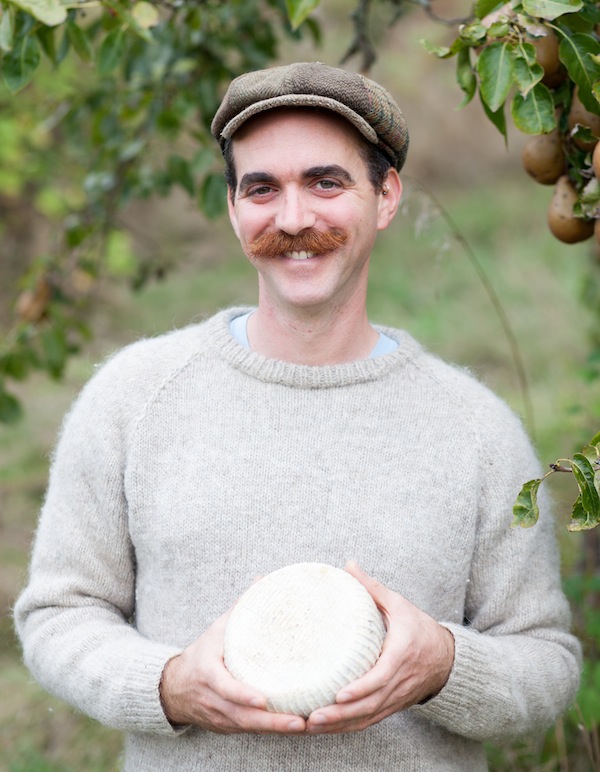
Once a full-time organic farmer, David Asher offers workshops through his Black Sheep School of Cheesemaking. He has also recently published his own book, The Art of Natural Cheesemaking. (photo by Kelly Brown)

Have you ever wanted your own cheese cave? If not, David Asher might convince you to crave one.

Based on British Columbia’s Gulf Islands, the former full-time organic farmer is the author of the recently published The Art of Natural Cheesemaking: Using Traditional, Non-Industrial Methods and Raw Ingredients to Make the World’s Best Cheeses (Chelsea Green). His book covers all the details one needs to know to make a variety of cheeses at home – and, yes, creating a “cave” to age it. Step-by-step recipes include paneer, cheddar, feta, blue cheeses, gouda, and about a dozen others.

“It’s as easy to make cheese at home as it is to make good bread at home,” he said.

For the past seven years, Asher has been offering workshops through his Black Sheep School of Cheesemaking to teach others the “lost” art of creating their own natural cheeses without unnecessary additives. But he wasn’t always a cheese fan – in fact, for most of his life, just the opposite.

“We weren’t a cheese-eating family. We only ate that stack of kosher cheese slices stuck together without plastic wrapping in a slab. I suffered through really terrible cheese as a child,” he said.

Like his favorite food, though, his taste has ripened with age.

As a young boy, he was introduced to “Italian immigrants’ guerrilla gardens” by Montreal’s railroad tracks, where he would relish plucking carrots and harvesting kale. Eventually, he created his own garden and, by his 20s, he was volunteering at community farms.

It was during an organic farming apprenticeship, traveling around visiting other farms, that he met a home cheesemaker, who was “making some inspiring rounds of moldy goat’s cheese” in her home with milk from her very own goats.

“She made this alchemy happen,” he said. “To make this beautiful cheese … without any specialized tools or equipment, I thought, ‘I can do this.’”

On a mission, Asher consulted the go-to cheesemaking guidebooks to find out how to start creating, but he was not inspired by the recipes or by the techniques suggested. Part of the problem, he said, was that the recipes called for freeze-dried packaged cultures.

book cover - The Art of Natural Cheesemaking

“I didn’t want to have to purchase these culture starter packages to make my cheese, because I knew that traditional cheesemakers didn’t use these,” he said. “I knew there had to be a better way, but there weren’t really any resources.… There were no references as to how traditional cheesemakers grew their white rinds, their camembert, almost as if that information had been lost.” Truly, he was “feta” up with the lack of “gouda” details.

Through trial and error, he explored and learned natural methods used long ago, for want of a mentor. And then, much like a wheel of provolone, things came full circle.

“After years of experimenting, I felt confident with my techniques. I then decided that I’d write a book,” he said, adding that it also serves as a resource for his students.

Asked if he thought any decent commercially made cheese can be found in mainstream supermarkets, he responded with a deep sigh. “You don’t want me to answer that,” he said. “Call me when you’re ready to make your own.”

For those wanting to make their own, there are three cheesemaking seminars this month: with the Clever Crow Sea Salt Co. in Black Creek May 7-8, with Linnaea Farm on Cortes Island May 14-15 and in Chilliwack at the Valley Permaculture Guild on May 28-29. For more information, visit theblacksheepschool.com.

Dave Gordon is a Toronto-based freelance writer whose work has appeared in more than a hundred publications around the world. He is the managing editor of landmarkreport.com.

A complex cultural mosaic

Think you know everything about Israel? Looking for an extraordinarily special book to give to someone who has been to Israel or is interested in the unusual aspects of the country that rarely, if ever, get press coverage? The answer to both of those questions is Unexpected Israel: Stories You Never Read in the Media (Gefen Publishing House, 2016) by Ruth Corman.

Corman is a British photojournalist and art consultant who splits her time between London and Jerusalem. Her first publication was with photographer David Rubinger, and his book Israel Through My Lens: Sixty Years as a Photojournalist, which she co-authored and edited.

book cover - Unexpected IsraelWith her latest book, with 84 vignettes, she writes, “I decided to try a side of Israel that rarely receives attention – the creative, amusing, quirky and moving aspects of the country.” She used the services of Alon Galili, a guide, and John Harlow, a consultant. Many of her tales have appeared in the Jerusalem Post. Her husband, Charles Corman, was the book’s editor.

Writes Corman on the publisher’s website, “Four years ago, I embarked on an expedition through the complex cultural mosaic that is Israel to introduce readers to aspects of the country that never appear in the media…. I was introduced to places that few know about, fossilized trees in the Negev dating back 120 million years and a leopard shrine from a mere 10,000 years ago. I marveled at magnificent pure white chalk hills near the Egyptian border and discovered sculptural rock forms near Timna, the remains of copper mining. I was delighted by a derelict Mandate-era spa by the Dead Sea where hand-painted murals depicting regional topography adorn the walls, and fascinated by the history of perfume production at Ein Gedi and the efforts to recreate the scent that so captivated our ancestors.”

Corman also “encountered some unforgettable individuals.” Her entries begin with Tsegue-Mariam, a 93-year-old Ethiopian nun who has written original music and plays the piano. It ends with “A Happy Ending: Rescue in the Skies,” the story of a young child who was on an El Al flight with her. The child was heading to London to undergo a liver transplant, and Corman helped raise from the passengers the money the girl needed. Corman did not keep in touch with the child, who must be over 30 by now.

In between are stories about typical and atypical Israeli aspects – the camel, falafel, floor cleaning (sponga), garinim (sunflower seeds), folk dancing, Machaneh Yehudah (where this author leads weekly walks in English), sabras (the fruit), standing in line, sheshbesh (backgammon), the Temple Mount sifting project (which originated with a friend of this author, Prof. Gaby Barkay), volunteerism and more.

For those who know – or want to know – Israel, it is a delightful read that you won’t be able to put down. There is humor, there is wit, great research and special photographs.

If you happen to be in Jerusalem on May 15, the official book launch of Unexpected Israel will take place at Menachem Begin Heritage Centre. Guests will include Daniel Taub, former ambassador to the Court of St. James, and Steve Linde, editor-in-chief of the Jerusalem Post. Corman will present stories and images from the book. RSVP to ruth@cormanarts.com or via gefenpublishing.com (or 02 538 0247).

Sybil Kaplan is a journalist, foreign correspondent, lecturer, food writer and book reviewer who lives in Jerusalem. She also does the restaurant features for janglo.net and leads weekly walks in English in Jerusalem’s market.

The story of Miriam Peretz

Those of us who live and work in Israel as journalists and book reviewers for international publications often have to wait until an Israeli bestseller is translated from Hebrew into English. I, for one, am very excited when this occurs, and especially for a biography like Miriam’s Song: The Story of Miriam Peretz (Gefen Publishing House, 2016) by Smadar Shir.

book cover - Miriam’s SongShirat Miriam was published in Israel in 2011 and became a bestseller, with more than 20,000 copies sold. It is Peretz’s story, as recounted to Shir, who is a prolific author and composer, as well as a senior journalist at the newspaper Yedioth Ahronoth.

Peretz was born in Casablanca, where her family lived until she was 10 years old. In 1963, they immigrated to Israel, initially living in an immigrant camp in Beersheva. After graduating high school, Peretz went to Ben-Gurion University and became a teacher.

When she was 21, she met Eliezer Peretz, who was 31, also Moroccan. They married, and he returned to his work in Sharm el-Sheikh. She eventually joined him there, until the city was evacuated. Meanwhile, she began teaching, and they started their family, ultimately having six children.

In November 1998, Uriel, their 22-year-old son, a Golani (special forces) officer was killed in Lebanon, while in the army. Peretz kept going.

“My husband was overcome with sadness and wouldn’t go to work, but I had no choice but to continue functioning,” she says.

Peretz got a master’s degree in educational administration. Her second son joined the army, while she and her husband continued processing their grief for Uriel. She began visiting schools and military bases to talk about her son.

In 2005, her husband died – only 56 years old. And then, in March 2010, her son, Eliraz, married with four children, was killed while in the army.

In December 2010, then-Israel Defence Forces Chief of General Staff Lt.-Col. Gabi Ashkenazi awarded her a medal of appreciation. He said: “Miriam’s ability to continue to express her deep pain and channel it into a contribution to the education and formation of future generations, serves as an example and model of inspiration for us all.”

The next chapters of Miriam’s Song are told by each of Peretz’s four surviving children.

Miriam left her principal position after 27 years to become a Jerusalem district supervisor with the education ministry. After Miriam’s Song was published in Hebrew, Peretz began to travel to the United States for the organization Friends of the Israel Defence Forces. In 2014, she was a torchbearer on Israel Independence Day.

For a feature on International Women’s Day this year in the Jerusalem Post, Peretz was interviewed and photographed along with two other mothers who had each lost a son. Journalist Tal Ariel Amir writes, “these three courageous women have risen from the ashes of their despair.”

People ask what it is like to live in Israel. Although Miriam’s Song is replete with courage, faith and commitment, it is also about tragedy and sacrifice. It is a book to read to understand what it means to be a woman, a wife, a mother in Israel today.

Sybil Kaplan is a journalist, foreign correspondent, lecturer, food writer and book reviewer who lives in Jerusalem. She also does the restaurant features for janglo.net and leads weekly walks in English in Jerusalem’s market.

There are lessons to learn

“My principal lesson of the Holocaust is … beware of lessons.” With this warning, renowned Canadian Holocaust scholar Michael R. Marrus, professor emeritus at the University of Toronto, has written an essential but also essentially frustrating book, claiming that there is nothing to be “learned” from the study of the Holocaust – Lessons of the Holocaust (University of Toronto Press, 2016).

All the mantras usually marshaled to justify Holocaust studies, such as “never again,” or “who does not learn from history is doomed to repeat it” or “evil will triumph when good people do nothing” are bogus, says Marrus. For “history does not speak to the present with … an admonitory voice”: historians are not moralists or mentors, and certainly not preceptors – their mandate is to “handle history with care” and to insist on “getting it right.”

But, if Holocaust studies have nothing to teach us, should we not ask to what end should Holocaust historians and educators “get it right”: and how does a Holocaust scholar’s commitment to “getting it right” differ from that of a botanist’s or a quantum physicist’s or, for that matter, an athlete’s or a bricklayer’s? It is the failure to answer this question that makes Marrus’ book so frustrating.

Marrus’ credentials in Holocaust studies are impeccable. His books on the Holocaust have received prestigious awards; he has served on some extremely important international committees designed to air out crucial Holocaust issues, and has met, and often argued publicly, with some of the world’s most prestigious Holocaust historians, including Raul Hilberg and Elie Wiesel, as well as Hannah Arendt, Emil Fackenheim and Daniel Jonah Goldhagen, all of whom he takes issue with in this book for suggesting that the Holocaust can offer lessons.

Marrus’ problem with regarding Holocaust history as a learning project is rooted in his historiography: what can one learn from history when history itself is so subjective? “If one looks hard enough at evidence,” says Marrus, “one can come up with the answer – or the lesson – that one wants.” And, again: history is “continually evolving,” its terrain endlessly “shifting,” exposing “new questions.” In other words, history is inevitably “a matter of interpretation.” (Marrus’ emphasis.) Thus, the lessons that one presumes to deduce from history will inevitably be the lessons that one preemptively wanted to find. As Marrus puts it, “lesson seeking often misshapes what we know about the event itself in order to fit particular causes or objectives.”

book cover - Lessons of the Holocaust

Fair enough, when it comes to comparing the Holocaust to “the rape of the environment [or] the harshness of bureaucracy,” but what about the larger, and more relevant, issues of social justice, of our moral duty to future generations, of our sacred duty to remember? Hitler saw carte blanche for his genocidal intentions by asking, “Who remembers the Armenians?” Surely it is crucial that no future Hitler be able to ask, “Who remembers the Jews?”

Marrus is on more solid, if more obvious, ground when he condemns the appropriating of Holocaust history by right-wing politicos in Israel, such as Menachem Begin and Binyamin Netanyahu, who he sees as using Holocaust references to manipulate opinion toward acceptance of their conservative policies. This political exploitation of Holocaust history has “crippled Israel’s capacities to respond imaginatively to questions of national identity and to seize new opportunities in a flawed global community.” Here, Marrus is probably right.

Marrus also condemns, again quite rightly, the enlisting of Holocaust precedents by special interest groups, such as advocates of gun control or those opposing bullying in schools, opponents of gay rights and animal abuse and so on – all anxious to further their causes by referencing the Holocaust and, in so doing, trivializing it.

Most pointedly, and again with some justification, Marrus attacks the thinking of those who would “universalize” the Holocaust, making Holocaust studies “a school for tolerance,” a warning against hate speech, against political apathy or against overly celebrating the actions of the pitifully few Nazi-fighting heroes, such as the leader of the Munich White Rose students,

Sophie Scholl, who was recently voted in Germany fourth among “the most important Germans of all time” – ahead of Bach, Goethe and Einstein. Again, this is an important point, and one that quite rightly occupies a lot of serious thinking in Holocaust studies.

Marrus’ final chapter, a brief 11 pages, is entitled “Lessons of the Holocaust,” and readers may be forgiven for thinking that Marrus is, finally, at the end of his book, going to take a stand.

Not at all. He says here, “we learn a great deal from the history of the Holocaust.” What, exactly? He doesn’t say. And, again, Holocaust studies are “intellectually enriching and facilitate our understanding of the world around us.” How so, and to what end? No answer. “We are wiser” for knowing Holocaust history. How so and, since there are no lessons in it, so what? In this final chapter, Marrus repeats over and over that Holocaust history “deepens appreciation of human reality” and “makes us more mature.” How so, since there’s nothing to be learned from it, on his own terms?

Holocaust educators will, I suspect, find Marrus’ position difficult to accept: they know exactly why they are teaching Holocaust studies – to impress upon (especially) young people the fragility of our human institutions and thereby to arm them against demagoguery. In other words, “never again.”

Demagoguery has been raising its head again in recent months in the United States. It would indeed be encouraging to all teachers of Holocaust studies if they could believe they’ve helped to effectively warn against it, a clear and inarguably important lesson to be learned from the dreadful past century.

Graham Forst, PhD, taught literature and philosophy at Capilano University until his retirement and now teaches in the continuing education department at Simon Fraser University. From 1975 to 2010, he co-chaired the symposium committee of the Vancouver Holocaust Education Centre.

Vilna, the place, its people

It is a master storyteller who can make you feel like you’ve met someone you never knew, visited a city to which you’ve never been, make you long for a people, place and culture you’ve never experienced but from a generation, location and language once, twice or thrice removed. Abraham Karpinowitz (1913-2004) is such a writer. And, thanks to local master storyteller and translator Helen Mintz, more of us can now visit Karpinowitz’s Vilna – a city full of colorful characters, both real and not, and share in a small part of their lives.

Vilna My Vilna (Syracuse University Press, 2016) is a collection of 13 short stories and two brief memoirs by Karpinowitz, translated from Yiddish into English by Mintz. For context and a better understanding of Karpinowitz and his work – notably one of the main “characters” in his writing, Vilna – there is a foreword by Justin Cammy, an associate professor of Jewish studies and comparative literature at Smith College in Massachusetts, and an introduction by Mintz. These two scholarly essays are invaluable, but if you’re completely unfamiliar with Karpinowitz, perhaps jump ahead and read a few of the stories before heading back to these parts of the book. It’s kind of a Catch-22, in that their insight enhances the enjoyment of the stories, but the stories enhance the understanding of the analysis and history.

book cover - Vilna My VilnaRomantics will appreciate most the linked stories of “The Folklorist” and “Chana-Merka the Fishwife.” In the first tale, Rubinshteyn heads to the Vilna fish market to collect material for YIVO (the Yiddish Scientific Institute) because he knows that, if the “genuine language of the people” is not documented, “it would be a great loss for the culture.” Dedicated to his work, and a dedicated bachelor, he fails to notice that Chana-Merka has fallen in love with him and, once his research is complete, he stops visiting the fish market, much to her – and his – sadness. In the second tale, Chana-Merka heads to YIVO herself to make sure that Max Weinreich, its director, knows from whom all of Rubinshteyn’s material came: she makes lists of curses for Weinreich, such as “May you speak so beautifully that only cats understand you,” and “May you be lucky and go crazy in a more important city than Vilna.”

Weinreich is one of the real people who appear in this collection where fiction and non-fiction meld. Yoysef Giligitsh, a teacher at the Re’al Gymnasium, is another. Most readers will not be able to identify all of these people and, while there will be added realism for those who can, the characters stand on their own. Besides, these people are secondary to the protagonists, who are the fishwives, the prostitutes, the criminals, the poor.

Despite that everyone is trying to eke out an existence, even the criminals follow a moral code. For example, Karpinowitz notes, in “Vilna, Vilna, Our Native City” that the Golden Flag criminal organization’s constitution includes the admonition, “Our members should behave properly and not forget that even though we are who we are, we are still Jews,” and that “[t]here was a directive for the general treasury to provide dowries for poor brides.”

Karpinowitz pokes fun at communism, capitalism, politics in general. His descriptions put readers right into the scene, almost as if they’re standing on the opposite street corner watching events unfold. And he has some wonderful turns of phrase. In “Shibele’s Lottery Ticket,” for example, Sheyndel’s husband goes off to fill the water bucket and never returns: “Sheyndel missed her husband, the shiksa chaser, less than the bucket.”

Or, in one of the two memoirs, “The Tree Beside the Theatre,” Karpinowitz writes about his father’s choice to sell his print shop to run a theatre, “If he’d stayed in the print shop, he’d be a rich man. My mother reminded him of this every time she couldn’t cover expenses. But everything in the print shop, including the machines and the letters, was black, and everything in the theatre was colorful, even the poverty.”

Karpinowitz’s characters have self-dignity and hope. They are not passive, for the most part, but are actively trying to change their situation for the better or to help someone else. Not surprisingly, many of the stories have bleak endings, with the narratives going from charming and/or humorous to horrific, illustrating just how abruptly and brutally this world came to an end.

These stories that turn on a dime are so moving. They emphasize just how little people at the time understood that most of them would soon be murdered. As Karpinowitz writes in “Vilna, Vilna, Our Native City”: “For years, a Jew with blue spectacles stood on Daytshe Street begging, ‘Take me across to the other side.’ His plea was so heartrending that, rather than asking to be taken across the few cobblestones separating Gitke Toybe’s Lane from Yiddishe Street, he sounded like he needed to cross a deep and dangerous abyss. Maybe he was the first Jew in Vilna with a premonition about the Holocaust. Just the name of the street, Daytshe Gas, German Street, drove him from one side to the other. We could all see the little water pump and Yoshe’s kvass stall on the other side of the street, but through his dark spectacles, that Jew saw farther. Fate didn’t take him to the safer side. He ended up in the abyss at Ponar with everyone else.”

Karpinowitz survived the Holocaust in the Soviet Union, having left Vilna in 1937. He briefly returned in 1944 and then, after two years in a displaced persons camp in Cyprus, moved to Israel. Mintz notes that he wrote seven works of fiction, two biographies, a play and five short story collections. He was awarded the Manger Prize (1981), among several other honors.

In the stories of Vilna My Vilna, the geography of the city is integral, and the maps included are useful in situating the action. The glossary is also an essential part of the book: kvass, for example, is a “fermented beverage made from black or regular rye bread.”

Adding even more value to this collection are three illustrations by Yosl Bergner that were in the original 1967 Yiddish publication of Karpinowitz’s Baym Vilner durkhhoyf and the painting “Soutine Street” by Samuel Bak is the cover of Vilna My Vilna. Both artists (and the Pucker Gallery, in the case of Bak’s painting) gave permission for their work to be used at no charge, which is an indication of the translation’s import beyond entertainment.

Mintz’s acknowledgements are many, and that she accepted so much input into the book speaks volumes about her integrity and the quality of her work. “Translating these stories brought me great joy,” she writes. “While never swerving from the truth, Abraham Karpinowitz answered genocide with love: love for his characters and love for his craft as a writer.” With Vilna My Vilna, Mintz adds her love, and that of many others, to ensure that Vilna, its people and its stories will not be forgotten.

Love, family, tradition

The 23 authors in editor Liz Pearl’s latest collection of essays – Living Legacies: A Collection of Narratives by Contemporary Canadian Jewish Women, Vol. 5 (PK Press, 2015) – come from a range of backgrounds. They work in fields as varied as medicine, education, the arts, philanthropy, event planning and graphic design. They have served in the army, immigrated from Africa and led all manner of enterprises in business, education and community service. Their essays are brimful of passion, wisdom and intellect.

Among the writers are Victoria’s Vicki Davidoff and Vancouver’s Ada Glustein.

In her essay, Davidoff describes her journey from good friend and wife to skilled caregiver and, finally, “death doula” for terminal cancer patients. Losing her own husband, Ken, to cancer in 2008, Davidoff learned what it means to create a “conscious death.” Together, she and her husband crafted a space for reflection, writing letters to family members as well as his obituary. She describes this space as “sacred,” and she has established a respectful, spiritual program for patients and their families, one that gives structure and meaning to an otherwise terrifying ordeal.

Glustein, the daughter of Russian immigrants, was raised in a kosher home where Yiddish was spoken and the festivals of Canadian society ignored. Defining herself through her religion and culture, she was presented with a challenge growing up. Every young adult longs to blend in with her peers, but this felt impossible. She once made an Easter card at school. Knowing that it could not go home with her, the teacher tore it up, “her best artwork ever tossed in the wastebasket.” It was like an act of violence; combined with the hurtful comments from well-meaning but ignorant peers, Glustein felt like an impostor.

book cover- Living LegaciesTimes have changed, she notes. Nowadays, we understand that a person’s culture is less like a cold, unchanging monolith than a soft, woven, multi-textured fabric. Coming to understand and respect her parents’ reasons for raising her as they did, Glustein’s values as a teacher and a mother are grounded in the principle of inclusion.

The desire to connect with family is a thread that runs throughout Living Legacies, but the narratives also capture the essence of an organic form of Judaism, in which we all play a role in nurturing bonds both within and beyond our nuclear families. Rituals and traditions are opportunities to slow down long enough to celebrate each other, such as Ruth Ladovsky’s mother exclaiming over the Shabbat dinner table, “Did I ever tell you how lucky I am?”

When Marlene Levenson’s mother was afflicted with early onset Alzheimer’s, which created a sense of “chaos and confusion” in her childhood home, Levenson transformed her anger and grief with chesed, deciding to serve the Alzheimer’s community as a volunteer. Writes Levenson, “I have fallen in love with each and every client…. Being able to give back love and caring to these people is a dream.”

The collection also celebrates the making and eating of food shared with friends and family – blintzes, egg noodles, latkes, the knishes and shtrudel made by Dorothy Rusoff’s mother. Rusoff’s prose is positively delicious, jam-packed with references to cookies, soups, meringues and pastries. The vivid description of her mother and aunt cooking together is served with humor and affection, as well as reverence.

Living Legacies reveals the constant search for growth and inspiration, as modeled by Jewish women who, like Lori Palatnik, observe that “tikkun olam is in our DNA.” These vibrant, dynamic and driven individuals have clear goals for their and their families’ spiritual development. There emanates from this collection the sense of an assembly of leaders.

The stories are entertaining, like the story of the apple pie contest reported by Linda Rosenbaum, as well as challenging and uplifting, like L. Deborah Sword’s account of her unplanned pregnancy. It’s a book best served in small dishes, with lots of room between courses to allow for contemplation.

As is evident from the biographies of these well-traveled writers, many of us are separated from our extended families. Many of us keep a close watch on the clock at certain times of the day, only reaching for the phone when our loved ones in other countries have woken up. Living Legacies is a lovely way to bring the voices of mothers, grandmothers, aunts and sisters into our minds as we sip our coffee and wait for the golden moment when we can call home and hear our own mothers’ voices.

Brenda Morgenstern’s reflection on her mother’s legacy sums up the collection perfectly: “My mother left me with pride. My mother left me with love for Friday nights, Shabbos. Long tables at Rosh Hashanah and Passover. Tables filled with her legacy, her many children and grandchildren, sharing what was most important to her. Each other.”

Like the communal ring described by Rhonda Spivak, the collection is a symbol of the “core values of which Judaism is based – strength of community, love, family and tradition.”

Living Legacies is available from PK Press.

Shula Klinger is an author, illustrator and journalist living in North Vancouver.

Making healthy eating cool

Adam Segal at Indigo Richmond Hill in Ontario last fall. (photo from adammichaelsegal.com)

Every parent knows how difficult it can be to cajole their children to eat their vegetables. Author Adam Michael Segal has come up with a tool he hopes will make it easier for parents – inspiring children to eat healthy, and combating the obesity epidemic.

The Toronto-based health communications expert and former elementary school teacher has penned Fartzee Shmartzee’s Fabulous Food Fest, a fun and whimsical book for children ages 4 to 7. The main character, Fartzee, is a quirky child with multicolored spiky hair on a quest to persuade his family to eat nutritious food. Through a series of hatched plans, a food festival and a sticker game, he succeeds in showing everyone in town that eating right can be fun.

The book is made more visually appealing with drawings by 20th Century Fox illustrator and animator Daniel Abramovici.

“This is an entertaining and imaginative story that educates children about healthy eating practices and behaviors,” said Dr. Samantha Witt, a pediatrician based in Maple, Ont.

Part of the inspiration for writing it, Segal told the Independent, included the lack of books specifically directed towards young children to teach them, in a fun way, about eating well.

According to the U.S. Centres for Disease Control and Prevention, obesity rates in Canada have nearly tripled in the past 40 years, with close to a third of children considered either overweight or obese. Diabetes, heart disease, stroke and some cancers are among the many issues that can arise from obesity.

“For generations, kids have been led to think of junk food as cool and fun, which has contributed significantly to the prevalence of childhood obesity,” said Segal. “With Fartzee, I am trying to completely shift the paradigm to obesity prevention, empowering kids to discover that nutritious food is cool, fun and delicious.”

Segal said he flipped through scores of children’s books to get a feel for what his target age group would find compelling. This is one reason why, in his book, “food is all over the place; it’s kind of messy but fun.”

For some parents, the main character’s name might sound too coarse for a child, but Segal said, so far, parents and educators haven’t had any problems.

“I was a little concerned and nervous,” he admitted, when initially sending out the book to a Grade 2 teacher, a librarian and a parent. “Not a single one had an issue with it. They said that there are already books, at least 10 others, with a character that did farts. It’s not anything unusual or out of the norm. Even someone from the ministry of education reviewed the manuscript and didn’t flinch at it, and they were a teacher for 30 years.”

The book has been read to more than 5,000 students at 15 schools across the Toronto area thus far, according to Segal. He’s finding that kids aren’t as resistant to eating right as we might have thought.

“I ask them why we eat healthy food, and they really get it. Even a 6-year-old will say it gives energy, helps you grow, it’s good for your body and brain,” he said. “At a young age, they actually understand a lot more about the benefits of nutrition than I would have thought when I wrote it.”

Fartzee Shmartzee’s Fabulous Food Fest is available through adammichaelsegal.com or amazon.com.

Dave Gordon is a Toronto-based freelance writer and the managing editor of landmarkreport.com.

Revenge story with humor

Before you get to the fifth page of text, it will become apparent that you haven’t yet encountered a period. Don’t be put off by that. Curt Leviant’s King of Yiddish (Livingston Press, 2015) is a page-turner. It is a comedic tour de force, interspersed with a detective story that will have you following Shmulik Gafni through Poland in an obsessive pursuit. He is hunting the man he witnessed murdering his father and uncle in Kielce, Poland, a pogrom that occurred 14 months after the end of the Second World War.

Shmulik is described as an “overlyfull professor” of Yiddish at the fictional University of Israel in Jerusalem. The pogrom in Kielce is a well-known tragedy that did occur, but Leviant’s fertile imagination weaves an original tapestry from that terrible time and place.

So, where’s the comedy? The humor centres around a basic human failing: men will be men, and Shmulik falls under the spell of Malina, a Polish Catholic linguist determined to become proficient in Yiddish. She also happens to be half Shmulik’s age and is unbelievably beautiful and well built. Malina is his second obsession.

book cover - King of YiddishThe two stories, solving his father’s murder and getting to the bottom (and the top) of Malina, are interspersed narratives that keep you guessing and entertained. Along the way, the reader encounters a Chassidic un-kosher kidnapping that goes awry (imagine the Marx brothers in black hats) and a bris (kosher or not depending on whether you are Orthodox or Reform) that are grist for Leviant’s mill of linguistic tomfoolery. You meet other academics, letting you in on university rivalries and gossip. Believe it or not, but a cookie with an incredible miniature topping in a Vienna café is an important character in the plot development that might have been written by Kafka, Borges or Nabokov, but it is pure Leviant, plying his considerable art as a fabulist.

Leviant also steps outside the narrative and talks to the reader. At one point, the author says you can skip a chapter. Take my advice: keep reading. As you join Gafni in his quest for justice, you will also find allusions to previous works by Leviant. These, he jokingly attributes to famous Hebrew and Yiddish writers, telling us that other colleagues translated those books. One of these is the Icelandic writer, C. Urtl Eviant, a self-referential invention who also plays a role in King of Yiddish.

Considering all the word play in English, Yiddish and Hebrew, my favorite occurs when a colleague of Shmulik’s is calling 911. He tells the operator he is a linguist with the City University of New York. Propriety in a family publication requires you figure it out for yourself. Revealing any of the other plot twists would spoil the fun.

If you have read Leviant’s other critically acclaimed fiction, you will catch many of the references here. If you haven’t, you may want to back up and read some of his earlier novels. The Yemenite Girl, The Man Who Thought He Was Messiah and Diary of an Adulterous Woman are good places to start. He has produced a body of work that has been widely translated throughout Europe.

John Irving has written that he always composes the last few sentences of his novels before he begins page one. Leviant must have done this with his novel. For those of you who like to look at the end of a book before you begin … please resist. King of Yiddish is a gripping narrative that will fascinate you from the opening paragraph to its surprising last.

Sidney Kessler is a freelance writer in Glen Allen, Va. His most recent articles have appeared in the Wall Street Journal and the Richmond Times-Dispatch.