Skip to content
  • Home
  • Subscribe / donate
  • Events calendar
  • News
    • Local
    • National
    • Israel
    • World
    • עניין בחדשות
      A roundup of news in Canada and further afield, in Hebrew.
  • Opinion
    • From the JI
    • Op-Ed
  • Arts & Culture
    • Performing Arts
    • Music
    • Books
    • Visual Arts
    • TV & Film
  • Life
    • Celebrating the Holidays
    • Travel
    • The Daily Snooze
      Cartoons by Jacob Samuel
    • Mystery Photo
      Help the JI and JMABC fill in the gaps in our archives.
  • Community Links
    • Organizations, Etc.
    • Other News Sources & Blogs
    • Business Directory
  • FAQ
  • JI Chai Celebration
  • JI@88! video

Recent Posts

  • Story of Israel’s north
  • Sheltering in train stations
  • Teach critical thinking
  • Learning to bridge divides
  • Supporting Iranian community
  • Art dismantles systems
  • Beth Tikvah celebrates 50th
  • What is Jewish music?
  • Celebrate joy of music
  • Women share experiences 
  • Raising funds for Survivors
  • Call for digital literacy
  • The hidden hand of hate
  • Tarot as spiritual ritual
  • Students create fancy meal
  • Encouraging young voices
  • Rose’s Angels delivers
  • Living life to its fullest
  • Drawing on his roots
  • Panama City welcoming
  • Pesach cleaning
  • On the wings of griffon vultures
  • Vast recipe & story collection
  • A word, please …
  • מארק קרני לא ממתין לטראמפ
  • On war and antisemitism
  • Jews shine in Canucks colours
  • Moment of opportunity
  • Shooting response
  • BC budget fails seniors
  • Ritual is what makes life holy
  • Dogs help war veterans live again
  • Remain vital and outspoken
  • An urgent play to see
  • Pop-up exhibit popular
  • An invite to join JWest

Archives

Follow @JewishIndie
image - The CJN - Visit Us Banner - 300x600 - 101625

Byline: Cynthia Ramsay

Preparing for her next role

Preparing for her next role

In Late Company, Kerry Sandomirsky and Michael Kopsa are a couple who has lost a son to bullying. (photo by David Cooper)

“One year after a tragedy, two couples sit down to dinner. Far from finding the closure they seek, the dinner strips bare their good intentions to reveal layers of parental, sexual and political hypocrisy.”

So begins the promotional material for the award-winning play Late Company, being presented by Touchstone Theatre later this month. It continues, “Loosely based on the true story of the son of a Tory politician who killed himself after being extensively bullied, Late Company imagines what a restorative justice dinner held a year later might have looked like between the parents of a dead gay son, his chief tormentor and that boy’s parents.”

Kerry Sandomirsky takes on the role of the grieving mother. She spoke with the Jewish Independent about the part – and other topics – via email.

JI: The subject matter – and small cast – of Late Company combine to make what seems like a very heavy, intense role. How do you prepare for such roles in general and this one in particular, especially as a mother yourself?

KS: I put my attention on the things that are important to the character, and the world starts to inform you via synchronicity. I was riding on a bus to Kerrisdale and I saw an ad above me for the Josh Platzer Society. It’s for teen suicide prevention and awareness. I contacted them and I’m now communicating with a mother who lost her son. I am also using their recommended reading list for research.

At the same time, my character is a sculptor so I’m reading a biography of Barbara Hepworth.

Earlier this year, I did a similar maternal role in Clybourne Park for the Citadel Theatre in Edmonton. When it comes to intense parts, your nervous system doesn’t know that the grief on stage isn’t real, so there’s a cost. Your adrenal system gets depleted. Being a mom, you have to guard against the play contaminating your life.

I got through Clybourne Park by exercising every day and not drinking any wine. Maybe for this one I’ll have to do the opposite.

JI: The last time the JI spoke with you was in 2011, before The Philanderer. At that time, you were returning to the stage after a two-plus-year hiatus to recover from a head injury. In what ways did that period of being away from theatre change your work/life?

KS: I became a teacher at Studio 58, I accepted an offer to direct, and I decided to take more holidays! I also gave myself permission to be a writer. I turned down playing Cleopatra for Bard on the Beach and instead attended SFU Writers Studio to work with Ivan E. Coyote. After that, I was chosen to go to the Banff Playwrights Colony to work on my one-woman play called Wobble.

JI: Your directorial debut (… didn’t see that coming) was a Pick of the Fringe this year. What were some of the highlights and challenges of directing? Can you see yourself doing more directing?

KS: It was a delight to direct one of my favorite people on the planet, Beverley Elliott, and we had Bill Costin doing our music. So, it was a privilege being in the same room with that much talent for almost a month. I’d definitely do it again. I loved not having to learn all those lines.

JI: When I met you at a recent Museum of Vancouver event, you mentioned having just filmed with Denys Arcand. Is there anything about that you can share?

KS: When you work with someone that gifted, there’s no fear on the set. There’s no ego. There’s just creative collaboration. Denys Arcand and the director Adad Hannah both welcomed input from their actors. Denys is quick to laugh. He was a joy to be around.

JI: What are some of the projects on which you’re currently working?

KS: I want to finish writing Wobble. And, of course, doing another new Canadian play is always fulfilling. I dream of collaborating with Crystal Pite. I’m not a dancer, but I did a workshop with her anyway. I was a troll among the whippets. And I’m hoping to work with Jovanni Sy, the new artistic director of Gateway Theatre. I met him at the Playwrights Colony. He’s a great addition to our Vancouver theatre community.

JI: In what part of the process from idea to stage is Wobble?

KS: Katrina Dunn, the director of Late Company, came to Banff and helped me workshop it. We’ve got a solid first draft. I value her intelligence, her feminism and her compassion. As the artistic director of Touchstone Theatre, she champions new Canadian work. The playwright for Late Company, Jordan Tannahill, just got nominated for a Governor General’s Award, but Katrina chose do a play by him long before that. Her instincts are superb. This will be our fifth production together. It’s a treat to be directed by her.

***

Late Company is at the Cultch, Vancity Culture Lab, 1895 Venables St., from Nov. 21-30, 8 p.m. (Tuesdays to Sundays), plus Nov. 22, 29 and 30, 2 p.m. There is a two-for-one preview Nov. 20, 8 p.m. Tickets ($27/$22) are available from the Cultch, 604-251-1363 or tickets.thecultch.com.




Format ImagePosted on November 7, 2014November 5, 2014Author Cynthia RamsayCategories Performing ArtsTags Cultch, Kerry Sandomirsky, Late Company
Bigger, better Broken Sex Doll

Bigger, better Broken Sex Doll

Co-creator Andy Thompson directs the sci-fi musical that is being remounted at the Cultch’s York Theatre Nov. 12-22. (photo from the Virutal Stage)

Broken Sex Doll is back. A hit at the Cultch in 2013, it ventured out to Halifax for the 2014 Magnetic North Festival, and returns to Vancouver Nov. 12-22, where it will play at the Cultch’s York Theatre as part of a national tour. The production will then head to the Yukon for four shows, returning to the Lower Mainland for a run at Coquitlam’s Evergreen Cultural Centre (Dec. 16-20).

Produced by the Virtual Stage, the sci-fi musical is the creation of Jewish community members Andy Thompson (director, book, lyrics) and Anton Lipovetsky (composer). The new production is being billed as “bigger and better.”

“We have a new set. A new lighting design. New costumes. Re-tooled songs. Some new performers. And the script has been tinkered with a little bit,” the award-winning director and writer Thompson told the Independent. “Refining a show is not something you always get to do, so the process feels somewhat luxurious. Rolling up our sleeves together and chiseling out details on a show like this is a lot of fun. Just today we were refining choreography and songs to a level of detail rarely explored in the rehearsal process. Often in the past I have found myself relieved just to get a show on its feet, but where we are currently at with Broken Sex Doll is altogether different. And installing it at the gorgeous York Theatre has been such an honor and delight.”

About the challenges and benefits of remounting a production, Thompson said, “This has been a wonderful opportunity to take another look at the show and make refinements, with the experience and knowledge gleaned from previous incarnations of what worked and what could be improved upon. The challenges vary from the artistic to the technical. My aim with this production is to raise the bar as high as I possibly can and produce as close to a Broadway-calibre musical as possible. Making the show tourable has also been a significant challenge.”

Broken Sex Doll comes with a content warning, and the evening performances are for audiences 19 and older. But is it as risqué as the title makes it sound?

“I think that depends on your perspective,” said Thompson. “It could be ‘too much’ for some and ‘not enough’ for others. For example, I chose not to include any nudity in excess of a male bum or two. Female nudity was off the table. I knew anything more than what we’re doing could cause discomfort within some audience members, ‘taking them out’ of the experience of the story. It’s a fine line that I’m walking. In the world of the show, social morality as we know it has more or less collapsed. And, while that’s been freeing to me a playwright to explore, I know that there are certain lines that, when crossed, are counterproductive. Pushing the boundaries in the rehearsal process was a hoot, to say the least. There’s a lot of simulated sex in the show. And, if done ‘tastefully’ on stage, sex can be entertaining. And even hilarious.”

The 2013 incarnation of Broken Sex Doll garnered seven Jessie Richardson Theatre Award nominations, including outstanding production and outstanding direction for Thompson, who is also an award-winning actor, filmmaker and teacher.

Born and raised in Chillwack, the Studio 58 graduate is founder of the Virtual Stage. Another of his sci-fi (and Jessie-nominated) creations is The Zombie Syndrome, “in which audience members with smartphones are endowed as elite agents on a mission to save the world from a deadly zombie plague.” The Virtual Stage-produced annual event, which began in 2012, generated a 2013 sequel called The Zombie Syndrome: On Death Island.

Broken Sex Doll opens at York Theatre, 639 Commercial Dr., on Nov. 12, 8 p.m. It runs Nov. 13-16, 18-22, 8 p.m.; and Nov. 15, 16, 22, 2 p.m. All 8 p.m. performances are 19+ only. There are Q&A sessions after the Nov. 13, 16 (2 p.m.) and 18 shows. Tickets (starting at $19) are available from 604-251-1363 or tickets.thecultch.com.
Format ImagePosted on November 7, 2014November 5, 2014Author Cynthia RamsayCategories Performing ArtsTags Andy Thompson, Broken Sex Doll, Cultch, Virtual Stage
Teaching self-defence

Teaching self-defence

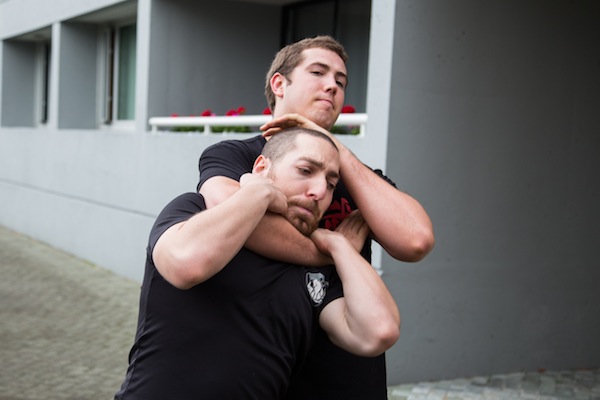
Jonathan Fader, left, and his business partner Borhan Jiang show a class at Urban Tactics Krav Maga how to disarm an attacker who has a knife. (photo by Albert Law)

When Jonathan Fader copied the Jewish Independent on an open letter that he posted online in mid-August, Operation Protective Edge was winding down. Noting the sometimes violent antisemitism that it had evoked in places around the world – including in some protests that took place in Canada – he stressed the need for members of the Jewish community to know self-defence. Since then, there have been two terrorist attacks on Canadian soil.

In the letter, he wrote, “I am asking you to please take it seriously and find your local krav maga gym and start learning to protect yourself. If there is none near by, at the very least find the most comparable style, just learn something!”

Intrigued, the Jewish Independent visited the Richmond location of Urban Tactics Krav Maga, Inc., in September. Fader and his business partner, Borhan Jiang, who has been featured in the Independent on more than one occasion, also have a Burnaby site.

Raised in a somewhat observant household, Fader, 27, said he nonetheless “didn’t really identify with being a Jew.” He describes himself as secular, and doesn’t “believe in religion but, of course, if the world is going to call me a Jew … I might as well accept it, and I’m a proud to represent the culture, but I’ll do it realistically…. I support Israel and what it does because, realistically, that’s just the way it is, but I have criticisms like anyone else.”

From 2009-2011, Fader lived in Israel. He went there for the purpose of joining the Israel Defence Forces, and he served in the 424th infantry battalion in the Givati regiment.

“When I came back, I literally did nothing,” he said. He had some savings and, “I was just living with my parents, living off of [my savings] for like five months. I did nothing.”

He spoke about some of the difficulties soldiers have in returning to civilian life. In his opinion, the “reason that they’re so slow to deal with PTSD and depression in Israel is because it’s less apparent, as everyone does the army and, when you go home, people understand, and you have people to talk to. So, the rates are much lower, but there … [are] still suicides and still depression…. But, when you come back here,” he said, referring to Canada, “you don’t have the support of your family or your friends because nobody understands what it’s like,” even if PTSD is more recognized.

He acknowledged that, as a result of the work of veterans here, “more PTSD and depression is being dealt with now and in the North American armies at least.” Once an “invisible group of people,” he said soldiers have become more vocal. If you look at the Canadian army, they now are starting to put psychiatrists actively in duty, he said.

For these and other reasons, Fader is studying psychology at Kwantlen Polytechnic University College. “I find that psychology really helps me understand everything, from marketing to trends to people, just everything,” he said, attributing the effectiveness of krav maga as a system of self-defence to the fact that “it’s working off of real psychology, action-reaction rate, fight or flight.”

He noted about Urban Tactics’ clients, “Interesting thing about that is, when we first started, we figured it was going be all young guys … but that wasn’t the case.… For the first year, it was predominantly males age 30 to 50 with families who wanted to protect the family.”

In general, Canadians don’t understand “what self-defence is and when aggression is appropriate, when violence is appropriate,” said Fader. Noting that women tend to be more vulnerable, he said, to defend yourself successfully, “you need to be able to hit hard and fast, and really be willing to damage the person who is attacking.”

photo - Krav maga instructor Jonathan Fader prepares to get out of a choke hold
Krav maga instructor Jonathan Fader prepares to get out of a choke hold. (photo by Victor Totten Photography)

People here have the idea that you should never hit back and that you can talk yourself out of every situation, he said. And, he agrees, to a point: the first step for self-defence is to avoid the conflict completely, to not put yourself in a position where you might end up being in danger. However, if you do end up in trouble, you need to be able to assess whether talk will be enough because, “if you think you’re in danger, you need to attack first … because [with] action versus reaction, reaction is always slower…. [In] proper self-defence, it is absolutely OK to strike first.”

He gave the example of a person walking through an alley at night and being attacked. First, he noted, the choice to walk down the alley was probably not a good one, “and you have to take some of the blame now because that’s a grand scheme self-defence: Why are you there? If you go there thinking nothing is going to happen, that’s ridiculous.” But, now that you’re in trouble, he said, if you have the chance to run, “it’s OK to run, it’s OK to avoid the situation.” If you can’t run, then you have to act first if possible, “because if you wait, you could be knocked out … [so] kick him in the groin, go for his eyes … push, run.”

A good instructor, said Fader, will drill it into your head to avoid a situation, then teach you some basic techniques. But still, all the technique in the world won’t help you if “you’re not willing to hit that guy in the groin, go for his eyes, go for his throat,” he said.

Krav maga isn’t a fitness class. “I’m not teaching cardio kickboxing,” said Fader, “but the thing is that you need to be in some physical capability in order to legitimately defend yourself against a violent attack…. You have to be able to move correctly. Some people who are … limited in what they can do but they mentally are willing to hit hard, hit fast, will be OK, reasonably, if they’re up against a trained attacker…. We don’t teach fitness but you will get in shape … but I don’t care if you lose five pounds – I want you to know that you can defend yourself.”

The fact that both he and Jiang have trained in Israel sets Urban Tactics apart from other places that offer krav maga, said Fader. “The fact that we understand both cultures – North American and Israeli – is what truly makes us different.” While most martial arts will teach you techniques that will help you stay upright during a conflict, if you do fall to the ground, and if your opponent has a weapon or an accomplice, “going to the ground is the worst possible thing you can do, even if you’re a Brazilian jiu jitsu black belt.… We teach ground stuff, but it’s about everything you can do to get up.”

In the end, said Fader, the techniques he teaches focus on reality, how people react in a physically threatening situation. “How do you need to deal with it, what’s the strategy? It’s a constant assessment. We don’t just do a move and stop [in our instruction]. We always make sure, Are your hands still up? Are you paying attention? Are you looking around arbitrarily or are you actually actively scanning?” Proper training, he said, will teach you how to continually assess your situation, as every second counts.

Fader acknowledged that he may lose in a boxing match or a karate bout that only allows certain types of hits, but “in a street fight, I’m going to beat this guy because I’m playing by no rules. I do whatever I have to do.”

For more information about self-defence courses and Urban Tactics, visit urbantacticscanada.com.

Format ImagePosted on November 7, 2014November 5, 2014Author Cynthia RamsayCategories LocalTags Borhan Jiang, Jonathan Fader, krav maga, self-defence, Urban Tactics
L-E-V: Part of the changing world

L-E-V: Part of the changing world

Israel’s L-E-V is at the Playhouse Nov. 14-15. (photo by Gadi Dagon)

It feels like it’s all been leading up to this. In 2009, Israel’s Batsheva Dance Company performed at DanceHouse. In 2013, Norway’s Carte Blanche brought Corps de Walk, a work commissioned from former Batsheva dancer and choreographer Sharon Eyal and her partner Gai Behar, to DanceHouse. And, in two weeks, Eyal and Behar’s own troupe, L-E-V, will be at DanceHouse to perform House, a piece originally imagined for Batsheva.

The multiple-award-winning Eyal danced with Batsheva from 1990 until 2008, served as its associate artistic director from 2003-2004 and as house choreographer from 2005-2012. She began choreographing works for other companies in 2009, including Killer Pig (2009) and Corps de Walk (2011) for Carte Blanche. Eyal and Behar launched L-E-V in 2013, with musician, drummer and DJ Ori Lichtik an integral part of the creative team.

“I first saw the work of Sharon Eyal and Gai Behar in 2011 at Jacob’s Pillow Dance Festival [in Becket, Mass.], and it was unlike anything else I have seen before – and I have seen a lot of dance,” said Jim Smith, producer at DanceHouse, in an interview with the Independent.

“When L-E-V had its U.S. debut, the New York Times referred to House as ‘a Hieronymous Bosch painting of an extraterrestrial rave.’ Visually, you can see these two very contrasting images at play together.

“I think the work being created by Sharon Eyal and Gai Behar is very much of our time, as they appear to represent a cross-disciplinary confluence of movement, music, lighting, fashion, art and technology. And this very much appears to be part of the changing world around us.”

DanceHouse, which has “has taken on presenting larger scale dance works (i.e. larger number of performers and/or work requiring a significant level of technical support) that are recognized to be touring internationally,” presents “a mix of both Canadian and international companies and artists,” said Smith. “We are part of a larger national dance touring network that includes such organizations as Danse Danse in Montreal, the National Arts Centre in Ottawa and Harborfront in Toronto.”

Before its arrival in Vancouver on this fall tour, L-E-V will have performed House in Mexico (Guanajuato, Mérida and León), Calgary and Ottawa. After Vancouver, it heads to Los Angeles.

The blurb on the DanceHouse website reads: “With a sensibility seen here in 2013’s Corps de Walk, House’s fiercely talented dancers move with expressive precision as they explore what a house truly is: a home, a club, an asylum, a way station.”

House was first commissioned by the Batsheva Dance Company in 2011. It has developed since then.

“Changes always happen in the piece; it can only be an eye, movement or breathing, but there will always be more layers and renewals,” Eyal told the Independent. “The work is dynamic and alive, so is the music. You can always grow and add a new dimension, it is our fun. It’s not like in a museum – the ones who make it are people and each moment they feel something new.”

A combination of “a lot of talent” and “exhausting work alongside endless happiness,” L-E-V is seeing success. “The company is currently touring many places in the world and receives recognition and a lot of love,” said Eyal.

“In terms of the dancers, we began with eight dancers and reduced it to six. Now we have become more exact and effective. The dancers are wonderful and do not cease to amaze, develop and become more sophisticated. Each one of them is a different star in heaven.”

“The opportunity to present the work of Eyal with her own company of dancers is a way of giving a great range of exposure to her for Vancouver audiences,” said Smith. “She is of a generation and stage of development in her career as such dance artists as Barak Marshall, Wayne McGregor, Benjamin Millepied, Hofesh Shechter, and even Vancouver’s own Crystal Pite, all of whom are making big waves in the international world of dance, and all of whom have been presented on the DanceHouse stage in the past.

“In a relatively short time since leaving Batsheva, Eyal has enjoyed a meteoric rise both as a choreographer for hire and also with her new company of dancers, many of whom are ex-Batsheva dancers. In 2013, Eyal’s company made its North American debut [with House] at Jacob’s Pillow and this past summer was programmed at the prestigious Montpellier Danse festival in France.”

DanceHouse generally presents four productions a season at the Vancouver Playhouse and one in partnership with other presenters at the Fei and Milton Wong Experimental Theatre at Simon Fraser University, explained Smith.

“DanceHouse aims to reflect the range and diversity of the different stylistic approaches being seen in the development of dance as an art form. In many ways, we think about DanceHouse as providing a window on the international world of dance – with dance being a reflection on the world we live – like other art forms.”

House is at the Vancouver Playhouse Nov. 14 and 15, 8 p.m., with a pre-show talk at 7:15 p.m. For more information and tickets, as well as information on other DanceHouse offerings, visit dancehouse.ca.

Format ImagePosted on October 31, 2014October 29, 2014Author Cynthia RamsayCategories Performing ArtsTags DanceHouse, Jim Smith, L-E-V, Sharon Eyal
Spielberg opens film festival

Spielberg opens film festival

Roberta Grossman (director), left, and Nancy Spielberg (producer) on the Duxford set of Above and Beyond. (photo from playmountproductions.com)

On Nov. 6, the 26th annual Vancouver Jewish Film Festival begins with the Canadian première of Above and Beyond, about a mainly American group of pilots, veterans of the Second World War, who fought for Israel in 1948. As part of Machal (foreign volunteers), “this ragtag band of brothers not only turned the tide of the war, preventing the possible annihilation of Israel at the very moment of its birth, they also laid the groundwork for the Israeli Air Force.”

Directed by Roberta Grossman, the 96-minute documentary was produced by Nancy Spielberg, who will be in Vancouver for the screening. Spielberg took the time to speak with the Independent via email in anticipation of her visit.

JI: What was it about the Machalniks’ experiences, in particular those of the air force pilots, that you found so compelling that you not only wanted to make a documentary but are following up Above and Beyond with a feature film version?

NS: First of all, we focused on pilots because, frankly, pilots are a lot sexier than infantry! There’s a romantic, tough, swagger, daring, live-on-the-edge, sweep-you-off-your-feet personality that felt bigger than life. I was so curious why these WWII pilots survived their tour of duty for the good ol’ US of A and then turned around and risked their lives for another country, and I was surprised that most of them were not at all Zionistic.

What drives a person to risk everything to save another person in need? Would I do that? Would you? Do we still do that as Americans? Is it part of that generation? Is it part of the American psyche? I was intrigued by their motivation and then I was swept off my feet by their charm and their chutzpah! The “adventures” that took place along the way and during their time in Israel make for great storytelling.

JI: What will a feature film be able to communicate that the documentary could not, or did not?

NS: I do hope that a feature film (dramatization) will communicate the same messages that we hope the doc does – how far does one go to help a brother in need? With a dramatization, we have more freedom to embellish the pilots’ stories and capers that we may have had to reduce in the doc or discard altogether. There are so many details and wild antics that could not be included in the doc but we’d love to explore in the dramatization.

JI: Near the end of Above and Beyond, you ask Coleman Goldstein whether he thought Israel would survive in tough times. What prompted the question and what was your reaction to his response, that, yes, it would survive, as “Israel’s an article of faith”? What is your answer to the question, and is it different now than it would have been when you asked it, given the most recent Israel-Hamas conflict (and the antisemitism it exposed) and as the U.S.-led fight against IS continues?

NS: We asked every pilot we interviewed whether he thought Israel had a fighting chance, or whether he thought he might not make it out alive. George Lichter said, “I thought we would lose….” We were surprised at Coleman’s answer because he was a very pragmatic, matter-of-fact gentleman, and he responded from his heart, as many of the pilots we interviewed did. Maybe they’ve become “softies” in their golden years, but there was a lot of emotion in our interviews.

My personal answer is that I am a spiritual person, and I agree with Coleman and Prime Minister David Ben-Gurion who, in 1956, said, “In Israel, in order to be a realist you must believe in miracles.” I need to hold on to that thought and belief in spite of the latest Israel-Hamas war and the antisemitism that has, once again, reared its ugly head.

JI: How does Israel and Judaism or Jewish culture fit into your life, and what would you tell North American Jewish youth today who, if polling is any indication, aren’t as connected to the Jewish state or Jewish practice as previous generations?

NS: I grew up in Phoenix, Ariz., where our family was the only Jewish family in the neighborhood (who didn’t always take too kindly to us). We were three-times-a-year Jews – Pesach, Yom Kippur and Chanukah. Outside of that, we were gastronomical Jews with a love for Yiddish and Russian melodies.

When I was in fifth grade, I started to go to a Jewish day school, which prompted me to come home and tell my mom that we needed to start keeping kosher so that I could have school friends over for play dates. Slowly, we evolved into kosher and Sabbath observance. When I was 19, I decided to leave UCLA and spend time on a kibbutz in Israel with my sister. That was it! I fell head over heels. I found a home that I didn’t know I was even missing. From that time on, I’ve been involved in Israel, Judaism and Jewish culture. My children went to Jewish schools and Jewish camps. In fact, my 26-year-old, Jessy Katz, has been living in Israel for two years. When I say to her, “I miss you, come home!” She says, “I am home.”

One of my main motivations in making this film is to reach out to the North American Jewish youth who feel very disconnected in the hopes that this film will be a much-needed shot in the arm of Jewish pride. I’m hoping that they will find a connection and take a fresh look at Israel and how it plays an integral part in being a Jew.

Above and Beyond screens at Fifth Avenue Cinemas on Nov. 6, 7 p.m. For more information about the film, visit playmountproductions.com. For the full schedule and tickets for this year’s Vancouver Jewish Film Festival, which runs Nov. 6-13, visit vjff.org.

Format ImagePosted on October 24, 2014October 23, 2014Author Cynthia RamsayCategories TV & FilmTags Above and Beyond, Israeli Air Force, Machal, Nancy Spielberg, Roberta Grossman, Vancouver Jewish Film Festival, VJFF, War of Independence
Maya Tenzer joins Ballet BC’s 29th

Maya Tenzer joins Ballet BC’s 29th

Maya Tenzer joins Ballet BC for its 2014/15 season. (photo by Michael Slobodian)

Earlier this year, Ballet BC welcomed five new company members, bringing the total to 14, and four new apprentices. Now part of this intimate group is Maya Tenzer, who has joined the company as an apprentice for its 29th season, which begins Nov. 6 with No. 29.

No. 29 features the world première of White Act by Fernando Hernando Magadan, the Ballet BC première of An Instant by Lesley Telford and the reprisal of A.U.R.A. by Jacopo Godani.

“With this program, we will have commissioned 29 new works over the past five years by dance makers from around the world,” said Emily Molnar, Ballet BC artistic director, in a press release. “No. 29 is an evening that will showcase a dynamic and versatile range of dance while offering an engaging experience for audiences. It will grab you, excite you and challenge your ideas of ballet.”

Tenzer, 20, should fit in well with Ballet BC, which prides itself on being “grounded in the rigor and artistry of classical ballet, with an emphasis on innovation and the immediacy of the 21st century.” She joins the company from Arts Umbrella, with whom she studied and worked – with countless choreographers – from age 10.

“I was led to Arts Umbrella through a friend who did the summer intensive there and loved it,” Tenzer told the Independent. “I had begun to dance one year before in Paris, France, where my family had been living for the year. I started out taking one class a week, but I knew the following year I wanted to be doing more. In the many years to come of my training at Arts Umbrella, the school became my home and provided me with invaluable training. At Arts Umbrella, I was given the tools to joy and success in dance and in the world.”

She also trained at the San Francisco Conservatory of Dance. In a four-week summer intensive, she said, “I danced six days a week with demanding classes and a high level of commitment always demanded. The training there was vital to me. I was exposed to Gaga (a movement language created by Ohad Naharin, the director of Batsheva Dance Company in Tel Aviv) and all the studios there have no mirrors, so I learned to love the freedom of not having the mirror as a distraction while dancing. I felt my individuality and ownership as a dancer take off while there.”

Locally, Tenzer apprenticed, in 2013, with choreographer Justine A. Chambers in the creation of Sphinx, “a solo created in collaboration with contemporary gamelan composer, Michael Tenzer,” according to Chambers’ website.

“For that project, being an apprentice meant acting as a body Justine could look at her movement on,” Tenzer told the JI. “It sometimes meant developing movement with her, and it was above all an amazing opportunity to work alongside Justine, who is an intelligent and generous artist.

“Also, Michael Tenzer is my father! Both my parents are music teachers – my dad at UBC and my mom at Suncrest Elementary School in Burnaby. The creative arts have always been an irreplaceable part of my daily life.”

As has Judaism, “in bringing together … family in a special way. I was never strongly religious but I love the bonds that the traditions of Judaism have made for me,” she said.

On the international front, Tenzer has toured with Arts Umbrella Dance Company, an experience she described as “a joy.”

“I thrive on the relentless schedule and the new experiences,” she said. “Last year, we spent one week in Holland and one week in Italy, taking workshops, rehearsing with NDT (Netherlands Dance Theatre), and preparing our own show. Being tired was a constant but, often, being at your end can be a catalyst for the best kinds of change and improvement.”

And that brings us back to Ballet BC. “Being an apprentice means I have the same schedule and opportunities to work with the incredible people that come to Ballet BC, but that often I will be an understudy for a piece instead of dancing in the first cast,” she explained. “This gives me a chance to learn from the artists of Ballet BC as they work to create the powerful art we see onstage.”

Tenzer spoke of dance as allowing her to connect body and mind. “To practise aligning the two daily, as my job, is a gift and an inspiration,” she said. “The environment at Ballet BC is supportive of being vulnerable and taking risks in order to enter new territory, and this is exciting and a privilege to be a part of.”

No. 29 is at the Queen Elizabeth Theatre Nov. 6-8, 8 p.m. Tickets range from $30 to $80 (including service charges) and can be purchased from Ticketmaster at 1-855-985-2787 or ticketmaster.ca.

Format ImagePosted on October 24, 2014October 23, 2014Author Cynthia RamsayCategories Performing ArtsTags Arts Umbrella, Ballet BC, Emily Molnar, Maya Tenzer
Memoir more than family history

Memoir more than family history

Alison Pick (photo by Emma-Lee Photography)

Award-winning author and poet Alison Pick comes to Vancouver later this month to participate in two panels at the Vancouver Writers Fest, one of which is already sold out.

As a teenager, Pick discovered that her father’s parents were Jewish. As she tells a rabbi in the first chapter of her memoir, Between Gods (Doubleday Canada), “My grandparents escaped Czechoslovakia in 1939. They bribed a Nazi for visas, came to Canada and renounced their Judaism. They spent their lives posing as Christians…. As a kid I was forbidden from discussing it. But now I’m going back and asking questions.”

In her 30s, struggling with depression, about to be married, and writing the novel that would become Far to Go, Between Gods is about Pick’s life during this period in which she lays claim to her Jewish identity. She spoke with the Jewish Independent via email.

JI: The title of the book is Between Gods. With what vision of God did you begin your spiritual/cultural journey, and how now do you grapple with or appreciate God/Source? Did your concepts/beliefs change when you had a child?

AP: Between Gods tells the story of my conversion from Christianity to Judaism. That said, the conversion was mostly cultural for me – an attempt to reclaim my family’s hidden Judaism. My personal concept of God, ironically, is probably most Buddhist in nature: the idea that there is a presence larger than us; that is it benign or even loving. It seems to me there is something akin to an energy field, and that we can choose to ignore it or to engage with it, and that, in engaging with it, we foster our relationship with it. I like the image of two hands. One is moving, grasping, reaching, touching – that hand is the ego, or the personality. The other hand remains still – it is the witness, both personal and theological.

These concepts didn’t change when I had a child, although I am very conscious of fostering a sense of the divine for and with her. The most important part of our week is Friday evening, when we have Shabbat dinner – seeing her take that for granted (in the best kind of way) is hugely gratifying.

JI: In the acknowledgements, you note that you’ve taken artistic liberty with some of the details, but still, it must have been difficult to write about family, friends. From where came the desire to write such a book at this point in your life?

AP: It didn’t really feel like a choice. Between Gods began as a set of notes I was taking at the same time as I was writing Far to Go. At first I thought the two projects were the same book – then it became clear that they were different. By the time I had finished writing Far to Go, I had converted to Judaism. I just knew that Between Gods was the next book I had to write. As a writer, you have to trust where the artistic energy lays, and so my practice is comprised at least partially of listening to what wants to be written as opposed to what my ego wants to write.

JI: Reading the memoir, your frustration with the conversion “policy” is completely understandable. With the distance of time, how do you feel about it?

AP: I had difficulty converting to Reform Judaism in Toronto because my fiancé was not Jewish. At the time, it was hard to not take this personally, to not feel rejected. It still, in retrospect, seems odd to me that I was already half Jewish and yet encountered many more obstacles than the other women in my class who were engaged to Jewish men. That said, I do see the very clear benefits that having an entirely Jewish nuclear family offers, not just individually, of course, but collectively. My experience made me more compassionate towards others, in that way that our personal suffering always shines a light on the suffering of the world, and has influenced my decisions around how to practise Judaism with my daughter – we are involved in communities that are inclusive and progressive while at the same time honoring tradition.

JI: Why did you choose, in a memoir mainly about your becoming Jewish, to also write so openly about your struggle with depression?

AP: It seemed to me that the two were intimately related. The more I learned about my family background the more I began to think that my depression was something inherited and that, in some ways, it was the result of the legacy of the Holocaust. I’m not saying that the relationship was directly causal, but that the two things fed off each other, culminating in an existential darkness.

JI: The absence of your mother and sister in the memoir is felt, even though they are mentioned, you share that they were supportive and you address why they don’t figure more prominently. The rabbi was concerned with creating an interfaith nuclear family, but extending this concern, how has your family’s being Jewish fit in/worked with your larger family (and even friends)?

AP: It was a conscious decision to not include very much of my mother, although you’re not the first person to say they would have liked more of her. She was generally extremely supportive, as was my sister. I have heard many other conversion stories in which at least one member of the potential convert’s family was upset, or at least in which the family dynamic was fraught. I experienced none of that. My mother, my sister, and my extended family and friends have really been behind me. Of course, I had many in-depth conversations along the way, but all of them had positive outcomes.

At the Writers Fest, which takes place Oct. 21-26 on Granville Island, Alison Pick participates in two panels about writing based on personal experience, one of which – Writing Back to the Self on Oct. 24 – still had tickets for sale at press time. In addition to Pick, Jewish community members participating in the festival include Cory Doctorow, Esther Freud, Herman Koch, Christopher Levenson, Daniel Leviton and Tom Rachman. For tickets: vancouvertix.com, 604-629-8849 or the box office at 1398 Cartwright St.

Format ImagePosted on October 3, 2014October 1, 2014Author Cynthia RamsayCategories BooksTags Alison Pick, Between Gods, Writers Fest
My Rabbi – about us, not others

My Rabbi – about us, not others

Joel Bernbaum and Kayvon Kelly are good friends who’ve drifted apart in My Rabbi. (photo by Derek Ford)

Religion, family, even something as innocuous as a book club or a sports team – any group to which we belong creates an “us” and a “them.” Conversely, for most of us, not belonging anywhere, with anyone, leads to feelings of isolation, desperation. Finding space for “the other,” being secure in oneself, these basic building blocks of healthy relationships, are at the core of My Rabbi.

When interviewed last month by the Jewish Independent (jewishindependent.ca/at-foundation-of-my-rabbi-is-friendship) co-creators Kayvon Kelly and Joel Bernbaum expressed the hope that their two-man play would raise more questions than it answers. It certainly does.

The opening scene shows both men praying, Arya (played by Kelly) on his knees to Allah, Jacob (Bernbaum) adorned in tallit and tefillin to Hashem. Arya and Jacob are not religious extremists, however. Both have turned to religion in part because of the relationship they had with their respective fathers, they are both seeking meaning, but both still live in Canada, by choice – in Toronto no less, one of Canada’s most multicultural cities – Jacob a Conservative rabbi, Arya still searching. They have drifted apart by the time the play begins and, when they happen to bump into each other again, the timing could not be worse – a synagogue in Toronto has just been bombed.

This awkward reintroduction leads to a reunion over coffee and flashbacks to earlier, happier days of their friendship. Frat-boy humor offers breathing room in this intense 60-minute play, as, in addition to the current-day tensions, we see Arya and Jacob interacting with their fathers (each played by the other actor) in some emotional, identity-defining scenes. We witness how/why Jacob becomes a rabbi with a strong sense of religious affiliation and Arya becomes more of a lost soul, his sense of identity not as clear.

There is little female presence in this play. We find out that, while Arya’s father was Muslim, his mother was Catholic, but other than sexist jokes at the pub about bar conquests, and catching up on the latest girlfriend status, women don’t play a large role in these men’s lives.

The easiest assumption to make between this play and the larger world is that it is a commentary on the Israeli-Palestinian conflict or the larger “clash of civilizations” between extremist Islam and the rest of Islam and the West. However, these characters could belong to any group (religious or not) that leans to the insular.

And, it’s not really about this group versus that group, but about human beings in general, how a question asked at the wrong moment can end a years-long friendship, how selfish we can be in our own fear. It’s about how we relate to each other, our susceptibility to outside forces, our evaluation of our self-worth.

While based on Kelly and Bernbaum’s own cultural backgrounds, it almost would have been nice if they had chosen characters that didn’t already come with so much baggage. As the discussion after a Victoria show proved, we come to the play – as we come to anything else – with our own preconceptions, and even though the play is intended to elicit openness, some will find it hard to empathize with Jacob (i.e. Jews) or Arya (i.e. Muslims). There is such a strong human tendency, it seems, to lay blame.

The title of the play doesn’t help in this regard, as it sets viewers’ expectations higher for the rabbi. And, it’s misleading, as the play is not more about Jacob than Arya, Judaism over Islam. It’s about two friends, any two friends, and it would be a shame if the play were considered relevant only to the Middle East conflict or how Jews and Muslims as groups may interact. Kelly and Bernbaum are asking us to consider our own personal motivations, actions and reactions, and are asking us to put ourselves not only in Jacob and Arya’s places and consider what we would have done, but what we – not someone else – should have done.

My Rabbi is at Firehall Arts Centre from Oct. 7-18.

Format ImagePosted on October 3, 2014October 1, 2014Author Cynthia RamsayCategories Performing ArtsTags Firehall Arts Centre, Joel Bernbaum, Kayvon Kelly, My Rabbi

Storytellers excel at Fringe

Sold out. That pretty much describes every show the Jewish Independent saw during the Vancouver Fringe Festival last month – two even made the Pick of the Fringe, which ran the week after the festival.

There were at least five shows in which a member of the Jewish community was involved. Kerry Sandomirsky directed and Lynna Goldhar Smith was the production manager for Beverley Elliott’s … didn’t see that coming, which made the Fringe Picks, along with Goldhar Smith-directed Dirty Old Woman. Both of these shows featured confident, funny older women in the lead.

Elliott’s was a one-woman show, but pianist Bill Costin added well-played and well-timed musical (and other sound) accompaniment, as well as being funny in his own right, and he provided some lovely harmonies in the vocal arena. The performance moved along quickly, with Elliott sharing both humorous and touching stories of her life, from her lack of success with internet dating – “47 coffee dates and I’m going broke” – to a longtime friend committing suicide, to a New Year’s Eve show at Vancouver’s Royal Hotel, hot yoga and more. Interspersed with the stories were many songs, several of which were original numbers, and they, too, ranged from the silly to the sentimental. It was a standing-ovation-garnering performance.

photo - Charlie Varon
Storytellers Charlie Varon (photo from Tangeret via Charlie Varon) and Naomi Steinberg (photo from Naomi Steinberg) were among the highlights of this year’s Vancouver Fringe Festival.

While the audience remained seated after Dirty Old Woman, they certainly whooped it up during the show, the actors having to pause more than once before the laughter subsided so that their next lines could be heard. The “dirty old woman” was played with impeccable comedic timing by Susinn McFarlen, who also made Nina a character with whom the audience empathized and for whom they rooted. She was surrounded by the excellent cast of Robert Salvador as Gerry, the much-younger and very handsome man with whom Nina strikes up a relationship; Emmelia Gordon as Liza, Nina’s daughter, who is somewhat jealous and completely unsupportive of her mother’s new relationship; and Alison Kelly as Diane, Nina’s best friend, whose marriage is “fine,” until it’s not. Written by Loretta Seto, the play didn’t feel scripted, but rather like watching snippets of real life.

Another writer who seemed to bring real people to the stage at this year’s Fringe was Charlie Varon, with Feisty Old Jew. Varon actually performed in front of the stage, a glass of water and a music stand the only props or set. As he enacted 83-year-old Bernie’s encounter with three 20-something surfers with whom he’s hitchhiked a ride back to his retirement home, Varon became each character.

Sharing not only what is said aloud between the people in the car, but what is going on in Bernie’s head, Feisty Old Jew is very funny and it is obvious that this production, these stories, are, as Varon told the audience, “a love letter” to his parents and that generation of Jews. Varon also shared a couple of short stories about another retirement-home resident, Selma, and, when he was finished, it was as if we’d met her. Varon said he has completed eight of 12 stories that he plans to publish as a collection in the next couple of years – it’ll be a fantastic read.

At the other end of the age range was Trey Parker’s Cannibal: The Musical, presented by Awkward Stage Productions, which provides young actors and crew the opportunity to learn theatre by doing. Young, of course, doesn’t mean inexperienced and the cast and crew of this Fringe show did an excellent job from start to finish – especially considering that there is no official script for Cannibal, which includes cartoons and animated backdrops, songs, dancing and dialogue. A lot goes on in this story, “loosely based” (to say the least) on that of Alferd Packer, “the first American to ever be convicted of cannibalism.” Not nearly as gross as it sounds, except for the short opening cartoon, this show was funny throughout and extremely well-executed.

photo - Naomi Steinberg
Naomi Steinberg

Rounding out the entertaining Fringe fare enjoyed by the Independent this year was Naomi Steinberg’s Goosefeather, which was quirky, thought-provoking, innovative and mesmerizing. In 2011, Steinberg interviewed her grandfather at his Paris apartment. She asked him 100 questions – about his youth, his first job, how he helped her grandmother survive the war, why he finds measurement so fascinating, why she, Naomi, is so stubborn. “You were born like that,” he responds in what turns out to be characteristically brusque fashion.

But this isn’t straight narrative. An experienced storyteller, Steinberg intersperses what she knows and learns about her grandfather with observations about the concept of measurement, of time and space. What do we measure? Our waists, our burdens? What are our favorite measuring tools? A yardstick, the position of the sun? There is no such thing as an exact measurement, she notes – scientists always allow for a margin of error.

Steinberg adds goose honks and other sounds, ticks of time passing, packaging tape unrolling; she responds to questions and reactions from the audience; she hugs a plastic blow-up globe, hangs a pocket watch on the wall; she is dressed in a corset made from her grandfather’s ties. The presentation as a whole is much more than the sum of its parts.

Currently traveling the world, “crossing longitudes and latitudes, carrying [her] own prime meridian” and making a map, Steinberg told the Independent in an email that she is “working on shows in California, Australia, China, Japan, England, Switzerland, France, Israel and then returning through NYC and across Canada.” When Goosefeather lands again in Vancouver, take the time to see it.

Posted on October 3, 2014May 5, 2025Author Cynthia RamsayCategories Performing ArtsTags Beverley Elliott, Charlie Varon, Kerry Sandomirsky, Lynna Goldhar Smith, Naomi Steinberg, Susinn McFarlen
Butt Kapinski – not your children’s clown

Butt Kapinski – not your children’s clown

Deanna Fleysher as private eye Butt Kapinski. (photo from Deanna Fleysher)

Think you’re going to go sit and watch Butt Kapinski at the Cultch next month? Think again. You’re going to be an integral part of the show.

An award-winning hit at last year’s Vancouver Fringe Festival, Deanna Fleysher is returning to Vancouver with her alter ego, Elmer Fudd-meets-Philip Marlowe private eye Butt Kapinski. It is funny, raunchy, unpredictable humor that involves the audience. In her expert hands, they become a crime boss, a femme fatale, a prostitute, all participating in the telling of a unique-every-time murder mystery.

photo - Deanna Fleysher
Deanna Fleysher (photo from Deanna Fleysher)

“We humans crave that feeling of spontaneity, of witnessing and being part of something that has never happened quite this way before and will never happen quite this way again,” Fleysher told the Independent about her preferred type of performance.

“I am convinced that theatre will become increasingly interactive, as theatre practitioners realize that the best way to entice people to put on pants and leave their homes is to include them in the experience somehow. We can’t let flat screens and underwear win the war!”

Fleysher is on the front lines, so to speak, having made interactive theatre a focus of her career. In addition to performing as a clown, in improv and in other capacities, Fleysher is a teacher, writer and director. Among the interactive and clown/bouffon shows she has created or co-created is the erotic production Foreplay, which ran for a year at the People’s Improv Theatre in New York City, as well as at the Chicago Improv Festival, and she created, produced and performed in Kill Me Loudly: A Clown Noir, and directed and co-wrote Red Bastard. She started the Naked Comedy Lab, in which participants learn how to perform interactive comedy and clown/bouffon, and she teaches labs in Los Angeles and around North America.

“My parents are both creative people, although they did not pursue the arts specifically,” shared Fleysher about her background. “Nonetheless, I was in theatre classes from probably 6 years old onwards. My sister is also a performing artist and teacher, specializing in Middle Eastern dance. So, two nice Jewish people ended up with a belly dancer and a clown for children. So it goes.”

Butt Kapinski, however, is not for children. The character is described as a “noir-loving, gender-troubled little fellow-gal who wears a trench coat and a streetlight strapped to his/her back and goes into crowds and solves mysteries.” He/she has appeared in previous Fleysher creations.

“I found Butt Kapinski on a street corner in the East Village, but also, Butt has been with me my whole life,” explained Fleysher about his/her origins. “I used to have many speech impediments as a child, so speaking that way is very natural for me. Also, I am a huge film noir buff, a lover of Raymond Chandler novels and spontaneous poetry and trench coats. Butt is just me without my ‘Normal Disguise.’

“I used to wear a nose, partly because I was worried about being too ‘pretty’ or ‘normal’ (or, hell, ‘feminine’) without it. But Butt is quite different than the me everyone sees, and losing the nose [that Butt used to sport] was the best choice I could have made.

“The streetlight that I wear came into the act once I decided to go solo. What I wanted was a true interactive experience with the audience, but I do not like when performers bring people up on stage. My light lets me take the show right into the audience, where everyone can stay comfortable, and still be a part of things.”

Asked about what attracts her to Kapinski, to the private-eye genre in general, Fleysher responded, “I have always delighted in the dark side. Butt allows me to share that delight with others, to make a community ritual out of a usually private kind of fetish for the sicker shit in life.”

In a 2012 interview with LAFF! (Ladies Are Funny Festival), Fleysher is quoted as saying she once heard Fran Lebowitz say, “Every Jewish woman wants to be a private eye.” About that comment, Fleysher explained to the Independent, “My mother found the first guy I ever slow danced with on JDate. How did she even remember his name? I went steady with him at sleep-away camp for about a week, and she found out all about who he is now … you know … just in case. That is a kind of sleuthing I tip my hat to.

“Fran Lebowitz was introducing some mystery/crime fiction writers at a reading in N.Y. many years ago, when she said, ‘Every Jewish woman wants to be a private eye.’ In that moment, my mother’s passionate curiosity was united with my noir world.”

Fleysher has always been a writer/actor at heart. “I was always more interested in creating my own theatre rather than reading/interpreting someone else’s words,” she said. “It’s not my thing to sell hand soap or be Battered Wife #3 in a cop drama. All of this means that I’d much rather be poor and creatively empowered than poor and at the mercy of casting agents.”

As for her interest in physical comedy/theatre versus more “serious” fare, Fleysher said, “My first theatre teacher was a clown, and I think I always had a strong bent toward comedy. Of course, the root of comedy is despair – so you get two for the price of one!”

Butt Kapinski is at the Cultch from Sept. 30-Oct. 11. For tickets, visit tickets.thecultch.com.

Posted on September 26, 2014September 25, 2014Author Cynthia RamsayCategories Performing ArtsTags Butt Kapinski, Cultch, Deanna Fleysher, Fran Lebowitz, LAFF!

Posts pagination

Previous page Page 1 … Page 79 Page 80 Page 81 … Page 84 Next page
Proudly powered by WordPress