
Skip to content
  • Home
  • Subscribe / donate
  • Events calendar
  • News
    • Local
    • National
    • Israel
    • World
    • עניין בחדשות
      A roundup of news in Canada and further afield, in Hebrew.
  • Opinion
    • From the JI
    • Op-Ed
  • Arts & Culture
    • Performing Arts
    • Music
    • Books
    • Visual Arts
    • TV & Film
  • Life
    • Celebrating the Holidays
    • Travel
    • The Daily Snooze
      Cartoons by Jacob Samuel
    • Mystery Photo
      Help the JI and JMABC fill in the gaps in our archives.
  • Community Links
    • Organizations, Etc.
    • Other News Sources & Blogs
    • Business Directory
  • FAQ
  • JI Chai Celebration
  • JI@88! video

Recent Posts

  • Eby touts government record
  • Keep lighting candles
  • Facing a complex situation
  • Unique interview show a hit
  • See Annie at Gateway
  • Explorations of light
  • Help with the legal aspects
  • Stories create impact
  • Different faiths gather
  • Advocating for girls’ rights
  • An oral song tradition
  • Genealogy tools and tips
  • Jew-hatred is centuries old
  • Aiding medical research
  • Connecting Jews to Judaism
  • Beacon of light in heart of city
  • Drag & Dreidel: A Queer Jewish Hanukkah Celebration
  • An emotional reunion
  • Post-tumble, lights still shine
  • Visit to cradle of Ashkenaz
  • Unique, memorable travels
  • Family memoir a work of art
  • A little holiday romance
  • The Maccabees, old and new
  • My Hanukkah miracle
  • After the rededication … a Hanukkah cartoon
  • Improving the holiday table
  • Vive la différence!
  • Fresh, healthy comfort foods
  • From the archives … Hanukkah
  • תגובתי לכתבה על ישראלים שרצו להגר לקנדה ולא קיבלו אותם עם שטיח אדום
  • Lessons in Mamdani’s win
  • West Van Story at the York
  • Words hold much power
  • Plenty of hopefulness
  • Lessons from past for today

Archives

Follow @JewishIndie
image - The CJN - Visit Us Banner - 300x600 - 101625

Byline: Curt Leviant

Rumshinsky operetta rediscovered

Rumshinsky operetta rediscovered

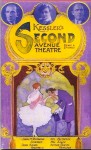
Joseph Rumshinsky’s Yiddish operetta Di Goldene Kale premièred 92 years ago at Kessler’s Second Avenue Theatre in New York, and was still being performed as late as 1948. The Aug. 5 perfomance at Nicholas Music Centre was the first since then. (image from masongross.rutgers.edu)

It is not often that a neglected or forgotten artistic treasure is rediscovered. But it happened recently at a theatre in New Brunswick, N.J. – a concert version, with full orchestra, of Joseph Rumshinsky’s 1923 musical comedy Di Goldene Kale (The Golden Bride). This joyful, melodically blessed operetta was co-presented with Mason Gross School of the Arts by another treasure, the National Yiddish Theatre Folksbiene, the oldest continuous theatre in New York. Founded in 1915 on the Lower East Side, the theatre is now celebrating its centenary.

Di Goldene Kale’s plot is above the usual standard banal fare of Yiddish plays: it involves a young woman who is heir to a fortune and now has several suitors after her and her money. But she loves Misha and ends up with him, after the usual ups and downs of musical comedy narrative.

Rumshinsky (1881-1956), one of the giants of Yiddish theatre during its heyday in the 1920s and ’30s, continued to work and compose until the year of his death. His operetta is full of memorable tunes, which the audience took to immediately. His musical traditions include influences from the Yiddish theatre, American musicals, European operettas and American popular music, most notably the opening chorus of George M. Cohan’s 1917 First World War song, “Over There.” Yiddish theatre was known for having at least one joyous religious occasion onstage, often a wedding, which nostalgically brought back an aspect of traditional Yiddishkeit to now-secular Jews, who were usually watching the performance on a Friday night, and Di Goldene Kale has a very moving Friday night Kiddush, a lovely melody that the soloists and chorus expand via theme and variations.

After its 1923 première, Di Goldene Kale toured the United States, Europe and South America. It was still being performed as late as 1948. The Aug. 5 show at Nicholas Music Centre was the first performance in Yiddish (with English and Russian supertitles) and full orchestra in 70 years.

The stunning cast was led by the gorgeous operatic voice of Dani Marcus, who plays Goldie, the goldene kale, and the fine baritone, Eyal Sherf – a trained cantor – who plays her boyfriend, Misha. The producer and director was Motl Didner, and Michael Ochs edited the orchestral score from manuscripts dating back to the 1923 première. National Yiddish Theatre Folksbiene artistic director Zalmen Mlotek conducted the young, attractive cast, all seasoned in singing, acting and comedy. To find first-rate singers who also act superbly and know Yiddish was a minor miracle and a major achievement. At the show’s end, the full house stood up and applauded. The orchestra and cast then reprised one of the operetta’s songs and everybody went out singing.

***

Classical American Yiddish theatre was also recently the subject of a program hosted by Michael Tilson Thomas, music director of the San Francisco Orchestra, who celebrated the career of his legendary grandparents, Boris Thomashefsky (1868-1939) and Bessie Thomashefsky (1873-1962), who were illustrious Yiddish theatre personalities.
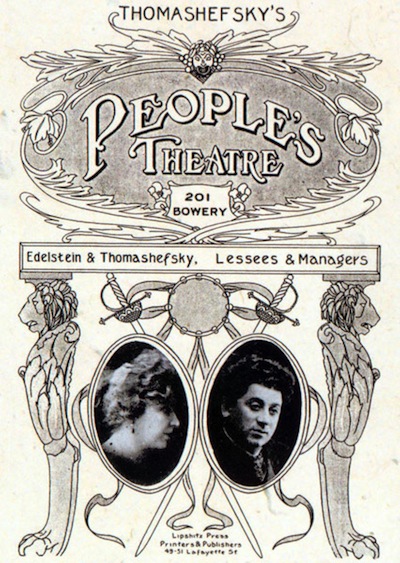
image - poster, Bessie and Boris Thomashefsky, the legendary grandparents of Michael Tilson Thomas, music director of the San Francisco Orchestra, are the focus of the show The Thomashevksys: Music and Memories of a Life in the Yiddish Theatre
Bessie and Boris Thomashefsky, the legendary grandparents of Michael Tilson Thomas, music director of the San Francisco Orchestra, are the focus of the show The Thomashevksys: Music and Memories of a Life in the Yiddish Theatre. (image from thomashefsky.org)

Titled The Thomashevksys: Music and Memories of a Life in the Yiddish Theatre, the show included four singer/actors and members of the Boston Symphony Orchestra at Tanglewood playing selections from Yiddish theatre music.

On the morning after his program, I walked down from our room at the Apple Tree Inn across the street to the Tanglewood grounds, where I met Thomas. I began in Yiddish: “Reb Mekhl” – the name his bobbe Bessie used for him – “ken ikh mit eykh redn a bisl vegn ayer program?” (“Reb Michael, can I talk to you a bit about your program?”)

By speaking Yiddish I wanted a) to know if he understood Yiddish and b) to separate myself from a group of people near him. Born in 1944, Thomas – his father shortened the original name – never met his famous grandfather, but the conductor told me that Grandma Bessie spent her old age near the family in California. Since she lived to be 89, she was a presence in Michael’s life until he was 18.

“She would show me around in Hollywood and take me to screenings,” Thomas recalled. “She called me Mekhl or Mekhele and would often jibe at my parents: ‘You’re too conventional. But Mekhele is not going to be that way.’”

When Boris’ infidelities became too intolerable, Bessie simply walked out on him in 1912 (she never did divorce him) and opened a rival theatre and became a success on her own.

“My grandmother used to say of her marriage to Boris: ‘We were a mistake – but a beautiful mistake,’” shared Thomas.

One of the most touching of personal anecdotes is Thomas’ strudel story.

“How did my grandmother make strudel? Here is her recipe: ‘You go home, you put on a clean apron, you wash your hands and you bake a strudel.’ And that’s what I do when I prepare for a concert. I make my way to the hall, I put on a clean tux, I wash my hands and I go out there and bake a strudel.”

The Tanglewood program also included a slide show that added lustre to the narration and a brief clip from the only film that Boris ever made, wherein he sings a Yiddish song. Along with sparkling orchestral numbers, the conductor and four singers offered musical selections and scenes from the couple’s real-life drama.

When Franz Kafka, early in the 20th century, brought a Yiddish troupe to Prague and told his audience, “Ladies and gentlemen, you know Yiddish better than you think,” he may have had the Tanglewood audience in mind for, with every Yiddish joke, most of them broke into laughter.

The highlight of the program was Thomas singing the once-popular song “Thomashefsky,” about the actor himself. The conductor pranced on stage, doing all the riffs and gestures of a veteran Yiddish music hall star, with the song’s memorable refrain, “Who do you think is going to marry my sister?” No doubt Grandma Bessie’s spirit was guiding her einikl in performing this enchanting song.

Curt Leviant’s most recent book is Zix Zexy Ztories. His ninth novel, King of Yiddish, will be published in December.
Format ImagePosted on August 21, 2015August 19, 2015Author Curt LeviantCategories Performing ArtsTags Di Goldene Kale, Joseph Rumshinsky, Michael Tilson Thomas, National Yiddish Theatre Folksbiene, Thomashefsky, Yiddish

Meet Minnie’s family

What a mouth on Minnie! And I don’t mean it pejoratively. (I just wanted to get your attention.) Grandma Minnie Bloch is articulate and sensitive as she meticulously narrates the three-generational story that includes her own early life with her husband, their move to the United States from Eastern Europe, and the family she creates.

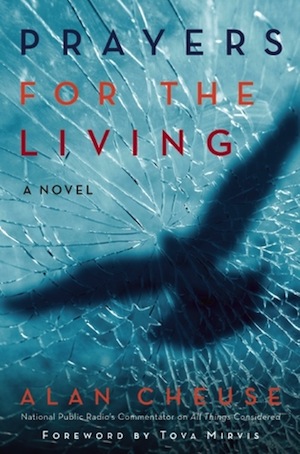
book cover - Prayers for the Living by Alan CheuseMinnie is the narrator/observer – acting almost like a Greek chorus – in the stirring new novel Prayers for the Living (Fig Tree Books, 2015), written by veteran novelist and National Public Radio literary critic Alan Cheuse.

Although she is not educated (in the formal sense), her intelligence and life experience enables her to depict for us so many living characters: her son Manny, who is a Reform rabbi and a businessman; his psychologically impaired wife, Maby; their problem-laden daughter, Sarah; and Manny’s mistress, Florette, a Holocaust survivor and a member of Manny’s congregation. Into this mix, we must also include Maby’s brother, Mord, who takes brother-in-law Manny into the family business.

How does Minnie narrate the rise and fall of this middle-class Jewish family? By telling her story to friends during occasional coffee-klatch meetings, portraying with motherly calm and painterly skill all the people she has encountered. Minnie has not personally experienced all the events she narrates, but she assembles them from talks with her son and other family members, from overheard conversations, and even from information discovered by reading pertinent private journals, which she cleverly doesn’t call “snooping” but “learning.”

Behind the voluble narrator, who speaks always from the heart, and often with poetic grace, stands the artistry of Cheuse, a sharp-eyed writer who brilliantly is the voice behind the voice.

Although the central narrator in Prayers for the Living (an ironic title, an inversion of the Kaddish, known as the Mourner’s Prayer, or Prayer for the Dead) is Minnie, the protagonist of the book is Manny, well-regarded by his congregation, who splits his duties between rabbinic work and business, ultimately not a happy partnership.

As the novel progresses, we learn of daughter Sarah’s missteps in college, Maby’s mental imbalance and alcoholism, and Manny’s visits to Florette, who is ostensibly painting her rabbi’s portrait but has other non-esthetic designs on him. In her telling, Minnie does not hide her family members’ flaws. The character of the book’s heroes, often shaped by earlier events, in combination with the exigencies of the present, leads them to their destined paths.

Cheuse plans the suspense, gives the hints of things of come, and arranges for Minnie to occasionally offer remarks akin to: “But I’ll tell you about that a bit later….” By so doing, he achieves a unique fluidity of time zones.

Minnie is the bedrock of the family, the only solid and trustworthy character in the book. She has perfect pitch for the rhythms of speech of Jewish women of a certain age, and faithfully reproduces the conversations of other characters in Prayers for the Living. This enables Cheuse to penetrate the psyches of his characters, their hopes and tremors.

Some central events are tiny sparks that build up to the conflagration that follows. Among them: Minnie, in Europe, fleeing from a groom that has been forced upon her; an accident in New York involving Minnie’s husband, which her son, Manny, witnesses; and Sarah, caught strumming a guitar on Yom Kippur by her rabbi dad.

By the riveting end of the book, whose intricacies and trajectory you have to discover for yourself, you can’t wait for one page to lead to another. You have a sense of what is going to happen – Minnie gives you little choice – but you still hope it won’t happen. Maybe a surprise will come your way. Perhaps

Minnie’s assessment is wrong. But even if you suspect what will happen and you know why, you still don’t know how it will happen.

Thank you, Minnie, for sharing with us your words and thoughts, your motherly wisdom and compassion. Yes, it all comes from Minnie’s mouth – to our ears and to our hearts.

Curt Leviant’s most recent book is the short story collection Zix Zexy Stories. This review was previously published on nyjournalofbooks.com.

Posted on June 19, 2015June 17, 2015Author Curt LeviantCategories BooksTags Alan Cheuse, Prayers for the Living

New book is first Jacob Dinezon work in English

Jacob Dinezon (1856-1919) was a Yiddish novelist and short-story writer, as famous during his lifetime as were his contemporaries, the three pillars of late-19th- and early-20th-century Yiddish literature, Mendele Mocher Sforim, Y.L. Peretz and Sholem Aleichem. All of these masters knew and were impressed with Dinezon’s work.

During his period of literary activity in the latter half of the 19th century, Dinezon at times even outshadowed the three founding fathers because his books touched thousands of readers and were more widely sold. In fact, one of his novels sold more than 200,000 copies, an unheard of success in Yiddish literature. Dinezon achieved fame at the age of 20 with the publication of his first novel and remained famous until the day he died. He was so well known and beloved that every major figure of Yiddish literature came to his funeral in 1919.

Even encyclopedias in English recognized him. The early 20th-century Jewish Encyclopedia lists Dinezon as an important Yiddish writer (like other classical Yiddish writers, he also established a reputation as a Hebrew author), praise that is echoed in the contemporary Encyclopedia Judaica.

Sometimes mazel plays a role in literary fame but, in Dinezon’s case, it seemed to express itself in income and not in posthumous regard. And now that the worldwide Yiddish-reading community is vanishing, a writer’s lot can be determined by translation, which can bring fame, and to discovery, which in turn can prompt translation. If a writer doesn’t find his translator/editor in another language, he suffers the misfortune of neglect, which is what happened with Dinezon. If you ask any knowledgeable reader familiar with Aleichem and other famous Yiddish writers if he has ever heard of Dinezon, the answer would probably be no.

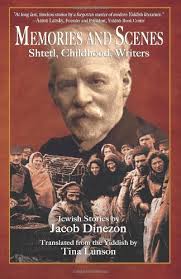
image - Memories and Scenes: Shtetl, Childhood, Writers book coverUntil now, we have not had any work by Dinezon in English. But this lacuna has been successfully filled with the wonderful book of 11 Dinezon stories, beautifully translated by Tina Lunson and edited by Scott Davis, who has also provided an illuminating introduction: Memories and Scenes: Shtetl, Childhood, Writers (Jewish Storyteller Press, 2014).

Dinezon was a social realist, accurately depicting small-town (shtetl) Jewish life. With a cinematic eye, he zeroes in on his characters, deftly telling fascinating stories while at the same time giving an accurate portrait of the mores, attitudes, speech and foibles of the men, women and children whom he depicts.

Like Dickens, Denizon wrote about the downtrodden and about poorly treated students in Hebrew schools with such realism that he actually brought about reforms. A cross section of Jewish society in Poland lives in his pages: the young and old, Chassidim and enlightened Jews, simple workingmen and rich householders. Every single one of his stories breathes with life and verisimilitude.

In this book of 11 stories, a collection published after Dinezon’s death in 1919, we have finely crafted tales – so in keeping with Jewish short-story writing at the turn of the 20th century – that recall vividly portrayed shtetl characters from Dinezon’s childhood years and memories of such literary figures as Mendele Mocher Sforim (Mendele the Bookseller, aka Sholem Abramovich), Peretz, and the playwright Avrom Goldfaden.

Dinezon also played an important historical role in the development of Yiddish as a literary language. In fact, he mentored, advised and befriended almost every major Jewish writer of his day. The list reads like a who’s who of late-19th- and early-20th-century modern Yiddish literature, including the writers mentioned above, as well as S. Ansky, David Frishman, Shimon Frug, Sholem Asch, David Pinski and Abraham Reisen.

In one of the superb stories, Mayer Yeke, we see how a boy’s great fear of the shtetl’s most righteous Jew, Mayer Yeke, turns to love and respect after he witnesses Mayer’s mitzvah assisting the town drunk. Sholem Yoyne Flask depicts a mild-mannered tailor transformed by the liquor in his flask into a fiery defender of the town’s poor folk – then something happens when a surprising discovery is made about his flask. With Motl Farber, Purimshpieler, we are introduced to a housepainter who languishes during the winter when he cannot work, but at Purim, he becomes the leader of a band of Purim players. When the troupe is arrested by the new Russian police chief, an unlikely “Esther” comes to their rescue.

A story that achieves the psychological depth of a Dostoevsky tale is Yosl Algebrenik and His Student. It tells the story of Yosl, an outstanding Talmud scholar, a genius some said, destined to become a great rabbi, who has a passion for mathematics. At age 30, for reasons no one remembers, he tosses away the Talmud and its commentaries for the study of algebra and algebraic logic. From then on, he spends all his time studying algebra, except for the few hours a week he devotes to tutoring children to eke out a living.

Another moving and profound story is called Borekh, after the name of the hero, a poor orphan living in the yeshivah. He doesn’t do well in talmudic studies but he has a talent for woodcarving, making dreidls, Purim groggers and toy animals for the children of the town. One day, he decides to leave the yeshivah and start anew, with hopes of making a great holy ark, “one that people have never seen before.” When he achieves that, he will send it to his friend in the yeshivah, who he knows will become a great scholar. He leaves without saying goodbye.

Some of Dinezon’s autobiographical sketches are as engaging as his fiction. In My First Work, he relates the childhood experience of reading his first Yiddish novel, a Jewish version of Robinson Crusoe. He is so taken by the book, he writes his own adventure story. In Sholem Yankev Abramovich, Dinezon tells how his debut novel, The Dark Young Man, was published and how he acquired his first copy in Moscow. At the same time, he learns that the Yiddish writer Mendele Mocher Sforim and the Hebrew author Sholem Abramovich are actually the same person.

It is not often that we are privileged to make a literary discovery of our own. With this book by Dinezon, the first in English, we happily encounter a master writer who deserves to be ranked with the great Yiddish writers whom he befriended and who admired him.

Curt Leviant’s most recent book is the short story collection Zix Zexy Ztories.

Posted on July 18, 2014July 17, 2014Author Curt LeviantCategories BooksTags Abraham Reisen, Avrom Goldfaden, David Frishman, David Pinski, Jacob Dinezon, Jewish Storyteller Press, Memories and Scenes, Mendele Mocher Sforim, S. Ansky, Shimon Frug, Sholem Aleichem, Sholem Asch, Y.L. Peretz, Yiddish

New York shows Marc Chagall

Seeing the Chagall show at the Jewish Museum in New York made me recall the year when Marc Chagall (1887-1985) was 90 and I decided it was high time that he, my favorite Jewish artist, and I meet. But first let me tell you about the current Chagall exhibit.

Until Feb. 2, lovers of Chagall’s works can see a fine selection of his paintings that were done between the early 1930s and 1948. Titled Love, War and Exile, the exhibit of 31 paintings, 22 works on paper and assorted photos and letters have been drawn from various public and private collections.

For me, Chagall was the ultimate Jewish artist of the 20th century. He combined artistic intelligence, vivid imagination, sensitivity to and awareness of Jewish history, and deep-rooted Jewish knowledge, based on his early education and the ambience of his Chassidic family in Vitebsk, Russia. Moreover, his knowledge of Yiddish and Yiddish lore expressed itself in many of his works.

Chagall’s colorful and fantastic paintings, with lovers in the air, suspended candelabras, a disembodied painter’s palette, roosters, flower-bedecked cows and snow-covered villages are seen in plenitude. In this show, there are also many crucifixion scenes, for Chagall saw the Jesus figure as representative of the martyrdom of the Jewish people during the 1940s. He himself, his beloved wife, Bella, who figures in so many of his paintings, and his daughter, Ida, were fortunate enough to escape from France and come to the United States in June 1941. The war in Europe was raging and it was just several months before the United States entered the battle in December 1941.

Chagall’s depictions of Jesus invariably have him wearing either a tallis or a tallis-like loincloth, thereby accenting his Jewishness. Although some viewers conclude that it is only during the l940s that Chagall began to paint Jesus on the cross, Chagall painted Jesus as early as 1908, when he was in his late twenties.

To understand Chagall’s works, especially those that are related to thoroughly Jewish themes, a deep understanding of the Yiddish language and Jewish culture are needed. Alas, even museums, which supposedly have knowledgeable staff, err in their interpretation because of ignorance.

To understand Chagall’s works, especially those that are related to thoroughly Jewish themes, a deep understanding of the Yiddish language and Jewish culture are needed. Alas, even museums, which supposedly have knowledgeable staff, err in their interpretation because of ignorance.

A classic example is his painting “Over Vitebsk” (not in this show), which depicts a village and its rooftops, and over the houses floats a bearded figure, with cap and cane, holding a stuffed sack. I remember visiting a museum once with my father, Yakov, and seeing this famous Chagall painting. The curator went to great lengths describing the scene. Reading this banal description, my father laughed and said, “They don’t understand this painting because they don’t know Yiddish and they don’t know Yiddish folk expressions. What Chagall is doing here is visualizing a Yiddish phrase: ‘geyen iber dee hizer’ – ‘going over the houses’ – an expression that actually means ‘going from house to house begging.’”

So, then, without a knowledge of Yiddish lore, Chagall’s brilliant rendering of this scene is misunderstood. What was mistaken as a typical Chagall “floating” scene is actually a rendering of a Jewish beggar going from house to house, as Jewish beggars did all over Eastern Europe, trying to collect food to put in their sacks.

In this show, too, we have one of Chagall’s crucifixion scenes in a shtetl, where there is a huge fire on the left side of the painting. The description on the little card says that it is a kind of crossing of the Red Sea. However, in reality, it is Chagall’s depiction of the Holocaust, a visual rendering of the Yiddish expression “mayn shteytl brent” – “my town is burning.”

I don’t know if the Jewish Museum’s administration is aware of the coincidence, but in the room that shows many of the artist’s crucifixion canvases there is a rather large cross-shaped blue sofa where visitors can sit and view the paintings.

One of the most fascinating parts of the show for me was the Yiddish letter that Chagall wrote to the mayor of Tel Aviv, accepting an invitation to visit. His calligraphy is clear and beautiful, showing the early schooling he had in writing the Hebrew letters, and his Yiddish is fluent and evocative. After all, he is a native Yiddish speaker. On view too is a letter to Hermann Struck, to whom Chagall writes that he hopes his visit will be beneficial to his art. Struck is identified merely as a “printer.” Missing from the description is the fact that Struck himself was a noted artist, who wrote a definitive book on etching. Moreover, Struck was a former teacher of Chagall.

Accompanying this show is a comprehensive catalogue, co-published by Yale University Press, entitled Chagall: Love, War and Exile. In addition to the paintings on view, the book also has many other related paintings, an English translation of some of Chagall’s Yiddish poems, and photographs. One particularly engaging photo is one of Chagall sitting in front of his painting of Bella, right next to Bella herself, who poses wearing a black dress with lace collar and holding a white lace fan.

Now I’ll return to getting to see Chagall in St-Paul-de-Vence, a small town not too far from Nice, in the Provence region of southern France. To see a very private artist, whose visitors were controlled by his managerial second wife, Vava, was not easy. For such an attempt one needs, as the Israeli expression has it: proteksia – or “pull.” I knew the then president of Hadassah, Miriam Freund, who had worked closely with Chagall when that organization commissioned Chagall to make the stained glass windows for the famous Hadassah Hospital synagogue in Jerusalem.

I explained my wish to Miriam, who gladly said she would try to be helpful. She gave me Chagall’s phone number and preceded it with a call to Chagall, telling him that an American writer would like to visit him. She told him that I knew Yiddish, and stemmed from a family whose origins were in Russia. And then she told him one more crucial fact that I had told her might clinch the acquiescence. I knew that Chagall’s first wife, Bella Rosenfeld, stemmed from a family named Levant, which was Bella’s mother’s maiden name. I asked Miriam to accent the fact that our family name, Leviant, might very well be connected to Bella’s family. Miriam also mentioned that I would be in Switzerland during the summer.

In short, Miriam was told that when I was in Europe I should call Chagall’s house. I couldn’t wait. Soon as I arrived in a little town in Switzerland, I dialed the number that Miriam had given me. A woman answered the phone, probably Chagall’s wife, Vava. I introduced myself, told her I had gotten the phone number from Miriam Freund of Hadassah, and hoped I could make the visit to see Chagall, since in a couple of weeks we would be in Nice, and would actually be in the town of St-Paul-de-Vence.

The reply was a very brief message in French: “The master [le maître] is not accepting visitors.”

And, so, that was the end of my Chagall adventure. In person, but not on museum walls.

The final irony of Chagall’s long and productive life is that the Jewish painter – who throughout his long life encapsulated Jewish themes, Jewish imagery, Jewish expressions and Jewish religiosity – was buried by his second wife, Vava (herself a Jew, from a noted Russian Jewish family), in the local Catholic cemetery in St-Paul-de-Vence.

Curt Leviant’s most recent book is the short-story collection Zix Zexy Ztories.

Posted on January 17, 2014March 31, 2014Author Curt LeviantCategories Arts & CultureTags Bella Rosenfeld, Chagall: Love, Jewish Museum of New York, Marc Chagall, War and Exile, Yiddish

Posts pagination

Previous page Page 1 Page 2
Proudly powered by WordPress