Dedicated to the community

Dvori Balshine has served the Vancouver Jewish community, in one capacity or another, for 45 years. She is retiring in November from her latest post – director of development at Louis Brier Jewish Aged Foundation – and she talked to the Independent about her life and work.

“We came to Vancouver from Israel in 1969,” she said. As an educator who studied at the Hebrew University of Jerusalem, she found a job right away. She taught Hebrew and Jewish history until she fell into fundraising, almost by accident.
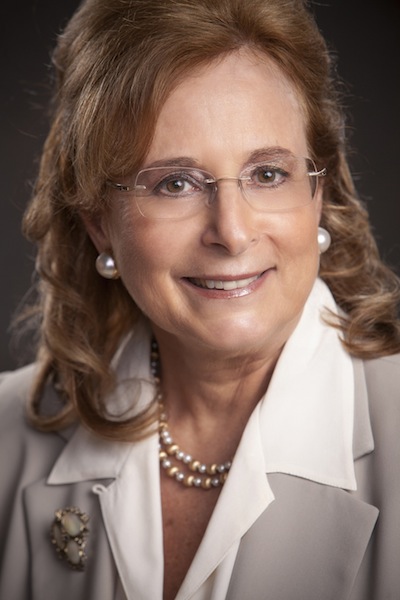
Dvori Balshine is set to retire. (photo from Dvori Balshine)
Dvori Balshine is set to retire. (photo from Louis Brier Jewish Aged Foundation)

“I was hired by the JCC as a cultural director around 1980,” she recalled. “I wanted to start an art gallery and a Jewish authors festival, wanted to do events, but there was never enough money. So, I met with the community members and asked for their support. Our biggest fundraiser was held at the Oakridge movie theatre. They had a movie theatre at the time. It was the opening night of Chorus Line, and it was unbelievably successful.”

With the funds raised by this and similar events on behalf of the Jewish Community Centre of Greater Vancouver, Balshine was at the root of the Sidney and Gertrude Zack Gallery and one of the founders, together with Cherie Smith, of the JCCGV Jewish Book Festival. When Hebrew University asked her, as one of its alumni, to head their Western Canada division, she agreed. For 17 years, she served as the executive director in Western Canada.

“I raised lots of money for them, sent many students to study abroad, organized other specific projects. But then I thought: I should work for my own community.” In 2003, she came to the Louis Brier Jewish Aged Foundation.

In the 12 years she has worked at the foundation, she has led many campaigns, and established endowment funds and awards. As well, more than 600 art pieces were acquired as donations from local Jewish artists. These works hang on the walls of Louis Brier Home and Hospital and of the Weinberg Residence, making the rooms and corridors more like those of a home, less institutional. A bus and a piano, a dental clinic and a garden sculpture, multiple renovations around the home and the Gallery of Donors Wall – they all owe their existence to Balshine and her crew, to their continuous efforts to improve the quality of life of the residents. She was also active in community outreach programs, including, but not limited to, numerous musical events and lecture series, book launches and octogenarians’ celebrations.

“My dream was to leave the organization with $10 million, and we are at $8.5 million,” she wrote in her reflections of her most important activities at Louis Brier. “It is not that we didn’t raise it, we raised more, however, the demand from the home and Weinberg annually has been so great that we have only been able to invest and grow to this amount.”

She sounded modest, as if raising almost a million a year is a trifle, but for anyone else, it would be a major accomplishment, even the achievement of a lifetime.

“I believe in the mission of the organization I work for,” she said. “I do it with all my heart, my mind and my might. Of course, there are multiple challenges. One of them is that there are many Jewish organizations in B.C., and everybody needs a piece of the pie. The need is great, but there are not many industries here.”

She also encountered another challenge. “I found that it’s easier to raise money for the young, for schools and universities, than for the elderly. How do I deal with this? With a smile and an explanation. We organize events and introduce potential donors to the organization. We honor our donors.”

Her conviction that everyone should share his/her wealth comes from her family background. Both her father and grandmother were involved in their local communities on various levels, and Balshine has continued the tradition. “Some people in the community are doing extremely well. They have a responsibility to share. I learned that at home.”

Her approach to finding new benefactors is personal. “I meet with everyone I’m going to ask for donations. If I don’t know them, I look for someone who can introduce us. We have coffee together and talk. I try to share with everyone the importance of Louis Brier for our community. People give to people, not organizations. Of course, you need people skills to do this kind of work. You need to be kind, to smile, to have charm. You have to feel it, to be willing to give from yourself; otherwise, you can’t do a good job.”

With such a personal fundraising strategy, she knows many members of the Jewish community in Vancouver. “I’ll tell you an anecdote,” she said with a smile. “I love opera. Recently, I took my granddaughter, who is 12, to the opera Carmen at the Queen Elizabeth Theatre. I introduced her to my friends. When we came home, her parents asked her how she liked it. She said that, of course, the music was great and the show. She also said, ‘There were like 3,000 people in the audience, and my grandma knows half of them.’”

Olga Livshin is a Vancouver freelance writer. She can be reached at olgagodim@gmail.com.
Fresh, solemn significance

For a great number of Canadians, particularly those too young to remember the Second World War, Remembrance Day is not the day of intimate commemoration it was for previous generations. Canadian engagement in Afghanistan, however, has once again bestowed on this solemn occasion more immediacy. That said, most young Canadians who file into school auditoriums for the recitation of “In Flanders Fields” and a moment of silence understandably may not experience the same emotional reaction as their parents or grandparents who participated in or lost loved ones in the world wars.

This Nov. 11 will probably have poignancy beyond the routine, though, because of the tragic events of recent days. Our country is mourning Warrant Officer Patrice Vincent, who was murdered last month in Quebec, and Corporal Nathan Cirillo, who was shot at the National War Memorial in Ottawa two days later.

The murder of Cirillo was immediately followed by a dramatic shootout at the heart of our democracy, the Parliament Buildings, in which the assassin and thankfully no one else was killed.

The symbolism of the latter shootings is unambiguous. A killer – maybe deranged, maybe driven by ideology, maybe a bit of both – kills a military official standing guard at the icon of Canada’s military sacrifices, then heads directly to the legislature of our country, apparently intending further destruction.

Reaction has varied intensely. American 24-hour news outlets treated the occasion with typical spectacle. Canadian media have been credited with exhibiting characteristic Canadian moderation. Canadians have not, evidence so far suggests, gone hog-wild in demanding the swapping of human rights for physical security. A typically Canadian assessment will be made about whether elected officials should have greater protection, but there has been minimal hysteria about an imminent invasion by terrorists.

These incidents, of course, raised the inevitable fears and allegations. Both crimes were perpetrated by men who were newly observant Muslims. Yet, there is minimal evidence that either was in any way connected to a larger Islamist network or that religious fanaticism was a greater driver than grave psychological or emotional troubles.

Still, there was reaction in the unlikeliest of places. In Cold Lake, Alta., a mosque – talk about a little mosque on the prairie – was a hate-crime target with, among other things, “Go home” spray-painted on its exterior. In what was the perfect Canadian response, locals showed up to clean off the graffiti and festoon the place with signs, including one with the message “You ARE home.”

There may be a place for hate-crimes legislation and certainly there are laws against vandalism, but the greatest reaction of all is individual members of a community coming together to undo – literally and figuratively – the hatred purveyed by a minority of bigots.

As we prepare to mark Remembrance Day Tuesday, members of our community also gather Sunday night to mark the 76th anniversary of Kristallnacht. This date marks the horrible moment when the incremental threats of the Nazi regime moved from words to deeds, and the intimidations of successive antisemitic laws moved toward the grisly realities of the Final Solution.

Kristallnacht also holds particularly fresh import in a world where Jewish shops and people this year have been subjected to attack in Europe and elsewhere. Both of these solemn days call on us to consider events of the past and to be vigilant in the present. Lest we forget.

Teaching self-defence

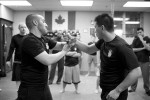
Jonathan Fader, left, and his business partner Borhan Jiang show a class at Urban Tactics Krav Maga how to disarm an attacker who has a knife. (photo by Albert Law)

When Jonathan Fader copied the Jewish Independent on an open letter that he posted online in mid-August, Operation Protective Edge was winding down. Noting the sometimes violent antisemitism that it had evoked in places around the world – including in some protests that took place in Canada – he stressed the need for members of the Jewish community to know self-defence. Since then, there have been two terrorist attacks on Canadian soil.

In the letter, he wrote, “I am asking you to please take it seriously and find your local krav maga gym and start learning to protect yourself. If there is none near by, at the very least find the most comparable style, just learn something!”

Intrigued, the Jewish Independent visited the Richmond location of Urban Tactics Krav Maga, Inc., in September. Fader and his business partner, Borhan Jiang, who has been featured in the Independent on more than one occasion, also have a Burnaby site.

Raised in a somewhat observant household, Fader, 27, said he nonetheless “didn’t really identify with being a Jew.” He describes himself as secular, and doesn’t “believe in religion but, of course, if the world is going to call me a Jew … I might as well accept it, and I’m a proud to represent the culture, but I’ll do it realistically…. I support Israel and what it does because, realistically, that’s just the way it is, but I have criticisms like anyone else.”

From 2009-2011, Fader lived in Israel. He went there for the purpose of joining the Israel Defence Forces, and he served in the 424th infantry battalion in the Givati regiment.

“When I came back, I literally did nothing,” he said. He had some savings and, “I was just living with my parents, living off of [my savings] for like five months. I did nothing.”

He spoke about some of the difficulties soldiers have in returning to civilian life. In his opinion, the “reason that they’re so slow to deal with PTSD and depression in Israel is because it’s less apparent, as everyone does the army and, when you go home, people understand, and you have people to talk to. So, the rates are much lower, but there … [are] still suicides and still depression…. But, when you come back here,” he said, referring to Canada, “you don’t have the support of your family or your friends because nobody understands what it’s like,” even if PTSD is more recognized.

He acknowledged that, as a result of the work of veterans here, “more PTSD and depression is being dealt with now and in the North American armies at least.” Once an “invisible group of people,” he said soldiers have become more vocal. If you look at the Canadian army, they now are starting to put psychiatrists actively in duty, he said.

For these and other reasons, Fader is studying psychology at Kwantlen Polytechnic University College. “I find that psychology really helps me understand everything, from marketing to trends to people, just everything,” he said, attributing the effectiveness of krav maga as a system of self-defence to the fact that “it’s working off of real psychology, action-reaction rate, fight or flight.”

He noted about Urban Tactics’ clients, “Interesting thing about that is, when we first started, we figured it was going be all young guys … but that wasn’t the case.… For the first year, it was predominantly males age 30 to 50 with families who wanted to protect the family.”

In general, Canadians don’t understand “what self-defence is and when aggression is appropriate, when violence is appropriate,” said Fader. Noting that women tend to be more vulnerable, he said, to defend yourself successfully, “you need to be able to hit hard and fast, and really be willing to damage the person who is attacking.”

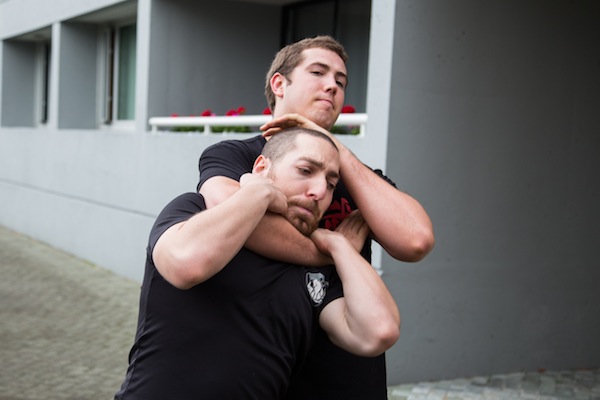
photo - Krav maga instructor Jonathan Fader prepares to get out of a choke hold
Krav maga instructor Jonathan Fader prepares to get out of a choke hold. (photo by Victor Totten Photography)

People here have the idea that you should never hit back and that you can talk yourself out of every situation, he said. And, he agrees, to a point: the first step for self-defence is to avoid the conflict completely, to not put yourself in a position where you might end up being in danger. However, if you do end up in trouble, you need to be able to assess whether talk will be enough because, “if you think you’re in danger, you need to attack first … because [with] action versus reaction, reaction is always slower…. [In] proper self-defence, it is absolutely OK to strike first.”

He gave the example of a person walking through an alley at night and being attacked. First, he noted, the choice to walk down the alley was probably not a good one, “and you have to take some of the blame now because that’s a grand scheme self-defence: Why are you there? If you go there thinking nothing is going to happen, that’s ridiculous.” But, now that you’re in trouble, he said, if you have the chance to run, “it’s OK to run, it’s OK to avoid the situation.” If you can’t run, then you have to act first if possible, “because if you wait, you could be knocked out … [so] kick him in the groin, go for his eyes … push, run.”

A good instructor, said Fader, will drill it into your head to avoid a situation, then teach you some basic techniques. But still, all the technique in the world won’t help you if “you’re not willing to hit that guy in the groin, go for his eyes, go for his throat,” he said.

Krav maga isn’t a fitness class. “I’m not teaching cardio kickboxing,” said Fader, “but the thing is that you need to be in some physical capability in order to legitimately defend yourself against a violent attack…. You have to be able to move correctly. Some people who are … limited in what they can do but they mentally are willing to hit hard, hit fast, will be OK, reasonably, if they’re up against a trained attacker…. We don’t teach fitness but you will get in shape … but I don’t care if you lose five pounds – I want you to know that you can defend yourself.”

The fact that both he and Jiang have trained in Israel sets Urban Tactics apart from other places that offer krav maga, said Fader. “The fact that we understand both cultures – North American and Israeli – is what truly makes us different.” While most martial arts will teach you techniques that will help you stay upright during a conflict, if you do fall to the ground, and if your opponent has a weapon or an accomplice, “going to the ground is the worst possible thing you can do, even if you’re a Brazilian jiu jitsu black belt.… We teach ground stuff, but it’s about everything you can do to get up.”

In the end, said Fader, the techniques he teaches focus on reality, how people react in a physically threatening situation. “How do you need to deal with it, what’s the strategy? It’s a constant assessment. We don’t just do a move and stop [in our instruction]. We always make sure, Are your hands still up? Are you paying attention? Are you looking around arbitrarily or are you actually actively scanning?” Proper training, he said, will teach you how to continually assess your situation, as every second counts.

Fader acknowledged that he may lose in a boxing match or a karate bout that only allows certain types of hits, but “in a street fight, I’m going to beat this guy because I’m playing by no rules. I do whatever I have to do.”

For more information about self-defence courses and Urban Tactics, visit urbantacticscanada.com.

Fragmented childhood

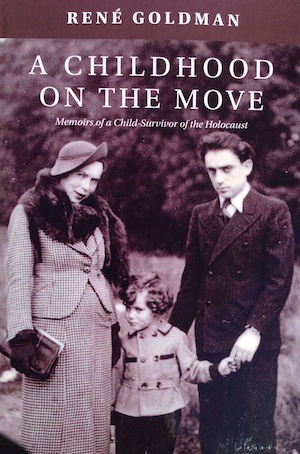
In a recently published memoir, A Childhood on the Move: Memoirs of a Child Survivor of the Holocaust, René Goldman, professor emeritus of Chinese history at the University of British Columbia, pieces together a fragmented and tragic childhood and adolescence.

Having migrated to Luxembourg from Poland, Goldman’s parents then fled the advance of the Nazis into the Benelux countries. The family made their way through occupied France hoping to sail from a Mediterranean port to South America. While their passage was interrupted, the family at least found themselves in France’s “free zone,” the southern area governed by the German-puppet Vichy regime, but not directly administered by the Nazis. While granted a period of comparative normalcy – unlike, Goldman notes, Jews in the north like Anne Frank and her family – eventually there was a roundup.

image - Childhood on the Move book coverGoldman was awakened by his mother and told that police were demanding they go to the train station. Why his father was not with them at that time Goldman does not know. Nor does he know why he was spared the fate of his mother.

“The entire station was a scene of bedlam, with men, women and children being pulled, shoved and hurled into the train,” writes Goldman. “Just as the commissar was about to throw me into the train as well, two gendarmes in khaki uniforms appeared in the nick of time to stop him. Without a word he let go of me…. That was the last time I saw my Mama.”

An aunt arranged for Goldman to be hidden in a rural village, which would become the first of countless temporary shelters for him. In an excruciating series of hasty moves, Goldman was transferred from the protection of one adult or institution to another. In some instances, the adults and his fellow children were amiable, in others far less so. Despite the instability and constant uprooting, he usually managed to attain some education in almost every one of his hiding places. At a Catholic institution, he and other Jewish children were assigned new identities and warned never to let anyone see their private parts, “since in France only Jews were circumcised.”

When finally the allies reached the village where Goldman was hidden, and he reconnected with his aunt, she told him that his father had joined the Free French forces and would return after the war. It’s not clear if she believed this. “Alas, even as Paris was about to be liberated, [Klaus] Barbie [the Nazi known as the ‘Butcher of Lyon’] hurriedly filled up one last train with victims destined for the death camps, a train which the Resistance vainly sought to derail, or otherwise prevent from reaching Germany,” writes Goldman. “Decades later I learned that my beloved Papa was among them.”

Though now liberated, things did not, of course, return to normal for Goldman. The winter of 1944-45 was a harsh one and food was scarce. Meanwhile, the war continued and the allies suffered setbacks in the Battle of the Bulge. “That unanticipated delay caused the Allies heavy losses, while thousands more victims, among them my father, perished in the Nazi death camps,” he writes.

Moreover, Goldman’s surviving aunt and uncle in France, with three children of their own, found they could not care for him. They sent him to a colony run by a Zionist organization, where he received a Zionist education, including a bit of Hebrew, to prepare the young people for aliyah. When the war finally ended, the children at the colony waited for news of their parents. “Daily I hung around the little railway station after school hours, sometimes alone, sometimes with others, scrutinizing the passengers who came off the afternoon train from Grenoble in the vain hope that Papa might turn up among them,” he writes.

The Jewish community in Grenoble hosted a photographic exhibition of the Shoah. “I felt my head spinning with shock and disbelief as I stared at the photos of emaciated, skeletal looking ‘déportés’ in striped uniforms; of heaps of corpses stacked like cord wood; and of the gas chambers and crematoria, in which millions were burnt to ashes.”

Goldman was entrusted to the Commission Centrale de l’Enfance (CCE), a product of the underground groups that had hidden Jewish children and that was now attempting to reunite them with surviving relatives or adopt them if they were orphaned. At the CCE homes, the children were indoctrinated with communist ideals. Some did not take to them, but Goldman emphatically did. He was enraptured with the idea of the socialist experiment taking place in Poland, the land of his parents’ ancestry. He opted against joining his maternal aunt and uncle in migrating to Canada, instead moving to Poland, where his huge extended family on both sides, save one paternal uncle, had all been killed in the Shoah.

He worked at the Polish national radio station, reading news and commentary and translating material for broadcast to France and Belgium, while struggling to master the notoriously complex Polish language. Disenchantment with communism began when he was chosen to participate in a summer program for boys at a beautiful resort town at the southern end of Poland in the Karkonosze mountains. The program was primarily aimed at the children of Polish émigrés in the West. While Goldman was excited to speak French again with some of the campers, the “counselors” were warned not to let on that they understood the languages the youngsters spoke. The director of the colony demanded of the boys who knew French to translate into Polish the letters the children were writing home to ensure the news from the old country met the standards of propaganda. Goldman refused to be a spy, however, and the other French-speakers followed suit. The protest was effective, and the boys could again enjoy the camaraderie of their guests.

Goldman was also aware of the antisemitic purges in Czechoslovakia and Moscow at the time, in which Jewish party activists were convicted as “agents of American imperialism and Zionism.”

In 1953, a delegation visited Goldman’s school, inviting students to apply to study abroad, primarily in the Soviet Union. Being an excellent student, he applied and was accepted to a program to study in China, where he would spend five years, during which time his enchantment with communism would come to an end. He was there during the period when Mao Zedong declared that China would “let 100 flowers bloom, let 100 schools of thought contend.” This was a trap, luring people into expressing their true beliefs and then dragging them into “struggle meetings” in which they were denounced, beaten, humiliated and forced to incriminate others. Then, in 1958 began the Great Leap Forward, the collectivization and forced industrialization of rural Chinese society, which resulted in a famine that claimed between 30 and 40 million lives.

Abandoning China, Poland and communism, Goldman received a scholarship to Columbia University, and reconnected with what was left of his family, in Canada, and eventually spent a long career as a professor of Chinese history at UBC. “The wonderful port city of Vancouver became the end destination of a life of wandering from country to country,” Goldman writes.

While his life on the move finally ended, he would never find solace. It would take decades for Goldman to piece together what he could of his parents’ fates. In 1965, he met a man in whose arms his father had died during a death march from Auschwitz in 1945. He never found any witnesses to his mother’s death, but he found a record of the convoy she had been on to Auschwitz-Birkenau: “Of the 407 women who arrived at Birkanau on that train, only 147 were registered and had a number tattooed on their forearm; the others were sent directly to the gas chambers,” he writes. “I can only assume that my mother, being small and frail, was among the latter, unless she died because of the atrocious conditions in which the doomed passengers of that train traveled. I never learned for certain what happened to her; there will never be closure for me.”

Pat Johnson is a Vancouver writer and principal in PRsuasiveMedia.com.

Marking Shabbat together

The Shabbat Project brought hundreds out to bake challah, celebrate Shabbat and dance over three nights, Oct. 23-25. (photo by Alan Katowitz)

photo - Shabbat Project Challah Bake
Shabbat Project Challah Bake. (photo by Alan Katowitz)

Oct. 23 saw more than 400 people make Vancouver history by participating in its first community-wide challah bake. The event served as the springboard for the Shabbat Project (also known as the Shabbos Project), an initiative spearheaded last year by South Africa’s chief rabbi, Dr. Warren Goldstein, in an attempt to unite his community through the practice of keeping one Shabbat together.

It’s a disarmingly simple concept. By experiencing the magic of Shabbat just once, we can rejuvenate family and community life, restore Jewish pride and identity, and build Jewish unity across the world. The international event this year exceeded all expectations, uniting Jews in more than 461 cities in 65 countries.

Taking place over the Shabbat weekend of Oct. 24-25, the Jewish Community Centre of Greater Vancouver served as the venue for the local celebrations. The inaugural challah bake yielded several hundred beautifully braided challot. And hundreds celebrated Shabbat, many of them for the fist time. People set up tents and invited others to join them for meals and/or the whole Shabbat. Different organizations facilitated community meals and programs throughout.

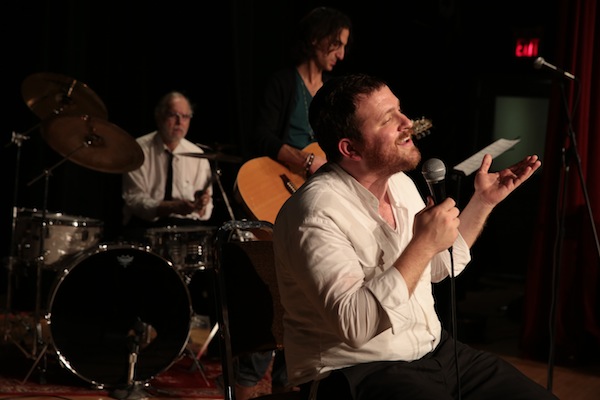
photo - Moshe Hecht and his band, from New York, kept the energy and excitement going way past the official end time
Moshe Hecht and his band, from New York, kept the energy and excitement going way past the official end time (photo by Alan Katowitz)

“Once I had lit the candles, I felt an amazing wave of peace,” said participant Barbara Weinberg. “Although at first I did miss that cellphone, we started playing board games and actually it was rather nice to be off the grid. In fact, after Havdalah, I felt reluctant to turn everything on! My daughter particularly enjoyed it, as she said that she liked that we spent so much time doing things together.”

The closing event – a Havdalah concert – brought a capacity crowd to the JCCGV auditorium for a night of music, dance and Jewish celebration. Moshe Hecht and his band, from New York, kept the energy and excitement going way past the official end time. A perfect end to an amazing Shabbat.

Canada hosts Limmud FSU

Left to right: Chaim Chesler, Diane Wohl, Matthew Bronfman and Sandra Cahn. (photo by Yossi Aloni)

Canadian Member of Parliament Irwin Cotler said the country needs to toughen security measures against terrorism, while preserving the nation’s democratic freedoms. Cotler addressed the recent attacks in Canada in remarks to some 500 Russian-speaking Jews participating in the inaugural Limmud FSU Canada, a dynamic and pluralistic Jewish festival of learning, culture and creativity.

Cotler, a Canadian Jewish leader and human rights activist who served as the honorary chair of Limmud FSU Canada, spoke alongside such public figures as Limor Livnat, Israel’s minister of culture and sport; Rabbi Shmuley Boteach, bestselling author and media personality; entrepreneur Marat Ressin; Matthew Bronfman, Limmud FSU chair; Chaim Chesler, founder of Limmud FSU; and Sandra Cahn, co-founder.

“Canada is a country that takes pride in its openness, freedom and democracy but, at this point, the Canadian government needs to take the right measures to ensure that it remains not only peaceful but also secured in a way that we combat the threats,” said Cotler. “Security has to be expanded, but not at the expense of freedom. We need to protect democracy, but also to protect our citizens,” he added.

Livnat added: “I salute the prime minister of Canada on his strong support of Israel. The recent terrorist event in Ottawa was not only directed against the Canadian Parliament, it was also directed against the democracies of the free world.”

Limmud FSU Canada, in collaboration with UJA-Federation of Greater Toronto and Jewish Agency for Israel, took place Oct. 25-27 at the Deerhurst Resort in Huntsville, Ont., site of the 2010 G8 Summit. Limmud FSU Canada offered a wide array of sessions, from Not Just ISIS and Hamas: The Threat of Islamic Radicalization on Israel and on the Western World, to Canadian Jews: A Unique Community or Just American Jews in the Making? Other sessions focused on the crisis in Ukraine, Jewish life in the Russian Empire, the Russian-speaking Jewish elite in Russia, and such esoteric topics as The Shadchan: The Art of Jewish Matchmaking, and a kosher wine workshop. Limmud FSU Canada also featured nature walks, theatre and programs for children.

This was the first time the global conference for Russian-speaking Jews was held in Canada, home to about 330,000 Jews, including an estimated 70,000-plus Russian speakers, many in the Greater Toronto area. The contemporary Russian-speaking Jewish community in Canada – among the centres of Russian-Jewish immigration globally – is shaped by three waves of immigration, starting with the major exodus of Jews from the Soviet Union in the 1970s and 1980s, Jews from countries of the former Soviet Union, including those who first went to Israel, between 1990 and 2001, and since then those who first immigrated to Israel in the 1990s. A large percentage, nearly 220,000, of the country’s overall Jewish population lives in the Greater Toronto Area, including about 20,000-30,000 Israelis.

Now, Canadian Russian-speaking Jews are seeking to develop their own conference, geared to this unique community. Local community organizers include conference co-chairs Karina Rondberg and Leon Martynenko, chair of the governing council Galina Sandler, and council members Julia Koschitzky and Shoel Silver.

JSA forum on mental health

At the recent Jewish Seniors Alliance of Greater Vancouver fall symposium, left to right: Peggy Casey, Lorilee Mallek, Nora Paul, Mark Godfrey and Grace Hann. (photo by Binny Goldman)

A capacity crowd of 175 gathered at the Peretz Centre for Secular Jewish Culture on Sunday, Oct. 26, to learn more about mental health and wellness, the topic of this year’s Jewish Seniors Alliance of Greater Vancouver fall symposium.

JSA president Marilyn Berger opened the session by asking the audience to rise in the name of mental health and to honor the soldiers who had lost their lives that week in Canada. This was followed by O Canada, led by Barbara Bronstein and Debbie Cossover, with Claire Cohen joining them in the singing of Hatikvah, and Marshall Berger accompanying on piano.

Gyda Chud introduced herself and co-convener Bev Cooper, and proceeded to inform those in attendance of the various projects that are JSA’s main concerns: advocacy, Senior Line Magazine, peer support counseling and the Empowerment Series. She went on to explain that the day’s topic had been chosen by attendees at past events, via the evaluation cards they had filled out citing this issue as a particular interest.

Cooper introduced the first speaker and the panel moderator, Dr. Penny MacCourt, past president of the B.C. Psychogeriatric Association, who admitted that she, too, will become a senior this summer.

MacCourt said that mental health is often equated with mental illness but that they are not the same thing. She emphasized the need to teach people ways in which to cope in the face of adversity; to help moderate the impact of stress, and facilitate social and emotional well-being. We as a society need to provide supportive living shelters, and continuous inclusiveness and access to such services, she said.

Help should be provided to those in need to maintain self-esteem and achieve effective coping strategies, she added, as these are the “protective factors” that can ease or ward off risks, including social isolation, limited income, loneliness, challenging life transitions, and lack of meaningful activity.

Dr. Martha Donnelly spoke next. At one time the director of the division of geriatric psychiatry at the University of British Columbia and a leader in the development of guidelines for geriatric mental health practice, she outlined some “red flag” symptoms of depression: appetite disturbance, loss of weight, early morning wakefulness, lower energy, and wishing life were over. The highest rate of suicide is in the senior years, she said.

One of Donnelly’s patients, Don Carroll, a very young 82, offered the audience a glimpse into his former work life, which included being an instrumental part of TV shows such as Mr. Dress Up and The Friendly Giant, and his subsequent descent into a depression from which he could not emerge on his own. With Donnelly’s continuing help, Carroll has returned to being an outgoing, fun, contributing person; a difficult journey for him, his supportive wife, Nancy, and family. It took resolute determination on all their parts to get Carroll to where he is now – off any medication and sharing with others his belief that one can heal with the correct diagnosis, therapy, doctor and support, to regain the ability to rely on oneself. The process was slow, including group therapy, daily exercise, medication and “thought catching,” tossing out negative thoughts before they take hold.

Grace Hann, who is currently working with JSA as a trainer and supervisor of peer support services, acknowledged JSA president emeritus Serge Haber for his vision to initiate the peer services as a vital project of JSA.

Hann is president of Senior Peer Counseling of British Columbia and on the YWCA board of the Community Action on Elder Abuse Project. She explained that it takes a peer to fully comprehend the feelings one is experiencing, such as loss of a loved one, age-related challenges, relocation, family discord – all situations that need empathy, which she described as “echoes of another person in ourselves.”

Hann called upon three graduates of JSA’s program to do role-playing, one of the methods used in the 55-hour course in peer counseling. They performed skits depicting examples of exchanges between clients and counselors at Week 1 and in Week 54. It showed the process through which the trainees had gone and from which they had grown from the initial expectations of their own abilities and finally gaining the knowledge and understanding of how to deal with the challenges clients face, such as loss of vision, a loved one and/or freedom and independence.

Trainees are taught to not use JAR: judgment, advice or rescue. Rather, counselors employ the three Es: empowerment, empathy and emotion. Both clients and counselors have benefited from the interactive sessions, said Hann, noting that there is a waiting list.

Hann then introduced a special guest, Tanja, 91, who, when Denmark was invaded by the Germans, secretly and at high risk to herself, helped Jewish adults and children escape to Sweden. Tanja shared that one of her most gratifying moments was witnessing the uniting of a mother with her child in a kindergarten when the war was over. She also shared that, many years later, here in Canada, when she was ill with cancer and reached out for help, she received empathy and understanding. Tanja was given a standing ovation by those attending, many of whom had been moved to tears listening to her.

The symposium came to a close with Berger thanking the speakers, presenting them with gift certificates. She made special mention of the co-conveners as well as JSA coordinator Karon Shear and the entire symposium committee for putting together such a successful event.

Refreshments and discussions followed. The audience left with much to contemplate but assured in the knowledge of where and to whom to turn should the need arise.

Binny Goldman is a member of the Jewish Seniors Alliance of Greater Vancouver board.


Meet your next mayor

Benjamin Mintzberg and Clementina Tai at CJPAC’s mayoral event. (photo from Canadian Jewish Political Affairs Committee)

On Oct. 7, CJPAC (Canadian Jewish Political Affairs Committee) hosted Vancouver Connect: Meet Your Next Mayor at Congregation Beth Israel. The event brought together more than 100 community members of all ages and mayoral candidates and their representatives in advance of the upcoming Vancouver municipal election.

“Vancouver Connect really provided us the opportunity to engage with the candidates and hear their take on municipal issues,” said participant Michael Schwartz. “The intimate atmosphere allowed us to ask questions about some of the larger issues facing Vancouver, such as transit and recycling, but also engage with issues that may be unique to the Jewish community in the city.”

During the first part of the evening, participants were arranged in small groups and met with individual candidates for a group discussion, and question and answer period. Candidates/representatives for this part of the evening included Councilor Geoff Meggs (Vision Vancouver), mayoral candidate Kirk LaPointe (NPA) and mayoral candidate Meena Wong (COPE).

The second part of the evening included networking between participants and candidates/representatives, including candidates and staff from the Bob Kasting mayoral campaign, the Cedar Party and Green Party of Vancouver, with regrets from the Colin Shandler mayoral campaign.

Tyler Golden, one of the evening’s moderators, noted that “encouraging involvement and engagement in the political process is crucial; especially within the pro-Israel and Jewish community. The excitement and energy in the room was really inspiring.”

Events such as these are a key part of CJPAC’s mandate to mobilize and engage Jewish and pro-Israel Canadians in the democratic process and increase political participation. CJPAC is dedicated to helping members of the community build relationships with elected officials at all levels of government, and those within the Canadian political arena.

CJPAC’s recently opened office in British Columbia will be hosting several events over the next few months, starting with its Women in Politics evening taking place on Nov. 13, 7-9 p.m., at Congregation Schara Tzedeck. Advance registration is required. To register for this event, or to learn more about how to become a volunteer with the campaign of your choice, contact Kara Mintzberg, CJPAC B.C. regional director, at kmintzberg@cjpac.ca or 778-903-1854. The Vancouver municipal election is on Nov. 15.

B-Shoe helps with stability, balance

The B-Shoe prototype. (photo from b-shoe.com)

While observing his elderly father, Yonatan Manor, a chemical engineer from Haifa, decided to create a shoe to help prevent falls, an all too common danger faced by the elderly.

Manor’s father was often losing his balance when trying to go backwards, using his four-legged walker. “One Saturday morning, I was sitting at breakfast with my wife and told her I wished I had an idea to prevent him from falling,” said Manor. “It was like a joke, as I know mechanics and it’s not simple to build a machine strong enough to balance a person.”

Manor recalled, “My father would stand on his heels and then I’d have to push him forward, back to a balanced position.” Considering what type of shoe could help solve the problem, Manor said, “If the shoe was moving backward, it would do the same thing,” meaning it would restore a person’s balanced position. Manor went on to build a pre-prototype, a mechanical tool with a small motor and batteries, which he inserted into a shoe.

“This makes it so you can’t lose balance in the backward direction,” said the inventor. “You lean backward and then you find you’re standing straight again, and the shoe doesn’t have to move much, only the [length] of the heel. It’s only five centimetres, enough to do the job. It doesn’t push you, give the feeling of something moving under the leg or give the feeling that you may lose balance.”

Manor said the shoe, which has been dubbed the “B-Shoe,” is designed for walking around at home. When an elder does venture out, someone else should still provide some accompaniment.

When Manor reached the point when he knew he needed some business support to get his invention to the market, he turned to Abraham Stamper, a friend and retired scientist. Stamper became the chief executive officer of B-Shoe Technologies Ltd., established in 2011.

Manor and Stamper were able to develop a business plan and a working prototype with the initial money they raised. They also had the help of the government agency overseeing the high-tech industry for their efforts in the field.

“We’re in the phase of looking for funds for the investment of this next stage … developing the product ready for mass production,” said Manor. “Right now, it is just a generic prototype. Once we have the funds, it will likely take about 18 months to get it to market.”

When it came to developing the B-Shoe, Manor said the electronic and structural aspects were fairly straightforward. “The electro-mechanical solution is a bit smart and difficult,” said Manor. “We need to do it in low volume and low weight. The electro-mechanical mechanism was the main development obstacle.”

As far as retail cost, Manor anticipates the shoe will be within the range of other high-end tailor-made comfort or orthopedic shoes, which is about $500 to $1,000 US per pair (which will be available at a store from a distributor).

“We believe people who begin feeling like they’re losing balance or who’ve already fallen or suffered a near-fall will ask their GP or neurologist what to do and how to protect themselves,” said Manor. “Our vision is that medical professionals will then point the patient to the B-Shoe. Right now, people are most often recommended to use a walker or cane – but many people refuse to do so. The B-Shoe will be the better alternative.

“The shoe’s innovation isn’t about the shoe itself, but the fall-prevention mechanism, which can be embedded into the sole of any conventional flat walking shoe – so there will be a wide variety of shoes for both men and women.

“B-Shoe’s project addresses an annual global market of about 14 billion U.S. dollars.”

Dr. Stephen Rabinovitch, professor and Canada Research Chair at Simon Fraser University in the department of biomedical physiology and kinesiology and the School of Engineering Science, is well-versed on falls and balance in older adults.

After having reviewed the information on the B-Shoe website, Rabinovitch said, “It’s an interesting concept, but is in [a] very early stage of development and evaluation. We don’t know anything yet on its effectiveness in improving balance and mobility and preventing falls in older adults. Right now, the B-Shoe device focuses only on preventing backward falls, but falls occur in different directions.”

According to Rabinovitch, falls are the number one cause of injuries in seniors, including 95 percent of hip fractures and 60 percent of traumatic brain injuries. “So, even a moderate reduction in falls would carry significant social and economic benefits,” he said.

“Falls are challenging to prevent, as there are a wide range of risk factors, such as reductions in physical and cognitive function, diseases, use of psychoactive medications, reductions in sensory function and muscle weakness.

“It’s often difficult to think about prevention until falls start occurring, but it’s important for people to exercise throughout their lifespan, and to focus on both their strength (through resistance training) and their agility and balance (through walking, hiking and approaches like Tai Chi). A current buzz phrase is ‘exercise is medicine,’ which is certainly appropriate with regard to mobility and falls.”

Rebeca Kuropatwa is a Winnipeg freelance writer.

Creepy, well-crafted thriller

In her film The German Doctor, Lucia Puenzo tries to capture Josef Mengele’s “very sociopathic, complex personality.” (photo from Vancouver Jewish Film Festival)

As a high school student in the 1990s, Lucia Puenzo was fascinated and mystified by an open secret: hundreds of Nazi war criminals found refuge in her native Argentina.

“I was intrigued that so many families knew what was going on because they had a German man on their block or somewhere in their neighborhood,” recalled the acclaimed novelist and filmmaker. “Maybe they didn’t know so much in the ’60s and ’70s but, by the ’80s or ’90s, everybody knew. How could they not open their mouths and say what happened? It had a lot of echoes of our military coup d’etat, where so many Argentine families didn’t speak out.”

In her 2011 novel Wakolda, Puenzo explored the devious machinations of a German doctor in the Patagonian town of Bariloche circa 1960 who befriends a young girl. The erstwhile physician injects her with growth hormones before turning his attention to her pregnant mother, distracting the suspicious father with a plan to mass-market his handmade dolls.

Puenzo adapted the novel for the screen, shifting the point of view from the doctor to the child. The German Doctor, which swept Argentina’s major film awards and was the country’s official submission for last year’s Oscar for best foreign language film, is a creepy, precisely crafted thriller made more unsettling by its restraint. It screens Nov. 12 in the Vancouver Jewish Film Festival.

At 37, Puenzo has already published five widely translated novels and directed three singular films, including XXY, her prize-winning tale of an intersex teenager. Smart and fearless, she is attracted to subjects that others find off-limits or taboo – like the Nazi presence in Argentina.

“For me, the big mystery has always been why this subject, that could be a hundred films and a hundred novels, has never been taken to film before,” she explained in a long-distance phone interview. “We have maybe a few excellent documentaries on the subject but not one fiction film, and maybe we have five or six novels, and that’s all speaking about the subject.”

The German Doctor did solid box office in Argentina, which Puenzo sees as confirmation of pent-up interest. The film has been released in dozens of countries, including several European nations.

The film succinctly illustrates how a cautious physician who adults would view with suspicion, let’s call him Josef Mengele, could win a child’s trust.

“In the camps, there were so many horrible testimonies of how kids would call him Uncle Mengele. He would have sweets to give to the children and then he would take them to his experiments,” Puenzo said.

The German Doctor captures that deviousness and single-mindedness, while persuasively depicting the polite veneer Mengele devised to mask his lunacy and deceive people.

“After the war, after the concentration camps, he disguised himself as this very civilized, seductive, enchanting man that lived for decades in three countries of Latin America without anybody suspecting who he was,” Puenzo said. “I think that’s how you have to portray this very sociopathic, complex personality who disguised himself. He was not the stereotype of the bad guy whom you could see coming.”

Puenzo comes across as earnest and serious but, befitting someone with a master’s degree in literature and critical theory, she recognizes the relationship between pop culture and popular perceptions of history.

“I remember films like The Boys of Brazil,” she said. “I loved it in a way, it’s such a strange film, but at the same time it’s a stereotype of Mengele. I think to honor these most horrific monsters, you really have to show them in all their complexity. They were much more dangerous than we think.”

The German Doctor is in Spanish and German with English subtitles; it is rated PG-13 for thematic material and brief nudity. For the full schedule of this year’s VJFF, which started Nov. 6, visit vjff.org.

Michael Fox is a writer and film critic living in San Francisco.