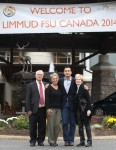
Left to right: Chaim Chesler, Diane Wohl, Matthew Bronfman and Sandra Cahn. (photo by Yossi Aloni)
Canadian Member of Parliament Irwin Cotler said the country needs to toughen security measures against terrorism, while preserving the nation’s democratic freedoms. Cotler addressed the recent attacks in Canada in remarks to some 500 Russian-speaking Jews participating in the inaugural Limmud FSU Canada, a dynamic and pluralistic Jewish festival of learning, culture and creativity.
Cotler, a Canadian Jewish leader and human rights activist who served as the honorary chair of Limmud FSU Canada, spoke alongside such public figures as Limor Livnat, Israel’s minister of culture and sport; Rabbi Shmuley Boteach, bestselling author and media personality; entrepreneur Marat Ressin; Matthew Bronfman, Limmud FSU chair; Chaim Chesler, founder of Limmud FSU; and Sandra Cahn, co-founder.
“Canada is a country that takes pride in its openness, freedom and democracy but, at this point, the Canadian government needs to take the right measures to ensure that it remains not only peaceful but also secured in a way that we combat the threats,” said Cotler. “Security has to be expanded, but not at the expense of freedom. We need to protect democracy, but also to protect our citizens,” he added.
Livnat added: “I salute the prime minister of Canada on his strong support of Israel. The recent terrorist event in Ottawa was not only directed against the Canadian Parliament, it was also directed against the democracies of the free world.”
Limmud FSU Canada, in collaboration with UJA-Federation of Greater Toronto and Jewish Agency for Israel, took place Oct. 25-27 at the Deerhurst Resort in Huntsville, Ont., site of the 2010 G8 Summit. Limmud FSU Canada offered a wide array of sessions, from Not Just ISIS and Hamas: The Threat of Islamic Radicalization on Israel and on the Western World, to Canadian Jews: A Unique Community or Just American Jews in the Making? Other sessions focused on the crisis in Ukraine, Jewish life in the Russian Empire, the Russian-speaking Jewish elite in Russia, and such esoteric topics as The Shadchan: The Art of Jewish Matchmaking, and a kosher wine workshop. Limmud FSU Canada also featured nature walks, theatre and programs for children.
This was the first time the global conference for Russian-speaking Jews was held in Canada, home to about 330,000 Jews, including an estimated 70,000-plus Russian speakers, many in the Greater Toronto area. The contemporary Russian-speaking Jewish community in Canada – among the centres of Russian-Jewish immigration globally – is shaped by three waves of immigration, starting with the major exodus of Jews from the Soviet Union in the 1970s and 1980s, Jews from countries of the former Soviet Union, including those who first went to Israel, between 1990 and 2001, and since then those who first immigrated to Israel in the 1990s. A large percentage, nearly 220,000, of the country’s overall Jewish population lives in the Greater Toronto Area, including about 20,000-30,000 Israelis.
Now, Canadian Russian-speaking Jews are seeking to develop their own conference, geared to this unique community. Local community organizers include conference co-chairs Karina Rondberg and Leon Martynenko, chair of the governing council Galina Sandler, and council members Julia Koschitzky and Shoel Silver.
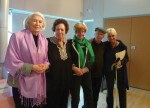
At the recent Jewish Seniors Alliance of Greater Vancouver fall symposium, left to right: Peggy Casey, Lorilee Mallek, Nora Paul, Mark Godfrey and Grace Hann. (photo by Binny Goldman)
A capacity crowd of 175 gathered at the Peretz Centre for Secular Jewish Culture on Sunday, Oct. 26, to learn more about mental health and wellness, the topic of this year’s Jewish Seniors Alliance of Greater Vancouver fall symposium.
JSA president Marilyn Berger opened the session by asking the audience to rise in the name of mental health and to honor the soldiers who had lost their lives that week in Canada. This was followed by O Canada, led by Barbara Bronstein and Debbie Cossover, with Claire Cohen joining them in the singing of Hatikvah, and Marshall Berger accompanying on piano.
Gyda Chud introduced herself and co-convener Bev Cooper, and proceeded to inform those in attendance of the various projects that are JSA’s main concerns: advocacy, Senior Line Magazine, peer support counseling and the Empowerment Series. She went on to explain that the day’s topic had been chosen by attendees at past events, via the evaluation cards they had filled out citing this issue as a particular interest.
Cooper introduced the first speaker and the panel moderator, Dr. Penny MacCourt, past president of the B.C. Psychogeriatric Association, who admitted that she, too, will become a senior this summer.
MacCourt said that mental health is often equated with mental illness but that they are not the same thing. She emphasized the need to teach people ways in which to cope in the face of adversity; to help moderate the impact of stress, and facilitate social and emotional well-being. We as a society need to provide supportive living shelters, and continuous inclusiveness and access to such services, she said.
Help should be provided to those in need to maintain self-esteem and achieve effective coping strategies, she added, as these are the “protective factors” that can ease or ward off risks, including social isolation, limited income, loneliness, challenging life transitions, and lack of meaningful activity.
Dr. Martha Donnelly spoke next. At one time the director of the division of geriatric psychiatry at the University of British Columbia and a leader in the development of guidelines for geriatric mental health practice, she outlined some “red flag” symptoms of depression: appetite disturbance, loss of weight, early morning wakefulness, lower energy, and wishing life were over. The highest rate of suicide is in the senior years, she said.
One of Donnelly’s patients, Don Carroll, a very young 82, offered the audience a glimpse into his former work life, which included being an instrumental part of TV shows such as Mr. Dress Up and The Friendly Giant, and his subsequent descent into a depression from which he could not emerge on his own. With Donnelly’s continuing help, Carroll has returned to being an outgoing, fun, contributing person; a difficult journey for him, his supportive wife, Nancy, and family. It took resolute determination on all their parts to get Carroll to where he is now – off any medication and sharing with others his belief that one can heal with the correct diagnosis, therapy, doctor and support, to regain the ability to rely on oneself. The process was slow, including group therapy, daily exercise, medication and “thought catching,” tossing out negative thoughts before they take hold.
Grace Hann, who is currently working with JSA as a trainer and supervisor of peer support services, acknowledged JSA president emeritus Serge Haber for his vision to initiate the peer services as a vital project of JSA.
Hann is president of Senior Peer Counseling of British Columbia and on the YWCA board of the Community Action on Elder Abuse Project. She explained that it takes a peer to fully comprehend the feelings one is experiencing, such as loss of a loved one, age-related challenges, relocation, family discord – all situations that need empathy, which she described as “echoes of another person in ourselves.”
Hann called upon three graduates of JSA’s program to do role-playing, one of the methods used in the 55-hour course in peer counseling. They performed skits depicting examples of exchanges between clients and counselors at Week 1 and in Week 54. It showed the process through which the trainees had gone and from which they had grown from the initial expectations of their own abilities and finally gaining the knowledge and understanding of how to deal with the challenges clients face, such as loss of vision, a loved one and/or freedom and independence.
Trainees are taught to not use JAR: judgment, advice or rescue. Rather, counselors employ the three Es: empowerment, empathy and emotion. Both clients and counselors have benefited from the interactive sessions, said Hann, noting that there is a waiting list.
Hann then introduced a special guest, Tanja, 91, who, when Denmark was invaded by the Germans, secretly and at high risk to herself, helped Jewish adults and children escape to Sweden. Tanja shared that one of her most gratifying moments was witnessing the uniting of a mother with her child in a kindergarten when the war was over. She also shared that, many years later, here in Canada, when she was ill with cancer and reached out for help, she received empathy and understanding. Tanja was given a standing ovation by those attending, many of whom had been moved to tears listening to her.
The symposium came to a close with Berger thanking the speakers, presenting them with gift certificates. She made special mention of the co-conveners as well as JSA coordinator Karon Shear and the entire symposium committee for putting together such a successful event.
Refreshments and discussions followed. The audience left with much to contemplate but assured in the knowledge of where and to whom to turn should the need arise.
Binny Goldman is a member of the Jewish Seniors Alliance of Greater Vancouver board.
Benjamin Mintzberg and Clementina Tai at CJPAC’s mayoral event. (photo from Canadian Jewish Political Affairs Committee)
On Oct. 7, CJPAC (Canadian Jewish Political Affairs Committee) hosted Vancouver Connect: Meet Your Next Mayor at Congregation Beth Israel. The event brought together more than 100 community members of all ages and mayoral candidates and their representatives in advance of the upcoming Vancouver municipal election.
“Vancouver Connect really provided us the opportunity to engage with the candidates and hear their take on municipal issues,” said participant Michael Schwartz. “The intimate atmosphere allowed us to ask questions about some of the larger issues facing Vancouver, such as transit and recycling, but also engage with issues that may be unique to the Jewish community in the city.”
During the first part of the evening, participants were arranged in small groups and met with individual candidates for a group discussion, and question and answer period. Candidates/representatives for this part of the evening included Councilor Geoff Meggs (Vision Vancouver), mayoral candidate Kirk LaPointe (NPA) and mayoral candidate Meena Wong (COPE).
The second part of the evening included networking between participants and candidates/representatives, including candidates and staff from the Bob Kasting mayoral campaign, the Cedar Party and Green Party of Vancouver, with regrets from the Colin Shandler mayoral campaign.
Tyler Golden, one of the evening’s moderators, noted that “encouraging involvement and engagement in the political process is crucial; especially within the pro-Israel and Jewish community. The excitement and energy in the room was really inspiring.”
Events such as these are a key part of CJPAC’s mandate to mobilize and engage Jewish and pro-Israel Canadians in the democratic process and increase political participation. CJPAC is dedicated to helping members of the community build relationships with elected officials at all levels of government, and those within the Canadian political arena.
CJPAC’s recently opened office in British Columbia will be hosting several events over the next few months, starting with its Women in Politics evening taking place on Nov. 13, 7-9 p.m., at Congregation Schara Tzedeck. Advance registration is required. To register for this event, or to learn more about how to become a volunteer with the campaign of your choice, contact Kara Mintzberg, CJPAC B.C. regional director, at kmintzberg@cjpac.ca or 778-903-1854. The Vancouver municipal election is on Nov. 15.
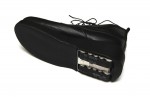
While observing his elderly father, Yonatan Manor, a chemical engineer from Haifa, decided to create a shoe to help prevent falls, an all too common danger faced by the elderly.
Manor’s father was often losing his balance when trying to go backwards, using his four-legged walker. “One Saturday morning, I was sitting at breakfast with my wife and told her I wished I had an idea to prevent him from falling,” said Manor. “It was like a joke, as I know mechanics and it’s not simple to build a machine strong enough to balance a person.”
Manor recalled, “My father would stand on his heels and then I’d have to push him forward, back to a balanced position.” Considering what type of shoe could help solve the problem, Manor said, “If the shoe was moving backward, it would do the same thing,” meaning it would restore a person’s balanced position. Manor went on to build a pre-prototype, a mechanical tool with a small motor and batteries, which he inserted into a shoe.
“This makes it so you can’t lose balance in the backward direction,” said the inventor. “You lean backward and then you find you’re standing straight again, and the shoe doesn’t have to move much, only the [length] of the heel. It’s only five centimetres, enough to do the job. It doesn’t push you, give the feeling of something moving under the leg or give the feeling that you may lose balance.”
Manor said the shoe, which has been dubbed the “B-Shoe,” is designed for walking around at home. When an elder does venture out, someone else should still provide some accompaniment.
When Manor reached the point when he knew he needed some business support to get his invention to the market, he turned to Abraham Stamper, a friend and retired scientist. Stamper became the chief executive officer of B-Shoe Technologies Ltd., established in 2011.
Manor and Stamper were able to develop a business plan and a working prototype with the initial money they raised. They also had the help of the government agency overseeing the high-tech industry for their efforts in the field.
“We’re in the phase of looking for funds for the investment of this next stage … developing the product ready for mass production,” said Manor. “Right now, it is just a generic prototype. Once we have the funds, it will likely take about 18 months to get it to market.”
When it came to developing the B-Shoe, Manor said the electronic and structural aspects were fairly straightforward. “The electro-mechanical solution is a bit smart and difficult,” said Manor. “We need to do it in low volume and low weight. The electro-mechanical mechanism was the main development obstacle.”
As far as retail cost, Manor anticipates the shoe will be within the range of other high-end tailor-made comfort or orthopedic shoes, which is about $500 to $1,000 US per pair (which will be available at a store from a distributor).
“We believe people who begin feeling like they’re losing balance or who’ve already fallen or suffered a near-fall will ask their GP or neurologist what to do and how to protect themselves,” said Manor. “Our vision is that medical professionals will then point the patient to the B-Shoe. Right now, people are most often recommended to use a walker or cane – but many people refuse to do so. The B-Shoe will be the better alternative.
“The shoe’s innovation isn’t about the shoe itself, but the fall-prevention mechanism, which can be embedded into the sole of any conventional flat walking shoe – so there will be a wide variety of shoes for both men and women.
“B-Shoe’s project addresses an annual global market of about 14 billion U.S. dollars.”
Dr. Stephen Rabinovitch, professor and Canada Research Chair at Simon Fraser University in the department of biomedical physiology and kinesiology and the School of Engineering Science, is well-versed on falls and balance in older adults.
After having reviewed the information on the B-Shoe website, Rabinovitch said, “It’s an interesting concept, but is in [a] very early stage of development and evaluation. We don’t know anything yet on its effectiveness in improving balance and mobility and preventing falls in older adults. Right now, the B-Shoe device focuses only on preventing backward falls, but falls occur in different directions.”
According to Rabinovitch, falls are the number one cause of injuries in seniors, including 95 percent of hip fractures and 60 percent of traumatic brain injuries. “So, even a moderate reduction in falls would carry significant social and economic benefits,” he said.
“Falls are challenging to prevent, as there are a wide range of risk factors, such as reductions in physical and cognitive function, diseases, use of psychoactive medications, reductions in sensory function and muscle weakness.
“It’s often difficult to think about prevention until falls start occurring, but it’s important for people to exercise throughout their lifespan, and to focus on both their strength (through resistance training) and their agility and balance (through walking, hiking and approaches like Tai Chi). A current buzz phrase is ‘exercise is medicine,’ which is certainly appropriate with regard to mobility and falls.”
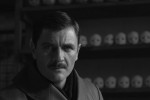
In her film The German Doctor, Lucia Puenzo tries to capture Josef Mengele’s “very sociopathic, complex personality.” (photo from Vancouver Jewish Film Festival)
As a high school student in the 1990s, Lucia Puenzo was fascinated and mystified by an open secret: hundreds of Nazi war criminals found refuge in her native Argentina.
“I was intrigued that so many families knew what was going on because they had a German man on their block or somewhere in their neighborhood,” recalled the acclaimed novelist and filmmaker. “Maybe they didn’t know so much in the ’60s and ’70s but, by the ’80s or ’90s, everybody knew. How could they not open their mouths and say what happened? It had a lot of echoes of our military coup d’etat, where so many Argentine families didn’t speak out.”
In her 2011 novel Wakolda, Puenzo explored the devious machinations of a German doctor in the Patagonian town of Bariloche circa 1960 who befriends a young girl. The erstwhile physician injects her with growth hormones before turning his attention to her pregnant mother, distracting the suspicious father with a plan to mass-market his handmade dolls.
Puenzo adapted the novel for the screen, shifting the point of view from the doctor to the child. The German Doctor, which swept Argentina’s major film awards and was the country’s official submission for last year’s Oscar for best foreign language film, is a creepy, precisely crafted thriller made more unsettling by its restraint. It screens Nov. 12 in the Vancouver Jewish Film Festival.
At 37, Puenzo has already published five widely translated novels and directed three singular films, including XXY, her prize-winning tale of an intersex teenager. Smart and fearless, she is attracted to subjects that others find off-limits or taboo – like the Nazi presence in Argentina.
“For me, the big mystery has always been why this subject, that could be a hundred films and a hundred novels, has never been taken to film before,” she explained in a long-distance phone interview. “We have maybe a few excellent documentaries on the subject but not one fiction film, and maybe we have five or six novels, and that’s all speaking about the subject.”
The German Doctor did solid box office in Argentina, which Puenzo sees as confirmation of pent-up interest. The film has been released in dozens of countries, including several European nations.
The film succinctly illustrates how a cautious physician who adults would view with suspicion, let’s call him Josef Mengele, could win a child’s trust.
“In the camps, there were so many horrible testimonies of how kids would call him Uncle Mengele. He would have sweets to give to the children and then he would take them to his experiments,” Puenzo said.
The German Doctor captures that deviousness and single-mindedness, while persuasively depicting the polite veneer Mengele devised to mask his lunacy and deceive people.
“After the war, after the concentration camps, he disguised himself as this very civilized, seductive, enchanting man that lived for decades in three countries of Latin America without anybody suspecting who he was,” Puenzo said. “I think that’s how you have to portray this very sociopathic, complex personality who disguised himself. He was not the stereotype of the bad guy whom you could see coming.”
Puenzo comes across as earnest and serious but, befitting someone with a master’s degree in literature and critical theory, she recognizes the relationship between pop culture and popular perceptions of history.
“I remember films like The Boys of Brazil,” she said. “I loved it in a way, it’s such a strange film, but at the same time it’s a stereotype of Mengele. I think to honor these most horrific monsters, you really have to show them in all their complexity. They were much more dangerous than we think.”
The German Doctor is in Spanish and German with English subtitles; it is rated PG-13 for thematic material and brief nudity. For the full schedule of this year’s VJFF, which started Nov. 6, visit vjff.org.
Michael Fox is a writer and film critic living in San Francisco.
Michael and Phyllis Moscovich in Cuba. (photo from Jewish Federation of Greater Vancouver)
When community lay leaders Michael and Phyllis Moscovich were planning their most recent mission trip, they never imagined discovering Jewish ties to former Cuban president Fidel Castro, and the vibrant community that exists on the island.
Michael, a committed volunteer with Jewish Federation and a board member for several years, is currently a member of Federation’s Israel and overseas affairs committee, as well as its Partnership2Gether committee. He and Phyllis also jointly chair the Ethiopian students internship program. The couple’s shared passion for travel and interest in Jewry across the Diaspora has motivated them to participate in nine previous Federation missions. Last October, they participated in their first American Jewish Joint Distribution Committee (JDC) mission to Havana, with a group of like-minded community members from North Carolina.
“I wanted to see Cuba before the regime changed and am always interested in Jewish communities elsewhere,” explained Michael.
JDC missions provide participants with a highly personal perspective on daily life for Jews and others in more than 70 countries in which JDC operates.
Cuban Jews have lived on the island for centuries, some tracing their ancestry as far back as the late 15th century to “anusim” who fled the Spanish Inquisition. In a February 2007 story, the New York Times estimated that there were about 1,500 identified Jews living in Cuba, most of them (about 1,100) living in Havana. The article added, “This small Jewish presence [in 2007] is in stark contrast to the bustling community that existed before Fidel Castro came to power in 1959. In those days, there were 15,000 Jews and five synagogues in Havana alone.”
JDC’s re-entry into Cuba in 1991 has sparked a Jewish resurgence on the island and a growing awareness of the community and its rich history. As it does elsewhere across the globe, JDC, in partnership with the local community, provides assistance to Cuba’s Jews, develops Jewish leaders and has prompted a revitalization of Jewish life. Working with JDC, the community has established a Jewish summer camp, adult education, an Israeli dance festival and communal holiday celebrations.
The mission visited all the operating synagogues in Havana, the Jewish cemetery and all the major tourist sites. “We met several times with members of the community, highlighted for us by a lunch with an unassuming fellow who spoke little English,” shared Michael. “By the end of lunch, we had determined he had been Fidel’s personal bodyguard for over a decade.”
One of the more surprising revelations of the trip for Michael and Phyllis is that there never seems to have been overt antisemitism in Cuba. “Fidel never even knew our guy was Jewish, until he attended a Chanukah celebration at one of the synagogues where one of the members mentioned that his bodyguard was a synagogue member,” Michael remarked. Also noteworthy is the fact that the young people are allowed to make aliyah, when almost no one else is allowed exit visas.
The opportunity to immerse themselves in the community was enlightening. “My expectations were all met. Seeing Havana, [getting a taste of] the regime, getting a sense of what 45 years of communism can do to an otherwise colorful and vibrant country,” said Michael. More remarkable from his perspective was “seeing the Jewish community and how it is sustaining itself.”
Michael and Phyllis took away with them enduring memories of the tenacity of the Jewish community and the vibrancy of the entire population, despite the hardships the regime has brought on its people. “It was great to travel with similarly committed Jews, to see the great work JDC has done, to meet our brethren, to see again what communism does and doesn’t do, to see it crumbling however slowly,” Michael explained. “The experience re-confirmed my personal commitment to the community, here and overseas.”
Federation invites you to participate in a mission trip to Vienna, Budapest and Israel, with mission chairs Anita and Arnold Silber, from Oct. 11-22, 2015. Visit the Israel and Overseas Experiences page on Federation’s website (jewishvancouver.com) for more information about opportunities to visit Israel and experience Jewish life in communities around the world. You can also donate to this year’s campaign via the website.
– This article was originally published in eYachad, and is reprinted with permission.
Anne, left, and Eva Gitelman. (photo from Deborah Rubin Fields)
The things we take for granted. Today, we spend countless internet hours looking for someone (or something). We assume increasingly rapid communication systems will effectively power these searches. Yet, for Eva Poll and Anne Rosenthal Schiffman, my paternal grandmother’s nieces (my first cousins once removed), staying in touch was a tremendous undertaking.
Beginning in the mid-1920s and continuing for almost 70 years, these two sisters struggled to keep in contact with their three Pinsk siblings, once their orphanage had shipped them and 32 other Jewish orphans to adoptive Jewish families in the United Kingdom.
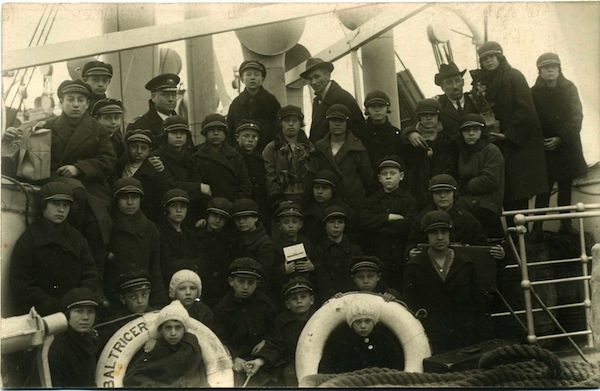
Pinsk’s orphaned children on the SS Baltricer, April 1926. (photo from Deborah Rubin Fields)
How did I piece together this faraway story of my Pinsk relatives? The truth is that until their death, my cousins Eva and Anne held on to letters, cards, diaries and photos from Pinsk (today a city in Belarus). Through these saved items, my family’s story emerges.
Eva was born in 1913 as Chaya. She was the fourth of five children born to Avrom and Shaina Basya Gitelman of Pinsk. Anne was born in 1916. She was named Chana. Their older siblings were Hershel, born 1906, Sarah Leah, born 1907, and Devorah, born 1909.
Prior to 1918, I know little about Eva and Anne’s life. But late that summer, both their parents died within weeks of each other. With their deaths so close together, the parents might have succumbed to either the influenza pandemic or to starvation (giving their five young children whatever food they had been able to scrounge). According to Azriel Shohet, author of The Jews of Pinsk, 1881-1941 (translated from the Hebrew by Faigie Tropper and Moshe Rosman, edited by Mark Jay Mirsky and Moshe Rosman), at the time, conditions in Pinsk were terrible.
Eva and Anne went to live in the Jewish orphanage at 2 Dominikanska St. It is not known how my older (but still quite young) cousins managed, either on their own or with assistance.
My paternal grandparents had just emigrated to Chicago but, somehow, they learned the children had been orphaned. My grandfather contacted the Joint Distribution Committee, asking for photos of the orphans. With eight of their own children, it is unlikely my grandparents were in a position to provide much assistance.
All I know is that by age 16 or 17, Sara Leah married Yisrael Kuper and that they quickly began their own family. Devorah began working in the Pinsk veneer factory and lived with the Kupers. At some point, Hershel married a woman named Faigel and became a father.
What I have learned through research is that the orphanage’s economic situation worsened in the early 1920s. Shohet writes that even though the staff took good care of the orphans, it sometimes had to feed the children hot bean cereal instead of bread. In August 1923, the orphanage sent the following “advertisement” [translated from Yiddish] to the Pinsker Relief Fund in London:
Chaya learns in the school and Chana Gitelman learnt dressmaking. In peacetime, they lived in a village near Pinsk. In the war, they became ruined. The parents died and the children were taken to an orphanage…. They … are good children and very diligent. (Courtesy of David Solly Sandler, author of The Life and Times of the Children from the Three Pinsk Jewish Orphanages in the 1920s)
By 1924, the two sisters and their orphaned friends knew they were candidates for adoption by Jewish families in Britain. In 1924, close to the time of Rosh Hashanah, a friend named Faigel Bambel wrote the following in Anne’s autograph book:
To remember To Chana Gitelman When you go away to a faraway land, don’t forget me…. Don’t forget how it was for you here where we were together. Today I send you my wishes, and I believe that we’ll remain good friends. (Yiddish translation by Amy Simon)
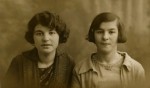
By 1926, the orphanage had found homes for Eva, Anne and 32 other orphans. A few months before departing Pinsk for the United Kingdom, the siblings had their last family photo taken. (For unknown reasons, Hershel and family are not in the picture.) At sailing, Eva was 13 years old and Anne was 10 years old. The sisters never saw Pinsk again.
While I never asked Eva or Anne about the psychological toll of leaving family, the onboard ship photo seems to indicate the difficulty of parting. Eva is the only child holding a suitcase. According to her nephew, Colin Schiffman, Eva saved all her Pinsk correspondences in this suitcase. Moreover, Eva kept the suitcase under her bed, taking it out to use as a writing table.
They were adopted by two different Jewish London families: Eva by the Polsky family (Eva later shortened her family name first to Pole, then to Poll) and Anne by the Rosenthal family. To their credit, these two families permitted the girls to maintain contact with one another, as seen in the lovely 1929 photo from their adolescence.
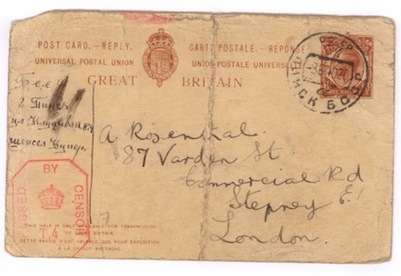
From saved correspondences, I discovered that until at least 1939, the sisters were in contact with the Pinsk part of the family. To insure responses to their letters, Eva and Anne purchased two-part (send-and-receive) international postal cards. One saved card already shows the Second World War censor stamp the British employed after declaring war on Germany.
Eva and Anne purchased send-and-receive international postal cards. This saved card, sent from Pinsk, shows the censor stamp the British employed after declaring war on Germany. (photo from Deborah Rubin Fields)
Anne must have told the Pinsk family about her plans to marry Bobby Schiffman on July 14, 1940, as brother Hershel sent a message: “Chana, how are you, what’s new with your wedding and with work? Regards to your parents and to your husband/groom.” Cousin Chaya wrote: “Regards to Chana and her husband.” Bobby and Anne had three sons: Alan, Stephen and Colin and eventually several grandchildren.
Eva chose to remain single. She had been engaged at least once, but did not go ahead with marriage because she had promised her Pinsk family she would always look after her little sister. Eva’s nephew Colin confirms that, by 1941, Eva was already living with the Schiffmans in London. Colin recalls that, as a young woman, Eva led a busy social life. For most of Eva’s working life she was the final quality-control person at the clothing factories at which she worked (and she sent back many items!).
After the Second World War and for the next 50 years, Eva searched for family, but kept her feelings to herself. As such, she never revealed how much emotional or physical energy it demanded to send numerous handwritten letters to Jewish newspapers, to the Hebrew Immigrant Aid Society, to the JDC, to Yad Vashem. Just as important, she never divulged how hard it was waiting for replies. While she found relatives in such far-flung places as the United States and Argentina, she unfortunately discovered no Pinsk family member had survived the Nazi onslaught.
With Yiddish-speaking relatives, the sisters communicated in (both written and spoken) Yiddish, but together they conversed in English. As the years went by, the two sisters seemed to enjoy a quiet life of working in the family’s Newbury Park house and garden, taking care of Colin, Bobby and the family cat, and, importantly, keeping each other company.
Anne died in August 1995. Eva died in April 2001. Despite trying childhoods, a difficult passage from one country to another and an upbringing in two different homes, until the end, the two sisters remained tremendously devoted to each other.
In the macro, their cherished papers provide an eye-opening glimpse of one corner of early 20th-century Eastern European Jewry. In the micro, they open a fascinating window to the lives lived by some of my relatives, lives marked by separation, on the one hand, and continuity, on the other.
Deborah Rubin Fieldsis an Israel-based features writer. She is also the author of Take a Peek Inside: A Child’s Guide to Radiology Exams, published in English, Hebrew and Arabic.
When I lived in New York for 10 years in the 1960s, going to the Lower East Side was a very regular part of my Sunday routine. However, while the name Yonah Schimmel might sound familiar to anyone traveling the same circuit during that time, regrettably, I never came across Mrs. Stahl. That’s because knishes were not part of my regular eating regimen.
That said, being a food writer and cookbook author, Knish (Brandeis, 2014) by Laura Silver was a fascinating read – because I learned more about the “pillow of filling tucked into a skin of dough” – but even more so because I learned about Silver’s favorite source of knishes: Mrs. Stahl in Brooklyn’s Brighton Beach neighborhood. When Mrs. Stahl went out of business, Silver’s “mourning” took the form of her search for “Jewish soul food.”
Silver has written on food and culture for the New York Times and the Forward, and she is the author of what her publisher calls “the one and only absolutely definitive biography of the knish,” making her the world de facto authority on the Jewish pastry.
Mrs. Stahl’s produced “baked round mounts, each plump with a stuffing, savory or sweet. Each piece – the size of a fist or just bigger – revealed a hint of filling on the top, a bald spot, as if for a yarmulke…. If you cut the knish in half, the cross-section revealed a membrane of dough that split the innards into chambers, like those of the human heart.”
From this, we divert to two of the strong influences in Silver’s life: her Riga-born grandmother who arrived in New York in 1906 and their relationship until her death, as well as the 2005 closing (after 70 years) of the infamous Mrs. Stahl’s, which started her on the journey. “Knishes,” she writes, “were my family’s religion.”
Beginning with the Brighton Beach Neighborhood Association, Silver investigates many New York connections to the knish; she travels to Israel, Paris, Warsaw, Bialystok and Knyszyn, Poland, where she found her family’s roots. She goes to Banff and St. Paul, where she finds groups of seniors making knishes, and San Francisco where she meets Mrs. Stahl’s granddaughter.
Closing her book, she lists the best spots for knishes today, including New York, Michigan, Baltimore, Boston, Florida, Los Angeles, San Francisco and Minnesota. The book also contains many pages of interesting notes, an extensive bibliography, an index and acknowledgments. In between, she recounts her visit to such knish hot spots as the Pasta Factory in Vineland, N.J., which purchased Mrs. Stahl’s bakery knish recipes. Then she tells the story of Gussie Schwebel, a New York knish maker, who learned that Eleanor Roosevelt was going to be in town and wanted to introduce her to the knish, several of which were dispatched at 5 p.m. on Jan. 27, 1942, to the first lady’s New York apartment.
Even if you’ve never been a big fan of knishes, this is an utterly charming book that recreates a bygone world and captures Silver’s hope that “Jewish soul food” is ready for its second renaissance.
In San Francisco, Silver met Toby Engelberg, Mrs. Stahl’s granddaughter and includes the famuos family recipe.
TOBY ENGELBERG’S POTATO KNISHES
Dough 3 1⁄4 cups flour 1 tbsp sugar 1 tsp salt 1⁄2 cup vegetable oil 1 cup lukewarm water
Turn oven on low until dough is ready. Mix flour, sugar and salt. Add oil and water. Mix with a spoon until the dough pulls together, or use a food processor or stand mixer (with a dough hook). Turn out on board and knead, incorporating all pieces. Knead until dough is one piece and is smooth and glossy. Turn off oven. Oil dough and place in oiled, covered bowl. Place in oven until ready to use. Let rest at least two hours; the dough should barely rise, if at all. Keeping the dough overnight in the refrigerator is fine. Bring back to room temperature before use.
Potato filling 6 lbs russet or new potatoes 1 cup oil 1⁄4 cup salt, or to taste 1 1⁄2 tsp pepper 8 cups raw thinly sliced onions
Scrub potatoes and peel (except if using new potatoes with very thin, unblemished skins). Boil about 20 minutes until knife tender and drain. Mash with a potato masher. Add oil, salt (not adding all at once and tasting as you add) and pepper, and mix. Stir in the onion.
Assembling and baking: Vegetable oil and flour as needed
Preheat oven to 450°F. Roll out about half the dough on a lightly floured counter or table top. Roll with a handle-less, rod-style rolling pin out from the centre until dough is thin enough to see through, about 1/16-inch thick.
Oil top edge of dough with a pastry brush. Place two-inch diameter line of filling about two inches from top edge. Pick up top edge and drape over filling. Brush oil on dough in a two-inch strip on the bottom edge of the filling. Pick up the dough with filling and roll again onto the oiled dough, compressing the filled dough as you turn it. Repeat until the dough covers filling three to four times, being sure to always brush oil on the dough first. Cut to separate the filled potato knish log from the remaining dough. Cut off edges of filled dough. Cut the filled roll into pieces about six- to eight-inches long and coil like a snail, tucking last end under the coil. Alternatively, place roll onto ungreased cookie sheet, and slash with a knife crosswise every two inches. Either rolls or snails should be placed on the pan with an inch of space between. Repeat with remaining dough on countertop. When that is used up, repeat with reserved dough.
Bake 20-25 minutes (starting knishes on lowest oven rack and raising to top rack after about 10-12 minutes) until tops are browned and knishes are cooked through. Cool in pan. If cooked in rolls, cut into serving pieces. Knishes can be reheated in the oven or in a skillet on the stove top.
Makes 16-18 knishes.
Sybil Kaplan is a journalist, foreign correspondent, lecturer, food writer and book reviewer who lives in Jerusalem. She also does the restaurant feature for janglo.net and leads weekly shuk walks in English in Jerusalem’s food market.
Tabor Winery uses only 10 growers, which is unique and helps control the quality of the grapes. (photo from taborwines.com)
The fifth in a series featuring nine Israeli wine producers features Justin Kohn of Tabor Winery. The most recent article – on Bazelet HaGolan Winery – was published in the Jewish Independent on Sept. 19, and can be found online at jewishindependent.ca.
Christopher Barnes: How did the winery get off the ground?
Justin Kohn: We’re fourth-generation growers, in the village by Tabor, right by the Mount Tabor. The Sela family [was] growing for about 100 years, and Oren Sela, company CEO, told his father, “Let’s make our own wine. A lot of people are doing it now in Israel, and they’ve been very successful.” They started up with 30,000 bottles, really to friends and a few critics, and word got out. Now, 2.3 million bottles later, we’re the sixth-largest producer in Israel.
CB: Talk a little bit about the types of soils and the climate that you have.
JK: We’re in the Mediterranean, of course, so a lot of wine producing reaches that area. But Israel has got a lot of microclimates within the small country that it is. Being located in the Galilee, where the winery is, we do get some nice cool nights and hot days, as well, but the elevation is pretty good. Right by the mountain, Mount Tabor, the elevation is 562 metres above sea level, so that’s a good altitude to have.
We also have some vineyards in the northern part of the Golan, even some in the northern Galilee and even some in the Golan Heights, so we really have the best selection of grapes coming out of the Galilee region. But, unlike other large wineries, we only use 10 growers, which is unique – this helps us to really control the quality. Each grower is incentivized by an agronomist, who will evaluate the quality of the crop and, therefore, pay them more based on the quality. She’ll visit each grower once a week and she has the ultimate say, not just when to prune, when to harvest, etcetera, but even which grapes to grow. There have been times she’s ripped out vines and replanted new vines where she’s deemed them suitable in that soil type.
CB: What would you say is unique about Tabor?
JK: I think the most unique aspect of Tabor Winery is that we really allow nature to take over and we try to step back. We let the soil do the talking, let the grapes do the talking. We don’t try to mask it. The winemaking process is pretty simple but we take ultimate care in the growing. We really focus on the soil to make sure that we have the ideal varietal growing in a soil, and how to manage that particular varietal throughout the year.
Additionally, we started as a boutique winery; we’re now producing 2 to 2.3 million bottles – we’re a large winery – but, as I mentioned, as a boutique, our focus and our DNA has always been on quality. We’re able now to continue producing quality but we don’t have the pressure of producing volume. I mentioned we’re the sixth largest – those ahead of us are about five times our size. Some of them, number five is even two times our size.
So, the attention to quality is there and yet the economies of scale to drive the price down per bottle really gives us an advantage over some other wineries.
CB: Anything else you want to add?
JK: I think Tabor is in a very unique position in the market, in that we’re making wines that are approachable and drinkable for what the consumer wants and at price points that are also approachable, everyday price points…. We think wine is meant to be enjoyed by people with other people. Being able to come home to that bottle every day is really what it’s about.
This article is reprinted courtesy of the Grape Collective, an online publication for all things wine. For more information, visit grapecollective.com.
Our species’ waking and sleeping cycles – shaped in millions of years of evolution – have been turned upside down within a single century with the advent of electric lighting and airplanes. As a result, millions of people regularly disrupt their biological clocks – for example, shift workers and frequent flyers – and these have been known to be at high risk for such common metabolic diseases as obesity, diabetes and heart disease. A new study published in Cell, led by Weizmann Institute scientists, reveals for the first time that our biological clocks work in tandem with the populations of bacteria residing in our intestines, and that these micro-organisms vary their activities over the course of the day. The findings show that mice and humans with disrupted daily wake-sleep patterns exhibit changes in the composition and function of their gut bacteria, thereby increasing their risk for obesity and glucose intolerance.
A consensus has been growing in recent years that the populations of microbes living in and on our bodies function as an extra “organ” that has wide-ranging impacts on our health. Christoph Thaiss, a research student in the lab of Dr. Eran Elinav of the Weizmann Institute’s immunology department, led this research into the daily cycles of gut bacteria. Working together with David Zeevi in the lab of Prof. Eran Segal of the computer science and applied mathematics department, and Maayan Levy of Elinav’s lab, he found a regular day-night cycle in both the composition and the function of certain populations of gut bacteria in mice. Despite living in the total darkness of the digestive system, the gut microbes were able to time their activity to the mouse’s feeding cycles, coordinating daily microbial activities to those of their host.
Does this finding have any medical significance? To further investigate, the researchers looked at “jet-lagged” mice, whose day-night rhythms were altered by exposing them to light and dark at different intervals. The jet-lagged mice stopped eating at regular times, and this interrupted the cyclic rhythms of their internal bacteria, leading to weight gain and high blood sugar levels. To verify these results, the scientists transferred bacteria from the jet-lagged mice into sterile mice; those receiving the “jet-lagged microbes” also gained weight and developed high blood sugar levels.
The research group then turned to human gut bacteria, identifying a similar daily shift in their microbial populations and function. To conduct a jet-lag experiment in humans, the researchers collected bacterial samples from two people flying from the United States to Israel – once before the flight, once a day after landing when jet lag was at its peak, and once two weeks later when the jet lag had worn off. The researchers then implanted these bacteria into sterile mice. Mice receiving the jet-lagged humans’ bacteria exhibited significant weight gain and high blood sugar levels, while mice getting bacteria from either before or after the jet lag had worn off did not. These results suggest that the long-term disruption of the biological clock leads to a disturbance in their bacteria’s function that may, in turn, increase the risk for such common conditions as obesity and imbalances in blood sugar levels.
Segal: “Our gut bacteria’s ability to coordinate their functions with our biological clock demonstrates, once again, the ties that bind us to our bacterial population and the fact that disturbances in these ties can have consequences for our health.”
Elinav: “Our inner microbial rhythm represents a new therapeutic target that may be exploited in future studies to normalize the microbiota in people whose life style involves frequent alterations in sleep patterns, hopefully to reduce or even prevent their risk of developing obesity and its complications.”
Also participating in this research were Gili Zilberman-Schapira, Jotham Suez, Anouk Tengeler, Lior Abramson, Meirav Katz and Dr. Hagit Shapiro in Elinav’s lab; Tal Korem in Segal’s lab; Prof. Alon Harmelin, Dr. Yael Kuperman and Dr. Inbal Biton of the veterinary resources department, Dr. Shlomit Gilad of the Nancy and Stephen Grand Israel National Centre for Personalized Medicine; and Prof. Zamir Halpern and Dr. Niv Zmora of the Sourasky Medical Centre and Tel Aviv University.