

Skip to content
  • Home
  • Subscribe / donate
  • Events calendar
  • Business Directory
  • FAQ
  • News
    • Local
    • National
    • Israel
    • World
    • עניין בחדשות
      A roundup of news in Canada and further afield, in Hebrew.
  • Opinion
    • From the JI
    • Op-Ed
  • Arts & Culture
    • Performing Arts
    • Music
    • Books
    • Visual Arts
    • TV & Film
  • Life
    • Celebrating the Holidays
    • Travel
    • The Daily Snooze
      Cartoons by Jacob Samuel
    • Mystery Photo
      Help the JI and JMABC fill in the gaps in our archives.
  • Community Links
    • Organizations, Etc.
    • Other News Sources & Blogs
  • JI Chai Celebration
  • JI@88! video

Recent Posts

  • Or Shalom reopens its doors
  • JFS from past to future
  • Need holistic approach
  • Sharing stories, advice
  • Journalist shares fears
  • Skills to live together
  • Road to independence
  • Cutting grass with scissors
  • Zionism as a solution
  • Deceit, desire & the divine
  • Reclaiming sacredness
  • Creative project ideas
  • Summer squares and cobbler
  • Thou shalt … summer commandments
  • Legal help for students
  • Revisiting myth of Lilith
  • Wrong person rebuked
  • Canada’s mixed messages
  • Questions for museum
  • Symposium on antizionism
  • Making soccer political
  • CJPAC lauds Pulver’s impact
  • City recognizes Vrba’s legacy  
  • Organ donation saves lives
  • Theodore’s March premiere
  • A healing Shabbaton
  • Supplying healthy food
  • A chime of metal tags
  • Yellowknife seder a first
  • Ishai energizes, unifies
  • A Lag b’Omer to remember
  • Expanding the healing
  • Hannah Senesh – a unique hero
  • Community milestones … May 2026
  • Sharing her testimony
  • Fall fight takes leap forward

Archives

Follow @JewishIndie
image - The CJN - Visit Us Banner - 300x600 - 101625

Tag: movies

Lelio’s film terrific

Lelio’s film terrific

Left to right: Rachel Weisz, Rachel McAdams and Alessandro Nivola in Disobedience. (photo from Bleecker Street)

Sebastián Lelio’s beautifully wrought Disobedience is some kind of small miracle. A close-up portrait of three 30-something British Jews grappling with their respective sexual and religious truths, it is a timeless saga that feels utterly contemporary.

It’s a film that probably couldn’t have been made even 10 years ago, because it assumes and addresses a world – or at least a generation or two – that is perfectly comfortable with the fluidity of sexual identity. Disobedience comes from a place where homosexual and bisexual relationships aren’t abnormal or unhealthy, even if they are still taboo in some subcultures.

Adapted from Naomi Alderman’s 2006 novel, Disobedience takes a familiar concept – the return of the prodigal child years after she left her Orthodox Jewish family and community – and spins it on a fresh and unexpected axis.

This type of drama has usually been framed as a dialectic between faith and secularism, and tradition and modernity. The emotional punch typically derives from sympathetic individuals bulldozed by a patriarchy portrayed as tyrannical and anachronistic.

The conflict in Disobedience isn’t between people on opposite sides of an irreconcilable philosophical divide – which would inevitably propel the viewer to identify with one protagonist and condemn the others – but within each person: who am I, and what hard choices do I need to make right now to live an authentic, satisfying life?

One refreshing consequence is there are no villains, whose roles are to constrain and injure the characters, in Disobedience. Furthermore, because the stakes are personal and individual, the film neatly sidesteps or backgrounds big-picture questions such as the modern world’s challenges and threats to the Orthodox community.

The movie opens with the elderly London rabbi of a small shul collapsing in mid-sermon. On the other side of the Atlantic, a dark-haired photographer (Rachel Weisz) shoots a man adorned with tattoos. The introduction of Ronit in conjunction with one of Judaism’s prohibitions instantly illustrates the distance she’s put between her upbringing and her current life. (In fact, if my hearing is accurate, in New York she dropped the “t” long ago and goes by Roni, an act of reinvention and assimilation.)

In a succession of quick shots, Ronit receives some bad news, has anonymous sex with a male stranger and, finally alone, tears her sweater in a Jewish gesture of mourning. The gifted Chilean filmmaker Lelio, who adapted the novel with British playwright Rebecca Lenkiewicz, immediately delineates a wild child who isn’t happy in the present nor reconciled to her past.

Ronit’s return to London for her respected father’s funeral isn’t welcomed by relatives and other members of the congregation, and we get the vaguest hints about the circumstances that led to her self-imposed exile. (Hers was the first act of disobedience, but it won’t be the last.) She receives a slightly warmer reception from the obvious heir to the late rav’s pulpit, the perpetually restrained Dovid Kuperman (Alessandro Nivola) and his demure wife Esti (Rachel MacAdams).

We expect the film to portray Ronit as a troubled heroine for choosing a “liberated” life and as the awkward outsider enduring a loss without much support. Lelio’s prior films, A Fantastic Woman (last year’s Academy Award-winning portrait of a grieving transgender woman) and Gloria (centred on an older woman who wilfully pursues a romance with a problematic man), conveyed his respect for women defying the judgment and rules of others.

However, Ronit behaves so selfishly and inappropriately that we are insulted along with the Orthodox characters. Disobedience is a form of rebellion, but people aren’t automatically entitled to hurt others – or to jeopardize their jobs and relationships – in the course of expressing their nonconformity. And that is the crux of Ronit’s entanglement with Esti and, to a lesser degree, Dovid. The great pleasure and power of Disobedience is the skill and subtlety with which Lelio interweaves their desires and responsibilities.

By the end of this terrific film, the various markers and labels that describe – and constrain – the characters have been scrubbed away. They are simply human beings, trying to do the right thing.

Disobedience opened May 18 at Cineplex Odeon International Village. The film is rated R for some strong sexuality.

Michael Fox is a writer and film critic living in San Francisco.

Format ImagePosted on May 25, 2018May 24, 2018Author Michael FoxCategories TV & FilmTags Disobedience, Judaism, LGBTQ, movies, Sebastián Lelio
Foxtrot steps on toes

Foxtrot steps on toes

Itay Exlroad as Dancer Soldier. (photo by Giora Bejach, Courtesy Sony Pictures Classics)

An audacious work of art that melds raw emotion and absurdist allegory into a blistering assessment of contemporary Israel, Samuel Maoz’s Foxtrot deserves to be seen and demands to be discussed.

Winner of the Silver Lion at the Venice Film Festival – where Maoz’s taut debut, Lebanon, won the Golden Lion in 2009 – and eight Ophir Awards (Israel’s Oscars), including best film, director and actor, Foxtrot uses a small-scale story to examine some of Israel’s deepest issues: the concept of military sacrifice, the oppression of Palestinians and the legacy of the Holocaust.

Skilfully strewn with ironies all the way to the final shot, Foxtrot was shortlisted for the Academy Award for best foreign language film but did not receive a nomination.

The film begins with a middle-aged man (the sublime Lior Ashkenazi, who played a fictitious prime minister last year in Norman and Yitzhak Rabin in this month’s 7 Days in Entebbe) opening his door to the worst possible news for a father with a son in the army. Even as the gravity of the situation and the intensity of his response wallops us in the face and grabs us by the collar, Maoz counter-intuitively undercuts the emotional naturalism with precision camerawork and a stylized set design.

It appears, at first, that the filmmaker is evoking the surreal, detached and alienating experience of being struck with a life-changing bulletin. But we get the nagging feeling, from Ashkenazi’s character’s black-humour interactions with the army representatives to the off-centre introductions of his wife and daughter, that there’s more on tap than the melodrama of domestic tragedy.

Indeed, Maoz pulls the rug out from under us, then cuts from the climate-controlled setting of a high-in-the-sky condo to an isolated checkpoint in the barren, forgotten north of Israel. This is where the son, Yonatan, is assigned the “mission” of guarding a remote, nonessential road with a handful of other bored young men.

The tilted shipping container that comprises the soldiers’ base and barracks fronts on a puddle-strewn mudfield, which they must trudge across to the checkpoint. The roadblock itself is cartoonishly minimalist, resembling a set you’d see onstage more than a military installation, and putting us in mind of surrealist (anti-)war films like Apocalypse Now and Catch-22.

Nothing happens in this God-forsaken spot, and everything happens here. Each detail has significance, though one must pay close attention because it may not be clear until events play out. In fact, the meaning of a close-up or sound cue often remains obscure until the movie is over, at which point the viewer is required to arrive at his or her interpretation.

Two key events occur at Yonatan’s base: one at the checkpoint involving a carload of Palestinians heading home from a party and the other in the barracks when the soldiers are killing lonely downtime. The latter scene, in which Yonatan relates an anecdote from his father’s youth, is the most astonishing passage in this taboo-trampling movie.

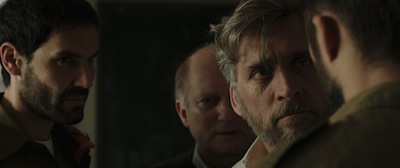
photo - Left to right: Danny Isserles as Official Military Officer, Yehuda Almagor as Avigdor, Michael’s brother, and Lior Ashkenazi as Michael
Left to right: Danny Isserles as Official Military Officer, Yehuda Almagor as Avigdor, Michael’s brother, and Lior Ashkenazi as Michael. (photo by Giora Bejach, Courtesy Sony Pictures Classics)

Yonatan has rendered his memory into a graphic novel, and Maoz brings it to life in the form of animation. This harrowing episode connects the Holocaust – and the self-reliance, persistence, shared sacrifice and residual faith that survivors applied to building the Jewish state – to a modern Israel, where idealism has curdled into a pursuit of temporary pleasures, and worse offences.

To be sure, in every land and every age, older generations castigate young people for ignoring tradition and abandoning their core values. But this parable takes place in Israel, so Yonatan’s father’s hormone-driven rashness hearkens to Esau swapping his birthright for a bowl of stew.

Threaded through Foxtrot is a critique of Israel’s leaders for maintaining a culture of cynicism and corruption that results in the unnecessary deaths of young soldiers. Furthermore, each loss is described as heroic regardless of the circumstances.

This is not unique to Israel, of course, but it’s harder to push back against the military spin when you’re a small country surrounded by enemies than a superpower. Maoz satirizes PR functionaries in the opening scene, in fact, and never stops spearing sacred cows.

Maoz’s triumph, finally, thanks in large measure to Ashkenazi’s unexpectedly vulnerable performance, is tracking the human cost amid the not-quite-real scenarios and sociopolitical commentary. Foxtrot is an altogether remarkable work, not least because it is a beautiful film about ugly truths.

Foxtrot is in Hebrew with English subtitles, runs 113 minutes and is rated R for some sexual content, including graphic images and brief drug use. It opens at Vancity Theatre on March 23, and runs to April 1.

Michael Fox is a writer and film critic living in San Francisco.
Format ImagePosted on March 16, 2018March 15, 2018Author Michael FoxCategories TV & FilmTags Foxtrot, IDF, Israel, military, movies, war

Posts pagination

Previous page Page 1 … Page 3 Page 4
Proudly powered by WordPress