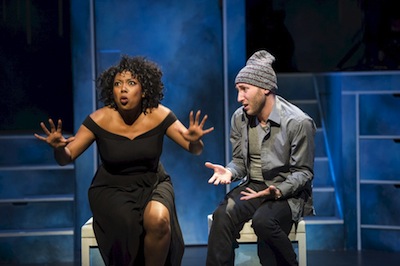
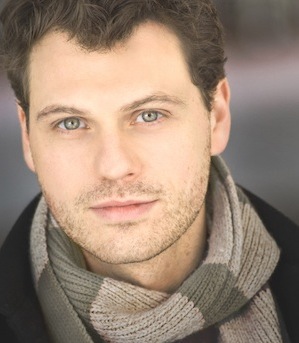
Josh Epstein raises a glass to toast lyubov (love) in recognition of the theme of the hit play Onegin, in which he plays a jealous lover. In a rare opportunity, theatre-goers are actually encouraged to bring their drinks with them into the auditorium in order to join the cast when they toast. Onegin, which is a musical with comedic overtones, has been brought back to the Arts Club after a successful showing in 2016 and runs until Dec. 31 at the Granville Island stage. For tickets and more information, visit artsclub.com.
In Bittergirl, Cailin Stadnyk, Katrina Reynolds and Lauren Bowler play women who have just been dumped by their boyfriends – maybe they can get back their men if they lose some weight? (photo by Emily Cooper)
Have you ever taken part in an aerobics class and wondered how many of the women in it were trying to lose weight to get a boyfriend back? The sad truth is, there are probably many, eagerly trying anything to return to the way things were, even if the way things were wasn’t all that great.
Bittergirl: The Musical takes aim at countless breakup truisms from the perspectives of three different women, reminiscent of the sharp wit in Mom’s the Word and the relationship charades of Sex in the City. Their varied responses to being dumped are hilariously insightful.
The progress of the play loosely follows the five stages of death: denial, anger, bargaining, depression and acceptance. The stages of the breakups are denial (he made a mistake), second-guessing (I could have done something differently), manipulation (I’m going to make him love me), reflection (I should have seen the warning signs) and acceptance (I’m over him, I’ve moved on).
The three women – played by Lauren Bowler, Katrina Reynolds and Cailin Stadnyk – are known only as A, B and C, as though these trials and tribulations are those that belong to every woman, not a specific person. Jewish community member Josh Epstein plays D, all three of the dumpers – the husband who wants to join the RCMP, the live-in partner who just “has to go” and the boyfriend who’s lost his “magic.”
Epstein delivers the stereotypical reasons why he needs to get out of each relationship: “I feel trapped,” “I can’t give you what you want” and the ridiculous “We’ve got to be birds flying higher.”
The lame rationales elicit howls of laughter at the familiarity, especially when one of the women initially thinks that the “talk” her boyfriend wants to have will lead to a proposal.
Not surprisingly, the women stand there, stunned into silence, not demanding further explanation, but meekly mumbling things like, “I understand,” even though they don’t – another conventional reaction it is sadly not surprising to see depicted.
After their men leave, the women think about what they might have done differently to save their relationships – “Maybe if I wore plum eyeshadow,” “Maybe if I didn’t talk to my mother so much” and “Maybe if I worked out more.” This last statement segues into an hysterical scene of the three women working out with various gizmos and in different types of classes in a desperate bid to get in shape and win back their men.
Katrina Reynolds and Josh Epstein in Bittergirl, at the Arts Club Granville Island Stage until July 29. (photo by Emily Cooper)
The women also reflect on the warnings signs they missed. He wears socks with sandals. He cries at Celine Dion songs. He growls during sex.
Especially comical is a scene where the women run into friends and they are forced to admit they were dumped. The standard, “You’re better off without him” or “If you guys couldn’t make it work, what chance do the rest of us have?” hit the mark on how insensitive people can be, much to the enjoyment of the audience. The rapid-fire delivery of the lines, the women playing off each other brilliantly, is a sight to see and hear.
As the musical progresses, classic girl-group songs of the 1960s and ’70s complement the dialogue. Thinking about their first dates leads into “And Then He Kissed Me.” The initial breakups prompt a rendition of “Mama Said There’d Be Days Like This.” When the women hope they’ll have a chance to renew the relationship, they sing “When Will I See You Again?” And who hasn’t felt the difficulty of moving on because there’s “Always Something There to Remind Me”?
The strength of the play is in how the writing spotlights those moments we all know so well and that sound so absurd when depicted one after the other. Being reminded of one’s own failed relationships, watching the play is like watching a good comedian – often funny and, despite being cringeworthy at times, you want to stay to the finale.
As with the different stages of death, the women finally accept their situations and move on with their lives, singing such lyrics as “you don’t really love me; you just keep me hanging on,” there are “too many fish in the sea” and “I will survive.”
Bittergirl is actually an autobiographical play written by three Toronto actresses who had, indeed, just gotten dumped by a husband, live-in boyfriend and short-term partner. The positive reaction to the play led to the 2005 book Bittergirl: Getting Over Getting Dumped. After that, the writers added the songs, accompanied by an all-female band onstage, and the musical was born.
Besides the sharp, insightful writing, these women (and Epstein) can all belt out a tune, making the performance a hit from the beginning to the (not so) bitter end.
Bittergirl runs at the Arts Club Granville Island Stage until July 29. For tickets and more information, visit artsclub.com.
Baila Lazarusis Vancouver-based writer and principal media strategist at phase2coaching.com.
Lauren Jackson as Olga Larin and Josh Epstein as Vladimir Lensky in Arts Club’s Onegin. (photo by David Cooper)
Generally, I don’t think background research is something that should be required in order to fully enjoy a performance; but every now and then a play really needs context, and the viewer becomes lost without it.
So, I would suggest – even to those with extensive Russian literature under your belts – if you have not read Alexander Pushkin’s dramatic poem, “Eugene Onegin,” start there before you see the musical Onegin. The poem contains descriptions of the characters, homes and countryside that add depth of interest that could simply not be communicated on stage.
That’s not to say that Onegin (pronounced “Onyegin”), the musical interpretation of the poem, can’t stand on its own. The singular creation by Veda Hille and Amiel Gladstone, combining the poetry of Pushkin and the opera of Tchaikovsky, is highly entertaining from start to finish.
The supremely talented group of seven performers, including the Jewish community’s own Josh Epstein, executes so many complex harmonies and moving solos, I certainly wasn’t walking out at intermission.
Set in 1819 St. Petersburg, the poem centres on four main characters: a self-proclaimed rakish womanizer, Eugene Onegin; Vladimir Lensky, a romantic poet; Vladimir’s love interest, Olga; and Tatyana, Olga’s sister, who’s in love with Onegin.
At first, Onegin rejects Tatyana, breaking her heart, and turns his attention to Olga, incurring Vladimir’s jealousy and bringing about a duel. Years later, after extensive traveling, Onegin returns to St. Petersburg and wants to be with Tatyana. But, by then, she’s already married, and Onegin realizes he’s wasted his life chasing women he doesn’t care about.
Taking place primarily in rural vacation homes, these well-to-do look for anything to “deal with the boredom of long winters” and come up with hunting, dancing, dueling and falling in and out of love.
The script includes quite a bit of play-by-play, where explanations of who’s who and what’s going on are interspersed with the action on stage. One by one, we’re introduced, in song, to the characters, with tongue-in-cheek descriptions. At one point, even the details of an impending pistol duel are sung to audience – just in case we were a little rough on the regulations.
These “asides” help with the background and also offer some great comedic breaks, often picking up on the satire that winds its way through Pushkin’s original work.
As an added bonus, guests are encouraged to bring their alcoholic drinks into the theatre and raise a glass for a sip every time someone says lebov (love in Russian). This is even facilitated by the cast handing out cups of vodka during the performance.
But there are also some bizarre non-sequiturs, such as when a singer in what looks like a boudoir is given a mic and electric guitar to continue her performance. Though it provided a chuckle, the reason for that choice went over my head.
While the script tries to provide the context I mentioned, it simply can’t make up for what’s lost from the poem, and I couldn’t help feeling “left out” of the framework.
For example, according to one translation of the poem, Onegin’s house is described: “All of the rooms were wide and lofty/ Silk wall paper embellished the drawing room/ And portraits of czars hung on the walls / The stoves were bright with ceramic tiles / There was no need for these things at all / Because he would yawn with equal distraction / At an ancient pile or a modern mansion.”
This paints such a great picture of the lifestyle and ennui of the main character, but not one that I caught onto in the musical.
Besides detailed description of scenery, the poem delves extensively into philosophical discussions, particularly about love, that would come across far better on stage as verbal jousting rather than a sing-song.
Onegin runs until April 10 at BMO Theatre Centre. Visit artsclub.com.
Baila Lazarusis a freelance writer and media trainer in Vancouver. Her consulting work can be seen at phase2coaching.com.
Left to right, Jay Hindle, Josh Epstein and Daniel Doheny in Bard on the Beach’s Love’s Labor’s Lost. (photo by David Blue)
How do you get more people interested in Shakespeare? Give ’em what they want – music, song, dance, comedy and words that are easy on the ears. Bard on the Beach has incorporated all these elements into its production of Love’s Labor’s Lost, set in a speakeasy in Chicago in the Roaring Twenties.
Think Prohibition, gangsters, molls, spats, fedoras, shoulder holsters, Cole Porter, flappers, the Charleston and vaudeville, all in glorious Technicolor, and you get an inkling of what is to come. Set on the intimate Howard Family Stage in the Douglas Campbell Studio, the fun begins the minute you walk through the tent flaps, as cast members accompany you to your seats with song and dance (and martinis – theirs, not yours). It continues with introductory remarks by a ventriloquist dummy that looks (and sounds) a lot like artistic director Christopher Gaze.
Ferdinand, aka “the king” of the gangsters (Jay Hindle), decides to shut down his nightclub, Navarre, devote three years of his life strictly to academic study and abstain from all vices including women (ouch!). He talks his friends Berowne (Jewish community member Josh Epstein) and Dumain (Daniel Doheny) into joining him in this escapade and the three sign a pact. However, just as they embark on their chaste journey, they meet blond bombshell Princess (Lindsey Angell) and her two friends, Rosaline (Luisa Jojic) and Katherine (Sereana Malani), each of whom catches the fancy of one of the potential abstainers.
To woo their respective ladies, the smitten men write secret letters and have a messenger, the resident clown Costard (Andrew Cownden), deliver them to the objects of their affection. Meanwhile, a fourth love story is brewing during all of this action, that of Don Amato (Andrew McNee), Ferdinand’s Italian house guest, who has fallen for Jaquenetta (Dawn Petten), one of the Navarre flappers – who has also written a letter to be delivered by Costard. A mix-up occurs (naturally) and what happens next is an hilarious musical romp through courtship interruptus with the men disguised and the women masked.
Princess’ chaperone, Boyet (Anna Galvin), gets into the game as the go between the men holed up in Navarre and the women forced to camp outside the building. Witty repartee abounds as the battle of the sexes heats up, and we all know who eventually wins that battle.
As musical director, Ben Elliott (with Jewish community member Anton Lipovetsky as his assistant) has done a great job of bringing iconic hits from the ’20s into this show. The jazz band (piano, bass, trumpet and drums) is the perfect background for the actors who, during an intense soliloquy, suddenly break into songs like, “It Had to Be You,” “Ain’t Misbehavin’,” “Second Hand Rose” and “Blue Skies.”
Epstein – who is the face of this production with Jojic on the season poster – wows with his voice in every number he sings and is certainly one of the standouts along with McNee, who sports a soprano-like gangsta accent and puts on a daring one- “woman” show (accompanied by his sidekick, Moth, played by Lili Beaudoin), and Petten, with her nasal voice and horizontal dance rendition (she rolls down the stairs and right back up).
This is the same cast that performs A Comedy of Errors on the BMO Mainstage (reviewed in the July 3 Independent) and it is a credit to their collective comedic acting talents that they can pull off both shows with success.
The set and lighting provide the feel of an underground Chicago speakeasy. The costumes by Rebekka Sorensen-Kjelstrup are simply divine, sparkly, fringed sheath dresses, rolled-up silk stockings, beautiful headdresses and glamorous fur stoles for the women; snappy suits, hats and Oxfords for the men. Valerie Easton’s peppy choreography is spot on.
Some will say that this production goes too far, and is not really Shakespeare – after all, Shakespeare: The Musical, who would have thought it possible? As with Bard on the Beach’s Comedy this year, purists are going to lament the loss of classical productions but, on Love’s opening night, audience members were humming along with the songs, tapping their feet to the catchy tunes and they jumped up in unison for a standing ovation before the last note was sung in the closing song, “Dream a Little Dream of Me.”
You have to give Gaze credit for taking a chance on director Daryl Cloran’s vision, which includes cutting half of the original text and omitting some characters. As he writes in the director’s notes, “Ultimately, that’s what’s so exciting to me about adapting a script – the process of exploring, shedding and inventing to get to the heart of the story and find a way of telling it so that it resonates with a contemporary audience.” It is a safe bet that even old Will himself would be doing the Charleston Stratford-on-Avon way if he saw this version of his play. If you are a lover of jazz and showmanship, this production is a must-see. While it runs until Sept. 20, word on the street is that shows are selling out quickly so don’t wait too long to book your tickets (bardonthebeach.org or 604-739-0559).
Tova Kornfeldis a Vancouver freelance writer and lawyer.
Josh Epstein, left, and Andrew Cownden in Bard on the Beach’s production of The Comedy of Errors. (photo by David Blue)
It’s summer in Vancouver and with it comes sun, surf and Shakespeare – that is, Bard on the Beach under the iconic red and white tents at Vanier Park. Celebrating its 26th season, the festival serves up an interesting mix this year: A Comedy of Errors, Love’s Labor’s Lost and King Lear, from the pen of the Bard himself, and a contemporary piece, Shakespeare’s Rebel, by local author Chris Humphreys.
Opening night of Comedy of Errors on June 13 saw the always dapper artistic director Christopher Gaze welcoming the crowd under the big tent of the BMO Stage and, for the first time in the history of the festival, acknowledging that the land upon which the tents are pitched for their annual sojourn is ancestral, traditional and unceded aboriginal territory. Deborah Baker of the Squamish Nation gave greetings and performed a traditional drum song.
Comedy of Errors is one of Shakespeare’s earliest works, the shortest in his repertoire, and it contains the zaniest of his plots. It is the tale of two sets of identical twins, one aristocratic, the other, their boy servants, with the pairs separated in the aftermath of a shipwreck. The family patriarch, Egeon, has spent years looking for his lost progeny and servants. His search takes him to the town of Ephesus, where he is captured and sentenced to death (no one is supposed to come to Ephesus without permission) but receives a last-minute reprieve to look for his sons and to find money to pay the fine.
It just so happens that one of the sons and his servant ended up in Ephesus while the other two ended up in Syracuse. Both sons are named Antipholus and both their servants, Dromio – all of this sets the stage for a frenzied journey through mistaken identities, hilarious hi-jinks and the ultimate sibling reunification when the Syracuse pair show up in Ephesus.
But what a journey. Think Edward Scissorhands meets Little Shop of Horrors meets Metropolis, and you have director Scott Bellis’ (who does double duty as Egeon) fantastical steampunk version of this production. What is steampunk? A mix of sci-fi electronics and gadgets set against a pseudo-Victorian era background as stylized by authors like Jules Verne, H.G. Wells and Mary Shelley.
The production is a bit over the top with its madcap bits and bobs – a hand-eating Venus fly trap, a communal lobotomy by a mad scientist, a creature trying to escape from a boiling soup pot, a Michael Jackson-like moonwalk, a bubble-shooting gun and a flatulation moment – and its frenetic pace. It is mostly fluffy fun although if you are looking for some meaning, there are three love stories intertwined with the humor. Shakespeare purists will probably cringe in their seats. But the opening night crowd was eating it up and this unique approach should bring in younger audiences and make the Bard’s words more accessible to a wider demographic. This reviewer loved it!
The acting is solid from the ensemble cast, many of whom do double and even triple duty in various roles: Ben Elliott as one Antipholus, Jay Hindle as the other, Jeff Gladstone as the mad Dr. Pinch, Andrew McNee as the grunting cook Nell, Daniel Doheny as the chambermaid, Lilli Beaudoin as the foxy courtesan, Jewish community member Josh Epstein as the smuggler, Andrew Cownden as the goldsmith, Sereana Malani as the Ephesean Antipholus’ overbearing wife, Lindsey Angell as her nerdy sister and Anna Galvin as the abbess, who makes her first appearance on stage in stilts. But it is the pint-sized Dromios, played by Dawn Petten and Luisa Jojic, who give the standout performances of the production. In their aviator hats and goggles, they really do look like identical twins. Petten, in particular, takes her role and runs with it with impeccable comedic timing and one of the best “ad lib” lines in the play, “Call before you dig.”
What really makes this production sublime are the visuals. The set is fantastic, a wall of steam-powered widgets, sprockets and gears dominated by a one-handed clock with a mind of its own, all kept in working order by shadowy, silent engineers constantly tweaking the machinery with wrenches and hammers. The play begins with one of the engineers pushing a big red button and, all of a sudden, the empty stage becomes a mélange of color and activity as the cast appears through a smoky haze, some through the many trapdoors in the floor, some out of the bowels of the machines, some appearing to drop out of the sky – all courtesy of community member Tara Cheyenne Friedenberg’s terrific choreography.
This dreamlike mechanical dance sets the tone for the whole evening. Mara Gottler has outdone herself with the costumes – lots of leather, lace-up boots, corsets, garters, black lace and accessories like aviator goggles, gas masks and leather bat wings. Gerald King’s lighting and Malcolm Dow’s sound design are the icing on this macabre cake.
Just as the action starts with a push of a button so does it end, with the shutting down of the machinery after the final revelations. This is one production that you can just sit back and enjoy, pure and simple fun.
Comedy runs to Sept. 26. For the full Bard schedule and tickets for any of this season’s offerings, visit bardonthebeach.org or call the box office at 604-739-0559.
Tova Kornfeldis a Vancouver freelance writer and lawyer.
The PNE is hosting a celebration of the 20th anniversary of Gotta Sing! Gotta Dance! and, on Aug. 24, 4:30 p.m., there will be a show featuring 2014 participants in the program, Perry Ehrlich’s ShowStoppers and Sound Sensation troupes, as well as some past participants in these programs. (photo from Perry Ehrlich)
There are several anniversaries in Vancouver’s arts scene this year. It’s the 50th for the Arts Club and the 25th for Bard on the Beach, for example, but the one that hits closest to home is the 20th for the Jewish Community Centre of Greater Vancouver’s resident summer musical theatre program, Gotta Sing! Gotta Dance! (GSGD).
The brainchild of local lawyer Perry Ehrlich, this program grew from a relatively inauspicious start to become one of the premier children’s musical programs in the Lower Mainland. In an interview with the Independent, Ehrlich noted that it all started when he tried to enrol his daughter, Lisa, in musical theatre classes.
“I realized that when I was looking around at the various offerings that I could do a better job and, if I participated with Lisa, it would be an outlet for my creativity and a playground for my daughter and myself. I thought when my kids were finished, that would be the end of it. I never thought it would last for more than five or six years – but I fell in love with the kids and the process and here we are 20 years later!”
Perry Ehrlich (photo from Perry Ehrlich)
Ehrlich, a pianist, has a strong musical background. While at law school at the University of Saskatchewan in Saskatoon, he played for dinner theatre at a downtown hotel and was the musical director of the faculty’s annual Legal Follies. He also was co-director of Sound Sensation, which rehearsed in Richmond. GSGD owes its name to that group: when Ehrlich was looking for new members for the group, he put an ad in the Vancouver Sun setting out the required qualifications, “Gotta sing, gotta dance.” When searching for a name for his “baby,” he was reminded of that ad and the rest is history.
Over the years, hundreds of youngsters from 9-19 have come to the JCCGV every summer from all over British Columbia, the United States, Europe and Israel to participate in one of the two three-week sessions. Each session culminates in a public performance at the Rothstein Theatre with a bespoke Broadway-like production penned by Ehrlich.
“By writing my own show, we get to do not 10 but 30 songs, all choreographed, so everyone of the kids gets to do something. My philosophy is to teach the kids to get along with each other and to work as a team to develop both personally and artistically – the younger ones work with the older ones and we are like a family.”
Ehrlich treats participants like adults and the program is set up like a school, six hours a day, and the kids are expected to behave responsibly and with respect towards their fellow students and the teachers. Ehrlich has high expectations for his charges and pushes the kids to their limits.
“I don’t want them to be second rate,” he said. “Mediocrity is not an option. With only 13 days from start to end of rehearsal and then three days of performance, this is a pretty intense experience.”
The teachers are a world-class staff with the likes of choreographer Lisa Stevens, actor Josh Epstein and musician Wendy Bross-Stuart. Noting that one of the dance teachers choreographed the Olympic opening ceremonies, Ehrlich said, “The kids are exposed to that message of excellence.”
His three keys to success? “To stand up, speak up and know when to shut up.”
In addition to the base program, Ehrlich runs a finishing school for two hours after each day of GSGD for serious students who get instruction in auditioning techniques from local professionals.
Ehrlich takes the crème de la crème from his annual programs and invites them to participate in a year-round group appropriately named – from what this writer observed while sitting in a rehearsal – ShowStoppers. This mix of energetic, talented young teens performs together up to 20 times a year at such events as the BMO Vancouver Marathon, the Santa Claus and Canada Day parades and the opening ceremonies of the Special Olympics. On Aug. 24, 4:30 p.m., there will be a 20th-anniversary performance at the PNE.
Andrew Cohen, who recently emceed Louis Brier Jewish Aged Foundation’s Eight Over Eighty event, is an alumnus, one of the founding members of ShowStoppers and now a faculty member of the program. “I remember looking forward to summer vacation every year knowing that I would be going to GSGD,” he told the JI. “It grounded me and taught me respect and the work ethic you need to succeed in the industry. It gave me an edge over other kids when it came time to audition for parts. Theatre is an incredible outlet for growing kids. It teaches them the necessary social skills, to have confidence and speak out and up for themselves.” As to the success of the program, Cohen said, “I would say that GSGD is synonymous with children’s talent in Vancouver.”
Parent Mark Rozenberg was effusive in his praise of GSGD, in which two of his children participated. “It allows kids with a passion for singing, acting and dancing to learn and to practise their passion. It is the most amazing program with some of the best instructors. When I sent my children off to the JCC every day in the summer, I knew they were in good hands.”
Nathan Sartore, a current ShowStoppers participant, could not contain his enthusiasm for the program. “It is such an important part of my life and means everything to me,” he said. “I can’t imagine my life without it.”
“I watch these kids coming in as shy, quiet youngsters and see them leave as confident performers…. I teach and expect the kids to make a full-out commitment but also to have fun and laugh.”
Ehrlich said that he was bullied as a child and feels that many young people involved in musical theatre have faced some sort of bullying for their artistic passions. “I see my job as providing a safe, happy, nurturing, learning space where all the kids can develop confidence and self-esteem,” he explained. “I watch these kids coming in as shy, quiet youngsters and see them leave as confident performers. They get the opportunity to work as a team and make lifelong friends in an environment where people are loving and caring. I teach and expect the kids to make a full-out commitment but also to have fun and laugh.”
Ehrlich is grateful to the community for its financial support of GSGD through scholarship funds like the Babe Oreck Memorial Fund and the Phyllis and Irving Snider Foundation, so that no child is turned away from the program for financial reasons.
“I am no different than any father who coaches basketball or baseball,” said Ehrlich. “I am doing exactly what they are doing, creating teams, teaching excellence, building confidence and skills. All of us, in our own way, are giving these kids something productive to do, not just hanging around the local 7-Eleven.”
Productivity aside, walk by the Rothstein Theatre on any given summer weekday and you will hear the sounds of joy coming through the doors. You gotta love it.
Tova Kornfeldis a Vancouver freelance writer and lawyer.
The cast of Spamalot, with Josh Epstein at centre, on one knee. (photo by David Cooper)
In any great adventure, that you don’t want to lose, victory depends upon the people that you choose. So, listen, Arthur darling, closely to this news: We won’t succeed on Broadway, If you don’t have any Jews.
– Sir Robin, Spamalot
Of all the Monty Python films, perhaps none has deposited as many “Pythonisms” as Monty Python and the Holy Grail. Who can forget the airspeed of an African swallow, horse hoofs portrayed by empty coconut halves, the knights who say “ni,” the killer rabbit and, that old chestnut, “It’s only a flesh wound.”
Produced in 1975, Holy Grail was the second in a string of five successful Python films that included And Now for Something Completely Different (1971), Life of Brian (1979), Live at the Hollywood Bowl (1982) and The Meaning of Life (1983).
Funny thing is, although I’ve seen Holy Grail perhaps a dozen times over the years, I don’t recall the presence of a giant Magen David dangling in a spotlight as the cast sings, “You haven’t got a clue if you don’t have a Jew.” Call me crazy but I don’t think that was in the original.
But then Spamalot does not suggest that it’s anything other than a rip off (albeit lovingly done), so, although it’s based on the movie, be prepared for the use of monumental artistic licence. And yet, what better piece for physical comedian/actor/musical theatre devotee Josh Epstein to sing as he prances around the stage in one of the funniest performances you’ll see this year.
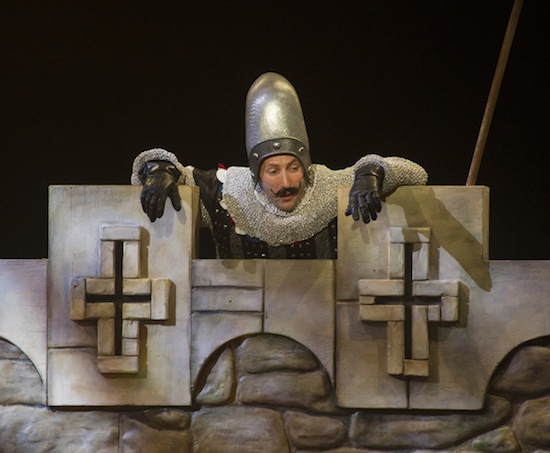
Josh Epstein, as the taunting Frenchman in Spamalot. (photo by David Cooper)
Epstein has already proven his prowess in memorable productions such as The Producers in 2008 and The 25th Annual Putnam County Spelling Bee in 2010. But seeing him frolic in chain mail, bedecked with Orlando Bloom hair, or hurling brilliant insults as a French soldier wearing the equivalent of a Conehead helmet, is gut-wrenchingly hysterical.
For those not familiar with the story, the plot centres on King Arthur’s attempt to round up some knights (or “ke-nicts” as Epstein mispronounces in his French “aksant”) to search for the grail. On his path, he encounters challenges of outrageous (in size and humor) proportions. He can’t even convince the local serfs that he deserves their respect as a king after relating how he acquired the title from the Lady of the Lake. “Strange women lying in ponds distributing swords is a bad way to choose a government,” he is told.
The hapless Arthur (David Marr) continues undaunted, however, eventually rounding up four knights – the Homicidally Brave Sir Lancelot (Jay Hindle); Sir Robin, the Not-Quite-So-Brave-as-Sir-Lancelot (Epstein); Sir Galahad, the Dashingly Handsome (Jonathan Winsby); and Sir Bedevere, the Strangely Flatulent (Ashley O’Connell). His biggest challenge comes when he is told by the knights who say “ni” that he can only continue his quest if he puts on a successful Broadway musical.
“Can it be done?” he asks Sir Robin. Yes, he responds, but only if you have Jews in the production. After all, “It’s a very small percentile who want to see a dancing gentile.”
Enter the Magen David, a menorah on a piano and four knights and one king who suddenly transform into Chassidic Yiddim.
As it turns out, Arthur’s sidekick Patsy is a member of the tribe, but has been keeping it a secret.
“It’s not the sort of thing you say to a heavily armed Christian,” he responds to Arthur when asked why he was not forthcoming.
Beyond the brilliant writing, kudos have to be given to choreographer Lisa Stevens and costume coordinator Rebekka Sorensen-Kjelstrup. The look, the sound and the dancing all elevate the production into stratospheric entertainment.
Monty Python’s Spamalot, with book and lyrics by Eric Idle, runs until June 29 at the Arts Club’s Stanley Industrial Alliance Stage, artsclub.com. Warning: profane language.
Baila Lazarus is a freelance writer, editor and photographer. Her work can be seen at orchiddesigns.net.
Since last year’s Chutzpah! Festival, the Jewish Independent has been waiting to see Noah Drew’s Tiny Music. The read-through in 2013 was a unique experience of a work-in-progress, and it will be fun to compare that “teaser” with the production that takes to the Rothstein Theatre stage later this month as part of this year’s Chutzpah!
“This play has actually been slow-cooking for almost 10 years,” Drew told the Independent in an e-mail interview. “In 2004, the fabulous actor/writer Josh Epstein approached me about writing and composing a musical together. We jammed on ideas, and decided to adapt a short story by Sholem Aleichem called The Fiddle, which I’d been very fond of growing up. At my grandparents’ house, I used to listen to a record of the great Howard Da Silva reading Aleichem’s stories accompanied by a klezmer band, and The Fiddle was one of my favorites: a dark fable in which a boy who’s obsessed with music is forbidden to have anything to do with it, but can’t help himself, to his family’s ruin. Josh and I wrote a few songs and scenes about a boy in the Old Country who was born with unusually large and dexterous hands – a violin prodigy. Some of the material was great, but then, life happened – Josh booked a big show in Toronto and moved there, and shortly afterwards I got a full scholarship to do my MFA in acting at Temple University in Philadelphia, and also moved east. Every once in awhile, Josh and I would connect and talk about working on the show, but it never quite happened.
“Then, in 2010, I was visiting my friend Sarah Shugarman (a wonderful musician in Toronto) and ended up unearthing one of the songs I’d written for the Fiddle project. When I read her the lyrics, she was effusive in her praise and excitement, and encouraged me to reopen the piece. We talked about co-composing, but in the end the scheduling and geography didn’t cooperate (I had completed my degree and moved back to Vancouver by this point) so I decided to push forward with the project alone.”
At the heart of Tiny Music is Ezra, described in the Chutzpah! program as “an autistic man with an auditory-processing disorder that heightens his experience of the sounds around him.” About the writing of such a character, Drew explained that, around the time he re-committed himself to the play, he was “spending a fair amount of time with two members of my family – one adult and one child – who are on the autism spectrum. I also had a private acting student who was autistic. I noticed that all three of these individuals had certain challenges, particularities and special abilities when it came to focusing, and that all three seemed to have a very strong relationship to music. Music has always been incredibly important in my life also, and I was finding nice connections with my autistic family members through listening to and/or playing music together. I conceived of a contemporary version of the Sholem Aleichem story with an autistic man who hears in an extraordinary way at the play’s centre.”
Drew said he wrote a handful of songs and a first draft. “A two-day script workshop in Montreal in January 2013 led me to a second draft of the script, which was presented as a reading in the 2013 Chutzpah! Festival,” he said. “That reading was a bit of a whirlwind – we had only the one day to rehearse – but it was a good opportunity to see how the story was working (and where it wasn’t) and to hear a few of the songs with piano and voice. I learned from that reading that some aspects of the characters and story were really working, but others were a bit superficial and/or clunky.
“I went back into the writing process and, in October 2013, the show’s director/dramaturg Jamie Nesbitt and musical director Yawen Wang came out to Montreal to join me, sound designer Joe Browne and eight Concordia theatre and music students for a six-day workshop of the piece. That was a fantastic process! In addition to further developing the script and story, we got to explore the most important question of the piece stylistically: how can we make the songs, story, instrumental music and sound design all work together as a cohesive whole? We did some wonderful experiments, played around with ways of combining the elements and made discoveries such as: in this show, sometimes a sound cue or instrumental moment could actually replace dialogue. The script, music and sound all moved forward a couple of drafts. The characters were becoming more three-dimensional. The music was becoming more contemporary (‘less Sondheim and more Bjork’). The unique world of the show was coming into focus.”
Rethinking the storytelling
At this point, however, Drew and Nesbitt – co-founders of Jump Current, the producer of Tiny Music – noticed a “significant problem with the script.”
“Although the show is experienced from the perspective of an autistic individual, the storytelling mode was still quite ‘neurotypical,’” explained Drew. “Ezra had monologues in which he explained his situation and point of view to the audience in a very linear, chronological way. But the more I read and spoke to people about the range of autistic experiences, the more I realized that this linear way of speaking and thinking didn’t feel right. At Jamie’s urging, I took the script apart, and re-imagined it as a world in which time and memory are at times fluid, fragmented and unpredictable. Now, in the language, sound, music and staging, we are finding rhythms, patterns and textures that feel more true to who Ezra is. Rather than just describing and showing the story of this unique individual, we are figuring out how to invite the audience to share his visceral experience.”
This is what makes Tiny Music not just a regular, run-of-the-mill musical.
A sound design musical
“I call Tiny Music a ‘sound design musical’ because I want the audience to spend 90 minutes really hearing through Ezra’s ears,” explained Drew. “For Ezra, tiny details of the sonic environment that might go unnoticed by most people are very vivid. Sometimes, these details might mesmerize him. At other moments, they might overwhelm him. And sometimes, he hears the patterns in things so vividly that mundane sounds coalesce and occur for him as music. So, the songs in Tiny Music don’t just happen because, hey, it’s a musical. Instead, we only have songs because either (a) it makes sense that another character would actually be singing to Ezra in a certain situation, or (b) Ezra’s internal experience of certain sound patterns ends up transforming non-musical sounds into a kind of song. And, there are many times in the show – even some pieces I’ve called a ‘number’ – when nobody actually sings. Instead, it’s more like the environment itself that sings … all the sounds on all the floors of the building he’s in combine to make a kind of ‘sound design song,’ or a the voice of a person who is just speaking warps and distorts in Ezra’s perception, becoming rhythmic and harmonic. Every sound can be a kind of music if you really listen.”
The producers: Jump Current
Tiny Music is but one of several projects that Jump Current is currently producing, despite its relatively recent appearance on the theatre scene. “Very close friends who have led kind of parallel lives for awhile now,” Drew and Nesbitt started the company last spring. Of the reasons for the collaboration, Drew said, “We’re both fairly well known in Canada as theatre designers (he for video projections and I for sound), but we both consider ourselves to be theatre artists in a much broader way than only design. In fact, we both are suspicious of the way that sometimes design tricks and flash can get in the way of real, organic moments of storytelling in the theatre. (Also, as it happens, Jamie and I are both married to yoga teachers who used to work as actors, who are now studying to be expressive arts therapists – go figure.)
“In 2012, Jamie got very involved in working on Tiny Music, and I started working as a dramaturg on a play he’s writing called Salamandra (which is based on the true story of his inheriting a 150-bedroom castle in Poland from his great-uncle, Poland’s former minister of war, and his great-aunt, a former Polish movie star). Because we were doing these two projects together, and because our views about theatre, politics and life are so aligned, we decided to start a company together.
“In addition to creating and producing works of theatre and media-based performance,” he continued, “Jump Current’s mission is to research, develop and champion uses of design and technology that illuminate live human-to-human connection, and counteract people’s sense of alienation from one another. We believe deeply that, although, of course, it’s true that we live in an age when technology can really separate people from direct, organic connection, there are ways that it can also facilitate a shared experience of wonder that can really unite people.”
Another project that Drew and Nesbitt are developing is The Riot Ballet, “which explores themes of crowd psychology, identity and protest – both peaceful and violent,” said Drew. “We recently participated in a two-week development process in Barcelona, which led to some really exciting material and ideas. The team is amazing – this project brings us together with fantastic theatre companies from Spain, Colombia, the U.S., and a dance company from Toronto. We’re aiming for a late 2015 or early 2016 première in the U.S., then dates in Canada and Europe.”
All of this is in addition to Drew being a tenure-track faculty member in the theatre department of Montreal’s Concordia University, his continued freelancing in sound design and his voice teaching work. One of his sound design projects, he told the Independent, is for Horseshoes and Hand Grenades’ production of This Stays in the Room, which will be performed at Gallery Gachet in Vancouver March 19-30.
About his full schedule, Drew said, “I feel very grateful that my years as a full-time freelancer and the demanding process of doing an MFA really helped me develop good time-management skills! But, when it’s all amazing, a busy life is a pleasure. Sometimes, when things get a little too intense, my wife and I look at each other and say, ‘At least it’s not boring!’ We’re usually smiling.”
Tiny Music takes place Feb. 25 and 26, 8 p.m., at the Norman and Annette Rothstein Theatre. It stars Anton Lipovetsky, Susinn McFarlen, Caitriona Murphy and Bob Bossin, with musicians Yawen Wang (piano and accordion), Joe Browne (live electronics), Caitriona Murphy (violin), Mike Braverman (clarinet), Jodi Proznick (bass) and Jason Overy (drums). There is a post-performance talk-back on Feb. 25. For tickets, visit chutzpahfestival.com, call 604-257-5145 or 604-684-2787, or drop in to the Jewish Community Centre of Greater Vancouver.