Skip to content
  • Home
  • Subscribe / donate
  • Events calendar
  • News
    • Local
    • National
    • Israel
    • World
    • עניין בחדשות
      A roundup of news in Canada and further afield, in Hebrew.
  • Opinion
    • From the JI
    • Op-Ed
  • Arts & Culture
    • Performing Arts
    • Music
    • Books
    • Visual Arts
    • TV & Film
  • Life
    • Celebrating the Holidays
    • Travel
    • The Daily Snooze
      Cartoons by Jacob Samuel
    • Mystery Photo
      Help the JI and JMABC fill in the gaps in our archives.
  • Community Links
    • Organizations, Etc.
    • Other News Sources & Blogs
    • Business Directory
  • FAQ
  • JI Chai Celebration
  • JI@88! video

Recent Posts

  • Zionism wins big in Vegas
  • Different but connected
  • Survival not passive
  • Musical celebration of Israel
  • Shoppe celebrates 25 years
  • Human “book” event
  • Reclaiming Jewish stories
  • Bema presents Perseverance
  • CSS honours Bellas z”l
  • Sheba Promise here May 7
  • Reflections from Be’eri
  • New law a desecration
  • Resilient joy in tough times
  • Rescue dog brings joy
  • Art chosen for new museum
  • Reminder of hope, resilience
  • The national food of Israel?
  • Story of Israel’s north
  • Sheltering in train stations
  • Teach critical thinking
  • Learning to bridge divides
  • Supporting Iranian community
  • Art dismantles systems
  • Beth Tikvah celebrates 50th
  • What is Jewish music?
  • Celebrate joy of music
  • Women share experiences 
  • Raising funds for Survivors
  • Call for digital literacy
  • The hidden hand of hate
  • Tarot as spiritual ritual
  • Students create fancy meal
  • Encouraging young voices
  • Rose’s Angels delivers
  • Living life to its fullest
  • Drawing on his roots

Archives

Follow @JewishIndie
image - The CJN - Visit Us Banner - 300x600 - 101625

Happy to be Canadian

For most Canadians, depending on the weather in our locale, Canada Day represents the real kickoff of summer. The kids are out of school, many workplaces are beginning a summer lull, families are looking forward to spending time together outdoors.

Canadians have rarely given ourselves over fully to the flag-waving, sleeve-wearing patriotism of many other countries. There are times when some of us lament this apparent lack of passion for our Canadian birthright, but this seeming lack of passion may well be an innate characteristic of our national spirit: a calm, reserved, nonaggressive attitude that is no less deserving, or indicative, of pride than a more fulsome nationalism.

As we observe events around the world these days, we should probably feel a special level of pride and relief at being Canadian. On every continent, it seems, crises of various proportions and types are roiling. Nigerian girls and Israeli boys are abducted by terrorists. The war in Syria has crossed the border into Israel, with an Israeli teenager dying last week from a roadside attack. Shia and Sunni combat each other in a brutal battle for control over what remains of the state of Iraq, now boiling over into Syria and Jordan – a conflict so multifarious that Western allies find ourselves in the unfathomable position of making common cause with the regime in Iran.

There are 51 million displaced persons in the world today, the highest number since the end of the Second World War. Half of these are children, fleeing violence in Afghanistan, Syria, Sudan, Somalia and elsewhere. Women and religious and ethnic minorities around the world are living in often increasingly hostile environments, with acts against their dignity, and violence to their person at intolerable levels. In Europe, far-right parties are exploiting economic difficulties to spread messages of scapegoating and blame.

A simple glance at any day’s headlines should remind us how lucky we are to be in Canada. We are certainly not without our problems. We have an ingrained history of mistreatment and inequality toward the First Nations of this place, most immediately demonstrated in levels of poverty and health outcomes in those communities that are exponentially worse than Canadian averages, and the murder or disappearance of hundreds of aboriginal women. Nor are we free from other forms of racism or injustice. This is not paradise, though by contrast to much of the world, and for most of us, it comes close.

We are fortunate to share our continent with stable neighbors with whom we share multilateral relations that are among the most peaceful and cooperative of any countries on earth. This fortunate situation is not all a matter of good geography. The comparatively peaceful situation here is not insignificantly a result of the evolution of a uniquely Canadian approach to coexistence across difference. Jewish Canadians and our communal institutions have played an important role in the successes of Canadian multiculturalism.

Our comparatively peaceable nation is also a result of factors including attitudes toward weaponry, which makes our country not immune to violent gun-related incidents, but keeps us far from the crisis situation being experienced in the United States.

All of this should not evoke complacency. We should feel gratitude for our relatively peaceable and prosperous state, but we should feel no less a sense of obligation to making the world better for all people. Our own security and well-being should not relieve us of the obligation to do what we can, as individuals and as a nation, to make things better for people in the world who do not share all of our good fortune. Indeed, our position of relative wealth, health, stability and living standards places on us a greater obligation to act on behalf of others worldwide who are not as fortunate as we are.

Posted on June 27, 2014June 25, 2014Author The Editorial BoardCategories From the JI

Canadians pray for teens

As three abducted Israeli teens ended their first week of captivity, communities from across Canada and around the world held vigils, gathered in solidarity and said prayers for their safe return; prayers that continue.

From Halifax to Vancouver, Jews gathered in support of Gilad Shaar, 16, Naftali Frenkel, 16, and Eyal Yifrach, 19, who were kidnapped by suspected Hamas terrorists while hitchhiking near Hebron June 12.

The largest of the events was held June 19 in the Toronto area, where as many as 1,000 people came together at the Schwartz/Reisman Centre at the Joseph and Wolf Lebovic Jewish Community Campus. The rally was sponsored by UJA Federation of Greater Toronto in conjunction with the Centre for Israel and Jewish Affairs (CIJA).

MP and former justice minister Irwin Cotler spoke. He was in Israel when news of the teens’ abduction broke. Reports in Israeli newspapers were dominated “by a sense of angst and anguish,” he said.

Cotler attributed the kidnapping to Hamas, pointing out that the Islamic terrorist group is pledged to destroy Israel and kill Jews. He noted that, even before the kidnappings, Israeli media had reported that security forces had foiled 44 attempts to kidnap Israelis in the last year alone.

He said former Soviet dissident Natan Sharansky, whom he met during his visit, stressed how important it was for his family and for him to know that Jews from around the world were rallying to his cause when he was in a Soviet prison.

Cotler said the operation to locate the teens is code-named “Brother’s Keeper,” and Israelis of all denominations are united in praying for the boys’ safe return.

Demonstrating support for the families of the three victims was a key motivation for many of those at the rally. “Those kids could have been any of ours,” Roz Lofsky said. “We all feel for those boys and we want to show solidarity with them.”

“We’re here to say that we are in support of those parents so they know they are not alone,” added Gladys Isenberg.

Conservative MP Mark Adler brought a message from Prime Minister Stephen Harper and drew a loud round of applause when he said, “Canada will stand with Israel through fire and water.” He called on the Palestinian Authority to disarm Hamas, take control of smuggling tunnels in Gaza and demonstrate its commitment to peace by reuniting the boys with their families.

Consul General D.J. Schneeweiss spoke and, in addition to members of the Jewish community, the event was attended by Prabmeet Singh Sarkaria, vice-president of the World Sikh Organization of Canada, Ontario Region. Messages of support were received from the United Macedonians Organization of Canada and from Dominic Campione, past national president of the National Congress of Italian Canadians.

In Halifax, Rabbi Ari Isenberg, spiritual leader of Shaar Shalom Congregation, in conjunction with CIJA, officiated at a community-wide vigil of hope for the boys’ safe return. At the same time, Rabbi Amram Maccabi of Beth Israel Synagogue said special prayers for the teens.

In Montreal, about 400 people attended a June 15 prayer vigil at Congregation Beth Israel-Beth Aaron in Côte St. Luc. The vigil was sponsored by Israeli Consul General Joel Lion in cooperation with CIJA. Chana Landau, a relative living in Montreal, relayed the thanks of the Frenkel family to Jews around the world for their expressions of solidarity. Chaviva Lifson read a message of gratitude from the Shaar family, who live a block from her sister in Israel.

In Hamilton, Temple Anshe Sholom, in conjunction with the Hamilton Jewish Federation, hosted a community gathering “in solidarity with the families of the three Israeli students.”

In Winnipeg, congregations Shaarey Zedek, Etz Chayim, Herzlia-Adas Yeshurun, Chevra Mishnayes and Temple Shalom co-sponsored a prayer vigil in conjunction with the Jewish Federation of Winnipeg.

The vigil, held at the Shaarey Zedek Synagogue, included a candlelighting ceremony, the recitation of psalms, a prayer for captives, the singing of Hatikvah and cantorial renditions of “Acheinu Kol Beit Yisrael ” (“All Israel are Brothers”) and “Bring Back our Boys,” a song written in the last two weeks in Israel.

Rena Elbaze, Jewish engagement specialist at the Winnipeg Federation, said the participation of a range of community organizations spanning a variety of denominations shows “we pray as a community and we’re united as a community when faced with these problems.

“We prayed for the sake of the boys, but also to make people present feel they are not alone and to show the families of the people who were kidnapped that people care about them.”

The Rabbinical Association of Vancouver, with support from the Jewish Federation of Greater Vancouver and other community organizations, sponsored a community prayer service at the Jewish Community Centre of Greater Vancouver.

Valder Belgrave, a spokesperson for JFGV, said, “Our sympathies are with the families, and it’s sad that they are drawn into the larger issue. They’re innocent victims in the larger scheme of things.”

– With files from Janice Arnold in Montreal. A longer version of this article can be found at cjnews.com/node/126049.

Posted on June 27, 2014June 25, 2014Author Paul Lungen CJNCategories NationalTags Eyal Yifrach, Gilad Shaar, Hamas, Irwin Cotler, Israel, kidnapped teens, Naftali Frenkel
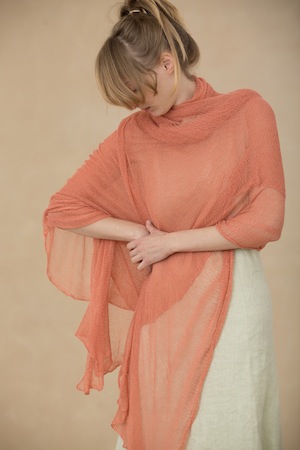
Tooshaaya all natural

Tooshaaya all natural

Tom and Tzameret in studio. (photo by Galit Reismann)

An Israeli mother and daughter duo have combined to create designer pieces that use exclusively natural textile, with a focus on nature, and creations that become an extension of the wearer of any shape or size.

Tzameret, 50, and Tom, 28, began their business from home when Tom was at Israel’s Shenkar College of Design, in her second year of studies (2009). Tzameret, an art therapist by profession, was looking to do something different, and building this business with her daughter was the perfect fit.

The pair began the work little by little while Tom was finishing school. After Tom graduated with honors in 2011, with a bachelor of design, she and Tzameret invested all the time, energy and resources they could into their brand. For the past 18 months, they have been working out of a studio in Jaffa.

Tooshaaya is a design studio for eco-textile accessories with the driving concept of “body, home, soul.” For now, they create accessories like scarves, shawls and cardigans, but they plan to soon also design accessories for the home and soul.

“I’ve wanted to have my own business since I was a little girl,” said Tom.

During the summer between her second and third year at Shenkar, Tom said, “I wanted to make my own products, like scarves, and sell them. My mom was at a point when she wanted to take a small break from therapy.

“As always, I shared my prototype with my mom. We started talking about it and the idea to work together came up. I thought it was a great idea.

“Me and my mom are complete opposite in a lot of things. That can make us feel crazy sometimes, but it also makes us perfect business partners and designers. Also, we always know how much we love each other and that we want the best for each other.”

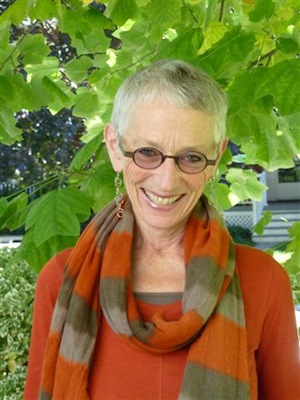
photo - A Tooshaaya bamboo cardigan modeled by Lior Sachar
A Tooshaaya bamboo cardigan modeled by Lior Sachar. (photo by Ami Bornstein)

Tzameret has always loved art, creation and design. Also, she said, “I love Tom, believe in her, and appreciate her talent. Since she was four or five years old, it has been very clear she is gifted in art and has her own unique way of looking at things.

“We decided to join forces and talents, and create an exciting journey together. Although it’s not always simple to be a business partner with your daughter, it’s a huge privilege. I’m very proud.”

When Tom was in college, she “learned the textile industry is the second-most-polluted industry in the world.” She said, “As a textile designer, I see it as my responsibility to design and create ecological textile.” Tooshaaya’s motto is “Touched by nature.”

Tom and Tzameret chose to work only with natural materials, especially with new eco-fibres like bamboo and soy. “These fibres, in addition to the eco part, have special and very important qualities, like UV protection, hypoallergenic, temperature adjustments and [the] creation of amino acids, which is healthy for the skin,” explained Tom. “They’re good for the world and the body. Of course, we also believe in sustainability and love the energy of natural materials around our bodies.”

Tooshaaya designs are inspired by the sights, shapes, textures and colors of nature. “With each of our designs, even when there are few similar items, no one [item] is the same,” said Tom. “Each has its own unique design and process of production, which is mostly handmade.

“We believe that, when we feel comfortable, it’s easier to be connected to nature and express who we are.”

It has proved challenging to find natural materials, however. “Yarns are imported by us,” Tom said. “Also, producing natural materials is slower and more complicated than it is with synthetic or mixed yarns.

“Israel is a small and challenging market, in general, and particularly for niche designers,” she added. “We’re glad to have local [from Israel] and international loyal and return clientele who love our designs, appreciate our work and share our concepts.

“When I look at nature, I see infinite organic beauty composed of stability and softness, a tension between order and disorder, and the changes wrought by time, giving everything its unique character.

“My art and designs are a constant search for this organic esthetic. When I design an item, like a scarf, I create a second skin that looks organic and feels like a natural continuation of the body. The item’s unique character comes from the person who wears it, through movement and over time.”

Each item is made using special knitting techniques, with fine and delicate threads, hand dying, embroidering, weaving and felting. The items can be worn with a variety of clothing types and styles. Most are one-size-fits-all, suitable for sizes 36-44 (EU).

“Our ability to create custom-size orders, including plus sizes, is also somewhat unique,” said Tom. “Our items can fit almost anyone. And our ability to ship worldwide is very exciting. We send packages to all continents of the world, from the U.S. to Turkey, Russia, Thailand, Australia, Hong Kong, Canada and Italy.

“We love our work. What is most satisfying is when customers tell us how much they enjoy wearing our items, and we can see how our ideas are reflected in reality and bring happiness to others.”

For more information on Tooshaaya, visit toosha.com, toosha.com/#!video/c65q, or like them on Facebook, facebook.com/toosha.eco.design.

Rebeca Kuropatwa is a Winnipeg freelance writer.

Format ImagePosted on June 27, 2014June 25, 2014Author Rebeca KuropatwaCategories IsraelTags eco-textiles, Tooshaaya
Waves of Jews to East Asia

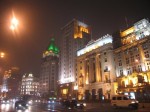
Waves of Jews to East Asia

Shanghai’s famous Bund district, where most of the buildings were built and owned by wealthy Sephardi Jewish families. (photo by Anthony Hartman via Wikimedia Commons)

It was a long trek: 6,000 miles by boat from central Europe to East Asia. But the towns of East Asia opened their gates for the waves of Jewish emigrants who had to find shelter from the tragic problems they faced first in Russia and, later, in Europe.

Though some believe their story still flies under the radar when compared to the prevalence of other Holocaust-related discourse – perhaps because most of Shanghai’s Jewish residents viewed their time in the city as a transient stage – historians now know there once was a large and thriving Jewish community in China. Records of immigrants kept by the Hebrew Immigrant Aid Society (HIAS), which operated in Asia from 1917-1950, paint an inescapable picture of Jewish refugees who survived the war in Shanghai.

“The United States, Canada, Australia closed the doors to Jews and other immigrants in the 1920s.… HIAS had to … find other places that were willing to allow Jewish refugees to live there,” explained Mark Hetfield, HIAS president and chief executive officer. “Desperate measures called for creative thinking.”

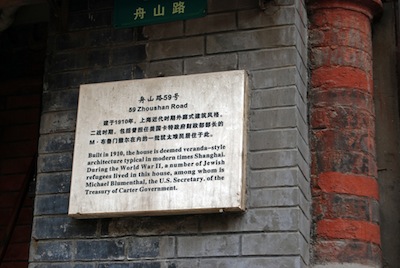
photo - A plaque at a house in Shanghai that was formerly the residence of Jewish refugees, including W. Michael Blumenthal, who went on to serve as U.S. Secretary of the Treasury under President Jimmy Carter
A plaque at a house in Shanghai that was formerly the residence of Jewish refugees, including W. Michael Blumenthal, who went on to serve as U.S. Secretary of the Treasury under President Jimmy Carter. (photo by H. Barrison via Wikimedia Commons)

The first Jews, Silk Road traders, arrived in China in the eighth century and settled in Kaifeng. The next Jews were those who arrived under British protection following the First Opium War. Many of these Jews were of Indian or Iraqi origin, due to British colonialism in these regions, and they became the largest dealers in opium. These included David Sasson (the “Rothschild of the East”), philanthropic businessman Sir Eli (Eliazer) Khadori and real estate lord Silas Herdoon. According to most accounts, the number of Sephardi Jews in China totaled around 1,000.

Around 4,000 Jews would then arrive as refugees from the Russian Revolution of 1917. Finally, a surge as large as 18,000 Jews arrived as refugees from the Holocaust in the late 1930s and 1940s. According to Peter Nash, a child survivor from Berlin who found refuge in Shanghai from 1939-1949, about 8,000 of these refugees originated from Germany and about 4,000 came from Austria.

Read more at jns.org.


Format ImagePosted on June 27, 2014June 25, 2014Author Maayan Jaffe JNS.ORGCategories WorldTags HIAS, Mark Hetfield, Shanghai Jews

Listening to her patients

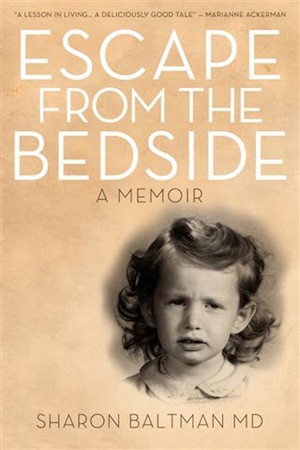
Toronto physician Sharon Baltman treats her patients by listening. Author of the self-published memoir Escape from the Bedside, Baltman, 66, takes readers on the journey of her decision to go to medical school until she ultimately gave up being a general practitioner so she could have more time for her patients.

photo - Dr. Sharon Baltman
Dr. Sharon Baltman (photo from cjnews.com)

Currently maintaining a two-day-a-week psychotherapy practice, Baltman, who is divorced with one daughter, said that she escaped “from the ivory tower of the hospital into private psychotherapy practice in order to listen closely to my patients, and hear their stories.”

She said that when she first announced her plans to enter pre-med at University of Toronto, she was told she’d never be a doctor, “because of her long painted fingernails, her big breasts, and the ‘three Ms: marriage, motherhood and medicine.’” She persevered, however, and went into emergency medicine, then family practice.

“I left emergency medicine because I didn’t have enough time for my patients,” she said. “I barely met [them] and rarely saw them a second time.”

She switched to a general practice, she said, “so I would have longer-term connections, but ran out of time trying to deal with both the physical and emotional needs [of the patients].

“In order to hear more about people’s lives, and what made them tick, I finally chose full-time psychotherapy work, so I could have time to listen to their tales in a quiet, un-rushed venue. I chose not to be a psychiatrist, because I did not want to go through another residency.”

While she started with classic Freudian analytic work, she said, she later moved to cognitive behavioral therapy, “to teach patients to deal with the here and now in a concrete way – to reframe their thoughts more positively, and to find the grey zone between the black and white extremes of life.”

image - Escape from the Bedside book coverIt’s only in the last 10 years, Baltman said, that medical schools have trained doctors in narrative medicine, a method whereby physicians do not merely treat medical problems, but take into account the specific psychological and personal history of the patient.

“It is a way of listening closely to patients’ stories about their illness. Instead of asking, ‘Where is your pain?’ narrative medicine has physicians asking patients to tell them what they need to know about them. By telling us a story, we get a lot more information about [our patients] and their illness.”

For example, she said, if someone comes in complaining of chest pains, “a doctor typically asks where, for how long, and if they’ve had it before. With narrative medicine, the doctor keeps interrogating until they get the whole story. Maybe it’s stress-related, maybe it happens after a certain activity. They try to dig into the story.”

Patient care is much better, said Baltman, if physicians know everything that is going on. “On the [other hand], patients feel heard. An important piece of narrative medicine is that everyone is humanized.”

She said that there are doctors who have been practising narrative medicine for years, “but now it is an important part of medical school curriculum. When students learn about eye disease, they may also read a story about someone losing their vision, so students get an idea of what the patient is going through. They learn about a patient’s experience by reading about them.”

Baltman said that, in retrospect, her career was headed in the direction of her current practice from the beginning. “My career took me here because I wanted to listen. Now, I have the opportunity to talk to my patients.”

– For more national Jewish news, visit cjnews.com.

Posted on June 27, 2014June 25, 2014Author Carolyn Blackman CJNCategories NationalTags Escape from the Bedside, psychotherapy, Sharon Baltman
How LGBTQ inclusive are Toronto shuls?

How LGBTQ inclusive are Toronto shuls?

Created in 1984, Holy Blossom Temple’s “rainbow chuppah” was inspired by imagery from the story of Noah’s Ark. (photo from cjnews.com)

Had they gotten engaged one year later, Orrin Wolpert and his husband, Mitchell Marcus, would have been married by the rabbi at the downtown Toronto synagogue to which they now belong, the First Narayever Congregation.

The traditional egalitarian synagogue changed its policy on allowing same-sex weddings in June 2009, 10 months after the couple planned their ceremony. At the time, Wolpert and Marcus were involved with the Narayever, but weren’t members, unwilling to belong to a shul that disallowed gay weddings. They asked a Reform rabbi they both knew to officiate at their August 2009 wedding, and subsequently joined Narayever in accordance with the synagogue’s new stance.

“I feel really strongly about the shul,” said Wolpert, who comes from a traditional background. “It’s an amazing community of passionate Jews who are very traditional in their practice yet very inclusive in their approach … the membership is very intellectual, very socially progressive … we feel totally included there.”

Wolpert worked on the Narayever’s board for two years, ran its social action committee, helped draft the language on its website and attends services with his husband and their two-year-old twins about once a month. The congregation honored them with an aufruf prior to their wedding, a brit milah for their son and a simchat bat for their daughter.

Wolpert and Marcus’ sense of total acceptance by their synagogue is not anomalous, but neither is it the norm.

Given the traditional Jewish view that homosexual sex is biblically prohibited, the issue continues to be sensitive for many synagogues and, in some cases, one that requires an overhaul of entrenched values.

Over the past decade or so, as Canadian legislation and large swathes of public opinion have come to recognize the rights of homosexual couples to marry and access attendant legal benefits, Canadian synagogues across denominations have been confronted with the expectation to assert where they stand on LGBTQ inclusion. Given the traditional Jewish view that homosexual sex is biblically prohibited, the issue continues to be sensitive for many synagogues and, in some cases, one that requires an overhaul of entrenched values.

And it’s not just the question of whether to allow same-sex marriage. Synagogues and rabbis across the board are increasingly establishing – both formally and informally – positions on their overall approaches to including LGBTQ congregants in matters such as ritual participation, educational programming and use of language.

While levels of acceptance vary widely among synagogues and rabbis – even within the bounds of a given denomination – there appears to be a general shift toward emphasizing practical inclusion of LGBTQ congregants above rigid adherence to biblical text. Reform, Reconstructionist and progressive, non-denominational synagogues across North America have generally embraced LGBTQ members as equal participants, both by officiating at same-sex weddings and offering full involvement in ritual and executive proceedings.

In 1999, the Central Conference of American Rabbis, the principal association of Reform rabbis in Canada and the United States, green-lighted same-sex marriages, but left the decision whether to officiate at them up to individual rabbis. For some Reform leaders, therefore, change has been more gradual.

This past April, Rabbi Yael Splansky became senior rabbi at Toronto’s Reform Holy Blossom Temple and the first rabbi in the synagogue’s history to perform same-sex weddings. “For years here [as an associate or assistant rabbi], I wouldn’t, out of respect for my senior colleagues, officiate at same-sex weddings,” she said.

Splansky explained that Holy Blossom has long supported the LGBTQ community in other ways. The shul is an ongoing sponsor of Jewish LGBTQ group Kulanu’s Pride Parade float and it supported gay Jewish men afflicted by AIDS in the 1980s and early 1990s.

While gay marriage itself remains a sticking point for a lot of rabbis, there are many who nonetheless view the welcoming of LGBTQ Jews as both an ethical and practical imperative.

The drawing of lines around “acceptable” and “unacceptable” forms of inclusion continues to be quite common among synagogues. While gay marriage itself remains a sticking point for a lot of rabbis, there are many who nonetheless view the welcoming of LGBTQ Jews as both an ethical and practical imperative.

“If someone with an interest, commitment or curiosity about Jewish life knocks on our doors, we’ve got to let them in,” Splansky said. “Some [rabbis] do it with full pleasure, while others do it grudgingly, but everyone’s got to do it … just looking at the numbers, we can’t afford to lose anybody.”

Her comment is in reference to the 2013 Pew report on American Jewry, a survey that indicates rising rates of secularism and intermarriage. Perhaps for this reason as well, the Modern Orthodox world has also seen a shift toward shelving views on homosexuality as sin and ushering LGBTQ Jews into the fold.

In 2010, close to 200 Orthodox rabbis signed a statement of principles regarding homosexual Jews. Drafted by Rabbi Nathaniel Helfgot, a member of one of the largest organizations of Orthodox rabbis, the Rabbinical Council of America, it affirms that although same-sex unions are “antithetical to Jewish law,” individuals with “homosexual inclinations should be treated with the care and concern appropriate to all human beings,” including acceptance in synagogues. It further acknowledges that homosexual Jews in the Orthodox community often face serious emotional and psychological challenges and that, especially among teenagers, the risk of suicide is greater.

Rabbi Aaron Levy, a Modern Orthodox rabbi at Makom, a non-denominational, grassroots Jewish community congregation in downtown Toronto, won’t perform gay marriages, but he said Makom is “a very queer-inclusive community,” with a number of active LGBTQ members. Last summer, Makom held a Shabbaton to honor the upcoming same-sex wedding of two members, which included an aufruf and learnings on queer issues and Judaism.

“Nature provides a minority of people whose sexuality is different, and halachah has to, at some point … come up with a credible response.”

“In terms of where I am vis-a-vis my own approach to traditional Jewish law and my understanding of where the Orthodox community is in grappling with LGBTQ issues … I don’t think I can perform a gay wedding,” said Levy. Still, he noted, “Nature provides a minority of people whose sexuality is different, and halachah has to, at some point … come up with a credible response…. Even if communities aren’t thinking as much about queer issues on the level of possible reinterpretations of halachah, they’re thinking about the social dynamic of becoming more welcoming.”

Boston-based Rabbi Steve Greenberg has garnered recognition for being the only known, openly gay Orthodox rabbi. Author of Wrestling with God and Men: Homosexuality in the Jewish Tradition and executive director of Eshel, an American organization that functions as a national support network for LGBTQ Orthodox Jews who wish to remain committed to tradition, he has performed a same-sex, halachically observant wedding for a Toronto couple and will officiate at another one in Toronto in August.

“ … it’s premature to expect the Orthodox world to sanctify or celebrate what most in it still believe is a prohibition…. I think it’s sufficient to have Orthodox rabbis support a same-sex couple’s Jewish life once they’re married.”

“I do it because, being gay myself, I feel a responsibility for young people, that there should be some way to commit in a fashion that’s real and that your family can celebrate,” Greenberg explained. “But I think it’s a mistake to presently expect [other] Orthodox rabbis to do this … it’s premature to expect the Orthodox world to sanctify or celebrate what most in it still believe is a prohibition…. I think it’s sufficient to have Orthodox rabbis support a same-sex couple’s Jewish life once they’re married.”

Greenberg emphasized that Orthodox rabbis have a responsibility not to dismiss LGBTQ individuals by telling them to pursue a heterosexual marriage or to opt for a life of celibacy. Such responses, can, particularly for young people, cause extremely harmful outcomes, such as depression, self-harm or substance abuse, he said.

“This cannot be a process by which we throw arguments at each other. We need to take a human read of what it is to discover oneself to be gay, lesbian or transsexual and figure out if the community can find ways – either within halachic norms or within a sense of responsibility to shift them – to make way for people who aren’t choosing their sexual or gender identity, but living it.” He suggested that Orthodox rabbis can instead say things such as, “God is merciful. There are 612 mitzvot you can still try to do to the best of your ability … join my shul.”

Aviva Goldberg is the ritual leader at Shir Libeynu, an unaffiliated, inclusive congregation that formed in the late 1990s in Toronto as a place for LGBTQ Jews to worship comfortably. Raised in a Modern Orthodox home, she turned to Reconstructionist Judaism as an adult and came out as a lesbian at age 38 (she’s now 65). Goldberg recalled how, two decades ago, even at a Reconstructionist synagogue, she and her partner weren’t allowed to come up for an aliyah together to mark their anniversary. While great strides have been made, she said, the community still has a way to go overall.

“I’ve heard some rabbis say, ‘Anyone can come to our shul.’ Sure, but do you talk about issues affecting LGBTQ members? Do any of your liturgies relate to them? Do you perform same-sex weddings? The answer is, of course, ‘No.’ It’s more like, ‘You can come to our shul, but leave your life behind.’”

“Toronto’s Jewish community is generally very conservative…. I’ve heard some rabbis say, ‘Anyone can come to our shul.’ Sure, but do you talk about issues affecting LGBTQ members? Do any of your liturgies relate to them? Do you perform same-sex weddings? The answer is, of course, ‘No.’ It’s more like, ‘You can come to our shul, but leave your life behind.’”

For some LGBTQ Jews, this perception sparks a rejection of “mainstream” synagogues in favor of wholly inclusive, non-denominational congregations like Shir Libeynu. For others, like Wolpert, a more traditional synagogue that accepts LGBTQ congregants, but doesn’t strictly define itself as a “gay shul” holds greater appeal.

“My gay identity is only one part of me,” he said. “The rest of me also has to be satisfied by my religious home.”

– For more national Jewish news, visit cjnews.com.

Format ImagePosted on June 27, 2014June 25, 2014Author Jodie Shupac CJNCategories NationalTags Aaron Levy, Aviva Goldberg, Central Conference of American Rabbis, Eshel, First Narayever, Holy Blossom, LGBTQ, Makom, Orrin Wolpert, Rabbinical Council of America, Shir Libeynu, Steve Greenberg, Yael Splansky
Take a day drive to Port Moody

Take a day drive to Port Moody

When driving in the area, be careful, as deer sometimes meander across the roads. (photo by Lauren Kramer)

I’ve lived in Vancouver for just 14 years, so I know I’ve just barely begun to discover all the beauty in the Lower Mainland and beyond. But recently, when I suggested to friends who’d lived in the city all their lives that they join us in Port Moody, their response stunned me. “What’s there?” they asked. It occurred to me then that though I’ve been taking the (close-to) hour-long drive to Belcarra every year I’ve called British Columbia home, for many, even locals, it remains one of the Lower Mainland’s best-kept secrets.

Be warned: the beauty doesn’t start until Barnet Highway, when you leave the congestion of Vancouver and Burnaby behind and enter a landscape of lush forests and ocean vistas. The trees tower on both sides of the highway as you turn onto Port Moody’s Ioco Road and any residue of stress is replaced by a clear sense of joie de vivre, or what I like to call “B.C. moments,” those rare times of year when you sigh in wonder at the sheer exquisiteness of this province and say to yourself, “This is why I live here.”

The curvaceous Ioco Road is home to some of Port Moody’s most luxurious homes, many of them nestling the sloping hillside and prefaced by rolling lawns, manicured flowerbeds and, for those perched overlooking the ocean, private docks. Between the acreages are forested sections with wildflowers and towering trees aplenty. With our car’s sunroof open, we saw eagles glide gently in the blue skies above us, the sun warm on our shoulders.

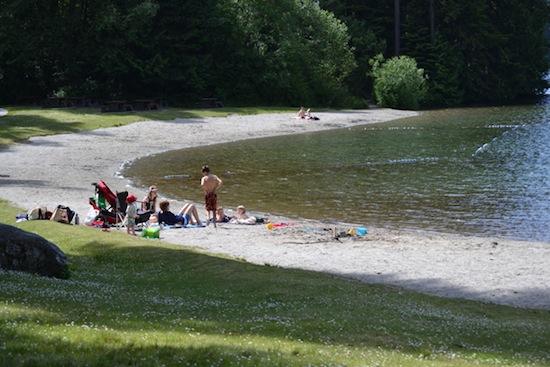
One of my favorite summer destinations in this area is the Village of Anmore, a semi-rural residential community that’s home to White Pine Beach on Sasamat Lake. The lake’s sandy beach and warm waters are a perfect playground for kids building sandcastles, athletic swimmers and those who want nothing more than to drift away on an inflatable mattress and soak up the sunshine. The air is filled with the delighted shrieks of children playing in the shallows as families grill their meals on portable gas barbeques, the smells lingering in the air. Our sandwiches didn’t seem quite so tempting!

You have to be organized if you’re headed to White Pine Beach and, in my house, that means preparing the night before for the day ahead, packing picnic baskets, shopping for food, and ensuring that towels, swimsuits and beach paraphernalia are ready for an early departure. On weekends, the parking lot fills up by 9:30 a.m., and those spots are coveted. Once they’re all occupied, the gate on Sunnyside Road closes to vehicular traffic and access to the lake requires a long walk. Still, it’s well worth it to have a rejuvenating day on the lake that reminds you how good it is to be alive.

photo - The options are numerous at White Pine Beach: you can rest and absorb the serenity, take a swim or or build a sandcastle
The options are numerous at White Pine Beach: you can rest and absorb the serenity, take a swim or or build a sandcastle. (photo by Lauren Kramer)

If you’re keen to kayak, canoe or challenge yourself to a long hike, continue north up Sunnyside Road until you reach the glacial waters of Buntzen Lake, a larger body of water surrounded by numerous hiking trails. The Buntzen Lake Trail, an eight-kilometre route that circles the lake, is a glorious walk through the shady forest and one of the shorter hiking paths in the area. The massive lake offers an off-leash canine beach, a large grassy picnic area shaded by towering hemlocks, a swimming beach and a dock from which kids can learn to fish – a skill they’ll be able to use every summer. For $45 you can rent a kayak for a full day from Anmore Grocery ($60 for a canoe, 604-469-9928) and, if you’ve not stocked up on provisions, call ahead to order croissants, muffins and/or sandwiches.

After a day on the beach, it felt glorious to drive around Port Moody, soaking up its views. As we careened along Bedwell Bay Road, we admired the mansions, envious of their ocean views. While at the Belcarra picnic area, Burrard Inlet glimmered before us, a rocky beach begging to be explored at low tide, preferably with ice cream in hand.

Sure, we got lost on those winding roads, but that was all part of this glorious day drive. At one point, we slowed for two deer that cautiously picked their way across the road right in front of us, posing cooperatively for photos before they disappeared into the forest. The road clear, we headed back into Port Moody, stopping at Suter Brook Village to replenish on smoothies and healthy snacks. Then, we reluctantly traded the wonderfully rural ambience in Port Moody for the road construction, stoplights and heavy traffic of Burnaby and Vancouver, knowing one thing for certain: we’d be back for sure this summer.

For maps and information on Belcarra Regional Park, which encompasses Belcarra, Anmore and Port Moody, call 604-520-6442 or visit metrovancouver.org.

Lauren Kramer, an award-winning writer and editor, lives in Richmond, B.C. To read her work online, visit laurenkramer.net.

Format ImagePosted on June 27, 2014August 18, 2014Author Lauren KramerCategories TravelTags Buntzen Lake, Port Moody, Sasamat Lake, Suter Brook Village, White Pine Beach

UNESCO finally runs “Holy Land” exhibit

Canadian participants in a meeting earlier this month with French President François Hollande came away impressed with the French leader’s sincerity and determination to address the terrorism and antisemitism that has France’s Jews on edge.

Avi Benlolo, president and chief executive officer of the Friends of the Simon Wiesenthal Centre, and Member of Parliament and former justice minister Irwin Cotler said Hollande was empathetic to the concerns of the country’s Jews and was forthright in discussing the threat posed by French-born jihadists returning from Syria.

“Hollande spoke about the barbaric attack on the Jewish museum in Belgium” and about the protection of Jewish schools, synagogues and other community buildings, Cotler said in a telephone interview from Jerusalem.

Cotler and Benlolo were part of a 20-member delegation assembled by the Los Angeles-based

Simon Wiesenthal Centre, which met with Hollande prior to officially inaugurating an historic exhibition at UNESCO’s Paris offices. The exhibit, mounted by historian Robert Wistrich, is titled, People, Book, Land: The 3,500-Year Relationship of the Jewish People to the Holy Land.

The exhibit was sponsored by the Simon Wiesenthal Centre along with the governments of Canada, Israel, the United States and Montenegro, and it launched this month after pressure from Arab countries forced its cancellation in January.

Benlolo said the reception by French officials and Hollande at the Élysée Palace was warm and welcoming. The delegates were anxious to express their concerns about the attack on the Jewish Museum in Brussels by a French gunman, who killed four people.

“Hollande believes there are more than 1,000 French nationals who went to fight in Syria and joined radical groups,” Benlolo said. Three hundred remain. Many came back and he’s concerned about their radicalization and if they will take action against the Jewish community.

Mehdi Nemmouche, the man accused in the Brussels attack, is believed to have spent 2013 fighting with Islamic radicals in Syria.

Hollande assured the delegates that he is working closely with intelligence and security services to track returning jihadists and to ensure the safety of the country’s Jews.

“I believe Hollande was very sincere,” Benlolo said. “The Jewish community received substantial grants to secure their schools and synagogues,” he added.

Cotler, who has visited France three times in the last six months, said, “People spoke well of Hollande and his genuineness, his commitment to combat antisemitism, to bring perpetrators of antisemitism to justice and his appreciation of jihadist acts as threatening to French Jews and France alike. He took the position that it’s a joint struggle, a part of the protection of French democracy and all of France.”

During the meeting, Rabbi Marvin Hier, dean and founder of the Wiesenthal Centre, told the president, “We meet at a pivotal time in history, when the Jewish community and France’s democratic values are under unprecedented attack by the forces of extremism both from the far right and from extreme Islamist purveyors of religious intolerance and murder.”

He applauded Hollande and his predecessor, president Nicolas Sarkozy, for denouncing an earlier terrorist attack in Toulouse that claimed the life of a rabbi and four children, but he lamented the failure of Muslim religious leaders to condemn the attacks.

Meanwhile, Cotler was effusive in his description of the Wistrich exhibit, which he called “historic.”

“It is a remarkable dramatization of history and heritage, of people, book, land, memory and state,” said Cotler.

In 24 panels, the exhibit traces Jewish history back to the patriarch Abraham, through Moses, King David and all the way through to the struggle for Soviet Jewry, the birth of Zionism and the reconstitution of the state of Israel.

The nine-day exhibit had been scheduled to open last January. Pressure from 22 Arab countries, who argued it would prejudice the peace process, prompted UNESCO to cancel it.

Responding to that decision, Hier stated, “It is ironic that, while the Arab League was trying to kill this exhibition and all the attention was focused on Paris, the UN headquarters in New York [was] hosting an exhibit entitled, Palestine, based entirely on the Arab narrative, which was not criticized as an interference with Secretary [John] Kerry’s mission.”

Following public criticism from Canadian Foreign Minister John Baird and U.S. envoy Samantha Power, the exhibit was rescheduled to open early this month, but with the name Israel removed from the title and replaced with “Holy Land.” UNESCO also required the removal of an image of the Dead Sea Scrolls, which had been part of the initial exhibit prepared by Wistrich, a professor of European and Jewish history at the Hebrew University in Jerusalem.

– For more national Jewish news, visit cjnews.com.
Posted on June 27, 2014June 25, 2014Author Paul Lungen CJNCategories WorldTags Avi Benlolo, Francois Hollande, Irwin Cotler, Marvin Hier, Robert Wistrich, Simon Wiesenthal Centre, UNESCO

Israeli company builds floating desalination plants for Japan

Environmentalists usually agree that making fresh water from brackish (salty) water is a last resort. Building desalination plants requires millions of dollars in technology, and it’s costly to produce potable water – both in terms of energy to run the plants and the environmental pollution the factories emit.

The Israeli company IDE Technologies – already planning the biggest desalination plant in the United States – is pushing the borders in this domain closer to sustainability in Japan, where it is working to produce floating desalination plants.

The new approach will breathe new life into Japan’s stagnant shipbuilding business and help the Japanese fulfil short-term freshwater needs, according to Bloomberg News.

Udi Tirosh, a business development director at IDE, told the business media outlet, “Floating plants will not replace the land-built ones, but floating plants can become an alternative that does not saddle a country with the burden of maintenance once local water tables improve.” This could be welcome news in parched regions of the United States, like California, which is experiencing an historic drought.

Read more at israel21c.org.


Posted on June 27, 2014June 25, 2014Author Karin Kloosterman ISRAEL21cCategories WorldTags desalination, IDE Technologies, Udi Tirosh

Palestinian prof. resigns after Auschwitz trip

The Palestinian professor who touched off a maelstrom of controversy by taking a group of students to visit the Auschwitz-Birkenau death camps in Poland is now at odds with his former employer after the school accepted his resignation.

Dr. Mohammed S. Dajani Daoudi, who headed the American studies department and served as chief librarian at Al-Quds University, stirred up controversy among Palestinians who felt the March trip was inappropriate. Although the participants were all students at Al-Quds, Dajani said that the trip itself was under the aegis of Wasatia, the nongovernmental organization that he heads whose goal is to “promote a culture of moderation and reconciliation between the Israeli people and the Palestinian people.” But when the trip became a public issue, criticism was leveled at the school and the professor. Dajani said he received threats and the employee and student unions, to which he did not belong, formally banned him from membership. On May 18, Dajani submitted his resignation from Al-Quds University.

Incoming university president Imad Abukishek said he was surprised by the resignation, given the lengths he said the school went to on Dajani’s behalf. “We thought he noticed what we did for him and that he would respect what we did for him,” Abukishek said, citing two university-assigned security guards hired to protect Dajani and the school’s attempt to confront the unions to demand the rescinding of the ban issued against the professor.

Dajani, however, said he saw the university’s response in a different light. In his letter of resignation addressed to outgoing university president Sari Nusseibeh, Dajani charged that as a result of the fallout from the Auschwitz trip, “the educational environment on this campus for teaching and learning is not available at your university, which makes it difficult to practise my mission to educate and practise academic freedom.”

In a statement, the administration strongly disagreed, citing the school’s efforts to “act promptly and effectively to deal with the actions” of the two unions and the hiring of the bodyguards. The administration insisted that Al-Quds did all it could do “to deal with the repercussions of his visit,” and did so even though it “was being made to deal with ‘an external activity carried out by Prof. Dajani in his private capacity as the CEO of an independent NGO, which he runs [that] … had nothing to do with the university.’” The statement added that the school did all it could “to ensure that individuals, including Prof. Dajani, had the right to express their views freely, and to act freely within the confines of the law, without fear of intimidations or threats.”

Read more at themedialine.org.

Posted on June 27, 2014June 25, 2014Author Abdullah H. Erakat TMLCategories WorldTags Al-Quds University, Auschwitz-Birkenau, Dajani, Imad Abukishek, Mohammed S. Dajani Daoudi, Sari Nusseibeh

Posts pagination

Previous page Page 1 … Page 641 Page 642 Page 643 … Page 664 Next page
Proudly powered by WordPress