
Skip to content
  • Home
  • Subscribe / donate
  • Events calendar
  • Business Directory
  • FAQ
  • News
    • Local
    • National
    • Israel
    • World
    • עניין בחדשות
      A roundup of news in Canada and further afield, in Hebrew.
  • Opinion
    • From the JI
    • Op-Ed
  • Arts & Culture
    • Performing Arts
    • Music
    • Books
    • Visual Arts
    • TV & Film
  • Life
    • Celebrating the Holidays
    • Travel
    • The Daily Snooze
      Cartoons by Jacob Samuel
    • Mystery Photo
      Help the JI and JMABC fill in the gaps in our archives.
  • Community Links
    • Organizations, Etc.
    • Other News Sources & Blogs
  • JI Chai Celebration
  • JI@88! video

Recent Posts

  • Legal help for students
  • Revisiting myth of Lilith
  • Wrong person rebuked
  • Canada’s mixed messages
  • Questions for museum
  • Symposium on antizionism
  • Making soccer political
  • CJPAC lauds Pulver’s impact
  • City recognizes Vrba’s legacy  
  • Organ donation saves lives
  • Theodore’s March premiere
  • A healing Shabbaton
  • Supplying healthy food
  • A chime of metal tags
  • Yellowknife seder a first
  • Ishai energizes, unifies
  • A Lag b’Omer to remember
  • Expanding the healing
  • Hannah Senesh – a unique hero
  • Community milestones … May 2026
  • Sharing her testimony
  • Fall fight takes leap forward
  • The balancing of rights
  • Multiple Tony n’ Tina roles
  • Stories of trauma, resilience
  • Celebrate our culture
  • A responsibility to help
  • What wellness means at JCC
  • Together in mourning
  • Downhill after Trump?
  • Birth control even easier now
  • Eco-Sisters mentorship
  • Unexpected discoveries
  • Study’s results hopeful
  • Bad behaviour affects us all
  • Thankful for the police

Archives

Follow @JewishIndie
image - The CJN - Visit Us Banner - 300x600 - 101625
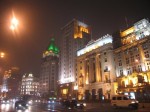
photo - Shanghai's famous Bund district, where most of the buildings were built and owned by wealthy Sephardi Jewish families

Waves of Jews to East Asia

0 Flares 0 Flares ×

Shanghai’s famous Bund district, where most of the buildings were built and owned by wealthy Sephardi Jewish families. (photo by Anthony Hartman via Wikimedia Commons)

It was a long trek: 6,000 miles by boat from central Europe to East Asia. But the towns of East Asia opened their gates for the waves of Jewish emigrants who had to find shelter from the tragic problems they faced first in Russia and, later, in Europe.

Though some believe their story still flies under the radar when compared to the prevalence of other Holocaust-related discourse – perhaps because most of Shanghai’s Jewish residents viewed their time in the city as a transient stage – historians now know there once was a large and thriving Jewish community in China. Records of immigrants kept by the Hebrew Immigrant Aid Society (HIAS), which operated in Asia from 1917-1950, paint an inescapable picture of Jewish refugees who survived the war in Shanghai.

“The United States, Canada, Australia closed the doors to Jews and other immigrants in the 1920s.… HIAS had to … find other places that were willing to allow Jewish refugees to live there,” explained Mark Hetfield, HIAS president and chief executive officer. “Desperate measures called for creative thinking.”
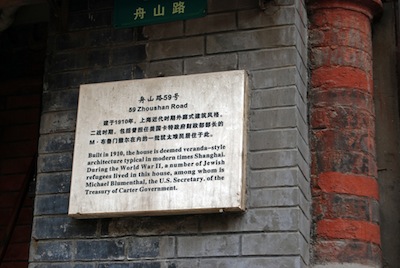
photo - A plaque at a house in Shanghai that was formerly the residence of Jewish refugees, including W. Michael Blumenthal, who went on to serve as U.S. Secretary of the Treasury under President Jimmy Carter
A plaque at a house in Shanghai that was formerly the residence of Jewish refugees, including W. Michael Blumenthal, who went on to serve as U.S. Secretary of the Treasury under President Jimmy Carter. (photo by H. Barrison via Wikimedia Commons)

The first Jews, Silk Road traders, arrived in China in the eighth century and settled in Kaifeng. The next Jews were those who arrived under British protection following the First Opium War. Many of these Jews were of Indian or Iraqi origin, due to British colonialism in these regions, and they became the largest dealers in opium. These included David Sasson (the “Rothschild of the East”), philanthropic businessman Sir Eli (Eliazer) Khadori and real estate lord Silas Herdoon. According to most accounts, the number of Sephardi Jews in China totaled around 1,000.

Around 4,000 Jews would then arrive as refugees from the Russian Revolution of 1917. Finally, a surge as large as 18,000 Jews arrived as refugees from the Holocaust in the late 1930s and 1940s. According to Peter Nash, a child survivor from Berlin who found refuge in Shanghai from 1939-1949, about 8,000 of these refugees originated from Germany and about 4,000 came from Austria.

Read more at jns.org.


Print/Email
0 Flares Twitter 0 Facebook 0 Google+ 0 0 Flares ×
Format ImagePosted on June 27, 2014June 25, 2014Author Maayan Jaffe JNS.ORGCategories WorldTags HIAS, Mark Hetfield, Shanghai Jews

Post navigation

Previous Previous post: Listening to her patients
Next Next post: Tooshaaya all natural
Proudly powered by WordPress