Funds to help Israel pour in

Jewish Federation of Greater Vancouver chief executive officer Ezra Shanken on Victoria Rumble Room Oct. 14. Shanken has very much been the face of the Jewish community in recent days. (screenshot)

An emergency fundraising campaign in response to the devastation in Israel raised more than $15 million in Metro Vancouver in less than two weeks.

The Jewish Federation of Greater Vancouver is spearheading the Israel Emergency Campaign. In his weekly email last Friday, Oct. 20, Federation chief executive officer Ezra Shanken announced the record total that had been raised to that point. By comparison, last year’s entire annual campaign raised $10.2 million.

Shanken told the Independent that, within the $15 million-plus total, is another new record for the local community: nine gifts of $1 million and a gift of $2 million.

Despite the great success, Shanken said the money will barely begin to approach the needs created by the human and material destruction caused by the Hamas terror attacks and the ongoing aftermath.

“As excited as I want to be,” he said, “I felt like $20 million, which is where we would like to get to, is not even going to be enough. The destruction, both in human life and in physical property, is so immense in the south, the risk is so high in the north, the mental health needs are so huge over there, that those alone are multi-, multi-million-dollar needs.… The damage is so deep that it’s going to take a lot for us to be able to make an impact.”

The Jewish Federations of North America set a goal of $500 million for the combined campaign and was already well past the two-thirds mark at the end of last week. Other Israel-based and Israel-supporting charities are also raising money and delivering support through funds and on-the-ground projects.

The speed and magnitude of the local emergency fundraising effort, Shanken said, may be a consequence of the community campaign already underway for the redevelopment of the Jewish Community Centre of Greater Vancouver. He calls it the “JWest effect,” referring to the name of the redevelopment project. Sensitizing philanthropists to community needs may have sowed the field for the extraordinary generosity shown when this unanticipated catastrophe occurred. The feeling that this is an unprecedented historical moment is also a factor.

For media in British Columbia and at public events, Shanken has very much been the face of the Jewish community in recent days. Speaking personally, he described the flood of contradictory emotions he has experienced.

“This time has been a mix of incredible pride and incredible pain,” he said. “They come in different waves. I have incredible moments of pride and incredible moments of resolve and strength and incredible moments of weakness and pain and depression.”

Shanken continued: “It’s a tough time for all of us, it’s a tough time for me.… But I believe more than ever that these are the moments where we are really forged in these fires and we will be a stronger community because of what we’re going through in this moment.”

The inhumanity witnessed not only in Israel but closer to home, with protests and statements effectively supporting and celebrating the mass murders, has stiffened his resolve, he said.

“I feel a need to stand up against those who are really trying to push us down in this moment,” he said. “I feel strong, I feel determined, I feel righteous in this moment in pushing back against those who are going to minimize the deaths of these folks, that are going to make us feel that we don’t have a right to grieve, we don’t have a right to defend ourselves, we don’t have a right to care for each other. I have no stomach for that anymore and we’re not going to keep our mouths shut on this.”

Funds raised will be allocated through several different projects working directly in Israel (click here for story). While most of the devastation from the Oct. 7 attacks is in the country’s south, the Vancouver Jewish community’s partnership region, Etzba HaGalil, the Galilee Panhandle, and other parts of northern Israel, have experienced attacks from the terror group Hezbollah, from their bases in southern Lebanon. Kibbutzim, villages and towns within a several-kilometre range of the Lebanon border have been largely evacuated. In all, about 200,000 Israelis from the north and south have so far been displaced by the crisis.

“The north is a major, major concern for Israel, it’s a major concern for us,” said Shanken. “So, we are trying to get them prepped up and ready, get emergency war rooms together in community centres, those kinds of things. We’re looking at some other kind of resiliency-building pieces in subsequent tranches of money that will be sent.”

Donations to the Israel Emergency Campaign can be made at jewishvancouver.com/israel-fund.

The situation is surreal

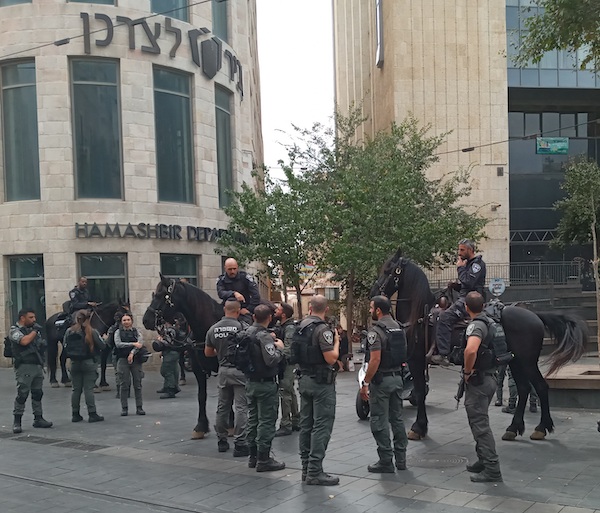
Downtown Jerusalem is deserted apart from Israel Border Police deployed in Zion Square. (photo by Gil Zohar)

It is Oct. 9. My wife Randi calls me while I am riding Jerusalem’s all-but-empty light rail, returning from a bat mitzvah celebration of a forlorn family of tourists from Arizona who are stuck in Israel. We simultaneously hear the air-raid siren blaring as we talk. Fighter jets are screaming overhead. With an edge of panic in her voice, Randi asks me what she should do. I calmly instruct here to follow the Home Front Command orders for civilians, which we have repeatedly reviewed. I’ve downloaded the app on my cellphone.

Our beautiful stone home in downtown Jerusalem, built in 1886, lacks a reinforced steel and concrete bomb shelter, known by the Hebrew acronym MaMaD (Makom Mugan l’Diyur), a protected residential place.

I remind Randi go to the neighbour’s basement apartment quickly but without running, and to wait there. Grabbing Bella our dog, she leaves the apartment door and windows open so that a blast from an explosion will not result in the windows being shattered and glass debris obliterating our house.

Below-grade structures make for poor bomb shelters since poison gas is heavier than air, I think. But there is no alternative. Nine Bedouin children were killed by Hamas rocket fire in the Western Negev. Their village lacked a MaMaD.

We hear the twin boom of Israel’s air defence system, the Iron Dome, intercepting a rocket barrage fired from the Gaza Strip. The strike lights up the sky. The threat is over until the next alert. The media reports that seven civilians living in towns in the periphery of Jerusalem were wounded in the barrage.

At the time of this writing, nearly 1,000 Israeli civilians have been killed, including 260 massacred at the Nova festival near Kibbutz Re’im – an all-night party in the desert. More than 130 civilians and soldiers have been taken hostage and dragged back to Gaza. Apart from 35 Israel Defence Force soldiers who fell in the line of duty, the names of the deceased have not been released.

It remains unclear if Hezbollah will open a full-scale second front from Lebanon. Israel has threatened to destroy Damascus, the capital of Syria, which backs the Shi’ite terror group, should the war broaden to the north.

Families of the kidnapped, missing and 2,200 wounded civilians are begging for news. Israel remains shrouded by military censorship. Nor is the news from the 2.3 million people in Gaza any clearer. Al-Jazeera lists long-out-of-date statistics. Based on data reported by the Palestinian Health Ministry, the Palestine Red Crescent Society and Israeli Medical Services, 560 Gazans have been killed. That number is likely to rise substantially.

More than 48 hours from when Hamas attacked and war broke out at 6:30 a.m. on Saturday, the IDF spokesperson announces that the army has neutralized the terrorists who overcame 22 cities and villages near Gaza. Israelis are being evacuated from the border area in anticipation of a ground invasion. Some are being housed in empty hotels near the Dead Sea.

I’ve offered our adjoining apartment. All our Airbnb guests have canceled. Apart from El Al, airlines have stopped flying to Ben-Gurion Airport.

The number of the dead, missing and wounded is surreal. The IDF has called up 300,000 reservists in the last 48 hours for what it has termed “Operation Swords of Iron.” Among them is my nephew Guy Carmeli, a Canadian-Israeli dual citizen and veteran tank gunner who lives in Herzliya with his wife Yael and 2-year-old son Oz. Randi doesn’t know of his callup. Maybe she’ll read it here. My wife doesn’t do well with stress.

A press release from Prime Minister Benjamin Netanyahu denies Egypt is trying to broker a ceasefire. The statement reads: “No message has arrived from Egypt and the prime minister has neither spoken, nor met, with the head of Egyptian intelligence since the formation of the government, neither directly nor indirectly. This is totally fake news.”

The implication? Israelis must gird themselves itself for a “long and difficult war ahead,” according to Netanyahu.

The electronic tom-tom drums uniting immigrant Israelis have been busy. As I write this, nine Americans have been confirmed dead, and 10 Brits are assumed to have been killed.

Adi Vital-Kaploun, the adult daughter of Ottawa native Jacqui Vital and her husband Yaron who live in Jerusalem, was kidnapped from her home by the Gaza Strip. Adi’s two infant children, aged 1 and 3, were also taken hostage but were abandoned at the border by their captors who felt the children would slow down the gunmen’s retreat. [On Oct. 11, after the Independent went to press, it was announced that Vital-Kaploun had been murdered by Hamas terrorists.]

There are other Canadians missing, including former Winnipegger Vivian Silver. And there are Canadians who were killed by the terrorists: Alexandre Look, who grew up in Montreal, and Vancouverite Ben Mizrachi; both young men were among those killed at the music festival near Kibbutz Re’im.

Canadian-Israeli Shye Weinstein, who was at the festival, too, documented how he and his friends fled. He described their nail-biting escape to Tel Aviv: “We only slowed down for checkpoints and bodies.”

Nuseir Yassin, who writes the blog @nasdaily, described his conflict as an Arab citizen of Israel: “Personal Thoughts: (not for everyone, feel free to skip) For the longest time, I struggled with my identity. A Palestinian kid born inside Israel. Like … wtf. Many of my friends refuse to this day to say the word ‘Israel’ and call themselves ‘Palestinian’ only. But since I was 12, that did not make sense to me. So I decided to mix the two and become a ‘Palestinian-Israeli.’ I thought this term reflected who I was. Palestinian first. Israeli second. But after recent events, I started to think. And think. And think. And then my thoughts turned to anger. I realized that if Israel were to be ‘invaded’ like that again, we would not be safe. To a terrorist invading Israel, all citizens are targets. 900 Israelis died so far.

“More than 40 of them are Arabs. Killed by other Arabs. And even 2 Thai people died too. And I do not want to live under a Palestinian government. Which means I only have one home, even if I’m not Jewish: Israel. That’s where all my family lives. That’s where I grew up. That’s the country I want to see continue to exist so I can exist. Palestine should exist too as an independent state. And I hope to see the country thrive and become less extreme and more prosperous. I love Palestine and have invested in Palestine. But it’s not my home. So from today forward, I view myself as an ‘Israeli-Palestinian.’ Israeli first. Palestinian second.”

Gil Zohar is a writer and tour guide in Jerusalem.

The sounds of terror attacks

Editor’s note: This article is a reprint of an Oct. 7 Facebook post.

“What the heck?!” I sat up in bed and looked at my husband. There was a siren blaring.

Instinctively, I reached for my phone – but it wasn’t on my night table. I checked under my pillow, where did I put it?

Then I remembered. It was Shabbat and Simchat Torah. We had gotten home late last night after a beautiful celebration with the Torah in the small Chabad synagogue down the road. “Rabbi Heber’s Chabad,” as we called it, was filled with Jews from all over: Israel, Morocco, the former Soviet Union, and a small sprinkling of English-speakers. That night, everyone danced the “hakafot” together in unity, celebrating the beautiful gift God gave to us.

Before heading home, we hugged and told each other we’d be back tomorrow for the day celebrations, when again we’d dance around with the Torah together.

On Shabbat and Simchat Torah we don’t use electric technology, and so when the air raid siren blared, my phone was in my drawer on airplane mode.

My husband and I leaped out of bed. “You get the girls, I’ll get the boys!” I said.

The kids were already awake, all but little Leah had climbed out of bed and began running towards our shelter. My husband grabbed Leah and, within seconds, we were in our bomb shelter, door closed shut.

We were caught completely off guard. The kids were confused.

“Why didn’t you tell us there would be a siren?” my son asked.

We didn’t know. We didn’t expect it. Maybe it was just a fluke? Maybe the Israeli army assassinated a Hamas terrorist and there was going to be a couple rockets in retaliation?

The siren went on for awhile. We heard lots of explosions. When it stopped, my husband stepped out to look at the clock. It was 6 a.m. The sun would be up soon, not a chance of the kids going back to sleep. We sat on the living room couch and said the morning prayer, Modeh Ani, thank you God for returning my soul to me.

We wondered if the sirens would stop soon and if we’d be able to go to the synagogue to celebrate Simchat Torah. Moments later, we were back in the bomb shelter. Sirens, explosions, on and on and on.

During a small break, we returned to the couch and listened to the sounds of war. Early on a Saturday morning, there was no other noise pollution, and so we heard everything for miles around. Sirens in the distance, explosions, military jets taking off, first responders whizzing by.

“Mom, I hear booms, we should go back to the shelter.”

I explained to my kids how to tell if a boom is close or far. If it’s a deep sound, it’s in the distance. The higher the pitch, the closer.

Sirens again, back to the shelter.

“Mom, that boom was very close.”

It was. But it was a thud, no crashing explosive sounds after. It couldn’t have hit a building. The sirens continued, and we stayed put.

On our bomb shelter windowsill are a pair of gas masks, sitting there since the Gulf War of 1991. They’re useless now, but staring at them sent a shiver down my spine.

My husband and I looked at each other. This was no ordinary operation going on. We had already lost count, but were sure that hundreds of rockets had been fired at Be’er Sheva in the past few hours.

It wasn’t just the air-raid sirens; there were nonstop first-responder sirens, too. Way more than we ever remembered hearing during any military operation.

Finally, at 10 a.m., another break. Our bomb shelter gets very stuffy, so we were relieved to step into the living room, where we had all the windows open.

“It smells like smoke.”

My daughter was right. It did. We went out our front door and saw a thick cloud of dark smoke rising behind our home.

Our neighbour walked out of his house, followed by his teenage daughter.

“It’s the park!” she shouted. “The park behind our house is on fire!”

A rocket must have made impact there. Probably the one my son pointed out. Just a few metres away from our home.

Our neighbour looked at us, and realized we probably hadn’t seen the news.

“It’s a balagan,” he said. “They kidnapped a soldier, they’re shooting in Ofakim. Hundreds of rockets. It’s a mess.”

I didn’t process what he was saying. Shooting in the city of Ofakim? Kidnapped a soldier? I probably wasn’t understanding him right.

My son found a piece of shrapnel on the street, right next to our parked car. We went back inside. It stunk of smoke. I closed the windows.

More air-raid sirens. More explosions. Nonstop first-responders. Some sounded different – maybe military ambulances or fire trucks? Maybe there was another big fire and they were all rushing to put it out? I couldn’t imagine why else there would be so many. Just in case, I locked the doors.

More sirens, back to the shelter. We spent most of the morning in that stuffy room. It’s also our laundry room and dairy kitchenette. There were a few dishes in the sink, I washed them, tidied up a little.

We realized there was no going to synagogue today, and began prayers at home. By this time, the sirens were further spread apart, and we were

able to spend most of our time in the living room.

It was Simchat Torah. How would we do the hakafot dancing without a Torah? Without a community come together in joy?

My kids ran towards the bookshelf.

“Look! It’s Torah Ohr! Lekutei Torah! We can dance with these!”

My husband found a mini set of the five Torah books, my oldest daughter a Tanach – the complete Bible set in one.

The Simchat Torah dance goes around the bima, the table on which the Torah is read. First the congregants repeat lines from the prayer book after each other, sharing l’chaims in between, and then begin the dancing.

We gathered around our dining room table.

“L’chaim to the safety of the IDF and all of Israel!”

“L’chaim!”

My husband read the first line, my kids and I repeated.

“Atah horaisah l’dat.…”

Around the table we went, my husband and I, and the kids, each taking a line, some around the table, some in the bomb shelter.

Then we began the hakafot and danced around and around the table, holding up our Torah books. My littlest had chosen a giant Torah Ohr that was almost half her size. I couldn’t help but lift her up and dance around as she giggled away.

We paused in between hakafot, and I told the children a story: After the Holocaust, a few survivors returned to Vilna, in Lithuania. On Simchat Torah, they gathered in the grand

Vilna synagogue, but all the Torah scrolls were gone. There was one child. The survivors picked him up over

their shoulders and danced around with him, “This is our Torah! This is our future!”

We finished hakafot around our table, and ate a Simchat Torah lunch.

In the distance, we heard children singing: “Anachnu maaminim b’nei maaminim!” “We are believers, children of believers! We have no one to lean on but our Father in Heaven!” We sang along.

The sounds of war were loud. Too loud. Jets, explosions – that we knew. But why were there so many first-responders?

My husband stepped outside. Maybe there was another fire? The kids followed him.

A neighbour was pacing back and forth in the street, staring at his phone. My husband asked him why all the sirens.

“The sirens are nothing. Nothing. 80 dead. 800 injured. Who knows how many kidnapped. We are at war! You don’t want to know what you will see when you turn your phone on.”

My son ran back inside: “It’s a war! It’s a war! We need to lock the doors so they don’t come and shoot us.”

I felt like vomiting.

Be’er Sheva has the closest hospital to most Gaza border communities. The nonstop first-responder sirens were ambulances. Hundreds of ambulances carrying patients to the hospital.

“Kids, let’s say Psalms. The best we can do right now is pray for the people who were injured or kidnapped, and for the IDF soldiers to be successful.”

We said Psalms. My kids kept asking when we can check our phones. We were inside and safe; I felt we could wait until Shabbat was over. I wanted to wait. I didn’t want to see.

But Shabbat and Simchat Torah came to an end, and I saw.

I still have not processed.

More than 300 dead [at the time of original writing]. Well over a thousand injured. At least 52 kidnapped.

A mass door-to-door slaughter of Jews. In 2023.

I will not process this. It cannot be real.

Three kids are sleeping in our bomb shelter. My oldest refuses. She’s in her own bed, in a much-needed sleep.

I’m still hoping this is some messed-up nightmare and I’ll wake up soon to a good world, with the same amount of Jews alive as there was before Simchat Torah began.

Bruria Efune lives in Be’er Sheva with her husband Mendy and four children. She is co-founder of Ohr Chabad, building a new community in Israel. Born in Vancouver, she is the daughter of Rabbi Tzvi and Nomi Freeman.

Urban warfare training

An Israel Defence Forces patrol. The mural on the right was painted by Batsheva Schneider when she was doing her military service. (photo by Gil Zohar)

Fans of Fauda may recognize the Tze’elim Urban Warfare Training Centre (UWTC) in the western Negev Desert near Kibbutz Tze’elim. The base – where Israel Defence Forces infantry and commanders train in the type of house-to-house and subterranean combat expected in the Gaza Strip, but also in the West Bank, southern Lebanon and other Middle East locations – was used as a set for the hit TV series. But, while faudameans “chaos” in Arabic, the disarray in this sprawling 24-hectare base has been finely calibrated to accustom troops to real-life conditions of fighting in Arab cities and villages.

photo - Soldiers in the midst of operations training.
Soldiers in the midst of operations training. (photo by Gil Zohar)

Located inside the larger Tze’elim Training Base, the UWTC simulates the maze of a multi-storey Middle Eastern urban environment. Established in 2005, it was built at a cost of $45 million.

The warren of 600 structures includes garbage-strewn streets, storefronts, schools, houses, shacks, an eight-storey apartment block and mosques. The muezzin’s call blares from the minarets, which are illuminated with green Islamic lights. Garages advertise cars for sale. Jeeps patrol the dusty streets. Holes blown in walls allow soldiers to avoid entering a building via the doorway, which may have been booby-trapped.

Most striking are the murals and graffiti scattered across the site, some painted by Batsheva Schneider when she was doing her military service. The images include Islamic Jihad fighters firing RPGs, Hamas founder Sheikh Ahmad Yassin, Qassam rockets from Gaza, and guerrillas with their faces covered by a keffiyah scarf marked “shahid” (martyr). One Arabic sign just says “death.”

photo - Murals and graffiti are scattered across Tze’elim
Murals and graffiti are scattered across Tze’elim. (photo by Gil Zohar)

Entering a mock-up of a claustrophobic Gaza terrorist tunnel, this writer felt the palpable panic among my fellow journalists behind me as they urged me forward in the pitch-black darkness.

photo - Images include Qassam rockets from Gaza
Images include Qassam rockets from Gaza. (photo by Gil Zohar)

Other buildings are decorated to replicate a salon in a private home. The verisimilitude extends down to framed family photographs, flowers in a vase, recent newspapers from Gaza and art with Quranic verses. Simulators showing mortar strikes and explosions suggest to soldiers what they might witness outside the living room window.

In addition to the IDF, Israel’s “Mini Gaza” has been used for urban warfare training by U.S. Army soldiers and United Nations peacekeepers. The project was developed to meet the need for better urban warfare training by the IDF, as a response to the challenges of the Second Intifada of 2000-2005. It is regularly updated as new terror strategies evolve.

Training exercises here are meant to help soldiers and their officers distinguish between combatants and civilians, and prepare them for situations where terrorists exploit civilians as human shields.

This writer was part of a delegation of international journalists on a tour organized by the Israel Government Press Office. The invitation came before the recent military operation in Jenin.

Gil Zohar is a writer and tour guide in Jerusalem.

Fighting domestic violence

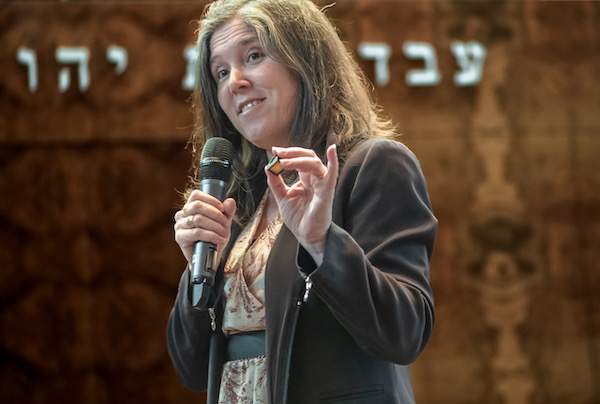
Lili Ben Ami, founder of the Michal Sela Forum, was in Vancouver last month to talk about how the forum works to save lives and combat domestic violence. (photo by Sid Akselrod)

“As Uber disrupted the transportation sector, Airbnb disrupted the tourism industry, and Facebook disrupted telecommunication, the Michal Sela Forum is disrupting the field of domestic violence,” said Adi Sofer Teeni, chief executive officer of Facebook Israel.

The Michal Sela Forum (MSF) is an Israeli nonprofit “dedicated to saving lives and combating domestic violence through innovation and technological solutions.” After Michal Sela was murdered by her husband, in 2019, Michal’s sister, Lili Ben Ami, founded MSF with the goal of saving the life of the next Michal.

Ben Ami was in Vancouver last month. She spoke on June 13 at an event presented by CHW (Canadian Hadassah-WIZO) at Beth Israel Synagogue.

“Michal was like a butterfly. No one could tell her what to do,” said Ben Ami. This resilience is symbolized by the butterflies in MSF’s logo, and through the organization’s core principles of out-of-the-box thinking, personal entrepreneurship and public awareness, she said. MSF’s goal is to achieve zero femicides per year and Ben Ami is confident that “it’s going to happen,” despite the primitiveness of current systems to fight domestic violence, through the application of available technological capabilities.

Ben Ami said that “in Israel, domestic violence support is characterized by old world tools,” highlighting the reliance on shelters, law enforcement and welfare centres – tools that have remained unchanged for 70 years. These reactive solutions do not break the cycle of domestic violence, agreed CHW chief executive officer Lisa Colt-Kotler. In her introduction to Ben Ami’s presentation, Colt-Kotler emphasized CHW’s shift away from immediate crisis support towards empowering victims with financial independence. CHW’s Safety Net program provides essential services such as counseling, resumé building and essentials kits for women. They also run holiday and summer camps for children of domestic violence survivors, providing women with an opportunity to continue working while their children are cared for at the camp.

In her talk, Ben Ami stressed that Israel has the technological capabilities to save lives, and that these capabilities must be applied to fight domestic violence. Each year, on Michal’s birthday, MSF organizes the Safe at Home Hackathon, a three-day-long technological event that brings together more than 600 software engineers to develop startups aimed at preventing domestic violence. Selected teams from the hackathon are invited to the Michal Sela Startup Academy, a three-month professional mentorship program in collaboration with Google. This program enables entrepreneurs to elevate their innovations and work towards implementing them.

Facilitating the creation of startups is a key focus of MSF – “we need 100 startups on the shelf for investors before we can reach our goal,” said Ben Ami. MSF aims to secure a venture capital investment of $10 million to expand and enhance their programs.

One such program is Michal Sela Canines, which provides women at high-risk of intimate partner violence with a dog for physical and emotional protection. The dog becomes a permanent part of the woman’s family and is given to her for life. The idea was proposed to Ben Ami by a local dog trainer who believes that, if Michal had had a dog on the night she was murdered, she likely would have been protected.

The canine project not only offers protection, but also aids in trauma healing for both women and children affected by domestic violence. Ben Ami reminded the audience, “all the women we protect are mothers.” By the end of 2023, 12 women and 48 children will be part of this program, she said. CHW recently funded a canine, named Maple, and they aim to fund at least five more dogs.

Michal’s Watch, another initiative, currently offers 130 women a security package designed to safeguard them from intimate partner violence. Developed in partnership with Israeli security experts at Shin Bet, Michal’s Watch equips women with a security camera, a panic button connected to emergency services, 10 self-defence lessons, and a cease-and-desist letter from a law firm against their attacker. Ben Ami described Michal’s Watch as an “iron suit” for women.

In addition to technological solutions, MSF is dedicated to educating the public on recognizing and addressing domestic violence. Ben Ami reflected that, in Michal’s marriage, although there was “never a black eye,” nor any visible signs of physical violence before the murder, there was emotional violence.

“The language of domestic violence is universal,” both for the victims and the aggressors, said Ben Ami. MSF collaborated with the best domestic violence experts in Israel to develop five international signals of identifying domestic violence. These signals apply to victims and aggressors, as well as friends and family of victims, and include behaviours such as obsessiveness, maintaining two-faced relationships, gaslighting, and intense overreacting. Graphics detailing these warning signs are publicized around Israel and on social media.

Ben Ami attributes MSF’s expansive growth and impact in only three years to Michal’s spirit – to “people who knew and loved my sister and wanted to help,” she said.

At the event was Ehud Lehavi, a Vancouver Jewish community member who knew Michal from a Scouts program in Israel. Lehavi has been involved with MSF since its early days. When asked, “Could you believe that, in three years, MSF has accomplished all this?”, Lehavi answered, “With any other NGO, no. But, with Lili, yes.”

Ben Ami said she has always been an activist, throughout her background in education and TV broadcasting. Colt-Kotler described her as a “trailblazer, a rockstar and a disrupter” and shared a story of taking Ben Ami to Costco upon arriving in Canada. At the store, Ben Ami was recognized and stopped by a woman who told Lili, “You saved my life.”

For more information, including on the warning signs of domestic violence, go to msf-global.org.

Alisa Bressler is a fourth-year student at Queen’s University in Kingston, Ont. She is an avid reader and writer, and the online director of the arts and culture publication MUSE Magazine. Bressler is a member of the Vancouver Jewish community, and the inaugural Baila Lazarus Jewish Journalism Intern.

Something a bit lighter

This article is a respite from my previous piece, “Living under fire of missiles” (Jewish Independent, May 26), which was about the Islamic Jihad missile that hit a house just around the corner from me during Israel’s most recent flare up with Gaza. It was cathartic writing that article, as it was this one – moving on, as we Israelis do. So, here’s something a bit lighter.

First, a call out to Burton Cummings about Israel’s first flute festival, held at the beginning of June in Tel Aviv. Unfortunately, Burton – who effortlessly played a beautiful sounding flute solo in the Guess Who’s hit song “Undone” – didn’t attend. OK, he was probably unaware of the event. But I suggest that Mattan Klein, founder and artistic director of the festival, reach out to the legendary Canadian singer, songwriter, Guess Who lead and flutist to arrange for his attendance at next year’s festivities. I’ll be first in line for tickets.

***

The definition of irony? Israel, the Jewish state, is facing a critical shortage of doctors. According to a recent OECD report, Israel has 10% fewer doctors per 1,000 people compared to other developed nations. That’s 3.3 doctors versus a 3.7 OECD average. No wonder I must wait so long to see a specialist. Anyway, I guess “my child the doctor” is bragging rights reserved for the diaspora Jewish parent.

***

Speaking of bragging rights. According to the Naturist Society, Israel’s Metsoke Dragot Beach is considered one of the 20 best nudist beaches – in the world! Along with Wreck Beach in Vancouver. Metsoke Dragot is located somewhat off the beaten track, along the western shore of the Dead Sea. A black mud rubdown anybody? And, speaking of irony, it’s only a half hour drive from Jerusalem, the world’s holiest city.

***

Speaking of clothes. Or lack thereof. First off, kudos to Noa Kirel, who came third in this year’s Eurovision song contest. Her performance was simply spectacular as she sang her new hit song, “Unicorn.” Is the song’s meaning related to Israel’s standout status as a “unicorn” nation? Unicorns being high-tech startups worth more than a billion dollars!

Or, does it relate to how much of the world may perceive us? To wit, Kirel sings: “Hey, you don’t like the way I’m talking / Hey, so you stand there keep on callin’ me names / No, I’m not your enemy…. Hey, do you wanna check my DNA? / Older stories, time to go away / And believe in fairytales…. I’m gonna stand here like a unicorn / Out here on my own / I got the power of a unicorn / Don’t you even learn?” The song goes on to say that we don’t have to be caught in a loop, that we “can write a new book / Don’t you wanna change it now?”

But back to Noa’s attire. The day after her stunning performance in Liverpool, England, esteemed United Torah Judaism lawmaker Member of the Knesset Moshe Gafni, had the chutzpah to comment on her wardrobe. Telling – no, lecturing – the Knesset that he is considering donating her some clothes, clearly insinuating she was not modestly enough attired during her performance. Give me a break, Gafni!

***

Speaking of modesty…. While every community has the right to define its own standards, I think the pharmacy in the ultra-Orthodox city of Bnei Brak went too far by covering the faces of women models on boxes of hair dye with purple stickers. They could have at least used stickers reflecting the colour of the dye. But no. That was not the purpose. It was to comply with extreme definitions of modesty. And, in a modern, high-tech country with more unicorns than most other nations – if not ironic, then just down right inappropriate. Fortunately, the pharmacy changed tack and removed the stickers a week later.

***

Back again to clothes. Welcome, Lululemon, the Vancouver sports apparel retailer that just opened its first Israeli branch in the high-end Ramat Aviv Mall, north of Tel Aviv. If all goes to plan, Lululemon will open seven more stores across Israel over the next three years. Can’t wait to see those shapely joggers in high-quality, skin-tight Lululemon outfits highlighting their muscular legs … and other parts of the anatomy. Unless, of course, the joggers are running along a path in Bnei Brak or have the benefit of being given alternative attire by Moshe Gafni.

***

Finally, looping back to a much earlier piece I wrote (JI, March 24). Remember that Hebrew Bible, the one dating back 1,000 years, which, according to Sotheby’s, was the most important document ever auctioned. This leather-bound, handwritten parchment on 792 sheepskin pages – known as the Codex Sassoon – sold for $38,100,000 US. The buyer was former U.S. ambassador Alfed H. Moses, who will graciously house the scrolls at the ANU Museum of the Jewish People in Tel Aviv. Well, I have my next museum outing planned.

Bruce Brown is a Canadian and an Israeli. He made aliyah … a long time ago. He works in Israel’s high-tech sector by day and, in spurts, is a somewhat inspired writer by night. Brown is the winner of the 2019 AJPA Rockower Award for excellence in writing, and wrote the 1998 satire An Israeli is…. Brown reflects on life in Israel – political, social, economic and personal.

Beit HaRav Kook at 100 years

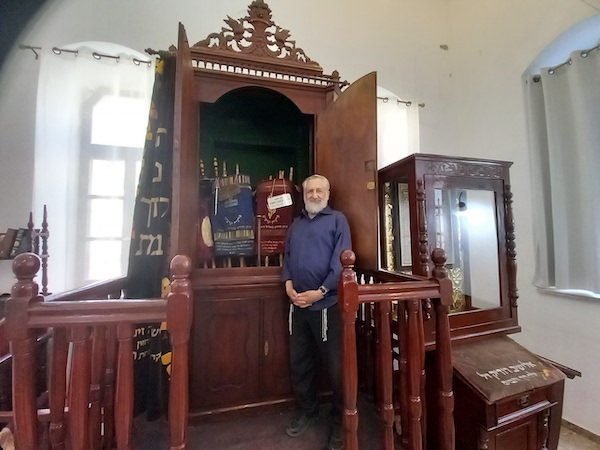
Rabbi Itzhak Marmorstein – a former spiritual leader of Vancouver’s Congregation Or Shalom – stands beside the ark in Beit HaRav Kook, where he is the gabbai (sexton). (photo by Gil Zohar)

Scores of congregants packed Beit HaRav in downtown Jerusalem June 2-3 to celebrate the centenary of the historic synagogue, yeshiva and home of Rabbi Abraham Isaac Kook (1865-1935), a seminal Zionist religious leader during the British Mandate who founded the Chief Rabbinate of Israel.

Born in Griva – then part of the Czarist Empire but today Daugavpils, Latvia – Kook arrived in Jaffa, Ottoman Palestine, on Iyar 28, 5665 (1904), where he became the city’s leading Jewish spiritual figure. The family’s private celebration became a national holiday during the 1967 Six Day War when Israel conquered the Old City of Jerusalem on the same date.

Exiled in Switzerland and then in Britain during the First World War, Kook – also known by the Hebrew acronym HaRaAYaH – played a key role in London in securing the 1917 Balfour Declaration by which Britain announced its support for the establishment of a “national home for the Jewish people” in Palestine.

Returning to the country then under British military occupation following the war, Kook served as the Ashkenazi chief rabbi of Jerusalem. Both the city’s Jewish religious leaders and Whitehall were anxious to replace the Ottoman office of hakham bashi, chief rabbi of the former Turkish empire. Thus, in 1921, Kook was appointed to the newly created position of Ashkenazi chief rabbi of the Land of Israel.

But where was a scholar of such stature to live, especially since the representatives of other religions in the holy city all had an appropriate residence?

The issue was brought up in a July 24, 1921, meeting at Government House on the Mount of Olives – today the Augusta Victoria Hospital – between Britain’s newly arrived high commissioner, Sir Herbert Samuel (1870-1963), and New York businessman Harry Fischel (1865-1948). Asked by Samuel to raise money for the project among his American peers, the philanthropist and his wife Shayna volunteered to fund the building themselves.

They identified Beit David, a one-storey kollel almshouse erected in 1873 by philanthropist David Reis. Owned by the Ashkenazi community’s Central Committee of Knesset Israel, the site was eminently suitable. The courtyard – opposite Rothschild Hospital (today Hadassah College) and near the residence of pioneering ophthalmologist Dr. Alfred Ticho and his wife, artist Anna – was located on Hadassah Street, which was renamed after Rabbi Kook following his death.

photo - The yeshiva hall and beit midrash of Beit HaRav Kook
The yeshiva hall and beit midrash of Beit HaRav Kook. (photo by Gil Zohar)

A cornerstone for the second-floor addition was laid on Aug. 15 before the Fischels departed. Work began immediately. Fischel, an architect and real estate developer in Manhattan, ensured the structure included all the latest modern conveniences. The double-height ceilings were decorated with colourful stencil patterns. Built surrounding a central courtyard, one wing included a reception area, kitchen, bathroom and three bedrooms for the Kook family. The other side included the Central Universal Yeshiva, a synagogue and the scholar’s bureau – now restored to its appearance a century ago. At Kook’s insistence, the synagogue incorporated a moveable roof to permit a sizeable sukkah.

The Kooks moved in at Hanukkah 1922, though the synagogue and yeshiva were still under construction. That spring, the Fischels again crossed the Atlantic. Docking in Alexandria, they caught the train from Egypt across the Sinai Desert to Palestine. Arriving at Lydda (Lod) on May 9, they were greeted by a delegation of rabbis. The couple insisted on being immediately escorted to Beit HaRav.

The dedication began at 3:30 p.m. on Thursday, Sivan 12, 5683 (May 27, 1923). The program – which included 33 events and speakers with a tea break – augured well for cooperation between the country’s growing Jewish community and the new imperial regime.

The many dignitaries in attendance included leading rabbis and Zionist figures. The event was a quasi-national holiday. Jerusalem was decorated with bunting in the Zionist, British and American colours. Flags flew everywhere across the city.

The orchestra of the nearby Institute for the Blind played the Star-Spangled Banner, God Save the King and Hatikvah, while the Etz Chaim Talmud Torah’s choir performed for the guests.

Among the dozens of speakers was Fischel, who addressed the assembly in Hebrew and then English: “Words fail me at this moment to express my gratitude to the Almighty for granting me this privilege of building this Beth HaRav and synagogue…. While my heart always beats for Palestine, yet my home is in America. I have, therefore, had to travel nearly 6,000 miles to participate in this holy celebration….

“The building committee has just presented me with the key of this house certifying thereby that the building is now completed. In view of the fact that this residence and synagogue are to be used for the benefit of the people of Palestine, and that Your Excellency [Samuel], is the chief executive of the land, I therefore deem it fitting and proper to present you with the key, and designate you as custodian of this combined edifice. May I ask you, please, to accept this golden key and keep it as a souvenir and memento of this occasion? I want to take this means also of publicly thanking you for the honour you have bestowed upon us. May God grant you, your administration and the people of Palestine continued security and peace.”

Turning to Kook, sitting next to him on the dais, resplendent in his Sabbath and festival fur spodek (tall, black hat), Samuel declared:

“I congratulate the Chief Rabbinate, Mr. and Mrs. Fischel and the Jewish community at large on this auspicious day. Among the many problems with which the civil administration had to deal on its establishment was the adoption of measures to place the Jewish community both on its secular and on its ecclesiastical side, upon a permanent and regular basis. The question of the organization of the secular side was not yet fully settled. But the government has been able to establish, on an electoral basis, the Chief Rabbinate and, for the first time after an interval of many centuries, a Jewish ecclesiastical authority has been founded on a permanent footing, based upon the decisions of the community itself.”

The ornately carved chair that Samuel presented to Kook on behalf of King George V remains in its place of honour on the synagogue’s eastern wall next to the aron kodesh (Torah ark).

photo - The Beit HaRav dedication ceremony a century ago. Rabbi Isaac Kook, fourth from the right in the photo, is wearing the fur spodek. To his left is Harry Fischel. Herbert Samuel and Sefardi Chief Rabbi Yaakov Meir
The Beit HaRav dedication ceremony a century ago. Rabbi Isaac Kook, fourth from the right in the photo, is wearing the fur spodek. To his left is Harry Fischel. Herbert Samuel and Sefardi Chief Rabbi Yaakov Meir. (photo from Rabbi Aaron I. Reichel, esq., administrator of the Harry and Jane Fischel Foundation)

Asked about the importance of Beit HaRav, the institution’s gabbai (sexton) Rabbi Itzhak Marmorstein – also known by his nom de plume rabbanique Evan-Shayish – cited Kook’s dedication address a century ago:

“We are engaged here in declaring an elevated ideal that must proceed higher and higher. This ideal must develop and grow its activity through the gathering together of our scattered powers so that together we can proceed in the rebuilding of the ruins of Jerusalem together. This involves strengthening the physical building of the land and the nation in the material realm as the basis for the higher, holy and spiritual building of the Torah and holiness. This will illuminate the living light for the entire national renewal in all its branches.”

Kook’s funeral in 1935 was attended by an estimated 20,000 mourners. Beit HaRav continued to function as the flagship for the dati leumi (national religious) community, but a larger yeshiva was erected in Kiryat Moshe in 1964, and the old building fell into disuse.

Since 2008, Marmorstein – a Canadian-Israeli who formerly served at Congregation Or Shalom in Vancouver – has been engaged in reviving the original building. The building today operates as a neighbourhood synagogue with Sabbath services, as well as a museum.

The centre offers a class every Thursday at 9 p.m. taught by noted kabbalist Rabbi Yohai Yemini on Kook’s commentary on Rabbi Isaac Luria’s teachings. Those insights, recorded and edited in Safed between 1570 and 1572 by his disciple Haim Vital, form the basis for Lurianic kabbalah (mysticism), a system of thought Kook helped spread under which the arrival the Messiah and the ingathering of the Jews to Israel is imminent.

Gil Zohar is a writer and tour guide in Jerusalem.

Israel’s antiquities trade

A brochure about antique coins from Zak’s Antiquities.

Israel’s central role in the global antiquities business was the subject of a Zoom lecture on May 2 sponsored by the W.F. Albright Institute of Archeological Research in Jerusalem and the Palestine Exploration Fund, headquartered in London.

Entitled The Antiquities Trade in Israel and Palestine: Same as it Ever Was?, the joint presentation featured Michael Press, a postdoctoral research fellow at the University of Agder in Kristiansand, Norway, specializing in the archeology of ancient Israel, and Morag Kersel, an associate professor of anthropology at DePaul University in Chicago, Ill., who studies the relationship between cultural heritage law, archeological sites and objects, and local interaction.

Press offered a scholarly overview of how the trade in antiquities burgeoned in the 19th century as tourism and Holy Land pilgrimage reached a mass scale, while Kersel spoke about how the quasi-licit trade functions today.

The Ottoman Empire enacted its first antiquities law in 1869, prohibiting the export of the empire’s heritage, Press noted. Yet, the first English-language Baedeker guide to Palestine and Syria, published seven years later, detailed the sum of baksheesh – a paltry few francs – needed to grease the palm of a customs officer to smuggle out a centuries-old souvenir.

The discovery in 1868 in Dhiban, Jordan, of a monumental Iron Age inscription mentioning King Mesha of Moab triggered an explosion of forgeries, continued Press. Notably, in 1873, Jerusalem antiquities dealer Moses Wilhelm Shapira (1830-1884) hoodwinked Germany into purchasing a trove of 1,800 fakes, he said.

Most pilgrims were interested in acquiring objets de piété, or items related to religion. A popular article was the widow’s mite, the least valuable coin circulating in Roman Judea, which Jesus mentioned in Mark 12:41-44 and Luke 21:1-4. The market in ancient coins included a brisk trade in forged gold and silver coins. Some pilgrims carried with them valuable numismatic items (rare coins, tokens, etc.) from Europe, which they sold in Palestine to fund their journey.

The evolving trade included Samaritan, Hebrew and Greek manuscripts, gems and seals, and ancient lachrymatories – perfume vials that widows would ostensibly fill with their tears and place in tombs as symbols of mourning for the deceased.

Press showed advertising from an American newspaper for the Phoenician (ie. Roman) glassware of Azeez Khayat (1875-1943). Born in Tyre, Lebanon, then part of Ottoman Syria, Khayat arrived at Ellis Island in 1893 and became a United States citizen five years later. Using the small collection of ancient glass he had brought with him, he became a dealer on Rector Street in Manhattan’s Little Syria. On repeated trips to his Middle East homeland, he was able to bring back thousands of artifacts – often excavated by his own workmen – and sell them in a gallery he opened first on West 11th Street and, later, at 366 5th Ave., opposite the Waldorf Astoria Hotel. Many notable U.S. museums acquired important objects through him.

The market for Holy Land antiquities – both counterfeit and real – also included pottery vessels and oil lamps, said Press.

Bringing the story to the present, Kersel said the restrictions imposed by Israel’s Antiquities Law of 1978 forbid the sale of any human-made item from before 1700 CE. However, the act grandfathered the sale of items already in the inventory of the country’s 50 or so licensed antiquities dealers, she said. Since those catalogues are often nondescript and include unclear photographs, and since the lists are rarely updated when an item is sold, there is considerable opportunity to introduce newly and illegally acquired items, Kersel explained.

Underfunded and overstretched, the Israel Antiquities Authority’s anti-theft unit does its best to monitor dealers’ illegal activities, she said. Most shops are located along the Via Dolorosa in the Old City of Jerusalem and resemble Aladdin’s cave of treasures. Those in luxury hotels are decked out with elaborate displays resembling those in prestigious museums. All provide a certificate of authenticity cum export permit with each sale, she noted.

Typical is Zak’s Antiquities, run by Zak Mishriky, located in the Old City’s Christian Quarter Road, which advertises: “Invest in biblical antiquities. Ageless, timeless & priceless.” Fine print about the source of the merchandise notes: “The majority of our ancient artifacts come to us through private collections and auctions here in Israel.”

As an archeologist, Kersel has devoted two decades to tracking how the illicit trade in unprovenanced objects extends from the ground to the consumer. In a network that extends from the United Arab Emirates through Jordan, the West Bank and Israel to the United Kingdom and the United States, shady operators, she noted, are pillaging the Middle East’s cultural artifacts. Their criminal enterprise results in the destruction of archeological sites, the desecration of ancient graves and theft from museums. Moreover, it compromises the understanding of the past, she said. Some tie the business to funding terrorism.

Kersel categorized those buying these items into four groups. The first she called explorers, some of whom volunteer on archeological excavations, who generally purchase low-cost items from a cabinet of curiosities in the Old City and do so in search of an authentic exotic cultural experience. While not condoning their behaviour, she excoriated the second group – the elite. She was particularly critical of billionaire Steve Green of Oklahoma. The evangelical Christian, whose family owns the Hobby Lobby craft store chain, used his fortune to establish the Museum of the Bible in Washington, D.C., which opened in 2017.

“There were a lot of red flags,” she said of the museum’s acquisitions. All 16 Dead Sea Scroll fragments Green purchased proved to be forgeries, she noted, explaining how the antiquities enthusiast’s agents mislabeled the thousands of artifacts he purchased. Shipping them in small batches to various American addresses, they hoped to stay below the radar. The scam was finally stopped thanks to a tip-off from a FedEx agent, she said. Some 3,450 items were seized by U.S. authorities.

Kersel was similarly harsh in discussing disgraced Wall Street financier Michael Steinhardt, who, during a period of high inflation in the 1970s, conceived that antiquities were a commodity likely to appreciate quickly. Like Green, Steinhardt sought to gain validation for his purchases – including a group of Neolithic masks perhaps looted from caves by the Dead Sea – by donating them to museums. Steinhardt was a major benefactor of the Israel Museum.

Kersel identified the third group as religious tourists. Like their 19th-century forebearers, they, too, are interested in small-scale items like the widow’s mite, or lachrymatories.

The fourth group Kersel identified comprises members of a charter, such as alumni of a university or members of a sports or social club on an organized tour, who are driven by a group psychology. If one person buys an artifact, that leads their peers to do so, too, she said. And those items must be “cheap, portable and dustable.”

Citing Nelson H.H. Graburn, a professor emeritus in sociocultural anthropology at the University of California, Berkeley, Kersel said such charter tourists will knowingly purchase a replica in order not to lose face with their fellow travelers.

“Afghanistan’s Law on the Protection of Historical and Cultural Properties (2004) strictly regulates the excavation and sale of antiquities: allowing private ownership of only registered antiquities, and prohibiting export except by the state,” said Press. The result has been to drive the business underground – would the result be any different were Israel to declare the antiquities trade illegal, revoke dealers’ licenses and nationalize their inventories?

Kersel cautioned such a radical solution would not end the trade. In an email, she wrote: “I don’t think that the demand for biblical antiquities will ever end, everyone wants something from the Holy Land, but I do think we can create better collectors, who only buy from licensed dealers and who ask about provenance, the origin stories, of the piece.”

Gil Zohar is a writer and tour guide in Jerusalem.

Tracking earth’s winds

A band of clouds above the equator, created by the rise of air within the Hadley cell and responsible for heavy rainfall in this region. (photo from Weizmann Institute)

Why do parts of earth become rainforests, whereas others turn into deserts? A new study exposes the far-reaching impact of human activity on a global airflow phenomenon that crucially affects earth’s regional climates.

In the tropics, above the equatorial rainforests and oceans, the strong solar radiation hitting earth propels a stream of warm, moist air far upward. Once reaching the upper atmosphere, this stream moves in both hemispheres toward the poles; it then descends in the subtropical regions at around 20 to 30 degrees latitude, contributing to the creation of massive deserts like the Sahara in northern Africa. From there, the stream – known as the Hadley cell – returns to the equator, where it heats up and rises again, embarking on its circular journey anew.

The two Hadley cells – the northern and the southern – circulate most of the heat and humidity across low latitudes, greatly affecting the global distribution of climate regions. When the warm, moist air rises, it cools down, allowing water vapour to condense, which leads to heavy rainfall deep in the tropics. In contrast, the streams of air that descend toward the earth in subtropical regions are accompanied by warm, dry winds that reduce rainfall. In essence, the Hadley cells determine which regions in the tropics and the subtropics will have arid deserts and which will be blessed with abundant rainfall. Israel is located on the margins of the northern Hadley cell, which contributes to the country’s semiarid climate.

Because of their huge significance, the Hadley cells are of great interest to climate scientists. However, while there is plenty of global data about rainfall and temperature, measuring airflow throughout the atmosphere is next to impossible. Adding to the quandary, the various models seeking to make sense of the Hadley cells have been found to contradict one another. Global climate models, which are used for climate projections, indicate that the northern Hadley cell has weakened over the past few decades, whereas observation-based analyses suggest the exact opposite.

An uncertainty over a system that is so essential to earth’s climate detracts from the researchers’ ability to assess how much humans have contributed to recent climate change. This, in turn, undermines the credibility of climate projections, making it ever harder to formulate policies required for dealing with the climate crisis. The latest report of the Intergovernmental Panel on Climate Change, the most important document in the field, makes a special point of this issue.

In a paper published in Nature, Dr. Rei Chemke, of the earth and planetary sciences department at the Weizmann Institute of Science, and Dr. Janni Yuval, of the Massachusetts Institute of Technology, address the uncertainty that has plagued the existing models for the past two decades. They propose an observation-based method for measuring the intensity of airflow in the Hadley cells.

To tackle the challenge, Chemke and Yuval looked for readily available data they could use to formulate a new way of measuring the cells’ intensity. After examining physics equations describing airflow, they identified a relationship between the Hadley cell intensity and a constantly monitored parameter: air pressure at sea level. They then examined observational data collected over several decades and reached the conclusion that the intensity of the northern Hadley cell has indeed been weakening – just as suggested by global climate models. Moreover, they were able to show, with more than 99% certainty, that this weakening has been the result of human activity and will likely continue.

What, then, is to be expected? Over the coming decades, the weakening of the northern Hadley cell is likely to mitigate the projected precipitation changes at low latitudes. It will act to temper both the increase of rainfall in equatorial regions and the reduction of rainfall in the subtropical regions. This tempering, however, might only reduce, but not overcome, the projected aridification and desertification of Israel.

“In our follow-up study,” said Chemke, “we will examine whether a similar weakening in the Hadley cell has happened in the past thousand years owing to natural phenomena – and that will allow us to assess how unprecedented these human-induced changes are.”

– Courtesy Weizmann Institute

The experience of a lifetime

There was no question that Zac Abelson (centre) would attend the Excelerate23 Summit in New York City this past March. (photo from Zac Abelson)

“I believe my Excel journey is only just getting started,” Zac Abelson told the Independent. “The last summer and the Excelerate conference have solidified my belief that there are not only bright young leaders in the world that will one day make an incredible impact, but that the Jewish community will forever be one that is strong, defiant, welcoming and passionate.”

Born in South Africa, Abelson moved to Canada with his family when he was 8 years old. “I have now lived in Vancouver for 15-plus years, being part of the Chabad Jewish community while growing up in South Surrey,” he said. “I learned my bar mitzvah on a tape recorded by my grandfather with the Chabad rabbi and went back to do my bar mitzvah with my grandfather in South Africa.”

Last year, Abelson was one of 60 international students chosen for a Birthright Israel Excel summer internship in Israel. One of the highlights of working with Deloitte, the company with which he interned, was “getting to learn and understand how the Israeli culture conducts business and truly see the impact they have on the world without most people knowing,” said Abelson.

Birthright Israel Excel, which started in 2011, is described as a business fellowship that offers select students an internship in Israel, followed by membership in a “community of peers focused on professional development, personal growth, Israel engagement and philanthropy.”

The most exciting part about being selected for the program, said Abelson, was the people.

“Excel selects not only the best and brightest but also the most genuine and caring individuals,” he said. “Being able to spend 10 weeks in a tight-knit community made every moment a life-changing experience and every memory one I will never forget. Mix those people with all that Israel has to offer and you have a recipe for an incredible summer.”

It was “an adjustment to be surrounded by so many talented people from the best schools in the world,” he acknowledged. “One can see it as daunting, but I chose to see it as an opportunity to learn and mix with the people who will push me to be a better version of myself.”

Abelson has just completed his studies at the University of British Columbia Sauder School of Business, graduating with a bachelor of commerce. “I now work full-time in real estate development,” he said, “helping shape and grow diverse and sustainable communities.”

In March, Abelson was one of more than 300 Birthright Israel Excel fellows from around the world who gathered in New York City for the Excelerate23 Summit.

“Having had such an incredible time with the Birthright Excel community this past summer in Israel, attending the Excelerate Summit in New York City was no question,” he said. “The opportunity to again be surrounded by such incredible Jewish leaders and innovators is rare and one I wanted to take full advantage of.”

Throughout the March 24-26 weekend, attendees participated in networking, industry panels and discussions about topics such as business development, Jewish identity and Israel engagement. The summit also held workshops on combating antisemitism.

Among the events Abelson attended was one entitled Scrappy to Scaled: How Entrepreneurs Turned Startups into Sustained Multi-Figure Operations.

“This was a fantastic session where we truly got to hear the grit required to turn an idea into a reality,” he said. “What I found fascinating was listening to Nathan Resnick – seeing how, rather than conforming to the expectation of what businesspeople and investors would look for, he allows his true light and personality to shine through, ultimately getting investments in the person over the product.

“Additionally, listing to [activist and former NBA player] Enes Kanter Freedom speak about his journey from hatred of the Jewish people to now embracing the community was eye-opening. It was unbelievable to see how his deep passion for acceptance and the international community drives him every day despite all that he has had to sacrifice. It also puts into perspective the sad reality of how stuck in the past the world still is and how unwilling to speak on important issues many sporting organizations still are.”

When asked what three things he would recommend about the Excel program, Abelson said, “One, you don’t know the value of an international network until you truly have one. Excel has allowed me to since travel the world and feel comfortable knowing there will always be an Excel fellow somewhere close by.

“Two, the feeling of connecting with like-minded, passionate and bright Jewish business leaders … will fill you with joy and hope for the future of both Israel and the world.

“Three, the Excel experience is more than just adding the internship to your resumé. It’s an experience of a lifetime that everyone in interviews will be intrigued with and ask you more about. Few in the workplace have such a wonderful story to tell.”

For more information about the programs offered, visit birthrightisraelexcel.com.