A long day in multiple ways

The car graveyard at Moshav Tekuma. The vehicles – recovered from along Highway 232 and the site of the Nova music festival – are being kept for at least a year, for investigators to scour them for further evidence. (photo by Adina Horwich)

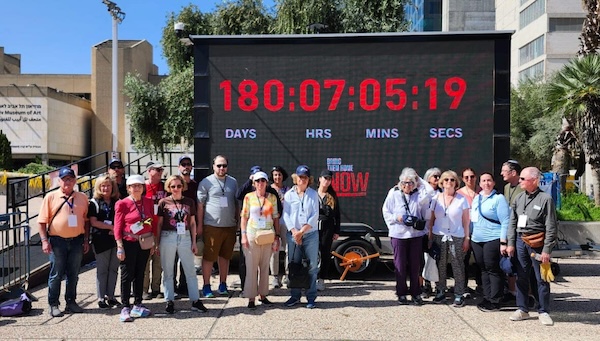
At the beginning of April, I had a very long day, which is rare for me. I rose at 5:45 a.m. to visit the Gaza Envelope with 30 others. At 7:35, the bus left Jerusalem. Our guide boarded at Latrun. We proceeded toward the Re’im Junction, also known as Masmia, then headed south to Sderot.

At Sderot, we went to the site of the destroyed police station, where many police and staffers were killed on Oct. 7. The town is slowly returning to normal function, as many evacuees have returned and schools have reopened. A new police station has been built.

Despite being the closest community to Gaza, under nearly constant fire from Hamas for nearly 20 years, Sderot has become an attractive place for young families, joining the stalwart old-timers. I was there several times a dozen years ago, when my son was a student at Sapir College, and have always enjoyed spending time there. New neighbourhoods, including high rises, have sprung up.

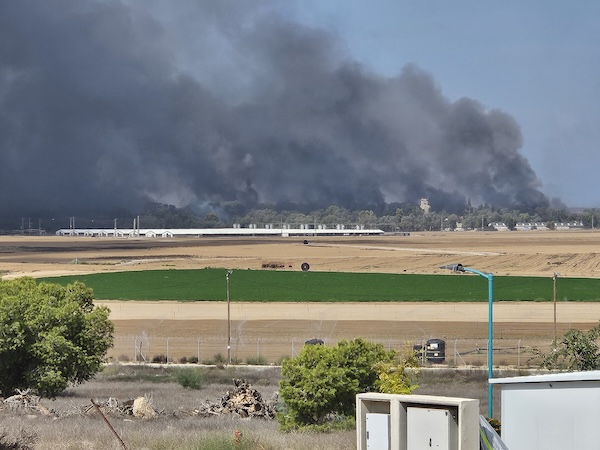
From a lookout on the outskirts of the city, atop Kobi’s Hill, we could see the entire length of the Gaza Strip. The lookout was consecrated in memory of four soldiers who died in Operation Protective Edge in 2014. It was impressive, if that is the word, to see Gaza  from so close. Mere kilometres.

We visited the up-and-coming city of Netivot, which is nearby. There, too, we saw much real estate, which has attracted a mostly, though not exclusively, religious sector, with Baba Sali’s gravesite and shrine a major calling card. He was a beloved rabbi and sage, particularly dear to Jews of Moroccan background. We went inside a well-tended sanctuary, to have a look and offer prayers. The place was hopping. As it was Monday, a Torah reading day, it was a suitable time to celebrate bar mitzvahs, and we caught a festive first haircutting of twin 3-year-old boys.

Afterwards, we headed to Moshav Tekuma. We did not expect to be allowed in, as there was heavy security and restricted access, but we were granted permission. Within the guarded gates, we saw what looked like a huge car junkyard – except that it is a graveyard. All the cars were recovered from along Highway 232 and the site of the Nova music festival at Re’im. They are being kept for at least a year, for investigators and forensic experts to scour them for further evidence. Many cars are smashed up, as if they had been in bad accidents, others are pockmarked, having been sprayed with bullets. Surrounding these is a huge pile of rusty scrap and charred rescue vehicles, as well as pickup trucks and motorcycles used by the terrorists to infiltrate the area.

photo - Memorial to those who were murdered at the Nova music festival by Hamas terrorists on Oct. 7.
Memorial to those who were murdered at the Nova music festival by Hamas terrorists on Oct. 7. (photo by Adina Horwich)

We drove further along the road, past Kibbutz Sa’ad and Alumim, along Route 232, and stopped just outside Kibbut Be’eri (the public is not allowed in). We looked inside one of the roadside shelters, next to a bus stop, which normally accommodates roughly eight people. On Oct. 7, some 40 people stuffed themselves inside. It was into such structures that many fled from the Re’im festival, seeking refuge, but the terrorists hurled grenades inside. At one migunit, Aner Shapira managed to throw the grenades back at the terrorists, though, in the end, he was killed, along with other young people. Inside are memorial candles, stickers with the pictures and names of victims, letters and comforting wishes are written on the walls.

photo - Site of the Nova music festival
Site of the Nova music festival. (photo by Adina Horwich)

We traveled some more, reaching the city of Ofakim. That is where a very brave woman, Rachel Edri, appeased the five terrorists who barged into her home by offering them refreshments, including her now-famous cookies. She and her husband, David, both in their 60s, were able to manage the terrorists, engaging them in conversation, plying them with more food and singing songs, over 19 hours. Whenever she could, Rachel would go to the bathroom and signal from the window to the police outside, who had surrounded the house, gauging attempts to enter. The Edris’s son is in the police force and was instrumental in finally seizing back their home. Unfortunately, during the siege, the house suffered great damage and is a total wreck; only a shell remains. And, sadly, David Edri passed away about a month ago. Rachel has gone to live with her sister-in-law.

As we were looking around, another hero appeared in the small parking lot opposite. Shuki Yosef lives across the street with his wife. He invited us to come into their building’s shelter, where he recounted how he and some of the neighbours hid for several hours, all the while hearing gunshots and shouting outside. He secured a metal bicycle frame to keep the shelter’s door closed, holding it with his own hands for hours. Later, after the ordeal had ended, he designed and fashioned a wooden plank to better fit the door hinges, in the event of future need.

The bravery of these residents is remarkable. It is worth noting that their homes are not the closest ones to the highway – which one might think would have been attacked first – but the houses and people who took the brunt of the terrorist attack are tucked well within the city. The sheer gall and number of terrorists that infiltrated, going from house to house on a murderous rampage in Sderot, in Ofakim, in the kibbutzim, on the roadsides, gunning down so many, are mind-boggling. These communities all lie within minutes of each other in a pretty small area.

It was an unusually hot day for April 1, over 30 degrees Celsius. And it was an intense excursion. Visiting made the reality a lot more tangible, but still impossible to fully comprehend. It was moving to witness and I learned much. We left the Otef (Envelope/Wrapping), as it is called, and I arrived home just before 7 p.m.

More than six months have passed since Oct. 7 and we remain in the thick of things. It is taxing and draining, even on those of us who, fortunately, are not too closely involved. Everyone is touched by the terror attacks and the war. 

Adina Horwich was born in Israel to Canadian parents. In 1960, the family returned to Canada, first living in Halifax, then in a Montreal suburb. In 1975, at age 17, Horwich made aliyah, and has lived mostly in the Jerusalem area. She won a Rockower Award for journalistic excellence in covering Zionism, aliyah and Israel for her article “Immigration challenges” (jewishindependent.ca/immigration-challenges-2).

Thought-provoking speakers

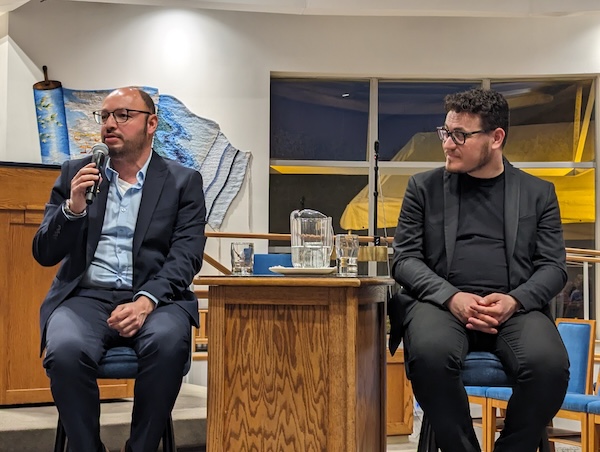
Dr. Gil Murciano of Mitvim, the Israeli Institute for Regional Foreign Policies, and Uri Weltmann of Standing Together, spoke April 17 at Temple Sholom. (photo by Pat Johnson)

For months, weekly rallies across Israel after Shabbat have demanded the return of the hostages from Gaza. These rallies have often coincided with separate protests, which have been going on much longer, against the government of Prime Minister Binyamin Netanyahu generally and its proposed judicial reforms specifically. These two streams of protesters have coalesced in recent weeks, according to an Israeli activist leader who spoke in Vancouver last week, because, he said, many Israelis are convinced that Netanyahu is not advancing freedom for the hostages, but hindering it, for his own political advantage.

Uri Weltmann, field organizer of Standing Together, made the claim April 17 during an event at Temple Sholom organized by New Israel Fund Canada. 

“What happened three weeks ago is that it stopped being two different protest movements,” said Weltmann. “They are basically changing their strategy. They are calling for early elections and for [Netanyahu’s] government to be removed and replaced with a different government. [Activists are] pointing their finger at him as the obstruction, as the obstacle toward advancing to a ceasefire agreement.”

Weltmann argues that Netanyahu is concerned not only for his political survival, but for his freedom.

“For Netanyahu, the protraction of this war, the continuation of this war, is in his political interest,” said Weltmann. “He knows that a temporary ceasefire might lead to a permanent ceasefire. A permanent ceasefire would mean an end to the war. An end to this war would bring an end to this coalition government because the extremists he huddled with have already said publicly that, if they will end the war before total victory, they will topple the government.”

The end of the current government and the ousting of Netanyahu, he said, would have more than just political ramifications for the prime minister, who opinion polls suggest would be soundly routed if an election were held now.

“New elections mean him losing the majority and him losing the majority is not only Netanyahu the politician being ousted from office. It’s also Netanyahu facing corruption charges, having his trial resume, [and he] might lose his personal liberty. For him, it’s intimately linked to the continuation of the war.”

The consensus among these activists is that Netanyahu is seeking to prolong the war and the captivity of the hostages to protect his political and personal interests, said Weltmann.

“It’s an incredibly important political development within Israel that a broad movement around the families and friends of the hostages have made this link,” he said.

Weltmann’s group, Standing Together (known in Hebrew and Arabic as Omdim Beyachad-Naqif Ma’an), was founded in 2015 and is one of the on-the-ground groups New Israel Fund supports.

Among the goals of the group is to build a grassroots movement for peace and progressive politics in Israel, including in rural and peripheral areas of the country. Making such a movement successful beyond the activist hub in Tel Aviv is the only way to advance Standing Together’s goals, Weltmann said. Even a more centrist or progressive government, if elected tomorrow, would not necessarily advance meaningful steps to peace and coexistence if there is not a broad popular movement in support of such a policy shift, he said.

Without a national movement for peace, he said, a new prime minister, however well-intentioned, would not feel the pressure to abandon the status quo and take steps for a changed future. 

“We must, as a strategic starting point in our process of progressive transformation of Israeli society, be present in the Negev, be present in the Galilee, be present in those parts of Israeli society that for too long have been the playing ground of the right-wing with left-wing actors completely non-present,” he said. “We must be there organizing local communities.”

Jewish citizens cannot do it by themselves, said Weltmann, and neither can Arab citizens. 

“We must have Jewish-Palestinian unity and cooperation within Israel for this change to be effective,” he said. An example of this strategy was a slogan adopted by a joint Jewish-Arab slate in Haifa during the recent municipal elections. The far-right Otzma Yehudit (Jewish Power) party of Itamar Ben-Gvir ran slates across the country trying to solidify the party’s roots at the civic level. The joint slate in Haifa played off Otzma Yehudit’s xenophobia with the slogan “Jewish Arab Power.”

“We are at a crossroads,” said Weltmann. “Every Israeli should choose which side am I on: the side that leads to a continuation of the status quo, a continuation of the state of affairs in which the Palestinians live in the occupied territories under military rule devoid of citizenship, devoid of rights, a situation that can lead to Oct. 7 one after another unless we put an end to it, or the reality of an Israeli-Palestinian peace that will guarantee both people safety, security and an imaginable, livable future?”

Weltmann spoke alongside Dr. Gil Murciano, an Iran expert and chief executive officer of the think-tank Mitvim, the Israeli Institute for Regional Foreign Policies, which one journalist has called “the diplomatic wing of the protest movement.”

Like Weltmann, Murciano longs for a “new majority” in Israel’s body politic. “A new majority that will allow us to advance toward a state where we live in peace, we live in dignity, we live in equality, without the occupation, without the injustices, throughout our society,” he said.

A fundamental shift in perspective is needed, argued Murciano.

“We used to speak about ‘wars of no choice’ in Israel,” he said. “We need to start thinking in terms of ‘peace of no choice.’”

On the one side, he said, the extreme right has a plan of annexation, with Bezalel Smotrich, Israel’s minister of finance and head of the far-right National Religious Party, calling for the government to “encourage” migration from Gaza to Egypt. On the other side, he said, since Oct. 7, people on the left have been motivated to seek an alternative to the status quo.

Dr. Maayan Kreitzman, a local food systems researcher and activist who moderated the event, challenged Murciano on this point. Rather than progressive voices calling for more coexistence, she said, she has heard the opposite. People that are “quite dovish” have had second thoughts about their worldview and transformed into a more hawkish, securitized attitude, she suggested.

Murciano acknowledged that all Israelis share one overriding priority. “For Israelis, it’s pretty clear,” he said. “The first, second and third priority of Israelis right now is security.”

That is a prerequisite to any advancement, he said.

Murciano proposes something he acknowledges to be “a little bit symbolic,” an international peace conference to kick off a new process between moderate Israelis and moderate Palestinians. This could be a first step to breaking an impasse that has existed in recent years, he said.

“Some people have described the last decade as the lost decade of Israeli diplomacy,” he said, a period where “conflict management” has been the priority; effectively, a maintenance of the status quo.

“I think that’s the right description, actually. It’s a strategy of not having a strategy,” said Murciano. “Coming to terms with the fact that there is no political way out and basically every couple of years we’re going to have a bit of violence.”

This approach sees Israelis forfeiting the initiative to Hezbollah and Hamas, he said, “Basically setting yourself in a situation where you only respond to a reality that is forced upon you.”

Oct. 7, he said, destroyed this conceptual framing.

Part of any future needs to include a multilateral project to “rebuild life-sustaining systems” in Gaza, he said, not a “peace-keeping force” but a “multinational force” that will be an on-the-ground part of a larger process toward peace and coexistence.

Ben Murane, executive director of New Israel Fund Canada, spoke of the emotional impacts of recent months.

“If you’re like me, what has been excruciating the past six months has been not just holding my pain, our Jewish pain, the pain of my Israeli coworkers, my family, my friends there, the pain of the Israeli people, but also, in my heart, holding the pain of the Palestinian people too,” he said.

Since the earliest days of the current war, Murane said, there have been countless glimmers of hope in the form of cross-cultural dialogue.

“In the first few months, we were astounded to see, across Israel, dozens of gatherings, conferences, events with hundreds of Jews and Palestinians standing together holding up those now-iconic purple signs saying ‘Jews and Arabs refuse to be enemies,’ ‘Jews and Arabs stand together’ or just simply ‘B’Yachad,’ together,” said Murane. “We were astounded to see Jewish citizens of Israel respond to the needs of the Palestinian citizens of Israel, Palestinian citizens of Israel making calls to families of the hostages, joint Jewish-Arab humanitarian aid missions to the south and to the north. As the war in Gaza accelerated, those Israeli voices also said, ‘We do have choices, even now. We have lots of choices with how we execute a just war justly.’”

Any long-term solution to the decades-long conflict must bring safety and dignity to both peoples, said Murane, “and anything else, anything short of fairness to both sides, will perpetuate this for another generation.”

New Israel Fund partners with and supports, according to its website, “organizations in Israel that fight for socioeconomic equality, religious freedom, civil and human rights, shared society and anti-racism, Palestinian citizens, and democracy itself.”

The April 17 event was hosted by Temple Sholom and co-sponsored by JSpaceCanada, which calls itself the advocacy voice of Liberal Zionism, Ameinu Canada, described as the voice of labour Zionism in Canada, and Canadian Friends of Peace Now, as well as the speakers’ organizations.

Rabbi Dan Moskovitz, senior rabbi at Temple Sholom, said he had received emails expressing concerns about hosting a perceived left-wing event. 

“I get the same emails when we host people to the right of centre,” he said. 

One of the purposes of a synagogue, he said, is to engage with ideas that “comfort the afflicted and afflict the comfortable.

“You may find your truth by agreeing with what you here tonight,” he said. “You may find your truth by disagreeing with what you hear tonight. The important part is to engage with it.”

Vancouver activist David Berson promoted the opportunity to listen to the Israeli guests as a chance to gain a perspective apart from the most common refrain he hears on social media and WhatsApp threads. 

“There’s another way you can look at what’s going on,” he told the Independent after the event. “Come out and hear a different perspective. I invited people to come tonight and listen to a different narrative.”

The 200 to 300 people at the event was about double what organizers had earlier expected, he said. 

A new refuge from violence

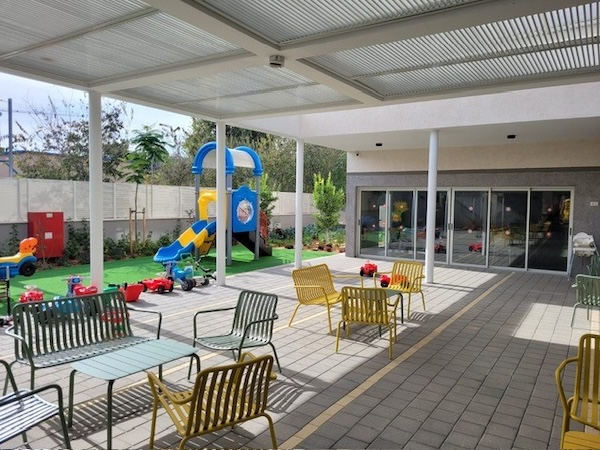
Western Canada House, a shelter for women and children escaping domestic violence, is now open in Rishon LeZion, near Tel Aviv. The project is a result of support from Jewish National Fund of Canada supporters in Vancouver and Winnipeg. (photo from JNF Pacific Region)

Western Canada House, a shelter for women and children escaping domestic violence, is now open in Rishon LeZion, near Tel Aviv. The project, a result of support from Jewish National Fund of Canada supporters in Vancouver and Winnipeg, provides a temporary home to families in crisis, as well as access to counseling services, programs for mothers to become self-supporting and assistance in finding permanent, secure housing.

The project was made possible by revenue from 2016 Negev Dinners in Vancouver and Winnipeg and was chosen by that year’s Vancouver dinner honouree, Shirley Barnett. The honouree of the Winnipeg dinner was Peter Leipsic. (An additional Vancouver connection is that Leipsic is the father of Dr. Jonathon Leipsic, who is, among many other things, a leader in the Jewish Federation of Greater Vancouver.)

Barnett said she was motivated to choose the project in part because it is a joint initiative with No2Violence, whose founder, Ruth Rasnic, Barnett had met previously. Rasnic, who was awarded the Israel Prize in 2009 for her life’s work, founded No2Violence in 1977, to enable women and children suffering from domestic violence to break away and start a new life – by providing them with shelter, professional help, vocational training and legal aid – as well as to raise awareness about domestic violence. The group now operates three shelters in Israel.

“When I was honoured by the JNF, they asked me what kind of a project I would like the proceeds to go to,” Barnett recalled. The agency provided a number of options and, based on her background in social work and her familiarity with Rasnic’s work, she chose this one.

“No2Violence is interesting,” Barnett said. “They are not a religious organization. There are other shelters in Israel that cater only to the Orthodox. No2Violence is nonsectarian and, in addition to that, it is open to women who are not Jewish. It is also open to women who do not have legal status in Israel, who have not been deported because their children have been born in Israel. So, their doors are open to women who have come from Sudan, women who have come from Russia, who have been trafficked into Israel by their Israeli boyfriends. That was also attractive to me.”

photo - Western Canada House, a shelter for women and children escaping domestic violence
Western Canada House, a shelter for women and children escaping domestic violence. (photo from JNF Pacific Region)

Rabbi David Bluman, director of youth engagement at Congregation Beth Israel, visited Western Canada House earlier this month as part of a joint mission to Israel by Beth Israel, JNF Canada and Congregation Har El.

“It’s a beautiful place,” Bluman said. “They have different areas for children to play. They have a communal kitchen where each family signs up at a different time to do the cooking for the group that’s there. It’s obvious that JNF Western Canada did a really good job, put a lot of money in to build that place. It’s beautiful.

“I don’t think anyone wants to be there, they need to be there,” said the rabbi. “JNF Canada has made it as welcoming as possible, making it so it’s like home for them while they are there.”

The shelter has capacity for 10 to 12 families, providing needed refuge in a country where, statistics indicate, as many as 70% of women and children experiencing domestic abuse cannot access alternative housing.

Michael Sachs, Pacific region executive director of JNF, visited the project last year to assess progress and is delighted that the shelter is now open and providing housing to families. There were delays in completion of the initiative, Sachs said, because of municipal bureaucracy. 

New role, familiar face

Ilan Pilo, left, and Rafi Yablonsky of the Canadian Shaare Zedek Hospital Foundation. (photo from CSZHF)

In Jerusalem, Yad Vashem stands as the foremost memorial centre to the Holocaust, dedicated to the millions of Jews murdered during the Shoah. Across the street, as if in defiant answer to the past, is one of the world’s busiest maternity centres, where 22,000 newborns meet the world every year, strengthening the future of the Jewish people. 

The maternity section is just one of Shaare Zedek Medical Centre’s many specialized departments, advancing health not only at the start of life but all through the lifespan of patients. Shaare Zedek is home to an emergency preparedness and disaster response centre. It offers a one-stop multidisciplinary and comprehensive diagnostic breast health centre. There are departments focusing on heart health, medical genetics, digestive diseases, oncology and an array of other specializations – more than 30 in-patient and 70 out-patient departments in all. The hospital sees a million patients annually and has 1,000 beds. Located in the centre of west Jerusalem, it is, among so much else, a teaching and research facility.

Western Canadians will likely be hearing more about this particular facility as the Canadian Shaare Zedek Hospital Foundation has just opened its first office in this part of the country. But, while the organization may be a newcomer as a physical presence in Vancouver’s Jewish community, it will be a familiar face sharing the Shaare Zedek story.

Ilan Pilo, who served as shaliach (emissary) and regional executive director of Jewish National Fund of Canada from 2013 to 2021, has returned from Israel as the Western Canada executive director for the Canadian Shaare Zedek Hospital Foundation.

“I was thrilled and honoured to be offered the opportunity to be the first to launch the Western office in Canada,” Pilo said.

During his time back in Israel, Pilo served as principal of a postsecondary trades and skills school and, most recently, ran the campaign for Yariv Fisher, who won an upset victory to become mayor of Herzliya, north of Tel Aviv. Municipal elections across Israel were delayed twice due to the war and, almost immediately after seeing his candidate elected, Pilo jumped on a plane and headed for Canada, spending 10 days in Toronto orienting to his new role before landing in Vancouver in March.

The hospital is 120 years old and was founded to ensure medical adherence to halachah (Jewish law), providing appropriate care for Orthodox Jews in the pre-state era. While it still provides everything religious Jews need, including minyanim, it is also, Pilo said, a “safe zone” for all people, regardless of ethnicity, nationality or religion. 

“When you look at the population in Jerusalem, you see that there are one million people – 300,000 of them are ultra-Orthodox, 400,000 are Arabs and the rest are, let’s say, secular Jews,” Pilo said. “It’s the most interesting and complex mix of people.”

That diversity is reflected not only in the patients but in the doctors and staff, Pilo said.

Right now, the hospital’s specialists in trauma are dealing with soldiers and civilians injured in the war. Since Oct. 7, Shaare Zedek has treated 300 wounded civilians and more than 700 Israel Defence Forces soldiers. In addition, hospitals in the north and the south of Israel have transferred 60 of their neonatal intensive care unit patients out of conflict regions to Shaare Zedek, where the NICU is housed in completely sheltered areas.

Rafi Yablonsky, national executive director of the Canadian Shaare Zedek Hospital Foundation, said he and the foundation’s board decided to expand operations across Western Canada because of the region’s philanthropic and Zionistic reputation. 

“We hope that more Canadians learn about the transformative and world-leading work of Shaare Zedek Medical Centre in Jerusalem,” he said. “Our goal is to grow our donor base and volunteer base with business and philanthropic leaders out West.”

This is not the first time Pilo and Yablonsky have worked together.

“Ilan and I were colleagues when we worked at JNF Canada together,” he said. “I witnessed firsthand how Ilan is highly skilled as a world-class fundraiser, also motivating groups of volunteers to do their part in our community.

“Shaare Zedek is a public hospital that is privately funded,” said Yablonsky, “and it receives very limited support from the Israeli government to upgrade equipment and technology, develop groundbreaking international research and ensure state-of-the-art medical training is available to staff. As such, the hospital relies heavily on the generosity of donors around the world to supplement $30 million needed annually.”

For more information, visit hospitalwithaheart.ca. 

Eat well, while helping Leket

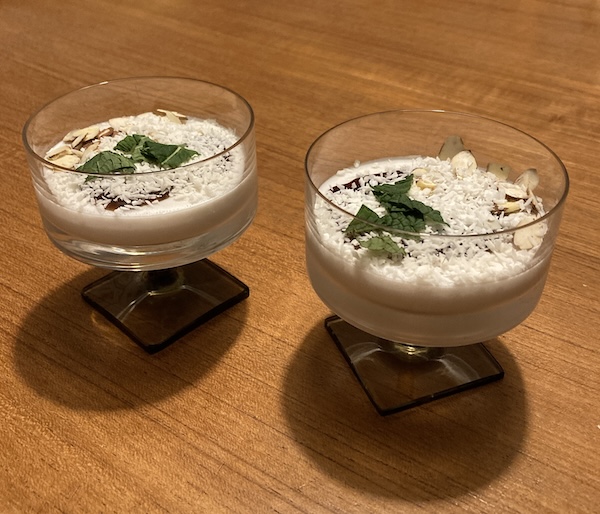
My new favourite dessert: Inbal Baum’s Coconut Cream Malabi. Baum is one of the contributors to June Hersh’s new digital cookbook, Cooking for a Cause. (photo by Ingrid Weisenbach)

I have a new favourite dessert: malabi. At least Inbal Baum’s Coconut Cream Malabi. Baum is one of more than 70 cooks, bloggers and others who have contributed to June Hersh’s new digital cookbook, Cooking for a Cause. All proceeds from the book’s sale support Leket Israel, whose focus is “rescuing healthy, surplus food and delivering it to those in need through partner nonprofit organizations.”

“By purchasing this digital cookbook,” notes Leket’s promotional material, “you will not only be supporting Leket Israel’s routine food rescue operations, distributing fresh, nutritious, surplus food to over 330,000 people in need each week, but you will also be part of Leket’s emergency relief campaign, providing much needed assistance to displaced Israelis throughout the country as well as to the Israeli farming community who has been significantly impacted by the ongoing war.”

Hersh has written several cookbooks “with a charitable flavour,” supporting various causes. She contributes to food blogs and magazines, appears on radio and TV, and gives talks on the importance of preserving Jewish food memory. Cooking for a Cause is a response to the Oct. 7 terror attacks, and Hersh and Leket Israel “reached out to everyone we could think of who has made an impact in the world of Jewish food,” writes Hersh in the introduction. “Additionally, we approached those incredibly outspoken Jewish and non-Jewish supporters who have taken a stand and used their moral compass to point the way. The response was overwhelming!”

image - Cooking for a Cause book coverThe result is a unique cookbook that is interesting both for its recipes and its stories – each entry tells users a bit about the contributor and/or the food being presented, and there are eye-catching colour photos throughout. The cookbook “is not arranged from starters to desserts and it is not consistent in its format,” writes Hersh. “I say this not as an apology but with pride, as this book is deliberately different. It reflects a cacophony of voices that have come together to support Leket and the people of Israel. Each contributor presents their connection to Jewish food and expresses it with a different perspective, writing style and point of view. You, the reader, benefit from diverse cooking techniques, interpretations of Jewish cuisine and fresh commentary with each recipe.”

Recipes that caught my eye as I skimmed through the book included Vegetarian Stuffed Cabbage Rolls (Holishkes) by writer Joe Baur; Pandora’s Chicken with Artichokes, Oregano, Olives and Sundried Tomatoes by Joan Nathan, “award-winning ‘godmother’ of Jewish food”; Aunt Rini’s Tahini Cookies by Elise Addlem, founder of Feminists Against Antisemitism; and Olio Egg Salad by Ben Poremba, who “infuses his Israeli-Moroccan heritage into all his restaurants.”

I have bookmarked these recipes for future cooking/baking sessions, and will certainly try others as well. Between the Jewish Independent’s Passover and Israel special issues, I only had time to try out three recipes. In addition to Coconut Cream Malabi, which Baum writes was inspired by “Our Chef Sevim [Zakuto], with her Turkish-Jewish roots, [who] shared the cherished recipe from her grandmother,” I made Rachel Simons’ Fennel and Herb Salad (Simons is a co-founder of the company Seed+Mill) and award-winning chef and restaurateur Jonathan Waxman’s Steelhead Trout with Vermouth, Baby Sorrel, Chanterelles and Fingerlings.

The salad was as big of a hit as the malabi, and I enjoyed the meal part of the trout recipe but wasn’t so keen on the sauce, which contained vermouth. Not being a lover of vermouth, I had put the sauce on the side, and I thought the food was better without it. When I make the fish again, I’ll try to halve the vermouth or reduce it on the stove to see if that makes it taste less sharp.

COCONUT CREAM MALABI
(by Inbal Baum)

1 can coconut cream (fat content should be greater than 14% for the best results)
3 tbsp sugar
3 tbsp cornstarch
1/3 cup of water
1 tsp of vanilla extract, or rose or orange blossom water
crushed (or chopped) nuts, to taste
desiccated coconut, for serving
pomegranate molasses and/or silan, for serving
optional toppings: chopped seasonal fruit (strawberries, apricots, mango)

In a small saucepan, combine the coconut milk and sugar. Bring to a gentle boil. Meanwhile, in a small bowl, mix the cornstarch and water until well combined. Slowly add the cornstarch to the saucepan, continuously stirring.

Over medium heat, continue stirring until the pudding thickens – this may take 3 to 5 minutes. If needed to thicken, add additional cornstarch in small amounts until the mixture begins to thicken.

Mix in the vanilla extract, orange blossom or rose water, then pour or ladle into four small bowls.

Allow to cool before serving (approximately one hour, but can be less).

When ready to serve, top with a layer of pomegranate molasses or silan (date honey), desiccated coconut and ground nuts.

FENNEL AND HERB SALAD
(by Rachel Simons; 4 servings; 30 minutes to prepare)

1 fennel bulb, very thinly sliced crosswise
juice of 1 lemon
1 cup cold water
1/2 cup fresh mint leaves, roughly chopped
1/2 cup fresh parsley leaves, roughly chopped
1 tbsp white wine vinegar
2 tbsp extra virgin olive oil
1 tsp flaky sea salt
1/8 tsp ground black pepper
1 cup parmesan cheese, thinly shaved (optional)

Place the sliced fennel into a bowl with the lemon juice and cold water. Let sit for about 10 to 15 minutes. Drain the fennel. 

In a large bowl, mix the fennel, mint leaves, parsley leaves, white wine vinegar, olive oil, salt, pepper and parmesan (if using). Mix to combine well. Serve the salad cold.

STEELHEAD TROUT WITH VERMOUTH, BABY SORREL, CHANTERELLES AND FINGERLINGS
(by Jonathan Waxman; serves 4)

4 x 4.5-ounce skin-on, boneless steelhead trout fillets
1/2 cup white vermouth
2 tbsp butter
2 tbsp olive oil
1 cup baby sorrel
1 cup cream
1 cup sliced raw fingerling potatoes
1 cup button chanterelle mushrooms

Season steelhead with sea salt and fresh ground white pepper.

Cook the potatoes in simmering salted water for 12 minutes. Set aside.

Wash mushrooms.

In a sauté pan, add 1 tbsp olive oil and 1 tbsp butter, heat to sizzling, add the trout, skin side down and sauté for 2 minutes.

When skin is crispy, turn over and add remaining olive oil and butter. Then add the potatoes and chanterelles to pan. Cook over medium heat for 5 to 8 minutes.

Remove steelhead to a warm platter. Ensure potatoes and chanterelles are cooked, add them to the fish platter.

Add the vermouth to pan and then add the cream. Turn off heat and add the sorrel leaves.

Taste sauce for seasoning and gently coat the potatoes and chanterelles with sauce. Serve hot.

* * *

To purchase Cooking for a Cause, go to chef.leket.org. For more on Leket Israel – including how you could join the organization’s approximately 54,000 annual volunteers “in gleaning, sorting and packaging rescued food for the Israelis in need” – visit leket.org. 

A plea for the hostages

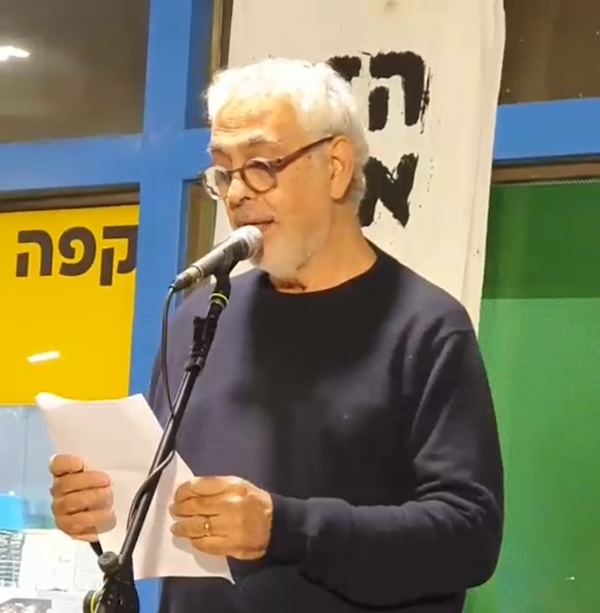
A screenshot of former Israel Air Force pilot Uri Arad speaking at the Jan. 20 Bring Them Home rally in Jerusalem.

***

Weekly rallies have been held in “Hostages Square,” the plaza in front of the Tel Aviv Museum of Art, since the Oct. 7 terror attacks by Hamas, who killed 1,200 people and kidnapped 240 that day. Every week, thousands gather in the square and in other locations, calling for the release of the 136 hostages still being held in Gaza, at least 32 of whom are now believed to be dead. At the Jan. 20 Bring Them Home rally in Jerusalem, one of the speakers was Uri Arad, a former pilot who was held in captivity in Egypt for six weeks during the 1973 Yom Kippur War. Arad is not related to Ron Arad, an Israeli Air Force officer missing in action since 1986, who Arad mentions in his speech. The remarks below were translated into English by Rahel Halabe, a Vancouver translator and educator, who is a family friend.

***

I was asked to speak here today because I have been a prisoner of war. Until recently, I had avoided talking publicly about my captivity or even identifying as a past captive. The reason I stand here today and talk to you stems from my deep empathy with the hostages and their families, my fear for the hostages’ fate and the need to join the call for their immediate release.

Indeed, I can testify from my experience that captivity is a very difficult experience, physically and mentally. Still, it is important for me to emphasize that, as difficult as my experience was, it is not the same as what our hostages in Gaza are going through. As a pilot of the air force, I was totally aware of the possibility of falling into captivity and I was prepared physically and mentally to cope with the experience. This is not the same for innocent civilians who are kidnapped out of the blue, without any previous preparation. As time goes on, it shows that the hostages are indeed going through hell.

Moreover, being held captive by a state is not the same as being held captive by a murderous terrorist organization. Being held by a state, I did not feel the constant existential threat on my life – I knew that, eventually, I would return home. This is unlike the hostages in Gaza, who are in constant existential fear of being murdered by their captors, or even killed by our own forces. It is, therefore, a much more difficult experience than what I went through.

I shut my eyes and imagine Noa Argamani, the Bibas family, Amit Buskila, Elyakim Libman, Yusef and Hamza Alziadneh, Liri Elbag, and all the other hostages, and my heart is shattered. Here in Israel, there are so many tormented families who are suffering from uncertainty and worry for their loved ones, some of them after experiencing losses without the ability to properly mourn. It’s just horror. We have to say clearly and loudly: we have reached a stage in which every day that passes is like Russian roulette in the life of the hostages. Therefore, it is necessary to do everything, everything, to bring them home now!

When people ask what reassured me most and helped me get through my time in captivity, I answer without any hesitation: I knew that the state would do all that it could to bring me back home. The ability to cope with torture, difficult interrogations and the uncertainty of my fate mostly came from my belief in the contract between me and the state, from knowing that I would not be abandoned. This confidence is what accompanies all soldiers who are ready to give their life for the state. This is the Israeli ethos of solidarity, the most sublime expression of which is that those injured on the battlefield are never abandoned, even if their rescue may involve losses, and that the state goes above and beyond to bring its captives and hostages home.

This is why I came here today, to say in a clear voice: the return of the hostages is the most important mission, maybe the only one, that should guide decision-makers at this moment. This is the necessary condition for our ability as a nation to recuperate from the horrendous disaster that hit us on Black Saturday. All of us are tormented knowing that Ron Arad never came back. It is, therefore, important to say it is unthinkable that there will be tens more of “Ron Arads.” If we don’t regain our composure and immediately bring the hostages home, this will happen. Some of the hostages will return in coffins, others will be forever lost.

But, I am asked, how do we bring them back? Don’t they keep telling us that the objective of destroying Hamas is not less important, that there have been great attempts to bring them back, that both objectives are interconnected and that we must keep putting military pressure on Hamas to bring the hostages back? It must be said, at this point in time, as Gadi Eisenkot expressed so well two days ago, this is senseless. The truth is that, today, these two objectives contradict each other. And the evidence is that – except for one hostage – all the hostages who have come back were returned in the framework of a deal. The military operation not only did not help in the return of the hostages, but it even cost the life of a few of them, and every day that passes just increases the danger to their lives. The conclusion is clear and sharp: the only way to bring the hostages back alive is through a deal. Now!

There are those who object to stopping the war, claiming that it would be a repetition of the same mistake that brought Oct. 7 upon us, and that it will eventually bring upon us many more Black Shabbats and an existential danger to the state in the long run. They mistakenly think that the destruction of Hamas is just around the corner. This is a delusion! Today, it is clear to all who are reasonable that the destruction of Hamas is an extremely difficult goal, which will require years to achieve. It is important to understand that what really hides behind this claim is the willingness to give up on the hostages. In the clash between short-term and long-term interests, those who claim the above prefer the long-term. I say, first, we must bring back the hostages! In the long-run, we will be able to continue weakening the terrorists through both military pressure and political initiatives, while striving for comprehensive agreements that will bring an end to the conflict.

I know that the thought of being forced to stop the fighting and, on top of that, pay the heavy price of a mass release of terrorists, is difficult for many people. I, too, have found it hard to swallow and say this grudgingly, but there is no escape. It is necessary to internalize that the hostages are the major asset Hamas has in its hands, and that [Hamas leader Yahya] Sinwar will not give up this asset except in exchange for the end of fighting. The strategic failure of Black Shabbat puts us, after more than 100 days of fighting, in a position in which we are forced to clearly make a decision and pay the price. The Israeli government, therefore, should initiate a deal of “all for all,” including a stop to the fighting. Now!

Binyamin Netanyahu refused to take responsibility for what happened on Oct. 7, but has been “gracious” enough to declare that he is responsible for all that will happen. If so, it must be clearly said: Netanyahu is responsible for the fate of the hostages. From here, I would like to address the prime minister and say: Netanyahu, you have brought upon us the worst catastrophe in the history of the state. This will be your legacy; you will be inscribed in history with shameful disgrace. Still, you have a chance to somehow soften history’s judgment, if you bring the hostages back alive. This is the time to rise above the political considerations that have led you and initiate a deal for the return of the hostages. Now!

Finally, I would like to say: continuing the current policy will cause a rupture, impossible to repair, in Israeli society. Israel will lose its soul, one of its most significant elements. We will never again be able to say that we hold human life sacred. This is an unbearable price. Therefore, bring the hostages back in exchange for stopping the fighting. Now!

Thank you all. 

ICJ ruling ‘nonevent’: lawyer

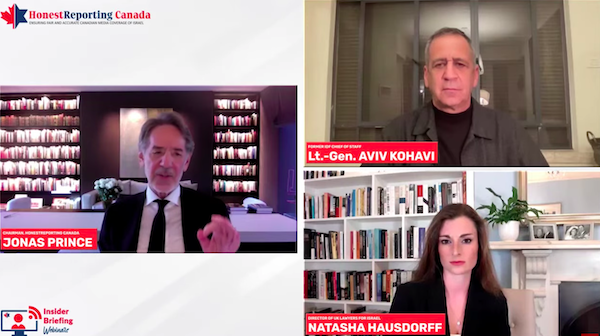
Screenshot of the Jan. 30 HonestReporting Canada discussion on the International Court of Justice ruling on whether Israel is perpetrating genocide. Jonas Prince, chair of HonestReporting Canada, emceed and speakers were Lt.-Gen. Aviv Kohavi, former chief of general staff of the Israel Defence Forces, and Natasha Hausdorff, a British specialist in international law and a former clerk for the president of the Supreme Court of Israel. 

The International Court of Justice ruling on whether Israel is perpetrating genocide means little, according to a legal academic speaking to Canadian audiences last week.  

“This was a complete nonevent,” said Natasha Hausdorff, a British specialist in international law and a former clerk for the president of the Supreme Court of Israel. “There was nothing substantive found and nothing substantive required or ordered as part of the provisional measures because there is no evidence that Israel is engaged in genocide; quite the contrary.”

Hausdorff was speaking in a webinar Jan. 30 alongside Lt.-Gen. Aviv Kohavi, former chief of general staff of the Israel Defence Forces. The event was presented by HonestReporting Canada, which describes itself as “an independent grassroots organization promoting fairness and accuracy in Canadian media coverage of Israel and the Middle East.”

Jonas Prince, cofounder and chairman of HonestReporting Canada, emceed the event.

“The words war crimes, genocide, proportionality, siege, humanitarian crisis have been weaponized by the media, as well as Israel’s enemies,” said Prince. “The Iron Dome defence against these verbal missiles is knowledge.”

Where Hausdorff brought legal acumen to the discussion, Kohavi offered the perspective of a top military official who has been on the ground, making life-and-death decisions in some of the most ethically dicey situations.

World reaction to the international court’s judgment, which was released Jan. 26, has been mixed, if not confused. The court notably did not call on Israel to end the war and neither did it rule, ultimately, on whether genocide is happening or seems imminent. 

The court handed down “provisional measures” that it said Israel was obligated to undertake, including that Israel should do everything possible to avoid killing Palestinians or causing serious bodily or mental harm, creating intolerable conditions, or deliberately preventing Palestinian births. The court also called on Israel to “prevent and punish” public incitement to genocide, citing comments from Israeli officials as examples. 

Hausdorff dismissed the last item, contending it was clear that the statements made by Israeli government officials that the court cited were referring to Hamas terrorists and not to Palestinian civilians. With respect to the other aspects of the ruling, she and Kohavi both essentially argued that Israel is already doing what the court demanded.

The wide-ranging discussion focused on Israel’s rights under international law and attempted to correct what the speakers said were misunderstandings of legal terminology. The expression “proportionality” is an example, Hausdorff said, with many people believing that the greater Palestinian death toll is proof of “disproportionality.”

“That is grotesque,” she said, “not least because the corollary of that analysis is often that not enough Jews have died to justify Israel’s response.” It also encourages Hamas’s tactics of using civilians as human shields, she said, “driving up the civilian casualty count as a means of putting pressure on Israel to desist with its lawful military activities.”

Proportionality, she explained, involves military commanders making assessments on whether the military advantage sought by a strike is proportionate to the anticipated collateral damage.

Kohavi emphasized that disparities in death tolls are due to a significant extent to Israel’s defensive technologies – Iron Dome – as well as the secure rooms and bomb shelters constructed for decades in Israeli buildings.  

“We have taken steps and measures in order to protect our citizens and that’s why the numbers on our side are relatively low,” he said. “Now, I do not expect Hamas to build their [own] Iron Dome, but they could build shelters. Instead, they have been building their tunnels for their perpetrators, not for civilians.”

For 15 years, Kohavi said, Hamas has embedded its military operations seamlessly throughout the Gaza Strip’s dense urban populations. Israel’s precision targeting technologies allow the military to destroy terrorist targets while harming as few civilians as possible, he said. 

Despite a global outcry over the estimated 27,000-plus Palestinians killed, Hausdorff and Kohavi took exception to these figures on several fronts. It is in the interest of Hamas, which compiles the statistics, to maximize them, said Hausdorff. She cited the notorious example of an alleged Israeli bombing of a Palestinian hospital killing 500. Later evidence said it was a Palestinian missile that caused the explosion and that the death toll estimates were exaggerated, possibly by a magnitude of 10. The cumulative casualty tally kept by the Gaza Ministry of Health was never altered downward after initial reports in that case were debunked, Hausdorff said.

The figures also make no differentiation between combatants and civilians, both panelists said. While lamenting all civilian deaths, they said that even in the confined theatre of the highly urban Gaza Strip, civilian deaths tolls are probably significantly lower than in parallel military engagements. 

Other data suggest 1.8 civilian deaths to every killed combatant in the current conflict, Hausdorff said, compared with the macabre accounting of the United Nations, which calculates that, in the context of urban warfare, civilian casualties average nine to every combatant death. American figures in wars Iraq and Afghanistan saw civilian death tolls of 3-to-1 and 5-to-1 respectively, she said.

In the circumstance, Hausdorff said, it is “utterly unparalleled” that Israel has kept civilian deaths to the numbers it has “despite every effort that Hamas has made to increase civilian casualties and inflate that toll.”

The court case, which was brought by the government of South Africa, is “extremely problematic,” Hausdorff said, “not just for Israel but for all law-abiding states, for those who uphold and prize the rule of law, that the International Court of Justice would be entertaining this.”

She accused the International Court of Justice of “essentially doing the bidding of a terrorist organization.”

South Africa likes to paint itself as a champion of Palestinian rights, Hausdorff said. 

“South Africa is a champion of Hamas, an internationally proscribed terrorist organization,” she said. “No individual who cared about Palestinian rights would be seeking to prop up Hamas given that the Palestinian people have borne the brunt of their brutality and their corruption and their slaughter and torture over the blast 16, 17 years.”

Readers can watch the HonestReporting Canada event at youtube.com/watch?v=FwksgmYqXBs. 

What happens after the war?

Area of Gaza controlled by the Israeli Defence Forces on Jan. 11, 2024.

While the war in the Gaza Strip continues between Hamas guerillas and the Israel Defence Forces (IDF) in the labyrinth of tunnels burrowed beneath Khan Yunis and in the alleys of the devastated city (population 205,000), another battle is being fought across Israel over the postwar fate of the coastal enclave.

Ultra-nationalist members of Knesset Bezalel Smotrich, leader of the National Religious Party, and Itamar Ben Gvir, head of Otzma Yehudit (Jewish Power), recently called for Gaza’s 2.2 million residents to be voluntarily resettled elsewhere. Congo was cited as a destination for the exodus. U.S. State Department spokesman Matthew Miller called the statements by Smotrich and Ben Gvir “inflammatory and irresponsible.”

Egypt is adamantly opposed to allowing the two million displaced Gazans to shelter in the Sinai Peninsula, lest Israel prevent the refugees from returning. Similarly, the Jewish state is no more likely to allow them to pass through its territory to fly out of Ben-Gurion Airport than it is to resettle those refugees who fled their nearby villages in the Arab-Israeli War of 1948.

photo - One controversial postwar scenario is for Israel to rebuild some of the post-1967 Gaza Strip settlements from which it unilaterally  withdrew in August 2005
One controversial postwar scenario is for Israel to rebuild some of the post-1967 Gaza Strip settlements from which it unilaterally  withdrew in August 2005. (photo by Gil Zohar)

Further limiting the options, Israel’s high-tech Erez Crossing at the north end of the Gaza Strip – similar in scale to a massive airport terminal – was destroyed during Hamas’s Oct. 7 rampage in which some 1,200 Israelis and other nationals living in cities and kibbutzim near the Gaza frontier were massacred and 240 kidnapped.

Concurrently, the black market is burgeoning for fixers with links to Egyptian intelligence; they are making a fortune in “fees” extorted from Gazans desperate to exit through the Rafah Crossing at Gaza’s south end. The bribe for being placed at the head of the legal exit list for passage across the Rafah border into Egypt and on to Cairo International Airport has now soared to $10,000.

In the face of the vast human suffering, staggering damage to infrastructure and environmental catastrophe caused by the conflict, which marked its 100th day on Jan. 14, another controversial postwar scenario is for Israel to rebuild some of the post-1967 Gaza Strip settlements from which it unilaterally withdrew in August 2005. The forcible evacuation of 8,600 Jewish residents from Gush Katif (the Harvest Bloc) – a cluster of 17 villages in the southern Gaza Strip – set the stage for Hamas’s 2007 coup d’état when it seized power from Mahmoud Abbas’s Palestinian Authority, based in Ramallah in the West Bank.

On Dec. 22, 2023, a group of settlers held an organizational meeting at the agricultural village of Kfar Maimon near the Gaza Strip demarcation fence to launch their plan to create a beachfront community on the barren dunes at Gaza’s southern edge. The day was symbolic since Asarah b’Tevet (the 10th of the Hebrew month of Tevet) is a fast day in the Hebrew calendar, marking the date 26 centuries ago when Nebuchadnezzar II of Babylon began his six-month siege of Jerusalem, which resulted in the destruction of Solomon’s Temple and the downfall of the Kingdom of Judah.

Though Gaza was allocated to the Tribe of Judah in the Hebrew Bible, the ancient Israelites never vanquished their Philistine nemesis who dwelt there and in the cities of Ashkelon, Ashdod, Gat and Ekron. Jewish and Samaritan communities intermittently flourished in the territory of Gaza over many centuries. Shaken by the riots of 1929, however, the Gazan Jewish community ended in 1948. In Gaza City’s historic Zaytoun quarter, the Ottoman-style Hammam al-Sammara (the Samaritan bathhouse) bears witness to the ancient Samaritan community that was exiled in 1917 by the Turkish army during the battles of the First World War.

The group of would-be settlers – who staged a car rally just outside Gaza on Jan. 11 – are encouraged by the report that Israel’s Knesset will be hosting a conference Jan. 28 on rebuilding settlements in Gaza after the war, and will offer precise maps and plans. The news site mako.co.il says that Knesset members and other public figures are expected to speak, and thousands of Israelis have already applied to join the settlement nuclei in Gaza.

The organizers of the event stated, “We are working both on the political level and on the practical side towards the moment when they can get on the ground. There is a great demand in the public that the victory of the war includes within it Jewish settlement in the Gaza Strip.”

Meanwhile, senior ministers among Prime Minister Binyamin Netanyahu’s right-wing allies have criticized the IDF over its plans to probe Oct. 7 intelligence failures. And Israel’s future may be hurtling backward to the widespread protests over judicial reform that divided the country in the months that preceded Hamas’s devastating surprise attack. Such is public anger that calls for a spring election are becoming vociferous.

Were Netanyahu and Abbas to both step down, and Saudi Arabia and Israel to establish ties, a postwar scenario of regional integration – including high-speed trains whisking cargo from Haifa to Riyadh and Abu Dhabi – could emerge. The trauma of the Gaza War could give birth to Mideast peace.

More than 50,000 Israelis responded to the Ashkenazi and Sephardi chief rabbis’ call for a day of prayer at the Western Wall in Jerusalem to mark the new moon of Shevat.

In Judaism, the full moon of Shevat is celebrated as the New Year of the Trees. Besides the pink-white almond blossoms, which mark the beginning of spring, the blood-red anemones also carpet the fields of the western Negev by the Gaza Strip. Like the poppies in Flanders Fields, this year those wildflowers will symbolize the tragedy of war. 

Gil Zohar is a writer and tour guide in Jerusalem. A longer version of this article can be found at religionunplugged.com/gil-zohar.

Rabbis’ emotional journey

Left to right: Rabbis Susan Tendler, Hannah Dresner, Philip Bregman, Carey Brown, Andrew Rosenblatt, Jonathan Infeld, Philip Gibbs and Dan Moskovitz in Israel last month. (photo from facebook.com/jewishvancouver)

Eight Vancouver-area rabbis recently visited Israel where, among many other things, they handed out cards and letters prepared by Jewish day school students and members of Vancouver’s Jewish community to soldiers and other Israelis. The response, according to one of the rabbis, was overwhelming.

“I saw soldiers taking these cards and then dropping down to the sidewalk and crying,” said Rabbi Philip Bregman. “Holding them to their chest as if this was a sacred piece of text and just saying, ‘Thank you. To know that we are not forgotten….’”

photo - The rabbis’ mission included the delivery of thank you cards to Israeli soldiers
The rabbis’ mission included the delivery of thank you cards to Israeli soldiers. (photo from facebook.com/jewishvancouver)

Bregman, rabbi emeritus at the Reform Temple Sholom, was almost overcome with emotion while recounting the experience, which he shared in a community-wide online presentation Dec. 17. The event included seven of the eight rabbis who participated in the whirlwind mission, which saw them on the ground for a mere 60 hours. Rabbi Andrew Rosenblatt of the Orthodox Congregation Schara Tzedeck was part of the mission but did not participate in the panel because he extended his time in Israel.

According to Ezra Shanken, chief executive officer of the Jewish Federation of Greater Vancouver, who emceed the event, the Vancouver mission was unique in Canada and possibly in North America for bringing together rabbis from across the religious spectrum. The close connection of most local rabbis, facilitated by the longstanding Rabbinical Association of Vancouver (RAV), set a foundation for the mission, which took place in the second week of December.

The eight rabbis transported 21 enormous duffel bags, filled with gear like socks, gloves, toques and underwear, mostly for military reservists.

photos - The rabbis delivered warm clothing, including socks, to Israeli soldiers
The rabbis delivered warm clothing, including socks, to Israeli soldiers. (photo from facebook.com/jewishvancouver)

Shanken, who visited Israel days earlier with Federation representatives and five Canadian members of Parliament, said nothing prepared him for what he encountered there. Bregman echoed Shanken’s perspective.

“It’s one thing to have that as an intellectual understanding,” said Bregman, “It’s another thing when you are actually there to witness the absolute pain and trauma. People have asked me how was the trip. I say it was brutal.”

The reception they received from Israelis was profound, several of the rabbis noted. 

“I’ve been to Israel dozens of times,” Bregman said. “People are [always] happy to see us. Nothing like this.”

Rabbi Dan Moskovitz, senior rabbi at Temple Sholom, said the mission was to bear witness and also was a response to what rabbis were hearing from congregants about the centrality of Israel in their lives. He told the Independent that he was able to connect with two philanthropists in Los Angeles who funded the mission. Rabbi Carey Brown, associate rabbi at Temple Sholom, and Rabbi Susan Tendler, rabbi at the Conservative Beth Tikvah Congregation, in Richmond, handled logistics, with input from the group.

The unity of Israelis was among the most striking impressions, said Brown.

“It’s so all-encompassing of the society right now … the sense that everyone’s in this together,” she said. The unity amid diversity was especially striking, she noted, when the rabbis visited the central location in Tel Aviv known as “Hostage Square.”

Brown said Israelis asked about antisemitism in Canada and seemed confounded by the fact that there is not more empathy worldwide for the trauma their country has experienced.

Tendler reflected on how Israelis were stunned and touched by the fact that a group of Canadians had come to show solidarity.

The rabbis were able to experience a microcosm of Israeli society without leaving their hotel. At the Dan Panorama Tel Aviv, where they stayed, they were among only a few paying guests. The hotel was filled with refugees from the south and north of the country who are being indefinitely put up in the city. 

Several rabbis spoke of incidental connections in which they discovered not six degrees of separation between themselves and people they ran into, but one or two.

Rabbi Jonathan Infeld of the Conservative Congregation Beth Israel, who is chair of RAV, told of being approached by members of a family staying at their hotel who heard they were from Vancouver. They asked if the rabbi knew a particular family and he replied that he not only knew them but that a member of that family had just married into his own.

Likewise, Tendler ran into people who went to the same summer camp she did and the rabbis found many other close connections.

“The idea [is] that we are spread out but, at the heart of it all, we honestly really are one very small, connected people,” said Tendler. “We are one family, one community and that was the most important, amazing thing of all.”

Close connections or not, the rabbis were welcomed with open arms. Rabbi Philip Gibbs of West Vancouver’s Conservative Congregation Har El told of how he was walking past a home and glanced up to see a family lighting Hanukkah candles. They insisted he come in and mark the occasion with them.

Gibbs also noted that the political divisions that had riven the society before Oct. 7 have not disappeared, but that the entire population appears to have dedicated themselves to what is most important now.

The rabbis met with scholars, including Israeli foreign ministry experts and many ordinary Israelis, including Arab Israelis, as well as the writer Yossi Klein Halevi, who told them that many Israelis feel let down by their government, intelligence officials and military leadership.

The rabbis traveled to the site of the music festival where 364 people were murdered, more than 40 hostages kidnapped and many more injured on Oct. 7. They saw scores of bullet-riddled and exploded vehicles. All of them will be drained of fuel and other fluids before being buried because they contain fragments of human remains that ZAKA, Israel’s volunteer rescue, extraction and identification agency, could not completely remove from the vehicles.

Rabbi Hannah Dresner of the Jewish Renewal-affiliated Or Shalom Synagogue was not the only rabbi to compare the mission with a shiva visit.

“I was just so amazed at the care that was being given, that each of these vehicles was now being siphoned of any remaining flammable materials so that each one of them could be buried according to our halachah,” Dresner said, “so that none of the human remains would be just discarded as junk. I found that overwhelmingly powerful.”

Relatedly, the group visited an exhibit at Expo Tel Aviv, which recreates the music festival site and features unclaimed property from the site, including the historically resonant sight of hundreds of pairs of shoes.

photo - The visiting rabbis went to an exhibit at Expo Tel Aviv, which featured unclaimed property from the music festival site where hundreds were murdered
The visiting rabbis went to an exhibit at Expo Tel Aviv, which featured unclaimed property from the music festival site where hundreds were murdered. (photo from facebook.com/jewishvancouver)

The rabbis visited Kibbutz Be’eri, where more than 100 people were murdered, and saw the devastation and destruction, some of it not from Oct. 7 but from days after, when explosives planted on that day detonated. It was also at this kibbutz that the Israel Defence Forces found a copy of the Hamas playbook for the atrocities. 

“It sounded as if it could have been written by Eichmann or Hitler,” said Bregman. “[The intent] was not only to destroy the body but to destroy the mind, the soul, the psychology, the emotional and spiritual aspect of every Jew.”

The plan included strategies for setting fire to homes in order to force residents out of safe rooms, then specified the order in which family members were to be murdered – parents in front of their children. 

photo - As part of their mission to Israel, Vancouver rabbis visited kibbutzim that were attacked by Hamas on Oct. 7
As part of their mission to Israel, Vancouver rabbis visited kibbutzim that were attacked by Hamas on Oct. 7. (photo from facebook.com/jewishvancouver)

While the trip may have had the spirit of a shiva visit, the mood of the Israelis, Dresner said, was “can-do resourcefulness.”

“It’s felt to me over the past couple of years that Israelis have been kind of depressed,” she said, referring to divisive political conflicts. “But they are full force embracing their ingenuity and turning the energy of the resistance movement into this amazing volunteer corps to supply really whatever is needed to whatever sector.”

Groups that had coalesced to protest proposed judicial reforms pivoted to emergency response, she said, ensuring that soldiers and displaced civilians have basic needs met and then creating customized pallets of everything from tricycles to board games, bedding and washing machines, for families who will be away from their homes for extended periods.

The rabbis also went to Kibbutz Yavneh and paid their respects at the grave of Ben Mizrachi, the 22-year-old Vancouver man and former army medic who died at the music festival while trying to save the lives of others. They had a private meeting with Yaron and Jackie Kaploun, parents of Canadian-Israeli Adi Vital-Kaploun, who was murdered in front of her sons, an infant and a 4-year-old.

On the final evening of their visit, the rabbis hosted a Hanukkah party for displaced residents of Kiryat Shmona, the northern Israeli town that is in the Vancouver Jewish community’s partnership region.

At the party, Temple Sholom’s Rabbi Brown spoke with a woman whose two sons are in Gaza fighting for the IDF.

“I told her that we do the prayer for tzahal, for the IDF, in our services in our shul,” Brown said, “and she was so surprised and touched, and she said, ‘Keep praying, keep praying.’” 

Judges slap down Knesset

Israel’s government pushed the country’s Supreme Court into a corner – but instead of weakening the judicial system and putting more power into the hands of the government, which was the aim of the coalition’s judicial reform package, the gambit incited a showdown that made the court stronger than it had been a year earlier.

That is the synopsis of a leading Israeli legal scholar. Yaniv Roznai, associate professor and vice-dean of the Reichman University’s law school and co-director at the Rubinstein Centre for Constitutional Challenges, was speaking virtually to North American audiences hours after Israel’s Supreme Court released a landmark decision Jan. 1. During the presentation, which was organized by UnXeptable, the international group that emerged in opposition to the judicial reforms, Roznai said the court also now has more legitimacy among the public, according to opinion surveys.

The 250,000-word written decision, with contributions from all 15 Supreme Court justices, represents the first time in Israeli history that the high court struck down a component of the Basic Law, which is effectively Israel’s constitution. The opinion overturned legislation the Knesset passed in July curbing the ability of judges to use “reasonableness” as a legal standard.

One justice wrote that Israel’s limited system of checks and balances means that the cancellation of the court’s ability to freely judge decisions by governments and ministers removed much of the ability of courts to defend individual and public interests.

While subjective, the idea of reasonableness has been a legal doctrine in Israel since the 1980s and was used a year ago to prevent Prime Minister Binyamin Netanyahu from appointing Aryeh Deri, the leader of the Shas party, from serving in cabinet because Deri had been convicted of tax fraud and bribery. The court declared it was not reasonable to appoint a convicted felon to lead a government department. This was the apparent impetus for a significant raft of legislation intended to reform the judicial system – proposals critics have called a “judicial coup.”

The reasonableness doctrine is available to the court if judges believe that elected officials did not take into account all relevant considerations before making a decision, or that those considerations were not given appropriate weight. It has been invoked numerous times on significant and less momentous government decisions.

In response to mass protests throughout 2023, the government at least temporarily backtracked on some of its judicial reform proposals, including efforts that would allow the Knesset to overturn court decisions by a majority vote and to give the government more direct control over the appointment of judges. That left the reasonableness doctrine as the remaining portion of the broader judicial reform proposal – and its rejection by the court is a blow to Netanyahu’s government. It also reopens the divisive topic, which has been largely dormant since the terror attacks of Oct. 7, possibly inviting social division at a time of national trauma.

Critics of the legislation, which passed the Knesset in July, argued that eliminating the reasonableness doctrine would allow the government to fire senior civil servants such as the heads of law enforcement agencies, making it easier to subvert the rule of law. Israel’s attorney general, for example, oversees the public prosecution system and determines whether politicians can be indicted on alleged crimes.

Since Israel has no formal constitution, the Basic Law serves as an alternative. However, whereas the American, Canadian and most other national constitutions have complex, in some cases almost impossible, amending formulas, Israel’s Basic Law can be amended by the Knesset by a majority vote. Therefore, Roznai said, “The only real check on political power is the attorney general and the judiciary, and the [Netanyahu government’s] reasonableness amendment was aimed to weaken precisely those two bodies.”

While the decision to overturn the law was close, with eight of the 15 justices in favour and seven opposed, three additional judges agreed that the court has the authority to strike down basic laws, but argued the time was not right.

The government defended the legislation by arguing that the idea of reasonableness was too arbitrary and, therefore, gave the court too much scope to intervene in areas the government considered the purview of the legislative branch. Critics, including Attorney General Gali Baharav-Miara, responded that the law eliminated guardrails that protect Israeli democracy.

Roznai, speaking Jan. 2, expressed mixed emotions about the court’s decision.

“I’m happy but, on the other hand, I’m a bit sad,” he said, noting that the entire controversy could have been avoided, “if the government had only worked a bit more gently, in a more clever manner. They could have enacted a more balanced amendment and then the court would not interfere.… I do not object to a reform in the judicial system. I think that any governmental system needs reform. In the education system we need to reform, in the health system we need reform, and also in the judicial system we need reform. But we need good reform. We need balanced reform. We don’t want something that would completely destroy the judicial system. We want something that would improve our systems and our democracy.”

A process that engaged different sectors of the society and tried to find a consensus on some of these issues could have resulted in constructive reforms, he said. Instead, millions of people took to the streets and polls showed that 80% of Israelis were opposed to the proposed judicial changes and a political schism has wrenched Israeli society amid a war.

Two days after Roznai spoke, UnXeptable hosted another event for North American audiences, featuring Dr. Tomer Persico, a research fellow of the Shalom Hartman Institute and former Koret Visiting Assistant Professor of Jewish and Israel Studies at the University of California Berkeley, where he was also a senior research scholar in the Centre for Middle Eastern Studies. He is a social activist advocating for freedom of religion in Israel.

Persico warned of cataclysmic impacts on global perceptions not only of Israel but of Jews if the trajectory of Israeli politics does not change. The current Israeli government, he said, includes individuals who are expressing ideas about the treatment of the people of Gaza that advocate ethnic cleansing and even genocide. Amichai Eliyahu, who was Israel’s heritage minister, was suspended from cabinet after saying that dropping a nuclear bomb on the Gaza Strip was “one of the possibilities” the government is considering. 

While the pro-democracy groups and individuals who were rallying against the government before Oct. 7 have closed ranks in a show of unity and determination since the Hamas terror attacks, these recent statements – including reports that the government is considering moving Palestinians from Gaza to third countries and returning Israeli settlers to the enclave – make this fragile unity difficult, said Persico.

Most Israelis tell opinion pollsters they want new elections and a different government. Persico warned that approaches to internal and external affairs by the current government might not only further tarnish Israel’s reputation in the world, but Judaism’s. Former governments have failed to find common ground with Palestinians to create a two-state solution, he said, but even the hawkish past administrations publicly expressed support for the concept. With the current government seemingly giving up on the idea and some voices in the coalition speaking of expulsions of Palestinians, Israel is on a path to becoming more of an international pariah, he said.

“There will be a breaking point between Israel and the liberal West and that includes liberal Jews,” he said. “I really fear that Judaism itself is going to be stained by the mark of the occupation.… It might materialize that that Judaism itself will be stained in the same way as Christianity has been stained by the Crusades, the same way as Islam has been stained by Islamic terrorism and ISIS.”