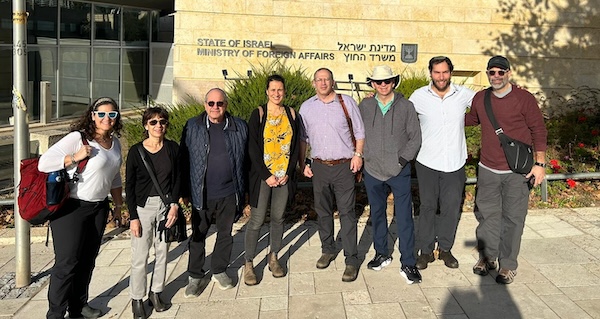
Hand in Hand (Yad b’Yad) is a group of Israeli schools where Jewish and Arab students learn together. Its co-founder, Lee Gordon, was in Vancouver last month (photo from Hand in Hand)
Lee Gordon, co-founder of Hand in Hand (Yad b’Yad), a group of Israeli schools where Jewish and Arab students learn together, spoke at Vancouver’s Or Shalom Synagogue and met with members of the community at large last month.
“We are always eager to have more friends and supporters for what Hand in Hand is doing, especially in the current very dark situation in Israel and in Gaza,” Gordon said in an interview with the Independent. “Hand in Hand is a beacon of light in a place where coexistence is not widespread enough.”
Gordon, who first moved to Israel in the 1980s, launched Hand in Hand with Amin Khalaf in 1997. The first classes started in September 1998 with 50 students on two campuses, in Jerusalem and in the Galilee. Today, there are more than 2,000 students, who study in Hebrew and in Arabic, on six campuses throughout Israel.
The bilingual schools were established to combat the threat posed to Israel by growing social alienation and lack of trust between Jewish and Arab citizens. Education, in the view of Hand in Hand’s founders, was – and still is – instrumental in changing this.
Gordon, who lived in Israel for 20 years before returning to the United States, became involved in Jewish-Arab dialogue while pursuing a master’s degree in social work from Hebrew University. Though the university was integrated, he observed, there was not a great deal of interaction between Jewish and Arab students, aside from weekly dialogues in which Gordon and others from the two groups would engage on campus.
While those meetings were clearly a step in the right direction, he felt they were lacking. “Dialogue is superficial. People can have lovely feelings afterwards but don’t see each other again,” said Gordon, who is currently the director of American Friends of Hand in Hand.
Later, when working on a fellowship project through the Mandel Institute, Gordon spent time looking at schools in Israel and analyzing what makes them succeed or fail. In the backdrop was the reality that the school system in Israel is completely segregated, even in mixed communities, such as Jerusalem and Tel Aviv.
“I started building a rationale for a school being a wonderful venue for bringing Arabs and Jews together, because it is not just for one hour a week. Once students are in school, they are there all day, all week, all year, and have a chance to truly get to know the other,” Gordon said.
Realizing that he needed an Arab partner for his goal of creating an integrated school to reach fruition, Gordon was introduced to Khalaf, an educator whose hope was for his children to grow up feeling as equals in Israeli society.
Hand in Hand was officially registered in spring 1997 and, for a year, Gordon and Khalaf scouted the country, trying to locate an ideal spot to start the school.
“We knew we wanted one in Jerusalem but also wanted a backup,” said Gordon. “We settled on an area in the Galilee where the Jewish and Arab towns are close together.”
When the first schools opened in fall 1998, the primary challenges consisted of hiring teachers, raising funds and recruiting Jewish students.
“We knew Arabs, as the minority, would flock to our schools, it would be seen as a step up for them,” said Gordon. “Jewish parents would be more of a struggle. We wanted our schools to be accredited and not be viewed as boutique, esoteric schools lacking legitimacy.”
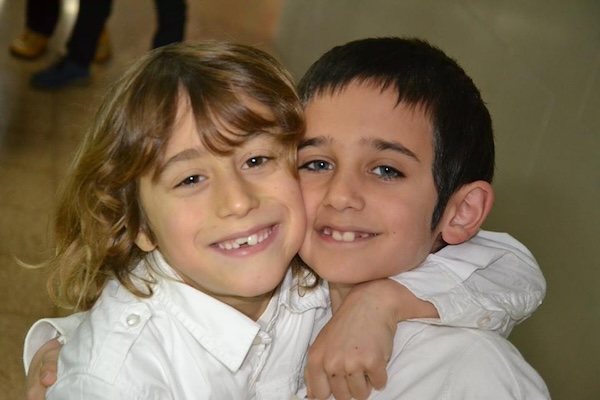
(photo from Hand in Hand)
Though never without obstacles, as the schools grew each year, it became easier to recruit new parents because Hand in Hand presented an attractive educational possibility – students were learning two languages in a vigorous academic environment, they were happy and the class sizes were smaller.
Even today, Gordon admitted, Hand in Hand still has to work harder to recruit Jewish parents, particularly after the Hamas attacks on Oct. 7.
“This is the worst war of the four since Hand in Hand has been in existence,” he said. “Jewish families often know someone who was killed or taken hostage, and many of the Arab families have relatives in Gaza.”
While there were concerns that Jewish families might withdraw their children from classes following the attacks, that has not happened yet.
“Bringing people together is really the only way there is any hope of this conflict ending because it is not happening on political levels,” Gordon said.
Multiple researchers have shown that there are many benefits from bilingual education, such as more empathy, better academic performance and improved engagement. Beyond those benefits, Jewish and Arab students at the Hand in Hand schools develop close friendships, which start through childhood sleepovers, birthday parties and play dates. Moreover, adults have formed long-lasting bonds with one another.
“Many parents have spoken of how they have been transformed by the experience,” Gordon said.
Hand in Hand schools are public, recognized and overseen by the Israeli Ministry of Education, and open to all parts of the Arab and Jewish populations in Israel. Government funding is supplemented by philanthropy and parents’ fees.
Besides Jerusalem and the Galilee, Hand in Hand operates schools in Haifa, Jaffa, Kfar Saba and Wadi Ara.
For more information about Hand in Hand, visit handinhandk12.org. Canadian residents can make a tax-deductible donation to Hand in Hand through the Jerusalem Foundation of Canada, 1-877-484-1289.
Sam Margolishas written for the Globe and Mail, the National Post, UPI and MSNBC.
I was driving home from work the other day. Left the office early to reduce driving time in the evening hours. Hamas likes their 6 p.m. missile barrage and I’m honing my missile-avoidance routine.
I was listening to talk-radio, but have kind of had enough of the news. Too much war talk and it’s getting a bit overwhelming. So, I switched to Spotify and up popped Supertramp, “The Logical Song.” How “wonderful, beautiful, magical” life once felt. Before Oct. 7. Before Hamas.
Then, as if on cue. I gazed towards the sky and saw missiles flying overhead. At first, it didn’t really click. And then, yikes! I quickly switched back to the news where, in a very calming voice, they were announcing areas under missile attack, which is another reason to listen to the radio while driving during war – real-time information. Lesson learned.
Suddenly, my smartphone’s flashlight started flashing, which was pretty darn cool! And there I was, on Star Trek, standing on the bridge. I even recalled the vessel number, NCC-1701. I was with Captain Kirk. No! I was Captain Kirk, Dr. McCoy by my side, Sulu and Chekov at the controls. The Klingons were attacking and Mr. Spock, standing to the side, was calmly advising the attack coordinates. No, wait! That was the radio announcer. Seriously, this all took place within a split second in my over-active imagination.
The flashing continued. I realized my cellphone was communicating with me, warning of danger. I have the Home Front Command application, which sounds an amazingly loud alarm during a missile attack in my area, but changing between the radio and Spotify prevented the siren from going off. So, instead, the phone activated my flashlight, sending out an SOS. Now how neat is that?! In a geeky sort of way. Like for someone who imagines himself on Star Trek during a real-life missile attack.
Reality set in. There were Home Front Command instructions to follow.
Momentary panic set in. Where was my wife, to tell me what to do? Like she always does … but that’s another story. This time, I wanted her there, instructing me.
All these thoughts raced through my mind in milliseconds. As I calmly slowed the car and veered to the shoulder, like other cars around me, I put on the blinkers. More flashing lights, but the bridge of the USS Enterprise was now a distant thought. Looking both ways, I left the car and hopped over the road barrier, moving away from the car, although probably not far enough, because there was a steep decline just below. It was getting dark and, suffering from poor night vision, I didn’t want to trip and hurt myself. I heard my son laughing at me. “Nerd!” he called out. But that was just my imagination.
I should have laid flat, prostrating myself for maximum protection. But it had rained earlier that day, the ground was wet and I didn’t want to get muddy. “Nerd!” This time, it was my daughter in my mind’s eye. “OK,” I said to no one in particular, “I’ll squat.” Good enough, but not really.
The family in the car ahead were huddling together but too close to their vehicle. I shouted for them to move further away, but they didn’t react. Maybe they didn’t understand me, given my still heavily accented Canadian Hebrew. This time, I heard both my kids teasing me – 30 years and still talking like an immigrant! “Hey, they just don’t hear me,” I said to the darkness.
It was very moving seeing the father crouching down on top of his brood, in a protective sort of way. “Isn’t that touching,” I said to my wife in my imaginings. “For sure,” she responded, somewhat sarcastically, in the back of my mind. “I know you’d do the same.”
Then it was over. The sky went quiet. People returned to their cars. The nestled family broke apart and entered theirs. We should have stayed in place several more minutes. Ten minutes is the recommended time. But it was dark, getting late, also a bit cold. I just wanted to get home, back to the real chiding of my kids and to my wife, somehow longing for her ordering me about.
A few minutes later, my wife called, to make sure I was safe. And then routine set in. “Don’t forget to pick up some milk and bread from the corner store,” she instructed me.
Am Israel chai.
Bruce Brown, a Canadian-Israeli, made aliyah 25 years ago. He works in high-tech and is happily married, with two kids. He is the winner of a 2019 American Jewish Press Association Simon Rockower Award for excellence in Jewish writing.
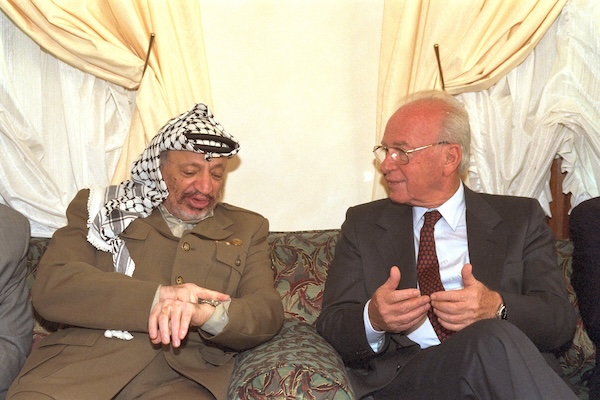
Prime Minister Yitzhak Rabin meets in Casablanca with PLO Chairman Yasser Arafat, 1994. (photo from flickr.com/photos/government_press_office/6324960139)
With all the darkness surrounding us since Oct 7, since the shattering of that tranquil Shabbat, have the people of Israel witnessed a miracle?
When Israel’s guard was fully down, when the south was under a vicious blitzkrieg by the monstrous Hamas, why did Hezbollah – with their 150,000 missiles pointed towards Israel – not exploit this excellent opportunity to open a second front? When Israel was existentially exposed, Hezbollah chose not to respond, at least not in any real-time, meaningful way. Complex geopolitical and military and conspiracy theories abound, attempting to explain why and why not. Pundits speculate and postulate and surmise. But maybe, just maybe, at some very esoteric level, the simplest and most logical answer, according to my close friend, a rabbi: it was a modern-day miracle. Pftt, pftt, pftt, as my great-grandmother would add.
***
The lights! Growing up, I was conditioned to shut the lights when leaving a room. I attempted to teach the same to my kids – and to my wife, although sometimes it seems she opens the lights when leaving a room. And then the missile sirens go off. Whoa! Slow it down. We have 90 seconds. Certainly time enough to shut the lights when racing to our shelter. My shouts muted by the screeching of the red alert, “Lights! Lights! Shut the lights!” I yell. To no avail, of course.
***
The day after … too soon to start thinking about it? That is where discussions about the war ultimately end up, each of us with our own theory, our own concerns, our own hopes. Once Israel achieves victory, in whatever form that takes, Gaza must then be rebuilt. But first it must be deradicalized – no more Hamas. Demilitarized – no more bombs hidden in schools, mosques and hospitals. And democratized – according to Winston Churchill, it’s the worst form of government … except for all others.
For this to succeed, Gaza should be divided into three cantons, similar to Germany, post-Second World War, each managed by a strong, Western or westward-looking country with enlightened self-interest for a stable and less radical Middle East. Maybe the United States. Maybe Britain. Maybe Germany. Maybe Egypt or Jordan. Escorted by a massive 21st-century Marshall-like plan. Maybe the Blinken Plan. Channeling the equivalent of $15 billion in 1948 purchasing power, that’s $191,569,917,012.48. OK, not that much, as the Gaza Strip is tiny compared to Germany, but enough funds to restore its economic infrastructure, to rebuild the Strip and rehabilitate its citizens, and make Gaza the Singapore of the Middle East – shipping, tourism, industry, maybe even offshore natural gas – like it could have become in 2005, when Israel fully withdrew. But then, what do I know.
***
Well before the day after, we need to take care of the Israeli hostages, including babies, children and octogenarians, both those still held in unknown condition by Hamas and other terrorists in Gaza, and those who have been returned. Interesting, but not necessarily surprising, is that neither the United Nations General Assembly nor UNICEF nor even the Red Cross demanded their unconditional release. Let alone a humanitarian visit.
As related by Liat Collins of the Jerusalem Post, Guelah Cohen – a 1980s right-wing parliamentarian, 2003 Israel Prize winner and mother of current senior Lukid lawmaker Tzachi Hanegbi – summarized this tragic situation best. Back during the First Lebanon War, when Tzachi was a combat solder, Cohen was asked what she would do if he were taken prisoner. She thoughtfully responded that, as a mother, she would be outside leading the protests to bring her son home, shouting with a megaphone outside the Prime Minister’s Office for the government to do anything and everything in its power to achieve his release. But, as a member of the government, she would be sitting quietly in the Prime Minister’s Office, advising him not to listen to the public.
Prime Minister Yitzhak Rabin, during the controversial days of the 1993 Oslo Peace Accords process and accompanying Palestinian terror, said, “We must fight terrorism as if there’s no peace process and work for peace as if there’s no terror.” How utterly profound.
So, with the tragic circumstances of the hostages, the government must listen to the cries of the hostages’ families. But they also must lead and not be swayed by public opinion. The government must fight the war on Hamas as if there were no hostages and must, at the same time, bring all the hostages home. Alive.
***
As for economic recovery, I share a very micro, personal anecdote. About 18 months ago, we redid our condo, buying much of our furniture from BaKatzer, a wonderful and unique boutique furniture store located in a moshav (agricultural community) just outside the Gaza periphery, not too far from Ashkelon, which receives the brunt of the rockets from Gaza. While not the easiest of customers – I can be very demanding on price and service – I recently sent the owner a WhatsApp message. “Hey!” I wrote. “Hope all is well during these difficult times and hope to be back soon for more shopping.” Given my unforgiving consumerism, maybe she saw that as another threat. Alas, I can also be a very loyal consumer.
***
And there we were, my wife and I sitting around our Shabbat table with my daughter and her best friends, one with a brother who is a paratrooper and fighting in Gaza, the other an intelligence officer whose service was just extended, and still another, who was on a weekend leave from his Golani unit stationed up north. The conversation quickly moving from the trivial and benign to questioning and
responding to issues and concerns that should be far away from them, that should not trouble the young minds of these 20-somethings, who should not deal with the complexities of miracles and hostages and day-after theories. Alas, there we were, talking of war and survival, looking hopefully to tomorrow. Am Israel chai.
Bruce Brown is a Canadian and an Israeli. He made aliyah … a long time ago. He works in Israel’s high-tech sector by day and, in spurts, is a somewhat inspired writer by night. Brown is the winner of the 2019 AJPA Rockower Award for excellence in writing, and wrote the 1998 satire An Israeli is…. Brown reflects on life in Israel – political, social, economic and personal.
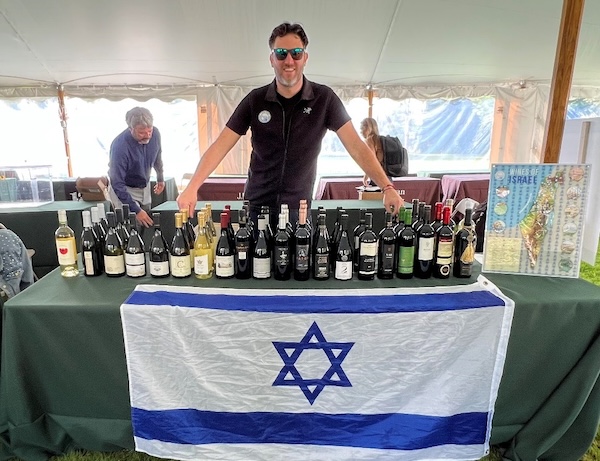
Joshua Greenstein, vice-president of the Israeli Wine Producers Association, showcases the array of wines produced in Israel. (photo from IWPA)
The world of wine in Israel, perhaps the oldest wine-producing region in the world, has become collateral damage of the atrocities that occurred on Oct. 7. To raise awareness, and in support of Israel and Israeli wineries, the Israeli Wine Producers Association (IWPA) is asking consumers to “Sip for Solidarity.”
The massacre has had an immediate, concrete impact, particularly on picking, sorting and winemaking teams. Harvest had begun shortly before the attacks, which meant that the sorting, crushing and fermentation processes were, in many cases, done under the constant threat of attack and bombardment. For many wineries, production teams have been hollowed out, as the young men and women who normally would be shepherding the crucial winemaking process have been called up to help defend the nation.
“Winemaking has its own schedule, unlike other industries, where you can pause production or run with limited staff. Grapes grow and ripen when they do. The winemaking process is very hands-on. Without staff, many wineries face an impending crisis,” said Joshua Greenstein, vice-president of the IWPA, a trade organization promoting 30-plus Israeli wineries through wine education and events.
“Additionally, wine is usually something enjoyed when you go out to eat or to a party, and people in Israel aren’t feeling particularly celebratory these days,” Greenstein added. “It’s catastrophic not just for this year’s sales, but for the vintages harvesting now that won’t be ready for sale for years to come.”
To help the situation, Greenstein suggested, “Buy a bottle of Israeli wine. Not only will the purchase help the wineries, but we’re donating 10% of every case shipped from Nov. 1, 2023, to Dec. 31, 2023, to Israeli relief efforts. With the wine-consuming public’s support, these challenges are surmountable, and wineries will still craft wines that accurately and deliciously reflect the character of the vintage and of Israel, just as they always have.”
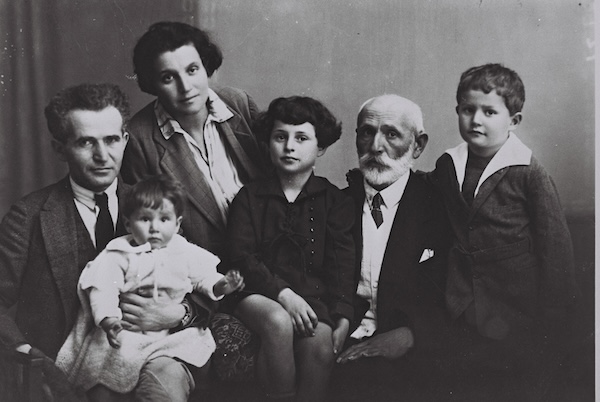
The Ben-Gurion family in their Tel Aviv home, 1929. From left: David and Paula with youngest daughter Renana on Ben-Gurion’s lap, daughter Geula, father Avigdor Grün and son Amos. (photo from National Photo Collection of Israel / Government Press Office)
David Ben-Gurion, who died 50 years ago, insisted Israelis needed Hebrew names. The process was controversial – but the outcome is clear.
The 50th anniversary of the death of David Ben-Gurion will be marked Dec. 1. The first prime minister of Israel is generally remembered in noble terms, though we live in an era when heroes are being toppled from their plinths. His actions in times of war and peace have been parsed by historians – fairly and unfairly, as seems inevitable – but Ben-Gurion’s legacy among Zionists appears generally secure. Those with ideological axes to grind will grind, but the esteem in which most Israelis and overseas Jews view “the Old Man” remains largely favourable. However, an aspect of his policy that affected people in a very personal way has come in for a reconsideration in the past couple of decades, though it is hardly the stuff that will make or break a reputation. It is the Hebraization of names.
Ben-Gurion was a fierce advocate of Israelis (or, before 1948, Palestinian Jews) adopting names that reflect their new reality and that, by extension, turn their backs on the past and the diaspora. Ben-Gurion himself was born David Grün (or Gruen), changing his name to the Hebrew Ben-Gurion (son a lion cub) in 1910. By 1920, at the latest, he had become an evangelist for Hebraizing names and, when he was in power, he insisted that leading military and political figures adopt Hebrew names.
Ben-Gurion did not start this trend – though he is perhaps most closely associated with it because he was in a position to make it the force of law and custom. He instituted an administrative order that senior military figures and diplomatic officials representing Israel abroad must have Hebrew names. Others, like Golda Meir, he browbeat into the change.
Of course, Jews – and others – have been changing their names since the dawn of migration. People have frequently altered their names when moving to a new society, in order to fit in. Iberian Jews migrating en masse to the Low Countries after the expulsions of the 1490s are an early, well-documented example. Jews arriving on North American shores routinely changed their names, but so did non-Jewish migrants. It was not necessarily (or only) antisemitism that name-changers sought to outrun, but differentness in general. There are stories of French newcomers changing from Boisvert to Greenwood.
Dara Horn, in her book People Love Dead Jews, emphatically debunks the long-held belief passed down by generations that their family names had been changed at Ellis Island (or whatever entry point was appropriate to the story). No, she argues, that didn’t happen. The changing of names by Jewish new Canadians and Americans was, she contends, done by the migrants themselves and represents a sad realization that the Goldene Medina might not be the refuge from antisemitism they had hoped.
But changing one’s name to fit into a society already in progress, like America’s, was different than the situation of arriving in the pre-state Yishuv. This was not a matter of looking around for a local-sounding name and changing Moses to Murray or Lipschitz to Lipson. This required inventing a whole new lexicon of names. It was not the act of taking a common name in the new place, but of inventing entirely fresh first and last names.
The process was a legacy, ultimately, of Eliezer Ben-Yehuda (né Perlman), who was the driving force behind the revival of Hebrew as a vernacular language. After making aliyah in 1881, he came to believe that the redemption of both the people and the land of Israel required a new language to replace Yiddish. This represented a rejection of the diaspora reality and mentality, and served to create a medium through which an eventual (hoped-for) ingathering of exiles from around the world, including places where Yiddish was not the Jewish lingua franca, could communicate. The revival of an ancient land would coincide with the revival of an ancient language, both modernized to meet the needs of a new type of Jew. Ben-Yehuda raised his son and daughter exclusively in Hebrew, which must have made for a somewhat lonely childhood, being effectively the only two people in the world to speak the language as a mother tongue.
Eliezer Ben-Yehuda (né Perlman) was the driving force behind the revival of Hebrew as a vernacular language. (photo by Av Yaacov Ben Dov / Widener Library, Cambridge)
As the language spread – in large part thanks to Ben-Yehuda’s continued perseverance in promoting it and inventing modern words where the ancient language lacked them – the application of the new tongue to family and given names likewise grew.
The repudiation of the diaspora took on an entirely new relevance after the Holocaust. Some who made aliyah resisted changing their names, being attached, as is understandable, to one’s family name. Even so, no Jewish surnames were particularly long-established in the first place, since the practice of Jews adopting inheritable family names was only a century old, or a little more, at that time. The Austro-Hungarian Empire required Jews to take surnames in 1789 and in the Russian Empire and the German principalities not until the following century. At that time, choosing a name followed predictable patterns for Jews and non-Jews: a variation on “son of,” (Aronoff, son of Aron; Mendelsohn, son of Mendel), a reference to a profession (Becker for a baker; Melamed for a teacher), or a connection to the town or region (Frankel, from Franconia; Warshavski, from Warsaw; Wiener, from Vienna).
The adoption of Hebraized names in Palestine and Israel took four primary approaches.
The first was the traditional use of patronyms or matronyms, which is probably the oldest form of naming. Yiddish names, but also names that were German, Polish, Russian, English or French patronyms could be Hebraized: Davidson to Ben-David, Mendelson to Ben-Menachem, Simmons to Shimoni.
A second approach was to choose a Hebrew name that sounded like the original name. In some cases, the new name had a (sometimes remote) connotation with the original, as in the case of Lempel (little lamp) becoming Lapid (torch). Levi Shkolnik would become Israel’s third prime minister as Levi Eshkol. This was more than simply a near-homophone. It reflected another trend in the process, which was to adopt a name that spoke to the commitment of the chalutzim, the pioneers, whose Zionism was deeply informed by a back-to-the-land ethos. Eshkol means “cluster of fruit,” so it did double duty, sounding something like the original and also having a kinship with the blooming desert.
A third strategy was basic translation. Goldberg might become Har-Zahav (mountain of gold); Silver or Silverman might become Kaspi; Herbst, which in German and Yiddish means autumn, could be changed to a Hebrew equivalent, Stav or Stavi.
The fourth approach took the pioneer spirit and connection with the land to greater depths (with or without the homophonic advantage of Shkolnik/Eshkol). Flora, fauna and geography of the new homeland were attractive new names that situated the migrants linguistically and geographically. The writer Carrie-Anne Brownian cites such examples as Rotem (desert broom), Nitzan (flower bud), Yarden (Jordan), Alon (oak tree) and Tomer (palm tree). Simply adopting a place name gives us Hermoni, Eilat, Golani, Kineret and many others.
Those whose names already had a nature theme were at an advantage. The Haganah commander Moshe Klaynboym changed his family name, which meant “little tree” in Yiddish, to Sneh, Hebrew for “bush.”
Not necessarily related to nature, but to the idealization of the Zionist spirit, some took names like Amichai (my people live), Maor (light), Eyal (strength), Cherut (freedom) and Bat Or (daughter of light).
Golda Meyerson, after prodding from Ben-Gurion, became Golda Meir. Interestingly, her rather emphatically Yiddish given name she kept, presumably making Ben-Gurion half-satisfied.
Golda Meyerson, with prodding from David Ben-Gurion, became Golda Meir. (photo from mosaicmagazine.com)
As refugees from the Middle East and North Africa began pouring into Israel in the 1950s and ’60s, the Hebraization of names came to be seen as Ashkenormative, the taking of one’s ancestral name being another indignity (alongside inadequate housing and social stigmatization, among other things) that different-looking newcomers faced in their presumed Promised Land.
It seems, for example, that teachers encountering “strange” Mizrachi and Sephardi given names took it upon themselves, in some cases, to assign kids new names based not on any Zionist ideological imperative but for the same reason Canadian teachers in the early to mid-20th century dubbed kids with “foreign” names new ones the teachers could more easily pronounce. In retrospect, some have complained that this phenomenon was an insidious part of a larger (conscious, unconscious or some of both) effort to force Mizrahim and Sephardim to comport to Ashkenazi expectations even in things as intimate as a given name.
Sami Shalom Chetrit, a professor at Queens College in New York, who is of Moroccan-Israeli origin, recalled in a Forward article by Naomi Zeveloff, feeling outraged when an Israeli elementary school teacher nonchalantly renamed him, along with other non-Hebrew-named kids.
“Alif, your name from now on will be Aliza,” Chetrit recalled the teacher declaring. “Jackie, your name is Jacob, and Michele, your name is Michal. She kept going alphabetically. Then she said, ‘Sami, your name will be Shmuel Shalom.’
“I went to my father, crying.… I really felt like something was stolen from me, something precious. I said: ‘They changed my name! They changed it!’”
Chetrit’s father taught the teacher something the next day, according to the story. In Arabic, “Sami” comes from the root “samar,” the father said, meaning “heavenly superior,” and that, the father declared, is “international.”
The tendency eventually faded out. When a million migrants from the former Soviet Union arrived in Israel, after 1991, almost none chose to, or were pressured to, change their names.
There are contemporary exceptions even to this, though. Anatoly Shcharansky, one of the most famous of the Soviet “refuseniks,” became Natan Sharansky on arrival in Israel in 1986. The American historian Michael Bornstein became the Israeli politician-cum-diplomat Michael Oren, having changed his name when he made aliyah in 1979.
Newcomers to Israel today are free to change their names – and free to keep their “galut” (“exile”) names. Israel, today, is an overwhelmingly Hebrew society, though. New arrivals do not present a risk of swamping the place with Yiddish, Arabic, German, Polish or English, as might have seemed a danger 75 years ago, creating a Babel where cultural unity was desperately needed.
In addition to the psychological impacts of adopting Hebrew names (and language) as a refutation of the diaspora that had so recently been the locus of calamity, there was the practical reality of finding commonality among wildly diverse new citizens. That has been achieved. Even sorbing a million Russian-speaking new Israelis after 1990 did not dilute the ascendency of the Hebrew language. For whatever criticisms the forced (or vigorously encouraged) adoption of Hebrew names might invite, there is no doubt the intended outcome has been realized. Ben-Gurion’s dream not only of a Jewish state, but a Hebrew one, is firmly in place.
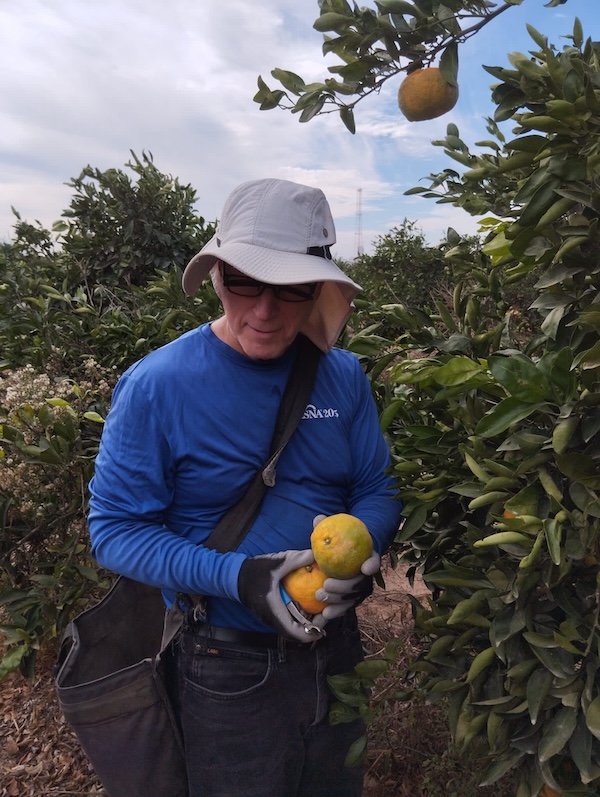
The author’s husband, Dr. Scott Fields, picking tangerines in southern Israel, on Kibbutz Nitzanim. (photo by Deborah Rubin Fields)
I have just returned from laundry brigade duty. Of course, your first question is, what is the laundry brigade? As you may or may not know, in my city of Jerusalem, as well as in other parts of Israel, the hotels are currently filled with people who, for safety’s sake, have left their homes in southern and northern Israel. These moves have created an unprecedented event in Israel’s history. As one friend from Adamit, a far northern kibbutz pointed out, “We are refugees in our own country.”
In my neighbourhood, as well as in other Jerusalem neighbourhoods, residents are volunteering to clean the clothes of those evacuated to hotels. This help is very organized, with a pool of volunteers listed on an Excel file. So, I just returned the laundered clothes of a young family from the northern town of Shlomi.
And, speaking of clothes, there have been clothing drives to help those who left their homes quickly. Books and games have also been donated so that displaced families have some positive way to occupy their time.
But there are so many other noteworthy acts of goodness. One of our sons and other staff from Kfar Saba’s Meir Hospital recently drove south to the Netivot area to help a farmer pick and box watermelon. The farmer’s usual Thai or Palestinian workers are gone. In their place, hundreds, if not thousands of ordinary citizens are in the fields picking – and this is happening all over the country.
One of our daughters spent a week at Jerusalem’s Bezalel Art School sewing uniforms and add-ons for protective ceramic vests, equipment the soldiers currently need. Sewing machines were even delivered to some kibbutzim so kibbutz members could also help with this task.
While there is enough food for soldiers, some people are still providing extra food. One Jerusalem restaurant owner prepared a meal for 70 soldiers (including his son) serving up north. The food was driven to the soldiers by someone else whose partner is serving with this platoon. In my area, one of my older religious neighbours gave his Pesach dishes to observant soldiers who are staying in a university dorm (camping “in” rather than “out” as it were).
There has been a big emphasis on checking people who live alone or who have mobility issues. Volunteers are helping with shopping, picking up medication, or just visiting these solitary individuals.
During this war period, Jerusalem’s branch of Magen David Adom has held more than one blood drive. Each turnout has been unbelievable, as potential donors stood in line for hours waiting their turn. Moreover, in addition to the sandwiches the MDA staff and volunteers regularly eat on their extended 12-hour shifts, volunteers have been cooking and delivering meals (including vegetarian portions) to the staff.
On the kibbutz where one of our sons lives with his family, each family is responsible for the needs of the 100 evacuees who are currently living on the kibbutz. Yad Sarah, the Israeli nonprofit that loans medical equipment, has offered to loan equipment that the evacuees were unable to take with them. In addition, volunteers have given their time to fix up these temporary living spaces while other locals have organized hazit habayit, drop-off sites where furniture and electronics are collected for those who have had to relocate. Another nonprofit, Tenufa Bakehila, is right now fixing up neglected bomb shelters and repairing homes damaged by rockets.
Other nonprofits have opened their doors to evacuees. The Society for the Protection of Nature in Israel has people lodging in its Eilat Field School. For the past month, it has likewise been providing meals.
All over the country, evacuated children have been enrolled in local schools. Even the National Library of Israel has become involved. It just moved into a beautiful new building, but its old building on Hebrew University’s Givat Ram campus has become a temporary school for children from Shlomi.
There is the story of a small family consisting of two sons and the father. When one son, Sgt. Maj. (Res) Gil Phishitz, was killed on Friday, Nov. 3, the word went out on social media. Thousands of people dropped what they were doing to attend the funeral in Hadera. Out of respect and to show support for the tremendous sacrifice of these fallen soldiers, people who don’t personally know the families have also been visiting during the shiva period.
Israeli farmers employ many Thai citizens. On Oct. 7, some of the Thai farm workers witnessed their co-workers being kidnapped. Some even saw their friends brutally murdered by Hamas. Our younger son, along with other volunteers, has been helping Thai workers find necessary food, lodging and medical care. Volunteers organized counselors and translators to help these people deal with what could easily turn into post-traumatic stress disorder, or PTSD. Volunteers advocated for these Thai workers with the Ministry of Agriculture and with local councils. At this point, many (estimates are 8,000 out of 30,000) Thai farm workers have left Israel.
In some places, acupuncturists and massage therapists are offering free sessions to people who have been evacuated. Several social workers and psychologists continue to give voluntary assistance to those put up in Dead Sea hotels.
Volunteerism is not just with people, it is also with animals. Volunteers have gone to the south to rescue pets and farm animals that were left behind. Veterinarians have provided medical care for injured animals. The rescued animals are now in shelters, awaiting foster homes.
Last, but certainly not least. In the big cities such as Tel Aviv and Jerusalem, many have been showing up at memorial services and vigils for the fallen and the kidnapped.
Why are people doing all these things? I think the best answer comes from Hillel in the Ethics of the Fathers (Pirkei Avot), 1:14: “If I am only for myself, who am I? If not now, when?”
Deborah Rubin Fields is an Israel-based features writer. She is also the author of Take a Peek Inside: A Child’s Guide to Radiology Exams, published in English, Hebrew and Arabic.
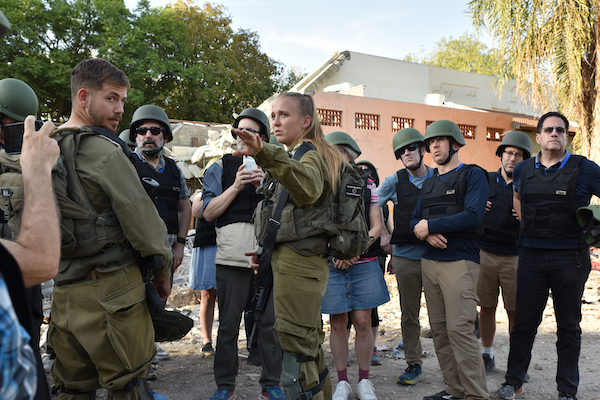
On Oct. 31, among the ruins of Kibbutz Be’eri, Israel Defence Forces personnel brief a delegation of Conservative rabbis and lay leaders from the United States, Canada and Britain, which was on a three-day solidarity mission organized by the Fuchsberg Jerusalem Centre. (photo by Boaz Pearlstein)
WARNING: Extremely graphic reporting.
Since Hamas’s Oct. 7 cross-border assault on multiple army bases, kibbutzim, cities and a music festival in the Gaza Strip periphery, staff at the Israel Defence Forces’ Shura base have been working around the clock to identify the remains of the 1,100 civilians and 315 IDF soldiers, reservists and police officers massacred by jihadi terrorists. With so many bodies, the victims were initially kept in refrigerated milk trucks in the morgue’s parking lot. Plain wooden coffins are stacked in the corridors, waiting for a positive identification so the remains may be released to their families for burial at a military or civilian cemetery. Only then can Judaism’s seven-day period of mourning begin.
A month on, the sickly smell of death lingers. Pathologists at this normally quiet IDF logistics centre and home base of the military rabbinate corps – located on the outskirts of Ramla, a mixed Jewish-Arab city not far from Ben-Gurion Airport – continue their painstaking, harrowing but holy forensic mission.
Dismembered limbs and badly decomposed bodies continue to be delivered. The human remains are sniffed out under the rubble of destroyed buildings by IDF canine units, staff told a 33-person Oct. 31 delegation of Conservative rabbis and lay leaders from the United States, Canada and Britain.
Initially, it is often impossible to determine if the remains are those of victims or perpetrators, Col. Rabbi Haim Weisberg, head of the IDF’s rabbinic division, told the religious leaders. Many are mutilated with limbs and heads dismembered, making the ghoulish jigsaw puzzle even more complex.
“We are in an abnormal situation and that is why it is taking so much time to identify the bodies. In most cases, we have had to identify people via deep tissue DNA or dental records because there is nothing left,” he explained.
The complex identification process has been compounded because so many of the victims were not Israeli residents.
Pathologists can take several hours to assess a body, photograph it and document the fatal wounds. Out of respect for the dead and their families, the IDF is not releasing those photos.
Weisberg spoke not only about whole bodies but also about charred and incomplete remains, including what in one case turned out to be a corpse so severely burned that only a CT scan revealed it was a mother and baby bound together in a final embrace.
The grisly job is complicated by uncertainty over the tally of victims. According to constantly updated data from the IDF, more than 1,400 Israelis and foreigners were murdered. Some 238 people are believed to be held hostage by Hamas inside the Gaza Strip and the fate of dozens of others is unknown. Some may be held inside Gaza by other terrorist groups, like Palestinian Islamic Jihad, or even by individuals. Others may still be among the dead, yet to be identified by the staff at Shura.
When drafted, all IDF recruits provide samples of their DNA and fingerprints, and have their teeth X-rayed. The army does not rely exclusively on identification made through a soldier’s twin dog tags kept in their combat boots and worn on a chain around the neck.
According to halachah (Jewish law), fallen soldiers are buried in a coffin in their blood-soaked uniform. They are not ritually washed in the tahara ceremony – the Jewish tradition of purification of the dead – nor are they wrapped in shrouds. The intention is that God should be angered by witnessing the fallen defenders among his Chosen People. Personal effects like a cellphone, watch or wallet are washed of blood and then returned to the family of the deceased. Artifacts that cannot be cleansed of blood are buried with the deceased.
By contrast, civilian dead are ritually washed and wrapped in shrouds. Generally, in Israel, they are interred directly in the ground without a coffin.
While dental records can allow straightforward identification of dead soldiers, that information is often unavailable for civilians. Many dental offices in the city of Sderot near Gaza were destroyed, and with them their files.
Ritual washing is tasked to male and female reservists who have volunteered for the mitzvah (commandment) of chesed shel emet (true kindness).
Women soldiers perform tahara for the hundreds of girls and women who were murdered. The team is working in shifts around the clock. Among them is Shari, an architect living in Jerusalem whose surname may not be released under IDF security regulations. She volunteered for the unit when it was established more than a decade ago to ensure that the modesty of female recruits killed in action was protected.
“We saw evidence of rape … and this was also among grandmothers down to small children,” she stated.
Shari said she and the other volunteers received specialized training from the IDF, which prepared them practically and mentally to care for the bodies of the dead. Until Oct. 7, she had not been called for active duty.
“I’ve seen things with my own eyes that no one should ever see,” she said, describing how she took care of the dead women. Many were still dressed in their pajamas. Their bodies had been booby-trapped with grenades, and the remains bore evidence of extreme brutality.
Shari’s duties begin with opening the body bags to remove the dead person’s clothes, jewelry and any other personal possessions in order to return them to the families.
“The only colour among the blood and dirt was their nails, beautiful manicures, painted the brightest colours,” Shari said, adding, “Their nails made me weep.”
“We gathered this group of 33 Jewish communal leaders from across North America to witness the horrors our brothers and sisters have suffered,” said Dr. Stephen Daniel Arnoff, chief executive officer of the Fuchsberg Jerusalem Centre – a home for Conservative and Masorti Judaism in Israel, which organized the three-day solidarity mission. Located in Jerusalem, the centre offers opportunities to study, pray and explore within an egalitarian and inclusive setting, creating multiple pathways for finding personal and communal meaning.
The solidarity group included the first civilians to tour the devastated remains of Kibbutz Be’eri, where terrorists went house to house slaughtering the inhabitants. Wearing flak vests and helmets, the clergy and communal leaders recited the El Male Rachamim and Kaddish prayers for the dead as soldiers continued their search for human remains.
“We literally saw the blood of our people crying out to us from the ground,” said Arnoff.
“It is our moral obligation to make sure that the world knows what happened there.”
Gil Zohar is a writer and tour guide in Jerusalem.
Teenagers are filling in for drafted reservists at Jerusalem’s Machane Yehuda market. (photo by Gil Zohar)
With the horrors of Oct. 7 embedded in our minds, in our hearts and in our souls, Israel has come together in so many ways, including for war. The effects are so broad and deep. Here is a bird’s-eye view from my narrow perch.
All the booms in the air, coming from far-off (and not-so-far-off) mid-air missile collisions – bravo Iron Dome! The swoosh of our fighter jets overhead – bravo Israeli Air Force! And all those customized Red Alert apps buzzing away on everyone’s cellphones – bravo Elad Nava, tech entrepreneur extraordinaire! It’s starting to sound like an orchestra out there.
Social media was calling for Israelis to sing, to go out on our patios at 9 p.m. and belt out Hatikvah. We did. And it felt great! So darn cathartic. What a sense of solidarity. As it turns out, on this particular evening, Hamas warned Tel Aviv of a missile barrage at 9 p.m. Guess our singing acted as type of musical Iron Dome, as no barrage arrived. Which is not to say Tel Aviv hasn’t had its share of missiles, just not at this particular time.
Driving to work, traffic slowed down considerably due to some “jackass” up ahead. Turned out to be a convoy of military jeeps carrying weapons and personnel to our north. As I passed them – 12 vehicles – I slowed down (in the left lane), gave a friendly honk and a thumbs up to each. Twelve times. Cars behind me did the same.
With 75 seconds to reach our safe room and with missile attacks being random with no real pattern, the stress and uncertainty prevents me from enjoying my private bathroom time, sitting down with a newspaper or book or my smartphone. But not under current circumstances. Just want to get in and out of there as quickly as I can..
Same for showering. No more basking under a warm spray of fresh water. No more humming a few showtunes while lathering up. Nope. Just a quick soaping and get out of there. For shaving, I’m getting use to a three-day growth cycle.
And, getting really personal … in the bedroom with the wife, I am now suffering reverse performance anxiety. I just get it done and move on. Don’t want to get caught with my pants down when the sirens sound.
Bravo to McDonald’s – giving McHappy meals free of charge to our soldiers. The restaurant stepped up, and many businesses are doing the same. From banks, to other restaurants, to retailers, providing goods or services at discounted prices to relieve some of the burden weighing on the country. Wonderful to see this coming together.
I miss my exercise routine. Was swimming a couple time a week. Now, not. The pool closed due to homeland security restrictions limiting gatherings at places of leisure. Who would categorize exercise as leisure? Anyway, I don’t think I’d hear the missile alert with my head bobbing in and out of the water while doing the breaststroke or front crawl. More so, there’s no running along the poolside, so would not make the saferoom in time.
We are not immune to panic buying. A few nights into the war, based on some rumour or other, I went grocery shopping to stock up on water, canned goods, candles, matches, toilet paper…. Didn’t get out of there until almost 11 p.m. The checkout line snaked all the way to the meat section. It was long, the joke being that, by the time we reach the checkout counter, Netanyahu will have negotiated a hudna (truce in Arabic). Ha.
I keep saying I’ll do it. Need to put more than just a half dozen bottled waters and a few inhalers in our safe room. Should stock it with canned goods, more medicine, flashlight, battery-powered radio and other survival aids. Maybe tomorrow.
If someone forgets their house key and knocks at our now always-locked door, they need to say a password before we’ll open the door. The theory being, if a Hamas terrorist is holding a gun to their head, they won’t say the password. Talk about paranoid. Probably run-of-the-mill war-related stress.
Joe Biden. His Oct. 11 “Don’t” speech was amazing! Talk about geopolitical alliances, commitments, pacts, and the such – I won’t. I’ll simply say I fell in love that evening.
Joe Biden. His Oct. 18 “We’ve got your back” speech was TREMENDOUS! I fell in love with him. Again. With a lightning visit to Israel, he kind of reminded me of Clint Eastwood in his glory days. He had that “make my day” squint in his eyes. Might have been him struggling to read the monitor, but he came across as a Dirty Harry kind of guy.
There are still a handful of Israelis – OK, maybe more than a handful – who just don’t get it. Now is not the time for divisiveness and finger pointing. There was utter failure. But the hard questions and difficult answers will come later. Now is the time for unity!
My wife and daughter volunteered at a high-end event (my wife works in the industry) to help arrange 1,000+ meals for our soldiers. There will be some very satiated soldiers enjoying gourmet meals in cardboard boxes and with disposable utensils.
And the sweet smell of my wife’s chocolate chip cookies and brownies baking in the kitchen. She slaps my hand as I go for a cookie: “Not for you! For our soldiers.” It’s that spirit of coming together.
My daughter left the house early the other morning and returned about an hour later with a huge orange garbage bag full of…. “What’s that?” I inquired. “Laundry. From a family in the south who was evacuated to some hotel. Mom volunteered.” As much as we get preoccupied with the war, with survival, sometimes it’s the mundane that really makes a difference.
Ouch. Our currency at its weakest since 2015. Pretty painful when you are sending US dollar instalments to your son studying in the States.
I know the diaspora is busy raising money for Israel at speeds and amounts like never before. But don’t stop once you give. Give more. This war will cost Israel billions. If you have given, please give again. Sderot is Israel’s front line. Israel is the diaspora’s front line.
Bruce Brown is a Canadian and an Israeli. He made aliyah … a long time ago. He works in Israel’s high-tech sector by day and, in spurts, is a somewhat inspired writer by night. Brown is the winner of the 2019 AJPA Rockower Award for excellence in writing, and wrote the 1998 satire An Israeli is…. Brown reflects on life in Israel – political, social, economic and personal.
The Institute for the Study of Civil Society and Philanthropy in Israel at Hebrew University of Jerusalem recently released a report called Civil Society Engagement in Israel During the Iron Swords War: Emerging Trends and Preliminary Insights. Written by Prof. Michal Almog-Bar, Ronit Bar, Ron Barkai and Hila Marmus, it offers an analysis of the exceptional civil engagement and volunteerism witnessed in Israel during the first two weeks of the Israel-Hamas war.
Operation Iron Swords was triggered by a heinous terrorist attack on Israeli civilians, launching a massive mobilization effort aimed at bolstering the nation. In response, civil society rallied under the banner of “Defending Our Home,” setting aside preexisting social divisions. The collaborative report, authored by experts at Hebrew University, examines the remarkable civil initiatives, volunteerism and philanthropic contributions that played a pivotal role in addressing urgent needs and challenges during this critical period.
During the first two weeks of the war, civil initiatives demonstrated their ability to address the urgent needs and pressing challenges that arose within Israeli society. These initiatives played a pivotal role in executing crucial tasks such as rescue operations, evacuations, temporary shelter provision, and the distribution of vital food and medical supplies. Additionally, they provided invaluable psychological support to those affected, emphasizing the power of grassroots efforts in times of crisis.
Here are the key highlights of the institute’s report.
Diverse Civil Initiatives: the report highlights over 1,000 civil initiatives that emerged across Israel, encompassing a wide range of activities. These initiatives included the rescue and evacuation of civilians and animals, and provision of essential supplies, as well as support for bereaved families and those who went missing during the conflict.
Local and Affiliated Groups: local and affiliated groups played a significant role in addressing the specific needs of their communities, providing temporary accommodation to evacuees and extending their support beyond their local borders.
Volunteerism: 48.6% of the Israeli population engaged in volunteering during the war, a notable increase from the rate observed during the COVID-19 crisis (33%). Notably, volunteerism cut across all age groups, genders and religious affiliations. In particular, the rate of volunteerism among the Arab-Israeli population during the war reached 29%, a rise from the 19% recorded during COVID.
Spontaneous Volunteers: a substantial majority of volunteers (28%) during the war were newcomers to volunteering, underscoring the widespread participation of citizens who had not volunteered before the conflict. These newcomers were predominantly secular and had above-average incomes.
Primary Volunteer Activities: the most prominent volunteer activities included collecting, packing and distributing food and equipment, transportation of people, food and equipment, assisting security forces, participating in outreach activities through social networks, and offering essential aid to evacuees.
Volunteers and Donations: many volunteers integrated their efforts with financial contributions, participating in voluntary initiatives and crowdfunding campaigns, highlighting the synergy between volunteerism and philanthropy.
Inclusivity: unlike the predominantly youth-driven volunteering seen during the COVID crisis, individuals of all age groups participated actively. Notably, 46% of those aged 18-35, 52% of those aged 35-55 and 52% of those 55+ engaged in volunteering. Volunteerism transcended gender and religious boundaries. The use of technology for digital volunteering extended the reach to remote and mobility-limited populations, underscoring the adaptability and inclusivity of these volunteer efforts.
Financial Mobilization: Israel witnessed a swift and substantial mobilization of financial resources, surpassing levels observed during prior military operations. Support poured in from North American Jewry and Jewish federations, with donations estimated to be in the hundreds of millions of dollars.
The report underscores the importance of effective coordination between civil organizations and government bodies to ensure a unified response to pressing needs. It also suggests that civil organizations can evolve into a valuable support force for government activities during ongoing combat operations.
The study was a collaborative effort between the Institute for the Study of Civil Society and Philanthropy in Israel at Hebrew University, the Israeli Council for Volunteering, Civic Leadership (the umbrella organization of Israeli nonprofit organizations) and the Forum of Foundations in Israel. It included several surveys. The survey of volunteering during the first two weeks of the war was administered by the company Geocartographia and included 1,000 participants, constituting a representative sample of the adult population of Israel aged 18 and over.
People can report misinformation and hateful material at FakeReporter.net.
In a world where misinformation and disinformation are coming at us in unprecedented volumes, an Israeli organization is working literally around-the-clock to flag, correct and eliminate online falsehoods – and they depend on ordinary people to inform them of lies that need addressing.
Achiya Schatz, co-founder and chief executive officer of the group FakeReporter, spoke virtually at a Nov. 2 event organized by Canadian Friends of Hebrew University of Jerusalem and Congregation Beth Israel.
“We try to leverage crowd wisdom in order to make the internet a safer place,” said Schatz.
The challenge goes far beyond reducing misleading information online, he said. The very survival of democratic societies is at stake.
“If we do not have the capacity to distinguish what’s true from what’s false,” he said, “then, by definition, the marketplace of ideas doesn’t work and, by definition, our democracy doesn’t work.”
FakeReporter’s work is painstaking. An on-call team of thousands of volunteers are connected by WhatsApp and other communication tools. When a report of unverified information comes in, it is channeled to an appropriate individual or team to investigate. They will contact government officials, military spokespeople or others who might be able to confirm or debunk the information. They post their findings on social media, disseminate it to conventional media outlets, especially those that may have spread the falsehoods, and report it to the social media or other platforms where it appears.
While the “fog of war” around the conflict between Israel and Gaza is an obvious source of fake news that keeps FakeReporter teams hopping, equally insidious efforts are fomenting internal strife in Israel.
“Arab citizens of Israel have been heavily attacked,” Schatz said of anti-Arab propaganda targeting citizens of Israel online. Posts have aimed to make Jewish Israelis believe that Arab Israelis are a threat. Photos of Arabs allegedly stalking Jewish homes and businesses turned out to be, after investigations by FakeReporter, tradespeople scoping a roofing project and municipal workers going about their business, for example. The messages, from unidentified sources, have the potential to create civil unrest inside the country amid ongoing conflicts with external terrorist groups on multiple fronts.
On the global level, FakeReporter is responding to a barrage of war-related and more routine anti-Israel material online. In response, taking the nomenclature and vision of Israel’s Iron Dome air defence system, Schatz said, his group is creating what strives to be an invincible defence against online incitement.
“We created a Digital Dome,” he said. “It’s an operation that, in one place, anyone can report hate speech, [content] glorifying terror, Hamas supporters and, generally, violence online on Meta, Google, LinkedIn and TikTok.”
The form for people to fill out is at DigitalDome.io, and the organization’s website is FakeReporter.net.
While there is an unlimited number of comparatively minor falsehoods, Schatz said his group is dedicated to confronting some specific and convoluted conspiracy theories that are going viral. Like the fantastical theories that emerged after the 9/11 terror attacks in the United States, the Oct. 7 attacks have spawned what Schatz calls the “traitors among us” conspiracies, in which Israeli security agencies are alleged to have masterminded, or at least participated in, the attacks, as a cover to attack Gaza.
While his organization is busy assessing and confronting the mass of misinformation and disinformation, individuals can do their part by consuming information critically, Schatz said.
To spot fake news, he said, several questions can narrow the field.
“Can I trust the person who wrote and distributed the news?” he said. “Is what I’m reading an opinion or a fact? Does what I’m reading make me feel rage? This question will help you understand that you are seeing something that maybe you should question.” If the “news” you saw in one place is not reported anywhere else, be very suspicious, he said.
The spread of false information is exacerbated by unwitting individuals who share what they find online.
“Before you spread anything forward, you should just breathe for a moment, look at it again with critical thinking and that would do half the job,” he said. “Don’t just spread news through WhatsApp groups and Telegram groups.”
If you find something that glorifies or promotes violence, that is racist, antisemitic or likely untrue, don’t send it to friends, send it DigitalDome.io, he said.
There are other things to consider in determining whether an item might be fake news.
“Many times, information is real but it’s not in the context,” said Schatz. A photo of a bombed building may be real, as opposed to Photoshopped. But what is purported to be in Gaza is often discovered to be from wars in Syria, Ukraine or elsewhere.
The FakeReporter team uses multiple strategies to assess the veracity of photos.
“We can recognize the vehicle,” he said, “we can geo-locate the area, understanding where it is in the world, and we can look for the information online and see, [was it] maybe published before?”
The problem is global and Schatz said governments and social media platforms must work together – or, as in the case of European legislation, governments can impose severe financial penalties on companies that do not speedily react to reports of false or dangerous information on their sites.
The European Union’s Digital Services Act makes it the responsibility of large online information companies to police and remove hate speech, disinformation and cyberbullying, as well as unsafe or illegal retail products, such as sham or life-threatening pharmaceuticals. Other countries could replicate Europe’s legislation, said Schatz.
“What is beautiful about the EU is that they have had a few countries come together and they used their power against big tech [in ways] small countries cannot,” he said. “Israel cannot do anything about it.… Even if we do pass a law, why would Facebook or Twitter care about the law that we passed? They don’t care. That’s a huge problem. What I think Canada and other countries should do is adopt what is happening in the Digital Services Act in Europe and then it’s much easier for the tech companies and for the country, because it’s just replicating what they already can do.”
All the examples Schatz used to this point were addressing the source of misinformation and disinformation. Societies also must sensitize the targets of this content by giving individuals the tools to assess what they see and hear.
“Finland, for example, understood the disinformation coming from Russia is a national threat to them,” he said. “So, they created programs, first for kids and then grown-ups, in digital literacy and information literacy and they are teaching … how to consume information.”
Dina Wachtel, Western region executive director of Canadian Friends of Hebrew University, opened the online event. Rabbi Jonathan Infeld of Congregation Beth Israel introduced Schatz and offered reflections on the topic.
Schatz warned that disinformation is at an inflection point, likely headed for an exponential increase thanks to artificial intelligence, while global responses to the problem are embryonic.
“We’re still learning,” he said. “We’re still adapting. Digital and information literacy is something that is still in its baby steps.”