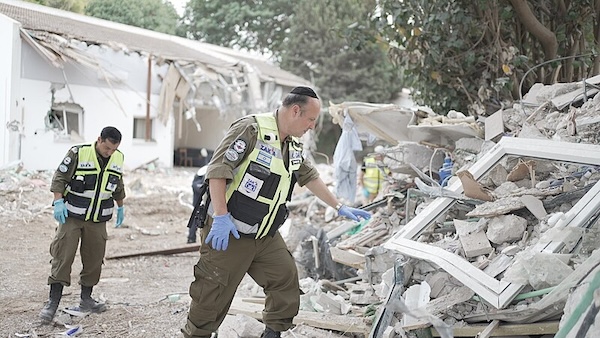
Kibbutz residents returning

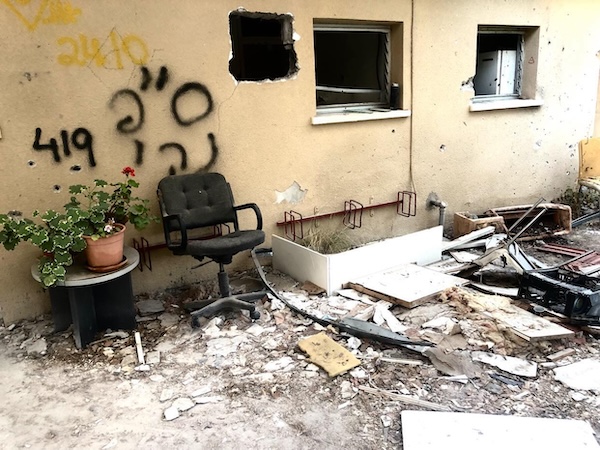
The medical centre at Kibbutz Be’eri, where at least five people were murdered Oct. 7, 2023. (photo by Melanie Preston)

I’m sitting in the dining hall at Kibbutz Be’eri, as people begin to enter for their Sunday lunch at 11:39 a.m. Sunday is like Monday here in Israel, the work week being Sunday through Thursday.

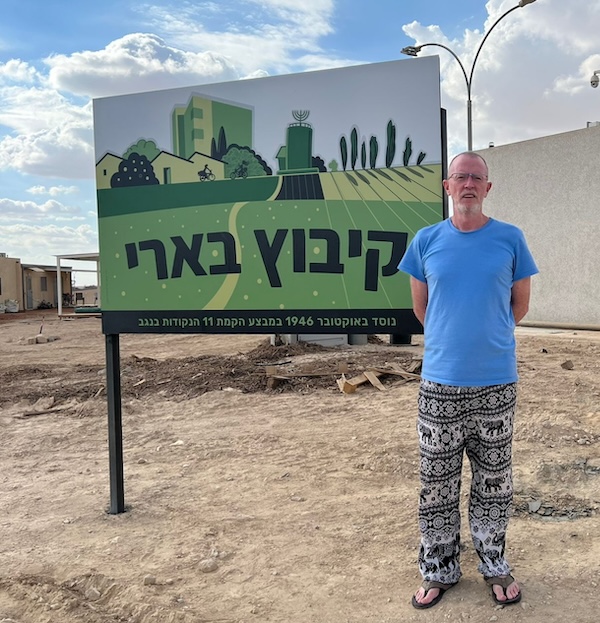
I’d never spent time on a kibbutz until now, except for a few days on my Birthright trip, which was my introduction to Israel. But now, I’m not only on a kibbutz, but on Kibbutz Be’eri, less than five kilometres away from Gaza, less than a year after the worst terror attack on Israeli soil.

On Oct. 12, 2023, in the Times of Israel article “Be’eri’s residents are gone, but their homes attest to the horrors they endured,” there was this incredible statement by Doron Spielman from the Israel Defence Forces’ Spokesperson’s Unit: “In the same way that Auschwitz is the symbol of the Holocaust, Be’eri is going to become the symbol of the [Oct. 7] massacre. The level of inhumanity of Hamas fighters surprised even us, Israelis who had no illusions about what Hamas is.”

And, yet, here I am, bearing witness as approximately 200 kibbutz members of the 1,100 total, have returned to live here. This does not include any children, due to the war next door in Gaza, and, of course, the traumatic memories of Oct. 7. 

The majority of Be’eri’s residents have just been moved from the Dead Sea-area hotels that housed them for the past year to Kibbutz Hatzerim, 45 minutes away from Be’eri, a wonderful community who rushed to build a new section of homes to accommodate them. This is where the families with children are now settling in and where school has just begun.

But there are many residents, couples with grown children, or singles without children, who have chosen to return to Be’eri. At first, they only commuted here to work during the week, but they are now choosing to stay full-time. They are determined to be back at home, to establish new routines, care for the grounds, hang out at the local pub and prove to the world and to the enemies who tried to destroy them and their spirit that they have done anything but that. The spirit in Be’eri is hurting, yes, but it is also fierce, and it will not be extinguished.

Last week, Israel’s Channel 12 aired a new documentary showing the horror that took place here on Black Saturday. It included footage from cameras all over the kibbutz, and the camera they kept returning to was right outside the dining hall in which I am writing right now.

How different it was to watch this documentary, how odd to watch the silent camera footage, how chilling, when I knew the reality on Oct. 7 was sirens blaring the entire day, due to thousands of rockets overhead, and screams from those being attacked all over Be’eri, in neighbouring communities and all over the nearby desert and forests, as young adults ran to try and escape the Nova music festival, many meeting a violent death.

I watched the tick, tick, tick of the digital clock in the corner of the TV screen on this documentary as Hamas terrorists methodically made their way through offices and the kibbutz’s medical centre, where at least five workers were massacred, and homes and children’s rooms, trapping people together and smoking and burning people to death, shooting them if they attempted escape, like Narkis Hand was forced to do when an RPG hit her home, setting it instantly on fire.

Narkis Hand was Thomas Hand’s former wife and the mother of his older children, Natali and Aiden. Thomas Hand’s younger daughter, Emily, then age 8, was kidnapped by Hamas terrorists with her friend Hila and Hila’s mother Raaya for 50 days, though he was originally told she had been killed.

The first and only time I had been to Be’eri before now was last February, when I visited with a different resident, Adam Rapoport, whose older brother Yonatan was murdered at some point between “6:29 a.m. and the end of day,” noted the documentary, as the silent clock in the upper left-hand corner went tick, tick, tick on Oct. 7.

photo - Adam Rapoport by the Dead Sea
Adam Rapoport by the Dead Sea. (photo by Melanie Preston)

Like many others from these communities, Adam will never know exactly what happened to his brother that day, other than that he saved his kids’ lives by ordering them under the bed, where they would spend 11 hours listening to the horrors taking place in the peaceful community they’d grown up in. Six-year-old Aluma and 9-year-old Yosef would later tell their uncles that Dad had said he was going out to get the terrorists money at the ATM.

“There were just too many … bodies … to learn what happened, and that was just at Be’eri,” Adam told me back in February, at the Dead Sea hotel where he and other evacuees were staying, the day before he brought me here to bear witness.

This was an invasion into homes that lasted an entire day and involved such gore that I hesitate to go into detail.

It involved shooting a 3-month-old baby in the head, in front of her mother, in Kibbutz Be’eri, and burning an entire family alive from neighbouring Kibbutz Nir Oz, including all three young children.

It involved murdering parents in front of their children and then kidnapping the children – and these sons and daughters have still not returned home. Some are confirmed dead in Gaza and are bodies waiting to be brought back, like Adam’s best friend Itay Svirsky, which was how I initially met Adam and began learning about this community, while others are likely still alive in captivity, starving and suffering in ways human beings should not be permitted to suffer. But the Red Cross has done nothing for the hostages since the very beginning. 

In Israel, we have waited, prayed, hoped and fought. We have gone to weekly rallies in Tel Aviv and Kiryat Gat, saying the hostages’ names and counting the days, chanting “Achshav, achshav, achshav.” (“Now, now, now.”) 

We have had to silence our phones, as constant notifications appear, notifying us of the nonstop rockets entering our airspace and our cities from Hezbollah in Lebanon, the Houthis in Yemen and other groups in Iraq and Syria, while ongoing predictions about whether Iran will or won’t do something big (and when they will or won’t do it) are discussed and analyzed.

But, since arriving on Kibbutz Be’eri last month, I have felt a shift.

It’s a unique kind of optimism I have never quite seen. It’s pride and it’s love and it’s strength and it’s resolve and it’s “F—- you, we’re not leaving.” It’s coming from returning Kibbutz Be’eri members, it’s coming from people like myself who have come to Be’eri since Oct. 7 to help with the land and to work, to add to the life being rebuilt here and to help heal the collective broken heart of this community.

I fell in love with Israel because I fell in love with its people. I am here in Israel to tell the stories of what happened on Oct. 7, 2023, and is still happening, at every moment of every day for these incredible people, these people of Kibbutz Be’eri and elsewhere, who have come back to their lives and are attempting “normality” on their beautiful land. 

Melanie Preston is a Canadian-born, American-raised, Jewish writer and traveler who discovered Israel at the age of 26, immigrated to the country and stayed for seven years. She flew to Israel alone on Nov. 16, 2023, from her home in Charlotte, NC, and was there to March of this year. She returned to Israel last month to continue writing about the hostages and impacts of October 7th on Israeli society. She intends to spend more time with the survivors of Kibbutz Be’eri as it is rebuilt. To support her work and read more of it, go to melanie-preston.com, or visit her GoFundMe (Raising Awareness on Israel’s War).

Volunteers help rebuild Israel

Vancouverite Gail Mattuck volunteering in Israel after Oct. 7. She found her placements with the help of the Sword of Iron – Israel Volunteer Opportunities Facebook group. (photo from Gail Mattuck)

They’re coming from around the world, taking a leave from their jobs to help rebuild Israel with their own hands. These are volunteers who have filled the labour gaps in the aftermath of Oct. 7, visiting farms or soldiers or hostage families; attending shivas, packing food for reservists and more.

Vancouverite Gail Mattuck is one of tens of thousands of people who have volunteered. But, if it weren’t for the Sword of Iron – Israel Volunteer Opportunities Facebook group that guided her to where she could help, she likely would not have lent a hand. 

Led by Hagit Greenberg Amar and Yocheved Kim Ruttenberg in Israel, the group provides a running list to its 35,000 followers of where people can volunteer.

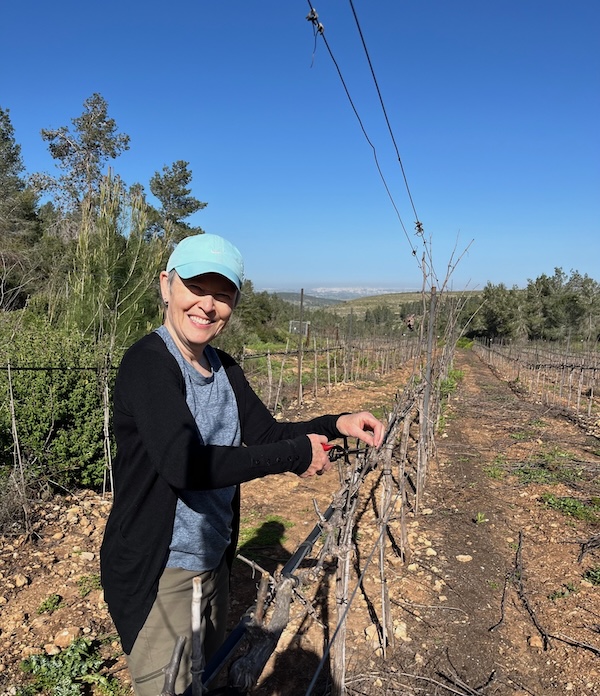
Mattuck chose a Chabad centre that assisted with food security, packing food for evacuees and making sandwiches for children of reservists. She also volunteered at Castel Winery, in the Jerusalem hills, to cut wires for the grape vines to grow on. 

“For my friends in Israel, they were really happy to see me, of course, but they appreciated I was there to be there during that time. Lots of people just thanked me for being there. Without that Facebook group, I couldn’t have done it,” said Mattuck.

“One of my friends lives up north,” she said. “There are missiles coming over there all the time. Her sons were in Gaza fighting. It’s very personal for them. For me to be there, they appreciated it. My sense was of a country that was incredibly hurt but not broken.” 

Mattuck has a close connection to one of the people killed at the Nova music festival, and made her trip in his memory.

Born and raised in Baltimore, Ruttenberg attended university in South Florida, then moved to Dallas, where she worked in construction sales. She and her brother had plans to go into real estate together after he completed his Israel Defence Forces service. He was scheduled to be released on Nov. 12, 2023.

Her brother was stationed in the south on Oct. 7, and she woke up to a text message alerting her to the attack, and his arrival in battle a few hours later. It was then and there, she felt the need to help. She intended to stay in Israel for a couple of weeks.

“I couldn’t not be here during that time,” she said. Within three days, she was on a plane, carrying 23 duffle bags of donations for soldiers, worth $17,000. Three days before her return flight, she quit her job. “I can’t go home. I need to be here,” she told her boss. 

“When the war started here in Israel, we didn’t know what to do,” said Amar. “So, we started to think about what we already know how to do. We started to import. We started with battery power banks, then medical equipment, things the Marines used in emergencies. A lot of special units came to our place. Then, we met [Ruttenberg’s] brother.”

It was Ruttenberg’s brother who introduced Amar to Ruttenberg.

In the beginning, Ruttenberg corralled volunteer information from various WhatsApp groups, Google Translated them and posted them. In late November 2023, the Facebook group formally launched.

Yael Yom Tov Emmanuel joined the page on day one, and matched thousands of volunteers to different opportunities. Since then, two other team members have joined – Ariel Boverman and Sarah Emerson Halford. They have since created a Google Docs document for members, so that prospective volunteers can search by area and specialty. 

The initiatives have impacted numerous lives by coordinating farm volunteers, aiding soldiers, assisting at food banks, and participating in reconstruction efforts in the south. The group has emerged as an essential resource for both residents and visitors, linking individuals with opportunities to make a difference.

“It blows me away to see how many people have done something outside their comfort zone in such a big way. People come to Israel for the first time in their lives, alone, in the middle of a war,” said Ruttenberg.

Group members are vetted carefully, something Amar says is one of the challenges in dealing with a hundred requests per hour. They have had to turf some infiltrators.

“It’s a 24/7 operation because we have people all over the world,” said Ruttenberg. “We all have our different roles. Some are more on the Facebook page interacting. A lot of my time is going into the field and meeting volunteers and interacting. But it’s a full-time job – beyond a full-time job.” No one is financially compensated for their time.

When Ruttenberg is not dedicating her time to the volunteers, she works part-time in marketing and sales consulting. She recently finished a US speaking tour and said that, while in Texas, half the room were Christians, they wept at her stories and couldn’t wait to get involved.

“People are sitting at home and feel helpless,” she said. “When your country is at war, when there’s antisemitism through the roof and you are not in the military and are not medically trained, you feel like there is no way to give back. It makes me incredibly proud to see, and incredibly proud to meet, the volunteers who are helping rebuild Israel with their bare hands.”

Amar, who lives in Ramat Gan with her three children, was previously chief executive officer of a brand and strategy company. She is now pursuing a second degree, in social work, at Haifa University, with an aim to offer therapy and mental health services.

“I think this group created a place where you could feel safe and be part of a community. There are real friendships in real life that occurred from the group. If somebody needs something, we always find someone to be with and support them,” Amar said.

“I think part of what we are doing is creating ambassadors, and changing the narrative about how people see Israel, showing Israel as a beautiful place,” added Ruttenberg. “Everyone who comes here meets soldiers and other people who are grateful. Israelis see people come from LA, just to pick tomatoes – we really appreciate that.” 

Dave Gordon is a Toronto-based freelance writer whose work has appeared in more than 100 publications around the world. His website is davegordonwrites.com.

Living amid continuing war

Band-aids – check. Bottled water – check. Tinned foods – wait. No sooner do I buy canned tuna, pickles, corn and peas and they’re eaten. Need to refresh that one. Flashlight – check. Portable radio – check. Now, this is a cool one. While not available in the groovy colours of the 1970s – bought it in a staid brown – the small, palm-sized handheld radio conjures up fond memories of those catchy songs from Billboard’s Top 10. Although the reason for the checklist is anything but fanciful. With the Islamic Republic of Iran and Lebanon’s Hezbollah threatening a major reprisal attack.

In the Star Trek movie Wrath of Khan, the Klingons said “revenge is a dish best served cold.” I can certainly attest to that. As can my more than 9.5 million fellow Israelis. It feels like an eternity since the ayatollahs promised mighty revenge for Israel’s assassination of Hezbollah’s military chief, Fuad Shukr, and Hamas’s military chief, Mohammed Deif, and the alleged Israeli assassination of Hamas’s politburo chief, Ismail Haniyeh. When Iran’s authoritarian regime said at a place and time of their choosing, they weren’t kidding. We are still waiting…. Actually, I think the Klingons were probably quoting Pierre Ambroise François Choderlos de Laclos, the 18th-century French novelist and army general who is credited with first analogizing revenge as a cold dish.

Speaking of proverbs, I think its origin is Chinese, some claim Yiddish. Regardless, whoever said “may you live in interesting times” was certainly cursing someone. Give me boring. Give me dull. Give me mundane. Give me monotonous. Give me colourless and bland. You can keep the gripping. The riveting. The fascinating. The stimulating. I just want to wake up to another simple day.

This waiting game is immensely stressful. It has the whole world on edge, with an alliance being built between Israel, the United States, Britain, France and Italy to thwart a second potential direct attack on my little shtetl. The first attack – of some 300 drones – was launched against Israel in April. We went to bed facing potential Armageddon and, thankfully, woke up able to just go to work, as Israel, with the help of its allies, knocked each drone out of sky before they reached Tel Aviv and Haifa.

Speaking of work, I am a self-confessed workaholic. And I find myself working even more during this very stressful period, where I fear my fate is out of my control. Will Iran attack? Where? And when? And how? No idea. No authority. No power. Simply unable to influence, in any way. Whereas work, which I am pretty good at, gives me all those things. I am largely in control, able to influence within my environment. Work gives me a calming sense and, if nothing else, allows me to escape into my purchasing processes and contracts. This is my own industrial and organizational psychotherapy. As good an excuse as any for my wife, when she again finds me tapping away at my keyboard at all hours or in another early morning or late evening Teams meeting.

As for preparations, I find myself obsessed with buying bottled water, toilet paper and Ajax. The first couple of items, you probably understand. But floor cleaner? I think it’s the Jewish mother in me. I don’t want to leave behind a dirty home. Kind of like Golda from Fiddler on the Roof, who insisted on sweeping their little Anatevka farmhouse before leaving. Although – and I say this loud and clear – we ain’t  going nowhere!

Another quirk in dealing with the stress is that I love the music from the hippie generation. For the longest time after that dreadful Oct. 7, I wouldn’t – couldn’t – listen to music. I felt a very deep sadness. Maybe a type of mourning. But now, over the last few days, I find myself blaring my tunes. One of the first songs to pop up in my feed just after Iran’s rulers made their threat of retribution was “Bad Moon Rising” by Creedence Clearwater Revival. How foreboding can you get? “I hear hurricanes a blowin’. I know the end is comin’ soon.… I hear the voice of rage and ruin. Don’t go around tonight. Well, it’s bound to take your life. There’s a bad moon on the rise, alright.”

And, I find myself listening again and again – at pretty high volume – to the dark and wonderful song by our own Edan Golan, “October Rain,” otherwise known to the world as “Hurricane”: “Every day, I’m losing my mind…. Dancing in this storm, I’ve got nothing left to hide….  Baby, promise me you’ll hold me again.… I’m still broken from this hurricane….” And then, with hope: “Don’t have words. Just prayers. Even if it’s hard to see, you always leave me one small light.”

On another music note, I find myself chanting, to no one in particular, that snappy little line “From the river to the sea, Palestine will be free.” Now, why can’t we come up with something as catchy? With an impressive gene pool of great Jewish songwriters: George Gershwin, Irving Berlin, Burt Bacharach, Carole King, Neil Diamond, Leonard Cohen, Bob Dylan, Paul Simon, Amy Winehouse, Gene Simmons. Come on! And still, gornisht, nothing. No wonder we’re losing the global PR battle.

Please continue donating to the war and revival efforts. You may have given earlier, when hostilities first erupted and the Gaza war was headline news. Almost 10 months later, war continues – on several fronts. Sderot and Metula – and maybe Tel Aviv and Haifa – are Israel’s front line and Israel is the diaspora’s front line. Am Yisrael chai (yeah, that’s the extent of our solidarity anthem). Bring them home now! 

Bruce Brown, a Canadian-Israeli, made aliyah more than 25 years ago. He works in high-tech and is happily married, with two kids. He is the winner of a 2019 American Jewish Press Association Simon Rockower Award for excellence in Jewish writing.

Photos depict Oct. 7 trauma

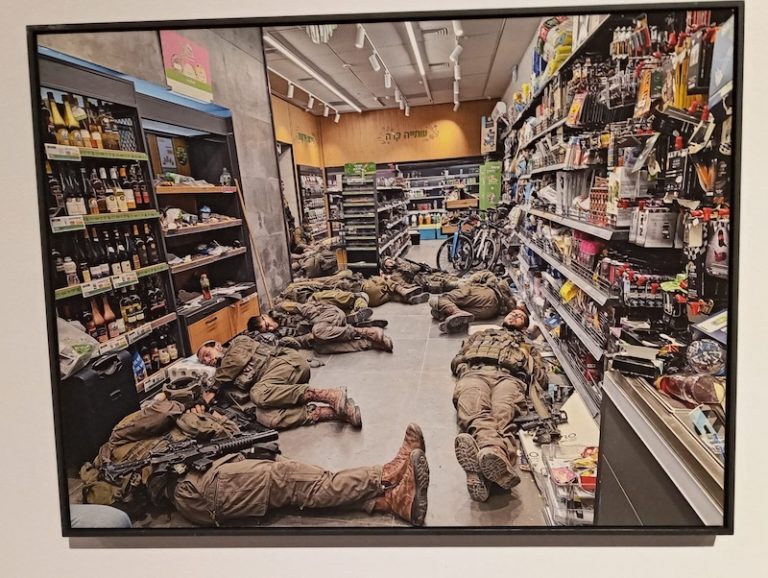
Batia Holini’s photo of Israeli soldiers sleeping on the floor of a grocery store near Kfar Aza on Oct. 8 is one of the works in the exhibit Album Darom. (photo by Gil Zohar)

Album Darom: Israeli Photographers in Tribute to the People of the Western Negev, which opened recently for a six-month temporary installation at the Petach Tikva Museum of Art, is the first group artistic endeavour in Israel to confront the tragedy of Hamas’s Oct. 7, 2023, massacre and the subsequent Gaza War, now in its 10th month. The ambitious tripartite installation Album Darom (Hebrew for Southern Album) incorporates a Facebook diary; a printed book of photographs accompanied by essays (published by Yedioth Ahronoth); and the museum exhibit.

Initiated by Prof. Dana Arieli, dean of the faculty of design at the Holon Institute of Technology, together with chief curator Irena Gordon, the project showcases 150 photographs, art installations and texts documenting the story of the western Negev region before and after Oct. 7. The exhibit includes the perspectives of 107 photographers and artists. Some of the participants in the album are world-renowned, others are amateurs. Lavi Lipshitz, the youngest featured photographer, lost his life fighting in Gaza. His mother penned the text accompanying his images.

The works in the album represent different photographic practices: artistic, personal and some staged, the intense images are upsetting. As well they should be in confronting mass murder.

Before walking around a corner to see Lali Fruhelig’s gruesome 3-D installation suggesting a corpse sprawled on the floor of a living room, a sign cautions: “The exhibition contains some potentially disturbing contents. Viewer discretion is advised.”

Arieli, a history professor and a photographer who explores remembrance culture and cultural manifestations of trauma, began the Album Darom project shortly after the Gaza war broke out.

“When something’s traumatic, you have to work or do something,” she said. 

Shocked by the murder of her friend Gideon Pauker from Kibbutz Nir Oz – who was killed just before his 80th birthday – she posted 100 daily historic and contemporary images of the Western Negev.

Initially, Arieli intended Album Darom to be exhibited at Kibbutz Yad Mordechai Museum just north of the Gaza Strip frontier. After the museum was damaged by rocket fire, this wasn’t feasible. Instead, she selected Petach Tikvah as the venue. She explained that the site – the first Yad Labanim memorial to fallen Israel Defence Forces soldiers from the War of Independence – is meant to be relevant to all Israelis. The museum offers free admission on Saturday, so observant Jews may visit on Shabbat.

Speaking to a group of journalists, Arieli compared Oct. 7 to the Nov. 4, 1995, assassination of then-prime minister Yitzhak Rabin. “Everyone is frozen in their memory of where they were,” she said.

Arieli and Gordon emphasized the intended cathartic nature of the exhibit. The two said the museum is a “safe space” and a “place for healing.” After experiencing the horrors of Oct. 7, Gordon found solace in this project, she added. “This is part of how we are coping with it all,” she said.

Miki Kratsman is one of the photographers whose depiction of his Oct. 7 nightmare is in the exhibit. Terrorists took his aunt Ophelia hostage from her home in Kibbutz Nir Oz. She was later released from Gaza in the November hostage exchange deal. 

Kratsman’s photograph, “In Aunt Ophelia’s Neighbourhood,” captures a modest kibbutz home collapsing as it is immolated in a fireball. 

“These are the kinds of things that need to be in a museum,” Arieli said of the photograph. “You’re looking at the destruction of Nir Oz.”

While vividly showing the devastation of the kibbutz, the burning home photograph is an enigma, and creates dialogue, she added.

But it is the human toll rather than the destroyed real estate that is most painful. Paradoxically, perhaps, Batia Holini’s peaceful photo of exhausted IDF soldiers sleeping on the floor of a grocery store near Kfar Aza on Oct. 8 hints at the savage warfare in which they have been engaged.

photo - “Funeral of Five Members of the Kutz Family who were Murdered in Kfar Aza,” a photo by Avishag Shaar-Yashuv
“Funeral of Five Members of the Kutz Family who were Murdered in Kfar Aza,” a photo by Avishag Shaar-Yashuv. (photo by Gil Zohar)

Avishag Shaar-Yashuv’s photograph, “Funeral of Five Members of the Kutz Family who were Murdered in Kfar Aza,” captures the searing emotion of the funeral of a family annihilated in the Hamas attack.

“I tried to focus and also wipe the tears at the same time,” Shaar-Yashuv said.

For this reviewer, the most symbolic part of the exhibit was a taxidermy display of a doe entitled “Bambi.” The exhibit references Felix Salten’s 1923 novel Bambi: A Life in the Woods and the 1942 animated movie produced by Walt Disney. Metaphorically, the hapless baby deer represents both the Six Million victims of the Holocaust and the 1,200 people murdered on Oct. 7.

Viewing Album Darom, one could conclude that the myth of the state of Israel protecting its citizens has been shattered. Arguably, Israelis today are no more secure than their ancestors were facing the Kishinev Pogrom of 1903, the Hebron Massacre of 1929 or the Farhud in Baghdad in 1941. 

Gil Zohar is a writer and tour guide in Jerusalem.

Enjoy a glass of Israeli wine – the award-winning industry has struggled since Oct. 7 attacks

According to historian and former ambassador Michael Oren, on Oct. 8, 2023, one day after the terror group Hamas’s brutal assault on southern Israel, the following things happened: 80% of Israelis volunteered to help in any way they could, 360,000 Israelis reported for military duty and thousands of Israelis who were not in Israel on Oct. 7 returned to defend their country. 

This remarkable resilience and dedication have also been apparent in Israel’s wine industry. Workers from wineries that could finish their 2023 harvests went to other wineries to help with harvesting and winemaking. A poignant example is the support for Kibbutz Nir Oz’s winery. When Kibbutz Nir Oz was attacked, Hamas murdered the winemaker, Gideon Fauker, z’l, and took his two partners captive to Gaza, where they remain today. In a recent Israel21c article, Andrea Samuels recounts how people in Israel’s wine industry came together to turn Nir Oz Winery grapes into wine and save the vintage, to honour their Nir Oz colleagues.

Jews have been making wine in the land of Israel for more than 3,000 years, a fact confirmed by archeological evidence. King David had vast vineyards and kept large stores of wine, and wine was a major export and economic mainstay for Jews during the time of the Second Temple in Jerusalem. Even when outsiders invaded the land and mandated pulling out the vines many centuries later, a limited number of vines remained to produce wine for sacramental purposes. Viticulture was reintroduced in the late 19th century and, by the end of the 20th century, Israel was garnering international recognition for the quality of its wines. Today, there are more than 300 wineries of all sizes in Israel, and a well-established wine culture.

Since the massacres and kidnappings by Hamas on Oct. 7, the wineries have faced tremendous obstacles due to the ensuing war with Hamas in Gaza and daily rocket and missile attacks on northern Israeli land and communities by the terror group Hezbollah. There are labour shortages, as Israelis are repeatedly called up for reserve duty and many foreign workers have left the country. In the north, some employees who have been evacuated because of the Hezbollah attacks can’t get to the wineries. Any work at the wineries and vineyards in this prized Galilee viticulture region remains a dangerous proposition and there is concern for the 2024 vintage. Vineyards in the north and south have been damaged by rockets and some in the north are inaccessible in closed military zones. Domestic wine sales, on which the wineries heavily rely, plummeted after Oct. 7 and, although they have recovered somewhat, a tourism decline and restaurant and bar closures have exacerbated the sales slump. And, of course, there is the human cost as the wars and threats continue and as many in Israel’s wine industry have lost family, friends and co-workers.

Despite these challenges, the people of Israel’s wine industry have shown classic Israeli resilience, determination, collaboration and commitment to the country and to one another. Samuels’s article noted that, since Oct. 7, Alex Haruni and his Dalton Winery team have been making Shabbat dinners for soldiers posted at the nearby Lebanon border. And, in his article “A taste of total victory,” Adam Montefiore, a 38-year veteran of Israel’s wine industry, wrote about Tom Carbone and his Be’eri Winery.

Carbone and his friend Dror Or, z’l, the Be’eri Dairy cheesemaker who was murdered by Hamas when they attacked the kibbutz, had a dream of collaborating to make Kibbutz Be’eri a food and wine tourism destination. Carbone is working to fulfil that dream for both of them, commuting to Be’eri from the hotel he and his family now live in at the Dead Sea. So far, he has produced an outstanding Be’eri Chardonnay and is continuing his friend’s work at the dairy. 

We in Canada can support Israel in many ways, including by buying and enjoying the beautiful wines of her irrepressible wineries. Israeli wines available in British Columbia are highlighted below with tasting notes.

GALIL MOUNTAIN WINERY

Established in 2000 as a joint venture between Golan Heights Winery and Kibbutz Yiron, Galil Mountain Winery (galilmountain.co.il) has five vineyards in the Upper Galilee mountains, with topographical and climatic conditions well-suited to growing grapes of the highest quality for wine production. 

Galil Mountain Cabernet Sauvignon 2022: A young, refreshing character with accentuated fruity aromas. No barrel aging. The wine was stored in stainless steel tanks after fermentation to preserve its fruity character.

Varietal: Cabernet Sauvignon

Colour: deep opaque purple

Aroma: pure ripe raspberry and blueberry primary fruit character, with hints of herbs and tobacco leaf

Taste: a medium-to-full bodied wine with delicate tannins; the finish is long and firm

Food: best served at 64°F (18°C) to accompany a wide range of meat dishes

image - Galil Mountain Rose 2021 bottleGalil Mountain Rosé 2021: A dry, light rosé with refreshing acidity. A combination of two winemaking techniques – skin contact followed by cold fermentation.

Varietal: a blend of Sangiovese, Barbera, Pinot Noir

Colour: bright pink 

Aroma: scents of strawberry, pomegranate and ripe nectarine with notes of blooming wildflowers

Taste: presents characters of flowers, strawberry and pomegranate; a joyful wine with invigorating and well-balanced acidity

Food: try with a fresh summer salad, with sushi or as an aperitif on its own

Galil Mountain Alon White 2020: The grapes are carefully selected at harvest, pressed gently, and half of the blend is fermented and aged in French oak barrels for three months.

Varietal: blend of Chardonnay, Viognier

Colour: pale lemon

Aroma: citrus blossom, alongside hints of fresh mint

Taste: ripe citrus, stone fruit and a hint of herbs on the palate, with refreshing acidity, light body and a lingering finish

Food: pairs beautifully with grilled fish and fresh salads

GOLAN HEIGHTS WINERY

Golan Heights Winery (golanwines.co.il) gained international recognition after releasing its first wines in 1984 and led a winemaking revolution that put Israel on the world wine map. The Golan Heights, a volcanic plateau with rich basaltic soil, is the coldest region of the Galilee appellation and considered the best for viniculture.

image - Mount Hermon Indigo 2022 bottleMount Hermon Indigo 2022: Made from classic varietals, a young medium-bodied wine full of flavour.

Varietal: blend of Cabernet Sauvignon, Syrah

Colour: deep indigo-purple

Aroma: black currant, tobacco and smoke

Taste: medium bodied with notes of raspberry and black cherry, characters of aniseed and cocoa, and hints of flowers and earth

Food: beef brisket, grilled lamb shanks or a barbecued beef burger

TEPERBERG 1870 WINERY

Teperberg 1870 Winery (teperberg1870.co.il) is located in the foothills of the Jerusalem Mountains with vineyards in several growing regions. It is one of the oldest wineries in Israel, founded in Jerusalem in 1870 and, for a time, known as Efrat Winery. Efrat remains a label of Teperberg 1870. The Teperberg and Efrat wines listed are mevushal, wine that has been flash pasteurized. 

image - Teperberg Malbec Vision 2021 bottleTeperberg Malbec Vision 2021: The Malbec Vision undergoes stainless steel fermentation and is aged in French and American oak for five months prior to release.

Varietal: Malbec

Colour: deep red with purple hints

Aroma: black fruits and spices

Taste: a deep and layered wine that combines a wealth of fruit with vibrant acidity

Food: beef dishes, charcuterie, beet salads

Teperberg Efrat White Blend 2022: Fermentation in insulated chilled stainless steel tanks for two weeks before the final blend is composed. To retain its crispness, the wine does not undergo malolactic fermentation.

Varietal: blend of Riesling, Semillon, French Colombard

Colour: light, pleasant yellowish

Aroma: mainly citrus aromas

Taste: fresh, balanced with pleasant acidity and medium body

Food: fried or grilled fish

Efrat Judean Hills Cabernet Sauvignon Argaman 2022: Fermentation in insulated chilled stainless steel tanks.

Varietal: blend of Cabernet Sauvignon, Argaman, Carignan

Colour: purple

Aroma: fruity aromas with black and red fruit

Taste: balanced, rich, medium-bodied with a long finish

Food: lamb dishes or pasta in meat sauce

Visit bcliquorstores.com to find a store near you with Israeli wine. L’chaim! 

Rochelle Golumbia is an advocate of supporting Israel through Israeli wine and initiated Vancouver’s first Israeli wine festivals.

An emotional remembrance

Members of ZAKA identification, extraction and rescue team search through the destruction in a Gaza Envelope community following the Oct. 7 attacks. (photo from ZAKA)

The annual Yom Hazikaron ceremony, marking Israel’s day of remembrance for fallen soldiers and victims of terrorism, took place May 12 at Temple Sholom. It was an unprecedentedly poignant ceremony, with hundreds of in-person attendees and hundreds more attending virtually, many of whom lost loved ones on Oct. 7 and in the war that began that day.

Dikla and Etsik Mizrachi, parents of Ben Mizrachi, the young Vancouver man murdered while heroically providing medical aid to others at the Nova music festival, both spoke.

“This Yom Hazikaron is different,” said Dikla Mizrachi. “This Yom Hazikaron, I can’t think of the many lives that we’ve lost. My heart can’t take the burden. The weight of my grief is too heavy to bear. This Yom Hazikaron, I can only think of one special boy, a boy who had big dreams, life ambitions.” 

Ben grew up in Vancouver, she said, attended Vancouver Hebrew Academy and then King David High School. 

“Ben was so proud of who he was,” his mother told the packed synagogue. “He was proud to be a Jew, he was proud to be Israeli. He had his mind set that, after high school, he would go to Israel and learn in a pre-army Mechina program to prepare him for the IDF. He couldn’t imagine himself doing anything else. And he didn’t. He did it all.” 

Ben Mizrachi served three years in the parachute unit and completed a paramedic course.   

“On Oct. 7, at the young age of 22, Ben was brutally taken from this world at the Nova festival in Re’im,” his mother said. “But he was not taken without a fight. His personality and moral core would not allow it. He did not run away to save himself when he had the chance. He showed tremendous courage and bravery as he tried to save others. 

“We do not know everything about the last hours of Ben’s life. But we have been able to piece together some of them. What we know is that, from 6:30 a.m. to 8:10 a.m., Ben was under attack. We know that he and Itai Bausi, a friend from his kibbutz who went with him to Nova, made a choice to leave the safety of their car and their chance to flee. We know they made this choice in order to render aid to the injured,” she said. 

Two brothers who survived the music festival attack have shared the story of how Ben used his medical skills to attend to the injuries of a young woman and then, with three other young men, transported her on a stretcher to the medical tent, holding her at hip level to avoid snipers. 

“We know after they deposited the woman the boys then separated to run in different directions to escape their attackers,” said Dikla Mizrachi. “We know from the last voicemail message Itai’s girlfriend received from him that he was shot in his back and his leg. We know from both the phones that Itai called Ben multiple times but there was no response and we know that Ben died a hero, as did Itai.

“This past Oct. 7, our life as a family and our life as a Jewish nation changed forever,” she said. “Our collective hearts are completely shattered. Today, we are all in mourning. We all have soldiers in Gaza. We all have 132 hostages in Gaza. We all have evacuees from the north scattered all over the country. We are all suffering together.” 

She told the audience that, at her son’s shiva, an army friend of Ben’s told her that he had lost a cousin in 2021, in Operation Guardian of the Walls. 

“That year, on Yom Hazikaron, Ben had called him and said, ‘I know it’s your first Yom Hazikaron, so if you need or want to talk to someone, I’m here for you,’” she recounted. “This was Ben, thinking about others at every moment and being so sensitive.”

Addressing her late son, she said: “Ben, this is my first Yom Hazikaron and I need you. 

“I need you to help our family choose life each day and give us strength. I know that you are still with us, but can you please send us a sign very soon, a sign that you are OK and in a good and peaceful place? Ben, we will do our best to live our lives according to your values, to be there for others, as you always were, and to cherish the things you loved. We love you. We think about you and we miss you every day a bit more.”

Later in the evening, Ben’s father, Etsik, said Kaddish for his son.

Geoffrey Druker, who has led the annual event for years, noted that this year was different.

“We have within our community families who lost loved ones in the past seven months, lost a son, a father, a brother, a sister, cousins, extended family, and friends,” he said. “Tonight, with our bereaved families here and worldwide, we remember our fallen in the establishment and the defence of the state of Israel, and all who have been murdered in terrorist attacks. We remember them all.”

Members of the BC Jewish community lit candles and spoke about those they have lost. A montage of photographs remembered friends and family of locals, from 1948 to recent months. Druker shared individual stories, a microcosm of the many stories of tragedy and heroism from Oct. 7 and the months since.

He told of the five members of the Kutz family of Kfar Aza – father Aviv, 54, mother Livnat, 49, and sons Rotem, 19, Yonatan, 17, and Yiftach, 15 – who were found hugging each other on a bed, father Aviv trying to provide a protective embrace.

In all, 64 members of Kfar Aza were murdered, and 13 soldiers killed in the battles on Kfar Aza. Among these residents was Mordechai Modi Amir. 

“Modi was a creative person, always thinking outside the box,” Druker said. “So, when they built his secure room, he decided to add a small shower room, a room within a room, with its own door. At 6:30 a.m. on Oct. 7 – when the red alert siren went off, Modi, his two daughters and granddaughter entered the safe room.

“When they heard shots close by, and voices speaking Arabic, he told his daughters and granddaughter to enter the tiny shower room and to remain quiet as he closed the door behind them. He then stood waiting in front of the shower room door,” Druker said. “He most likely thought, when the terrorists enter the safe room, they will see a man standing by the wall, they will shoot him, and move on. A member of Kfar Aza later said: ‘Modi was shot several times and fell to the floor. He most likely, in his last seconds alive, saw the terrorist leave, knowing he saved his family.’ And, indeed, 13 hours later, his three family members left the tiny shower room alive, and survived.”

photo - Destruction at Kibbutz Kfar Aza
Destruction at Kibbutz Kfar Aza. (photo from US Embassy Jerusalem)

Vancouverite Amnon Kones and his family lived on Kfar Aza for 20 years and knew many of those killed. He lit a candle of remembrance, as did Sam Heller, who lived there during his military service as a lone soldier.

Adi Vital-Kaploun, an Israeli-Canadian who lived on Kibbutz Holit, was a relative of Vancouver residents Jason Rivers and Helen Heacock Rivers.

“Her husband was away that weekend,” Druker explained. “When Adi realized terrorists had infiltrated her kibbutz, she phoned her husband and asked how to operate his weapon, to defend her children.

“By some miracle, Adi persuaded the terrorists to allow her two young boys, Negev, 3-and-a-half, and Eshel, 6 months old, to be kept by her neighbour, Avital. Adi was shot and murdered in her home, and her body booby-trapped by the terrorists,” said Druker. “The Hamas terrorists then marched Adi’s neighbour, Avital, who was carrying Negev and Eshel, towards Gaza. At the Gaza border, for some unknown reason, they were released, and they survived, though 3-and-a-half-year-old Negev had been shot in the foot.”

Noam Caplan and Kessem Keidar, members of Habonim Dror Camp Miriam, lost family members and a friend on Oct. 7. Caplan spoke of his cousin, Maya Puder, 25, who was murdered at the Nova festival. Keidar remembered her cousin’s uncle, Amit Vax (Wachs), who was murdered in Netiv HaAsara. 

“When he was killed, he was not aware that his brother Igal Vax was murdered earlier, while he too was fighting the terrorists on the other side of the moshav,” said Keidar.

The pair lit candles in memory of these victims, as well as Vivian Silver, another Canadian-Israeli, who lived on Kibbutz Be’eri.

It is estimated that about 120 people were murdered on Kibbutz Be’eri, among them Sylvia Ohayon. Dalia Ohayon lit a candle in memory of her sister.

Five members of the Bira family were murdered on the kibbutz: Oron Bira, 52, and his wife, Yasmin Laura Bira, 51, and their daughters Tahir, 22, and Tahel, 15, along with Oron’s elder brother, Tal, 62. Yahav, Oron and Yasmin’s son, was in another house, and is the sole survivor. 

Navah Jacobs, a member of the extended Bira family, lit a candle in their memory.

Vancouverite Hofit Sabi recalled her cousin, Yinon Tamir, a 20-year-old paratrooper killed in action in the Gaza Strip in November, having earlier served among the first responders at Kibbutz Be’eri.

“Before going into Gaza, a few weeks after the battle of Be’eri, another comrade told of how Yinon comforted and guided him through his fears and anxieties to go into Gaza,” said Sabi. “Yinon promised that he would stay by his side and protect him, and he did, until his death. Yinon’s courage and leadership qualities shone through.”

Tamir had told his mother that he saw things at Be’eri that he could never unsee and that he felt a profound sense of privilege to serve and protect the right “to live as free people in our homeland.”

Itzhak Ben Bassat, a colonel nicknamed Benba, had just returned from vacation abroad at the end of a storied military career when he received a message to head for Be’eri on Oct. 7. He fought there for two days, securing the kibbutz, and survived. He died in battle two months later, age 44. His sister, Hamutal Ben Bassat, lit a candle in memory of her brother.

Nicky Wasserman Fried, whose uncle Aaron Fried died in the 1948 War of Independence, lit a candle in his memory and told the audience of casualties in Vancouver’s partnership region in northern Israel.

“Three IDF soldiers from our region were killed fighting Hamas as they infiltrated our communities surrounding Gaza on Oct. 7,” Fried said. “Since Oct. 7, an additional seven soldiers and three civilians have been killed.”

Cantor Yaacov Orzech chanted El Moleh Rachamim. The Clore & Roll Ensemble, who were the featured entertainers at the next evening’s Yom Ha’atzmaut event, performed, as did singers Mayan Molland, Shir Barzel and the Meitar Choir. Shir Barzel played piano. 

The ceremony was presented by the Jewish Federation of Greater Vancouver, the Centre for Israel and Jewish Affairs, the Rabbinical Association of Vancouver and the Jewish Community Centre of Greater Vancouver. 

Kibbutz movement in crisis

A home in Kibbutz Erez. (photo by Larry Barzelai)

Spending a night in late March at Kibbutz Erez in southwestern Israel was an unforgettable experience. Visiting friends, it was somewhat eerie. Most residents have not returned since the Hamas terror attacks on Oct. 7, and the absence is profound. 

The area is like a Canadian suburb. A group of houses surrounds a large grassy area, which has children’s playgrounds and lemon, orange and kumquat trees. This type of living is a rarity in Israel, where most people live in apartment buildings.

While the environment was scenic and comfortable, explosions could be heard in the distance and puffs of smoke periodically arose from Gaza, the border of which is less than a kilometre away. The Israel Defence Forces were entrenched nearby.

Kibbutz Erez fared better on Oct. 7 than many other kibbutzim and towns in the region because they received advanced warning from a neighbouring kibbutz that an attack was underway. Their neighbours had seen hang gliders from Gaza soaring overhead.

The security team of Kibbutz Erez quickly assembled to try to prevent the invaders from entering the kibbutz through the main gate. First, they called the IDF to make sure that the army wasn’t conducting an exercise. Receiving confirmation that it was a terrorist attack, the kibbutzniks asked how long it would take for the army to come – they were told they were on their own. 

A firefight involving rifles, grenades and RPGs ensued. According to one of the kibbutzniks, “we fought like lions.” This was no ordinary military engagement, but a battle to protect their children and other family members from the Hamas terrorists. If they failed, they knew that Hamas would hurt their children.

Amir, one of the kibbutzniks, whose wife was expecting their first baby, was killed in the encounter. Danny received a bullet to the neck and Uri suffered wounds to his head and leg.

Liora, a nurse described as having nerves of steel, recognized that neither Danny nor Uri would survive without immediate medical attention. Both were bleeding profusely, and their level of consciousness was decreasing. With the help of a friend, she packed them into a car, drove out of the kibbutz amid a hail of bullets and got them to a nearby hospital, where they received lifesaving treatment. Both survived in relatively good physical shape.

After a fight of close to two hours, the terrorists decided that Kibbutz Erez was too difficult to overcome, and moved on to wreak havoc on the next village. The IDF did not arrive until later that day.

The whole kibbutz was evacuated to Mitzpe Ramon. Many of the families moved into hotel rooms there. After several weeks, makeshift schools were established and members of the kibbutz achieved some measure of normality, as much as it can be normal living in a hotel, totally dependent on caring neighbours, a supportive community and government help. Since then, some of the kibbutzniks have relocated to Kiryat Gat, which is much closer to their home. Some, including my friend, have returned home. 

What is the future of Kibbutz Erez? People are slowly trickling back. The telling test will be in the summer, if families return in preparation for the start of the school year in September. 

Kibbutz Hatzerim and Kibbutz Be’eri

Earlier in March, we visited extended family who live on Kibbutz Hatzerim, and heard about their experiences on Oct. 7.

People on Kibbutz Hatzerim awoke that day to sirens and multiple WhatsApp messages from friends and relatives, letting them know that Israel was under attack by Hamas terrorists, who were infiltrating the settlements close to the border. Were the attackers coming to Kibbutz Hatzerim, 20 kilometres west of Beer Sheva? Rumours circulated that they were on their way to Tel Aviv. People were reluctant to turn on their TVs, to protect their children from seeing the horrors that were happening. People received no directives from government sources or from the army. It was an information vacuum.

Some visitors at the kibbutz, who had arrived for Simchat Torah, decided to return to their homes in central Israel, but was it safe to drive there? Nobody knew.

Would the kibbutzniks be able to defend themselves? They did not have many weapons and the kibbutz could be easily infiltrated from several locations. But people on Kibbutz Hatzerim ended up being the fortunate ones. The terrorists were planning to move in that direction but didn’t make it that far. Apparently, they had killed and kidnapped enough people by then – 364 people killed and 44 kidnapped at the Nova music festival alone, mainly young people.

After Oct. 7, life returned to some degree of routine on Kibbutz Hatzerim. However, there were frequent missile attacks, necessitating trips to the bomb shelters. People were called up to do army service (miluim). The IDF was fighting in Gaza and soldiers were being killed. The plight of the more than 240 hostages was on everybody’s minds.

The death and destruction of some of Kibbutz Hatzerim’s neighbours is indescribable. Of special note is Kibbutz Be’eri: approximately 70 terrorists entered the kibbutz. Of the 1,000-plus residents, 97 kibbutz members were killed, 11 people were abducted and one-third of the houses were severely damaged.

Kibbutz Be’eri and Kibbutz Hatzerim have a lot in common. Hatzerim is famous for having developed the drip-irrigation technique and has a large production facility at the kibbutz. Be’eri houses one of the largest printing companies in Israel. Both kibbutzim resisted privatization, which many others had adopted as additional sources of revenue.

Hatzerim and Be’eri were both established in 1946 and both were comprised mainly of people on the left of the political spectrum. They looked forward to a peaceful future with the residents of Gaza. Many were involved in a program that transported sick people from Gaza to hospitals in Israel for advanced treatment. One of the residents of Be’eri, Vivian Silver, originally from Winnipeg, had learned Arabic to better communicate with her Palestinian neighbours, but that didn’t save her life on Oct. 7.

Currently, most residents of Kibbutz Be’eri are being housed in temporary locations, such as hotels in the Dead Sea area. They are safe and relatively free from missile attacks, but life is far from normal. Trying to reestablish a kibbutz lifestyle, while living in a crowded hotel with none of the amenities that glue kibbutzniks together, is challenging. 

photo - A house in Kibbutz Be’eri after the Oct. 7, 2023, Hamas terror attacks
A house in Kibbutz Be’eri after the Oct. 7, 2023, Hamas terror attacks. (photo by Tomer Persico)

A massive building project is now underway adjacent to Kibbutz Hatzerim. A whole new temporary kibbutz to house the residents of Be’eri is under construction. The plan is to have the temporary kibbutz finished by the summer, so that families can move in before school starts in September. 

Some facilities, such as medical clinics and administrative offices, will be shared by the two kibbutzim. Otherwise, the temporary Kibbutz Be’eri will have its own houses, schools and offices. Hatzerim will expand its present dental clinic, seniors lounge and grocery store to accommodate the increased needs from the larger population. In typical kibbutz fashion, members of both kibbutzim have met many times to jointly plan this project. 

The ultimate plan is to rebuild the original Kibbutz Be’eri, which was mainly destroyed on Oct. 7. It is hoped that this will be accomplished within the next two years.

Kibbutz Yiron

Look at the label on your kosher wine from Israel. Most likely it comes from Kibbutz Yiron. Next year will probably be different, as the kibbutz is on the Lebanese border and has been evacuated – no one is allowed into the area. As a result, according to one kibbutz member, the pruning of the vines, which usually takes place in the spring, did not happen this year. The same kibbutznik informed me that $20,000 worth of his favourite apple, Pink Lady, was left to rot.

Kibbutz Yiron is an oasis in the desert. We have visited because we have friends who live there, but people come from many other places in Israel and elsewhere to enjoy the mountain scenery, go for hikes and rest in a peaceful environment. Lebanon is visible in the background, but the border was quiet. It is heartbreaking to see this piece of paradise abandoned.

photo - Spring pruning hasn’t been possible at Kibbutz Yiron’s vineyards because of the evacuation
Spring pruning hasn’t been possible at Kibbutz Yiron’s vineyards because of the evacuation. (photo by B. Negin / flickr)

The jewel of Yiron was its Pinat Chai, a literal oasis consisting of a zoo with multiple animals, including a python, which would be taken out on non-feeding days and draped around the necks of unsuspecting visitors. Peacocks, ducks and geese roamed freely. Deer would run around their enclosed area, frequently escaping into the wider area, trying to evade recapture. A lake in the middle of the zoo was a star attraction. Row boats and paddleboats navigated the small artificial lake in a region with no natural lakes.

Kibbutz members looked forward to the day when Pinat Chai would serve as a meeting place for children and families of different origins. They anticipated a day when Lebanese children would enjoy themselves at Pinat Chai together with Israeli children.

But the zoo is now gone. The government also ordered them out of the kibbutz. The animals have been relocated to other places in Israel, and even to other countries.

The evacuation was part of a larger one that included all settlements close to the Lebanese border, like the city of Kiryat Shmona, with 22,000 inhabitants; and the town of Metulla, home of Canada Centre and one of only a few skating rinks in Israel. This area of northern Israel has special significance to the Jewish community of Vancouver, as our partnership region. Since the mid-1990s, Jewish Federation of Greater Vancouver has worked closely with Etzba HaGalil (the Galilee Panhandle).

Kibbutz Yiron was not attacked on Oct. 7. However, the northern border has heated up since then. Hezbollah has been firing many missiles into the region, sometimes 30 per day, killing several Israelis.

Villages, especially in the Gaza Envelope, are receiving government compensation and many have relocated so that they are all living as a group, whether in Mitzpe Ramon or Eilat or the hotels at the Dead Sea. People in the north have not received the same compensation, so they are widely scattered. The kibbutznik with whom I spoke is living in a village close to Haifa. When I asked him when he’s going back to his home, he said anywhere from six months to maybe a couple of years.

There are many in Israel, including government ministers, who think that a war with Hezbollah is imminent. Hezbollah’s arsenal of weapons is much larger than that of Hamas, so a war with them could be even more destructive. The IDF has been stationing additional troops in the north, as tensions rise. Many people are strengthening their bomb shelters.

Looking to the future 

Oct. 7 changed Israel in dramatic ways. Stories of neglect, abandonment and destruction are legion. At the same time, Israelis have shown incredible resilience to plan and rebuild for the future.

For many years, kibbutzim have defined Israel’s borders and acted as a protective barrier, both in the north and surrounding the Gaza Strip. But will the kibbutzim be able to rebuild their lives with some semblance of security? Can they ever again trust a government and an army that so dramatically let them down?

People are slowly returning to the kibbutzim surrounding Gaza, but many may never return. For the people along the Lebanese border, the situation in some sense is more dire. They have been exiled from their residences for more than seven months. The agricultural and industrial bases of the kibbutzim economies have been shattered. When will they be able to return? Will the small-scale conflict in progress along the Lebanese-Israel border become a major war?

It’s a very challenging time to be an Israeli, especially a kibbutznik living close to Israel’s borders. Hopefully, their future will include some degree of peace and normality. 

Larry Barzelai is a semi-retired Vancouver family physician, who travels to Israel frequently to visit his three grandchildren there. He is presently co-chair of the Jewish Medical Association of British Columbia.

Reflections on April mission

JNF Canada, Har El and Beth Israel mission participants in Hostages Square in Tel Aviv. (photo from Lorraine Katzin)

About 20 volunteers – from Vancouver, Edmonton and Toronto – went on the JNF Canada Bearing Witness Mission to Israel April 1-8. Organized by Jewish National Fund Canada, Congregation Har El and Congregation Beth Israel, the trip was led by BI’s Rabbi David Bluman and JNF Edmonton executive director Jay Cairns. On his Facebook page, Cairns thanks JNF Pacific executive director Michael Sachs, BI Senior Rabbi Jonathan Infeld and Bluman “for spearheading this important mission.” Among the volunteers were Har El members Lorraine Katzin and Karen Shalansky, who shared some of what they experienced with the Jewish Independent.

Some first impressions
(Lorraine Katzin)

Stepping onto the El Al plane from Los Angeles to Tel Aviv reminded me of the olden days of flying – a blanket, pillow, headphones and a bag with a toothbrush, toothpaste and eye mask. Two meals were served and, during the flight, you could help yourself to snacks, sandwiches and drinks.

Walking through Ben Gurion International Airport, you see photos of the hostages still in captivity. When we went through the foreign passport area, it was chilling – we were literally the only people passing through passport control. There were no tourists. Our hotel was quiet as well.

Walking on the promenade in Tel Aviv to Jaffa on our arrival, it felt as if there were no war – people were out on the beach, swimming, playing beach bats, foot volleyball, and jogging.

Tuesday, April 2, was our first full day of touring. We started at Kibbutz Kissufim in the south. We heard stories of the murders and saw the devastation made by the Hamas terrorists. One of the stories that haunts me is that of the chief fireman whose only child, his daughter, and her husband were shot to death in their safe house, then their home was burnt down. Searchers only knew by finding a nose ring and bracelet in the ashes that the bodies had been burnt. 

We were very close to Gaza and could hear artillery every now and again, which was scary. At the site of the Nova music festival, there was a memorial of photographs: 364 people were killed there by Hamas, 44 hostages were taken.

On Wednesday, we toured Adi Negev-Nahalat Eran, which is a village for children with disabilities, which JNF supports. Karen and I volunteered at the therapeutic farm, cleaning the goat pen and washing the tortoises. That day we were also taken to the car cemetery, where you see two burnt ambulances, as well as burnt and bullet-holed cars numbering more than 1,000. In Sderot, we saw where the police station used to be – the building was taken over by Hamas terrorists and then an Israeli tank destroyed the building, killing the terrorists inside.

photo - A burnt-out Magen David Adom ambulance in the car cemetery near the Gazan border, where burnt and bullet-holed vehicles numbering more than 1,000 are being kept for further investigation
A burnt-out Magen David Adom ambulance in the car cemetery near the Gazan border, where burnt and bullet-holed vehicles numbering more than 1,000 are being kept for further investigation. (photo from Lorraine Katzin)

The first few days of the mission, I found it difficult to sleep, the images and stories kept going through my head.

On Thursday, we picked lemons and went to Rachashei Lev Israel Children Cancer Centre, another JNF project. We also visited Hostages Square.

Friday included a visit to Western Canada House, a No2Violence shelter for women and children fleeing domestic violence, the building of which was funded by JNF Canada supporters in Vancouver and Winnipeg. [For more on Western Canada House, see jewishindependent.ca/a-new-refuge-from-violence.] We also went to the ANU Museum of the Jewish People, which had on display models of different shuls in Europe and the United States, a replica of the Codex Sassoon and an Oct. 7 exhibit. After stopping at the Carmel Market, we went back to Hostages Square for Kabbalat Shabbat, which was very moving.

Saturday, we went to the beach in the morning and walked around Tel Aviv in the afternoon. That night, we had a survivor come speak to us and it happened to be Shalev Biton, who had come to speak at Har El and elsewhere in Vancouver a few weeks prior. Amazingly, he remembered me!

On another night, we heard from Jacqui and Yaron Vital, parents of Adi Vital-Kaploun, who was murdered on Oct. 7. Jacqui, who is a Canadian, was in Ottawa visiting family when the Oct. 7 Hamas terror attacks happened. Adi, her husband and two children lived on Kibbutz Holit in the south and Yaron had come to visit; he was put up in a room in a vacant house opposite his daughter’s. Adi texted her husband, who had gone on a hike, warning him not to return home. Adi was killed, and her two children and a neighbour were kidnapped but let go at the Gaza border, by some miracle. Yaron survived, as the terrorists had determined which homes had how many people and who had dogs, which were shot first, but the room Yaron was in was usually vacant, so went unchecked by the terrorists.

photo - Karen Shalansky, left, and Lorraine Katzin tree planting
Karen Shalansky, left, and Lorraine Katzin tree planting. (photo from Lorraine Katzin)

On Sunday, April 7, we went JNF tree planting. We visited the Black Arrow Memorial, where, from the lookout, you can see Gaza. There, we were given a briefing by retired colonel Kobi Marom, whose opinion was that the Palestinian Authority should be enlisted to run Gaza. We then traveled to the Israel Defence Forces base at Nahal Oz for lunch with the soldiers – these 19-, 20- and 21-year-olds going into Gaza are truly amazing! The soldier I sat with, his name was Daniel and he was from Eritrea. We were so close to Gaza that we could see convoys of food trucks going through the Rafah Border Crossing.

Monday, our last day, we went to Jerusalem to two places that JNF supports: the Jerusalem Hills Therapeutic Centres, which provides services for at-risk children, and the Glassman PTSD and health centre at Herzog Hospital. We then visited the market and went for a walk down Ben Yehuda Street, the Kotel and the tunnels, and had dinner at Piccolino restaurant before heading to the airport. We were joined by Jewish Federation of Greater Vancouver executive director Ezra Shanken and Rabbi Jonathan Infeld from Congregation Beth Israel.

Israel trip highlights
(Karen Shalansky)

I went to Israel to show my support in its time of need, as well as to hear the views of Israelis and their feelings toward the war. Through our many experiences, I felt I accomplished my mission.

Listening to the diverse perspectives of our guide, the young soldiers and guards on our bus, my 31-year-old cousin who made aliyah right after high school and is now fighting in the reserves, Lorraine’s Israeli friends, a retired colonel and others, I heard varying opinions on many topics. For example, should Israel invade Rafah, should there be a ceasefire, should the release of the Israeli hostages be the No. 1 priority, should there be an election, who should oversee Gaza after the war? While there was always more than one answer to every question, there were consistent feelings among everyone we met of resilience, strength and perseverance – that this war is another of many, and that Israel will carry on. As well, everyone we met was both amazed that we came during war and so happy that we had made the effort. That happiness alone made Lorraine and I feel that this trip was worthwhile. 

Some highlights of the trip for me were:

1) Visiting Hostages Square in Tel Aviv for Kabbalat Shabbat. This is a square that has Shabbat tables set up for both the released hostages (with blue tablecloth and wine glasses) and for the hostages still being held (with dirty water and stale pita). There was a wonderful band playing, with a singer, and, at one point, there was a chance for people to stand up and say something. Lorraine was our spokesperson and announced that we were on a trip from Canada to support Israel. Several Israelis came up to us afterwards to shake our hands and welcome us. When the band sang Lecha Dodi, a few people got up to dance the hora, including Lorraine and me. 

2) Visit to Shlomit settlement in the southern Negev. This was a religious settlement that JNF helped build. As an aside, JNF has been very active in rebuilding bomb shelters and kibbutzim that were destroyed on Oct 7. At Shlomit, we heard from Dana, a mother of six children, about how her husband and four other men went to a neighbouring kibbutz to fight the terrorists. While the men were successful in killing all five terrorists, her husband, unfortunately, was shot dead. Dana said she wanted her children to remember her husband as a hero, and to foster a sense of hope, not hate. In this inspirational talk, she kept emphasizing that we can’t live with hate, only with love and hope. 

3) A talk from a trauma psychologist at the Glassman centre. While post-traumatic stress has risen substantially in Israel, this psychologist told us a story of an army unit that recently returned from a three-month stint in Gaza. Prior to going home, the unit visited one of the soldier’s grandmothers, who was a Holocaust survivor. The attacks by Hamas on southern Israel have been equated to a second holocaust, but, upon asking the grandmother’s views, she said “no,” the attacks were nothing like the Holocaust. We have a country and a people that will fight for us now, whereas in 1940 we had nobody, she said. She concluded: we are never alone again, as long as there is an Israel. 

Heroic survival at kibbutz

A photo Dekel Agami took Oct. 7, 2023, of Kibbutz Nir Oz in flames. (phot by Dekel Agami)

On Oct. 7, Kibbutz Magen, from which residents can see the Gazan city of Khan Yunis, was infiltrated by dozens of terrorists from Gaza. While two of the approximately 400 kibbutzniks were murdered and two seriously injured, a more horrific outcome was avoided, thanks to the heroic acts of a small squad of kibbutz civilian defenders, who held off the terrorists during a seven-hour gun battle.

A member of that response team was in Vancouver last week, sharing his story.

Kibbutz Magen is a kilometre away from Kibbutz Nir Oz, a village with a similar population, but which suffered exponentially more tragic outcomes that day – 46 Nir Oz residents were murdered and 71 taken hostage.

One reason for the less catastrophic death toll in Magen is that the terrorist infiltrators blew apart the perimeter fence a good distance from the kibbutz’s residential area. But the heroism and tireless response of Magen’s civilian emergency squad played a big role.

photo - Dekel Agami, left, and his partner Nufar Gal-Yam, share their Oct. 7 experiences with Vancouver audiences April 14. Itai Bavli, right, a University of British Columbia academic, grew up with Agami on Kibbutz Magen, near the Gaza border
Dekel Agami, left, and his partner Nufar Gal-Yam, share their Oct. 7 experiences with Vancouver audiences April 14. Itai Bavli, right, a University of British Columbia academic, grew up with Agami on Kibbutz Magen, near the Gaza border. (photo by Daphna Kedem)

Dekel Agami, who grew up on the kibbutz, and his partner, Nufar Gal-Yam, who grew up in Sde Boker, the kibbutz most noted as the home of David Ben-Gurion, had moved in together on Kibbutz Magen on Oct. 4.

Since both had grown up in southern Israel, close to Gaza, the red alerts on Oct. 7 did not disturb them unduly. Around 7 a.m., Agami, an Israel Defence Forces veteran who served in the special forces, headed out with his weapon to meet other members of the security squad, a group of civilians and off-duty soldiers ranging in age from 20 to 70. He quickly realized this was not a routine day.

As he walked to meet his colleagues, Agami saw figures near the kibbutz border. The first one he encountered was wearing an Israel Defence Forces uniform – as numerous terrorists were that day – and so he did not shoot.

He came across the head of his security team, Baruch Cohen, who had been shot in the leg. As Agami was delivering first aid, an anti-tank missile hit the vehicle they were next to. Agami does not know how they survived.

In the event of an emergency, civilian and off-duty military personnel on kibbutzim are expected to manage on their own for 20 to 30 minutes until the arrival of the IDF. On Oct. 7, the dozen emergency squad members in Kibbutz Magen battled 30 to 40 terrorists on their own from 7 in the morning until 2 in the afternoon.

The terrorists breached the fence at a location relatively remote from the residential area of the kibbutz, giving the defenders a small tactical advantage. Fighting soon moved to the terrorists’ targets, the kibbutz’s homes, and, after providing first aid to Cohen, Agami fought the terrorists from one of the houses. The kibbutzniks successfully flushed the infiltrators back to the fence, where some of them fled – maybe back to Gaza, possibly off to murder easier prey.

During the fighting, Agami took a photo of nearby Nir Oz, where multiple plumes of smoke were rising in an ominous foreshadowing of their potential fate. The photo went viral in Israel.

“When I took this picture, I thought we were next,” Agami said to an audience at Temple Sholom on the evening of April 14. He and Gal-Yam also spoke at the weekly rally earlier that day, outside the Vancouver Art Gallery.

When the IDF finally made it to Kibbutz Magen, about 2 p.m., they killed the remaining terrorists. Then the larger trauma began to dawn on Agami and his fellow kibbutzniks.

Agami’s two daughters from a previous relationship were with their mother at a moshav a few kilometres away. During the battle, he didn’t worry about them – partly because, he said, he “couldn’t go there” but more because it never crossed his mind that the battle he was engaged in was part of a much larger crisis. When he finally did get in touch, he found out the three were safe.

The Magen fighters were too occupied keeping the terrorists at bay – Agami alone expended 15 magazines, about 450 bullets – to check their phones to see what was going on elsewhere. They did, though, have cellular connectivity, which was not the case in many kibbutzim. The terrorists were strategic, first targeting army bases and bringing down communications systems.

As the smoke cleared midafternoon on Oct. 7, several stunning realities came to light.

Three wounded residents – Cohen, Nadav Rot and Avi Fleisher – had been transported by the kibbutz doctor to a nearby community, from which they were helicoptered to hospital. Fleisher did not survive. Cohen would eventually have his leg amputated. No one – including those who made the journey – understand how they made it to safety. The terrorists had taken control of all the roads in the region, killing every Israeli they encountered. Even the military had not breached the area by the time the medical transport got through.

The exhausted kibbutz defenders soon discovered that what they had experienced was a comparatively small part of the worst terror attack in Israel’s history. In just a hint of the depths of preparation that went into the attacks, the fleeing terrorists left behind not only weapons, flashlights and food for an extended siege, but even supplies of blood for infusions.

Agami and Gal-Yam were brought to Vancouver by Itai Bavli, a postdoctoral fellow and lecturer in public health at the University of British Columbia. He and Dekel grew up together in Magen.

The friends estimate that 60 alumni of their regional high school died on Oct. 7. Including those killed in the subsequent war, they estimate 100 of their circle of friends are dead, including Bavli’s stepbrother, Tamir Adar, who lived in Nir Oz.

Agami downplays his heroism, but Bavli is emphatic.

“He saved my family,” Bavli said.

Gal-Yam, who is expecting a baby in July, just completed a five-month call-up as a major in the IDF. She and Agami are now in temporary accommodations on her home kibbutz of Sde Boker. Agami spent five months relocated in Eilat.

“It’s like some area after a hurricane,” Gal-Yam said of the chaos at Kibbutz Magen, which was founded in 1949 and is one of the oldest communities adjacent to the Gaza Strip.

She has since returned to her day job, but everything has changed, she said.

“It seems unimportant to do again whatever it was I was doing before Oct. 7,” she said, noting that creating a normal routine is impossible. “Nothing is normal now. I’m not normal. I’m a completely different person. We are living completely different lives than before. Nothing is the same. Nothing at all.”

The Israeli visitors demurred from making predictions about the political or military ramifications of events.

“Some people are going to have to give answers after all this will be over,” Gal-Yam said.

The length of time the hostages have been in captivity – more than six months – is something that was unimaginable on that first, terrible day, she said. “Not a person in Israel thought it would take more than six months to bring them home,” she said. “This is a reality none of us expected.”

An audience member asked how they view residents of Gaza now.

Bavli reflected on how, before Hamas took over the Gaza Strip, workers from Gaza came to their kibbutz, even staying overnight.

“People from Gaza worked on our kibbutz and were treated as family,” he said. “We wanted to have them as neighbours, to find political solutions, to find a way to live together.

“We don’t have anything against people from Gaza,” he said. “What broke our hearts was, at Kibbutz Nir Oz, the first wave [of infiltrators on Oct. 7] was Hamas, but the second wave was just people who came to steal. But they also killed people. That’s what broke our hearts, confused us.”

For the future, Bavli sees the willingness of Gazans to live in peace as key.

“Hopefully,” he said, “there are enough good people there to find a way to live together.”

Freedom and friendship

Achiya Klein and Joy at Trout Lake Park in Vancouver April 4. Klein and Joy were brought together by the Israel Guide Dog Centre for the Blind. (photo by Cynthia Ramsay)

“The Israel Guide Dog Centre is not just a centre,” said Achiya Klein. “It’s like a family.”

Klein and his assistance dog, Joy, came to Vancouver from Toronto earlier this month with Atarah Derrick, executive director of Canadian Friends of the Israel Guide Dog Centre for the Blind. The Independent met with them at Trout Lake Park April 4.

It was an educational experience to see Klein and Joy interact, like a unit. Even when Joy was off leash, clearly enjoying the freedom of running around on her own, meeting other dogs, she would respond to Klein’s occasional check-in whistles or calls. Being a Hebrew-speaking dog, one wonders what she had to say to her Canadian compatriots. Only once, enticed by the lake, did Joy hesitate to return to Klein, but she did – and before taking the plunge she so obviously wanted to take. On our walk, Derrick explained that all the 

Israeli guide dogs have English names so that the animals will know it’s them being called – imagine, she said, if a client called out a name like Yossi in an Israeli market, for example.

Klein has had Joy since the end of last October, since his first guide dog, Night, passed away at the age of 8.

“Having a guide dog is my way to get my independence again,” said the Israel Defence Forces veteran, who was injured in 2013. “I can do whatever with a guide dog because I can walk alone, with no fear, and being comfortable.”

Klein has serious visual impairment. “I have some sight,” he said, “but it’s minimal.”

A team commander in Yahalom, a special unit of the IDF that deals with the handling of dangerous ammunition and weapons, Klein was injured in a Gazan tunnel. “I was on a mission to demolish the terror tunnel that crossed into Israel,” he explained, “and, when we were walking in the tunnel … there was a booby-trap, and I got injured from that when it exploded.”

Klein moved to Canada with his wife, who is Canadian, in 2023. Noach Braun, the founder of the Israel Guide Dog Centre, personally brought Joy to Klein, where he worked with the pair for 10 days. The training period was shorter than usual because Klein had already had a guide dog. Normally, after matching a client with a dog, the pair train together for a few weeks at the centre, which then provides more training in the client’s home environment.

“It’s not like they just give you a dog and say, ‘OK, good luck,’” said Klein. “It’s more than that, and I think that one of the best examples is, after Night passed away, even though I was in Canada and I was supposed to go to Israel to receive a new dog, because of Oct. 7, I couldn’t make it to Israel, so Noach … came here during the war. He came here with Joy and I think that’s a beautiful story, to show what it means to be a part of the family.”

According to Derrick, who has been leading the Canadian Friends of the Israel Guide Dog Centre for the Blind since 2021, the centre has placed 796 guide dogs, 39 post-traumatic stress disorder (PTSD) dogs and 442 emotional support dogs, for a total of 1,277 since its founding in 1991. In 2023, there were 176 puppies being raised by centre volunteers, she said.

“The IGDCB (as it is known in Israel) serves Israel’s blind community by providing them with mobility, independence, self-confidence and companionship through the faithful assistance of guide dogs specially trained in Hebrew to meet Israel’s rigorous and challenging environment,” Derrick explained in an email. “We also breed and train service dogs for IDF veterans who have service-related PTSD and provide emotional support dogs for children on the autism spectrum.”

Canadian Friends of the Israel Guide Dog Centre for the Blind was established almost 20 years ago and Canada accounts for 6.6% of donations, according to its 2022 annual report. It is one of Derrick’s goals to increase that amount.

“I have always been passionate about community service and working in the charity sector, raising funds for vulnerable communities,” she said. “I’m a real dog person and, when the opportunity opened at Canadian Friends of the Israel Guide Dog Centre, it was the perfect match for my skills, interests and passions – helping people, Israel and dogs!”

Last year, Derrick and Braun visited Vancouver to visit donors and meet others interested in the centre’s work. “Everyone asked us to come back soon, preferably with a client and their dog, so they could see our work in action,” said Derrick, which was why she came this spring with Klein – who has become, she said, since being injured, “a Paralympic rower, a dedicated skier, a father and an asset to the IDF” – and Joy.

“We visited Vancouver Island first, with a meeting in Ladysmith to meet new friends there,” said Derrick. “We then headed south to Victoria, specifically Chabad of Vancouver Island. Then we moved east to Vancouver, where we met with Schara Tzedeck, the Kollel, and held a parlour meeting at the home of new friends. It was such a lovely visit, and we got to meet terrific people with whom our work really resonated.”

Initially, former Jewish National Fund shaliach (emissary) to Vancouver Mickey Goldwein, his wife Lili and her dog, Zita, were to accompany Derrick on the BC visit. Unfortunately, they couldn’t make the journey from Israel.

Lili Goldwein was partnered with Zita in 2018, explained Derrick, “because Lili’s vision had significantly deteriorated. Mickey joined the Israel Guide Dog Centre for the Blind’s board in 2022.”

The need for the centre and its services has increased since Oct. 7.

“Due to this war, we altered the criteria for receiving an emotional support dog to provide an immediate response to those injured or suffering due to the war,” said Derrick. “Since then, we have provided our emotional support dogs to children and adults with special needs whom the war has immensely impacted. Some of these people fought on Oct. 7 and were discharged immediately because of the trauma they endured. Some are widows of fallen soldiers. Some have been afraid to leave the house for months. 

“We are aware of some soldiers who have lost their vision in this conflict, and we need to be ready for them when they need us. This is in addition to the current clients on the waitlist,” she said.

The war also has disrupted the centre’s training, which may impact the number of guide dogs it can provide this year. “But we are doing our best to meet the challenge,” said Derrick.

photo - Atarah Derrick, executive director of Canadian Friends of the Israel Guide Dog Centre for the Blind, with Cookie
Atarah Derrick, executive director of Canadian Friends of the Israel Guide Dog Centre for the Blind, with Cookie. (photo from Atarah Derrick)

And they are meeting the challenge while still feeling the effects of the pandemic.

“COVID had two major impacts on our training,” said Derrick. “The first was in the socialization of our puppies. In their first year, it’s crucial to expose them to as many environments as possible. The office or university, the mall and the train station are all places where our pups get to experience lots of people, noises and smells and become more comfortable navigating those environments. Because of the lockdowns, most were cut off from those experiences, and many were not ready to take on service work. So, our success rate through COVID dropped, and our clients had to wait longer periods for their dogs. This was the case worldwide. 

“The second was that we were not able to open our residences to clients in guide dog courses. When a person is partnered with a guide dog, they live in residence with us for two weeks while they train together with our professionals. This was impossible during COVID, so our trainers went to the clients and worked with them at home, one-on-one, to complete the course. We put a lot of mileage on our vans during those years.”

Now, it is hospital visits that account for some of the mileage being put on the centre’s vans, with puppies and guide-dogs-in-training traveling to offer comfort to injured soldiers and civilians across Israel. 

“As the war rages on, we’re committed to continuing this mission of love and compassion,” reads the centre’s latest blog. “Because no matter the circumstances, a little bit of puppy love can go a long way in healing hearts and bringing people together.”

Seeing Klein and Joy together at Trout Lake Park and getting a glimpse of what having a guide dog has meant to Klein, the importance of the IGDCB’s work seems clear.

“They provide you with one of the most basic tools that you use every day,” Klein said. “But it’s not just a tool, it’s also a friend.”

To learn more about the Israel Guide Dog Centre for the Blind, visit israelguidedog.ca.