Risk … game vs. reality

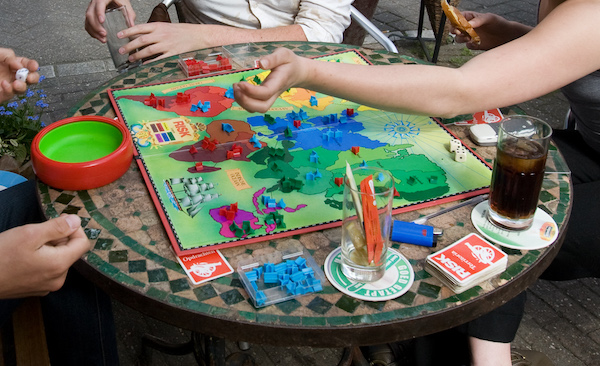
Playing the game of Risk. (photo © Jorge Royan)

I’ve always thought of the Nordic region as peaceful. Admittedly, my knowledge of the area is largely limited to Risk, the board game, where Greenland, Iceland and the Scandinavian countries are considered a haven, free of imminent attack from the throw of a dice.

Well, Finland just purchased Israel’s David’s Sling defensive system. For $345 million US. It was one of Finland’s first moves after recently being accepted into the North Atlantic Treaty Organization. And it was the first sale abroad for David’s Sling, an integrated part of Israel’s multi-tier missile defence system. Israel now carries the title of major supplier to NATO.

I guess the world’s a bit more complicated than Risk.

*** 

So long, Noa Tishby, the Israeli performer appointed by our previous prime minister, Yari Lapid, to advocate for Israel through her strong social media presence. With the formal and former title of special envoy for combating antisemitism and delegitimization of Israel – fit that onto a business card! – she was known for sparring with BDS advocate Bella Hadid and others. Tishby was also a vocal supporter of Israel’s anti-judicial reform movement. Giving voice to the many thousands protesting the current government and its extreme shift rightward and into sometimes theocratic territory, Tishby says this was the reason for her dismissal. Well, ya. As the hawkish Jerusalem Post editorialist Ruthi Blum noted, “Tisbhy is free to share [her opinion]. But she shouldn’t have expected the government she’s been bashing to keep her as a representative.” Well, no. But keep on truckin’ Noa Tishby.

BTW, Tishby will be a guest at the JNF Negev event in Vancouver on June 29.

***

Israel’s Tel Aviv Museum of Art is again among the world’s 100 most visited museums. This according to international art magazine The Art Newspaper. TAMA was ranked 49th in 2022, a jump from its 56th place the year prior. I am fortunate to be one of those visitors, on multiple occasions, over the past many years, often dragging my two children there when they were younger – how fun was that!

Paris’s Louvre and the Vatican Museum took first and second place, respectively. Canada was represented with a 60th place win by Toronto’s Royal Ontario Museum.

***

Congratulations Milk & Honey, Israel’s preeminent whisky distiller, awarded the 2023 world’s best single malt whisky by the World Drink’s Awards for its Elements, Sherry Cask drink. Described as “[f]ruity aromas of citrus zest and white peach with a dash of wood varnish. Sweet to the taste … with flavours of golden syrup, vanilla, tropical fruit and iced tea.…” Sounds like a palate pleaser to me. But, if I had to choose, my favourite would be Seagram’s Five Star rye whisky. Not so much for its taste but for fond memories of fighting with my siblings for the silver sheriff’s star glued to the bottles.

***

Jerusalem was selected by Time magazine as one of the world’s 2023 top 50 destinations, holding the 48th spot. It’s one of my favourite places to visit on a bustling Friday, starting with a walk through the overcrowded neighbourhood of Mea She’arim and enjoying a freshly baked challah. Then, bargaining my way through the Old City’s Arab Market, its tastes, smells and sights, and eventually making my way to the Western Wall, with the golden Dome of the Rock overhead. Ending with lunch at Machane Yehuda, the popular central Jerusalem food market, which has the freshest of meats and vegetables, and many colourful stalls.

Not to be outdone, Canada held two spots. Churchill was third – can’t beat those Northern Light spectaculars. Vancouver was 38th, for its eclectic cuisine and the beautiful Stanley Park.

***

For sure, difficult days in Israel. Sociopolitical cultures are clashing internally. External enemies are looking on with glee, and testing us. But we’re not sinking into despair. Israel has experienced difficult times before and emerged stronger and wiser. So it will be this time.

Arguably, we are being governed by the worst government in our short history – for many reasons, including recent security challenges. I mean, come on, with someone as inexperienced and reactionary as Itamar Ben-Gvir as national internal security minister. Or Finance Minister Bezalel Smotrich spouting off on things about which he should know better and doesn’t. But let’s not blame the victims for the terror and rockets. Hezbollah, Hamas, Iran, an inept Palestinian leadership with a hateful street – they are to blame, not the government.

Usually, it’s the right-wing governments that muster support for the very difficult realpolitik choices, from Menachem Begin’s 1982 Sinai exit to Ariel Sharon’s 2005 Gaza disengagement. Even Binyamin Netanyahu’s 2021 peace deals with several Arab countries under the Abraham Accords. Unfortunately, Netanyahu’s current government may be too inexperienced and messianic to enable reasonable, democratic, liberal change – read judicial reform – at such a scale. But who knows.

We cannot despair. At a very esoteric level, Israelis have hope. In fact, hope is the theme of our national anthem, Hatikvah, The Hope.

***

According to the World Happiness Report, published by the Sustainable Development Solutions Network, Israel remains one of the happiest countries in the world. (See jewishindependent.ca/measuring-happiness.) Rising to fourth place in 2023, just behind Finland, Denmark and Iceland, Israel’s showing likely reflected its reputation as a “villa in the jungle,” as dubbed by former prime minister Ehud Barak – despite being in the Middle East, one of the most contentious spots … on the Risk board.

Bruce Brown is a Canadian and an Israeli. He made aliyah … a long time ago. He works in Israel’s high-tech sector by day and, in spurts, is a somewhat inspired writer by night. Brown is the winner of the 2019 AJPA Rockower Award for excellence in writing, and wrote the 1998 satire An Israeli is…. Brown reflects on life in Israel – political, social, economic and personal.

Creating opportunities

The Jerusalem Business Development Centre (MATI) helps people create or expand businesses in Jerusalem. Two leaders of the Israeli organization visit Vancouver on May 11 as part of a Canadian tour. (photo from CFHU Vancouver)

Every year, the Jerusalem Business Development Centre, known in Hebrew by the acronym MATI, helps thousands of people create or expand businesses in Jerusalem. It does this through a range of services – from personal mentoring to training in various fields to the granting of loans – focusing its efforts on new immigrants, the ultra-Orthodox and residents of East Jerusalem.

On May 11, as part of a Canadian tour, Michal Shaul Vulej, deputy chief executive officer of MATI, and Reham Abu Snineh, MATI’s East Jerusalem manager, will be in Vancouver for “a conversation about shared living in Jerusalem, about mentoring and creating entrepreneurial opportunities for women and promoting diversity as strength.”

Abu Snineh joined MATI in 2011, as a project coordinator for a program to promote women’s entrepreneurship in East Jerusalem. Today, she heads the East Jerusalem branch, leading a team of seven employees.

“The beginning was challenging,” she told the Independent. “The decision to join an Israeli organization was inconceivable. I was afraid of the reactions and criticism of those around me. It also took me awhile to get comfortable with the staff. In addition, I did not speak Hebrew. I grew up in East Jerusalem and studied for my law degree and, later, further degrees in Jordan. All of my studies were in Arabic and I had never considered working with an Israeli organization. I realized that, if I ever wanted to really be able to help my community, I had to find a way to move forward and, over time, things settled down and today I feel completely part of the team.”

For Abu Snineh, it’s the social impact of MATI that most excites her – “The feeling that I am helping people in a difficult socioeconomic situation; helping individuals, families and women to improve their economic situation in general.”

For Shaul Vulej, it’s the “combination of social welfare and the entrepreneurship and business development – the stories of the women who manage to start a business, make a living and be financially independent, and even employ other women.”

MATI measures success by the number of participants, the number of businesses that develop, the number of businesses that expand and the number of new jobs that are created in Jerusalem because of its activities. All MATI’s programs include participant feedback, an annual review and an evaluation process.

Abu Snineh and Shaul Vulej shared one of MATI’s success stories with the Independent, that of Hiba, a fashion design instructor. They said Hiba, 36, grew up in East Jerusalem in a traditional Muslim family and was married at age 16. Despite various factors hindering her progress, she studied fashion design and proceeded to hold several jobs. She wanted to establish a sewing and fashion design school, so she joined some of MATI’s programs: the business establishment and management course, a digital marketing workshop and, recently, a program for import/export from Turkey, which will allow her to import fabrics herself. Together with her artisan husband, she rented an apartment and currently trains several groups, as part of a professional training project for teenagers, and promotes her business.

About 60% of MATI’s clientele are women, who have a range of educational backgrounds. The organization focuses on residents of East Jerusalem who are looking for employment, people who want to start a business, and existing business owners who need assistance to take the next step.

Abu Snineh described some of the challenges people living in East Jerusalem face. Difficulty communicating in Hebrew contributes to a “difficulty in being able to develop entrepreneurship and businesses that can be relevant also in Western Jerusalem, a barrier in the ability to market and sell goods and services to the Hebrew-speaking public, a barrier in dialogue with institutions and authorities in the business framework.”

A lack of trust in the Israeli government system, which does not recognize many of the East Jerusalem businesses as legal entities, has “created a situation where legal business owners in the country received grants, [while] many of the businesses in East Jerusalem (mainly small and medium-sized ones) were left without the financial security granted to others,” said Abu Snineh.

Other factors include the political and security situation, digital barriers that make it difficult to market outside of East Jerusalem or online, insufficient knowledge about business laws, “which blocks the ability to make the business legal and granting rights alongside obligations,” and “a lack of domestic and foreign tourism.”

When asked how Vancouverites could help or participate in MATI, Abu Snineh and Shaul Vulej said, “To help us establish the first hub in East Jerusalem…. A hub would provide the appropriate and technology atmosphere similar to other areas in the world.”

Also needed, they said, is support for “all the ongoing programs that provide for the progress of Arab society in East Jerusalem” and for “a program for the advancement of women in East Jerusalem.”

The May 11 event is presented by the Jerusalem Foundation in partnership with Canadian Friends of Hebrew University, and it is sponsored by the Asper Foundation, as well as the Canadian Memorial United Church. It takes place at the Canadian Memorial Centre for Peace, 1825 West 16th Ave., starting at 7 p.m. To reserve a spot, visit cfhu.org/upcoming-events or call 604-257-5133.

Creating a life of inspiration

Near-fatal war injuries led Anat Yahalom to decades of mutual support for injured soldiers and others. (photo from Jewish Federation)

In 1973, when the Yom Kippur War broke out, Anat Yahalom was a young Israel Defence Forces recruit in the Battle of the Sinai.

“I was 18-and-a-half years old and the state of Israel was 25,” she said. “We were both young and at the beginning of our lives.”

A sudden Egyptian air attack changed her life forever.

“When they rushed me to the rescue helicopter, badly injured and bleeding, hovering between life and death and begging for my life, I used my last remaining strength to mumble, ‘Don’t let me die,’” Yahalom recounted in an email interview with the Independent. “That desire to remain alive and to live has always been with me. Over the years, every time that I’ve faced a crisis, I am reminded of that moment, and again I have that incredible desire to live – to never give up.”

Yahalom is to share her story of near-death, recovery and a life of dedication to others as part of the Israel@75 celebration in Vancouver. She will speak at Congregation Beth Tikvah, in Richmond, on Friday, April 28, 6 p.m., with an Israeli-style Shabbat dinner.

“Being wounded in battle is very different to being injured in an accident,” said Yahalom. “Many of the shrapnel pieces and explosives that caused my injuries have remained inside my body and will accompany me for the rest of my life. Being wounded in battle causes injuries that are external and internal, resulting in a complete breakdown of the body’s system, and to extensive scar tissue that needs a long, slow and complex rehabilitation.”

Shrapnel that remains in her body can cause recurring infections that require regular treatments to allow her to function.

In the decades since her injuries, Yahalom has founded Etgarim, an association supporting the integration of disabled children through sports, and the IDF women with disabilities forum. She is an athlete, hand-bike marathon rider for people with disabilities, wife and mother of three sons.

“Israel has a large proportion of people who have been wounded in battle and disabled,” she said. “Because of this, Israel’s healthcare system has developed the most innovative and effective medical treatments that have allowed many of the injured to return to society, to their families, to work. This is the essence of rehabilitation. Rehabilitation is not only physical, but also emotional. While these are very different, they are equally important. Most of the time, society doesn’t differentiate between the two. Emotional injuries are often initially expressed in the form of depression, anger, impatience. Later on, they are also expressed by smaller things such as slamming doors, raised voices, threatening language, or senses that recall the battlefield. For me, the height of this was when my sons joined the IDF. I began experiencing an endless and overwhelming anxiety. Every small thing could trigger a huge reaction in me – from deep anger, to complete withdrawal.”

Yahalom said that those, like her, who were injured in battle found that the best way to deal with challenges and thrive was through social rehabilitation.

“We came to support and rely on one another like family,” she said. “We involved each other in all the small details, offered and received help of any and every kind. But, mostly, we made sure to meet regularly, to talk, to listen, to offer and seek advice. It was this process and this starting point that the idea of establishing centres for wounded IDF veterans was born, recognizing that social rehabilitation was the very essence of our strength.”

The messages of her life and of the organizations she has founded, she said, are unequivocal: “We can recover from any crisis if we stand together.”

“War is a terrible crisis, being injured is an endless struggle, and being disabled is with you forever,” she said. “Sometimes it is extremely difficult, and sometimes a little easier. But it is always there, a companion for life. A reminder for me that life and the desire to live is more important and can conquer anything.

“My family, the one that I created following my injury, my friends that are my chosen family, and the family of Eretz Israel, all accompany me throughout my life,” said Yahalom. “They allowed me to return to the world of the living, they help with the rehabilitation of my friends, and it is them that makes me continue to want to help in every way possible, to embrace, to encourage and to fill my heart and theirs with hope and faith that every crisis will pass.… This is the message that I bring to your community. In these stormy days of upheaval and crisis at home in Israel, I know that even this storm will pass and we will still be there. We will remember that life is more important, more precious and stronger than anything else. I’ve known this since that fateful day, Oct. 6, 1973, when I was given my life back – and I received it as a gift.”

Yahalom’s visit is one of many events taking place through May marking Israel’s 75th anniversary. The celebrations culminate in the Yom Ha’atzmaut, Israel Independence Day, concert May 14 at Queen Elizabeth Theatre, featuring the band Teapacks. Full details of all events are at jewishvancouver.com.

ABCs on visiting West Bank

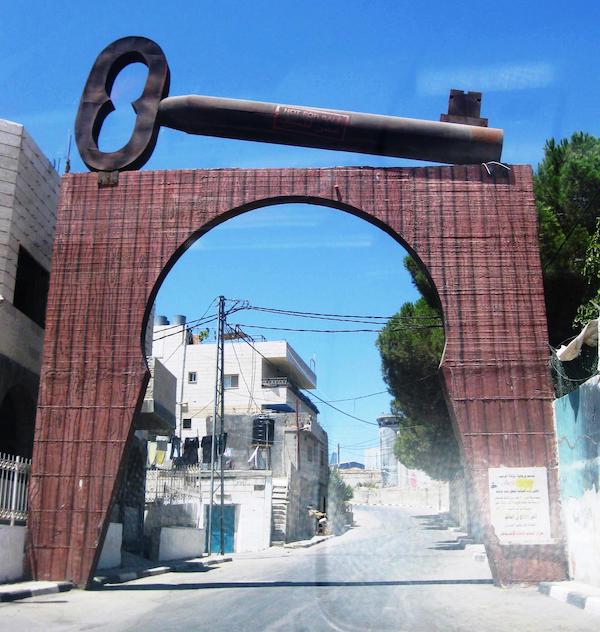
According to one tour guide, an hour spent walking around the Aida Refugee Camp in Bethlehem and talking to the residents there is the best way to gain an understanding of the complex conflict that has caused so much suffering. (photo from Gil Zohar)

The throngs of foreign journalists parachuted into Israel to cover the judicial reform debacle – and the many more correspondents based here on a semi-permanent basis – do a poor job explaining basic facts of life in the Jewish state. A case in point is the West Bank.

Most English-speaking tourists I encounter as a licensed tour guide/journalist are woefully ignorant about the legal status and history of the territory Israel captured from the Hashemite Kingdom of Jordan in the June 1967 Six Day War. The term West Bank is a neologism King Abdullah invented in 1948, when his Arab Legion crossed the Jordan River from the east bank to occupy the area known in Mandatory Palestine as Judea and Samaria.

Apart from those traveling with companies like Abraham Tours, which offers a dual narrative tour of Hebron, or Green Olive Tours, which also promotes travel to the Palestinian Authority provisional capital Ramallah and other key Palestinian cities, most tourists avoid the Area A cities of Bethlehem, Ramallah, Nablus, Jenin, Tulkarm, Qalqilya and Hebron. The latter city, divided into PA-ruled H1 and IDF-controlled H2, is the only city in the West Bank with both Jewish and Palestinian residents.

Car rental companies like Hertz or Shlomo Sixt don’t offer insurance to visit Area A. The exception is Middle East Car Rental, located in East Jerusalem’s Wadi Joz neighbourhood, which provides twin insurance policies for those PA-controlled Area A cities, Israel-ruled areas B and C, and the pre-1967 remainder of the country.

What, then, are areas A, B and C? And what should a tourist know about visiting them?

First, the West Bank is safe for tourists – mostly. On March 18, two German nationals were surrounded by angry youths in Nablus, who slashed the tires of the tourists’ Israeli rental car. Notwithstanding that the two knew their car insurance was void in Area A, the pair – who were mistaken for Jewish settlers – drove to the city to enjoy Turkish coffee and the local goat cheese and rosewater pastry delicacy called knafeh nablusiyya. They were rescued by an Arab-Israeli who himself was shopping in Nablus in violation of the Israeli law barring its citizens from visiting Area A.

Looming trilingual signs painted red warn Israelis that entering Area A is dangerous. Nonetheless, hundreds of thousands of Israelis from Nazareth and elsewhere in the Galilee routinely shop in Jenin, where prices for food and vegetables are strikingly lower than in Israel, and where the 17% value-added tax is not paid.

Similarly, some Jerusalem Israelis illegally buy granite and marble products and furniture from factories in nearby Bethlehem, thus saving the 17% VAT. Trucks with yellow Israel licence plates, rather than the green and white ones used in the PA, routinely pass through the Israel Defence Forces roadblocks that ring the West Bank. These soldiers are not customs officers, so they don’t inspect waybills from those trucks, whose bilingual drivers have tuned their radio to Hebrew stations to blend in should they be stopped.

Apart from the aforementioned signs, nothing prevents anyone from driving into Area A. Under the bilateral Oslo Accords signed by Israel and the Palestine Liberation Organization in Washington, D.C., in 1993, Israel divided the West Bank into Areas A, B and C, and withdrew from the first. Area A is mostly composed of non-contiguous municipalities and villages, and Israel’s roads and bypass highways gerrymander around Area A cities.

photo - Despite trilingual signs painted red, warning Israeli citizens that entering Palestinian Authority-controlled Area A is dangerous, hundreds of thousands of Israelis routinely travel to Area A cities
Despite trilingual signs painted red, warning Israeli citizens that entering Palestinian Authority-controlled Area A is dangerous, hundreds of thousands of Israelis routinely travel to Area A cities. (photo from Gil Zohar)

Areas B and C are under the control of the Coordinator of Government Activities in the Territories (COGAT), a unit in Israel’s Ministry of Defence that coordinates civilian issues between the Israeli government, the IDF, international aid and nongovernmental organizations, diplomats, and the PA. Following the Oslo Accords, COGAT replaced the defunct Civil Administration, which had governed the West Bank and the Gaza Strip between 1981 and 1994. (Israel unilaterally quit Gaza in 2005.)

Returning from Area A to Israel can be trickier. The main difficulty is not the 800-kilometre-long incomplete wall and fence that partially encircles the West Bank. For example, while Palestinians with the correct documents and biometric ID card are required to pass through the Qalandiya checkpoint between Ramallah and Jerusalem, five kilometres to the east is the Hizma checkpoint used by Israelis living in the West Bank. Under normal security procedures, cars with yellow licence plates simply drive past the IDF troops. Bored-looking soldiers wave drivers through. Mostly, cars just slow down for perfunctory profiling.

But how does a scofflaw who scarfed hummus at Bandali in Ramallah’s Lower City get back to Jerusalem? Ditto for Rukab’s Ice Cream in the city centre, which has been dishing up its unique, stretchy gelato since 1941? Or the Vanilla café, renowned for its divine cakes? Having had a culinary respite from the Israeli-Palestinian conflict, one hails a cab and asks to be taken to the Rami Levy supermarket in Geva Benyamin, east of Ramallah. The driver – wink, wink – will drop you off on Route 60 at a slight distance from the settlement’s gate, which is guarded by an armed security officer. Should the guard ask you where you are coming from, the response “From Route 60” will be sufficiently vague that he will allow you past the barrier. There, at the bus stop, one waits for the bulletproof bus that drives back to Jerusalem through Hizma. No ID documents are checked.

Similarly, no documents are required for the 25-minute ride on Bus 231 from Jerusalem’s Damascus Gate Bus Station to central Bethlehem via Beit Jala. Like traveling from Ramallah back to Jerusalem, the return from Bethlehem requires some fudging of the truth. Bus passengers disembark at the checkpoint on Route 60 between Beit Jala and Jerusalem. Some Israeli citizens holding a foreign passport pretend to be tourists. When asked for the visa they received at Ben-Gurion Airport (which is issued on a sheet of paper rather than stamped in one’s passport), they play the “stupid card,” claiming they don’t have it. The guards may scowl but routinely let the faux-tourists re-board the bus rather than create ill-will.

Israel’s porous approach to security similarly applies on the West Bank’s highways. Today, all the permanent army roadblocks that once cut up the West Bank have been removed, allowing freedom of movement. “Z,” an intrepid tour guide who routinely takes tourists to all three sectors in the West Bank, points out where the decommissioned IDF posts once stood.

Jeff L., a lawyer from Los Angeles who volunteered with the Israeli army’s Sar-El program, recently went with Z on a day-long tour across the northern West Bank, including Nabi Musa (a shrine Muslims revere as the mausoleum of Moses), the oasis of ‘Ain Mabu’a, the all-Christian village of Taybe (with its renowned brewery), the all-Muslim village of Turmus Ayya, and the model city of Rawabi. Rawabi and Taybe are in Area A.

Stuck outside Ramallah in an L.A.-style traffic jam in the late afternoon, the two abandoned their plan to pose for a selfie outside Yasser Arafat’s tomb in the Muqata government compound.

In an email, Jeff wrote, “It was an awesome day. I will do my best to become an ambassador for peace.

“My day in the West Bank began at Wadi Qelt / Nahal Prat. The beautiful nature reserve was full of blooming wildflowers. Muslim women and their families from Hebron were enjoying the rushing water and lush surroundings. We were greeted warmly by all with big smiles.

“Visiting Taybe, Tarmus Ayya and Rawabi, again, everywhere we went we were warmly greeted. Fortunately, Z speaks Arabic and was able to communicate with everyone we met. My impression of the day in the West Bank was one filled with hope for the future.

“There was a genuine interest in everyone we met to talk and to make us feel welcome.

“All the people we met who live in the West Bank want the same peace and prosperity for their families as we [Jews] do.”

Z – who has a permit from the Israel Ministry of Tourism to enter Bethlehem and Jericho – has never encountered a problem in Area A or elsewhere in the West Bank. During the pandemic, he was stopped by a PA policeman en route to the Mar Saba monastery east of Bethlehem. The officer, who was carrying an AK-47, didn’t have an issue with a car full of tourists in a vehicle with yellow licence plates driving in Area A, but instructed them to return to Jerusalem because of the threat of COVID.

Should tourists to Israel also visit the West Bank and Area A?

Z insists that an hour spent walking around the Aida Refugee Camp in Bethlehem and talking to the residents there is the best way to gain an understanding of the complex conflict that has caused so much suffering. Moreover, tourist sites like Hisham’s Palace in Jericho or Jacob’s Well in Nablus, where Jesus is said to have chatted with a Samaritan woman, are all exceedingly interesting and photogenic. But Z recommends going with a seasoned tour guide, lest you end up like the two German tourists who were attacked going to Nablus’s al-Aqsa pastry shop.

Gil Zohar is a writer and tour guide in Jerusalem.

Look on bright sides of earth

The southern and northern hemispheres look equally bright in this iconic image of earth, titled “The Blue Marble,” which the crew of the Apollo 17 spacecraft took on Dec. 7, 1972. (photo from NASA)

Why do earth’s hemispheres look equally bright when viewed from space? Weizmann Institute scientists offer an answer to this decades-old question.

When looking at the earth from space, its hemispheres – northern and southern – appear equally bright. This is unexpected because the southern hemisphere is mostly covered with dark oceans, whereas the northern hemisphere has a vast land area that is much brighter than these oceans. For years, the brightness symmetry between hemispheres remained a mystery. In a new study, published in the Proceedings of the National Academy of Sciences (PNAS), Weizmann Institute of Science researchers and their collaborators reveal a strong correlation between storm intensity, cloudiness and the solar energy reflection rate in each hemisphere. They offer a solution to the mystery, alongside an assessment of how climate change might alter the reflection rate in the future.

As early as the 1970s, when scientists analyzed data from the first meteorological satellites, they were surprised to find out that the two hemispheres reflect the same amount of solar radiation. Reflectivity of solar radiation is known in scientific lingo as “albedo.” To better comprehend what albedo is, think about driving at night: it is easy to spot the intermittent white lines, which reflect light from the car’s headlights well, but difficult to discern the dark asphalt. The same is true when observing earth from space: the ratio of the solar energy hitting the earth to the energy reflected by each region is determined by various factors. One of them is the ratio of dark oceans to bright land, which differ in reflectivity, just like asphalt and intermittent white lines. The land area of the northern hemisphere is about twice as large as that of the southern and, indeed, when measuring near the surface of the earth, when the skies are clear, there is more than a 10% difference in albedo. Still, both hemispheres appear to be equally bright from space.

In this study, the team of researchers, led by Prof. Yohai Kaspi and Or Hadas of Weizmann’s earth and planetary sciences department, focused on another factor influencing albedo, one located in high altitudes and reflecting solar radiation – clouds. The team analyzed data derived from the world’s most advanced databases, including cloud data collected via NASA satellites (CERES), as well as data from ERA5, which is a global weather database containing information collected using a variety of sources in the air and on the ground, dating back to 1950. ERA5 data was used to complete cloud data and to cross-correlate 50 years of this data with information on the intensity of cyclones and anticyclones.

photo - Prof. Yohai Kaspi, left, and Or Hadas of the Weizmann Institute of Science
Prof. Yohai Kaspi, left, and Or Hadas of the Weizmann Institute of Science. (photo from Weizmann Institute)

Next, the scientists classified storms of the last 50 years into three categories, according to intensity. They discovered a direct link between storm intensity and the number of clouds forming around the storm. While northern hemisphere and land areas in general are characterized by weaker storms, above oceans in the southern hemisphere, moderate and strong storms prevail. Data analysis showed that the link between storm intensity and cloudiness accounts for the difference in cloudiness between the hemispheres.

“Cloud albedo arising from strong storms above the southern hemisphere was found to be a high-precision offsetting agent to the large land area in the northern hemisphere, and thus symmetry is preserved,” said Hadas, adding: “This suggests that storms are the linking factor between the brightness of earth’s surface and that of clouds, solving the symmetry mystery.”

Will climate change have an impact?

Earth has been undergoing rapid change in recent years, owing to climate change. To examine whether and how this could affect hemispheric albedo symmetry, the scientists used CMIP6, a set of models run by climate modeling centres around the world to simulate climate change. One of these models’ major shortcomings is their limited ability to predict the degree of cloudiness. Nevertheless, the relation found in this study between storm intensity and cloudiness enables scientists to assess future cloud amounts, based on storm predictions.

Models predict global warming will result in a decreased frequency of all storms above the northern hemisphere and of weak and moderate storms above the southern hemisphere. However, the strongest storms of the southern hemisphere will intensify. The cause of these predicted differences is “Arctic amplification,” a phenomenon in which the North Pole warms twice as fast as earth’s mean warming rate. One might speculate that this difference should break hemispheric albedo symmetry. However, the research shows that a further increase in storm intensity might not change the degree of cloudiness in the southern hemisphere because cloud amounts reach saturation in very strong storms. Thus, symmetry might be preserved.

“It is not yet possible to determine with certainty whether the symmetry will break in the face of global warming,” said Kaspi. “However, the new research solves a basic scientific question and deepens our understanding of earth’s radiation balance and its effectors. As global warming continues, geoengineered solutions will become vital for human life to carry on alongside it. I hope that a better understanding of basic climate phenomena, such as the hemispheric albedo symmetry, will help in developing these solutions.”

Other collaborators in conducting this study include Dr. George Datseris and Prof. Bjorn Stevens of Max Planck Institute for Meteorology, Germany; Dr. Joaquin Blanco and Prof. Rodrigo Caballero of Stockholm University, Sweden; and Dr. Sandrine Bony of Sorbonne University, France. Kaspi is head of the Helen Kimmel Centre for Planetary Science; his research is supported by the Yotam Project and Rene Braginsky.

– Courtesy Weizmann Institute

BGU moving to solar

(photo from BGU)

Ben-Gurion University of the Negev will soon produce 20% of its energy needs on the Marcus Family Campus from solar energy. Recently, solar panels were installed on the roofs of three buildings on campus in the first stage of the initiative.

The project is estimated to cost NIS 2 million (approximately $736,000 Cdn). Once completed, it will replace more polluting fuels that are typically used to power buildings. The university is expected to recoup this investment within a few years as it reduces its energy expenses.

Dr. Daniel Farb has donated a small wind turbine called the Tulip, developed by his company, which will charge laptops and phones from wind energy.

In April 2022, BGU announced it would stop investing in companies that produce oil and coal and move those investments and all future investments into alternative energies and investment vehicles governed by ESG (environmental, social and governance) principles.

The university was awarded Green Campus status by the Israeli Ministry of Environmental Protection in 2010 and has been among the top universities worldwide in green rankings. Bike racks, electronic recycling and solar and wind-powered charging stations can be found all over campus.

BGU’s Jacob Blaustein Institutes for Desert Research have been studying environmental issues for 50 years. Leveraging these strengths, the Goldman Sonnenfeldt School of Sustainability and Climate Change was dedicated in May 2022. It brings together more than 150 labs on the university’s three campuses to tackle these issues.

 – Courtesy Ben-Gurion University of the Negev, BC & Alberta Region

Beauty amid turbulent times

Israeli journalist Yair Cherki (photo from Facebook)

Bravo Yair Cherki, the popular, ultra-Orthodox TV news reporter. He recently came out as gay in a wonderful social media post. In part, he said: “I write these words shaking, postponing to tomorrow. For next week. For after the holidays. Maybe it’s been 10 years since I’ve been writing and erasing…. And I write not because I have the strength to write but because I have no power to stay silent. I love men. I love G-d. It is not contradictory….”

His confession continues, “I live the conflict between my secular preference and my faith all the time. Some have solved the conflict for themselves by saying that there is no G-d, while others explain that there is no homosexuality. I know both exist. And I try to reconcile this contradiction within myself in various ways. These are things between G-d and me…. This is neither a fashion nor a trend nor a political statement. It is simply me….”

An intimate and intelligent statement.

* * *

Now, if this doesn’t take “blaming the Jews” to new extremes. In my previous article in the JI (jewishindependent.ca/land-of-milk-honey) I praised the historic maritime natural gas agreement between Israel and Lebanon, enabling both countries to drill for natural gas within their own territory. I truly wished Lebanon much success in hitting a gusher and creating their own Sovereign Wealth Fund.

Hezbollah’s leader Hassan Nasrallah sees it a bit differently, warning that any delay in Lebanon’s extracting gas from its own waters will be met by a punishing attack on Israel’s adjacent gas fields. Maybe Robert Frost’s poem “Mending Wall” will assuage Nasrallah: “I let my neighbour know beyond the hill…. And set the wall between us once again…. To each the boulders that have fallen to each…. He only says, ‘Good fences make good neighbours.’”

Nasrallah went on to threaten that if the United States continues spreading chaos within Lebanon – some conspiracy theory or other –  that Israel will pay. Reminiscent of the Three Stooges slapstick routine when Curly slaps Larry for Moe slapping him.

Peace and prosperity for all, on both sides of the Fatima Gate. Otherwise known as the Good Fence!

* * *

Going once. Going twice. Do I hear $50 million? According to its website, “Sotheby’s is proud to offer … the earliest, most complete Hebrew Bible during this year’s marquee New York sales auction.”

The Codex Sassoon is more than 1,000 years old. According to Sharon Mintz, Sotheby’s senior Judaica specialist, in an interview with CNN, “this is the most important document to come to auction ever.” It’s expected to generate huge interest across the world from the wealthiest of bidders, with offers expected to reach as high as $50 million.

Other treasured documents fetching such modest amounts at auction include the Codex Leicester by Leonardo da Vinci (ostensibly his science diary) sold to Bill Gates in 1994 for about $31 million. And the first printing of the U.S. Constitution, bought by American hedge fund manager Kenneth Griffin in 2021 for about $43 million.

May 16 … save the date. And your shekels!

* * *

A few weekends ago, my wife and I drove south for the day to enjoy the year’s winter festival, Darom Adom, when the bright red poppies – a protected flower in Israel – come out in full bloom along the Gaza periphery. It’s another reason to celebrate with local handicrafts, seasonal fruit, local cheeses and wine, homemade Israeli cuisine.

Taking place not too far from Sderot, within the opened gates of local kibbutzim and moshavim (agricultural communities) and less than a kilometre from another good fence delineating the border between Israel and Gaza, the festival a testament to Israeli’s resilience – and longing for a peaceful coexistence.

Somewhat poetically, we purchased a beautifully handcrafted hamsa made by a young, local artist. This hand-shaped amulet is used for protection by both Jews and Muslims. In the Jewish faith, the five fingers of the hamsa represent the Five Books of Moses, or the Torah. The Muslim faith sees a hamsa as representing the Five Pillars of Islam (declaration of faith, prayer, alms, fasting, pilgrimage). In popular culture, the charm represents the five senses (sight, sound, smell, touch, taste).

* * *

Judicial reform. Judicial reform. Judicial reform. Sounds like Jan Brady whining about her sister getting all the attention, “Marcia. Marcia. Marcia,” from the 1970s sitcom The Brady Bunch. Judicial reform certainly has been getting all the attention lately.

Issues aside, we’ve had 10 weeks and counting of protests, with several hundred thousand Israelis protesting around the country every Saturday night against judicial reform. The protests are also aimed at the extreme, right-wing – even theocratic – makeup of the current coalition that is driving headstrong into judicial reform. And yet, the primarily secular, centre-left who comprise these thousands, waving Israeli flags and ending every protest with the singing of Hatikvah, respectfully wait until after Shabbat to begin their protests. How’s that for deep-bred regard for this Jewish tradition that crosses sociopolitical lines?

* * *

Bravo again to Yair Cherki. To come out in these turbulent, sociopolitical times for the Israeli LGBTQ+ community. With our far-right, xenophobic, theocratic and anti-LGBTQ+ government, Cherki’s post and testament to himself is nothing short of brave, beautiful and brilliant.

Bruce Brown is a Canadian and an Israeli. He made aliyah … a long time ago. He works in Israel’s high-tech sector by day and, in spurts, is a somewhat inspired writer by night. Brown is the winner of the 2019 AJPA Rockower Award for excellence in writing, and wrote the 1998 satire An Israeli is…. Brown reflects on life in Israel – political, social, economic and personal.

Not your parents’ Netanyahu

Lihi Shmuely of Israel Hofsheet and Ben Murane of the New Israel Fund of Canada. (photos from the organizations)

Binyamin Netanyahu is the longest-serving Israeli prime minister and should be a known quantity. The government he leads now, however, is unlike anything the country has seen in the past, according to a leading Israeli activist who participated in a cross-Canada speaking tour.

“This is different,” said Lihi Shmuely, deputy director of Israel Hofsheet. “This is completely new to us. This is a very extreme, radical government that we’ve never seen before.”

Israel Hofsheet (Israel Be Free) works to increase freedom and equality in the areas of religion and state, as well as Jewish pluralism in Israel, particularly focusing on civil options for marriage, gender equality, pluralistic Shabbat in the public realm and LGBTQ+ rights.

Even some voters who supported parties that are now in the governing coalition are expressing regret, she said. Many supported right-wing parties based on national security issues or a range of other policies.

“Now they understand that it comes as a whole package, that these people who promised national security … [are] not just racists but also chauvinists and homophobes and misogynistic people who are promoting legislation that will hurt the very core, the liberal and democratic core, of Israel,” said Shmuely.

She warned that people should take members of the new government seriously when they advance what appear to be extreme policy positions. To contextualize what is happening, she compared the reaction in the United States when the U.S. Supreme Court overturned Roe versus Wade, the precedent-setting reproductive rights case.

“We thought this was already set in stone, the Supreme Court has decided and that’s it,” Shmuely said. Returning to the Israeli situation, she warned that some people do not believe that the more extreme statements or policies – even the formally agreed-upon coalition agreements – will actually be codified in legislation or policy. “They will do what they say they’ll do. So, we need to take it very, very seriously.”

Evidence suggests many Israelis are taking it seriously. Rallies throughout the country against the range of legislation and proposals – most notably the subjugation of the Supreme Court to the elected Knesset, as well as women’s equality and LGBTQ+ rights, the status and rights of Palestinians in the West Bank, and encroachments of religion into the public sphere. People who have never been political in the past are getting involved and even attending the mass rallies that take place every weekend.

“We don’t have this privilege anymore, to say, I will not get involved,” Shmuely said, adding that Israelis are facing existential questions. “I feel like we are asking ourselves, what are we? Are we a Jewish state? Are we a democratic state? Are we a liberal democracy? Is there a contradiction between all of them? It feels like these days we are writing the rest of our history.”

Shmuely’s grandmother is a Holocaust survivor and, in recent months, has been saying, “This is not the country that I ran away from Europe for.”

While emphasizing urgency, Shmuely counters that it is not too late to alter course.

“I do think we are under terrible threat and I do think that it’s not too late,” said Shmuely. “It’s almost – but it’s not yet. We still have a lot to do.”

A major focus for opposition groups is this October’s municipal elections across Israel.

“These are sort of like the midterms in the States,” she said. Aside from this, municipal governments also have power to push back against national trends. For example, some municipalities have expanded transportation services to Shabbat.

Shmuely was supposed to be in Vancouver March 1 for a program at Or Shalom synagogue. However, she was stuck in Toronto after contracting COVID and appeared virtually. In person was Ben Murane, executive director of the New Israel Fund of Canada. His group supports civil society organizations in Israel that advance socioeconomic equality, religious freedom, civil and human rights, shared society and anti-racism efforts. Their Vancouver event was co-sponsored by Or Shalom, and the advocacy groups Peace Now and Ameinu.

Murane highlighted what he sees as recent positive developments.

“We couldn’t have anticipated that every Saturday there would be 100,000 protesters coming out – 300,000 last weekend,” he said. Security officials, business leaders, the heads of universities, lawyers, the press council and others who might previously have remained silent on contentious issues are speaking out, said Murane, and high-tech businesses are giving employees time off to attend protests.

“We couldn’t have anticipated that, in the past few weeks, major Diaspora voices who, between you and me, are usually the ones arguing against criticism of Israel, would be coming out saying, please criticize the government of Israel,” he said. “The Jewish Federations of North America issued a very surprising and precedent-breaking statement against the court override. You see individuals like [former Canadian justice minister] Irwin Cotler coming out, you see [former head of the Anti-Defamation League] Abraham Foxman and, for whatever it’s worth, Alan Dershowitz also saying something.”

He cited the resignation of Avi Maoz from cabinet last week as a positive outcome, partly due to public opposition. Maoz is head of the far-right Noam party, which advocates against equality for women and LGBTQ+ people. He resigned from cabinet, though not from the governing coalition, when he realized that Netanyahu was unlikely to implement numerous of his priorities.

“Avi Maoz came in with very bold intentions and then met all of this intense resistance and found that his agenda is not going to be as easily advanced,” he said. The rest of the coalition realized, according to Murane, that it would cost a great deal of political capital for the government to allow Maoz to get his way. “We are seeing them say, Avi, you’re not going to get everything you want, and he quits in a huff.… This is evidence that some of this is actually working, that it may appear a pyrrhic victory, but these are the dribs and drabs of what impact looks like in these moments.”

The role of groups like his and its partners on the ground in Israel is eternal vigilance, Murane said.

“Part of the role of civil society is to let nothing go unchallenged. Nothing,” he said. “Even if our odds of actually completely forestalling it are slim, part of the victory is to make an atrocious thing merely bad and to make the political powers that are advancing these initiatives expend a great deal of political capital in order to get what they want, by making them waste time and energy.”

Murane addressed the extraordinary violence that took place in the Palestinian village of Huwara Feb. 26, where rampaging Jewish settlers engaged in what has been called by some a “pogrom” that left one person dead, almost 400 wounded, and homes and businesses set afire. The attack was revenge for a terror attack the same day, in which Israeli brothers Hallel Yaniv, 21, and Yagel Yaniv, 19, were murdered.

“We’ve seen settler violence,” said Murane. “It’s been on the increase. It’s a real thing. It’s a fact of life for Palestinians from the territories. But to have dozens of settlers go into a village with impunity and commit the violence they committed, that is a new thing.”

He said civil society organizations must draw as much attention as possible to such incidents, including promoting the use of body cameras for police and wider availability of video cameras for civilians.

Incidents like these cloud the reality of evolving Israeli views on Arab-Jewish political cooperation, he said. Over the last several election cycles, opinion polls have indicated a steep increase in the proportion of Israelis who support Arab-Jewish political cooperation, from about 30% a couple of years ago to a majority today. The inclusion of an Arab political party in the last coalition government was groundbreaking.

“That’s a huge change in Israeli society that, a year ago, we didn’t even imagine it was possible,” Murane said. In the 2022 election, he said, “unless you are voting for the right-wing, you are implicitly voting for more Jewish-Arab political partnership.”

Or Shalom’s Rabbi Hannah Dresner introduced the event.

“I think it’s an important time for me to acknowledge that the democracy that I imagine as part of that beautiful place that I called Israel through my whole growing up and adulthood is really a selective democracy, a democracy for some and not for all,” she said. “That is a very important aspect of my concern at the moment – not just what happens with the loss of democracy but what is that democracy and how can it be a democracy that serves all who live in the land of Israel?”

Israelis not that divided

Dr. Einat Wilf and Mark Regev spoke at a Centre for Israel and Jewish Affairs event Feb. 9.

Canadian Jews who don’t like the look of Israel’s new government should not withdraw from engagement with that country and its discourse, but get more involved, says Dr. Einat Wilf, a former Labour party member of the Knesset.

Leaders in the North American Jewish community are expressing concerns over the new government and aspects of its policy agenda, while others worry that the always-present fear of schisms between Israeli and Diaspora Jewry could be reaching a breaking point. But Wilf said this is a time for overseas Jews to act strategically to influence policies that reflect their priorities.

Wilf, who served in the Knesset from 2010 to 2013, is an author, businessperson and one-time foreign policy advisor to Shimon Peres. She was part of a panel convened by the Centre for Israel and Jewish Affairs Feb. 9. Wilf engaged with Mark Regev, who is chair of the Abba Eban Institute for Diplomacy and Foreign Relations at Reichman University and a former spokesperson and senior foreign affairs advisor to Binyamin Netanyahu. He also served as Israel’s ambassador to the United Kingdom. Yaron Deckel, the Jewish Agency for Israel’s director for Canada and a veteran Israeli journalist, moderated the event.

Wilf said it is up to Canadian Jews to decide how to respond to the political situation in Israel. “But my personal view is that this is perhaps the time for Jews outside Israel to fund more and channel money and efforts to things that have to do not with welfare but actually with how Israel is Jewish,” she said. “North American Jews, if they want Israel to be hospitable to their kind of Jewish practice, they need to make a stark choice.”

The Conservative and Reform movements in Israel are simply too small to be major players in this discussion and so the more practical camp with which Diaspora adherents of those denominations can partner to meet their goals is the secular movement, Wilf said. This is the most likely way to advance policies such as egalitarian prayer at the Kotel, liberal interpretations of identity for aliyah and reducing the powers of the chief rabbinate.

Both panelists attempted to dispel some conventional wisdom, including that Israeli society is divided, turning its back on liberalism and getting more and more religious.

“Israeli democracy, as it stands now, is more inclusive, more representative of the greater diversity of voices than it has been probably throughout its history,” said Wilf. That diversity, by its very inclusiveness, has opened the door to ideas that can be considered contrary to traditional progressive Israeli values, she argued. “That means that more non-liberal voices are represented than ever before.”

Regev concurred. The “good old days” of early Israeli democracy were, he said, “a one-party state run by the Labour Party.… It was a much more conformist society, it was difficult for gays, it was difficult for women, it was a society that was more closed, it was difficult for Mizrahim,” he said. “Today, I have no doubt if you look at the trajectory, Israel is more liberal, more pluralist, more open, more free than ever before.”

A couple of decades ago, Regev noted, if you wanted to go out for dinner in Jerusalem on a Friday night, you had to travel to east Jerusalem. “Now, in Jewish Jerusalem, you have all sorts of places you can go to,” he said. “The idea that Israel is becoming only more religious, more Haredi, more Orthodox is just not true.”

One of the areas where most Israelis agree, said Wilf and Regev, is on the Palestinian issue. After Yasser Arafat ended the peace process and started the Second Intifada, and his successor Mahmoud Abbas demonstrated no more conciliatory a tone, Israelis realized the ball was not in their court. All they can do is wait for a change of leadership on the Palestinian side, both said.

The fiercest divisions in Israeli society right now are over proposals to reform the judiciary, including allowing the Knesset to override Supreme Court decisions by a majority vote and to hand the power of judicial appointments to politicians.

Deckel noted that Canadian legalist Irwin Cotler has warned that the judicial overhaul would make Israel a flawed democracy and other Jewish leaders in North America have spoken up in ways that are rare or unprecedented against some of what the new government is advocating.

“Is there really a threat to Israeli democracy?” asked Regev. “I’m not so sure. I don’t believe there is. I believe Israeli democracy is strong. I believe we can debate the pros and cons of the different judicial reforms put on the table without having to say this is the end of democracy.”

Both commentators think fears of the new government are overblown, although Wilf has a caveat. She has studied past Netanyahu governments and concluded their bark is generally worse than their bite or, at least, that the “hysteria” with which they were met was not commensurate with the policies they enacted.

“All Netanyahu governments, especially the one of 2015, were received with complete hysteria and none of it materialized,” said Wilf. “Sometimes the exact opposite. Netanyahu turned out to be much more centrist, careful, generally very much eschewing violence and conflict and even bringing peace agreements.”

A difference now, said Wilf, is that Netanyahu is head of a more ideologically narrow government, where in the past he had built fairly broad coalitions.

“For Netanyahu, that was very comfortable,” Regev said. “Because, when you have a coalition partner to the left of you and a coalition partner to the right of you, that allows you to be the conductor of the orchestra, so to speak.”

Regev sees a danger in Diaspora Jews who disagree with events in Israel airing dirty laundry, but Wilf said that is the least of her concerns. No matter who is in charge or what policies they advance, overseas opponents will make the same case, she said. “They still would have argued that Israel is a settler-colonial, apartheid, genocidal, white European blah blah blah,” she said. “That’s how they work.”

Addressing the widespread spike in antisemitism, Regev sees a silver lining. “You could be very cynical and you could say some things don’t change. But something has changed,” he said. “Something very important has changed. Unlike my father when he was a child and the Jews were stateless and defenceless and knocking on people’s doors [saying] ‘Please let me in so they won’t kill me,’ today we can proudly say that, if something has changed, the Jews have changed. We have a state. We have a successful state. With all our problems, Israel is a very successful country, politically, economically, diplomatically, militarily. We can protect ourselves.”

Gail Adelson-Marcovitz, national chair of the board of the Centre for Israel and Jewish Affairs, opened the online event, which attracted more than 1,000 participants. “Many of us believe that Israel is a state of the totality of the Jewish people and not just its citizens,” she said. “While it is the citizens of Israel who elect their government, that choice has ramifications for many aspects of our partnership and specifically impacts Diaspora Jews. We feel that our interest must, at the very least, be heard, if not respected, particularly in those areas where we are impacted.”

Living amid rocket attacks

Adele Raemer lives in Kibbutz Nirim, near the border with Gaza, which means the community has had to build safe rooms for protection from rocket attacks. (photo from Adele Raemer)

Tens of thousands of rockets have been fired regularly and indiscriminately at Israel from Gaza since 2001, and they continue. Adele Raemer is a community member of Kibbutz Nirim, just two kilometres from the Gaza border – so close that, she says, “there is zero to 10 seconds’ warning” of a rocket attack on her neighbourhood.

As spokesperson for the community, Raemer moderates a Facebook group called Life on the Border, about the kibbutz. She teaches English as a foreign language, and is a counselor for the Israeli Ministry of Education. In addition, she is a trained medical clown in the pediatric ward of the hospital in Ashkelon. She was invited in November 2018 to be on an independent investigative committee for the United Nations, to discuss living at the border, and, in December 2019, she addressed the UN Security Council. She has filed stories for CNN, particularly during the Pillar of Defence conflict in 2012.

While attending the Jewish Media Summit in Jerusalem this past December, the Jewish Independent spoke with Raemer.

JI: What compelled you to move to Nirim, and when was it?

AR: I came to Nirim [from the United States] in the framework of my army service in 1975. I fell in love with the community and decided to stay.

JI: At the summit, you mentioned a joint bike marathon with Gazans. Can you talk about that?

AR: I have been in touch with Rami Aman, a Palestinian from Gaza, for a number of years. He is one of the founders of the Gaza Youth Committee, a group of people who work with youth in Gaza in order to improve their quality of life and education, and to teach them that those who live on the other side of the border [Israelis] are not their enemies. One of the activities I participated in with them was a [joint] marathon. I am not able to discuss activities happening now, for the safety of my contacts. Unfortunately, doing activities such as these, on the other side of the border, can cost one one’s freedom, even one’s life.

JI: How did you get invited to speak at the UN Security Council in 2018?

AR: In light of the map of [Gazan-initiated] fires that I put together at the time, the interviews I gave to the media, my blogging and the Facebook group Life on the Border with Gaza, people in Israel who work with the American embassy turned to me. At the time, the U.S. were the hosts of the UN Security Council, and President Trump was interested in putting the situation in Israel in the spotlight.

photo - Adele Raemer’s granddaughter stands outside a safe room
Adele Raemer’s granddaughter stands outside a safe room. (photo from Adele Raemer)

JI: Nirim began building concrete safe rooms to protect against rocket fire. What is the ratio of safe rooms to homes, and how many people typically fit in one? What is the cost of a room?

AR: Each home typically has one safe room, about the size of a small bedroom, about nine square metres, and costs about $44,000. Safe rooms in people’s houses usually have beds in them, so, depending on how much furniture is in the room, it varies how many people fit in. Certainly the entire family will fit.

JI: How many casualties have there been in your community from rocket fire?

AR: Two members were killed in 2014 and, if I am not mistaken … fewer than 10 were wounded, mostly lightly. That, of course, does not take into account the many who have suffered psychological damage.

JI: Who is your member of Knesset, and how are they involved in ensuring the safety of the community?

AR: It doesn’t work that way – we do not have regional representatives, like you do. All of the MKs should be working towards the good of our communities. The current ministry for the development of the periphery of the Negev and the Galilee is Yitzhak Wasserlauf, but he has just taken office so I cannot say what he will be doing yet. The office itself has done the following in recent years: reinforced all schools within the Gaza envelope, developed Ale Negev [a rehabilitation hospital in the Negev] and programs for developing psychological support and resilience centres.

JI: You’ve said the kibbutz was “95% heaven.” Why do you feel that way?

AR: The region is a desert that has been made to bloom, a modern miracle of development, while protecting and preserving the nature and wildlife, despite multiple challenges including, but not only, security challenges. The community in which I live is not only beautiful but it is crime-free, and [it is] safe for children to play on the lawns, without worry of being run over or kidnapped. But, above all else, it is the sense of community – our kibbutz, as well as the other communities in the region, which support each other … make it a friendly, warm environment in which to raise families.

JI: What is the main industry of the kibbutz?

AR: Our kibbutz is mainly agricultural, so we have farmers and workers in the different branches that support the agriculture, but our people also work as professionals in all different professions, just like anywhere else in the world. We have doctors, nurses, lawyers, mechanics, teachers, social workers, chief cooks and bottle washers.

Dave Gordon is a Toronto-based freelance writer whose work has appeared in more than 100 publications around the world. His website is davegordonwrites.com.