Observations on China

A Magen David is still attached to the roof of a former synagogue in Harbin, China. (photo by Deborah Rubin Fields)

If a few years ago you had flown on an international flight from Beijing, China, you would have noticed a departure terminal display of Chinese marionettes. Like many other sites in China, there was more to this small puppet exhibit than met the eye. While the display explained the history of this colourful theatre, it ironically underscored the question about which we Westerners are most curious: who is pulling the strings in today’s China?

photo - A taxi in Beijing
A taxi in Beijing. (photo by Deborah Rubin Fields)

Our arrival point was Beijing. Right away, our local guide made critical comments about the regime. In her opening remarks, she stated the temperature in Beijing never went above 39°C. Why? Because then, she claimed, the government would have to give people the day off. So, officially, it never got hotter than 39°C. When she said this, I half-expected some secret police (perhaps our tour bus driver?) to arrest her for her sarcasm. As no one hauled her away, I started to rethink where I was and what I knew about China.

Our guide gave the group free time to wander Tiananmen Square. Like all those who visit the square, we passed through a metal detector and an X-ray security check. Yet, once past this point, uniformed police officers were few and far between. As my husband and I walked around the vast and infamous plaza, however, mounted cameras were everywhere. Nevertheless, everyone seemed oblivious to the fact that someone, somewhere was watching their every move. Chinese citizens and foreign visitors alike seemed preoccupied with one thing: taking photographs of each other.

This preoccupation with self expressed itself in different ways. For instance, several young Chinese awed me with their self-assurance. In Xian, a female guide-in-training confided in me that she wanted to do what she called exciting graduate work in the United States. She seemed undaunted by applying for permission to study abroad, having to take foreign entrance tests, getting accepted at an American university, finding funding and a challenging subject to study. She showed both marvelous confidence and a sense of mobility.

In a Jewish cemetery in Harbin, a young girl materialized by our side. Earlier, I had noticed her pushing her bike up the steep hill to the cemetery. It seemed she wanted nothing more than to practise her very limited English vocabulary. We huddled around her and the puppy she was carrying in her basket. She did not seem at all fazed that we weren’t able to understand her. We never learned where she came from (there were no homes close by) or where she was going. From our guide’s translation, all we learned was that she was 12 years old and that she had to leave to take care of her dog.

photo - A sign advertising a synagogue in the former Jewish quarter of Kaifeng
A sign advertising a synagogue in the former Jewish quarter of Kaifeng. (photo by Deborah Rubin Fields)

In Kaifeng, a 30-year-old female resident demonstrated a similar sense of unabashed certainty. Claiming Jewish descent, she expressed conviction in being able to build an entire synagogue. Although she seemed to have little knowledge of Judaism, much less about Jewish politics and/or philanthropy, she believed she would be able to achieve her goal.

In Beijing, one of our Chinese lecturers bombastically concluded that the Kaifeng Torah scrolls – which, according to the British Library, are from the 17th century – were fake. He offered no new study material; he simply and quickly discarded what others had written. Conversely, he offered a lengthy explanation of how, throughout his career, he had managed to be in the right place at the right time. And so it seemed, from his down-pat Silicon Valley gestalt and his outstanding command of American English.

I hoped that, on the road, I’d catch people “off guard.” In fact, there were lots of antics on the road. In big cities like Beijing and Shanghai, pedestrians had designated crosswalks and lights, but drivers didn’t honour them. People on foot would begin crossing with the “green walking man,” but would end up dodging approaching vehicles. Yet, no one yelled or raised a fist at the intruding scooters, cars, buses, trucks and taxis.

In traffic, drivers impulsively decided to make U-turns on multi-lane highways. Intriguingly, other drivers simply yielded. There was no Western-style road rage; Chinese drivers just let the others merge into traffic. There was likewise fascinating seen-but-not-seen vehicle activity: scooter owners pocketed illegal fares from passengers they had picked up, while parking attendants of an upscale spa discreetly covered the car licence plates of relaxing “Party” members.

Yet, even with all the upward mobility of the big cities, we saw signs of hardships, past and present. For example, a senior university lecturer and former member of the Chinese diplomatic corps, still carefully extinguished his cigarette butt, saving the remainder for a later smoke. On the way to our Harbin hotel, I saw people searching for clothes in a giant heap of cast-offs. Down the same road, people were picking up chunks of coal in a coal yard. We saw small dwellings where even my head (I am only 5’1”) would touch the ceiling.

Aha, I said to myself. I have found the “true” China in all this dust and pollution. The real China, I told myself, resembles the USSR of the late 1970s. But, as we kept driving, we reached the downtown skyscrapers and tall new apartment buildings. No beloved Chinese cranes (the ornithological family name is Gruidae) soared the horizon. They had been replaced by swiveling construction cranes.

Plastered on some of these buildings were the names of Western brand items. Not only were there ads for Western consumer products, but the Chinese models themselves all had surprisingly Western facial features. In fact, I later heard that Chinese plastic surgeons are doing a booming business “styling” Caucasian-type eyes.

photo - The entrance to Modern Hotel, formerly owned by Harbin Jews
The entrance to Modern Hotel, formerly owned by Harbin Jews. (photo by Deborah Rubin Fields)

And what of China’s Jews? The merchant economy of ancient China brought Jewish traders to Kaifeng as early as the eighth century. The community thrived, reaching its height in the 17th century at 5,000 members. But, following generations of war, poverty and religious isolation, the community significantly declined. Some claim that Kaifeng Jews were victims of their own success, as they assimilated so well.

Wanting to establish a foothold, Russia encouraged its Jews to settle in Harbin in the 19th century. By 1908, Harbin had a diverse Jewish community of 8,000.

Shanghai first saw Russian Jews fleeing czarist persecution and massacres in the early 1900s, continuing through the 1917 revolution. Then came Jews from Baghdad, Bombay and Cairo, including several financially successful families. In the 1930s and early 1940s, more families from Germany and Nazi-occupied areas fled to Shanghai.

Most of China’s Jews did not want to live under communism. So, after the Second World War ended, they left for either the West or Israel. Now, Beijing has a transient Jewish community of international businesspeople.

***

Even today, one party in China is calling the shots. Democratic freedoms such as multiple political parties or a free press are missing, so some elite group is still pulling the symbolic strings of millions of people. But the strings appear to have a lot of slack and the go-phrase ironically comes from other cultures: seize the day! In this, the Chinese seem to be having a lot of success.

Deborah Rubin Fields is an Israel-based features writer. She is also the author of Take a Peek Inside: A Child’s Guide to Radiology Exams, published in English, Hebrew and Arabic.

***

Sidebar …

In 2014, the Chinese film industry produced a movie entitled Dr. Rosenfeld, by director Xu Zongzheng. The movie, which stylistically calls to mind old Soviet movies, was recently screened in Jerusalem.

Dr. Jakob Rosenfeld came to China as a Viennese-Jewish refugee from Nazi Austria. A urologist and gynecologist by training, he joined Mao’s army to fight the Japanese. He was elevated to the rank of general and to a postwar job as health minister in the Manchurian government. At the end of the film, viewers read that, in 1952, Rosenfeld died in Tel Aviv of a heart attack.

– DRF

Exploring Jewish Marseille

BirthWrong participants in Calanques de Morgiou. (photo courtesy Jewdas)

Marseille, a lively port city sloping down toward the Mediterranean Sea, has a long, rich history of immigration and multiculturalism – including a Jewish presence dating back 1,000 years. Today, France’s second-largest city is home to about 80,000 Jews, or almost 10% of its population, with both newer and centuries-old Sephardi and Ashkenazi communities.

Recently, a group of 30 self-identifying Jews and allies from Europe, North America, South Africa and Israel gathered in Marseille for the second edition of BirthWrong, an initiative started by the London-based collective Jewdas to explore and celebrate Diaspora histories and cultures. (The inaugural BirthWrong took place in Seville, Spain, in 2015.) We spent four days exploring the city and surrounding nature, meeting with locals and partaking in Jewish life, and found plenty to do for visitors.

The city’s Old Port is the classic starting point, with a spacious plaza, boat-filled marina and daily cruises shuttling visitors along the Calanques, a 20-kilometre series of fjord-like inlets surrounded by steep limestone cliffs. With a compact city centre, Marseille is easy and enjoyable to explore on foot; there are also trams, buses and subways. As in Vancouver, there are beaches in the heart of the city (Plage des Catalans, west of the Old Port) and near the centre (Malmousque, Plage du Prophète, Plages du Prado and Pointe Rouge).

In a city of 40 synagogues, the oldest and grandest is aptly called the Grande Synagogue de Marseille. Opened in 1864, it’s a three-storey Sephardi synagogue (with a basement Ashkenazi chapel) that hosts Shabbat services on Saturdays, followed by Provençal-style kiddush including green olives, anchovies and pastis, which is a local anise-based liqueur. The small congregation is predominantly Algerian-French Jews, and the impressive sanctuary – with the men’s section on the ground floor and women on the second floor – has shining marble floors, chandeliers, Romanesque arches and jewel-toned stained-glass windows. To attend services, be prepared to bring ID and have your bag searched, and women are asked to wear a dress or skirt.

A plaque outside commemorates that, in 1943, Jews were deported from the synagogue to Nazi death camps. In Marseille, 23,000 Jews were deported – with French police aiding the Nazis – and about 1,800 were killed in camps.

Prewar Jewish history in Provence dates back to the first century, with a more documented presence starting in the sixth century. After the Inquisition, Sephardi communities arrived from nearby Spain and Portugal and, in the Middle Ages, when the Vatican controlled the Avignon-Carpentras area, the Juifs du Pape (Jews of the Pope) acted as its financiers. At the time, Jews were banned in most other parts of present-day France.

photo - BirthWrong participants take part in Havdalah
BirthWrong participants take part in Havdalah. (photo courtesy Jewdas)

Today, much of the Jewish community in Marseille came from Tunisia, Algeria and Morocco in the late 1950s and early 1960s, following the countries’ independence from France. The city is also home to large Italian, Armenian and North African communities (resulting in delicious cuisines to choose from).

A local guide, Lou Marin, gave us a custom walking tour of the city centre focused on 1939-1945, and has encyclopedic knowledge of Marseille’s history. He leads hours-long or multi-day walking tours with flexible rates. (Contact loumarin.mrs@immerda.ch or 33-486-954576 to inquire about a tour.)

Just outside the city, Calanques National Park offers more than 85-square kilometres of stunning coastal walks through pine forests, which were planted by the Romans, and ridges above the cliffs, with bushes of wild rosemary and thyme dotting the landscape. Our group did a four-hour hike with local guide Felix Altgeld (provenceapied.wordpress.com), who offers customized walks and has extensive knowledge of the local flora and geography.

Food-wise, Marseille is an affordable city within France, with ample fresh produce coming from sunny Provence and varied cuisines to relish, including North African kebab shops, Lebanese delis and 30 kosher eateries (including the pizza food truck L’imprévu). On Tuesday, Thursday and Saturday mornings, look out for the market in La Plaine plaza, a community institution with independent food stalls and other shopping. The neighbourhood, which holds an annual carnival and is filled with colourful street art, is fiercely resisting gentrification, and maintains an inspiring multicultural, multi-class spirit day and night.

We got the sense that many non-Jewish Marseillais are aware of Jewish history and culture. At the annual May Day rally, multiple locals (both Jewish and non-Jewish) approached our group to ask about our trip and the Yiddish songs we were singing. Both Marin and the local historian Alessi Dell’Umbria, who spoke to us about Marseille’s history, knew a lot about Marseille’s Jewish history and culture through both their work and their personal lives.

Given France’s culture of secularism – where religious identity isn’t generally part of public life – the local Jewish activists who hosted us found it refreshing and unusual to meet Jews who bring our religious identity to politics, wear Stars of David and kippot and are openly Jewish in public. We, in turn, were fascinated to visit a bustling but laid-back city with a rich left-wing history, near-constant sun and diverse communities carving out an inclusive collective identity.

Marseille is just over three hours from Paris by high-speed train (visit sncf.com/en).

Tamara Micner is a playwright and journalist from Vancouver who lives in London, England. Her work has appeared in the Globe and Mail, Wall Street Journal and London Review of Books.

Travel along Incense Route

A sculpture of camels traversing the Incense Route in Avdat National Park. (photo by Kate Giryes/Shutterstock.com)

Close your eyes and travel back in time 2,000 years. You’re riding on the back of a camel laden with frankincense and myrrh from faraway Yemen, navigating 100 kilometres across the harsh, hilly Negev Desert to get your precious cargo to the Mediterranean ports.

For 700 years, from the third-century BCE until the second-century CE, this was the hazardous but hugely profitable task of the nomadic Nabatean people. Today, the small Israeli portion of the 2,000-kilometre Incense Route – a UNESCO World Heritage Site – is a fascinating trail filled with beautiful desert vistas and archeological discoveries.

The route includes the remains of the Nabatean towns of Halutza, Mamshit, Avdat, Shivta and Nitzana (another, Rehovot-Ruhaibe, is hidden by sand dunes), four fortresses (Katzra, Nekarot, Mahmal and Grafon) and two khans (Moa and Saharonim). You can see evidence of surprisingly sophisticated watering holes, agriculture and viniculture that the Nabateans innovated.

“The Roman and Greek empires controlled a lot of cities around the Mediterranean shores and, in all these cities, there were pagan shrines where they sacrificed animals. The smell was terrible, so the Nabateans brought incense for those shrines to cover the smell of the slaughter,” explained tour guide Atar Zehavi, whose Israeli Wild tours specialize in off-the-beaten-track jeeping, cycling, hiking and camel-back trips like the Incense Route.

photo - At Moa, you can see an original pressing stone for olive oil
At Moa, you can see an original pressing stone for olive oil. (photo by Atar Zehavi)

“The route is surprisingly difficult because there were easier ways to go across the Negev. But the Nabateans wanted to stay hidden from other Arab tribes that might ambush the caravans, and they wanted to avoid being discovered by the Romans so they could keep their independence,” Zehavi said. “They knew how to harness the harsh desert conditions to their advantage, building water holes and strongholds others would not find. The Romans conquered Judea pretty easily but it took them another 150 years to conquer the Nabateans.”

Zehavi recommends a two-day “jeeping and sleeping” excursion along the Incense Route, also called the Spice Route. Start in the east, at Moa in the Arava Valley, site of an ancient khan (desert inn). From there, ascend the Katzra mountaintop, a stronghold overlooking the whole region. This will give you an appreciation for how hard it was to lead a caravan of camels up a steep slope.

“They’d travel 30 kilometres a day between khans. One camel carried 350 kilos of incense and only needed to drink once every 10 days or so,” said Zehavi, who has a master’s degree in environmental studies.

Even back then, camels wouldn’t have had much to drink at the third stop, the Nekarot River, a dry riverbed that once flowed through the Arif mountain range and northern Arava. The Nekarot is part of the Israel National Trail and boasts spectacular landscapes.

This leads you past Saharonim to the fourth stop, the town of Mitzpeh Ramon with its world-famous Ramon Crater (Makhtesh Ramon), which still has visible Nabatean milestones among its abundant flora and fauna, including the Nubian ibex. Ramon is the world’s largest erosion crater, stretching 40 kilometres and descending to a depth of 400 metres. It has unique geological structures, such as the Hamansera (Prism) of crystallized sandstones and the Ammonite rock wall embedded with fossils.

photo - An ibex at the Ramon Crater
An ibex at the Ramon Crater. (photo from PikiWiki Israel)

Camp out overnight in the crater, if weather and traveler preferences permit. A variety of hotels, from desert lodge to hostel to luxury, are also in the crater area. While in Mitzpeh Ramon, you may want to include the visitors centre and a nighttime stargazing tour.

The next morning, you’ll have a choice of trails for walking, jeeping or biking in the crater. A guided jeep tour is always a good option.

Getting back on the Incense Route, you go up Mahmal Ascent on the northern rim of the crater, a 250-to-300-metre climb to the Mahmal Fortress. Proceed northwest from there to Avdat National Park, site of a once-flourishing Nabatean city, where you can see shrines that were later turned into Byzantine churches.

Zehavi explained that, after the Roman Empire transitioned into Byzantine Christianity around 324 CE, incense was no longer needed, so the Nabateans started producing wine and desert agriculture, as well as raising Arabian horses.

“It’s amazing to see the way the harsh desert was colonized for agriculture through the use of highly sophisticated irrigation systems,” said Zehavi.

End your tour of the Incense Route at Avdat or go northwest to Shivta National Park and Halutza, or northeast to Mashit National Park near Dimona.

Israel21c is a nonprofit educational foundation with a mission to focus media and public attention on the 21st-century Israel that exists beyond the conflict. For more, or to donate, visit israel21c.org.

Nidje Israel – a hidden gem

Nidje Israel – now called Sinagoga Histórica – was built by Eastern European Jews who came to Mexico in 1930. (photos by Rubén López Vargas)

photo - The ark, where the Torah is located, surprises the visitor with its golden columns crowned by the tablets of the law
The ark, where the Torah is located, surprises the visitor with its golden columns crowned by the tablets of the law. (photo by Rubén López Vargas)

Walking around the historic centre of Mexico City, where the main buildings are Catholic churches and convents, I am surprised to find in a small square called Loreto, a synagogue surrounded by two churches – Loreto and Santa Teresa la Antigua. The synagogue is easily overlooked at first glance, since its exterior is of a neo-colonial style that blends in with its surroundings, and one only realizes that the building is related to the Jewish people from the two Stars of David at the top of its main door.

Synagogue Nidje Israel was built by Eastern European (Ashkenazi) Jews who came to Mexico in 1930. It opened for services on Sept. 14, 1941, and closed its doors at the end of the 1970s. It was abandoned for about three decades, until a renovation was begun in 2008. Months of hard work culminated in the synagogue’s reopening on Dec. 13, 2009, and, today, it serves as a cultural centre, and is called Sinagoga Histórica (Historic Synagogue).

On entering, I am greeted with great cordiality and informed of the rules that must be followed inside. I pass a small patio that serves as a divider, and encounter the main façade, with its neo-Romantic style. Inside the synagogue, I walk into a salon, where celebrations are carried out in a traditional fashion. There is currently a photography exhibition of festivities celebrated in days gone by.

photo - Synagogue Nidje Israel was built by Eastern European (Ashkenazi) Jews who came to Mexico in 1930
Synagogue Nidje Israel was built by Eastern European (Ashkenazi) Jews who came to Mexico in 1930. (photo by Rubén López Vargas)

The first floor welcomes me with its open doors, and the first thing I see is the bimah. Located in the centre of the enclosure, it is the largest in Mexico, elaborated in fine woodwork, with stained glass images depicting musical instruments, alluding to Psalm 149.

The ark, where the Torah is located, surprises the visitor with its golden columns crowned by the tablets of the law. These are sustained by two mythological animals. The cape that covers the ark door is embroidered with golden thread. The two menorot on each side of the ark enhance the beauty of the whole.

The ezrat nashim, the area reserved for women, is on the second floor, as is the mural depicting the Garden of Eden, on which I notice that there are no representations of humans, but only of animals.

photo - The ezrat nashim, the area reserved for women, is on the second floor
The ezrat nashim, the area reserved for women, is on the second floor. (photo by Rubén López Vargas)

When I stand next to the bimah, my attention is caught by two spectacular elements: the beautiful ceiling painted with vivid colours, with a great number of Jewish symbols, and the majestic candelabra, which was the most difficult element to restore, but an important aspect to remind us of the old synagogues.

I sit for a moment just to imagine what it would be like to take part in a religious service in this synagogue full of people. I stand and walk to the exit door, and stop once more to observe for the last time the beauty of the building that continues to amaze me.

I want to thank everyone who made it possible to restore this place and open it to the general public, to make better known the culture and identity of the Jewish people in this part of the world.

To find out more about Historic Synagogue, visit sinagogajustosierra.com.

Rubén López Vargas was born in 1972 and is a lifelong resident of Mexico City. He dedicates himself to photography of social events, historic monuments and colonial architecture. He loves dancing, reading of all kinds, and traveling throughout Mexico. This article was translated by Carl Rosenberg.

photo - Sinagoga Histórica is currently hosting a photography exhibition of festivities celebrated in days gone by
Sinagoga Histórica is currently hosting a photography exhibition of festivities celebrated in days gone by. (photo by Rubén López Vargas)

Nature, adventure close up

If you’re coming for the natural splendours of Costa Rica, you won’t leave disappointed. (photos by Lauren Kramer)

This travel story comes with a caution: if you’re visiting Costa Rica for any reason other than its nature, don’t bother.

Don’t come for the food, which is easily forgettable. The most popular dishes are gallo pinto, which is rice and beans, and fried pork skins known as chicharrones. While local Costa Ricans love this food, if you’re not from here, you might well be mystified by its appeal.

Don’t come for the driving conditions either, as the winding back roads leading to the coastlines and volcanic regions inland can be perilous, with bathtub-sized potholes and no streetlights out of the city.

Costa RicaBut, if you’re coming for the natural splendours of this small Central American country, you won’t leave disappointed. A tropical jungle filled with lush palms, massive ferns, strangler fig trees and unexpected bursts of bright heliconia, it’s a scene straight out of a Tarzan movie, complete with howler monkeys swinging shyly from the drooping vines and sloths cradled sleepily in tree branches. A quarter of the country’s landmass is protected from development, and its verdant beauty is nothing short of spellbinding.

We were grateful to leave the dense bustle of San Jose, Costa Rica’s capital and a city unremarkable but for a handful of colonial-style architectural buildings easily seen from a bus on the way out of town. Our destination was the Pacuare River, two hours east, where we’d signed up for a whitewater river rafting adventure, one of the hallmark tourism experiences in Costa Rica. Over the course of two days, we’d travel 18 miles over Class 3 and 4 rapids, spending a night at an eco-lodge, where we’d be hushed to sleep by the thrum of rushing water.

The rafting was thrilling, with adrenaline-pumping rapids around every bend and, between them, a few serene, calmer stretches where we could hop overboard. With one hand on the raft, we’d drift gently in the soft current, watching the iridescent turquoise wings of blue morpho butterflies as they flitted across the river. By early afternoon, we reached the eco-lodge, a series of rustic treehouse-style rooms located on the river bluffs. Once we’d swapped wet clothes for dry, there were hikes we could venture on, but it was prudent to exercise caution, our guide Jonny warned us. “There are snakes around here and they get active this time of day,” he said. “Just a few days ago, I killed a very poisonous one outside the dining hall.”

Costa Rican eco-villageAs evening fell, we gathered at candlelit tables in the thatched dining hall for dinner with other travelers. The air was thick with moisture, the jungle was shrouded in misty clouds and a steady rain made the palm fronds glisten in the fading light. It felt magical spending a night on the riverbanks, surrounded by tropical jungle and just a two-hour hike from the Cabecar Indians, the closest isolated indigenous community. “We have an arrangement with them,” Jonny explained. “They allow us to stop along the river and prepare meals for our rafting guests, but if there’s any food left over, we leave it for them.”

I wanted to spend Shabbat in San Jose, which is why we headed back there on the dusty Costa Rican roads a few days later. We’d been invited to spend the night at the Hotel Presidente, an establishment owned by the Mikowski family, third-generation Jewish Costa Ricans.

“My great-grandfather left Poland in the 1930s and somehow ended up in Costa Rica, where he sold clothing door-to-door,” said Daniel Mikowski. Daniel’s late father, Jaime, was the architect behind Hotel Presidente’s expansion and, before his death in 1998, he designed another hotel three hours northeast. Tabacon, located on the slopes of the Arenal Volcano, started as a 30-room establishment with beautiful gardens and hot springs fed by the diversion of thermal water to the property. Today, the five-star, 100-room property is in high demand and known to be the best accommodation in the area.

As dusk approached, we made our way to the Centro Israelita Sionista de Costa Rica, a massive complex whose high security walls include administrative offices for various Jewish agencies, the Jewish museum and an impressively grand Orthodox Ashkenazi synagogue. I’d sent my passport and filled out a questionnaire months prior to arriving for Friday night services, but security was tight, passports were inspected and I was still questioned by an Israeli guard before being waved through. Later, at the Shabbat table of the gracious local Jewish family I’d been invited to join, I asked if there was any hostility towards Jews that might justify such high security. The adults at the table shrugged. They couldn’t remember any instances of antisemitism in Costa Rica, a democratic country that prides itself on its high literacy rate, its emphasis on conservation (25% of the land is protected and 11% is national parkland) and the fact that it has no army.

I’m used to daydreaming through rabbinical sermons and this time I had the perfect excuse: it was delivered in Spanish, so the possibility of comprehension was nonexistent. Still, I loved the familiarity of the Shabbat songs that washed over me during the service, and the warmth of community members who were happy to welcome visitors. After a week of barely mediocre restaurant meals, it was blissful to eat challah at a local table, where the menu included kosher tamales wrapped in banana leaves, a labour-intensive exercise but a culinary favourite.

Over the course of the evening, I heard of the kinds of issues that pester Jews the world over. The handsome medical student that drove me to dinner complained there weren’t enough Jewish girls in town. Others mentioned that the pews at the synagogue were full only on the High Holy Days, and that the Jewish day school was more secular than it needed to be.

Still, by all appearances, Costa Rica’s is a tight Jewish community and, though many of its young Jewish people head to the United States for their studies, Mikowski said most of his friends have chosen to stay in Costa Rica. At the Friday night table, I asked the young parents around me if, given the opportunity, they’d rather live elsewhere. One suggested Israel, but everyone else concurred they were happy staying put. Which makes perfect sense, when you think about it – according to the Happy Planet Index, Costa Rica is the happiest country on earth.

Lauren Kramer, an award-winning writer and editor, lives in Richmond. To read her work online, visit laurenkramer.net.

A trip to a garden paradise

If you are seeking a mecca for happiness, and are going to take your first trip with your baby, you might want to consider a relaxing and beautiful place like Hawaii. (photos by Masada Siegel)

According to a 2014 Gallup poll, the hypothetical happiest American was described as a tall, Asian-American man over 65 years old, who lives in Hawaii, is married with children, owns a business, earns a household income of more than $120,000 a year – and is an observant Jew.

photo - Hawaii - mother and sonWhile I don’t fit most of the criteria, I thought why not investigate on my own. Hawaii was a mere plane ride away. And if you are seeking a mecca for happiness, and are going to take your first trip with your baby, Hawaii might just be a more relaxing place to start than, say, New York City.

Upon arrival in Kona on the Big Island, we were whisked away and taken to the Four Seasons oceanfront luxury resort in Hualalai. Our check-in was completed on comfy couches, where we were presented with thirst-quenching drinks, tasty treats and sweet-scented leis.

At our oceanfront cabana, the view was endless, only broken by palm trees caressing the skyline. There were black and white rocks dotting a shoreline filled with fine white sand. This along with the soft sound of the wind dancing over the water made me realize I had come to a paradise. One of the most relaxing aspects of our quarters was the outdoor lava rock shower decorated with pink and white orchids.

We strolled towards the beach, and I held my baby close. I put him down to stand on the sand and, as his eyes looked up, he gasped. My husband and I recited the Shehecheyanu. It was our son’s first time seeing the ocean. The enormity of the vast blue blanket of water, with its gentle crashing waves topped in blues, greens and greys also made me stare with wonder and awe. It was as if I were also viewing the world through my nine-month-old baby’s eyes.

The next morning, we found our way to King’s Pond, a perfect place for snorkeling, as there are more than 4,000 tropical fish to see and to swim among, and it is mere steps away from the beach. After a quick dip, I held my son’s hand as he grinned and walked on the sand towards the water. We played and giggled in the ocean under swaying palm trees until our stomachs growled.

The majestic breakfast buffet was our next stop and it was overflowing with fresh papaya, star fruit, mangos, blueberries, melons, croissants, buttery rolls, Hawaiian pastries, meats, cheeses, smoked salmon and an entire breakfast selection just for children. After rushing through breakfasts for the last many months, the outlandish spread was a sight for sore and hungry eyes.

My plate was crowded with delicacies; I gazed at the ocean and sipped on my coffee. It was among the best coffees I had ever tasted from around the globe. It was called Buddha’s Cup and was 100% Kona coffee.

photo - Hawaii - flower The Big Island is dotted with coffee plantations, both large and small. Visiting one and learning how coffee was made was on the adventure to-do list once we completed the relaxing part of the trip.

A few days later, we met up with the rest of our family at the gorgeous Fairmont Orchid, which is a family-friendly resort on the coast. The sandy lagoon with its azure waters is filled with snorkelers, an endless number of colourful fish and they even host yoga classes on paddleboards. If you are in the mood for a scenic stroll, walk past the golf course to experience a spectacular coastal trail filled with brilliant views. Every afternoon, anywhere from five to eight Hawaiian Green Sea Turtles appeared, to catch some rays as the setting sun hit the shoreline.

We elected to stay on the Gold level, which was a great move, as not only is the food delicious, it is plentiful and there are meals and snacks provided daily, so no need to waste time looking for restaurants.

Now, the touring began in earnest. The Big Island is filled with stunning sites, interesting activities and untold beauty.

One morning, we set out towards Hilo with a few scenic stops in mind, one being the Hawaii Tropical Botanical Gardens. Their creator, Dan J. Lutkenhouse, discovered the Onomea Valley in 1977 while vacationing with his wife, Pauline. He purchased the area, an overgrown jungle choking with wild invasive trees, weed and thorn thickets and strangling vines. After eight years of backbreaking work on the part of Lutkenhouse, his assistant Terry Takiue and two helpers, the garden was opened to the public in 1984.

The 40-acre valley is filled with trails, a tropical rainforest and streams, and it boasts more than 2,000 species of plants. Visitors are treated to several waterfalls and the waves of the ocean along the rugged Pacific coast.

Another coastal must-see area is Hawaii Volcanoes National Park, a World Heritage Site comprising two active volcanoes: Kilauea and Mauna Loa. Founded in 1916, the park encompasses 333,000 acres from the summit of Mauna Loa to the sea. There are 150 miles of hiking trails through volcanic craters, scalded deserts and rainforests. Visitors can also tour a museum, see petroglyphs and experience a walk-in lava tube.

photo - Hawaii - oceanBecause of the rich volcanic soil, Hawaii is filled with an enormous variety of flora and fauna. It also is the perfect place for coffee trees to thrive. Recalling the taste of that Buddha’s Cup, while we were en-route to somewhere else, I asked my sister Audrey and brother-in-law Gabriel to add it to our tour itinerary for the day. They agreed and, without a thought to call and see if they were even open, I Googled the address. We drove up a tiny, windy road until we were completely surrounded by coffee trees in all directions on what seemed to be the top of the mountain.

We saw construction and, moments later, a woman appeared and asked us what we were looking for and where we were from. Her name was Christine Coleman, and she was the owner. She explained that the visitors centre was being renovated, but invited us for a personal tour, where she shared that they not only grow coffee beans but also macadamia nuts.

The area was full of large trees with flowers dangling down, and greenery as far as the eye could see. It was clear even under construction that the facility was going to be gorgeous.

Since our visit, the coffee plantation has reopened, and it provides guests free tea and coffee tastings. Additionally, visitors can pay a small fee and go on a four-wheel-drive educational tour of the plantation.

Meanwhile, I have returned to reality from my Hawaii paradise relaxation vacation. At home, alas, there are no long lingering breakfasts by the beach filled with exotic fruits and someone serving me. However, once in awhile, I brew Buddha’s Cup and, for a brief moment, it all comes rushing back, and it makes me smile. Finding happiness is easy in Hawaii, but you don’t have to live there to take home its bubbling spirit.

Masada Siegel is an award-winning journalist and photographer. Follow her @masadasiegel and visit her website, masadasiegel.com.

A Jewish gladiator?

A painting from Pompeii showing gladiators fighting. It is housed in the National Archeology Museum in Naples. (photo by Deborah Rubin Fields)

Among the fabulous finds of Pompeii is the helmet of an apparently Jewish gladiator. Who would have thought?

As many readers might know, Pompeii was the unfortunate recipient of Mount Vesuvius’s 79 CE wrath. Many gladiator helmets have been dug up in Pompeii’s excavations. (Unfortunately, this collection is kept in storage at Naples’ National Archeology Museum.)

In the paper “A Jewish Gladiator in Pompeii,” historian Dr. Samuele Rocca notes that one of these stored helmets stands out for its unique decoration. While there are images on other recovered helmets and weapons, they usually come from pagan iconography. On this one helmet’s forehead relief, however, there is a seven-branched palmetto tree with a cluster of dates on each side.

During the time of the gladiators, the palmetto symbol was apparently employed in only one other place – as an engraving on Judaean coins. These coins, Rocca says, were associated with Jews. Indeed, the symbol was jointly chosen by the local Jewish leadership and the Roman procurator. Thus, the palm tree symbolized both the religious and secular ideals of the late Second Temple Jewish leadership.

photo - The amphitheatre in Pompeii
The amphitheatre in Pompeii. (photo by Deborah Rubin Fields)

Moreover, Rocca reports that a small number of other Jews came to Pompeii both before the exile of 70 CE and afterward. In Pompeii, they did not form a Jewish community as such, but apparently Jewish women lived at Pompeii.

Remarkably, archeologists have excavated lists of Pompeian names. Apparently, during this time, Maria was a Jewish name. One Pompeii woman bearing that name worked with textiles.

Another woman with the same name lived in the Casa dei Quattro Stili, although her rank and societal position remain a mystery. It is theorized that the most well-known Maria was a prostitute, who worked in the Thermopolium of Asellina, in Via dell’Abbondanza.

While Prof. Andrew Wallace-Hadrill, in Herculaneum, Past and Present, writes that food could not have stayed hot in the thermopolia’s terracotta containers, others maintain that the thermopolia were the precursors of today’s restaurants. In brief, this explanation makes a case for Maria to have been a barmaid or waitress.

Estimates are that, in 70 CE, Titus took 20,000 Jewish slaves to Rome, so it is not surprising that Jews arrived in Pompeii as slaves. In fact, from the many documents salvaged from Herculaneum – another town severely affected by that same Vesuvius eruption – we know that Roman society was organized along the lines of freeborn, enslaved, freed and those holding a special status. According to Wallace-Hadrill, “It is a society in which your legal status has an overwhelming importance…. But a society characterized by movement between status groups … the third group comprised those who were neither freeborn nor regularly set free … but who had nevertheless … been promoted to full citizenship.” On still-legible marble panels listing residents’ names, he writes, “only a sixth of the Roman male citizens in Herculaneum could name their freeborn fathers … it leaves them massively outnumbered.”

After Mount Vesuvius’s horrific 79 CE eruption, you may well wonder how so much Herculaneum documentation is still available. Wallace-Hadrill explains, “Pompeii was blanketed in ash and pumice pebbles, while Herculaneum was covered in the fine, hot dust of pyroclastic surges and flows, result[ing] in the extensive preservation at Herculaneum of organic material – principally wood, but also foodstuffs, papyrus and cloth.”

photo - The tombstone for the young Jewish Numerius, written in both Latin and Hebrew, which can be seen at the National Archeology Museum in Naples. Note the menorah in the middle of the bottom line
The tombstone for the young Jewish Numerius, written in both Latin and Hebrew, which can be seen at the National Archeology Museum in Naples. Note the menorah in the middle of the bottom line. (photo by Deborah Rubin Fields)

As somewhat of an aside, Salvatore Ciro Nappo, in Pompeii, notes that the Pompeians apparently did not consider Mount Vesuvius dangerous. One indication of this is that the House of the Centenary has a lararium (shrine niche for household gods) fresco in the servants’ rooms showing Bacchus, a thyrsus (a type of staff or wand) and a panther in front of the mountain. Vineyards entirely cover the mountain, presumably indicating Vesuvius brought festivity and prosperity.

Today, archeology is, for the most part, an appreciated study, but that was not always the case. According to Wallace-Hadrill, when medieval rulers wanted to tunnel down into the ruins of Pompeii, they ran into opposition from the Inquisition. Sanctioned excavation – haphazard as it first was, with some kings taking “the good stuff” or even going so far as to destroy finds so as not to share the wealth – did not begin until the 1700s.

Archeology has shown that nearby Naples, located 14 miles southeast of Pompeii, had a bona fide Jewish community pre-dating the Jewish arrival in Pompeii. For trade reasons, Jews started settling in this port city in the first century BCE. Life was tolerable for them, even as the Roman Empire started falling apart. When, in the late fifth and sixth centuries CE, Justinian tried to regain the Roman Empire from the Germanic Ostrogoths, the Jews of Naples fought against Justinian.

These Jews apparently “blended in” to the extent that they inscribed their tombstones almost entirely in Greek or Latin. Significantly, while the travertine (the land-formed version of limestone) grave markers at Naples’ National Archeology Museum are usually not in chiseled Hebrew, they do contain obvious Jewish symbols such as menorot, lulavim, etrogim and shofarot. On one tombstone, the inscription reads: “Here lies Numerius, a Jew, who lived for 26 years and whose soul is in peace. Shalom, Numeri[u]s, amen.”

The French Angevins oppressed the Jews in the 13th century, but their Aragon successors (in the 1400s) basically left them in peace. Naples thus became a major centre of Jewish book production during the 15th century. Then, as happened in other European countries, the Jews were expelled in 1541, only allowed back in generations later. In the 1800s, the Rothschilds, who were the banking concern in Naples, helped restart the Jewish community. In the 1920s, the community grew to 1,000. While 80% of Italian Jewry survived the Holocaust, Naples’ current Jewish population is about half its former size, with even fewer people belonging to Naples’ synagogue.

Deborah Rubin Fields is an Israel-based features writer. She is also the author of Take a Peek Inside: A Child’s Guide to Radiology Exams, published in English, Hebrew and Arabic.

Going with the flow in Petra

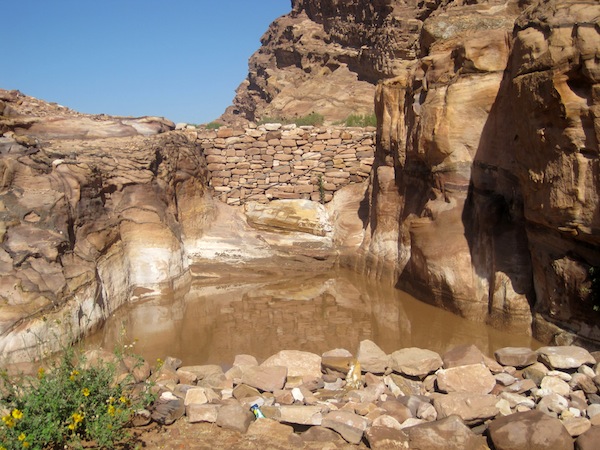
An ancient water reservoir at Petra. (photo by Orli Fields)

Desert living is tough. The toughest part of it is having water fit for consumption. Nobody knew this better than the Nabatean people. The desert was their home.

Some 2,600 years ago, the Nabateans daringly accepted the challenge of finding and supplying water to their people. They did this by building desert towns with life-sustaining water systems.

Archeologists and hydrologists have studied the waterworks at the Nabatean town of Petra. They report that Petra stood in a huge desert canyon, in what is today the country of Jordan. This area receives little rain. Petra gets only about six inches of rain a year. Temperatures go from a low of 34°F to a high of 94°F (1.1°C-34.4°C). For about half the year, the daytime temperatures are quite high. Yet 30,000 people once lived in Petra.

Petra is far from any ocean, sea, river or lake, but the Nabateans did not lack for water. Three things made this possible: the Nabateans had very smart water engineers, they had skilled builders and they had talented water managers.

photo - Petra’s water engineers had to consider the ups and downs of yearly rainfall, the ups and downs of temperature, and the ups and downs of Petra’s mountainous surroundings
Petra’s water engineers had to consider the ups and downs of yearly rainfall, the ups and downs of temperature, and the ups and downs of Petra’s mountainous surroundings. (photos by Deborah Rubin Fields)

The engineers’ biggest worry was getting Petra to save as much water as possible. So, first, they designed a water system covering the whole city. The system collected a maximum amount of water from two sources: from rain and from local springs.

The engineers had several considerations. For instance, they had to worry about the ups and downs of yearly rainfall. They had to take into account the ups and downs of temperature. And they had to overcome the ups and downs of Petra’s mountainous surroundings.

photo - closeup of mountain pipelineThe engineers also had to lower the risk of the system getting blocked. They realized that water pipes that ran along the side of a mountain would be hard to clean. Thus, they designed special water filters. These filters made it easy to trap and remove rocks or silt. If there were particles, they would settle in the reservoirs, not in the pipes. The engineers’ design was practical. It functioned throughout the year and, importantly, provided for a lot of water storage. It included crisscrossing water pipelines, channels, dams, tunnels, reservoirs and cisterns (totaling some 200 surface and underground units).

When looking at Petra’s water system, it is important to note how it was built. There were no motorized digging machines or hauling trucks, of course. All work was done by hand. The chisel was probably the most commonly used tool and, with this simple tool, builders carved an amazing water system.

Water managers had to maintain good water pressure and water flow. Too much pressure, for example, would cause a pipe to break, and that would result in wasted water. The managers’ goal was to maximize flow while minimizing leakage. They did this in part by operating a partial flow of water.

Also to reduce water leakage, the water managers used a particular kind of pipe. This pipe was often made from clay baked at high temperatures; it was short, with thin walls. Even with this innovation, Petra’s mountains and its irregular rainfall and temperatures must have meant that water managers were always on the alert.

And, sometimes, they were really “put to the test” – for example, when a large camel caravan entered Petra. When a large group of dusty and thirsty traders and animals arrived, it meant one thing: a sudden increase in the demand for water. Water would be needed for drinking and bathing. For such situations, water managers needed to ensure that back-up water sources were working.

In times of real emergency, the Nabateans had numerous storage centres. Scientists figure that some sites held three weeks’ emergency supply while other sites held several months’ supply. Thus, inhabitants had some insurance against a siege or drought.

Scientists have estimated that about 12 million gallons (or more than 45 million litres) of fresh spring water ran through Petra’s water channels daily. Water was relatively plentiful and also accessible – residents could easily reach the water that ran into nearby fountains.

The Nabateans also traveled through present-day Israel. Along what is today recognized as the UNESCO World Heritage Incense Route, the Nabateans established forts and settlements. In agricultural communities such as Shivta, they “captured” rainwater to grow grapes for wine production.

Both in travel and at home, the Nabateans’ water systems were as complex as they were practical. Even in ancient times, they overcame the harshness of desert living. They harnessed its unpredictability and thrived.

Deborah Rubin Fields is an Israel-based features writer. She is also the author of Take a Peek Inside: A Child’s Guide to Radiology Exams, published in English, Hebrew and Arabic.

Navigating Northern Ireland

The HMS Caroline, a First World War light cruiser, is worth visiting. (photo by Deborah Rubin Fields)

Identified for so long – from the late 1960s to the late 1990s – by “the Troubles,” peace appears to be bringing both social and political stability to Northern Ireland. This, in turn, has led to an economic upswing.

Greater Belfast, and some of the other coastal towns, such as Derry, once had successful shipbuilding and textile industries. At the height of Belfast’s shipbuilding, for instance, Harland and Wolff, the biggest company, employed 35,000 workers. Edward James Harland and Gustav Wilheim Wolff, who came from a German-Jewish family, started this company in 1861. They designed and built the White Line ships, the most famous of which was the doomed Titantic.

Heavy industries suffered during the Depression and were later largely knocked out of the game by the terrible decline during the Troubles – the 30-year conflict between the unionist and mostly Protestant majority, who wanted to remain part of the United Kingdom, and the nationalist/republican and mainly Catholic minority, who wanted an independent Northern Ireland – by Chinese industry and/or both. Today, Belfast’s scaled-down dock industry focuses on ship repair and iron works.

Over the past 10 years or so, Northern Ireland has moved creatively to remember its more glorious industrial past. It maintains the history of shipbuilding in two ways: by awarding historic preservation distinction to two large, biblically named shipyard cranes, the Samson and the Goliath, and by recently expanding the whole area, which is referred to as the Queen’s Island, to encompass the Titanic Quarter. If visiting, worth seeing are the HMS Caroline, a First World War light battle cruiser, local businesses (studios, etc.), educational facilities and apartment buildings, and worth doing are such leisure activities as boating and cycling.

Northern Ireland’s maritime culture dates back hundreds of years. Paralleling the region’s general history, Northern Ireland’s naval life features a lot of rough water. Some locals might tell you it was the fairies, banshees and vampires that caused nautical disasters, but non-believers will tell you human error or unpredictable stormy weather caused numerous shipwrecks.

Thus, for example, while the Spanish had the money and manpower to fight the British fleet in the late 16th century, the rough coast of Northern Ireland, on-board disease and a scarcity of supplies wiped out a not-insignificant part of the Spanish Armada, mockingly referred to by non-Spaniards as the “Invincible Armada.”

Since the late 1960s, Northern Ireland divers and archeologists have sought to locate some of the many ships that foundered along their coast. Fascinatingly, underwater discoveries are now exhibited in Derry’s Tower Museum and at Belfast’s Ulster Museum. Shipwreck sites are likewise marked along the stunning Giant’s Causeway cliff path.

While on the subject of walks, Northern Ireland offers a lot of unspoiled, green countryside. If you’re outfitted correctly, hiking is a great way to see this stunning part of the world.

Northern Ireland’s extended social, religious, political and economic battles ended in 1998. Probably nothing currently recalls the Troubles more than the murals painted in Belfast and Derry. What visitors might not realize is that a significant number of the murals are actually part of the high walls separating the unionist (largely Protestant) neighborhoods from the nationalists (mostly Catholic) neighborhoods. Since the peace agreements, the barbed wire at the top of the walls has been removed, and the gates that nightly lock the sectarian neighborhoods are bolted by a private security firm rather than by British military or police.

The murals cover a wide range of topics. Understandably, some of these locally painted murals focus on remembering the significant events of the Troubles, such as the civil rights marches and Bloody Sunday. Some of the art portrays political allegiance; some pays tribute to dead paramilitary fighters; and some are memorials to murdered children.

photo - Bangor Bank, adorned above its doorway with three Red Hands of Ulster
Bangor Bank, adorned above its doorway with three Red Hands of Ulster. (photo by Deborah Rubin Fields)

Today, however, the murals have expanded their scope to include conflicts from around the globe, such as the Israeli-Palestinian conflict. The pro-Israeli mural on Northumberland Street is dedicated to Lt.-Col. John Henry Patterson, a Christian Zionist who commanded the Jewish Legion in the First World War. The pro-Israel mural seems to receive less respect than the Palestinian and, this past summer, it was vandalized in a reported hate crime. Similarly, two years ago, an Ulster History Circle plaque erected at Israeli President Chaim Herzog’s Belfast birthplace was removed following defacement and building vandalism.

While on the subject of symbols of Northern Ireland, you may notice an open hand, often painted red, over building lintels. While it is hard to pinpoint the exact origin of what is known as the Red Hand of Ulster, it bears a similarity to Judaism’s “hand of God.” In Judaism, the “hand of God” has been a fairly common symbol, generally referring to God’s stepping into human affairs, but can be a subject in and of itself. Moreover, in both Judaism and Islam, the five-fingered hamsa is used as an amulet against the evil eye.

Belfast has a small assortment of sites with a link to Judaism, its texts or symbols. For example, in front of Customs House, there is a large stone water trough dedicated to Francis Calder, who founded the SPCA in Belfast. The trough contains a quote from Proverbs 12:10: “A righteous man regarded the life of his beast.” Close by is Albert Memorial Clock, dedicated to Queen Victoria’s husband. Undoubtedly better known for the way the tower leans, due to a sandy base, it has six-pointed stars carved into the stone.

photo - Jaffe Fountain in Belfast
Jaffe Fountain in Belfast. (photo by Deborah Rubin Fields)

Not far from downtown’s Victoria Square shopping mall, there is a striking yellow fountain donated by Daniel Joseph Jaffe (1809–1871), the founder of the Jewish community. Jaffe’s son, Sir Otto, was the mayor of Belfast twice (1899 and 1904). Sadly, his German birth led to his leaving Northern Ireland. During the First World War, when the Germans torpedoed the Lusitania near Cork in May 1915, anti-German sentiment rose to the point where, even as a leading industrialist, philanthropist and naturalized U.K. citizen, Jaffe was accused of being a German spy. He left Northern Ireland in 1916 for London, England.

The most known Jewish and Canadian connection to Northern Ireland is a tragic one. On April 2, 1912, the Titanic left its Belfast shipyard. At its Southampton launching, it carried an unidentified number of Jewish passengers, some wealthy, established Jews, but many poor Jews seeking a better life in the United States. When the Titanic sank around Newfoundland on April 15, 1912, a small number of unidentified Jewish deceased were buried at Baron de Hirsch Cemetery in Halifax, N.S.

If you plan to travel to Northern Ireland, read This Man’s Wee Boy: A Childhood Memoir of Peace and Trouble in Derry by Tony Doherty and Reading in the Dark: A Novel by Seamus Deane, and listen to Tommy Sands’ “There Were Roses.” Seek in-person and/or virtual assistance from the attentive staff at Discover Northern Ireland, Northern Ireland’s tourist facilities (discovernorthernireland.com) and visit the small Belfast Jewish community’s website (belfastjewishcommunity.org.uk) and its lively Facebook page. While you’re in the country, you can attend Shabbat morning study sessions and services.

Deborah Rubin Fields is an Israel-based features writer. She is also the author of Take a Peek Inside: A Child’s Guide to Radiology Exams, published in English, Hebrew and Arabic.

Bevis Marks 315 years later

The interior of Bevis Marks Synagogue looking towards the ark and with the bima in the left foreground. The ark is made of oak, but painted to look like Italian marble, as are the supports to the ladies gallery. (photo by Edgar Asher)

Britain’s oldest synagogue, Bevis Marks, was built in 1701. Now situated in the heart of London’s Square Mile business district, the synagogue has been in continuous use since its foundation.

In 1655, Rabbi Menasseh ben Israel arrived in London from Holland with a petition to Oliver Cromwell asking that Jews be allowed to once again to settle and live in England and begin to trade – they had been banned from the country some 366 years earlier. In 1656, Cromwell agreed, despite opposition from London merchants.

Jews had been living in England since Roman and Anglo-Saxon times. In 1066, William the Conqueror encouraged Jewish craftsmen and merchants to move to England from northern France. However, in 1290, Jews were banished altogether from England.

Bevis Marks Synagogue was, from its very beginning, an Orthodox congregation set up to serve the Sephardi Jews in the area. The need to build the synagogue came about because of the increase in the Jewish population of the neighborhood and the lack of other synagogues in the area.

photo - The central candelabrum, one of seven that hang in Bevis Marks, was a gift from the community of Amsterdam at the time of its original construction
The central candelabrum, one of seven that hang in Bevis Marks, was a gift from the community of Amsterdam at the time of its original construction. (photo by Edgar Asher)

In early 1698, a committee was set up, consisting of the leading Sephardi leaders in the neighborhood to look into the possibility of building a new synagogue to cope with the influx of Jews moving into this part of London. In February 1699, a contract was signed for the building of a new, larger synagogue and, in September 1701, Bevis Marks Synagogue was dedicated. The interior décor, layout and furnishing were based on the design of the main Sephardi synagogue in Amsterdam, which had been completed in 1675. The central candelabrum, one of seven that hang in Bevis Marks, was a gift from the community of Amsterdam at the time of its original construction.

The prominent Renaissance-style ark was painted to look as though it is made of colored Italian marble; in fact, it is surprisingly made entirely of oak. The 12 pillars, representing the 12 tribes of Israel, which support the ladies gallery, are also made of oak and painted to look like Italian marble.

Bevis Marks became the centre of the English Spanish and Portuguese Jewish community and was also the home of the community’s chief rabbis.

Bevis Marks has always been intimately associated with London, so much so that on the eight occasions when a Jewish lord mayor has been elected, Bevis Marks has been the destination of the new lord mayor’s first official duty. It has made no difference if the mayor followed the Sephardi or Ashkenazi rite. Many notable Jews have had association with Bevis Marks, including Moses Montefiore, who was also a big benefactor of the synagogue; prime minister Benjamin Disraeli’s father Isaac; and Daniel Mendoza, who was an English boxing champion in the late 18th century.

Several seats in the synagogue, even today, are roped off with a red cord to be reserved for notable people who have been associated with Bevis Marks. One seat in particular was the reserved seat of Montefiore. Now, this seat is a seat of honor reserved for a distinguished visitor, such as a Jewish lord mayor. In 2001, Prince Charles occupied the seat during the synagogue’s 300th-year commemoration ceremony. In 2006, prime minister Tony Blair was guest of honor at the synagogue during the ceremony marking the 350th anniversary of the resettlement of Jews in England.

London, from a Jewish standpoint, has undergone many changes. Over the years, Bevis Marks, apart from being the flagship synagogue of the Sephardi community in Britain, has had a large catchment area around London’s Square Mile. Two things happened to affect the attendance at the synagogue, however. First, many Jews who had become more affluent moved to other parts of London and, second, the city itself and its financial district were redeveloped from being primarily residential to large office blocks.

Nonetheless, Bevis Marks still managed to hold regular but less well-attended services. At one point, the once proud centre of the Spanish and Portuguese Jews looked like it might become an historic landmark, rather than remain a vital house of prayer. After all, the community itself designated Lauderdale Road Synagogue in northwest London as the community’s administrative headquarters. In addition, the number of British Jews claiming affiliation with any Jewish community organizations fell precipitously over a span of 50 years. Many British synagogues were on the verge of closing down or amalgamating with other synagogues in the same district.

In 1955, there were an estimated 410,000 Jews in the United Kingdom; by the time of the national census in 2001, this figure was down to only 270,000. The question on the census form asked, What denomination do you consider yourself to belong to?

Bevis Marks still attracts many visitors from all over the world, both Jewish and non-Jewish. With a few exceptions, its interior is exactly how it looked some 315 years ago. When all is said and done, the building remains a place to offer up prayer, despite some trouble, in recent times, to gather a minyan of 10 men to hold a prayer service. However, the rebuilding of London’s Square Mile and its surrounding neighborhood has brought new blood to Bevis Marks, as the developments have included up-market expensive homes, particularly in the nearby dockland areas. Young Jewish businesspeople are once again making use of the synagogue and Bevis Marks is secure in its future both as a unique architectural building and an active synagogue.