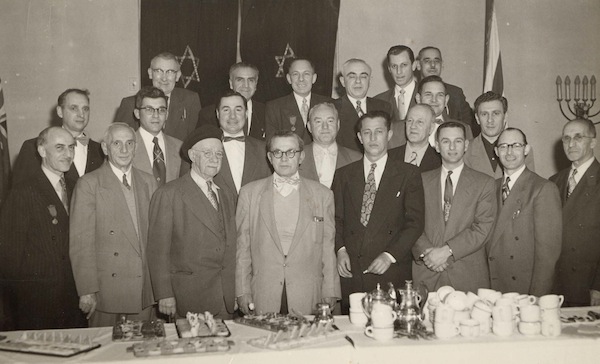
Women with thrift sale goods, National Council of Jewish Women, 1960. (photo from JWB fonds; JMABC L.13961)
If you know someone in this photo, please help the JI fill the gaps of its predecessor’s (the Jewish Western Bulletin’s) collection at the Jewish Museum and Archives of B.C. by contacting archives@jewishmuseum.ca.
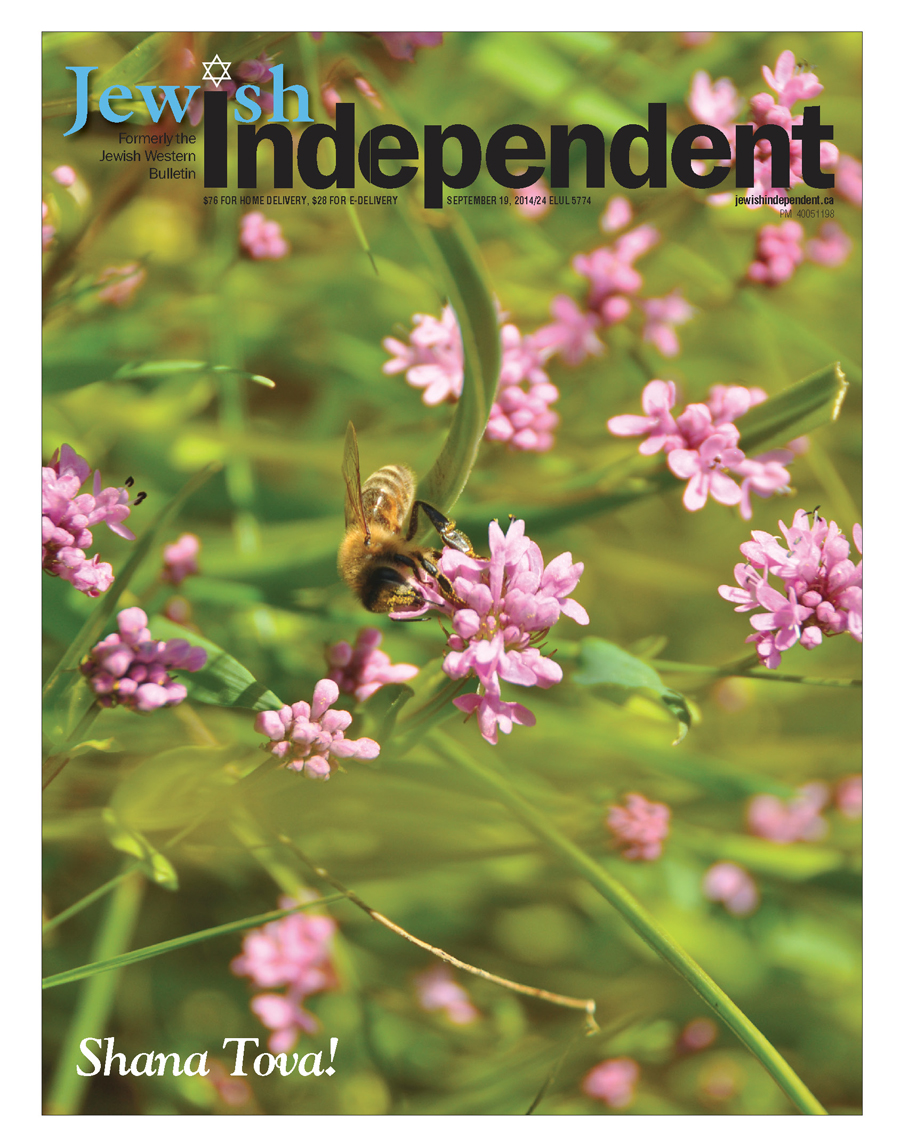
This year’s Rosh Hashanah cover featured a photographer by Saanich-based biologist Leah Ramsay (leaningoaks.ca).
Domestic honeybees, like this one, were introduced to the east coast of North America from Europe in 1622. Aided by settlers, it took a couple hundred years before they reached the West Coast. Today, they are found across the continent, with both domestic and feral populations. There are estimates that up to 80 percent of all crops in North America are dependent on bee pollination – both the honey and the apples eaten during Rosh Hashanah are dependent on bees for their production, plus multitudes of other food and forage crops. The other species in the photo is the annual plant, Sea Blush. It is a native wildflower that grows in meadows on the West Coast and produces carpets of pink in the spring. They are often alive with the introduced honeybee and native bumble bees.
It’s the children, at first, that inspire awe, the infants now walking, the toddlers talking, the grade schoolers freshly combed and pressed, the high schoolers immense, the college students all but unrecognizable in their newfound sophistication. The brief span of 12 months has metamorphosed them all. They enter the sanctuary this Rosh Hashanah morning with an eye to audience and reunion, conscious, as at few other times, of their own growth and maturity, the oldest children flanking their parents with an air of independence, the slick-haired sons towering over balding fathers, the bejeweled daughters as carefully coifed and clothed as their mothers, all proud of what they have become.
Change is everywhere: new siblings sit wedged between the old, once-single adults arrive partnered, young wives enter expectant, older couples return fractured, cleaved in twain by death or divorce. Gravity exerts its inexorable pull upon the bowed backs of the oldest congregants; the cast of many a head has grown silver; chins have sprouted beards, foreheads become more deeply furrowed, eyes less acute.
I sit among my own altered children marveling at this tidal wave of transformation passing through our midst, hoisting some as it submerges others, bearing all of us, inexorably, toward eternity. From day to day, the alchemy of aging goes unremarked, even as our children molt before our eyes. We are not meant to be conscious of every instant of change, preferring not to be reminded of the mortality and uncertainty it implies. We seek instead a reassuring constancy, a routine that grounds and sustains us, though we know our time here is all too finite, that even as we feel most anchored, we are slowly, imperceptibly, drifting out to sea. The image in today’s mirror looks no different than the one that greeted us yesterday. But a snapshot of that face a year hence tells a very different tale.
And those snapshots are what we carry with us as we enter the synagogue these High Holy Days and stare in amazement at the undeniable alteration a single year has wrought upon the familiar landscape of family and friends. It is both exhilarating and alarming, and it, more than the prayers we have come together to recite, prepares us for these Days of Awe, this personal accounting of conduct and intention, impulse and resolve.
The prospect is daunting as we join our kinsfolk and face squarely into the probing light of conscience. There is no interlocutor but the self, and perhaps no other judge. We arraign ourselves before a court of inquiry, concede doubt and weakness, ask for certainty and strength, then render judgment, emerging chastened, cleansed, perhaps annealed. We give thanks for blessings and acknowledge the fragility of our contentments, knowing that tomorrow may challenge our every conviction, undermine our serenity, rob us of everything we hold dear.
And, as we sit side by side, husbands and wives, brothers and sisters, parents and children, we discover portals to conciliation where perhaps only provocation and resistance prevailed. We rediscover tenderness and vulnerability and the myriad contradictions of our humanness. Against a backdrop of responsive prayer, we reflect upon the great challenges of parenting, on marriage’s call to remain emotionally committed, on the biblical injunction to honor our aging and increasingly infirm parents. We recite the liturgy of awe – admissions of frailty and failure, entreaties for greater understanding, for strength, for forgiveness. The gnawing hunger of Yom Kippur afternoon begins in the murmuring mouth of Rosh Hashanah, as we empty the casks of self-justification, discarding great stores of blind self-interest, and live for a time consuming nothing but the thought of our own imperfection.
And yet … while these Days of Awe clarify and distil us, they cannot sustain us. We are not cloistered contemplatives; we require a richer diet, one free of the astringent bite of continuous self-scrutiny. We need to live, to test our resolve. The gates will close, the great accounting will conclude for another year, and we will turn back to life renewed by these days of honest soul-searching, passing from assessment to action.
As the final song is sung, I turn to my family, wondering what has passed through their hearts during these hours of prayer. My son seems wrung out by so much stasis, eager to shed his confining clothes, grab a basketball and burst back into the light. My daughters yearn for the disembodied voices of friends, silver cellphones shimmering in their restless hands. My wife looks upon them with gratitude, awakening anew to the miracle of their presence in our lives, their youth, their beauty, their remarkable growth. She kisses each cheek, then takes my face in her hands and murmurs, “L’shana tova.”
May it be so for us all.
Steven Schnur, a member of Westchester Reform Temple in Scarsdale, N.Y., teaches writing at Sarah Lawrence College. This article was originally published in Reform Judaism magazine, and can be found at reformjudaism.org/these-days-awe. It is reprinted with permission.
Carrots represent the hope that Israel’s enemies will be “cut off,” or kept away. (photo by Stephen Ausmus / USARS via en.wikipedia.org)
Most Jews, religious or not, celebrate Passover, opening the holiday with a seder – fewer know that a seder is held on Rosh Hashanah, too. Being the year’s first meal, it gains higher importance in Jewish tradition and, therefore, should be special.
In the seder of Rosh Hashanah, a dedicated prayer is said, then a meal with symbolic foods is served, each food representing a different blessing for the people of Israel. Some of these foods have a unique prayer that is said prior to eating them. These foods differ slightly between communities, yet some are common, and are served on both religious and secular tables.
As some of the seder foods may stand for similar blessings, not all of them have been preserved among secular Jews. The most common traditional food served at Rosh Hashanah is an apple, dipped in honey; this custom represents a blessing for the year to be as sweet as honey. Gefilte fish is also served, usually having slightly sweet flavor, for the procreation of the people of Israel like the propagation of fish. On the gefilte fish, sliced carrots are placed, a symbol for Israel’s enemies to be “cut off.”
A fish head is displayed/served, symbolizing a blessing for the people of Israel to be the head and not the tail. This blessing has two meanings: (a) we will be the thinkers, the inventors; (b) we will gain leadership by moving forward, following our own will; not backwards, following other peoples’ will.
Beets also represent the hope that Israel’s enemies will be kept away. (photo by Jennifer Kleffner / Miles Away Farm via flickr.com)
Sometimes, a beet or beet leaves are served for the removal of Israel’s enemies. A pomegranate is served, its many seeds symbolic of the many mitzvot that the Jewish people have and hope to continue to have.
Although linguistically not necessarily related historically, some of the foods are traditionally linked to their blessings by their Hebrew roots: the carrots placed on the gefilte fish are called gezer (pl. gzarim, root gzr) in Hebrew. The blessing of cutting off Israel’s enemies that is symbolized by the carrots makes use of the root gzr: “sheig az ru oyveynu,” “let our enemies be cut off.” The beet (leaves) is selek (root: slk); the related blessing: “she-is talku oyveynu ve-son’eynu,” “let our enemies and haters be gone,” is also represented by the same root slk, “remove.”
Other traditional foods either make use of a semantic feature of the original notion, or they have undergone a semantic shift to adapt to the holiday’s blessings. For example, we use the feature of quantity of the schools of fish for the parallel blessing: “shenifre ve-nirbe ke-dagim,” “let us procreate [literally: be fruitful and multiply] as fish.”
The fish head represents the brain, as well as the mind, which spiritually lies in the brain, and leadership, by being the head, the first in everything. This word gains a double meaning, as it appears in the name of the holiday, Rosh Hashanah, as well as in rishon, “first,” derived from rosh, “head.”
I wrote down some of these thoughts from my home shelter during the war. Let us hope to be blessed in the future with real rimonim (pomegranates’ fruit), and not rimone-yad (hand grenade). Let us bless southern Israeli fishermen to be able to continue fishing, and farmers to be able to continue selling their honey, carrots and beets, so that all of us can have a peaceful Rosh Hashanah seder. Happy New Year.
Nurit Dekelis an independent academic researcher of colloquial Israeli Hebrew, and principal linguist at NSC-Natural Speech Communication; author of Colloquial Israeli Hebrew: A Corpus-based Survey. She is based in southern Israel.
Fish is a traditional part of the Rosh Hashanah meal. Since Rosh Hashanah translates literally as “Head of the Year,” some people will eat the head of a fish as part of the holiday meal, or at least have one on their holiday table. Fish is also a symbol of fertility and prosperity.
Today, we will make a beautiful fish from Plasticine. While you won’t be able to eat it, you can add it to the table with other symbols of the holiday.
For this art project, you will need various colors of Plasticine or Play Doh.
1. First, we make the body of the fish. Roll a small ball from blue Plasticine.
2. Flatten the ball with the palm of your hand and flip onto the other side.
3. With the tip of your fingers, gently raise the edges on both sides.
4. Now make a top fin. You will need three small pieces of dark blue or purple Plasticine. Using a toothpick, attach the top fin to the body of the fish.
5. Use yellow Plasticine to make a bottom fin.
6. Add an orange fin on top of the yellow one.
7. With the help of a toothpick, make an indent for the mouth. Later, using pink Plasticine, create heart-shaped lips. Attach the lips to the body.
8. Using white and black Plasticine assemble an eye, and add it to what you’ve already put together.
9. Our fish is almost ready! We just need to add scales. Make a small green ball and flatten it. Add this newly formed circle to the body. Now, create many of these circles and decorate your fish with beautiful and colorful scales.
Instead of circles, you may create stripes or any other unique designs – and, of course, you can use any colors you want for any part of your fish. Art is a soul’s expression. Imagine, inspire, innovate!
Happy New Year to all young readers and their parents! Curly Orli and I wish you a year full of happiness and joy!
Lana Lagooncais a graphic designer, author and illustrator. At curlyorli.com, there are more free lessons, along with information about Curly Orli merchandise.
The tuna salad recipe is one of Lynn Kirsche Shapiro’s mother’s most popular recipes. (photo by Nick Ulivieri Photography)
The first section of Food, Family and Tradition: Hungarian Kosher Family Recipes and Remembrances (Cherry Press, 2013) is a family album, which Lynn Kirsche Shapiro says is her way of completing two unfinished legacies: “my mother’s recipes and my father’s autobiography.”
Her mother went blind at age 75 and Shapiro viewed the project of compiling her recipes as a tangible tribute to her mother’s contribution to the lives of her family and others. Her father was in the process of writing his life story when he died at the age of 81.
Food, Family and Tradition is both cookbook and memoir.
“After beginning the book, I understood that my family’s recipes and history were part of a larger world: the traditional Jewish life in Czechoslovakia and Hungary before the Holocaust,” Shapiro writes. “Many books have been written to educate others, to bear witness to the events and atrocities of the Holocaust. My book also attempts to get the picture of the richness of Jewish life in Eastern Europe prior to the Holocaust. Strong family traditions were the bedrock on which our parents, and so many of the Holocaust survivors, were raised. It is because of this strong family bond, deep tradition and unwavering faith that our parents were able to live again, to build a family and to contribute to the future.”
Shapiro’s father, Sandor Kirsche (Shalom Kirschenbaum) was born in a village in Carpathian Czechoslovakia. His family ran a small grocery store in their home. Barely surviving Buchenwald, he returned to his hometown of Hlyuboka, where he found his remaining two sisters who, along with Sandor and an aunt and uncle, were the only five remaining from 38 family members. A ship he had planned to take to Palestine was canceled and he soon after met Margit Weisz. They married in 1947 and moved to Chicago. There, Sandor worked in retail foods and, in 1973, opened an all-kosher supermarket that thrives today.
Margit was born in Gergely, Hungary. In 1944, on the last day of Passover, word came that the Nazis were to evacuate the Jews the next day. Her family hired non-Jews to drive them in wagons away in the night, but they were caught. They were sent first to a ghetto and then most of the family was killed in Auschwitz. Shapiro’s mother was sent to a subcamp of Buchenwald, where she worked with 250 other women preparing wooden crates and making ammunition. After liberation, she discovered that a brother had survived, alone among their large family. Meeting Sandor shortly after liberation, the family story takes an uplifting turn as their American dream becomes real.
The recipes in the book are not really innovative. Many of them, like the ones included here, which have been proven in one of the Jewish Independent “test kitchens,” are superb in part because of their simplicity. While East European cuisine generally, and its Jewish form specifically, certainly have dishes that are set apart from others as emblematic of major celebrations, they emphatically avoid fancy-schmancy trends so common today. This is probably why recipes like these last generations.
The book, in fact, has a litany of the classics of Ashkenazi Jewish cuisine: chopped chicken liver, gefilte fish, chopped herring, stuffed cabbage, borscht, potato soup, chicken soup, of course, blintzes, kugel, boiled fish, schmaltz, cholent, goulash, brisket, tzimmes, beet salad, latkes, kasha, and a litany of baking from challah to dumplings and honey cake.
While these recipes are fitting for the High Holidays, you might want to put them aside (the ones with oil, at least) for Chanukah as well.
SWEET AND SOUR CABBAGE SOUP WITH MEAT Traditional Hungarians cooked cabbage in a variety of ways. Here is a rich and tasty sweet and sour cabbage soup, with the deep flavor of meat. I like to cook it for a few hours to develop a flavor. For a sweeter taste, add raisins. I always do.
1 to 2 tbsp vegetable oil 1 1/2 to 2 lbs short ribs, cut into large chunks 1 medium onion, diced 1 medium head cabbage, cored, cut into small squares or shredded 1 (28-ounce) can whole tomatoes quartered or one (28-ounce) can diced tomatoes 1 cup tomato sauce 1/2 tbsp lemon juice 1/3 cup sugar 1/4 tsp freshly ground black pepper 1 tsp salt 1/3 cup dark or golden raisins, optional
In an eight-quart pot over medium-high heat, heat oil. Brown short ribs with onions, turning so ribs brown on all sides. Decrease heat to low, cover tightly and steam until meat is tender, about 30 minutes to one hour.
Add the cabbage, the tomatoes together with their juice, and the remainder of ingredients to the meat, including raisins if using. Add six cups of water. Bring to a boil, decrease heat to low and simmer, covered, until the cabbage and the meat are both tender, about one hour. Taste and adjust seasonings. For a richer flavor, cook an additional 30 minutes to one hour.
Serve ladled into heated bowls. Makes eight to 10 (eight-ounce) servings.
TUNA SALAD This tuna salad is one of my mother’s most popular recipes, and we have been told that nobody’s tuna salad is as tasty. It is simple but it has its secrets. One is the grated egg; another is the oil-packed tuna. You can substitute water-packed tuna if you want a lighter salad, but the depth of flavor will not be quite the same.
1 (12-ounce) can or 2 (5-ounce) cans oil packed tuna, well-drained 3 hard-boiled eggs, shelled 1/4 cup minced onion 1 stalk celery, very finely chopped 1/3 to 1/2 cup mayonnaise
Place tuna in a medium bowl and mash with a fork. Grate the egg and add to the tuna, stirring to mix. Add the onion and celery, and mix well with the mayonnaise. Cover and refrigerate for up to three days. Makes four servings.
CHICKEN SCHNITZEL Schnitzel is authentically European, whether veal or chicken. My mother’s chicken schnitzel is special. She debones her own white meat from the chicken, then slices it thin and pounds it to about 1/4-inch uniform thickness. Also, she uses fresh breadcrumbs for the breading. Pounding the chicken breasts uniformly thin allows them to cook faster and more evenly. For added flavor, I often mix breadcrumbs with cornflake crumbs, half and half.
6 to 8 boneless skinless chicken breast halves, about 2 pounds 1 cup flour 1 tsp seasoned salt 1/2 tsp sweet Hungarian paprika 1/4 tsp garlic powder 1/4 tsp freshly ground pepper 2 eggs, beaten, mixed with 1 tbsp water 1 cup fresh breadcrumbs, or 1/2 cup fresh breadcrumbs and 1/2 cup cornflake crumbs vegetable oil for frying, as needed
Slice each chicken breast in half horizontally. Cover each piece with plastic wrap. Using a meat mallet or rolling pin, pound chicken breasts to an even thickness of 1/4 inch. Some tears are OK; even thickness is the most important step.
Place flour and seasonings in one shallow bowl; stir to mix. Place egg and crumbs into additional separate shallow bowls.
Dip each chicken piece first in flour, then egg and then the crumb mixture. Transfer to a tray or plate and repeat until all chicken is breaded.
In a 12-inch skillet over medium-high heat, heat oil as needed. Fry schnitzel on each side, in batches, turning once, until golden brown and cooked through, about five minutes for each side.
Serve immediately or transfer to a parchment-lined baking pan and keep warm in a 250°F oven. Serve on individual plates with vegetables and potatoes or rice of choice. Makes eight servings.
FRIED CAULIFLOWER This is crispy and best prepared in a deep fryer. For a lighter, healthier choice, oven bake it on a cookie sheet.
oil, as needed, for deep frying 1 cup bread crumbs, preferably from challah, or 1 cup cornflake crumbs [the Independent used Panko, with great results] 1/4 tsp salt 1/4 tsp sweet Hungarian paprika 1/8 tsp freshly ground black pepper 1 cup flour 2 eggs, beaten 1 large head cauliflower, separated into florets
If frying, preheat the oil to 350°F in a deep fryer or deep pot. Season breadcrumbs or cornflake crumbs with the salt, paprika and pepper.
In three separate shallow dishes, place flour, eggs and crumbs.
Dip the cauliflower florets first in the flour, next the eggs, and then the breadcrumbs. Fry in batches in the deep fryer, drain on paper towels.
Alternatively, preheat oven to 400°F. Place breaded cauliflower florets on a parchment paper-lined baking sheet sprayed with nonstick cooking spray, and bake until crisp and brown, about 20 minutes, turning the pan once in oven.
Makes eight servings.
CUCUMBER SALAD, UKORKASALATA
Cucumbers were readily available in Hungary and Czechoslovakia from spring through summer, making ukorkasaláta a classic salad during the season, light and refreshing, perfect for a summer meal. My husband, Irv, likes to serve it as an accompaniment to grilled steak; it balances the richness of the beef. The vinegar and the salt are preservatives, allowing the salad to keep, refrigerated, for a week. Of course, as my mother says, “At home, we never worried about the refrigeration because it never lasted too long – it was all eaten up quickly.” It is best prepared in advance, so the cucumbers have a slightly pickled flavored.
2 large seedless cucumbers (about 1 1/2 pounds), skin on, sliced paper thin one medium onion, sliced paper thin 1 heaping tbsp salt 1/3 cup water 1/3 cup sugar 1/3 cup white vinegar
Place the cucumbers and the onions in a medium bowl and toss with the salt. Let stand for one hour. Transfer to a colander and drain. Place plastic wrap on top and press down to extract the maximum liquid. Transfer drained cucumber onion mixture to a nonreactive bowl. Reserve.
In a small bowl, place water, sugar and vinegar, and whisk to dissolve sugar. Pour this marinade over the cucumber and onions. Cover and refrigerate, for up to one week.
On the right track to finding a place to purchase shofarot. (photo from Steven Finkleman)
Heading down the B2 from Swakopmund to Windhoek, I could see by the road signage that this would be a prime location to search for the perfect shofar. As you can see from the signage, with each kudu, one would have two shofars to blow on Rosh Hashanah.
So, I went on the prowl for the perfect shofar in Namibia. When I was in Windhoek last spring and was at the airport awaiting my return flight to the big city of Johannesburg, I happened to notice a Chassidic man on my flight carrying several long, Yemenite-style shofarot. Although I didn’t speak to him at the time, it was clear that with an abundance of African antelope, Namibia could be a good source of shofarot for Jews all over the world.
Apparently, there are two types of shofarot that are kosher to use. The original was a ram’s horn, which is linked to the biblical account of the near sacrifice of Isaac. At the last moment, a ram tangled by its horns in the bush appeared to Isaac’s father, Abraham, and he sacrificed the animal instead of his son. The other style comes from Yemen, where there was an abundance of antelope, or more specifically kudu, from which the Jews in that country were able to make shofarot.
A fantastic set of kudu horns. (photo from Steven Finkleman)
Both styles are used today, and indeed in my own synagogue sanctuary is a painting by Gertrude Zack of a rabbi blowing a Yemenite-style shofar. Whether there are still kudu in Yemen is unclear to me. Perhaps, it is too dangerous for Jews to fly into Sanaa looking for kudu horns. Therefore, why not come to the safe locale of Namibia, known among tourists as “Africa lite” for a safe supply of kudu-horn shofars.
I was fortunate to have a work project this April in Windhoek and, clearly, one of my main goals, besides work, of course, was to track down that supply of kudu horns. It sounded like a great article: “In search of the perfect shofar, direct from its source.”
I made contact with Zvi Gorelick of the Windhoek Jewish community, and visited the synagogue, now about 80 years old, took some great pictures and attended the Friday night service. Theirs is a small community, very diverse and welcoming. Indeed, the second Shabbat, I had arranged to lead the service in my Reform style, with lots of traditional and vibrant Shabbat songs, probably quite distinct from the South African Orthodox service that the congregation was used to. Indeed, after services, I was fortunate to be invited to Barbara and Alexandra’s home for Shabbat dinner. All were welcome to join.
Once there, I was able to ask Zvi the all-important question in order for me to continue my quest for the perfect shofar. I was directed to the Nakara Tannery in the North Industrial area.
The two-dollar cab ride took me directly to the factory and the factory shop. Trying to keep things low-key and not to come across as a camera-happy tourist snapping four million pictures, I kept calm as I checked out the warehouse and then the factory store. The warehouse was filled with hides of all kinds, the most distinctive being the piles and piles of Zebra hides. Quite a sight. And, we think in Canada, it’s cool to have a bearskin on the wall!
As I entered the factory store, I noticed some kudu horns on the ground, polished, and some of very gaudy colorations – blue, orange, red, etc. Obviously not suitable for a shofar.
Testing a shofar out in advance of Rosh Hashanah. (photo from Steven Finkleman)
Trying to play it cool, I asked the sales lady at the desk, Marie-Louise, if they sell vuvuzelas made of kudu horns. Do you remember all those horns at the World Cup soccer tournament in South Africa a few years ago? She replied in the affirmative, and as I stammered away asking for a kudu-horn sort of trumpet, she responded in her Afrikaans accent, and asked if I was interested in buying a shofar for Rosh Hashanah! I knew immediately that I was at the correct spot. I coolly ordered four, but subsequently placed an order for another three. Darn good price … perhaps I ought to import them. I wonder who is making the 10 times mark-up in North America!
I then asked to see the factory where the shofarot are made. Starting with raw skulls, the horns are removed, soaked in water to remove the central core, then polished, and finally the tip is cut off in order to turn it into a shofar. I took my usual million pictures of the workshop and the production line, and, of course, tested a few shofarot out.
As I packed up my multiple shofarot, I began to wonder what sort of grief the customs officials might give me with my suitcase of kudu horns. After all, I would be crossing multiple borders, into Botswana, Zambia, Zimbabwe, the United States and, finally, home to Canada. I’d tell them the truth, of course, that these are religious article; I was unlikely to run into any trouble. Right?
Steven Finkleman, originally from Winnipeg, is a retired pediatrician living in Kelowna. He travels extensively and often researches and visits remote Diaspora communities on his adventures.
Mikve Israel-Emanuel in Willemstad, Curaçao, is the oldest synagogue in continuous use in the Americas. (photo from Masada Siegel)
The night was aglow with candles and the silky white sand found its way in between my toes. I grinned, as it only added to the spirituality of the experience. Then, the chanting began.
No, I was not at an ashram or a yoga retreat. I was experiencing Shabbat services in the oldest synagogue in continuous use in the Americas, Mikve Israel-Emanuel in Willemstad, Curaçao.
Originally established in 1651 by settlers from Amsterdam, many in the community are of Spanish and Portuguese descent, as well. The settlers brought traditions from their ancestors, one of which was placing sand on the floor. During the Spanish Inquisition, secret Jews called conversos put sand on the floors of rooms in which they worshipped, which helped to muffle the sounds during services, and to avoid certain death if discovered. And so, today, sand is still placed on the floor of the synagogue to honor their ancestors and to remember the past.
My way of arrival to Curaçao was via a Holland America cruise, whose itineraries sometimes allow for late evening departures, allowing travelers to experience Shabbat services in a magnificent synagogue such as Mikve Israel-Emanuel.
Our ship, the Zuiderdam, was cozy and intimate, the food was plentiful and there was an explorer lounge filled with books, a coffee bar, fitness centre and the all-important spa. A cruise is one of the best ways to combine relaxation, excitement, scenic views and fabulous food. Kosher catering is also an option on this ship, we were told by the two Orthodox couples we befriended on deck. Holland America also offers shore excursions, as varied as city tours and swimming with dolphins.
The journey through the Panama Canal takes the cruise ship through the Gatun locks. (photo from Masada Siegel)
Our adventure would take us from the majestic Mikve Israel to the thatched-roof homes of the Emberá tribe who live in the Panamanian rainforest. Experiencing the magnificent Panama Canal transit through the Gatun locks, steering through one of the 20th century’s greatest engineering marvels, we saw some tight squeezes, massive lock gates, boat-tugging locomotives and ongoing canal expansion work.
Finally, we disembarked, journeying via bus and then on motorized canoes back in time on the Chagres River in Chagres National Park, where we met members of a tribe that maintains traditions and a lifestyle from before the Spanish colonized Panama, more than 600 years ago.
Singing children and ornately decorated ladies with flowers in their hair greeted us upon our arrival to the jungle. The women were topless but were mostly covered in intricate non-permanent drawings and markings. They wore brightly colored sarongs as skirts. The men wore loincloths.
I wandered from the crowd and found myself photographing a young lady, and we started to communicate via pencil and paper, mostly laughing. As the rain started to pelt down from the sky, she invited me to stand under her house, which was on stilts, and to meet her two dogs. She was celebrating her birthday the next day and was excited. She motioned for me to come with her to meet some of her friends.
Members of the Emberá tribe present their wares for sale, including their brightly colored woven baskets. (photo from Masada Siegel)
Eventually, I found my way to the centre of the village, which had a covered area where families were selling their creations. Each family had a table with their wares for sale.
The woven baskets were exquisite and a few found their way home with me, not to mention some sculptures, a wooden slingshot and brightly colored necklaces carved out of wood. Truth be told, the works were so stunning, I spent every penny I had with me.
The women prepared food and used large leaves folded as plates for serving. After dinner, members of the community performed some traditional dances for the visitors. The whole experience was a window into a world of yesteryear.
The rain came cascading down as we found our visit over and made our way back to the river and canoes. I soon found myself in the Sloth Sanctuary in Costa Rica.
Sloths are extremely slow-moving mammals found in the rainforest canopies of Central and South America. There are two species of sloths: two-toed and three-toed. Most sloths are about the size of a small dog.
A baby sloth at the family-run sanctuary in Costa Rica. (photo from Masada Siegel)
Alaskan Judy Avey-Arroyo and her Costa Rican husband, Luis Arroyo, started the Sloth Sanctuary after three young neighbor girls brought them an orphaned three-fingered baby sloth.
They called the San José Zoo and a rescue centre for help, but soon realized they were on their own if they wished to save the sloth. They named her Buttercup and, 21 years later, she greets visitors at a sanctuary that has saved hundreds of the cute creatures and releases as many as possible back into the wild.
The Sloth Sanctuary is a family-run operation where the love of the furry creatures is obvious. It led me to reflect on all aspects of my journey, from the dedication of the people who created the synagogue hundreds of years ago to the world of yesteryear in the Panamanian jungle.
Every place and space we visited revealed a love and respect for heritage, nature and working together to build a better world. Perhaps this is why some of us are compelled to travel, to see the beauty, the goodness from other worlds and to take a piece of it home, to make our own worlds brighter, happier and more meaningful.
From Sybil Kaplan: A couple of years ago, I discovered clafouti, the French dessert of fruit, covered with a batter, baked and served warm. What I loved most was that it was good year around, it could be made pareve and it looked elegant.
MASTER CLAFOUTI Works for peaches, plums, nectarines, cherries, pumpkin, pears, apples. Makes six to eight servings.
1 cup non-dairy creamer or pareve whipping cream (with/without sugar) 1/3 cup sugar (or substitute) 4 large eggs 1 tbsp vanilla 1/2 cup flour
Preheat oven to 350°F. Butter a baking dish or deep glass pie plate. Place non-dairy creamer, sugar, eggs, vanilla and flour in a blender or food processor and blend until smooth. Place fruit overlapping in bottom of baking dish. Pour batter on top. Bake 30-40 minutes. Serve warm or at room temperature.
APPLE CLAFOUTI 6 apples 1 cup non-dairy creamer or pareve whipping cream 1 tbsp brandy 1/4 cup raisins 4 eggs 1 tbsp vanilla 1/2 cup flour
Follow directions for master clafouti. Makes six servings.
CLAFOUTI WITH PEACHES 6 large sliced peaches 2 1/4 cups non-dairy creamer or whipping cream 3 eggs 3 egg yolks 1 1/2 tsp vanilla 6 tbsp sugar cinnamon
Grease baking dish. Preheat oven to 350°F. Place peach slices in baking dish. Whisk together non-dairy creamer, eggs, egg yolks, vanilla, sugar. Pour over peaches. Sprinkle on cinnamon. Bake 30-40 minutes until knife inserted in centre comes out clean. Makes six servings.
Plum cake (photo by Frank Vincentz via commons.wikimedia.org)
From Esther Tauby: This is a Rosh Hashanah cake that my Aunt Rose made up and my mother always makes for the holidays – as do I. Enjoy!
PLUM CAKE 2 cups flour
1 1/2 cups sugar 1/2 cup oil 3 eggs 2 tsp baking powder 1/2 cup water 1 tsp vanilla 6-8 prune plums pinch of salt
Cream oil and sugar. Add eggs, beat well. Add flour, baking powder, salt, then vanilla. Use Pam or cover nine-by-13 cake pan with foil or parchment. Pour in half the batter. Cut plums in half lengthwise, place face down in batter. Cover with rest of batter. Bake at 325°F until golden brown, about 30 minutes.