Lovin’ from the oven

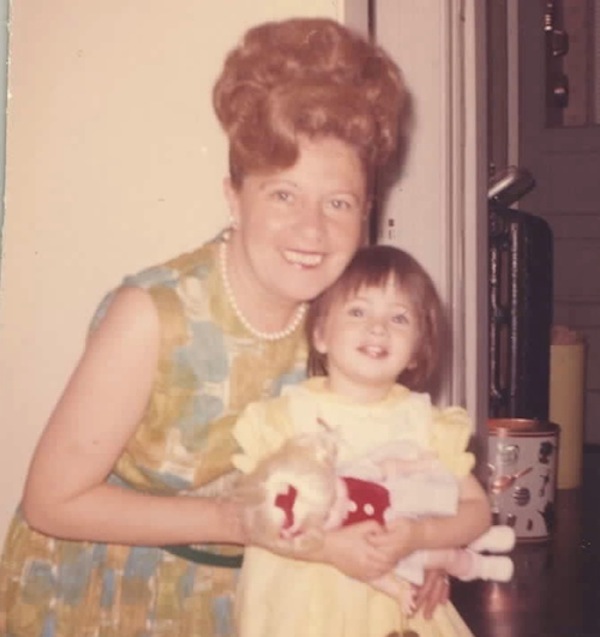
A young Dawn Lerman with her grandmother, Beauty (photo from Dawn Lerman via JNS.org)

In her memoir My Fat Dad, New York Times wellness blogger and nutritionist Dawn Lerman (@dawnlerman) shares her food journey and that of her father, a copywriter from the Mad Men era of advertising. Lerman spent her childhood constantly hungry, as her father pursued endless fad diets from Atkins to Pritikin, and insisted the family do the same to help keep him on track. As a child, Lerman felt undernourished both physically and emotionally, except for one saving grace: the loving attention of her maternal grandmother, Beauty. Below is an adapted excerpt from My Fat Dad, in addition to a recipe for a healthier version of a Chanukah staple.

***

When I lived in Chicago, Jewish holidays were spent either at my Grandma Beauty’s house or my Bubbe Mary’s house. My grandmothers lived near each other on Chicago’s north side. I saw Beauty every weekend, but I would only see Bubbe Mary, my father’s mother, on occasional holidays. While my grandmothers had a lot in common – they were both amazing cooks – they were also very different.

book cover - My Fat DadBeauty adored me, but Bubbe Mary did not seem to have much time to see me. Also, Beauty was all about being healthy, using a lot of fresh fruits and vegetables in all her dishes. Bubbe Mary was all about recreating the dishes that made her feel closer to Old World traditions she left behind in Romania.

Every year at Chanukah, the whole family was invited to Bubbe Mary’s for a traditional Jewish dinner. She even included my mom’s parents, Beauty and Papa. What I loved most about holiday gatherings at Bubbe Mary’s house was seeing my first cousins, whom I adored but rarely ever saw – and listening to both grandmothers speak Yiddish. I never knew what they were saying, but something about the sound of the dialect combined with intense hand gestures and the aromas of the Jewish food left a lasting imprint.

Bubbe Mary grew up in Romania and traveled by boat to the United States when she was 13. She traveled with some of her sisters and brothers, but many family members were left behind.

Bubbe Mary used schmaltz to cook everything – from matzah balls to latkes to chicken livers. Everything was fried with schmaltz, which she kept in a glass jar above her stove. For Chanukah, she often went through a whole jar. She fried and grated so many potatoes for the latkes that her knuckles would bleed. She made sure if you were eating at her home there was plenty of food, and you would not leave without a full belly and a doggy bag.

The most memorable Chanukah at Bubbe Mary’s was when I was 8, the last one before my family moved to New York, and one of the last times I ever saw her.

Read more at jns.org.

Figuring out family holidays

Adam Brody played Seth Cohen in the show The O.C. and celebrated “Chrismukkah.” (photo from cookiesandsangria.files.wordpress.com)

If nothing else, The O.C., the popular 2003-07 American television show that featured the overblown dramas of hyper-privileged Orange County teens and their self-obsessed parents, can be credited with making a household name of “Chrismukkah” – the handy portmanteau that character Seth Cohen used to describe his interfaith family’s fusing of Christmas and Chanukah.

With intermarriage on the rise, many Jews in Canada and the United States are partnered or raising children with spouses of Christian backgrounds. Jewish Federations of Canada-United Israel Appeal’s 2011 National Household Survey found that the intermarriage rate in this country is 25%, about half the rate in the United States.

With Christmas being the centrepiece of the Christian calendar in the West – even for the increasing number of North Americans who celebrate Jesus’ birthday only culturally – many intermarried Jews find themselves in a quandary: should they embrace “Chrismukkah,” observe Christmas and Chanukah separately, or focus on creating an exclusively Jewish home by just celebrating the Festival of Lights.

While every family’s situation is different, it seems that many interfaith couples are finding ways to mark both holidays, but with the emphasis on each one’s cultural value.

This lines up with findings from the Pew Research Centre’s 2013 study A Portrait of Jewish Americans, which notes that younger generations of American Jews – 32% among Jewish millennials – often identify themselves as Jewish on the basis of ancestry, ethnicity or culture rather than religion. This matched the broader U.S. public’s shift away from religious affiliation, which is particularly prevalent among those in the 18-to-29 age range.

As for “Chrismukkah,” the Pew report found that about one-third of Jews surveyed said they’d had a Christmas tree in their home the year prior. Among those married to non-Jews, that number was 71%.

Tyler Irving isn’t Jewish, but his wife is, and the couple had their first child last year.

“So far, I’ve found it pretty easy to celebrate both sets of holidays,” he said. “We’ve been thinking about holidays as chances to reflect on culture, spend time with family and build strong bonds, and putting less emphasis on the religious aspects.”

Because Christmas is when they visit Irving’s parents, who live in the country, he expects that his own kids will view Christmas as a time to “be with Grandma and Grandpa,” while Chanukah will be “the chance to go to spend time with Bubbie and Zaide.”

Arielle Piat-Sauvé grew up in Quebec with a Jewish mother and a Catholic father.

“We always celebrated both holidays,” she said. “We went to my dad’s family for Christmas, though we did have a tree and did gifts at our own home. On Chanukah, we’d light the candles and do something with my [maternal] grandma and cousins. When I was younger, I’d get a gift for each night, but that wore off.”

If the two holidays coincided, her family would first light the Chanukah candles and then go to her grandparents’ for Christmas dinner. She stressed that neither holiday celebration focused on their religious components, but tradition and family time.

“Often, it’s easier for families to add than subtract,” said Rabbi Jordan Helfman of Toronto’s Holy Blossom Temple, a Reform synagogue that has among its members quite a few interfaith couples.

Interfaith families with children enrolled in Holy Blossom’s supplementary religious school are asked not to celebrate Christmas in their own homes, but going to a non-Jewish relative’s place for Christmas is OK, Helfman explained.

“My experience is it’s not hard for children to make that distinction, especially when the parents are clear about, ‘This is what we do in our house, and this is what Grandma does in her house.’ Kids are smarter than we give them credit for,” he said.

Rabbi Tina Grimberg of Congregation Darchei Noam, Toronto’s Reconstructionist synagogue, said her congregation has a number of interfaith families, many of whom get involved in the shul’s Chanukah festivities, or who light candles in their own homes.

“Do I go into people’s homes and see Christmas trees? Not often at all. Do trees come up in [interfaith congregants’] homes on Dec. 24? Most likely not … though if people do celebrate both Christmas and Chanukah, they don’t tell me,” she said.

Just because a non-Jewish partner hasn’t converted doesn’t mean Christmas is central in their life, she emphasized. And, ultimately, when addressing interfaith families’ practice of Judaism, there’s a larger conversation at play.

“It’s about how to live life in a Jewish context when you have deep roots in another reality. It’s not about, ‘I’m Jewish because I don’t celebrate Christmas.’ It’s ‘How many Jewish things do I do … do I do Shabbat, go to synagogue, have a seder, do mitzvot, say Shema in the morning?’” she said. “Some people will still have a tree, because it honors their grandma, while others feel they have enough of a rich Jewish life that they no longer need it.”

Rabbi Jillian Cameron is director of the Boston chapter of InterfaithFamily, a U.S. organization that supports interfaith couples exploring Jewish life. It provides families with educational materials and connections to inclusive organizations, programs and local clergy.

She stressed that, while she doesn’t see a single trend with regard to how families led by intermarried couples approach the holidays, at this time of year, many of them are focused on figuring out how to be respectful of both Chanukah and Christmas, whether they celebrate the holidays in their own home or that of an extended family member.

While Christmas can be tough to give up for many who are raised with it, Cameron said, the religious element is secondary to “the family connections, the music, the smells, the tree … there’s a big pull to the sensory nature of Christmas.”

She added that this speaks to the wider trend of younger people finding value in tradition, but focusing on things outside of the theological realm.

While families with one Jewish and one Christian parent observe the holidays at this time of year in all sorts of incarnations, it’s clear that many, as in the general population, are most concerned about preserving tradition and a sense of family togetherness.

– For more national Jewish news, visit cjnews.com


Getting through Chanukah

It’s that time of year again! For many, the holiday season is spent with family and is filled with nothing but joy, love, laughter, gratitude and giving. If this is you, you can go ahead and stop reading now…. This piece is for those of us who don’t live on the Hallmark Channel.

Let’s be honest with ourselves. We love our family. At the same time, getting together with our families or our in-laws around the holidays can get stressful, awful or even painful. Some people end up in my therapy office after the holidays, shattered from family celebrations.

If you’re tired of the stressful dynamics in your family, maybe this year it’s time to try something a little different. Let’s call this an early Chanukah list.

Set boundaries. Setting boundaries is the foundation for standing up to the family difficulties that we deal with every year. Maybe the lessons we learned in childhood were to not “stir the pot” and to avoid conflict. The end result of this is that we end up acting as if we are OK when, quite frankly, we aren’t.

When your mother–in-law pulls up an old dig about your weight, you don’t have to sit quietly and let your blood pressure go through the roof. Instead, you can say, “I don’t like it when you make comments about my weight.”

Another way to set boundaries is to put space between yourself and whatever or whomever you’re trying to set boundaries with. You may not be able to control what others say, but you can certainly move yourself to another room or go for a walk.

Don’t regress. Perhaps you always got dragged into being the mediator or the scapegoat in your family when you were growing up. When we, as adults, spend time with our families in the present, we tend to slip back into old roles. Don’t be who you were when you were 14. Be who you are now, even if your family doesn’t see it. If they continue to define you as your past, don’t stoop to their level by doing the same to them. Be the grown-up in the room.

Don’t be held back by the prospect of negative outcomes. You might plan to do things differently around your family, but it doesn’t mean the results will be rosy. You might set boundaries and get a lot of backlash.

This is not advice for the faint of heart. It’s advice to help you survive your family holiday. These are suggestions for people who are tired of getting sucked into the same old family patterns, and are ready to find their voice and get unstuck.

There’s no way to know for sure how your holiday will turn out as you try some of these ideas. At best, you might become a catalyst for actual change in your family and holidays might get better.

But, whether family time improves or continues on as it always has, you can at least know that you are taking charge of your life and taking steps toward a happier you.

Enjoy the latkes!

Lynn Superstein-Raber is a registered psychologist who helps people overcome depression, anxiety and relationship problems. For more information, visit lynnsuperstein.com.

Mystery photo … Nov. 25/16

United Synagogue Youth Cycle-athon, 1971. (photo from JWB Fonds, JMABC L.09838)

If you know someone in this photo, please help the JI fill the gaps of its predecessor’s (the Jewish Western Bulletin’s) collection at the Jewish Museum and Archives of B.C. by contacting archives@jewishmuseum.ca or 604-257-5199. To find out who has been identified in the photos, visit jewishmuseum.ca/blog.

Feeling at home in Ecuador

The Jewish Community Centre of Quito is a magnificent building containing two synagogues, its architecture reminiscent of Old Jerusalem. (photo by Lauren Kramer)

It was Friday night in Quito, Ecuador, and, as dusk fell, my husband and I approached the Jewish Community Centre, a magnificent one-hectare complex whose light stone walls and graceful architectural arches are reminiscent of Jerusalem. We joined the community for Kabbalat Shabbat, singing the same Ashkenazi tunes we knew so well from Vancouver as an impassioned, young Brazilian rabbi led the service. With us was Pedro Steiner, a member of the Ecuadorian Jewish community who’d graciously offered to pick us up from our hotel and drive us to and from the synagogue that night.

I admit, it had felt odd sending out an email requesting hospitality over Shabbat a few weeks prior. But, as the melody of L’Cha Dodi washed over the large synagogue, its domed roof meticulously hand-painted and inscribed with the words of the Shema, I figured it was well worth it. We were 4,000 miles from home, but we felt very much closer in the warm embrace of Quito’s Jewish centre.

Our host was a first-generation Ecuadorian whose Czech and Austrian parents had arrived in the country just before the Second World War. They were among 4,000 European Jews who found refuge from the Holocaust in Ecuador, granted entry permits on the proviso that they work in agriculture. Most of those Jews had been merchants, industrialists and businessmen and, while they were grateful to escape the war, most had no interest in pursuing an agrarian lifestyle. After the rich culture they knew in Europe, Ecuador seemed small and culturally impoverished. Perhaps that’s why at least half of those new immigrants left by 1950 for lives in Israel, America, Argentina and Chile.

Steiner’s parents opted to stay. “My dad bought a book on agronomy and read it while on the ship to Ecuador,” he recalled. “After arriving, he found work on a farm south of the city and, by 1955, he’d established a small dairy factory in Quito.” Years later, he sent his son to college in the United States and Pedro spent a decade there with his wife before the two returned to Quito to raise their children.

There are some 600 Jewish families remaining in the city. “I realized that, in coming back to Quito in the 1970s, we were delaying the decision to move for another generation,” Steiner reflected.

Until the early 1970s, most Jews in Quito sent their children to American School, a liberal institution created by Galo Plaza Lasso, one of the country’s past presidents. Then a student at the school won a prize for his review of Mein Kampf and the Jewish community, insulted this could happen, determined it was time to establish a new school. In 1973, Collegio Alberto Einstein was founded with “an atmosphere of Jewishness.” The K-12 school, ranked among the top educational institutions in Ecuador, offers classes in Jewish studies but “it’s not a religious school,” Steiner emphasized. Of the 700 students at Alberto Einstein, only 10% are Jewish.

That’s where Steiner’s kids were educated. And, firmly committed to building Jewish life in Quito, Steiner helped obtain the funding and donations necessary to build the Jewish Community Centre in 2000. He proudly toured us around the impressive site. With a ballroom, conference rooms, two synagogues, a kosher kitchen, a swimming pool, large sports grounds and rooms for Jewish youth movements and Hebrew classes, the JCC is an enviable facility. “But it’s underutilized,” Steiner said, his voice tinged with regret.

Days before Steiner picked us up from our Quito hotel, we had spent time in the Ecuadorian highlands two hours north, at Hacienda Zuleta, the family home of the late Lasso. Built in the 1600s, the expansive property is set in a bucolic valley surrounded by the Andes Mountains. Cows bellowed gently outside our bedroom window, a fireplace lit the 17th-century paintings on the ancient stone walls at night and hot soups with traditional Ecuadorian dishes warmed our bellies at meal times.

photo - Fernando Polanco, grandson of the late Ecuadorian president Galo Plaza Lasso, holds a Tanach given to his grandfather on a diplomatic visit to Israel in the 1970s
Fernando Polanco, grandson of the late Ecuadorian president Galo Plaza Lasso, holds a Tanach given to his grandfather on a diplomatic visit to Israel in the 1970s. (photo by Lauren Kramer)

The Lasso family library contains more than 1,000 books but, minutes after arriving, we’d extracted the only one of Jewish significance: a Tanach inscribed and given to Galo by a chief rabbi when he visited Israel in the 1970s. In another book documenting his political legacy, we found a photograph of Golda Meir welcoming him to the country. “My grandfather was loved by the Jewish community of Ecuador because he helped Jews relocate to Latin America,” said Fernando Polanco, Galo’s grandson, who now runs the Lasso family home.

Hacienda Zuleta hosts visitors for overnight stays, horseback rides into the mountains and bike excursions on its cobbled roads. During our stay, we explored the organic vegetable garden, toured the cheese factory, cycled past the dairy farm with its herd of 500 cows and marveled at the size of caged condors at a rehabilitation project to help protect this critically endangered bird. Most of these are initiatives Galo put into place.

In the ornate Lasso hacienda, we perused portraits of a family that helped shape Ecuador, marveling at Galo’s generosity of spirit. This was a man who helped shape the policies that welcomed Jews to the country, and who divided up his own 50,000-acre fertile estate, giving parcels to the Zuleta locals who lived and worked there.

“My grandfather’s clear vision, environmental responsibility and social consciousness back in the 1940s made him one of Ecuador’s best presidents,” said Fernando, beaming with pride. “Zuleta was his trial and error, his conscience.”

If you go: Adventure Life, a company specializing in travel in Ecuador, coordinates itineraries throughout the country, including Quito city tours, highland hacienda adventures, Galapagos island cruises and visits to the jungle (adventure-life.com or 1-800-344-6118).

Lauren Kramer, an award-winning writer and editor, lives in Richmond. To read her work online, visit laurenkramer.net. This article was originally published in Canadian Jewish News.

Mystery photo … Nov. 11/16

B’nai B’rith, 1960. (photo from JWB fonds, JMABC L.12160)

If you know someone in this photo, please help the JI fill the gaps of its predecessor’s (the Jewish Western Bulletin’s) collection at the Jewish Museum and Archives of B.C. by contacting archives@jewishmuseum.ca or 604-257-5199. To find out who has been identified in the photos, visit jewishmuseum.ca/blog.