Contending with contradictions

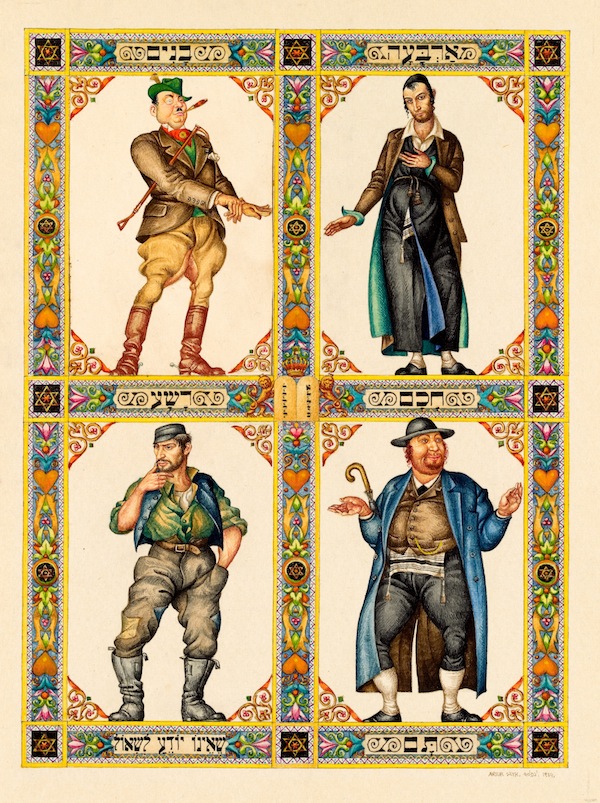
“The Four Sons,” Arthur Szyk, 1934. According to Wikimedia, Szyk “originally intended his Passover story of persecution and deliverance (told through the traditional text of the Haggadah) to be a strong statement against the Nazis, but no publisher in his native Poland dared take on a project with strong anti-Nazi iconography. He ultimately found a publisher in England. This image of the Four Sons … depicts the Wicked Son as an assimilated German complete with porkpie hat and Hitler mustache.” (image from From Arthur Szyk Society, Burlingame, Calif.)

The significance of the seder’s Four Questions should not be confined to being a concrete educational tool for the purpose of teaching historical information to children having a limited sense of abstraction and who bore easily. The questions are a characteristic of the adult intellectual culture during the time of the rabbis.

In the Mishnah, the child is the one who asks and the parent teaches, but, in the Talmud, another source is quoted that requires the adult to ask questions of him or herself: “Our rabbis taught: if his child is intelligent he asks him, while if he is not intelligent his wife asks him; but if not, he asks himself. And even two scholars who know the laws of Passover ask one another.” (Babylonian Talmud, Pesachim 116a)

Here the point is not to recount the story of the Exodus to children, but rather to create a dialogue of questions and answers among adults. The questions of the wise child may be thought-provoking to his or her parents; similarly, the questions of one colleague would be of interest to another. Someone who knows all the laws of Pesach is still required to ask questions, and scholars on their own at the seder are required to ask themselves questions. Why?

At a certain level, the questions serve as an external pretext to refresh the memory in order to raise the level of consciousness concerning the Exodus, even for those who have passive knowledge of the information. At another level, someone who asks himself or herself questions and then answers them, can delve deeper and discover new aspects of knowledge.

This is the educational method practised in the Lithuanian yeshivot – two students on the same level study the text by asking each other questions, raising hypotheses and debating the issues, without hearing lectures from a teacher “who knows the answers.”

This is common practice in universities, where a researcher finding himself or herself at an impasse takes a walk alone while conducting an internal dialogue, which may culminate with new insights into a subject with which s/he is very familiar. The question is a powerful tool for the advancement of the thinking of both the one who asks and answers it.

The rabbis identified a particular type of question, known as a kushiya. A kushiya queries a practice that contains an internal contradiction or which runs contrary to other authorized sources. Unlike the kushiya, an ordinary question generally begins with the word “what,” for example, “What time is it?” It is as if the object of the question has something, information, that the one asking the question needs, and that the one asked “lends” out (literally, sh’ayla, in Hebrew).

The formulation of the kushiya is more sophisticated: “One would expect that such a thing would happen or be written, but why has something else, something unexpected happened or been written?” The poser of the kushiya comes equipped with information and expectations for a certain world order, and this makes him or her aware of deviations, contradictions and the disappointment of expectations. “How is this night different from all other nights – on all other nights we eat leavened bread and matzah, but on this night we eat only matzah?”

The one posing the kushiya sees the whole picture and has expectations of a rational world order. That is why any contradiction requires a rational explanation. We might expect that the more one learns, the fewer questions s/he might ask, after all, s/he already has so much information. But the true intellectual will pose ever more kushiyot, because s/he is all the more aware of the complexity of the world, which is arranged according to so many principles. Curiosity is increasingly aroused and that is why the wise child is the one who asks the kushiyot of his or her own volition, while the younger children need the help of the parent to ask even the simplest question.

Paradoxically, the search for rationality is sustained by the unusual and not by the regular orderly routine. People do not query that which can be taken for granted, even if the explanation is unknown. For example, based on the experience of many Pesachs and seder nights, to the adult Jew, the youngest child asking the Four Questions is taken as a matter of course. But as soon as s/he discovers a different version of the questions, such as the one we saw in the Mishnah, s/he asks “Why do we ask these questions and not others? What is the reason?” or “Why does the Mishnah say the parent says Ma Nishtanah rather than the child?”

The search for rationality in our familiar world is sustained by the ability to imagine alternatives to the existing order. There is a set introduction to the midrashei halakha, homiletic interpretations and inferences of the rabbis (in the Mekhilta). It involves the raising of a hypothetical question, as in this example from the Haggadah. The rabbis wondered:

“You shall tell your child on that day: ‘It is because of this, that the Lord did for me when I went free from Egypt.’” Could this verse mean that you should begin to tell the story at the beginning of the month (in which the Exodus occurred)? No, for the verse explicitly states “on that day” (of the Exodus). Could that mean that we start when it is still daytime? No, for the verse explicitly states: “because of this.” “This” refers to matzah and maror laid before you (only on seder night) (Mekhilta).

“This” implies that the parents must point at the matzah and maror, and use them as visual aids to tell the story (Rabbi Simcha of Vitri).

“Could this verse mean” introduces an imaginative, alternative hypothesis based on the biblical text. “No, for the verse explicitly states that” is a strict construction of the meaning of the existent version of the text that neutralizes the feasibility of an alternative suggestion.

Indeed, the midrashei halakha ask even when no additional version has been found, and only an imaginative person could envisage other reasonable possibilities. There is no attempt here to undermine the accepted text or religious practice, but rather to understand what lies behind it.

If so, then the study method of the rabbis is seemingly founded on a paradox. In order to understand the reasons for the existing order of the customs or the words of the biblical text, we must be able to conceive of another order based on alternative logic. Only that which is not self-explanatory and is not accepted blindly as tradition can lead to a process of thought and discovery of the rationality it contains. The ideal scholar in the culture of the rabbis is not an authoritative figure acting on the basis of a simplistic faith who accepts basic premises without question.

Noam Zion has been a senior research fellow at the Shalom Hartman Institute since 1978, and he teaches in Hartman Institute rabbinic programs. He also works with the Muslim Leadership Institute, the Hevruta gap-year program for Israeli and American Jews, and the Angelica Ecumenical Studies program in collaboration with the Vatican University Angelicum in Rome. He has developed study guides on Bible, holidays and rabbinic ethics, has numerous publications to his credit and lectures worldwide. Articles by Zion and other Hartman Institute scholars can be found at shalomhartman.org.

My homemade Purim poncho

I might have been a Jewish Martha Stewart if fate had been kinder to me. I used to watch with envy as she placed her rose-scented candles on the needlepoint tablecloth in the centre of which were the exquisite paper flowers she crafted. In my fantasy, I imagine my own dinner table now ready for the chopped liver, with braised lamb shanks, kasha pilaf and apple kugel, which would be served on my designer Star of David ceramic plates. Blossoms of fresh orchids from my greenhouse would fill the room. And it would be a good thing.

It is to my chagrin, however, that domestic tasks have never been my forte. Instead, I learned to deflect sizzling hockey pucks from four older brothers as they practised their shots on goal on the frozen North End streets of Winnipeg. I couldn’t whip up a chocolate brownie, but I could power a strike ball for the boys baseball team. I would likely have made a slam-dunk career in basketball if not for my growth spurt maxing out at five feet at an early age.

But, as I became an adult, stopping a puck, throwing a baseball or shooting baskets were no longer in demand. Domestic tasks became the necessity of life and I had few skills. I did manage to accumulate some basic cooking skills, however, and, to date, none of my family has succumbed to starvation.

Now, the task of sewing is a different ball of yarn. What little I learned, I picked up in school. I still remember the pained look on the face of my Grade 7 teacher as I zigzagged the hemline on the proverbial apron running it through the sewing machine. Nonetheless, my lack of proficiency with domestic skills had not interfered greatly in my life – that is, until I became a mother. Then it all came to a flashpoint!

My then-5-year-old daughter, who was attending Peretz School at the time, needed a costume for their annual Purim carnival. She, the little princess, wanted to be a queen – Queen Esther, no less. Oh sure, I’ll just whip up a queen’s costume as soon as I finish the cheese soufflé, the salmon mousse, chocolate-coated orange peels and homemade halvah. What to do? Well, creativity helps where skills fail. I pondered that maybe I could pick up a large piece of fancy material, cut a hole in the middle, and then throw the whole thing over her head, like a poncho.

So, for the first time in my life I found myself in a fabric store like a rookie at a textiles Superbowl. I looked and felt and touched, feigning expertise. Eventually, I settled on a rich red satin. I cut out a round hole in the centre using a “dummy” circle for an approximate size of her head. If I was looking for a “dummy,” I could well have used my own head. The hole had to be adjusted several times to make it big enough to actually get her head through it. The biggest problem, however, was the edges. They were frayed all around and still needed something more to dress it up.

After another search, I discovered long strands of sequins sold by the yard. Exactly what I needed! I chose gold. Very royal, I thought. Much to my surprise, I still remembered the basic back and hemstitch from my sewing class – not a total loss. With needle and thread, I painstakingly stitched on the sequins around the neck and all the edges (I knew enough not to have her head in it at the time). After numerous hours, with bleary, red, irritated eyes, stitch by stitch, it was done.

“What will I wear for a crown?” whined my unappreciative daughter. Once again, I called on some inner resources for inspiration. I found an expandable holder used for tying hair back in a knot or bun. It was gold-coloured metal dotted with decorative “pearls.” When it was fully extended, it sat on the top of her little head like a crown. She loved it! Perfect!

We were ready. Her long, blonde hair flowed softly over her simple red satin poncho gilded with gold sequins, and her greenish-blue eyes sparkled like the “crown” on her head. She was a queen! A blonde Queen Esther!

The party was already in full swing when we arrived, with blue-and-white streamers and balloons lining the walls and ceiling. Chattering children were milling about in all kinds of wonderful outfits. Although her costume was not as elaborate as many, she blended with the others and joined in the games, sang Purim songs and ate hamantashen. At the end of the afternoon, everyone was told to gather around because the judges were ready to announce the winners of the contest.

What contest?

But before I could answer my own question, I heard them announce, “The winner for the best girls costume is Queen Esther.”

“Who?” I whispered under my breath in disbelief.

“Queen Esther!” they called again, as if responding to me personally.

With astonishment, I watched, tears welling in my eyes, as my daughter scrambled onto the stage of the school auditorium for her special moment. I was delighted for her, but bursting with pride for me. It had not been my goal but turned out to be my slam-dunk. This small victory was my personal triumph. I was a Martha Stewart after all. Well, a Jewish Martha Stewart, or maybe substitute Miriam Silver? Regardless, it was a good thing.

Libby Simon, MSW, worked in child welfare services prior to joining the Child Guidance Clinic in Winnipeg as a school social worker and parent educator for 20 years. Also a freelance writer, her writing has appeared in Canada, the United States, and internationally, in such outlets as Canadian Living, CBC, Winnipeg Free Press, PsychCentral and Cardus, a Canadian research and educational public policy think tank.

A food fit for a queen

In my North American Ashkenazi house growing up, my mother always cooked arbis at Purim time. The dish is associated with Queen Esther, for whom this was supposedly a mainstay. Why? Because, some Jewish sources say, Queen Esther kept kosher in the court of her non-Jewish husband, King Ahasuerus. Eating this dish nowadays is one way in which Jews remember Queen Esther’s fortitude.

As I recall, this basic and healthy dish of cooked chickpeas took forever to cook, but it was worth it. It had a chewy, nutty kind of taste.

Arbis, like other Jewish foods, has been quite the globetrotter. For example, some Yiddish speakers refer to the dish as nahit, which, according to L.J.G. Van Der Maesen in a 1987 article, is close to the name used in Turkey, Romania, Bulgaria, Iran, Afghanistan and other adjacent former Soviet bloc countries, with arbis actually referring to another legume, peas. However, H. Gams’s 1924 legume study claims that the ancient Greek words for chickpea were orobos and erebinthos, and that these two words are related to the old German word arawiz and sound similar to erbse, the new German word for chickpea.

Besides eating arbis on Purim, traditional Ashkenazi Jews serve this dish at the Shalom Zachar, an after-dinner gathering on the first Friday night following the birth of a baby boy. There is a mourning aspect to this event, as the newborn’s soul, which had once dwelt in the heavenly realm, must now reside inside the earthly, physical body. Hence, arbis is served at this gathering as a food symbolic of the circle of life.

But a different explanation involving a play on Hebrew-Yiddish words goes like this: arbis, the Yiddish word for chickpeas, helps us remember the promise G-d made to Avraham. “I shall multiply [in Hebrew, arbeh] your seed like the stars of the Heavens.” (Genesis 22:17)

There is a Sephardi version of chickpeas, also served on Purim. Iraqi Jews call it sambusak el tawa, or chickpea turnovers. While most recipes call for adding salt and pepper to arbis, nahit or chickpeas, author Claudia Roden, in her book The Book of Jewish Food, suggests serving them as a sweet side dish with sugar or honey. Editors Anne London and Bertha Kahn Bishov also offer a sweet nahit casserole – in their Complete American-Jewish Cookbook recipe, brown sugar is added. Meanwhile, in the Jewish Vegetarian Year Cookbook, authors Roberta Kalechofsy and Rosa Rasiel recommend eating arbis as a Yom Kippur break-the-fast entree containing salt, cumin, green pepper and tomato sauce.

As we read every year, Megillat Esther opens with an assessment of the vastness of King Ahasuerus’s kingdom – it covered areas from India to Ethiopia.

Indian chickpea history goes way back: the earliest occurrence of chickpeas in India dates from 2000 BCE, at Atranjikhera in Uttar Pradesh, according to Van Der Maesen. Moreover, archeologists have discovered Bronze Age (2500–2000 BCE) chickpeas, peas, green gram and black gram inside storage jars at the Harappan site of Farmana, located in the Indian state of Haryana.

The Archeology of Africa: Food, Metal and Towns, edited by Thurstan Shaw, notes that, in the Natchabiet and Laliblea cave excavations near Ethiopia’s Lake Tana, there was evidence of chickpeas, barley and legumes. Significantly, shiro, which is made from powdered chickpeas, is a staple in Ethiopia.

In his book Ancient Canaan and Israel: New Perspectives, Jonathan Michael Golden reports that, during the Early Bronze Age, at Halif Terrace (located in Israel’s northeastern Negev), people were eating chickpeas, possibly with olive oil. Israeli archeobotanists say there was an agricultural revolution during the Neolithic period. Although not the easiest legume to cultivate – the crop can be wiped out by ascochyta blight and needs good drainage in sunny, dry, warm conditions – chickpeas became one of the early domesticated plants. Zohar Kerem, Simcha Lev-Yadun, Avi Gopher, Pnina Weinberg and Shahal Abbo offer an explanation. In a 2007 article, they claim that the cultivators of that period sensed the nutritional benefits of chickpeas. Today, scientists know that chickpeas are rich in tryptophan, an essential amino acid. They can bring about higher ovulation rates, improved infant development, a feeling of satiety, better performance in stressful situations and a lessening of depressive moods.

Indicative of how important chickpeas are to the Mediterranean diet, an international Hummus Day was inaugurated almost six years ago, on May 13. But let’s give arbis the last word: what goes around, comes around. Here’s a recipe.

ARBIS

1 pound uncooked, dry chickpeas
Cold water to cover chickpeas
Salt to taste (added during the cooking process)

Soak the chickpeas 12 to 24 hours in a pot. Drain the water and rinse the chickpeas to get rid of possible lectin, phytic acid and enzyme inhibitors. Return the chickpeas to the pot, adding enough water to cover them, plus another two inches. Total cooking time will be about two hours, but could be up to four hours, depending on what you consider tender or soft. Cook with the pot covered. Skim off the white froth, which early in the cooking might form at the top. Keep the flame low and add water as needed. After 45 minutes, add salt to taste and go back to cooking the chickpeas. When soft enough to eat, drain and spread out on a paper towel to dry. Sprinkle with salt. May be served hot or cold.

Deborah Rubin Fields is an Israel-based features writer. She is also the author of Take a Peek Inside: A Child’s Guide to Radiology Exams, published in English, Hebrew and Arabic.

Poppy seeds for Purim

Purim is coming the evening of Feb. 28, and if your schedule doesn’t allow time for making hamantashen, try poppy seed cookies. The Yiddish word for poppy seed is mohn, which some say sounds like Haman. Another story says Esther kept kosher and ate as a vegetarian; her diet including seeds, nuts, legumes and poppy seeds, so many Jews serve these foods on Purim. Another tradition says Esther subsisted on poppy seeds during her three-day fast. Whatever the reason, here are a few recipes.

MOHN KICHLACH

1/2 cup margarine
1/2 cup sugar
1 egg
1 tbsp water
1/2 tsp vanilla
1/4 tsp almond extract
1/4 to 1/3 cup poppy seeds
2 cups flour
1/2 tsp baking powder

  1. Preheat oven to 350°F. Spray a cookie sheet with vegetable spray.
  2. In a bowl, cream margarine and sugar. Beat in egg, water, vanilla and almond extract.
  3. Mix in poppy seeds.
  4. Add flour and baking powder and mix well.
  5. Drop by teaspoon onto cookie sheet and flatten with a fork. Bake for 15 minutes.

POPPY SEED COOKIES #1

1 cup poppy seeds
1/2 cup hot milk
1/2 cup margarine
1/2 cup sugar
1 1/4 cups flour
1 tsp baking powder
1/2 tsp cinnamon
1/4 tsp cloves
1/2 cup raisins
1/4 cup chocolate chips (optional)

  1. Preheat oven to 350°F. Spray a cookie sheet with vegetable spray.
  2. Soak poppy seeds in milk.
  3. In a mixing bowl, cream margarine and sugar.
  4. Add flour, baking powder, cinnamon, cloves, raisins and, if using, chocolate. Add milk and poppy seeds and mix.
  5. Drop by teaspoon onto greased cookie sheet. Bake for 20 minutes.

POPPY SEED COOKIES #2

1/4 cup vegetable oil
1/4 cup unsalted butter or margarine
2/3 cup sugar
2 eggs
1 tsp vanilla
dash cinnamon
2 cups flour
2 tsp baking powder
1/4 cup poppy seeds

  1. Preheat oven to 375°F. Spray a cookie sheet with vegetable spray.
  2. In a bowl, combine oil, butter or margarine, sugar and eggs. Mix well. Add vanilla and cinnamon.
  3. Add flour and baking powder. Then add poppy seeds. If dough is pasty, add more flour until dough is easy to form into small balls.
  4. Place balls on cookie sheet and flatten. Bake for 8-10 minutes, until lightly browned.

Sybil Kaplan is a journalist, lecturer, book reviewer and food writer in Jerusalem. She created and leads the weekly English-language Shuk Walks in Machane Yehuda, she has compiled and edited nine kosher cookbooks, and is the author of Witness to History: Ten Years as a Woman Journalist in Israel.

Some treats for Tu b’Shevat

(photo from pixabay.com)

Tu b’Shevat, the 15th of the Hebrew month of Shevat, begins at sunset Jan. 30. The Tu comes from the Hebrew letters tet and vav, which add up to 15, and the festival is also called the Holiday of the Trees and the Holiday of Fruit.

Tu b’Shevat is not mentioned in the Torah but in the Mishnah, the written combination of texts of Jewish oral traditions compiled in the third century CE. It is also mentioned in the Talmud, which is both the Mishnah and the Gemara, the elucidation of the Mishnah.

Beginning at the end of the 17th century, eating fruit became a custom associated with Tu b’Shevat, frequently the sheva minim, the seven fruits mentioned in Deuteronomy (Devarim), grown in Eretz Yisrael – wheat, barley, grapes, figs, pomegranates, olives and dates. It is also customary to eat nuts on the holiday. Here are some recipes to help you celebrate.

EASY ALMOND CAKE
8 servings

1 cup flour
1/2 tsp baking soda
1/4 cup soft margarine or 3 tbsp vegetable oil
1 cup sugar
1 tsp almond extract
2 eggs
1/4 cup buttermilk, yogurt or non-dairy creamer
2 tsp finely sliced almonds

  1. Preheat oven to 350°F. Grease a cake pan or a square pan.
  2. Stir together flour and baking soda.
  3. In a mixer, beat margarine or oil, sugar, almond extract and eggs. Stir in flour mixture alternately with buttermilk, yogurt or non-dairy creamer and blend.
  4. Pour into greased bake pan. Sprinkle top with almonds. Bake for 25 to 30 minutes or until a pick inserted into the centre comes out clean.

DATE NUT CAROB TORTE

1 cup chopped dates
1 cup ground nuts of your choice
1/4 cup carob powder
4 separated eggs
1/4 tsp cream of tartar

  1. Preheat oven to 375°F. Grease a cake pan.
  2. In a mixing bowl, toss dates and nuts with carob powder.
  3. Separate eggs, adding yolks to mixing bowl. Place whites in a separate bowl and beat with cream of tartar until they hold stiff peaks. Add to date-nuts-carob-egg yolk mixture and blend.
  4. Spoon into greased cake pan and place in oven for 15 to 25 minutes. Test every five minutes with a pick inserted into the centre until it comes out clean.

BAKED FIGS
8 servings

24 dried figs, with a horizontal slit part of the way in each fig
zest of 2 oranges, cut in strips
1 cup almonds
1 cup sweet wine

  1. Preheat oven to 375°F.
  2. Stuff each fig with one piece orange zest and one almond. Pack into a small baking dish that will hold them tightly in one layer.
  3. Pour wine over figs. Place another glass baking dish on top to weigh them down and to get the figs flat and covered in wine. Remove that dish, and then place the first baking dish into a second dish, then put in the oven. Bake 20 minutes.

Sybil Kaplan is a journalist, lecturer, book reviewer and food writer in Jerusalem. She created and leads the weekly English-language Shuk Walks in Machane Yehuda, she has compiled and edited nine kosher cookbooks, and is the author of Witness to History: Ten Years as a Woman Journalist in Israel.

Dreidels and drinks fun

Left to right are Jason Murray, Pacific Region LPC, CIJA; Carmel Tanaka, CIJA-Pacific Region; Nico Slobinksy, CIJA-PR; Alexandra Moses, CIJA-PR; Shelley Rivkin, Jewish Federation of Greater Vancouver; Ezra Shanken, JFGV; and Kara Mintzberg, CJPAC, B.C. (photo from CIJA and CPJAC)

On Dec. 19, local elected officials, interfaith leaders and Jewish community members gathered at King David High School for a Chanukah reception hosted by the Centre for Israel and Jewish Affairs (CIJA) and the Canadian Jewish Political Affairs Committee (CJPAC). Guests at the reception sampled Israeli wines and enjoyed traditional holiday foods like latkes and sufganiyot.

“We are thrilled that so many elected officials and community partners were able to attend our Dreidels and Drinks event,” said Nico Slobinsky, director of the Pacific Region for CIJA. “Events like this allow us to bring members of our community together with political and civil society leaders in order to deepen the already existing relationships.”

“It was a fantastic opportunity to engage political and interfaith officials in a fun and festive environment, as well as a wonderful way to celebrate the holidays as a community,” added Kara Mintzberg, CJPAC’s B.C. regional director. “In the new year, Nico and I plan to co-host more events in the Greater Vancouver area, that focus on bringing the Jewish and political community closer.”

Celebrating the lights

Left to right are Rabbi Falik Schtroks, Jason Aginsky, Jessie Miller, Emily Miller and Rebbetzin Simie Schtroks. (photo by Naomi Nelson)

When Adina Ragetli, age 9, opened the annual public menorah lighting event on Dec. 17 at the Semiahmoo Shopping Centre by playing “Padah Bishalom” on the harp, “we knew it was going to be a ‘light-filled’ Chanukah program,” said Rabbi Falik Schtroks, co-director of the Centre for Judaism-Chabad of the Lower Fraser Valley (C4J).

Members of the Legislative Assembly Marvin Hunt and Tracey Redies, as well as White Rock Councilor Bill Lawrence and Surrey Councilor Mike Starchuk, each addressed the crowd with meaningful and timely messages. Chazzan Yaakov Orzech lit the chanukiyah and got everyone to join him in singing some Chanukah favourites. Prof. Rudy Rozanski entertained the audience with an arrangement of Jewish lullabies and music of Jewish composers.

photo - Chazzan Yaakov Orzech lit the chanukiyah and got everyone to join him in singing some Chanukah favourites
Chazzan Yaakov Orzech lit the chanukiyah and got everyone to join him in singing some Chanukah favourites. (photo by Naomi Nelson)

Perhaps the greatest highlight of the evening was the 2017 Young Lamplighter Award, which was presented to Emily Miller and Jessie Miller. The young women devote a lot of their time to making life more pleasant for those who are struggling materially or emotionally. By spearheading the Live2Give program in their NCSY chapter, they are also managing to get many other teenagers involved in projects that are focused on helping others.

“Kudos to the supportive parents and grandparents of Emily and Jessie Miller. We know that these young women have great role models in their lives and that they were not raised in a vacuum,” said C4J co-director Simie Schtroks at the event.

A few rounds of “Let’s Make a Chanukah Deal” were played, and there were doughnuts, chocolate gelt, dreidel glasses and dreidels given out.

Rabbi Yitzchak and Henia Wineberg made it out from Vancouver on a very rainy evening to join the festivities. Marat Dreyshner and Ella Dreyshner donated the doughnuts and Moshe Chanowitz of Plaque Impact in Montreal made the beautiful awards.

Iron Chef Chanukah 2017

On Dec. 13, after the lighting of the menorah and a Chanukah party at the Centre for Judaism (C4J) in Surrey, participants in the Iron Chef Chanukah Competition filled the C4J kitchen. The excitement was palpable as the chefs and their teams quickly planned and executed the preparation of their dishes.

“It was really wonderful to see teenagers, millennials, parents and grandparents working together seamlessly and having so much fun,” said shluchah Simie Schtroks.

“The competition this year was taken to a whole new level,” said Rabbi Nuta Yisroel Shurack, who is one part of The Rabbi and the Chef, with chef Marat Dreyshner.

Although various prizes were awarded, all the participants agreed that dinner together at Rabbi Falik and Simie Schtroks would be the best way to celebrate another great championship.

photo - “It was really wonderful to see teenagers, millennials, parents and grandparents working together seamlessly and having so much fun,” said shluchah Simie Schtroks

photo - “The competition this year was taken to a whole new level,” said Rabbi Nuta Yisroel Shurack, who is one part of The Rabbi and the Chef, with chef Marat Dreyshner