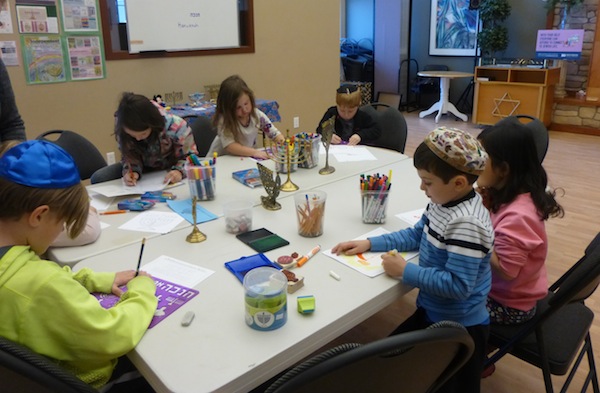
School bars Chanukah

The chair of Vancouver Board of Education (VBE) and even the provincial minister of education waded in after Jewish students at a Vancouver elementary school went public with concerns that they were being made to feel excluded by exclusively Christian holiday symbolism.

Students Maya Sontz and Rebecca Weinberg went public last week after asking the principal of General Gordon Elementary, Hope Sterling, to add some Chanukah decorations to the Christmas trees, wreaths and other Christmas decorations up around the school. The girls said they were rebuffed by the principal, who claimed the Christmas decorations were not religious symbols, while a chanukiyah or other Chanukah items would be. The holiday concert was to include songs about Santa, reindeer and trees, which the principal defended as being “cultural” symbols, not religious ones.

The principal’s position drew rebukes over the weekend from Janet Fraser, chairperson of the board of education. “The VBE sincerely regrets any practices at General Gordon Elementary that have negatively impacted a sense of inclusion and representation for students and parents within our school community,” she wrote. “As chairperson, I apologize on behalf of the board to the students and their families who did not feel welcomed and included at their school. We acknowledge that, in the interpretation and implementation of our policies, there has been confusion about what is permitted as part of upcoming winter celebrations, including Chanukah. The board chairperson and school district staff will be meeting with members of the families … to ensure that their children, as well as all others, are included and represented in their school.”

In response to Fraser’s statement, Rob Fleming, B.C. minister of education tweeted: “ALL children, regardless of ethnicity, religion or gender should feel and be welcome to celebrate who they are in every single one of our #bced schools.… Thank you for your leadership upholding inclusive schools @VSB39 and @janetrfraser.… Let’s #celebrate diversity this year!”

Administrators were to meet with school officials, parents and students Monday to address the issue.

“It is called a public school, so, if you’re going to invite everybody, you’ve sort of got to include everybody,” 11-year-old Maya Sontz told CTV news.

Menorah-making in Richmond

The Shadeck family. (photo by Sarah Aginsky)

Approximately 300 people showed up to a menorah-making event at the Home Depot in Richmond on Sunday, Dec. 3. Families could come and make menorot out of wood, glue and nails supplied by Home Depot. Chabad of Richmond also supplied bullet shell casings to hold the candles on the menorah, symbolic of turning weapons of war into a source of light and life.

photo - Mayaan and her dad Amir
Mayaan and her dad Amir. (photo by Sarah Aginsky)
photo - Liam with his menorah
Liam with his menorah. (photo by Sarah Aginsky)
photo - Levi and Rabbi Nuta Yisrael Shurack
Levi and Rabbi Nuta Yisrael Shurack. (photo by Sarah Aginsky)

Judaica in Metro Vancouver

Among the items featured in Buchan’s Judaica section is a set of six hammered liquor cups on a pomegranate branch from Yair Emanuel, for any Shabbat or holiday table. (photo from facebook.com/BuchansKerrisdaleStationery)

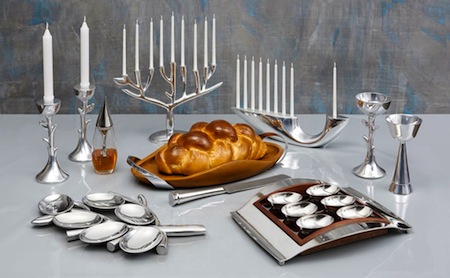
If you’re looking for a new menorah or some cool Chanukah gifts over the next few weeks, you’ll want to target your search to three stores that have become the only hotspots for Judaica in the Lower Mainland. Sure, there are items here or there that you can find elsewhere, but not with much selection. And, you can shop online, but the problem with click-and-purchase is you don’t get to hold the weight of an object in your hand, to see the real symmetry of a piece from your screen, how it will fit into your home. Here’s where to go if you’re in the market for Jewish objets d’art.

Buchan’s Kerrisdale Stationery sits right next door to Garden City Bakery in Richmond, the Lower Mainland’s number one challah maker. The store has had a small selection of Judaica for several years but, when Inna Vasilyev took ownership a year ago, she decided to up the ante and significantly increase the variety. Vasilyev, who also owns the original Buchan’s Kerrisdale, on West 41st Avenue in Vancouver, aims to please everyone in her product choices. You’ll find 99 cent Chanukah candy, inexpensive wooden dreidels over which small kids can drizzle candle wax, fancy hand-painted dreidels and the plastic ones that disappear into the corners of a house each year. Buchan’s has Chanukah games, gelt, colouring books, tea towels, napkins with Jewish designs and menorot.

photo - Beth Tikvah’s gift store offers several different styles of menorot and a host of other Chanukah gifts, including shaped cookie cutters, games and books
Beth Tikvah’s gift store offers several different styles of menorot and a host of other Chanukah gifts, including shaped cookie cutters, games and books. (photo from btikvah.ca/support/beth-tikvah-gift-shop)

“We have designer pieces by well-known designers and a good selection of candles, too, from simple ones to deluxe ones that burn for ages and smell beautiful,” she said.

Vasilyev also stocks non-Chanukah-related Judaica like mezuzot and candlesticks. For shoppers averse to crossing the bridge into Vancouver (or into Richmond), this accommodating store owner will transfer product between the stores to make life more convenient. She’s in the throes of updating her website and hopes to eventually display all her products on it.

Also in Richmond is one of the Lower Mainland’s longest-lasting synagogue stores, the gift shop at Beth Tikvah. Vicki Northy has been the manager and chief volunteer for the past seven years.

In the hours the office is open, office staff will gladly open the store to shoppers and handle the transactions. Northy buys new products every year, choosing a variety of fun items like bagel spreaders and mensch mugs, functional items like Kiddush cups, candlesticks and challah boards, and Judaica art by well-known artists including Yair Emanuel, Gary Rosenthal, Lily Art, Adi Sidler and Agayof. The store will be open 11 a.m.-12:30 p.m. on Dec. 3 and 10 this year to accommodate Sunday shoppers.

Olive+Wild, the gift and home décor store at 4391 Main St., is quite possibly Vancouver’s only retailer selling Judaica. Owners Simon and Bella Zaidel have 18 different menorah designs in stock right now, ranging from menorot that will get your kids excited about Chanukah to artistic beauties in brass, silver and glass.

photo - Olive+Wild has some 18 different menorot from which to choose, as well as Judaica for Shabbat and other Jewish holidays and occasions
Olive+Wild has some 18 different menorot from which to choose, as well as Judaica for Shabbat and other Jewish holidays and occasions. (photo from oliveandwild.com/collections/judaic)

“We stock Judaica designs by Nambé, Michael Aram, Yair Emmanuel and Carrol Boyes. And, given the demand, we’ve expanded our collection with various price points to make our products available to all different budgets,” Simon Zaidel said. The store opened last September and the response from the community has been “incredible,” he added. “Since Temple Sholom’s gift store closed down, there’s a limited availability of Judaica in Vancouver,” he noted. “We carry Kiddush cups, Shabbat candles, tzedakah boxes, Havdalah sets, challah covers and boards, kippot, tallises, mezuzahs, hamsas and Judaic jewelry, most of the products made in Israel.”

After the sugar-rush from the combination of Chanukah gelt and sufganiyot has worn off and the aroma of frying latkes is leaving your kitchen, you’ll want to begin “the Great Menorah Cleanup.” If there’s candle wax on your glass surface, it’s a relatively easy job involving a dollar store scraper and a hairdryer to melt any stubborn excess wax. Candle wax on silver candlesticks can be harder to eliminate without scratching your metal. Experts suggest placing your candlestick holder or menorah in the freezer for at least 20 minutes and then using your fingernails to flick off the frozen wax. A cotton ball with silver polish or rubbing alcohol can also be a useful resource to swap the area until it’s clean.

Lauren Kramer, an award-winning writer and editor, lives in Richmond. To read her work online, visit laurenkramer.net.

Why we head home

(photo from oliveandwild.com/collections/judaic)

It is the season for gatherings and celebrations, and many travelers are urgently trying to make their way home for the holidays. An innate urge seems to drive them back to their roots. And, I wonder, What is it that draws people home for the holidays?

This existential question arose one year as I was lighting the menorah on the first night of Chanukah. Friends and family were gathered at our home to celebrate the holiday season once again. The loving faces, which crossed generations, reminded me that, for some, it is Christmas, a time to spread peace and joy throughout the world. For others, it is Chanukah, with its message of rebuilding, rededication and freedom from oppression.

Suddenly, I had a surreal experience in which the immediate sounds, sights and smells faded into the background. I am both participant and observer in this scenario and am filled with an overwhelming realization that I am looking at the history of the years, the culture and religion of past centuries, sitting at my table eating symbolic foods like potato latkes, gefilte fish and sufganiyot. It gave me pause to reflect on one of our most basic human needs – a sense of belonging.

The rituals that accompany such special occasions, regardless of whether it is Christmas, Chanukah or a powwow, serve to strengthen communal and family ties. There may or may not even be a religious focus but their significance should not be underestimated, as they have a deep and long-lasting impact. It is our cultural and social heritage that carries us from the cradle to the grave, and we learn these social ceremonies within the safety and security of the family.

The emotional attachments that are developed in the course of such activities are powerful, especially for a developing child. If you ask many adults who celebrate Christmas, for example, they will recall the occasion with fond memories. The nostalgia of the colourful lights, the smell of turkey roasting, the sounds of fun and laughter with family and friends and the excitement of exchanging gifts are hard to erase from one’s psyche. Special foods like Christmas cake, latkes or bannock, which are interwoven with the particular celebration, help form a powerful emotional bond that ties us to one another, its strength consolidated with annual repetition.

And, when we are adults, we are bound to repeat them, not only for ourselves, but to give to our children and grandchildren. We want to provide them with the beautiful memories of childhood we enjoyed. Rituals link the past with the future. Those who have never had these experiences, or have lost them, suffer a sense of painful loneliness at these times, leading to a widespread myth that suicide rates increase over the winter holiday season.

Numerous studies indicate the opposite. For example, an analysis by the Annenberg Public Policy Centre, which has been tracking media reports since 2000 in the United States, found that half of the articles written during 2009-2010 perpetuated this myth. However, reported incidents of suicide are the lowest in December and this has not changed in recent years, according to the U.S. Centres for Disease Control and Prevention. A Canadian article, Holiday Depression by Michael Kerr, which can be found at healthline.com, also dispels the myth of higher suicide rates during the holiday season. However, it may trigger other issues, such as substance abuse or depression, which do increase.

Sadly, people may become aware that, with the passing years, family and friends are no longer always available. Children move away, people pass away and these celebrations can emphasize solitary feelings that are glaring in their stark contrast to the happy family images portrayed all around. But there are remedies for loneliness. Volunteer at a homeless shelter or see what your local synagogue has on offer. Create a new tradition and invite over new friends and neighbours. Stay active. It can offer much to alleviate feelings of isolation.

While these philosophical meanderings ramble through my mind, an explosion of laughter jolts me back from my reverie. I contemplate the people around me with warmth and appreciation. The people sitting at my table are not so different from those sitting at yours. Social formalities are found in all societies, religions and cultures, and are strikingly similar. Though the focus of holidays varies, they cement communities and families together. As Barbra Streisand sings, “People who need people are the luckiest people in the world.”

Libby Simon, MSW, worked in child welfare services prior to joining the Child Guidance Clinic in Winnipeg as a school social worker and parent educator for 20 years. Also a freelance writer, her writing has appeared in Canada, the United States and internationally, in such outlets as Canadian Living, CBC, Winnipeg Free Press, PsychCentral, and for Cardus, a Canadian research and educational public policy think tank.

The beauty of the light

(photo from flickr.com/photos/scazon)

The sky turns shades of orange and mauve as I glance outside my dining room window and notice the sun slipping behind the trees. The havoc and chatter in the house has peaked. I call my daughter to come and light the Shabbat candles with me. It’s time. Eighteen minutes before sunset.

We light the candles, nine for me, representing each of our family members, and one for her. We cover our eyes and circle the flames three times with our hands as we say the blessing that ushers in the holy Shabbat. “Baruch ata Adonai Eloheinu Melech HaOlam, asher kidshanu b’mitzvotav, v’tzeevanu l’hadlik ner shel Shabbat kodesh.” (“Blessed are you, G-d, our Master of the Universe, who has sanctified us with His mitzvah, and commanded us to light the candle of the holy Shabbat.”) Instantly, the chaos subsides and peace and serenity reign. It’s visceral, and a mystery to me how it occurs every Friday evening.

The Shabbat candles warm the atmosphere of the Shabbat table. Their soft glow draws us in. All week, we run from home to work and school, activities and errands that fill our days. Many of us do not share meals or spend time together at all!

Only on Shabbat do we have the opportunity to have precious moments with family and share meals, discuss our week’s events, share Torah thoughts and stories of the parashah, to enjoy each other’s presence as well as that of our Shabbat guests.

Shabbat, the seventh day of the week, is the gift that G-d has given us in order to reconnect with family and friends, and teach us, by His example, to rest as He did after creating our beautiful world for us in only six days. We reconnect with our G-dly souls and recharge our batteries for the busy week ahead. We pray at home and in a synagogue and get a special spiritual feeling as we connect to G-d and our community.

We also have Chanukah, an eight-day festival of lights, falling yearly on the 25th day in the winter month of Kislev. Chanukah recalls the Jews’ victory, with a small army, over the huge Greek army in the second century BCE. It also commemorates the miracle of the tiny bit of light, enough to burn for one day, which lasted for eight days, until the rededication of the Temple was possible after the struggle.

The Shabbat candles are placed inside our homes, while the Chanukah candles are placed so they can be seen from outside our homes. Why the difference?

On Shabbat, we are supposed to enjoy and benefit from the holy glow of the Shabbat candles as they shine over the beautifully set Shabbat table, with its white tablecloth and lavish settings. It is the main attraction for those fortunate to have a place around the table.

On Chanukah, we are forbidden to use the light of the menorah for any practical purpose. As the Chanukah candles melt, we are not supposed to do any housework at all. Only after they’ve melted, can we celebrate the miracle of the oil with food and games.

From this, we can extrapolate an essential difference between Shabbat and Chanukah. Shabbat is for us, the Jewish people; it nourishes and reinforces us weekly. Chanukah reaches beyond the warmth of the home to light up the darkness of the outside world. It reminds us not to be afraid, even in the harshest times. And Chanukah candles teach us to stand up and speak out for those who do not possess this strength. This feeds a pride that transcends ego. This is our proud Jewish heritage and our gift to the world.

As I polish my Shabbat candelabra, candlesticks and our family’s chanukiyah, I smile as memories of past Shabbatot and Chanukah celebrations mingle with anticipation. This year, Chanukah begins on the evening of Dec. 12 and continues until the 20th. Wishing you a very happy and festive Chanukah.

Esther Tauby is a local educator, writer and counselor.

Some holiday songs’ origins

“Maoz Tzur,” recording by Abraham Tzevi Idelsohn. (photo from Music in the Jewish Community of Palestine 1880-1948 by Yehoash Hirschberg)

What do we have every year at Chanukah but rarely think about in terms of their origins? The songs. In a Hadassah Magazine article of some years ago, Melanie Mitzman quotes Velvel Pasternak on this subject. He said Chanukah songs are no more than a century old because Chanukah is a post-biblical holiday.

Pasternak is a musicologist, conductor, arranger, producer and publisher specializing in Jewish music. He has been described as “an expert on the music of the Chassidic sect and probably the largest publisher of Jewish music anywhere, although he is quick to note that publishing Jewish music is a business that attracts few rivals.”

The founder of Tara Publications, Pasternak has been responsible for the publication of 26 recordings and more than 150 books of Jewish music since 1971, spanning the gamut of Israeli, Yiddish, Ladino, cantorial, Chassidic and Holocaust music.

Most Chanukah songs, he told Mitzman, have been adapted from old folk melodies, have more than one set of lyrics and/or have been translated from language to language.

Maoz Tzur,” for example, is called “Rock of Ages” in English. As Ariela Pelaia explains on thoughtco.com, it was written sometime in the 13th century by someone named Mordechai, and is a Jewish liturgical poem or piyyut, written in Hebrew originally, about “Jewish deliverance from four ancient enemies, Pharaoh, Nebuchadnezzar, Haman and Antiochus.” It is usually sung after lighting the chanukiyah. Its six stanzas correspond to five events of Jewish history and a hope for the future. Of its six stanzas, often only the first stanza is sung (or the first and fifth), as this is what directly pertains to Chanukah.

The authorship of the Yiddish song “Oy Chanukah,” or “Chanukah, Oh Chanukah,” in English, is unknown. According to the Freedman Jewish Music Archive at the University of Pennsylvania Library, alternate names of the Yiddish version of song have been recorded as “Khanike Days,” “Khanike Khag Yafe,” “Khanike Li Yesh,” “Latke Song (Khanike, Oy Khanike),” “Yemi Khanike” and “Chanike, Oy Chanike.” The standard transliteration of Chanukah in Yiddish, according to the YIVO system, is Khanike.

The Society for Jewish Folk Music in St. Petersburg published two classical compositions that make extensive use of this tune: “Freylekhs” for solo piano by Hirsch Kopyt, published in 1912 but performed as early as 1909; and “Dance Improvisation” for violin and piano by Joseph Achron, published in 1914 (composed in December 1914 in Kharkov, Ukraine).

The lyrics of the Hebrew version, which has the same melody, were penned by Avraham Avronin. The words correspond roughly to the original (more so than the English version), with slight variations for rhyme and rhythm’s sake. Thus, the first line names the holiday; the second calls for joy and happiness (using two synonyms); in the third, the speakers say they’ll spin dreidels all night; in the fourth, they will eat latkes; in the fifth, the speaker calls everyone to light the Chanukah candles; the sixth mentions the prayer Al Hanissim (On the Miracles).

The only big change is in the last line. Whereas the original calls us to praise God for the miracles He performed, the Hebrew one praises the miracles and wonders performed by the Maccabees. This reflects the anti-religious attitude of early Zionism, evident in many other Israeli Chanukah songs. In Israel, it’s still a very popular song, but, since the country has a rich inventory of Chanukah repertoire, it is not as popular as the English or Yiddish versions in North America.

I Have a Little Dreydl,” also known as the “Dreidel Song,” is very famous in the English-speaking world. It also has a Yiddish version. The Yiddish version is “Ich Bin a Kleyner Dreydl,” “I Am a Little Dreidel.” The lyrics are simple and are, not surprisingly, given its title, about making a dreidel and playing with it.

The writer of the English lyrics is Samuel S. Grossman and the composer is listed as Samuel E. Goldfarb. The Yiddish version apparently was both written and composed by Mikhl Gelbart, known as Ben Arn, the Son of Aaron. Therefore, there is a question about who composed this music, as the melody for both the Yiddish and the English versions are precisely the same and the meaning of the lyrics in both versions is largely the same. However, in English, the song is about a dreidel made out of clay, which would be hard to spin, whereas in the Yiddish, the four-sided spinning top is made out of blay, which is lead.

Another popular dreidel song is “Sevivon,” with sevivon, sivivon or s’vivon being Hebrew for dreidel, which is the Yiddish word for a spinning top. “Sevivon” is very popular in Israel and with others familiar with Hebrew.

Al Hanasim” is another popular Hebrew song for Chanukah. It is taken from the liturgy, but it is also an Israeli folk dance. The song is about thanking God for saving the Jewish people. The most popular tune, however, is relatively recent, having been composed by Dov Frimer in 1975.

The Chanukah song “Mi Y’malel” opens with the line, “Who can retell the mighty feats of Israel,” which is a secular rewording of Psalms 106:2, which reads “Who can retell the mighty feats of God.”

Ner Li” translates as “I Have a Candle.” This is a simple Hebrew Chanukah song that is more popular in Israel than in the Diaspora. The words are by Levin Kipnis and the music is by Daniel Samburski.

Kipnis also wrote the words for “Chanukah, Chanukah,” which is a traditional folk song originating in Israel. In a completely different vein, “Judas Maccabaeus” is an oratorio by George Frideric Handel. During Chanukah, the melody for the oratorio’s “See, the Conqu’ring Hero Comes” is used by Spanish and Portuguese Jewish communities for the hymn Ein Keloheinu.

Last for this article, but certainly not the only remaining Chanukah song, is “Ocho Kandelikas.” This Ladino (Judeo-Spanish) song was written by Jewish-American composer Flory Jagodain in 1983, explains Pelaia. She adds that its lyrics describe “a child joyfully lighting the menorah candles,” saying that “beautiful Chanukah is here,” and describing all the wonderful things that will happen this time of year. The song counts out the eight candles for the eight days of Chanukah.

Sybil Kaplan is a journalist, lecturer, book reviewer and food writer in Jerusalem. She created and leads the weekly English-language Shuk Walks in Machane Yehuda, she has compiled and edited nine kosher cookbooks, and is the author of Witness to History: Ten Years as a Woman Journalist in Israel.

A homemade taste of Israel

You don’t have to go to Israel to savour the perfect Israeli sufganiyot. (photo from IMP)

Here is a favourite Israeli Chanukah recipe courtesy of Tnuva, an Israeli company that makes kosher cheese and dairy products.

ISRAELI MINI SUFGANIYOT
(12 servings)

3 1/2 cups flour
1/4 cup sugar
1/2 tsp dry yeast
1 1/4 cup of 1% milk, lukewarm
2 tbsp butter
1 egg, at room temperature
oil for frying
8 tbsp sugar
1 tbsp cinnamon

In a small bowl, mix together yeast, milk and eggs.

In a separate bowl, mix half a cup of flour with the sugar. Then add in the yeast mixture and blend together. Add in the remaining flour and continue stirring until the dough is elastic.

Cover the bowl with a towel and let the dough rise for about an hour or until the dough has doubled in volume.

On a floured surface, roll out the dough to about half an inch thick. Make circles using a medium-sized cookie cutter.

Place the dough patties onto a well-floured baking tray and let them rise again until they have doubled in volume (about an hour).

Heat oil in a medium saucepan and fry the dough patties until they are golden on both sides.

Mix remaining sugar and cinnamon and coat the sufganiyot with the mixture.

Time to light the lights

Chanukah lights (photo from pxhere.com/en/photo/285940)

Rabbi Kibbitz! Rabbi Kibbitz!” Young Doodle ran into the rabbi’s study, breathless and excited. “Rabbi Kibbitz! It’s time to light the Chanukah candles!”

Doodle stopped cold. The senior rabbi of the village of Chelm sat behind his desk, with his head drooping in his hands, staring blankly into nothing.

“Rabbi Kibbitz, are you all right?”

The wise old man shook his head.

“Are you having a heart attack? A stroke? Indigestion?!”

Again the rabbi shook his head.

“You’re not getting a divorce are you?”

The rabbi’s head shot up. He stared at Doodle, and firmly shook his head, no.

“Then, Rabbi, what is it?”

“The world, Doodle,” the rabbi said. “It’s falling apart. The czar is going crazy and so is the king of Poland. It looks like war may happen at any time, and Chelm is right in the middle.”

“That’s not new,” said Doodle. “The czar is always crazy. I hear last week he commissioned a jeweler to make a dozen eggs out of gold!”

“What’s crazy about that?” asked Rabbi Kibbitz.

“Eggs come out of chickens for free,” Doodle said. “With real eggs, you can eat ‘the gold.’ But golden eggs, it seems like you’re paying a lot for nothing.”

The rabbi nodded. He’d never been able to understand how Doodle thought.

“Come, Rabbi,” Doodle said. “It’s time to light the Chanukah candles. Everybody is waiting.”

“The harvest was poor this year,” the rabbi said. “It’s been poor the last four years. I don’t know how we are going to feed ourselves this winter. And, if next harvest is bad, then I’m sure we will all starve.”

“Actually, rabbi, it’s been six bad years,” Doodle corrected. “And you know what they say in the Torah? After seven years of famine, there will be seven years of feast!”

“I’m not sure it says that.”

“Perhaps not,” Doodle said. “But we will figure it out. We always do. If nothing else, we can always move somewhere.”

“Borders are closing, Doodle. Nobody wants to have poor refugees.”

“In America, there is plenty of opportunity!”

The rabbi shook his head. “I don’t know.”

“Come, let’s light the candles,” Doodle said.

“People are becoming so hateful.” The rabbi’s head slumped back into his hands. “Neighbours fight each other. Everyone looks out only for himself or his tribe. I always thought that, over time, the world would become a better place, but I hear the news about this revolution or that uprising or this massacre and that famine and all I see is darkness.”

“Let’s light the candles,” Doodle insisted.

“Enough with the candles!” The rabbi burst with frustration. “Chanukah is not even a major holiday. With all the problems of the world, it just doesn’t matter.”

Doodle stood still and stared at the rabbi. “It does matter. Every year, on the last night of Chanukah, our whole community gathers in the synagogue to light the candles. We kindle a shammos from the eternal lamp, and then that flame is passed to every shammos. We sing the blessings, and then one light becomes eight lights, multiplied by every single family in the village. It doesn’t matter how cold it is outside. We are warm and together in celebration. Even in the darkness the menorahs glow as bright as day.

“Come, Rabbi. Let’s light the candles.”

Rabbi Kibbitz looked up at the young boy. The wise old man had tears in his eyes. He nodded and stood.

Just then, Reb Cantor the merchant burst into the rabbi’s study.

“Rabbi Kibbitz! Have you heard? They’re devaluing the currency. The money – all the money – is going to be worthless!”

“Reb Cantor,” said Rabbi Kibbitz. “It seems very dark and bleak sometimes, doesn’t it?”

Reb Cantor nodded in agreement.

“Isn’t it wonderful,” the rabbi said, “that it is time for us to gather in the synagogue and light the Chanukah candles?”

Reb Cantor took a deep breath and nodded. “You are a very wise man, Rabbi Kibbitz.”

Together, the rabbi and the merchant left the study and their troubles behind.

Doodle rolled his eyes. Then, he grinned and ran to catch up. “Rabbi Kibbitz, Reb Cantor! Wait for me!”

Mark Binder is a Jewish storyteller and the author of A Hanukkah Present! Twelve Tales to Give and Share and Matzah Mishugas. These and other books are available in print and ebook on Amazon, iBooks, Google Play Books and other booksellers. To learn more about Binder, visit markbinder.com.

Step aside fried latkes

My younger brother has one main rule for my nieces, who are 6 and 4 years old – “No head injuries.” Sounds simple enough, until you see one of them launch themselves off the back of the couch. I could see a bit of them in the character of Sadie in Queen of the Hanukkah Dosas, written by Pamela Ehrenberg and illustrated (beautifully and creatively) by Anjan Sarkar.

“It wasn’t that I didn’t want my little sister, Sadie, to help us make dosas for Hanukkah,” explains her big brother. “The problem was, she climbed too much.” Onto tables, out of cribs, up stacks of cans at the supermarket, Sadie does like to climb. And luckily so, it turns out. But you’ll have to read the book to know why.

book cover - Queen of the Hanukkah Dosas
Queen of the Hanukkah Dosas cover

If the title didn’t give it away, Sadie and her family are a Jewish family with Indian heritage. Instead of latkes, they are celebrating the Holiday of Lights with dosas, and there is a recipe for the Indian pancake in the book, as well as a recipe for sambar, a vegetarian lentil stew made with tamarind paste and many other delicious ingredients.

Queen of the Hanukkah Dosas, published by Farrar, Straus and Giroux (2017), is part of PJ Library, which sends free Jewish children’s books to families with kids from 6 months to 8 years old. B.C. community members can sign up through Jewish Federation of Greater Vancouver or Jewish Federation of Victoria and Vancouver Island.

PJ Library’s selection committee chose Queen of the Hanukkah Dosas because it “loves how this book celebrates the varied cultural and ethnic backgrounds that make up today’s Jewish community, and encourages each of us to be proud of our individuality.”

The book also offers the opportunity to talk about various holiday customs that cut across Jewish cultures. Sadie wears a dreidel costume for some of the book, the family lights the chanukiyah, there is gelt on the table and, of course, dosas are fried, so there’s that miracle of oil to discuss.