Every year, a new beginning

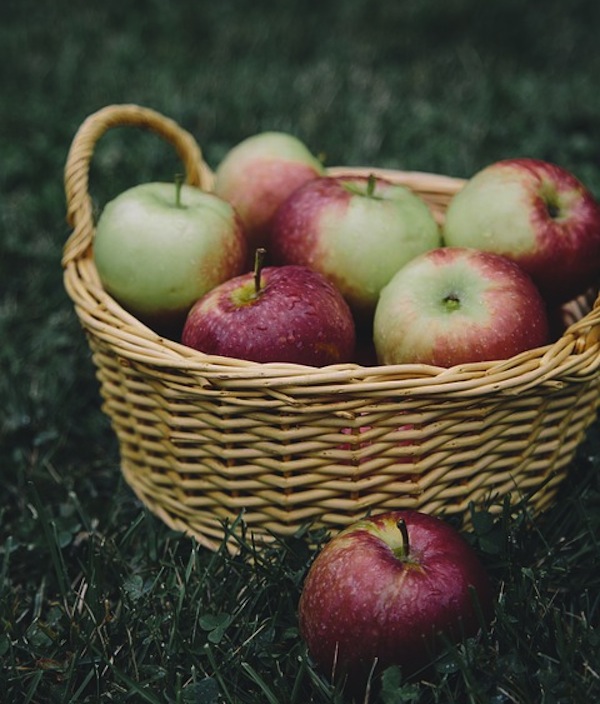
Barring disaster, this season’s apple harvest would be bountiful. (photo from maxpixel.net)

“I don’t want to do my job any more.” That loud thought just popped into Rabbi Yohon Abrahms’ head.

It was dawn, and the birds were singing. He was lying in bed alone, staring up at the whitewashed wooden ceiling of his small house. Alone.

Summer in Chelm had been hot, with enough rain to produce a bumper crop of wheat, rye, corn, squash, barley and buckwheat. Hard work. Lots of sweat. In a small village like Chelm, when it was time for ingathering, all hands, even the rabbi, joined in the work. From daybreak to dark for nearly a month, the fields had been full of neighbours working and laughing and complaining.

The whole world thought that everyone in Chelm was always happy but, of course, there was complaining. As Rabbi Kibbitz, the wise old man, often said, “Kvetching is one of the greatest pleasures in life! It’s free and opportunities are plentiful. Anyone can kvetch! And you should!”

The harvest was hard. Back-bending, blister-raising, mind-numbingly repetitive tasks. Reach, cut, lift, wrap, tie, and a small sheaf of buckwheat stood in the field, drying under the sun. Bend, grasp, twist, pick, turn, place the cucumber in a basket. Curse the sharp thorn that poked through a hole in the worn leather glove. And repeat.

It had been bliss. For weeks on end, Rabbi Abrahms had lived in his community, outside his house, surrounded by fellows, outside his mind. All summer, he had not had a moment’s peace to think about his own problems. Instead, he’d rushed from field to field, with the occasional visit with Reb Schlum, the butcher, to perform his job as mashgiach, overseeing the ritual slaughter of chickens and cows. He barely had time to eat and, when he fell asleep at night, it was an exhausted and dreamless slumber that left him feeling eager and refreshed in the morning.

Yesterday, though, the last of the crops had been harvested. The fresh vegetables were on their way to market or into barrels for pickling. The seeds in the field weren’t dry enough to begin threshing.

“Enjoy your rest,” said Reb Cantor, the merchant, over his shoulder as he drove his cart toward Smyrna. “Rosh Hashanah is coming soon and, this year especially, Rabbi Kibbitz is going to need your help.”

The great Rabbi Kibbitz was old. He had always been old. When Rabbi Abrahms first moved to Chelm decades ago, Rabbi Kibbitz had seemed ancient. Now he was practically prehistoric, eating nothing but the healthy chicken soup made by his beloved wife, Mrs. Chaipul (she kept her name, which is another story). Rabbi Kibbitz was beginning to fail. Everyone knew it, but nobody would say it. Soon, beloved Rabbi Kibbitz was going to die.

“Chak, chak, chak.” A red-spotted bluethroat, pecked at a piece of straw outside Rabbi Abrams window. “Chak, chak.”

Rabbi Abrahms did not want to lead the Rosh Hashanah and Yom Kippur services by himself. For years, he had assisted, ready to take over whenever the senior rabbi got tired or needed a break. But Rabbi Kibbitz had been an indomitable bear of a man, davening his prayers from side to side in his peculiar fashion long after younger men grew weak and sat down for a rest.

Rabbi Abrahms did not want to stand on the bimah alone. Truth be told, he did not want to stand on the bimah at all. For years, he’d been picking at that scab, a sore spot in his thoughts, that perhaps being a rabbi was not for him.

It was nonsense, of course. He had studied hard to become a rabbi. He had moved to Chelm to accept the position. He had worked hard as a maschgiach and even harder to teach the stubborn children in the village’s small yeshivah. Being a rabbi had consumed his life. Of course, he was a rabbi.

He was 55 years old, and still the junior rabbi. What else could he be?

He was not married, something that the yentas in Chelm tutted him about regularly. As a younger man, he had loved and lost and, until it was necessary, he would not walk that road again. So he had no children to occupy his mind and time.

He had written some small books: a thin catalogue called The Wildlife of Chelm and the Nearby Black Forest, an English and Hebrew Haggadah that had been published by someone in America named Maxwell House, even a slender humorous novel in the style of the Russians. Writing, though, was not a job that would pay for eggs and tea and firewood.

“Chak, chak,” the bluethroat chided.

Foolish thoughts.

But, even after Rabbi Kibbitz left the world behind (may that day be distant), Rabbi Abrahms knew that he would always be the junior rabbi of Chelm.

It wasn’t the relative position or lack of prestige that bothered him. Rabbi Abrahms hated listening to other people’s troubles. He didn’t like cheering people up. He was bored with morning prayers, afternoon prayers, evening prayers and Sabbath prayers, let alone the special prayers for holidays and festivals. He dreaded officiating over wedding and bris ceremonies. Visiting the sick made him feel sick. And the idea of saying the Mourner’s Kaddish at Rabbi Kibbitz’s funeral left him weak and heartbroken.

Even being called Rabbi Abrahms chafed like a burr.

“My name is Yohon,” he whispered at the wall. “Can’t you see?”

Perhaps if he had mentioned his affliction to Rabbi Kibbitz a few years earlier, they could have worked something out. Put an advertisement in the Jewish newspaper in Pinsk for a new rabbi for Chelm. Or together found passages in the Torah or Mishnah that would have eased his mind.

But the great man was dying. Rabbi Abrahms shouldn’t trouble him.

Maybe he wouldn’t die this year. Maybe there would be time.

Barring disaster, this season’s apple harvest would be bountiful.

Sukkot was early, right at harvest time, and Rabbi Abrahms would take to the fields, climb the thin triangular ladder with a basket looped over his shoulder. Reach. Pick. Drop. Until the basket was full.

Then move the ladder to another tree, and begin again.

Every so often, he would stop, near the top of a tree heavy with fruit. He would lean against the trunk, take a bite of a crisp just-picked apple, and look up through the leaves at the wide, blue sky.

Mark Binder is a writer and storyteller, who lives in Providence, R.I. He is the author of more than 20 books and audio recordings, including The Brothers Schlemiel, a novel of Chelm. Follow him on Instagram, @MarkBinderBooks, or visit his website markbinder.com.

To embrace teshuvah

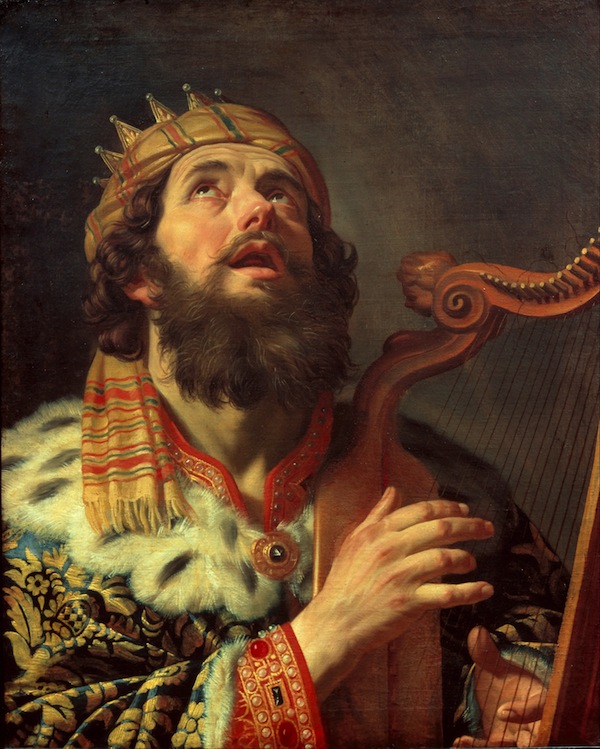
“King David Playing the Harp,” by Gerard van Honthorst, 1622. All of the biblical heroes are imperfect, as are we. (photo from artsandculture.google.com)

One of the beautiful ideas behind Rosh Hashanah and Yom Kippur is the notion that we need to reflect, review and rethink who we are and what we have achieved in our lives. We should never see who we are and what we have created as the ultimate expression of who we ought to be. There must always be a gap between who we are and who we ought to be, between reality and our aspirations. When our aspirations are fulfilled, there must be something wrong with our aspirations.

This is the fundamental idea behind teshuvah and its challenge to us – to embark on a process of self-criticism and reflection. To embrace teshuvah is the ultimate aspiration of our humanity, for the highest level that humans can achieve is not one of fulfilling all our values, but of constantly maintaining a tension in which goals serve as a foundation to evaluate the lives we have created and to challenge us to move forward and beyond.

An expression of this idea is found in the biblical depiction of heroes, all of whom are imperfect. We are never given a hero who embodies everything. Sometimes, it’s embarrassing. The biblical heroes seem too human, permeated by too much imperfection. The Bible is teaching us that being a hero doesn’t mean that one is devoid of imperfections; it means that one must do something about those imperfections.

By elevating these people to be our ideal, it challenges us to emulate them. You are going to fail like Moshe or Avraham. You are going to sin like David. There are going to be multiple dimensions of your life, whether it’s in your worship of God, with your spouse, with your children or with your friends, where you’re not going to be who you ought to be. Welcome to the human story. Our religion has no fantasies about human beings. It has aspirations from human beings.

For human beings to embody the aspiration of self-criticism and reflection, it is not only the individual who must be open to change but also the societies within which we live. People around us often want us to remain who we are. People don’t want us to change. They have gotten used to and comfortable with our imperfections, for it gives legitimacy to theirs.

Some rabbis in the Talmud were deeply worried about the social pressure to maintain mediocrity and lock everyone within the status quo of their failings. As a result, in Tractate Baba Kama 94b we find the following teaching:

It once happened with a certain man (thief) who desired to repent and make restitution (to those from whom he stole). His wife said to him: “Fool, if you are going to make restitution, even the clothing which is on your back would not remain yours.” He consequently refrained from repenting. It was at that time that it was declared: “If robbers or usurers are prepared to make restitution, it is not right to accept it from them, and he who accepts it does not obtain approval of the sages.”

A thief’s desire to complete his or her process of self-correction by making restitution is clearly understood and valued. The problem is that this standard may inhibit them from beginning the process. A lifetime of harm cannot be erased and, as a result, may lock us in our imperfections under the argument that one can never really begin again. “Fool, if you are going to make restitution, even the clothing which is on your back would not remain yours.”

In response, the rabbis teach that we have a responsibility towards each other to enable these new beginnings. A Jewish society is one where we make sure that reflection, self-criticism, self-evaluation and the ability to accept new horizons and new ideas are things society fosters and encourages, even at a high cost. We are individually responsible to not merely refrain from hindering each other’s growth, but that we must be willing to forgo what is rightfully ours in order to ensure that our fellow citizens will grow and change.

A Jewish society is not simply characterized by a high level of kashrut or Shabbat observance. A Jewish society is one where we allow others to do teshuvah, where we are not threatened by others’ desires to move in a new direction. A Jewish society is one that understands that to be fully human is not to accept our failings: to be fully human is to aspire to overcome them.

Shana tova to us all.

Rabbi Dr. Donniel Hartman is president of the Shalom Hartman Institute and author of the 2016 book Putting God Second: How to Save Religion from Itself. Articles by Hartman and other institute scholars can be found at shalomhartman.org.


Seeing God’s humanity, our own

A mosaic of the Akeida in Bet Alfa National Park in Israel. (photo from hartman.org.il)

For many of us, the approach of the Jewish New Year offers an opportunity to take a moment from our harried lives to reflect on life’s “big” questions. It is a time for many of us – across the religious spectrum – to think about our relationships with ourselves and our families, with our tradition and with God. For those of us who choose to spend Rosh Hashanah in synagogue, the holiday offers the opportunity to participate in a communal reading of some of our most sacred and paradigmatic collective narratives, which in turn have the potential to illuminate some of our most pressing personal dilemmas.

Two of the most important biblical stories we revisit every Rosh Hashanah are the binding of Isaac (known in the Hebrew parlance as the Akeida) and Abraham’s argument with God regarding the fate of the inhabitants of Sedom. These two accounts represent two different religious anthropologies: one of sacrificial self-surrender and one of assertive moral challenge. As I have previously written, the personal moral empowerment displayed by Abraham in the story of Sedom – his insistence on his own ethical intuition and God’s acceptance, in turn, of those claims – is, for me, the foundation of the covenantal relationship.

The account of the Akeida, on the other hand, presents a distinct moral dilemma: How do we begin to understand a God who would ask His most loyal follower to sacrifice his beloved son? There are many ways to approach the theological puzzle that is the Akeida. This Rosh Hashanah, as we pause to examine not only our relationship to the divine, but our personal family relationships as well, I propose rereading the story of the Akeida by looking at God’s character through an anthropomorphic lens.

Before I begin describing God in human terms, however, it is important to remember that we have a long and deep tradition of doing so. The Bible is replete with images of God experiencing “human” emotions. Throughout the biblical narrative, we are presented with a God who is alternately angry, jealous or ego-driven.

During the Jewish people’s sojourn in the desert, for example, Moses, like Abraham before him, finds himself in the position of having to plead with God not to destroy a people – in this case, the Jews of the desert generation. The Bible describes God in nakedly human terms, as Moses finds that he has to, in some way, appeal to God’s ego. The Midrash describes Moses grabbing hold of God and saying to Him, “I’m not going to let you do what you want to do to the Jews.” Moses even appeals to God’s public relations considerations: he reminds God that He not so recently delivered this desert people from bondage in Egypt; if He kills them now, the other nations will say that He took them out of slavery only to slaughter them in the wilderness. Moses tells God in no uncertain terms that he will not help facilitate a people’s destruction.

Moses has to convince God not to allow His “emotions” to overpower Him, not to let His anger consume Him. This is but one example of many throughout the Bible and the Midrash of profound anthropomorphism, of portraying God as a character full of human weaknesses, with the potential to be both vulnerable and volatile.

In examining the story of the Akeida, we are compelled to ask, How could the God of the covenant – the God who promised Abraham that a great and multitudinous nation would emerge from his son Isaac – command that Isaac be killed? How are we able to understand the covenant in light of this seemingly unfathomable dictum? In attempting to understand the God of the Akeida, and what the Akeida might mean for us today, I have found it helpful to look at God as a parent.

God made the covenant with Abraham. But, after He did so, He got nervous, He suddenly felt scared. He had given over enormous power to human beings and He felt His ego being threatened. Thus, when God commands Abraham to “Take your son,” Abraham senses intuitively that it is not a moment in which to approach God with his moral claims. When God says, “Take your son,” Abraham understands that the God who is speaking – the God of the Akeida – is a God who experiences His own authority as under siege.

Abraham knows that the moment of the Akeida is not a moment for encounter or dialogue, but a moment that requires silence. It is a moment when Abraham knows that his only choice is to be quiet and submit. Abraham, a lover of God, senses the divine mood. When Abraham stood in front of God at Sedom, it was, in part, because he felt that it was a time when he could approach God; he sensed that God was in a willing position, that there was a possibility that He would be receptive to Abraham making covenantal demands.

Abraham’s response to God is analogous to a child’s response to a parent who the child knows is feeling challenged or threatened. There are times in a family’s life when a child knows intuitively – as Abraham knew intuitively – that there’s an opportunity for discussion, a moment when he can be critical of his parents, and his parents will be receptive to what he has to say. But there are other moments when a child understands that his parent is feeling insecure; moments when the mother or father is terrified of losing his or her authority. A child knows that is not the moment to try to encounter the parent in critical relationship; it’s not the moment to remind the parent that, in the past, he or she has encouraged critical reflection. That is a reality of family life: parents can become terrified of losing their position of power; they can become frightened that their children misjudge their encouragement of critical reflection as a negation of their parental authority. So, in some way, I attribute to God the same weakness or the same dilemma. He feels threatened. He feels that He must assert His power and test His child.

Before the Akeida, Abraham is referred to as ohavai elokim, a lover of God. Subsequent to the Akeida, he is referred to as yerei elokim, a fearer of God. The question we are faced with is why must God demand Abraham’s submission and fear? Why was his love not enough? To understand the God of the Akeida, we have to understand that God has conflicting forces within Him. The Midrash on the Akeida paints a very strange portrait of a God who says to the Jewish people, “Please pray for me. Please pray that my attribute of compassion will overcome my attribute of justice.”

Who is this God that must pray to human beings for help in overcoming His impulses? Who is the God that needs to ask human beings to remind Him of compassion? The Midrash illuminates for us the reality of a God who is struggling to reconcile the opposing forces within Him. It is my view that the Akeida is a moment of God’s struggle within Himself. God tests Abraham because of God’s own internal difficulty balancing justice with compassion, fear with love.

How can we talk about God experiencing an internal struggle? The great contemporary biblical scholar Yohanan Muffs argues that it is only in human terms that we can most authentically grasp the nature of the divine. I share Muffs’ view that God’s humanity, so to speak, is essential to a true understanding of Him. Yet it is not only 20th-century thinkers such as Muffs, Abraham Joshua Heschel and I who have portrayed God in starkly mortal terms. Drawing on the tradition of the Bible and the Midrash, the rabbis of the rabbinic period routinely discussed God as having an interior emotional life. While this approach did not fit in with medieval philosophy, which maintains that God cannot take on any human form, that any change or emotion in God is a sign of imperfection, the great figures of the rabbinic period were not frightened to speak of God in the language of human psychology.

It is this tradition that empowers me to think of God in terms of psychodynamic maturation: to cite His shift from being a figure of complete and total authority to a figure who works in concert with human beings. It is the deep rabbinical tradition of ascribing human qualities to God that enables me to see a God who decides to become accountable to human beings.

And it is this precedent of anthropomorphism in the rabbinic canon that informs my view of the God of the Akeida as a parent struggling with his identity, grappling with the competing values within Him. He loves Abraham and He has planned great things for him, but God is beset by his own internal dilemmas, by his own conflicting emotions. This is the God of the Midrash, the God who says to Moses, “Hold me back, Moses, I’m losing myself.”

If this is a bold way of discussing the divine, it is no bolder than the way the Bible itself discusses God. Rather than diminish God in our eyes, looking at God in human terms enables us to understand Him on a deeper level. The God who experiences emotion, who experiences internal struggle, is a God who can enter into a relationship of mutual accountability with human beings. The God who experiences His own psychodynamic reality is the God of covenantal spirituality.

This Rosh Hashanah, as we examine our relationships with our parents and our children, with ourselves and with our tradition, we are all faced in some form or another with the challenge of balancing compassion with justice, authority with love. As the Jewish New Year draws closer, let us allow ourselves to draw on the wisdom of our shared narratives as we struggle to reconcile the competing values within us.

Rabbi Prof. David Hartman (1931-2013) was founder of the Shalom Hartman Institute. Articles by Hartman, z”l, and other institute scholars can be found at shalomhartman.org.

Forgiving but not forgetting

Robbie Waisman, left, and Chief Robert Joseph, will speak at Temple Sholom’s Selichot program Sept. 1. (photos from Temple Sholom)

Two men who have built bridges between Canada’s indigenous and Jewish communities will speak about reconciliation, forgiveness and resilience at Temple Sholom’s Selichot program.

Robbie Waisman, a survivor of the Holocaust who was liberated as a child from Buchenwald concentration camp, and Chief Robert Joseph, a survivor of Canada’s Indian residential schools system, will address congregants on the subject of Forgiving But Not Forgetting: Reconciliation in Moving Forward Through Trauma. The event is at the synagogue on Sept. 1, 8 p.m.

Waisman is one of 426 children who survived Buchenwald. At the age of 14, he discovered that almost his entire family had been murdered. He came to Canada as part of the Canadian War Orphans Project, which brought 1,123 Jewish children here under the auspices of Canadian Jewish Congress.

Joseph is a hereditary chief of the Gwawaenuk First Nation, located around Queen Charlotte Strait in northern British Columbia. He spent 10 years at St. Michael’s Indian Residential School at Alert Bay on the central coast of the province. He recalls being beaten for using his mother tongue and surviving other hardships and abuse. A leading voice in Canada’s dialogue around truth and reconciliation, the chief is currently the ambassador for Reconciliation Canada and a member of the National Assembly of First Nations Elders Council. He was formerly the executive director of the Indian Residential School Survivors Society and is an honourary witness to Canada’s Truth and Reconciliation Commission.

Waisman and Joseph have become close friends over years of discussing, publicly and privately, their respective histories and the challenges of building a life after trauma. Waisman has become a leading Jewish advocate for indigenous Canadians’ rights.

“I think we have a duty and obligation to give them a stand in the world,” Waisman said. “For many, many years, many people ignored them, and their story about truth and reconciliation was just in the background, they weren’t important. I think that now that we give them an importance – and it is important that they speak up and speak about their history and so on – [it is possible] to make this a better world for them.”

Waisman believes that the experiences of Holocaust survivors and the example that many survivors have set of assimilating their life’s tragedies and committing themselves to tikkun olam is a potential model for First Nations as they confront their past and struggle to address its contemporary impacts.

“We were 426 youngsters who survived Buchenwald and the experts thought that we were finished,” Waisman said of his cohort of survivors, who have been immortalized in The Boys of Buchenwald, a film by Vancouverites David Paperny and Audrey Mehler, and in a book by Sir Martin Gilbert. “We wouldn’t amount to anything because we’d seen so much and we’d suffered so much and lost so much. And look what we have accomplished. We have little Lulek [Rabbi Yisrael Meir Lau], who became the chief rabbi of Israel, Eli Wiesel, Nobel Peace Prize winner, and I can go on and on. When I speak to First Nations, I say, ‘look what we’ve done,’ and then I quote [Barack] Obama and say, ‘Yes, you can.’”

One of Waisman’s first experiences with Canadian indigenous communities was when he was invited to the Yukon. His presentation was broadcast on CBC radio and people called in from all over the territory, asking that Waisman wait for them so that they could come meet him.

“They kept phoning in and saying, ‘Don’t let Robbie leave, we are coming in to see him,’” Waisman recalled. “It was just amazing. I would sit on a chair and they would come and touch me and then form themselves in a circle and, for the first time, they were speaking about their horrors and how to move on with life.”

This was a moment when Waisman realized the power of his personal story to help others who have experienced trauma gain strength.

The Selichot program was envisioned by Shirley Cohn and the Temple Sholom Working Group on Indigenous Reconciliation and Community, which Cohn chairs.

“It’s the right thing to do given the political atmosphere, the increased awareness about indigenous issues and just the fact that, as Jews, I think we need to be more tolerant of others, and these are really the first people in Canada, and they’ve suffered discrimination, as we have, and I think it’s important,” she said.

The message is especially relevant at this time of penitence and self-reflection, she added. “It’s a time for thoughtfulness and looking inward,” said Cohn, who is a social worker.

Rabbi Carrie Brown said the Temple Sholom community sees the topic as fitting.

“We want to look at this further as a congregation,” said Brown. “Selichot is a time of year when we really start to think about ourselves as individuals and ourselves as a community and the conversation between Robbie Waisman and Chief Joseph really fits nicely into that, about trauma and reconciliation and forgiveness and all of these major themes of the season.”

This is “not just a one-off program,” the rabbi stressed, but the beginning of a process of education and conversation.

Torah is part of who we are

Much to the disappointment of their Orthodox brethren, most of the Jewish people outside the Orthodox world probably do not believe that the Torah was literally received at Sinai. This creates something of a problem on Shavuot, the festival on which the giving of the Torah at Sinai is celebrated.

On Passover and Sukkot, even non-believers who reject the literal truth of the biblical stories on which these festivals are based, can find ways to connect to universal notions of freedom from slavery and the temporariness of the human condition that they inspire. On other holidays, too – Rosh Hashanah and Chanukah come to mind – it is possible to relate to broader themes and even to the symbols and rituals that seek to evoke them. Shavuot is different. It is limited in symbolic ritual, and it does not offer an easily identifiable, abstract idea worthy of celebration even by non-religious Jews.

What’s more is that the rabbinic sages seem to make a point of exalting an aspect of the Mount Sinai story that is anathema to modern sensibilities. “Na’aseh v’nishmah” – “We will do and we will hear/understand” – a phrase uttered, according to Exodus 24:7, as the Jewish people accept the Torah, is often glorified in our tradition as an act of blind obedience. The willingness to do first, and comprehend later, is seen as a readiness to receive the Torah unconditionally, regardless of its content. The Midrash praises the Jews for the commitment – unlike that of any other nation – to follow the scriptures without asking why. Had the attempt to alienate Jews of Western, liberal convictions been deliberate, it would not have been more successful.

What are those who question the merits of blind obedience to do with this tradition? How to reconcile teaching our children to question, when we are told to applaud the fact that the Children of Israel did not?

Fortunately, our sources – as always – offer alternatives to this particular approach. For one thing, the text of “na’aseh v’nishmah” provides less evidence of blind obedience than popular wisdom suggests. Chapter 24 of Exodus, where the concept of “na’aseh v’nishmah” is cited, actually stipulates twice (in verses 3 and 7) that the Torah was first read in its entirety to the Children of Israel. The result is a far less dramatic narrative of the Jewish people’s agreement to accept the Torah, after it was heard.

Others offer a softer reading of “na’aseh v’nishmah” to suggest that the Jewish people demonstrates through this phrase not unthinking acceptance of the Torah, but rather the view that it is through the act of doing – of actually fulfilling the commandments – that the Torah will be understood.

More significantly, there is a well-known, and contrary, midrashic tradition that suggests that the Torah was not in fact willingly embraced by the Jewish people at Sinai, but instead coerced upon them. The Talmud, in Tractate Shabbat 88a, drawing from the phrase in Exodus 19:17 that the Jewish people camped “b’tachtit ha’har” – “at the base/under the mountain” – suggests that the Holy One blessed be He covered the mountain over them like an (inverted) barrel, and said to them, “If you accept the Torah, fine, but, if not, there will be your burial place.”

The Jewish tradition demonstrates a constant tension between unquestioning obedience to God, and struggle with Him. Both are valued, neither absolutely. We are told of the Abraham who obediently agreed to sacrifice Isaac, and of the Abraham who argued with God to spare the innocents of Sodom. And, in the case of the Torah at Sinai, we are relayed two distinct rabbinic narratives – one, of a people eagerly accepting their canonical text, and the other, of that text being forced upon them.

When taken together, these conflicting narratives seem to be saying that we can either embrace the Torah or fight against it, but in either case we cannot escape that it is ours. In the same way as we cannot choose our parents, we cannot choose our spiritual ancestry. Whether out of choice or out of coercion, the Torah is our spiritual home. We can quarrel with it, turn from it, reinterpret it or embrace it whole, but it is the unavoidable reference point from which we chart our path.

I have always been struck by the fact that the Gemara cited above strangely says that the Jewish people will be buried “there” rather than “here.” After all, if the message is about the coercion at Mount Sinai, wouldn’t the threat be to accept the Torah or to perish at the foot of the mountain? Instead, the implication of the text is that the risk of burial is at a later time and place, as if to suggest that the impact of rejecting the Torah will not be immediate.

In this sense, the text can be seen as a kind of warning. A people that is not familiar with its foundational texts, that is not engaged with them – whether in agreement or in argument – risks withering away. Our burial place is not at the moment of rejection; it is “there,” further down the road, when the connection of future generations with the conflicting and profound stories that shape our tradition is severed.

Shavuot need not only be seen as a celebration of the acceptance of the Torah. It also celebrates acceptance of the idea that who we were is part of who we are. It is an embrace of, and reconnection with, our story and our texts, not necessarily because we accept them literally and wholeheartedly, but because they are part of the DNA of Jewish civilization.

We do not enter the earth free and clear to invent ourselves from naught. Like it or not, we are born into a legacy, a tradition and a set of values that should draw us into a dialogue and shape our identity and sense of meaning. That dialogue may be one of reverence, or of rebellion, or of something in between. But, at its heart, it prizes the idea that, for the Jewish people to stake a claim to a truer and healthier future, we must be honest, learned and engaged in the claim our heritage has upon us.

Dr. Tal Becker is a fellow at the Shalom Hartman Institute and a senior fellow of the Hartman Institute’s iEngage Project. More articles from the SHI can be found at hartman.org.il.

Treat your mom special

H Tasting Lounge at the Westin Bayshore has a new tea service. (photo from westinbayshore.com/htasting-lounge)

Mother’s Day might be celebrated only once a year, but being a mother is an everyday, every minute occupation. Rashi, the brilliant 11th-century sage, offered a moving interpretation: “A mother is a woman who gives life,” he wrote (see Rashi, Genesis 3:20).

Rabbi Pinchas Allouche, spiritual leader of Congregration Beth Tefillah in Scottsdale, Ariz., explained, “A mother does not just live; she makes life. She does not just occupy space for herself; she makes space for others. She does not desire to take; she desires to provide. She does not seek power; she seeks influence. She does not just live by existing; she lives by giving. And she breathes life, continuously, into her own children, and into her own surroundings.”

Since most moms are so busy taking care of everyone else, this special day is an opportunity to give back to this wonderful person, if you’re lucky enough to have her still in your life. Here are a few ideas on how to celebrate.

Something sweet

If you live in the Metro Vancouver area, check out the new tea service at the H Tasting Lounge at the Westin Bayshore in Coal Harbour (westinbayshore.com/htasting-lounge). It has two choices, Eastern-style and Western. Their Western Tea includes smoked salmon and cucumber tea sandwiches, as well as a variety of sweet samplings such as scones with jam and cream. Meanwhile, the Eastern Tea, while also a classic tea service, includes a mix of traditional Asian foods, such as a duck wrap.

If you would rather create something unique at home, try using Yonanas (yonanas.com). My mom and I made a healthy dairy-free dessert, as the machine transforms frozen fruit into what tastes like ice cream – without all the calories. They include a recipe book with the machine, but we found it fun to experiment. We added, for example, a little chocolate and cinnamon to the frozen bananas.

DNA kit

Mother’s Day is a great opportunity to get to know your mom better in myriad ways and a DNA test is a great way to learn about your family. We used the Living DNA test (livingdna.com), but there are others.

My mom swabbed the inside of her mouth and, within a few weeks, we discovered that some of our ancestors were Dutch, Finnish and Swedish! Living DNA does a comprehensive analysis. It provided data on our ancestry throughout human history, as well as percentages of our ethnic backgrounds from 80 global regions. The company also offers a full-colour coffee table book of your results, which preserves your family history for future generations.

Something stylish

I recently discovered a few new stylish brands of purses for moms. MZ Wallace and Be Brilliant have purses that are useful for a variety of purposes, from practical to simply being fashionable, which is always a treat for the mom shlepping around a million items usually not for herself. Both brands are easily cleaned, offer lots of pockets and, best of all, will make your mom feel special. (And both companies sell and ship to Canada.)

photo - To design and make your own hat, check out Vancouver-based West Coast Hatters
To design and make your own hat, check out Vancouver-based West Coast Hatters. (photo from westcoasthatters.com)

The purse can be paired with a fancy hat. I love creating new fashions, and spending quality time with my mom doing something creative is always a joy. To design and make your own hat, check out Vancouver-based West Coast Hatters (westcoasthatters.com), which specializes in creating hats for film and hosts one-on-one workshops or small classes for people who want to create their own special style.

In the fascinator-making class, students use a straw base and build up from there. However, if you want to get serious about hat-making, try the two-day class, where you will create a masterpiece by hand, blocking, steaming and draping the fabric into your own special creation.

Spa day

A personal favourite is to treat my mom to a spa day. The truth is I have yet to meet a mom would couldn’t use some time for herself, and what better way to celebrate each other than by spending quality time together in a quiet setting.

There is also the option of a do-it-yourself spa day. You can set the mood by lighting candles and putting out comfortable chairs while you and your mom give yourselves facials.

Personally, I like American spa owner David J. Witchell’s eponymous collection (davidjwitchell.com), which features an all-natural line of products. I like DJW’s Matcha Wash with grit for cleansing, using a towel or natural sea sponge, then following it with the company’s Shaman oil blend, which firms and illuminates the tone and texture of the skin, and its Time Traveler, which brightens, hydrates and protects your skin.

To complete the spa experience, you can gift your mom some luxury body soaps. One brand I use it Costa d’Oro (siegebrands.com/naturalsoaps). Its soaps are natural, made in Arizona and leave my body feeling a decade younger. I especially like Himalayan Salt Scrub with Activated Charcoal; Lemongrass and Rosemary; and Gardenia.

The best part of a do-it-yourself spa day is that your mom can use the products again and again.

Happy Mother’s Day!

Masada Siegel is an award-winning journalist and photographer. Follow her @masadasiegel and visit her website, masadasiegel.com.

Helping more families

On Feb. 20, students at Vancouver Hebrew Academy packaged more than 200 mishloach manot bags full of non-perishable food items donated by the Marine Drive and Grandview Superstore locations. (photo from VHA)

The atmosphere at the Jewish Food Bank on Feb. 22 at the Peretz Centre for Secular Jewish Culture was almost festive. Adults chatted, kids played, as people made their way through the various lines. Vancouver Hebrew Academy students had already come and gone – having delivered more than 200 mishloach manot packages in anticipation of Purim – and Minister of Justice and Attorney General of Canada Jody Wilson-Raybould had stopped in to visit.

“We were thrilled to be able to distribute the Purim packages through the food bank,” Rabbi Don Pacht, VHA head of school, told the Independent. “It was the idea of Hodie Kahn and Rachael Lewinski, two die-hard VHA enthusiasts … Hodie is a past VHA parent and board member, Rachael is a current VHA parent (and a VHA alum) and board member. They have been largely responsible for building the program to where it is today. They saw this as a great way to bring the lesson of Purim into living colour. So much of the Purim theme revolves around helping others and bringing community together to celebrate – think mitzvot of sending food to neighbours and charitable gifts to those in need. What better way to celebrate as a community than to bring the joy of Purim to more and more families?”

photo - Several VHA students and teachers delivered the mishloach manot bags to the Jewish Food Bank on Feb. 22
Several VHA students and teachers delivered the mishloach manot bags to the Jewish Food Bank on Feb. 22. (photo from VHA)

“It’s a powerful symbol of love and friendship among our community,” said Richard Fruchter, Jewish Family Services chief executive officer, about the mishloach manot project in the agency’s February e-newsletter. He also noted that, during Wilson-Raybould’s visit, the minister spoke “with JFS about food security, housing and mental health services. She connected with the dozens of volunteers and hundreds of clients who benefit from this twice-a-month service.”

All of the items provided in the 200-plus mishloach manot gift bags were donated by two Real Canadian Superstore locations: Marine Drive and Grandview. “And they have [donated] for several years now,” said Pacht, stressing his gratitude.

In years past, the initiative has included other Jewish schools – Vancouver Talmud Torah, Richmond Jewish Day School, King David High School, Pacific Torah Institute and Shalhevet Girls High School – and “was an avenue to raise funds for all of the Jewish day schools,” said Pacht, as people donated to have Purim packages sent to friends, family and colleagues. Run under the umbrella of VHA, it was the “Vancouver Jewish Day Schools Purim Project,” he added.

“In past years, we have hosted the event at KDHS and had students from all the schools participate in various capacities,” explained the rabbi. “VTT, VHA and RJDS students packing, KDHS students setting up and cleaning up, PTI and Shalhevet students picking up items from Superstore, etc. We also have had parents from all of the schools volunteer their time to assist the packing process and deliver the packages on Purim day.

“This year, we took a step back and did not run the program as a fundraiser. With only 200 packages being prepared, that were then distributed through the Jewish Food Bank, we managed the entire process in-house.”

VHA also sent out “a mailing containing a Purim kit, with some information about the holiday and a few practical goodies as well,” said Pacht.

“What started in Ruth Huberman’s living room – at the time she was a VHA parent and board member (she now has several grandchildren attending VHA) – preparing about 100 packages, mushroomed into a program that reached the farthest corners of our community. We have over 1,200 families we connect with each year!” he said. “After 10 years of doing the same thing, we found it difficult to maintain the same momentum and enthusiasm. We are looking at various alternative models for next year. Something to refresh the program and keep the community engaged.”

What is freedom?

“Israel in Egypt” by Edward Poynter, 1867. (photo from Wikimedia Commons)

There is a certain inherent ambivalence when we think of the meaning of freedom and its association with the holiday of Pesach. One of the essential features of the liberation story is our freedom from human subjugation: “Yesterday we were slaves to Pharaoh, today we are free men and women.”

This freedom, however, did not come about as a result of a revolution instigated by the Jewish people but, rather, as the biblical story relates, through the redemptive hand of God. As a result, this physical redemption is often connected with a religious duty: “I am the Lord your God, who brought you out of Egypt, out of the land of slavery; you shall have no other gods besides me.” (Exodus 20: 2-3)

What is the nature of this connection? Is it an obligation or an opportunity? Is our commitment to God and the Torah a price we pay for the Exodus, or is it a gift – a gift made possible by our physical freedom, but one that we may choose whether or not to receive? The question we as Jews ought to reflect on this Pesach is whether the freedom from Egypt is limited to liberation from physical servitude, or does it include freedom of conscience and faith.

Historically, Jews did not engage extensively in questions of personal autonomy; at most, they spoke about what Isaiah Berlin referred to as “positive liberty” (Berlin, Two Concepts of Liberty). As opposed to the simple, more intuitive concept of negative liberty – “the freedom from” constraints or compulsion, positive liberty is “the freedom to” – the freedom to be all one ought to be, to do that which is the fullest expression of one’s potential. The notion of positive liberty is clearly present in the rabbinic tradition, in such statements as, “There is no free person but he or she who studies Torah.” (Avot 6:2) Freedom, for Jews, has traditionally meant “the freedom to” – the ability to achieve complete self-realization, through a firm, unwavering commitment to God and His word.

Standing alone, however, positive liberty is an extremely precarious concept. We need look no further than the 20th century, when different fascist leaders established their rule on a promise of positive liberty (the freedom to live in a stable society, the freedom to attain financial prosperity, the freedom to fulfil one’s destiny as a member of the master race), to appreciate the danger it harbours: the creation of oppressive, totalitarian regimes, violently trampling the rights of their citizens in the name of freedom. Without the underlying basis of negative liberty, positive liberty means nothing more than the freedom to do that which others determine you ought, to fulfil what others have decided to be your potential.

This question becomes all the more pointed in the context of the state of Israel. So long as Jews lived in Western liberal democracies, they vicariously inherited the value of negative liberty and functioned within its confines. But an essential question facing the modern state of Israel, the only Jewish democracy, is what concept of liberty does it officially espouse? Is Israel a “free state” that dictates the forms of Judaism that are most appropriate? Or does it guarantee its citizens the right and conditions to determine their own individual Jewish path?

If Pesach is going to be not simply a liberation story of our past but a modern, continuous liberation story “in every generation,” we must recognize that positive liberty is an incomplete liberty, that the freedom from Egypt – indeed, our very existence as a free people in our own country – must be accompanied by a commitment to religious freedom and the diversity it will engender.

The spirit of Pesach requires a national pledge to free Israeli society of all and any vestiges of religious coercion, including the manipulation of public funds in order to constrain spiritual choices. In the spirit of Pesach, we must commit ourselves to speaking only in the language of education, and never in the language of indoctrination and coercion.

One of the great paradoxes of Israeli society is that those who function in the name of positive liberty actively limit the actualization of the spiritual potential of Jews. Consequently, the state of Israel is one of the only places in which non-Orthodox Jews can barely receive a Jewish education. Religious coercion and legislation hasn’t furthered our marriage with God; rather, it has created an ever-increasing rift and divorce.

The freedom of Pesach has multiple dimensions. It is our responsibility to ensure it is understood and employed as a catalyst for progress, as a basis for assimilating the broadest notions of negative liberty within our religious language and values. Just as we reject being enslaved by Pharaoh, so, too, must we reject the subjugation of our minds and souls to any authority. In the end, if God is to be the God of the Jewish people, if Judaism and its values are to shape our lives, it will not be because we owe God for our redemption from Egypt, but because we choose a life with God as free men and women.

Rabbi Dr. Donniel Hartman is president of the Shalom Hartman Institute and author of the 2016 book Putting God Second: How to Save Religion from Itself. Articles by Hartman and other institute scholars can be found at shalomhartman.org.

Pesach’s lessons for today

Israel’s Escape from Egypt, illustration from a Bible card published in 1907 by the Providence Lithograph Company. (photo from Wikimedia Commons)

We begin Passover – which starts this year on the night of March 30 – with two seders, and invite family, friends and guests to celebrate the holiday with us. At both seders, we eat matzah, to recall the swiftness of our ancestors’ departure from Egypt, maror (horseradish) to commemorate the bitterness of the slavery in Egypt and charoset, which resembles the mortar our ancestors were forced to use to build pyramids for Pharaoh. The 15 steps of the seder (order) are our way of retelling the tale.

G-d Himself rescued His beloved children from their bitter situation. As written in the Haggadah, “Vayotzeeaynu Hashem Mimitzraim, lo al yiday malach, v’lo al yiday saraf, v’lo al yiday shaliach, ela haKadosh Baruch Hu bichvodo uviatzmo” – “G-d brought us out of Egypt, not through an angel, not through a fiery angel and not through a messenger, but it was the Holy One blessed be He, He Himself in His glory.”

The Israelites had spent 210 years in Egypt, which was an agricultural country, where the soil was fertile, irrigated by the Nile. Our commentaries teach that Pharaoh didn’t want anyone to see him taking care of his bodily functions, so he would go to the Nile early in the morning then return to the palace. He guarded his power with brutality. We recall the birth of Moses and his early life in a basket on the Nile, saved by Pharaoh’s daughter, Batya (the daughter of G-d) and his rise to life in the palace of Pharaoh.

One of the most striking features of the Exodus was the Israelites’ faith in the promises of G-d. They were an entire nation, men, women and children, numbering several million, who willingly left a prosperous and well-settled country, whose pagan values had already left their impression on them, to venture on a long and dangerous journey without provisions, but with absolute reliance on the word of G-d, as spoken to Moses.

Even more, they didn’t follow the familiar and shorter route through the land of the Philistines, which, although it involved the risk of war, was far more attractive than the prospect of crossing a vast and desolate desert. In war, there is a chance of victory and, even in defeat, there is the chance of escape, but, in a desert, with no food or water, nature allows no chance of survival. Yet they followed this route, disregarding rationality and trusting in the word of G-d.

Why did they do this?

This question is echoed in every generation. In the contemporary, materialistic and competitive world, where we all struggle for economic survival, how can we exempt ourselves from its values? How can we adhere to a code of precepts that restricts our actions? The answer lies in the Exodus from Egypt.

In that time, when Jews responded to the call of G-d, disregarding what seemed reasonable, breaking with the values of their Egyptian environment, it transpired that the path they took was the path of true happiness, spiritually in receiving the Torah and becoming G-d’s Chosen People, and materially, in reaching the Promised Land, flowing with milk and honey.

So it is today and always. Through the Torah – the Torat Chayim, the Law of Life – and the mitzvot (good deeds or commandments), a Jew attaches themselves to the creator of the world, and frees themselves from all “natural” limitations. This is still the way of happiness.

Wishing you a happy, kosher and enjoyable Passover, wherever you find yourself in the world. If you find yourself traveling, or even here in Metro Vancouver without a place to celebrate, there are Chabad Houses where you can commemorate our ancestors’ freedom from Egypt at a joyous and meaningful seder. Chag kosher v’sameach.

Esther Tauby is a local educator, writer and counselor. She wrote this article using excerpts from the letters of the Lubavitcher Rebbe.

A few Pesach songs’ origins

An illustration by Russian artist El Lissitzky in the book Had Gadya, 1919. (photo from getty.edu)

We sing them every year, but from where did Passover songs such as “Chad Gadya” originate?

Chad Gadya” or “One Little Goat” is a playful cumulative song in Aramaic and Hebrew, sung at the end of the seder. According to Wikipedia, the melody may have its roots in medieval German folk music. It first appeared in a Haggadah printed in Prague in 1590, which makes it the most recent inclusion to the traditional Passover seder liturgy.

The Haggadah was a project that was initiated by the anshei Knesset Hagedola, the members of the Great Assembly, the supreme council of sages that ruled during Temple times in Jerusalem. They were the first to compile and canonize many of the texts that we have today. The Haggadah, however, was only started during that era – it was not completed until much later.

“Chad Gadya” also only found its way into the Haggadah at a much later date. This is because the song was written in Aramaic, which was the vernacular of the Jews of Babylon, and not in Hebrew – at least not in Hebrew for the most part. The slaughterer, angel of death and Holy One Blessed Be He in the song are referred to in Hebrew.

Some suggest that “Chad Gadya” was written by Rabbi Eliezer Rokeach in the 12th century.

According to some modern Jewish commentators, the song may be symbolic. One interpretation is that “Chad Gadya” is about the different nations that have conquered the Land of Israel: the kid (goat) symbolizes the Jewish people; the cat, Assyria; the dog, Babylon; the stick, Persia; the fire, Macedonia; the water, the Roman Empire; the ox, the Saracens; the slaughterer, the Crusaders; the angel of death, the Turks. At the end, God returns to send the Jews back to Israel. The recurring refrain of two zuzim is a reference to the two stone tablets given to Moses on Mount Sinai, or refer to Moses and Aaron.

Versions of the song exist in Ladino, Judeo-Italian and Judeo-Arabic.

***

We know that the “Avadim Hayinu” (“We Were Slaves”) section was written by Rabbi Eliezer Hagadol in the second century). It is an introduction to the formal narration of the Exodus from Egypt, based on the views of Samuel. Passages of unknown origin supplement the narration, stressing its importance.

***

Echad Mi Yodea” (“Who Knows One”) is another cumulative riddle with versions in Hebrew and Yiddish. The song relates the 13 basics of Judaism. After relating God’s wonders and kindness and the events of the Exodus, it demonstrates how everything can and should relate to God.

According to Encyclopedia Judaica, this song is first found in Ashkenazi Haggadot of the 16th century. It is believed to have originated in Germany in the 15th century, possibly based on the German folk song “Guter freund ich frage dich,” which means “Good friend, I ask you.”

***

Dayenu” is a Hebrew song, traditionally sung during Passover. The word itself essentially means, “It would have been enough for us.” Day is the Hebrew word for “enough” and the suffix enu means “our.”

This traditional up-beat Passover song is more than 1,000 years old. The earliest full text of the song occurs in the first medieval Haggadah, which is part of the ninth-century Seder Rav Amram.

The song goes through a series of gifts believed granted by God to the Israelites, such as Torah and Shabbat, proclaiming that any of them alone would have been sufficient. It is 15 verses long, sequentially recounting each divine intervention in the story of the Exodus. After each divine act, the chorus “[If God had done only this,] it would have been enough for us” is sung.

Canadian journalist, author and social activist Michele Landsberg wrote “The Women’s Dayenu”:

“If Eve had been created in the image of God and not as a helper to Adam, dayenu.

“If she had been created as Adam’s equal and not been considered a temptress, dayenu.

“If Lot’s wife had been honoured for compassion for looking back at the fate of her family in Sodom, and had not been punished for it, dayenu.

“If our mothers had been honoured for their daughters as well as for their sons, dayenu.

“If our fathers had not pitted our mothers against each other, like Abraham with Sarah and Hagar, or Jacob with Leah and Rachel, dayenu.

“If the just women in Egypt who caused our redemption had been given sufficient recognition, dayenu.

“If Miriam were given her seat with Moses and Aaron in our legacy, dayenu.

“If women had written the Haggadah and placed our mothers where they belong in history, dayenu.

“If every generation of women together with every generation of men would continue to go out of Egypt, dayenu.”

***

Adir Hu” (“Mighty is He”) is a hymn naming the virtues of God in the order of the Hebrew alphabet, expressing hope that God will rebuild the Holy Temple speedily.

The tune of “Adir Hu” has undergone several variations over the years, but the origin is from the German minnesinger period. The earliest extant music for the song is from the 1644 Rittangel Haggadah, the second form was in the 1677 Haggadah Zevach Pesach, and the third version can be found in the 1769 Selig Haggadah. In the Selig Haggadah, “Adir Hu” is also referred to, in German, as “Baugesang” (the song of the rebuilding of the Temple).

There are 24 short, simple lines, each beginning with an attribute of God. Most of the virtues of God are adjectives – for instance, holy (kadosh) – however, a few are nouns, “Lord is He.”

There is also a feminist variant of the song by Rabbi Jill Hammer of the Academy for Jewish Religion in Yonkers, New York. In it, God is feminine (She) and, quoting Hammer, the song “emphasizes God’s sharing in human joys and griefs, and God’s ability to renew life through the strength of the earth.”

Sybil Kaplan is a journalist, lecturer, book reviewer and food writer in Jerusalem. She created and leads the weekly English-language Shuk Walks in Machane Yehuda, she has compiled and edited nine kosher cookbooks, and is the author of Witness to History: Ten Years as a Woman Journalist in Israel.