Big Sister available for rental

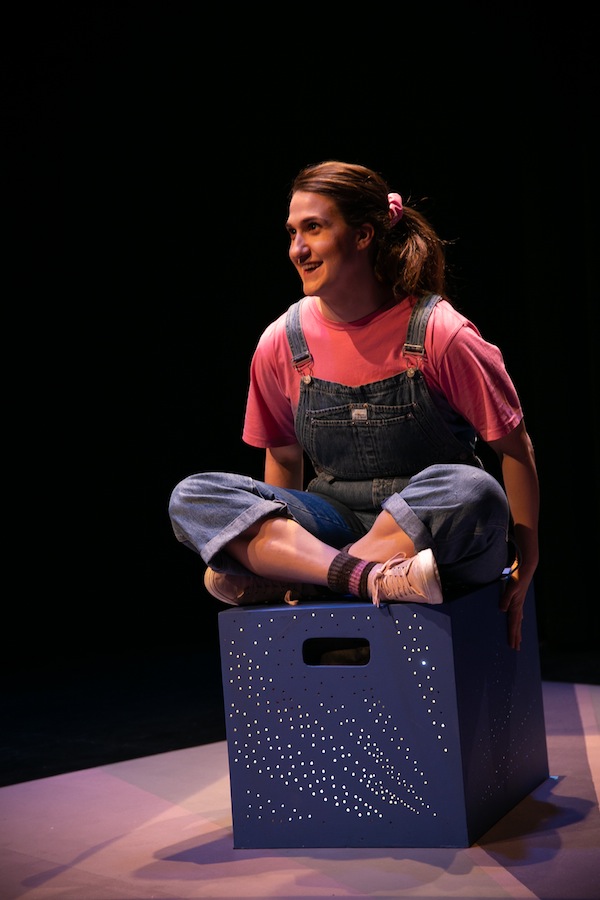
Those who missed the Vancouver performances of Deborah Vogt’s Big Sister, which is performed by her real-life sister, Naomi Vogt, can rent it online until June 11. (photo from JW3)

Former Vancouverite Deborah Vogt’s play Big Sister is available to rent on JW3’s website until June 11.

Vogt is the arts and culture programmer at JW3, which is described on its website as a “cross-communal hub for Jewish arts, culture, family programming, social action, learning and much more.”

“JW3 opened its doors in October 2013 with the mission to increase the quality, variety and volume of Jewish conversations in London and beyond,” said Vogt of the centre, which is located in north London, on Finchley Road.

“I grew up in Vancouver and lived there my whole life, but decided to move to London three years ago,” she said. “I miss the trees, ocean and sushi in Vancouver, but love the excitement and opportunities in London. I joined JW3 as an employee in September 2019.”

Big Sister is a one-woman show about Vogt’s sister’s 75-pound weight loss, told through Vogt’s perspective, but performed by her sister, Naomi Vogt. It played the Vancouver Fringe Festival in 2018. At that time, Deborah Vogt told the Independent that writing the play was a challenge.

“First of all,” she said in that interview, “it was difficult trying to find the balance between Naomi as my real human sister and Naomi as a character. We wanted this show to be entirely truthful, while still presenting a piece of theatre. And this show touches on painful aspects of both of our lives (in a funny way, of course), so trying to write that without overstepping my place or lying to the audience about what actually happened (two sides to every story, right?) was difficult to manoeuvre.” (See jewishindependent.ca/fringe-mixes-drama-comedy.)

The video that is available via JW3’s website is from a sold-out production at the Cultch in February 2020, said the playwright. Being available online means that the work will be able to reach more people.

“The run at the Cultch sold out by opening night, so there may be people that didn’t get a chance to see it then now have the option,” said Vogt. “Putting Big Sister online in this form also expands on one of our themes: vulnerability.

“We never meant to share our work this way,” she explained. “We filmed it for archival purposes, not for public viewing. The show is meant to be live, and intimate, and present. That’s not an option right now, so, instead, we get to experiment with what it’s like for people to experience Big Sister in their living rooms.

“It also means the show lives on. For both Naomi and I, the show changes as our relationship changes. The filmed show captures our relationship in one specific moment in time. I’m interested to see what the next iteration will be.”

When asked to clarify what she meant by that, Vogt said, “I am speaking about our real-life relationship as well as our work, because the two became intertwined during Big Sister. The show allowed us to talk about things we never knew about one another, so it has affected, and strengthened, our relationship. If we decide to put the show on again, we may have to rewrite parts of it to reflect our current relationship. I have an idea for a sequel, but I haven’t told Naomi yet.”

JW3’s presentation of Big Sister is part of a season of streamed theatre through its virtual platform, said Vogt.

The first released was Wot? No Fish!!, which explores “the issue of the ‘outsider’ as artist, immigrant or disabled family member,” said Vogt. It is available for rental until June 4. Becoming Electra – “a heart-warming and original one-woman drag show about a queer Jewish girl trying to find her voice” – is available until June 21.

“The fourth piece is a West End show that had to end the run early, and more info will be released soon!” said Vogt.

About the online theatre presentations, she explained, “When JW3 had to physically shut our doors, the whole team worked incredibly hard to adapt and continue bringing programming into people’s homes. This means classes are online, we have a brand new website, and have had to come up with other creative ways to provide community during this difficult time. While we figure out the next steps for theatre and performance, we wanted to share a season of filmed versions of shows that have a special relationship to JW3. Big Sister is the first time I’ve been able to share my own theatre work with my programming work.”

While JW3 closed its doors to the public in March, Vogt said, “The building is now being used as a food bank, cooking and delivering meals to vulnerable people in Camden. The team has delivered over 5,000 meals already. So, while the building has closed to the public, the space is still being used to support the community. And that reflects the aims of the wider organization: everyone is working really hard to provide entertainment, education, community and connection during these isolating times.”

To find out more about JW3 and its programming, including various arts and culture rentals, visit jw3.org.uk.

Gotta Sing! Gotta Dance! deadline April 1

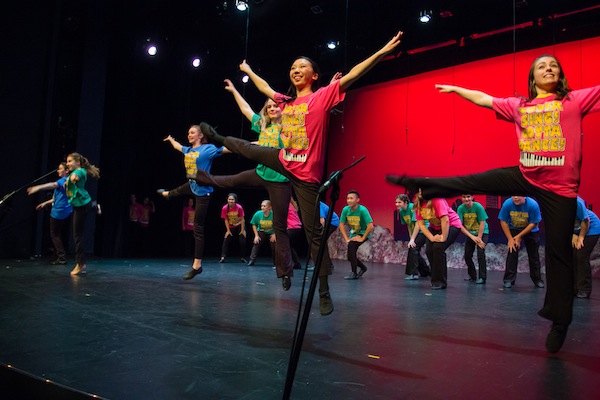
(photo from Gotta Sing! Gotta Dance!)

The deadline to apply for Gotta Sing! Gotta Dance! at the Jewish Community Centre of Greater Vancouver July 7-30 and Aug. 4-27 is April 1. With participants ages 9 to 19 from various parts of Canada and elsewhere in the world, director and creator of the program Perry Ehrlich will be joined this year by faculty including musical directors Wendy Bross Stuart and Diane Speirs; director Chris McGregor; choreographers Jason Franco, Keri Minty and Meghan Anderssen; acting coach Amanda Testini; and Mariana Munoz, set construction and costume co-ordination. The final production of each session will be Wild Wild West Side Story, featuring an original script and a repertoire from Broadway and movie musicals. Also being offered is the finishing school, for serious musical theatre students attending Gotta Sing! Gotta Dance!, and a boot camp dance program. Scholarships are available.

The comics rise again on Feb. 20

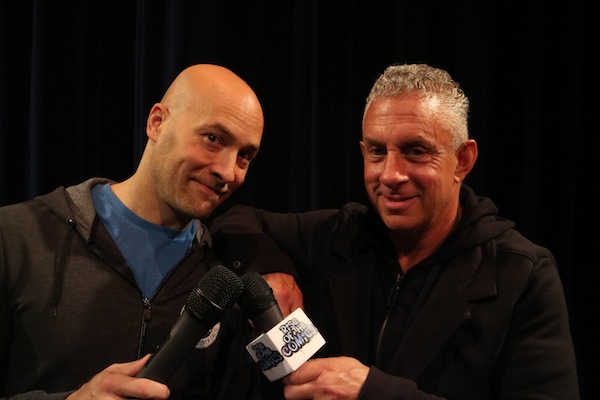
Kyle Berger, left, and Scotty Aceman, co-producers of Rise of the Comics. (photo from Rise of the Comics)

The outer limits of the laugh-o-meter will be tested on Feb. 20 at the Jewish Community Centre of Greater Vancouver’s Rothstein Theatre, when a group of Canada’s top funny people step on stage for A Night of Shticks & Giggles, presented by local comedy producer Rise of the Comics. This will be the third Shticks and Giggles show to raise money for the JCC Maccabi Games.

Headlining the event is Julie Kim, a two-time Canadian Comedy Award nominee for stand-up, who has performed at comedy festivals around the continent and appeared on CBC’s The Debaters and Laugh Out Loud. Her YouTube videos have amassed millions of views and, in 2018, she released her debut comedy album, Outside Voice.

Among other topics, Kim’s routine delves into modern parenting and various cultural issues, sometimes involving life seen from an Asian perspective. Yuk Yuk’s comedy club co-founder Mark Breslin called her “smart, funny, with enough self-awareness to deconstruct her life in a very sophisticated way.”

Other acts in the show, which Rise of the Comics describes as its “best line-up to date,” include Robert Peng, who bills himself as “an unemployed engineer who turned to stand-up comedy out of desperation”; New Zealander Sophia Johnson, “the one who keyed your car but probably shouldn’t have told you that”; Sean McDonnell, who Canadian comedy star Norm MacDonald has praised as “a fantastic talent”; and Brett Nikolic, a maven on Mountain Dew-flavoured weed.

Rise of the Comics is the brainchild of Vancouver stand-up comedian Scotty Aceman, who will also be on stage at Shticks & Giggles. Starting off as a weekly 30-minute program on Shaw Cable with the same name in 2015, the show has highlighted the work of many stand-up comedians who got their start on the local scene, such as Dino Archie and Ivan Decker, who has appeared on Late Night with Conan O’Brien.

Aceman, a University of British Columbia and B.C. Institute of Technology graduate, switched to comedy five years ago, after a 20-year stint in a sales job with Rogers in the corporate wireless phone department.

“Leaving the cellphone business after 20 years was a tough call,” he said. “But you have to chase your dreams. People would ask me, ‘What about my dignity and respect?’ I’d say dignity and respect went out the window the minute I had a Thursday morning bar mitzvah!”

In 2019, Aceman brought in Kyle Berger as co-producer of Rise of the Comics. Berger, sports coordinator at the JCCGV, will be the master of ceremonies for the Feb. 20 Shticks & Giggles.

Before joining the crew, Berger, in his role as JCC Maccabi Games delegation head, had hired Rise of the Comics for a fundraiser. He credits Aceman for allowing him to get his stand-up feet wet, with a debut performance at the Charqui Grill in Kitsilano in 2018.

“Stand-up was one of those things on my bucket list to do by the time I turned 40,” Berger told the Independent. “Scotty (and my then-girlfriend, now fiancée) were both big helpers in getting me up there on stage for a five-minute routine. My fiancée had had enough of me saying I was going to do it.”

Berger said, “Scotty’s reputation within the local comic community is a great asset. Nowadays, Rise of the Comics does all sorts of things, including parties in people’s living rooms. And, last year, we were hired by the Chutzpah! Festival to put on a show.”

Rise of the Comics currently works with a roster of more than 50 stand-up performers of all styles and experiences, and tailors its shows to any situation. They have created performances at such diverse venues as Hy’s Steak House, the Jericho Arts Centre and Ronald McDonald House, among others. Their gigs can cover everything from clean to dirty, social commentary to observational, but always, they say, with an emphasis on the funny.

Berger promises that he and fellow Shticks & Giggles comedians are likely to make mention, in one way or another, that their show is backed by the foundation created by Dr. Neil Pollock, a leading Vancouver male sexual health and circumcision expert, and his wife Michelle.

The show starts at 7:30 p.m. Tickets are $20 and can be purchased at m.bpt.me/event/4499277. For more information about Rise of the Comics, visit riseofthecomics.com.

Sam Margolis has written for the Globe and Mail, the National Post, UPI and MSNBC.

Loves making people laugh

Esther Povitsky performs at the Biltmore Cabaret on Feb. 22 as part of JFL NorthWest. (photo from JFL NorthWest)

Chicago-born comedian, actor and writer Esther Povitsky is one of several Jewish community members performing in the Just for Laughs NorthWest comedy festival, which takes place around Metro Vancouver Feb. 13-25. Her credits include being co-creator and star of the show Alone Together, a recurring role on Crazy Ex-Girlfriend, parts on programs such as Brooklyn 99 and Parks and Recreation, stand-up on The Late Late Show and Comedy Central, as well as host of the podcast Glowing Up. The Jewish Independent spoke with her in advance of her Feb. 22 show at the Biltmore Cabaret.

JI: When did you first start doing stand-up and what motivated you to do it?

EP: I love comedy. I love watching it, I love laughing and making people laugh. I also liked the idea of being able to do something creative where I only relied on myself.

JI: Before you started stand-up, what were you working toward education- or career-wise?

EP: I thought I was going to be a professional dancer, and majored in dance in college.

JI: What is it about performing that you most enjoy, in stand-up and in acting?

EP: Having an excuse to drink too much coffee.

JI: When did you move to Los Angeles, and was it for a specific job or more opportunity for work in general?

EP: I did not have any specific jobs lined up! I moved here to pursue stand-up and worked as a babysitter, worked at a gym, a juice bar, and other random gigs.

JI: You describe your stand-up as just being you. Being Jewish on your dad’s side, where/how/does Judaism, Jewish culture or community fit into that, or your comedy series?

EP: I feel that I was raised very culturally Jewish and it’s a big part of my personality and who I am.

JI: In an interview you talk positively about the immediacy of seeing what works and what doesn’t onstage. How do you handle the highs and lows of comedy?

EP: I try to keep busy, stay active, spend quality time with friends and family, do puzzles, watch TV. I try to really focus on doing as many “normal” things as possible.

Povitsky’s Vancouver show is 19+. For tickets and the JFL NorthWest lineup, visit jflnorthwest.com.

JFL NorthWest returns

Jessica Kirson and Big Jay Oakerson are part of the Just for Laughs NorthWest comedy festival lineup in Vancouver Feb. 13-25. (photos from JFL NorthWest)

The Just for Laughs NorthWest comedy festival takes place around Metro Vancouver Feb. 13-25. Among the performers are several members of the Jewish community, including Andy Kindler, Jessica Kirson, Big Jay Oakerson and Esther Povitsky. The Jewish Independent recently spoke with Kirson and Oakerson.

Kirson is an award-winning comedian. She has appeared on several talk and TV shows, and has her own podcast, Relatively Sane. She was a consultant, producer, writer and actor in the Robert De Niro film The Comedian and will play herself on the HBO series Crashing with Pete Holmes. As part of JFL NorthWest, she will be at the Biltmore Cabaret on Feb. 17, 9 p.m.

JI: Since the JI spoke with you in 2016 ahead of your Chutzpah! show (jewishindependent.ca/gonna-be-a-fun-night), a lot has happened in your world. Could you share some of your professional highlights over the last few years?

JK: So much has happened. I have done a ton of television and movie appearances. I’m loving traveling all over the world doing stand-up. I am executive producing a movie for FX, a documentary about female comedians; it will première this summer. I had a special come out on Comedy Central called Talking to Myself, in addition to a bunch of other projects.

JI: You’ve been in the podcast world for a long time now. What do you particularly like about the medium?

JK: I started Relatively Sane because I wanted to create a podcast that wasn’t just funny and silly. I wanted it to get real also. I wanted to talk about anxiety, depression, etc. I love it. It’s one of my favorite creative mediums now.

JI: What is the difference, if any, performance or prep-wise between working on a radio show versus a podcast?

JK: It’s very similar. I don’t do a ton of prep work with my guests. I love finding things out while I’m talking to them. It’s more real that way.

JI: Can you tell me a bit about your Comedy Central special, how it came about and what it has meant to you career-wise?

JK: I had felt like I deserved a comedy special years ago. It was the one thing I felt I deserved that I didn’t get. I got a call from Bill Burr. He told me he wanted to produce my special. He shocked me. I feel very grateful to him. When comics do things like that for other performers, it’s amazing. We should all do it for each other.

JI: Similarly, The Comedian and Robert DeNiro. How did that happen?

JK: DeNiro saw me performing at the Comedy Cellar in New York City. He was looking for comics to be in his movie. We met up that week, we connected and I became his right-hand person. I ended up being in the movie and getting a producer credit. The hardest part was showing up every day, giving my opinion and not caring what the producers and director thought. It was very intimidating but I had him by my side so it worked out.

JI: Is getting your own television show still something you’d like to achieve?

JK: Yes, I would love to have a talk show.

* * *

Oakerson has appeared on many television shows. He has recorded two specials, one for Comedy Central in 2016 and one for Netflix in 2018, as well as three albums. He was the host and creator of What’s Your F#$king Deal?! and currently co-hosts the podcasts The Legions of Skanks, The SDR Show and The Bonfire with Big Jay Oakerson and Dan Soder. For the JFL NorthWest festival, he will perform at the Biltmore Cabaret Feb. 19-20, 9:30 p.m.

JI: When did you first start doing stand-up and what motivated you to do it?

BJO: I started doing comedy in 1999 at the urging of a friend who caught up with me after high school and expressed her disappointment in me never trying it before.

JI: In what ways has your stand-up style changed since you first started?

BJO: First of all, my level of nerves is significantly down. I think I’ve evolved it into a very comfortable style of storytelling and interaction versus joke writing/telling than I started with.

JI: Did you grow up in a household where you were encouraged to form and express your own opinions?

BJO: I don’t recall anyone in my household being highly opinionated about anything.

JI: Were you a witty or mouthy child?

BJO: 30% mouthy, 70% witty.

JI: What role, if any, does being Jewish, Judaism, Jewish culture or community have in your life and/or your career?

BJO: I thought I’d get a bump in this business because I’m Jewish, and nothing. I guess I’m not that kind of Jewish.

JI: What is it about pushing the boundaries that you most enjoy, and to what purpose do you do it?

BJO: “Edgy comedy” was generally the comedy I was drawn to growing up, so it’s just sort of how my humour developed. If I can make you question things or think about a different perspective on something, great, but, ultimately, I’m just trying to make people laugh.

JI: Are there any red lines you won’t cross?

BJO: Not if I think I can make the subject more funny than offensive.

JI: What do you enjoy most about doing podcasts?

BJO: Freedom.

Both Oakerson’s and Kirson’s shows are 19+. For tickets and the full JFL NorthWest lineup, visit jflnorthwest.com.

In next week’s JI: an interview with Esther Povitsky.

Directing a favourite musical

Malka Martz-Oberlander, left, and Dalia Currie are co-directing Little Shop of Horrors, which is at the Red Gate Revue Stage from Feb. 6-9. (photos from TES Theatre)

At 17, many Jewish Independent readers were probably spending most of their time hanging out with friends, maybe doing a music or art class or two, some sports activities. In addition to being a student, 17-year-old Jewish community member Malka Martz-Oberlander is a filmmaker, writer, film and theatre director, cartoonist, musical theatre actress and photographer. Her latest initiative is a production of Little Shop of Horrors, which is at the Red Gate Revue Stage on Granville Island Feb. 6-9.

Presenting the production is TES Theatre, or Transforming Education, which, explained Martz-Oberlander, was “originally the theatre program at the one-of-a-kind Windsor House School: a democratic, multi-campus, K-12 school in East Vancouver.

“When Windsor House School closed down last year,” she said, “former principal Meghan Carrico decided to start a theatre company for the students, like myself, who wanted to continue to do theatre and musical theatre together. The program that arose after the school’s devastating closure is grounded in the same democratic philosophy. Our mission is to make sure any student who wants to do any aspect of musical theatre can and will be supported by a willing cast and a professional musical theatre teacher.”

Martz-Oberlander is co-directing Little Shop of Horrors with Dalia Currie. Last June, the pair co-directed a production of Much Ado About Nothing that Currie adapted. According to Martz-Oberlander, Currie “loves Shakespeare” and has “co-directed and acted in many of the Bard’s shows,” including playing the role of Theseus in A Midsummer Night’s Dream in 2018, as part of the Carousel Theatre Teen Shakespeare Program.

Currie found musical theatre through joining Windsor House in 2018, said Martz-Oberlander. “She played Olive Ostrovsky in The 20th Annual Putnam County Spelling Bee and Gaston in Beauty vs. Beast, an original parody of the tale as old as time.”

For her part, Martz-Oberlander performed with Encore Musical Theatre (formerly Broadway Edge) for four years, then performed in two shows with Windsor House School and, this year, is a member of Arts Umbrella’s Pre-professional Musical Theatre Troupe.

illustration - Crystal, Ronette and Chiffon are the three narrators of Little Shop of Horrors. Malka Martz-Oberlander sketched this image of the trio, which was colourized by Emi Lavoie
Crystal, Ronette and Chiffon are the three narrators of Little Shop of Horrors. Malka Martz-Oberlander sketched this image of the trio, which was colourized by Emi Lavoie. (image from TES Theatre)

Martz-Oberlander said she and Currie initially pitched Little Shop of Horrors to the theatre company because they had both grown up watching it, “and we were very excited at the thought of directing our first musical together this year with the mentorship of our new musical theatre teacher, Isabella Halladay, who is a local musical theatre artist.”

The production involves around 30 people, said Martz-Oberlander, “and all but three of them are students. We held auditions for people within our theatre community,” she said. “We made sure that anyone who was interested has been involved in some way, whether it be onstage or in the tech booth. The actors range from age 14 to 19. There is no live band, we have backing tracks.”

Little Shop of Horrors, both a film and a Broadway musical from the 1980s, is now back on Broadway, said Martz-Oberlander. “It’s about an orphan boy taken in and given a job by Mr. Mushnik, a European Jewish immigrant and the owner of a run-down flower shop in the ‘bad part of town.’”

Despite the fact that both writers of the musical were Jewish – Howard Ashman (who passed away in 1991) and Alan Menken – Martz-Oberlander said that she and Currie were concerned about the portrayal of certain characters, in particular that of Mr. Mushnik.

“As a cast and individually, we have discussed when it’s good to bring out stereotypes and when it’s actually really harmful,” Martz-Oberlander told the Independent. “For example, the character Mr. Mushnik seems like a two-dimensional, money-hungry shop owner. The character embodies this Jewish stereotype throughout the whole story. My non-Jewish co-director and I have tried our best to approach this thought-provoking comedic piece with the intention of not perpetuating hurtful stereotypes. When producing a show written in a different decade, when values were different, it’s so important to come at it from an authentic, respectful and knowledgeable way.”

Martz-Oberlander had only praise for the production’s venue, the Red Gate Revue Stage. Saying that the cast and creative team were “incredibly lucky to get to rehearse and perform” there, she added, “I think a place like the Revue is vital at a time in Vancouver where things are less and less affordable – to have arts spaces and small theatres like the Revue is very important.”

As for Little Shop of Horrors, Martz-Oberlander said, “I think it’s a great opportunity to come out and support local youth-directed theatre and watch a fantastic show! This show is really a one-of-a-kind, hilarious science fiction musical that will have you humming tunes for weeks after.”

Tickets to Little Shop of Horrors ($5-$15) can be purchased at the door or online from brownpapertickets.com/event/4481952.

Opera urges “never forget”

The ship’s cabin in Pasazerka (The Passenger), as envisioned by UBC Opera’s creative team. The opera is part of a series of events at the University of British Columbia marking the 75th anniversary of the liberation of Auschwitz. (photo from UBC Opera)

UBC Opera presents the Canadian première of Mieczyslaw Weinberg’s Pasazerka (The Passenger). Opening Jan. 30 at the Chan Centre for the Performing Arts on the University of British Columbia campus, this will be the first time the work has been presented on any university stage in the world.

The Passenger opens on a luxury liner bound for Brazil. A newly married German woman, Lisa, who, earlier in life, had been an aufseherin, camp guard, at Auschwitz, thinks she recognizes a fellow passenger. The passenger is Martha, a Polish Auschwitz prisoner who was thought to have died at the camp. The effect that their meeting (either actual or imaginary – it’s never made clear) has on the two women, and on Lisa’s marriage to the German ambassador to Brazil, is the subject of this dramatic and powerful opera.

UBC Opera’s production is being created from scratch. The opera has proven so popular no sets or costumes are available for rent; consequently, new sets are being constructed and, at this writing, the students were sewing together dozens of striped prison pajamas for the Auschwitz prisoners’ chorus.

After receiving its world première in 2010 at the Bregenzer Festspiele in Austria, The Passenger has seen frequent performances in various German venues, a highly acclaimed production at the English National Opera in 2011 and, more recently, it has been performed successfully in the United States at the Houston Grand Opera and at the Lyric Opera of Chicago. In spring of last year, it was performed at the new Tel Aviv Performing Arts Centre, and it will be performed in Spain later this year.

The UBC production has received funding from various sources, including the Adam Mickiewicz Institute, which promotes Polish culture around the world, and the Consulate General of the Republic of Poland, as well as Poland’s Department of Public and Cultural Diplomacy and Ministry of Foreign Affairs.

When the president of UBC, Dr. Santa Ono, heard about the project, he committed further funding for the production. Other funding has come from UBC’s dean of arts, Gage Averill, and the David Spencer Endowment Encouragement Fund. The production also has received support from the Vancouver Holocaust Education Centre, Temple Sholom and UBC Hillel House.

“In our time, antisemitism and neo-Nazism has become shockingly prevalent again. Even our own neighbour to the south has witnessed a growing social and political climate which has encouraged disrespect for other human beings and blatant racism,” said Prof. Nancy Hermiston, head of the Voice and Opera divisions at UBC and the director of this production of The Passenger, in a recent interview with the Independent. “In my opinion,” she said, “this has, in part, been released as a result of the behaviour and actions of President Trump. His attitude has given those elements of the world’s population promoting discrimination, hatred, antisemitism and neo-Nazism, a sense that they have a licence to do so. Our opera highlights the consequences of this hatred and racism. Now is the time to remind ourselves of respect and tolerance for others and of our humanity. It is the exact time to remind ourselves of the horror of the systematic extermination of millions of innocent people. Genocides continue to plague our world. Have we learned nothing from the past?

“We can never forget the tragic deaths of those millions of innocent souls nor can we forget those who survived that crime against humanity,” she said. “We cannot let another Holocaust occur.”

The Passenger is sung in Polish, Russian, Czech, French, Yiddish, German and English, which offers a particular challenge to the young singers at UBC. Equally challenging for the singers, according to Hermiston, is the difficulty of dealing emotionally with the subject matter, which, in rehearsal, has led to periods of weeping and feelings of deep sorrow, both for the singers and “even for me,” admitted Hermiston, “especially at the end, when the chorus of prisoners comes downstage and challenges the audience to ‘never forget, never forget.’” (Hermiston has engaged a counseling team to help the singers through their own trauma as they reenact this emotional narrative.)

Performances of The Passenger are set for Jan. 30 and 31 and Feb. 1 at 7:30 pm, and Feb. 2 at 2 p.m. Tickets are available online at music.ubc.ca/opera-pasazerka-the-passenger.

The opera is part of a larger commemoration of the 75th anniversary of the liberation of Auschwitz that is being undertaken by UBC Opera; the UBC Modern European Studies program; the UBC department of Central, Eastern and Northern European studies; the UBC Witnessing Auschwitz International Seminar; and UBC Go Global. During a symposium that runs Jan. 27-30, there will be various symposia and exhibits, and school-outreach programs featuring local survivors and UBC professors and students, as well as the opera The Passenger.

Guest speakers for the symposium include Dr. Michael Berenbaum, Dr. Bozena Karwowska, Dr. Piotr Setkiewicz, Dr. Chris Friedrichs, Aleksander Laskowski, Dr. Richard Menkis, Dr. Dorota Glowacka, Dr. Rima Wilkes, Dr. Anja Nowak, Dr. Peter Suedfeld, Dr. Tricia Logan, Dr. Ilona Shulman Spaar, Janos Benisz, Amalia Boe-Fishman and David Ehrlich, among others. For more information, visit auschwitz75.arts.ubc.ca.

Graham Forst, PhD, taught literature and philosophy at Capilano University until his retirement and now teaches in the continuing education department at Simon Fraser University. From 1975 to 2010, he co-chaired the symposium committee of the Vancouver Holocaust Education Centre.

Searching for a safe harbour

Ben Caplan is narrator and co-creator of Old Stock: A Refugee Love Story, which runs Jan. 24-30 at Frederic Wood Theatre, as part of the PuSh festival. (photo by Stoo Metz Photography)

The 2020 PuSh International Performing Arts Festival opens next week. Among the highlights is Old Stock: A Refugee Love Story, which follows Chaim and Chaya from the pogroms in Romania they are fleeing, to Halifax’s Pier 21, where they meet in 1908, to Montreal, where they end up living. The show, which runs Jan. 24-30 at Frederic Wood Theatre, is narrated and co-created by Halifax-based musician and performer Ben Caplan, with whom the Jewish Independent recently spoke.

JI: How and when did you become involved in the production?

BC: It all started with a phone call from 2b Theatre Company’s artistic co-director Christian Barry in mid-2015. Christian was familiar with my work as a songwriter and performer in the music world and he wondered if I would be interested in collaborating on creating a theatrical production featuring new songs that we would write together.

To be honest, I was skeptical at first. I tend to be a very solitary writer and, though I had a lot of experience in theatre many years ago, it had been a decade since I had performed in theatre. The first few writing sessions were pleasant enough and Christian and I got along great, but we were struggling to find the story that we wanted to tell. As we were searching and exploring to find the substance of what the work would consist of, a confluence of events conspired to show us the story that would become Old Stock.

The first thing was our growing consciousness of the scale of the human tragedy emerging in Syria as a growing number of refugees started trying to find their way out of the violence. Next came Prime Minister Stephen Harper’s comments about “Old Stock Canadians” during the 2015 leadership debate. This othering of “non-Old Stock Canadians” seemed to be vile and absurd. At what point does one get to call themselves “Old Stock”? I am the great-grandson of Jewish immigrants who came to Canada fleeing violence in their own home countries. Was I supposed to think of myself as “Old Stock” or did I fit into some other category in our [then] prime minister’s logic.

Around this time, Christian’s wife, who happens to be the celebrated playwright Hannah Moscovitch, gave birth to their first child, Elijah, and came across the immigration records of her own great-grandparents who immigrated to Canada in 1908 through Pier 2 in Halifax. She realized that, if her great-grandparents hadn’t made the journey to Canada, she would not exist, let alone her infant child. It was then that Hannah asked if she could write the scenes for the show we were trying to create.

With Christian’s vision of the artistic whole, my work as composer and lyricist, and Hannah’s work as playwright, we were off to the races and we worked together to create the show. We thought that the Jewish story from 110 years ago had a striking and tragic resonance with the tragedy unfolding in our own time. I should mention that, of course, the originating cast, musical director Graham Scott, our production manager and designer Louisa Adamson, and many others played a huge role in realizing the vision and bringing the music and the play into the world.

JI: In broad strokes, could you describe how the co-writing process worked?

BC: Christian Barry created the structures and conditions that made it possible for any of these songs to be written. I was probably not always the easiest artist to work with – I tend to desire quiet and solitude when I am writing.

The way it usually worked is that Christian would book a time and a space in whatever city we were able to meet up in (we did writing in Halifax, Montreal, Stratford and Banff) and the day would start with conversations and questions. We would talk, share ideas, listen to music, read texts, Google things, etc.

Out of our conversations and questions, the idea for a song would emerge. The first one we wrote was something for their arrival at Pier 2. We didn’t have a scene or a broader context to work with but, after awhile, Christian would say something like, “We know they are going to come through Pier 2, let’s start there.” I sat at the piano and started mashing out some chords and throwing words into the air. Christian had a wonderfully delicate touch after I got rolling, and would provide helpful comments, critiques, and throw ideas into the room.

JI: What is it about the production that drew you back to performing?

BC: I had stopped performing in the theatre after I became somewhat disillusioned of the possibilities of making a career in theatre. In 2005, the year I did my last theatre performance, I was working on academic pursuits, theatre and my hobby as a singer-songwriter. My life was over-full and something had to give. My logic was something like, in theatre, you need to rely on finding a lot of talented people who are willing to work on a project that takes a lot of time and resources to complete. As a singer-songwriter, there is more room to work solo and bring other people into the project as interest and resources permit. So, that’s the path I chose to express my artistic impulses. I gave up the dream of becoming an actor to focus on the more reasonable and safe path of becoming a songwriter. Ha!

When Christian called me to ask me to make a piece of theatre with him, it was a no-brainer. Being a part of this show has been one of the great privileges of my life. Not only did I get to collaborate with a crazy good team on writing the thing, but I had the opportunity to perform on stages that I wouldn’t have dared to dream of stepping onto when I was making theatre 10 years ago. It’s been an amazing learning experience and one that is sure to influence my work as a performer for the rest of my career.

JI: In what ways does the story and/or themes of Old Stock speak to you as a Canadian in 2020?

BC: What is most meaningful for me about the story and themes of the show is the humanization of the character of the refugee. It has been disturbing to see the ways in which migrants have been portrayed by so many politicians and media outlets around the world. They are often spoken of as hordes, masses and statistics. What is lost are the individual human lives – people with hopes, dreams, fears and trauma searching for a safe harbour.

In Old Stock, we tell the story of Hannah Moscovitch’s great-grandparents coming to Canada. We see their struggles to overcome their past and to generate new and complicated identities. I think that we all, as human beings, have complicated and multi-layered identities. I think that, among other things, this show is about demonstrating layered and sometimes tragic identities with compassion and a healthy dose of humour. That’s basically the most Canadian thing I can think of.

For tickets to Old Stock: A Refugee Love Story and other PuSh shows, visit pushfestival.ca. The soundtrack to Old Stock is available on Spotify, YouTube and elsewhere.

Last Cabaret almost sold out

Joanna Garfinkel is part of the creative team behind the world première production of Berlin: The Last Cabaret, part of the PuSh festival. (photo from the artist)

The world première of Berlin: The Last Cabaret, presented at Performance Works Jan. 23-26 by City Opera Vancouver in association with Sound the Alarm: Music/Theatre, is almost sold out. Part of the PuSh International Performing Arts Festival, the only tickets that remain will be sold at the door, though writer and Jewish community member Joanna Garfinkel told the Independent, “I hope we are able to add more presentation opportunities, as well, since this is truly becoming an exciting and rich production.”

Set in Nazi Germany in 1934, a group of artists must decide whether or not to perform their new political show – which, reads the press release for Berlin, “challenges state media, calls out the Nazi classification of gay individuals as ‘degenerates’ and includes parodic inflection that women are being marginalized” under the new regime – or save themselves.

The opera takes place “two weeks after ‘the Night of Long Knives,’” said Garfinkel, “when the future had been cast, but many were not yet seeing it, including my own family. One thing that interested me a great deal is how people are forced to make compromises under oppression, and even make excuses for what’s happening around them.”

The “Night of the Long Knives” was the June 30, 1934, purge by Hitler of more than 85 members of the Sturmabteilung, the Nazi party’s initial paramilitary wing.

Rather than being a satire itself, Garfinkel explained that Berlin: The Last Cabaret “is more an unearthing of the under-heard Jewish and queer artists who flourished in the Weimar era and were crushed by the Holocaust. The humour we employ is their urgent satire, which feels fresh and relevant with all that is going in the world right now.

“My own family escaped from Berlin to Winnipeg (eventually), so I am both bound to respect and honour the history, and also privy to the dark humour we employ about it.”

City Opera Vancouver approached Garfinkel last spring, she said. They had “heard about me from my dramaturgical work with Playwrights Theatre Centre and the historically based Japanese Problem for my own company, Universal Limited. I was excited by the opportunity to work with an opera company, which would be new to me, but on something quite close to my heart, history and interest.”

The relevance of the opera was one of the reasons she joined its creative team. In regard to choosing projects in general, she said, “Right now, it feels like art must be speaking to the world and on behalf of marginalized voices. Theatre is too much work, and the world too messed up, to work on projects that don’t resonate on an activist level. I am lucky right now to get to choose to work on things that are so resonant.”

Garfinkel, who is billed as librettist for the production, clarified that categorization.

“I contributed story, structure and additional dialogue for this piece,” she said, “but it’s important to note that the songs themselves are historical, written by composers Eisler, Spoliansky, Hollaender and Weil, so I am not, technically, the librettist. However, building a story and play around preexisting songs presents its own challenges. It was of central importance to me that the Jewish/queer and other marginalized artists of the time were centred in our story.

“We were working with excellent (but unavailable!) collaborators in our composers and, together with director Alan Corbishley, music director and historian Roger Parton and choreographer Tara Cheyenne Friedenberg, tried to honour their work and build a vital story around it.”

Cheyenne Friedenberg is also a member of the Jewish community.

Berlin: The Last Cabaret stars actors with a background in music and spoken theatre, rather than traditional opera singers, and each performer, according to the press release, “was involved in the creation of their on-stage characters and storylines.” The production features a live four-person band.

For more information on PuSh, visit pushfestival.ca.

It’s a Wonderful Life in music

Erin Palm and Nick Fontaine reprise their roles as Mary and George Bailey in Patrick Street Productions’ musical It’s a Wonderful Life. (photo by David Cooper)

So ingrained in popular culture is Frank Capra’s It’s a Wonderful Life that many Jews probably make it an annual tradition to watch the 1946 film. This year, there is also the chance to see a musical adaptation of the classic, in which the angel Clarence is assigned the job of trying to save Bailey Building and Loan owner George Bailey from committing suicide on Christmas Eve, after there is a run on the bank and George faces the possibility not only of financial ruin but of believing his life has been a waste.

Patrick Street Productions presents the musical version by Peter Jorgensen, with arrangements and orchestrations by Nico Rhodes, at the Anvil Centre Theatre in New Westminster from Dec. 19 to Jan. 5. The show is the only ticketed event of Winter Celebrations, free daily performances by professional artists, singers and musicians at the Anvil Centre until Jan. 5.

It’s a Wonderful Life features a few Jewish community members: Erin Palm as George’s wife, Mary; Andrew Cohen as Ernie, who Cohen describes as “everyone’s favourite Bedford Falls cabbie”; and Stephen Aberle playing, in his words, “the ruthless, cold-hearted capitalist Mr. Potter, as well as the Sheriff, and hero George Bailey’s father, Peter.”

“Mr. Potter is the antagonist of the piece,” explained Aberle. “He owns practically everything in the small town of Bedford Falls, other than the little Bailey Building and Loan Society that George Bailey’s father founded and that George continues. Potter hates the Building and Loan and does everything he can to crush it because it helps working people to save and buy their own homes instead of having to rent from him and live in the slums he owns.”

While Cohen and Aberle are new to the show, Palm played Mary in the 2018 Patrick Street production at the Gateway Theatre. As an aside, she said, “I also auditioned for the original production in Chemainus so many moons ago. I am so happy it all worked out the way it did. I truly believe it was the right fit for me at this time in my life. I have so much more personal growth and experience to bring to the role of Mary.”

Never wanting her acting to be a copy of someone else’s work, Palm said she has not seen the movie in its entirety. “I have seen some clips,” she said, “but not enough to develop a multifaceted character. Peter has written a great script and all I need to bring Mary to life is in the text. The musical aspect is completely different from the movie, and I think a beautiful addition.”

About her character, Palm said, “I appreciate Mary’s faith in community and her love for her family. She’s really strong and an anchor for George. When she wants something in her life, she goes after it. She’s the matriarch and heroine of the story. She comes through for her family and for her community when times are at their worst.

“I also appreciate her love of the simple life. In complex times like ours, and when I find my ambition too great, it’s people like Mary that remind me I can be happy and grateful for what I have, what I have worked so hard to create.”

One of Palm’s favourite scenes is “the moment right before we meet Clarence,” she said. “George is on the bridge and he’s deciding the fate of his own life, the same bridge where so many of his life’s highlights happen. It often makes me weep backstage. It’s difficult to think of people who carry the weight of the world with them, feeling isolated and alone, especially around the holidays, but the reality is the troubles of the world do not stop around those times and are in fact amplified for people who are struggling with depression and financial hardship. It’s a beautiful reminder how important it is to reach out to those around you, be a light in their lives. It only takes one person, one gesture to change the outcome of the lives of many.”

For her part, Palm is grateful to be working with the cast and especially Aberle, who happens to be her father-in-law. “Working on a show that has to do with family makes me long for family during the holidays and it is a gift to work with him,” she said.

Of the Christmas aspect of the show, Palm said the story is based in community and, “while we sing some Christmas carols, the heart of the piece is a very human story of how communities can overcome hardship by coming together around the holidays to help those who need it most, to support each other and to celebrate life. It touches on how faith can be a guiding light, but, ultimately, it’s in our own hands. Our daily work, prayer and decisions can change our own lives and people around us.”

While acknowledging that the story “seems to be somewhat synonymous with this season,” Cohen said it’s “the story of a stalwart man who continually puts the needs of his community members above his own. He learns that the value of life is not determined by monetary gain or ambition but rather the positive impact you have made on the lives of others. Even though we like to watch this story around Christmas time, it is not a story about any one holiday, but rather a family man who learns how to be a mensch.”

Aberle echoed his co-stars’ comments, adding more context and noting some Jewish connections.

It’s a Wonderful Life is about the importance of family, fairness, justice, courage in resistance to oppression and people sticking together in hard times,” he said. “It celebrates the human spirit and the importance of individual action and responsibility. While it’s true that the climactic scenes of the story are set at Christmas time and that our production (like perennial TV broadcasts of the film) is coming out at that time of year, I’d say (with director Frank Capra himself) that it’s not a Christmas story. To quote Capra: ‘I didn’t even think of it as a Christmas story when I first ran across it. I just liked the idea.’ In a 1946 interview, Capra described the film’s theme as ‘the individual’s belief in himself.’

“It happens that several of the writers who were involved with it were Jews, or of Jewish descent,” Aberle added. “The original short story, The Greatest Gift, was by Philip Van Doren Stern, whose father was of Bavarian Jewish extraction, and the writers who contributed to the film screenplay included Clifford Odets and Jo Swerling, both Jewish, and Dorothy Parker, whose father was a Jew.

“A heck of a lot of the music in this adaptation – like a heck of a lot of American musicals in general – is by Jewish composers and librettists, including George and Ira Gershwin, Alan Jay Lerner, Kurt Weill.”

For tickets to It’s a Wonderful Life, call 604-684-2787 or visit patrickstreetproductions.com. The show is recommended for ages 9+.