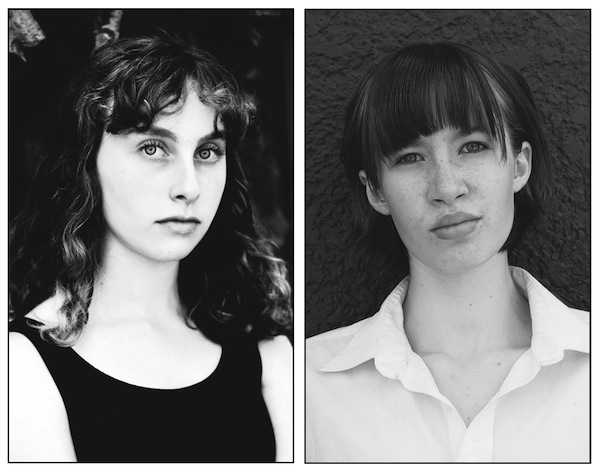
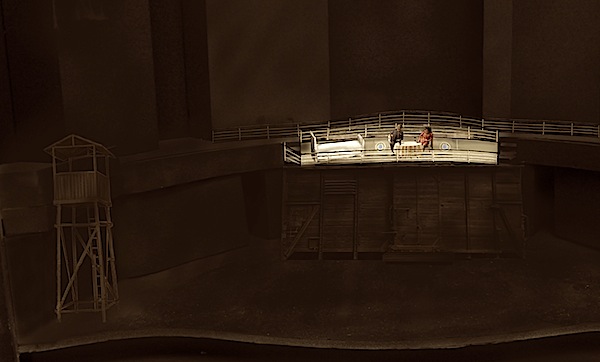
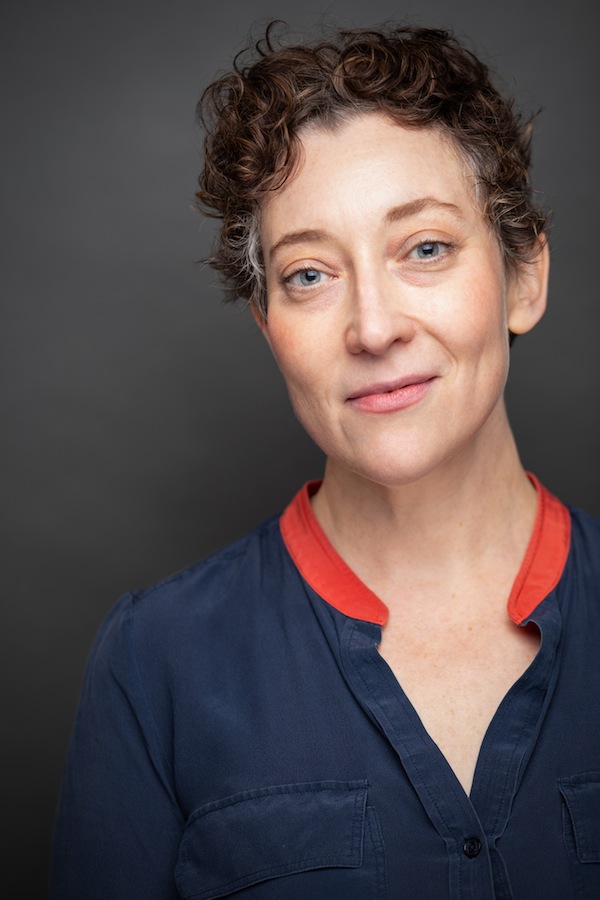
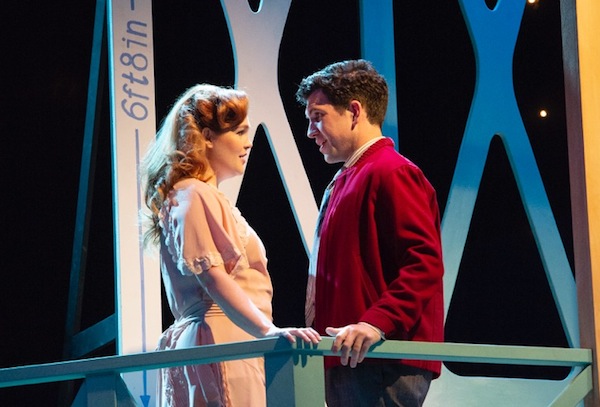
Hannah Everett, left, and Drew Carlson co-star in Artisanal Intelligence, at the Havana Theatre Jan. 14-18. (photo from Spec Theatre)
Drew Carlson and Jewish community member Hannah Everett are reprising their roles in Artisanal Intelligence, which again plays at the Havana Theatre, Jan. 14-18.
Written by Jewish community member Ira Cooper, the show had a limited two-show run this past July at the Havana; both of those performances sold out. It also traveled to a few Fringe festivals, garnering positive reviews.
Carlson plays Barry, a hipster customer-service robot who is filled with esoteric knowledge and mad skills. Everett plays Jane, the entrepreneur who created Barry.
“The content will be the same, aside from a few tweaks and tightens,” Cooper told the Independent about how the January production differs from the summer show. “One of the songs, ‘No Off-Switch for Love,’ will be fully orchestrated, as opposed to the passable version of it that I created on GarageBand with digital instrumentation, so that is exciting and new. I am hoping it will fill out the song more, give it its deserved panache, and get people dancing in and out of their seats. It’s a Boney M.-inspired funk track, so I am really happy that it will finally be given the backtrack it has always longed for.”
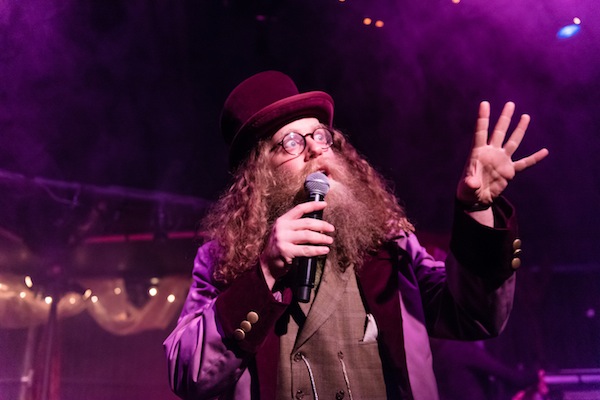
Ira Cooper (photo from Spec Theatre)
The idea for Artisanal Intelligence took a couple of years to develop.
“In 2017, I went to live in China for a year to teach at a Canadian high school abroad,” said Cooper, who teaches the younger grades English and drama at King David High School. “My partner stayed in Canada and so I was there, in a new city, in a massive apartment, concocting, creating and percolating thoughts, ideas, words and scribbles to fill a void. Artisanal Intelligence was my attempt to write an accessible Fringe show…. Hipsterism just has so much great material to rib and, being that I would self-identify as a ‘hipster,’ I needn’t go too far to do my research. And robots. And AI. All are distinct and widely known, relevant, partaken in and discussed topics, so it seemed like an easy fit with my own personal playwriting aspirations this time around.
“I do not remember much about the writing process for the initial drafts. Knowing myself, it was probably over a three- or four-week period. Then drafts. Collaboration is integral to everything I and Spec Theatre do, so, early on in the process, I had people reading the script and giving me notes. Then it was sitting down with the director, Bronwen Marsden, for more edits. Then with the actors. Then with my partner, who is also the artistic designer for Spec, Ruby Arnold. The more feedback the better. The end result is a deeply heart-filled joint-effort, which we are all proud of and which we all had a part in molding, from the very words on the page outwards.”
Cooper said Artisanal Intelligence lampoons and lambasts hipster culture, as opposed to critiquing it.
“The show uses a lot of recognizable hipster motifs, tropes and allusions, but the audience is consistently in on the joke,” he said. “The show is a discussion on identity, self-perseverance, self-reliance and the impending (or not) robot apocalypse, but in a soft and humorous way.
“I think the show actually exemplifies why culture can be important, how it can bind us to something bigger than ourselves. We are constantly looking for the ‘bigger than ourselves’ entities. And so, with the culture references, the clearly identifiable razzing and fun that takes place in the 55 minutes of Artisanal Intelligence, the audience, who get what the show is alluding to, are part of each joke’s equation – that knowledge links culture, the audience and the performers.”
The performances at the Havana in January will be relaxed, said Cooper, which means “the houselights will never fully dim and people are free, if they need or want, to get up, stretch, move, go for a walk, etc. We want theatre to be accessible to everyone and we respect, acknowledge and cherish the diversity of our audiences. Also, if you’re an artist of any kind, Spec Theatre is always looking to collaborate, to make unique, experimental, new things. Reach out!”
For tickets to Artisanal Intelligence, go to spectheatre.com.
Kat Palmer, left, and Kyra Leroux during the final dress rehearsal for Alice in Wonderland – The Panto, which opened at Metro Theatre Dec. 13 and runs to Jan. 4. (photo by Tracy-Lynn Chernaske)
“In Alice in Wonderland – The Panto, audiences will see all of their favourite characters from the original story in a new, more hilarious light,” Kyra Leroux told the Independent. The panto opened at Metro Theatre on Dec. 13 and runs to Jan. 4.
“This show is definitely a lot more silly and ridiculous than the original Alice in Wonderland story, but the difference that really strikes me the most is my character, Alice,” said Leroux, who is a member of Perry Ehrlich’s ShowStoppers and a past participant in the Gotta Sing! Gotta Dance! annual summer theatre program at the Jewish Community Centre of Greater Vancouver. “In this show, Alice has so much confidence and spunk, which is exactly what you would expect from a curious, forward-thinking young woman!
“She’s such a fun character to play because I see myself in her in so many ways. Although at first she is confused about which direction she wants to take her life, relying on others to show her the way, she soon realizes that she can make her own decisions and take charge of her own life, thereby gaining so much confidence.
“Alice loves to joke around,” added Leroux, “and, at times, even matches the absolute absurdity of characters such as the Mad Hatter, the Cheshire Cat and the Queen of Hearts. Despite feeling stuck in her confusing situation, Alice is never one to take herself too seriously, which is exactly like me in real life.”
An easy-going attitude will also help Jewish community member Kat Palmer in her role as stage manager of the production.
“Pantos definitely conjure up the phrase ‘controlled chaos.’ While there is always a certain element of surprise with live theatre,” said Palmer, “each performance of the panto is undoubtedly ever-changing, with a unique audience every night – so much of this show is determined by audience participation and the actors improvising.
“Pantos are always a family favourite,” she said, “because kids are encouraged to react loudly – they boo the Demon and cheer for the Good Fairy. As a stage manager, I might plan to call a sound or lighting cue on a certain line but, if the actor is ad-libbing or we have a particularly rowdy audience, the line may not happen when it’s supposed to. You have to be on your toes and focused all the time. Whereas musicals and plays are more set in stone, the panto will be a different show every night.”
The silliness of it all is what Leroux most enjoys.
“Throughout the process,” she said, “it has been so much fun to just let go and allow myself to be absolutely ridiculous along with my castmates. My favourite days in rehearsal are when I get to watch other actors make choices that make me laugh so hard I feel like I could explode! With that in mind, the most challenging thing about being in a panto is being so focused and in character onstage that you will never break character and laugh at what others are doing. There are so many hilarious moments in the show that even I, after seeing them over and over again, have to work hard not to laugh. That being said, I’m so excited to see how audiences will react when they see all of my favourite moments for the first time.”
For tickets to Alice in Wonderland – The Panto, call 604-266-7191 or visit tickets.metrotheatre.com.
Bema Productions presents the Canadian première of the comedy O My God at Congregation Emanu-El Synagogue in Victoria, Jan. 16-26. In O My God by Israeli playwright Anat Gov, God walks into a therapist’s office suffering from depression. The therapist asks, “How long have you felt this way?” God says, “Two thousand, five hundred years. Give or take.” “You’ve been depressed for 2,000 years and only now you’ve come to therapy? What were you waiting for?” asks the therapist. And God says, “I thought time would heal.”
Gov, who died of cancer at 58, was born in 1953, and was a graduate of Thelma Yellin High School of the Arts. She was briefly a student in Tel Aviv University’s theatre department – she dropped out to become a successful playwright and television writer. She also married and was a mother of three and grandmother of two.
The Bema Productions staging of O My God is directed by Zelda Dean and performed by Christine Upright (the therapist), Rosemary Jeffery (God) and Jesse Wilson, who is on the autism spectrum himself, plays the autistic son of the therapist.
Tickets ($23) can be purchased online at ticketrocket.co or at the door.
Brigitte May plays many characters in The Tragic Comedy of Macbeth, which runs Dec. 5-15 at the Jericho Arts Centre. (photo from Literary Larceny Artistic Collective)
“I love the spontaneity of it all. Improv is so magical because it can and will go anywhere,” actor Brigitte May told the Independent. “The agreement that improvisers have to commit to whatever has been established in the scene is such an amazing thing because, if done well, the scene can bear an undeniable truth in complete absurdity.”
May is part of the cast of The Tragic Comedy of Macbeth, which opens Dec. 5 at the Jericho Arts Centre. The production uses comedy, improvisation and the words of William Shakespeare to reveal more of the real Macbeth. It has its origins in a show envisaged by David C. Jones and created with the students of Langara College’s Studio 58 in 2014.
“As a professional improviser and actor, I have loved playing with existing stories and finding a way to make them more inventive and funny,” said Jones. “I was one of the original creators of a hit show that was remounted by several theatre companies (including the Arts Club) across Canada entitled A Twisted Christmas Carol. I also created an award-wining street theatre show called A Twisted Cyrano de Bergerac and toured England with a show called Twisted Anne of Green Gables.
“A decade later, I was approached by Kathryn Shaw, the artistic director at Studio 58, the professional theatre training program, to create a theatrical performance piece with the fourth-term students. We decided to do a partially scripted and partially improvised Macbeth. The premise of that one was very different and it was only one hour. It was narrated by the Porter, Hecate and Lady Lennox and they got the suggestions to change the show, and the focus was more of fixing ‘plot holes’ and problems with the original text. Although Shakespeare is brilliant, he does have some hiccups in some of his scripts.”
The Tragic Comedy of Macbeth is being staged by the Literary Larceny Artistic Collective.
“We are a group of professional actors and improvisers who came together specially to make this new expanded version of the show,” said Jones of the collective. “Now under the direction of Shakespearean actor Bernard Cuffling and veteran professional improviser Gary Jones, we have created this new slightly darker version.
“The real Macbeth (Mac Bethad Mac Findlaích) was actually a ruler of Scotland from 1040 to 1057 and was not at all like the man portrayed in Shakespeare’s play,” explained Jones. “He is trapped in the play in our production and he is trying to get free so he doesn’t have to suffer the beheading for the six billionth time. The witches in the play have agreed that, if he can derail the play and survive to the end, then his spirit can be set free. So, it is up to the audience to help him change the play to survive, or not.”
May plays many characters in The Tragic Comedy of Macbeth, but, she said, “the witch Hecate is the most prominent. Hecate is the queen of the witches, the mistress of charms, a very powerful expert of the dark arts, but she gets cut out of most versions of the play. In TCOM, Hecate seeks revenge for constantly being omitted and attempts to foil Macbeth’s plan.”
In improv, how much of the plot and action are laid out ahead of time depends on the show, said May. “In TCOM,” she said, “we have a fairly concrete structure. We are able to manipulate and play with it a little through audience suggestion, but David C. Jones and Brent Hirose (the writers of the play) worked hard to create a fascinating twist on a classic tale.
“Practising improv sounds like a joke, but it’s actually super-important!” she added. “Making sure your brain is warmed up to take whatever is being thrown at it, building trust with your castmates, and practising and learning the format that you’re performing are integral to the success of any improv show.”
In addition to being an improviser and actor – she has performed with Affair of Honour and Blind Tiger theatre companies and is a cast member of Instant Theatre’s Fistful of Kicks improv comedy show – May is a staff writer for the satirical news website, the Beaverton, and works in retail. She graduated from Queen’s University in Kingston, Ont., with a bachelor of arts (honours) in English with a film minor, but was born here.
“I am a first-generation Vancouverite,” she said. “My father and mother moved here from Ottawa and Manila, respectively, got married and raised my brothers and me on the west side of Vancouver.”
Intentionally or unintentionally, those brothers helped direct her to the stage.
“As a kid, I was always performing. I am the youngest in my family and have three older brothers, so I was always vying for attention and trying to prove myself,” she explained. “I wasn’t too much of a troublemaker (I feel like my brothers had that covered), but I would frequently get into fights if I were told I couldn’t do something because I was a girl. Still, my parents were supportive of my creative pursuits, they signed me up for dance lessons (at the JCC), music lessons and acting camps. I didn’t really start writing comedy till late in high school and into college, but I had been on my school’s improv team, which heavily influenced my love for comedy.”
As for the roles played by Judaism, Jewish culture or Jewish community in her life, May said, “The Jewish community has always been a part of my life. I have been a member of the Jewish Community Centre of Greater Vancouver ever since I was born. I remember swimming in the pool with my bubbie, and watching my dad and zaidie play racquetball. Now that I think about it, a lot of my childhood was spent running around the halls of the JCC.
“It was also where I was first introduced to performing. I had my first ballet lessons there – there’s actually a photo of me in the lobby of the JCC in my first-ever dance recital … we did The Little Mermaid! – then did a couple years in Gotta Sing! Gotta Dance! in my teens. I was even a counselor at Camp Shalom for a couple of years. The JCC was where I first was introduced to the arts, so I owe a lot to the community.
“In regards to Judaism and Jewish culture,” she said, “I find myself being drawn to it. Being half-Jewish and half-Chinese comes with a lot of ambiguity, so, when I was younger, I used to grasp at anything that gave me any notion of identity and history. My grandfather was a drummer and artist by trade, so, while my siblings and I might not have been the most educated in the religious aspect of Judaism, we were exposed to a lot of the cultural aspects. We would watch old Saturday Night Lives with Adam Sander, Mel Brooks movies, old(ish?) SNL with Andy Samberg, and were constantly being told jokes by our uncles. I think growing up having those comedians as my role models greatly influenced and shaped who I am today.”
The Tragic Comedy of Macbeth previews Dec. 4. Opening Dec. 5, it runs Wednesday through Saturday, 7:30 p.m., with 2 p.m. shows on Sundays, until Dec. 15. For tickets, visit tickets.theatrewire.com.
Left to right, Patrick Bahrich, Sjahari Hollands and Christine Iannetta co-star, along with Rob Monk, in United Players’ production of The Price by Arthur Miller, which is at Jericho Arts Centre until Dec. 1. (photo by Nancy Caldwell)
United Players of Vancouver theatre company has a reputation for tackling challenging, thought-provoking material and, with its current production, The Price, by Arthur Miller, it lives up to that reputation.
Playing at Jericho Arts Centre until Dec. 1, The Price is a densely packed play, covering several themes: sibling rivalry, self-perception, filial and spousal duty, memory, modernity, the Depression, materialism, success, failure, and more. In a play where dialogue is the main action, actors Patrick Bahrich, Sjahari Hollands, Christine Iannetta and Rob Monk do an adept job at keeping the audience engaged.
First to enter the scene – a room full of heavy, dated furniture, piled high and seemingly haphazardly – is Victor Franz (Bahrich), a New York City policeman. He slowly and almost lovingly uncovers some of the many items and puts a record on a Victrola – a laugh track of sorts, apparently a popular type of recording, once upon a time.
Victor’s wife Esther (Iannetta) arrives, amid the laughter, which contrasts to the obvious tension between the two. Victor immediately accuses her of being drunk, and she defensively replies, “I had one!”
The furniture belonged to Victor’s family and is being stored on the upper floor of the building in which they lived. His brother Walter (Monk) is supposed to be coming to help him sell it to an appraiser (Hollands), as the building is soon to be demolished.
The Franzes’ marriage could be summarized by the phrase “unfulfilled expectations.” Director Adam Henderson – who is a member of the Jewish community – has chosen to stage the play as a period piece, so that viewers will ponder how the roles of men and women have changed, and how societal norms have evolved (or not), since 1968, when The Price premièred on Broadway. Miller’s opening direction is, “Today. New York.” However, the today of 2019 is very different from that of 50 years ago, as is evident on several occasions, especially in how the men talk to and about Esther, and how her character is written overall.
Eventually, the appraiser stomps and puffs his way up the stairs to home-cum-storage unit. Eighty-nine-year-old Gregory Solomon was expecting there to be only a few pieces to consider and is overwhelmed by the volume of furniture. He also ends up entangled in the volume of resentment and distrust between the brothers, who haven’t spoken to each other for ages. Walter shows up at the end of Act 1, just as Solomon is paying Victor the agreed-upon price for the lot, $1,100, one $100 bill at a time.
Sweeping in, expensively dressed and broadcasting on more than one level his success and confidence, Walter is the brother who managed to escape their controling father and follow his dreams, while self-effacing Victor dropped out of college to take care of their father, who lost almost everything in the Stock Market Crash of 1929. But, as the conversation and argument proceed, it becomes apparent that neither characterization is accurate. Nor is there a clear verdict on what really happened all those years ago, as they are unable to reconcile their recollections of the past or their beliefs about each other and themselves.
Solomon – who has his own regrets in life – tells Victor, “… the price of used furniture is nothing but a viewpoint and, if you wouldn’t understand the viewpoint, it’s impossible to understand the price.”
We do not understand everything we do in life, let alone everything that other people do. The price that we – and others – pay for our choices is as obscure. And time doesn’t allow us to go back and change things; time is an ever-present weight in The Price.
There is no happy ending here, despite the humour that runs throughout, and the fact that the play both starts and ends with the laughter record. Once the Franzes have all left, the deal done, Solomon puts on the record. He flops into one of the big armchairs and laughs and laughs.
The Price will leave you with much to think and talk about. For tickets, visit unitedplayers.com or purchase them at the door.
Writer and comedian Iris Bahr performs at the Rothstein Theatre on Nov. 12 and 13, as part of the Chutzpah! Festival. (photo by Gail Hadini)
Award-winning writer, actor, director and producer Iris Bahr delves into serious issues using humour – and by being someone other than herself. She will bring some of her many characters to the Rothstein Theatre stage Nov. 12 and 13 as part of the Chutzpah! Festival.
Bahr hosts the weekly podcast X-RAE, as alter ego Rae Lynn Caspar White. In her one-woman show DAI (enough), she portrays 11 different characters in a Tel Aviv coffee shop. In her comedy series Svetlana, which ran for a couple of seasons, she starred as the Russian prostitute and political consultant. These are but a few examples of the personas she has created.
“I think I was about 6 years old,” Bahr told the Independent about when she did her first impression. “My family went on a trip to Italy and I began to imitate the tour guide, who kept going on and on in a heavy Italian accent about ‘marble from Carrera’ and so, for years after that, I would always be asked to ‘perform my Italian woman’ when my parents had company over.”
Using the example of the character of Rae Lynn, Bahr explained how an alter ego allows for a better conversation.
“I host my X-RAE podcast in character because I find it puts people at ease and they open up about topics they wouldn’t otherwise,” she said. “Rae Lynn flips from highbrow to lowbrow in a heartbeat and talks openly and outrageously about parenting, marriage and various R-rated topics. During my interview with Lawrence O’Donnell, for example, we veered from Marxism to Penn Gillette’s sex parties in a single breath.”
A magna cum laude graduate of Brown University, in Providence, R.I., Bahr studied neuropsychology, and has done brain research, as well as cancer research.
“I think I gravitated towards neuroscience because the inner workings of the brain fascinate me and I’m equal parts cerebral and highly emotional, and so that translates into all my work,” she explained. “I have a splintered identity, but not in a 50-50 kind of way – I actually feel 100% American and 100% Israeli at all times and that feeling of connection yet constant alienation lends itself to me inhabiting different characters and being able to truly commit to different viewpoints.”
Bahr was born and raised in the Bronx but moved to Israel as a teenager, staying there through military service; she still has family there. Her latest satire, The Olive Tree, about the Israeli-Palestinian conflict, recently had a soldout reading in New York and is set to open in spring of next year. DAI came to the stage in 2006 and audiences have included the United Nations, in 2007.
“I was invited to perform the show for over 100 ambassadors and delegates and the experience was unforgettable,” she said. “They were highly attentive and laughed at all the right moments, which I was not sure was going to happen. I felt like a diplomat for a day.”
Bahr said she wrote DAI “to communicate the intricacy and complexity of life in Israel, the inner conflicts prevalent in Israeli society, and how they are affected by living under constant threat of suicide bombings/sudden death, which, as any Israeli will tell you, instil not a feeling of helplessness but a vibrancy and love for life. On the flip side, is how that very fact is perceived by visiting outsiders and Palestinians affected by the conflict. The characters we meet in the café – from all walks of life, ideological spectrums and backgrounds – have no idea their lives will be ending abruptly [by a suicide bomber] and so their monologues range from outrageously humourous, vengeful, disillusioned and more.”
She first performed DAI at Baruch College in New York City, “as part of a festival sponsored by the Culture Project,” she said. “I had no idea it would get picked up immediately for a commercial run, and so that was a phenomenal development.
“A lot has changed since I first wrote DAI, in terms of how the conflict is manifesting itself on both sides, and yet the situation has sadly stayed the same. Thankfully, suicide bombings seem to be a thing of the past, but my dear childhood friend and father of four was stabbed to death only last year while out shopping, the Palestinian plight has not improved and the political climate is worse than ever. Nevertheless, the characters in DAI have sustained their relevancy; my German character talks about rising antisemitism in modern-day Germany, for example; my Israeli former military man talks of his son who doesn’t want to serve in the military; and the snooty ex-pat woman who lives in New York City, well, those types of women only seem to multiply by the minute.”
She stressed, “The play is not a polemic – it is a collection of social observations that speak from many different viewpoints. The piece aims to entertain, offer a visceral theatrical experience and, hopefully, also illuminate and enlighten. Thankfully, it has been warmly received amongst extremely ‘pro-Israel’ audiences and also ‘pro-Palestinian’-leaning crowds both in Europe and here in America. Of course, certain right-wingers think it’s too leftist and left-wingers think it’s too right, which is all I could really hope for as a piece about humanity.”
For tickets to see Bahr perform at Chutzpah!, and for more festival offerings, visit chutzpahfestival.com.
Amber Funk Barton presents VAST at the Dance Centre Nov. 22, as part of Dance in Vancouver. (photo by Chris Barton)
From Nov. 20 to 24, the Dance Centre presents the 12th biennial Dance in Vancouver. This year’s event was programmed by Dieter Jaenicke, director of the internationale tanzmesse nrw in Dusseldorf, Germany, and features the work of at least two Jewish community members, Amber Funk Barton and Noam Gagnon.
“What I find most impressive about dance in Vancouver is the fact that there are so many different identities of contemporary dance, connected to certain studios, companies, artists,” Jaenicke told the Independent. “It feels like the dance is spread out in the entire city, in very different and distant neighbourhoods, with the Dance Centre in the centre…. Trying to get familiar with dance in Vancouver, I felt like a collector of stories, stories about dance, stories about human beings…. That is why I chose the sentence of the Vancouver dancer and choreographer Amber Funk Barton as a kind of motto for this edition of Dance in Vancouver: ‘There are global stories in everything.’”
Barton, an award-winning choreographer, formed her company response. in 2008, but she will be performing the solo piece VAST, “an ode to the explorer that resides in all of us, the traveler and the dreamer who wonders what resides beyond the edge,” at DIV on Nov. 22. Noam Gagnon’s company, Vision Impure, will be presenting Pathways, which “explores the intricate push and pull of relationships impacted by urban living,” on Nov. 21. During DIV, there will also be performances by Raven Spirit Dance, Joshua Beamish/MOVETHECOMPANY and OURO Collective, with installations by Company 605 and Lee Su-Feh/battery opera, as well as discussions and other free events.
About how he chose the program, Jaenicke said, “First, I tried to get an overview of what is happening in dance in Vancouver – I visited companies, studios; saw rehearsals, performances; talked to many artists from the dance field. I was impressed by the diversity, the different backgrounds, cultures, approaches to dance and about the high quality of dancers and choreographic creativity.
“The selection was very difficult due to the amount of very interesting and convincing proposals,” he said. “With the choices I had to make, I tried to follow the diversity which I found so impressive, to include established and emerging artists, include the different cultural and artistic backgrounds of the choreographers, include indigenous works, different styles and genres of contemporary dance. But, the most important criteria was, of course, the artistic quality. Although it is difficult to describe what is artistic quality, I believe it is something objective to be seen, to be discovered, to be chosen.”
Both VAST and Pathways saw their premières at the Vancouver International Dance Festival.
“I am so pleased and honoured to perform VAST as it originally premièred in 2018 – and in the same theatre – for Dance in Vancouver,” Barton told the Independent.
The creation of the work started in 2015. Surfing the internet, Barton came across the quote from Carl Sagan that is included in the description of VAST: “We are a way for the universe to know itself. Some part of our being knows this is where we came from. We long to return. And we can, because the cosmos is also within us. We’re made of star stuff.”
“I was so struck by the poetic nature of the quote and found it so beautiful and comforting,” said Barton. “It made me start to think a lot about life, my life, and how everything and all of us in the universe are connected.
“That also got my imagination going and soon I realized I had an idea for my next work. I knew quite early on that this was supposed to be a solo and that I needed to perform it. I knew, as a choreographer and dance artist, that all the feelings and emotions and images I wanted to explore and express would have to come from my body and personal expression.
“I also knew, but was unclear at the start of the project, how to transform the performance space so that the audience could suspend belief and be transported with me into an otherworldly arena. My instincts told me I needed to work with a scenographer or set designer.”
Barton approached Andreas Kahre and they “started to have many discussions about universal space and The Little Prince.” She also brought her long-term collaborator and light designer, Mike Inwood, into the process.
“Together, our research began in the theatre, playing with objects and materials to create the surface of the moon and other environments relating to space and scale,” she said.
After that, “I knew it was time to go back and figure out how to create a journey through dance and movement, which then seemed like such a daunting task.
“By this time, I brought in another dear long-term collaborator of mine, music and sound designer Marc Stewart. He had the opportunity to have a glimpse and visit us while we were building environments in the theatre and, from there, he created a couple of 20-minute series of sound samples. Upon hearing one, I knew it was the direction I wanted to go and it helped me immensely to start creating a movement journey.
“Because the music at that point was a series of samples, the sound was constantly changing, which I thought was perfect,” said Barton. “As far as the loose narrative of the solo goes, I wanted to create the sense of waking up in a dream, being lost and, as in a dream, constantly dealing with new environments and surroundings out of my control.”
Along the way, the creative team engaged more support to both flesh out and edit down their ideas. They also had a two-week residency supported by Dance Victoria, which, said Barton, “was instrumental in finalizing the set and visual aesthetic of the production.” About a year later, they had a week residency at the Massey Theatre, which led to the première, in March 2018, at the Dance Centre, as a co-production with the Vancouver International Dance Festival.
On the response. website, VAST is described as “a singular expression of an individual’s choice to be by oneself, a meditation on our limitations as human beings and how, despite these limitations, we still desire to propel ourselves forward into unknown territory.”
“As human beings, there are times we assert our agency and choose to be ‘by oneself’; that night you wanted to stay in, the decision to leave a relationship, the choice to travel and/or explore alone. For me,” said Barton, “‘being alone’ can be similar, such as being alone with your thoughts and/or feelings, but then ‘being alone’ is that liminal space I think we’ve all experienced: feeling so small, as if you couldn’t possibly make a difference in the world. Feeling overwhelmed by how we want to, or should, live our life. Feeling lost as to what our purpose on this planet is. And then, hopefully, to choose to face our fears by ‘being alone’ and to overcome and/or embrace them.”
The story of the protagonist of VAST “starts with waking up in an environment and quickly realizing she has no control of the world around her,” said Barton. “At times, this is playful and full of wonder but, for the most part, it is terrifying. When I perform the work, I always imagine myself being trapped in a dream and being unable to wake up. And, of course, it is terrifying being in unknown territory alone.
“Being alone, traveling by yourself, exploring on your own – I believe these are the biggest gifts we can give ourselves because they ultimately bring us closer to meeting our true selves. There is a point, where we learn to stop fighting the rhythm of life and accept it, embrace it, realize that there is a force greater than us that is allowing our heart to beat and the conjunction of the planets. There are simply things we will never be able to understand and/or explain or have the answers to.”
Towards the end of Barton’s solo, when she is “exhausted and feeling completely alone, there is a faint sound in the distance,” she said. “A message. A song. Something that connects with our molecules and convinces us to keep going. I think we have to be very quiet to get our ‘messages.’ For me, in the dance, when I receive my message, it is also completely submitting to the universe, accepting my fate, accepting my weaknesses and limitations, realizing I am no better or worse than anyone else…. My absolute final movement is inspired by the whirling dervishes of Turkey, who spin with one open palm towards the sky, the other palm facing downwards towards the ground in recognition of the soul’s connection to both heaven and earth. I can’t think of a more appropriate image for VAST to end with.”
VAST does not provide any answers to life’s questions, but, rather, said Barton, “I think of VAST as a moving meditation and I feel it is quite interactive for the audience with regards to how they interpret the journey of the protagonist.”
Of venturing into the unknown herself as a creative person, Barton said, “We all have the capacity to investigate change. But, of course, it is not easy and certainly not encouraged in our society. It’s scary so, sometimes, we need people to remind us to take that leap. I think artists play a very important part in our society, of not only inspiring their communities but also reminding them that we are not alone in our thoughts and feelings. I believe art is a confirmation of our humanity and, a lot of the time, it is art that encourages people to take that next step or to pursue their dreams.”
“Speaking as a creator,” Gagnon told the Independent, “the act of creating a new work is an act of courage. There is no guarantee that the images I initially picture in my mind and what I intend to evoke will reach the audience with the right attention to tension. What is required of me is the deepest awareness and careful attention to each and every aspect I can think of in order to find the perfect physicality, musicality and intention in the talented dance artists with whom I am working. That awareness of and attention to every aspect is what I was referring to when I described Pathways as being my ‘heart, soul and brain.’”
Vision Impure in rehearsal for Pathways, which is at the Dance Centre Nov. 21. (photo by Erik Zennström PhotoArt)
The Independent interviewed Gagnon prior to the première performances of Pathways at the Vancouver International Dance Festival this past March. (See jewishindependent.ca/dance-explores-our-relationships.) The JI asked him whether any elements of the work had changed since then.
“When the 10 incredibly generous and talented dance artists of Vision Impure return to rehearse one week before the Dance in Vancouver biennial begins, I will likely be making the few changes that I feel are most needed,” said Gagnon. “My first priority for the upcoming process is keeping my dance artists safe and ready to blow the roof off the theatre the night they perform Pathways. The work is mentally, physically and emotionally demanding and requires the same focus from the dance artists that I required of myself during creation. We have a tough job ahead of us because, with this kind of intense work, nothing can be taken for granted.”
Pathways has not been performed since the dance festival in March, but Gagnon would like more audiences to see it.
“Speaking for this generous cast of dance artists, they can hardly wait to be performing this beast of a work,” he said. “Like me, they are deeply aware that the effort and demands required to perform this work may seem impossible at times, but the result is this incredibly empowering, life-changing reward. We are all keeping our fingers crossed that the Dance in Vancouver biennial presentation will be productive.”
For tickets ($34/$25) to DIV, visit ticketstonight.ca or call 604-684-2787. For more information, visit thedancecentre.ca or call 604-606-6400.
Tamar Cohen and her husband, Michael Gal. (photo from Vancouver Israeli Folk Dance Society)
After 43 years of teaching with the Vancouver Israeli Folk Dance Society (VIFS), Tamar Cohen is retiring. One of the early leaders of the VIFS and co-founder, with Rivka Cohen, in 1981, of the Shalom Dancers, an Israeli dance performance group, Tamar Cohen has inspired generations of dancers.
Cohen’s passion for dance began in Israel, in her teens, when she was introduced to Israeli dancing in school, in Kiryat Haim, a suburb of Haifa. At that time, in the late 1940s, in the formative years of the state of Israel, there was an avid interest among the youth in Israeli cultural activities, including folk dance. She joined a performance group in high school and then trained as a teacher, both as a profession and as a dance instructor.
“We did couple and circle dances, no line dancing, and there really weren’t that many dances, not like today,” she explained.
Cohen also trained as a school teacher, and taught Judaic studies for more than 40 years in Israel, the United States and Canada, including at Vancouver Talmud Torah.
It was in 1960 that Cohen brought her dance talents to Canada, teaching and starting a performing dance group in Winnipeg, where she met her husband, Michael Gal. In 1975, moving to Vancouver, she was part of the formation of the Vancouver Israeli Folk Dance Society, where she has taught continuously since 1976.
“In those days, we used records, and then tapes,” she said. “My son would help me shlep all these big cartons with records on Sundays and Wednesdays.” Now, of course, everything is on computers.
Cohen taught at the Jewish Community Centre of Greater Vancouver, the Peretz Centre for Secular Jewish Culture and at Congregation Beth Tikvah. Many dancers who still gather at the JCC on Wednesday and Sunday evenings, including Lorna Donner and Marilyn Weinstein, both on the current VIFS executive, were introduced to Israeli dancing during the nine years Cohen taught at Beth Tikvah.
“In 1992, in the Beth Tikvah social hall, Marilyn and I started dancing by following our teacher, Tamar, around the circle,” said Donner. “Here we are, decades later, still sharing our love and enthusiasm for Israeli dance. Thank you, Tamar!”
Cohen became a VIFS board member when it first became a society, and served as president from 1985 to 1987. She remains on the VIFS executive and is a valued part of its community of dancers – approximately 80 active members – who come from a range of ages and walks of life: teenagers to dancers in their 80s; students, artists and professionals; beginners to those, like Cohen, who have danced all their lives.
“I’ve known and shared the dance floor with Tamar since the early ’80s, when I first began to attend Israeli dance sessions at the JCC,” said Nona Malki, VIFS executive director. “Tamar’s dedication and commitment to the local dance community, to the Israeli dance movement and to the Vancouver Israeli Dance Society, as one of its founders, was both profound and inspirational. Tamar took it upon herself to mentor me and, due to her guidance and encouragement, my passion for Israeli dance was sparked.”
Reflecting on the changes in Israeli folk dance over the years, Cohen said, “To me, folk dancing is for the folks, not for the professional or the advanced. I’m a little bit nostalgic in that regard. The dances used to be much shorter and quite symmetric. It came so naturally. I find that, nowadays, the dances are longer and more complicated. The old dances were easier to remember. I might belong to a different generation,” she said, chuckling.
Speaking about the future of Israeli dancing, Cohen said, “Israeli dancing is very popular.” There are scores of choreographers from Israel and around the world, she said, and countless new and challenging dances.
Certainly, it was the joy of dancing that hooked Cohen decades ago. However, she said, “I also see Israeli dancing as an ambassador for Israel. By presenting the folklore, the culture, the music and songs, it brings people, Jews and non-Jews, closer to Israel. Israeli dancing is beautiful. I think it’s very important that it continues.”
Ilana Zackon and Ariel Martz-Oberlander played current-day partisans in the immersive theatre piece Time Machine. (photo from Radix Theatre)
Two Jewish theatre artist-creators, Ariel Martz-Oberlander and Ilana Zackon, teamed up this summer to create an immersive piece based on the Jewish partisan movement, as part of Radix Theatre’s futuristic play Time Machine, set on a boat, the Pride of Vancouver.
The show took place on the yacht over a five-hour journey up Indian Arm (traditionally known as səl̓ilw̓ət) and featured both local emerging and established artists presenting new work of various genres, such as theatre, spoken word poetry, sound installation and more. The artists were asked to create a piece inspired by what Vancouver will look like in the year 2050. Some darker, others playful, the works were all grounded in a strong sense of the artists’ identities.
Martz-Oberlander and Zackon wanted to bring their ancestral roots into their piece. The pair created an immersive show in which they played two rebels helping smuggle climate refugees to safety. The 10-minute piece, which ran on a loop for an hour-and-a-half of the boat ride, took place in the boat’s basement bathroom, which acted as a safehouse. Five to seven audience members at a time were summoned by Zackon, dressed as a soldier, down into the dimly lit bathroom, where they were greeted by a similarly dressed Martz-Oberlander; “Zog Nit Keynmol” (“The Partisan Song”) played in the background.
The invited audience soon discovers they are now refugees who have just escaped fires in California. The soldiers, members of a new wave of partisans called PAP, explain that the refugees are being brought to another safehouse and prepared to enter the new world. The soldiers explain that their resistance cohort has based their movement on the survival lessons of their ancestors, partisan fighters in the forests of occupied Europe. The audience members are given new names, briefed on the types of skills, such as hunting moose, that they will need to survive in their new lives and, eventually, led into a discussion on identity.
“What’s better: start over or remember where you’re coming from?” Martz-Oberlander’s character asks. The two soldiers bicker over their differing views and invite the audience to contribute. After the group has spoken, the soldiers receive word that it is safe to move the refugees. Before leaving, audience members are given the option of writing down “one thing about their identity they don’t want to lose in the new world” on a sticky note. The notes lined the stairwell and, as the loop continued, more and more words were added, creating a tapestry of human identity. The notes lined the bathroom walls for the remainder of the boat ride, and included such items as “curiosity and kindness,” “time to think,” “my favourite berry picking spot,” “my knowledge of languages” and “the giggles of my daughter,” among many others.
Audience members were given the option of writing down “one thing about their identity they don’t want to lose in the new world” on a sticky note. (photo by Didier Brûlé-Champagne/DBC Photographie)
A number of the boat passengers who attended the piece were Jewish and shared how they connected with their ancestors through remembering their stories. Many non-Jews had never heard of the partisan movement and the two artists felt the work they did helped educate people on an important part of history.
Zackon and Martz-Oberlander also received, from the Jewish Museum and Archives of British Columbia, transcripts of interviews with Jewish refugees coming to Canada during the 1930s and 1940s. These testimonials were hidden around the safehouse and incorporated into the performance. The two artists hope to receive the opportunity to continue developing and expanding this work and to incorporate more of their own personal family stories about immigration to Canada.
Laura Reynolds and David Volpov in The Wars, which opens Nov. 7. (photo by Javier R. Sotres)
Timothy Findley’s award-winning novel The Wars, adapted by Dennis Garnhum for the stage, comes to University of British Columbia’s Frederic Wood Theatre Nov. 7-23. Directed by Lois Anderson, it will be performed by UBC Theatre and Film’s graduate class of 2020, among whom is Jewish community member David Volpov.
Volpov takes on the leading role of Robert Ross, who is described as “a tender-hearted idealist who shares a strong bond with his wheelchair-bound sister” and “trades his comfortable Canadian life for the harsh world of trench warfare in World War I.”
“What I find challenging about playing Robert is imagining the play as a series of events, with each event slowly transforming him into a new person,” Volpov told the Independent. “At first, he’s a shy city boy who comes from a wealthy family. Over the course of the play, he becomes a confident lieutenant, who’s gained a lot more life experience. It’s not until he escapes his domestic life and goes to war that he truly discovers who he is. He discovers more about his sexuality, his morality around war and his will to live.
“As well as being a war story, the play is also a coming-of-age story. Finding those moments of change has been a rewarding experience because Robert is such a complicated character to crack. Even though he’s so young, he has so much trauma and weight that he carries with him to France. It feels like a big step for Robert every time he grows or learns something, or pushes past his comfort levels.”
Volpov is in his final year of the bachelor of fine arts acting program at UBC. As a writer, his plays include The Minimum-Wage Dame and Ten Years Later. His acting credits include Promethean Theatre Company’s productions of Of Mice and Men and Saint Joan.
“I love working with Promethean because we’re a small group of friends who are passionate about theatre,” he said. “We come together and discuss what stories we want to tell, what stories we think are important to tell. Then we go ahead and tell them. There’s nothing high-brow about it.”
Volpov’s appreciation for storytelling comes in part from his parents.
“My parents were Jewish immigrants from the former Soviet Union – my mom from Latvia and my dad from Belarus. Having grown up persecuted for being Jewish, they found it important to pass on their life stories to me, and that I understood what it meant to be Jewish,” he explained.
Growing up in Richmond as a secular Jew, he said, “It wasn’t until I was a teenager and spent one summer at Camp Tel Yehudah in Upstate New York that I felt connected to my heritage. The camp was oriented on teen leadership, so each camper chose a global issue which they were passionate about, researched it and created an activism action plan.
“The issue I chose to dive into was gun safety,” he said. “My group and I created a policy plan that we got the chance to take to Washington, D.C. We met with senators’ aides and representatives of the NRA [National Rifle Association] and the Brady Campaign. It was very important to be able to speak with people on both sides of the issue and still be able to have a healthy discussion. The experience impacted me a lot because it was the first time that I felt like I had a voice about something I was passionate about, something that felt so personal to me. That’s one thing that really helped in my acting from then on. Before that, I knew how to read and play someone else’s script, but that was when I learned how to make someone else’s text feel like it was my own.”
Considering the text of The Wars, Volpov said that one of the reasons Findley wrote about the First World War “is because that was the war that changed everything. It marked the first use of chemical weapons in war and the first time that the senselessness of war was widely reported. World War I marked a point where the world shifted to a much more cynical outlook, where the chaos of the world was realized.
“Presently,” he said, “we’re living in a similarly cynical time, in a new age of increasing isolationism – of Brexit and [Donald] Trump, and the climate crisis, too. The message that the play applies to the First World War can also apply to today: even when we’ve lowered our faith in our leaders and in humanity, we can always hold onto hope and lean on meaningful connections to others to get by.”
He added that “these connections take precedence over mere survival. The play is so life-affirming because it’s all about finding hope and joy even during the hardest times.”
For tickets to The Wars, call 604-822-2678 or email box.office@ubc.ca.