Find comfort in music

Vancouver singer-songwriter Haley K. Turner will release her first full-length album on May 29.

“I have gone back and forth questioning whether now is the right time to release a new album,” she told the Independent. “But here’s the thing. Long before our lives were turned upside down, I titled my album in from the dark and, if right now is not the time to bring each other back in from the dark, I don’t know when is. This record was written with the intention of leaving people feeling a little more understood and a little less alone, myself included. So, while it feels like I am taking a huge leap of faith, releasing it while people may be too overwhelmed to notice, it also feels like I don’t have much of a choice. We don’t know what the future holds, and I happen to be fortunate to have completed the recording back in January. I want to share it with anyone who might find it comforting right now.”

A couple of singles from the album will be released earlier in May. Notably, “Loved You Perfectly” will come out May 8 for Mother’s Day that weekend. For the song video, Turner asked people to send in a short recording about their mom.

“Being privy to the sweet messages people have sent in for their moms is such a wonderful feeling,” she said. “I’m pretty sentimental, and it’s more of the thought about the moms’ reactions than the video itself that gives me little heart flutters.

“‘Loved You Perfectly,’” she explained, “is a song about motherhood, or at least my experience with it. With all the doubts and worries and mistakes, there is just as much love and growth and connection. I know I can’t be the only one who feels like I mess up all the time. And this song is my way of acknowledging that we can’t get it all right all of the time, but, even though we aren’t perfect, we love our kids perfectly. It felt like a good song to release around Mother’s Day.”

Speaking of motherhood, the Independent last spoke with Turner when she entered that phase of her life. “I went into labour with my son at 4:45 a.m. the same morning you interviewed me [by email] for my debut EP,” she said. “A couple years later, my daughter was born.” Her son is now 8, her daughter, almost 6. (For the article about the EP Ready or Not, see jewishindependent.ca/oldsite/archives/april12/archives12april06-29.html.)

“Making music and writing has always been a part of how I process emotions,” said Turner. “If I am not writing, I am usually bubbling up inside with some uncomfortable feeling and that never ends well. While it took me awhile to pick up the guitar and really get back into preparing for an album after starting a family, I was always writing in my head, even if it never made it onto a piece of paper.”

Having kids has changed her approach to life. “Well, I have a deeper admiration for my own mom now,” she said. “Yes, Mom, you! I have a greater understanding of the complexity of a mother and child relationship. I have spent the last couple of years processing who I was before kids and who I am now (hint, I’m still figuring that out) but, while a lot has changed, the really neat thing I have discovered is that, when it comes to making art, my intentions are still pretty much the same. Having little ones reinforced my ideas about media and made me more determined to create content that, hopefully, leaves this world better and not more wounded.”

The album in from the dark is more edgy than the EP Ready or Not. Last fall on Facebook, Turner posted what she described as a more cheery song than she had in awhile, but “Hey You” didn’t make the cut to the album.

“In order for me to commit to recording a song, I need to feel really connected to it,” she explained. “When I am writing, I often get emotional during the beginning of the songwriting process and that’s how I know it’s something I can stand behind. The lyrics mean everything to me, and it’s something I spend a ridiculous amount of time agonizing over.

“If I could have, I would have made a 20-song record because I have so many more songs I wish I could have included…. This album was about artistic exploration for me and testing out a few new sounds, stepping out of my comfort zone and letting my curiosity be the driving force even when my self-doubt wanted to weigh in. ‘Hey You’ felt like it would fit better on a different album, perhaps a future collection of songs for my kids, as a way to share with them all the emotions that come with parenting, along with my hope for them in this world. It felt comfortable to sing and play and I wanted to choose things that felt a bit more unsafe.

“Also,” she added, “in this recording process, my producer, Tom Dobrzanski, listened to all my demos and we chose songs that we both connected to. I believe that people have to be into what they are working on or it will be forced. So, we selected songs that felt right to both of us.”

In addition to Dobrzanski – who has worked with Said the Whale, and who used to be in the Zolas as a musician – on keyboards, Turner worked with several other notable musicians on in from the dark: Marcus Ambramzik, bass (the Belle Game, the Matinee); Brian Chan, cello (Jordan Klassen, Heis, Zaac Pick); Niko Friesen, drums (Hannah Georgas, Jane Siberry); Stephanie Chatman, violin; Julien Amar, piano on “For the Win”; and Adrian Glynn, vocals (solo artist as well as his band, the Fugitives). Turner is the lead singer and plays the acoustic guitar.

“I am beyond lucky to have had so many wonderful humans on this project,” said Turner, who reached out to Glynn a couple of years ago at an open mic.

“At the time,” she said, “I didn’t have any actual plans in the works to record, but I asked him if he would be up for singing on a song in the future. I have always loved male and female vocals together and it was on my bucket list.”

Through Glynn, she connected to Dobrzanski, who owns Monarch Studios, and, she said, “before I was even ready, I had committed to making an album!” She credits Dobrzanski for bringing “in an amazing team of Vancouver-based musicians who he had worked with before.”

Most of songs on in from the dark were written over the past few years, “and some even within the weeks leading up to recording,” said Turner. “‘Better’ is an older one of mine and it surprises me how relevant it still is. ‘Better’ is my way of processing how deeply women are affected by the expectations we have of them, specifically in our appearances. It’s about how we show up for each other, and expresses my desire to help create a world where we aren’t so hard on each other and hard on ourselves. I wrote it in my early 20s, before kids, and I am furious that it feels like it is taking forever to make these positive shifts.

“I have a background in TV and film and the constant critiques on my image and weight were damaging to say the least,” she explained. “When I released my debut EP, I had just stepped back from pursuing my career in acting because I wanted to be in creative control of the image and content I was putting out. I was so upset that I couldn’t do that as a 20-year-old actress – that it was always about looks and physique and never about my work – and so I decided to rebel by not putting my face on my album. I didn’t want that to weigh into whether people listened or not.”

Of all the songs on the album, Turner said, “‘Stay With Me (Jacob’s Song)’ holds a special place in my heart. It is dedicated to someone I loved dearly who passed away unexpectedly at the age of 8. It was the hardest song to record on the album because its essence is out of my control. I don’t think it will ever be good enough in my eyes, but I sure tried. I know that talking about people who are no longer here often brings pain and sadness to the surface. It was my hope to make a song that created space to honour and reflect and remember.”

Amid the pandemic, Turner is trying “to stay hopeful and focus on the blessings that will come out of this,” she said. “I’m processing the experiences slowly and watching for the creation and innovation that will help us heal.

“Prior to COVID-19, I was trying to engage in conversations with people, many of whom were women, about isolation, although I wasn’t phrasing it like that. Motherhood can be terribly isolating – beautiful and wondrous and lonely. Pretty much anyone anywhere can feel alone even with people swarming around them. I have been mulling over that thought for quite some time, so I ask myself, what’s different now?

“What’s different is that almost everyone is experiencing it in some form now, and perhaps it won’t be so hard to talk about it after things settle and people are able to integrate themselves back into their communities. I don’t think this feeling of isolation is new, I just think there is less to distract us right now. I really believe that, if we can be more transparent as humans, we will feel more connected. So, that’s what keeps me positive, I guess. If we felt alone before all these unexpected changes, the blessing is that we will come out with a stronger sense of what was missing and how to fulfil that for ourselves and others.”

She added, “I also have a greater appreciation for those who have shown up and worked hard to bring people together, like our teachers and artists everywhere and people in all types of service industries. Sometimes you don’t realize how much you rely on someone or something until it’s not accessible anymore. I have a better understanding of the different skill sets people have, and how I value them will be forever changed.”

For more information on Turner and her music, visit her website, haleykturner.com.


Emanuel busy making music

Megan Emanuel of the band Hello Victim. She and bandmates Adam Wilson and Spencer Daley released the single “Out of It Alive” on April 2. (photo from Megan Emanuel)

Megan Emanuel released a new single this month with her band Hello Victim and, last month, she launched a bi-weekly virtual concert series with fellow Jewish Vancouverite Andy Schichter, co-owner of Park Sound Studio.

“The concerts benefit local artists who have lost their income due to COVID-19 gathering restrictions,” Emanuel wrote in an email to the Independent. “Our weekly goal is $1,000 to split amongst the artists … to cover things like groceries and basic bills. Anything over $1,000 is donated to the Greater Vancouver Food Bank.”

The next concert will be live on Instagram (@parksoundbc) on May 2.

“Of course, the money isn’t the only important thing,” Emanuel noted, “and some of our favourite feedback from audience members has been their appreciation of the ability to feel somewhat ‘normal’ for a couple of hours, like there’s still a vibrant arts culture in Vancouver.”

Schichter has co-owned Park Sound Studio in North Vancouver with Emanuel’s fiancé, Dan Ponich, since 2017.

“When the pandemic hit, it was immediately apparent that musicians were going to be hit extremely hard,” Emanuel told the Independent. “Many artists work service industry jobs in order to maintain a lifestyle that allows for gig work and touring, and the rug was just pulled right out from under them and there seemed to be a need for relief. I contacted Andy because he is an organizational phenom and pretty familiar with putting shows together since Park Sound was hosting monthly showcases prior to all of this. We pulled the first virtual concert off days after chatting about it and were able to raise $1,200 overnight. Things have taken off immensely since.”

In addition to helping others, Emanuel is working on her own musical career. Hello Victim – comprised of Emanuel, Adam Wilson and Spencer Daley – released the single “Out of It Alive” on April 2. Produced and mixed by Ben Kaplan of Fader Mountain Sound (Mother Mother, Five Alarm Funk, Ninjaspy), the song is described as “a dramatic anthem for survivors of abuse.”

“We’ve all met the person this song is about,” Emanuel says in the press release, “That person who gives you a creepy ‘something about this is very wrong’ feeling in your gut.”

Ultimately, the song has a positive message. She explains in the release: “For those of us who are unlucky enough to become entangled with these types of people, times can get pretty scary and that toxicity stays with you for some time, even after they’re gone from your life…. This song is kind of like the phoenix’s flight; it’s the catastrophic rebirth from that very dark place when you realize that none of us gets out of this life alive, and the only justice that is in our individual power to serve is choosing to reject toxicity, move on from these people, and stop letting them live rent-free in our heads.”

Emanuel told the Independent that she first met Wilson in February 2018, while on an early-days date with her now-fiancé. As co-owner of Park Sound Studio, Ponich had been hired to handle sound for a music event at Luppolo Brewery, she said. “He texted me at some point during the night because my place was about a 10-minute walk away and, when I got there, I was introduced to a couple of his friends, one of whom was Adam (who he was playing in a band with at the time). Serendipitously, I’d made a Facebook post a matter of days prior along the lines of ‘girl seeks guitar player to write tell-all album with.’ I had just gotten out of a less-than-ideal relationship and I was at this point where I was ready to pull an Adele and sing about it where everyone could hear…. It took about five months for us to start working on music together.”

Emanuel liked the electronic compositions Wilson was creating for his Instagram stories, so she asked him if she could write a vocal melody and some lyrics for his music and, she said, “it took off from there and we went on writing remotely for awhile, sending each other voice notes of ideas over WhatsApp. When we started writing our song ‘Feel Slow,’ which we released back in July of 2019, Adam suggested we talk to his other bandmate Spencer about helping us out with writing a bass line. After working with him on that one tune, it was pretty clear he belonged in the band.”

Soon after the trio had finished a few songs, they were offered a spot at the Railway Club, which they accepted. “That ended up being my first live performance in eight years!” said Emanuel of that early 2018 gig.

“I learned a little while ago that I suffer from severe generalized anxiety disorder, so jumping back into live shows was a massive hurdle I had to figure out how to jump quite quickly,” she said. She attributed some of her ability to overcome that hurdle to Wilson and Daley, who, she said, “are not only incredible musicians, but amazing human beings who consistently make me feel safe and confident on stage.”

Emanuel has been in music since she was a kid, “with piano and voice lessons beginning at around 9. Pat Covernton taught me piano and Wendy Stuart was my voice teacher – both taught me for about 10 years. I also spent many, many summers in Gotta Sing! Gotta Dance! at the JCC and participated in the Jewish Federation’s events for Yom Ha’atzmaut, Yom Hazikaron and Yom Hashoah.

“Since I can remember,” she said, “being a musician is literally the only thing I’ve ever been able to identify as my ‘dream.’… I started writing music when I was 14 and went on to play small venues throughout Vancouver. In my last year of high school, I participated in the JCC’s Battle of the Bands and became the first and only solo, non-rock artist to win first place.

“After high school, I began traveling – first to Israel, then New York, then Melbourne – which meant that I put performing my music on hold, but continued to write in the absence of an audience.”

Emanuel attended both Vancouver Hebrew Academy and King David High School.

“I think my Jewish day school upbringing shaped the questions I’m looking to answer when I write music,” she said. “I wouldn’t say that my music is religious in any sense, but there’s such a distinct method of thinking within the Jewish community that I think is probably the product of generations of Talmud study, and I often find myself hearing it most when I’m writing. What’s the truth? What’s the point? Why are we here? How can I connect?”

For more information on the band and to watch the video for “Out of It Alive,” visit facebook.com/hellovictimofficial. To find out about the next virtual Park Sound Studio concert, visit parksoundstudio.com.


No barriers to music

Victoria composer Ari Kinarthy. (photo from Ari Kinarthy)

Victoria composer Ari Kinarthy has not let spinal muscular atrophy (type 2), a condition that has confined him to a wheelchair since the age of 6, inhibit his ability to create music. In fact, the very movements he makes in the wheelchair go into producing his music.

Using Soundbeam, an interactive hardware and software system that forms sounds from movements, Kinarthy’s music is recorded into multimedia platforms. For example, movements closer to the recording device establish lower notes and movements away spark the higher notes.

“I create all my music entirely with the computer. Sometimes, I will have access to a guitar player or singer but normally the music will be all done by the samples I use. I usually start with just piano and sometimes will write out a score. I think of a melody and/or harmony and continue from there. I love making themes,” Kinarthy, 30, told the Independent.

“I got into music at age 16 with music therapy sessions. I loved creating music. I started with remixing songs and then creating my own from scratch. I wanted to see what I could create and it just continued from there,” he said.

Starting out at the music therapy department at Canuck Place in Vancouver in 2006, he moved to the Victoria Conservatory of Music in 2007, where, over time and under the tutelage of music therapist Allan Slade, Kinarthy became adept at mastering the intricacies of his device.

The Soundbeam device, which looks like a large red microphone, is stationed in Kinarthy’s studio. It transmits ultrasonic sound, i.e., sound that is inaudible to the human ear, which, in turn, intersects with motion. This then transforms the resulting sound into MIDI, a digitized protocol for electronic instruments.

In 2012, Kinarthy released his first album, A Lion’s Journey, a play on his Hebrew name, Ari, which means lion. It featured an eclectic blend of many genres, including jazz and rock, mixed through the assistive technology. Though he is inspired by several music styles, he admits to loving orchestral music, specifically what one hears in Hollywood films, with Hans Zimmer and John Williams among his favourite composers.

When Soundbeam held an international competition to mark the company’s 25th anniversary in 2013, Kinarthy was one of two winners selected by a jury of musical heavyweights, which included Led Zeppelin bassist and keyboardist John Paul Jones, conductor Charles Hazelwood and composer Edward Williams.

“Pain E Motion,” the composition he presented, was lauded by the jury. Of it, Jones said, “A very interesting idea of performing live with a pre-recorded composition. A very good piece of work in its entirety.”

It was at that moment when Kinarthy decided he would devote himself further to studying music. He enrolled in the Berklee College of Music’s online program and received his certification in orchestration and music composition in film and TV in 2017, but not before releasing his follow-up album, A Lion’s Roar, which also delved into his extensive musical interests.

Judaism, too, has an important role in Kinarthy’s creative process, and his faith has been a source of inspiration. “I recently created a piece of music to honour my local temple. Creating music to share with my congregation made me very happy. I would say that Judaism has helped me share beautiful music,” he said.

After the High Holidays last year, Kinarthy wrote a song called “Kolot Mayim,” with lyrics in Hebrew and English, taken from the Book of Psalms.

His physical challenges have not infringed on his ability to perform live, which he has done on several occasions throughout Victoria.

Presently, Kinarthy is looking for people who might need original music for their project, as well as focusing on promotion and small personal pieces for family and friends.

“I don’t know if it will ever be a reality, but composing for visual media would be a dream come true, be it film, TV or even a commercial. Other than that, I just keep composing music and maybe take some more music classes. There’s always more to learn,” Kinarthy said.

“I never thought I would be able to not only create beautiful songs but also perform them live! That’s all thanks to the technology I have in my home studio.”

To learn more about Kinarthy and hear some of his music, visit facebook.com/arikinarthymusic.

Sam Margolis has written for the Globe and Mail, the National Post, UPI and MSNBC.

Illustrating Holocaust stories

Gilad Seliktar, left, and Rolf Kamp in Amsterdam. They are drawing the last hiding place of Nico and Rolf Kamp in Achterveld, which was liberated in April 1945 by Canadian troops. (photo from UVic)

A University of Victoria professor is orchestrating an international project that links Holocaust survivors with professional illustrators to create a series of graphic novels, thereby bringing the stories of the Shoah to new generations.

Charlotte Schallié, a Holocaust historian and the current chair of UVic’s department of Germanic and Slavic studies, is leading the initiative, which connects four survivors living in the Netherlands, Israel and Canada with accomplished graphic novelists from three continents.

The project, called Narrative Art and Visual Storytelling in Holocaust and Human Rights Education, is supported by the Social Sciences and Humanities Research Council of Canada. Its aim is to teach about racism, antisemitism, human rights and social justice while shedding more light on one of the darkest times in human history.

UVic is partnering with several organizations in the project, including the Canadian Museum for Human Rights in Winnipeg, the Anne Frank House in Amsterdam and the Vancouver Holocaust Education Centre.

Many historians of the genre have argued that the rise of graphic novels as a serious medium of expression is largely due to the commercial success of Art Spiegelman’s Maus in 1986. Maus, the first graphic novel to win a Pulitzer Prize, depicts recollections of Spiegelman’s father, a Shoah survivor, with Jews portrayed as mice, Germans as cats and Poles as pigs.

Schallié told the Independent that the idea for the project came from observing the interest her 13-year-old son has in graphic novels and the appeal Maus has had among her students, who have continually selected it as one of the most poignant and memorable materials in her classes.

“Though a graphic novel, Maus could hardly be accused of treating the events of the Holocaust frivolously,” she said from her office on the campus of the University of Victoria.

As most survivors are now octogenarians and nonagenarians, the passage of time creates an ever more compelling need to tell their stories as soon as possible.

image - Barbara Yelin’s illustration of Emmie Arbel, now
Barbara Yelin’s illustration of Emmie Arbel, now. (image from UVic)
image - Barbara Yelin’s illustration of Emmie Arbel, then
Barbara Yelin’s illustration of Emmie Arbel, then. (image from UVic)

“Given the advanced age of survivors, the project takes on an immediate urgency,” said Schallié. “And what makes their participation especially meaningful is that each of them continues to be a social justice activist well into their 80s and 90s. They are role models for the integration of learning about the Shoah and broader questions of human rights protection.”

The visual nature of a graphic novel allows it to bring in elements or depict scenes that are not possible with an exclusively written work, according to Schallié. A person may describe an event in writing but leave out aspects of a scene that might add more to the sense of what it was like to be there at the time.

One of the survivors participating in the project, David Schaffer, 89, lives in Vancouver. He is paired with American-Israeli comic artist Miriam Libicki, who is also based in the city. The two met in person in early January so that Libicki could learn the story of how he survived the Holocaust as a child in Romania.

In 1941, Schaffer was forcibly sent with his family to Transnistria, on the border of present-day Moldova and Ukraine, by cattle car. There, they suffered starvation and were subjected to intolerable and inhumane living conditions.

image - One of the illustrations by Miriam Libicki, who is working with survivor David Schaffer
One of the illustrations by Miriam Libicki, who is working with survivor David Schaffer. (image from UVic)

“The most important thing is to share the story with the general population so they realize what happened and to avoid it happening again. It’s very simple. History has a habit of repeating itself,” said Schaffer.

Libicki, who was the Vancouver Public Library’s Writer in Residence in 2017, is the creator of jobnik!, a series of graphic comics about a summer she spent in the Israeli military. An Emily Carr University of Art + Design graduate, she also published a collection of essays on what is means to be Jewish, Toward a Hot Jew. (See jewishindependent.ca/drawing-on-identity-judaism.)

“The more stories, the better. The wiser we can be as people, the more informed we can be as citizens and the more empathy we can have for each other,” Libicki said. “Graphic novels are not just a document in the archives; they’re something people will be drawn to reading.”

image - Gilad Seliktar drew this sketch of Rolf Kamp
Gilad Seliktar drew this sketch of Rolf Kamp. (image from UVic)

The other illustrators are Barbara Yelin, a graphic artist living in Germany, and Gilad Seliktar, who is based in Israel. Yelin is the recipient of a number of prizes for her work, including the Max & Moritz Prize for best German-language comic artist in 2016. Seliktar has illustrated dozens of books – from publications for children to adult graphic novels – and his drawings frequently appear in leading Israeli newspapers and magazines.

Brothers Nico and Rolf Kamp in Amsterdam and Emmie Arbel in Kiryat Tiv’on, Israel, are the other three survivors who are providing their accounts of the Holocaust.

The books will be available digitally in 2022. A hard copy version of each book is planned, as well. When finished, the graphic novels will be accompanied by teachers guides and instructional material designed for schools in Canada, Germany, Israel, the Netherlands, the United Kingdom and the United States.

UVic hopes to match a larger number of survivors with professional illustrators in the future. To learn more, contact Schallié at schallie@uvic.ca. You can also visit the project’s website at holocaustgraphicnovels.org.

Sam Margolis has written for the Globe and Mail, the National Post, UPI and MSNBC.

Honestly Jewish and radical

Listening to Geoff Berner’s Welcome to the Grand Hotel Cosmopolis will break your heart one minute and stir you to historic rage the next. (photo by Mischa Scherrer)

In November 2019, myriad Chutzpah! Festival and Geoff Berner fans (not always the same bedfellows) and I crowded into the WISE Hall in Vancouver to be introduced to Berner’s new album, Welcome to the Grand Hotel Cosmopolis. The hotel is a real place in Augsburg, Germany. The liner notes describe it: “half the space is living quarters for refugees and asylum seekers, and half of it is a beautiful, inexpensive hostel…. It’s a wonderful thing for me, as a Jew, to see this project in Germany, where ordinary Germans are committed to truly welcoming traveling people in trouble, who are seeking help and a new home.”

The title of the first song on the album, “Not the Jew I had in Mind,” comes from a lecture by Thomas King called “You’re Not the Indian I had in Mind.” Berner wrote to King to get permission to use the title, and King responded, “Don’t need my permission…. Nice thing about words (except for the ones the corporations try to corral) is that they’re free…. So go for it … and no need to credit me.… Maybe I’ll run into one of your songs and craft a novel around one of the lines.”

image - Welcome to the Grand Hotel Cosmopolis CD cover

The album catches at being Jewish in ways that are profoundly political and not always specifically Jewish – the song, “Why Don’t We Just Take the Billionaires’ Money Away,” for example. Berner’s lyrics and melodies will break your heart one minute (“What Kind of Bear Am I”) and stir you to historic rage (“Zog Nit Keyn Mol”) the next. When I heard “Would You Hide Me” for the first time at the launch, I burst out laughing. And then looked around warily. I had thought it was only me who wandered around occasionally wondering this.

The music is klezmer punk but not always punk. “Vilne,” for example, is a beautiful song about displacement. Berner is dynamite on the accordion and is accompanied by a stellar group of musicians. Dancing is a must: as the lyrics to “The Drummer Requests” say, “Dancing in your chair is part of please continue dancing.” Berner also provides seamless translations for those of us who are sadly not fluent in Yiddish.

I’m sure I’m not the only Jew who takes this album personally – my grandfather was born in Lithuania (“Vilne”) but I’m not alone in that. As I continue to listen to the songs, I am encouraged that I can be part of a movement that is about being both honestly Jewish and radical. The music is a powerful testament to the kind of Judaism that I’m always looking for and often can’t find.

Buy the album – you will be supporting Berner and the other musicians. And read the liner notes while you’re listening to the songs. They are some of the most interesting I’ve ever read.

You can find more information about Welcome to the Grand Hotel Cosmopolis at grandhotel-cosmopolis.org/de and Berner’s website is geoffberner.com.

Penny Goldsmith sings with the Solidarity Notes Labour Choir, the Highs & Lows Mental Health Choir and, occasionally, with the Vancouver Jewish Folk Choir. She is the owner of Lazara Press, a small, independent publishing house in Vancouver.

Musician tries to offer hope

Montreal-based musician Elizabeth Leslie has a new EP out, Brave Animal, which, among other topics, tackles climate change. (photo from Eric Alper PR)

It had always been musician Elizabeth Leslie’s dream to visit Scotland, which her Sephardi ancestors had made their home. For years, she had envisaged hiking the Highlands, reveling in its beauty and experiencing the misty, “dreary” British weather that she had heard so much about.

Learning about the Leslie clan and their lives as Jews intrigued the young Canadian musician, who had been raised in Eastern Canada and is now based in Montreal. But so did the idea of experiencing a truly Scottish spring. So it came as a rude shock, she said, when she finally arrived to the British Isles to be greeted by a drought of parched hillsides and 25˚C weather. Her image of Scotland’s Highlands, she admitted, appeared to be sorely out of date.

“It wasn’t green rolling hills anymore. It was just glaring sun,” said Leslie. “I was peeling off layers and [there was] yellow grass and rampant tourism.”

That experience became a seminal moment for the musician, who attributes the erosion of the Highlands to humanity’s greed and the unrealistic goals of 21st-century capitalism. “Capitalism affects everything,” she told the Independent. “It’s a selfish beast and it’s unsustainable.… Capitalism mixed with climate change and the fact that climate change is a product of capitalism, [makes it] glaringly obvious that we need to completely reimagine the way we live.”

image - Brave Animal EP coverHer recently released EP recording, Brave Animal, speaks to that urgency. Its lead song, “To the Next,” is the summation of what she sees for future generations left to navigate the impacts of a warming planet. Its dark-wave melody is as hypnotic as its lyrics:

“There is only one place left to go / And I’m afraid that it is far / If you listen close / You will soon hear / All their words / Are full of fear.

“Men might be masters of this world / But little girl / We’re going to the next / Men might be fighting against this world / But little girl / We’re fighting for the next.”

According to Leslie, the song was written before Swedish climate change activist Greta Thunberg rose to notoriety. Still, its refrain hits to the heart of a question that is commonly voiced these days.

“When I wrote this song,” Leslie said, “Greta wasn’t around … but [she is] exactly the kind of girl I am speaking to in the song and she is metaphorically what that little girl is.”

Leslie added, “I mean, who is there to comfort Greta Thunberg? Why is there a teenager fighting [against] climate change and why aren’t the older guys in suits doing it with their millions of dollars?”

In Leslie’s eyes, change is motivated by leadership, and she believes there is a dearth of examples for young people to follow these days.

“There’s really no adult role models out there who are really standing up – at least in music,” or none willing to tackle a topic that is already defining a generation’s social and environmental expectations, she said. “I am just trying to give them some glimmer of hope, I guess.”

For this artist, probing difficult questions seems to come naturally, even when the questions are unpopular with those around her. When she learned some years ago that her Scottish ancestors were Jewish, she searched for more information and unearthed stories of the Leslie clan – started by a Jew who had served in a distinguished position for Mary, Queen of Scots, and was a Knights Templar – despite warning from her mother about antisemitism.

Although her mother wasn’t Jewish, she was concerned about her daughter taking on an identity that had been subjected to persecution throughout millennia. The warnings, though, didn’t deter Leslie, who later converted to Judaism.

“My mom had like 10 cups of tea per day and my dad drinks scotch every other night and my uncle plays the bagpipes and all that stuff, so it was a huge surprise in a lot of ways,” said Leslie about discovering her Jewish heritage. “But, for some reason … I always had a feeling about it.”

Although Leslie said her visits to shul are more infrequent these days, she sees a parallel between the values she was raised with and the ethics that Judaism espouses. Fairness and protecting the environment are at the heart of both her identity as a Jew and as a musician, she said. As is social justice. She said she was incensed when she found a book about the Leslie clan and learned that her ancestors were forced to convert to Christianity.

“That connection with the culture and values and also a really deep need to right the wrongs of the past” were key to her decision to convert, she said. “I just found it so unrighteous that my family was forced into this religion [of Christianity]. We already had a religion. I just felt it was so unfair and I wanted to turn back the clock.”

Her identity as a Jew has also been shaped by her relationships. Leslie, who self-describes as a non-binary queer person, was first introduced to Judaism when she dated a woman who had been raised Charedi and maintained a Jewish household. Leslie said the exposure to Jewish traditions was both fascinating and “extremely familiar.”

“I think one thing I love about Judaism is … we have never forgotten who we are,” said Leslie. “And I think that sort of cultural preservation is really important, especially in the face of recent antisemitism, in face of capitalism and climate change and everything, that sort of centreness is a power. And I think it is really important.”

Leslie’s music can be purchased through a number of online venues, including Spotify or by connecting through her Facebook page.

Jan Lee’s articles and blog posts have been published in B’nai B’rith Magazine, Voices of Conservative and Masorti Judaism, Times of Israel, as well as a number of business, environmental and travel publications. Her blog can be found at multiculturaljew.polestarpassages.com.

A busy year for local artist

“Midnight Sun” by Monica Gewurz, who was to show her work at Art Vancouver, which has been postponed. (image from Monica Gewurz)

The Jewish Independent last spoke with Vancouver artist and Jewish community member Monica Gewurz when she participated in Art Vancouver in 2018. She was to be a participant in this year’s international art fair, which has been indefinitely postponed because of the coronavirus pandemic.

“As a professional artist,” said Gewurz, “it is important to exhibit at high-calibre international art exhibition shows. Art Vancouver provides me with a platform to display my works as well as sell them – this will be my fifth time exhibiting there.”

Gewurz was to share a booth with fellow contemporary artist Pam Carr. Previous Art Vancouver fairs have drawn more than 10,000 art appreciators and collectors to the Vancouver Convention Centre. The annual event is billed as “Western Canada’s largest contemporary art fair.”

“In the past year,” Gewurz told the Independent, “I have successfully increased the number of juried exhibitions in B.C. and the U.S., including one in Singapore. My sales and my collector base has increased, as well.”

Gewurz’s artwork can be found in corporate and private collections throughout Canada, the United States, Europe, Mexico, Peru, Australia, New Zealand, China and Japan.

photo - Vancouver artist Monica Gewurz
Vancouver artist Monica Gewurz.

Artistically, she said, for this past year, “the focus of my work has become more introspective and philosophical, with less emphasis being put on the literal depiction of the landscape and more on the feelings evoked by the experience.

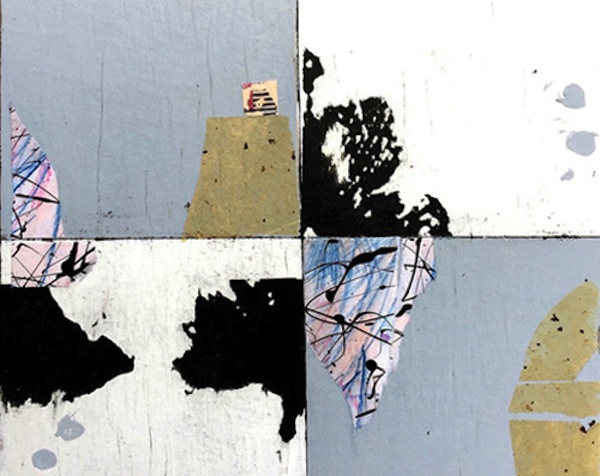
“The expansiveness and the quiet energy of coastal British Columbia are strongly evident in the imagery and the palette of my recent paintings, which are meant to be a transformative interpretation rather than a literal rendering of the coastal landscape,” she explained. “Using mixed media and metallic paints and foils has allowed me to develop a personalized style that translates and interprets nature and iconography through layers of transparent glazes.”

Another new development since the Independent spoke with Gewurz is that her art is featured on both a wine bottle and on a line of skincare products. While she has always created wearable art, such as jewelry, this foray into commercial art is different.

“‘Ebbing’ was chosen through a juried competition to become the label of Safe Haven fortified wine of the 40 Knots winery,” she said. “A portion of the wine sales goes to support the Kus-kus-sum salmon habitat restoration by Project Watershed, an NGO. Because I am a supporter of environmental causes, I donated the artwork.”

photo - Monica Gewurz’s painting “Ebbing” adorns the label of 40 Knots Vineyard and Estate Winery’s Safe Haven fortified wine
Monica Gewurz’s painting “Ebbing” adorns the label of 40 Knots Vineyard and Estate Winery’s Safe Haven fortified wine. (image from Monica Gewurz)

The vineyard also produces its own line of skincare products and, said Gewurz, “The owner of the 40 Knots winery commissioned the artwork ‘Waves of Tranquility’ to be featured in all VinoSpa product labels, using some of the lees of their red wines. The painting was created to capture the feeling of and tranquility and restfulness provided in all VinoSpa skincare lines and their associated spa.”

The winery website explains that Gewurz mixed the lees from the fortified wine with acrylic gels and paints to create the colours of “Waves of Tranquility.” It notes, “Influenced by Turner, ‘the painter of light,’ and Asian traditional painting, Monica’s abstract landscapes aim to reflect truthfully the moods of nature. Captured on canvas or in silver, her work draws on the exceptional landscape of the Pacific West Coast.”

Gewurz was to bring a new collection of work to this year’s Art Vancouver. Her bio noted, “She is excited to share her highly textured, iridescent, colourful acrylic and oil abstract paintings, often worked with a palette knife, unconventional tools and metallic patinas.

“Texture and thin layers of colour are two key elements in her work, as she aims to blur the line between painting and sculpture. She invites you to touch the work, by integrating natural and man-made repurposed materials, including textiles, paper and plastic, each layer of colour and medium allowing you to experience the paintings – perhaps sparking memories, perhaps freeing your mind to wander, imagine and dream. Through materials and her own travels and life experiences, she strives to make work that can be understood across cultures.”

For more on Gewurz, see jewishindependent.ca/inspired-by-cultures-nature, and her website is mgdesigns.org. For updates on Art Vancouver, visit artvancouver.net.

Nieces enjoy new kids books

I review a lot of books for the Jewish Independent. Over the years, that has included many children’s books. I do my best in these instances but, as much as I like to let my inner child run free occasionally and as much as I’d one day like to create a children’s book or two, I’m a grown-up. What do I really know about how enjoyable the single-digit-age set will find a publication? Well, for my latest two reviews, I turned to a couple of experts for advice.

With COVID-19 causing the shutdown of schools, my youngest nieces – Fae, 8, and Charlotte, 6 – were suddenly available to be put to work. With their parents’ blessing, nay, encouragement, I scanned and emailed them two recent books published by Intergalactic Afikoman (see jewishindependent.ca/new-publisher-set-to-launch). The assignment was to read Asteroid Goldberg: Passover in Outer Space by Brianna Caplan Sayres and illustrator Merrill Rainey and Such a Library! A Yiddish Folktale Re-imagined by Jill Ross Nadler and illustrator Esther van den Berg. As my nieces were new to the reviewing world, I gave them a handful of questions to answer: What did you like about the books? What did you not like? What did you learn? Would you recommend the books to your friends?

Their mother, Deborah Weiss, sent me summaries of their answers, as well as Fae’s handwritten responses – I’d asked her to be the family’s scribe for the job.

They started with Asteroid Goldberg, which features Asteroid and her parents on their way home from Pluto for the Passover seder. When the family gets to earth’s orbit, they are not allowed to land (for an unstated reason), so they must make alternate seder plans on the fly (pun intended). A few of Jupiter’s moons for kneidl, a piece of Saturn’s rings for matzah, the Milky Way as their pantry. Who to invite? Family members close by, including Grandma Luna, who was biking on Venus, and Uncle Cosmos, who was hiking on Mars. When they come to the Mah Nishtanah, Asteroid asks, “What makes this night so different?” to which the answer is “Everything!” Caplan Sayres couldn’t have known how relevant her Passover story would be this year.

photo - Fae’s note on what her mother, Deborah (D.), thought of the book Asteroid Goldberg: Passover in Outer Space
Fae’s note on what her mother, Deborah (D.), thought of the book Asteroid Goldberg: Passover in Outer Space.

Both Fae and Charlotte loved the story and the artwork. Even though Charlotte found it a bit too long, Fae recommended it for kids 7 and under.

“I like this book because it was a rhyming book and because it had lots of play-along words,” wrote Fae, who explained to her mom that “play-along words are words with multiple meanings.”

As for lessons learned, Fae “did not learn anything.” However, her sister, who can be a pistol, said she learned that one should “never go on a rocket before Passover.”

As for their mom’s thoughts, Deb said, “I really liked this book. As we get ready for a Passover that will be very different this year, I loved reading about a family that had to change their Passover plans and still had lots of fun and found new ways to celebrate. This really resonated with me!”

Deb and the girls also enjoyed Such a Library! “I thought this was a really clever and imaginative take on a well-known folktale,” said Deb, who noted, “Both girls liked the funny text, the story and the artwork. We also liked the clever name of the librarian.”

In Such a Library!, Stevie heads to the public library to read his book – “With three brothers, two sisters and a baby at home, Stevie’s house was never quiet.” As he starts to read, though, he hears pages turning, computer keys tapping. He tiptoes to the librarian, Miss Understood, and says, “This library is too noisy.” He tells her, “It’s like a party in here.” Thinking that a party sounds like a wonderful idea, she opens a book: “Hundreds of colourful balloons flew from the pages, followed by party hats and horns.”

image - Such a Library! book coverEach time Stevie goes to Miss Understood to complain, she opens another book and the library becomes a zoo, then a circus, as the characters jump out of the pages of the books she opens and take over the library. Only once the characters are all returned to their books can Stevie enjoy reading his, to the relatively quiet sounds of the pages turning, computer keys tapping.

Such a Library! is an interpretation of the Yiddish folktale about a man who thinks that his small house is too crowded with his wife and many children. The rabbi recommends that the man also bring into the house the family’s cow, chickens, goats, geese and ducks. When the man can’t take it anymore, the rabbi tells him to kick out all the animals, after which, the small house seems quite big and spacious.

Fae would recommend Such a Library!, once again, to kids age 7 and under, while Charlotte really liked it and would recommend it to anyone.

As for what the girls learned, Deb said, quoting Charlotte, “We learned that, if you’re looking for a quiet place to read, to not to go to the library when it’s full of acrobats!”

To order either book, visit intergalacticafikoman.com/books.

Among Canada’s best books

In the play Birds of a Kind by Wajdi Mouawad, the character of Eitan, injured in a terrorist attack in Jerusalem, lies in a coma. As his estranged parents and his grandmother hope for his recovery, they bitterly dig ever deeper into their familial dysfunction. At one point, the doctor tells them about Eitan, “What matters is the voices of those dear to him. His parents, his friends.”

His father responds, “His friends are in Berlin.” His mother, “Or New York.” His grandmother, “But his fiancée is here.” (The Palestinian fiancée that his parents cannot fathom and regarding whom they are nasty, based on a mix of racism, fear, guilt, concern over their own identity, secrets they have kept and more.) The doctor tells the trio, “The stronger the emotional attachment, the quicker the brain responds. We reconstruct ourselves through affection.” Godspeed to Eitan, then.

Birds of a Kind is a fascinating, if somewhat predictable, story and Mouawad’s exposition of complex and hyper-relevant topics, such as group identity versus individual choice, is nuanced and poetic; he uses language beautifully. It is no wonder that Montreal-based translator Linda Gaboriau earned the play its 2019 Governor General’s Literary Award for translation (from French to English).

Also faring well in last year’s awards was Calgary writer Naomi K. Lewis, whose Tiny Lights for Travellers was a finalist in the non-fiction category of the prize, which is funded and administered by the Canada Council for the Arts.

image - Tiny Lights for Travellers book coverLewis is extremely candid and self-critical in this travel memoir. Readers learn about her family, her struggle with developmental topographical disorientation (which means she can’t envision a map in her head and, therefore, often gets lost), the complicated messages about Judaism she received growing up, her insecurities about being Jewish (including a botched nose job when she was a teen) and her failed marriage, among other things. We follow her on her literal and metaphorical journeys to self-discovery, -understanding and -acceptance, as her personal story is interwoven with her retracing of the route her grandfather took in 1942 to escape from Nazi-occupied Netherlands to southern France, from where he then traveled through Spain and Portugal to get to London, England.

While Tiny Lights for Travellers includes excerpts from Lewis’s grandfather’s journal of his escape, it is mostly about Lewis and her exploration of identity, family history and the Holocaust. As Lewis notes well into her book, “the journal seemed a tease, so withholding, the anomalous 30-page confession of someone who otherwise lived inside his own experience with no desire to make himself known to anyone.”

Lewis may have set out with a goal of learning more about her grandfather, of connecting to her past, “trying to find what made me,” but there are not clear links from the past to the present. The journey is revealing in the end, just not about her grandfather or exactly how she came to be who she now is, but rather in coming to terms with who that person is.

A Jewish guide to streaming

Mike Wallace is Here is one of the smartest and best documentaries of 2019. (photo from Cinando)

In the streaming universe, as with all entertainment, there’s the stuff that everyone watches and talks about. But that’s just the tip of a vast catalogue, a lot of it quite good, that doesn’t get the hype and the buzz. Here’s an eclectic list of accessible Jewish-themed movies that received some hosannas on their initial release. The more obscure (and great) Jewish films of recent years will be on a future list, since, alas, it appears we’ll have ample time to watch more after catching up with these.

The Zigzag Kid (j-flix): The Toronto Jewish Film Foundation has launched a free streaming platform, j-flix, with dozens of terrific recent fiction and documentary features and shorts. You could get lost there for weeks. I suggest you start with this irresistible, action-packed, family-friendly adventure about a precocious Dutch boy, adapted in 2011 by a Belgian director from Israeli author David Grossman’s novel.

The Women’s Balcony (Chai Flicks): Menemsha Films, the venerable U.S. distributor of Jewish-themed films from around the world, offers a free 30-day trial of their streaming platform. (A subscription will then run you $5.99 US a month.) Israeli director Emil Ben-Shimon and screenwriter Shlomit Nehama set their warm and wonderful romp in a small Orthodox congregation dislocated by structural damage to the shul.

Tel Aviv on Fire (Amazon Prime): Sameh Zoabi’s clever comedy about a Palestinian soap-opera writer trying to navigate the demands of both his bosses and an Israeli checkpoint commander will lift your spirits without insulting your IQ. Make a batch of hummus first.

1945 (Amazon Prime): This extraordinary black-and-white Hungarian film parlays the postwar arrival of two exhausted Jews at a small village into an exposé of guilt, betrayal, corruption and murder. One of the most acclaimed European films of 2017, 1945 is a gripping and haunting reckoning with dark history.

Mike Wallace is Here (Hulu): One of the smartest and best documentaries of 2019 examines, entirely through archival television footage, the ambitious journalist who made 60 Minutes essential viewing. Not a Jewish film, oddly enough, but a riveting one.

Disobedience (Amazon Prime): Sebastian Lelio’s taut, understated 2017 drama, adapted from Rebecca Lenkiewicz’s novel, is a remarkably nonjudgmental story that follows a volatile, adrift woman’s (Rachel Weisz) return to London after the death of her estranged father, an Orthodox rabbi. Community, identity, responsibility, sexuality – everything is on the table.

Prosecuting Evil: The Extraordinary World of Ben Ferencz (Netflix): The last surviving U.S. attorney from the Nuremberg trials has an impeccable memory, a spotless moral compass and enormous gravitas. If your fortitude is at a low ebb, Ben Ferencz will give you the strength to persevere.

A Serious Man (Netflix): The Coen Brothers’ most personal and most Jewish film, filmed in and around their childhood stomping grounds of Minneapolis-St. Paul, is a painfully hilarious moral fable guaranteed to provoke a cross-generational dinner table conversation. One politically incorrect question that this devious 2009 movie poses: Are Jews our own worst enemies?

Michael Fox is a writer and film critic living in San Francisco.