Improv conference held here

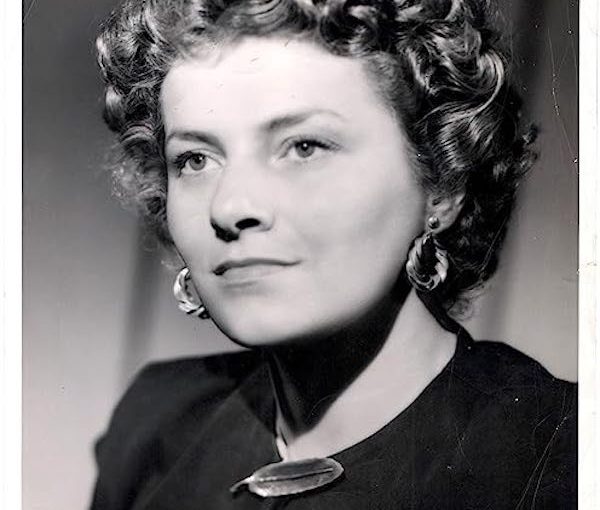
Viola Spolin is widely thought to be the mother of modern improvisation. (photo from amazon.ca)

If you thought that improv was only for entertainment, think again. This summer’s applied improvisation conference at Granville Island will showcase some of the world’s best applied improvisation coaches, trainers and facilitators.

The conference will be hosted by the Applied Improvisation Network in partnership with the Improv Centre, formerly Vancouver Theatresports.

Avril Orloff is one of four Jewish community members on the Vancouver conference planning committee. She told the Independent that there will be more than 30 workshops offered, from improv in education and health care to using it to navigate difficult conversations, increase confidence, build community and address humanitarian issues.

“The hard part will be choosing among all the great offers,” she said.

Conference dates are July 27-30, with July 25-26 called “Learning Journeys” before the conference proper, where people can sign up to do a deep dive into particular topics for a half or full day.

“Another highlight is the Open Space sessions on the final day, which is a marketplace of ideas where anyone can offer a workshop on any topic they’re particularly interested in,” said Orloff. “Open Space is a great lab for people who want to test out new ideas, processes and games, or put out an ask to anyone who’s willing to answer.”

Orloff dived into applied improv in 2022 and fell in love with it.

“The weekly classes and open space sessions were a bright spot in my life during the pandemic,” she said. “They expanded my outlook beyond the confines of the immediate moment and made me feel connected during a time of isolation.”

Since then, she has used applied improv techniques more and more in her work as a facilitator, starting with the online “connection cafés” she hosted during the pandemic, and now in person.

Avi Dolgin is another community member on the planning committee. He said they are expecting 200 delegates with a dozen or so who are local but the majority from elsewhere in Canada, as well as from the United States, Europe and Asia.

Dolgin sees improv as a profound way of unlocking human potential. Now retired, he uses improvisation to teach Bibliodrama at Or Shalom.

“In my life, an improvisation mindset encourages me to greater spontaneity, unexpected creativity and a greater willingness to help others in their ideas,” he said.

Carol Ann Fried, an inspirational speaker and consultant who lives in Vancouver, is also on the conference committee. She is presenting an applied improv workshop alongside Sarah Fisk and Matt Weinstein.

“Now that many people – but not all – are meeting again in person, the need to conduct ‘hybrid meetings,’ where some are in person and others are online, has arisen,” she said. “This split format is difficult, in part because it is hard for people to interact with each other. Our session attempts to address this issue with specific structures and activities to engage people in a hybrid setting, that are based in the values of improv, and that can be used in any work context.”

Well-known improviser Colin Mochrie will be one of the keynote speakers at the conference. Mochrie is most famous for appearing in the television show Whose Line Is It Anyway for the last 30 years.

Jewish community member David Diamond is the other keynote speaker. He will be giving a demonstration of Theatre for Living, with three audience members. Based on Augusto Boal’s Theatre of the Oppressed and Diamond’s lifelong interest in physics, Theatre for Living uses improvisation to create scenes that stimulate community dialogue and calls for change, in particular cross-sectoral understanding.

Applied Improvisation Network (AIN) was created in 2002 to bring together professionals with a keen interest in the study, practice and teaching of applied improvisation. Initially, a group of 30 or so improvisers gathered for the first conference in San Diego. Today, AIN is a global community of more than 8,000 participants online and across numerous regional and local groups.

Ed Reggi is AIN’s president and another member of the Jewish community. Reggi, who lives in St. Louis, Mo., told the Independent that there has always been a Jewish presence in the organization, from its founding to the present day.

Reggi said he takes his inspiration from Viola Spolin (1906-1994), who is widely thought to be the mother of modern improvisation. Spolin was the daughter of Jewish immigrants from Ukraine. Spolin’s father, Make Mills, had escaped pogroms in Ukraine to come to the United States. Her grandfather stayed in Ukraine and died at the hands of Stalin’s troops after the Soviets took his farm.

Much of Spolin’s work and success comes from her body of experience around recreational play. She studied under Neva Boyd, who was a sociologist, and documented recreational games, dance and activities that came over from Europe, Reggi said.

“Of course, Viola’s son, Paul Sills, watched his mother developing her Theatre Games and he took them over to the University of Chicago, where he worked with Mike Nichols, Elaine May, Ed Asner, Alan Alda and Avery Schreiber and so many more.”

Sills went on to create the Second City in Chicago, now North America’s oldest improvisation theatre institution, where Saturday Night Live stars Gilda Radner, John Belushi, John Candy, John Belushi, Dan Aykroyd, Eugene Levy and Catherine O’Hara made their debuts.

Reggi is excited about attending the conference here in July.

“I think, because this conference is happening in Vancouver, I expect more Jewish presence. Last year, we were in Ávila, Spain, after two years of being halted by the pandemic. I am thrilled to be coming back together in person again.”

For more information about the conference, go to appliedimprovisationnetwork.org/vancouver-conference-2023.

Cassandra Freeman is a freelance writer living in Vancouver.
Bard masters comedy, tragedy

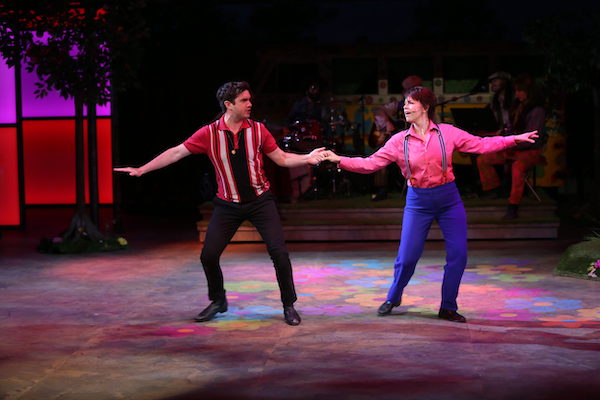
Oscar Derkx (Orlando) and Chelsea Rose (Rosalind) in As You Like It. (photo by Tim Matheson)

What do you get if you mix a Shakespearean comedy with 23 Beatles hits from the 1960s and set the whole thing in Vancouver and the Okanagan? An unforgettable night at Bard on the Beach, which opened its 34th season with a remounting of its 2018 hit As You Like It.

Various nips and tucks to the original script have been made. While purists may not appreciate the surgery, the Bard version still follows the convoluted saga of four pairs of young lovers who cross paths as they work through obstacles in their quests for true love. After all, all you need is love.

The action starts in Vancouver with a zany pre-show bout of Superstar Wrestling – make sure you get into the tent 15 minutes before curtain time. Ringmaster Touchstone introduces Charles 2 Guns Leibowitz, a narcissist on steroids, who takes on all comers for cash prizes. Orlando, who has been denied his inheritance by older brother Oliver, decides to go for it, although the underdog in size and confidence.

During the match, Orlando catches the eye of Rosalind, and it is love at first sight (“she loves you, ya ya ya!”). However, Rosalind is banished from Vancouver by her aunt, and runs off to the Okanagan with best friend Celia and faithful servant Touchstone. To do this safely, Rosalind uses one of Shakespeare’s favourite ploys and disguises herself as a boy (Ganymede), with Celia playing her sister.

Orlando, with his devoted servant, Adam, also heads to the Okanagan when his brother threatens to have him killed. As expected, he crosses paths with Ganymede/Rosalind and her entourage.

Add to the mix a lovelorn rube and the object of his affections, a shepherdess who becomes enamoured of Touchstone, a commune of back-to-earthers headed by Rosalind’s mother, who also was banished, and the plot twists and turns through secret notes, trysts, actors hiding behind trees (it is Shakespeare after all), strange picnics and more. Every scene morphs smoothly into a Fab Four moment through songs like “I Want to Hold Your Hand,” “Can’t Buy Me Love” and “All you Need is Love,” high-energy, fancy footwork (a shout out to choreographer Jonathan Hawley Purvis) and toe-tapping music from a five-piece band helmed by musical director Ben Elliott (who also acts in the play).

This is a real ensemble piece and every cast member seems to give it their all. I was particularly impressed with Chelsea Rose’s vocals, as Rosalind. Oscar Derkx (Orlando) is boyishly charming and can also belt out a song. Elliott (Silvius) showcases his comedic chops in a raunchy pas de deux with Alexandra Lainfiesta (Phoebe). Finally, Scott Bellis, as Jacques, movingly delivers the iconic soliloquy “All the world’s a stage,” where the Bard explores the circle of life in seven stages, from babe to senile senior. Clad in a black turtleneck sweater and corduroy bell bottoms, Bellis is the quintessential beatnik. He also gets one of the best lines of the night – “I can suck melancholy out of a song as a weasel sucks eggs.”

Director Daryl Clonan can be proud of this latest iteration, which has toured through parts of Canada and the United States. The production values are top rate, starting with the glitzy set including a psychedelic VW parked at the back of the stage. Kudos to costume designer Carmen Alatorre for capturing the essence of the era – paisleys, acid-wash jeans, fringed vests, bell-bottoms, granny glasses, headbands and beads for the Okanagan granola set with Jackie O pillbox hats, white gloves, two-piece suits, chinos and polyester shirts for the urban crowd. And Gerald King’s lighting works wonders with a rainbow palette projected against Plexiglas panels that illuminate the tent backdrop of ocean and mountains.

***

In something completely different, the cast members of As You Like It also star in Julius Caesar, which plays alternating nights on the BMO Stage.

Bard on the Beach last produced Julius Caesar in 2007. This summer’s adaptation by Stephen Drover, set in modern times, brings novel perspectives to the classic tragedy of political ambition, jealousy, tyranny, treachery, mob rule, murder and revenge, and will resonate with contemporary audiences.

Despite the title, the real protagonist is Brutus, who grapples with his loyalty to Caesar and what he believes is the greater good of Rome, when approached by a group of senators to help assassinate Caesar. Hesitant at first, he ultimately joins the other senators in plotting Caesar’s demise – to take place at a meeting on the Ides (15th) of March. Though Caesar has been warned by a local soothsayer to beware that day, he ignores that warning and the pleas of his wife to stay home.

Caesar (an impressive Andrew Wheeler) arrives at the senate resplendent in a white business suit, topped off with a jaunty fedora, to the cheers of his people. Once there, Brutus and his fellow conspirators surround Caesar and, one by one, stab him, the final thrust coming from Brutus. In this viscerally haunting scene, Caesar falls to the ground, his white suit covered in red blood, as he utters his last words, “et tu, Brute,” surrounded by the conspirators, their hands dripping with blood.

At the state funeral, Brutus tries to convince the crowd that Caesar had to die for the good of Rome, but Mark Antony – a loyal friend to Caesar and a skilful orator – gives the “Friends, Romans, countrymen, lend me your ears” speech, over a ghoulish glass coffin containing Caesar’s bloodied body. The crowd turns against the conspirators, who are forced to flee. Antony then summons Caesar’s nephew, Octavius, to raise an army to hunt down and kill the conspirators so that Caesar’s death can be avenged. This leads to a civil war, with the action coming right into the audience.

In the penultimate scene, Brutus, having been visited by Caesar’s bloodied ghost and surrounded by his fallen comrades, realizes that defeat is at hand and implores his trusty servant to kill him. Andrew McNee’s performance as Brutus in this scene is compelling.

The final scene is eerie, as Caesar’s ghost slowly walks off the stage into the sunset amid wisps of smoke.

Director Cherisse Richards has chosen to reverse many of the roles so that most of the conspirators are female, as is the role of Mark Antony, played by Jennifer Lines, who is simply sublime.

In another twist, Caesar’s wife, Calpurnia, and Portia, Brutus’s wife, appear more prominently in the adaptation, providing insights into the private lives and feelings of their husbands.

The stark set showcases a mix of old and new – jagged concrete columns evoke ancient Roman architecture, which morphs into tables, desks and even a wardrobe, against a backdrop of multimedia screens.

Jessica Oostergo’s warrior costumes are metaphors for good versus evil – Octavius’s allies clad in light khaki fatigues while Brutus’s side roams the stage in black and grey, looking like SWAT team members.

Video designer Candelario Andrade’s projections – spanning the spectrum from Joan of Arc, to Napoleon at Waterloo, to the Jan. 6, 2021, riots at the U.S. Capitol – accompanied by sound designer Kate Delorme’s ominous scores contextualize the action.

For Bard on the Beach tickets and the full schedule, which also includes Henry V and Goblin: Macbeth, visit bardonthebeach.org.

Tova Kornfeld is a Vancouver freelance writer and lawyer.

Theatre that educates

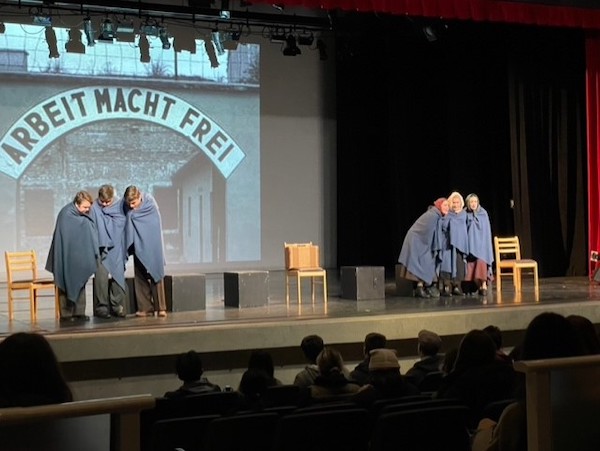
Wendy Kout’s play Survivors is based on 10 real-life stories of young people’s Holocaust experiences. (photo by Peter Nadler)

Last year, Victoria-based Bema Productions and the Victoria Shoah Project collaborated on a pilot project: a nine-performance tour to middle and secondary schools of Survivors, a Holocaust-themed play by Wendy Kout. The success of the tour, which reached more than 1,100 students and 500 adults in the Victoria area, has led the organizations to broaden their reach throughout Vancouver Island, Metro Vancouver and other Western provinces beginning this autumn.

“Following our pilot tour in Victoria, we were asked to cover the Western provinces, and I happily accepted the challenge,” said Zelda Dean, the director of the play. “We will be touring to 30 schools on Vancouver Island in October 2023. In the fall of 2024, we will tour on the Mainland and in Alberta. Saskatchewan and Manitoba will be toured in 2025 – 150 performances in total will be presented.”

Citing a 2018 Canadian survey produced by the Azrieli Foundation, Yad Vashem, the United States Holocaust Memorial Museum and the Claims Conference, the Victoria organizers offer compelling reasons why Holocaust education is necessary today, particularly (but not only) for youth. According to the survey, 52% of millennials cannot name a concentration camp or ghetto; 62% of millennials did not know that six million Jews were killed in the Holocaust; 22% of millennials haven’t heard or are not sure if they have heard of the Holocaust; and 23% of all Canadians believe that substantially fewer than six million Jews were killed (two million or fewer) during the Holocaust, while another 24% were unsure of how many were killed.

“I have been alarmed at the ongoing rise in antisemitism for some years and have been looking for a suitable educational play. I had previously produced a play by Wendy and loved her work,” said Dean, regarding the selection of Survivors.

The intention of the one-hour play, suitable for those from Grade 6 to adulthood, is to provide a vehicle to teach lessons from the Shoah to younger audiences. Based on 10 real-life stories of young people’s Holocaust experiences, the play hopes to enable students to recognize the short- and long-term causes and effects of prejudice, discrimination and, ultimately, genocide. It also aims to foster critical thinking and bring the importance of human rights and social justice advocacy to the forefront.

Survivors goes through the chronological history of the Holocaust by enacting the experiences of Jewish children and teenagers from Europe. The young cast of six professional actors portrays the survivors, starting at innocence and continuing through the terrifying rise and rule of bigotry, xenophobia and violence, before they immigrate to America.

The play includes the true stories of a teen who watched her boyfriend being taken away to a concentration camp, a girl who was separated from her parents and relocated to England through the Kindertransport and a boy whose family struggled to escape to China.

Dean credited the young actors in the production for their diligence and dedication to their parts. “I put a casting call out and was delighted that a large number of very skilled young actors tried out for the roles. Those who were cast were tasked with doing considerable research into the Holocaust prior to rehearsals starting,” she said.

Survivors was originally commissioned and developed by CenterStage Theatre in Rochester, N.Y., in 2017, when Kout was asked to write a Holocaust play about survivors who had immigrated to the city. Shortly thereafter, while watching neo-Nazis march in Charlottesville, Va., Kout expressed the feeling that she was not simply writing an historical play but also a “warning play.”

The Victoria production in November and December 2022 – which played in school auditoriums, theatres and libraries, and had four public performances – was the first international tour of the play. There are other tours currently on both coasts of the United States, with Kout, along with the New York company that developed Survivors, creating a documentary on how the play came to be.

“Sharing the history of the Holocaust with students provides an important historical example of the dangers of allowing hatred and intolerance to take hold within a society,” said former B.C. minister of education Rob Fleming about the Victoria tour.

Additionally, several students who saw the play offered their input concerning how the performance affected them.

“I want to continue to learn more about the Holocaust and people’s stories. I’ve read [Elie Wiesel’s] Night and seen this play but other than that I haven’t heard many personal stories, so I’d like to learn more,” said one.

“I learned once again that I should not judge others selfishly based on race, religion, appearance or prejudice, and I will try to [remember that] whenever I meet new people from now on,” contributed another.

The organizers are looking for financial support to fund the upcoming Western Canadian tours.

“Over $450,000 is required to offer this powerful educational play to so many students, and we are actively fundraising to individuals, corporations, foundations, etc. We are running a campaign inviting folks to sponsor a school in their area for only $500,” Dean explained.

For more information about the play and to contribute, visit holocausttheatre.com or email info@holocausttheatre.com.

Sam Margolis has written for the Globe and Mail, the National Post, UPI and MSNBC.

A musical Canada Day

Perry Ehrlich’s ShowStoppers at Jack Poole Plaza (photos by David P. Feng)

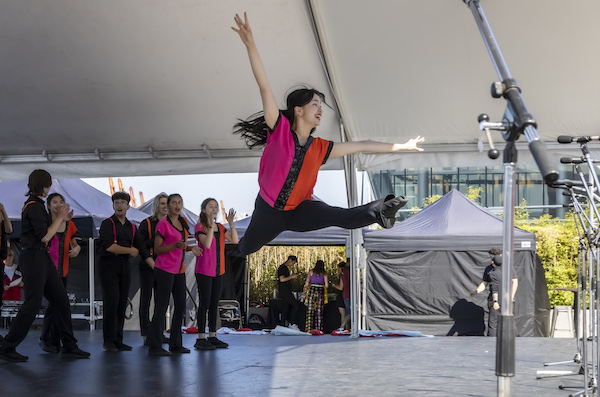
Perry Ehrlich’s ShowStoppers performed at Jack Poole Plaza on Canada Day – it was Ehrlich’s 29th year celebrating Canada Day at Canada Place.

photo - Perry Ehrlich’s ShowStoppersShowStoppers is a glee troupe that performs in concert, on radio and television, and at galas, awards shows, conventions, corporate and charitable events.  Previous shows include with Barry Manilow and Eric Church at Rogers Arena; with the group Foreigner at various venues; at the Pacific National Exhibition; on the Variety Club Telethon; and singing the national anthems at Vancouver Canucks games. The troupe’s repertoire includes everything from Motown and disco medleys to Canadian favourites and pop songs like “Let’s Get Loud” and “Shut Up and Dance.”

For more information about ShowStoppers, visit theimpresario.ca or contact Ehrlich at ehrlich@kzellaw.com or 604-315-1850.

– Courtesy Perry Ehrlich

For new generation

The marvelous children’s stories in Ilse Weber’s Mendel Rosenbusch: Tales for Jewish Children (illustrated by P. John Burden) are fascinating in their own right, as is translator Hans Fisher’s discovery of this book. He and his wife, Ruth, have brought Weber’s book, first published in 1929, from the original German to English.

Let’s get to stories first; then we’ll talk about how this book was discovered.

Ilse Herlinger Weber was born 1903 in Witkowitz, now in Czechia, and, after a period of time in Theresienstadt with her husband and son, was deported to and murdered in Auschwitz in October 1944. She was a Czech poet and writer who, like Kafka, wrote in German, and is best known for Mendel Rosenbusch: Tales for Jewish Children.

The title character is an older man (pictured with a white beard and wearing a black yarmulke) who gets a coin that enables him to become invisible whenever he wishes, and he uses this gift to help his neighbours anonymously. Mendel plays a beneficent role in most of the stories, including magically arranging that a stubborn father permits his son to marry the girl of his choice, and is beloved by all the children in Weber’s stories.

One of my favourites – perhaps because he reminds me of a combination of Tom Sawyer and Huck Finn, with a blend of some of the rascals in Sholem Aleichem’s stories – is “Uri, the Rascal.” Uri is a lad who always gets into trouble, always plays pranks. But, when a poor, sickly boy, the son of a needy widow, becomes his seatmate in school, Uri does his best to help and defend him, and even comes up with an idea on Purim to help the mother and son.

Another charming tale is “Simcha, the Liar,” about a boy who cannot stop telling fibs – until, one day, he suffers a punishment (purple patches on his face) for his uninterrupted stream of untruths. But, here again, Mendel Rosenbusch comes to the rescue and Simcha never tells another lie again.

These are typical of the heart-warming, ethically pointed stories in this book. Now to its (re)discovery.

When Hans Fisher, who taught at Rutgers University in New Jersey for many years, visited Santiago, Chile, for his mother-law’s funeral, he discovered in her vast library a book of children’s stories in German that he had read as a child in Germany 60 years earlier, before immigrating to the United States to escape the Nazi slaughter of Jews. Like Proust’s biscuit, which brings a flood of memories to the author as he remembers the past, so with Fisher. Seeing this old, torn book brought back memories of wonderful, gentle stories that, in Fisher’s words, “transported me to my own boyhood in Breslau.”

It is with love and devotion and the translators’ writerly skills that Ruth and Hans Fisher have restored these wonderful tales and made them accessible to a new generation of readers.

Curt Leviant also recently made a literary discovery of his own. He found a neglected novel by the famous Yiddish humourist Sholem Aleichem, Moshkeleh the Thief, which he translated into English: for a review, see jewishindependent.ca/a-rediscovered-novella. Leviant’s 12th novel, Me, Mo, Mu, Ma & Mod; Or Which Will It Be, Me and Mazal or Gila and Me?, was published in 2021.

Honouring ancestors’ stories

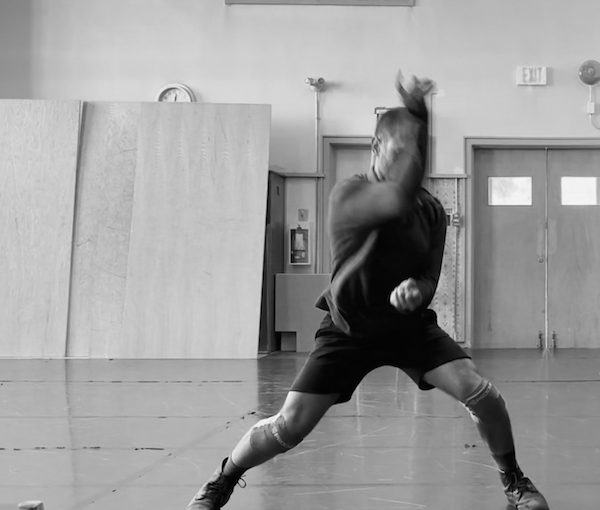
Juan Villegas rehearsing Edictum, choreographed by Vanessa Goodman, which is about Villegas’s Sephardi ancestry. The work is part of Dancing on the Edge’s EDGE One July 6 and 8 at the Firehall Arts Centre. (video still from Vanessa Goodman)

“I am very happy to be able to share my work and talk about Sephardic Jews, as I am doing a lot of research and I am discovering a lot about my own culture and where it comes from,” Juan Villegas told the Independent about Edictum, a new work with Vanessa Goodman about his family heritage, an excerpt of which he will perform at this year’s Dancing on the Edge July 6 and 8. “Throughout history, the Jewish community has suffered a lot and I am very happy to be able to pay respect, honour, shed some light and help tell the story of my ancestors,” he said.

Villegas and Goodman had already started their collaboration when Villegas found out that his ancestors were Spanish Jews who, following the Alhambra Edict of Expulsion in 1492 and the persecution of Jews by the Spanish Inquisition, sought refuge in Colombia.

In 2015, Spain passed legislation to offer citizenship to members of the Sephardi diaspora, but the window of opportunity to apply was only a handful of years and Villegas’s family missed it. However, they did apply to Portugal, which passed a similar law, also in 2015. Given the number of applicants, it could be several years before the family finds out. For the application, certified records were needed, so Villegas’s siblings hired a genealogist.

“They did both of my parents’ family trees and both ended up having the same ancestor – Luis Zapata de Cardenas, who came to Antioquia, Colombia, from Spain in 1578 and whose family had converted to Catholicism in Spain,” he said. “What is unclear to me is whether Luis Zapata de Cardenas was a practising Jew and was hiding it or if his family back in Spain became Catholic and raised him Catholic. I find it very hard to believe that people fully converted to Catholicism, as religion is so embedded in one’s culture and must be very difficult to switch by obligation. So, this is probably when they started disguising some Jewish rituals as Catholic, which happened a lot in Colombia.”

Villegas left Colombia in 2003, at the age of 18, concealing from his family his real reasons for leaving.

“I told them that I was going to only be in Canada for eight months to study English and then come back to Colombia,” he shared, “but deep inside I knew that I wanted to find a way to stay in Canada. I am gay and had a hard time growing up in Colombia – without realizing it, I was also escaping from a traumatic childhood, as I had been sexually abused and bullied at school. I was lucky enough that my parents helped pay for ESL studies in Canada and then I was able to do my university studies in Vancouver at Emily Carr University.”

After getting a bachelor’s degree in design from Emily Carr, Villegas worked at a design studio but was let go when the economy collapsed in 2008. He took about a year to figure out what he wanted to do next.

“I had a lot of unresolved trauma and I think it was a combination of having the time and (unconsciously) wanting to be healed from trauma that I started taking yoga and dance classes,” he said. “I met a dance artist named Desireé Dunbar, who had a community dance company called START Dance and she invited me to join her company. Vanessa [Goodman] had just graduated from the dance program at SFU and she was in the company also, this was back in 2009. Then, in 2010, I joined the dance program at SFU and Vanessa came to choreograph for us a couple of times. I always loved working with her and I felt like I connected with her.”

Graduating from SFU with a diploma in dance, Villegas moved to Toronto, where he danced for a few years. When he returned to Vancouver in 2017, he started following Goodman’s work. Intrigued, he asked if she would choreograph something for him and she agreed.

“And that piece that we created was about family,” he said, “but we left it at that, because I did not get the grants I needed to continue the work. So, when I discovered about my Sephardic Jewish ancestry, I pitched the idea to her and she agreed (without me knowing that she also has a Jewish background).”

video still - Juan Villegas rehearsing Edictum
Juan Villegas rehearsing Edictum. (video still from Vanessa Goodman)

Everything fell into place, he said, including some funding, so they took up work again this year on Edictum, which is Latin for order or command. The project was always intended to be a solo for Villegas, and they had started by “diving into his family history and the names of his ancestors to build movement language,” said Goodman.

“Since his family found that they have Jewish ancestry and were a part of the diaspora from Spain and Portugal in the 1400s, we found it very relevant to revisit the starting material and expand on this history inside the work,” she said. “I was raised Jewish culturally and we found, through conversations about our family rituals in relation to culture, food and celebration, there were some very interesting links between his family’s expressions of their identity and mine. We have woven these small rituals into the piece and have found a very touching cross-section of how this can be shared through our dance practice in his new solo.”

Goodman is also part of plastic orchid factory’s Ghost, an installation version of Digital Folk, which will be free to visit at Left of Main July 13-15. It is described on plastic orchid factory’s website as “a video game + costume party + music and dance performance + installation built around the desire to revisit how communities gather to play music, dance and tell stories.”

“I began working with plastic orchid factory on Digital Folk in the very early days of its inception,” said Goodman. “James [Gnam] and Natalie [Purschwitz] began researching the work in 2014 at Progress Lab, and I was a part of that initial research for the piece. Since then, the work has been developed over a long period of time with residency creation periods at the Cultch, at Boca del Lupo, at the Shadbolt, at SFU Woodward’s, and it has toured Calgary and northern B.C. This work lives in several iterations, but the Ghost project is a beautiful way for the work to live in a new way one more time. The cast got together at Left of Main in December of 2022 and filmed the piece for this upcoming iteration…. It is exciting to see a work have such a rich life with so many incredible artists who have been a part of this project.”

Dancing on the Edge runs July 6-15. It includes paid ticket performances at the Firehall Arts Centre, where Edictum will be part of EDGE One, and offsite free presentations, such as Ghost. For the full lineup, visit dancingontheedge.org.

Immerse yourself in music

Screenshot from the video for the song “Medicine,” made by Gigi Ben Artzi, featuring Yonatan Gat and the Eastern Medicine Singers. “Medicine” comes off Gat’s album Universalists.

You never know when a life-changing moment will happen. For musician Yonatan Gat and members of the Eastern Medicine Singers, a chance encounter at the 2017 South by Southwest (SXSW) Music Festival in Austin, Tex., has led to a unique continuing collaboration that melds experimental and powwow music in a way that is simultaneously ancient and contemporary, energizing and hypnotic.

Fans of Gat and the Medicine Singers will be happy to know they are performing at this year’s Vancouver Folk Music Festival, which runs July 14-16 at Jericho Beach Park. They will be joined by Daniel Monkman (Zoon), an experimental Anishinaabe musician from Toronto (Tkaronto), and local oud player and guitarist Gord Grdina, who also mixes multiple musical styles. For newcomers to Medicine Singers’ music, definitely go down the internet rabbit hole. Chances are that you’ll want the in-person experience, to be immersed in the sound.

The Eastern Medicine Singers are an Algonquin drum group from Rhode Island “dedicated to keeping the eastern woodlands American Indian culture alive.” They sing and drum in the language of Massachuset and Wampanoag dialect, and have produced several CDs together. To differentiate from their traditional powwow style, they call themselves Medicine Singers for collaborative projects with musicians of other traditions, like Gat. Their debut full-length album in this capacity is the self-titled Medicine Singers, which came out in 2022 on Stone Tapes, a sub-label of Joyful Noise, and Mothland in Canada.

“The result is a spellbinding musical experience, cycling through a kaleidoscope of sounds, from psychedelic punk to spiritual jazz and electronic music,” reads the description on Joyful Noise’s website. “But the genre-smashing album remains firmly rooted in the intense physical power of the powwow drum and the Medicine Singers’ connection to their ancestral music, creating a daring and ambitious record that celebrates tradition, while boldly breaking away from its restrictions or, in the words of Medicine Singers’ leader Daryl Black Eagle Jamieson: ‘These two cultures can work together, and blend together, to show people how we can work together and make something beautiful.’”

Gat is accustomed to these kinds of partnerships and musical innovation. In Israel, he was part of the punk band Monotonix. In the United States, he has released a few full-length albums, each more varied than the last, with the latest being American Quartet (Stone Tapes, 2022), described as a “punk slash-and-burn reimagining of one of the defining works of the Western classical canon – Antonín Dvořák’s legendary string quartet – written while Dvořák was, like Gat, an expatriate living in New York City.”

A good place to start your exploration of Gat and the Medicine Singers is by watching the video of the 2018 track “Medicine,” which was included on Gat’s second album, Universalists (Joyful Noise, 2018). The fruit of an impromptu recording session, this release caught a larger public’s imagination and the rest, to be cliché, is history – yet continues to be groundbreaking.

The Jewish Independent had the chance to talk with Gat via email this week.

JI: What was it about the Medicine Singers’ performance/repertoire at SXSW 2017 that so mesmerized you?

YG: I was playing a show in a club during SXSW and Eastern Medicine Singers were playing outside. I didn’t know them personally and my band were watching them outside just before we went on. I thought their style (six people powerfully hitting a drum and singing call-and-response vocals) could mesh well with my trio and, also, just like them, we played on the floor in the middle of the audience. So, after they were done playing, I invited them to sit in with us. They famously said no at first and then changed their mind after they heard our music.

Our improvisation style leaves a lot of room for new musicians to join and freely do their thing. I think Eastern Medicine Singers noticed that, too, and when they joined us – it quickly became one of the most incredible shows we’ve ever played. The audience was feeling that as well. When I looked up, I noticed everyone in the crowd was crying, and that’s how our collaboration began, and we’ve been touring nonstop around the world since 2017.

JI: In an interview, you talked about taking piano lessons as a kid and, even then, improvising. What do you love about improvising?

YG: I took piano lessons as a kid but I never cared about learning to read sheet music. I just wanted to improvise. At some point, I started playing bass, but when we did Monotonix, we wanted a trio of guitar-drums-vocals, so I moved to a 77 Fender Mustang tuned two tones down to C with bass strings running through a custom-made humbucker pickup to make it sound more low-endy. I learned to play the harmony on the open strings while doing the lead on the highs.

We played 1,000 shows that way with Monotonix and I discovered myself as a guitarist along the way. I never practised or cared about technique, but being the only instrument except drums made me work hard and grow as a player. When I started my own band, I was able to build it around improvisation, which helped me learn even more about myself as a musician and human. Improvisation doesn’t have to be confined to jazz, long solos or anything like that – it’s more a way to live life, to respond to the world around you, get to know yourself better every night.

JI: From where do you draw inspiration for your compositions?

YG: When we record, we like to create a zone that’s radically free, where it’s all about the musician’s self-expression as it relates to the collective and we just let the tapes roll and have fun with it. Our studio days are very fun and wild and free. We also record other situations – practices, soundchecks, hangs. Sometimes, we record in some of the best or most interesting studios in the world, sometimes we record on iPhones or broken tape machines someone left behind.

It doesn’t matter what it is, we just gather material (usually hours of music) and then the process of editing begins, which is when the “composition” happens. In that way, most of the writing is actually the editing. Everything else is just about having a good time and making sure every musician gets documented the way they envisioned.

JI: You have played in Vancouver before. What are you most looking forward to on this upcoming visit?

YG: I was always lucky to play inspiring shows in Vancouver. My first time in town was a wild DIY punk show in a place called Emergency Room back in ’08. People were going crazy, falling on the band (we were playing on the floor). That vibe just continued to Biltmore Cabaret, where we played so many times after that. Just a sweaty haze with everyone losing their minds and melting into one another.

The last time I was in town was for Vancouver Jazz Fest back in 2019 with Medicine Singers. That was fun. I’m not used to playing jazz fests (they probably think we’re too loud or something) but it was so cool to play to an audience that was following the instrumental parts and appreciating the playing that comes with the freedom and energy.

Vancouver Folk will be a special one for sure. We don’t often play on the floor nowadays, but Medicine Singers transcend the stage. This show really creates a kind of connection between audience and musicians I’ve never seen before. It still has all the magic we discovered in 2017, the first time we played together.

My experience working and learning from Medicine Singers led us to start a label together, Stone Tapes, which is more like a community of musicians, or a collective. I think that represents what we do in the best way possible, and I’m looking forward to coming back to Vancouver and backing Medicine Singers along with other musicians from that collective.

For the full Vancouver Folk Music Festival lineup and tickets, visit thefestival.bc.ca.

Art Downtown at Lot 19

Art Downtown festival runs to Sept. 15 in Lot 19 downtown. (photo from Vancouver Visual Art Foundation)

On June 21, Vancouver Visual Art Foundation and Downtown Van (formally, Downtown Vancouver Business Improvement Association) launched the fourth edition of the outdoor summer festival Art Downtown. Every Wednesday and Friday from 11 a.m. to 5 p.m. until Sept. 15, people can drop by Lot 19 to see a diverse array of artwork from both emerging and established artists, while enjoying live music.

“Art Downtown is more than just an exhibition – it’s a catalyst for artistic expression, fostering an environment where artists can thrive and connect with a broader audience,” said executive director Lisa Wolfin, a member of the Jewish community. “We want to inspire the public to appreciate and engage with the power of art.”

To meet the participating artists virtually and for more information, visit vanvaf.com/art-downtown. 


Preserving links to past

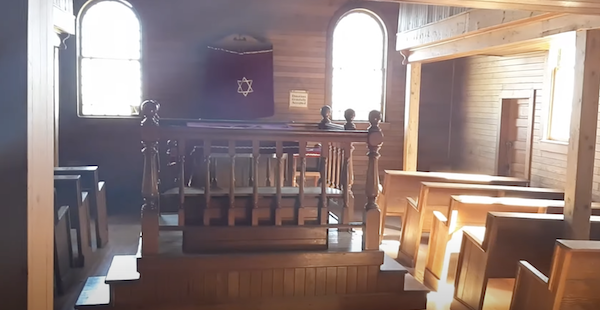
Screenshot from Jordan Amit’s video on the former Jewish settlement of Edenbridge, Sask. The synagogue and the Jewish cemetery are cared for by the Saskatchewan Wildlife Federation.

Almost 120 years ago, 56 Jews fled Lithuania and ended up in a remote Saskatchewan prairie that would become the community of Edenbridge. The town and its people have scattered to the winds – but the spirit of the place comes to life again in a short video by North Vancouver filmmaker Jordan Amit.

In addition to filmmaking – which he hopes to turn into his main gig – Amit has a window-washing business and, for years, traveled to Alberta and Saskatchewan for seasonal work. Through the Chabad rabbi in Saskatoon, he learned about the abandoned Jewish settlement, which lies about two-and-a-half hours northeast of Saskatoon – the last leg on a dirt road.

The shul is beautifully maintained – or it was when Amit took his camera there – and the small synagogue is open to the public. Said to be the oldest shul in the province, the site, which includes the Jewish cemetery, is cared for by the Saskatchewan Wildlife Federation, which was granted a 40-acre plot in 1987, when the rest of the Jewish settlement’s land was sold.

photo - The Jewish cemetery at the former Jewish settlement of Edenbridge, Sask
The Jewish cemetery at the former Jewish settlement of Edenbridge, Sask. (photo by Jordan Amit)

The Litvaks, Lithuanian Jews, who came here did not set out for one of the coldest, most unforgiving places on earth. They traveled first to South Africa, where one of their party, Sam Vickar, saw an ad for cheap land in the Canadian West. They uprooted again, arriving in 1906 at what they would call Edenbridge.

Originally, they wanted to call it Jewtown, but the government balked. They chose Edenbridge as a sort of Anglicization of “yidden bridge,” reflecting the bridge that traversed the small Carrot River nearby.

On their initial 160 acres, bought for $10, they built Beth Israel Synagogue. Expanding out into other fields, three schools, a Jewish community hall and numerous houses would eventually form the structures of a community that, at its peak in the 1920s, was home to 170 people.

Indigenous neighbours helped teach them how to survive the first winter with sod-roofed dugouts.

While other Jewish settlements in Saskatchewan were funded by Baron Maurice de Hirsch, Edenbridge does not appear to have received such support, Amit said, though he doesn’t know that for sure.

The Depression and the general trend toward urbanization started a decline in the town and, by 1964, the synagogue ceased operation. The exact date of Edenbridge’s transition into ghost town status is vague, in part because local farmers moved to Saskatoon and returned seasonally to farm.

At the cemetery, the last gravestone is dated 2000, a departed resident who chose to be interred in the cemetery of the abandoned village. The last bar mitzvah at the shul was more recent – the child of one of the community’s descendants, in 2021. Amit had his own bar there, too. Born in Israel, he came with his family to Vancouver as a child and never became bar mitzvah. So, his friend and rabbi in Saskatoon suggested he have a belated ceremony at the historical site, and it was the first since 1976.

As more people have seen the video online, descendants of the settlers have reached out to him. He is piecing more history of Edenbridge together, and also is on the lookout for additional off-the-beaten-path Jewish (and non-Jewish) sites to explore for his growing online video explorations.

photo - Jordan Amit
Jordan Amit (photo from Jordan Amit)

“I always have this feeling when I see Jewish sites that are kind of in the middle of nowhere, there’s something so fascinating about it,” he said, recalling a trip to the Indian province of Kerala, where he explored three abandoned synagogues. “When you go into the synagogue, it’s a special experience. You go in and you just feel this presence of the building and the silence.”

Amit invites anyone with knowledge of Edenbridge, or ideas for future videos, to contact him at streetgemstravels@gmail.com. He also recommends road-trippers make the diversion to the remote location to see the place themselves.

“It’s fully open to the public,” he said. “You just open the latch and walk inside. You only see that in Saskatchewan, that kind of trust. They just trust that it’s going to get taken care of and respected.”

In the story of Edenbridge, Amit contemplates the settlers’ tenacity and the opportunities, sometimes hard won, of newcomers to a land.

“[It is] something we could learn from, that despite difficulties of life and all the odds against us in realizing our dreams, really, if we put our mind to it, we can do whatever we want,” he said. “We can self-realize and create the life that we want, just like they did.”

This year’s book award winners

image - The House of Wives book coverThe fourth edition of the Western Canada Jewish Book Awards, presented by the Cherie Smith JCC Jewish Book Festival, culminated in a May 24 event at the Jewish Community Centre of Greater Vancouver at which the winners in six categories – fiction, non-fiction, memoir/biography, children and youth, poetry, and Holocaust writing – were announced.

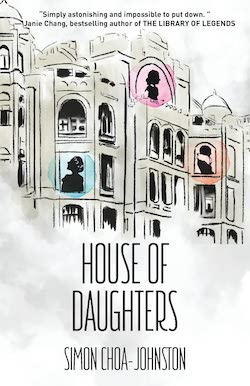
Winning the Nancy Richler Memorial Prize for fiction was Simon Choa-Johnston for House of Daughters, a stand-alone sequel to The House of Wives. Based on the author’s family, this multi-generational family saga opens when Emanuel Belilios, a wealthy Jewish opium oligarch, suddenly leaves Hong Kong, and his junior-wife, Pearl, blames Semah, the senior-wife. Pearl kicks Semah out of the mansion where the polyamorous trio had lived and shuns everyone, including her daughter. This is a story of passions and regrets, wealth and survival, set in Eurasian Hong Kong’s high society.

image - Gidal coverIn the non-fiction category, the Pinsky Givon Family Prize went to Alan Twigg, editor of Gidal: The Unusual Friendship of Yosef Wosk and Tim Gidal, a selection of letters between Israeli Tim Gidal, a pioneer in photojournalism, and Vancouver scholar and art collector Yosef Wosk. In the late 1920s, with his handheld Leica, Gidal was able to travel in interwar Europe, capturing rare images of Polish Jews prior to the Holocaust. Wosk first encountered Gidal’s work in a magazine in 1991 – the photo “Night of the Kabbalist” captivated him. Wosk was determined to meet the photographer and eventually did. The two became close and the letters – selected by Twigg from hundreds the friends exchanged over two decades – both memorialize Gidal as an artist, scholar, historian of photography and “hero among the Jewish people,” and also capture the essence of Gidal and Wosk’s friendship.

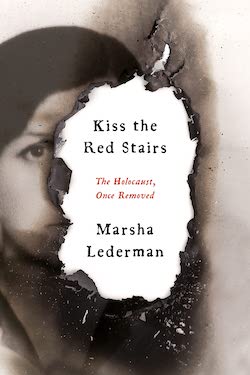
image - Kiss the Red Stairs coverThe Cindy Roadburg Memorial Prize for memoir/biography was given to Marsha Lederman for Kiss the Red Stairs: The Holocaust, Once Removed. In it, Lederman delves into her parents’ Holocaust stories in the wake of her own divorce, investigating how trauma migrates through generations. At the age of 5, Lederman asked her mother why she didn’t have any grandparents, and her mother told her the truth: the Holocaust. Decades later, her parents having died and now a mother herself, Lederman began to wonder how much history had shaped her life and started her journey into the past, to tell her family’s stories of loss and resilience.

image - Boy from Buchenwald cover Boy from Buchenwald by Robbie Waisman (with Susan McClelland) took the Diamond Foundation Prize for children and youth writing. In 1945, Robbie Waisman, then Romek Wajsman, had just been liberated from Buchenwald, a concentration camp where more than 60,000 people were killed. He was starving, tortured and had no idea if his family was alive. Along with 472 other boys, these teens were dubbed “the Buchenwald Boys.” They were angry at the world for their abuse, and turned to violence: stealing, fighting and struggling for power. Few thought they would ever be able to lead functional lives again, but everything changed for Romek and the other boys when Albert Einstein and Rabbi Herschel Schacter brought them to a home for rehabilitation.

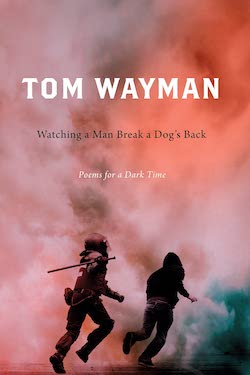
image - Watching a Man Break a Dog’s Back coverThe Betty Averbach Foundation Prize for poetry went to Tom Wayman’s Watching a Man Break a Dog’s Back: Poems for a Dark Time, which explores the question of how to live in a natural landscape that offers beauty while being consumed by industry, and in an economy that offers material benefits while denying dignity, meaning and a voice to many in order to satisfy the outsized appetites of a few. A cri de coeur from a poet who has long celebrated the voices of working people, the collection also grapples with why “anyone, in this era so profoundly lacking in grace, might want to make poems – or any kind of art.”

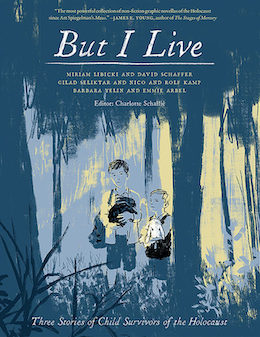
Rounding out the awards was the Kahn Family Foundation Prize for Holocaust writing, which was given to But I Live: Three Stories of Child Survivors of the Holocaust by Charlotte Schallié (editor) and illustrators Miriam Libicki, Barbara Yelin and Gilad Seliktar. But I Live is a co-creation of the novelists and four Holocaust survivors: David Schaffer, brothers Nico and Rolf Kamp, and Emmie Arbel. Schaffer and his family survived in Romania due to their refusal to obey Nazi collaborators; in the Netherlands, the Kamps were hidden by the Dutch resistance in 13 different places; and, through the story of Arbel, who survived Ravensbrück and Bergen-Belsen concentration camps, we see the lifelong trauma inflicted by the Holocaust. The book includes historical essays, a postscript from the artists and words of the survivors.

image - But I Live coverEach category in the 2023 Western Canada Jewish Book Awards was assessed by five jurors, in different configurations, from the following professionals: Linda Bonder, a retired librarian; Susanna Egan, professor emeritus of literature in English from the University of British Columbia; Dave Margoshes, who writes fiction and poetry on a farm west of Saskatoon; Norman Ravvin, a writer, teacher and critic living in Montreal; Rhea Tregebov, an author of fiction, poetry and children’s picture books, and a retired professor in the UBC Creative Writing Program; Elisabeth Kushner, a librarian and writer living in Vancouver; Karen Corrin, former head librarian of the Isaac Waldman Jewish Public Library at the JCC; Nicole Nozick, former executive director of the Vancouver Writers Fest and former director of the JCC Jewish Book Festival; and Anita Brown, who is working with the Waldman Library.

Daniella Givon, chair of the awards committee, introduced the May 24 event, sharing a bit about the awards and thanking all the sponsors and participants for the high calibre and diversity of the submissions. The winning authors then said a few words, and Dana Camil Hewitt, director of the JCC Jewish Book Festival, closed the proceedings with more thank yous, and an invitation for everyone to purchase and enjoy the books.

– Courtesy Cherie Smith JCC Jewish Book Festival