Following historic footsteps

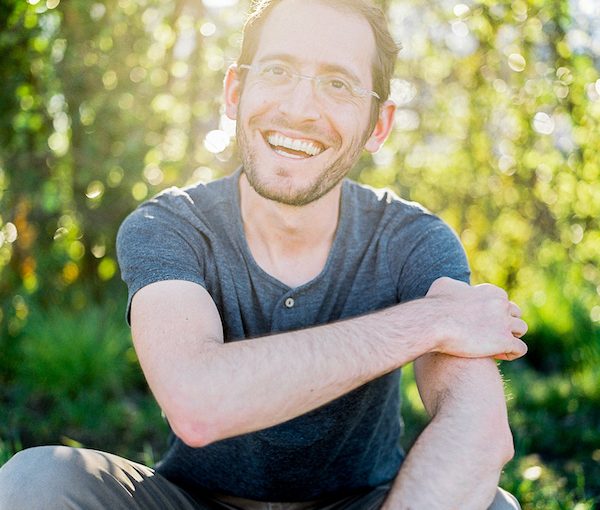
Elam Rotem, founder and director of Profeti della Quinta, which plays in Vancouver Nov. 9. (photo by Theresa Pewal Photographie)

Swiss ensemble Profeti della Quinta, directed by Elam Rotem, brings Stars of  the Italian Renaissance: Monteverdi & Rossi to Vancouver Nov. 9. Part of Early Music Vancouver’s 2023/24 season, the concert takes place at Christ Church Cathedral.

“Salomone Rossi and Claudio Monteverdi are two composers we like very much,” Rotem told the Independent. “We find the fact that they were colleagues – they played together as instrumentalists and collaborated as composers – very interesting. Even more interesting is the fact that the Jewish singers and musicians in Mantua had this double musical life, where sometimes they sang madrigals and participated in the opera productions at the court (collaborating with Monteverdi and other non-Jewish musicians) and, at other times they sang Hebrew polyphony in the synagogue.

“In this program,” said Rotem, “we follow in the footsteps of those Jewish musicians from Mantua who, unlike Jews in other places (in Italy or elsewhere), participated in the arts. This particular constellation allowed Salomone Rossi to develop his polyphonic music for the synagogue, and it is also the reason why, despite the hopes of Rossi and his followers, this tradition never took off elsewhere.”

Rotem – who was born in Sdot Yam, Israel – has a bachelor’s in harpsichord from the Jerusalem Academy of Music and Dance, and he came to Basel, Switzerland, at the end of 2008 to specialize in early music at Schola Cantorum Basiliensis, from where he received his doctorate in a joint program with the University of Würzburg, in Germany. His PhD thesis was on early basso continuo practice.

“Throughout the 16th century, music was primarily polyphonic – typically composed of four to five parts. Towards the end of the century,” he explained, “new ideas led to the development of a new technique in which only two parts were composed: a vocal part and a basso continuo part – an instrumental bass line on which the player had to fill in the harmonies above it. The possibility of having only one singing voice allowed a much more direct and expressive communication with the audience and played an important role in the creation of early operas. The difference between the older polyphony and the new monodic style is so great that it changed the course of music history, and some examples of this will be heard in our concert.”

The origins of Profeti della Quinta go back to Rotem’s studies at Kibbutz Kabri High School, where he organized a vocal quintet with fellow students. Rotem is also a singer.

“I started Profeti in the corridors of my high school, wherever we could find some church-like acoustics” he said, “but the group only became professional after we won the York Early Music Competition in 2011.”

The ensemble now performs throughout Europe, North America, Israel and elsewhere. Focusing on the vocal repertoire of the 16th and early 17th centuries, the group “aims to create vivid and expressive performances for audiences today while, at the same time, considering period performance practices.”

About how he approaches this dual goal, Rotem said, “First and foremost, I’m interested in music from the period that I find interesting and beautiful. Then, I’m also interested in how it was performed and in what context – and, for that, you have to research and try things out. For example, we sing from (copies of) original partbooks and not from modern scores, so each singer has only his or her own line. This makes listening and making music very different. Then we also try to understand the music better. Finding out the motivations behind the decisions of composers, we feel that we can deliver their music better.”

In response to a question about how Rossi’s music is perceived with regard to its Jewishness – including his liturgical compositions – Rotem said, “It depends on what people mean by ‘Jewish music.’ If, for some people, Jewish music means Eastern European klezmer music, then Rossi’s music doesn’t sound Jewish. Rossi’s music is written in the language of his time – what we can categorize (if we must) as late Renaissance Italian style. If we compare the music of his prayers, for example, with the contemporary love madrigals (also his own), we see that the prayers are more solemn and simpler. But this is hardly surprising – the way composers created their music was based on the text, and so a heart-wrenching madrigal text would be composed in a very different way than a psalm praising the Lord. Another way to look at Rossi’s prayers is not so much as pieces of music in the normal sense, but simply the text of the prayers served on a plate of harmony – with the goal of elevating and glorifying the prayer.”

Joining Rotem (bass vocals, harpsichord and musical direction) from Profeti della Quinta on the Western Canadian tour that will take the musicians to Vancouver, Edmonton and Calgary, are Doron Schleifer (countertenor), Andrea Gavagnin (countertenor), Lior Leibovici (tenor), Loïc Paulin (tenor) and Ori Harmelin (chitarrone, which is a kind of lute). After the concert in Vancouver, there will be a talk and Q&A with Rotem, hosted by Suzie LeBlanc, artistic and executive director of Early Music Vancouver.

For tickets to the performance on Nov. 9, 7:30 p.m., at Christ Church Cathedral, visit earlymusic.bc.ca.
Lanyi debuts in March

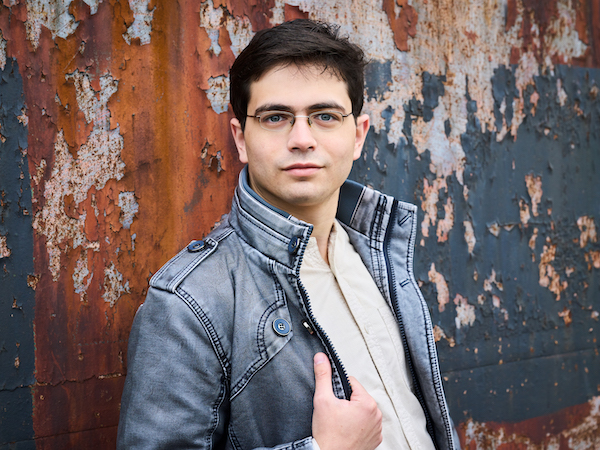
Israeli pianist Ariel Lanyi performs in Vancouver March 3. (photo by Kaupo Kikkas)

Israeli pianist Ariel Lanyi will make his Canadian debut on March 3, 3 p.m., at the Vancouver Playhouse in a concert presented by the Vancouver Recital Society.

Born in Jerusalem in 1997, Lanyi is now based in London, England, having recently completed his studies at the Royal Academy of Music. In 2023, he received the Prix Serdanag, a Swiss prize awarded by Austrian pianist Rudolf Buchbinder, and was nominated as a Rising Star Artist by Classic FM. In 2021, he won third prize at the Leeds International Piano Competition and was a prize winner in both the Young Classical Artists Trust YCAT (London) and Concert Artists Guild (New York) International Auditions. Also in 2021, Linn Records released Lanyi’s recording of music by Schubert, with other releases also planned. Lanyi’s 2021 Virtually VRS recorded performance can be viewed on the Vancouver Recital Society’s YouTube channel.

Lanyi has appeared with orchestras in Israel, the United Kingdom, Argentina and the United States, and highlights include playing with the Israel Philharmonic, Royal Liverpool Philharmonic Orchestra and City of Birmingham Symphony Orchestra, the latter of which he will return to this season for Mozart K503. Other notable future engagements include his debut with the Mahler Chamber Orchestra at the Grafenegg Festival, a return to Australia at the Sanguine Estate Music Festival, followed by a tour to China, and the Stars & Rising Stars concert series in Munich.

An avid chamber musician, Lanyi has collaborated with members of the Berliner Philharmoniker and Concertgebouw Amsterdam, as well as with musicians such as Maria João Pires, Marina Piccinini, Charles Neidich and Torleif Thedéen. He also recorded with the Mozarteumorchester Salzburg under the auspices of the Orpheum Stifftung, as part of their Next Generation Mozart Soloist series, and gave recitals at the Kissinger Sommer, Fundaçion Juan March in Madrid, and Festspiele Mecklenburg-Vorpommern.

Lanyi’s March 3 performance in Vancouver will feature Ludwig van Beethoven’s Sonata No. 30 in E major, Op. 109, Frédéric Chopin’s Mazurkas, Op. 59, and Chopin’s Polonaise-Fantaisie in A-flat major, Op. 61, as well as Max Reger’s Variations and Fugue on a Theme by Bach, Op. 81. The concert will be followed by a talkback session. For tickets, visit vanrecital.com.

– Courtesy Vancouver Recital Society

Multidisciplinary approach – When the Walls Come Down

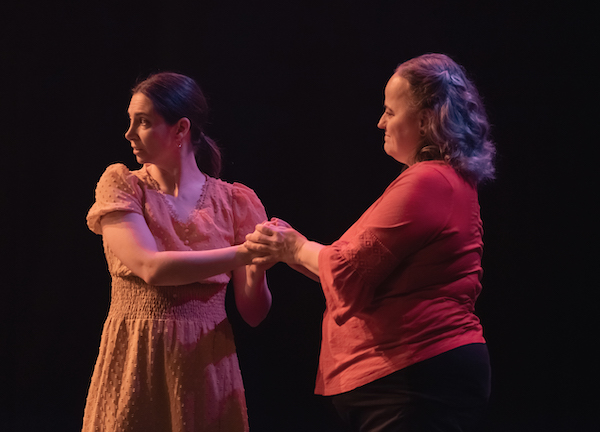
Racheal Prince, left, and Caroline Hébert in When the Walls Come Down, which is at the Rothstein Theatre Nov. 8 and 10. (photo © iiiiportraits)

“I think the performance is a really fun way to learn a little bit about Deaf culture,” Caroline Hébert, the lead actor and inspiration for When the Walls Come Down, told the Independent. “I hope people can make the time to try something different and I look forward to meeting some new people at the Chutzpah! Festival.”

When the Walls Come Down (WTWCD) will see three performances at the Rothstein Theatre next month, as part of the festival. A collaboration from Vancouver’s Dance//Novella, led by Racheal Prince and Brandon Lee Alley, the work highlights moments in Hébert’s life, “shed[ding] light on stereotypes and difficulties faced by many Deaf Canadians and tell[ing] a story of resilience and love,” according to the press material. It is performed with movement, music, projections and lighting, and in ASL with English voiceovers.

“Racheal and Brandon and the WTWCD team have been learning ASL,” said Hébert. “It’s really inspiring to me to see a group of people who want to create an environment where we can share ideas and our culture. I want to participate in more collaborations as I continue my journey as a Deaf actor. This is my first time stepping into a leading role for a one-hour show. I think, at first, I wasn’t really sure if this is something I could do. Over time, I realized that I can do it, and I can connect to many different people through my art form.”

The creation of WTWCD began in 2020, said Prince and Alley, when “our curiosity led us to explore the fusion of ASL and dance, with a strong desire to collaborate with a Deaf actor and blend their creative ideas with ours. Caroline was recommended to us by Chis Dodd, director of SOUND OFF. What intrigued us further was her last name, Hébert, which happened to be the maiden name of Racheal’s grandmother. This unexpected connection felt like a sign. After a video-translated conversation with Caroline, we realized that she possessed a compelling story that needed to be shared, so we quickly chose her as the central character for the work.”

As for her decision to be that central character, Hébert said, “I was interested in trying something new and I thought why not!? I did dance a little when I was a child so maybe that was also part of the reason?”

WTWCD debuted as a live-streamed performance during the 2021 Vancouver International Dance Festival (VIDF), which made it “challenging for us to establish a direct connection with the audience and gauge their reception of the work,” said Prince and Alley. “However, we knew this work had the potential of uplifting and illuminating a traditionally marginalized community, so we kept refining and building upon our initial ideas.”

In 2022, they received an invitation to perform WTWCD in Edmonton at the SOUND OFF festival, the first time the piece was presented in a live setting. “To our astonishment, the audience responded with thunderous stomps and a standing ovation. It was truly incredible to witness the profound connection the work had with the Deaf community,” they said.

In addition to that positive reaction, the pair won the 2023 VIDF Emerging Choreographic Award. “To us,” they said, “this award emphasized the collaborative and harmonious aspect of the work’s creation, transcending our roles as individual choreographers.”

Both creatives multitasked to make WTWCD. Prince and Alley choreographed the work; they played a part in the storyline creation and development with Hébert and her daughter, Anna-Belle Hébert, all four of whom perform the piece; Alley composed the music and Prince did the costume and set design. Other key contributors are lighting designer James Proudfoot, assistant lighting designer Chengyan Boon, and mentors and coaches Chris Dodd and Landon Krentz.

“Being a contemporary dance company, one of our goals was to find innovative ways to convey the music to a Deaf audience,” said Prince and Alley. And it was Alley who “came up with the idea of using a playful animation to advance the storyline and evoke the emotional essence of the music.

“To realize this vision, we collaborated with the Vancouver Film School,” they said. “We pitched our ideas to them, leading to the organization of a competition involving five different groups. Each group listened to our concepts and then presented us with small animations. After careful consideration, we selected the group that we believed best captured the essence of the work and the nuances of the music. They went on to create the animations that will be showcased during the performance.”

Listed on Dance//Novella’s website are producer Jill Tao, designer/animators Kanako Takashima and Cecilia Cortes, animation lead Arturo Acevedo and storyboard artist/designer Heena Yoon.

An integral part of this project has been Anna-Belle Hébert.

“She is a CODA (child of Deaf adult), fluent in ASL, QSL, English and French,” explained her mother. “Anna-Belle understands who I am and the story I want to share because it’s partly her story too. In the beginning, I recommended that Racheal and Brandon reach out to Anna-Belle to see if she would like to join the process, which they enthusiastically agreed to. In the performance, she is my voice over actor, but has also been a huge part of the creative process. She really helps bridge the gap between our ideas and how they can connect to hearing and Deaf people at the same time.”

Both Prince and Alley talk about how much they have learned while creating WTWCD. “One significant revelation for us,” they said, “was the realization that ASL and English are two distinct languages. Initially, we attempted to transcribe everything in an effort to ensure clarity, but this approach only seemed to confuse Caroline further. With the guidance of a specialized ASL coach, Caroline developed a unique method for documenting the script on paper. This breakthrough allowed her to memorize and retain everything effortlessly while making it her own.”

Prince and Alley had nothing but good things to say about Hébert.

“Caroline is an incredibly generous and patient collaborator,” they said. “During our rehearsals, we frequently paused our creative process to listen to stories from Caroline’s life. Each story offered us a glimpse into the experiences of a Deaf child, mother and student, which ultimately became the core of our creative journey. The exchange of knowledge and personal narratives became the driving force behind our work, giving it profound meaning for our team.”

When the Walls Come Down is at the Rothstein Theatre Nov. 8 and 10, at 8 p.m., and there is a special matinée for school groups grades 6 and up on Nov. 9, 11 a.m. (contact nrt@jccgv.bc.ca for more information about that). The show runs 60 minutes with no intermission. For tickets, visit chutzpahfestival.com.

Vazana at Chutzpah! Fest

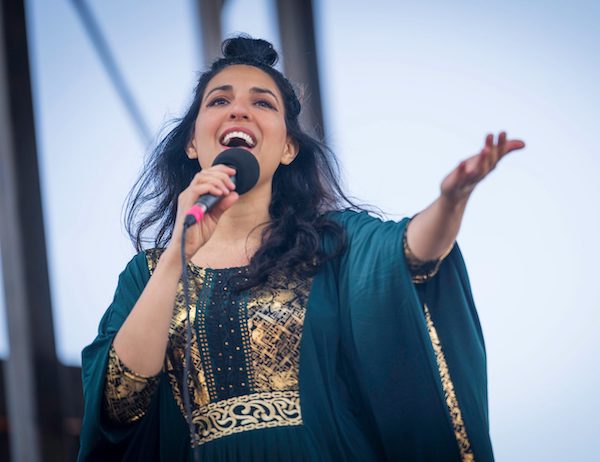
Nani Noam Vazana performs at the Rothstein Theatre Nov. 11 as part of this year’s Chutzpah! Festival. (photo from NaniMusic.com/ProLadino)

Gracing the cover of this year’s Chutzpah! Festival guide and posters is Nani Noam Vazana. The Amsterdam-based musician is one of the only artists in the world writing and performing new songs in Ladino, or Judeo-Spanish. The JI spoke with her when she last came to Vancouver, in 2017, and did so again, ahead of her Nov. 11 Chutzpah! show at the Rothstein Theatre.

“The concert in Vancouver is a part of my international Ke Haber tour that will take me through 15 countries,” said Vazana. One of the highlights of the tour will be a concert at the Library of Congress in Washington, DC, she said, “where I’ll have the honour of documenting my new Ladino songs for libraries and universities all over the world and make them available for Ladino research.”

The tour features mostly songs from Ke Haber but will also include “some traditional Sephardic songs and surprise covers – different to each show!” she said.

Ke Haber incorporates a millennial’s perspective – hers – into the writing of songs “in an old, almost extinct language,” she said, explaining that “Ladino is a language of the Sephardic Jews who were expelled from the Iberian Peninsula in the Middle Ages (Spain and Portugal of our days). My grandmother has roots in Portugal and she and her family sailed to Morocco from Porto in the 1400s. That’s where she grew up and where my parents were also born.

“In the ’50s, both my parents’ families immigrated to Israel and my father wanted to leave the past behind so he actually forbade us to speak Ladino at home,” she continued. “The only times I had contact with the language was when I was left alone with my grandmother. It was the language of witchcraft and mystery because she would only use it to speak to me in secret and tell me magical fairy tales that I actually thought she made up herself, because nobody else knew them. We sang songs in the kitchen while cooking, and it was all seeping in through the senses, very inviting and very curious.”

Vazana’s grandmother passed away when she was 12 years old.

“One of my first memories is of me and my Nona (Grandma) sitting at the kitchen table, peeling beans and singing ‘Los Guisados De La Berendjena,’ a song about seven recipes for eggplants. She hardly spoke Hebrew and my father forbade us to speak Ladino…. But, it seems, you carry this love subconsciously in you wherever you go, because, 15 years after my Nona passed away, I visited Morocco for the first time and heard people on the street singing the same lullaby she used to sing to me when I was a little girl. All of a sudden, those forgotten kitchen songs came alive and I started a long journey searching for songs and melodies that led me to release my traditional Ladino album Andalusian Brew. Sometimes, all it takes is just a sound or a scent and you’re transported to a life you’ve forgotten.”

After performing traditional repertoire for a few years, Vazana felt a yearning to write her own songs, and she dove into an exploration of the language. “I visited a scholar in Leiden, who showed me a lot of texts at an ancient Jewish library, but I wanted more,” she said. “So, I dug deep into medieval poetry and started learning the rhythm of the stanzas. Based on existing rhythmical formations, I started writing my own lyrics in Ladino, concerning questions we ask ourselves today, and, I must admit, I found a lot of correlation between where we are now and the medieval Iberian population.”

Vazani described Ke Haber as “an album of new songs that sound old, or maybe the other way around.”

“There are songs in the album that speak about female empowerment, like my song ‘No Kero Madre,’ a mother-daughter dialogue about the will to break free from the arranged marriage tradition and marry out of love,” she explained. “What a lot of people don’t know about Ladino is that it is a matriarchal language, so the relationship between mother and daughter is put on a pedestal, as the highest form of love in existence.

“In my song ‘Sin Dingun Hijo Varon,’ I describe the transformation of a transgender teenage girl who wants to be recognized as a boy. The father tries to kick her out of the house but the mother steps up and accepts her child as a boy.

“My song ‘Una Segunda Piel’ is about a Sephardic retirement ritual where your family and friends sow around you the shroud of the dead! You lie down in a cocoon, meditate and think about the troubles you want to leave behind. When the cloth is done [with], it goes into the cupboard, symbolizing all your troubles, and you emerge from it as if shedding your skin. That’s why the title is ‘Una Segunda Piel,’ which means ‘A Second Skin.’

“For my song ‘El Gacela,’” she said, “I composed music to an ancient text by Shmuel Hanagid, which is a love poem between two men. When the song was published, some people claimed that I was ‘outing’ the Jewish saint, but I think if he already published this work, he was out in the first place.”

The recording of Ke Haber, which started in London, England, in 2020, was complicated by COVID.

“I had to figure out a creative way to finalize the project, so we started recording remotely,” she said. “That’s really hard, because programs like Zoom have latency, so you can’t really record with other musicians simultaneously. We had to overdub – can you imagine playing music when the band is not in the same room? We all came to the studio whenever we were able to travel from Columbia, Chile, the Canary Islands, Bosnia, Israel, India, the Netherlands and Poland! That’s why the album is also a colourful tapestry of musical traditions and cultural aspiration from all over the world.”

While COVID was a quiet time touring-wise, “it was also a turmoil of creativity,” said Vazani, “because I just couldn’t sit still at home and wait for the world to pass by. So, I broadcasted house concerts every week, learned to edit video and record sound, which led to facilitating multicam broadcasts for other artists, such as the West East Orchestra.

“I also started doing voiceover gigs, overdubbing cartoon characters for animation and narration for documentaries and commercials. I also dabbled in emceeing when hosting online events and I hosted my own weekly podcast, interviewing [professionals] from the music industry about tips for emerging musicians.”

She received offers from music colleges and music industry conventions worldwide and hosted masterclasses and panel discussions for more than 30 institutions. “Eventually,” she said, “I was commissioned by the Dutch national TV broadcast NPO to create and host my own television series that will start airing in 2024.”

In addition to all that, Vazani teaches at the London Performing Academy of Music and the Jerusalem Music Academy, and is chair of the Amsterdam Artist Collective. She is also a guest lecturer at Codarts University, Rotterdam.

She enjoys being active – “for the mind and the soul to stay agile, we gotta train them,” she said. “This is my mental gym.”

And she’s not that interested in achievements, she said, though she has garnered several awards. “I am interested in being on the road as much as possible with my music,” she said. “This translates in my mind into happiness, and that’s not a fleeting experience, it’s a state of existence.”

To support Vazani’s music and receive content in return – all the music she has released, for example, and exclusive meet-and-greet sessions – readers can join her music family at nanimusic.com/family. For tickets to her performance at Chutzpah! and the whole festival lineup, visit chutzpahfestival.com. The festival runs Nov. 2-23.

VIFF films explore humanity

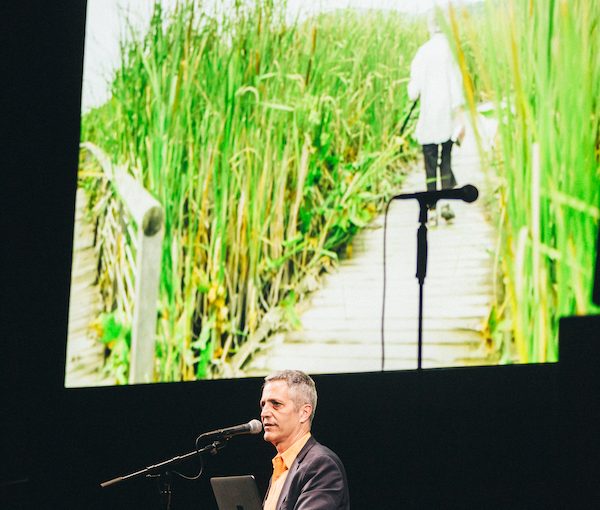
Filmmaker Sam Green will narrate live his documentary 32 Sounds, which is part of the Vancouver International Film Festival. (photo by Catalina Kulczar)

“There’s a thing in documentary filmmaking where, after you’ve done an interview with someone, you need to get what’s called room tone,” shares director, writer and editor Sam Green in his film 32 Sounds. “Room tone,” he explains, “is basically just sitting still for about 30 seconds or so and recording the sound of the room; this can help out a lot with editing later. I’ve been making films, which is kind of just marveling at people in the world, for 25 years now, and there’s always something odd and wonderful about this moment. An interview takes a person to other times and places and, now, they’re just here in the present, sitting with the sound of the room.”

Watching some of his interviewees, as they struggle or embrace sitting in silence for a few seconds, is one of the many highlights of Green’s latest documentary, 32 Sounds, which screens Oct. 5, 7 p.m., at the Vancouver Playhouse, as part of the Vancouver International Film Festival’s specialty program VIFF Live. New York-based Green will be in town to narrate the screening in-person, and audience members will be given headphones to wear, to help make the experience as immersive as possible.

The film premièred in January 2022 at the Sundance Film Festival. It exists in three forms: one as described above, but sometimes also with live music by composer JD Samson, who wrote original music for the film; another designed for an immersive at-home experience; and a theatre version without the in-person performance aspect. Watching the film at home without headphones was not ideal, but it was still enjoyable and mind-opening. There are parts where it would have added understanding and had greater impact to have heard something in only the left ear or only the right one.

32 Sounds is not just auditorily stunning but a visual pleasure, and intellectually stimulating, as well. Though there are explanations of how humans hear and how sound affects our bodies, the documentary is more philosophical than scientific. It presents concepts like the idea that all the sounds that have been made in the world should still be out there somewhere, “tiny ripples vibrating,” as contemplated by mathematician Charles Babbage, who is credited with having invented the computer, in the 1800s. If we had the right device, mused Babbage, we should be able to listen again to every joke, declaration of love or angry word ever uttered, narrates Green. “The air itself is one vast library, on whose pages are forever written all that man has ever said or woman whispered,” wrote Babbage in 1837.

In 2022, Green wrote: “I’ve made many documentary films over the years, and each one has changed me in some way, but none as much as the film I just recently finished called 32 Sounds. The film weaves together 32 different recordings as well as images, music by JD Samson, and voice-over to create a meditation on sound. Or, put a different way, the film uses sound to consider some of the basic features of our experience of being alive: time and time passing, loss, memory, connection with others, and the ephemeral beauty of the present moment.”

From the sound of a womb, to a cat purring, to fog horns, to a man who captures the sound of bombs landing nearby as he’s recording his music, Green masterfully takes viewers (listeners) on an emotional journey. We get to see how movie sound magic is made by foley artists like Joanna Fang. We meet sound and visual artist Christine Sun Kim, who talks about the deaf community, as well as hearing people’s perceptions of her work. Edgar Choueriri, professor of physics at Princeton, plays part of a tape he made for his future self when he was 11 years old. And we get to know a bit about composer and academic Annea Lockwood, 81 at the time of filming, who had been recording things like the sound of rivers for more than 50 years. Lockwood fundamentally changed how Green thinks about sound, especially a point she makes in the film: “There’s something I started writing about a year ago: listening with, as opposed to listening to,” she shares. “And it’s my sense that, if I’m standing here, I’m just one of many organisms that are listening with one another within this environment … we’re within it and we’re all listening together, as it were.”

32 Sounds has much to recommend it, including the chance to get up and dance, if you choose, when Green pumps up the volume on Sampson’s music, so you can “feel the sounds in your whole body.”

Accepting oneself

image - William Bartolo as Daniel, left, and Daniel Gabriel as his secret lover, Isaac, in a still from Cut, which is part of VIFF’s International Shorts: Nothing Comes Easy program
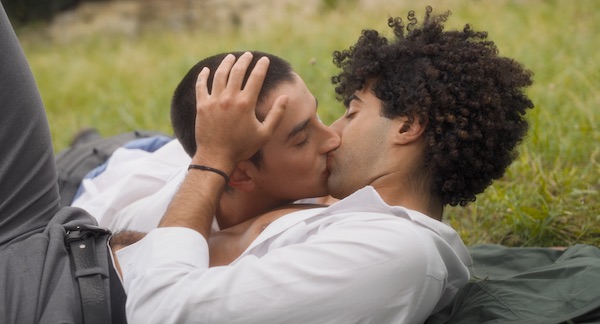
William Bartolo as Daniel, left, and Daniel Gabriel as his secret lover, Isaac, in a still from Cut, which is part of VIFF’s International Shorts: Nothing Comes Easy program. (image from VIFF)

Sound that you can feel in your whole body plays an important part in the short film Cut by Samuel Lucas Allen. In what may – or may not – be semi-autobiographical, Cut tells the story of Daniel, a high school student who tries to hide his Jewishness and his queerness. At key moments, the original score created by Sam Weiss thrums with tension, underscoring Daniel’s inner conflict.

Despite being somewhat heavy-handed – there is nothing subtle in this film, perhaps because it is only 19 minutes long – Cut is interesting, well-acted and put together. It opens with a Chassidic man holding a rooster, then shows Daniel cutting his hair, which falls onto a copy of Merchant of Venice, from which the teen will eventually have to perform, by memory, Shylock’s “If you prick us, do we not bleed?” speech. Daniel’s room has drawn images of men on his walls, in various poses, apparently his own work.

The film defines its three main elements: kapparot, as a “Jewish ritual where a chicken is blessed and slaughtered in the place of a person, to atone for their sins”; tefillin as a “pair of leather boxes containing portions of the Torah, worn by Jewish men in their morning prayers”; and cut, “a slang term for circumcision, the surgical removal of the foreskin, usually performed for religious reasons.”

It is mainly the Jewish aspect that Allen deals with in this work. Daniel is able to walk away from a gay slur, but not an antisemitic one, and, in the end, he is reconciled to himself and his Orthodox father by the mystical Chassidic man’s performing kapparot over him. We witness Daniel’s acceptance of being Jewish, but are left to wonder if he comes to accept his queerness, an aspect of his being that conflicts with Orthodox Judaism, though his soul would still be considered divine in religious circles, even if he engages in homosexual acts, which are prohibited by the Torah.

Cut is featured in VIFF’s International Shorts: Nothing Comes Easy, a program for viewers aged 18+, in which the films’ “protagonists discover that sorting out their lives can be much more difficult to achieve than they realized.” It screens Oct. 5, 6:45 p.m., and Oct. 7, 12:15 p.m., at International Village 8.

The Vancouver International Film Festival runs Sept. 28-Oct. 8. For the full schedule and tickets, visit viff.org.

VIFF 2023 ticket giveaway

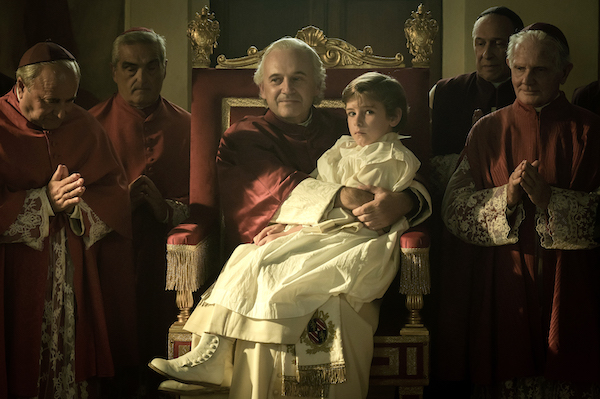
A still from the film Kidnapped, which is set in 19th-century Italy. In it, a 6-year-old Jewish child is abducted by papal soldiers who inform his parents that the boy was secretly baptized by a maid. If they want him back, they must convert to Catholicism. In the meantime, the boy will be educated in the Vatican at the feet of Pope Pius IX (Paolo Pierobon). There’s an international outcry, but even as the Church loses political ground with the emergence of an Italian state, the Pope remains adamant: the child has been saved.

Marco Bellocchio (The Traitor, Dormant Beauty and Exterior Night) seizes on this true story to mount a fierce denunciation of antisemitism and the excesses of the Catholic Church, as well as to chronicle a pivotal chapter in Italian history.

Email editor@jewishindependent.ca by Sept. 27 for a chance to win two vouchers to see the Jewish Independent-sponsored film Kidnapped at the Vancouver International Film Festival Sept. 28, Oct. 3 or Oct. 6.

A land of contradictions

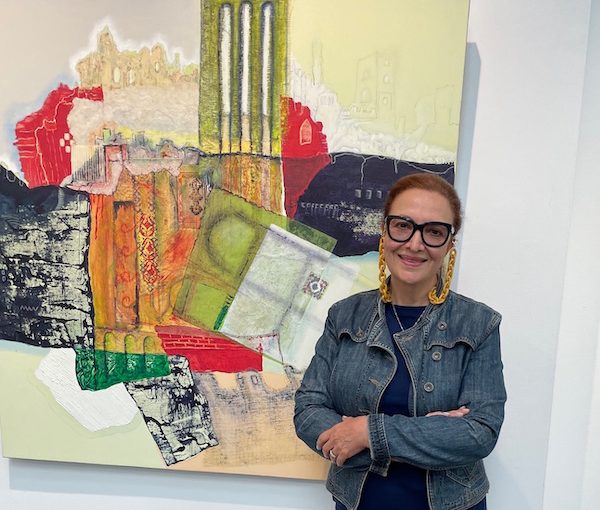
Sorour Abdollahi’s solo exhibit Intersecting Landscapes is now at Zack Gallery. (photo by Olga Livshin)

Over the years, Iranian-Canadian artist Sorour Abdollahi has participated in several group shows at Zack Gallery, but the current exhibition, Intersecting Landscapes, which opened on Sept. 7, is her first solo show here.

“Sorour is definitely not the first non-Jewish artist with a solo show at the Zack,” said gallery director Hope Forstenzer. For years, the mission of the Zack Gallery, which is in the Jewish Community Centre of Greater Vancouver, has been to showcase Jewish artists and art dedicated to Jewish themes, she said. Non-Jewish artists were not excluded, but they usually appeared in group shows.

“The big difference in the past few years,” said Forstenzer, “has been an expansion of the definition of a Jewish theme to include a wider variety of human universal experiences that reflect on Jewish cultural history and traditions.… Sorour’s work, while not as overtly Jewish as some, addresses the concept of diaspora and its impact on culture and memory. When we made the decision to show her work, it was based on the concept of a cultural nostalgia for home as an inherently Jewish theme. And the response to it, so far, has borne that out – it has had a very strong emotional impact on the community here at the JCC and has already engendered discussion of the Jewish diaspora.”

Abdollahi has been a professional artist all her life. “I’ve always painted, since I was a child,” she told the Independent.

She received her art education in Iran, and her first solo art show happened there in 1987. A successful artist, working in mixed media and acrylics, she regularly exhibited in Iran, participating in multiple group and solo shows in various cities, including Tehran and Isfahan. The only big gap in her exhibiting schedule occurred when she immigrated to Canada. “We came here in 2000,” she said. “We did it for the children.”

Like all immigrants, she struggled with the new language and new culture. “It was several years later, when my children grew older, that I enrolled in Emily Carr [University of Art + Design] part time,” she recalled. “I wanted to become familiar with the local art scene, with the educators and the artists. I wanted to become a part of the local artistic community. And it worked beautifully. My friendships with wonderful Vancouver artists Devora and Sidi Schaffer stem from those days.”

Five years after her immigration, Abdollahi felt immersed enough in the British Columbia art vista to open her own studio and gallery in Yaletown.

“People would pass my gallery on the street, and some would come in,” she said. “They asked questions. I felt that my art connected.”

That connection gave her the courage to join the Eastside Culture Crawl – the biggest visual art festival in Vancouver – 10 years ago.

Abdollahi’s current show at the Zack represents the scope of her art perfectly. It consists of old and new paintings from several different series. A blend of abstract and figurative art, her paintings are airy and bright. Most of them have vague architectural connotations and employ a predominantly blue and green palette reminiscent of spring and rebirth. The abstract forms, sometimes utterly modern, often reveal faint outlines of ruins, shimmering in the mist, in the background.

“I grew up in the land of contradictions, where a traditional way of living juxtaposed a modern, Western lifestyle,” she said. “Those contradictions manifested in the landscape surrounding me, the historical against the contemporary, with layers of change and transformation.”

Immigration to a new country profoundly impacts her imagery.

“In my paintings, I examine the relationship between memories and the external landscape,” she said. “My Iranian background and my Canadian experience have had an enormous influence on my works. They inspired a negotiation between the modern and the ancient, the old and the new, the West and the East. Ancient ruins and Persian architecture play a pivotal role, too. They have enabled me to express the conflict and the negotiation process that often exists between two different cultures or societies. While the ruins speak of a mysterious, pure and mystical past, they also illustrate the corrosive effect of time and modernity, the constant reconfiguration of a country’s landscape, architecture and culture. The dripping paint in many of my pictures also illuminates the process of renewal. The old slides down, while the new grows over it. My paintings attempt to form a bridge between the past and the present.”

Two of the paintings particularly stand out. “The Magical Carpet” is a collage, full of the whimsical patterns, warm hues and bright shapes of a traditional eastern bazaar, with the artist’s customary ruins in the background.

Another painting, “Letters from Beyond”, with its strong punch of red paint, uses fragments of writing that are wholly imaginary. “The language and the letters in that writing don’t belong to any nation,” Abdollahi said. “I created it because I believe that we are all the same people. We should have no borders and no different languages separating us. That’s why I wanted to have a show here, at the Jewish Community Centre. I feel like my art is a link that connects us all.”

Abdollahi’s works can be found in private collections in Canada, the United States, the United Kingdom, France, Australia, Saudi Arabia and Iran.

Intersecting Landscapes runs until Oct. 12. For more information, visit sorourart.wordpress.com.

Olga Livshin is a Vancouver freelance writer. She can be reached at olgagodim@gmail.com.

Film is a tribute to Burquest

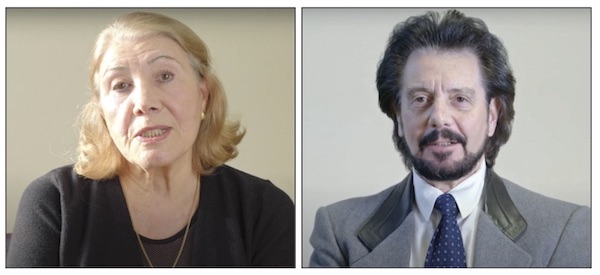
Zanna Linskaia and Rudy Rozanski were key in making the video Burquest Jewish Community: Past, Present, Future, which is available on YouTube. (screenshots)

Burquest Jewish Community, which serves people in the eastern suburbs of Vancouver, turns 50 next year. Whether that milestone is marked by a major celebration or not, a recently released video provides a permanent commemoration of the impact the group has had on individuals and Jewish life in the area. The film premièred at an event June 25.

Zanna Linskaia, a former Burquest board member and longtime force of nature in the community, had the idea of making a permanent, easily viewable history of the community and she got the support of the organization’s board. She recruited Rudy Rozanski, Burquest’s then-president, to work with her to get the project done.

They collected archival materials, old photos, newspaper clippings and historical artifacts, and identified people to interview on camera to help tell the story. A valuable find was video footage of Burquest members taken two decades ago by Jelena Fuks and longtime member and past president Dov Lank. They also hired filmmaker Lior Noyman.

Linskaia and Rozanski have several lifetimes of creative achievement between them.

“I was always a huge fan of Zanna,” Rozanski told the Independent. “I had the great honour to arrange a few of her songs and do some performances with her and so I knew she’s a composer, a writer, a poet … probably the most amazing woman I’ve ever known.”

In addition to all that, Linskaia, a journalist by background (she once wrote the Russian-language page in the Jewish Independent’s predecessor, the Jewish Western Bulletin) and a Coquitlam resident for two decades, retired in 2020 as a seniors outreach counselor for Jewish Family Services. Rozanski is a classical pianist and teacher, with a PhD in musicology. He has lived in Coquitlam for 30 years.

Through interviews with a host of longtime members – including two founding originals, Bill Gruenthal and Max Jacobson (who, sadly, died Aug. 18) – the video sets the stage by indicating how remote many suburban Jews felt from the geographic heart of the community half a century ago.

Gruenthal recalled reading the Jerusalem Post on the bus headed for Kootenay Loop those many decades ago and a fellow passenger leaned over to ask if he was “a member of the tribe.” It was Jacobson.

“Max and I have been friends ever since,” Gruenthal says in the film.

A few intrepid people plodded through the old Jewish phone book and called anyone who lived in Burnaby, New Westminster, Coquitlam and surrounding areas. A living room meeting was held in 1974, with a few more than a dozen attendees. A lawyer volunteered to shepherd the nascent group into legal existence and Jacobson became founding president.

A year later, they formed a supplementary school for kids in the community, and Burquest became a gathering place for holidays and simchas. But they were meeting mostly in private homes. They raised some money, with the support of the late Morris J. Wosk, the Diamond Foundation and other philanthropists, and hired an architect to design a purpose-built shul and community centre. But the plan wasn’t feasible and it was decided to buy an existing building instead. Gruenthal’s son-in-law was in the mortgage sector and helped the society purchase a Jehovah’s Witnesses building in Coquitlam that has served ever since as Burquest’s locus for Shabbat and holiday celebrations, classes, kids programs, seniors lunches and a raft of other activities. Visiting rabbis, including Rabbi Yosef Wosk, have led holiday services over the years. Cantor Steve Levin has been Burquest’s spiritual leader for more than two decades.

Current and past members speak in the video about the impact Burquest has had on them and their families.

“Some of the most emotional and connected experiences we had with Judaism were when we were at Burquest,” recalls Shelley Rivkin. Stewart Levitt talks about the number of intermarried families or families with converted members and how they were welcomed.

The film, Burquest Jewish Community: Past, Present, Future, is available on YouTube. The musical score is an original creation by Rozanski.

“I ended up improvising some of [the music] on the spot as we were editing and we went through the entire film and edited it scene by scene,” he said.

At the wine-and-cheese reception before the première screening, Rozanski performed the entire score, accompanied by Arnold Kobiliansky on violin.

“The music [in the film] gets cut up and only specific parts are used,” said Rozanski, “so we wanted to present the film music almost as a score, so they could hear the entire music as it unfolds … and then they would be able to recognize it in the film.”

The film project, a labour of love, was a major undertaking.

“We are not going to do a second film,” Linskaia said with a laugh.

“We both felt this was really important,” said Rozanski. “I realized immediately what an important gift this was to Burquest and to future generations. It really is our gift and we put our heart into this. We understand nothing is perfect, of course, but we really did our best with it.”

For Linskaia, the film is a tribute to the centrality of the community in her life.

“Burquest became my Jewish home,” she said.

Kalla’s toxic new thriller

“I see how it looks…. Just another teen suicide. Or maybe an accidental OD. Another addict who fooled his parents. No…! I know my Owen…. Never, never, never….”

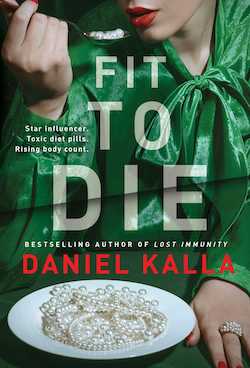
image - Fit to Die book coverThis is the reaction of Owen’s mother – who happens to be a U.S. senator – to her son’s death in Daniel Kalla’s latest thriller Fit to Die (Simon & Schuster Canada). L.A. detective Cari Garcia initially writes off the reaction as a mother ignorant of her child’s drug use, and bristles against the political pressure to determine the young track star’s cause of death. When she learns he died from ingesting a capsule that contained 2,4-Dinitrophenol, or DNP – used as a fertilizer, pesticide or explosive, but also abused by people to lose weight – she becomes more motivated to solve the mystery, in part because of a tragedy in her own past.

Meanwhile, here in Vancouver, toxicologist Dr. Julie Rees is dealing with a mysterious increase in deaths among bodybuilders, finding out that DNP is the cause. Then, a famous pop star and social media influencer dies in her penthouse, showing the same symptoms. And the co-owner of a wellness centre with locations in Los Angeles and Vancouver dies of a similar overdose. All the cases are connected and the L.A. and Vancouver police and medical personnel have to work together to find out who’s behind the influx of DNP on the market.

Like all of Kalla’s books, Fit To Die is an intriguing read, suspensefully written. While I didn’t enjoy it quite as much as I have his other thrillers – it was somewhat repetitive and the main characters’ backstories didn’t ring as true to me – I still wanted to know whodunnit. I also value having learned about the real-life issue of toxic diet pills and gaining some insight into body dysmorphia and eating disorders. I trust Kalla’s facts, as he is not only a writer, but an emergency room physician and a University of British Columbia clinical associate professor. He was kind enough to answer some questions via email.

JI: There are some Jewish-sounding surnames in the novel. In what ways does your being Jewish enter into your novel writing?

DK: Well, in this case the Hertzberg-Davis Centre is the real forensic lab for the LAPD. So that made it easy. I couldn’t remove the Jewish influence in my writing even if wanted to, which, obviously, I don’t. I’ve written a historical trilogy, The Far Side of the Sky, that is explicitly a Jewish story. In thrillers like Fit to Die, I don’t consciously think about my background or religion, but there is no doubt it influences the writing.

JI: Do you name characters after friends, or sometimes offer naming opportunities for charity auctions or the like?

DK: Haha. I learned early in my writing career to never name a character after a friend. It only ends badly. I’ve never auctioned off a character name for charity, but I would love to. It can be agony finding the right character name. Why not outsource it?

JI:  This is your 10th thriller. How has your writing style and/or process evolved since your first one?

DK: I hope I’ve learned from some of my past mistakes. Paradoxically, it gets easier and harder. Easier in the sense that I’m more confident in my voice and the nuts and bolts of my storytelling. Harder in that I’m more critical of my writing and fear becoming derivative in my stories. But the one thing that keeps me going is my enthusiasm for telling a new story. I think I’m more passionate than ever.

JI: From the several thrillers of yours that I’ve read, your topic choices are timely and coincide with current events. The medical side, you’ve got covered. But what are some of your sources for other aspects? In this book, for example, how the dark web works and even the pop culture aspects, including language, like “partizzle”?

DK: I obviously have a huge advantage with respect to the medical background, but that’s only a part of it. As you point out, this story – about a (real) and deadly diet pill that is marketed online to the most vulnerable and amplified by toxic social media – took some intense research. I had to learn all about body dysmorphia and immerse myself in the TikTok culture, which explains some of the Zoomer slang one of the character uses, like “partizzle.” I was lucky to have a local VPD superintendent help guide me through the logistics of what an investigation into this kind of complex online conspiracy would look like.

JI: Where do you find time to write?

DK: For me, it’s never about the time. I’m lucky to work in the ER, which is shift work, but I think I could find time no matter what my day job was. For me, it’s all about momentum and inspiration. When I have those, I find the time. When I don’t, free time doesn’t help.

JI: What part of your soul does writing feed?

DK: Not to sound overly melodramatic, but it kind of feeds my core. Medicine does, as well, but in a very different sense. I find purpose as a doctor, but I find my passion as a writer. I can imagine retiring one day from medicine, but I can’t imagine not writing.

JI: Can you speak about the process of getting a book from idea to publication?

DK: The challenge of transforming the kernel of an idea into a publishable novel always seems insurmountable from the outset – this book particularly. I wanted to build a compelling mystery and resurrect some characters from a past novel (The Last High) and introduce new ones, all while tackling a highly sensitive yet vitally relevant topic: how the toxic diet culture and social media prey on the most vulnerable. I like to think I met the challenge, but, of course, that’s for each reader to decide.

Habonim role pivotal

A recently retired rabbi who was born and raised in Vancouver is offering an insider’s look at life as a congregational leader.

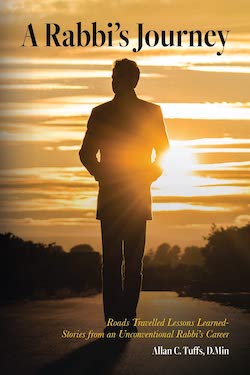
image - A Rabbi’s Journey book coverRabbi Allan Tuffs, who now lives part-time in south Florida and in the Raleigh-Durham area of North Carolina, has published A Rabbi’s Journey: Roads Traveled Lessons Learned – Stories from an Unconventional Rabbi’s Career. The 54 bite-sized chapters (coincidentally, he notes, the same number as parshas in the Torah) range from touching and hilarious to insightful and tragic.

Tuffs was born in Vancouver – he’s 10 days older than the state of Israel – and his home life was tough. His mom had a mental illness and his largely absent father had alcoholism. He and his sister would end up in the foster system.

The bookish, thoughtful Allan devoured everything he could read about Israel (among other topics) and, when he was invited to join the Labour-Zionist youth group Habonim, his life changed and everything else is as result of that connection.

“Habonim was kind of like a family to me, it really was,” he told the Independent in a telephone interview from North Carolina. “The people were warm and inviting and I was looking for my place in the Jewish community.”

Being the product of an intermarriage – “My father was not Jewish, my mother was,” he said – made the young Allan feel like an outsider.

“Intermarriage was still somewhat rare in those days,” he said. “I did not have a real religious background. I guess I was spiritual. I was very proud of my Jewish heritage and Habonim was very Jewish, very Israel-oriented, and it had a deep sense of purpose. It was kibbutz-oriented and there was this idea that the Jewish people had a role in the world, to repair the world, so to speak. That appealed to my youthful idealism.

“We had meetings almost weekly,” he added. “Here we were, these young kids.… I don’t really know if we understood what we were talking about, but we studied some of the great early socialist Zionist thinkers.”

In addition to their interest in Israel, social justice causes closer to home also drove the Habonimniks’ activism.

“We were pretty uniformly against the war in Vietnam,” he said. “We were quite disturbed by the racial injustices happening in the United States and also we were involved in fighting for Indigenous peoples’ rights in Canada. There was this sense that we are going to make the world a better place because we are Jews, because we have this ideology, because we are cognizant of the whole history of being a minority, being persecuted.”

In 1969, Tuffs headed to Israel and lived for two years at Kibbutz Menara, almost flush against the Lebanese border (and, coincidentally, now part of Vancouver’s partnership region in Israel). It was during the War of Attrition and the reality of the conflict was intense. Concentric rows of barbed wire were interspersed with landmines and German shepherd dogs patrolled the perimeter of the kibbutz.

While socialism, not Judaism, was the religion of the kibbutzniks, Tuffs notes in his book that a fortuitous meeting in Jerusalem changed the young man’s path again. Working in the holy city to earn a plane ticket home, he encountered an Orthodox rabbi from Seattle, with whom he began studying Budokan karate and Talmud. Among other things, the mix of eastern and western influences would follow Tuffs through his life. He integrates contemplative and meditative practices into his Judaism and practises yoga.

Returning to North America – and Habonim – Tuffs worked as a counselor at the movement’s camps in Pennsylvania and Washington, D.C.-adjacent Maryland. While in the D.C. suburbs, he started teaching Hebrew at a Conservative synagogue. He was hired for his language skills but the gaping holes in his Jewish knowledge – he never had a bar mitzvah – led his employer to suggest taking a few courses at Baltimore Hebrew College. This was the beginning of “a lifelong love of Jewish learning,” he writes.

Now in his mid-20s, he still wasn’t sure what to do.

“I was scholarly, but I would never be a scholar – too solitary,” he writes. “I was interested in psychology, but the thought of listening to people’s problems five days a week gave me a headache. I’m something of a ‘ham’ but would never be an actor. I’m a do-gooder – hardly a way to make a living.… What profession would allow me to do a little of all these things?”

Turns out the rabbinate fit quite nicely for 40 years. While a child of intermarriage with no early Jewish education might not seem a top candidate for the clergy, fate intervened again. Tuffs’ Hebrew language skills got him a job running a Conservative synagogue youth group in Maryland on the understanding that he would become shomer Shabbat and keep kosher. The job, in fact, put him under the wing of the rabbi and gave him more experience.

“This opportunity amounted to a rabbinic internship,” he writes.

Tuffs spent two years learning the ropes of the rabbinate. He began leading Shabbat services at a local nursing home. In 1977, he entered Hebrew Union College – Jewish Institute of Religion, spending the first year on the Jerusalem campus and four more at the institute’s New York centre.

He experienced “imposter syndrome,” partly because he had only one Jewish parent. But, he concluded, “with such a high frequency of intermarriage these days, who better than a rabbi of mixed parentage to welcome others like himself or herself into the Jewish fold? Suddenly, my rabbinate had renewed significance and purpose.”

In his book, Tuffs reflects the tumultuous and historic times he has lived through. After receiving his ordination, his first convention of the Reform movement’s Central Conference of American Rabbis, in 1983, saw the historic decision to recognize patrilineal descent.

Over the next 40 years, as he shares, he navigated synagogue politics – some comedic, some sad, including a corrupt sisterhood president and an authoritarian, bullying board president. He discusses his decision to officiate at same-sex weddings, his activism on behalf of persecuted Christians in the Middle East, and his congregation’s support of orphans in Haiti.

The tragic collapse of a condominium building in Surfside, Fla., in 2021, hit Tuffs close to home. A young couple whose marriage he had presided at just weeks earlier were killed in the disaster.

The hurricane that devastated parts of Florida and other states in 2005 ravaged his temple. The silver lining was that Tuffs was able to be part of a rebuilding project that made the sanctuary more welcoming, removing the elevated bimah that instilled “an air of un-approachability” for the rabbi and cantor.

Perhaps because he came to the Reform rabbinate with some Conservative movement experience, Tuffs considers himself on the traditional side of Reform. He wears a kippa and dons a tallit when praying, something that was unusual in some American Reform congregations when he started out.

“I embraced the growing trend in the movement toward reintegrating older, discarded ritual practices into religious life,” he writes. “At the same time, I was sold on the Reform idea of personal autonomy in matters of ritual practice.”

He would serve at congregations in Wisconsin and Pennsylvania before spending 25 years at Temple Beth El, in Hollywood, Fla., from which he retired a year ago.

Fate almost brought Tuffs back to Canada before he ever made it to Florida. Desperate to escape the Wisconsin winters, he was invited to consider a position at a synagogue in Ottawa. His mind was made up for him when a congregant enthusiastically offered: “Rabbi, you’ll be able to skate to work on the Rideau Canal four months a year.”

In addition to all else, Tuffs obtained a doctorate in ministry, for which he wrote a dissertation about masculine spirituality, which was published as a book. He was a rabbinic fellow at the Shalom Hartman Institute in Jerusalem for five years and studied at the Institute for Jewish Spirituality.

Reflecting back on his life, Tuffs can’t recall precisely where or how he first connected with Habonim. Everything that came after, though, can be traced back to that early Vancouver connection.

Tuffs’ book is available in ebook format on Amazon, though it is currently not available to order in Canada as a hardcopy.