Studio 58 presents 1933 play

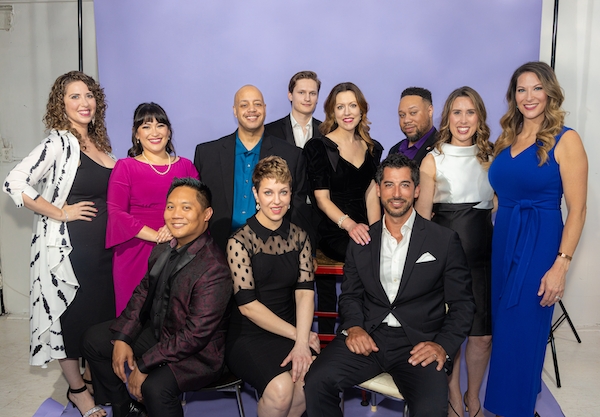
Left to right, Caylen Creative, Michelle Avila Navarro and Terrence Zhou co-star in Studio 58’s production of Blood Wedding. (photo by Emily Cooper)

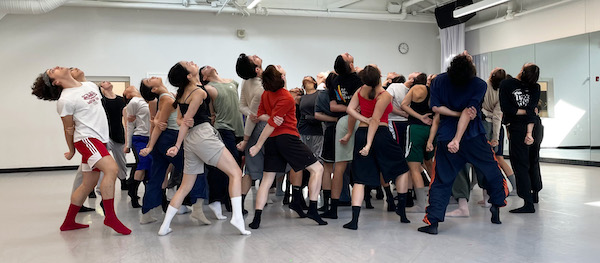
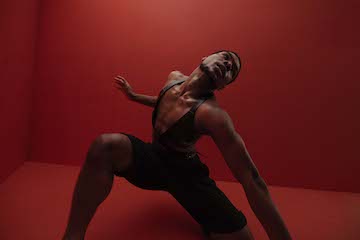
Studio 58, the professional theatre training program at snəw̓eyəɬ leləm̓ Langara College, brings flamenco dance to the stage with Federico García Lorca’s Blood Wedding Nov. 23-Dec. 3.

Recognized for his surreal and socialist works, Lorca’s Blood Wedding is a tragedy of love, repression and duty. Set in rural Spain, a bride is torn between her fiancé and her former lover, and must balance feuds between the families. Blood Wedding is a poetic play that explores the isolation of loyalty versus personal freedom.

“Federico García Lorca’s Blood Wedding premièred in 1933, three years before he was assassinated by the fascists during the Spanish Civil War for being a socialist and a gay man,” explains director Carmen Aguirre in the press release. “This play is about forbidden love, resistance to oppressive societal norms and a foreshadowing of the war. I have set the play in an Andalucian bar on the eve of that war, where a group of flamenco dancers, musicians, actors and cantaores tell us this tragic story.”

The Studio 58 production creative team includes lighting designer Itai Erdal, who is a member of the Jewish community.

Blood Wedding will have 3 p.m. and 7:30 p.m. showtimes. New this season will be a relaxed performance, on Dec. 2, 3 p.m. The show is at Studio 58 at Langara College, 100 West 49th Ave. Tickets (from $10) are available at studio58.ca.

– Courtesy Studio 58

Double book launch

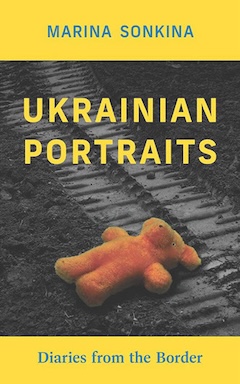
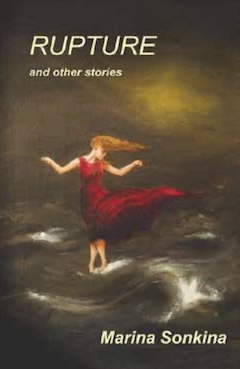
image - Ukrainian Portraits book coverJoin writer Marina Sonkina in celebrating the release of her two new books: Ukrainian Portraits: Diaries from the Border and Rupture and Other Stories. About Ukrainian Portraits, she writes: “At the end of March of 2022, I traveled to the Ukrainian-Polish border to volunteer at a refugee evacuation centre. Much as I tried to prepare myself psychologically, what I encountered face-to-face didn’t fit any of my expectations: I saw a disaster on a massive scale. I went to volunteer as someone who speaks Russian, Ukrainian and other languages; someone who had been a refugee herself.

image - Rupture book coverI soon realized that what the Ukrainian refugees needed most (apart from practical advice) was to talk about their experiences. They needed to be heard.”

The double book launch takes place Sunday, Dec. 10, 1:30 p.m., in the Aceman Seniors Lounge at the Jewish Community Centre of Greater Vancouver. Nibbles and light refreshments will be provided.

– Courtesy Marina Sonkina

Art that makes people think

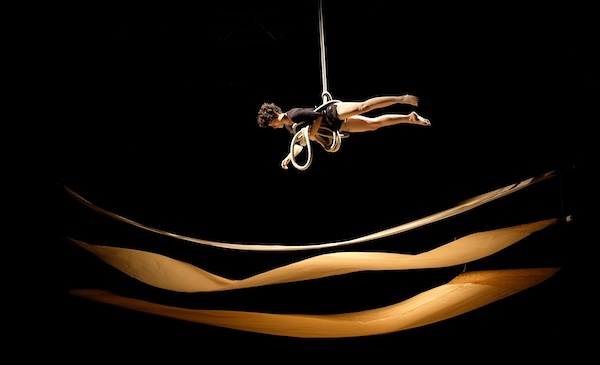
Domitille Martin in Pli, part of the PuSh International Performing Arts Festival, which runs Jan. 18 to Feb. 4. (photo by Lucie Brosset)

PuSh International Performing Arts Festival returns to Vancouver Jan. 18-Feb. 4. The mid-winter event that delivers innovative, contemporary works asks the questions, “Can a live art festival be a ritual for social change? A cultural strategy? A means to rethink history while imagining possible futures?” Participating artists include Jewish community members and a production presented with Chutzpah! Festival.

Vancouver’s Vanessa Goodman (Action at a Distance) is co-creator with Tangaj Collective (Simona Deaconescu, from Romania, and Gaby Saranouffi, from Madagascar) of BLOT, Body Line of Thought: “Our bodies are strong and fragile. BLOT redefines how we see our physical selves and their relationship to the world. In a stark set reminiscent of a science lab, two dancers observe the intricacies of the body and using salt, microbiome and physiology demonstrate how interconnected we truly are.”

BLOT will be presented Jan. 22-23, 7:30 p.m., at Left of Main, with a post-show talkback after the Jan. 22 production.

PuSh, with SFU Woodward’s Cultural Programs & Touchstone Theatre, presents Toronto-based theatre company Human Cargo’s The Runner, Jan. 24-26, 7:30 p.m., at SFU Goldcorp Centre for the Arts. The play description reads: “When Jacob, an Orthodox Jew, makes a split-second decision of who to help, his world comes crashing down. Urgent, visceral and complex, The Runner invites us into a nuanced exploration of our shared humanity and the value of kindness.”

In Pli, by France’s Les Nouvelles Subsistances (Inbal Ben Haim, Domitille Martin and Alexis Mérat), “paper becomes a playground. This visually stunning, philosophical work considers risk and transformation, as told through a circus artist moving through a set made entirely of paper – like a vast, changing sculpture. The relationship between body and paper offers a new conversation about the relationship between strength and vulnerability.”

Presented with Chutzpah! Festival, the circus/dance Pli runs Feb. 2-3, 7:30 p.m., at Vancouver Playhouse and Feb. 2-4 online.

In all, PuSh features 17 original works from 15 countries, including four world premières and seven Canadian debuts. The works presented offer personal accounts of resistance and acts of vulnerability, and push us to examine our relationship to themes such as migration, displacement, labour, injustice and artificial intelligence.

Events include Club PuSh, a casual atmosphere where people can connect with artists and party with fellow festival-goers; the PuSh Industry Series, which, in partnership with Talking Stick, stimulates dialogue with attendees during the second week of the festival; youth programming for participants aged 16 to 24; and, in partnership with Playwrights Theatre Centre, free artistic consultations with visiting dramaturgs representing diverse artistic points of view and cultural contexts.

Tickets for PuSh range from $16.75 to $39, with a top-tier seating option of $69 for Pli at the Playhouse, and PuSh passes for people who want to see multiple shows. To buy tickets, visit pushfestival.ca or call the festival audience services line at 604-449-6000.

– Courtesy PuSh International Performing Arts Festival

A fresh take on Hanukkah

Chicago a cappella in June 2022. The ensemble released Miracle of Miracles: Music for Hanukkah last month. (photo by Kate Scott)

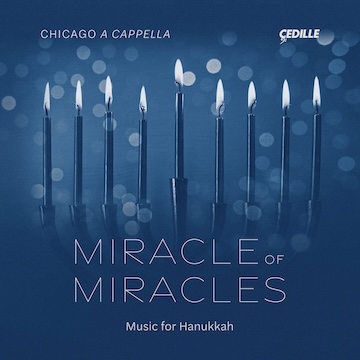
The CD Miracle of Miracles: Music for Hanukkah arrived at the Jewish Independent unsolicited. The album, released last month by Cedille Records, features a range of songs from the American Jewish musical tradition, performed by Chicago a cappella vocal ensemble. As someone who spent a good portion of her teenagehood in a choir at a Conservative synagogue and about a decade singing in another Conservative synagogue choir later in life, I have been happily singing along to this recording, enjoying the fresh take on songs with which I am mostly quite familiar.

Miracle of Miracles will appeal most, I think, to someone like me, who grew up in a Conservative Judaism milieu where a cantor and choir formed a large part of the service, or someone who appreciates classical music, as Chicago a cappella are classically trained A-listers, who perform a repertoire of music from the ninth to the 21st centuries. The current artistic director is John William Trotter, and Miracle of Miracles was recorded over a few days last January at Northeastern Illinois University in Chicago.

image - Chicago a cappella CD coverThe CD opens with an arrangement of “Oh Chanukah / Y’mei Hachanukah” by Robert Applebaum that the liner notes describe as “modern versions of the song form from the confluence of at least two streams, the first springing from Hebrew lyrics, the second flowing together from Yiddish and English sources. Turning again to [composer] Harry Coopersmith’s mid-20th-century collection … to create something of a mash-up of ‘Oh Chanukah’s’ popularity.”

There are several Applebaum arrangements. His “Haneirot Halalu” (“These Lights We Light”) mixes English translation and commentary into the traditional Hebrew lyrics, and his “Maoz Tzur” is a cantor-choir interplay that comprises elements most of us will recognize and be able to join initially, but then becomes more complex. His finger-snapping arrangement of Samuel E. Goldfarb’s well-known “I Have a Little Dreidl” – called “Funky Dreidl” – is in English with the Hebrew “nes gadol haya sham,” “a miracle happened there,” as a kind of chorus. It’s followed on the CD by a lively rendition of Mikhl Gelbart’s Yiddish “I Am a Little Dreidl (Ikh bin a kleyner dreidl).”

Other Yiddish offerings are Mark Zuckerman’s arrangement of “O, Ir Kleyne Likhtelekh” (“O, You Little Candle”), the lyrics of which were written by poet and lyricist Morris Rosenfeld, and an arrangement by Zuckerman of “Fayer, fayer” (“Fire, Fire”) by Vladimir Heyfetz, about burning the latkes while frying them.

Applebaum’s jazzy “Al Hanism” (“For the Miracles”) is one of three versions of the song on this recording. There is also an arrangement by Elliott Z. Levine that is the traditional, fast-paced version I’ve sung countless times and love, and the expansive, movie soundtrack-sounding arrangement by Joshua Fishbein.

Levine also contributes “Lo v’Chayil” (“Not by Might”), based on text from the Book of Zechariah, which is not a Hanukkah song per se, but, as the liner notes say, “rather the more transcendent spirit that underlies the commemoration of Hanukkah.” Translated from the Hebrew, the verse is: “Not by might nor by power, but by My spirit, saith the Lord of Hosts.”

Other composers/arrangers whose work is featured on this CD are Steve Barnett (“S’vivon” / “Little Dreydl”), Gerald Cohen (“Chanukah Lights”), Daniel Tunkel (four movements of his “Hallel Cantata”), Jonathan Miller (“Biy’mey Mattityahu” / “In the Days of Mattityahu”).

Two bonus tracks are included: an arrangement by Joshua Jacobson of Chaim Parchi’s Hanukkah tune “Aleih Neiri” and Stacy Garrop’s take on the prayer for peace “Lo Yisa Goy”: “Nation shall not lift up sword against nation, neither shall they learn war any more.”

In the program notes, Miller, who is Chicago a cappella’s artistic director emeritus, talks about the limited number of Hanukkah songs that are appropriate for an ensemble to perform, commenting that “Jewish choral music is a recent phenomenon, begun in earnest only about 200 years ago in Berlin, so there’s a simple quantity issue: we have much less repertoire to peruse than in other choral traditions. Given all of this, we are especially grateful for the composers and arrangers whose persistence and skill have given us the works found here.”

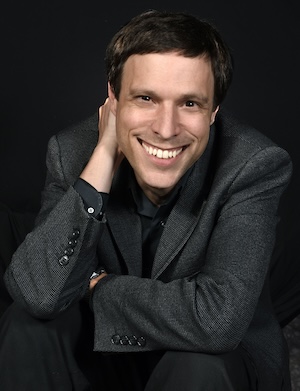
photo - Chicago a cappella artistic director John Trotter
Chicago a cappella artistic director John Trotter. (photo from Cedille Records)

Despite the dearth of Hanukkah choral music, Trotter, the ensemble’s current artistic director, observes that the CD comprises “a sprawling variety of styles.”

“There are at least two reasons for this breadth,” he writes. “On the one hand, we are in debt to the fertile imaginations of our composers, who envisioned so many different sound worlds and so many different ways to clothe these texts. But there is also the nature of Hanukkah itself, which offers so many different modes of personal, social and spiritual practice. Consider just three of these. Hanukkah offers the chance to reflect on the historical significance of the Maccabean revolt, with its consequences echoing through to the present day. It invites quiet contemplation of the candle flames, set aside from any utilitarian purpose. And it provides an opportunity to gather with family and have a really great party with really great food.”

Miracle of Miracles would provide a perfect acoustic background for a Hanukkah gathering. To purchase a CD or buy or stream the music digitally, visit cedillerecords.org/albums/miracle-of-miracles.

A spoof on true crime

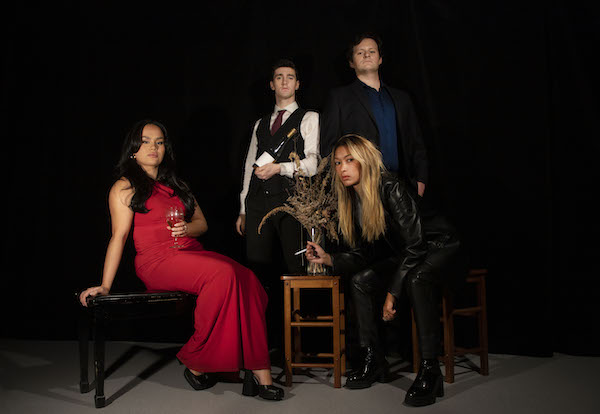
Left to right: Sophia Paskalidis, David Underhill, Drew Ogle and Mai Stone (seated) co-star in Tragedy, Slander & Wine. (photo by Sarah Cherin)

When a community theatre production ends with an actor dying on stage, the media descends on the small B.C. town. Conspiracy theories flourish and no one is above suspicion.

This is the plot of Tragedy, Slander & Wine by Jewish community member David Volpov, which premières at the NEST on Granville Island Nov. 13-19. The mystery/comedy explores, among other things, media literacy.

“My goal in writing Tragedy, Slander & Wine is to bring awareness about the issue and to invite audience members to think more critically about the media they consume. So, that’s where the idea of true crime entered the play,” said Volpov, executive director of Promethean Theatre, which is presenting the work. “I see true crime lovers popularize a lot of sensationalistic interpretations of well-known deaths. I think people tend to want to believe wild hypotheses instead of the cut-and-dried truth simply because it’s more entertaining. This conspiratorial thinking can become dangerous if it impedes on innocent people’s lives, which is what happened in real life to the town of Moscow, Idaho, after several infamous deaths.”

On Nov. 13, 2022, Ethan Chapin, Xana Kernodle, Kaylee Goncalves and Madison Mogen were stabbed to death in the young women’s off-campus (University of Idaho) house. False accusations and other misinformation proliferated, causing much harm to the community. Eventually, suspect Bryan Kohberger was charged with their murders, and his trial continues.

In Volpov’s fictional story, the play’s description notes, “The finger-pointing grows so rampant that the victim’s sister, Shannon (Mai Stone), can’t even have a healthy relationship with her own mother. Shannon’s longtime friend Alec (Drew Ogle) promises to help Shannon replenish her image in the public eye and shed her status as a pariah. But they find out that manipulating the media is harder than they anticipated. They have to get past power-hungry reporter Penelope (Sophia Paskalidis) and gatekeeping publicist Colin (David Underhill). Soon, Shannon uncovers a secret plot that upends everything she thought she knew about the tragedy.”

The play features four actors on stage and seven performers who act only on screen.

“I knew that I needed a multimedia film component in the production to spoof true crime,” Volpov told the Independent. “We filmed interviews with the townsfolk, who give the audience information about the circumstances of the mystery of the play. The film is played on TVs, which are onstage during the entire performance.”

This approach was new to many working on the production and Volpov said he appreciated the help of a few film artists who offered their guidance. In particular, he noted, “Our videographer, Bruna Xavier, and our film editor, Ian Tan, are both godsends. I’m really excited for audiences to see what this collaboration created because it’s not something that Vancouver audiences have seen before.”

Tragedy, Slander & Wine is Promethean Theatre’s sixth production. Formed in 2018, the company’s mandate is “to create work opportunities for emerging artists,” said Volpov. “There are some apprenticeships open to emerging artists in Vancouver theatre companies, but I keep hearing from my peers that these positions only take them so far. They feel stuck in what they consider a trainee limbo before they can get a shot at a role they want. That’s why Promethean puts emerging artists directly in positions of creative leadership. In that sense, we act as a launchpad for artists who want to continue expanding their practices.” (For more information, visit prometheantheatre.ca.)

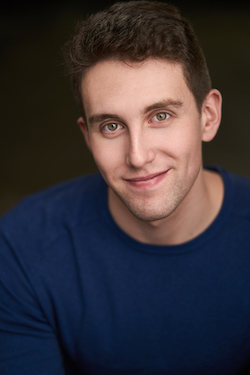
photo - With Tragedy, Slander & Wine, playwright David Volpov invites audience members to think more critically about the media they consume
With Tragedy, Slander & Wine, playwright David Volpov invites audience members to think more critically about the media they consume. (photo from Promethean Theatre)

Volpov joined the producing team after having acted in Promethean’s first production, Saint Joan. He graduated from the bachelor of fine arts acting program at the University of British Columbia in 2020.

“Like many people who graduated then, my final play at UBC was cut short after just three performances due to COVID,” he said. “This experience really opened my eyes…. I always knew acting is a difficult profession, but to see virtually every theatre and movie set shut down spiked my existential worries a lot. There’s a silver lining, though. I returned to playwriting during the lull period in 2020 because I realized that writing was a way I could create art while social distancing. I learned that I didn’t have to wait for theatre work to come to me; I could generate work myself. In hindsight, I didn’t actually know what art I wanted to make when I graduated UBC. It wasn’t until I began writing plays that I found my voice and had something to say about the world.”

Tragedy, Slander & Wine is one of the works Volpov began writing during the pandemic. “I felt troubled by how quickly conspiracy theories spread,” he says in the press release for the play. “I saw this cycle repeat after each major world event. Our abilities to engage in meaningful discourse eroded while our reliance on bias-confirming news increased. With so much misinformation online nowadays, how is anyone supposed to parse through what’s fact and what’s fiction?”

“Research shows that feelings of anxiety, disenfranchisement and isolation cause people to think more conspiratorially,” Volpov told the Independent. “People feel comforted by believing that their enemies cause their bad fortune (as opposed to random chance). One of the reasons conspiracy theories endure is because they have a backfire effect: when someone confronts a conspiracy theorist about their beliefs, it is interpreted as confirmation. Theorists think ‘of course, the higher powers want to convince me I’m wrong, that’s part of their plan.’ I don’t think conspiracy theories will ever go away, unfortunately.”

Nonetheless, Volpov is doing what he can to improve the situation, in addition to writing about it.

“Promethean Theatre partnered with a media literacy platform to provide education about the topic,” he said. “They are called Ground News and are a Canadian company based out of Kingston, Ont.

“I believe that there are many ways that people can combat their confirmation biases and to have a well-rounded knowledge about current events,” he continued. “The number one thing people can do is to read multiple sources about one story. I know it probably feels like a chore, but reading different perspectives can mitigate our political blindspots.

“After that, I recommend cutting your social media use when engaging with current events. Traditional media isn’t perfect, and it’s rightfully facing scrutiny from the public, but social media can be especially pernicious because the algorithm can steer people to engage with content that already supports their beliefs. Also, the algorithm boosts sensationalistic content while ignoring nuance, which I think is necessary for every discussion.

“My next piece of advice is, be diligent about claims you read. If information can’t be traced back to a source,” he said, “it can’t be verified as true.”

Tragedy, Slander & Wine is recommended for audience members age 16+ because of its “mature content, including references to substance abuse, murder and suicide.” Among the performances is a matinée for high school students Nov. 15, and artist talkbacks after the Nov. 18 and 19 matinées. For tickets, visit plainstage.com/events/tragedy-slander-and-wine.

Culture Crawl starts Nov. 16

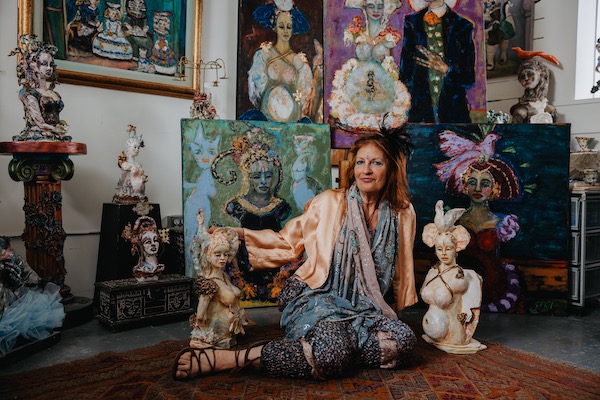
Suzy Birstein is one of the many Jewish community artists taking part in this year’s Eastside Culture Crawl Visual Arts, Design & Craft Festival, which runs Nov. 16-19. (photo by Britt Kwasney)

The 27th annual Eastside Culture Crawl Visual Arts, Design & Craft Festival takes place Nov. 16-19 and features almost 450 artists, including many from the Jewish community. Among the community members opening their studios to visitors are Suzy Birstein, Olga Campbell, Hope Forstenzer, penny eisenberg, Robert Friedman, Lori Goldberg, Lynna Goldhar Smith, Ideet Sharon, Stacey Lederman, Shevy Levy, Lauren Morris and Esther Rausenberg.

“We welcome the public to dive back into the Culture Crawl this fall to experience and be inspired by our artists’ growth and discovery. [The pandemic] has been a time of change for many of us and I believe art is a conduit for moving forward together,” says Rausenberg in the event’s press release. Rausenberg is a photo artist, as well as artistic and executive director of the Eastside Arts Society, which puts on the Crawl.

The Independent spoke with a few of the participating Jewish artists about what visitors to their studios can expect to see, and whether creativity is a place of refuge or if it is harder for them to create in times of conflict, including but not limited to the Israel-Hamas war and the war between Ukraine and Russia.

Visitors to Birstein’s studio will see her “figures from fired clay infused with aged and lustred surfaces, which inspire paintings in oil, cold wax and collage.”

The artist is currently working on two series, which will merge into the solo retrospective at Il Museo Gallery, curated by Dr. Angela Clarke for 2025.

“Both series evoke my art/travel adventures to Europe, Mexico and Cambodia,” said Birstein.

“‘Ladies-Not-Waiting’ reference the gazed-upon women by old master painters – Velasquez, Fouquet and Manet – alongside self-portraits painted by masterful female artists, Frida Kahlo, Leonora Carrington and Leonor Fini,” she said, while Tsipora (her Hebrew name, meaning Bird) is a series of loose self-portraits, which “embrace an exotic earthiness living within my poetic imagination.”

Both bodies of work, she said, “speak to nesting and transcendence, the mirror and reflection and celebrate the individual and universal.”

For Birstein, in times of conflict, “be it COVID, warfare, personal challenges – the only thing that centres me, coming directly from within me, is the creative refuge of my studio and making art. As I say this, I must stress that the love and compassion I feel for and receive from my family, friends, students and peers is the other half of that equation. I can’t imagine one without the other and I am extremely grateful.”

Friedman describes himself as “a muralist-styled stained glass artist.” He has worked in stained glass for more than 40 years and has recently added a blown glass dimension to his work, according to his website, which is also a recent addition.

“My studio is a great place and haven for creative thought and output,” he told the Independent. “[T]hese troubled times just [add] more impetus for me to have it reflected even more so in my artwork.”

Goldberg also finds herself more driven.

“My work is about vitality, life, vibration forging connections and bringing two opposing energies together as a way to find potential for resolution,” she said. “I have a responsibility as an artist to respond. I am more motivated. Expressing ‘Heaven on Earth’ is one way I respond to pain and suffering.”

Goldberg had a three-month residency on the North Shore, which she spent painting the forest – work that studio visitors will see.

“I was recently reading the book Speak for the Trees by Diana Beresford-Kroger about how the roots of the trees, the mycelium and plants and trees talk to each other,” said Goldberg. “By painting in the forest, I learnt how to listen, experience the tranquility, vitality and interconnectedness of the forest and to myself.”

Since the spring, Goldhar Smith has been “creating minimal colour-field style landscapes based on the idea of the shape of light and the colour of shadows,” she said. “The paintings are rendered in soft blues and pastels or deeper mysterious tones and suggest memories of places real and imagined.”

She acknowledged, “The conflict in Israel has, of course, been enormously upsetting and I find myself in despair for both sides of the conflict. My paintings do not yet reflect these emotions, but they will in coming months. I don’t yet know what I will be painting but I will be exploring more difficult terrain.”

For Forstenzer – a glass artist and director of the Sidney and Gertrude Zack Gallery – creativity can be a place of refuge, but also more challenging in times of conflict.

“Making work when I’m feeling the stress of all that’s going on personally and globally is truly healing,” she explained, “but when I’m feeling overrun with those things, it can be a lot harder to fully concentrate at times.”

Lately, Forstenzer has been making glass clocks, something she describes as “incredibly fun.”

“I can experiment with colour and pattern in the glass, and I’ve learned a lot about clockwork mechanisms, which is also an exciting thing to dive into – I’ve been down many rabbit holes online about clockmakers,” she said. “I’ll have a bunch of clocks on display and for sale at the Crawl.

“I also have spent a lot of the last year generally playing with colour and pattern,” she added. “I’ve made vessels – vases, bowls, cups – that experiment with a particular colour or look or pattern or stripe in glass. Once I have a colour process in place, I often go on to use those colours, patterns and processes in sculptural pieces. Since I’ve done so much experimenting this year, there will be a lot of pieces on display and for sale at the Crawl as well.”

In addition to opening their studios, Forstenzer and Birstein are part of the Crawl’s juried exhibition, which has the theme “Out of Control.”

“At a time when we start to celebrate our freedom from pandemic restrictions, it’s an opportunity to reclaim experiences that were denied for so long, a chance to think outside of the box and just let go,” says Rausenberg in the press release.

The exhibition features the work of 80-plus Eastside artists and takes place at multiple venues: Alternative Creations Gallery and Strange Fellows Gallery (both until Nov. 19), the Pendulum Gallery (until Nov. 24) and the Cultch (until Nov. 25).

For more information, visit culturecrawl.ca.

Help fund Gary documentary

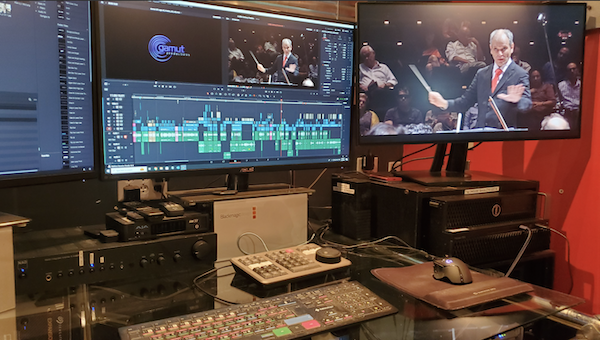
The costs of completing the documentary A 20th Century Passion include editing time, colour correction and sound mix. (screenshot)

A GoFundMe campaign has been launched to bring to the big screen a documentary about the late Peter Gary, a Hungarian-born composer, Holocaust survivor and resident of Victoria.

The online fundraising effort to complete A 20th Century Passion was started by filmmaker David Malysheff and Gary’s widow, Judith Estrin. Their goal is $35,000.

Gary passed away in 2016, the same year his oratorio A 20th Century Passion premièred in Jerusalem. The work spans the period from the First World War to the Nuremberg trials, including his experiences living in and surviving three years in three different concentration camps.

Gary had a message, the campaign organizers say, which was to stamp out hate. Over the years, he delivered this message to tens of thousands of students throughout Canada.

“The message of the oratorio is to remember history, that hate is ugly and brutal and should be stopped. It is a love piece in honour of Peter’s mother, who was brutally murdered by the Nazis while Peter spent three years in death camps,” Estrin said.

“Like all classical oratorios, it is tragic – this one deals not with the life of Jesus but with the six million murdered Jews. Because Peter had to deal with the murdered bodies of children, he dedicated the piece to the murdered 1.5 million Jewish children,” she said.

While Gary wrote the oratorio over a period of many years, revising it right up to time of his death, it was mostly written during 1970s and 1980s. Barak Tal, the conductor who led the work in Jerusalem, spent time with Gary at his home, going over every note.

The documentary explains how the oratorio came to fruition, using the Jerusalem performance as the score beneath the narrative. The film also shows Gary speaking to high school students about his experiences.

Malysheff, who has been a cinematographer for The Nature of Things, Us and Them and The Fifth Estate, described the film as a passion project – one for which he has not received any payment in the seven years since he began working on it. The costs of completing the film, including editing time, colour correction, sound mix and more, have led Estrin and him to appeal to the public for support.

The importance of A 20th Century Passion at this time cannot be overstated, Estrin said. “With antisemitic hate crimes and acts up just since Oct. 7, the message to stamp out hate, to go in peace, is more critical than ever,” she said. “The world has lost its moral compass, and this piece is about the hope that [people] will remember what horror the 20th century held for the world. We are facing an enemy who wants to annihilate all Jews. Once they are done with us, they will come for everyone else.”

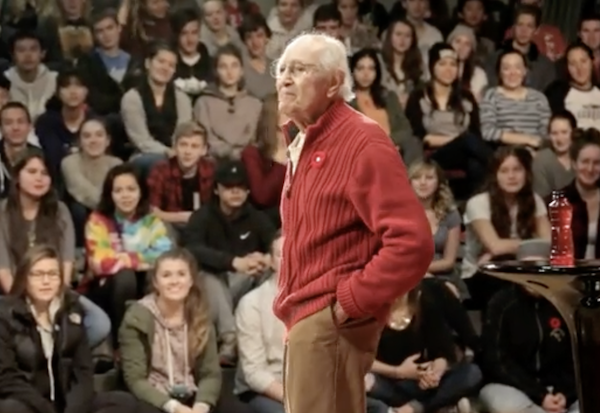
screenshot - The documentary shows Peter Gary, a Holocaust survivor, speaking to high school students about his experiences
The documentary shows Peter Gary, a Holocaust survivor, speaking to high school students about his experiences. (screenshot)

The filmmakers also point out that a significant number of North Americans born after 1981 cannot name a single concentration camp or ghetto and think that fewer than six million Jews were killed during the Holocaust. An alarming percentage of young people, they added, hold the opinion that the Jews caused the Holocaust.

Gary was born in 1924 into an artistic family that included famed Hungarian musicians, such as conductor Eugene Ormandy and pianist Lili Kraus. Through his mother’s encouragement, he began his musical training on the piano before the age of 5.

Deemed a musical “wunderkind,” Gary was admitted at the age of 9 to Budapest’s Franz Liszt Academy of Music, where he studied advanced choral and orchestral composition, as well as conducting, under the tutelage of Bela Bartok, Zoltan Kodaly and Leo Weiner.

In 1940, Gary’s education stopped when both he and his mother were arrested by the Nazis. His father was away on a business trip, which allowed him to escape into hiding. Gary spent the next years in concentration camps before he was liberated from Bergen-Belsen by the British on his 21st birthday.

Following the war, Gary moved to Paris to resume his musical studies at Sorbonne University. He received a doctorate in musicology there in 1949.

Gary then immigrated to the United States and, for a brief time, worked in the music department at MGM. In 1963, he took a year off to compose a ballet suite that was performed in France. During his life, he composed more than 20 orchestral pieces, which have been performed in the United States, Canada, Germany, Holland, France and Scotland.

The film runs approximately 90 minutes. Malysheff and Estrin would like it shown at Jewish film festivals and in schools. They have a curriculum for secondary schools that uses the libretto as text. To date, the oratorio has been translated into Hebrew, French and German.

The Jerusalem performance of A 20th Century Passion is available on YouTube. More on Gary can be found at jewishindependent.ca/help-passion-to-israel and jewishindependent.ca/holocaust-survivor-peter-garys-oratorio.

To donate to the documentary’s fundraising campaign, visit gofund.me/d335a5f8. All who send in a contribution will receive a screen credit for being part of the message of the film.

Sam Margolis has written for the Globe and Mail, the National Post, UPI and MSNBC.

Survivors play brings tears

On Oct. 29, six young actors offered a powerful rendering of Survivors, a play by Wendy Kout, at the University of Victoria’s Phoenix Theatre. The production will tour BC and other Western provinces. (photo by Peter Nadler)

On Oct. 29, six young actors offered a powerful rendering of Survivors, a play by Wendy Kout about 10 Holocaust survivors. The performance at the University of Victoria’s Phoenix Theatre had the audience, many of whom were decades older than the actors, reaching for handkerchiefs as the last words of the play, “never again,” were spoken in unison on stage.

The Victoria organizers, who have been given the rights to perform Survivors across the Western provinces, are hoping the play and its message will eventually reach, inform and educate students about the Holocaust and the dangers of hate.

Suitable for audience members from Grade 6 and up, Survivors is intended to provide students the ability to recognize the short- and long-term effects of prejudice, discrimination and, ultimately, genocide. Other objectives are to foster critical thinking in young (and older) people and impress upon them the importance of human rights and social justice advocacy.

The six actors – Julie McGuire, Ryan Kniel, Sarah-Michelle Lang, Nolan McConnell-Fidyk, Sophie Radford and Brandon Sugden – took on the roles of the 10 Holocaust survivors and dozens of other characters pertaining to their respective stories during the 65-minute performance.

Survivors progresses chronologically, portraying events leading up to, during and after the Holocaust, bringing to the stage the experiences of Jewish children and teenagers from Europe. The professional cast portrays the survivors, starting at innocence and continuing through the terrifying rise and rule of bigotry, xenophobia and violence, before they immigrate to America.

Among others, the play includes the stories of a teen who watched her boyfriend being taken away to a concentration camp, a girl who was separated from her parents and relocated to England through the Kindertransport, and a boy whose family struggled to escape to China.

Four of the 10 survivors on whom the play is based were still alive when the play premièred in New York in 2018. Though each story is unique, all the survivors “went through this horror and came through the other side to build meaningful, contributing, beautiful lives,” notes Kout. “We’re not just telling history. We’re telling history as a cautionary tale for the present and the future.”

Several prominent members of the public, such as MLAs Murray Rankin and Rob Fleming, were in attendance at the UVic performance. In remarks made after the show, Rankin suggested he would press the Ministry of Education and Child Care to bring Survivors to schools in the province.

Rankin’s comments preceded the announcement by Premier David Eby the following day, Oct. 30, that Holocaust education would become mandatory in high schools throughout British Columbia beginning in the 2025-26 academic year. The move made British Columbia the second province, after Ontario, to mandate study of the Shoah.

There is a tangible sense of urgency by the organizers of Survivors to have the play viewed as widely as possible.

“We need to capture young minds of young people at an early stage before hate and racism becomes normalized,” their literature states. “We need to do this in the schools, because that is where most young people can be reached and it’s an opportunity to educate children and engage teachers.”

Survivors, with its aim to educate young people about hate, comes at a time when clear evidence of the ignorance of history has been in the news. In September, Anthony Rota, the speaker of the House of Commons, stepped down after honouring a Ukrainian veteran who fought with a Nazi unit during the Second World War.

More broadly, the organizers of Survivors cite a report by the Azrieli Foundation, Yad Vashem and others, which found that 62% of millennials did not know that six million Jews were killed in the Holocaust, 22% of millennials had not heard or were not sure if they had heard of the Holocaust, and 23% of all Canadians believe that two million or fewer Jews were killed during the Holocaust.

The Victoria production of Survivors that played last fall in school auditoriums, theatres and libraries, and had four public performances was the first international tour of the play. (See jewishindependent.ca/survivors-a-cautionary-tale and jewishindependent.ca/theatre-that-educates.) There are other tours currently on both coasts of the United States, and Kout, along with the New York company that developed Survivors, is creating a documentary on how the play came to be.

Survivors was originally commissioned and developed by CenterStage Theatre in Rochester, NY, in 2017, when Kout was asked to write a Holocaust play about survivors who had immigrated to the city. Shortly thereafter, while watching neo-Nazis march in Charlottesville, Va., Kout expressed the feeling that she was not simply writing an historical play but also a “warning play.”

For the Victoria troupe, Zelda Dean, the director, said, “Our goal is to expand the tour to more of Vancouver Island, to Vancouver on the mainland, and to select schools in the interior. The following year we will expand to include more schools throughout BC and other Western Canadian provinces.”

To learn more about Survivors and to donate, visit holocausttheatre.com.

Sam Margolis has written for the Globe and Mail, the National Post, UPI and MSNBC.

The opposite of death is love

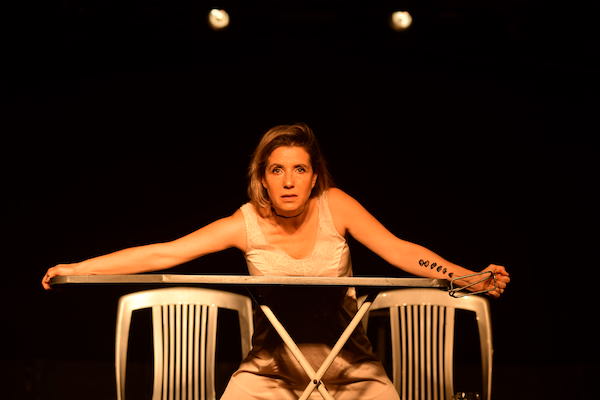
Hadar Galron in Whistle, which is at the Firehall Arts Centre Nov. 14-15, as part of the Chutzpah! Festival. (photo by Nathan Yakobovitch)

“As a child I was never hugged or kissed; I think my parents did not even see me. I wrote this story to stop being an invisible child,” Israeli author Ya’akov Buchan has said about Whistle: My Mother was Mengele’s Secretary.

The play Whistle is part of this year’s Chutzpah! Festival, with performances Nov. 14 and 15 at the Firehall Arts Centre. Writer, director and actor Hadar Galron, who adapted Buchan’s story for the stage, stars in the monodrama.

“Buchan was born to two Auschwitz survivors, and began writing after he was injured in the Yom Kippur War. He’s written 18 books – four concerning the Holocaust – but he felt that people don’t read so much anymore, and that he wanted to write a play about second generation Holocaust survivors,” explained Galron in an interview with the Independent. “Dramatic writing and prose are very different techniques, and Ya’akov sent me about 30 pages of interesting and well-written content, but not dramatic enough for stage.

“The first meeting with him was out of respect – I thought I’d give him a few tips and let him take it from there,” she continued. “I remember the turning point: I said, ‘You mention twice in these pages the name Mengele. You can’t just throw in a name like that, it needs to have some dramatic payoff, or not to be mentioned at all.’ Ya’akov said nothing, just nodded. And, suddenly, I thought that maybe Mengele had tortured one of his parents. ‘Were any of your parents somehow … (how to say this?!) … connected to Mengele?’ Ya’akov looked me squarely in the eye and said, quietly, ‘My mother was Mengele’s secretary.’ That was when I knew I would take the task, and help him tell his story and the story of the second generation.”

In recent years, Galron has been working on several plays that deal with the lasting impacts of trauma. “We tend not to consider [the] second generation as traumatic,” she said, “but something as horrendous as the Holocaust leaves some people so scarred that they cannot really love anymore, even their children. Or, they love but in a different, obsessive way. The children who grow up without feeling love are traumatized, too, but their wounds are invisible.

“It’s important to understand that, whilst the trauma lasts a minute or a year or five years, post-trauma lasts a lifetime and, when considering [the] second generation, then even more than a lifetime. Long-term traumas such as [the] Holocaust are not a swing of the sword, they are more like the bite of a snake – the venom penetrates the body and mixes with the blood of the victim.”

Though she generally directs her own works, Galron said, “When I’m the actress, I need someone on the outside. At first, I thought maybe I’d direct and not act. It was Ya’akov who begged me, after seeing my stand-up cabaret Passion Killer, to act the part.”

Jaffa, Israel-born director and playwright Hana Vazana Grunwald was the first person who came to Galron’s mind to direct.

“We studied theatre together at Tel Aviv University, but that was decades ago! I had no idea where to find her,” said Galron. “We’d met a couple of times in festivals, etc., along the years. I was thinking of her on my morning walk-jog in the park by my home. In the distance, I saw a woman that reminded me of Hana and then we got closer and I saw it actually was Hana! She lives five minutes away from me, but that was the first day she decided to go out and take a power-walk before work. I don’t believe in coincidence – it’s only God’s way of remaining anonymous.”

Grunwald started out in community theatre more than 25 years ago. She is the director of the Frechot Ensemble, a collective of women creators, which she founded some 10 years ago.

“I see myself as a feminist Mizrahi (Middle Eastern Jew) writer, who brings to the forefront my personal story,” she told the Independent. “But my personal story is never just my own, it’s an inherent part of my political story, my family’s story and the collective which I belong to. I feel that my world isn’t really represented in Israeli theatre. I don’t see the household I grew up in, I don’t encounter complexities and dilemmas that interest me. I realized I have the responsibility to represent myself – I have to write these texts, I have to tell these stories. My job is to search through history and prose and to bring back the voice of all those whose voice was taken away from them.”

When Galron sent her the script for Whistle, Grunwald said, “I was immediately hooked. But, after we met again, I felt that the opportunity to work together and find connections would also be reflected in the play’s dramaturgy.

“The challenge that the play Shirika [Whistle, in Hebrew] brings to our door is how to retell the story of the Holocaust and the story of the members of the second generation, who feel transparent. Two images guided me in my search for the keys to directing the play,” said Grunwald.

“The first: whistle. Tammy, the protagonist, lost her ability to whistle, she lost her ability to love and feel loved and, as she says in the play, ‘The opposite of death is not life, the opposite of death is love.’ The way this whistle is expressed on stage is through the prop of a kettle full of boiling water. The boiling and bubbling kettle and the whistler on stage metaphorically tell the story of the Holocaust, a story that never ends.

“The second image we chose is the painting. Tammy is a painter and, when we wondered what was painted on the stage, we realized that the body is the canvas, the body treasures and carries the wounds of the past, the memories – the actress jumps from limb to limb and with the help of simple means such as brushes and paints Tammy marks national history…. This is the way in which the trauma is present again on the stage.

“It seems that precisely now the spectacle of a whistle is given a relevant meaning,” Grunwald added. “We find ourselves facing a terrorist attack in which again Israeli Jews are brutally murdered and mass murdered because of their Jewishness. We again witness horror stories in this war against Hamas. We find ourselves again, 75 years after the establishment of the state of Israel, in a shocking event that reminds us of the fear of being destroyed. The harsh scenes from both sides shake the soul, sow terror and fear, and remind us that the feeling of security is a temporary illusion and we must not forget it. I work at the Hebrew-Arab theatre in Jaffa, a theatre that gives a stage to the binational discourse, it gives a stage to both narratives, and I feel that, these days, it is the first to be hurt.”

Galron also works with artists of different backgrounds and shared one of her experiences.

“Between 2016 and 2018, I was artistic director of the Shalom Festival, a small festival that was an official part of the Edinburgh Fringe fest,” she said. “We created this festival after an Israeli production, in 2014, was shouted down by the BDS [boycott, divest and sanction movement] and, in 2015, there were no Israeli productions.”

She was inspired by Sir Rudolf Bing, founding director of the Edinburgh International Festival, from which the Edinburgh Fringe Festival has its roots. Galron explained that Bing, a Jewish-Austrian opera singer, who fled Nazi Germany, “created the festival as a cultural bridge, inviting, firstly, German artists to take part! With that in mind, I told the sponsors of the Shalom Festival that we cannot make a one-sided Shalom (Peace) Festival and that, as the artistic director, I would like to bring artists from all of Israel, including Israeli Arabs – both Muslim and Christian – and also some Palestinian artists. At first, there was big objection but, eventually, I convinced them that these are Palestinians who believe in peace, in dialogue. Until today, even in these times, I am in contact with my Palestinian friends.

“I believe art is a bridge,” she said. “I believe art and culture and theatre have the power to heal – to give us insight and create empathy. From my very first performance as a stand-up artist – my show was on the status of women in the Jewish law – I made a decision to make my art meaningful, to merge life and stage.”

Since the Oct. 7 Hamas terror attacks on Israel, Galron has been posting related videos and other items on Facebook, including “Creativity in place of survival” writing challenges. She got the idea from a course she took during COVID with Dr. Joe Dispenza. “In one of the online digital courses, he speaks of how our brain can be either in ‘survival’ or in ‘creativity’ mode,” said Galron. “The moment I heard this, I understood many things about myself and how creativity has always been for me a way of surviving. Now I know that, when we begin to be creative, we actually begin to pull ourselves out of ‘survival’ [mode] even if we are being creative whilst we try to survive. A bit like Baron Munchausen explains that he pulls himself by his hair out of the pit.”

About how she is doing since the attacks, Galron said, “I didn’t have a real answer to that question until yesterday, because everything is so chaotic. But I was speaking to a university student of mine who answered, ‘I’m committed to the good.’ I was so moved by this. She told me she adopted it from her yoga teacher. I adopted it from her. I’m committed to the good.”

For tickets to Whistle and other Chutzpah! shows, visit chutzpahfestival.com.

Two world premières

Artists of Ballet BC and Arts Umbrella practise Shahar Binyamini’s BOLERO X. Part of HERE, which runs Nov. 2-4, the work brings 50 dancers on stage for the first time in Ballet BC history. (photo by Marcus Eriksson)

Ballet BC begins its season Nov. 2-4 with HERE, a diverse program that includes two new works from choreographers who have never worked with the company before, and the return, by popular demand, of Enemy in the Figure by William Forsythe.

“Each work stands on its own, and there are no common themes, so to speak,” Ballet BC artistic director Medhi Walerski told the Independent. “It invites audiences to create their own narrative and interpretation, allows for personal engagement, and invites them to explore the scope of human connection and expression.”

One of the new works featured is the world première of Israeli choreographer Shahar Binyamini’s BOLERO X.

“I have been following Shahar’s work for awhile, and I was eager for both the company and the audience to immerse themselves in his distinctive style and choreographic language,” said Walerski.

It will be the first time Binyamini is presenting his work in North America, Walerski added, “and it is a privilege that he has chosen Ballet BC for this special occasion.”

BOLERO X brings 50 dancers to the stage – the most in Ballet BC history.

Of the logistics, Walerski said a multitude of factors come into play. “Scheduling is at the forefront, both in the studios and at the theatre. Fortunately, we’re collaborating with Arts Umbrella Dance, sharing a common vision of turning the impossible into reality.

“On the production side, the costume department is putting in tremendous effort,” he said. “Led by our dedicated head of wardrobe, Kate Burrows, our incredible team is going the extra mile to bring that vision to life. Our rehearsal directors are navigating a new experience of rehearsing many dancers at once, and they are doing this brilliantly. It shows the professionalism and dedication of our remarkable team.”

Binyamini returned to Vancouver to work with the company this week. It is important that such performances continue, even when there is a war going on “because the arts and creation are amazing bridges in order to build trust,” he said. “What we see happening could easily happen anywhere else and be used as inspiration for other conflicts to accelerate in the same direction. The crime against humanity is the destruction of trust and, in order to build trust, you need to create channels into humanity. Dance could be a very important vessel or tool to connect people. And this is what gives me the motivation to be here and working. Because what I do is important, especially now.”

“Art has this unique power to breathe life into the world, and it brings vitality into our everyday lives,” said Walerski. “It is an incredible force that transcends boundaries. It has this magical ability to bridge gaps between people, regardless of geographical or cultural differences. It’s like a vibrant thread weaving through the fabric of humanity, connecting hearts and minds. It brings a sense of unity and shared understanding, nurturing a profound connection among individuals who might otherwise seem worlds apart.”

The press material for BOLERO X says “the creation explores themes of unison and repetition, while still allowing for individuality and stand-out solo and duet performances.”

“I’m focusing more and more on the dancers’ uniqueness in relation to the large group,” said Binyamini. “There is unison, but individuality within that unison. Here at Ballet BC, I find I can explore more the individual aspects and solos. These dancers are so generous and they give you everything – all they have. It’s very rewarding.”

Maurice Ravel’s 1928 composition, Bolero, “is very repetitive, obviously, the melody itself, but the orchestration brings more layers,” Binyamini explained. “A long crescendo of something getting more intense has been very present in my work previously. It’s what turns me on. So, when I started working with Ravel, I tried various works, but got fixated on this and it felt like it really fit. It allowed me to focus on something I was already into, but gave me the anchor and licence to clear out all the unnecessary thoughts or feelings. I decided to just focus on the musicality and the playfulness, which allows the dancers to stay playful.”

Binyamini was not at all daunted by the challenge of having 50 dancers on stage.

“I felt and still feel how much of a force it is to react to, and to say yes to. To have a dialogue with 50 dancers is such a powerful thing in the studio and it enables me to be in the moment, especially with all the other things going on in my life,” he said. “I feel very comfortable working with a lot of people.”

photo - Ballet BC artist Sidney Chuckas at work in the studio ahead of the season opener HERE
Ballet BC artist Sidney Chuckas at work in the studio ahead of the season opener HERE. (photo by Marcus Eriksson)

The other new creation – and world première – being presented in HERE is Stephen Shropshire’s Little Star. Originally commissioned by former Ballet BC artistic director Emily Molnar, its trip to the stage was delayed by the pandemic.

The inspiration for Little Star was composer Angelo Gilardino’s “cycle of guitar variations based upon ‘Ah vous dirais-je Maman,’ a popular children’s song originating in 18th-century France and adopted for the English-language lullaby ‘Twinkle, Twinkle, Little Star,’” explains the press release. “Shropshire’s movement language for the creation is dynamic, beginning with themes suggesting something child-like and playful, before evolving into something more intricate and complex.”

Rounding out the HERE program is Forsythe’s Enemy in the Figure, which was mounted by Ballet BC in 2018. Set to music by Thom Willems, the work involves improvisation, which means that each performance is different.

“Dance can tell a universal story, like music,” Binyamini said. “I think it’s very challenging to tell a story based on movement, but, when doing it correctly, it’s very effective and has the potential to go much deeper than words, because it’s something we all have in common. We can all relate to physical effort, and have empathy for someone that is moving. You can connect to that energy. To be able to tell a universal story through movement is a big challenge, but very satisfying.”

HERE takes place Nov. 2-4, 8 p.m., at the Queen Elizabeth Theatre. Tickets, starting at $19, are available at balletbc.com.