Uncovering Israel’s wonders

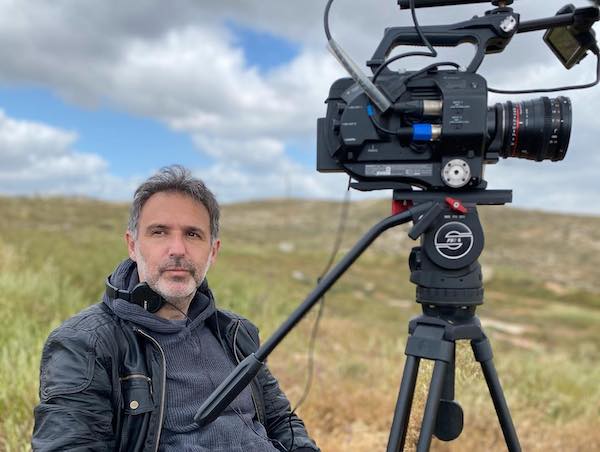
Igal Hecht filming Secrets of the Land. (photo from Chutzpa Productions Inc.)

The Western Wall area, with thousands of metres of subterranean space, contains much that is yet to be discovered. The latest find in this space is a market. While not open to the public, people can get a glimpse of the ancient market on the new Yes TV documentary series Secrets of the Land, directed, produced and written by Israeli-Canadian filmmaker Igal Hecht.

Each episode of Secrets of the Land, which is presented by Chutzpa Productions Inc., takes viewers behind the scenes of substantial excavations in Israel, and features some of the region’s top archeologists and most historically significant sites. The series debuted March 15, and runs each week for 13 episodes.

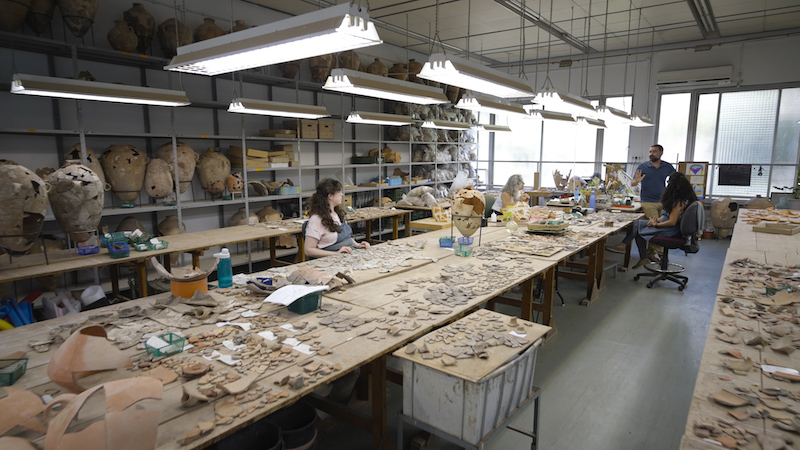
In addition to on-site discoveries, Hecht visits the labs that explore the meanings of each artifact.

“I realized that the way archaeology is explored today is very CSI,” said Hecht, referring to the popular television series. “The excavations themselves might be low-tech, but everything that comes after, such as carbon dating and things along those lines are very high-tech.”

One of many examples is when archeologists found grape seeds in 2,000-year-old donkey feces and, through that, determined the types of people who lived in the area.

photo - Prof. Erez Ben-Yosef speaking with colleagues in the archeology lab at Tel Aviv University
Prof. Erez Ben-Yosef speaking with colleagues in the archeology lab at Tel Aviv University. (photo from Tel Aviv University / Chutzpa Productions Inc.)

Hecht and his crew – which included Lior Cohen, Gabriel Volcovich, Nikki Greenspan and Julian Hoffman – take viewers on a journey through various parts of the Holy Land. Hecht said he learned something every step of the way.

“I had very little knowledge [of archeology],” Hecht told the Independent. “In fact, in the show, I don’t pretend that I do. That makes the show work. I am there experiencing the discoveries in the same manner that the audience does, as they watch at home.”

Among many sites, the crew visited Timna, the location of Solomon’s Mines, where Hecht was awed by the landscape. “The rock formation is something you’d see in Petra in Jordan or the Grand Canyon,” he said. “There’s so much beauty and history to explore there.”

Other locales included Tower of David, also known as the Citadel, located near the Jaffa Gate entrance to the Old City of Jerusalem. There’s also an episode about Shiloh, in Samaria, or the West Bank, where the Israelites, prior to King David’s time, set up a sanctuary and city, and where the Ark of the Covenant was housed for hundreds of years. Meanwhile, Magdala is home to an ancient city from the first century, where recent excavations revealed the Migdal Synagogue, dating from the Second Temple.

Over the past quarter-century, Hecht has been involved in the production of more than 50 documentary films and more than 20 television series. His projects have appeared on Netflix, BBC, Documentary Channel, CBC, HBO Europe, and others. Secrets of the Land is the latest in a string of Jewish-themed films, such as A Universal Language, which taped six comedians performing in Israel. An upcoming project includes The Jewish Shadow, a documentary that explores the lives of Soviet Jews in 1970s Ukraine.

For Hecht, Secrets of the Land wasn’t merely a project, but very much a passion to do his part to help the Jewish people.

“I think the biggest takeaway for Jewish audiences is the historical and unbreakable connection of the Jewish people to that land,” he said. “That archeology truly proves that the Jews were, in fact, living in Judea and Samaria, Jerusalem and all over the Fertile Crescent thousands of years ago.”

Dave Gordon is a Toronto-based freelance writer whose work has appeared in more than 100 publications around the world. His website is davegordonwrites.com.

Frost album release

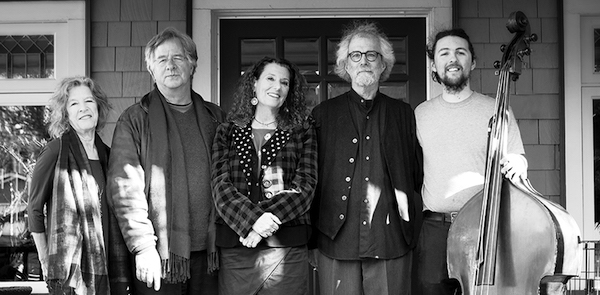
Harriet Frost and the Universal Band (photo from Harriet Frost)

image - Harriet Frost and the Universal Band logoHarriet Frost and the Universal Band are holding an album release party on April 15, 8 p.m., at Or Shalom. The Universal Band is Martin Gotfrit (strings, vocals), Wendy Rubin (keyboard, flute, vocals) Andréas Kahre (percussion, cello) and Noah Gotfrit (basses). Tickets – for the live show and for the stereo livestream on YouTube – are available from eventbrite.ca.

– Courtesy Universal Band

Museum releases 40th Scribe

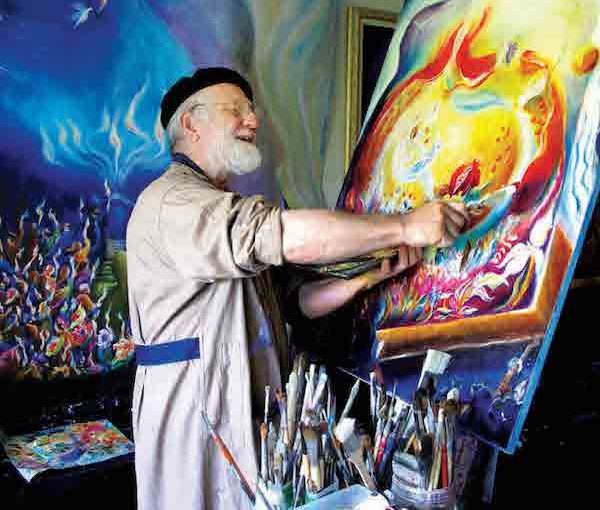
Mordechai Edel is among the artists featured in the latest edition of The Scribe, which will be released April 19 at VanDusen Botanical Garden. (photo from JMABC)

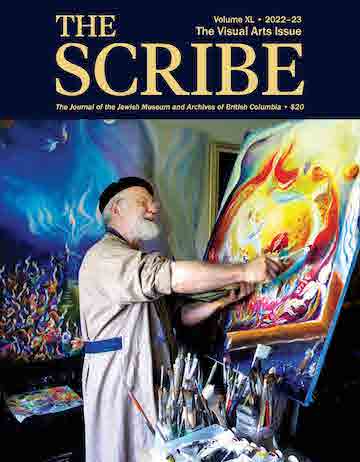
The Jewish Museum and Archives of British Columbia (JMABC) is releasing its 40th issue of The Scribe, which celebrates the lives of B.C. Jewish residents by focusing on one sector each edition. The official release of the Visual Arts Issue will take place on April 19, 7 p.m., at VanDusen Botanical Garden, in the Floral Hall.

image - Visual Arts Issue of The Scribe coverThe 2022/23 issue features a cross-section of the province’s Jewish visual arts community, including painters, sculptors, mixed media artists, illustrators, textile artists, art educators, art consultants, an art curator and a gallery owner. Features are based on interviews recently documented for the JMABC and interviewees represent several cities and many islands. They include Ron Appleton, Miriam Aroeste, Hinda Avery, Suzy Birstein, Tanya Bub, Olga Campbell, Janis Diner Brinley, Mordechai Edel, Janet Essevia, Jessica Freedman, Linda Frimer, Monica Gewurz, Lori Goldberg, Pnina Granirer, Barbara Heller, Jeannie Kamins, Stacy Lederman, Julia Lucich, Anna Lutsky, Cynthia Minden, Suzy Naylor, Joyce Ozier, Nora Patrich, Marcia Pitch, Jack Rootman, Sidi Schaffer, Phyllis Serota, Elizabeth Shefrin, Carla Stein and Mia Weinberg.

“The Visual Arts Issue of The Scribe is surely one of the most dynamic and visually stunning publications in its 40-issue history,” said Daniella Givon, JMABC president. “Jewish individuals have made significant contributions to our province’s arts and culture sector throughout our history in B.C., and 2023 is a fitting time to take an historical snapshot of artists who are working and thriving here.”

Carol Crenna, managing editor of The Scribe Visual Arts Issue, added, “It’s been an extraordinary experience to meet this group of talented Jewish artists, many internationally known. They are fearlessly innovative, inspiring individuals with the strength and ability to push boundaries and bridge beliefs. They’re also wonderful storytellers with rich life experiences. I found their personal stories fascinating, and often entertaining, but, most important, they made me think differently.”

The publication’s launch will include a silent auction of artworks donated by many of the artists highlighted in the issue. The keynote speaker of the event will be journalist Marsha Lederman, Western arts correspondent for the Globe & Mail. Refreshments will be served. All proceeds are in support of the JMABC.

For tickets ($36), visit jewishmuseum.ca.

– Courtesy Jewish Museum and Archives of British Columbia

Destruction and rebirth

Grass is Green is at the Rothstein Theatre on April 25. (photo from Una Productions)

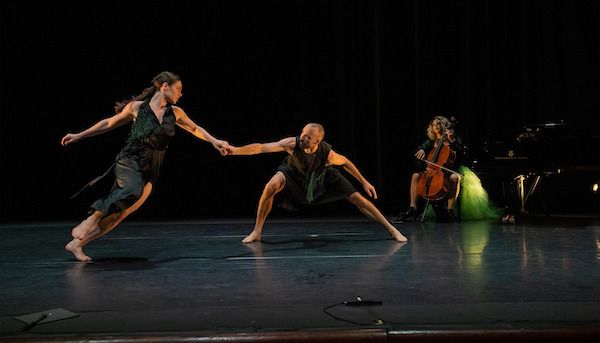
B.C. Movement Arts and Chutzpah!PLUS present the Canadian première of Grass is Green in Vancouver and several other B.C. locations, starting April 25.

Grass is Green is an evening-length work from San Francisco- and New York City-based UNA Productions. Performed by six dancers and drag queen/cellist/pianist Rose Nylons, Grass is Green considers cycles of destruction and renewal both within humanity and the land of which humanity is a part. The highly physical and exuberant work embodies a cycle of rebirth, representations of queer intimacy, and moments of communal joy, grief and connectivity.

The choreographer of Grass is Green is Chuck Wilt, in collaboration with the performers, who are Wilt, Nylons, Kira Fargas, Dominica Greene, Dasol Kim, Rebecca Margolick and Hadassah Perry. The music is by Nylons, Donna Summer, Sylvester, DJ Koze and Nils Frahm, Julia Wolfe and Matthew Welch, and Michael Nyman.

Grass is Green is the first partnership of B.C. Movement Arts (BCMA) and the Chutzpah! Festival. BCMA was founded by artistic and executive director Mary-Louise Albert, the former director of Chutzpah!, which is now led by artistic managing director Jessica Gutteridge, who has been at the helm since 2020.

Grass is Green takes place at the Rothstein Theatre on April 25, 7:30 p.m. For tickets, go to chutzpahfestival.com or call 604-257-5117.

It moves on to Sointula April 27-28, Alert Bay April 29, Port Hardy April 30 and Campbell River May 2. For more details on and tickets for these shows, visit bcmovementarts.com or call 604-970-3206.

– Courtesy B.C. Movement Arts

Pied Piper in music, dance

Into the Little Hill is a multi-disciplinary re-telling of the classic Pied Piper tale. Performances take place May 19 and 20 at SFU Goldcorp Centre for the Arts, Fei and Milton Wong Experimental Theatre. (photo by Flick Harrison)

In partnership with Simon Fraser University’s Woodward’s Cultural Programs, Astrolabe Musik Theatre presents the Canadian première of the chamber opera Into the Little Hill, a contemporary re-telling of the Pied Piper tale, with direction and choreography by Idan Cohen of Ne.Sans Opera and Dance, and musical direction by conductor Leslie Dala. Performances take place May 19 and 20, 7:30 p.m., at SFU Goldcorp Centre for the Arts, Fei and Milton Wong Experimental Theatre.

Into the Little Hill – by composer and classical musician George Benjamin with libretto by playwright and theatre translator Martin Crimp – is an unflinching look at our response to the “Other.” A mysterious stranger rids a town of its rats, only to also make its children disappear when his promised payment is withheld. The story evokes many questions. Who do we deem as “rats” in our society? Who gets to decide? What are we willing to do to get rid of them? And what are the consequences when we refuse to “pay the piper,” i.e. refuse to accept responsibility for the outcomes of our actions?

All six characters (the Crowd, the Stranger, the Narrator, the Minister, the Minister’s Wife and the Minister’s Child) are sung by mezzo-soprano Emma Parkinson and soprano Heather Pawsey. The orchestration for this production includes bass flute, basset horns, mandolin and banjo. And, in a multi-disciplinary staging, Astrolabe’s production incorporates dancers Juolin Lee, Daria Mikhalyluk and Hana Rutka.

“It has always been my vision to have dancers as part of this intensely dramatic opera,” said Pawsey, Astrolabe’s artistic director.

Lighting design for the production is by Victoria Bell; the costume design, by Elena Razlog.

Ne.Sans Opera and Dance’s Cohen was born and raised in Israel, on Kibbutz Mizra. After being trained as a classical pianist, he studied theatre and fine arts at the Art Colony, in Israel. At the age of 20, he participated in a video-dance project by Batsheva dance company dancer Lara Bersak before joining, in 1998, the Kibbutz Contemporary Dance Company, where he danced for seven seasons. Since 2005, Cohen has been creating, performing and teaching.

For tickets to Into the Little Hill, go to eventbrite.ca/e/into-the-little-hill-tickets-609025460547.

– Courtesy Astrolabe Musik Theatre

Who decides what culture is?

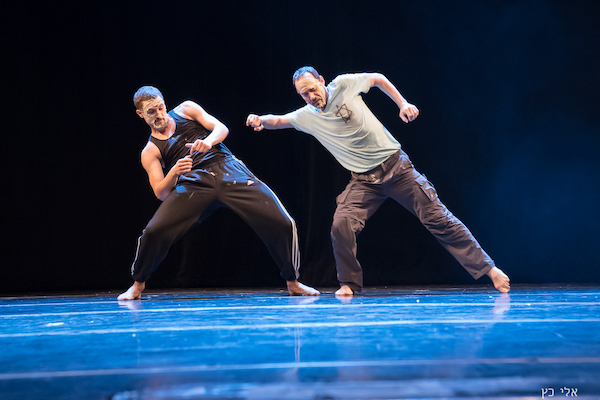
Mourad Bouayad, left, and Hillel Kogan in We Love Arabs, which is at the Dance Centre April 13-15. (photo by Eli Katz)

“I don’t have answers so I can only ask questions,” Israeli choreographer Hillel Kogan told the Jewish Independent. “If this is changing people’s political views, I doubt it, but at least what I’m trying to do is to put the questions on the table and make people, audiences, and myself see that art is not a separate sphere, that art is part of politics and social and cultural systems … and this is what I’m trying to expose in my pieces.”

The JI interviewed Kogan in advance of the Vancouver run of We Love Arabs, which is being presented at the Scotiabank Dance Centre by the Dance Centre and Théâtre la Seizième April 13-15. There will be both English- and French-language performances of this work, which also has Hebrew and Spanish versions. Kogan will dance the duet here with Mourad Bouayad.

We Love Arabs premièred at the 2013 Intimadance Festival in Tel Aviv. The brief outline for the piece, which Kogan has on his website, begins: “I address the audience, my name is Hillel Kogan. Some say that I do political art. I want to show you today how dance has the power to promote coexistence between Arabs and Jews in Israel. I invited an Arab dancer here….” The video teaser offers a glimpse of Kogan’s physicality, humour, tenderness, intelligence.

Born in Tel Aviv, Kogan has performed with and created for companies and choreographers around the world. At Batsheva Dance Company, he is director of educational programs. He is pursuing a master’s degree in cultural studies.

We Love Arabs garnered awards, and it has traveled to more than a dozen countries. The Vancouver show was postponed twice, said Mirna Zagar, executive director of the Dance Centre. First due to a scheduling conflict and then due to COVID. “However, I believe the work is just as relevant now as it was when we started,” she said. “It is an exceptional work that continues to engage audiences internationally.”

The Dance Centre often partners with other arts organizations, as a means of pooling resources and amplifying opportunities to show international artists. “This collaboration is along these lines,” she said. “I have known Esther Duquette, the now-outgoing artistic director at Théâtre la Seizième, for some years and the nature of this piece – multilingual and straddling theatre as well as dance – made it a perfect opportunity for our organizations to work together.”

The April 14 performance and talkback will be in French; the other two shows and the April 15 talkback in English. Kogan speaks six languages: Hebrew and Russian because his parents were born in the Soviet Union and he was born in Israel; he studied English in school; he learned French from working two years in Switzerland, and Portuguese and Spanish from working in Portugal for seven years. He doesn’t speak Arabic.

“This is interesting,” he said, “because this piece, We Love Arabs, is an autocritical peace that asks exactly this. Why am I facing the languages and cultures of the West and not the languages of my neighbours and of my co-citizens in Israel? Why don’t I read the books of Arabic writers? Why doesn’t Arab culture interest me, and why do I identify myself as ‘Western,’ which is a bit strange?”

It is both a geographic question, he said, living as he does in Israel, and a social, historical, cultural and political question. “And the piece deals with this question: who decides what the general culture is, and why I am – and why the Israeli art field, at least as I see it, is – so orientalist, which means looking at the Orient, at the Arab as inferior and wanting to impose on it the Western culture.”

The different versions of We Love Arabs resulted from Kogan’s wanting to perform the piece abroad, in the language the audience speaks. “I think it brings more this idea of relevance to the space,” he explained. “If I did the piece in Hebrew with subtitles, it would be more like a piece from Israel … and be framed as something local and in my perspective. The universality of the piece is one of the ideas – I want people to identify with it and, by choosing their own language, I feel there is more chance to make them sense that they are part of it as well.”

Kogan had no idea of how much impact We Love Arabs would have. “It was created for a small niche festival in Israel,” he said, and “for a specific audience who is already convinced in the political opinions that I hold. So, I didn’t imagine it ‘big.’… As I performed the piece out of Israel, I understood that the question of Jews and Arabs in Israel is just a microcosm of a more universal question: of the situation of power between minority and majority, and the way we see ‘the other’ – who is the master of the culture in any nation?”

In looking at the question, Kogan asks: “Who is invited to participate in creating a national identity, what is Israeli or what is Arab Israeli? It is not very different than the question of, I don’t know, for example, in Canada: who is invited, what is Canadian? Is it French? Is it American? Is it English? I don’t know the minority situation in Canada, but I know there is a history with Native Canadians. So, are they also invited to take part in culture? How much are they participating in mainstream dance, literature, music? How do we define what is high art and what is popular art? What is folk and folklore? And what is universal art?”

Initially dancing the duet with Kogan was Adi Boutrous, an Israeli Arab dancer who is also a choreographer and so not always available. Bouayad, who is French, danced in Israel in the Batsheva junior company. “This is how we met, so I invited him to perform with me,” said Kogan. “And, of course, it’s very different for an Israeli Arab to play the role of an Israeli Arab than for a French half-Arab person, because to be an Arab in France is different than to be an Arab in Israel.”

Not wanting to speak for Bouayad, Kogan noted that, while Bouayad may define “himself first as French, and his relationship with his Arab origins are just an extra part of his being,” for Israeli Arabs, he said, “I’m not sure that they are first Israeli and then Arab because of their own perception of themselves – but also the way the majority looks at them, the state looks at them, society looks at them, Jewish society looks at them.

“We often make the mistake even in the language, and we forget to say that Arabs are Israeli as well. We say Israelis and Arabs – even when we refer to Arabs who are citizens of Israel and who hold an Israeli passport, we call them Arabs, and we call ourselves, the Jews, Israelis…. We are both Israeli and the difference between us in definition is our religion. In a country like France, where it’s a republic and religion has at least formally not such an important role in the definition of citizenship and of nationality, then, of course, the change of cast is also changing the relationship.”

Kogan has no illusions that art can change the world. Elected politicians “are the ones who should change the world,” he said. For him, art is there to reflect, to inspire. “Art, for me, is a place for the imagination, for the possibility of not necessarily escaping reality, but giving an alternative to reality…. If art can feed the imagination and then, as an outcome of this feeding of imagination, can change the reality, OK, that’s great. But I think that … when artists try to change the world by their art – in history, at least as far as I see, it ends in political propaganda and just serves the hands of politicians.”

As many funny moments as there are in We Love Arabs, they have a profound purpose.

“I have anger towards some of the cultural systems, and the questions that I’m asking are involved with hard emotions. I feel that humour allows me to take some distance from the aggression and from being so emotionally involved,” said Kogan. “It allows me to laugh about myself as well. It allows me to invite people to laugh about a question without making it not serious. The laughing, I feel, is a tool to invite people to enter a conversation, to agree to criticize, to agree to ask questions … to see the bias, to be aware of the stereotypes, to be aware of the prejudgments that we have…. The laughter is just a means in order to speak about something very serious.”

For tickets to We Love Arabs, call 604-736-2616 or visit thedancecentre.ca.

Systemic change possible?

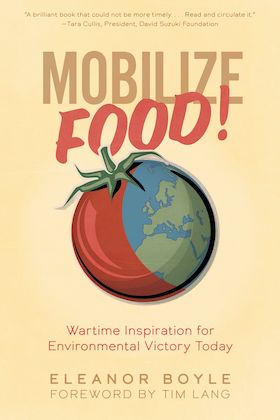
Eleanor Boyle’s Mobilize Food! Wartime Inspiration for Environmental Victory Today offers concrete ideas for how food systems can be transformed. (Julie Doro Photography)

I plan to make the Honourable Woolton Pie. Just for fun, not necessarily because I think it’ll taste wonderful, though it might. Named after Lord Woolton (Frederick Marquis), who was appointed minister of food in 1940 Britain, it represents several of the British government’s goals during the war years: it was “meatless, thrifty, filling, and made use of domestically produced in-season foods.” The recipe is in Eleanor Boyle’s latest book, Mobilize Food! Wartime Inspiration for Environmental Victory Today (FriesenPress, 2022). The book is the only reason I know who Woolton is. More importantly, the book offers many reasons to feel less naïve for mostly believing that humankind can save ourselves and the planet before we kill ourselves and the planet.

Mobilize Food! is an optimistic examination of Second World War rationing and other wartime policies in England and how the lessons from that period could help us counter the climate crisis by changing our food systems, to start. Lest one think that Boyle is a pie-eyed dreamer, she has solid credentials – a bachelor’s in psychology, a master’s in food policy and a doctorate in neuroscience. The Vancouverite also has been a journalist and she taught for many years. She wrote the book High Steaks: Why and How to Eat Less Meat (New Society, 2012).

image - Mobilize Food! book coverDespite all of Boyle’s education and experience, she still believes that radical change is possible. This is heartening in and of itself. But it’s the 42-page bibliography that I found more assuring. The recommendations Boyle makes in Mobilize Food! are based on extensive research. And they consider what individuals, governments and businesses are already doing, as well as what they could be doing more of (which is a lot). She is not arguing for a socialist utopia, or a utopia of any sort, though she does imagine more engaged, civic-minded communities than I think currently exist anywhere in the world. That said, she gives an example of a city that apparently has ended hunger – Belo Horizonte, Brazil, “which in 1993 declared access to food as every citizen’s right. It then implemented food price subsidies, supply and market regulation, supports for urban agriculture, education on food preparation and nutrition, and job creation in the food sector.”

How does this relate to Second World War Britain? As did Britain during the 1940s, Belo Horizonte set up state-subsidized restaurants that are open to everyone (to avoid stigmatizing people on lower incomes), it feeds kids in the public education system every day, it partners with private grocery stores so that they can sell cheaper fruits and vegetables, and it supports family farms, among other actions “that help democratize food.”

Boyle provides copious data and examples of how the food industry, as it stands, is contributing to climate change “by contributing at least a quarter of human-caused GHGs [greenhouse gases].” It does this through its use of fossil fuels, the cultivation of monocultures (“vast, unnatural acreages of single-species crops”) and destroying ecosystems by removing or burning vegetation, among other activities. One of the eye-opening stats is: “Some analysts calculate the contribution of livestock to overall anthropogenic GHGs as at least 30% and as high as 51%.”

Boyle argues persuasively that how we produce and consume food can be transformed. The first half of Mobilize Food! runs through all that Britain did to make significant changes, “from national agricultural policy to the family dinner plate. They didn’t wait for dire food shortages or society-wide agreement of exactly how to proceed. Even before war was declared, government set up a high-powered food committee to craft plans for making food systems crisis-ready.” They used multiple strategies and strived for general engagement using PR campaigns and other tools. “The programs were simple but transformational,” writes Boyle, “based on shifts toward domestically produced, plant-rich and minimally processed foods. Together those programs adequately fed the population – and, in many ways, better than prewar, by providing broader and more equitable access to food and enhanced health [reducing diabetes and heart disease, for example].”

The wartime measures also show that people can change how they eat and act, she notes. But leadership is key – Lord Woolton was very charismatic, it seems, and, on the larger scale, Boyle writes, “Only governments have the mandate for the public good, the oversight for national strategy and the legislative levers. Only public officials can do the necessary system-wide planning, coordinate sectors, forge agreements across regions, and make the tough decisions.” Lastly, such massive change relies on everyone participating: “We’ll need to think systems-wide and involve every segment of society, every community, every food-related business and civic organization, and every one of us.”

Boyle admits this all “sounds like fantasy. But, as the story of World War II Britain shows, such a transformation has occurred.” Am I personally convinced we have what it takes to mobilize so drastically? The larger whole is still too much for me to contemplate, but I can eat even less meat and fewer processed foods, buy more from local growers, invest in businesses that improve the environment and/or social outcomes, support politicians who are working toward a healthier and more inclusive society. No doubt, there is much more that I could be doing, but it’s a start.

I’m glad that I read Mobilize Food! Full of images (including awesome wartime PR posters), data and stories from people who lived through the war effort, it is engaging on many levels. It reminded me that what seems impossible may not actually be so. And the importance of hope – combined with action – cannot be overstated.

For more information, visit eleanorboyle.com.

New season of standup

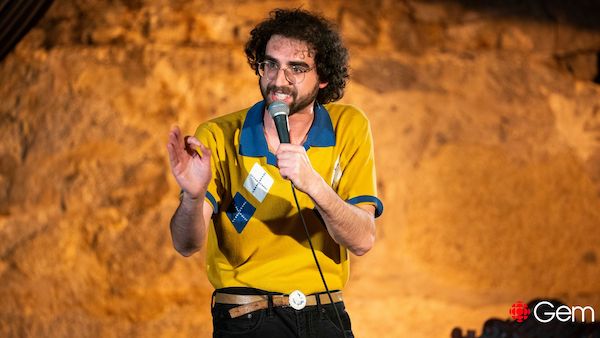
Jacob Balshin (photo by Emily Cooper)

Just For Laughs Vancouver and CBC have announced that original series The New Wave of Standup is returning for Season 3 beginning March 24 on the free CBC Gem streaming service.

The third season showcases 14 Canadian comedians with diverse backgrounds and unique comedy styles who perform standup sets that explore topics including dating, workplace politics, family dynamics and overall observations about life and finding the humour in it. Among the rising stars are Jewish community members Jacob Balshin and Laura Leibow.

Balshin was the winner of I Heart Jokes Awards Newcomer of the Year in Toronto and was later nominated for Breakout Comic of the Year. He has recorded sets for CBC’s Laugh Out Loud and Sirius XM. He is currently fresh off a month-long run of shows at the Edinburgh Fringe Festival in Scotland. His standup clips on TikTok have amassed millions of likes and a loyal group of fans who enjoy his personal, loose and free style of joke-telling.

In 2022, Leibow was chosen to be a part of New Faces at Just For Laughs at the Montreal and Toronto festivals and also did a taping for CBC Gem’s New Wave of Standup. She has a witty and laid-back comedic style, performing on the club circuit, in alternative rooms and in theatres. She has performed in clubs like the Improv and Micky’s in Los Angeles, and Gotham and Broadway Comedy Club in New York City. She is the editor of the comedy website Unoriginal and hosts two podcasts for the Canadian Jewish News. She can be heard frequently on SiriusXM and on 604 Records’ comedy compilation album The Great Canadian Comedy Rumble.

photo - Laura Leibow is one of 14 comics on the third season of The New Wave of Standup
Laura Leibow is one of 14 comics on the third season of The New Wave of Standup. (photo by Emily Cooper)

The new season also features comedian Brendan D’Souza, a fast-talking non-binary comedian and podcaster. Travis Lindsay – an on-air correspondent and writer for CBC’s This Hour Has 22 Minutes – brings a mix of jokes and storytelling. Rachel Schaefer has been featured on CBC Radio’s Laugh Out Loud, and appears on the JFL Original’s comedy album Stand-Up BC: Yee-Haw Hell Yeah.

Courtney Gilmour has written for and made appearances on CBC’s The Debaters and Humour Resources. Using a rapid-fire joke style and laid-back demeanour, Bobby Warrener has performed standup at multiple festivals, on TV and on tours across Canada. Charles Haycock has performed at many festivals, as well.

Seán Devlin was a 2022 Juno nominee for his comedy album Airports, Animals, and was a consulting producer on Borat: The Subsequent Movie Film, as well as writer and director of the satirical feature film When the Storm Fades. Dino Archie made his network late-night debut on Jimmy Kimmel Live!, while Heidi Brander is a writer for CBC’s Son of a Critch, Baroness Von Sketch Show and Still Standing, who has served for three seasons as head writer of This Hour Has 22 Minutes.

Jackie Pirico has multiple Just For Laughs television tapings under her belt and a feature film (Sundowners); she also has made appearances on Viceland TV and Crave’s new mockumentary series New Eden. Malik Elassal is a stand-up comedian, actor and writer, performing in clubs across Canada and appearing on various TV shows, while Mike Green produces shows Secret Standup Series and Comedy At the Handsome Daughter, which is one of the longest running weekly shows in the country.

To watch the season, visit gem.cbc.ca/the-new-wave-of-standup.

– Courtesy C2C Communications

Thinker on hate at 100

Next month marks the centenary of the birth of a psychiatrist whose work on antisemitism deserves a fresh reading. Theodore Isaac Rubin was born 100 years ago April 11. He died at 95, in February 2019. His 1990 book Anti-Semitism, A Disease of the Mind: A Psychiatrist Explores the Psychodynamics of a Symbol Sicknessposited that bigotry against Jews may be a mental disorder.

Rubin had a sprawling career, writing fiction and nonfiction. His 1961 novel Lisa and David, a love story of teenagers with severe mental illnesses, was made into a film the next year and garnered two Academy Award nominations. But Rubin’s work, in addition to his clinical practice in New York City, was primarily devoted to psychology and self-help, including weight loss. He has been credited with coining the term “comfort food.”

Rubin attributed antisemitism to “symbol sickness.” Human beings use symbols to represent objects in the world and to communicate how we feel through these symbols – love and hate being among the most familiar. Symbol sickness occurs when a symbol becomes so divorced from its original meaning that it takes on a distorted or pathological sense. Antisemitism can occur when the objective meaning of “Jew” is imbued with projections from the mind of a person we would call antisemitic.

“The symbol tends to take on increasing importance, and this can and often does reach a state in which there is obsessional preoccupation with it,” he wrote. “In projecting inner conflict to, let us say, Jews, what really happens is that Jews – the symbol – are assigned roles representing aspects of one’s own conflicts.”

Rubin saw envy and feelings of exclusion as central to antisemitism, particularly the idea of a people who the spectator perceives as inferior yet are, in theological terms, “chosen.” The perception that these “inferior” people have little or no interest in him can lead the antisemite into frenzies of rage.

“Even as [the antisemite] denigrates the Jews, he envies what he sees as separateness, clannishness and exclusivity,” he wrote. “He believes that Jewish lack of interest in him, let alone winning him over, is a form of rejection. His reaction to rejection is enormous self-hate and projected self-hate. He rejects and despises the Jew, salving his own hurt pride and disguising his secret admiration and envy. He further embroiders the disguise, twisting envied Jewish characteristics into threatening ones. Thus, he sees Jewish commonality and cohesiveness as arrogance and unwillingness to meld and cooperate with the larger society. Even more, he sees Jewish cooperation and lack of missionary zeal or their desire to assimilate as secretive, cabal-like machinations.”

Perceptions of Jewish achievement can be similarly problematic.

Jews “had to cooperate in order to survive,” wrote Rubin. “They connect the past, present and future, and connect to each other. They profit from the wisdom and experience of forefathers and the group. This makes Nobel Prize cooperative efforts possible. This also makes them the envy – often the malignant envy – of the self-disenfranchised (from self, others, and past and future) antisemite to whom they become prime objects of projected self-hate. The Jew is an intense cooperator. The antisemite’s philosophy confuses commitment, dedication, intense interest, involvement and optimism with sick competition.”

Waiting for the Messiah – who never arrives – is a lesson in the process of postponement of gratification, Rubin argued, offering a reason for collective success – but rational explanations are not accepted by an antisemite. “To the antisemite, Jewish achievements are not seen in this light at all. They are seen as the result of slimy manipulation and cabal-like insider cooperation, designed to frustrate non-Jews.”

For people who are oppressed by political leaders, theology, daily drudgery or any other factors, antisemitism offers a scapegoat. Jews are a symbol of freedom – even when they are oppressed by dictatorial regimes or violent neighbours – merely because they exist outside of the majority society.
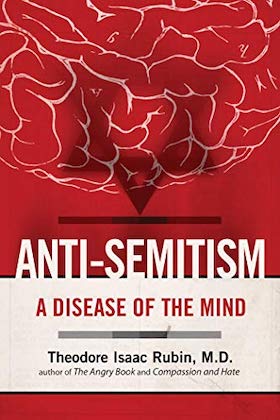
image - Anti-Semitism, A Disease of the Mind book coverRubin goes to some lengths to address Christian antisemitism and how it may fit into his thesis of anti-Jewish bigotry as a mental disorder. Rubin suggests that Christians who traditionally have accused Jews of deicide are not expressing hatred for the perceived annihilation of their deity, but the opposite. Jesus the Jew, in the Christian narrative, is the conscience-giving entity, paralleling the role of Judaism as the wellspring of ethical monotheism.

“The Jew is hated for being a conscience-giver rather than a Christ-killer,” according to Rubin. “Even as they kill the hated conscience-giving part of Jesus symbolized by the Jew, they brag about love for Jesus and Christian brotherhood.”

The antisemite may venerate the loving, compassionate aspects of Jesus, but struggle against the strictures imposed by moral and behavioural principles that accompany the theology.

“I believe that rabid antisemites who have convinced themselves of the historical delusion that Jews killed Christ unconsciously really admire and envy them for doing so,” Rubin added. “They also are secretly grateful to the Jew for providing them with a symbol to which they can displace that hatred. Hating Jesus directly is terrifying indeed and threatens overwhelming guilt, unbearable self-hate and eternal damnation. Calling Jews ‘Christ-killers’ supports shaky identifications with Jesus and even more so with his teachings. This helps convince the victim that, as the Jews killed Christ, the hater of Jews loves Christ.”

Similarly, the ethical constraints that are inherent to most religions – but which a Christian might associate with the Jewish origins of their own theology – might lead to not only a lashing out against their own church or clergy, but a messy effort to improve one’s own self-worth by “proving” the moral failure of the followers of the antecedent religion.

“To be Jewish is to be righteous, ethical in the world,” Rubin wrote. Identifying and emphasizing examples of Jewish moral failing is a form of self-redemption, he argues. If the Jews, the apparent fountainhead of Christian morality, can be proven as hypocrites, one’s own shortcomings may seem less corrupt.

Like the bogeyman under the bed, the antisemite is terrified of a monster of their own creation.

“The antisemite assumes that he is hated by the Jew at least as much as he hates the Jew,” Rubin wrote. “He must keep the Jew powerless and in sight at all times and, if possible, obliterate him, because the secretive creature of secret cabals may have special powers, powers derivative of the God of the Old Testament.”

Jewish reverence for life – exemplified in the toast “l’chaim!” – may be another source of resentment for people who are taught that their reward will come after death.

“To the Jew the greatest courage is not related to death but rather to life. To live and to live an ethical, caring life is a courageous way of life,” wrote Rubin. “The antisemite and all bigots are essentially joyless, life-denying, disconnected, auto-digestive people.”

There may also be a foundation of misogyny in antisemitism, Rubin suggested, with Judaism portrayed as the “mother religion” of Christianity.

As a representation of motherhood, he wrote, Jews “then offer an easy target for displacement and projection. Hatred for the mother is repressed to the unconscious and projected to Jews on the conscious level. This projection would be fed by any disturbed relationship with parents or authority.”

Additionally, peace is traditionally symbolized as feminine and war as masculine. The Jewish quest for peace – “shalom!” – is juxtaposed with, to offer just one example, the Crusades, and Jews’ perceived passivity in the face of centuries of oppression may be interpreted as a feminine docility by those who esteem masculine aggression. (The inversion of this, in recent decades, through the perception of Jewish aggression in the form of Israeli military actions, could be seen as an eruption of envy or outrage over a people who “don’t know their place.”)

Lashing out at others as a response to (real or perceived) internal shortcomings may be a desperate response to perceived shaming, according to Rubin. “The saddest is a person whose feelings are blunted and even deadened,” he wrote. “This means that inflicting pain is a last-ditch attempt to have feelings vicariously oneself. Coupled with bullying tactics, the infliction of pain makes the sadistic bully feel momentarily alive and potent. This is compensation for feeling powerless, helpless and dead.”

Rubin’s assessments rest on the idea that the perpetrators of antisemitism are bullies who perceive themselves as bullied. This is a fundamental way that antisemitism differs from most forms of discrimination or bigotry, which tend to position the perpetrator as superior to the victim. An antisemite often imagines Jews as believing they are superior to others, which leads the antisemite to feel driven to bring Jews down a notch.

When Rubin wrote his book, in 1990, antisemitism, at least in North America, was largely believed to be a fact of history. Since it came roaring back, a decade later, we have struggled to explain and contain it. We generally fall to sociological explanations and Rubin’s unique approach – a psychological explanation – is an important one to help understand a phenomenon that, to be frank, we really have no firm consensus about how to confront.

Finding community in art

“Nostalgia” by Lovena Galyide (photo by Olga Livshin)

Community Longing and Belonging, the fifth annual exhibition in celebration of Jewish Disability Awareness and Inclusion Month, is now on at the Zack Gallery.

Curated by Leamore Cohen, coordinator of Jewish Community Centre of Greater Vancouver’s Inclusion Services, the participating artists demonstrate a range of artistic levels, abilities and social affiliations, but they all strive to answer the same questions in their artwork: What does community longing look like? How to find a place to belong in our ever-changing world?

Cohen has been the driving force of this show for five years. For her, an unjuried exhibition is the best way to honour the commitment to remove barriers and celebrate community members’ creativity. If an artist wanted in, they were in, professional artist or amateur, Jewish or non-Jewish, young or old. Cohen stressed that inclusion is the basic principle, and participation is what counts most.

Many artists in the current show have participated in the Inclusion Services exhibit before. Although most of the works on display are paintings, there are also photographs and drawings. There are portraits and landscapes, figurative and abstract imagery. Some items are for sale, while others are not.

Many of the portraits are disturbing in their naked emotional anguish. The faces are jagged or crooked, angular or cubical. One of them is clearly inspired by Picasso, but all of them portray loneliness, a search for belonging.

Most of the abstract images are similarly angry or sad. Very little figurative recognition manifests, but the emotions explode out of the pictures, multiplied by dark colours and sharp lines. They depict the pain of isolation, the desire for acceptance.

Not every work is bleak. Clare Palmer’s photograph “Red Maple” is full of natural serenity, as if the photographer found her community in nature and recommends it to everyone.

Roi Alexander M. Sanchez’s painting with a long and winding title starting with Clean Environment shows a man and a woman cleaning the land, collecting garbage into sacks, together with their friends in the background. The cleaning they are doing is obviously a community event, and the artist emphasizes this with bright colours and cheerful composition. The painting radiates gladness, with a child-like flare. The author seems to say: we clean our home together.

Togetherness also seems to be the main meaning of Aileen Leong’s untitled piece, where two hearts are pierced by one arrow. Connected by this arrow of love, the hearts fly above the mountains on the golden wings of joy.

Lovena Galyide, on the other hand, doesn’t speak of love in either of her two paintings. Both are larger than most of the others in the exhibit. Both feature a single woman. In one, called “Say Yes to Your Open Door,” a girl lifts the curtain of night above her head, allowing in the light of the morning. She welcomes a new beginning and abolishes darkness. The painting thrums with hope. The girl is alone, with her back to viewers, but maybe the new day will bring her a new friend. Or a new love is waiting for her on the sunny side.

Another of Galyide’s paintings is “Nostalgia.” It is less exuberant than the first. The woman in this canvas stands in the rain outside the window of a flower shop. The viewers are “inside,” looking out. All they see is a blurry female silhouette under an umbrella. But, inside the shop, flowers bloom. Is that pensive, lonely woman going to enter? Buy flowers? Or is she just passing down the street? So many stories could start with this painting, all going in different directions. It is up to viewers to finish those stories.

Flowers are also the focus of Sandra Yuen’s “Bias.” This painting is large, and the close-up flowers are accordingly huge and gloriously pink, blooming in splendid isolation on the blue background. The painting is reminiscent of Georgia O’Keeffe’s gigantic flowers, capturing the beauty and vastness of nature.

Unlike Yuen’s exposition of colour, another large painting, by Rodrigo Perez Parra, seems composed mostly of melancholy, echoed by its subdued, earthen palette. Its title, “The Dance in the Dream,” reflects its subject: a woman standing thoughtfully beside an open door. Does she dream of a dance in her past? Does she hope to dance again? Where is her partner? Only a hat, hanging beside the door, reminds us about them. Are they coming back? Again, stories abound from this painting, some of which might even have a happy ending.

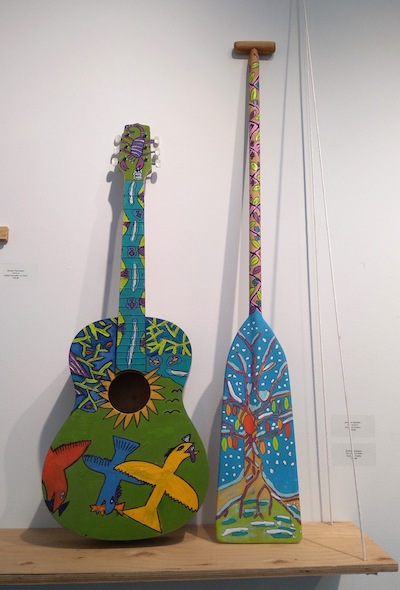
photo - “Folk Guitar” and “Tree of Life Paddle” by Andrew Jackson
“Folk Guitar” and “Tree of Life Paddle” by Andrew Jackson. (photo by Olga Livshin)

In the middle of all the images on the gallery walls, two 3-D exhibits stand out. Andrew Jackson’s “Folk Guitar” and “Tree of Life Paddle” are tongue-in-cheek, almost goofy. Both are real-life objects, painted in a distinctive folksy style. The guitar flaunts soaring gulls gobbling fish. The paddle is painted with the Tree of Life. Although the guitar lacks its strings, perhaps the artist considers music our inescapable community. Or sports (for the paddle)?

Another unique item on display is a small clay tablet called “The AHA Community.” The artists who created it belong to the Artists Helping Artists (AHA) collective. The plaque doesn’t list any names, but Cohen said each of the 11 little colourful figures placed on the tablet’s surface, all engaged in different artistic activities, were made by different members of the collective. They are merry self-portraits, making the tablet itself a representative of all the artists in this show.

According to their website, AHA is an art studio collective in Burnaby, where artists of all abilities and skill levels are encouraged to come together to make art – visual art, music, writing, anything goes. The studio provides space, affordable materials and the opportunity to pursue the individual artist’s aspirations. A large percentage of their membership is artists with complex needs.

Like the JCC Inclusion Services, AHA believes that art is a vital element in our lives, and that inclusion is mandatory. Their mandates are congruent – each invites people to share their feelings through art.

The Community Longing and Belonging exhibit runs at the Zack until March 28. To view the flipping book, visit online.flippingbook.com/view/836064016.

Olga Livshin is a Vancouver freelance writer. She can be reached at olgagodim@gmail.com.