One is never too old to learn

I had the privilege of seeing Mark Leiren-Young’s play Bar Mitzvah Boy when it premièred at Pacific Theatre in 2018. It was funny, edgy and insightful, and well-acted by Gina Chiarelli and Richard Newman. It contained a lot of local references, making it even more special.

image - Bar Mitzvah Boy book coverWhat I see from the Playwrights Canada Press edition, which was published in 2020 and arrived at the JI sometime in 2021, is that Leiren-Young’s notes on various aspects of the play allow productions to change certain references and pronunciations to localize the action, thereby making it special no matter where it is performed. For instance, the audience first meets Rabbi Michael Levitz-Sharon, who is in her mid-30s to maybe 45 years old, on a jogging path, “dressed in sweats and a ball cap for a local sports team.”

The next scene: in the rabbi’s office, there sits a man in his mid-60s or older, Joey Brant, “decked out in prayer regalia – including tefillin, which are on incorrectly.” This is our first hint that he, despite initial appearances, is not a rabbi or a religious Jew. When Michael arrives, Joey assumes that the relatively young woman in running gear doesn’t belong at the synagogue – and certainly isn’t the congregation’s spiritual leader. This exchange sets the tone for the essentially two-person play that unfolds. The other cast member is Sheryl, the receptionist, who is never seen, only heard. As described by Leiren-Young, the actor of this role (which was Jalen Saip in 2018 at Pacific Theatre) should have “the accent you want the woman who runs your local deli to at least pretend to have.”

I love having these types of stage direction “made public.” It is a completely different experience to read a play than to attend it in person. It’s almost like listening to the acoustic version of one of your favourite pop musicians – if they are able to sing on key and play their chosen instrument skilfully, they really are excellent at their craft. Similarly, if the words of a play still make you laugh and cringe and move you emotionally in other ways, with no cues from actors or audience members, it is a very well-written play. Bar Mitzvah Boy in book form made me do all those things – I chuckled a lot throughout, and also got teary near the end. Michael and Joey (the bar mitzvah “boy,” btw) are both dealing with some serious, raw issues.

Since I finished the book, I’ve been revisiting some of the many topics it covers. I’ve thought about my own beliefs about Judaism and faith, what happens after we die, what makes a good friend, parent or spouse, how people navigate challenges differently, the ways in which a congregation (or any other group) can be both supportive and trying at the same time.

Leiren-Young dedicates the publication to his mother, Carol Leiren: “I guess it was worth sending me to Talmud Torah.” For viewers or readers of Bar Mitzvah Boy, it certainly was worth it – thank you.

Playing against hatred

A basketball game may not be able to bring about world peace, but at least one game has acted as a bridge to increasing mutual understanding and empathy.

The graphic novel The Basketball Game (Firefly Books, 2022) is based on the National Film Board of Canada animated short of the same name. Written by Hart Snider and illustrated by Sean Covernton, it is based on Snider’s memories of his first year at Jewish summer camp. It proved to be a unique experience.

image - The Basketball Game book coverIt was July 1983. The camp was Camp BB Riback in Pine Lake, Alta. Snider was 9 years old and “totally homesick,” finding refuge in the comic books he had brought with him. That is, until he meets Galit. (The book is dedicated to his “partner, collaborator, inspiration and best friend, Galit,” his daughter and his parents.)

For young Hart, Camp BB made him feel at home. “Even both my parents went to this camp,” he writes. “It was a tradition in the community. It was a place to just be ourselves … and that was important because back then, growing up Jewish in Alberta wasn’t always so easy.”

Back then, in Eckville, Alta., the winter before Snider’s first summer at camp, teacher Jim Keegstra, “also the town’s mayor, was fired by the local school board.

“Believing the curriculum was ‘incomplete,’ Keegstra had been teaching Holocaust denial and antisemitic conspiracy theories in his classroom – that Jewish people had an international plot to control the world and were to blame for everything that’s wrong.”

But one Eckville parent, Susan Maddox, “noticed her 14-year-old son had some strange new opinions.” She looked through his notebooks, then filed a complaint with the school board.

Meanwhile, more than a thousand people attended a rally at the Edmonton Jewish Community Centre to figure out how to respond to the situation. One of the ideas proposed – by then Camp BB director Bill Meloff, z’’l – was to invite some of Keegstra’s former students to the camp for a “day of fun and fellowship,” which included the title’s basketball game.

image - Team A: In The Basketball Game, each team imagines the other side as monstrous stereotypes – until they get to know one another. (Text by Hart Snider / illustrations by Sean Covernton)
(Text by Hart Snider / illustrations by Sean Covernton)

In a brilliantly drawn sequence, the team players are depicted as their negative stereotypes, how they see one another. Blue Team – a horned demon, a world-controlling banker and an evil wizard – versus Red Team – a skinhead, a Nazi and a member of the KKK. The game is intense. Then, an opposing player compliments Hart’s shot. “Thanks, man,” says Hart. The game continues, kids versus kids, no more monsters.

“Looking back, it’s amazing that it happened at all,” writes Snider. “That Keegstra’s students were invited to the camp, and they actually came.”

image - Team B: Team A: In The Basketball Game, each team imagines the other side as monstrous stereotypes – until they get to know one another. (Text by Hart Snider / illustrations by Sean Covernton)
(Text by Hart Snider / illustrations by Sean Covernton)

That’s the thing. Someone had to extend the invitation, and someone had to accept. An illustrated reproduction of an actual newspaper clipping from 1983 notes that attendance at the camp was voluntary and that a preliminary survey indicated that about 10% of Eckville Junior-Senior High School’s 186 students “would be willing to attend.”

Here we are, almost 40 years later and, as Snider notes in his introduction: “Racism, conspiracy theories and antisemitism are spread every day on social media and other platforms. The hate that Keegstra taught in his classroom is now found in memes, videos and forums. Over and over again, we are challenged with the question, how do we deal with fear and prejudice?

“I hope we can continue to find common ground and have empathy for each other, but, most importantly, I hope that parents and kids keep talking to each other.”

The book, intended for readers 12 years old and up, includes more on the Keegstra trial, discussion questions and a glossary.

Snider participates in the 2023 Cherie Smith JCC Jewish Book Festival, which takes place Feb. 11-16.

We are inheritors of history

When Toronto poet Simon Constam emailed me with a request to read his debut collection of poetry, Brought Down, he described it as “notable because it addresses people’s daily experience of God and the Jewish religious tradition.” He noted, “it is provocative and well-written as can be attested to by the reviews of it thus far.” Indeed, the reviews I’ve read have been highly complimentary – and justifiably so.

I am neither religious nor a poetry buff, yet I found Constam’s poems engaging. I liked his challenging and questioning manner. At 70+ years old, he has wisdom gained from life experience that includes approximately a decade in which he followed Orthodox Jewish observance. His knowledge of Judaism infuses his writing and I had to look up a few names and concepts, even though there is a glossary at the end of this 61-page volume.

What I greatly appreciated about these poems is the theme that runs through most, if not all, of them: the title idea of “brought down,” as it refers to what we inherit from our ancestors, whether we’re talking about traditions, rituals, genes, coping mechanisms, etc. The lens through which Constam explores these ideas is his Jewishness. In “Yerushalmi,” for example, he writes:

“Today I seem to have the face of a man I briefly stared at, on a bus on Rehov King David in the fall of 1969. / I wear the same clothes, dark jacket, dark shirt, rough tan trousers, dust-scuffed brown boots. / The mirror shows me, grizzled, unkempt, stocky, stoic, almost seventy. / My face is the face my grandfather wore. / My parents, aunts, and uncles swore the resemblance is uncanny. My history is clear. / I was one of Titus’s captives marched through Rome in chains. I collected all my things in a sack to flee from Ferdinand and Isabella along the Jew-choked roads.  I missed my fate in Kielce and Bialystock. I hid in the forests by Kishinev.” It ultimately concludes: “I am the inheritor of a furious history that only in this place can I never deny or forget.”

In his struggles with God, Constam contemplates what it means to be Jewish, what it means to be human. While this all sounds quite serious, and it is, there is humour in this collection and, ultimately, it is hopeful. As much as he takes God to task, Constam is calling on all of us to question ourselves, and to accept our responsibility for the state of the world.

Serious play with language

I always look forward to reading whatever Adeena Karasick writes, even though I know I won’t understand all of it. To be generous to myself, I’d say at least 20% of her latest publication, Massaging the Medium: Seven Pechakuchas (Institute of General Semantics, 2022), went over my head – or will require a few more reads and some discussions with friends to get the most out of it.

image - Massaging the Medium book coverMassaging the Medium is part of the Institute of General Semantics’ Language in Action series, which “publishes books devoted to creative modes of expression that can open the doors of perception and foster better understandings of the nature of language, symbols, communication and the semantic, technological and media environments that we inhabit.”

The preface is written by Maria Damon of the University of Minnesota. She explains, “For anyone still unfamiliar with the format, pechakucha – Japanese for ‘chitchat’ – is a highly stylized presentation form that comprises a public speech accompanied by 20 slides for visual demonstration, each of which is shown for 20 seconds, while the speaker addresses their (his/her) topic. Initiated in 2003 by a pair of architects working in Japan, the format (trademarked and copyrighted, by the way, in true contemporary entrepreneurial style) has spread to encompass a worldwide enthusiasm for a storytelling/info delivery style that relies on the visual as much as, or even more than, on the verbal.”

Given Karasick’s “dazzling linguistic pyrotechnics on page and stage,” writes Damon, the pechakucha format is ideal, “as the propulsive energy that characterizes her writing and reading style is given sharper urgency for being trapped in a small temporal space…. These seven tours de force of serious play celebrate meaning and unmeaning, communication and miscommunication, the happy errors/eros of semantic and sonic slippage, the glories of the im/p/precise.”

This description is better than I could ever give. I had to look up several terms, such as ’pataphysical – “a ‘philosophy’ of science invented by French writer Alfred Jarry intended to be a parody of science,” according to Wikipedia. “Difficult to be simply defined or pinned down, it has been described as the ‘science of imaginary solutions.’”

I also had to look up some of the names of people Karasick cites as if they’re old friends. While I’ve heard of folks like Jacques Derrida and Marshall McCluhan, and of Jewish texts such as The Zohar, my knowledge barely touches the surface. I think that’s part of why I have such fun with Karasick – I’ve no preconceptions going into my reading of her work and, while I don’t take it all in, I do feel as if my mind expands from the experience. She is at once academically rigorous, poetically versatile and sensically nonsensical, or nonsensically sensical (I’m not sure which would be most accurate).

image - Here is but one example of a section of one of the pechakuchas featured in Adeena Karasick’s Massaging the Medium: Seven Pechakuchas, to give readers an idea of the book’s content and form. (© 2022 Adeena Karasick)
Here is but one example of a section of one of the pechakuchas featured in Adeena Karasick’s Massaging the Medium: Seven Pechakuchas, to give readers an idea of the book’s content and form. (© 2022 Adeena Karasick)

In her introduction, Karasick notes that the seven pechakuchas comprising this book were originally created for and presented at academic literary conferences that took place during the period of 2013 to 2019. For a printed publication, she had to adapt them.

“The visuals,” she notes, “consist of both found and original collaged material which both speak to and against the text. And each of the original slides were embedded with audio and video clips, gifs, other forms of kinetic digital media such as montages of sound poetry,” pop songs, movies and more. “What is illustrated here, however, are stills from the digital live motion presentation and, although originally all consisting of 20 separate components, they are now of slightly varying length.”

I can’t even begin to simplify any of the pechakuchas, in order to give an example of their content and form. Best to experience them yourself. Not everything will land – I enjoyed the first few most – but they do offer the possibility of changing how you think about many things. The list includes but is not limited to language, technology, physiology, time, space, cyberspace, mysticism, consumerism, reality, truth. As does any good Jewish text, it will raise more questions than it answers.

Continuing Chelm tradition

It’s been eight years or so since I reviewed Mark Binder’s The Brothers Schlemiel, which recently has been reissued by Light Publications with the title The Village Twins, and written under Binder’s pen name, Izzy Abrahmson. I knew this story of Chelm would withstand the test of time for two reasons. First, we regularly publish a Binder/Abrahmson story in our holiday papers. Second, the stories are written in the style of Yiddish folk tales, which have proven staying power.

image - The Village Twins book coverAs Abrahmson explains in The Village Twins, Chelm is “a tiny settlement of Jews known far and wide as the most concentrated collection of fools in the world.” According to The YIVO Encyclopedia of Jews in Eastern Europe, the “first publication of Chelm-like stories appeared in Yiddish in 1597, and were tales of the town of Schildburg, translated from a German edition. Hence, these stories first entered Jewish culture as Schildburger stories, and it is unclear when they became connected to the town of Chelm. During the 19th century, a number of other Jewish towns figured as fools’ towns, including Poyzn. Over time, however, Chelm became the central hub of such stories, the first specific publication of which occurred in an 1867 book of humorous anecdotes, allegedly written by Ayzik Meyer Dik. Later, particularly in the early 20th century, dozens of collections of Khelemer mayses (Chelm stories) were published in Yiddish, as well as in English and Hebrew translations.”

The Village Twins is one of the latest such collections, and it does honour to its literary ancestors, providing wisdom in the guise of absurdity. The novel can be read on many levels, including as pure entertainment, as the story of a particular family living in a particular era and as a series of parables (it’s 414 pages long, which, I admit, was a bit lengthy for me). It is part of Abrahmson’s Village Life series, which includes several publications and a podcast, but can be read as a standalone novel. I am proof that a person might enjoy, but does not have to, read or listen to the other stories to follow this tale of the Schlemiel family that is centred around twins Abraham and Adam, who cause trouble from the day they are born.

The brothers make full use of their physical similarity throughout their life, from incidences as harmless as pranks around town to more serious situations, such as avoiding being drafted into the Russian army. What I wrote in my 2014 review still stands: Abrahmson “has created characters with whom we empathize…. He ably manages some fine balances: writing about silliness without the story becoming stupid, and evoking sentimentality while not becoming saccharine….. As well, through the vehicles of comedy and fantasy, [it] touches on many serious topics, from poverty to racism, to ethics in business, to whom people choose to be, and more.”

According to the press release, The Village Twins has been updated and revised, though I can’t speak to how, as my copy of The Brothers Schlemiel has long since been passed on. Along with this reissue came Binder’s pen name “to distinguish the series from his other work. By combining his Hebrew name, Isaac, with his father’s Hebrew name, Abraham … Izzy Abrahmson was born.”

As an editor, dealing with a writer with two names is a little unwieldy and I sometimes feel like the villagers of Chelm, who, for “many, many years” couldn’t tell Abraham from Adam. But that doesn’t diminish my enjoyment of Abrahmson’s – or is it Binder’s? – storytelling. He has won multiple awards for a reason. Anyone who likes a good folk tale will delight in The Village Twins.

A life-changing meeting

A Visit to Moscow is a beautifully illustrated and haunting graphic novel. In a brief 72 pages, it relates the story of an American rabbi who, on a 1965 trip to the Soviet Union, sneaks away from his delegation in Moscow to visit the brother of a friend – Bela hadn’t heard from Meyer for more than 10 years and was worried.

image - A Visit to Moscow book coverA Visit to Moscow (West Margin Press, 2022) is an adaptation by Anna Olswanger of a story told to her by Rabbi Rafael Grossman. It is illustrated by Yevgenia Nayberg, who captures in her palette, in the angles of her images, in her use of light and shadow, scratches and blurs, the claustrophobic fear that existed in that era in the USSR.

“Although the events of A Visit to Moscow are set before my time, the overall spirit of the Soviet Union feels very similar to what it was throughout my childhood when I lived there. I didn’t have to make a big leap to connect to the time period,” writes Nayberg in a section at the end of the book, where we get to see some of her preliminary sketches.

Olswanger knew Grossman, having collaborated with him on writing projects since the early 1980s. “One of our first projects,” she writes, “was a Holocaust novel with a character based on his cousin, a leader of the Jewish resistance in the Bialystok ghetto. As we planned out the storyline, Rabbi Grossman told me about an incident during a trip he made in 1965 to the Soviet Union, where he met a young boy whose parents were Holocaust survivors. The boy had never been outside the room he was born in.

“We never finished the novel, and then, in 2018, Rabbi Grossman died.”

Years later, Grossman’s daughter sent Olswanger a box of writings that Olswanger and the rabbi had worked on. It inspired Olswanger to revisit the story. But she didn’t have the whole story, so, on the suggestion of her editor, wrote A Visit to Moscow as historical fiction.

The main part of the book is incredibly moving. The tension as the rabbi makes his way to Meyer’s last known address is palpable in both text and images; the KGB are an ever-looming threat. When he arrives, it takes the rabbi time to gain Meyer’s trust and for Meyer to let the rabbi into his flat, where he meets Meyer’s wife and their son, Zev, who has never left their home. The rabbi promises to get them all to Israel.

image - Visit to Moscow is a powerful, if incomplete, story, written by Anna Olswanger and illustrated by Yevgenia Nayberg
Visit to Moscow is a powerful, if incomplete, story, written by Anna Olswanger and illustrated by Yevgenia Nayberg.

This core of the novel is well-written, easily understood and powerful. Unfortunately, this mid-section is bookended by ambiguous scenes. At the beginning, Zev hovers from heaven over his dead body, which is laying somewhere in a mountain range. In the throes of dying, he remembers the story of the rabbi’s visit, which leads into the main story, after which we see young Zev on a plane, remembering the ride and Israel’s beauty. In the midst of this, he wonders, “And later – was it years later? Was he a young man?” In the next panel, a fire burns in the aforementioned mountain range and the text reads: “He remembers a sudden flash. A burst of black smoke. Burning metal.”

I first thought that he and his parents had been killed in a plane crash on the way to Israel, so close to freedom but never reaching it. After madly flipping pages back and forth in the book, trying to figure out what I’d missed, I found what I was looking for in the About the Contributors section: “For over 25 years, Rabbi Grossman visited Zev and his family in Israel. He saw them together for the last time in 1992, the year Zev died at the age of 37, a husband and father, while on reserve duty with his army unit in Lebanon.”

A tragic ending either way, but at least Zev got out of his room and got to live more fully for those 25 years. “Every time I visited Zev in Israel,” wrote Grossman, “he was smiling.”

A Visit to Moscow could have benefited from a few more pages, to make the transition of Zev’s journey from the Soviet Union to Israel more understandable, and to include some aspects of his life in Israel, even if they were fictional. Olswanger and Nayberg have created something special, but it feels incomplete.

Into belly of the beast

Danny Danon, former Israeli envoy to the United Nations. (photo from IGPO / Chaim Tzach)

“Jerusalem is an inseparable part of Israel and her eternal capital,” said an Israeli prime minister. “No United Nations vote can alter that historic fact.” This quote, which could have come from any of the country’s leaders, was in fact spoken by the first, David Ben-Gurion, in 1949, just days after the UN voted for the internationalization of the city. Israel’s issues with the agency, in other words, have existed for some time.

One wouldn’t expect a right-wing Likud party stalwart, well-known hothead and self-acknowledged non-diplomat to be one of Israel’s foremost voices to present an unambiguous defence of the UN. But, in his new book, Danny Danon does exactly that.

Danon’s book, In the Lion’s Den: Israel and the World, focuses on his term as Israeli ambassador to the United Nations, from 2015 to 2020. Before that, he was a Likud member of the Knesset and a minister in Binyamin Netanyahu’s government.

He acknowledges that, when he was appointed to the diplomatic post, commentators in Israel and elsewhere suggested that Netanyahu was deliberately poking a stick in the belly of the beast.

“There was an expectation that, because of my background and strong ideological beliefs, I would not fit into the world of diplomacy, that I was too much of a hawk and a ‘hardliner,’ which would make it difficult for me to build relationships and achieve anything of substance,” he writes.

Well, yes and no. He does not fit into the world of diplomacy. But he does claim a litany of successes. Danon devotes nearly 200 pages to justifying Israel’s engagement with the international body. Despite the routine censures of Israel and seeming obsession the General Assembly and several of the UN’s agencies have with Israel, Danon argues convincingly that taking on the haters in that forum is a worthy enterprise.

“What many people don’t understand is that there is a public UN and a private UN,” he writes. “The public face of the UN – at least when it comes to Israel – is aggressive and bullying. But, privately, you can build bridges, forge friendships and create a space for understanding, particularly if you are transparent.”

His own approach – far more bull in a china shop than circumspect diplomat – has its merits, he contends. His calling out of critics by name, apparently nearly unheard of in the hallowed halls of the UN’s Manhattan headquarters, may have drawn gasps, but it also seems to have made some think twice before talking.

“After a few times calling out the French ambassador in the media, not only did he reiterate that he did not appreciate it, which had no effect on me, but, more importantly, it made him much more careful in the words he used and actions he took going forward.” Danon said.

image - In the Lion’s Den book coverIn one segment, the former ambassador goes into extensive detail about the efforts he made to derail two particularly troublesome resolutions. “Both resolutions were pointless,” he acknowledged, which might describe most of the General Assembly resolutions against Israel, but this comment, in turn, raises the legitimate question about why such energy and resources are devoted to fighting them. Danon’s argument is that it is in Israel’s interest not to ignore them and to take up the fight whenever and wherever possible.

If his own account of his time there is to be believed, Danon achieved many victories.

He caused the UN to officially recognize Jewish holidays so that, for example, no major meetings occur on Yom Kippur. He managed to get a small amount of kosher food onto the menu at the UN staff cafeteria – and it was promptly snapped up by non-Jews who view a hechsher as proof of healthy, quality food.

More substantively, he hosted more than 100 ambassadors on delegations or missions to Israel.

Partly as a result of a conference that Danon organized for fellow ambassadors on the subject of antisemitism, the UN issued its first-ever thorough report dedicated entirely to anti-Jewish racism.

After successfully pressuring for a UN bureaucrat who is Israeli to be promoted (apparently a challenge), he took on a more entrenched problem. The UN unofficially boycotts Israel, he writes, passing over Israeli options in the agency’s not-insubstantial procurement process. He set out what he called the three T’s.

“We would sell our relevant technology, offer training and provide troops,” he said. The first two he succeeded in.

“I believe the last T, providing troops to UN peacekeeping missions, will come in time,” he writes. “Sending troops is still an ongoing effort on our part. We have one of the best trained militaries in the world, and it knows how to deal with many difficult conflicts. We have so many security challenges that require us to engage in prevention, deflection and defence that it puts us in a unique position of having both the know-how and the experience on the ground. This gives us an advantage in comparison to others. We have the expertise to train UN forces, such as search and rescue, medical treatment in the field, and addressing acute emergency situations…. It has not happened yet, but I am hopeful. It remains a goal for the future.”

For all its flaws, Danon argues, the UN is a unique environment where an Israeli ambassador can shmooze with people he would never get to meet otherwise.

“Think of this: anytime a special envoy from Israel travels to an Arab country, it has to be done with the utmost discretion. If such visits were to be discussed publicly, they could become an issue that could result in political backlash or even violence from extremists and terrorists. At the UN in New York, you can meet anyone, anytime, in a legitimate and open forum, free from the anxiety of those who are determined to see you fail. Indeed, such exchanges between adversaries and friends are expected, which is why the UN is a useful tool despite criticisms about its effectiveness in the 21st century.”

UN ambassadors aren’t nobodies, either, and the connections an Israeli envoy can make there can bear fruit later.

“Once a term at the UN is over, you can be assured that many ambassadors turn their attention to political positions in their home countries, some going on to become heads of state or ministers of foreign affairs,” he said. “It is useful to have existing relationships with such people.”

The Israeli delegation at the United Nations has managed to peel away a few European countries from the European Union’s consensus position against Israel.

“As the Czech Republic, Hungary and Bulgaria grow more confident and economically strong, one of the ways they have and will continue to show their independence and sovereignty is the approach they have taken toward Israel. We have a great opportunity to continue to strengthen our bond with the people and governments; as young countries striving to grow, they understand and relate to Israel’s challenges. I believe they will continue to reject Western Europe’s automatic pro-Palestinian and anti-Israeli sentiment.”

More remarkably, Danon also managed to peel away members from the Arab bloc. In a secret ballot, Danon became the first Israeli ever elected chair of one of the UN’s six standing committees. There were far fewer votes against his candidacy than there are Arab countries at the General Assembly, he notes.

“I had the courage and vision – and the will,” he writes of the chutzpah he showed in his role. “I was often told, great idea, let’s do it next year. I always said, let’s do it now, we can get it done in two months.” (Memoirs are rarely testaments to humility.)

Though Danon argues that he made headway in his term at the UN, predictably, he didn’t make many friends. But he certainly made one. Nikki Haley, the U.S. ambassador appointed by Donald Trump, became fast pals with Danon, apparently joyfully collaborating to stick it to the enemies. (Haley wrote the foreword to the book.)

This alliance and the many other overt and covert bridges he built during his term were overwhelmingly with representatives of governments that are on the right of the political spectrum – sometimes on the far-right, like Brazil’s and Hungary’s.

Though he doesn’t address this fact, he would no doubt make the case that Israel must take its friends where it can find them. In the bigger picture of Danon’s time in the belly of the beast, perhaps the words of the late Yitzhak Rabin prove true: “You don’t make peace with friends. You make it with very unsavoury enemies.”

Enjoy the gift of words

When someone loves what they do or is passionate about a certain topic, it’s obvious. In the case of a book, if this someone is also proficient with words and excels at writing, their enthusiasm figuratively jumps off the page and inhabits the reader, getting them as excited as the author. This is how I felt reading Jonathan Berkowitz’s latest book, Tales From the Word Guy: What Your English Teacher Never Taught You(FriesenPress). Excited about the wonder that is language – in this case, the English language.

With the help of his wife, Heather, Berkowitz has compiled a collection of essays adapted from his segments on CBC Radio 1’s North by Northwest over several years as the Word Guy. Noting that people “perceive the spoken word differently from the written word,” he writes: “Adapting the radio columns into written essays requires a sensitivity to the difference between listening and reading. Heather has that sensitivity, not to mention a keen sense of style and grammar.”

North by Northwest host and producer Sheryl MacKay has written the book’s foreword.

“I first met Jonathan when he came in to talk about the National Puzzlers’ League convention, which was taking place that year in Vancouver,” she writes. “I was struck right away by his enthusiasm, his depth of knowledge (in the field of puzzles and beyond), his sense of humour, and by the fact that he could identify patterns in words and numbers everywhere. It’s like a superpower he has!

“I immediately asked him to do a regular column on the show. Jonathan, who is always up for a new adventure, agreed and, for the next year, he was our Puzzling Professor. Every month, he’d appear on the show and introduce listeners to a different kind of puzzle, talk about its history and then challenge them to solve a few. It was such fun and so mind-bending!

“The next year, Jonathan changed focus a little and became the Word Guy for the show. Each month, he takes us on a radio journey through some of the vagaries of the English language. As Jonathan owns more dictionaries and language reference books than anyone I know, he’s well equipped to lead this particular expedition!”

image - Tales From the Word Guy book coverIn Tales From the Word Guy, Berkowitz admits that his favourite books are dictionaries, followed perhaps by thesauri (I admit that I Googled the plural of thesaurus).  “In fact,” he writes, “thesaurus comes from Latin, meaning ‘treasure,’ and the first dictionary definition of thesaurus is treasury or storehouse. Indeed, what a treasure house it is.”

Words have always been a passion for Berkowitz, but he is also a fan of numbers and mathematics, having chosen a career as a statistician. With his facility for words, numbers and problem-solving, it is no wonder that MacKay, in 2015, invited him to present puzzles on her show. I never heard him in that role, but I did very much enjoy the book those puzzles led to: The Whirl of Words, also published by FriesenPress. (See jewishindependent.ca/playing-with-words-and-more.)

Berkowitz’s breadth and depth of knowledge can be overwhelming at times. To build off his metaphor of this latest book as a box of chocolates, you might get the equivalent of a sugar rush if you read too much of it in one sitting. While the chapters are short, amusing and easy to read, there is just so much information “filling,” from the erudite to the silly to Berkowitz’s trademark puns. (Among those he shares is one of his favourites: “The only thing flat-earthers have to fear is sphere itself.”)

I learned so much in Tales From the Word Guy. For example, I knew that A, E, I, O, U and sometimes Y are vowel letters – but also sometimes W?! Berkowitz gives the example of the “uncommon word, cwm, a synonym for cirque, [which] means ‘a deep steep-walled basin on a mountain usually forming the blunt end of a valley.’ Linguists sometimes refer to Y and W as semivowels,” he writes. “Conversely, U and I sometimes represent consonants, as in quiz and onion, respectively.”

I can understand the U being considered a consonant in quiz, but remain confused about the I in onion. But in a good way. I enjoy having my mind challenged, my assumptions upended.

I also enjoy being wowed and there are many “really?!” moments in this book, such as W being a vowel sometimes, albeit rarely. To name just a few of the other things that made me ooh and ah – the origins of the terms uppercase and lowercase; the number of words Shakespeare created (and some examples); and the name for and function of “um,” “uh,” “like,” “you know,” all those annoying sounds or words most of us unconsciously insert into our sentences when we talk.

But it’s not just the many fun facts that make Tales From the Word Guy such fun to read. Berkowitz shares a bit of himself, from more serious topics, like how his mother and father influenced his life, to his favourite, or most beautiful, words, his language pet peeves and his efforts at making up new words. It is easy to see why CBC’s the Word Guy is so popular.

To order a copy of Tales From the Word Guy, go to talesfromthewordguy.com.

****

Tales From the Word Guy: What Your English Teacher Never Taught You book launch with author Jonathan Berkowitz in conversation with Sheryl MacKay; adapted from radio by Heather Glassman Berkowitz. Nov. 29, 7pm, at the Jewish Community Centre of Greater Vancouver. No registration required.

Tales From the Word Guy: Jonathan Berkowitz talks about his new book with Daniella Givon. Dec. 12, 7:30pm, at Beth Israel. bethisrael.ca.

How to be radically creative

Linda Dayan Frimer speaks about her new book, Luminous, at the Waldman Library on Nov. 27. (photo from Linda Dayan Frimer)

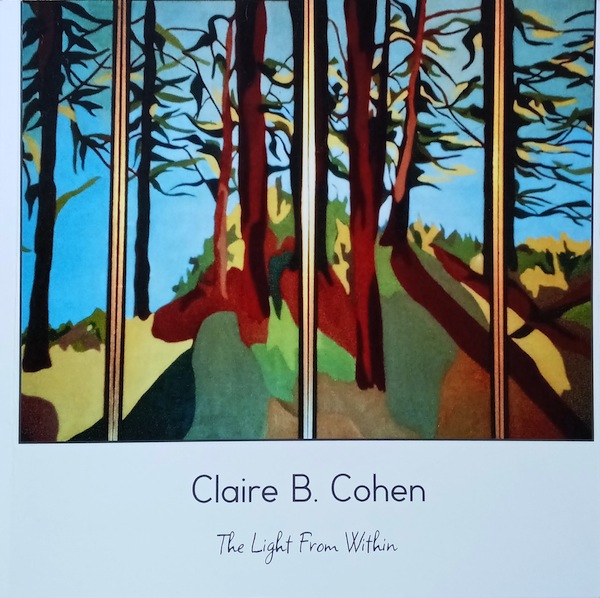
Linda Dayan Frimer’s new coffee table book, Luminous: An Artist’s Story as a Guide to Radical Creativity, takes the reader from Frimer’s early years in rural British Columbia through to the present, mixing her own story with encouraging the reader to jump-start their inner artist. Along the way, the multifaceted memoir also incorporates art history, spirituality and Judaism.

For Frimer, who was raised in the Cariboo District town of Wells, where hers was the only Jewish family in the community, making art is something she has done since early childhood.

“Painting was the same as experiencing wonder and awe within creation, where everything – the trees, their trunks and the big starry sky – led to a sense of a creation unified through colour. Just as it was for Chagall, colour from early childhood was love for me,” Frimer told the Independent in a recent interview.

As she grew and learned more of her own cultural suffering, and empathized with the suffering of the First Nations peoples in the Cariboo region, she longed to express this love for creation by unifying and healing in her own way, however she could.

“Art-making was my remarkable tool and the colourful, light-filled forests surrounding my home was my first inspiration,” she said. “I then learned the power of stories and how to tell them visually using photographs. This led to sharing reverence with other cultural groups, particularly in a group show called Kaleidoscope, where I met Cree artist George Littlechild. And our work on sharing cultural reverence through art – and our great and soulful friendship – began.”

A later example of the power of stories occurred when child Holocaust survivor Renia Perel showed Frimer a letter that was written 50 years after the death of Perel’s mother. Frimer created visual tribute in which Perel was able to write the letter into the artwork.

Exploring book’s subtitle

According to Frimer, radical creativity is an intense action that has the potential to occur each time we bring something new into creation. “It impacts upon the fundamental way we see and experience the world at a particular time, which can lead to each of us to having an inward moral experience. To be radically creative is to not only express what is most deeply felt but to hold an intense connection and longing to heal, and to unify this creation and ourselves within it,” she said.

“This calls upon and leads each of us to think deeply and imagine more. Bold and courageous radical creativity is ours each time our heightened emotional selves seeks a creative means to both respond to and enlighten the darkness of uncertain political and societal times.”

Citing various modern artists, Frimer noted that Picasso painted “Guernica” in only black, grey and white in response and protest to the impact and suffering caused by the Spanish Civil War on the Basque town of Guernica. American artist Adolph Gottlieb released the creative potential of the unconscious mind by painting the opposite polarities in existence as dots on a spectrum, where, with only one change, one dot could become the other, she said. And Czech painter Alphonse Mucha wrote that the purpose of art is never to destroy but always to create, to construct bridges.

In an era fraught with loss of species and forests through global warming, the war in Ukraine and other conflicts, economic suffering, the pandemic, among other issues, Frimer said, “We, like the aforementioned spiritual visionaries, greatly need to be people of true feeling with the creative purpose of constructing bridges.”

Radical creativity driven by one’s inner core self, she said, takes colours and forms and, often intuitively, paints an open emotional response to what urgently will need expression in our own time.

“To be radically creative is to be amazed by creation,” she said. “I paint from my heart all that I feel and all that comes through me as my receptive and creative art becomes more abstract. I am open to the source of this inspiration and grateful.”

Source of inspiration

Throughout her book, Frimer delves into the history and significance of colour. She includes dozens of exercises for aspiring artists of all levels, and highlights the role of creativity as a positive force between humanity and nature.

In Frimer’s words, “All creativity begins with a dot, in our imagination and on paper. In that movement of the first spark, everything and everyone is equal, and all of us equally creative.”

She hopes the reader will “take a journey to their own essence, their inner child who was created without memory and was free from fear of appearances and outside judgment – and also to look and to see more deeply and to be more aware of the energy of the colours in their midst daily. And to use these colours in their own expression of radical creativity.”

Colours are symbols and tools that can offer personal and universal meaning and lead to deepening understanding and caretaking of both nature and culture, she said.

“I’m hoping the art history shared and the stories of great artists, who, as seers in their time were radically creative, can enlighten and inspire individual pathways ahead,” she said.

Luminous is available through Chapters, Amazon, area bookstores and the Jewish Community Centre of Greater Vancouver. Frimer will speak at the Waldman Library on Nov. 27, at 3 p.m.

Sam Margolis has written for the Globe and Mail, the National Post, UPI and MSNBC.

Talking with authors

The 35th annual Vancouver Writers Festival includes many members of the Jewish community among the more than 115 authors from across Canada and around the globe who will join the events on Granville Island and elsewhere Oct. 17-23.

The festival will celebrate the five shortlisted Scotiabank Giller Prize finalists; engage in conversations with Booker Prize-winner Douglas Stuart, as well as Canadian superstars Heather O’Neill, Billy-Ray Belcourt and Wayne Johnston. It’ll host conversations between emerging Canadian and American poets, novelists and memoirists, and feature flagship favourites like the Literary Cabaret, Sunday Brunch and Afternoon Tea.

The guest curator of this year’s festival is 2021 Scotiabank Giller Prize winner Omar El Akkad, who has invited a wide range of authors, including Noor Naga (Egypt), Elamin Abdelmahmoud (Ontario) and Threa Almontaser (United States) – and many others – to join him for six conversations that focus on home, identity and storytelling

Among the Jewish community members participating in the festival are Méira Cook, with her adult-young adult crossover novel, The Full Catastrophe, in Mecca, Mitzvah and Milestones, and in Wry Humour for Modern Life; Tilar J. Mazzeo (Sisters in Resistance: How a German Spy, a Banker’s Wife and Mussolini’s Daughter Outwitted the Nazis) speaks with Marsha Lederman (Kiss the Red Stairs: The Holocaust, Once Removed); Sarah Leavitt facilitates a workshop led by University of British Columbia’s creative writing department; and Guy Gavriel Kay (All The Seas of the World) takes part in Fabulous Historical Fantasy.

Lederman is one of the authors participating in the The Power of Story: Live Recording for CBC’s The Next Chapter, she hosts Generational Fiction: Stories of Lineage, History and Things Passed Down, and moderates Bestseller to Blockbuster. Actor, theatre critic and UBC professor emeritus Jerry Wasserman moderates Building Suspense, on writing thrillers, and Dr. Gabor Maté talks with Globe and Mail reporter Andrea Woo about his latest book, The Myth of Normal: Trauma, Illness and Healing in a Toxic Culture.

Festival tickets ($25) can be bought online at writersfest.bc.ca or at the event venue, starting 45 minutes prior to the performance. There are discounts offered for regular events to seniors (10%) and youth under 30 (50%).

– From writersfest.bc.ca