Rabbi launches book at BI

Rabbi Paul Plotkin returns to Congregation Beth Israel for the Canadian launch of his new book, Wisdom Grows in My Garden. (photo from AIA Publishing)

In part to fill his need to nurture – his kids off to college and his congregation less reliant on him – Rabbi Paul Plotkin took up gardening. Not only has he produced some of the most expensive tomatoes, taking into account all the capital that goes into every one that makes it into a salad or sandwich, but he has produced a new book: Wisdom Grows in My Garden (AIA Publishing). And he will launch that book in Canada on May 10, 7:30 p.m., at Beth Israel Synagogue, where he began his rabbinical career.

“I started in the summer of 1976 as Rabbi [Wilfred] Solomon’s first assistant, and he left for Israel after breaking his Yom Kippur fast on the way to the airport, and the 26-year-old ‘kid’ took over. Rabbi [Marvin] Hier was away from the Schara Tzedeck for most of the year preparing to build what was to become the Simon Wiesenthal Centre, so I was thrust into the position of often being the Vancouver non-Reform senior rabbi. It was quite a ride. It was a good thing I didn’t know what I couldn’t do, or I would have been paralyzed with fear. Instead, I jumped in and went to work.”

While BI was his first pulpit, Plotkin said, “I had been a youth director of my home synagogue while in college and in New York while at the seminary. I learned a lot about programming and leadership from those jobs and translated it into heading a synagogue.”

He admitted that the experience “was not without mistakes but what I couldn’t entirely appreciate was the menschlichkeit of my members. They appreciated my enthusiasm, my passion and my sincerity and pardoned most of my excesses and faults. It was a truly Canadian thing. I know now how special it was because my other two congregations in Florida were a lot different. Years later, I would share privately that my ‘worst critics’ in Vancouver treated me better than my good friends in Florida. By being thrown into the fire and succeeding – succeeding was a low bar, if the shul was still standing when Rabbi Solomon returned, I would have been praised – I learned of the potential people had for change, of their desire for knowledge, and that I could actually help transform people into greater commitment to mitzvot and the Jewish people.”

Plotkin was born and raised in Toronto, but has lived in South Florida for more than four decades. He is rabbi emeritus of Temple Beth Am and served on the Rabbinical Assembly’s committee on Jewish law and standards for some 20 years. He is the founding chair of its kashrut subcommittee and also is in charge of kashrut for Ben’s Kosher restaurant chain. He loves food and cooking. And Canada still holds a special place for him – he and his wife own a townhouse in Whistler, “primarily as a new summer cottage for after retirement,” he said. “We will be there for four months this summer.”

An avid writer, publishing articles in various newspapers and magazines, Plotkin has a blog on medium.com. He published a book some 20 years ago – The Lord Is My Shepherd, Why Do I Still Want?: Ancient Wisdom for the Modern Soul (Eakin Press) – but waited until retirement to write his second.

“First, in those days, I had to triage my time and creative mental energy. I also needed more age and seasoning for all of the pieces to melt together. Pirkei Avot teaches us to see wisdom in the elderly. Great red wine isn’t great in its first year. It takes years to develop nuance and subtlety. Creation of the book was no different.”

The idea came to him in a dream, he said.

“Unfortunately, I was still in my active work years, with an 1,100-family congregation. Finding time to breathe was hard, let alone write a book, so I made it a priority in retirement. Over the years after the dream, new ideas would come to me in the garden and I would jot them down and throw them into a file with the dream material.”

image - Wisdom Grows in My Garden book coverIn describing the book, Plotkin said, “Technically, it is a narrative memoir, because it is my story and told entirely from my perspective, but it is not in its heart a memoir. It revolves around the garden, but you won’t improve your tomato growing by reading the book. It is, in essence, a life lesson book (indeed, there are 25 life lessons in the book) that will help guide you to a better life. It is filled with humour and stories, two tools that featured prominently in 40 years of sermons. It will offer the reader some important guides to navigating a better life. I like to tell Jewishly knowledgeable audiences that the garden was my ‘Torah,’ my book is the Midrash.”

Plotkin said “gardening is a wonderful emotional and humbling pastime” and cited a recent article that “extolled its value as an alternative choice for exercising.”

“If you haven’t got time,” he said, “try a few herbs in a pot on the windowsill. If you have a black thumb, grow zucchini. In northern climates, everyone grows so many, they start to call friends they don’t have to offer them some. If you read the book, the irony of this last statement will become clear.”

Of the feedback he has received so far – from readers in his own demographic, as well as that of his mid-40s son, from Jews and non-Jews, from observant people and atheists – Plotkin said, “much to my shock, they all liked it and, yet, like a Rorschach test, they all found messages in my lessons that reflected their needs or interests. There is something in this book for everyone.”

Chapter 1 of Wisdom Grows in My Garden takes place at Beth Israel, said Plotkin. “I hope many readers and especially those who may remember me from their bar/bat mitzvahs and weddings that I officiated at will come out to the evening and say hello,” he said.

Museum releases 40th Scribe

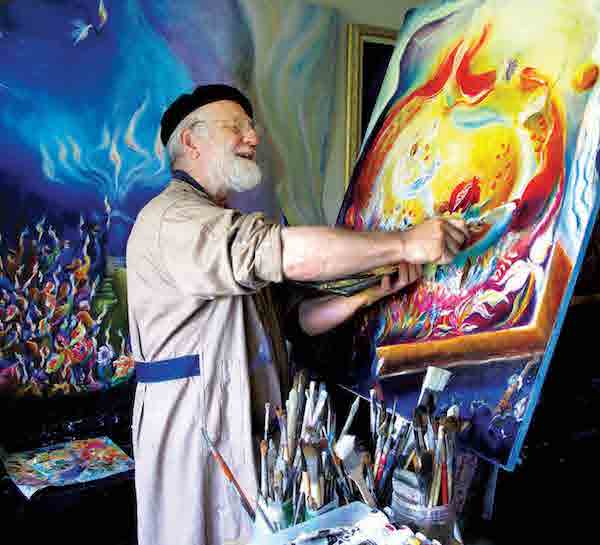
Mordechai Edel is among the artists featured in the latest edition of The Scribe, which will be released April 19 at VanDusen Botanical Garden. (photo from JMABC)

The Jewish Museum and Archives of British Columbia (JMABC) is releasing its 40th issue of The Scribe, which celebrates the lives of B.C. Jewish residents by focusing on one sector each edition. The official release of the Visual Arts Issue will take place on April 19, 7 p.m., at VanDusen Botanical Garden, in the Floral Hall.

image - Visual Arts Issue of The Scribe coverThe 2022/23 issue features a cross-section of the province’s Jewish visual arts community, including painters, sculptors, mixed media artists, illustrators, textile artists, art educators, art consultants, an art curator and a gallery owner. Features are based on interviews recently documented for the JMABC and interviewees represent several cities and many islands. They include Ron Appleton, Miriam Aroeste, Hinda Avery, Suzy Birstein, Tanya Bub, Olga Campbell, Janis Diner Brinley, Mordechai Edel, Janet Essevia, Jessica Freedman, Linda Frimer, Monica Gewurz, Lori Goldberg, Pnina Granirer, Barbara Heller, Jeannie Kamins, Stacy Lederman, Julia Lucich, Anna Lutsky, Cynthia Minden, Suzy Naylor, Joyce Ozier, Nora Patrich, Marcia Pitch, Jack Rootman, Sidi Schaffer, Phyllis Serota, Elizabeth Shefrin, Carla Stein and Mia Weinberg.

“The Visual Arts Issue of The Scribe is surely one of the most dynamic and visually stunning publications in its 40-issue history,” said Daniella Givon, JMABC president. “Jewish individuals have made significant contributions to our province’s arts and culture sector throughout our history in B.C., and 2023 is a fitting time to take an historical snapshot of artists who are working and thriving here.”

Carol Crenna, managing editor of The Scribe Visual Arts Issue, added, “It’s been an extraordinary experience to meet this group of talented Jewish artists, many internationally known. They are fearlessly innovative, inspiring individuals with the strength and ability to push boundaries and bridge beliefs. They’re also wonderful storytellers with rich life experiences. I found their personal stories fascinating, and often entertaining, but, most important, they made me think differently.”

The publication’s launch will include a silent auction of artworks donated by many of the artists highlighted in the issue. The keynote speaker of the event will be journalist Marsha Lederman, Western arts correspondent for the Globe & Mail. Refreshments will be served. All proceeds are in support of the JMABC.

For tickets ($36), visit jewishmuseum.ca.

– Courtesy Jewish Museum and Archives of British Columbia

Systemic change possible?

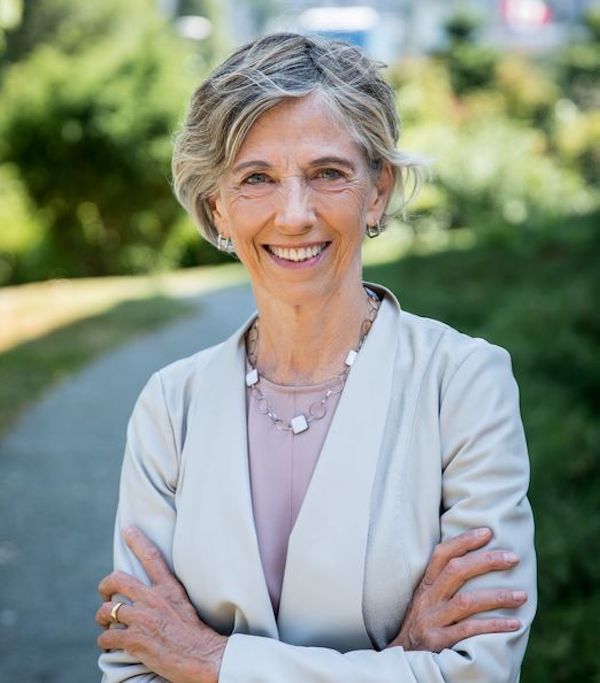
Eleanor Boyle’s Mobilize Food! Wartime Inspiration for Environmental Victory Today offers concrete ideas for how food systems can be transformed. (Julie Doro Photography)

I plan to make the Honourable Woolton Pie. Just for fun, not necessarily because I think it’ll taste wonderful, though it might. Named after Lord Woolton (Frederick Marquis), who was appointed minister of food in 1940 Britain, it represents several of the British government’s goals during the war years: it was “meatless, thrifty, filling, and made use of domestically produced in-season foods.” The recipe is in Eleanor Boyle’s latest book, Mobilize Food! Wartime Inspiration for Environmental Victory Today (FriesenPress, 2022). The book is the only reason I know who Woolton is. More importantly, the book offers many reasons to feel less naïve for mostly believing that humankind can save ourselves and the planet before we kill ourselves and the planet.

Mobilize Food! is an optimistic examination of Second World War rationing and other wartime policies in England and how the lessons from that period could help us counter the climate crisis by changing our food systems, to start. Lest one think that Boyle is a pie-eyed dreamer, she has solid credentials – a bachelor’s in psychology, a master’s in food policy and a doctorate in neuroscience. The Vancouverite also has been a journalist and she taught for many years. She wrote the book High Steaks: Why and How to Eat Less Meat (New Society, 2012).

image - Mobilize Food! book coverDespite all of Boyle’s education and experience, she still believes that radical change is possible. This is heartening in and of itself. But it’s the 42-page bibliography that I found more assuring. The recommendations Boyle makes in Mobilize Food! are based on extensive research. And they consider what individuals, governments and businesses are already doing, as well as what they could be doing more of (which is a lot). She is not arguing for a socialist utopia, or a utopia of any sort, though she does imagine more engaged, civic-minded communities than I think currently exist anywhere in the world. That said, she gives an example of a city that apparently has ended hunger – Belo Horizonte, Brazil, “which in 1993 declared access to food as every citizen’s right. It then implemented food price subsidies, supply and market regulation, supports for urban agriculture, education on food preparation and nutrition, and job creation in the food sector.”

How does this relate to Second World War Britain? As did Britain during the 1940s, Belo Horizonte set up state-subsidized restaurants that are open to everyone (to avoid stigmatizing people on lower incomes), it feeds kids in the public education system every day, it partners with private grocery stores so that they can sell cheaper fruits and vegetables, and it supports family farms, among other actions “that help democratize food.”

Boyle provides copious data and examples of how the food industry, as it stands, is contributing to climate change “by contributing at least a quarter of human-caused GHGs [greenhouse gases].” It does this through its use of fossil fuels, the cultivation of monocultures (“vast, unnatural acreages of single-species crops”) and destroying ecosystems by removing or burning vegetation, among other activities. One of the eye-opening stats is: “Some analysts calculate the contribution of livestock to overall anthropogenic GHGs as at least 30% and as high as 51%.”

Boyle argues persuasively that how we produce and consume food can be transformed. The first half of Mobilize Food! runs through all that Britain did to make significant changes, “from national agricultural policy to the family dinner plate. They didn’t wait for dire food shortages or society-wide agreement of exactly how to proceed. Even before war was declared, government set up a high-powered food committee to craft plans for making food systems crisis-ready.” They used multiple strategies and strived for general engagement using PR campaigns and other tools. “The programs were simple but transformational,” writes Boyle, “based on shifts toward domestically produced, plant-rich and minimally processed foods. Together those programs adequately fed the population – and, in many ways, better than prewar, by providing broader and more equitable access to food and enhanced health [reducing diabetes and heart disease, for example].”

The wartime measures also show that people can change how they eat and act, she notes. But leadership is key – Lord Woolton was very charismatic, it seems, and, on the larger scale, Boyle writes, “Only governments have the mandate for the public good, the oversight for national strategy and the legislative levers. Only public officials can do the necessary system-wide planning, coordinate sectors, forge agreements across regions, and make the tough decisions.” Lastly, such massive change relies on everyone participating: “We’ll need to think systems-wide and involve every segment of society, every community, every food-related business and civic organization, and every one of us.”

Boyle admits this all “sounds like fantasy. But, as the story of World War II Britain shows, such a transformation has occurred.” Am I personally convinced we have what it takes to mobilize so drastically? The larger whole is still too much for me to contemplate, but I can eat even less meat and fewer processed foods, buy more from local growers, invest in businesses that improve the environment and/or social outcomes, support politicians who are working toward a healthier and more inclusive society. No doubt, there is much more that I could be doing, but it’s a start.

I’m glad that I read Mobilize Food! Full of images (including awesome wartime PR posters), data and stories from people who lived through the war effort, it is engaging on many levels. It reminded me that what seems impossible may not actually be so. And the importance of hope – combined with action – cannot be overstated.

For more information, visit eleanorboyle.com.

Thinker on hate at 100

Next month marks the centenary of the birth of a psychiatrist whose work on antisemitism deserves a fresh reading. Theodore Isaac Rubin was born 100 years ago April 11. He died at 95, in February 2019. His 1990 book Anti-Semitism, A Disease of the Mind: A Psychiatrist Explores the Psychodynamics of a Symbol Sicknessposited that bigotry against Jews may be a mental disorder.

Rubin had a sprawling career, writing fiction and nonfiction. His 1961 novel Lisa and David, a love story of teenagers with severe mental illnesses, was made into a film the next year and garnered two Academy Award nominations. But Rubin’s work, in addition to his clinical practice in New York City, was primarily devoted to psychology and self-help, including weight loss. He has been credited with coining the term “comfort food.”

Rubin attributed antisemitism to “symbol sickness.” Human beings use symbols to represent objects in the world and to communicate how we feel through these symbols – love and hate being among the most familiar. Symbol sickness occurs when a symbol becomes so divorced from its original meaning that it takes on a distorted or pathological sense. Antisemitism can occur when the objective meaning of “Jew” is imbued with projections from the mind of a person we would call antisemitic.

“The symbol tends to take on increasing importance, and this can and often does reach a state in which there is obsessional preoccupation with it,” he wrote. “In projecting inner conflict to, let us say, Jews, what really happens is that Jews – the symbol – are assigned roles representing aspects of one’s own conflicts.”

Rubin saw envy and feelings of exclusion as central to antisemitism, particularly the idea of a people who the spectator perceives as inferior yet are, in theological terms, “chosen.” The perception that these “inferior” people have little or no interest in him can lead the antisemite into frenzies of rage.

“Even as [the antisemite] denigrates the Jews, he envies what he sees as separateness, clannishness and exclusivity,” he wrote. “He believes that Jewish lack of interest in him, let alone winning him over, is a form of rejection. His reaction to rejection is enormous self-hate and projected self-hate. He rejects and despises the Jew, salving his own hurt pride and disguising his secret admiration and envy. He further embroiders the disguise, twisting envied Jewish characteristics into threatening ones. Thus, he sees Jewish commonality and cohesiveness as arrogance and unwillingness to meld and cooperate with the larger society. Even more, he sees Jewish cooperation and lack of missionary zeal or their desire to assimilate as secretive, cabal-like machinations.”

Perceptions of Jewish achievement can be similarly problematic.

Jews “had to cooperate in order to survive,” wrote Rubin. “They connect the past, present and future, and connect to each other. They profit from the wisdom and experience of forefathers and the group. This makes Nobel Prize cooperative efforts possible. This also makes them the envy – often the malignant envy – of the self-disenfranchised (from self, others, and past and future) antisemite to whom they become prime objects of projected self-hate. The Jew is an intense cooperator. The antisemite’s philosophy confuses commitment, dedication, intense interest, involvement and optimism with sick competition.”

Waiting for the Messiah – who never arrives – is a lesson in the process of postponement of gratification, Rubin argued, offering a reason for collective success – but rational explanations are not accepted by an antisemite. “To the antisemite, Jewish achievements are not seen in this light at all. They are seen as the result of slimy manipulation and cabal-like insider cooperation, designed to frustrate non-Jews.”

For people who are oppressed by political leaders, theology, daily drudgery or any other factors, antisemitism offers a scapegoat. Jews are a symbol of freedom – even when they are oppressed by dictatorial regimes or violent neighbours – merely because they exist outside of the majority society.

image - Anti-Semitism, A Disease of the Mind book coverRubin goes to some lengths to address Christian antisemitism and how it may fit into his thesis of anti-Jewish bigotry as a mental disorder. Rubin suggests that Christians who traditionally have accused Jews of deicide are not expressing hatred for the perceived annihilation of their deity, but the opposite. Jesus the Jew, in the Christian narrative, is the conscience-giving entity, paralleling the role of Judaism as the wellspring of ethical monotheism.

“The Jew is hated for being a conscience-giver rather than a Christ-killer,” according to Rubin. “Even as they kill the hated conscience-giving part of Jesus symbolized by the Jew, they brag about love for Jesus and Christian brotherhood.”

The antisemite may venerate the loving, compassionate aspects of Jesus, but struggle against the strictures imposed by moral and behavioural principles that accompany the theology.

“I believe that rabid antisemites who have convinced themselves of the historical delusion that Jews killed Christ unconsciously really admire and envy them for doing so,” Rubin added. “They also are secretly grateful to the Jew for providing them with a symbol to which they can displace that hatred. Hating Jesus directly is terrifying indeed and threatens overwhelming guilt, unbearable self-hate and eternal damnation. Calling Jews ‘Christ-killers’ supports shaky identifications with Jesus and even more so with his teachings. This helps convince the victim that, as the Jews killed Christ, the hater of Jews loves Christ.”

Similarly, the ethical constraints that are inherent to most religions – but which a Christian might associate with the Jewish origins of their own theology – might lead to not only a lashing out against their own church or clergy, but a messy effort to improve one’s own self-worth by “proving” the moral failure of the followers of the antecedent religion.

“To be Jewish is to be righteous, ethical in the world,” Rubin wrote. Identifying and emphasizing examples of Jewish moral failing is a form of self-redemption, he argues. If the Jews, the apparent fountainhead of Christian morality, can be proven as hypocrites, one’s own shortcomings may seem less corrupt.

Like the bogeyman under the bed, the antisemite is terrified of a monster of their own creation.

“The antisemite assumes that he is hated by the Jew at least as much as he hates the Jew,” Rubin wrote. “He must keep the Jew powerless and in sight at all times and, if possible, obliterate him, because the secretive creature of secret cabals may have special powers, powers derivative of the God of the Old Testament.”

Jewish reverence for life – exemplified in the toast “l’chaim!” – may be another source of resentment for people who are taught that their reward will come after death.

“To the Jew the greatest courage is not related to death but rather to life. To live and to live an ethical, caring life is a courageous way of life,” wrote Rubin. “The antisemite and all bigots are essentially joyless, life-denying, disconnected, auto-digestive people.”

There may also be a foundation of misogyny in antisemitism, Rubin suggested, with Judaism portrayed as the “mother religion” of Christianity.

As a representation of motherhood, he wrote, Jews “then offer an easy target for displacement and projection. Hatred for the mother is repressed to the unconscious and projected to Jews on the conscious level. This projection would be fed by any disturbed relationship with parents or authority.”

Additionally, peace is traditionally symbolized as feminine and war as masculine. The Jewish quest for peace – “shalom!” – is juxtaposed with, to offer just one example, the Crusades, and Jews’ perceived passivity in the face of centuries of oppression may be interpreted as a feminine docility by those who esteem masculine aggression. (The inversion of this, in recent decades, through the perception of Jewish aggression in the form of Israeli military actions, could be seen as an eruption of envy or outrage over a people who “don’t know their place.”)

Lashing out at others as a response to (real or perceived) internal shortcomings may be a desperate response to perceived shaming, according to Rubin. “The saddest is a person whose feelings are blunted and even deadened,” he wrote. “This means that inflicting pain is a last-ditch attempt to have feelings vicariously oneself. Coupled with bullying tactics, the infliction of pain makes the sadistic bully feel momentarily alive and potent. This is compensation for feeling powerless, helpless and dead.”

Rubin’s assessments rest on the idea that the perpetrators of antisemitism are bullies who perceive themselves as bullied. This is a fundamental way that antisemitism differs from most forms of discrimination or bigotry, which tend to position the perpetrator as superior to the victim. An antisemite often imagines Jews as believing they are superior to others, which leads the antisemite to feel driven to bring Jews down a notch.

When Rubin wrote his book, in 1990, antisemitism, at least in North America, was largely believed to be a fact of history. Since it came roaring back, a decade later, we have struggled to explain and contain it. We generally fall to sociological explanations and Rubin’s unique approach – a psychological explanation – is an important one to help understand a phenomenon that, to be frank, we really have no firm consensus about how to confront.

Book Fest epilogue event

Jack and Edie Austin (photos from JCC Jewish Book Festival)

image - Unlikely Insider book coverFormer federal cabinet minister and senator Jack Austin, who has been involved in politics and public policy for more than 50 years, and his daughter, Edie Austin, editorial page editor of the Montreal Gazette, will be in conversation with Ronald Stern, founder and president of Stern Partners, on Feb. 28, 7 p.m., at the Rothstein Theatre as a Cherie Smith JCC Jewish Book Festival epilogue event.

The two will discuss their book, Unlikely Insider: A West Coast Advocate in Ottawa, about Jack Austin’s public service. With both historical perspective and an eye to the future, Austin reflects on events and people whose impacts are still being felt, and on the enduring challenges of Canadian life. For tickets ($18) to attend the event, visit jccgv.com/jewish-book-festival.

– Cherie Smith JCC Jewish Book Festival

Series tries to inspire climate action

Tikkun olam, repairing the world, is a central tenet of Jewish life, but sometimes the task can seem overwhelming. The climate crisis looms large for all of us, but especially for younger folks, who will bear the brunt of its effects. A new graphic novel for 6-to-12-year-old readers offers an optimistic, fun story about the power of kindness – towards ourselves, other people, animals, the environment – to energize and inspire us to action, to at least try and fix things.

I Can Hear Your Heart Beep, published by Planet Hero Kids in Vancouver, is the first book of the children’s graphic novel series Steve and Eve Save the Planet. Written by Paul Shore and Deborah Katz Henriquez, with imaginative and colourful illustrations by Prashant Miranda, the book is being released on Feb. 25, in recognition of International Day of the Polar Bear, which takes place Feb. 27. One of the book’s two main characters is a polar bear, Steve, who lives in the Arctic. Steve, Eve (an electric vehicle) and their friends come to realize that it is up to them to do whatever they can to clean up the environment and try to stem the global warming that is, among other things, reducing the animals’ food supply.

image - I Can Hear Your Heart Beep book coverEve ends up in the Arctic accidentally. Bullied and ostracized by her “gassy car cousins,” who tell her, “You’re just a heartless machine, sister – like us – you’ll never make a difference in this world!” she takes off (she has wings) to find her “pack,” other electric vehicles. On her way to Norway, she experiences a malfunction that lands her in the Arctic, where she is found by Steve, who’s having problems of his own – driven to stealing food because he’s so hungry, and missing his parents, who went away to find food and haven’t returned.

I Can Hear Your Heart Beep is the genesis story of the two likely-to-become environment heroes, Steve and Eve. We find out their motivations and meet their first sidekicks/allies, the other Arctic animals, and Burger the Booger, their first nemesis of, no doubt, more to come.

For readers wondering about the choice of an electric car as a heroine, Shore writes on the book’s website: “The spark that started our Planet Hero Kids journey first became visible when my pyjama-wearing 8-year-old daughter spontaneously hugged an electric car! That day of our first EV test drive, my daughter laid her little body on the car’s hood with arms outstretched across it, and with one ear against the smooth metal she said, ‘she has a heartbeat.’ The fact that the car seemed calm, gentle and fun … seemed to tell her that the machine was as friendly as a family pet.

“The realization that young children intuitively understand what is healthier for them and the planet sent me in search of partners to help create an uplifting climate action kids book that would cultivate hope and a sense of opportunity during the challenging era in which our children find themselves growing up.”

Shore took the idea to Henriquez, who, he told the Independent, he “first met at an author’s reception at the JCC book festival several years ago!” The pair began their collaboration, eventually connecting with Miranda.

I Can Hear Your Heart Beep can be ordered from Amazon. For more information on the series, visit savetheplanetbook.com.

Fresh new fairy tale

Making old, familiar stories new and fresh again. Writer Sandy Lanton and illustrator Kim Barnes do just this with their take on Red Riding Hood: Lily Blue Riding Hood, published by Seattle’s Intergalactic Afikoman.

Lily loves to skateboard and almost every page of Lily Blue Riding Hood is full of movement, as she swiftly rolls to everywhere she needs to be. On Purim, it’s to Granny’s house, with her blue hoodie pulled over her Queen Esther costume, its crown atop her helmet, her backpack full of hamantashen she’s just baked (leaving behind the messiest of kitchens). On the way, she passes Thaddeus T. Wolfe and chats long enough with him that the smell of the hamantashen gets him plotting how he can get Granny’s treats for himself.

Readers can make their own treats using the recipe for Lily’s Skateboarding Hamantashen, which are the regular triangle shape, but then attached to a long flat cookie, the “skateboard,” and either small round cookie or candy “wheels.” The recipe page also includes a paragraph on what Purim is and how it’s celebrated.

Lily Blue Riding Hood is a colourful and humour-filled modern-day Jewish fairy tale that will make both adult and child readers smile.

Survivor reflects on identity

Marie Doduck speaks with a guest at the launch of her book A Childhood Unspoken on Jan. 22. (photo by Josias Tschanz)

“We survived.” These are the words that adult Marie Doduck would tell her childhood self, Mariette, who survived the Holocaust being moved from hiding place to hiding place over a period of five years.

Doduck was answering a question during a book launch laden with emotion – deeply sad as well as celebratory and with moments of laughter – Jan. 22 at a packed Rothstein Theatre. Her book, A Childhood Unspoken, was just released by the Azrieli Foundation’s Holocaust Survivor Memoirs Program.

In a conversation with Jody Spiegel, director of the memoirs program, Doduck spoke of how she is two people – the European Jewish child, Mariette Rozen, who never grew up, and the Canadian adult, Marie, who she had to create to suit her new surroundings after arriving in Vancouver with three orphaned siblings in 1947.

“Mariette will never grow old,” she said. “The child Mariette will always be the child inside and that’s what survivors live. We left the child that was in Europe, we created a wonderful life here in Canada, but when I speak and when I leave this room Mariette stays in this room and I become Marie again.”

Doduck explained her long hesitancy in sharing her story, not only because of the vulnerability it requires, but because the experiences of survivors like her had been dismissed and diminished in the past.

“As a child survivor,” she said, “we were told that we didn’t have a story.”

For decades after the end of the Holocaust, the term “survivor” was largely reserved for those who had been in concentration camps or subjected to forced labour. Child survivors who had been hidden or otherwise managed to escape capture and murder were deemed not to have suffered like older survivors.

This silent or quietly conveyed message was underscored by the way child survivors were treated after the war, even by well-intentioned adults like the families who fostered some of the 1,123 orphans, including Doduck, who came to Canada under the auspices of Canadian Jewish Congress from 1947 to 1949.

“We were from outer space,” she said of the reactions she and fellow child refugees received from Canadians. “We saw things that children should never have seen.”

Placed in homes with new families, with little or no assistance in addressing what they had experienced, many children did not do well.

“Of the 40 children who came to Vancouver, my brother Jacques and myself, I think, were the only two lucky children who stayed with the same family,” Doduck said. “My sister [Esther] didn’t stay with her first family, she became an au pair. Henri jumped from family to family.”

In some cases, said Doduck, the children were told they would die by the time they were 30 “because we were not normal in the Canadian eyes.”

Doduck wrote the book with Dr. Lauren Faulkner Rossi, assistant professor of history at Simon Fraser University. Speaking at the event and addressing Doduck directly, Faulkner Rossi acknowledged that the process was difficult.

“You would have to become the child Mariette many times,” she said, noting that Doduck was forced to plumb memories she has tried to forget. Faulkner Rossi said Doduck had to trust her, though Doduck’s “inclination is to trust no one – a crucial Holocaust childhood lesson that is never quite unlearned.”

“It’s a hard process for any child survivor to write their story,” Doduck said, not only because of the emotional toll but also because of the imperfections of childhood memories. “Did we hear it from adults? Did we live it? I wanted the truth.”

Doduck pressed Faulkner Rossi wherever possible to substantiate her recollections with historical evidence. During the process, Doduck recalled things she thought had been lost. “Sometimes one memory triggers another that you thought you had forgotten,” she said.

Doduck is a founding member of the Vancouver Holocaust Education Centre, through which she has shared her history with tens of thousands of students and others. She is also a philanthropist and community leader, volunteering and leading events, including co-chairing, with fellow VHEC co-founder Dr. Robert Krell, the 2019 conference of the World Federation of Jewish Child Survivors of the Holocaust and Descendants, in Vancouver.

Before Doduck’s presentation, VHEC executive director Nina Krieger described Doduck as “a force … a formidable and sought-after champion for many community organizations. She is also a mentor and a friend to so many, including me, and has inspired more than a generation of community leaders, especially young women, with her vision, passion, tenacity and work ethic, not to mention good humour and grace.”

The book launch event was presented by the VHEC and the Azrieli Foundation. Doduck’s daughters Cathy Golden and Bernice Carmeli read from the book. Arielle Berger, managing editor of the Azrieli Foundation, noted that, since 2005, the foundation has published more than 150 memoirs of Canadian survivors of the Holocaust. The foundation provides the books for free to schools and universities and also provides teaching resources and training to educators. This was the first in-person book launch since the pandemic.

The full theatre was still during an emotional moment when Doduck addressed her family in the front rows.

“I don’t say it often and I want to say it publicly to my children, my family sitting here, thank you for accepting who I am,” said Doduck, now a great-grandmother, before acknowledging the lack of experience with which she approached parenting. “When I was blessed with my children, my husband had to teach me how to go to the library and get a book,” she said. “I never knew a story to tell the kids.”

As a child, she said, Mariette was never hugged, never put to bed, was never kissed, never had a toy and never had a bedtime story.

“My first toy, I was 36 years old, I was the guest speaker in Winnipeg at a fundraiser,” she said, “and they gave me my first doll. I still have it. The only doll I ever had in my whole life.”

As a founding member of the local group of child survivors who meet regularly, Doduck tried to explain the uniqueness of child survivors to their own children.

“We all passed something to them that we didn’t realize we were doing, a burden that we gave to our children, our firstborn,” she said. “I apologize to all the firstborn. We didn’t mean to put a burden on you.”

She takes pride and sees a sense of progress in the different ways her three daughters have viewed her.

“My middle daughter, Bernice, always accepted me. That’s the way mom is,” she said. “That’s the middle child of all the survivors’ children. And my youngest daughter, Cheryl, may she rest in peace, only thought of me as a Canadian. So, I progressed. I fulfilled my duty in becoming Marie, the Canadian.”

An intense, urgent read

A formula for survival for a child in the Holocaust: “Don’t trust anyone; never speak unless spoken to; never give your real last name; if you see your brothers and sisters, don’t run to them: cross over to the other side of the street. Don’t cry and don’t get sick; just survive.”

This is how the character of Mariette Rozen of Brussels, Belgium, aka Marie Doduck of Vancouver, Canada, was fashioned during her formative years between the ages of 6 and 11 during the Holocaust, beginning in 1940. Those words of caution from her older brother Jean, painfully scoured from the mists of Marie’s memory, have become a kind of coat that one takes off in polite company, but it is a mantle that never left her, even in her 80s, as Marie looks back in her memoir on her two lives: a child Holocaust survivor and a Canadian with a lifetime of achievement in the arts, family life, business and service to her community.

image - A Childhood Unspoken book coverEntitled A Childhood Unspoken, this book of only 138 pages is a powerhouse! Co-authored and researched by Simon Fraser University history professor Lauren Faulkner Rossi, the memoir is written in two authentic voices: Marie Doduck the Canadian citizen, 86-year-old mother, grandmother and great-grandmother who, while recollecting her past, slips back into Mariette Rozen, being hunted or hiding in Belgium in the 1940s or transitioning to a new life in Vancouver in the 1950s. I began reading the first chapter silently. Then, the urgency and honesty of the voices behind the prose came alive. I wound up reading the entire book aloud to my partner Ruth, who grew up with Marie and shares high school memories with her.

It was an intense experience. There is in the book an urgency to at last speak the unspoken repressed memories of her traumatic childhood, to unearth and – most importantly – to verify the truth of Marie’s memory about where Mariette had been, with whom and where she lived as she was bounced from one location in Belgium to another while running from the Nazis. Marie wondered: did Mariette really see her mother and brother snatched from a Brussels street by the Nazis or did that happen in a dream? Did she have grandparents? This and much more was verified through Faulkner Rossi’s research. Marie’s memory grew clearer, however, when she described the frustration of Mariette the teenaged refugee whose lack of English drove her to draw pictures in order to communicate with her Vancouver foster parents, the Satanoves.

But Mariette desperately wanted to catch up on her education, to fit into the Kerrisdale schools of Vancouver. To become a Canadian. Very quickly, and to the amazement of other children, she not only learned English but even seized leading singing roles in school operettas. As a married woman, the same talent, grit, brains and determination guided Marie to leadership roles in her children’s schools, in her synagogue, in Jewish charities and in business with her husband, Sidney Doduck. She gained such a wide reputation as a Holocaust witness and survivor that she was invited to address the German parliament, which she refused.

Several of the Shoah episodes retold by the Doduck-Rossi team bear repeating here. In a Belgian orphanage where Mariette’s Jewish origins had been carefully guarded, one of the nuns told the Nazis about her but then confessed it to the Mother Superior, who quickly opened a sewer for Mariette and banged the metal plate closed over her. Mariette waited for hours, terrified in the black sewer while rats crawled over her and the boots of Nazi soldiers clanged on the metal plate above. The Nazis left empty-handed.

Chased by Nazis, Mariette took shelter in a Belgian barn but knew that she couldn’t hide in a loose haystack because they would be probing them with pitchforks, so she chose a tightly-bound bale, dug a hole for herself, crawled in and pulled the hay in behind her. Sure enough, a Nazi came and began probing the loose stacks with a pitchfork. As he left, he stuck the fork into Mariette’s bale and pierced her hand. When the farm housewife came to rescue her, she found blood all over and took the child into the kitchen for repairs. “Who is doing all the screaming?” Mariette wondered out loud. “It’s you,” said the woman as she disinfected and bandaged the wound.

Although Mariette saw much brutality and death, there were some good people. Among her many saviours was a “good” German soldier. Mariette had been swept up on a Brussels street along with many other Jews and non-Jews, packed into a cattle car and transported to a concentration camp overnight. When the doors slid open at the camp, a Nazi soldier screamed in German, “What is my sister doing on this train?” Without hesitation, Mariette began screaming back the few German words she knew and the Nazi soldier took her off the train, put her into a motorcycle sidecar, drove her to the outskirts of town and dropped her off.

I was inspired by Marie’s Judaism. There is also much to be admired about her lack of hate and her anti-hate philosophy, her lack of self-pity and the life force that drove her to accomplish so much and to give back so much. Yet this book is also a tribute to Marie’s brothers and sisters and to all of those approximately 1,200 traumatized Jewish children who were brought to Canada after the war and strove to fit in and to make themselves a new life. It’s a memoir that Marie’s children, grandchildren and great-grandchildren can proudly cherish as a history of their ancestor who is one of this country’s great Jewish Canadians.

Stan Goldman is a retired English teacher who lives in Richmond.

Integration policy misguided

Max Czollek, left, speaks with Prof. Chris Friedrichs, after Czollek launched his new book here Jan. 19. (photo by Pat Johnson)

German attempts to create a cohesive national narrative into which newcomers must integrate is a mistake – and the role Jewish Germans play in this “Theatre of Memory” is especially problematic, according to Max Czollek, a provocative thinker who was hosted by the Cherie Smith JCC Jewish Book Festival last month.

Czollek visited Vancouver Jan. 19, the only Canadian stop on a North American tour promoting the English translation of his book De-integrate: A Jewish Survival Guide for the 21st Century. He excoriated the German integration process as an ideological disaster.

“The only integration Germany has done well is the integration of old Nazis,” he said, explaining that about 99% of Nazi core perpetrators never met justice and, in fact, often succeeded in postwar Germany despite their wartime activities. By contrast, he notes in his book, those who challenged the Nazi regime were often viewed in the postwar context as politically untrustworthy: “[A]fter all, they had already revealed themselves as willing to resist the structures of the German state before.”

While the failure of the larger integration scheme is a theme of Czollek’s book, his main thesis is that Jews are being used to cover up the atrocities of the past. In the contemporary German narrative of integration, newcomers to the country are expected to assimilate into a vaguely defined “guiding culture” (Leitkultur) and not misbehave, Czollek told an audience in the Zack Gallery. But, despite that the vast majority of German Jews are migrants, too, that expectation is not imposed on them. Instead, Jewish Germans are assigned a different and unique role in a German narrative that seeks a return to a normality that was shattered by the Nazi era.

Positioning German Jews collectively as bit players in a larger narrative of redemption reduces them to a cover for the history of their own destruction, he argued: “Because, as long as there are Jews in Germany, then Germans can’t be Nazis.” He later said, “We don’t feel this is our function – making Germans feel good again.”

Czollek, who was born in East Berlin in 1987, two years before the reunification of Germany, explained the different postwar experiences of the tiny Jewish populations of East Germany and West Germany. Numerically, though, these experiences are overwhelmed by those of post-Soviet Jews: 90% of German Jews are migrants from the former Soviet Union or their descendants, he said. And these migrants (or, in the term used for their children and grandchildren, “postmigrants”) are excluded from the burdens placed on other newcomers, especially Muslims. In fact, said Czollek, Muslim immigrants play a role in this narrative, too, in which “good Germans” must now protect Jews against perceived threats from Muslims.

image - De-integrate book coverThe author looks with a particularly jaundiced eye at German Jews who subscribe to this narrative, such as those who vote for the far-right Alternative for Germany party (AfD) based on anti-Muslim and anti-immigrant policies. “Maybe the next time the mosques are going to burn first, but then the synagogues are going to be next,” Czollek said. “We know if the Muslims won’t be able to live safe in Germany, then the Jews won’t either.”

The very idea of a German “guiding culture” is flawed, Czollek argues, not only because the unification of Germany in the 19th century brought together diverse tribes and groupings into what is now purveyed as a unitary nation, but because the postwar immigration of diverse peoples has made such a unified culture unworkable. “Because, given its current state of social diversity, arriving at an ethnically and culturally homogeneous Germany would simply require ethnic and cultural cleansing,” Czollek writes.

A central flaw in the integration narrative, he argues, is that, no matter how long someone named Mohammad has lived in Germany, they will be subject to different criteria of good citizenship. Neo-Nazis who commit arson against refugee shelters or march down the street chanting “Heil Hitler” are not accused of failing to integrate into the German culture, he noted.

“[A]t what point are you no longer considered an immigrant who refuses to integrate [Integrationsverweigerer], but simply a frustrated German?” he asks.

Czollek contends that the narrative of a prevailing German culture (and integration into it) has seeped from the far-right across the spectrum. “Not a single democratic party platform neglects to centre this term in discussions of social belonging,” he writes. “No discussion panels about migration are complete without someone underscoring the importance of integration.”

Czollek argues for a live-and-let-live approach, but suggests the advocates of integration aren’t interested.

“They can eat weisswurst with sweet mustard for lunch and drink at least one litre of beer a day,” he writes. “I have no problem with that and neither do my friends. And that’s precisely the point that fundamentally separates those of us who would defend a concept of radical diversity from those proponents of German guiding culture: we want to create a space in which one can be different without fear, while the other side wants to implement cultural criteria for belonging that by necessity exclude those who don’t align with their concept.”

The original German version of Czollek’s book was published in 2018, shortly after the far-right AfD had become the third-largest party in the Bundestag. Rather than spurring a backlash against extremism, other politicians took a page from the playbook, he argues, with the parties of the right, centre and left warning of the perils of nonintegrated newcomers.

Czollek views the AfD’s rise as a symptom as much as a cause – “Suddenly things everywhere are staining Nazi brown,” he writes – and he sees a different avenue for political success in the face of the far-right surge.

“I don’t believe Germany will win the fight against the New Right without the votes of (im)migrant, postmigrant, Jewish and Muslim citizens,” he writes. “And this critical – if perhaps unfamiliar – new alliance requires strong narratives, the willingness to accept self-criticism from all sides, and a political vision for a society beyond the current integration paradigm.”

Czollek has a doctorate from the Centre for Antisemitism Research at the Technical University of Berlin, has published books of poetry, and is a co-editor of Jalta, a journal of contemporary Jewish culture. He has been involved in political and multicultural theatre in Berlin for many years but with this, his first nonfiction book (translated into English by Jon Cho-Polizzi), he burst on the scene as a contentious public intellectual. The opposition to his work evoked not just political challenges but also public efforts to discredit him based on his identity as a patrilineal Jew.

Czollek’s presentation, in conversation with Markus Hallensleben, associate professor in the department of Central, Eastern and Northern European studies at the University of British Columbia, was opened by book festival director Dana Camil Hewitt. The main festival runs Feb. 11-16.