
For more cartoons, visit thedailysnooze.com.
Author: freelancer
The fight faced by the West – Melanie Phillips delivers the Faigen Family Lecture
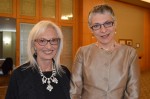
From left, Meryle Kates, executive director, Toronto chapter, Stand With Us, and British journalist and author Melanie Phillips. (photo from Vancouver Hebrew Academy)
On April 1, at the fourth annual Faigen Family Lecture Series presented by Vancouver Hebrew Academy, British journalist and author Melanie Phillips tackled what she called “the herd of elephants stomping around the furniture.”
From 9/11 to the 7/7 bus bombings in London, through the Spanish train and Mumbai bombings, the activities of Hezbollah and Iran, she said, “There is a refusal in the West to acknowledge the link between all these disparate events … that all these phenomena, which take different forms, are a variation of the Islamic religious war, or jihad. Now, we know that this is the case because the perpetrators tell us this – they tell us this over and over again in varying terms.”
More than 150 people filled the downstairs auditorium at Schara Tzedeck Synagogue to hear Phillips speak, which she did after brief remarks from VHA board co-president David Emanuel; Gina Faigen, whose father, Dr. Morris Faigen, z’l, created the lecture series; and Meryle Kates, executive director, Toronto chapter, Stand With Us, who introduced Phillips.
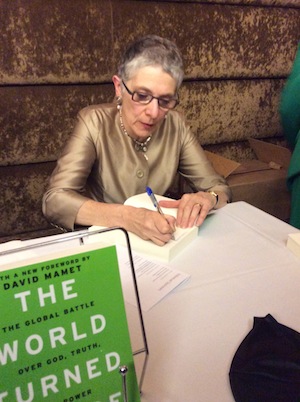
Phillips, author most recently of The World Turned Upside Down: The Global Battle over God, Truth and Power (Encounter, 2010), said that, in Britain, when 9/11 happened, they were told it had nothing to do with religion: “It was to do with poverty, it was to do with lack of education, it was to do with alienation from the surroundings of society.” Referring to the perpetrators of terrorism, she said they were not poor, they were well-educated and, in Britain, they were being alienated, not by Western influences, but by Islamic preachers. Nonetheless, the British were told, “It was Bosnia, it was Chechnya, it was Kashmir and, above all, it was Palestine. So, the way of solving this problem … was you dealt with grievances. Get rid of the grievances, and you will get rid of the problem of terrorism…. It ignored the fact that all these people said over and over again they were doing it for religious reasons, they were doing it in order to defend God against modernity, against America, against the Jews and against the West. It ignored the verses of the Koran which framed these declarations of war being perpetrated on Jews and on the West.”
Phillips said the British government now has decided “what we’re living through is the perversion of the religion,” but it is more accurate to say we’re up against an interpretation of the religion with which not all Muslims agree and, indeed, of which many Muslims are “the principal victims.” However, she noted, offering the British security service as her source, between 2,000 and 4,000 young British Muslims are considered to be “active terrorists” and “they believe the true number is far greater than that.” She added, “opinion polls show that some 40 to 60 percent of British Muslims want to live under sharia law. Now, this is no small matter. Sharia law is in direct conflict with the state, it recognizes no such authority.”
Britain has a “very, very serious problem of religious fanatical radicalization but it has not accepted this.” Only recently, she said, it was reported that the prime minister has set up an inquiry into the Muslim Brotherhood.
Phillips argued that reticence in dealing with terrorism comes from a decent impulse most people have: the fear of being intolerant. She said we must never forget that there are many Muslims “who come to the West because they actually subscribe to Western ideals in that they want to live in peace and freedom, they want to have jobs like everybody else, they want to bring up their families in peace and security like everybody else…. There are people who are so enraged by Muslim, by Islamic terrorism … that they forget that, and I think it’s very important that we don’t forget that. But it’s equally important that we don’t ignore the other side of the story.”
Liberal democracies welcome minorities, she said, as contributing to and enhancing the culture. “The quid pro quo, however, is that minorities have to, in their terms, sign up to a kind of overarching national story, an overarching set of values.” If the rule of law doesn’t apply to everyone, she continued, then a country is no longer a liberal democracy.
In the late 1980s, Phillips began writing about the “cultural vacuum” she perceived was developing. “I started writing about things to do with family, with education, with multiculturalism. It just seemed to me that, over the years, something was going very, very wrong with all these issues; values were being turned on their heads.” She gave the example of family breakdown becoming more of an entitlement, a person’s right rather than a thing that should be avoided if at all possible. She spoke of education in Britain as becoming more child-centric, the belief that imposing constraints and rules on children limited their creativity, leading to illiterate and innumerate children. As well, she said, certain self-defined victim groups were being given a free pass on their behavior because they were supposed victims of the majority.
“… the culture of the nation, as expressed in education, as expressed in the laws passed by that nation … was deemed to be illegitimate because the nation was deemed to be illegitimate. Why? Because nations led to nationalism, and nationalism led to prejudice and war, and if you wish to avoid prejudice and war, you basically abolish the nation … you set up institutions which trumped the nation, transnational institutions, which bound nations together under an umbrella of common values, and those were deemed to be more legitimate than the nation because those brought people together, they were inclusive, they didn’t separate.”
She described human rights laws as pitting one set of rights against another, rather than being universal, as was claimed, and contended this was part of a more general view that “the culture of the nation, as expressed in education, as expressed in the laws passed by that nation … was deemed to be illegitimate because the nation was deemed to be illegitimate. Why? Because nations led to nationalism, and nationalism led to prejudice and war, and if you wish to avoid prejudice and war, you basically abolish the nation … you set up institutions which trumped the nation, transnational institutions, which bound nations together under an umbrella of common values, and those were deemed to be more legitimate than the nation because those brought people together, they were inclusive, they didn’t separate.”
In Phillips’ view, multiculturalism doesn’t mean that we should simply be tolerant and respectful of minorities, but rather, as a doctrine, says that every single culture should be regarded as having identical value as every other. “So, that means that you cannot hold liberal values because … if you’re up against a culture which basically believes that women are second-class citizens or that gay people should be killed, then you as a liberal society cannot impose your view that gay people should have civil rights and that women should have equality because you are being racist, because you are imposing your culture on their culture … consequently, it’s a liberal death warrant, it’s a liberal society’s death warrant, multiculturalism.”
As with other isms, Phillips said, multiculturalism has become unchallengeable. This has happened, she argued, because the West has told itself that religion is bunk. “In other words, instead of adhering to a program which owes its origins to what are considered to be divinely inspired rules of behavior, man … shapes the world, or reshapes the world, according to his own wishes…. So, we have a whole range of ideologies which now govern our assumptions in the West. We have materialism, the idea that everything … must be explained by material explanation. We have moral and cultural relativism, the idea that what is right for me is what is right…. We have deep-green environmentalism, which says that the world would be a great place if only it wasn’t for the human race mucking it all up.”
Phillips said that ideologies replace truth by power. “In the non-ideological world, one looks at facts and evidence and then other facts and evidence and one reaches a conclusion. With an ideology, you start with the conclusion…. The idea governs how you look at the world and, if there is evidence that conflicts with that idea, you have to wrench the evidence to fit that idea … one group fights for supremacy over another group, and that’s how you lose the sense of a national overarching set of values.”
On a whole range of issues, “it is no longer possible to have a rational discussion with people who believe in these ideologies, as upon each issue there can be only one story for them…. Reason is replaced by bullying, intimidation and the suppression of debate.”
Ideologies drive out reason, she said. “And, if there is no truth, there can be no lies either because truth and lies are merely alternative narratives in the jargon of the time.” On a whole range of issues, “it is no longer possible to have a rational discussion with people who believe in these ideologies, as upon each issue there can be only one story for them…. Reason is replaced by bullying, intimidation and the suppression of debate.”
Phillips noted the irony in the West’s replacement of religion with secular dogma. “Just as with medieval Christianity, with Islam through the ages, these ideologies represent a perfectly closed thought system which brooks no alternative because … each of them aspires to create a perfect world, they are synonymous with virtue and, therefore, brook no opposition.”
They have turned evidence and logic on their heads, she said, in a way that is particularly relevant to Israel. “Because of the ideology of multiculturalism and minority rights, self-designated victim groups, defined as those without power, can never do wrong, while the majority groups can never do right. So, it follows, the Muslim world can never be held responsible for blowing people up because they are, as people of the Third World, victims of the West.”
In this scenario, she explained, Jews can never be victims, they are not a minority because they are held to be all-powerful and in control of the media, Wall Street and America – “so much of the hateful discourse about Israel follows from that.” Phillips said this echoes the narrative within Islam. “Because Islam considers itself to be the perfect, unchallengeable word of God, it can never do wrong.” All aggression by Islam is, therefore, seen as “automatically self-defence,” while Western or Israeli “real self-defence is said to be aggression.”
Added to this, she said, is “transnational progressivism,” in which nations are innately divisive and Western nations “innately colonialist, rapacious and cruel.” Israel, therefore, is “triply damned”: “It’s a nation, bad. It’s a Western nation, very bad. It’s a Jewish, Western nation, racist. So, when Israel goes to war to defend its people against the thousands of rockets coming at it from Gaza or whatever it is, the thousands of rockets are regarded as immaterial. What is important is Israel’s military self-defence in the interests of a Western, ‘racist’ nation. Terrorism, by contrast, becomes resistance.”
The utopian nature of ideologies makes them, “by definition, the most high-minded of ideas and thus the most high-minded people subscribe to them, the intelligentsia, which wear them as badges of conscience.” Among the things this explains, she said, is “the phenomenon of left-wingers, high-minded people devoted to human rights and sexual promiscuity marching shoulder to shoulder on the streets of London and elsewhere with radical Islamists devoted to killing homosexuals and stoning adulterous women to death under the common band of human rights.”
Worse, she added, is that, when utopia “fails to materialize, and utopia always fails to materialize, its adherents, its proponents, are so enraged by the failure of what cannot fail … that they select scapegoats on whom they turn to take out their rage over the thwarted establishment of a perfect world, and the scapegoats become enemies of humanity.”
One of the commonalities between all these disparate ideologies, she said, is “hostility to Judaism, Israel and the Jewish people.” She attributes this, in part, to the fact that it was Judaism that laid down the moral foundations of Western morality, “which is under attack from moral relativism.” And herein lies her solution.
In Phillips’ opinion, “the essence of the problem is the displacement of religion, especially biblical morality, and its replacement by secular ideology.” So, the religious basis of the West needs to be restored. She thinks this is possible for two main reasons. “First, people are not adverse to spirituality…. What they don’t want to believe in is in organized religion, but that’s very different from saying they don’t want to believe or that they don’t instinctively believe in something that is supernatural…. The second is this, there’s an assumption in our modern world that in one box is reason and in another box is religion and the two can never meet…. The fact is that religion was the wellspring reason, order, progress, human dignity and liberty…. Without the Hebrew Bible, these things … would not have existed and, I would suggest, that as religion has been progressively edged out of Western life, so truth and morality have crumbled, leading to irrationality, prejudice and so forth.
“Western science grew, essentially, out of the revolutionary claim in the Bible that the universe was the product of a rational creator who endowed men with reason so that he could ask questions about the natural world.”
“And it was not just any religion that created reason and progress,” she continued, “but very specifically Christianity and the Hebrew Bible from which it sprang, the Hebrew Bible…. Western science grew, essentially, out of the revolutionary claim in the Bible that the universe was the product of a rational creator who endowed men with reason so that he could ask questions about the natural world…. The problem arose in our modern times, when science overreached itself and sought to explain the inexplicable … and so, scientific materialism became a kind of faith in itself, an explanation for all things, but that isn’t actually the case.”
It is the same with equality, she said. “It is the Hebrew Bible again which tells us that we are all created equal in the eyes of God and, therefore, we have to respect each other as human beings and, without that biblical story, equality would not exist, nor would we have our assumptions of putting the interests of others first, which lie at the very heart of a civilized … society.”
The task of the West, she said, is “to re-Christianize, as the previous pope well understood. And I realize that to use those terms, to say the West must re-Christianize, causes a terrible frisson, not least among people in this audience. Christianity has not been an unalloyed pleasure for the Jewish people, but if we wish to defend and protect and assert Western culture, we have to accept that Christianity is at the root of Western culture, with all its freedoms and all its values…. And at the root of Christianity is the Hebrew Bible.”
As Jews, we must “help reconnect the Western world with those Jewish roots and values which are the root, are the very core, of the Western culture,” she said. “We have to stand up very clearly for stating the truths about the state of Israel, its history and its present situation.”
Phillips called the “attack on Israel” the most important “cause of our time, not just because we are Jews and we should care about the existence, survival and security of the state of Israel,” but “because attitudes to Israel are attitudes to truth, to justice, to morality, to decency, to civilization. If people are on the wrong side, essentially … of Israel, they are on the wrong side of truth, justice, morality and civilization…. Western culture is currently at great risk because its understanding of itself has been smashed into fragments. The way to save it … is by putting those fragments back together again…. The challenges are truly formidable but if, and only if, we have faith in ourselves, it can and must done.”
After a 15-minute Q&A, VHA head of school Rabbi Don Pacht concluded the evening on a light note, thanking Phillips for an informative lecture, as well as for her “wholesale endorsement of the Hebrew Bible,” of which he’s “a huge fan.” He also thanked the Faigen family for their sponsorship of the annual event.
Beware of scam letter
The Centre for Israel and Jewish Affairs is alerting Holocaust survivors and their families not to be taken in by an “odious” scam that promises to unlock Swiss bank accounts in exchange for personal information.
CIJA became aware of a campaign that appears to be targeting the Jewish community and which in one case advised a Calgary resident that one of their relatives killed during the Holocaust had left $75 million in a Swiss bank account. The letter bears the name of a consulting firm, a New York address and phone number. Sara Saber-Freedman, CIJA executive vice-president, said she contacted the letter writer by phone, but when she refused to give him her cell number, he hung up on her.
In the letter, copies of which were sent to others in Canada, the writer claims he is able to access the funds if the recipient of the letter provides extensive personal information. Saber-Freedman said, “It’s exactly like every other one of those scams that you read about and you get by email all the time.”
While frauds of this type prey on people’s trusting nature, this particular fraud “is revolting,” she said. “To use the Holocaust in this context is just vile.” Survivors are elderly and can be vulnerable to this sort of pitch, she added.
Sidney Zoltak, co-president of the Canadian Jewish Holocaust Survivors and Descendants, said similar “sick kinds of operations” have come up before, promising survivors they could recover funds on insurance policies and properties in Poland. He advised survivors and their families to pursue claims through reputable organizations. While the current campaign did not ask for money up front, Zoltak said, “this is the beginning. Once you get to speak to someone who is really smooth, they can talk you into a lot of things.” They prey on the vulnerable and they’re ready “to take away their last savings and leave them penniless. They don’t care as long as they score,” he added.
Saber-Freedman said she has informed U.S. law enforcement and the Canadian Anti-Fraud Centre about the letters.

JOFEE – an antidote to pessimism
Adamah Dairy co-managers Glenn Katz and Steve Sherman tending to new goat kids last year. (photo from Hazon)
More than five months after the Pew Research Centre’s A Portrait of Jewish Americans survey drew widespread pessimism over rising intermarriage and assimilation, as well as declining connection with synagogues and other institutions, proponents of a newly released study believe they may have the antidote for what ails the Jewish community.
On March 10, the Jewish nonprofit Hazon and six funders released Seeds of Opportunity: A National Study of Immersive Jewish Outdoor, Food and Environmental Education (JOFEE), whose findings drew from a mixture of focus-group data, a survey of 800 people age 18 and older, and review forms submitted by 41 programs. All programs examined were what the study called “immersive” experiences of four days or longer that fall under the umbrella of JOFEE. The acronym, although coined specifically for the purpose of the study, is lingo that the report’s supporters hope will grow to define a movement and become part of the Jewish vernacular.
Bigoted values lose in Quebec
With the defeat of the Parti Quebecois in Monday’s Quebec provincial election, Canada as a whole dodged a bullet. Yes, one could say the bullet we dodged was the risk of Quebec separatism and a third in the series of referendums that threaten to tear the country apart. Many commentators are saying that the PQ’s devastating loss represents the end of separatism as a force for a generation or more. But, according to opinion polls, most Quebeckers – anglo-, franco- and allophone – were already opposed to both a referendum and to separation. The bullet we dodged was more immediate.
While the threat of a sovereignty referendum is probably what led to the PQ’s defeat, the more immediate issue was the PQ government’s Charter of Values, which would have almost certainly become law had the results turned out differently Monday. The proposed charter would have prevented government employees, and perhaps recipients of government services, including students at public universities, from exhibiting prominent displays of religious affiliation. The draft charter was the latest in decades of struggle in Quebec to preserve the majority French language and culture.
Quebec has always been the place in Canada where preservation of the majority culture (in Quebec’s case, most exemplified by the French language) has been of greatest priority. But a large proportion of Muslims in Quebec come from French-speaking North Africa and, therefore, the “values” that the charter would protect were no longer solely associated with linguistic assimilation. Marois’ PQ identified a broader range of defining characteristics under the umbrella of “secularism.”
The rhetoric around the proposed charter overwhelmingly centred on Muslims and Muslim practices, but we have, in Canada, concepts of equality that encourage us to treat in ways that are alike people who are different. So, rather than addressing whether there is a qualitative difference between, say, a full-face-covering veil and a turban, the charter attempted a sort of equal-opportunity bigotry. Even in distinct-from-the-rest-of-Canada Quebec, a law that would discriminate against people based on observant religious identity would have to discriminate equally. Crucifixes, turbans, kippot and other “ostentatious” evidence of religiosity would have been restricted under the charter along with Muslim head and face coverings – but with notable exemptions for certain symbols related to Christianity in public spaces and government buildings.
In his speech after resoundingly defeating Marois, Liberal leader and premier-elect Philippe Couillard addressed Quebec’s diverse citizens. “We share the values of generosity, compassion, solidarity and equality of men and women with our anglophone fellow citizens who also built Quebec and with our fellow citizens who came from all over the world to write the next chapter in our history with us,” he said. “I want to tell them that the time of injury is over. Welcome, you are at home here.”
These inclusive words suggest the miserable, unnecessary social divisions sewn by Marois and the PQ will no longer have sway within the government. Yet, while the PQ exploited and exacerbated social conflict with demagogic intent, the root fears, concerns and prejudices that allowed them to do so remain.
PQ or no PQ, Canada will continue to address the role not only of religion in the public sphere, but the impact on society of immigration. Successfully for the most part, Canadians have struggled over the generations to respond to successive waves of immigrants – and newcomers have struggled to respond to the demands made of them in a diverse country of immigrants. We have integrated new Canadians who believe in different gods, or no god, who speak hundreds of different languages and practise myriad distinct rituals and cultures, and the debate over degrees of accommodation is continuous. In the absence of a PQ government in Quebec, hopefully it will proceed with more nuance, subtlety and intelligence.

John Lazarus’ The Grandkid plays at Gateway
Richard Newman and Pippa Mackie in The Grandkid. (photo by David Cooper)
Former community member John Lazarus is a very interesting man. Dubbed by the media as one of Canada’s best-known playwrights,” his fertile mind has spawned the likes of Babel Rap, The Late Blumer and his award-winning Village of Idiots, which evolved from a play through a CBC Radio mini-series to a National Film Board animated short. His latest work, The Grandkid, the intergenerational story of Julius Rothstein and his granddaughter, Abby, opened at Richmond’s Gateway Theatre this week.
Montreal-born Lazarus graduated from the National Theatre School of Canada in 1969. The call of the West lured him to Vancouver, where he worked for 30 years as an actor, director, critic, broadcaster, playwright, screenwriter and teacher – including a stint at Studio 58, one of Canada’s leading theatre schools. For the past 14 years, he has been an associate professor of drama at Queen’s University in Kingston, Ont. Now, his newest creation brings him back to the West Coast.
The two-character play tells the story of an aging film professor, Rothstein, grieving over the recent loss of his wife, when his 19-year-old freshman granddaughter decides to move in with him to attend university. This leads to an intriguing social experiment and a new twist on BFF (best friends forever), as Julius and Abby become roommates and grapple with the timeless issues of youth and aging.
In a telephone interview with the Independent, Lazarus talked about his inspiration for the show. “I had friends where that living arrangement came up, their daughter moved in with Grandpa, and I listened with interest to their conversations about what was going on in the relationship. I was intrigued by the concepts of old age and youth and the stereotypes surrounding these two groups. I look around and see both people my age and young adults behaving very differently than depicted in the media and I wanted to write something to show how we can transcend the age differences and get along as a family.”
Developing strong characters is always essential, but especially so in a “two-hander,” as they have to hold the attention of the audience for the entire show. Lazarus believes that he has created two very likeable ones: “Julius is a hip old guy, easy-going, artistic, who is generally happy, but we see him when he is saddened after the death of his wife. He is an observant Jew and a liberal thinker, except when it comes to Israel, who he staunchly supports. He is tired of his career and he hopes that, with his granddaughter coming to live with him, she will inject a ray of sunshine into his life – and she does.” As to Abby, said Lazarus, “She is very idealistic, smart and wants to make a difference in the world. While the two love each other very much, they do clash over generational-gap kind of things.”
“My father, an insurance salesman, was a great storyteller and had a great sense of humor and irony. I remember thinking after listening to one of his stories, what a wonderful thing to do – to make people laugh.”
Lazarus often uses Jewish themes and characters in his repertoire. “I was brought up in a Jewish home and, while not observant, I feel culturally Jewish,” he explained. “My father, an insurance salesman, was a great storyteller and had a great sense of humor and irony. I remember thinking after listening to one of his stories, what a wonderful thing to do – to make people laugh. While I started off as an actor, writing became my passion. Although I don’t think of myself as strictly a writer of comedies, even in my serious plays humor sneaks in. To me, that is the Jewish essence of it, putting humor into every situation.”
Family and friends often provide ideas for his work and the needed conflict for the narrative. “When I was writing The Grandkid, I asked my wife what I could put into the story that would drive Julius crazy. She told me to give Abby a Palestinian boyfriend. I did not want to go there because I thought some might label the story racist so, instead, I gave her an Israeli boyfriend who has views on Israel that are diametrically opposed to those of Julius – that leads to some interesting dialogue.”
Some have suggested that the play is autobiographical. Lazarus laughed, “Definitely not. Yes, there are similarities between Julius and himself. Both of us are Ontario university professors, he film, me drama, but we differ in our views of politics and religion. I think, if we could sit down and have coffee together, we would have a very heated, but respectful, conversation.”
When asked why people should see the play, Lazarus reflected, “It makes you feel good about family and relationships. I guess you could call it a love story of sorts. It highlights the best parts of being young and being old, and how different generations can learn from one another. It will appeal to all age groups. Also, you could not ask for a better cast – Richard Newman, who I first worked with in the seventies, and Pippa Mackie, who I met in 2013 and encouraged to audition for the play because I thought she would be perfect for the part – and a terrific director, Natasha Nadir. It is good for a few laughs and you don’t have to be Jewish to enjoy it.”
In anticipation of being at the theatre on opening night, as the interview took place before the play opened, Lazarus said, “It is a culmination of a dream, to come to Vancouver and say, ‘Hello, here I am, I am back and here is my new play. I hope you enjoy it.’”
The Grandkid runs at the Gateway until April 26. For more information, visit gatewaytheatre.com or call the box office at 604-270-1812.
Tova Kornfeld is a Vancouver freelance writer and lawyer.

Noah channels God’s wrath and humankind’s fallibility
Russel Crowe is Noah in Darren Aronofsky’s latest film. (photo from Paramount Pictures)
An earnest amalgam of free-association Bible story, dire disaster movie and family melodrama, Noah is a more thoughtful and provocative movie than one has any right to expect. Sure, it’s ludicrous and ponderous at times and embellished with gratuitous special effects, but it also succeeds in prodding the viewer to reflect on his or her behavior toward others and relationship to God.
Darren Aronofsky, a Brooklyn Jew by birth and upbringing, has concocted a sporadically inspired film with enough fodder for a month of sermons. It’s a compelling saga up until the great flood, when key plot elements collide with enough force and absurdity to sink an ark. Metaphorically speaking, that is. After all, the species (plural) must go on.
In terms of contemporary resonance and relevance, the film’s depiction of religious absolutism pushed to the point of tyrannical self-righteousness – in the name of God, of course – neatly undercuts the inclination by zealots of any faith to claim Noah as gospel.
I remember Noah as a mild-mannered super-carpenter and reluctant zoologist in my Hebrew school classes of yore, but you don’t cast Russell Crowe to play a guy grappling with internal and existential dilemmas. His Noah is a decisive survivalist who doesn’t hesitate to kill to protect his family or to fulfil God’s plan.
Aronofsky’s Noah can only infer and deduce that plan from the occasional wondrous sign or disturbing dream, aided by his sage, Merlin-esque grandfather, Methuselah (Anthony Hopkins). Aronofsky and co-writer Ari Handel resist the temptation – and the arrogance – of having God speak directly to Noah.
We have no doubt, though, that Noah is the last true believer in the Creator, as the Lord is referred to throughout the picture. Indeed, he has a real talent for channeling God’s merciless fury. In this regard, Noah is reminiscent of Moses, who was up to the task of meting out vengeance – or justice, in the vernacular of the film – when the time came.
That association aside, Aronofsky’s most Jewish picture remains his mystical black-and-white debut, Pi, in which Handel has a cameo as a kabbalah scholar. It is much more difficult to discern a Jewish sensibility in Noah than it was (to summon another biblical adaptation) to detect Mel Gibson’s deep-seated antisemitism in The Passion of the Christ.

The most jarring element in Noah from a Jewish perspective is the presence of angels, called “Watchers” and manifested as angry, hulking, walking, talking rock piles. Punished by God for trying to intervene on behalf of Adam and Eve, the Watchers decide to help Noah – and, by extension, serve their Creator – build the ark and then repel the hordes who desperately attempt to board when the hard rain starts a-fallin’.
At a crucial moment, the Watchers are redeemed for their sacrifice and return to the heavens like Roman candles. Polls report that a majority of Americans believe in angels, so for some viewers this sequence will mark the emotional high point of the movie.
Amid the concessions to visual effects-driven miracles, Noah manages to convey the nasty, brutish world of the Bible. At the same time, it demolishes Noah’s cloak of absolute good to demonstrate that no person is devoid of flaws and fallibility.
The film does not, alas, evoke the strength and power of the Bible’s matriarchs, for its female characters – Noah’s wife Naameh (Jennifer Connelly) and a young girl (Emma Watson) saved and raised by the family who grows up to be Shem’s love interest – are given little to do in the second half except cry, shriek and sob.
The biggest obstacle to a visual rendering of Noah’s mythic saga, though, is that we know how the reboot of civilization turned out. We’re living it. So the optimistic rainbow at the end of Noah has all the credibility and gravitas of a Hallmark commercial.
Whether we see the modern world as the inevitable manifestation of human nature in all its glories and depravities or as a technologically supercharged Sodom, Noah makes us ponder the fate of the world as a function of our interdependence as well as our individual morality. Should we fear God’s anger and another flood, or (as the movie hints) is a self-inflicted die-off from environmental destruction just as likely? Either way, Noah represents a powerful admonition to humankind.
What’s intriguing about a repeat apocalypse is that it would be a communication from a God who’s been silent for centuries. The power of Noah, one could say, is to remind us that every cloud has a silver lining.
Michael Fox is a writer and film critic living in San Francisco.
Passover always takes place in the spring
This year, Pesach begins at sundown on Monday, April 14, and continues through to Tuesday, April 22. The Exodus from Egypt was ordained by G-d to take place in the month of spring. Moreover, the Torah has ordained that special care should be taken to ensure that Pesach always occurs in spring, as it is written: “Observe the month of spring and keep the Passover unto G-d your G-d, for, in the month of spring, G-d your G-d has brought you out of Egypt by night.” (Deuteronomy 16:1)
To ensure that Pesach should indeed occur in spring, in view of the fact that our calendar is based on the moon and the lunar year is about 11 days shorter than the solar year, while the four seasons are determined by the sun, our calendar provides a “leap year” once every two or three years with the addition of a whole month, Adar II, as it did this year. In this way, the lunar year is “reconciled” with the solar year, and Pesach always occurs in the spring. All of the other months of the year, and all our festivals, are regulated accordingly, so that they, too, occur in their due season.
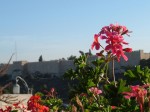
The circumstance of the Exodus from Egypt having been in the spring is explained by our sages as a special Divine benevolence in taking the Jews out of Egypt during the best time of the year. Pesach falls in the middle of the month of Nissan, when nature reveals its greatest powers. We can see and smell blossoms on trees, watch fruit appearing from buds and hear the song of the red-breasted robin.
In fact, there is a special blessing that the rabbis composed for Nissan, for the coming of springtime, that is to be recited when seeing a fruit tree bearing fruit: “Blessed are you, Lord our G-d, King of the Universe, who has made nothing lacking in His world, and created in it goodly creatures and goodly trees to give humankind pleasure.”
The blessing is said just once a year, preferably in Nissan, but if one didn’t get a chance to say it then, it can also be said in Iyar, the next Hebrew month. Our relatives in South Africa recite this blessing in the months of Elul and Tishrei, as that is when their spring occurs.
The great descriptions that appear in King Solomon’s Song of Songs (Shir Hashirim) include “the times of the rain are passed, the time of the songbird has arrived, the blossoms of the trees are seen throughout the land.” This refers to the Land of Israel, where springtime is warm but not summer hot, and the threat of rain all but gone for the year. The smell of spring and renewed life fills people’s souls, and this season in the holy land of Israel is the beloved partner of Pesach, the holiday of renewal and redemption, optimism and hope. Pesach weather carries with it special blessing and encouragement.
When we were taken out of Egypt by G-d’s outstretched arm, we became a nation. In fact, G-d loves us so much that He came down and took our ancestors out Himself, instead of sending an angel to perform the task. As it is written in the Haggadah, in the portion beginning with “Avadim hayeenu,” “We were slaves,” it says, “We were slaves to Pharaoh in Egypt and
G-d our G-d took us out of there with a strong hand and with an outstretched arm. If the Holy One, blessed be He, had not taken our fathers out of Egypt, then we, our children and our children’s children would have remained enslaved to Pharaoh in Egypt.”
Here in Canada, and indeed in so many places, spring arrives with Pesach, however the weather isn’t necessarily springlike. As a child in Toronto, I remember one Pesach having to be carried by my father during the holiday over snow-covered sidewalks. As a teenager in Florida, we were able to have guests over during Pesach and sit outside for our seder. Having lived in Vancouver for more than 30 years, I have experienced Pesach in pounding rain, as well as in sunshine and warmth.
Pesach is, of course, celebrated by Jews the world over. Our dear daughter and her husband, as emissaries for Chabad, will be hosting more than 30 people in their small apartment in Turin, Italy, for the seders, for example. I wish you and your family a very happy and kosher Passover wherever you will be this Pesach – and whatever the weather. Enjoy!
Esther Tauby is a local educator, writer and counselor.

“Chad Gadya”: an ecologist’s favorite seder song
Passover is soon upon us, and many Jews will celebrate by singing rounds of their favorite classic Passover songs. “Chad Gadya” is a song that ensnares the singer in an increasingly complex chain of causality. Starting with one’s father who buys a goat that gets eaten by a cat that is bitten by a dog that is beaten by a stick, etc., etc. But “Chad Gadya” is not simply an incredibly fun shanty, it is also a great lesson in food chain ecology.
A food chain describes the complex interconnections that occur in nature from different organisms that eat each other. At the start are plants that absorb energy from the sun. The plants are then eaten by herbivores, that are then eaten by predators, that are then eaten by higher-level predators and so on. Each step up the food chain is called a trophic level, from the Greek word trophikos, meaning food.
One phenomenon documented by ecologists is called a trophic cascade. When you remove a key species from the food chain, say from the top, the effects will cascade down the food chain, affecting every organism along the way. One classic example involves the sea otter, a charismatic marine mammal that lived off the coasts of North America as far south as California. Unfortunately, the sea otter was once prized for its lovely fur and, by the early 20th century, they had become extinct south of Alaska.
Sea otters happen to eat a lot of sea urchins. Sea urchins eat a lot of kelp. When the sea otters disappeared, the effect cascaded down the food chain. Sea urchin populations skyrocketed, and began feasting on the kelp. Entire forests of kelp began to disappear, only to be replaced by barren underwater fields full of spiky urchins. This spelled trouble for the many fish and other animals that depended on the kelp forests for shelter and food. Bald eagles, for instance, would normally eat fish hiding in the kelp forests. Without those fish, the eagles had to search elsewhere for food.
Fortunately, sea otter hunting was banned, and populations from Alaska were shipped in. Those new immigrant sea otters have begun to repopulate our coasts, restoring the kelp forests and returning balance to the ecosystem.
Understanding how ecosystems work can be very helpful. For instance, in Israel, on Kibbutz Sde Eliyahu, they grow many useful crops, such as alfalfa and oats. But voles (a type of rodent) can be a huge pest problem. Thousands of burrow openings can accumulate per hectare, causing severe damage to their crops. Poisons are expensive, can be dangerous for consumption and for other animals, and are often ineffective anyway because more voles can just immigrate from nearby fields. Barn owls eat voles, but they only nest in pre-existing cavities, so farmers began putting up nesting boxes to encourage the owls. The strategy worked, the owls keep the voles under control, and they end up being more cost effective than poisons. Manipulating ecological systems for pest management in agriculture – known as biocontrol – is an increasingly common strategy used around the world to improve yields.
So, when sitting down for your Passover seder, eating your favorite foods, reclining and singing your beloved songs, take a moment to reflect on the complex chains of events that brought that food to your table.
Ben Leyland is an ecologist at Simon Fraser University, a musician and an Israeli-Canadian resident of Vancouver.

Springtime frogs for Pesach
In anticipation of the Jewish holiday of Passover, Curly Orli and I are making cute froggies. It is true that frogs were one of the Ten Plagues, but frogs are also believed to be the bringers of spring! These days, they are happily hopping around in parks and forests after a long winter slumber. Now, you can have one of them at home … a Plasticine one, that is.
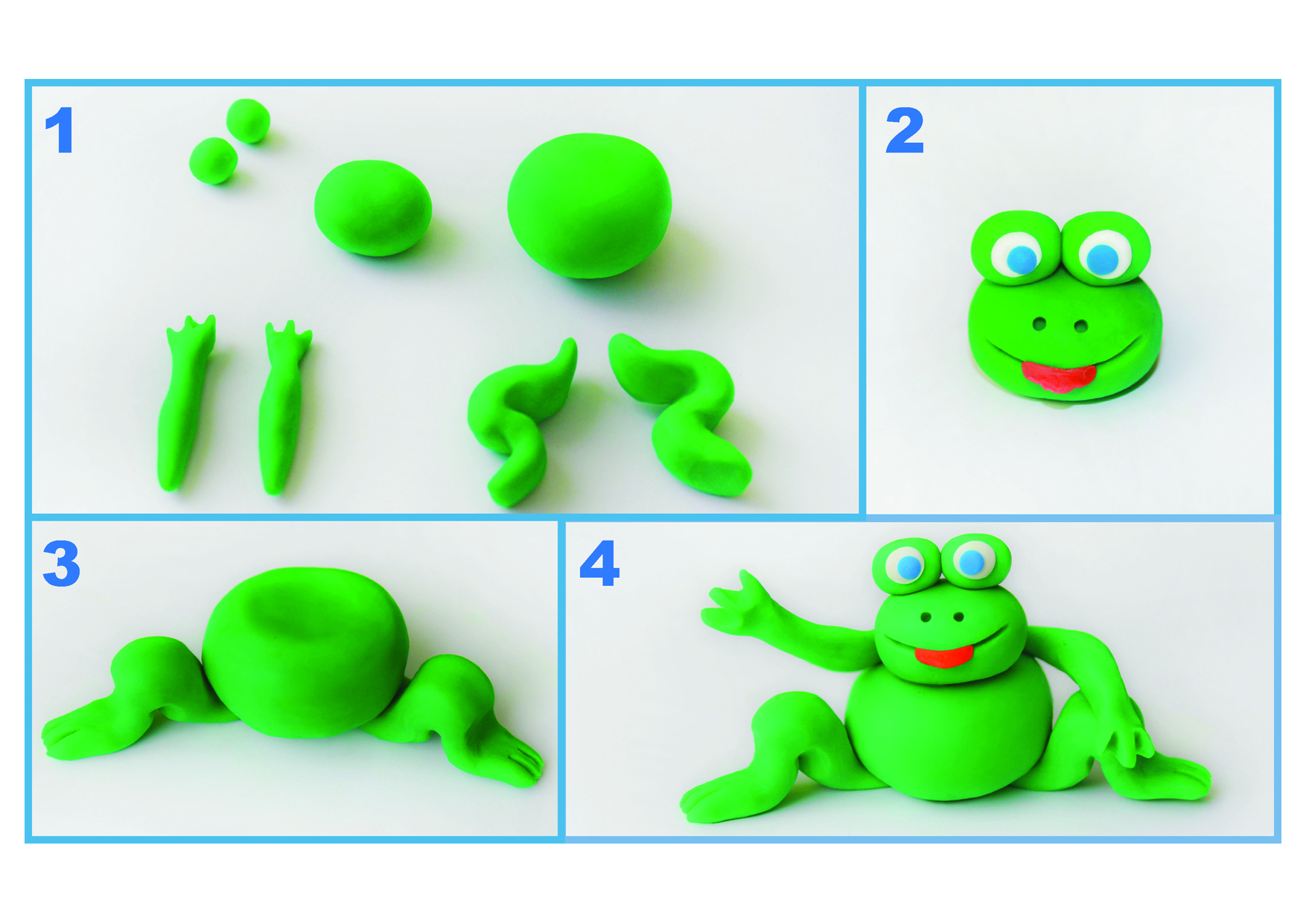
1. Prepare green Plasticine. Separate it into pieces for different body parts: eyes, head, torso and two pairs of legs.
2. Using white and blue Plasticine, make eyes. With the help of a toothpick, make a nose by poking two holes, then a mouth and, finally, add a red tongue.
3. From earlier prepared pieces, let’s make a lower part of the body and legs. Attach them together.
4. Connect upper and lower body. The froggy is ready!!!

5-6. Our froggy is festive and joyous, so let’s give him a beautiful flower. We can make petals from various small and round colorful Plasticine pieces by making them pointy at the end.
7. Let’s add petals to the flower and connect them to the stem.
8. Now, we will give this flower to the froggy. Our creation is complete.
Happy Passover to all the readers of the Jewish Independent! We wish you peace, joy and new creative adventures.
Lana Lagoonca is a graphic designer, author and illustrator. At curlyorli.com, you will find more free lessons, along with information about Curly Orli merchandise.