Meet Sara Dent: co-founder of Young Agrarians

Sara Dent of Young Agrarians, which hosts farm tours, potlucks, workshops and a website with networking tools like connecting retiring farmers with land to young farmers seeking it. (photo from Sara Dent)

Whether it’s visiting a farmers market, signing up for a CSA (community-supported agriculture) box or just paying attention to where the produce in the grocery store was grown, local and sustainable eating has been in the zeitgeist for nearly a decade and it shows no signs of flagging. For many North Americans, food has proven an accessible entry point into issues of consumption, environment, community and health. All this, of course, doesn’t happen by itself.

Meet Sara Dent, one of British Columbia’s behind-the-scenes farm organizers. Dent is the co-founder of Young Agrarians, a network and community that supports young farmers as they attempt to start and develop farming businesses. She is also starting to do farm business development consulting, and teaches workshops in permaculture, a design philosophy focused on long-term sustainability. On top of that, she maintains a photography blog, mainly documenting the farmers with whom she visits and works.

As anyone who speaks to Dent will soon realize, the vibrancy and growth of Young Agrarians can be largely attributed to her specific abilities: as a fundraiser, organizer and speaker. Dent is perhaps predisposed to seek respite from some of the harsher aspects of urbanization. Her parents relocated to Vancouver in the 1970s, seeking a healthier, less crowded environment.

In her twenties, Dent did administrative work for nongovernmental organizations around youth, social change and community building. But, in 2006, she said she was broke and decided to take a break from the city, volunteering on three farms over four months. That summer, a light bulb turned on. Since then, Dent has photographed and volunteered on dozens of farms, completed the Linnaea Ecological Garden Program on Cortes Island and become a certified permaculture design teacher. All through this period, she continued to do contract fundraising work.

“We want to look at agriculture as a dynamic entrepreneurial sector where people have many on-ramps to farming.… New farmers need to marry business skills with production skills. People are starting their farming careers in all different stages on the spectrum, with different levels of experience.”

But all this was just a warm-up to co-founding Young Agrarians, which was dreamed up in 2011. The group – which is a partnership with the Vancouver nonprofit Farm Folk City Folk – has turned into a vibrant community with regular activities for both farmers and for the interested public. The main target, however, remains building capacity with young farmers. Dent explained, “We want to look at agriculture as a dynamic entrepreneurial sector where people have many on-ramps to farming.… New farmers need to marry business skills with production skills. People are starting their farming careers in all different stages on the spectrum, with different levels of experience.”

Young Agrarians hosts farm tours, potlucks, workshops and a website with networking tools like connecting retiring farmers with land to young farmers seeking it. The next big project is building a program to offer business coaching for farmers and startups. That program will provide 20-50 hours of human resource support essentially free, or on a sliding scale.

In order to do this, and to expand Young Agrarians beyond its current B.C. focus, Dent is trying to broaden her funding base beyond goal-oriented grants from foundations that require specific program deliverables. According to Dent, a challenge for many NGOs is to raise enough funding for general operations. Eventually, she hopes, Young Agrarians will increase donations from individuals and through public events, which can more easily provide operating funds.

When asked whether starting her own farming business is in her future, Dent matter-of-factly said, “I have no equity. You can get 10 acres outside of Montreal for $100,000-$200,000. Those 10 acres cost one million in the Lower Mainland.”

Aside from the financial reality of buying land, Dent said that the farmers she works with don’t want her to stop being an organizer. As a person with a background in fundraising, and general macher qualities, the value she provides as a consultant and community builder may well exceed that of starting her own farm. And this is where she sees her future: Dent said that, in her 40s and 50s, she would like to make her primary living from consulting.

The term permaculture was coined in 1978 by Australian Bill Mollison as a contraction of “permanent agriculture.” The term has since expanded into a set of principles for all aspects of human planning, design and engineering, which emphasize long-term sustainability through modeling human systems on natural ecosystems. A common theme of permaculture designs are concentric zones around the home from the most frequently used herb and vegetable beds, to main cropping areas, to perennials, to the semi-wild and wild. Permaculture principles are applicable on multiple scales, from small gardens that only contain one or two zones to larger farms that contain all zones. Permaculture emphasizes maximum collection and storage of abundant resources (energy, water, calories) in order to be financially viable and sustain a year-round system.

Critics of permaculture contend that the concept has devolved into quaint urban gardens with herb spirals and flowers, instead of modeling economically viable production systems that grow food for the masses. Dent didn’t disagree, but emphasized that the incorporation of permaculture concepts into agriculture is fairly new territory, and can create success. “Things can get lost in the conceptual realm if people are trained in permaculture, but have no agricultural training,” she explained. “But the people that are hybridizing those models are having a lot of success…. Joel Salatin, a permaculture agriculturalist, is very much modeling that out on the ground.”

“On any sustainable organic farm, you’re going to want to have both annual and perennial systems running at the same time.”

An example of holistic management using a permaculture approach is to look at perennial plants as a savings account (longer maturity, high-value yield) and your annual plants as a chequing account (for cash flow in the early years of the business). “Farms right now can have really interesting diversified revenue streams, like cut flowers, edible flowers, herbs,” she said. “On any sustainable organic farm, you’re going to want to have both annual and perennial systems running at the same time. These are new territories in terms of practitioners being able to adapt and use the ideas together and in different combinations.”

Other permaculture concepts are on their way to becoming mainstream, said Dent. As concentrated areas of food production like the central valley of California face severe drought and uncertain climate changes, land contouring techniques like keylining and swales, which capture rainwater and soak it into the soil instead of allowing it to flow over the surface, will be essential, and will be incorporated widely, she said.

As for her Jewish heritage, Dent said that she does the work that she does because of the work that her grandmother did and that which her father did. “I very much come from an activist, Yiddish, left-wing, socialist family tradition. Those values, of culture, unions, education, affordable university, all of those things were things that my family fought for … my grandmother was a union organizer and was a member of the communist party.” Her family history, “from poverty to solidarity,” is a source of pride for Dent.

There are a handful of other Jewish food organizers that she gets to work with from time to time, as well. “As someone who very much grew up in a non-Jewish society, it’s nice to work with other people that have that shared cultural background,” she said.

For details on Young Agrarian activities, visit youngagrarians.org.

Maayan Kreitzman is a freelance writer living in Vancouver.

Leiren-Young first literary laureate

In 2013, the Cherie Smith JCC Jewish Book Festival in partnership with the Isaac Waldman Jewish Public Library announced a new initiative: the Jewish literary laureate project.

“It is a vision of Yosef Wosk,” said book festival director Nicole Nozick in an interview with the Independent. “He came to me at the end of last year, and we talked about it. The City of Vancouver has its poet laureate, Evelyn Lau. It’s a similar concept, only belonging to our Jewish community. The post is a two-year position, selected by our laureate committee, to be a literary ambassador to the community, spread love of the written word, raise the profile of Jewish writers, encourage reading and writing and promote multicultural exchange.”

Wosk described how he came up with the idea. “I remember hearing about England’s poet laureate when I was in high school. I was intrigued by the idea of poetry playing such an important role in society. A few years ago, I was privileged to be able to endow the position of poet laureate for the City of Vancouver. This helped to champion the place of poetry in our midst. Poetry presents us with a surprising rhythm that moves and inspires us in many ways. Poetry also has the power to condense a great deal of information and emotion into a few well-chosen and often surprising words.

“Once we witnessed the success of the Vancouver poet laureate initiative, I thought it was a natural extension to also stimulate poetry in more particular communities, such as the Greek, Chinese, Jewish, Italian, Korean and so on. Although poetry was my initial inspiration for this program, we concluded this was an opportunity to extend the program to include all forms of literature, such as non-fiction and fiction prose, plays, theatre, etc. Working with the Isaac Waldman Jewish Public Library and the Jewish Book Festival, we have taken the first step towards modeling a literary laureate program for one particular community. If this is successful, it can be replicated in other communities.”

Wosk discussed this project in relation to the current state of the publishing industry.

“Poetry partakes of the eternal,” he said. “In some ways, poetry is an antidote to a plethora of electronic media. Whether reading in the privacy of your home, in a café or in a gathering of poets, we are transported to surprising realms of mind and matter, emotion and spirit. Other forms of literature, like a family of diverse relatives, compliment poetry…. Today, more is being published than ever before. It doesn’t matter whether text is handwritten, printed or electronically mediated: they are all related forms of communication. It still serves the same purpose of transmitting information in one of several forms.”

The benefits of this program are manifold. “Certainly the laureates themselves will benefit by being able to share their creativity with the community,” said Wosk. “They will also receive an honorarium in recognition of their work and appreciation for their time. The community, from school students to other published poets, will be stimulated by the encounter with the literary laureate, who … we hope might act as a catalyst for writing in the community.”

Nozick emphasized that, despite the growth of digital media, people are still reading. “We want our laureate program to take reading to the next level, inspire more participation,” she said. “The particular activities are up to the laureate himself. Each laureate will bring his or her own unique strength and interests to the project. He will have a permanent office at the Waldman Library and work in collaboration with the library and the Jewish Book Festival. Our inaugural laureate is Mark Leiren-Young.”

photo - Mark Leiren-Young is the Jewish community's first literary laureate
Mark Leiren-Young is the Jewish community’s first literary laureate. (photo from Mark Leiren-Young)

The committee came together last year and brainstormed who would be the best writer for the position, she explained. “We selected Mark because he is a gifted, award-winning writer. He has experience writing across different genres, including playwriting, memoirs, documentaries, humor, and he is also good with people, able to connect with different generations.”

Leiren-Young commented on how important the position of laureate is to him. “For someone who grew up in Vancouver – and the JCC – it’s a completely unexpected and very cool honor. Yosef Wosk has launched several amazing programs, and I hope I can do justice to his vision for this one. The timing was amazing too. My latest book, Free Magic Secrets Revealed, actually starts at the Jewish Community Centre, and many of the key scenes take place in the JCC.”

Leiren-Young’s pilot laureate initiative is the Multi-Generational Media Lab Storytelling Project. It pairs King David High School students with seniors to share and hone their storytelling in a digital format.

“I recently served as the writer-in-residence for Vancouver Community College,” said Leiren-Young. “While I was there, I spent a bit of time with the oldest student on campus. I think he was in his mid-seventies. From the moment I met him – my first week at VCC – I kept asking if he had any stories he wanted to share. He kept telling me he didn’t have anything.

“Naturally, in my last week, he finally handed me a story about growing up in a small town. He had all these rich, detailed memories about his childhood, so after my residency was over, I contacted the community archive for the town Trail, B.C., so they could have access to and share his stories. But I kept thinking that if I’d known he was willing to tell his stories, I could have set him up with a student who could have interviewed him.”

The multi-media project is in the planning stage now. “Over the summer, we’ll be recruiting seniors, and I’ll work with them to focus on specific stories they want to share,” said Leiren-Young. “In September, when the school year begins, the high school students will be introduced to the project and will prepare their interview questions. The final presentation will take place during the Jewish Book Festival week in November.”

Olga Livshin is a Vancouver freelance writer. She can be reached at olgagodim@gmail.com.

Granville Island gastronomy

Terra Breads’ Granville Island Market location is one of four in Vancouver. (photo by Joanne Leung) 

When the first Terra Breads opened in Kitsilano 20 years ago, owner Michael Lansky would probably not have expected to be part of a food tour that includes truffle salt, fireweed honey or slices of Rathtrevor cheese. But Terra Breads’ Granville Island location is one of the culinary stops on the Granville Island Market Tour – billed as a combined “food tasting and educational walking excursion.”

Presented by Vancouver Foodie Tours and Edible Canada, the tour has been recognized by the Canadian Tourism Commission as a unique Canadian experience. It was one of the first such activities to be inducted into the Canadian Signature Experiences collection in 2011. Edible Canada supports local and Canadian food producers, and the tour reflects this commitment.

You may have visited Granville Island Market with limited time and/or an agenda to pick up a specific item, so you’ve bypassed various market stalls because their products weren’t on your list. This tour will give you pause to spend a little more time getting to know the local food that’s available. Whether you decide to go back and purchase what you’ve tasted is up to you but, at the least, you’ll have more options the next time you want to impress visitors with exceptional cuisine that’s farmed or made here, or close by.

Meeting at the Edible Canada retail store and restaurant on Johnston Street, we were treated to our first tasting on the tour and given some history of the island and the market.

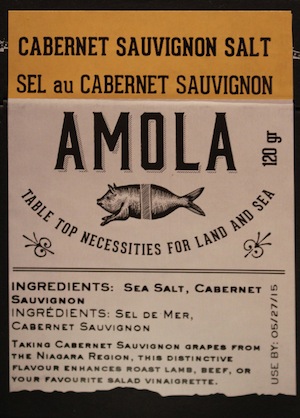
On the menu for the nosh were fish cakes, salad, wine and flavored sea salt. The local ingredients in the meal were Pemberton-grown potatoes. Of particular interest was Amola flavored sea salt, which Edible Canada sells in small packets with flavors such as black truffle and cabernet sauvignon.

photo - Use Amola flavor-infused sea salt from the Edible Canada retail story and your guests will think you’ve slaved away over dinner with special ingredients.
Use Amola flavor-infused sea salt from the Edible Canada retail story and your guests will think you’ve slaved away over dinner with special ingredients. (photo by Baila Lazarus)

On the menu for the history was a discussion of the creation of Granville Island and the market. The size of 22 soccer fields, the island was originally dredged out of False Creek in the early 20th century. The reclamation project was to establish an industrial park. Saw mills, steelworks and cement plants went through booms and busts in the area. In the 1970s, the island was redeveloped by the federal government to create the cultural and business destination it is today. The cement factory that still exists on the island is the last heavy-industrial business.

In 1972, the administration, management and control of the revitalization of Granville Island were transferred to the Canada Mortgage and Housing Corp. According to CMHC, the island is now home to approximately 275 businesses that generate more than $130 million annually.

Granville Island Public Market opened in 1979. They offered Sunday shopping as a way to draw people to the location. The structure that houses the market is the old B.C. Equipment Ltd. building, a wood-framed machine shop. The market has 50 permanent vendors and a rotating roster of approximately 40 farmers and culinary artisans.

After our first taste and chat, we were off to JJ Bean, a local roaster since 1945. Along with our medium roast, we were given some education on coffee, such as the drawback of “aggressive blooming.” (Hint: If you buy freshly roasted coffee, let it sit for a couple of days before putting them through a French press.)

Then, it was over to Terra Breads, where we were treated to olive/rosemary bread and pecan fruit crisps. Considered Vancouver’s first artisan bakery, the two-decade-old institution first opened on 4th Avenue in Kitsilano and now has two other locations – on 5th Avenue near Ontario and in the Village in False Creek. (Hang on to a crisp or two, so that you can eat it with foods later in the tour.)

Next stop was Oyama Sausage, where the charcuterie is infused with Okanagan red wine or sake made around the corner on Railspur Avenue.

For cheese aficionados, a six-year-old cheddar from Armstrong and a Swiss-like Rathtrevor from Little Qualicum on Vancouver Island were very well received by our tour group. These were presented by Benton Brothers Fine Cheese.

Apples and cherries from #1 Orchards in the Okanagan were used to cleanse our palate before heading over to Granville Island Tea Co. They have created a smooth chai that comes in a two-package mix you can make yourself easily at home. (Ask them what the secret ingredient is. You’ll be surprised at the answer.)

In a far corner of the market, Chilliwack Honey offers a tasting of fireweed honey, named for the flowering plants that grow in areas ravaged by forest fires. The B.C. company has been raising bees in the valley for more than 35 years.

After the smorgasbord of gastronomic glee, you might not think you’d have any room for dessert. But one whiff of the heavenly scent at Lee’s Donuts will have you thinking twice. Go before 2 p.m. for hot old-fashioned glazed doughnuts. The melt-in-your-mouth decadence is a perfect end to the “class.”

In addition to the market tour, other offerings are the World’s Best Food Truck tour and the Guilty Pleasures Gourmet tour. Visit ediblecanada.com.

Baila Lazarus is a freelance writer, painter and photographer. Her work can be seen at orchiddesigns.net.

Take a virtual tour of Jewish Montreal

The three current Museum of Jewish Montreal tours can be taken online or while in Montreal, either self-directed using a mobile device or led by museum staff.

The Museum of Jewish Montreal was created when the city’s Jewish community turned 250 years old in 2010. While it may contain material dating back to the 1760s, it presents the information using the latest technology.

An online and mobile museum, its activities include “connecting exhibits to personal stories, narrations, songs, poems and films”; and “creating a virtual museum and mobile applications so that the viewer can interact with our community’s history at home or on the street.” So, if you’re in Montreal, you can take the museum’s tours with museum staff or self-direct your own. From Vancouver, you can simply go online.

One of the current tours, Work Upon Arrival, gives visitors an idea of the challenges faced by immigrants who worked in Montreal’s garment industry from 1914-1941. It does this through the stories and photographs of six people, supplemented by archival images and text/audio providing the broader historical context.

The oral history excerpts in the exhibit were recorded in the 1970s by Vancouverite Seemah Berson. They are among the interviews Berson conducted with Eastern European Jewish immigrants to Montreal, Toronto, Winnipeg and Vancouver in the first part of the last century, which form the basis of her book I Have a Story to Tell You (Wilfrid Laurier University Press, 2010).

Berson’s work came to form the foundation of the exhibit when Montrealer Harold Gordon wrote Berson to praise her book. They kept in touch and he introduced her to a friend, who introduced her to museum director Zev Moses. Later, Berson was introduced over the phone to museum research director Stephanie Tara Schwartz and exhibit curator Sarah Woolf. For them, she told the Independent, she was “available for queries and questions. I suppose were I younger and more agile, I would have loved to be on the spot and physically part of this. They were amenable to my suggestions, etc. Essentially, I needed to keep in mind the important fact that a great part of the purpose of my book was to disseminate these stories and keep the voices of my storytellers alive.”

Berson explained that Schwartz and Woolf “researched and found children and grandchildren – one in Israel – which was so great for me because his grandmother was not known to me when I went to Montreal to interview people. I had walked into a nursing home where she lived and she talked to me. I didn’t know anyone in her family, so it was great to connect.”

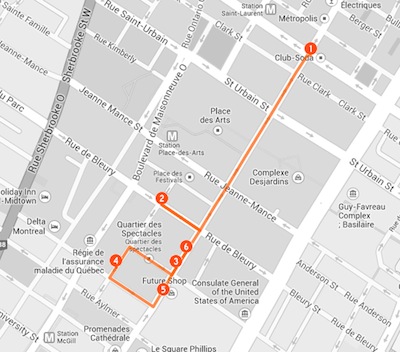
The six interviewees and locations featured in Work Upon Arrival are Hyman Leibovitch, Midway Photo Play, 1229 St. Laurent (1914); Jennie Zelda Litvack, L. Holstein and Co., 1475 Bleury (1925-26); Rose Esterson, International Ladies’ Garment Workers’ Union, 395-397 Ste. Catherine O. (1933-1954); Sidney Sarkin, Sam Hart and Co., 437 Mayor (1925); Ena Ship, Jacobs Building, 460 Ste. Catherine O. (1934); and Norman Massey (aka Noach Puterman), Parkley Clothes, 372 Ste. Catherine O. (1937-1941).

image - Work Upon Arrival exhibit takes visitors along Rue Ste. Catherine Ouest and through its garment-industry history.
The Work Upon Arrival exhibit takes visitors along Rue Ste. Catherine Ouest and through its garment-industry history.

“Exploring the open expanses of downtown Montreal’s Quartier des spectacles, it’s difficult to believe this was once a bustling garment district. Packed with factories and sweatshops, tailors and seamstresses, manufacturers and union executives, the relatively small Rue Ste. Catherine corridor between University [Street] and Boulevard St. Laurent was a hotbed of clothing production, class confrontation and radical politics,” the exhibit begins.

“Picture Ste. Catherine on a busy day in the 1920s and 1930s: steam billowing out of factory windows and grey snow covering the muddied streets; children ferrying newspapers and bales of cloth from building to building; thousands of weary workers flooding the streets for a brief lunchtime break; the mingling sounds of French, English, Yiddish, Italian, Russian….”

Work Upon Arrival explores such questions as “… how did these immigrants find work with little financial support and few personal connections at their disposal? How did so many Jews end up in the garment industry, working as cutters, machine operators and even as manufacturers? And how did so many Jews get involved in labor politics?”

Each oral history section has a summary of the subject’s arrival to Canada and their first jobs (at least), how much they were paid, the working conditions, etc.; a couple of brief excerpts from Berson’s book, along with their transcriptions; and photos of the interviewee and relevant buildings and/or documents. The parts between each oral history provide a broader context, and direct tourists (virtual and literal) from one location to the next. The combination of the personal and more general makes for a memorable learning experience. There is something special about hearing someone’s voice, even if you don’t know them, and it gives the exhibit more impact than images or text alone would have provided.

Work Upon Arrival has 20-odd sources, and Berson’s recordings appear courtesy of the Canadian Museum of Civilization, Seemah C. Berson Collection. Among those thanked are Berson and the Betty Averbach Foundation.

The other current MJM tours are Between These Walls: Hidden Sounds of Hazzanut in Montreal (1934 to 1965) and A Geography of Jewish Care: A Virtual Tour of 150 Years of Jewish Social Services in Montreal. The website is imjm.ca and in-person visits can be scheduled by emailing info@imjm.ca.

Winnipeg’s garment industry still going strong

Marissa Freed (photo by Rebeca Kuropatwa)

The garment industry has played a vital role in the development of the Jewish community, the city of Winnipeg, and even the province of Manitoba over several generations.

On May 8 at Rady Jewish Community Centre’s Berney Theatre, the Jewish Heritage Centre of Western Canada hosted a panel discussion on Winnipeg’s Garment Industry – Past, Present and Future. CBC Radio’s Terry McCloud was the moderator, panelists were Bill Brownstone, Marissa Freed, Howard Raber, David Rich, Bob Silver and Gary Steiman. From the discussion, it seems as though most of the panelists did not plan to get into the industry, but stumbled into it by chance.

Brownstone, for example, took over for his father after his father had a heart attack. “I was home for the summer, in June, and was to make one trip to his territory…. So, I made the one trip and, 55 years later, I made the last trip,” said Brownstone. “That was how I got into it.”

Freed also grew up in the business. “It was around all the time, certainly because of my father and, more so, because of my grandfather and my great-grandfather,” she said. “I’ve always loved fashion, so that was the exciting part, but certainly not the business part.”

Freed’s great-grandfather started a sewing and pad factory, which was, over the years, transformed into more of an outerwear and ladies wear company, also offering tailored items, like uniforms.

“Something we’ve been doing for a long time is government uniforms,” said Freed, listing some of their clients, such as the RCMP and Parks Canada. “For the Canadian Olympic teams, we made the opening ceremony jacket for the athletes. And in the HBC stores, we did all the replicas.”

Raber’s grandfather started in gloves in 1924. “My zaida started being a glove cutter,” he said. “In 1934, the partner came to the realization that no one was manufacturing dress gloves in Western Canada. So, they started a company, called Perfect Fit Glove [and he was involved there from] around 1934-1941, manufacturing the majority of the dress gloves for people like the Eaton’s bale order, which at that time hosted 90 percent of the retail shares in Canada.”

In 1941, when Raber’s grandfather’s partner’s son and Raber’s father finished school, his zaida suggested they buy him out, which spawned the company Raber Glove that same year.

“Now, we make all domestic leather gloves and mitts for many uses, for many customers: the RCMP, the military, police departments across Canada,” said Raber. “We also supply a lot of independent stores from coast to coast that stick to [us because of] the quality we make, and we’ve existed that way … 99.99 percent of all gloves coming into North America come from offshore.”

Rich’s father started his business, with four operators and himself, in 1939. It was called Winnipeg Pants and Sportswear, with one of the main buyers at the time and for many years following being Eaton’s.

“Today, we have a factory in Winnipeg,” said Rich. “We still manufacture high-quality work outerwear. We also deal in Asia, Bangladesh, China and Cambodia. People ask us how we can make a living dealing with people [worldwide] like that. I tell them I come from the North End [of Winnipeg] … [so] if I can’t deal with these guys, nobody can.”

Silver recalled his closest neighbor driving up at eight o’clock in the morning, informing him that his dad had died. “I made my way back to Winnipeg and a lot of people were pointing fingers and wondering who would take care of the business,” said Silver. “I said, ‘Not me. I’m going back to B.C.,’ but my great-uncle, who was around at the time, asked me to come in and help him sell the business. That was 37, 38 years ago and I have yet to be able to sell it.”

Silver discovered that no one was willing to buy unless he was willing to stay and manage the company, spurring him to do just that. “So, I bought it with some partners and then the drive for success kept me going,” he said.

Weston Glove Works was established around 1921 by Silver’s grandfather and three great-uncles and, in the beginning, exclusively manufactured gloves.

“In 1921, gloves were one of the most important parts of work wear, because all work was outside with your hands,” said Silver. “Then, they branched off into coveralls, overalls and other types of work wear. Then, they got into casual wear, and then into polyester leisure suits.

“I was interested in developing a brand that could sell a large volume of merchandise for Victoria Beckham, and the jeans were about $300. I thought we could do about 20 to 25 million dollars globally.

“At the same time that I was making garments for Victoria Beckham that sold for $300, I was making jeans for Walmart that sold for $15. People would ask what the difference was between the two, and I’d say $285 – except the ones for Walmart would last longer.”

“At the same time that I was making garments for Victoria Beckham that sold for $300, I was making jeans for Walmart that sold for $15,” he continued. “People would ask what the difference was between the two, and I’d say $285 – except the ones for Walmart would last longer.”

Last but not least, Steiman spoke about how he got into the industry. His grandfather started one of the first garment companies in Winnipeg, making, among other things, buffalo coats for the Winnipeg police force as early as 1900. Steiman came into the business in 1962.

“I remember, as a young boy, I hated to go up to his shop to get a leather jacket, which I had to do every two years, because it stunk, was noisy, was sweaty, and people yelled at each other. It was the last place I could envision myself having a career.”

Rebeca Kuropatwa is a Winnipeg freelance writer.

Mystery photo … June 27/14

Group of women holding honor scroll certificates, State of Israel Bonds, Marjorie Groberman second from the left, Vancouver, B.C., 1971. (JWB fonds, photographer Franz Lindner, JMABC L.14624)

If you know someone in this photo, please help the JI fill the gaps of its predecessor’s (the Jewish Western Bulletin’s) collection at the Jewish Museum and Archives of B.C. by contacting archives@jewishmuseum.ca.

Happy to be Canadian

For most Canadians, depending on the weather in our locale, Canada Day represents the real kickoff of summer. The kids are out of school, many workplaces are beginning a summer lull, families are looking forward to spending time together outdoors.

Canadians have rarely given ourselves over fully to the flag-waving, sleeve-wearing patriotism of many other countries. There are times when some of us lament this apparent lack of passion for our Canadian birthright, but this seeming lack of passion may well be an innate characteristic of our national spirit: a calm, reserved, nonaggressive attitude that is no less deserving, or indicative, of pride than a more fulsome nationalism.

As we observe events around the world these days, we should probably feel a special level of pride and relief at being Canadian. On every continent, it seems, crises of various proportions and types are roiling. Nigerian girls and Israeli boys are abducted by terrorists. The war in Syria has crossed the border into Israel, with an Israeli teenager dying last week from a roadside attack. Shia and Sunni combat each other in a brutal battle for control over what remains of the state of Iraq, now boiling over into Syria and Jordan – a conflict so multifarious that Western allies find ourselves in the unfathomable position of making common cause with the regime in Iran.

There are 51 million displaced persons in the world today, the highest number since the end of the Second World War. Half of these are children, fleeing violence in Afghanistan, Syria, Sudan, Somalia and elsewhere. Women and religious and ethnic minorities around the world are living in often increasingly hostile environments, with acts against their dignity, and violence to their person at intolerable levels. In Europe, far-right parties are exploiting economic difficulties to spread messages of scapegoating and blame.

A simple glance at any day’s headlines should remind us how lucky we are to be in Canada. We are certainly not without our problems. We have an ingrained history of mistreatment and inequality toward the First Nations of this place, most immediately demonstrated in levels of poverty and health outcomes in those communities that are exponentially worse than Canadian averages, and the murder or disappearance of hundreds of aboriginal women. Nor are we free from other forms of racism or injustice. This is not paradise, though by contrast to much of the world, and for most of us, it comes close.

We are fortunate to share our continent with stable neighbors with whom we share multilateral relations that are among the most peaceful and cooperative of any countries on earth. This fortunate situation is not all a matter of good geography. The comparatively peaceful situation here is not insignificantly a result of the evolution of a uniquely Canadian approach to coexistence across difference. Jewish Canadians and our communal institutions have played an important role in the successes of Canadian multiculturalism.

Our comparatively peaceable nation is also a result of factors including attitudes toward weaponry, which makes our country not immune to violent gun-related incidents, but keeps us far from the crisis situation being experienced in the United States.

All of this should not evoke complacency. We should feel gratitude for our relatively peaceable and prosperous state, but we should feel no less a sense of obligation to making the world better for all people. Our own security and well-being should not relieve us of the obligation to do what we can, as individuals and as a nation, to make things better for people in the world who do not share all of our good fortune. Indeed, our position of relative wealth, health, stability and living standards places on us a greater obligation to act on behalf of others worldwide who are not as fortunate as we are.

Canadians pray for teens

As three abducted Israeli teens ended their first week of captivity, communities from across Canada and around the world held vigils, gathered in solidarity and said prayers for their safe return; prayers that continue.

From Halifax to Vancouver, Jews gathered in support of Gilad Shaar, 16, Naftali Frenkel, 16, and Eyal Yifrach, 19, who were kidnapped by suspected Hamas terrorists while hitchhiking near Hebron June 12.

The largest of the events was held June 19 in the Toronto area, where as many as 1,000 people came together at the Schwartz/Reisman Centre at the Joseph and Wolf Lebovic Jewish Community Campus. The rally was sponsored by UJA Federation of Greater Toronto in conjunction with the Centre for Israel and Jewish Affairs (CIJA).

MP and former justice minister Irwin Cotler spoke. He was in Israel when news of the teens’ abduction broke. Reports in Israeli newspapers were dominated “by a sense of angst and anguish,” he said.

Cotler attributed the kidnapping to Hamas, pointing out that the Islamic terrorist group is pledged to destroy Israel and kill Jews. He noted that, even before the kidnappings, Israeli media had reported that security forces had foiled 44 attempts to kidnap Israelis in the last year alone.

He said former Soviet dissident Natan Sharansky, whom he met during his visit, stressed how important it was for his family and for him to know that Jews from around the world were rallying to his cause when he was in a Soviet prison.

Cotler said the operation to locate the teens is code-named “Brother’s Keeper,” and Israelis of all denominations are united in praying for the boys’ safe return.

Demonstrating support for the families of the three victims was a key motivation for many of those at the rally. “Those kids could have been any of ours,” Roz Lofsky said. “We all feel for those boys and we want to show solidarity with them.”

“We’re here to say that we are in support of those parents so they know they are not alone,” added Gladys Isenberg.

Conservative MP Mark Adler brought a message from Prime Minister Stephen Harper and drew a loud round of applause when he said, “Canada will stand with Israel through fire and water.” He called on the Palestinian Authority to disarm Hamas, take control of smuggling tunnels in Gaza and demonstrate its commitment to peace by reuniting the boys with their families.

Consul General D.J. Schneeweiss spoke and, in addition to members of the Jewish community, the event was attended by Prabmeet Singh Sarkaria, vice-president of the World Sikh Organization of Canada, Ontario Region. Messages of support were received from the United Macedonians Organization of Canada and from Dominic Campione, past national president of the National Congress of Italian Canadians.

In Halifax, Rabbi Ari Isenberg, spiritual leader of Shaar Shalom Congregation, in conjunction with CIJA, officiated at a community-wide vigil of hope for the boys’ safe return. At the same time, Rabbi Amram Maccabi of Beth Israel Synagogue said special prayers for the teens.

In Montreal, about 400 people attended a June 15 prayer vigil at Congregation Beth Israel-Beth Aaron in Côte St. Luc. The vigil was sponsored by Israeli Consul General Joel Lion in cooperation with CIJA. Chana Landau, a relative living in Montreal, relayed the thanks of the Frenkel family to Jews around the world for their expressions of solidarity. Chaviva Lifson read a message of gratitude from the Shaar family, who live a block from her sister in Israel.

In Hamilton, Temple Anshe Sholom, in conjunction with the Hamilton Jewish Federation, hosted a community gathering “in solidarity with the families of the three Israeli students.”

In Winnipeg, congregations Shaarey Zedek, Etz Chayim, Herzlia-Adas Yeshurun, Chevra Mishnayes and Temple Shalom co-sponsored a prayer vigil in conjunction with the Jewish Federation of Winnipeg.

The vigil, held at the Shaarey Zedek Synagogue, included a candlelighting ceremony, the recitation of psalms, a prayer for captives, the singing of Hatikvah and cantorial renditions of “Acheinu Kol Beit Yisrael ” (“All Israel are Brothers”) and “Bring Back our Boys,” a song written in the last two weeks in Israel.

Rena Elbaze, Jewish engagement specialist at the Winnipeg Federation, said the participation of a range of community organizations spanning a variety of denominations shows “we pray as a community and we’re united as a community when faced with these problems.

“We prayed for the sake of the boys, but also to make people present feel they are not alone and to show the families of the people who were kidnapped that people care about them.”

The Rabbinical Association of Vancouver, with support from the Jewish Federation of Greater Vancouver and other community organizations, sponsored a community prayer service at the Jewish Community Centre of Greater Vancouver.

Valder Belgrave, a spokesperson for JFGV, said, “Our sympathies are with the families, and it’s sad that they are drawn into the larger issue. They’re innocent victims in the larger scheme of things.”

– With files from Janice Arnold in Montreal. A longer version of this article can be found at cjnews.com/node/126049.

Tooshaaya all natural

Tom and Tzameret in studio. (photo by Galit Reismann)

An Israeli mother and daughter duo have combined to create designer pieces that use exclusively natural textile, with a focus on nature, and creations that become an extension of the wearer of any shape or size.

Tzameret, 50, and Tom, 28, began their business from home when Tom was at Israel’s Shenkar College of Design, in her second year of studies (2009). Tzameret, an art therapist by profession, was looking to do something different, and building this business with her daughter was the perfect fit.

The pair began the work little by little while Tom was finishing school. After Tom graduated with honors in 2011, with a bachelor of design, she and Tzameret invested all the time, energy and resources they could into their brand. For the past 18 months, they have been working out of a studio in Jaffa.

Tooshaaya is a design studio for eco-textile accessories with the driving concept of “body, home, soul.” For now, they create accessories like scarves, shawls and cardigans, but they plan to soon also design accessories for the home and soul.

“I’ve wanted to have my own business since I was a little girl,” said Tom.

During the summer between her second and third year at Shenkar, Tom said, “I wanted to make my own products, like scarves, and sell them. My mom was at a point when she wanted to take a small break from therapy.

“As always, I shared my prototype with my mom. We started talking about it and the idea to work together came up. I thought it was a great idea.

“Me and my mom are complete opposite in a lot of things. That can make us feel crazy sometimes, but it also makes us perfect business partners and designers. Also, we always know how much we love each other and that we want the best for each other.”

photo - A Tooshaaya bamboo cardigan modeled by Lior Sachar
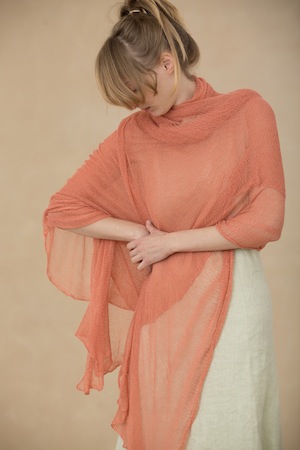
A Tooshaaya bamboo cardigan modeled by Lior Sachar. (photo by Ami Bornstein)

Tzameret has always loved art, creation and design. Also, she said, “I love Tom, believe in her, and appreciate her talent. Since she was four or five years old, it has been very clear she is gifted in art and has her own unique way of looking at things.

“We decided to join forces and talents, and create an exciting journey together. Although it’s not always simple to be a business partner with your daughter, it’s a huge privilege. I’m very proud.”

When Tom was in college, she “learned the textile industry is the second-most-polluted industry in the world.” She said, “As a textile designer, I see it as my responsibility to design and create ecological textile.” Tooshaaya’s motto is “Touched by nature.”

Tom and Tzameret chose to work only with natural materials, especially with new eco-fibres like bamboo and soy. “These fibres, in addition to the eco part, have special and very important qualities, like UV protection, hypoallergenic, temperature adjustments and [the] creation of amino acids, which is healthy for the skin,” explained Tom. “They’re good for the world and the body. Of course, we also believe in sustainability and love the energy of natural materials around our bodies.”

Tooshaaya designs are inspired by the sights, shapes, textures and colors of nature. “With each of our designs, even when there are few similar items, no one [item] is the same,” said Tom. “Each has its own unique design and process of production, which is mostly handmade.

“We believe that, when we feel comfortable, it’s easier to be connected to nature and express who we are.”

It has proved challenging to find natural materials, however. “Yarns are imported by us,” Tom said. “Also, producing natural materials is slower and more complicated than it is with synthetic or mixed yarns.

“Israel is a small and challenging market, in general, and particularly for niche designers,” she added. “We’re glad to have local [from Israel] and international loyal and return clientele who love our designs, appreciate our work and share our concepts.

“When I look at nature, I see infinite organic beauty composed of stability and softness, a tension between order and disorder, and the changes wrought by time, giving everything its unique character.

“My art and designs are a constant search for this organic esthetic. When I design an item, like a scarf, I create a second skin that looks organic and feels like a natural continuation of the body. The item’s unique character comes from the person who wears it, through movement and over time.”

Each item is made using special knitting techniques, with fine and delicate threads, hand dying, embroidering, weaving and felting. The items can be worn with a variety of clothing types and styles. Most are one-size-fits-all, suitable for sizes 36-44 (EU).

“Our ability to create custom-size orders, including plus sizes, is also somewhat unique,” said Tom. “Our items can fit almost anyone. And our ability to ship worldwide is very exciting. We send packages to all continents of the world, from the U.S. to Turkey, Russia, Thailand, Australia, Hong Kong, Canada and Italy.

“We love our work. What is most satisfying is when customers tell us how much they enjoy wearing our items, and we can see how our ideas are reflected in reality and bring happiness to others.”

For more information on Tooshaaya, visit toosha.com, toosha.com/#!video/c65q, or like them on Facebook, facebook.com/toosha.eco.design.

Rebeca Kuropatwa is a Winnipeg freelance writer.

Waves of Jews to East Asia

Shanghai’s famous Bund district, where most of the buildings were built and owned by wealthy Sephardi Jewish families. (photo by Anthony Hartman via Wikimedia Commons)

It was a long trek: 6,000 miles by boat from central Europe to East Asia. But the towns of East Asia opened their gates for the waves of Jewish emigrants who had to find shelter from the tragic problems they faced first in Russia and, later, in Europe.

Though some believe their story still flies under the radar when compared to the prevalence of other Holocaust-related discourse – perhaps because most of Shanghai’s Jewish residents viewed their time in the city as a transient stage – historians now know there once was a large and thriving Jewish community in China. Records of immigrants kept by the Hebrew Immigrant Aid Society (HIAS), which operated in Asia from 1917-1950, paint an inescapable picture of Jewish refugees who survived the war in Shanghai.

“The United States, Canada, Australia closed the doors to Jews and other immigrants in the 1920s.… HIAS had to … find other places that were willing to allow Jewish refugees to live there,” explained Mark Hetfield, HIAS president and chief executive officer. “Desperate measures called for creative thinking.”

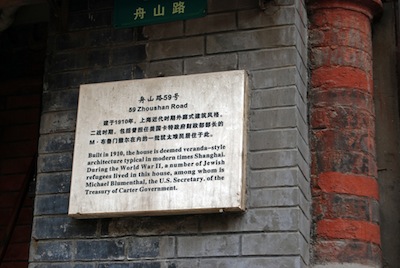
photo - A plaque at a house in Shanghai that was formerly the residence of Jewish refugees, including W. Michael Blumenthal, who went on to serve as U.S. Secretary of the Treasury under President Jimmy Carter
A plaque at a house in Shanghai that was formerly the residence of Jewish refugees, including W. Michael Blumenthal, who went on to serve as U.S. Secretary of the Treasury under President Jimmy Carter. (photo by H. Barrison via Wikimedia Commons)

The first Jews, Silk Road traders, arrived in China in the eighth century and settled in Kaifeng. The next Jews were those who arrived under British protection following the First Opium War. Many of these Jews were of Indian or Iraqi origin, due to British colonialism in these regions, and they became the largest dealers in opium. These included David Sasson (the “Rothschild of the East”), philanthropic businessman Sir Eli (Eliazer) Khadori and real estate lord Silas Herdoon. According to most accounts, the number of Sephardi Jews in China totaled around 1,000.

Around 4,000 Jews would then arrive as refugees from the Russian Revolution of 1917. Finally, a surge as large as 18,000 Jews arrived as refugees from the Holocaust in the late 1930s and 1940s. According to Peter Nash, a child survivor from Berlin who found refuge in Shanghai from 1939-1949, about 8,000 of these refugees originated from Germany and about 4,000 came from Austria.

Read more at jns.org.