What began as a last-minute visit to one of the most solemn places in history has grown into a nationwide campaign supported by many distinguished people and groups, including the Canadian and Polish ambassadors and the Centre for Israel and Jewish Affairs. Canadians Remember is a grassroots campaign relying on the goodwill of average Canadians to spread the word of the need for preservation and restoration at Auschwitz-Birkenau in Poland. The former German Nazi concentration camp – where more than 1.1 million Jews, Roma, Sinti, Poles, Russians and other Europeans were systematically killed during the Second World War – is reaching out for support of its Perpetual Fund.
“Since visiting Auschwitz, we’ve learned that a remarkable number of connections to the camp exist in Canada,” said campaign director Rob Carter. “Many Canadian success stories began with the small number of people who survived the Holocaust.”
Canadians Remember logo (CNW Group/Seed Communications Inc.)
Funds raised by Canadians Remember will be presented to the Auschwitz-Birkenau Foundation in 2015 to commemorate the 70th anniversary of the camp’s liberation. The foundation’s director, Piotr Cywinski, endorses the Canadian campaign and has pledged to install permanent recognition at Auschwitz, listing Canadians as a “Pillar of Remembrance” if the campaign can raise one million euro. All net funds raised go to the foundation’s Perpetual Fund, created in 2009 to enable the redevelopment of the museum and the preservation of the historic facility. In 2012, Canada’s federal government donated $400,000 to the fund. The Canadians Remember team hopes to raise $2.5 million, a figure in line with donations pledged by other countries, including Germany, France, Great Britain and the United States.
Each year, many more than one million visitors from around the world arrive at Auschwitz-Birkenau to view the museum and memorial. The remains of the concentration camp stand today as a cemetery and as evidence of the horrors of which humanity is capable. The site is also a warning to future generations about the realities of the Holocaust, genocide and prejudice.
In addition to Auschwitz survivors like George Brady (widely known from Hana’s Suitcase, the story of his sister), the campaign’s early supporters include Canada’s Ambassador to Poland Alexandra Bugailiskis and Polish Ambassador to Canada Marcin Bosacki. “We believe that Canadians of all walks of life will recognize the importance of this initiative not only for Auschwitz, but its relevance in today’s socio-political environment,” said Bosacki.
For only $1, donors can add a photo of themselves to the website’s donor wall. By encouraging Canadian citizens – of all ages, religious affiliations and cultural backgrounds – to donate just $1 each, the Canadian public can make a gesture of remembrance and support for Holocaust education. Canadiansremember.ca provides the details of the campaign, and accepts donations via PayPal.
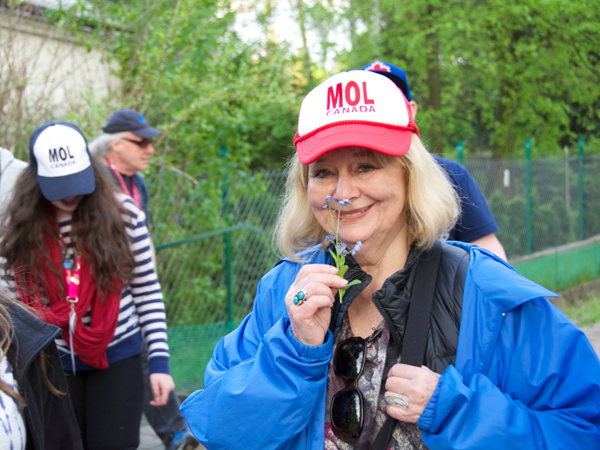
Teens on this year’s March of the Living helped Lillian Boraks-Nemetz face down haunting memories. (photo by Adele Lewin Photography)
Lillian Boraks-Nemetz, a Vancouver poet and author who was a child survivor of the Holocaust, initially declined the offer of a trip to her Polish homeland. She had been there, and written books and poems about her experiences as a child and as a returning adult. She didn’t know that an invitation to go again would lead to an emotional and psychological closure for which she had waited seven decades.
When first invited to participate in last spring’s Canadian contingent of March of the Living, Boraks-Nemetz demurred. March of the Living is a program that brings Jewish young people from around the world to the sites of Nazi atrocities in Europe and then to the Jewish homeland of Israel, marching from Auschwitz to Birkenau on Yom Hashoah, Holocaust memorial day, and traveling to Israel in time for Yom Hazikaron, Israel’s remembrance day for fallen soldiers, and Yom Ha’atzmaut, Israeli independence day. March of the Living’s teenage participants are accompanied by Holocaust survivors.
“I thought, how am I going to keep up with a bunch of 16-, 17-year-olds?” Boraks-Nemetz said in a recent interview. But she was assured that survivors are well taken care of on the trips and she was convinced to go.
“There were difficulties, but I rose to the occasion,” she said, laughing. On the extremely long day traveling from Canada to Poland, which then continued immediately with more travel and programming, Boraks-Nemetz was aided by one of the young participants. “One of the girls had chocolate that had extra caffeine in it, so she gave it to me,” she explained.
Boraks-Nemetz was accompanied by another survivor, chaperones and young people from Edmonton, Calgary, Winnipeg and Ottawa, as well as eight Jewish teens from Vancouver. In all, there were 78 people on the trip. (Young people from Ontario and Quebec made up their own contingents and traveled on different buses.)
The program was intensive. The week in Poland involved stays in Krakow and Warsaw, where they visited the Museum of Polish Jews, and they went to the extermination camps Auschwitz-Birkenau and Majdanek.
“The young people who came with us are so beautiful and so good and so well behaved and so moved by everything. You could just see how they took it all in. For them, it was a life-changing experience.”
“The young people who came with us are so beautiful and so good and so well behaved and so moved by everything,” she said. “You could just see how they took it all in. For them, it was a life-changing experience.”
In Warsaw, they also went to the orphanage that had been run by Janusz Korczak. A Polish Jew who was a respected published author, Korczak was offered multiple opportunities to save himself from the advancing Final Solution. When the Warsaw Ghetto was created, Korczak’s orphanage, its staff and nearly 200 young charges were forced to move into the ghetto. When the ghetto was liquidated, in 1942, Korczak was again offered immunity, but instead stayed with his orphaned children as they were deported to Treblinka.
In Lodz, the group visited the cemetery and the place where the second-largest Nazi-enforced Jewish ghetto had been. (More than 200,000 Jews were held in Lodz Ghetto during its existence. About 10,000 of those were alive in 1945.) There, the Canadians boarded one of the rail cars that had transported Jews to the camps.
“It was dark and there were many of us,” said Boraks-Nemetz. “It was tight. It was scary. We got the feel of it. Of course, the fear wasn’t there, but there was something foreboding about it.”
At the camps, the participants said prayers and sang mournful songs.
“There was a lot of poetry,” she said. “I brought my book Ghost Children, which was written after one of my trips there. And, whenever we went to a certain place, I would read a poem and it really got to them.”
An unexpected insight came during conversations with young Polish Jews during an arranged dinner at the hotel in Warsaw.
“They sat down, one at each table of students, so they were able to talk,” said Boraks-Nemetz. “At the end of the dinner, I saw the five or six of them standing in the lobby of the hotel, the Polish Jews, and so I went to talk to them. We went to the side and it was really interesting what they told me. They’re quite modern. They’re a little bit shy. They’re a big change from the Israeli youth,” she said, laughing.
The young Polish Jews told her that things were pretty good for them. Some go abroad – to France or elsewhere – to study, but jobs are hard to find and the standard of living isn’t great. They had a question about March of the Living.
“They said, ‘Why do you always come here looking for what’s dead?’ And I explained to them that this is an educational trip,” said Boraks-Nemetz. “But they said, ‘You know, there are some of us here, there is beauty here too, we are alive and there is a Jewish community – small, but there is a Jewish community. And I could see that that was maybe something to address.”
From Poland, the group flew El-Al to Israel.
“It’s like walking in from the shadow into light,” she said. “The Jerusalem of Gold! And we went straight to Masada off the plane.”
There, the other survivor on the trip, Max Iland, an octogenarian from Sault Ste. Marie, Ont., celebrated his bar mitzvah, a few decades late.
“The students were singing and he and I were dancing, it was really fantastic,” said Boraks-Nemetz.
The entire experience, she said, was life-altering for the participants.
“They felt that their Jewishness was strengthened, that they are a part of history,” she said. “They cherish their homes and their families after finding out what happened to Jews over there. And, above all … they were becoming witnesses to my story. That’s what one of them said. She felt she was a witness to it. I did speak to them about the legacy that we, survivors who were on our way out, are leaving them.”
Boraks-Nemetz found especially notable the connection of young Canadian Jews to those who had given their lives in defence of the Jewish state.
“What I didn’t realize was how strongly they feel about the fallen soldiers who fought for Israel,” she said. “They read poetry again to the fallen soldiers.”
When the national moment of silence came, the experience was transfixing.
“We’re standing on [Tel Aviv’s central street] Ben Yehuda and the sirens sounded and, all of a sudden, it was like everyone was made of wax figures. That was an incredible thing.”
For Boraks-Nemetz, the trip provided an unexpected closure to the darkest chapter of her life.
Lillian Boraks-Nemetz accompanied teens on this year’s March of the Living. (photo by Adele Lewin Photography)
For her, the climactic moments of the March of the Living took place in the small Polish village of Zalesie. It was here that young Lillian survived the Holocaust in hiding. After spending two years in the Warsaw Ghetto, she was smuggled out by her father before the ghetto was liquidated and its residents – more than a quarter million Jews – were sent to Treblinka and other death camps. Outside the ghetto, she was met by a Christian woman who transported her to a little white home in Zalesie, where her grandmother was in hiding, posing as the wife of the Polish man who lived there.
Boraks-Nemetz has written about that time in her poetry and in her book for young adults, The Old Brown Suitcase. As an adult, she has returned to the little house at Spokojna Street, Number 16. But this visit was different.
“These two buses went down this dusty road, and there were all these [people in] houses wondering what was going on,” she said. “Nobody bothered us. We filed out and we went into the garden. We all stood in the garden and I told them the story of hiding.”
There was one part of the story she hadn’t intended to tell, but she had developed closeness and trust with the participants accompanying her. She felt confident and compelled to share more than she ever had before, which led to an unprecedented emotional catharsis after almost seven decades.
“I told them something about the man with whom we were in hiding. He was both good and bad,” Boraks-Nemetz said. “How does a child of eight take that? That, on the one hand, he saved us, our lives, and, on the other hand, he was a drunk who could have given us away and didn’t, and, thirdly, he abused me when my grandmother wasn’t there. This is life and that’s how it was.”
In small groups of six or eight, the young people accompanied Boraks-Nemetz into the home.
“When we went into the house, I explained where I slept and where I stood by the window and watched for my parents to come, the road, the garden, the whole thing,” she said. “They were very moved, and a funny thing happened. Each time a group would come out, I would come out with them onto the little porch and they would all hug me. Every one of them. And I think what happened to me was probably, for the first time in my life, I was able to face what happened there. That was an awesome experience for me. I had been there before many times but I always blocked it out. I never faced it properly. And, this time, because of the kids … I just couldn’t believe how it opened me up, this experience with the kids.”
The ambulance being sent to Israel by the Winnipeg CMDA is the same type as the one pictured here. (photo from CMDA)
With the recent violence and tensions in Israel, Magen David Adom (MDA) is, once again, being pushed to its limits – working in a state of high alert and keeping most of its equipment in service 24 hours a day. And though tensions are high in Jewish communities outside of Israel, as well, the recent Operation Protective Edge seems to be bringing out the best in people, including additional financial support for Israel.
One such Canadian example is in Winnipeg, where people are pouring their energy into helping to send ambulances and medical equipment to Israel via Canadian Magen David Adom (CMDA). Winnipeg’s local CMDA chapter sent an ambulance to Kiryat Shmona last year. Now, it is sending its second ambulance to Israel, which will be stationed in the south.
While most of the support has come from the local Jewish community, there is growing support from Manitoba’s Christian community, who are eager to show their support for the Jewish state.
One of the leading figures in that group is Pastor John Plantz, who has been leading tours to Israel every year via his Beauty Field Tours to Israel. Plantz said he was looking for a tangible way to help Israel aside from visiting the country with his tours. He was first introduced to CMDA through materials he came across at a local Jewish community centre and, later, around 2009, through a meeting with CMDA Winnipeg member Ami Bakerman. Plantz invited Bakerman to set up a CMDA table at a local Bible conference he organizes each year.
Looking for even more ways to support Israel, Plantz recently purchased a grove of 1,000 trees, along with Beauty Field Tours group-mates John and Janice Thiessen, through the Jewish National Fund. The grove will be planted in the Yatir Forest.
“My joining the Winnipeg CMDA chapter came through an invitation from Ami [Bakerman],” said Plantz. “I was very excited about the opportunity to help this organization get ambulances for the state of Israel and to be able to help get practical resources to people in a time of need in a country that I’ve truly come to love.”
Some 25 years ago, Plantz discovered that his grandfather was Jewish. Since then, he said, “I decided to support, in practical ways, the Jewish community here, in Winnipeg, and also the state of Israel.”
Plantz sees it as “a privilege” to introduce many more Christians to CMDA at the many events he attends by handing out CMDA tzedakah boxes and other CMDA materials. Also, Plantz said, “By informing people of the need[s] in the state of Israel, it gives them the opportunity to give and help.
“I was so pleased to hear when CMDA had sent their first ambulance to Israel just over a year ago, as I was a part of that through our Bible conference, along with many others from that event.
“And now to think that another ambulance will be sent this month brings great joy to my heart and it should be celebrated by all who’ve had a part. I’d like to give the glory to the God of Abraham, Isaac and Jacob for putting it into the hearts of many to respond.”
He added, “I believe that the time to help is now, for the need is great in Israel and lives are at stake. Let’s get involved today.”
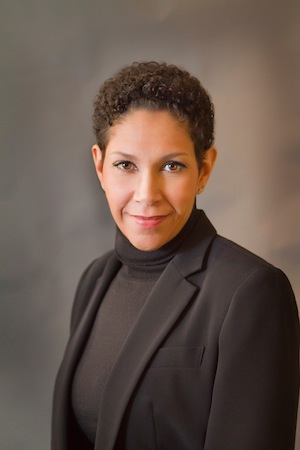
Laurelle Harris (photo from Laurelle Harris)
Another local CMDA chapter member is Laurelle Harris, a lawyer and a director of Levene Tadman Golub Law Corp.
“I’m thrilled to have been able to play a very small role in the chapter having been able to send two ambulances so far,” said Harris. “To be able to contribute to the safety and well-being of people in Israel is amazing.”
Harris joined the Winnipeg chapter of CMDA about two years ago. “The ability for MDA to provide emergency services is essential to the well-being of all those living in or visiting Israel,” she said.
“At the time, I didn’t know how long it would take to be in a position to send one ambulance. Actually sending two makes me believe that we’re on a roll and can achieve our goals in the future.
“To be able to send a second ambulance – an intensive care unit (MICA), no less – during the current conflict with Hamas makes me feel that Winnipeggers have done something tangible to make a difference right now,” she added. “Winnipeggers have, quite literally, helped MDA save lives in real time.”
According to Harris, the Winnipeg chapter’s ability to send more ambulances depends on the continued financial support of the general community in Winnipeg and throughout the province, as well as adding more volunteers with diverse skill sets and backgrounds.
“During this particularly difficult time for Israel, as she remains under attack, there are a number of ways that people can help,” said Harris. “But, most importantly, is to give to any cause that will have a direct impact on service provisions. CMDA is one such organization that will not just be of benefit in the immediate, but will also have a lasting impact in times to come. When this crisis is over, gifts given now will continue to have a lasting impact for years into the future.”
For more information or to donate to the Winnipeg chapter ambulance drive, email Winnipeg chapter treasurer Bakerman, amibakerman@gmail.com. You can also donate online at cmdai.org or by calling 1-800-731-2848. CMDA is a registered charity and all donations receive a tax receipt.
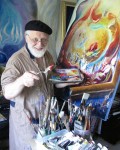
Mordechai Edel at work in the studio. (photo from the artist)
Mordechai Edel is not a stranger to grief and pain. His parents escaped Austria in 1939. His uncle spent years in the Nazi concentration camps. His father died when he was 16 years old. Edel has been aware of the darkness in the world since he was a child, but he has never succumbed to it. The art he creates is light fantastic, bursting with colors, suffused with gladness. “Bringing joy to the world,” is his artistic motto.
Edel’s solo art show at the Unitarian Church on West 49th Avenue opened on Aug. 1. The artist talked to the Independent about his life and his paintings. His involvement with the arts started in his early childhood.
“My mom baked cakes for a coffee shop in Birmingham. It was also a gallery, and the owner,
Andre Drucker, was my first art teacher. When I was about 8, I won a BBC art competition with my self-portrait. It must’ve been my bright red hair,” he joked.
Even more than painting, he said, he wanted to sing, but for a child of a working immigrant family in post-war Birmingham, it wasn’t an easy or even a realistic dream, especially after his father fell sick and young Edel had to leave school at 14 to help his mother.
“I listened to the radio when they played classical music and opera,” he said. “We also had a very good cantor in our synagogue, and I wanted to sound like him. I sang in the choir.”
He frequently bought classical opera records at the local flea market but couldn’t listen to them at home – the family didn’t own a record player. When someone at the flea market suggested playing them on his player, the music was a revelation to the boy. “I wanted to sing like Caruso,” he remembered. “I wanted to study classical music and opera.”
Instead, he followed a much more practical route and apprenticed to a hairdresser. “My uncle was an opera singer before the war. It saved his life in the Nazi camp – he sang there. After the war, he immigrated to Canada and became a hairdresser. Nobody needed an opera singer.”
Edel followed in his uncle’s footsteps. He moved to Canada in 1969, when he was 20, and worked as a hairdresser, while spending all his money on music and singing lessons. He sang in concerts. At some points in his life, he was a cantor in Victoria and a soloist for the Tel Aviv opera.
But visual art was always an intrinsic part of his life, always casting light onto the shadows. When he opened his own hairdressing salon, he played classical music there and decorated the room with his paintings. His patrons loved the ambience, and the word of mouth spread about the hairdresser artist and his paintings.
It is no wonder that one of the recurring themes in Edel’s paintings is music. The picture “Spinner of Light” looks like a tapestry of colors and notes, where fantastic creatures sway to the unearthly melodies in an imaginary landscape. Flowers dance in several of his paintings, and Chassidic bands indulge in merry klezmer tunes. “O Sole Leone” is more grounded but just as whimsical, a song of Vancouver at night, while “Transparent Emet” reminds the viewer of the spiritual theatre of life. The musicians play in the pit, but the conductor exalts above, a part of a mystical pomegranate.
Symbolism plays a huge part in Edel’s artistic vision. Combined with his colorful esthetics, it leads him the way of impressionists, where emotions get embedded in pictures, entangled with floral and abstract motifs.
“I listen to classical records when I paint. Sometimes I listen to my wife Annie playing her violin. She is my muse. She inspires me.” Married for four decades, he is as much in love with his wife now as ever, he said, and their mutual devotion helped them five years ago, when darkness struck the family.
Someone they had trusted conned them out of their life savings. After working hard for more than 40 years, the family lost everything, about half a million dollars.
“People don’t like to hear others crying,” Edel said, “but frankly, it’s played havoc with our lives. We had intended to make aliyah to Israel for the ‘last and best’ retirement years – even though artists never retire – but we had to recoil into a one-bedroom rented apartment these past few years. And yet, in order to combat our tragedy and adversity, I came up with my ‘artidote.’… So many people need to be uplifted with light and laughter.”
“I don’t dwell on darkness. I try to stay positive, although it’s a challenge to be happy in the face of darkness,”
Currently, the couple lives on a small government pension, and he paints in the living room – his studio. Like in all other areas of their life, however, his wife is his source of happiness and stability. “My wife says we go forward. And we do. I don’t dwell on darkness. I try to stay positive, although it’s a challenge to be happy in the face of darkness,” he admitted.
The current show emphasizes Edel’s drive towards the light. His paintings vibrate with joyful energy. “I wanted to reach out with my art, to show my paintings to Jews and non-Jews alike,” he said, explaining the placing of his deeply Jewish art in a Christian church.
The show runs until Aug. 31 and viewing is by appointment. On Aug. 27, at 7 p.m., there will be a guided tour by the artist and a complimentary concert. To register, call the Unitarian Church, 604-261-7204, or contact the artist, 604-875-9949.
Olga Livshinis a Vancouver freelance writer. She can be reached at olgagodim@gmail.com.
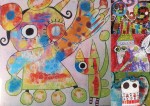
Claudia Segovia’s creations are colorful, whimsical monsters. (photo from Claudia Segovia)
It took Claudia Segovia a long time to find her niche. “I always liked art,” she said in an interview with the Jewish Independent, “but I’ve been primarily a dancer, drawing on the sideline. When I got pregnant 17 years ago, I couldn’t dance, so I started drawing much more. I also always liked sewing, so I experimented with textile art, tried different techniques: finger puppets, smaller pictures, drawings, collages, sewn little monsters. Nothing seemed to fit, until I began painting. I have only been painting for a few years but I know that’s my direction, that’s what I want to do.”
Segovia’s solo show, Intuitive Mythology, opened at the Zack Gallery on Aug. 17. It is awash with colorful, whimsical monsters. Painted as large pictures or crafted as fabric dolls, the artist’s monsters are full of contradictions. They are childish and philosophical, ugly and charming, spout big ideas or cavort like spoiled brats.
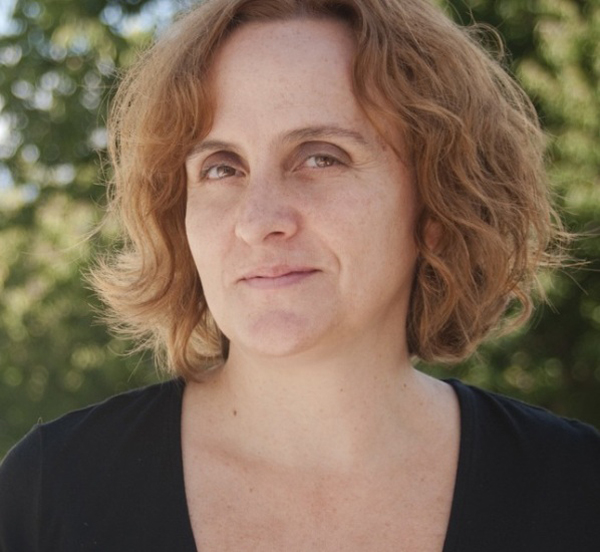
Claudia Segovia (photo from the artist)
“I don’t decide what I paint,” Segovia said. “First, I let my intuition flow and play with colors and figures on canvas for the background. Then, when it’s done, I try to see what shapes are there, what creature emerges from within. Once the creature is realized, I work to fulfil its life. Only then, I try to understand its meaning. For me, it is the most important part. Sometimes I see my siblings there, sometimes a timepiece, sometimes a totem pole. It is as amazing to me as it is to the viewers. Each piece is a surprise. What does this creature mean? What words come up? What questions does it answer?”
For this show, Segovia doubled each of her painted monsters as a hand-made fabric doll. “After I finished the painting, I worked on a 3D textile sculpture. I try to match the fabrics to the texture and colors of the painting. I display my sewn creatures in front of the paintings, as if they are coming out of the canvases, into life.”
Each of her monsters has a story to tell, if only the viewers would listen. All of them are unique, sweet and tart fruits of Segovia’s imagination.
“I have a passion for little monsters, the ones that are funny and different. I don’t like realistic art,” she admitted. “Sometimes, I write words on my monsters. My intuition guides me.… I’m inspired by the Mexican folk art, especially Alebrije – painted wooden sculpture from Oaxaca. I visited the town once, when I was younger, and talked to the artists. I do similar things with my monsters. It’s not on purpose, it just happened.”
Segovia started selling her little sewn beasties long before she started painting them. “My son was about five,” she recalled. “I wasn’t painting yet but I was making the fabric creatures. I emailed all my friends and they emailed their friends and, eventually, a couple of gift shops expressed interest. Now, three stores in B.C. carry my monsters and my smaller pictures and collages. One is on Granville Island, one on Main and one in Victoria.”
She feels excited when someone buys her art – and it’s not about the money. “People buy it because they love my piece so much they want to take it home,” she explained. “It feels wonderful.”
Unfortunately, like many artists, Segovia can’t make a living with her art. “It helps,” she said, laughing, “but to pay the bills, I teach. I teach art and I teach dancing. I love teaching.”
“I don’t teach computers anymore. Now, I only teach what I love: dancing and art. And I concentrate on my painting.”
Before she immigrated to Canada from Mexico, Segovia taught computers. Her educational background includes training in computers, as well as in art and dancing. “I did it in Canada, too, for a few years,” she noted, “before the high-tech crash in 2001. Then, when no job in the computer industry was available, I started teaching dance and art, choreographed a few pieces. I don’t teach computers anymore. Now, I only teach what I love: dancing and art. And I concentrate on my painting.”
As with her own work, in her art lessons, Segovia lets intuition take the reins. “I’m interested in the creative process, not the technique,” she said. “When I come to a school to teach, my lessons depend on the supplies. Scraps of fabrics? We’ll make aprons. Snippets of paper and old magazines? We’ll make collages. I look at what they have and think, What can we make of it?… My favorite art student’s age is from 6 to 9. Such kids engage easily. I think that must be my real age inside, too, about 8 years old.”
Segovia is a respected teacher in Vancouver, teaching art and dancing at Arts Umbrella, the Jewish Community Centre of Greater Vancouver and the Shadbolt Centre for the Arts. For more information about her, visit claudiasegoviaart.blogspot.com. Intuitive Mythology runs until Aug 31.
Olga Livshinis a Vancouver freelance writer. She can be reached at olgagodim@gmail.com.
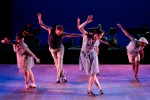
Dorrance Dance will perform at the Rothstein Theatre on Aug. 30. (photo from Vancouver International Tap Festival)
“It would be like a jazz festival presenting Oscar Peterson,” said Sas Selfjord, executive director of the Vancouver International Tap Festival. She is so proud that tap dancer Michelle Dorrance is headlining her festival that she compared Dorrance to the great Canadian jazz musician. “Michelle Dorrance is the ‘it’ girl,” she said of the artist who takes the stage Saturday, Aug. 30, at the Norman and Annette Rothstein Theatre.
The dance festival is now in its 15th season and it’s time to celebrate. A weekend of professional performance and a fundraising gala are on the schedule that runs Aug. 28 to 31.
With this, the festival’s 15th edition, Selfjord said, the Vancouver International Tap Festival “is one of the top two or three in the world. With that reputation,” she said, “we can attract any artist we want. That’s a very egocentric statement, but it’s true. People want to be part of the Vancouver festival, so that is the legacy.”
Selfjord said anyone who has ever enjoyed tap, even in old movies, will appreciate the festival’s artists. “Fred Astaire, Ginger Rogers, Gene Kelley, the Nicholas Brothers, these are people we revere in the highest regard,” she said. “Their work is a subset and that work is always carried through in everything that a tap dance artist does, except we give our own relevance to it … there could be a little bit more hip hop, there could be some breakdancing, there could be, you know, innovative combinations that no one has ever heard.”
In addition to Dorrance Dance on Aug. 30, the festival features two other professional performances, on Aug. 29, also at the Rothstein. First is LOVE.Be.Best.Free, choreographed by Danny Nielsen with an all-male cast. Selfjord remembers encountering Nielsen years ago. “I remember he was at our very first festival and what was he, 14? He’s now an internationally revered artist.”
Travis Knight (photo from Vancouver International Tap Festival)
Second on the Aug. 29 ticket is Lisa La Touche’s Hold On, the debut of a work commissioned specifically for this festival. “Lisa was here from the get-go,” said Selfjord. “Now she’s in New York and she’s revered.” Hold On has an all-Canadian cast of dancers.
Selfjord is also proud of Travis Knight, one of the performers in Hold On. Knight has been a tap consultant with Cirque du Soleil and performed at the opening ceremonies of the 2010 Olympics. He has toured with the Australian show Tap Dogs. Knight “is one of Canada’s top artists,” said Selfjord, “and I remember he came to our first festival. He took a Greyhound bus and came out on a scholarship from Montreal. He is one of Canada’s amazing, talented, generous artists.”
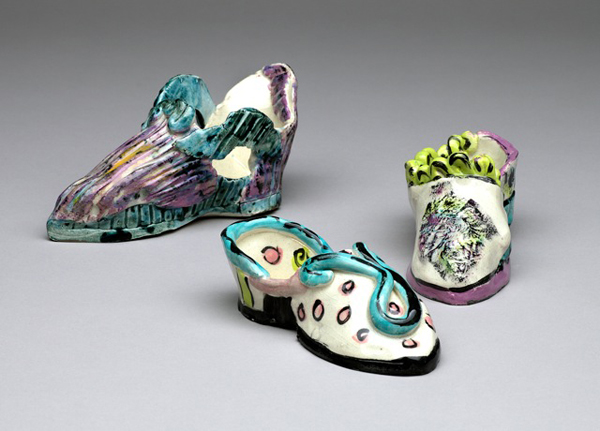
The gala fundraising and awards event, which takes place Aug. 28 at the Holiday Inn Downtown Vancouver, benefits from the sculpting talent of local ceramics artist Suzy Birstein. The local artist – who once chose dancing class over Hebrew school – was commissioned to design the awards to be presented. Birstein, who dances with the society during the year, was given the task of coming up with fancy ceramic shoes to honor some of those who have made the society great. “They pretty much gave me carte blanche as to what I wanted to do,” said Birstein. “So, I’m making shoes, like miniature shoes, not just like tap shoes. They’re just kind of in my style,” she said, referring to her own internationally known approach to sculpture.
Three of the 15 individually crafted awards – created by Suzy Birstein – that will be given out at the Aug. 28 gala event. (photo from Suzy Birstein)
Each of the clay shoes will bear a special feature. “They’ll all have something that looks like a tap on the bottom of them,” she said.
Rounding out the weekend is Tap It Out on Aug. 31, where, according to the schedule, “everyone in Vancouver is invited to experience the tap phenomena themselves … when more than 100 dancers take to Granville Street,” and a performance by four youth ensembles that night at the Rothstein Theatre.
The festival idea began in the late 1990s when Selfjord took a trip to Minneapolis on behalf of others in the Vancouver tap world “to see what we could do to help build community and engage the community at large, and we thought a festival” might be the idea.
In Minneapolis, she encountered “two of tap’s greatest legends,” the Nicholas Brothers. To some, they are the greatest tap dancers who ever lived. Born in 1914 and 1921, the two became famous as children and opened at the Cotton Club in 1932. They made films throughout the 1930s and ’40s that showed off the prowess of the dancing team, which combined tap with ballet and acrobatics.
Meeting the brothers, said Selfjord, “turned me right on my head. I thought, how am I sitting having a brandy with the Nicholas Brothers and talking to them and engaging them? I was just so motivated by having access to artists of that calibre, that just set the stage to come home and to do the festival, so we did.”
When Elan Mastai’s father said hello to a pretty stranger in a Jerusalem café some four decades ago, it was the only English word he knew.
She was born in Chicago and grew up in Vancouver, and had lived in London the previous few years before trekking to Israel to explore her Jewish heritage and teach English, of all things.
It worked out pretty well for both of them. They relocated to Vancouver, got married and started a family. Now, their 39-year-old son has channeled their youthful bravado into his screenplay for What If, a warm and refreshingly grounded romantic comedy that opens in as-of-yet-unspecifed Canadian cities Aug. 22 with its original title, The F Word (F as in friend).
“The idea of moving to a country where I didn’t speak the language, different legal system, different everything, and having to start my life from scratch, it’s almost impossible for me to imagine doing that,” Mastai said in an interview. “But that’s what my father did. And he did it for love. That is a big part of the kind of things I like to write. I think in my DNA are the things that people do for love. And that’s all over this movie.”
The film imagines just-dumped Daniel Radcliffe meeting Zoe Kazan at a party, only to learn that she’s in a serious, long-term relationship. Say, there’s no reason they can’t be friends, right? It just requires a little honesty on his part and a lot of clarity on her part.
If only things were that simple, well, there’d be no movie. The film has great fun poking and prodding the central characters until one of them takes a leap of faith – and a transatlantic flight – that results in nothing I can reveal here.
“I love the romantic comedy, but it can sometimes be a bit of a debased genre because it’s a very phony genre at times,” Mastai said on the phone from Toronto, where he lives with his wife and children. “The ones I love – and they’re the ones that most people love – have something real and relatable to say about human interaction.”
Mastai’s childhood was happily marked by a Shabbat dinner every Friday night, where his large family would convene and debate the issues of the day. Everyone had strong ideas of right and wrong, but there was plenty of grey to debate, as well.
“In my personal heritage, I had all the different versions of the Jewish experience in the 20th and 21st century,” Mastai explained. “Whether it’s American Jews, European Jewry, Sephardic, the beginning of Israel, it was all literally sitting around my dinner table when I was growing up.”
Notably, the travails his grandparents had survived did not mitigate their sense of humor. “To me, the sensibility at the core of the film is very Jewish in terms of that legacy of Jewish humor, whether it’s Billy Wilder or Woody Allen or Nora Ephron or Charlie Kaufman or William Goldman,” Mastai said. “Wit and humor as a tool to defuse awkwardness and tension, and that prizing of intelligence, and the prizing of ethical behavior – these are things that were part of my Jewish upbringing, and I tried to bring those to the characters.”
We may think that a successful screenwriter, more than anything, must have a fabulous imagination. Mastai’s triumphantly demonstrates in What If/The F Word that heart and intelligence are sufficient to engage an audience in the romantic travails of a couple of ordinary people.
“All the way through it, I wanted to write what I thought of as an ethical romantic comedy,”
Mastai confided. “A comedy where people aren’t making these crazy, cockamamie schemes or twisting the truth or hiding things from each other. Everybody’s trying to do the right thing. That feels very Jewish to me because of how I was raised, that you can try to do the right thing, try to make ethical decisions, and still make a total mess of your life. Because that’s the way life is.”
Michael Foxis a San Francisco film critic and journalist.
Weapons recovered from a Hamas tunnel. (photo from IDF/FLICKR)
“One hundred Israeli schoolchildren killed in Hamas attack.” Israelis say this would have been just one of many similar headlines announcing untold loss of civilian life had Operation Protective Edge not been launched last month. The goal of the operation was to silence the seemingly endless barrages of Gaza rockets aimed at Israeli cities and towns, and to detect and destroy the vast network of underground tunnels dug beneath Gaza and into Israel by the Islamist Hamas terror organization.
As details of the tunnel system became public, Israelis were at once fascinated and infuriated to learn specifics of the intricate Trojan-horse-like network lurking beneath their communities; an engineering feat so potentially lethal that the national discussion is rife with unsubstantiated worries about terrorist plans for the execution of “an Israeli 9/11.”
Frequently heard were comments like, “Surely the high-tech nation should have the ability to detect tunnels!” while others ask how such an elaborate feat of engineering and construction could have proceeded right under the noses of the military in a security-savvy country with vast counter-terrorism experience.
In October 2013, Israeli army intelligence located entrances to one such tunnel just a couple of hundred metres from the entrance to Kibbutz Ein Hashlosha, a collective community in southern Israel near the border with Gaza.
On a tour of that network, standing at ground level, one can see the tunnel split in the middle, its branches extending deep into the earth, with one entrance/exit nearly a mile away – through Israeli territory and into the Gaza Strip – and the other a mere 600 metres (almost 2,000 feet) to the right: exiting into Israeli territory.
Moving closer required man- oeuvring through a steep downward 46-foot trek, assisted by the steadying hand of an IDF officer to navigate the distance from the surface to the underground passageway itself. Crawling through the deceptively small opening and out of the desert’s summer heat into the coolness of the subterranean concrete-encased structure, it was surprising to find myself standing upright, able to see far enough to sense the vast distance it covers. Though visibility was limited by the dearth of ambient light, helped only slightly by the lighting unit attached to our camera, the immense dimension of the tunnel was perceptible, the elaborate nature of the structure striking. From the sophisticated construction to the array of cables, conduits, finished ceilings, communication lines and pulley systems, it made sense that each tunnel was estimated to have required several years and millions of dollars to build – mostly by hand, with jackhammers and shovels.
Also discovered in many of the recently destroyed tunnels was a variety of weapons, army uniforms, motorcycles, chloroform and handcuffs: macabre “kidnapping kits.”
Fact: There are 200 Christian Arab Israelis serving in the Israel Defence Forces (IDF). Fact: There are 200 Muslim Arab Israelis serving in the IDF. Fact: There are 1,400 Bedouin serving in the IDF. Fact: There are 4,000 Druze serving in the IDF. Fact: There are 100 Circassians serving in the IDF.
Why don’t journalists write about them? Perhaps because most might find it hard to believe that these 5,900 view their citizenship to mean they have a role to play in defending their country. How do these minority members of the IDF come to the decision to serve their country?
A recent meeting with parents of minority soldiers in the IDF presented some context. The visit was organized by MediaCentral, an independent Jerusalem-based nongovernmental organization that provides support services for journalists based in or visiting Israel, the Palestinian Authority and the region.
Anett Haskia (photo by Barry A. Kaplan)
Anett Haskia is an attractive, fashionably dressed blond with long, manicured fingernails. She is an Israeli Muslim Arab and outspoken. Growing up, she said, “It was not acceptable for our kids to join the army. Everyone [who wanted to join the army was] considered to be a traitor, but I didn’t see it as [being] a traitor. I saw it as taking responsibility like every other citizen.”
Twenty-two years ago, after a divorce, she and her three children moved to a kibbutz and she went to enrol them in a Jewish school, the first time that school had been approached to enrol an Arab child. He was accepted in three days.
As her children grew up, her older son decided to volunteer to serve in the IDF infantry; her daughter volunteered to serve in an education unit and became one of the first Arab Israeli women to serve in the IDF. Haskia’s youngest son is part of the Golani Brigade (an infantry brigade) currently serving in Gaza.
“The aim was not to integrate into Israeli society,” she said. “They [already] are Israeli. They want to live in the present and future as Israelis. They never suffered from being Arab and they never hid their heritage.” Haskia said she didn’t tell them to join the IDF, rather, it was a choice the children made as individuals.
Yusuf Jahja (photo by Barry A. Kaplan)
Speaking to reporters, Yusuf Jahja said proudly, “I am a Muslim Arab citizen of the state of Israel.” A blue-collar worker most of his life, Jahja comes from an Arab village up north and has six sons and two daughters. His was the first family from his village to send their children to the Israeli army.
Three of the sons went to serve in the IDF together – two served in combat units and one in border patrol. In 2004, one of the sons was killed in an explosion in Gaza. The family’s home community initially boycotted the funeral. Today, two of Jahja’s sons are still serving their country.
Sybil Kaplan is a journalist, foreign correspondent, lecturer, food writer and book reviewer who lives in Jerusalem. She also does the restaurant features for janglo.net and leads weekly Shuk Walks in English in Jerusalem’s Jewish food market.
The Babani family at New York’s JFK airport, moments before they boarded the plane to Israel. (photo by Shahar Azran via Nefesh b’Nefesh)
Despite tensions surrounding the war in Gaza, 338 new olim (immigrants) from the United States and Canada departed on an aliyah charter flight to Israel on Aug. 11. The special flight is a joint venture of Nefesh b’Nefesh, the Ministry of Aliyah and Immigrant Absorption, and Keren Kayemeth Le’Israel, in cooperation with the Jewish Agency for Israel, JNF-USA and Tzofim Garin Tzabar.
Among the olim are Nir Babani and Luz Arroyave with their daughter Antonia from Vancouver. “We’re going to miss our family and the peaceful environment of Vancouver. We’ll miss the quality life there,” said Arroyave.
The large group of olim includes 37 families with 107 children. The passenger list also includes 65 olim moving to the Galilee and the Negev as part of the Nefesh b’Nefesh and Keren Kayemeth L’Israel Go North and Go South programs. Altogether, the olim will be settling in every part of Israel, from Ma’alot in the north to Eilat in the south. Included in the group of olim are 109 young men and women who will be serving in the Israel Defence Forces.
The olim hail from 27 states and three Canadian provinces, from Arizona to Quebec, and range in age from a six-week-old baby to a 93-year-old great-grandparent in a family of four generations making aliyah together.
“I find it profoundly inspiring that we have a 747 jumbo jet filled to capacity with people from the North American Jewish community making aliyah, especially at such a challenging time,” said co-founder and executive director of Nefesh b’Nefesh Rabbi Yehoshua Fass. “To see that Jews everywhere, young and old, religious and secular, are determined to fulfil the dream of helping to build the Jewish state is truly amazing.”
This summer, 2,000 olim are expected to have made aliyah with Nefesh b’Nefesh on eight different flights. Since the beginning of the year, about 1,600 olim have made aliyah with the organization. Since 2002, Nefesh b’Nefesh has brought nearly 40,000 olim to Israel from the United States, Canada and England.