More racist activities

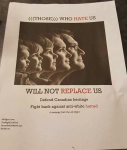
(photo from Anti-Racist Action UVic/Facebook)

On Nov. 9, the anniversary of Kristallnacht, a swastika and “Heil Hitler” were found written on a hallway blackboard in the University of British Columbia Forest Sciences Centre. The antisemitic graffiti was first reported to Hillel BC, who then contacted security.

This was one of several racist incidents that have occurred on B.C. campuses and across Canada in recent months, including pro-Nazi posters found at UBC on Remembrance Day. On Halloween night and in the days following, posters reading, “It’s okay to be white,” appeared on several Canadian university campuses, apparently based on instructions from a post which Vice Canada traced to the anonymous online forum 4Chan, a hub for the alt-right.

During the same week, antisemitic posters found at the University of Victoria read, “Those who hate us will not replace us. Defend Canadian heritage. Fight back against anti-white hatred. A message from the alt-right.” The word “those” was placed in triple parenthesis, a way of identifying Jews. When the posters were taken down, moderators of Anti-racist Action UVic Facebook page and others reportedly received a backlash of hateful messages online.

The election of Donald Trump one year ago this month is widely perceived as a triumph for the tangle of white supremacists, antisemites, misogynists, racists and ethno-nationalists who have come to be called the “alt-right.” In Kill All Normies, a book about the genesis of the group, journalist Angela Nagle describes an online world where cynicism, irony and absurd in-joke humour have combined with racism and misogyny to produce a “taboo-breaking anti-PC style” that has come to characterize the alt-right. Since then, the movement has tapped into latent racism and xenophobia, bolstered by the rise of people like Richard Spencer and Milo Yiannopoulos.

Not everyone is happy with the use of the term “alt-right.” Given their white supremacist beliefs, “alt-right” is somewhat innocuous. The Associated Press avoids the term because its editors think it downplays the movement’s racist goals.

Long before the 2016 election, the alt-right was gathering strength and allies. Trump granted the racists among his supporters visibility, lowering the social costs of bigotry and inspiring these supporters with a hope that their vision of “white identitarianism” could come to rule America once again. This has emboldened them and brought them out of the shadows.

In the days following the election of Trump, Canada saw a spate of vandalism, hate speech and pamphleteering directed against Jews and other minorities. As in the United States, this did not come to Canada overnight. In 2015, the CBC temporarily closed all online comments on stories featuring First Nations people because of the “staggering number of hateful and vitriolic comments” posted. In August 2016, the premier of Saskatchewan was forced to issue a plea for an end to hate speech following the second-degree murder of an aboriginal man on a farm. As a result, his own Facebook page was flooded with racist messages.

The posters at UVic were discovered by an anti-racist group on campus organized by Tyson Strandlund, who said the increasing activities of the alt-right in the public sphere are what led to his group’s creation in September. Strandlund said there has been heightened concern on campus since last summer, when an art installation meant to inspire conversations about resistance to racism was instead extensively defaced with racist slurs and had to be dismantled. He mentioned a meeting that was to take place in the Student Union Building on Nov. 15, for students and others to discuss anti-racist strategies.

David Blades, president of the Jewish Federation of Victoria and Vancouver Island, said they are “keeping close tabs” on the alt-right movement. “We have a good sense of who these people are,” he told the Independent. “What’s increasing is their public activity, not their numbers, which have remained pretty stable for years.

“Nevertheless,” he warned, “we have to be vigilant because they are also recruiting. There is no question that there is latent racism in Canadian society and it can be tapped into. My concern is that this was not isolated to the University of Victoria, this also happened at the University of Alberta and elsewhere. It was a coordinated national event. That’s my concern as Federation president. This is a shift in the overall organization of this group.”

Blades said he is “really happy with the response of UVic” and that there are plans in the works for “five days of activism against racism.”

“In some ways,” he said, “these incidents have been more effective at inspiring the opposite of what they intended: an increase in anti-racist activism.”

Matthew Gindin is a freelance journalist, writer and lecturer. He writes regularly for the Forward and All That Is Interesting, and has been published in Religion Dispatches, Situate Magazine, Tikkun and elsewhere. He can be found on Medium and Twitter.
Holocaust awareness

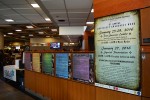
The Post-Survivor Exhibit in Mystic Market, one of the busiest spots on campus. (photo by Chorong Kim)

The following remarks have been modified from the original address given during Hillel Victoria’s Second Annual Holocaust Awareness Presentation during Holocaust Awareness Week, which took place at the University of Victoria Jan. 25-29.

When my co-organizer, Dr. Kristin Semmens in the history department at the University of Victoria, and I embarked on planning Holocaust Awareness Week, we decided to put a call out for poster submissions to include in the Post-Survivor Exhibit to be publicly displayed in Mystic Market, one of the busiest spots on campus. The aim was to feature personal stories of post-survivors – UVic students who are descendants of Holocaust survivors – and we welcomed submissions from survivors of other genocides and atrocities. We thought that, between all the Jewish students and the diverse student body, we would be overflowing with submissions and would struggle to select 20 stories to include in the exhibit. As it turned out, our struggle was to get any submissions at all. Why am I sharing with you our experience of failed expectations? Well, it’s quite simple. This has been a learning experience for us, just as much as it has been for the students we approached to participate in the exhibit.

Many of the Jewish students said they knew very little about their grandparents or their survival story, and felt they didn’t have enough to write personal reflections about it. I was coming from the point of the view that you can write about “not having enough to write about” and attribute that to the implications of being a descendant of a survivor and the negative effects of post-Holocaust syndrome (a form of transferable post-traumatic stress disorder). Others didn’t want to share their story in public and recommended that we ask people to submit anonymously; some were too scared to be identified as Jews on campus. Both Kristin and I were not surprised by the reasons we received but, as advocates of Holocaust awareness and education, we thought the students could overcome their fear and disassociation from their family’s past.

photo - Dr. Orly Salama-Alber, left, and Hannah Faber sing “Mi Ha’Ish,” while Cheryl Noon, left, and Kaitlin Findlay light the second candle
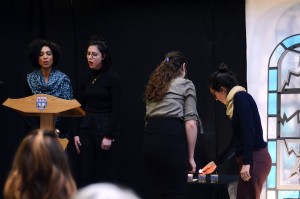
Dr. Orly Salama-Alber, left, and Hannah Faber sing “Mi Ha’Ish,” while Cheryl Noon, left, and Kaitlin Findlay light the second candle. (photo by Chorong Kim)

As a granddaughter of Holocaust survivors from Poland (and today Belarus) on my mother’s side and a granddaughter of interned Japanese-Canadians on my father’s side, I can tell you that there are two types of survivors. Those who talk and those who don’t. My maternal safta (grandmother) spoke about the Holocaust and would tell everyone that the only reason she survived was because of her blond hair and blue eyes, whereas, my other three grandparents chose to never talk about what happened to them. So much so, that my Japanese bachan and gichan (grandmother and grandfather) completely abandoned their Japanese heritage and opted to raise their children with English names and, tragically, my maternal saba (grandfather) couldn’t even recall the names or faces of his murdered first wife and baby girl. That’s how he dealt with his past.

I only know about my histories because I wanted to know about them and I asked questions. That got me thinking, how can I ask students to write about their stories if they haven’t gone through this process of asking yet? And who am I to pressure them to do so? I know now that I may have asked too much of the students. Perhaps we are not as ready as I thought to share our stories, let alone share them collectively as an international community.

I thank the handful of students who did send in poster submissions for their bravery in sharing their stories. Each one was on a different page in their personal journey to coping and understanding their family or nation’s past. Some already knew all the details while others had to ask their families for help in obtaining old photographs and putting all the bits and pieces of their grandparents’ stories together into one cohesive personal reflection. One of my students wrote to me on Facebook, “I just found out a ton of information that I didn’t know before, and I’m still kind of processing it”; another texted me saying that, although they have decided not to submit a story, this has started a personal desire to find out more about their family’s history. Coming to terms with the past is not easy, we all need healing and we all have the right to look to a brighter future.

photo - Carmel Tanaka with, left to right, Dawn Smith, Thomas Laboucan-Avirom and Rachelle Trenholm of the Indigenous Law Students Association
Carmel Tanaka with, left to right, Dawn Smith, Thomas Laboucan-Avirom and Rachelle Trenholm of the Indigenous Law Students Association. (photo by Chorong Kim)

This weeklong exhibit and the presentation today have already served their purpose – Holocaust awareness. It was not smooth sailing organizing this event. The Holocaust is a very sensitive subject and everyone has their views on how to approach Holocaust education. I am very moved by the outpouring of support from participating organizations in our very diverse community. May this be an example of collaboration, tolerance, compassion and love towards our ultimate goal: peace on this campus, in our community and around the world.

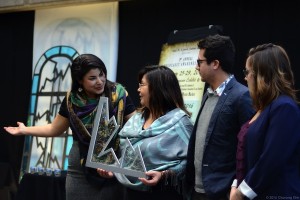
Traditionally, during Holocaust commemorations, six memorial candles are lit to represent the six million Jewish lives lost in the Holocaust. Today, we have chosen to light seven memorial candles, to be lit by UVic students representing various communities and causes, with our seventh candle symbolizing our hope. Performing “Mi Ha’Ish” is post-doctoral fellow Dr. Orly Salama-Alber, accompanied by Hannah Faber, the volunteer coordinator of UVic’s Jewish Students Association, and the same song that has been incorporated into our gift to Dawn Smith, who performed the First Nations acknowledgement earlier. In English, the lyrics read: “Who desires life, loving each day to see good? Then guard your tongue from evil and your lips from speaking deceit. Turn from evil and do good, seek peace and pursue it.” (Psalm 34:12-4)

Our first candle will be lit by undergraduate students Shelly Selivanov, Paige Gelfer and Anat Kelerstein and master’s student Keenan Anthony, grandchildren of Holocaust survivors, and they will be lighting on behalf of the six million Jews who perished in the Shoah.

Our second candle will be lit by I-witness Field School student Cheryl Noon and history graduate student Kaitlin Findlay on behalf of all other persecuted victims of the Holocaust.

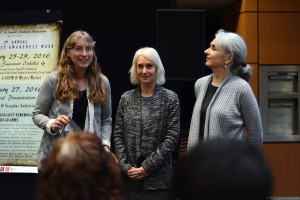
photo - Holocaust educators at UVic, left to right, Dr. Helga Thorson, chair, Germanic and Slavic studies department; history professor Dr. Kristin Semmens; and Dr. Charlotte Schallié, co-chair of the European Studies Program
Holocaust educators at UVic, left to right, Dr. Helga Thorson, chair, Germanic and Slavic studies department; history professor Dr. Kristin Semmens; and Dr. Charlotte Schallié, co-chair of the European Studies Program. (photo by Chorong Kim)

Our third candle will be lit by international students Moe Ezzine and Abbie Urquia, who are members of the African Awareness Club, on behalf of all the victims of genocide, including, but not limited to, the Armenian genocide, the Rwandan genocide, the Ukrainian genocide and, more recently, the Syrian genocide.

Our fourth candle will be lit by student advocates Lane Foster and Maks Zouboules from the Sexualized Violence Task Force on behalf of all victims of sexualized violence on and off campus.

Our fifth candle will be lit by undergraduate student Nicola Craig Hora and graduate student Lauren Thompson, who are co-designing a teaching unit on the Holocaust for high school students, on behalf of all the children whose lives were cut short and were robbed of their bright futures.

Our sixth candle will be lit by members of the Indigenous Law Students Association, Thomas Laboucan-Avirom and Rachelle Trenholm, on behalf of all victims of residential schools and Japanese internment camps here in Canada.

Our seventh and final candle, our candle of hope, will be lit by Multifaith Services work-study students Olivia Bos and Gabriela Turla, on behalf of all humanity, regardless of their race, religion, creed and sexual orientation.

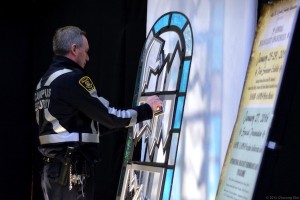
photo - Team leader Mike Brosselard from Campus Security
Team leader Mike Brosselard from Campus Security. (photo by Chorong Kim)

On stage, between the candles is our broken window. This window is shattered and represents Kristallnacht, the night of Nov. 9, 1938, on which a massive coordinated attack on Jews occurred and swept across Europe, marking the beginning of the Holocaust. This night is otherwise known as the Night of Broken Glass. Throughout this presentation, we will be reclaiming the broken pieces of glass and rebuilding this very window in a communal act of resilience.

The eight window pieces were placed by members or representatives of the following groups: 1) First Nations community; 2) UVic Multifaith Services; 3) Jewish Federation of Victoria and Vancouver Island; 4) UVic Holocaust educators; 5) Campus Security; 6) student leaders (Jewish Students Association, Indigenous Law Students Association, History Undergraduate Society, Multifaith Services work-study students, Germanic and Slavic studies students, I-witness Field School students, and student advocates from African Awareness Club and Sexualized Violence Task Force); 7) UVic administration (Equity and Human Rights Office); and 8) children of Holocaust survivors and members of the Kristallnacht planning committee.

It takes a community to overcome trauma and rebuild a peaceful future. It also takes a community to prevent trauma from happening in the first place.

Carmel Tanaka is the Hillel BC director at the University of Victoria, a granddaughter of Holocaust survivors and an advocate for Holocaust awareness.

Living at Victoria’s Hillel House

Living at the Victoria Hillel House has provided Hannah Faber a space to engage with her Jewish identity in a holistic way. (photo from Hannah Faber)

When I decided to move to Victoria to finish my undergraduate degree at the University of Victoria, I was told by a longtime friend to look into the Victoria Hillel House as a place to live. At first, I was cautious because I had not been very active at the Hillel of my last university. Following that friend’s advice has turned out to be one of the most transformative experiences I have ever had. Living at the Hillel House has given me so many opportunities to be a part of the Jewish community, which has irrevocably changed my sense of Jewish identity.

Within the first week of moving to Victoria as a transfer student, I was asked by the Hillel director to volunteer at a lot of community events. There were two things that struck me deeply and had me admiring the local Jewish community. The first was how small it was and, therefore, how everything within it was such a labor of love. The second was how much older most people at community events were and how much they wanted young people to become involved. Even though I grew up in a relatively small Jewish community in Calgary, the question of whether or not young people would commit and engage in the Jewish community did not seem nearly as urgent as it does in Victoria. Victoria Jewry is made up of mostly older people who have dedicated their lives to the community and are looking for people to carry the torch.

photo - The Jewish tradition of sitting down to a nice meal plays a large part at the Victoria Hillel House
The Jewish tradition of sitting down to a nice meal plays a large part at the Victoria Hillel House. (photo from Hannah Faber)

My ability to get involved with the kehilah is in part because I am a resident of the Victoria Hillel House. Living in the Hillel House has provided me a space to engage with my Jewish identity in a holistic way, to explore its many facets and intricacies. The space created is based on values like hospitality, generosity, tikkun olam, as well as inclusive and compassionate listening. I can ask questions about the intersections of feminism and Judaism in my life, and how social justice could be directly informed by my Jewish identity. It is a place where I have explored pertinent questions relating to my Jewish identity with other young Jews, been surrounded by Jewish culture, met members of the Jewish community outside of the university, as well as faculty, and done that all within the Jewish tradition of sitting down to a nice meal.

Hillel House has been a place for me to feel a sense of pride in my identity as a person who is part of a greater shared history. It is rare for one to find a place that validates oneself and simultaneously allows for personal growth. The Victoria Hillel House has done just that. It has played an integral part in allowing me to come into my Jewish identity and, for that, I am very grateful.

Hannah Faber is a Victoria Hillel House tenant, as well as the volunteer coordinator of the Jewish Students Association and an undergraduate studying theatre at the University of Victoria.