Skip to content
  • Home
  • Subscribe / donate
  • Events calendar
  • Business Directory
  • FAQ
  • News
    • Local
    • National
    • Israel
    • World
    • עניין בחדשות
      A roundup of news in Canada and further afield, in Hebrew.
  • Opinion
    • From the JI
    • Op-Ed
  • Arts & Culture
    • Performing Arts
    • Music
    • Books
    • Visual Arts
    • TV & Film
  • Life
    • Celebrating the Holidays
    • Travel
    • The Daily Snooze
      Cartoons by Jacob Samuel
    • Mystery Photo
      Help the JI and JMABC fill in the gaps in our archives.
  • Community Links
    • Organizations, Etc.
    • Other News Sources & Blogs
  • JI Chai Celebration
  • JI@88! video

Recent Posts

  • Or Shalom reopens its doors
  • JFS from past to future
  • Need holistic approach
  • Sharing stories, advice
  • Journalist shares fears
  • Skills to live together
  • Road to independence
  • Cutting grass with scissors
  • Zionism as a solution
  • Deceit, desire & the divine
  • Reclaiming sacredness
  • Creative project ideas
  • Summer squares and cobbler
  • Thou shalt … summer commandments
  • Legal help for students
  • Revisiting myth of Lilith
  • Wrong person rebuked
  • Canada’s mixed messages
  • Questions for museum
  • Symposium on antizionism
  • Making soccer political
  • CJPAC lauds Pulver’s impact
  • City recognizes Vrba’s legacy  
  • Organ donation saves lives
  • Theodore’s March premiere
  • A healing Shabbaton
  • Supplying healthy food
  • A chime of metal tags
  • Yellowknife seder a first
  • Ishai energizes, unifies
  • A Lag b’Omer to remember
  • Expanding the healing
  • Hannah Senesh – a unique hero
  • Community milestones … May 2026
  • Деньги до зарплаты на карту Займ до зп онлайн за 5 минут 2026
  • Микрокредит онлайн в Казахстане Микрозайм в Акшамат

Archives

Follow @JewishIndie
image - The CJN - Visit Us Banner - 300x600 - 101625

Category: World

EcoPeace crosses borders

EcoPeace crosses borders

EcoPeace Middle East is an Israeli-Jordanian-Palestinian organization dedicated to environmental peace building, primarily through water diplomacy. (photo from EcoPeace Middle East)

EcoPeace was created by Gidon Bromberg some 22 years ago after he made the connection between ecology and the lack of cooperation between the region’s various authorities regarding water issues.

At the time, he was studying for a master’s in environmental law in Washington, D.C. When he returned to Israel, he organized the very first gathering of Israeli, Palestinian, Jordanian and Egyptian environmentalists. On the second day of the meeting, in December 1994, an agreement was struck to create EcoPeace Middle East.

Bromberg has been working together with Jordanian Munqeth Mehyar since then and Palestinian Nader Khateeb since 2001 to create an Israeli-Jordanian-Palestinian organization dedicated to environmental peace building, primarily through water diplomacy, and to the advancement – through both top-down advocacy and community-led grassroots work – of cross-border cooperation concerning shared water resources, pollution issues and sustainable development issues. Half of their programming is bottom-up community work through the Good Water Neighbors (GWN) project, now into its 15th year of operation.

“The second half of our work is advocacy aimed at influencing the Israeli, Palestinian and Jordanian governments, as well as at garnering support from the international community in advancing dialogue and cooperation between them,” Bromberg told the Independent.

photo - The three co-directors of EcoPeace Middle East at the Jordan River. From left to right: Gidon Bromberg (Israel), Munqeth Mehyar (Jordan) and Nader Khateeb (Palestine)
The three co-directors of EcoPeace Middle East at the Jordan River. From left to right: Gidon Bromberg (Israel), Munqeth Mehyar (Jordan) and Nader Khateeb (Palestine). (photo from EcoPeace via commons.wikimedia.org)

The underlying assumption behind their efforts on all fronts is that regional cooperation is in each party’s best self-interest. “As altruism is not a common feature of foreign policy, particularly not in the midst of conflict, speaking to the self-interest of each side enables us to create political will for cooperation that ultimately serves the region as a whole,” said Bromberg.

Over the years, EcoPeace’s major areas of work have been focused on the rehabilitation of the Jordan River; a regional plan for sustainable development in the Jordan Valley; water and the peace process; Gaza’s water, sanitation and energy crisis; the water-energy nexus in the region; and the Red Sea-Dead Sea conduit.

Since its establishment, EcoPeace Middle East has seen many periods of extreme hostility and bloodshed in the region but, in the midst of that, has been able to make headway.

“Joint work of Israelis, Palestinians and Jordanians through EcoPeace’s programs has brought the leveraging of more than half a billion U.S. dollars in recent years for water supply and sanitation solutions in the GWN communities, all with a strong cross-border effect, i.e. removal of sewage from shared resources,” said Bromberg. “EcoPeace has also been able to convene Israeli, Palestinian and Jordanian government representatives together and generate dialogue between them around issues such as the Jordan River, at a time when no such meetings were taking place.”

At the community level, EcoPeace holds many cross-border youth gatherings every year, wherein kids not only learn about the interdependency of their and their neighbors’ water reality, but also about each other, in an effort to break down negative stereotypes.

One of the biggest achievements of EcoPeace in terms of bringing together people from the three countries has been the facilitation of relations between Jordan Valley mayors, who have rallied together to demand joint governmental cooperation toward rehabilitating the river.

“As far as positive ripple effects, very much due to our work, there is a growing realization amongst the various stakeholders, including decision makers, that regional sustainable development is crucial for geopolitical stability and for security in the region, for economic growth, public health and other aspects of life in the region,” said Bromberg.

EcoPeace’s notion of water as a political game changer in the region, for example, is slowly but surely becoming a part of the political discourse.

“The Jordan River is a good example of persistence that has recently started to pay off,” said Bromberg. “Ten years ago, when we were trying to convince the Israeli Water Authority (IWA) to release fresh water from the Sea of Galilee to the Jordan River, something which had then not happened for almost 60 years, one of the seniors raised his palm and said, ‘Gidon, when hair grows on this palm, that’s when fresh water will flow again from the Sea of Galilee to the Jordan River.’”

Nonetheless, by mid-2013, following years of advocacy by EcoPeace and others, the IWA released nine million cubic metres (mcm) of water into the river, committing to raise this volume to 30 mcm in the near future. This is only a drop in the bucket, however. Based on research commissioned for the project, the estimate is that 400 mcm overall is required to rehabilitate the river – and not all from the Sea of Galilee, which is in Israeli territory, but also from Jordan and Syria.

This is a very important first step, said Bromberg, who is certain of EcoPeace’s ability, with the help of many partners, to convince the relevant decision makers to allow for more significant volumes of water to flow into the river.

“Times now are particularly difficult in our region,” he said. “Hostility between Israelis and Palestinians has reached a whole new level, a frightening environment that, for the most part, does not react well to cooperation.”

Bromberg believes that, through providing youth in each of their communities with opportunities and cooperation with their neighbors, even this complex environment can be overcome.

For more information, visit foeme.org or facebook.com/ecopeacemiddleeast.

Rebeca Kuropatwa is a Winnipeg freelance writer.

Format ImagePosted on May 6, 2016May 5, 2016Author Rebeca KuropatwaCategories WorldTags Dead Sea, EcoPeace, Israeli-Palestinian conflict, Jordan River, Middle East, peace, Red Sea, water

Increasing organ donations

Leading up to the provincial election in Manitoba in April, activists, family members of organ recipients and those waiting for organs pushed the topic of organ donation as an election issue. They reached out to many prominent people to help them spread their message, including Prof. Arthur Schafer, founding director of the Centre for Professional and Applied Ethics at the University of Manitoba.

The centre’s purpose is to promote research specifically in applied ethics across different professions, such as medicine, engineering, pharmacy and nursing. Schafer further described it as “ethics as it applies to controversial, moral, social and political issues in society.”

Organ donation, while supported by most segments of the population, has been an issue with which many countries struggle. As there is most often a gap between supply and demand, some countries are coming up with new ways to tackle the problem.

photo - Prof. Arthur Schafer
University of Manitoba’s Prof. Arthur Schafer. (photo from Arthur Schafer)

“Israel used to have just about the lowest organ donation rate of all the Western countries,” said Schafer. “So, historically, and rather embarrassingly, more people died waiting for an organ donation in Israel than anywhere else.”

According to Schafer, the lack stemmed from the common misconception that Jewish law prohibits organ donation.

“But, the very low donation rate in Israel changed after a new law was passed in 2008,” he said. “The new law gave priority [to certain people]. It was still true, after the new law was passed, that medical need was the most important criteria. Someone faced with imminent death would have priority over someone whose need was less urgent but, when patients had comparable need, the 2008 law gave priority to those who’d signed an organ donor card or whose family had donated an organ.”

The policy was nicknamed, “Don’t Give. Don’t Get.” Schafer said what this meant was that, if someone, for religious or other reasons, would not sign an organ donor card, they might end up dying themselves as a result of having a lower priority on the list of waiting patients.

“I suppose it’s the dual moral justification … first of all, a principle of justice or fairness,” said Schafer. “If you aren’t willing to give, you don’t deserve, you could argue, it’s not fair for you to take when you’re not willing to donate.

“Then, there’s also the principle of maximizing benefit, because this law seems to have resulted in saving many lives – which, according to Jewish law, is supposed to be of the highest priority. Jewish law says that saving a life is more important than anything else. Yet, many Orthodox Jews refuse to sign an organ donor card.”

Schafer said that, while the supply gap in Israel is still significant, it has narrowed dramatically since the passage of this new law.

Meanwhile, in Canada and its provinces, there is no priority given at present to those who sign an organ donor card.

As for the current local situation, the Province of Manitoba has passed a law – called Required Consideration – that requires physicians to consider whether someone dying or near death is a suitable candidate for organ donation, and to ask them or the family about donating.

Other provinces, like Ontario and British Columbia, have taken it a step further, passing a law known as Required Request. Doctors must discuss organ donation with dying patients. In both of these provinces, doctors can take themselves out of the process by alerting an organ donation coordinator to the situation.

“Many physicians are quite squeamish about the topic, by the way, especially when a younger person has died tragically in a car accident,” said Schafer. “Their organs might be a potential source of numerous healthy organs that could save lives but doctors feel, due to the severe family grief resulting from the death of a young person, that they don’t want to add to the burden by asking for an organ donation. That’s a fairly understandable reaction. But, I think it’s profoundly wrong. I think that, if your child has died in an accident or suffered from an untimely death, the family might welcome the opportunity to make something morally significant by agreeing to have other lives saved through organ donation. I think many people actually feel this way and that doctors who are reluctant to ask the families about it are depriving them of an opportunity.”

Schafer went on to say that, in many provinces, there is a big push to change the system of organ donation so that it would be a choice of opting out as opposed to one of opting in. The current situation is that, if you do not tick the box or tell your family you want to donate, your organs will not be harvested. Schafer contends that reversing the onus is a good option, as it still gives individuals a choice, but they have to choose not to do it rather than to do it.

“Many European countries have adopted opting-out systems, such as Spain,” he said. “Their donation rates have gone up considerably.”

Another option Schafer suggested is to tweak the compensation system for doctors, giving them further incentive to talk to people about organ donation when there is not the option of referring the matter to an organ coordinator.

“Many people die in community hospitals, nursing homes or in their own homes,” he said. “The family doctor, rural doctor or community hospital doctors are often unwilling to take the time filling out the forms to arrange for organ donation. I think the medical profession itself has been a big impediment to an increase in cadaveric organ donation.

“If you’re in a teaching hospital where transplant operations are occurring, you’re more likely to approach the family or individual and arrange organ donation,” he continued. “If you’re in a community hospital, it takes time. You have to fill out forms, you have to speak to people, and you’re not reimbursed. I think part of the solution to the dramatic gap between the supply and demand for organs requires a change in the medical profession itself or making it a requirement for doctors.”

The possible downside to a change in the compensation system for doctors, however, is to ensure that they still do all they can to save a patient.

For information on becoming an organ donor in British Columbia, visit transplant.bc.ca/be-donor.

Rebeca Kuropatwa is a Winnipeg freelance writer.

Posted on May 6, 2016May 5, 2016Author Rebeca KuropatwaCategories WorldTags Canada, halachah, Israel, Jewish law, organ donation, transplant
Anti-tunnel technology

Anti-tunnel technology

(screenshot of IDF Twitter page via israel21c.org)

Smugglers of drugs and illegal migrants using tunnels along the U.S.-Mexico border may want to keep an eye on Israel. The American government, after all, is co-sponsoring the tunnel-detection technology now being developed by Israeli engineers.

Described by the Hebrew media as the underground equivalent of Iron Dome anti-missile defence system, this latest innovation made world headlines upon the announcement that the Israel Defence Forces (IDF) uncovered a two-kilometre-long, concrete-lined tunnel on Israel’s Gaza border.

While the Israeli government has been funding its development for five years, few details about the new system have been reported until now. News reports say that up to 100 companies – including Iron Dome’s developers, Elbit Systems and Rafael Advanced Defence Systems – are involved in assembling the detection system. Military units, Shin Bet security agency officers, civilian engineering, infrastructure contractors and tunnel construction experts are also credited with helping.

“The search for tunnels is at the top of our priority list … and we will not spare any efforts,” said Defence Minister Moshe Ya’alon, following the IDF announcement that it found a tunnel extending from southern Gaza into Israeli territory.

The fine details about how the anti-tunnel technology works are still under wraps but, according to Yedioth Ahronoth, dozens of Israeli-developed sensors gather information from the field and transmit it to a control system for analysis using advanced algorithms. The system, says the report, can identify the length of the tunnel and its exact location without false alarms.

“We do whatever we can to find a technological solution,” Maj. Gen. Nitsan Alon, head of the IDF operations directorate, said at a briefing. “Dealing with the phenomenon of tunnels is very complex, and the state of Israel is a world leader in this field. This battle demands from us persistence, creativity, and also responsibility and good judgment.”

According to a report in Defence News, Israel’s Ministry of Defence has invested more than $60 million in anti-tunnel technologies. In February of this year, the Financial Times reported that the United States will provide $120 million over the next three years to help develop complementary technologies.

An Israel Today report says Israel is building a counter-tunnel barrier along its Gaza border that “will also feature a state-of-the-art fence, complete with sensors, observation balloons, see-shoot systems and intelligence gathering measures, as well as an underground wall.”

A video of the IDF discovering a Hamas tunnel in southern Israel can be found at youtube.com/watch?v=yETrQXh2FZU.

Israel21C is a nonprofit educational foundation with a mission to focus media and public attention on the 21st-century Israel that exists beyond the conflict. For more, or to donate, visit israel21c.org.

Format ImagePosted on May 6, 2016May 5, 2016Author Viva Sarah Press ISRAEL21CCategories WorldTags defence, IDF, Israel, security, smuggling, technology, tunnels
Jewish dating app fills gap

Jewish dating app fills gap

Shapira began piloting JFiix in Israel a couple of years ago and it was launched recently in the United States and Canada with an English version. (screenshot)

In 1996, at a time when not everyone had a home computer, Joe Shapira started a dating website – JDate. Today, very few people in the Jewish community have not heard of it. Since its inception, it has been embraced by Jews around the world.

“When I started in the online dating business, I was one of the pioneers of this business on the internet,” Shapira told the Independent. “And I never anticipated it would become such a big business.

“There were a few other dating sites when I started. I hired the programmer and we launched the very first dating site where you could define your preferences. We started marketing and it took off like a fire.”

Shapira was living in Los Angeles at the time. From a conversation with a friend about the difficulty of meeting other Jews in a place where the majority of people are not Jewish came the idea of JDate. Shapira wanted to help Jews meet other Jews, reduce the rate of intermarriage and help ensure Jewish continuity.

Born in Tel Aviv, Shapira went to a technical high school before serving in the army. After he finished his army service, he became an entrepreneur. Four years later, he moved to Los Angeles, where he stayed for some 30 years before moving back to Israel several years ago to spend more time with his kids.

“I think that people, in general, adapted well to the internet dating world,” said Shapira. “It’s a very highly used internet service. I think, in the Jewish community, the need was there. You live in a certain community and, pretty much by the time you’re 25, your connection – whether it’s your mother, grandmother or through mutual friends – we’re expected to meet a Jewish mate there. It’s ingrained in us. But, sometimes, you just exhaust your ability.

“The internet became more and more [popular and] … the style of work that most people do [changed]. You used to meet more people at work and talk to people on the phone. Now, you don’t even go out to the stores to a certain extent. Instead of telephones, we use email or texting. The lifestyle of people created less interaction with others and the Jewish community had a distinct need.”

Although, technically, Shapira launched JDate in Los Angeles, he was quick to point out that it has always been accessible around the world. In fact, the first marriage through a JDate interaction was in Caracas, Venezuela.

“If you are single and looking and you found JDate somehow, you’re going to tell your friends,” said Shapira. “We Jews are a close-knit community. I loved JDate, because of my concern for Jewish continuity, but I left the company in 2006, before smartphones and Facebook.”

Over the last few years, Shapira has been noticing a gap in communication that computer-based sites are still struggling with – that younger people do all their communication via smartphones, not on laptops or in front of computer screens.

“Millennials use the smartphone more than desktop computers,” said Shapira. “You go to work and you have a desktop computer. You work on your laptop at home. Unless you are in your 20s … then, you use your iPhone for everything.”

Internet dating is “a lifestyle thing,” he said. For someone in their 20s, “online dating is like emailing or texting – very natural. When I started JDate 20 years ago, it was not completely natural. In Israel, it took awhile before it caught on.”

Because Jewish online dating sites were not adapting well to mobile phones, Shapira found that millennial Jews were going to non-Jewish sites and this raised again his concern for Jewish continuity. Hence, he started JFiix.

“If you look at the landscape, you have Tinder on one end of the spectrum and the hookup app,” said Shapira. “And then you have apps like JDate or Match.com that are just a smaller [version] of a website.

“One of the big advantages of having an app is you’re always available. You remember JDate – if you wanted to contact someone, you sent them a message and then it took them two to five days to reply. With a mobile, if a woman contacts you, you decide in seconds.”

Shapira began piloting JFiix in Israel a couple of years ago and it now has about 250,000 users. It was launched only recently in the United States and Canada with an English version.

“We are at the stage of acquiring the user base and marketing,” said Shapira. “I think it will be another four months before [we reach] a critical mass of users.”

Shapira promises to wow users with the app’s complex technology, which includes a matchmaker feature. “The matches we select for you are based on the people that you’ve had good communication or chats with,” he said. “We also do a deep learning of photos you submit, so we know your type. People are usually attracted to the same type.”

With JFiix, no nudity or provocative clothing is allowed. The software monitors what people write in their profiles and analyzes the chats, removing any inappropriate content in a manner that is several notches above the competition.

“The purpose of this is to maintain a very positive community, a positive customer experience,” said Shapira. “We can’t prevent non-Jews from being a part of it, as it would be illegal to discriminate based on religion, just as a synagogue can’t prevent non-Jews from joining. However, we provide certain features, especially for women. For instance, women can define who can see them – age, distance, religion – as, when you register, one of the data collected is if you’re Jewish or not. A woman can say she wants only Jews.”

JFiix communities in Canada, so far, include Toronto and Montreal, with only a few individuals in Vancouver, a community he’d like to see grow to allow JFiix to work best.

“I think we provide a very good solution for millennial Jews,” said Shapira. “With the continuity of the Jewish community so important to the Jewish people, I hope I will be able to make a dent in intermarriage’s growing numbers. I think most Jews want to marry a Jew to continue the tradition. In saying that, I hope to, at the very least, help some Jews find Jewish soulmates.”

Rebeca Kuropatwa is a Winnipeg freelance writer.

Format ImagePosted on May 6, 2016May 5, 2016Author Rebeca KuropatwaCategories WorldTags dating, Israel, JDate, JFiix, Shapira, technology
Iran dominates AIPAC talks

Iran dominates AIPAC talks

Republican presidential hopeful Donald Trump upset AIPAC organizers when he criticized President Barack Obama. (photo by David Zam)

There were clear signs of discord in Washington, D.C., as representatives of AIPAC publicly rebuked presidential hopeful Donald Trump after he harshly criticized the sitting president.

At the pro-Israel organization’s policy conference last month, in front of some 18,000 attendees, visibly upset AIPAC president Lillian Pinkus admonished Trump on stage for his remarks a day earlier.

“Whatever policy disagreements we may have, we must not condemn the sitting president on stage,” she said. “There are people in our AIPAC family who were deeply hurt last night and, for that, we are deeply sorry.”

Chairman of the board Robert A. Cohen said that booing and clapping speakers when they attack another person was unacceptable at the event, and that “AIPAC doesn’t pick sides.”

Trump, who was cheered wildly for noting that it was President Barack Obama’s last year in office, said that “Obama rewards our enemies” and “Hillary was a total disaster as secretary of state…. Obama and Hillary have been very bad to Israel. Obama may be the worst thing to happen to Israel.”

Every major party candidate for president spoke at the dais, except the senator from Vermont, Democrat Bernie Sanders, who is Jewish. All candidates who spoke placed heavy emphasis on Iran.

GOP frontrunner Trump didn’t mince words. He called the Iran deal brokered by the P5+1 – the United States, China, Russia, France and the United Kingdom plus Germany – “awful” and “bad for Israel, the Middle East and the world.”

The $150 billion channeled to Iran in the agreement, by his reckoning, was “unbelievable” with “nothing in return,” and that the Islamic Republic will have a nuclear bomb within several years.

As president, Trump said he would “stand up to Iran’s aggression” because “I know how to deal with aggression and that’s why I’ll win.”

The Middle East’s terror activity has Iran’s fingerprints all over it, he continued, including Hezbollah in Lebanon, Hamas in Gaza, reward money for Palestinian terrorists, and influence in at least two dozen other countries.

“I will dismantle Iran’s global terror network,” Trump said. “We will enforce this deal like you’ve never seen a contract enforced before.”

The New York billionaire mogul and reality TV host took aim at two other threats to Israel, the United Nations and Palestinian terror activity.

“The UN is incompetent and no friend of Israel,” he said. “A [peace] agreement imposed by the UN would be a total disaster. And the U.S. must use our veto, which I will use 100%.”

The Jewish state, he said, has always been willing to strike a deal with its neighbors, noting that prime minister Ehud Barak in 2000 offered nearly the entire West Bank as a Palestinian state, but the offer was dismissed by then-PLO leader Yasser Arafat. Other times, he said, “Palestinian leadership has rejected very good offers.”

Trump noted that, under his purview, the U.S. embassy would move “to the eternal capital of the Jewish state, Jerusalem.”

Texas Senator Ted Cruz, trailing a distant second to Trump in GOP delegates, began his speech, “America will stand with Israel and defeat Islamic terror.”

He spoke about his three trips to Israel as senator, including a visit to Israeli hospitals that treated Syrian refugees. He noted that he had proposed legislation to ban the Iranian ambassador to the UN from entering the United States since he was involved in the 1979 Iranian hostage crisis. It passed in both the Senate and House.

Taking a jab at the Obama administration, he said it was “unjust” for them to impose a travel ban on Israel in the summer of 2014. He further called out Democrats for boycotting Israeli Prime Minister Binyamin Netanyahu’s speech last year at AIPAC.

photo - At AIPAC, Democrat frontrunner Hillary Clinton advised a three-pronged approach to global security, focusing on Iran, extremism and the attempts to delegitimize Israel
At AIPAC, Democrat frontrunner Hillary Clinton advised a three-pronged approach to global security, focusing on Iran, extremism and the attempts to delegitimize Israel. (photo by David Zam)

Hillary Clinton, the Democratic presidential frontrunner, was taken to task for saying that Hamas fires rockets from civilian areas because Gaza is tight for space. “Rather,” said Cruz, “it’s because Hamas are beasts who use human shields.”

As for the “fundamentally immoral” Iran deal, Cruz said he will “rip it to shreds on the first day,” since the Islamic Republic won’t follow it anyway.

“Hear my words Ayatollah Khomeini: If I am president and Iran launches a missile test, we will shoot that missile down,” said Cruz. “And, in January 2017, we will have a commander-in-chief who says under no circumstances will Iran be allowed to acquire nuclear weapons: either you will shut down your nuclear program or we will shut it down for you.”

Cruz compared the Iran deal to the failed 1938 agreement between British prime minister Neville Chamberlain and Adolf Hitler, which led to the Third Reich’s takeover of Czechoslovakia and allowed its continued military build-up.

If elected president, Cruz said he would move the U.S. embassy from Tel Aviv to Jerusalem, yank federal funds from schools that boycott Israel and veto any UN unilateral declaration of a Palestinian state.

Governor of Ohio John Kasich, running third in the GOP delegate count, noted his 35-year support for Israel and his role in helping erect a Holocaust monument in his state.

He called for the suspension of the Iranian nuclear deal, particularly after recent test missiles in contravention of international treaties. As president, he would “defeat ISIS and stop arms flows to Hezbollah.”

He also spoke out against the boycott, divestment and sanction movement, and antisemitism on campus. On Israel, he noted the “culture of death that the Palestinian leadership has promoted for decades,” and that “Palestinians cannot continue to promote hatred.” In sum, he called Jerusalem the eternal capital of Israel.

When she took to the stage, Clinton noted that the “the ideological gap between the parties has increased, but there’s still common agreement on Israel.”

She took a three-pronged approach to global security: Iran’s aggression, the growing tide of extremism, and efforts to delegitimize Israel. “The deal with Iran is making the world safer, including Israel,” she said. “The supreme leader still calls all the shots in Iran, but we should support voices who want to bring change in Iran.”

Regarding other parts of the region, she said that “ISIS must not be contained; it must be defeated.”

On the issue of Israel, she noted that Palestinian leadership has to stop inciting violence. “Children should not be taught to hate in schools,” she said, adding that she would oppose any attempts to “push a [unilateral two-state] solution,” including in the UN. “Palestinians should be able to govern themselves in their state,” she said, while adding that Israeli “settlements are not helpful to peace.”

She condemned BDS and said, “we have to fight against it” because “antisemitism has no place in American society.”

Meanwhile, U.S. Vice-President Joe Biden took a risk mentioning to the 18,000 attendees at the policy conference that Israeli “settlements are a barrier in the way of a two-state solution.” That risk was welcomed by a chorus of boos – despite attendees being cautioned by AIPAC leadership to not do so.

Biden insisted that, notwithstanding political differences, the United States is “united in our unwavering commitment to the Jewish state of Israel.”

However, “violent acts of retribution must stop,” he continued, “terror is terror is terror … and it must be stopped.”

The White House “stands with Israel against delegitimization” and believes that “Israel is stronger today because of the Obama-Biden administration,” he said.

Biden touted last year’s Iran deal as a “success,” explaining that many “Iranian facilities are dismantled and destroyed” and that “Iran is further away from the possibility of being nuclear. If Iran violates [the deal] there will be consequences.”

Speaking by video link from Israel, Netanyahu both criticized, and suggested salvaging, the U.S.-brokered Iranian nuclear deal.

“Those who worked for the deal and against the deal can work together to ensure that the deal is followed,” he insisted, noting that, in March, Iran tested a missile that posed a threat to Israel.

“The writing isn’t just on the wall; it’s on the missile,” said Netanyahu.

He said that Israel is singled out for condemnation at the UN and said he hopes the United States will continue its moral voting record at the Security Council.

With regard to Israel’s neighbors, he said Palestinian children are taught to hate, and showed a video of television broadcasts that illustrate his point.

“We cannot compromise with terror and must defeat it,” he said. “We need a two-state solution with a demilitarized Palestinian state.… We are ready for negotiations anywhere and anytime without preconditions.” But, he said, Mahmoud Abbas, the leader of the Palestinian Authority, “isn’t ready or willing to come” to the negotiating table.

David Zam has covered political, cultural and historical events for Landmark Report, including the 50th anniversary of the Selma to Montgomery voting rights march as White House-approved press, two AIPAC policy conferences and several other political conventions. He has degrees in history and law.

Format ImagePosted on April 1, 2016March 31, 2016Author David ZamCategories WorldTags AIPAC, Donald Trump, Hillary Clinton, Iran, Israel, Netanyahu
From Kaifeng to Kotel

From Kaifeng to Kotel

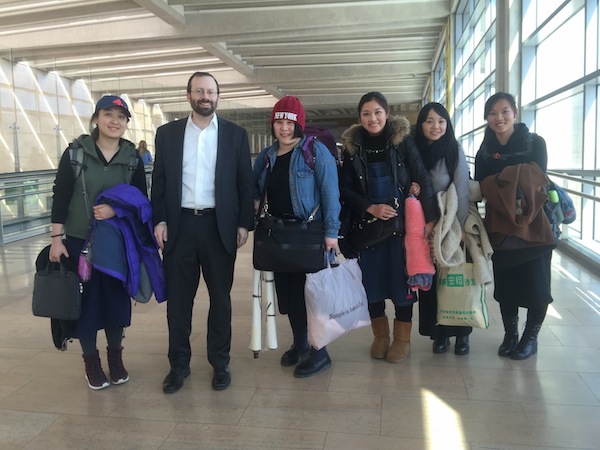
Shavei Israel founder and chair Michael Freund greeted the five women from Kaifeng – left to right, Gao Yichen, Li Chengjin, Li Yuan, Yue Ting and Li Jing – at Ben-Gurion Airport on Feb. 29. (photo by Laura Ben-David courtesy of Shavei Israel)

Last month, five women from the ancient Chinese Jewish community of Kaifeng arrived in Israel to fulfil their dreams of making aliyah, thanks to the Jerusalem-based nonprofit Shavei Israel.

The women – Gao Yichen (“Weiwei”), Yue Ting, Li Jing, Li Yuan and Li Chengjin (“Lulu”) – have been studying Hebrew and Judaism for several years in Kaifeng. Upon arrival in Israel, they were greeted by Shavei Israel chair Michael Freund, who took them straight from Ben-Gurion Airport to the Western Wall (Kotel) so they could thank God for helping them return to the land of their ancestors.

“Kaifeng’s Jewish descendants are a living link between China and the Jewish people,” said Freund, who succeeded in obtaining the requisite permission to bring the Chinese Jews on aliyah after several years of struggling with the Israeli bureaucracy.

“After centuries of assimilation, a growing number of the Kaifeng Jews in recent years have begun seeking to return to their roots and embrace their Jewish identity,” Freund said, adding that, “These five young women are determined to rejoin the Jewish people and become proud citizens of the Jewish state, and we are delighted to help them realize their dreams.”

Believed to have been founded by Iraqi or Persian Jewish merchants in the eighth or ninth century, Kaifeng’s Jewish community built a large synagogue in 1163, which was renovated throughout the years. At its peak, during the Ming Dynasty (1368-1644), the Kaifeng Jewish community may have numbered up to 5,000 people, but widespread intermarriage and assimilation, and the death of the community’s last rabbi, brought about its decline by the early 19th century. Today, the community claims between 500 to 1,000 members.

Despite the pressure to assimilate, many Kaifeng Jews sought to preserve their Jewish identity and pass it down to their descendants, who continue to observe Jewish customs. Today, the community is experiencing a revived interest in its roots, and Shavei Israel has been providing support while helping some immigrate to Israel.

“Being part of the Jewish people is an honor, because of the heritage and wisdom,” said Li Jing, who on a brief previous visit to Israel put a note of prayer in the Kotel asking to return and live in Israel. “Now, my prayer has been answered,” she said.

The last time Shavei Israel was able to bring a group of Chinese Jews from Kaifeng on aliyah was in October 2009, when seven young men from the community arrived in the Jewish state. The organization has brought a total of 19 members of the Kaifeng Jewish community to Israel.

The five women plan to continue their Jewish studies at Jerusalem’s Midreshet Nishmat – The Jeanie Schottenstein Centre for Advanced Torah Study for Women, with the support of Shavei Israel, which will also cover their living expenses and support them as they prepare to undergo formal conversion by Israel’s Chief Rabbinate. Upon completion of the conversion process, they will receive Israeli citizenship.

Shavei Israel is currently active in nine countries and provides assistance to a variety of different communities such as the Bnei Menashe of India, the Bnei Anousim (referred to as the derogatory “Marranos” by historians) in Spain, Portugal and South America, the Subbotnik Jews of Russia, the Jewish community of Kaifeng in China, descendants of Jews living in Poland, and others. For more information, visit shavei.org.

Format ImagePosted on March 25, 2016March 24, 2016Author Shavei IsraelCategories WorldTags aliyah, China, Israel, Kaifeng, Midreshet Nishmat
Election bid put into context

Election bid put into context

U.S. Senator Bernie Sanders speaking at a town meeting at the Phoenix Convention Centre in Arizona in July 2015. While a Jewish American president would be a first, many other countries have had Jewish leaders. (photo from Flickr user Gage Skidmore via commons.wikimedia.org)

U.S. presidential candidate Bernie Sanders is the first Jew to win a presidential primary and, given that he is only one of two Democratic hopefuls in the race, there is the possibility of a Jewish president after this fall’s election.

But this milestone isn’t such a milestone when one looks around the world, and the United States – with its approximately seven-million-strong Jewish population (including children) – could be considered behind the curve. After all, Italy, France, New Zealand, Panama, Peru and Russia all have had multiple Jewish heads of state or heads of government in the past century or so. Such places as El Salvador, Honduras, Guyana, the Dominican Republic and Norway, with relatively few Jews, have all had Jewish heads of state.

We know some of the stories of antiquity, with Jewish leaders of lands other than Israel. The most famous are Joseph, as viceroy of Egypt; Moses, the prince of Egypt; and, in the fifth-century BCE, Queen Esther in Persia. Among others are:

  • In the early first century, Queen Julia Bernice II, married the Cilician king, Polemon II of Pontus.
  • Queen Shushandukht ruled Persia (and some of Mesopotamia) in the fifth century.
  • Beginning around the fourth century, Jewish kings and queens reigned in Ethiopia for about a millennia.
  • King Abu Karib ruled Yemen in the fifth century and, a hundred years later, King Dhu Nowas.
  • Queen Dahiya Kahina reigned in Algeria in the early eighth century.

In modernity, there are/were dozens of Jewish prime ministers, presidents and vice-presidents outside of Israel. As best as we can figure, with some latitude for converts, those born Jewish but raised in another religion, high-ranking officials that were a heartbeat (or two) from becoming head of state, and those who came close, there have been roughly three dozen Jewish leaders outside Israel, with about a dozen “almosts.”

Great Britain/United Kingdom

  1. Benjamin Disraeli, prime minister in 1868 and 1874-80 (converted to Anglicanism)
  2. Rufus Isaacs, 1st Marquess of Reading, viceroy of India, 1921-26
  3. Almost: Ed Miliband, opposition leader of Great Britain, 2010-15; and Prime Minister David Cameron, elected in 2010, who in a speech to the Knesset, said his great-great-grandfather was a German Jew

Switzerland

  1. Ruth Dreifuss, president, 1999

France

  1. Leon Blum, prime minister, 1936-37, 1938, 1946-47
  2. René Mayer, prime minister, 1953
  3. Pierre Mendès France, prime minister, 1954-55
  4. Michel Debré, prime minister, 1959-62 (convert to Catholicism)
  5. Laurent Fabius, prime minister, 1984-86 (raised Roman Catholic)
  6. Nicolas Sarkozy, president, 2007-12 (born to a Jewish father)

Spain

  1. Juan Álvarez Mendizábal, prime minister, 1835-36 (raised Roman Catholic)

Italy

  1. Alessandro Fortis, prime minister, 1905-06
  2. Sidney Sonnino, prime minister, in 1906 and 1909-10 (raised Anglican)
  3. Luigi Luzzatti, prime minister, 1910-11

Eastern Europe

  1. Kurt Eisner, president of Bavaria, 1918-19
  2. Paul Hirsch, president of Prussia, 1918-20
  3. Zigfrids Anna Meierovics, prime minister of Latvia, 1921-24
  4. Petre Roman, prime minister of Romania, 1989-91 (raised Romanian Orthodox)
  5. Jan Fischer, prime minister of Czech Republic, 2009-10

Scandinavia

  1. Jo Benkow, president of Norway, 1985-93
  2. Dorrit Moussaieff, first lady of Iceland since she married President Ólafur Ragnar Grímsson in 2003

Russia

  1. Yevgeny Primakov, prime minister of Russia, 1999
  2. Mikhail Fradkov, prime minister, 2004-07 (Russian Orthodox)

New Zealand

  1. Sir Julius Vogel, premier, 1873-76
  2. Sir Francis Bell, prime minister, 1925 (raised Anglican)
  3. John Key, prime minister since 2008

Africa

  1. Sir Roy Welensky, prime minister of the Federation of Rhodesia and Nyasaland (Zimbabwe), 1956-63 (raised Anglican)

Central/South America (one-offs)

  1. Francisco Henríquez y Carvajal, president of the Dominican Republic, 1916
  2. Janet Jagan, president of Guyana, 1997-99
  3. Mike Eman, prime minister of Aruba since 2009
  4. Nicolás Maduro, president of Venezuela (raised Roman Catholic) since 2013

Honduras

  1. Juan Lindo y Zelaya, president of El Salvador, 1841-42; and president of Honduras, 1847-52 (raised Roman Catholic)
  2. Ricardo Maduro, president of Honduras, 2002-06 (raised Roman Catholic)

Panama

  1. Max Delvalle, president, for one week in April 1967, because the National Guard General did not approve of his succeeding his predecessor
  2. Eric Arturo Delvalle, president, 1985-88 (in 1988, he attempted to remove Manuel Noriega as the de facto military dictator, but instead Noriega overthrew him; Delvalle fled to the United States and died in Cleveland at age 78)

Peru

  1. Efraín Goldenberg Schreiber, prime minister, 1994-95
  2. Yehude Simon Munaro, prime minister, 2008-09
  3. Salomón Lerner Ghitis, prime minister, 2011

Costa Rica (almosts)

  1. Rebeca Grynspan Mayufis, vice-president of Costa Rica, 1994-98
  2. Saul Weisleder, president of Costa Rica’s Legislative Assembly, 1997-98
  3. Luis Liberman Ginsburg, vice-president of Costa Rica, 2010-14 (the grandson of the first mohel of Costa Rica’s Jewish community)

North America (almosts)

  1. Barry Goldwater, GOP presidential candidate, 1964 (Jewish father)
  2. Henry Kissinger, as secretary of state (fourth in line of succession), 1973-77
  3. Madeleine Albright, as secretary of state, 1997-2001
  4. Joe Lieberman, 257 votes away from U.S. vice-president in 2000
  5. Eric Cantor, former speaker of the House (third in line to the presidency), 2011-14
  6. Herb Gray, deputy prime minister of Canada, 1997-2002 (Canada’s first Jewish federal cabinet minister, one of only a few conferred the title “right honorable” who were not prime ministers, and the longest continuously serving member of Parliament in Canadian history)

Dave Gordon is a Toronto-based freelance writer whose work can be found in more than 100 publications globally. His is managing editor of landmarkreport.com.

Format ImagePosted on March 4, 2016March 3, 2016Author Dave GordonCategories WorldTags politics, Sanders, U.S. election, world leaders
The real purpose of BDS

The real purpose of BDS

While the three stated goals of the boycott, divestment and sanction (BDS) movement are an end to Israel’s “occupation” of “Arab lands occupied in June 1967,” equal rights for Arab Israelis and the right of return for Palestinian refugees (bdsmovement.net), its real aim is the destruction of Israel. As BDS activist Norman Finkelstein succinctly explained in a 2012 video, the ultimate result if the BDS’s three goals are achieved is: “There’s no Israel. That’s what it’s really about.” And, indeed, Palestinian Authority president Mahmoud Abbas has said, “I will not accept a Jewish state.”

In a Jan. 19, 2016, interview Fatah Central Commitee member Tawfiq Al-Tirawi said: “a Palestinian state in the 1967 borders [i.e. limited to the West Bank and Gaza], with Jerusalem as its capital, is just a phase.” While initially suggesting giving Jews plane tickets to leave the region, he says, “I want to live together with them” in “Palestine, in its historical borders, and we want all the Palestinian refugees [to] return to their country.” Omar Barghouti, a BDS leader who apparently studied at Tel Aviv University for a time, acknowledged during a University of Ottawa talk in 2009, “if the refugees were to return, you cannot have a two-state solution like one Palestinian commentator remarked, you will have a Palestinian state next to a Palestinian state rather than a Palestinian state next to Israel.”

There are many other myths perpetuated by the BDS movement and its supporters, which point to it being antisemitism disguised as anti-Zionism, the denial of the right of Jewish people to live in peace and security in their own homeland. Examples follow.

BDS supporters talk about boycotting products from the Israeli “invasion of Palestine.” Jews did not invade nor did they steal the land. Thousands of Jews were already living in the region before the state of Israel was established, and Jews used to call themselves Palestinians. Jews are indigenous to Israel. Jerusalem was the capital of the Jews. Even during the British Mandate, banknotes, coins and stamps had the initials of Eretz Israel (Land of Israel). And the Jews who immigrated to Palestine, as Israel was then called, as a reaction to the ethnic cleansing and genocide they suffered in European and Muslim countries, bought their properties, as returning Jews had been doing for decades.

The Arab Palestinians rejected the United Nations partition of the land (77% for Arab Palestinians and 23% for Jewish Palestinians) in November 1947, and have yet to establish their own state. After the War of Independence, it was not Israel but Jordan and Egypt that occupied illegally Cisjordan (Judea and Samaria, or the West Bank) and Gaza, respectively.

Abbas, Barghouti and others also have accused Israel of genocide. Israel has done no such thing. While its military has been forced to act against terrorism, it has not set out to deliberately wipe out an entire people. The Palestinian population is growing, according to the Palestinian Central Bureau of Statistics. At the same time, 1.7 million Arabs make up 20% of the Israeli population.

The charge of apartheid is another false accusation. As Dr. Kenneth Meshoe, South African politician, president of the African Christian Democratic Party, aptly put it: “Israel apartheid is a lie.” Every Israeli citizen has rights and freedoms. All minorities in Israel, including Arabs, can study in universities, are allowed to become professionals, businesspeople, athletes, work in public sector jobs and hold seats in the Knesset. In the current Parliament, Arab Israelis occupy 14 seats. As an anecdote, the sentence of Israel’s Supreme Court of former prime minister Ehud Olmert was read by an Arab Israeli judge, Justice Salim Joubran. Could that happen in an “apartheid” country?

Another issue BDSers protest is that of Israel’s blockade on Gaza, despite that it is legal, according to international law and the San Remo Manual, given that “relations between Israel and Hamas (which has ruled the Gaza Strip since 2007) are in the nature of armed conflict.” What would be illegal is if Israel let only some boats seeking to break the blockade pass, as a blockade must apply to every ship unless special permission is given. For more on this, see the article by Prof. Ruth Lapidoth (jcpa.org/article/the-legal-basis-of-israel’s-naval-blockade-of-gaza).

The blockade is needed to prevent terrorist groups from getting more weapons. Hamas’ charter specifically states their will to destroy Israel. More than 15,000 missiles in the past 15 years have been launched from Gaza at innocent Israeli civilians, leaving in their wake deaths, injuries and billions of dollars in damages, in addition to three wars and continued missile and rocket fire at Israel, combined with ongoing incitement against Israel and Jews on Palestinian TV and in schools and training camps.

The security fence – yet another mark against Israel in BDSers’ views – is also a legal method of self-defence. While it is not ideal and while some of it (less than 10%) is an imposing concrete wall as opposed to a wire fence, it reduced terrorist attacks by 90% in its first many years. While terrorist attacks have since increased, there are still fewer than before, and the barrier is a part of the reason for the decline.

As to the BDSers’ demand for the right of return. “The Palestinian demand for the ‘right of return’ is totally unrealistic and would have to be solved by means of financial compensation and resettlement in Arab countries,” Egypt’s then-president Hosni Mubarak noted in 1989. As Barghouti correctly observed, if Israel were to absorb the more than six million Palestinian Arab refugees, Israel as a Jewish and democratic state would disappear.

Refugees, as defined by the UN Relief and Works Agency, are “persons whose normal place of residence was Palestine during the period 1 June 1946 to 15 May 1948, and who lost both home and means of livelihood as a result of the 1948 conflict” – which began when Arab countries attacked the newly forming state of Israel – and their descendants. Approximately 750,000 Palestinians fled or left Israel by choice because of that conflict, and more left after the 1967 Six Day War, which was also the result of Arab aggression.

As former Canadian justice minister Irwin Cotler wrote in a 2014 Times of Israel blog and has spoken and written about elsewhere, there is another aspect that must be considered when speaking of the rights of refugees: “the pain and plight of 850,000 Jews uprooted and displaced from Arab countries – the forced yet ‘forgotten exodus,’ as it has been called – has been expunged and eclipsed from both the Middle East peace and justice agenda for 67 years.”

Another question more people need to ask of BDS supporters is about the lack of protest when Egypt considers building a wall on her border with Gaza, blockades Gaza, destroys neighborhoods adjacent to her border with Gaza to create a buffer zone and destroys tunnels used for arms smuggling, kidnapping of civilians and soldiers and infiltration for attacks.

If BDSers really were concerned about Palestinians, they would be protesting the treatment by the Palestinian Authority and Hamas of their own people, the lack of basic human rights and freedoms that people living in the West Bank and Gaza possess. But they’re not. Instead, they focus their sights on Israel, their ultimate goal its destruction.

Silvana Goldemberg is an award-winning author of more than 20 books and magazines published in Spanish and English throughout the Americas. Originally from Argentina, she is currently based in Richmond.

Format ImagePosted on February 26, 2016February 25, 2016Author Silvana GoldembergCategories WorldTags Abbas, Barghouti, BDS, boycott, Finkelstein, Gaza, terrorism, West Bank

March of the Living impact

March of the Living International (MOLI) has published a study examining the effects that the program has had on its participants. The educational program takes, on average, 10,000-20,000 students annually to Poland and Israel with the goal of educating and inspiring future generations to learn from the destruction of the European continent during the Second World War. MOLI accepts applicants from all walks of life and religions, hoping to ensure that not only is the Holocaust not forgotten, but also that it is never repeated.

The report studies the impacts that the program has on its Jewish participants, and highlights the educational and religious changes that the program has inspired since its creation in 1988. Of the population surveyed, most initially signed on to the program in order to better understand their Jewish culture. Many of the participants in the study said that the program has directly impacted them, leading many to visit, study in or move to Israel. Fifty percent of the respondents said that the program caused them to consider moving to Israel later in life.

The study was conducted by Prof. William Helmreich of CUNY Graduate Centre and the Colin Powell School at City College, a sociologist and expert on ethnic identity. “What’s most remarkable about the March is how deeply it impacts participants over a period of many years,” he states. “These include life choices like selecting a mate, moving to Israel and career choices. In addition, it greatly impacts not only on Jewish identity but also on compassion toward other people as well.”

Indeed, 54% of respondents said that the March had made them more tolerant towards other groups. And the effect increases over the years, as 66% of those who attended the March 10 years ago, reported it had made them more tolerant.

The study also found that 86% of the participants asserted the importance in their spouse being Jewish, and 91% in raising their children with some sort of Jewish education; 65% felt the importance of raising their children in a Jewish neighborhood.

Of those surveyed, 90% felt the March instilled in them the importance of reacting to confrontations with antisemitism, and 95% stated the March had strengthened their sense of Jewish identity.

“To think that the March is such a successful program in terms of ensuring and enhancing Jewish identity and in making people realize the importance of engaging as a Jew within their communities and caring for those outside of them, truly illustrates the goals that we had when initially forming the first March so many years ago,” said Dr. Shmuel Rosenman, MOLI chair.

March of the Living brings individuals to Poland and Israel to study the history of the Holocaust and to examine the roots of prejudice, intolerance and hate. Since the first March in 1988, more than 220,000 participants from 52 countries have marched down the same three-kilometre path leading from Auschwitz to Birkenau on Yom Hashoah as a silent tribute to all victims of the Holocaust. March of the Living is a partnership between March of the Living International, local MOTL foundations, the Claims Conference, individual donors, private philanthropists and Jewish communities around the world. Visit motl.org.

Posted on February 26, 2016February 25, 2016Author March of the Living InternationalCategories WorldTags Holocaust, Israel, MOLI, Poland, William Helmreich
Art therapy kits to families

Art therapy kits to families

United Hatzalah of Israel and Artists 4 Israel distributed art therapy kits to families in southern Israel and held a program that included visits by graffiti artists who worked with teens to paint neighborhood bomb shelters. (photo from United Hatzalah of Israel)

At the end of last year, 75 families from southern Israel received specialized art therapy kits, thanks to a new project organized by United Hatzalah of Israel’s Team Daniel initiative. In conjunction with Artists 4 Israel, the art therapy kits were distributed Dec. 8-10, along with a program showing parents how to use the kits with their children and visits by graffiti artists who worked with teens to paint neighborhood bomb shelters. Various art therapists also participated in the events.

Last summer, during Operation Protective Edge, a group of Chicagoans was touring the Eshkol region as sirens blared. These community members were so moved by their experience and, after hearing about the death of 4-year-old Daniel Tragerman, decided to raise money to help the region. Some 50 Chicago families established Team Daniel to fund the training, placement and equipment needed for 100 United Hatzalah medics to service southern Israel. The new kits are given directly to the families of these volunteers, who often run out on a moment’s notice to attend to rocket attacks and other local emergencies.

“Because these particular families are committed to saving lives as United Hatzalah medics, it was important to us that we give them a way to cope,” said Brielle Collins, Chicago regional manager for United Hatzalah. “Art is such a powerful tool to give to people who are recovering from war, stress and tragedy.”

The arts kit was developed by experts from Israel and the United States in the mental health field in collaboration with the nonprofit Artists 4 Israel. It is hoped that the “first aid kit for young minds” will combat the effects of trauma and eliminate the chances of PTSD by up to 80% through self-directed, creative play therapies.

United Hatzalah, a community-based emergency medical response organization, has been distributing the kits in a pilot program throughout Israel since July.

Format ImagePosted on February 26, 2016February 25, 2016Author United Hatzalah of IsraelCategories WorldTags Brielle Collins, Eshkol, Israel, terrorism, therapy, trauma, United Hatzalah

Posts pagination

Previous page Page 1 … Page 22 Page 23 Page 24 … Page 33 Next page
Proudly powered by WordPress