Art therapy kits to families

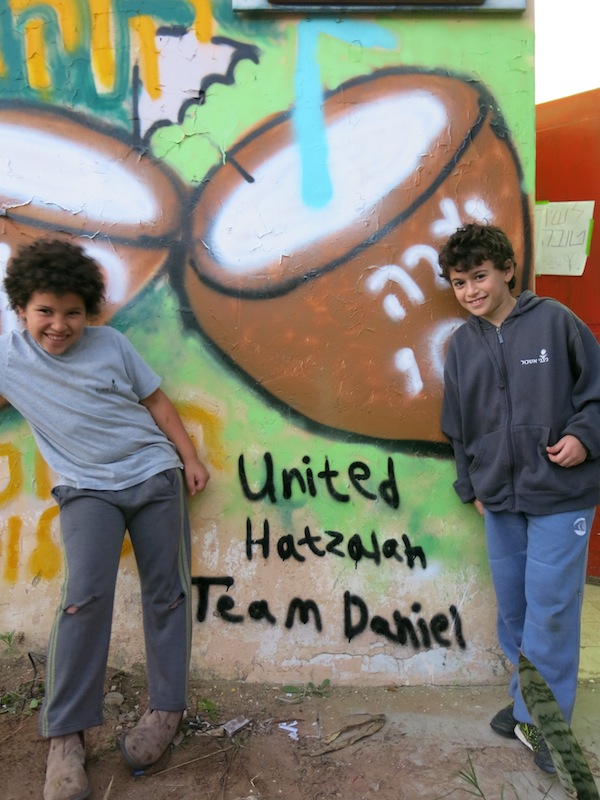
United Hatzalah of Israel and Artists 4 Israel distributed art therapy kits to families in southern Israel and held a program that included visits by graffiti artists who worked with teens to paint neighborhood bomb shelters. (photo from United Hatzalah of Israel)

At the end of last year, 75 families from southern Israel received specialized art therapy kits, thanks to a new project organized by United Hatzalah of Israel’s Team Daniel initiative. In conjunction with Artists 4 Israel, the art therapy kits were distributed Dec. 8-10, along with a program showing parents how to use the kits with their children and visits by graffiti artists who worked with teens to paint neighborhood bomb shelters. Various art therapists also participated in the events.

Last summer, during Operation Protective Edge, a group of Chicagoans was touring the Eshkol region as sirens blared. These community members were so moved by their experience and, after hearing about the death of 4-year-old Daniel Tragerman, decided to raise money to help the region. Some 50 Chicago families established Team Daniel to fund the training, placement and equipment needed for 100 United Hatzalah medics to service southern Israel. The new kits are given directly to the families of these volunteers, who often run out on a moment’s notice to attend to rocket attacks and other local emergencies.

“Because these particular families are committed to saving lives as United Hatzalah medics, it was important to us that we give them a way to cope,” said Brielle Collins, Chicago regional manager for United Hatzalah. “Art is such a powerful tool to give to people who are recovering from war, stress and tragedy.”

The arts kit was developed by experts from Israel and the United States in the mental health field in collaboration with the nonprofit Artists 4 Israel. It is hoped that the “first aid kit for young minds” will combat the effects of trauma and eliminate the chances of PTSD by up to 80% through self-directed, creative play therapies.

United Hatzalah, a community-based emergency medical response organization, has been distributing the kits in a pilot program throughout Israel since July.

Abrahamic faiths’ traditions

A chuppah in Jerusalem. (photo by Nikki Fenton)

Mazal tov. Mabrouk. Congratulations. No matter one’s religion or language, a wedding is generally a joyous occasion.

While there is no apparent consensus, varying reports say that between 60% and 80% of all marriages in the United States are performed in a religious ceremony. Where do the religious wedding traditions come from? What are the similarities and differences between the marriage traditions of the three Abrahamic religions – Judaism, Christianity and Islam?

The most obvious similarity between Jewish, Christian and Islamic marriages is that, in each case, the tradition requires that the union be between a bride and a groom of the same religion. In other words, according to the letter of the religious law, intermarriage is forbidden.

The Torah, New Testament and Quran indulge in many stories designed to warn men against marrying women who worship foreign gods or are nonbelievers.

Deuteronomy 7:3-4 states, “Do not intermarry with them. Do not give your daughters to their sons or take their daughters for your sons, for they will turn your children away from following me to serve other gods, and the Lord’s anger will burn against you and will quickly destroy you.” For Christians, 2 Corinthians 6:14-17 explains that one should not be “yoked together with unbelievers,” and should “touch not the unclean thing” if one wants to be received by the Lord. In Sura 60:10, Muslims learn, “Do not maintain your marriages with unbelieving women.”

In Israel, where couples can wed only through religious ceremonies administered by the Chief Rabbinate, the intermarriage rate is relatively low. The 2015 Israeli Democracy Index survey found more than one-third of both Jewish (36%) and Arab (38.8%) Israelis support organizations that work to prevent Jewish women from marrying Arab men, even if their activities are radical and/or violent.

In the United States, however, intermarriage is almost the norm. The 2013 Pew Research Centre survey of American Jews found an intermarriage rate of 58%, up from 43% in 1990 and 17% in 1970. Among non-Orthodox Jews, the intermarriage rate is 71%.

How do these intermarried couples plan their weddings? Are the traditions similar enough to make it work?

The modern idea of a secular marriage based on love is rooted in Christianity. But, according to Karen Armstrong’s The Gospel According to Woman, the first detailed account of a Christian wedding in the West dates back to the ninth century and was identical to the old nuptial service of ancient Rome. This is likely because, at its core, Christianity looks down upon marriage.

In the New Testament (Matthew 22:23-30), Christians are taught that in heaven there are no marriages. St. Paul describes marriage as a last resort for those who cannot restrain themselves, saying that being chaste is the ideal.

In contrast, there are deep Jewish and Islamic marriage traditions that begin even before engagement. Arranged marriages – or the use of a shadchan (matchmaker), in Jewish terms – is something that’s not only condoned, but encouraged by both faiths.

Rabbi Etan Mintz, leader of B’nai Israel Synagogue in Baltimore, said matchmaking is experiencing a resurgence. There are now any number of religious- and secular-rooted websites helping couples meet and match. Likewise, there’s a growing phenomenon of executive matchmakers.

In the time of the Talmud, Jewish engagement (erusin) looked very different than it does today, Mintz explained, as engagement and marriage nuptials (nissu’in) were different ceremonies that took place about one year apart. When a man wanted to marry a woman, he would ask her father for permission, and documents of commitment would be signed. During that time, the couple was able to plan their lives, but no direct or immodest contact was allowed.

Today, the erusin and the nissu’in ceremonies generally happen at the same time – under the chuppah (wedding canopy). The ceremonies are divided by the reading of the ketubah (marriage contract).

photo - An Islamic bride’s hand is decorated as part of the henna pre-wedding ritual
An Islamic bride’s hand is decorated as part of the henna pre-wedding ritual. (photo by Ibtisam Mahameed)

This is not too different from how Muslim engagement practices look today, in some circles. Ibtisam Mahameed, a Muslim woman from the village of Faradis in Israel, told JNS.org that, in order for a couple in her town to get engaged, the man and his family must meet with the woman’s family.

“The boy has to come and sit in the parents’ house and say he wants to marry the daughter. The parents have to agree. If they don’t agree, the couple cannot be married,” she explained.

If the parents agree, then the village sheikh will come to the house of the woman’s parents and go over Muslim marriage law – what is owed to the bride and groom, the obligations of the man to the woman, and the ramifications of divorce.

“The rights are fully explained before the wedding,” Mahameed said.

Both Muslims and Jews enjoy rich pre-wedding rituals.

The Jewish bedeken (veiling ceremony) is “so powerful,” said Mintz. Often marking the first time a bride and groom are seeing each other after a week of separation before the wedding, the bedeken is wrought with emotion.

While one understanding of the bedeken is that it relates to the fact that the biblical patriarch Jacob was forced to marry Leah instead of Rachel when the brides were switched by their father Laban – and, by extension, today, the groom symbolically makes sure he is marrying the right bride by checking and then veiling her – Mintz said there are other more spiritual interpretations of ritual.

“Rabbi Shlomo Carlebach asks, ‘If the purpose is to make sure she is the right one, why does he veil the bride at the bedeken? Shouldn’t he be taking the veil off?’ Carlebach says the radiance of the bride is so powerful under the chuppah, so beautiful, that the chatan (groom) veils her. That intensity, that beauty, is just for the two of them in their own personal space,” Mintz said.

Mahameed described Islam’s “henna” ceremony as powerful and intimate, too. She said the groom’s best friends and relatives gather in his home to mix and paint the henna dye. Then, they mix more of the dye to deliver to the bride. Carrying a uniquely woven basket with a golden plate of henna, the groom and his mother walk hand-in-hand to make the henna delivery to the bride.

Read more at jns.org.

Venice ghetto 500 years old

The main square of the Venice ghetto. The building on the right, which is now a hotel, used to house the Jewish community retirement home. (photo by Ashernet)

Next month will mark 500 years of what most consider the world’s first Jewish ghetto, though some historians contend that a similar type of area, which confined Jews to a restricted quarter, was set up in Frankfurt a short time before the ghetto in Venice. The word ghetto comes from the Italian ghèto, meaning slag, as the area chosen to contain the Jews of Venice had been used as a foundry. Today, some 500 Jews live in and around the ghetto area. There are kosher restaurants, two small hotels that offer kosher breakfast and one that also caters for lunch and evening meals. In the main square, apart from two of the historic synagogues, there is a Jewish museum and a kosher restaurant, run by the Venice City Council.

The state of Jewry in Russia

A scene from filmmaker Reuven Brodsky’s documentary Home Movie. (photo by Yevgeny Spivak)

In 1989, the USSR’s emigration gates opened. Responsible for prying them open was a small group of tremendously courageous and patient Soviet Jews (called refusenikim for their denied exit permits) who had fought long and hard for their religious and cultural freedom, with thousands of Western Jews and non-Jewish people of conscience. The Soviet Jewry movement, which began in the United States in the 1960s and spread from there to other countries, including Canada, eventually witnessed 1.6 million Jews and their non-Jewish relations leave for Israel and the West. A thrilling climax, but then what happened?

While it is hard to say how many Jews live in Russia today, estimates are between 400,000-700,000, approximately 0.27%-0.48% of the total Russian population. Since the early 1990s, efforts to revitalize Jewish life in Russia and other former Soviet Union (FSU) countries have been ongoing.

After the dissolution of the USSR, different denominations within world Jewry started operating openly in Russia. Of all the different Jewish religious groups on the scene today, Chabad has probably worked the hardest to bring Jewish awareness to the unaffiliated. It sends its emissaries (usually a couple consisting of a male rabbi and his teacher wife) to Russia and numerous other FSU centres.

After so many years of not being able to publicly run Jewish institutions, Russian Jewish communities now have 17 day schools, 11 preschools and 81 supplementary schools with about 7,000 students. There are also four Jewish universities. The major towns have a Jewish presence, with synagogues and rabbis. In the past few years, a state-of-the-art Jewish museum even opened in Moscow and a deluxe Jewish community centre containing a small movie theatre, synagogue, mikvah, kosher gourmet restaurant and guest rooms for Sabbath observers was inaugurated in December 2015 in Zhukovka, near Moscow.

photo - The Zhukovka Jewish Community Centre was inaugurated in December 2015
The Zhukovka Jewish Community Centre was inaugurated in December 2015. (photo from Federation of Jewish Communities of Russia via jta.org)

Yet the picture is far from rosy. In an introductory essay to An Anthology of Jewish-Russian Literature: Two Centuries of Dual Identity in Prose and Poetry (2007), book editor Maxim Shrayer critically views Jewish cultural life in post-Soviet Russia: “… my preliminary conclusion is that Jewish-Russian writers whose careers were formed during the Soviet years continue to address Jewish topics in their work, some due to a renewed personal interest as well as the freedom to write about it, others out of cultural inertia. At the same time, younger authors of Jewish origin in today’s Russia have tended to be assimilated and Russianized, resulting in a dearth of Jewish consciousness in their writing.

“Jewish-Russian literature in the former USSR might have found a temporary domain in the pages of such periodicals as the Moscow-based magazine Lekhaim … [one of the] attempts to consolidate, perhaps artificially, a critical mass of writers and readers even as Jewish-Russian culture itself spirals toward disappearance.”

In Jewish Life After the USSR (Indiana University Press, 2003), Prof. Zvi Gitelman claims that, following the breakup, Russian Jews have become increasingly less concerned about intermarriage. Ethnic identity as such seems to be based on antisemitism – even if it is unofficial, popular antisemitism rather than state-sanctioned antisemitism.

Looking to the future, the offspring of these intermarriages are likely to feel less tied to Judaism. Speculatively, they are likely to remain so unless Russian-based Jewish institutions are willing to “reach out” to people who, according to the strict reading of Jewish law, are not considered members of the “tribe,” he argues.

Since 2000, immigration to Israel and/or to the West has slowed down. But, based on past experience, immigration – provided the doors to Israel and/or the West remain open – will likely pick up if antisemitism flares up, if the Russian economy takes a real and prolonged nose-dive or if political-military strife developed in Russia as it has in the Ukraine. As Lee Yaron recently reported in Haaretz, the situation is already changing: in 2015, “15,000 immigrants … came from the former Soviet Union … an increase of over 20% from last year’s figure.”

In the post-USSR age, Jewish culture in Israel and Russia mix in unexpected ways. Gone is my grandparents’ generation who, once out of Russia, never again saw “left behind” family members. Today, many former Russian Jews living in Israel (and vice versa) frequently fly four hours to visit relatives who did not leave. According to the Israeli Ministry of Tourism, there were 60 weekly flights from Russia to Israel, as of the end of December 2015.

But the exchange is beyond familial ties. Here are four examples – two from the arts and two from the sciences.

Israeli filmmakers who left the USSR as children have begun making at least part of their films in Russia. Seven Days in St. Petersburg, written, directed and produced by Reuven Brodsky, is one case in point. Significantly, the protagonists speak both Hebrew and Russian. A few years earlier, Brodsky made the documentary Home Movie, described as, “The final chapter in the breakdown of the director’s family – one of many who did not survive the trials of immigration.”

Also in the film world, just a few months ago, Vladi Antonevicz released Credit for Murder, a documentary dealing with the topic of Russia’s neo-Nazis. As if the subject in and of itself is not dangerous enough to undertake, Antonevicz’s film apparently exposes a connection between the Russian administration and these hate groups. Antonevicz claims that certain Russian politicians are manipulating neo-Nazi activity to further their own political needs. To make this film, Antonevicz infiltrated Russian neo-Nazi groups, secretly investigating an unsolved double murder. He succeeded, but some say his small film crew has had to lay low after completing the film.

Former Russian Jews in Israel (and in the West) have likewise forged profitable positions in the start-up world. Moscow-born Prof. Eugene Kandel, outgoing head of Israel’s National Economic Council, analyzes this phenomenon. In a July 29, 2015, Forbes blog by Scott Tobin, the professor is quoted as saying, “Many Russian-born techies now working in Israel are especially innovative because the Soviet state traditionally under-invested in computer hardware and other technology, even as the state was scrambling to develop weapons and related technology to win the Cold War. That left engineers to fend for themselves and develop creative workarounds in many businesses.”

Finally, medical tourism from Russia has blossomed. Many well-to-do Russians come to Israel to be treated by Russian- and Hebrew-speaking doctors, nurses, technicians and medical secretaries (see imta.co.il).

A cause for hope and promise? Stay tuned.

Deborah Rubin Fields is an Israel-based features writer. She is also the author of Take a Peek Inside: A Child’s Guide to Radiology Exams, published in English, Hebrew and Arabic.

A long time in China

A model of the Kaifeng synagogue at an exhibit at the Diaspora Museum in Tel Aviv in 2011. (photo by Sodabottle via commons.wikimedia.org)

With the Chinese New Year taking place next week, it is an appropriate time to reflect on the close and positive relationship between Jewish and Chinese peoples, which reaches back almost 2,000 years.

It might be simplest to begin with the fall of Jerusalem to the Romans in the year 70 of the Common Era. This was the climax of the first of three Jewish-Roman wars that would take place over the first and second centuries. The net result of these conflicts was the deaths of hundreds of thousands of Jews, the enslavement of many others, and those who managed to escape such tragedies fled as refugees. This scattering of Jews across the world we call the Diaspora ultimately resulted in the formation of the various communities we are familiar with today, such as the Ashkenazi, Sephardi and Mizrahi Jews. But there was a smaller, lesser-known Diaspora community that settled in China.

Between 206 BCE and 220 CE, China was ruled by the Han Dynasty. The Han established a vast international trading network that came to be known as the Silk Road. According to the oral history of the Chinese Jews, their ancestors first settled in China during the late Han Dynasty. Such a period would correspond with the Diaspora that followed the Jewish-Roman wars.

After the collapse of the Han Dynasty, the Silk Road trading network collapsed, but was reestablished in 639 CE during the Tang Dynasty. The Silk Road interconnected Tang Dynasty China with the wealthy states of India, East and North Africa, across Asia and into Europe. During the Medieval period, many Jews made their living as merchants. At this time, Christians and Muslims refused to trade directly with each other, and Jews earned great profits acting as intermediaries.

Many Jews traded along the Silk Road, the most prominent group of whom were the Radhanites, who inevitably found themselves in China. It is during this period that the first document indicating the presence of Jews in China has been found. It describes how a rebel leader executed foreign merchants and Jewish residents in the city of Guangzhou. Discovered at an important stop along the Silk Road in northwest China, the document dating to some point around the eighth or ninth centuries was written in a Jewish-Persian script on paper, which at the time would have only been available in China. Some historians have suggested that the Radhanites were responsible for bringing Chinese paper technology to Europe, although this theory is contested. The presence of Jews in Guangzhou at this time should not be surprising, considering it was an important port city linking Chinese and Middle Eastern trade. Guangzhou has one of the oldest mosques in the world and, at the beginning of the ninth century, may have had a population of as many as 100,000 foreigners.

In 908 CE, the Tang Dynasty fell, the Silk Road trading network again collapsed for several centuries and the prominence of the Radhanites declined. But this did not mean the end of the Jewish presence in China. Between 960 and 1279 CE, China was ruled by the innovative and prosperous Song Dynasty, with their capital city at Kaifeng. Kaifeng has been described as the New York of its day. It was a massive cosmopolitan city, a centre of global trade and the largest city in the world, reaching a population of 1.5 million people.

Though Jews would settle in other cities, such as Hangzhou, Ningbo, Ningxia and Yangzhou, most were in Kaifeng, and it became the centre of Chinese Jewry. The first synagogue was built in Kaifeng in 1163 CE. It was made of wood, in a Chinese architectural style. It would be destroyed and rebuilt many times throughout its history. The Jews of Kaifeng were held in high esteem by the Song emperors, and went on to pursue successful careers not only as merchants, but as court officials, scholars and soldiers. There is still a Kaifeng Jewish community today.

In the early 12th century, the first Jin emperor, Wanyan Aguda, unified the Jurchen, a group of tribal peoples living in Manchuria. The Jurchen waged war against the Song Dynasty and, in 1127, Jurchen forces conquered Kaifeng, an event that has come to be known as the Jinkang Incident. After this battle, the Song capital was moved south to Hangzhou, and many of the Kaifeng Jews accompanied the Song rulers in their migration. Nevertheless, there were some who stayed in Kaifeng. The Jurchen established the Jin Dynasty, and continued to wage war against the Song Dynasty for more than 100 years. Eventually, both the Jin and the Song were conquered by the Mongols in the 13th century.

In 1232, the Mongols besieged Kaifeng. During the conflict, the Jin used rockets against the Mongol invaders, which is the first use of rockets in warfare in recorded history; a technology all-too-familiar to the modern residents of Israel. In the mid-14th century, the Mongol rulers of China established the Yuan Dynasty, with their capital in Beijing. When Marco Polo traveled to Beijing in 1266, he wrote about the importance of Jewish merchants there.

In 1276, the Mongols conquered the Song capital of Hangzhou. In 1280, the Mongol emperor, Kublai Khan, issued a decree banning Jews from kosher practices and circumcision. Yuan Dynasty documents written in 1329 and 1354 issue a request of Jewish residents in China to go to Beijing to pay taxes. Though many atrocities occurred during the Mongol invasions, their rule was nevertheless marked by flourishing trade and the Jewish communities of China persisted.

At the site of the synagogue in Kaifeng, several stone steles have been recovered. The oldest, written in 1489, commemorates the construction of the synagogue in 1163. It describes how the Jews first entered China during the late Han Dynasty, and the Jinkang Incident, including how many of the Jewish population of Kaifeng fled to Hangzhou. Also inscribed on this stele were the following words: “The Confucian religion and this religion agree on essential points and differ in secondary ones.”

A second stone stele was made in 1512, which describes Jewish religious practices, which is fascinating considering it is written in Chinese. In 1642, a third stele commemorated the reconstruction of the synagogue in Kaifeng after it was destroyed by a flood. The synagogue was destroyed again by a flood in 1841, but was not rebuilt. This is likely due to the sociopolitical turmoil occurring in China at the time. It is interesting to note that, while Jews were persecuted, rejected and alienated by the nations of Europe, they were accepted and assimilated into Chinese culture.

During the 19th and early 20th centuries, persecution of Jews in Europe began again on a massive scale. The worst events of these times were the many pogroms in the Russian Empire, where hundreds of thousands of Jews were murdered, raped, robbed. Many Jews were forced to flee as refugees, some migrating to North America, some to Palestine, and some to China. The Russian Revolution in 1917 resulted in the deaths of around 250,000 Jews, and the orphaning of around 300,000 Jewish children. Many Russian Jews fled to the city of Harbin, in Manchuria, whose Jewish population reached 20,000. However, when the Japanese annexed Manchuria in 1931, many among that population left for Shanghai, Tianjin or Palestine.

Many Chinese intellectuals understood the plight of the Jewish people, and compared it to their own. The Chinese Nationalist and founder of the Republic of China, Dr. Sun Yat-sen, made the following comparison: “Though their country was destroyed, the Jewish nation has existed to this day…. Zionism is one of the greatest movements of the present time. All lovers of democracy cannot help but support wholeheartedly and welcome with enthusiasm the movement to restore your wonderful and historic nation, which has contributed so much to the civilization of the world and which rightfully deserves an honorable place in the family of nations.”

During the course of the Second World War, the Jewish population in China would swell to 40,000, many of whom resided in Shanghai. A number of Chinese diplomats helped smuggle in Jews using special protective passports. One such hero, a Chinese diplomat working in Vienna named Ho Feng Shan, helped Jews from Nazi-occupied Europe get to China, ultimately saving around 3,000 lives. Ho Feng Shan was posthumously awarded the title Righteous Among Nations by Yad Vashem in 2001.

photo - A plaque erected at Shanghai Jewish Refugees Museum and Ohel Moishe Synagogue in China in honor of the late Chinese diplomat Ho Feng Shan (1901-1997) who saved thousands of Jews between 1938 and 1940
A plaque erected at Shanghai Jewish Refugees Museum and Ohel Moishe Synagogue in China in honor of the late Chinese diplomat Ho Feng Shan (1901-1997) who saved thousands of Jews between 1938 and 1940. (photo by Harvey Barrison via commons.wikimedia.org)

In 1943, the Japanese forced the 20,000 Jews living in Shanghai into a ghetto that was around one square kilometre in size, with conditions described as squalid, impoverished and overcrowded. The Shanghai ghetto was also inhabited by some 100,000 Chinese residents.

The Nazis pressured the Japanese to execute the 40,000 Jews living in China, but the Japanese purposefully delayed the planned atrocity, ultimately saving the Jews’ lives. When the Japanese military governor of Shanghai informed the leaders of the Jewish community of the planned execution and asked them why the Germans hated them, one rabbi responded by saying “because we are short and dark-haired,” a reply that allegedly caused a smile to appear on the serious face of the governor. After the war, most of the Jews in China migrated to the newly formed state of Israel.

Ben Leyland is an Israeli-Canadian writer, and resident of Vancouver.

Berlin’s House of One

In Petriplatz, Pastor Gregor Hohberg, left, and Imam Kadir Sanci listen as Rabbi Andreas Nachama recites a prayer for peace. (photo by Frithjof Timm)

In the middle of Berlin, on the grounds of where a church was destroyed in the Second World War, a pastor, imam and rabbi are collaborating to create a new reality wherein Christianity, Islam and Judaism can be practised under the same roof.

“It seems so logical that something like this would take place, but it never has before,” said Rabbi Dr. Andreas Nachama who leads the only Reform congregation in Berlin, Sukkat Shalom (House of Peace).

Some congregations and groups of people refrain from intermingling out of fear of losing members to other groups. For Nachama and the other House of One proponents, this is not a concern.

“I think that the congregations are solid and I don’t think that this might turn out to be a problem,” he said. “We have a lot of experience from sharing a building with Catholics, Protestants and Jews, and we’ve never had that kind of problem. The problems we had were very secular and could be solved quickly with a short discussion – things like who is cleaning the toilets after congregation and so on.”

As for the risk of intermarriage, Nachama said intermarriages “take place because people are studying at the same university or classroom, sitting in the same office, or meeting in a restaurant or theatre. I haven’t had a single case where intermarriages originate from a Christian-Jewish dialogue group in all my years.”

photo - Rabbi Tovia Ben Chorin
Rabbi Tovia Ben Chorin (photo by UFA Lab)

The idea for House of One originated five or six years ago with Nachama’s predecessor, Rabbi Tovia Ben Chorin. He was working to bring the concept to life until he retired and moved back to Switzerland. Nachama has been involved with House of One since April 2015.

Nachama is no stranger to Christian, Jewish and Muslim trialogue. He has been involved in the field since 1972, starting at summer camps in western Germany, where a local school invited members of each of the three faiths to discuss common stories and problems.

As Nachama went on to take Jewish studies in university in the 1970s, he also took basic courses on Islam and Catholicism. Gaining a good understanding of these religions has enabled him to effectively introduce his congregation to interfaith interactions since 1999, bringing in his Islamic and Christian counterparts to teach in the synagogue alongside him.

The clergy meet on a regular basis, sometimes involving leaders in their respective communities, but always aiming to keep meetings to no more than 15 people. So, the interfaith groundwork began long before the excavations started in 2007 of Petriplatz, the site of the old church, among other structures, and a new House of God was being planned. The church wanted to build a house where the three religions would each have a holy space of their own.

“Each would have their own synagogue, mosque and church, working together in one building,” said Nachama. “But, everyone would follow his/her own faith tradition, so it was not about some new religion being created.

“Instead, the idea was to build a house of teaching, of worship, wherein the teaching might bring us together; the worship, everyone does for him/herself in his/her religion.

“We can do programs on some aspects of interest to many, like looking at the differences between kosher and halal. We can also offer teaching programs to the general public.”

Worship times do not seem to be an issue either, with the holy day for Muslims being Friday; for Jews, Saturday; and, for Christians, Sunday.

“But, what happens if Christmas Eve is on a Friday night or during Shabbat?” admitted Nachama. “We can always find problems in terms of holy days on the calendar. They will be solved, but it’s not so easy.”

According to Nachama, the most difficult challenge is in the area of politics. “Islam, in particular, is being taken as a hostage for Islamic fundamental brutality,” he said. “That makes it difficult, because those Muslims that we deal with are not part of that. It makes it difficult … in the public eye … to make it understandable that we, as individuals and as congregations here in Berlin, can cooperate and speak with each other, whatever happens.

“My congregation is very much involved in Christian-Jewish dialogue, and we also sometimes have teachings or panel discussions together with Muslims, so it’s not new to my congregation and, as far as I see, the other congregations have had experience in the field before as well.”

As far as reaching beyond congregational circles, Nachama understands all too well that if someone has prejudice, it is he or she who needs to be willing to open their eyes and ears to seeing the other side. “We can’t do it for them,” he said. “If they are willing, we then can try to show them how we see things.”

While the project is gaining momentum and more than a million euros have already been collected, much more is needed to even break ground on the building project.

Nachama anticipates that his congregants will have no problem with the move when the time comes. “We’ve moved already once and, when completed, either parts of the congregation will move or the whole congregation. It won’t be a problem.

“We believe this project is a result of the history in Berlin,” he continued. Given the history of antisemitism in Germany and the Holocaust, people want to create “a new page of history,” he said. “People really try to look for new ways of cooperation, coexistence and respect for other peoples and faiths.”

For more information or to join the project, visit house-of-one.org.

Rebeca Kuropatwa is a Winnipeg freelance writer.

Germany trip changes views

In fall 2015, Yael Levin, third from the right, participated in the program Jewish Life in Germany – Past, Present and Future. (photo from Yael Levin)

Last year marked 50 years of diplomatic relations between Germany and Israel. To celebrate this milestone, events took place everywhere. The Canadian West Coast was no exception. The Centre for Israel and Jewish Affairs, Pacific Region, was approached by the German Consulate in Vancouver to plan the celebrations locally.

I had the privilege of working with a fantastic team at the consulate. I was impressed by the fact that everyone, from the consul general himself to the person that welcomes visitors, was involved. Among other activities, we held a concert by operatic soprano Johanna Krumin and pianist Markus Zugehör performing pieces by Jewish and non-Jewish German composers.

Following months of hard work, it was not only a memorable celebration with the German and Jewish communities but also a strong relationship that led the consul general in Vancouver, Josef Beck, to invite me to participate in the program Jewish Life in Germany – Past, Present and Future. Put together by the Federal Foreign Office and the Goethe Institute, the fall program packed eight days of nonstop activities that allowed North American Jewish professionals and lay leaders to visit Germany and explore both the current reality of Jewish German life, as well as the Israel-Germany relationship.

photo - Interior of Ohel Jakob, Munich’s main synagogue
Interior of Ohel Jakob, Munich’s main synagogue. (photo from Yael Levin)

My experiences on this trip could fill several pages so I will share just a few that left a special impression on me.

We began with a visit to Berlin’s historic Jewish Quarter, on the trail of Moses Mendelssohn. We visited the site of the first synagogue, the Centrum Judaicum, the old Jewish cemetery, the Jewish high school and the house of the world’s first female rabbi, Regina Jonas, ordained during the Nazi regime in 1935. Hers is a little-known and fascinating story that would be an inspiration for every Jewish woman (and man).

Following the theme of female leadership, we sat with Deidre Berger, managing director of the American Jewish Committee in Berlin to discuss their work lobbying the government on issues that affect the Jewish community and Israel, such as the European Union’s newly adopted guidelines for labeling goods from Israel’s disputed territories, combating the boycott, divestment and sanction movement, and antisemitism. Their work doesn’t stop there: they are actively engaged in Jewish interfaith dialogue, particularly with the Turkish community, and they work closely with the government helping develop civic education curricula in schools.

The next day, we moved to the subject of anti-terrorism at the Federal Ministry of the Interior, where we spoke with Richard Reinfeld, head of Division ÖS II 3, the office of terrorism and extremism by foreigners. Among other topics, we heard about the great cooperation between Israel and Germany in terms of intelligence exchange.

After the imperative, behind-the-scenes visit to the Jewish Museum of Berlin, the Memorial to the Murdered Jews of Europe and the Topography of Terror Foundation, we had the opportunity to meet with Gerhard Friedrich Schlaudraff, head of the Near East division of the Federal Foreign Office, which covers Israel and all its neighbors. It was frustrating to confirm something that we all know: while there is always someone on the Israeli front to be held accountable for negotiations with the Palestinian Authority, no reliable partner can be found on the PA side.

photo - The “Corridor of Remembrance” inside Ohel Jakob commemorates the 4,587 Munich Jewish citizens murdered by the Nazis
The “Corridor of Remembrance” inside Ohel Jakob commemorates the 4,587 Munich Jewish citizens murdered by the Nazis. (photo from Yael Levin)

We left Berlin after meeting with some of the many Israelis that continue to move to the city. More than 18,000 Israelis have made Berlin their home. Listening to their stories got me thinking about our homeland. Many leave Israel, we were told, because it has become hard to stay, a situation they described with words like “incredibly expensive,” “stressful,” “constant anxiety” and “hopelessness.” I still have mixed feelings about this. While I’m happy they are able to live in a situation that is better for them, I think about the irony: the very place where, years ago, life became absolutely unsustainable for Jews has today become a safe haven of sorts for many.

Our next stop was Munich, where we met with some outstanding people. Listening to Janne Weinzierl from the Stolpersteine Initiative was uplifting. This initiative is a whole topic on its own, but, for now, I will just say that this woman and her husband, neither of whom is Jewish, have volunteered tirelessly to keep the memory of thousands of Jews, and other minorities across Europe murdered during the Nazi regime, alive with a simple “stumbling stone.” To learn more, visit stolpersteine.eu/en/home.

From Dr. Charlotte Knobloch, we heard about the 200-year history of the Bavarian Jewish community and its 70th re-founding anniversary. Knobloch is a pillar of Jewish life in Munich, at 83 years old still actively working for the community.

I particularly enjoyed a conversation with Rabbi Steven Langnas, who is very involved in interfaith dialogue. At some point during lunch, he asked us to pass this message on to our communities: “Many people think that Jewish life has come to an end in Germany and practically in many places in Europe. We are showing that the Holocaust was a tragic pause but it wasn’t the end … the Chabad House now stands across from Hitler’s Munich residence. He’s not there anymore and we still are; just that, is a reason to go on….”

After a special and vibrant Shabbat service at Ohel Jakob synagogue, we headed to Dachau. Can you imagine how it felt after walking to shul to gather with another 300 or so Jews – including some survivors – in the middle of the city, praying the same prayers and singing the same songs that we have sung for hundreds of years (at least) and then proceeding to the sombre and moving visit to a concentration camp?

photo - The memorial for the murdered athletes and coaches of the Israeli Olympic team at the 1972 Games in Munich
The memorial for the murdered athletes and coaches of the Israeli Olympic team at the 1972 Games in Munich. (photo from Yael Levin)

The entire trip, in fact, was so intense that, most nights, I could not sleep. There was so much to think about at the end of every day. We had sad moments, including our visit to the memorial for the victims of the 1972 terrorist attack on the Israeli Olympic team, and amazing, positive experiences that no one in the group will forget.

I rediscovered Germany on this trip, saw it as never before and, like many mission participants visiting Israel on CIJA trips, I changed many of my opinions about the country – one that marked our people in a very profound and complex way.

It is evident that there is still antisemitism in German society, though definitely not more than in other European countries. I also perceived ambiguity in some of our meetings with German government officials, especially with regard to Israel, but don’t get me wrong, I could see that Germany is one of Israel’s strongest and closest partners today.

It is also clear that Germany has completely changed for the better in relation to our community – not only acknowledging a heavy responsibility for the past but also honestly seeking to create a better future by supporting, protecting and fostering Jewish life and by educating the new generations against antisemitism and hatred.

This is important for us both as Jews and as advocates of justice and tikkun olam.

Yael Levin is manager, community relations, at the Centre for Israel and Jewish Affairs, Pacific Region. This article was originally published by CIJA’s The Exchange.

Outside of British Columbia

Jewish summer camp combines land and water activities with learning about Israel and Judaism. (photo from Camp BB Riback)

When summer comes to the Pacific Northwest, it’s the best time to head into the great outdoors and, of course, for kids, into the summer camp experience. For Jewish kids in British Columbia, there are not only great local camps – Camp Hatikvah and Camp Miriam – but a few out-of-province options worth considering.

When Camp Solomon Schechter (CSS) was established in 1954, on the shores of Whidbey Island, there was a vision born out of the camp’s now-common catch phrase, “Where Judaism and joy are one.” Sixty-one years later, now located on private, protected lakefront property on the outskirts of Olympia, Wash., the camp is looking to the future again, with the combination of Judaism and joy still central.

A Conservative movement-based summer camp, CSS launched a capital campaign in 2014 called From 60 to 120, with a focus on supporting the next 60 years of growth. In an informational social gathering hosted in Vancouver by the camp on Jan. 10, director Sam Perlin shared plans for the campaign and the new facilities that would be born from it.

photo - Jewish summer camp combines land and water activities with learning about Israel and Judaism
(photo from Camp Solomon Schechter)

Already halfway to reaching their $12 million goal, Perlin said that if they reach $8 million on time, construction would begin as soon as the summer. New dining and covered sports facilities with programming space are in the works, along with health and welcome centres, all built while preserving and enhancing the camp’s unique wetlands.

The new developments will be a welcome addition to the approximately 120 Canadian campers CSS gets in any given summer, a number Perlin says he hopes will continue to grow. “We have full Canadian buses coming from Canada,” he explained. “We even moved Aleph (First) session to accommodate the Canadian school schedule.”

With several matching grants approved, Perlin noted that Canadians can participate in the matching program to maximize their contributions. He also pointed out that a Canadian donation will be matched with the same number in U.S. dollars, regardless of the exchange rate.

For more information on CSS programming or the campaign, visit campschechter.org or from60to120.org.

* * *

Across the Rockies and into Alberta, Camp BB Riback (a B’nai B’rith camp) is celebrating its 60th anniversary on Pine Lake.

Camp director Jerrod Henoch said they’ve been building up their waterfront program to include learn-to-ski and wakeboard sessions. “Our professional-level ski boat and boom, combined with the expert attention of our waterfront staff, sees even many of our youngest campers get up on water skis for their first time at camp,” he explained.

Of course, with the Alberta-based location, Camp BB also features a horseback riding instruction program.

Camp BB will also be building new camper cabins this spring as part one of their facility enhancement plans.

Although the majority of Camp BB’s participants are from Edmonton, Calgary and Saskatoon, Henoch said they do get several B.C. families every summer as well.

“Camp BB is famous for its inclusive and open camp community and we are especially good at helping new campers from out of province or across the world feel included,” he said. “With one of the largest arrays of activity areas in Western Canada, we have something that every camper will excel at and something that will challenge each camper.”

Henoch said there are several staff and even senior management studying or living in British Columbia with whom a consultation for any interested local families could be set up.

More information on the camp can be found at campbb.com.

* * *

One of the newer Jewish camps in the region is Camp Kalsman. Affiliated with the Reform movement, the facilities are located off the Interstate 5, between Mt. Vernon and Everett in Washington.

photo - learning Torah at Camp Kalsman
(photo from Camp Kalsman)

Entering their 10th summer, director David Berkman said this summer will be one big birthday celebration, highlighted by a community-wide party on July 31.

In its first decade, Berkman said the camp’s sense of community has stood out more than anything else.

“The two things that most distinguish Kalsman from other Jewish summer camps are our staff and the community we form with all our participants,” he said. “The Kalsman staff are extraordinary and their dedication to the campers and the camp is amazing. We all work hard to create a sense of family and home away from home. More often than not, campers refer to camp as their home.”

In addition to a heated pool, Camp Kalsman also features a 50-foot tower, a giant swing, a speaking garden and even a petting zoo. With sessions ranging in length from three days to three weeks, the camp serves participants from Grade 2 all the way through high school.

Berkman said Camp Kalsman usually sees three to four dozen campers from north of the border, but he is looking forward to seeing that number grow.

For more information on Camp Kalsman, visit campkalsman.org.

Kyle Berger is Jewish Community Centre of Greater Vancouver sports coordinator, and a freelance writer living in Richmond.


Shaping Israel’s tech future

Nir Kouris addresses a Tomorrow Israel gathering. (photo from israel21c.org)

Nir Kouris is one of those hyper-accomplished young Israelis who cannot be described in a single phrase. Digital brand manager, tech evangelist, growth hacker, startup mentor, technology conference organizer, wearable-tech adviser, IoT enthusiast – these are all apt labels, but he prefers to call himself simply “a person who loves the future.”

He does not only mean that he loves futuristic technologies, though he really, really does. His passion is nurturing Israel’s future tech leaders by connecting them with peers and experts across the world.

In addition to NK Corporate Digital Strategy, the business he started in 2003 at age 20, Kouris got the ball rolling with eCamp, co-founded in 2008 to bring Israeli and overseas kids together for an American-style summer experience in technology. He founded Innovation Israel – a community for Israeli startups, entrepreneurs, investors, venture capitalists, angels and developers – together with Ben Lang, an American eCamper who moved to Israel five years later at age 18.

Kouris has organized Hackathon Israel, Tel Aviv Hackathon Day and World Hackathon Day, all attracting hundreds of young programmers. In 2014, he helped launch Israel’s first Wearable Tech Conference, headlined by Silicon Valley trendsetters.

Perhaps Kouris’ most ambitious endeavor is Tomorrow Israel, a movement to boost technology education and opportunities in Israel through worldwide collaboration.

“When I was 12, I read a book that changed my life, Dig Your Well Before You’re Thirsty,” Kouris told Israel21c. This bestselling guide to networking taught him, “If you want to be somebody, go to tech conferences.” And so he did.

“I was always the youngest person at these events and, at one of them, a Microsoft marketing manager asked me what I was doing there; I was only a kid. I promised myself to treat people equally, to listen to people of all ages, because nobody did that for me. That’s why I always dedicate time to young people,” said Kouris, who turns 34 in May.

At the Israeli Presidential Conference Facing Tomorrow, held annually from 2008 to 2013 at the behest of former president Shimon Peres, Kouris was dismayed to see no young faces among the distinguished presenters and few in the audience.

“I proposed creating Tomorrow Israel to take Peres’ vision into reality, a global movement connecting Israeli teens to others using the universal language of technology,” he explained. “I don’t believe in waiting for government officials and people with titles to take responsibility. I believe in regular people taking responsibility for our lives – not for fame, but because we really care and we love doing it.”

At first, Kouris rented venues to present workshops and lectures, and then Google Campus in Tel Aviv offered free space. Global technology gurus began accepting his invitations to Tomorrow Israel meetups, and he started sponsoring local and national conferences and hackathons for kids from Israel and elsewhere.

The Tomorrow movement has spread to Holland, the United Kingdom, India, America and Australia. Though there’s no official age limit, most participants are under 21.

“It’s not an age, but a way of thinking. We attract people wanting to make their countries better through entrepreneurship,” Kouris said. “It’s like a VC for people. Tomorrow is all about smart and good people because being a good person matters most.”

The Amsterdam municipality, Google for Education and other entities have approached Kouris about collaborating with Tomorrow. Members are forming teams and launching projects together via national and international Tomorrow Facebook groups. Kouris is proud that Israel is the nexus of this activity.

“Before Tomorrow, everybody heard the negative stuff about Israel and now they all want to come here to see our startup culture. We’re proving we can find new channels of communicating with the next generation of leaders and empower other nations to be startup nations,” Kouris said. “We have something strong and solid in our hands.”

eCamp becomes Big Idea

When Kouris was a teen in the early days of the internet, he’d sit at the computers in his school library in a village near Afula, earning money by registering and selling domain names.

During his military service, he was sent to work in American Jewish summer camps. “I was inspired to make something like that in Israel, combining the American camp experience with the Israeli tech story,” he related.

He co-founded eCamp after dropping out of college (“What I was learning in class was about the past, and I had to deal with the future”) and working briefly at a high-tech startup. Now called Big Idea, the camp is still going strong, but Kouris left after a year to build his branding consultancy and organize for-profit conferences supported by corporate sponsorships and ticket sales.

“Israelis usually don’t pay for conferences, so it has to be something exceptional you can’t get anywhere else,” explained Kouris, who says his favorite hobby is “meeting people smarter than myself.”

He’s persuaded big names like Robert Scoble, a top American tech evangelist, and Prof. Steve Mann, “the father of wearable technology,” to come to Israel along with participants from China, Europe and the United States. “They come on their own budget because they feel these conferences are the best,” Kouris said.

Kouris is planning two international confabs in Israel for 2016, one to present outstanding technologies to the world on behalf of Innovation Israel; the other a free Tomorrow gathering to introduce the established global tech community to the next generation.

The single Herzliya resident said he is “having great fun and traveling the world” as he helps shape the future of Israel.

Israel21C is a nonprofit educational foundation with a mission to focus media and public attention on the 21st-century Israel that exists beyond the conflict. For more, or to donate, visit israel21c.org. Visit israel21c.org/forget-tablets-the-next-breakthrough-is-wearable-audio to listen to Viva Sarah Press speak on TLV1 to Nir Kouris about Israel’s role in this trend.

Helping businesses expand

In August, the Jewish Independent connected with Gary Brownstone about a Winnipeg tech incubator he was working on called Eureka. In the short time since then, the entrepreneur has already moved on to his next adventure.

photo - Gary Brownstone
Gary Brownstone (photo from Gary Brownstone)

“Most of my career has been characterized by taking on multiyear projects,” said Brownstone. “In many cases, I’d be involved with or invest in small companies needing help growing to the next level. I’d grow them to the next level and then I would exit. But, generally, the projects I get involved in have a Point A and a Point B, and my mission is to take them from A to B.

“When I went to the Eureka Project, which was an incubator in Winnipeg that a group of individuals together with government and the U of M [University of Manitoba] had tried to launch, for all intents and purposes, [it] had failed. They hadn’t achieved what they’d set out to.”

Brownstone was brought onto the Eureka team to try to save it. They needed answers to three questions. Was there enough world-class talent in Winnipeg to make a venture like this worthwhile? Could the incubator help advance their causes and spin off commercial enterprises? And could Brownstone help make the operation sustainable?

“A big challenge with incubation is that early- stage companies can’t always afford to pay market rates for help, but governments don’t want to pick up the costs forever,” said Brownstone. “When I got to the project, the Manitoba government was covering about 90% of the operating budget.

“The first two [questions] we solved in a relatively short period of time. But, the sustainability issue was longer and … this year, we saw a third of those solved with the signing of a multiyear funding agreement with the province – with them only needing to cover about 30% of our operating budget.”

Seeing that a service like the one he was providing in Manitoba was needed everywhere in Canada, Brownstone move on to create a small practice under the name of LucraTech. He soon had several clients across Canada, the largest one situated in Vancouver, where he now spends about 60% of his time. The other clients are located in Manitoba, Ontario and Nova Scotia.

“I’ve got some associates that I bring into jobs as needed,” said Brownstone. “We are building up our business across Canada and have been for about six months now with some pretty decent success.”

The Vancouver-based company with which Brownstone is working is Canada’s largest technology incubation platform, Istuary Innovation Group. “This is a group of Chinese Canadians who see an opportunity to invest in or acquire Canadian technology for which there could be a market in China,” said Brownstone. “Their expertise is taking Canadian-developed world-class technology into China, where there’s a big market and hunger for this technology … so, these guys are trying to bridge the gap.

“Let’s say that you are an engineer and you have some unique approach to internet security, and they know that, today, in China, on an industrial level, there’s a huge demand for internet security. If they feel that your technology is suitable for that market, they will offer to do a deal with you, and they are very flexible about how they do that. They may offer you employment in one of their innovation labs or, if you had an existing company and were looking for investors, they would invest in you and help you access that market, or they could represent you on an agency basis.”

According to Brownstone, any Canadian technology looking for a home in the Chinese market can likely be aided by Istuary. He believes that Canada is in a unique position and has an advantage over other countries, due to the quality of its schools for engineering, computer programming and related fields, like clean technology and light sciences.

“There is also very strong R&D support in Canada, both federally and provincially,” said Brownstone. “The government will often match every dollar I invest. There is also a very strong tax-credit program, [and] rebates offered will sometimes offset the big costs of R&D.” As well, he added, Canada is an attractive place for developing technology at the moment with the low Canadian dollar compared to that of the United States.

LucraTech aims to take on a series of projects with each client and create a support team to work with that client, beginning by identifying a starting point and an end point.

“Typically, the companies we start working with are small,” said Brownstone. “They have some customers, they have some revenue, but they are trying to grow to the next level. Maybe you have a company that is doing $300,000 a year in revenue and you want to grow that to $3 million in the next couple of years. We create a road map and a plan that will get you from $300,000 to $3 million, and work with you to achieve that.

“By the time you are at $3 million, you’re probably at a size where you can get and manage the support talent in-house and you can now afford more full-time employees, so maybe we aren’t needed anymore at that level of expertise.”

LucraTech offers other services, as well, such as turnaround, wherein they take on medium-sized companies that, for one reason or another, have encountered some trouble and need help. In this scenario, LucraTech goes in and tries to fix the problem and make the company healthy again. Their typical timeline with clients can be anywhere from one to four years.

“If we believe in a company and the entrepreneur and we can add value to the whole equation, we are very flexible on how we work with companies and usually give them two or three choices. We know we will only get paid if the project goes ahead,” said Brownstone.

“Sometimes, we work just for success fees, where we set out to raise money for a company … sort of a finder’s fee. If we are successful, we get paid. If not, we don’t. Sometimes, we will work for a piece of the business or a small number of shares in the business. We’re really flexible. Once we believe in the concept and the entrepreneur, we will find a way to make it work, whether they have a lot or a little money.”

Rebeca Kuropatwa is a Winnipeg freelance writer.