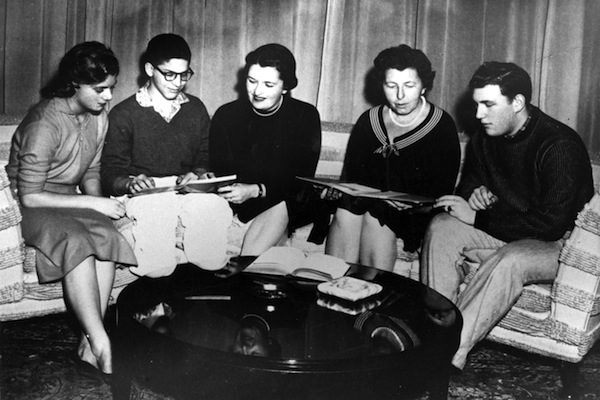
Mystery photo … April 28/17

Jewish National Fund, 1980. (photo from JWB fonds; JMABC L.11965)

If you know someone in this photo, please help the JI fill the gaps of its predecessor’s (the Jewish Western Bulletin’s) collection at the Jewish Museum and Archives of B.C. by contacting archives@jewishmuseum.ca or 604-257-5199. To find out who has been identified in the photos, visit jewishmuseum.ca/blog.

Mystery photo … April 21/17

Canadian Friends of the Hebrew University, 1995. Dvori Balshine is on the far left. (photo from JWB fonds; JMABC L.11102)

If you know someone in this photo, please help the JI fill the gaps of its predecessor’s (the Jewish Western Bulletin’s) collection at the Jewish Museum and Archives of B.C. by contacting archives@jewishmuseum.ca or 604-257-5199. To find out who has been identified in the photos, visit jewishmuseum.ca/blog.

Travel along Incense Route

A sculpture of camels traversing the Incense Route in Avdat National Park. (photo by Kate Giryes/Shutterstock.com)

Close your eyes and travel back in time 2,000 years. You’re riding on the back of a camel laden with frankincense and myrrh from faraway Yemen, navigating 100 kilometres across the harsh, hilly Negev Desert to get your precious cargo to the Mediterranean ports.

For 700 years, from the third-century BCE until the second-century CE, this was the hazardous but hugely profitable task of the nomadic Nabatean people. Today, the small Israeli portion of the 2,000-kilometre Incense Route – a UNESCO World Heritage Site – is a fascinating trail filled with beautiful desert vistas and archeological discoveries.

The route includes the remains of the Nabatean towns of Halutza, Mamshit, Avdat, Shivta and Nitzana (another, Rehovot-Ruhaibe, is hidden by sand dunes), four fortresses (Katzra, Nekarot, Mahmal and Grafon) and two khans (Moa and Saharonim). You can see evidence of surprisingly sophisticated watering holes, agriculture and viniculture that the Nabateans innovated.

“The Roman and Greek empires controlled a lot of cities around the Mediterranean shores and, in all these cities, there were pagan shrines where they sacrificed animals. The smell was terrible, so the Nabateans brought incense for those shrines to cover the smell of the slaughter,” explained tour guide Atar Zehavi, whose Israeli Wild tours specialize in off-the-beaten-track jeeping, cycling, hiking and camel-back trips like the Incense Route.

photo - At Moa, you can see an original pressing stone for olive oil
At Moa, you can see an original pressing stone for olive oil. (photo by Atar Zehavi)

“The route is surprisingly difficult because there were easier ways to go across the Negev. But the Nabateans wanted to stay hidden from other Arab tribes that might ambush the caravans, and they wanted to avoid being discovered by the Romans so they could keep their independence,” Zehavi said. “They knew how to harness the harsh desert conditions to their advantage, building water holes and strongholds others would not find. The Romans conquered Judea pretty easily but it took them another 150 years to conquer the Nabateans.”

Zehavi recommends a two-day “jeeping and sleeping” excursion along the Incense Route, also called the Spice Route. Start in the east, at Moa in the Arava Valley, site of an ancient khan (desert inn). From there, ascend the Katzra mountaintop, a stronghold overlooking the whole region. This will give you an appreciation for how hard it was to lead a caravan of camels up a steep slope.

“They’d travel 30 kilometres a day between khans. One camel carried 350 kilos of incense and only needed to drink once every 10 days or so,” said Zehavi, who has a master’s degree in environmental studies.

Even back then, camels wouldn’t have had much to drink at the third stop, the Nekarot River, a dry riverbed that once flowed through the Arif mountain range and northern Arava. The Nekarot is part of the Israel National Trail and boasts spectacular landscapes.

This leads you past Saharonim to the fourth stop, the town of Mitzpeh Ramon with its world-famous Ramon Crater (Makhtesh Ramon), which still has visible Nabatean milestones among its abundant flora and fauna, including the Nubian ibex. Ramon is the world’s largest erosion crater, stretching 40 kilometres and descending to a depth of 400 metres. It has unique geological structures, such as the Hamansera (Prism) of crystallized sandstones and the Ammonite rock wall embedded with fossils.

photo - An ibex at the Ramon Crater
An ibex at the Ramon Crater. (photo from PikiWiki Israel)

Camp out overnight in the crater, if weather and traveler preferences permit. A variety of hotels, from desert lodge to hostel to luxury, are also in the crater area. While in Mitzpeh Ramon, you may want to include the visitors centre and a nighttime stargazing tour.

The next morning, you’ll have a choice of trails for walking, jeeping or biking in the crater. A guided jeep tour is always a good option.

Getting back on the Incense Route, you go up Mahmal Ascent on the northern rim of the crater, a 250-to-300-metre climb to the Mahmal Fortress. Proceed northwest from there to Avdat National Park, site of a once-flourishing Nabatean city, where you can see shrines that were later turned into Byzantine churches.

Zehavi explained that, after the Roman Empire transitioned into Byzantine Christianity around 324 CE, incense was no longer needed, so the Nabateans started producing wine and desert agriculture, as well as raising Arabian horses.

“It’s amazing to see the way the harsh desert was colonized for agriculture through the use of highly sophisticated irrigation systems,” said Zehavi.

End your tour of the Incense Route at Avdat or go northwest to Shivta National Park and Halutza, or northeast to Mashit National Park near Dimona.

Israel21c is a nonprofit educational foundation with a mission to focus media and public attention on the 21st-century Israel that exists beyond the conflict. For more, or to donate, visit israel21c.org.

Pesach sameach!

During Passover, thousands of Israeli families will be taking advantage of the holiday period to visit some of the many attractions all over the country. One of the busiest will be Ramat Gan Safari Park, which does its own Pesach cleaning, to ensure there is no chametz (unleavened bread) anywhere. The park has ordered five kilograms of matzot for each of the animals that eats breads the rest of the year.

New legion slate, and more

Left to right: John Collier, Ralph Jackson (president), Alan Tapper (first vice-president) and Marc Perl (second vice-president) at Royal Canadian Legion Shalom Branch 178’s January general meeting. (photo from the legion)

At its general meeting in January, Royal Canadian Legion Shalom Branch 178 elected its new management slate: Ralph Jackson (president), Alan Tapper (first vice-president), Marc Perl (second vice-president), Jenica Neamu (secretary) and Jeff Simons (treasurer). The executive officers are, in alphabetical order: Libbera Amram, Eugene Edelman, Maurice Elharrak, Rosemary Harkins, Frank Long, Angela Miller, Danny Redden and Larry Shapiro.

The next general meeting will take place at the legion, 2020 West 6th Ave. For information on it and becoming involved, call Tapper at 604-263-8498 or email legionsecretary178@gmail.com.

* * *

photo - Minister Gilad Erdan, left, and Moshe Teitelbaum
Minister Gilad Erdan, left, and Moshe Teitelbaum. (photo from United Hatzalah)

On Feb. 13, Israel’s national volunteer emergency medical services organization, United Hatzalah, received the Jerusalem Prize for excellence in lifesaving. The director of United Hatzalah, Moshe Teitelbaum, received the award in honour of the 3,200 volunteer EMTs, paramedics and doctors who work with the organization. The award was presented by Gilad Erdan, Israel’s minister of public security, strategic affairs and information.

Among the reasons given by the judges with regards to why United Hatzalah was selected for the award, the judges explained: “United Hatzalah is receiving this prize due to the activation and operation of its volunteers, and providing first-response emergency medical treatment in the first few minutes after an emergency occurs, before the arrival of an ambulance.”

United Hatzalah president and founder Eli Beer welcomed the prize and the recognition of the efforts of the volunteers.

“This prize was given to us due to our volunteers,” he said. “It is they who deserve it for their hard work and dedication to saving lives across Israel. They leave their beds, homes, workplaces, family and friends in order to answer the call of others and save the lives of those who need it most in their communities. Our volunteers work tirelessly, often long into the night, in order to provide fast and professional emergency response in under three minutes. May Israel be blessed with more people like our volunteers.”

* * *

Limmud, the international network of Jewish learning communities, will be awarded the Jerusalem Unity Prize in the Diaspora category on Unity Day, June 7.

President of Israel Reuven Rivlin will bestow the award in Jerusalem, recognizing Limmud’s global success in bringing Jews together. The prize is a joint initiative between Jerusalem Mayor Nir Barkat, Gesher and the families of Eyal Ifrach, Gil-ad Shaer and Naftali Fraenkel, z”l.

“We are grateful for this fabulous honour,” said Limmud chair David Hoffman. “Limmud promotes Jewish unity by offering an inclusive cross-communal space for Jews of all ages and backgrounds, to meet, learn, volunteer and build community. Unity is about celebrating our diversity while working together to build community and create a dynamic Jewish future. This is what Limmud does.”

Founded in the United Kingdom in 1980, Limmud today has spread to 84 communities in 44 countries on six continents. In 2016, Limmud’s 4,000 volunteers produced 74 Jewish learning festivals and events around the world, which drew more than 40,000 people.

A core tenet of Limmud is that everybody is an equal member of the community, whether layperson or rabbi, communal leader or educator, adult or child. Limmud’s values stipulate that it is a community of learning, recognizing that far more can be achieved together than individually. Everyone can contribute and all are responsible for one another and the communities that are created.

“Today, when deep schisms separate Jews – politically, religiously, within communities and between the Diaspora and Israel – the Limmud model and message is more necessary than ever,” stated Limmud board member and head of strategic development David Bilchitz, who is based in South Africa. “Building and sustaining unity takes hard work and a constant effort to understand and bridge our differences. Owing to Limmud’s shared values, Limmud offers a platform to explore, understand and discuss differences, emphasizing common denominators and what we can learn from each other. It is thus a beacon of light in building the future of community through respect and accepting diverse Jewish identities.”

Apart from its work in the Diaspora, Limmud has been embraced by thousands of Israelis, where nine Limmud communities bring together people across the religious spectrum and from all ethnic origins – Ashkenazim, Sephardim, immigrants from the Former Soviet Union, and many others.

The Jerusalem Unity Prize and Unity Day recognize individuals, organizations and initiatives in Israel and throughout the Jewish world that advance mutual respect among the Jewish people.

Mystery photo … March 31/17

Jewish Community Centre of Greater Vancouver, 1950. (photo from JWB fonds, JMABC L.11154)

If you know someone in this photo, please help the JI fill the gaps of its predecessor’s (the Jewish Western Bulletin’s) collection at the Jewish Museum and Archives of B.C. by contacting archives@jewishmuseum.ca or 604-257-5199. To find out who has been identified in the photos, visit jewishmuseum.ca/blog.

Nidje Israel – a hidden gem

Nidje Israel – now called Sinagoga Histórica – was built by Eastern European Jews who came to Mexico in 1930. (photos by Rubén López Vargas)

photo - The ark, where the Torah is located, surprises the visitor with its golden columns crowned by the tablets of the law
The ark, where the Torah is located, surprises the visitor with its golden columns crowned by the tablets of the law. (photo by Rubén López Vargas)

Walking around the historic centre of Mexico City, where the main buildings are Catholic churches and convents, I am surprised to find in a small square called Loreto, a synagogue surrounded by two churches – Loreto and Santa Teresa la Antigua. The synagogue is easily overlooked at first glance, since its exterior is of a neo-colonial style that blends in with its surroundings, and one only realizes that the building is related to the Jewish people from the two Stars of David at the top of its main door.

Synagogue Nidje Israel was built by Eastern European (Ashkenazi) Jews who came to Mexico in 1930. It opened for services on Sept. 14, 1941, and closed its doors at the end of the 1970s. It was abandoned for about three decades, until a renovation was begun in 2008. Months of hard work culminated in the synagogue’s reopening on Dec. 13, 2009, and, today, it serves as a cultural centre, and is called Sinagoga Histórica (Historic Synagogue).

On entering, I am greeted with great cordiality and informed of the rules that must be followed inside. I pass a small patio that serves as a divider, and encounter the main façade, with its neo-Romantic style. Inside the synagogue, I walk into a salon, where celebrations are carried out in a traditional fashion. There is currently a photography exhibition of festivities celebrated in days gone by.

photo - Synagogue Nidje Israel was built by Eastern European (Ashkenazi) Jews who came to Mexico in 1930
Synagogue Nidje Israel was built by Eastern European (Ashkenazi) Jews who came to Mexico in 1930. (photo by Rubén López Vargas)

The first floor welcomes me with its open doors, and the first thing I see is the bimah. Located in the centre of the enclosure, it is the largest in Mexico, elaborated in fine woodwork, with stained glass images depicting musical instruments, alluding to Psalm 149.

The ark, where the Torah is located, surprises the visitor with its golden columns crowned by the tablets of the law. These are sustained by two mythological animals. The cape that covers the ark door is embroidered with golden thread. The two menorot on each side of the ark enhance the beauty of the whole.

The ezrat nashim, the area reserved for women, is on the second floor, as is the mural depicting the Garden of Eden, on which I notice that there are no representations of humans, but only of animals.

photo - The ezrat nashim, the area reserved for women, is on the second floor
The ezrat nashim, the area reserved for women, is on the second floor. (photo by Rubén López Vargas)

When I stand next to the bimah, my attention is caught by two spectacular elements: the beautiful ceiling painted with vivid colours, with a great number of Jewish symbols, and the majestic candelabra, which was the most difficult element to restore, but an important aspect to remind us of the old synagogues.

I sit for a moment just to imagine what it would be like to take part in a religious service in this synagogue full of people. I stand and walk to the exit door, and stop once more to observe for the last time the beauty of the building that continues to amaze me.

I want to thank everyone who made it possible to restore this place and open it to the general public, to make better known the culture and identity of the Jewish people in this part of the world.

To find out more about Historic Synagogue, visit sinagogajustosierra.com.

Rubén López Vargas was born in 1972 and is a lifelong resident of Mexico City. He dedicates himself to photography of social events, historic monuments and colonial architecture. He loves dancing, reading of all kinds, and traveling throughout Mexico. This article was translated by Carl Rosenberg.

photo - Sinagoga Histórica is currently hosting a photography exhibition of festivities celebrated in days gone by
Sinagoga Histórica is currently hosting a photography exhibition of festivities celebrated in days gone by. (photo by Rubén López Vargas)