On making a new start

Why is it so hard for many of us to shake off the past and begin anew? My Bride often tells me she finds it amazing how easily I forgive myself for my errors. She holds her misgivings about past actions to her breast for eternity. For me, when I forgive myself, I find it much easier to strike off in another direction, one which may, or may not, lead to a better result.

Maybe it has something to do with my background. As an adherent to Judaism, I have always been much taken by the ideas associated with the Jewish New Year. Rosh Hashanah, occurring in the autumn, as determined by the lunar calendar, is one of our major holidays. It is a happy holiday, a time of feasting and family gatherings, celebrating that we managed to get safely through another year. And there are lots of wishes expressed that we might do the same again next year, even marking it in our spiritual birthplace, Jerusalem.

But there is a serious side to the holiday as well. The New Year will be followed closely by the Day of Atonement, Yom Kippur, when all Jews are assessed and judged as to what their fate will be in the year to come. So, the New Year is a time when all Jews are expected to examine their behaviours and make resolutions that, hopefully, will guide their actions more positively in the coming year.

To do so, one has to search one’s conscience, one has to admit to oneself all those things that we have done wrong, that only we know about. We have to admit to ourselves remorse for our actions that we know have not been correct in the light of our values. Then we have to decide that we will not do those things again. We have to forgive ourselves and resolve to do differently. Indeed, during this season, many individuals go out of their way to visit antagonists and others to whom they may have done wrong to beg pardon for any perceived excesses to which they may have been a party.

So, you can see that I come by my approach rightly. It was imbibed with my mother’s milk. Judaism is not unique in including this concept within its construct. It seems to be an important element within many religious and philosophical approaches as to how humans should live. The key thing to me is that we have to be able to forgive ourselves so that our contrition can motivate actions toward a new start.

I must admit I always feel refreshed when I am in the position of having cast off the constrictions imposed by ideas I have been forced to abandon. Ahead of me lie whole new worlds of possibilities. That old stuff didn’t work. What did I learn? Where can I go from here?

What about that idea that we discarded before as impractical, impossible? Could there be something in it? What about what Joe suggested, which we shouted down? Maybe we should ask him to explain it more fully. Could there be something in it that we missed? He has had good ideas before. What if we put that idea together with the one we had? Could that give us a better result? Anybody who has spent a part of his or her life confronting problems, and problem-solving, in concert with other people, will know that of which I speak.

Don’t we feel better after we have cleared the decks with an old adversary? Now maybe we can make a fresh start and work together to accomplish common goals that we share. Isn’t it great when the difference you have had with your spouse has been resolved and you have returned together to the zone of loving and sharing that you were in danger of losing? Isn’t that more important than things that may have divided you? Aren’t so many long-term relationships built by making new starts over and over again?

The Jewish New Year ethic is a part of how we can live our lives each day. Making a fresh start is what we can do every day we wake up. We all know there are things percolating on the back burner. We may not want to think about some of these things. We may push them off to the back of our minds because of their unpleasantness. But they don’t go away. They are the things we will have to tackle if we want to make a fresh start in some important area of our lives.

Max Roytenberg is a Vancouver-based poet, writer and blogger. His recently published Hero in My Own Eyes: Tripping a Life Fantastic is available from Amazon and other online booksellers.

What kids can teach

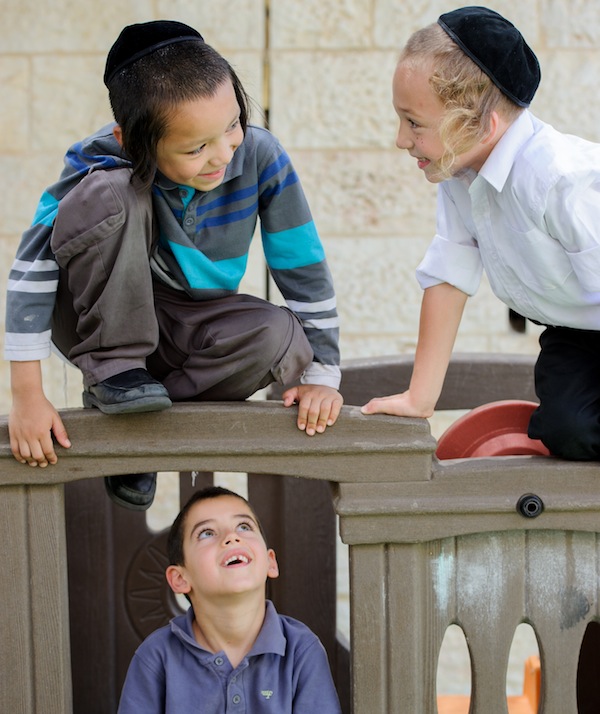
Rosh Hashanah is a time to take stock of the previous year and prepare yourself spiritually for the year ahead. But for those of us with busy families, it can be hard to squeeze time for reflection into the round of Yom Tov preparations. It seems that, once you have children, the holiday focus goes from attending shul to tending to your children and, as rewarding as parenting can be, it leaves little time for focusing on spiritual growth. Yet, one of our most important jobs as parents is to teach our children the concepts of teshuvah (repentance), tefilah (prayer) and tzedakah (charity/justice). How are you supposed to teach these values to your children when you may not have time to connect to them yourself?

Child education expert Moshe Beller has found that the answer lies within the very task at hand – by watching your children.

As director of Beit Metzudot School at Seeach Sod, an Israeli organization for kids and adults with special needs, Beller must often answer tough questions about how to teach children these important values. His answer – emunah (faith/belief) – in them, yourself and, ultimately, in Hashem.

“Here at Seeach Sod, we work with children of all ages and abilities. When we approach educating a child, we look at every detail, from the diagnosis, available therapies and interventions, family circumstances and more. Then we calculate it all to find a solution that best serves the individual child. Though I cannot tell you one therapy that works for every situation, I can say that, at the core of every treatment, is believing that your child can succeed – there is no greater intervention than that!”

Sounds good, but how can we tap into that elusive ideal? If you haven’t guessed it already, it’s our children who can teach us that as well.

Children have a profound ability to trust their parents to lead them. Even if they don’t always follow what you say, they trust you with their life essentials. They trust you will keep them safe, fed, clothed, etc. This level of emunah is one we should allow ourselves to tap into when it comes to grappling with G-d. Mirror what your child displays regularly – let go of the worries that hold you back and know that everything is being taken care of for your benefit.

As for teshuvah, an essential element of teshuvah is believing you can start anew, that you can learn from your mistakes without your ego holding you back. Children display this to us with their ability to live in the moment. They don’t condemn their past actions or the past actions of others like adults do. They’re excited to learn and grow without fear of admitting they don’t know it all.

With respect to tefilah, a key to heartful prayer is awe. A sense of G-d’s greatness and the miracles that surround us each day opens possibilities to so much more. Children have the ability to be wowed by things we take for granted. As adults, we become jaded and forget that the simple pleasures surrounding us are in fact miraculous. Learn from your children and find wonder in the simple creations.

Finally, tzedakah. Have you ever seen how a child lights up when you tell them you need their help? At the core of generosity is the understanding that, no matter what your financial situation is, we all have something we can offer to another. Children take much pride in being able to help, whether or not being of genuine assistance is within their capabilities. We, too, can take the same joy in giving tzedakah and doing acts of chesed (loving-kindness).

This year, instead of seeing your children as a distraction from the path to spiritual preparation for the High Holidays, look to them to guide you towards a year of growth.


Recipes for a tradition

(photo by Noa Fisher via PikiWiki-Israel)

Pomegranates are referred to in the Bible in many various ways. In the sensual poetry of Song of Songs, we read, “I went down into the garden of nuts … to see whether the vine budded and the pomegranates were in flower.” In another passage, the poet writes, “I would cause thee to drink of spiced wine, of the juice of my pomegranate.” Song of Songs has four additional mentions of pomegranates, and there are also references in Joel, Haggai and I Kings.

For many Jews, pomegranates are traditional for Rosh Hashanah. Some believe the dull and leathery skinned, crimson fruit may have really been the tapuach, apple, of the Garden of Eden. According to Forward “Food Maven” Matthew Goodman, the pomegranate originated in Persia and is one of the world’s oldest cultivated fruits, having been domesticated around 4000 BCE. The Egyptians imported pomegranates from the Holy Land in 1150 BCE and natural pomegranate juice, made into spiced wine, was a favourite of Hebrews living in Egypt. Pomegranate wood could also be carved into skewers on which to roast the lamb for Passover.

The word pomegranate means “grained apple.” In Hebrew, it is called rimon, which is also the word for hand grenade! In fact, the English term “hand grenade” is said to come from this and that both the town of Granada in Spain and the stone garnet come from the name and colour of the pomegranate. The juice can also be made into grenadine.

The Hebrews yearned for the pomegranates they left behind in Egypt while wandering in the desert – “And wherefore have ye made us to come up out of Egypt, to bring us in unto this evil place? It is no place of seed, or of figs, or of vines, or of pomegranates.” (Numbers 20:5) And the spies reported their findings in Canaan to Moses: “And they came unto the valley Eshkol and cut down from thence a branch with one cluster of grapes, and they bore it upon a pole between two; they took also of the pomegranates and of the figs.” (Numbers 13:23)

Pomegranates were also used on the faces of the shekel in the second century BCE. King Solomon had an orchard of pomegranates, and pomegranates of brass were part of the pillars of his great Temple in Jerusalem. Throughout the Bible, pomegranates are referred to as a symbol of fertility. As well, in the Jewish mystical tradition of kabbalah, it is said there are 613 seeds in each pomegranate, equaling the number of mitzvot commanded by God.

On the second night of Rosh Hashanah, when it is customary to eat a “new” fruit, one that celebrants have not eaten during the year, many Sephardi Jews choose the pomegranate. They recite the prayer “ken yehi ratzon, may it be thy will, O Creator, that our year be rich and replete with blessings, as the pomegranate is rich and replete with seeds.”

In modern days, a study at the Technion in Haifa a few years ago showed the power of the fruit. The cholesterol oxidation process, which creates lesions that narrow arteries and result in heart disease, was slowed by as much as 40% when subjects drank two to three ounces of pomegranate juice a day for two weeks. The juice reduced the retention of LDL, the “bad” cholesterol that aggregates and forms lesions. When subjects stopped drinking the juice, the beneficial effects lasted about a month. Other studies have shown that pomegranates fight inflammation and cancer, and slow cellular aging. Pomegranates are a good source of potassium, low in calories and low in sodium.

When choosing a pomegranate, look for one that is large, brightly coloured and has a shiny skin. You should store a pomegranate in a plastic bag in the refrigerator, and it can keep up to 10 weeks. To open a pomegranate, score the outside skin into four pieces, then break the fruit apart with your hands following the divisions of the membranes. Pull off the membranes then scrape the seeds into your mouth or lift them out with a spoon. Here are some recipes for those seeds.

POMEGRANATE SYRUP

6 pomegranates
1/3 cup white sugar
1/3 cup brown sugar
1 cinnamon stick
1/8 tsp nutmeg
1/8 tsp allspice

  1. Puree seeds from pomegranates in blender or food processor and strain. Place in saucepan.
  2. Add white sugar, brown sugar and cinnamon stick. Bring to a boil. Reduce heat and simmer about 10 minutes. Add nutmeg and allspice and cook one minute.
  3. Remove from heat, discard cinnamon stick and strain.

BAKED APPLES IN POMEGRANATE SYRUP
6-8 servings

4 slightly tart apples
1 halved pomegranate
apple juice
1/3 cup preserves of your choice
1/2 tsp cinnamon

  1. Cut each apple into four wedges. Place in microwavable dish.
  2. Squeeze juice from half the pomegranate into a measuring cup. Add enough apple juice to make half a cup. Add preserves and cinnamon and mix well. Pour over apples to coat them.
  3. Cover with plastic wrap and microwave for two minutes. Stir and microwave two more minutes. Place apple wedges in serving dishes.
  4. Remove seeds from other half of pomegranate and garnish apples.

POMEGRANATE FRUIT SOUFFLE

3 eggs
1 cup + 3 tbsp confectioners’ sugar
1 tbsp unflavoured gelatin
1/2 cup hot water
1/2 cup cold water
7 tbsp orange juice
2 1/2 tbsp lemon juice
pulp and seeds of 6 pomegranates

  1. Place yolks and sugar in a saucepan over a second saucepan filled with water (double boiler-style). Cook, stirring, until thick and creamy.
  2. Dissolve gelatin in a bowl of hot water. Then stir in cold water.
  3. Add orange juice, lemon juice, pomegranate pulp and seeds and mix.
  4. Add juice mixture to egg yolk mixture.
  5. Beat egg whites until stiff. Fold into pomegranate mixture. Pour into a soufflé dish or casserole with height built up of three to four inches with a double thickness of wax paper or aluminum foil, stapled or held in place with a paper clip.
  6. Chill in refrigerator until set. Remove band of paper. Decorate with whipped cream.

Sybil Kaplan is a journalist, lecturer, book reviewer and food writer in Jerusalem. She created and leads the weekly English-language Shuk Walks in Machane Yehuda, she has compiled and edited nine kosher cookbooks, and is the author of Witness to History: Ten Years as a Woman Journalist in Israel.

Apples and honey – so good

(photo by Markus Hagenlocher)

One of the most well-known customs of Rosh Hashanah is the dipping of apple pieces in honey but what is its origin?

In the time of King David, we know he had a “cake made in a pan and a sweet cake” (II Samuel 6: 15, 19) given to everyone. Hosea 3:1 identifies the “sweet cake” as a raisin cake.

The Torah also describes Israel as eretz zvat chalav u’dvash, the land flowing with milk and honey, although the honey was more than likely date honey, a custom retained by many Sephardi Jews to this day.

While honey may have been used in King David’s cake, the honey of ancient Eretz Yisrael was made from dates, grapes, figs or raisins because there were no domestic bees in the land. At that time, only the Syrian bees were there and, to extract honey from their combs, it had to be smoked. Still, honey was of importance in biblical times, as there was no sugar then.

During the Roman period, Italian bees were introduced to the Middle East, and bee honey became more common. Today, Israel has roughly 500 beekeepers who have some 90,000 beehives, which produce more than 3,500 tons of honey annually. Kibbutz Yad Mordechai is the largest producer of honey – 10,000 bottles a day.

Among Ashkenazi Jews, challah is dipped in honey on Rosh Hashanah, instead of having the usual salt sprinkled on it. The blessing over the apple is, “May it be Your will to renew for us a good and sweet year,” before it is dipped in honey.

Dipping the apple in honey on Rosh Hashanah is said to symbolize the desire for a sweet new year. Why an apple? In Bereishit, Isaac compares the fragrance of his son, Jacob (who he thinks is his son Esau), to a field, and Rashi says it is sadeh shel tapuchim, a field of apple trees.

Scholars tell us that mystical powers were ascribed to the apple, and people believed it provided good health and personal well-being.

Some attribute the using of an apple at Rosh Hashanah to the translation of the story of Adam and Eve and the forbidden fruit, which caused the expulsion from paradise. The Garden of Eden is also called Chakal Tapuchim, “Garden (or field) of Apple Trees.”

According to Gil Marks (z”l) in Encyclopedia of Jewish Food, “the first recorded association of apples with Rosh Hashanah was in Machzor Vitry, a siddur compiled around 1100, which included this explanation: ‘The residents of France have the custom to eat on Rosh Hashanah red apples….’ Future generations of Ashkenazim adopted the French custom … leading to the most popular and widespread Ashkenazi Rosh Hashanah tradition.”

Rabbi Jacob ben Asher, born around 1269, who fled with his family to Spain in 1303, was the first to mention the custom of apples dipped in honey in his legal compendium Arbah Turim, circa 1310, citing it as a German tradition.

Rabbi Alexander Susslein of Frankfurt, Germany, a 14th-century rabbinic authority, revealed it had become a widespread practice in Germany.

A few years ago, an article revealed that the average Israeli eats 125 apples and 750 grams of honey a year, mostly around the High Holy Days. Israel is very self-sufficient with regard to apples, with around 9,900 acres cultivated yearly, grown in the north, the Galilee hills and the Golan Heights. The most popular types of apples grown are Golden Delicious, Starking, Granny Smith, Jonathan, Gala and Pink Lady.

Honey in Hebrew, dvash, has the same numerical value as the words Av Harachamim, Father of Mercy. We hope that G-d will be merciful on Rosh Hashanah as He judges us for our year’s deeds.

Moroccans dip apples in honey and serve cooked quince, which is an apple-like fruit, symbolizing a sweet future. Other Moroccans dip dates in sesame and anise seeds and powdered sugar in addition to dipping apples in honey. Among some Jews from Egypt, a sweet jelly made of gourds or coconut is used to ensure a sweet year and apples are dipped in sugar water instead of in honey.

Honey is also used by Jews around the world not only for dipping apples but in desserts. Some believe in the phrase, “go your way, eat the fat, drink the sweet,” the sweet referring to apples and honey. Here are some recipes using honey for your Rosh Hashanah eating.

TISHPISHTI: MIDDLE EASTERN HONEY-NUT CAKE

Honey syrup:
1 1/2 cups honey
2/3 cup water
1/3 cup sugar
1/4 cup lemon juice

Cake:
2 cups finely ground almonds, hazelnuts, pistachios or walnuts
1 cup cake meal
2 tsp orange juice
1 tsp ground cinnamon
1/2 tsp allspice or ground cloves
6 eggs
1 cup sugar
1/2 cup vegetable oil
1 tbsp grated orange or lemon zest

  1. Stir honey, water, sugar and lemon juice in a saucepan over low heat until the sugar dissolves, about five minutes. Increase heat to medium, bring to a boil and boil for one minute. Let cool.
  2. Preheat oven to 350°F. Grease a 13-by-nine-inch baking pan.
  3. Combine nuts, cake meal, cinnamon and cloves in a mixing bowl.
  4. In another bowl, beat egg yolks with sugar. Add to nut mixture with orange juice. Add oil and orange or lemon zest.
  5. In a third bowl, beat egg whites until stiff but not dry. Fold into batter. Pour batter into baking pan and bake for 45 minutes. Cool.
  6. Cut cake into one- to two-inch squares or diamonds. Drizzle cooled syrup over the warm cake. Serve at warm or room temperature.

MY GRANDMA SADE’S TEIGLACH
Though my grandmother was born in New Jersey, her mother came to the United States as a young girl from Russia, so she probably learned this dish from her mother. Teiglach means “little dough pieces,” and it was originally for family celebrations and various holidays. Today, it is made primarily for Rosh Hashanah as a symbol for a sweet new year. According to my favourite reference book for any food, Marks’ Encyclopedia of Jewish Food, Teiglach was brought to the United States by Eastern Europeans in the early 1900s, and nuts were not part of the recipe in the old country.

2 1/2 cups flour
1 tsp baking powder
4 tbsp oil
4 eggs
1/8 tsp salt
3/4 cup brown sugar
1 1/3 cups honey
1 tsp ground ginger
1/2 tsp ground nutmeg
1 cup finely chopped pecans

  1. In a mixing bowl, combine flour, baking powder, oil, eggs and salt. Stir until dough is formed.
  2. In a saucepan, boil sugar, honey, ginger and nutmeg for 15 minutes.
  3. Wet a board with cold water.
  4. Pinch pieces of dough and drop them into the boiling honey mixture. Cook until very thick. Add nuts and stir. Pour honeyed pieces onto the wet board and cool slightly.
  5. With wet hands, shape dough into two-inch balls or squares. Let cool. Store in an airtight container.

Sybil Kaplan is a journalist, lecturer, book reviewer and food writer in Jerusalem. She created and leads the weekly English-language Shuk Walks in Machane Yehuda, she has compiled and edited nine kosher cookbooks, and is the author of Witness to History: Ten Years as a Woman Journalist in Israel.

City overflowing with history

The early 20th-century Casa Bianca is today one of the locations of the Municipal Art Gallery of Thessaloniki (Salonika). (photo by Pappasadrian)

When you think Salonika, don’t think old, think ancient. Because of its geographic location on the Via Egnatia trade route, this northern Greek city traces its beginnings to 316 BCE. Even back then, who you knew was key. Thus, the town was named Thessalonike, after Alexander the Great’s sister, the wife of Cassandrus. Over the years, it has been called Thessaloniki, Saloniki or Salonika. (Note: sometimes the “k” is switched to a “c.”)

Jewish Salonika is a small community of about 1,000. But it was not always this way. Trade drew lots of different people to Thessaloniki, including Jews.

The original Jewish residents were Romaniot Jews – they spoke Greek and maintained a Hellenistic culture. In the beginning, Romaniot Jews and non-Jews held the same occupations and language. As a strategic town in the Byzantine Empire, both groups faced invasions. But, by the 1000s, the empire reached a level of stability that permitted flourishing Jewish scholarship. During this early phase of the Middle Ages, Jews from other areas, such as Anatolia, Germany and Hungary, settled in Salonika. In the late 1300s, more Jews arrived, this time from Provence, Northern Italy, Sicily and Catalonia.

What followed will sound familiar. Religious affiliation defined the Jewish Salonikan way of life: the Romaniotes had their synagogue, the Ashkenazim had theirs and the Jews from Italy and France had theirs. The situation intensified when Salonika received the many Jews that Spain and Portugal expelled. Back then, there was no worry about space and growth, as the Ottoman takeover had depleted the city’s population, but the influx of Sephardim was so great that, by the end of the 16th century, Romanite ritual was no longer practised. Ladino or Judeo-Español became the Jewish community’s language of choice.

For more than four centuries, half of Salonika’s population was Jewish, pinning it with the title, “Mother of Israel,” or “Madre d’Israel.” With so many Jews, it was not uncommon for the non-Jews of Salonika to be conversant in Ladino.

Not only that, but, as the Renaissance had influenced many of the Sephardi arrivals, Jewish Salonika received a significant secular and religious boost. The city became famous for its Jewish silk producers, weavers and wool dyers. Libraries, an influential talmudic academy, a printing press and a conservatory for Jewish religious singing all started during this golden period.

By the 1600s, the corrupt and inept Ottomans had started milking the merchant class. When, in 1636, Judah Kovo, the chief of the Salonika delegates, came to Murad IV to pay the annual “clothes tax,” the sultan capriciously ordered his execution. No Jew was well enough “connected” to stay the order. Unfortunately, at the same time, key foreign markets dried up. Having the means to escape, many wealthy Jewish merchants left. Other Salonikan Jews tried to escape troubles by following in the footsteps of a false messiah, Shabbetai Zvi.

photo - The 15th-century White Tower is one of the most-recognized monuments in Salonika
The 15th-century White Tower is one of the most-recognized monuments in Salonika. (photo by MaurusNR)

The Ottoman Empire was in decline by the 17th century. Nonetheless, in the late 1800s and early 1900s, Salonika’s well-to-do Jewish residents managed to open flour mills, brick factories, breweries, soap-works and silkworm nurseries, carpet and shoe-making factories and several large tobacco workshops. Most of the Jewish population, however, remained poor. Considerable philanthropy within the community eased some of the daily hardships and provided education for many of the male children.

During this period, Jewish economic, social and political pursuits varied: on the one hand, some influential Jews continued in commerce and banking; on the other hand, some Jews became heavily involved in socialism. (The Workers’ Union, for example, was started in 1909 by a group of Salonika Jews. It became the most important socialist organization in the Ottoman Empire.) The railroad and port were important factors. Amazingly enough, until 1923, the city’s port closed on Shabbat and Jewish holidays.

The social balance started to shift in the intervening years of the First and Second World Wars. The national government passed laws aimed at hellenizing the city. Slowly, the Jews – numbering 61,439 in a 1912 Greek census – became segregated (the horrendous 1917 fire probably abetted this process) and reduced many to second-class citizens by virtue of their not speaking the Greek language. Some antisemitic activities occurred, leading to a pogrom that drove many Jews to leave. (See the 2015 essay “Mother of Israel” by Dr. Lena Molho at greece-is.com/mother-of-israel.)

When the Nazis arrived, they herded Jews into a ghetto, then to Auschwitz. While the courageous actions of Archbishop Damaskinos Papandreou (and the Athens police chief) saved thousands of Greek Jews, the Nazis killed 96% of Salonika’s Jews.

The killing was not enough for the Nazis, however. They also destroyed Salonika’s 2,000-year-old Jewish cemetery. Headstones ended up as pavement, urinals, driveways and even a dance floor. More damage – both physical and emotional – was sanctioned by the Greeks themselves. The university was built right on top of the cemetery. Even today, there is still no campus memorial to the massacred Jews.

Interestingly, individual Jewish Salonikans might well tell you their families came from Spain – as if this migration happened only recently. (See Bea Lefkowicz’s PhD thesis, published in 1999 by the London School of Economics.) At least among the older generation, this seems to be part of their personal narrative.

Today’s Jewish community is tightly run. A council provides numerous services to its members. Rabbi Eliyahu Shitrit, an Israeli with Moroccan roots, has been the community’s spiritual leader for several years now.

Central Salonika has the feel of a port town like Haifa, but with its own unique history. Some of its Jewish-related buildings from the 19th and 20th centuries still stand. Even if you don’t believe in ghosts, there is something eerie about today’s Jewish Salonika. But visitors will also see how grand and vital this place once was. Walk around and you will see sites specifically related to the Nazi occupation of the city, but also the Baron de Hirsch Hospital, the Villa Allatini and Allatini Flour Mill, Villa Bianca, Villa Modiano, Villa Mordoh, the White Tower, the market synagogue, Yad l’Zikaron and the Museum of Jewish Presence in Thessaloniki.

Deborah Rubin Fields is an Israel-based features writer. She is also the author of Take a Peek Inside: A Child’s Guide to Radiology Exams, published in English, Hebrew and Arabic.

Charleston’s southern charm

The Orthodox synagogue Brith Sholom Beth Israel. (photo from jsilverman.weebly.com/synagogues-in-charleston.html)

Charleston, S.C., is one of the most popular travel destinations in the United States. With its perfectly preserved old mansions, Charleston has charm and grace, in addition to genuine human warmth. Just walk along any of its streets and the first person you meet will surely give you a friendly hello.

Jews have resided in Charleston since 1695, attracted by economic opportunities and its proclamation of religious liberty for all. In 1749, there were enough Jewish pioneers in town to organize a congregation, Beth Elohim, the second-oldest synagogue in the country (now Reform) and the oldest in continuous use. Its imposing colonnaded neo-classical structure on Hasell Street was designated a National Historic Landmark in 1980.

The congregation’s small museum features the historic 1790 letter that George Washington wrote in response to the synagogue’s good wishes upon his becoming president: “May the same temporal and eternal blessing which you implore for me rest upon your congregation.”

This letter is emblematic of the spirit of friendship between the gentile establishment and Jews – and the acceptance, even early on, of Jews into the American mainstream, especially in the South. (More than 20 Jews from Charleston fought in the American Revolution and one, Francis Salvador, was a delegate to several Provisional Congresses. This may explain the friendly link between George Washington and the Charleston Jewish community. And, besides, Washington was known as a decent and courtly man.)

During the first decade of the 1800s, Charleston, with its 500 Jews, almost all of them Sephardi, was considered the largest, most cultured and wealthiest Jewish community in America. But, because of the destruction of the city during the Civil War, the city and its Jews became impoverished, and the waves of Jewish immigration in the 19th and 20th centuries passed it by. However, after the Second World War, the city prospered, as did its Jews. Today, the nearly 2,000 Jews in the city are in the professions, trade and business, teaching, politics and the arts. In the 1920s through the early 1950s, the city’s main street, King Street, was virtually shut down on Saturday. Walk along King Street today and you will still see many Jewish names on the shops.

photo - Congregation Kahal Kadosh Beth Elohim (now Reform)
Congregation Kahal Kadosh Beth Elohim (now Reform). (photo from charlestonsmuseummile.org)

In addition to three synagogues, one each from the major branches of American Jewry, there are a number of Jewish philanthropic and communal organizations, a Jewish community centre and a well-established day school.

The College of Charleston, the oldest municipal college in the United States, also has a broad-ranging and ever-growing Jewish studies program under the devoted and imaginative direction of Prof. Martin Perlmutter – now with its own building, thanks to the generosity of Henry and Sylvia Yaschik. The 800 Jewish students make up a significant minority of the college population. In addition to an active Hillel, the array of courses includes Hebrew language, Jewish culture and history and Israel- and Holocaust-related courses.

What makes Charleston especially attractive is its visible Jewish history, coupled with the world-class arts festival Spoleto USA, which runs for about two-and-a-half weeks every year, from the end of May to early June. The festival is an all-encompassing cultural experience: opera, dance, theatre, jazz and classical music, popular music, even acrobatics. The twice-daily chamber concerts, at 11 a.m. and 1 p.m., hosted with humour and panache by first violinist of the St. Lawrence Quartet, Geoff Nuttall, are considered the musical anchor of the festival.

But there is more. The Piccolo Spoleto Festival, sponsored by the City of Charleston, which runs during the same two-and-a-half weeks, offers a dizzying array of classical music, plays, cabaret and comedy acts, jazz cruises and much, much more. The College of Charleston’s Jewish studies unit also sponsors several events during the festival, including A World of Jewish Culture.

This year, the Orthodox synagogue Brith Sholom Beth Israel, on Rutledge Avenue, hosted four evenings of chamber music, featuring Jewish composers like Kurt Weill, George Gershwin, Paul Ben-Haim, Ernest Bloch and Eric Korngold, and non-Jewish composers who wrote Jewish music, like Ravel’s “Kaddish” and Max Bruch’s “Kol Nidrei.”

In Charleston, too, lived the people who inspired Porgy and Bess, by George and Ira Gershwin. The Gershwins resided temporarily on James Island, just outside the city, while writing their opera. They purposely came to Charleston to get a feel of the city, its ambience and its people. One of the great tunes in Porgy, of course, is “Summertime,” with its Yiddish-sounding melody in a minor key.

Charleston also has a Conservative congregation, and the three Charleston congregations – Reform, Conservative and Orthodox – are unique in that their rabbis cooperate for the greater good of the community and even meet once a month for lunch and a study session. Another fascinating crossover is that many Jews in the community belong to more than one shul – a kind of anti to the old joke about the Jew on the desert island who builds two shuls. When asked why, he responds, “That one, I daven in; the other, I wouldn’t be seen dead in.”

One longtime Jewish resident, a spry and active octogenarian agnostic proudly and only half-facetiously remarked, “I belong to all three shuls, thank God, but you won’t catch me praying in any of them.” And when he was indeed caught one Sabbath morning davening in the Orthodox shul, one of his pals came up to him and joked, “What are you doing here? Today’s not Yom Kippur.” In response, the 80-year-old quipped in his slight Carolina drawl, “Well, then I hope God forgives me for coming today.”

At the College of Charleston during the academic year, there is a kosher dairy cafeteria, Marty’s Place. And Chabad has pre-packaged prepared meat meals that are available at the famous Hyman’s Fish Market on King Street. For delicious vegetarian meals at reasonable prices, go to Jon York’s Gnome Cafe, at 109 President St.

Be sure to also take a horse-and-buggy ride in the historic district. The knowledgeable guides will take you through the residential part of town, focusing on the homes and the history of their occupants. Then stroll along the quiet streets, in the famous covered market, and tour the nearby plantations.

Two useful telephone numbers are those of the Charleston Visitors Bureau, 1-800-774-0006, and Spoleto’s, 1-843-579-3100 or spoletousa.org.

Curt Leviant’s most recent books are the critically acclaimed novels King of Yiddish and Kafka’s Son.

Mystery photo … Aug. 25/17

Na’amat Pioneer Women, 1960. (photo from JWB fonds, JMABC L.12599)

If you know someone in this photo, please help the JI fill the gaps of its predecessor’s (the Jewish Western Bulletin’s) collection at the Jewish Museum and Archives of B.C. by contacting archives@jewishmuseum.ca or 604-257-5199. To find out who has been identified in the photos, visit jewishmuseum.ca/blog.

Despair tempered by hope

On the Sabbath preceding the fast of Tisha b’Av, the ninth of the Hebrew month of Av, we read in our synagogues from Isaiah, and this reading is one of the three “Haftorahs of Rebuke.” The fast completes the cycle of the Jewish year and commemorates the destruction of the Temple in 586 BCE by the Babylonians and, 656 years later, on the same date, when the

Romans destroyed the Second Temple.

The prophet Isaiah, from whose book we read, was the son of Amos, a native of Jerusalem. He came from a respected family that moved in royal circles and was a prophet in Israel from 740 to 701 BCE. These were stirring years, for the kingdoms of Syria and Israel both fell to the Assyrians in 721 and only by a miracle was Jerusalem delivered from their grasp 20 years later. Isaiah brought the message of the holiness and sovereignty of God, seeking to interpret the crises of history in the light of Divine guidance.

On Tisha b’Av, we read from Lamentations and the writings of another prophet, Hosea. In describing Jerusalem, he wrote: “for their mother hath played the harlot … she that conceived them hath done shamefully….” (Hosea 11:7)

There is an interesting story connected with Hosea. He was married to a woman called Gomer, beautiful but faithless, who eventually ran off with one of her lovers, later becoming a slave and a concubine. Despite her degradation, Hosea continued to love her and bought her back from slavery. He did not take her back as his wife, but as a ward who he hoped would one day repent and be worthy of his protection.

During this period, Hosea had a strange awakening. He felt that this traumatic personal experience was symbolic of God’s love for Israel. The loving husband who had been abandoned by a faithless wife could be compared to God’s beneficence towards Israel, who repaid Him by worshipping the golden calf. God had redeemed the Israelites from slavery in Egypt and made them His special people. Yet, instead of keeping their part of the covenant made at Mount Sinai with God, they adopted the idolatrous practices of the Canaanites, forsaking their God for heathen idols.

However, just as Hosea continued to feel love for Gomer, he realized that God’s love for His people would not change. Just as he did not despair that his wife would one day repent, he believed that God’s everlasting mercies also encompassed His sinning people and that their exile would lead to self-knowledge and a return to God.

When Hosea realized the similarity between his wife’s conduct and that of Israel, he felt that his marriage to Gomer had been preordained and was God’s way of speaking to him.

So, while we mourn the destruction of the Temple and the many tragedies that have befallen our people through history, we can still take comfort in the fact that God’s compassion is ever available to us when we truly repent. In Judaism, despair is always tempered by hope. Because of this, we conclude the Tisha b’Av reading with the words: “Turn us unto Thee O Lord, that we may be turned. Renew our days as of old.”

Dvora Waysman is a Jerusalem-based author. She has written 14 books, including The Pomegranate Pendant, which was made into a movie, and her latest novella, Searching for Sarah. She can be contacted at dwaysman@gmail.com or through her blog dvorawaysman.com.

Mystery photo … July 21/17

Beth Israel Sisterhood panel, 1977. (photo from JWB fonds; JMABC L.09864)

If you know someone in this photo, please help the JI fill the gaps of its predecessor’s (the Jewish Western Bulletin’s) collection at the Jewish Museum and Archives of B.C. by contacting archives@jewishmuseum.ca or 604-257-5199. To find out who has been identified in the photos, visit jewishmuseum.ca/blog.

Observations on China

A Magen David is still attached to the roof of a former synagogue in Harbin, China. (photo by Deborah Rubin Fields)

If a few years ago you had flown on an international flight from Beijing, China, you would have noticed a departure terminal display of Chinese marionettes. Like many other sites in China, there was more to this small puppet exhibit than met the eye. While the display explained the history of this colourful theatre, it ironically underscored the question about which we Westerners are most curious: who is pulling the strings in today’s China?

photo - A taxi in Beijing
A taxi in Beijing. (photo by Deborah Rubin Fields)

Our arrival point was Beijing. Right away, our local guide made critical comments about the regime. In her opening remarks, she stated the temperature in Beijing never went above 39°C. Why? Because then, she claimed, the government would have to give people the day off. So, officially, it never got hotter than 39°C. When she said this, I half-expected some secret police (perhaps our tour bus driver?) to arrest her for her sarcasm. As no one hauled her away, I started to rethink where I was and what I knew about China.

Our guide gave the group free time to wander Tiananmen Square. Like all those who visit the square, we passed through a metal detector and an X-ray security check. Yet, once past this point, uniformed police officers were few and far between. As my husband and I walked around the vast and infamous plaza, however, mounted cameras were everywhere. Nevertheless, everyone seemed oblivious to the fact that someone, somewhere was watching their every move. Chinese citizens and foreign visitors alike seemed preoccupied with one thing: taking photographs of each other.

This preoccupation with self expressed itself in different ways. For instance, several young Chinese awed me with their self-assurance. In Xian, a female guide-in-training confided in me that she wanted to do what she called exciting graduate work in the United States. She seemed undaunted by applying for permission to study abroad, having to take foreign entrance tests, getting accepted at an American university, finding funding and a challenging subject to study. She showed both marvelous confidence and a sense of mobility.

In a Jewish cemetery in Harbin, a young girl materialized by our side. Earlier, I had noticed her pushing her bike up the steep hill to the cemetery. It seemed she wanted nothing more than to practise her very limited English vocabulary. We huddled around her and the puppy she was carrying in her basket. She did not seem at all fazed that we weren’t able to understand her. We never learned where she came from (there were no homes close by) or where she was going. From our guide’s translation, all we learned was that she was 12 years old and that she had to leave to take care of her dog.

photo - A sign advertising a synagogue in the former Jewish quarter of Kaifeng
A sign advertising a synagogue in the former Jewish quarter of Kaifeng. (photo by Deborah Rubin Fields)

In Kaifeng, a 30-year-old female resident demonstrated a similar sense of unabashed certainty. Claiming Jewish descent, she expressed conviction in being able to build an entire synagogue. Although she seemed to have little knowledge of Judaism, much less about Jewish politics and/or philanthropy, she believed she would be able to achieve her goal.

In Beijing, one of our Chinese lecturers bombastically concluded that the Kaifeng Torah scrolls – which, according to the British Library, are from the 17th century – were fake. He offered no new study material; he simply and quickly discarded what others had written. Conversely, he offered a lengthy explanation of how, throughout his career, he had managed to be in the right place at the right time. And so it seemed, from his down-pat Silicon Valley gestalt and his outstanding command of American English.

I hoped that, on the road, I’d catch people “off guard.” In fact, there were lots of antics on the road. In big cities like Beijing and Shanghai, pedestrians had designated crosswalks and lights, but drivers didn’t honour them. People on foot would begin crossing with the “green walking man,” but would end up dodging approaching vehicles. Yet, no one yelled or raised a fist at the intruding scooters, cars, buses, trucks and taxis.

In traffic, drivers impulsively decided to make U-turns on multi-lane highways. Intriguingly, other drivers simply yielded. There was no Western-style road rage; Chinese drivers just let the others merge into traffic. There was likewise fascinating seen-but-not-seen vehicle activity: scooter owners pocketed illegal fares from passengers they had picked up, while parking attendants of an upscale spa discreetly covered the car licence plates of relaxing “Party” members.

Yet, even with all the upward mobility of the big cities, we saw signs of hardships, past and present. For example, a senior university lecturer and former member of the Chinese diplomatic corps, still carefully extinguished his cigarette butt, saving the remainder for a later smoke. On the way to our Harbin hotel, I saw people searching for clothes in a giant heap of cast-offs. Down the same road, people were picking up chunks of coal in a coal yard. We saw small dwellings where even my head (I am only 5’1”) would touch the ceiling.

Aha, I said to myself. I have found the “true” China in all this dust and pollution. The real China, I told myself, resembles the USSR of the late 1970s. But, as we kept driving, we reached the downtown skyscrapers and tall new apartment buildings. No beloved Chinese cranes (the ornithological family name is Gruidae) soared the horizon. They had been replaced by swiveling construction cranes.

Plastered on some of these buildings were the names of Western brand items. Not only were there ads for Western consumer products, but the Chinese models themselves all had surprisingly Western facial features. In fact, I later heard that Chinese plastic surgeons are doing a booming business “styling” Caucasian-type eyes.

photo - The entrance to Modern Hotel, formerly owned by Harbin Jews
The entrance to Modern Hotel, formerly owned by Harbin Jews. (photo by Deborah Rubin Fields)

And what of China’s Jews? The merchant economy of ancient China brought Jewish traders to Kaifeng as early as the eighth century. The community thrived, reaching its height in the 17th century at 5,000 members. But, following generations of war, poverty and religious isolation, the community significantly declined. Some claim that Kaifeng Jews were victims of their own success, as they assimilated so well.

Wanting to establish a foothold, Russia encouraged its Jews to settle in Harbin in the 19th century. By 1908, Harbin had a diverse Jewish community of 8,000.

Shanghai first saw Russian Jews fleeing czarist persecution and massacres in the early 1900s, continuing through the 1917 revolution. Then came Jews from Baghdad, Bombay and Cairo, including several financially successful families. In the 1930s and early 1940s, more families from Germany and Nazi-occupied areas fled to Shanghai.

Most of China’s Jews did not want to live under communism. So, after the Second World War ended, they left for either the West or Israel. Now, Beijing has a transient Jewish community of international businesspeople.

***

Even today, one party in China is calling the shots. Democratic freedoms such as multiple political parties or a free press are missing, so some elite group is still pulling the symbolic strings of millions of people. But the strings appear to have a lot of slack and the go-phrase ironically comes from other cultures: seize the day! In this, the Chinese seem to be having a lot of success.

Deborah Rubin Fields is an Israel-based features writer. She is also the author of Take a Peek Inside: A Child’s Guide to Radiology Exams, published in English, Hebrew and Arabic.

***

Sidebar …

In 2014, the Chinese film industry produced a movie entitled Dr. Rosenfeld, by director Xu Zongzheng. The movie, which stylistically calls to mind old Soviet movies, was recently screened in Jerusalem.

Dr. Jakob Rosenfeld came to China as a Viennese-Jewish refugee from Nazi Austria. A urologist and gynecologist by training, he joined Mao’s army to fight the Japanese. He was elevated to the rank of general and to a postwar job as health minister in the Manchurian government. At the end of the film, viewers read that, in 1952, Rosenfeld died in Tel Aviv of a heart attack.

– DRF