Art beyond the gallery walls

For Dan Russek, art abounds in urban settings, whether it be in the form of manhole covers, bike racks or other items and scenes that city dwellers regularly encounter. Spurred by an early love of photography, he has been surveying cityscapes with an eye for “public art that goes beyond the gallery.” 

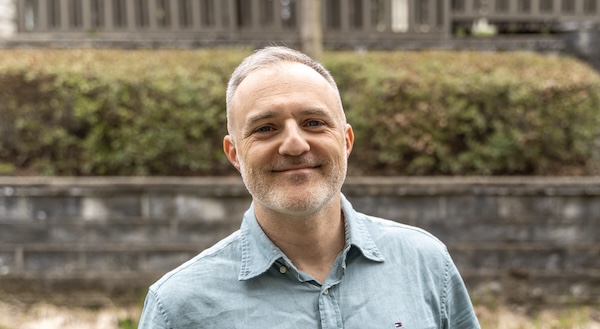
photo - University of Victoria professor Dan Russek, author of Exercises in Urban Mysticism: Practical Poetry and other books
University of Victoria professor Dan Russek, author of Exercises in Urban Mysticism: Practical Poetry and other books. (photo from Dan Russek)

A professor in the department of Hispanic and Italian studies at the University of Victoria, Russek is the author of Exercises in Urban Mysticism: Practical Poetry, a 2020 book – written in Spanish, with the title Ejercicios de mística urbana: Poesía práctica, and published in Mexico – that explores the poetry of everyday life.

“One way I look at it is that I take the idea of modern art seriously,” Russek told the Independent. “When you see a painting by Jackson Pollock, you may understand its place in the history of art. But what Pollock is showing is a kind of texture, composition and movement that you can find outside of the gallery walls, appealing to a certain sensibility that takes you beyond the museum.”

Russek was intrigued by the 1996 book Manhole Covers, written by Mimi and Robert Melnick and published by MIT Press. It delved into how an object many consider ordinary can provide a record of the history of a city and, some would argue, be deserving of a spot in contemporary urban culture; in other words, seeing a utilitarian object as an “urban sculpture.”

Russek devoted a lot of space in his illustrated book to manhole covers, bike racks, various geometric structures and a variety of textures. Art, as he views it, extends far beyond the confines of canvas or paper. Indeed, by his admission, one of his favourite spots to be is on construction sites, especially in a place like Mexico City, where there are few restrictions for getting inside. 

“You take something in itself that may not appear to be too interesting, but, when you look at it in a certain way, it becomes interesting. Or, to quote Gustav Flaubert, ‘Anything becomes interesting if you look at it long enough,’” Russek said.

As an example of this, Russek gives the work of American photographer Edward Weston in the 1920s and 1930s. As Russek describes it, in one image, Weston takes a simple green pepper and turns it into something “astounding.” The same can be done for bike racks and many other urban and industrial artifacts, he said.

Russek, who was born in Mexico, remembers being surrounded by relatives who were passionate about photography.

“As a kid, we would make an album while on a vacation. Each trip yielded an album, as did life events, weddings, bar mitzvahs,” he said. “Life was documented. It gave me a model. I began taking pictures in high school, and I realized I was interested in abstraction.”

Over the years, walking through the streets of cities like Chicago, Mexico City and Buenos Aires, Russek has been struck by many aspects of street art, including graffiti, another form of public art that is found beyond the gallery. In fact, some graffiti, he said, is as valuable as the art one finds in a museum.

“I wish I had my camera with me all the time. The reflections of light in the afternoon over the pavement, it’s phenomenal. The light making reflections on the water from a gutter – life is full of these interesting moments. Bringing the camera is a good thing because I don’t have to look for anything, the world sends it to me,” he said. 

Russek completed a PhD in comparative literature at the University of Chicago, specializing in modern and contemporary Latin American literature and visual arts. His fields of research include the links between literature and the visual arts and media, urban studies and esthetics. He has explored the relations between modern technology, culture and literature, and centres on the notion of epiphany and the phenomenon of light. His first book, Textual Exposures: Photography in Twentieth Century Spanish American Narrative Fiction, was published in 2015 by University of Calgary Press. 

Some of Russek’s next plans involve going beyond the printed page. He wants to make videos, as the medium “allows you to do more stuff, with music and the matching of images, that you cannot do in a book.” He also writes poetry (sonnets in particular) because, for one reason, “you can take an object or an emotion and write a poem about it and elevate it to a new level of importance.”

Argentine writer Julio Cortázar is an example Russek cites of an artist reaching beyond the confines of a particular medium, an approach that is multifaceted or experimental. In one work, Último Round (Last Round), Cortázar created an almanac-style book filled with articles, poems, essays and illustrations.

Aside from teaching and writing, Russek is the coordinator of the Latin American and Spanish Film Week, now in its 14th year, held in the fall at UVic’s Cinecenta. He is also the president of the Hispanic Film Society of Victoria. 

Sam Margolis has written for the Globe and Mail, the National Post, UPI and MSNBC.

Art as an anchor amid chaos

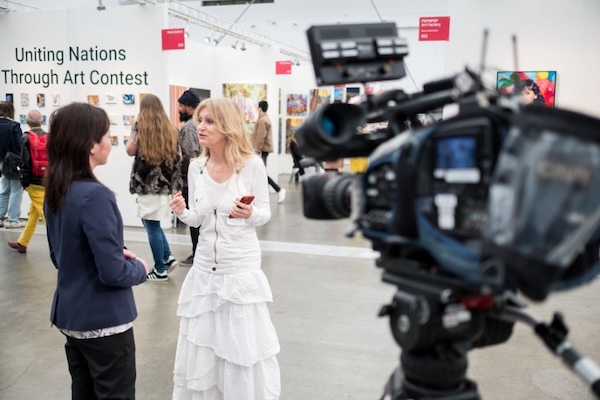
Lisa Wolfin, executive director and founder of Art Vancouver International Art Fair, which is at the Vancouver Convention Centre East April 11-14. (photo from Art Vancouver)

“Art serves as a vital anchor amidst the chaos of the world, both as a creator and a viewer,” said Lisa Wolfin, executive director and founder of Art Vancouver International Art Fair, which returns to the Vancouver Convention Centre East April 11-14.

“As a creator, it offers a therapeutic outlet to process complex emotions, providing a medium through which to express, reflect and make sense of the turbulence surrounding us,” she told the Independent, saying that, no matter the form of artistic expression, she finds solace in the act of creation, in addition to beauty and meaning.

“As a viewer,” she said, “art serves as a sanctuary, offering moments of escape and contemplation. It provides a lens through which to interpret and understand the world, offering insights, perspectives and opportunities for introspection. In both roles, art becomes a source of comfort, inspiration and resilience, offering a sense of connection and grounding amidst the uncertainty of our times.”

Wolfin and her daughters, Taisha Teal and Sky Lilah, who are also part of the Art Vancouver team, are among the Jewish community members participating in the annual art fair that drew more than 11,000 attendees last year. This April’s event is the eighth edition of the exhibit, which includes workshops, live demonstrations, a range of conversations, and is an opportunity for creatives to network and collaborate.

Wolfin is most looking forward to the sense of community and connection that Art Vancouver brings. “I’m eager to be a part of that vibrant atmosphere once again,” she said.

photo - Taisha Teal
Taisha Teal (photo from Art Vancouver)

Teal echoes that sentiment.

“I’m particularly excited about showcasing my art to a diverse audience of art enthusiasts and collectors,” said Teal. “Connecting with fellow artists, sharing insights and drawing inspiration from their work is another aspect I’m looking forward to. This event also provides a unique opportunity to engage with artists and galleries from around the world…. Moreover, I’m eager to receive feedback from attendees and potential buyers, which will contribute to my growth as an artist and refine my artistic practice.”

Lilah is looking forward to two main things: what she will create for the exhibit – “it is always a surprise,” she said – and, she shared, “Additionally, there’s immense enthusiasm surrounding hosting the opening night! Welcoming everyone to Art Vancouver is a true privilege, and having a significant role at the show is an honour.”

Art Vancouver, which was established in 2015, has been held annually, with the exception of the first two years of COVID.

“During the pandemic, I dedicated time to exploring new artistic styles,” said Teal. “Over the past couple of years, I’ve blended several styles together, continually evolving my approach. For instance, my ‘sparkle ladies’ series has undergone transformations with each passing year, featuring diverse female figures and introducing abstract faces. I particularly enjoy experimenting with abstract shapes and colours, and my upcoming collection will focus on incorporating textured elements using molding paste and various tools.”

photo - Sky Lilah
Sky Lilah (photo from Art Vancouver)

Following the pandemic, Lilah curated her inaugural solo art exhibition, unveiling a series of abstracts for the first time. “Instead of merely attempting to depict something, I sought to channel the divine through my creative process, crafting unique works of art that had never been realized before – pieces that were distinctly mine,” she said.

“Over the years, I’ve persisted in exploring abstract styles, seamlessly blending them with my previous series,” she added. “I’m currently amalgamating elements from several series, combining the favourite aspects of each into a cohesive whole. While I continually experiment with new styles, I often layer them upon the foundations of styles with which I am familiar – an ongoing ebb and flow of artistic exploration.”

Wolfin, too, has spent time developing and refining her existing style and techniques, while venturing into different areas. “This has allowed me to push the boundaries of my creativity and explore new avenues of expression,” she said, noting that her work is inspired by many sources, “including nature, emotions, personal experiences.”

“I find inspiration in the beauty of the natural world, the complexities of human emotions and the stories of people and cultures,” said Wolfin. “Each of these influences shapes my creative process and fuels my desire to express myself through art.”

Teal also has a deep love for nature – “Whether it’s the patterns in a leaf, the colours of a sunset or the textures of a rock formation, nature constantly offers fresh ideas and motifs that find their way into my artwork” – and points to multiple sources of creativity.

“Firstly, the diverse cultures, landscapes and experiences I encounter during my travels serve as a constant wellspring of inspiration,” said Teal. “Each new destination offers unique perspectives, colours, textures and stories that influence my artistic vision.

“Secondly, connecting with other artists allows me to exchange ideas, techniques and perspectives, fueling my creativity and pushing me to explore new artistic territories. Collaboration and dialogue with fellow creatives foster a sense of community and shared creativity that invigorates my artistic practice.”

image - “A Thousand Expressions” by Taisha Teal
“A Thousand Expressions” by Taisha Teal.

Teal added that her “passion for experimentation with new materials adds another dimension.”

“Exploring unconventional materials and techniques challenges me to think outside the box and pushes the boundaries of my artistic expression,” she said.

“Art serves as a profound means of expression for me,” said Teal. “As a creator, it allows me to channel my emotions and immerse myself completely in the process. I infuse my art with love and happiness, aiming to evoke those feelings in my viewers. In a world filled with chaos, art becomes my sanctuary, a place where I find solace and peace. My intention as an artist is to spark positive emotions and inspire others with each brushstroke, inviting viewers to explore their own creativity and embrace the beauty within themselves.”

For Lilah, art embodies her very existence. “I’ve never known a life without it,” she said. “It serves as a means of creative expression, a harmonizing force for the diverse aspects of my personality and an invitation to embrace play, structure, freedom, love and acceptance.

image - a portrait by Sky Lilah
A portrait by Sky Lilah. (photo from Art Vancouver)

“Through art, I learn valuable skills and life lessons, such as time management (as artistic endeavours require dedication), self-love (recognizing that my efforts are ‘good enough’) and the importance of experimentation. It teaches me that we don’t know the result before it happens, and that you have to start in order to get to the end. For my work, I rarely know what I’m going to paint before I start painting, I discover it on the canvas, and that is a life lesson for my role in business as well – when hosting a new event, I won’t have all the answers before. I simply just need to start.”

Transformations in her life and the “opportunity to explore diverse cultures, languages and symbols sparks a fire of creativity,” Lilah said, adding that she tries, in her art, to “communicate a message that embodies inner strength, love, exploration, confidence, authenticity and kindness,” creating works “in an abstract, pop art manner to challenge mainstream thinking.” 

Art Vancouver opens April 11, 7 p.m., and runs April 12, 1-9 p.m.; April 13, noon-9 p.m.; and April 14, 11 a.m.-5 p.m. For tickets and more information, visit artvancouver.net. 

The art of creating ketubot

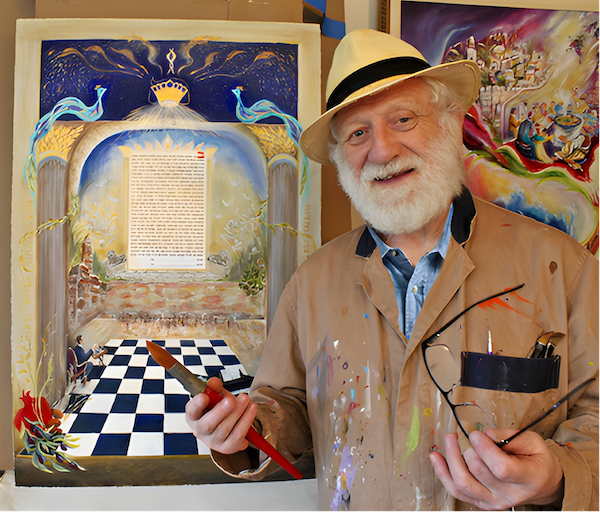
Mordechai Edel beside the personalized ketubah he created for A.J. and Olena Steigman; A.J. is a chess champion and Olena is a classical pianist. (photo from Mordechai Edel)

Vancouver artist Mordechai Edel is one of a handful of people in Canada who make ketubot (singular: ketubah), the standard contract for traditional Jewish marriages, which have been used for millennia.

“I was trained as an impressionist artist, from which I developed the philosophic concept of ‘impression-mystic’ art,” Edel told the Independent. “Hopefully, this contributes in a small way to ‘marrying’ wedding contracts with art and harmonizing the opposites of heaven and earth, chiaroscuro [the use of strong contrasts of dark and light], fire and water.”

While the central theme of a ketubah is constant – an obligation on the part of the groom to provide for his bride – their designs can vary immensely, and each one designed by Edel tells, in its way, a separate story. He has been creating ketubot for 40 years.

“I often incorporate a stylized menorah symbol, which reflects the potential marriage of all humanity uniting together under G-d’s joyous chuppah canopy of shalom [peace and wholeness],” he said.

A kosher ketubah requires precision and documentation, especially regarding Hebrew names, marriage location and dates. Ketubot are usually written in Aramaic, in calligraphic style, and halachic (Jewish legal) requirements allow little room for embellishment. 

“Not much fun there,” said Edel of the creative possibilities. “However, ‘the fun’ may begin with the surrounding artwork. That’s when personal requests start to kick in. I am often requested to incorporate ‘painted stories,’ illustrating romantic memories of how a couple first met.”

In the past several years, Edel has received numerous ketubah requests from local rabbis, including a “standard house model” developed with Rabbi Andrew Rosenblatt of Congregation Schara Tzedeck.

“Occasionally, some people do still enjoy elaborate weddings, which tend to generate requests for more personalized, sometimes eccentric artwork,” said Edel.

Depending on the couple’s budget, the creative detail of a personalized ketubah can vary substantially, from minimal artwork to the most elaborate designs, he said.

Edel can take several weeks to paint a personalized ketubah, although sometimes it can “just click” and he can finish one in two to three weeks. Ideally, couples planning on getting married would contact him as soon as possible, to give him as much time as possible.

Often, he said, the biggest challenge is to receive accurate place, name, date and time information. Sephardi ketubot do not permit any erasures, whereas Ashkenazi halachah (Jewish law) allows changes before the contract is signed and validated by two kosher witnesses, he explained.

Edel shared an experience that happened during a Sephardi wedding in the mid-2000s. He had painted a calla lily ketubah for a couple that had met in Acapulco, replete with a romantic sunset and a ship setting sail for Jerusalem in the background.

“Guess what? The night before the marriage, the rabbi checked the ketubah and there was one letter, ‘vov,’ missing in the Hebrew spelling of Vancouver. I was told it was invalid, it could not be rectified and was void,” Edel recalled. 

The solution, Edel found, was to physically cut out the contract part, leaving the surrounding artwork, forming a window. He then spent the entire night rewriting the document, which he then inserted, forming a two-part ketubah.

“This negative-into-positive transformation has become a trademark blessing that I now incorporate into all commissioned ketubot,” said Edel. “And, in case of a last-minute error or wine spill, all ketubot come with a duplicate backup document.”

Along the way, Edel has received some unique ketubah requests. One couple, who had encountered a skunk on their first date in Stanley Park, asked that the scene be recreated in the marriage contract. 

“I had difficulty finding a stinky model who would sit still,” Edel recalled. “That turned out to be a most scentimental ketubah.”

Another couple commissioned a grandiose, oil-on-canvas ketubah to fit over their fireplace. At the wedding ceremony, the three-foot-by-five-foot ketubah was carried into the sanctuary. The audience stood up and, according to Edel, let out an enormous communal “wow!”

Some of the more exceptional commissions Edel has seen have come from far afield. He recently completed a request that arrived “out of nowhere” from American businessman and professional chess player A.J. Steigman and his bride Olena, a classical pianist. They got married at the Western Wall (Kotel) in Israel and the ketubah features the groom (chatan) playing chess on a Vermeer-style chessboard with the bride (kalla) playing a Shostakovich concerto, all in the foreground of the Kotel.

Edel has also refurbished ketubot. In one instance, he was commissioned by the son-in-law of longstanding Schara Tzedeck members to “enhance” their original 1948 marriage certificate for their 50th anniversary. He created a ketubah “with memories of leaving the shtetl in sepia tones, transported into modern times via heaven’s kohanic [priestly] blessings, and embellished with a gorgeous bouquet of their favourite, fragrant rose flowers.”

One of Edel’s ketubot, “Le Picnique,” began as a painting commissioned by the late Joe and Rosalie Segal to be viewed by residents and staff at the Louis Brier Home and Hospital. “It later developed into a ketubah as a joyous tribute to this wonderful, caring couple,” said Edel.

Edel is grateful for the many blessings he has received in life, and gives special thanks to his wife, Annie, who helps design the ketubot.

“It is humbly interesting to note that the surname Edel means fine and noble, whereas a play on words of Mordechai suggests the French amour de chai or love of life,” Edel said. “It is this joyous love of life partnership that characterizes our ketubot and relationship between G-d, bride and groom and artist.”

For more information about Edel’s art and his ketubot, visit edelartworks.com. 

Sam Margolis has written for the Globe and Mail, the National Post, UPI and MSNBC.

Art helps bring us together

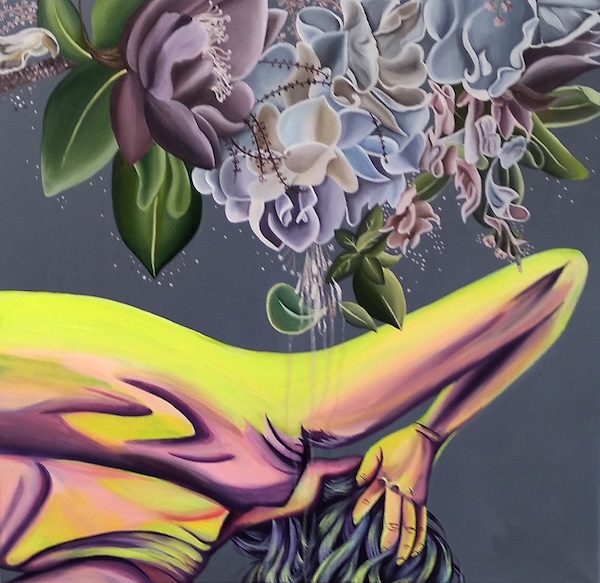
The current show at the Zack Gallery, Community Longing and Belonging, brings together a range of artists and styles. Pictured here is Alejandra Morales’s “A Landscape of Consumable Dreams.” (photo by Olga Livshin)

The current show at the Zack Gallery, Community Longing and Belonging, which opened Feb. 21, is the sixth annual exhibition in celebration of Jewish Disability Awareness and Inclusion Month. 

The exhibit was organized by the Jewish Community Centre of Greater Vancouver’s Inclusion Services and curated by Shelly Bordensky, the program’s coordinator. Most participating artists are either members of the JCC program or similar ones in other localities, like Aspire Richmond. These initiatives support people with developmental disabilities through various creative endeavours. 

The Zack show’s creative displays consist of paintings and pottery. While the size, media, colour palettes and framing of the works are all different, the underlying theme is the same: we all want to belong, we are all together on this planet.

Two paintings reflect that theme not only in their content and method of execution, but in their titles as well: “All Together 1” and “All Together 2.” Both works are cheerful and colourful, rendered with the abandon of the primitivism style. Cats and birds frolic on the canvas without regard for one another or for rules of perspective. Both list the artist as Art Hive, the visual art division of JCC Inclusion Services.

Bordensky told the Independent that both paintings were group pieces, created by several people. “Each artist added an element – a cat or a bird – and our wonderful art instructor, Kim Almond, made sure they all matched in style and colours.”  

According to Almond, 13 artists, all members of Art Hive, participated in each painting.

“Mark Li and Andrew Jackson started off the two collaborative paintings for the group, and it was a great project to work on as a class,” she said. “Colours were a huge part of the process, as the artists were always striving to create that special pop of colour.”

Another example of group art is the pottery creations – playful little animals, solemn hamsas (hands) and juicy pomegranates – crowding several stands around the gallery. 

“These ceramic pieces are all Raku ceramics by the pottery artists who are members of our Art Hive,” said Bordensky. “Together, we can create so much.”

Individual artists’ paintings are also on the theme of community.

Alex Lecce’s untitled piece is a slice of a neighbourhood street with a pie shop. The colours are realistic, and the image captures a quiet, everyday moment. We all go there, the artist seems to say. Those pies make our lives happier and more flavourful. They unite us in our humanity. 

On the other hand, Alejandra Morales’s painting, “A Landscape of Consumable Dreams,” is jarring in both the colour palette and the structure. This painting screams of discord. There are two disparate parts in the image. The top part is a tangled bunch of flowers, all in beautiful, greyish lilac hues, intertwined and elaborate. The bottom part is a vague human figure bowing to the pretty flowers. The colours of the figure are harsh, grating; they don’t fit with the flowers. But the figure obviously wants to fit, just as we all want to fit in with our surroundings. The complexity of the juxtaposition of humans versus nature is unmistakable.

Other paintings are not as complicated. Mami Zimmerman’s “Best Friends” features two ponies. Its simplicity is charming and lovely. We all want such friends. 

image - Mami Zimmerman’s “Best Friends”
Mami Zimmerman’s “Best Friends” (photo by Olga Livshin)

Calvin Ho’s painting “Nuts” is another example of primitivism in the show. The bright depiction of a squirrel and a woodpecker is reminiscent of picture books from our childhood. Bold lines and primary colours underscore that feeling. The two creatures are playing tug with a nut. Or maybe they are sharing it. Or fighting over it. The innocence of the picture invariably induces a smile.

image - Calvin Ho’s “Nuts”
Calvin Ho’s “Nuts” (photo by Olga Livshin)

In contrast, Merle Linde’s powerful landscape – “BC Wildfire 2023” – doesn’t invite smiles. The painting, its red and black scheme grim and scary, reminds us of the horror of the wildfires that affect our forests every year. The tragedy implied in the painting unites us, just as the sweeter emotions in other images do. 

In a telephone interview with the Independent, Linde said: “I’ve always enjoyed art, from the day I could hold a pencil. I liked going to art shows, too.” Mostly self-taught as an artist, she said she only started painting seriously after she retired. 

Judaica is one of the directions she explores in her art. To date, the Independent has used two of her paintings for its cover: for the 2023 Passover issue and for the 2022 Rosh Hashanah issue. Occasionally, she teaches classes for seniors in various artistic techniques.

Merle Linde’s “BC Wildfire 2023” (photo by Olga Livshin)

“Acrylic pour is a fascinating technique,” she said. “You pour the paint and let it spread as it will without a brush, and then wait till it dries. That was what I did for the background of the ‘Wildfire’ painting. I made it a few years ago. When I saw the news about the wildfires last summer, I picked up a brush and painted the black burned-out tree skeletons on top. I have two such paintings, but there was only space for one in the Zack show.”  

Most of the paintings in the show express themselves at first view. However, Gail Rudin’s “Out for the Hunt” raises questions. It portrays four seemingly perky owls on a merry, greenish background. One could assume a light-hearted company of friends on an outing, until one notices a line of tiny mice scurrying away in terror in the very bottom of the picture. Suddenly, the entire image changes its meaning, illustrating the unavoidable conflicts within nature, where the hunters and the hunted coexist. Despite the constant danger of the wild, nature somehow always finds its balance. Maybe, as humans, we could take lessons from that.     

Community Longing and Belonging is on display at the Zack Gallery until April 2. 

Olga Livshin is a Vancouver freelance writer. She can be reached at olgagodim@gmail.com.

Sculpturing with wood

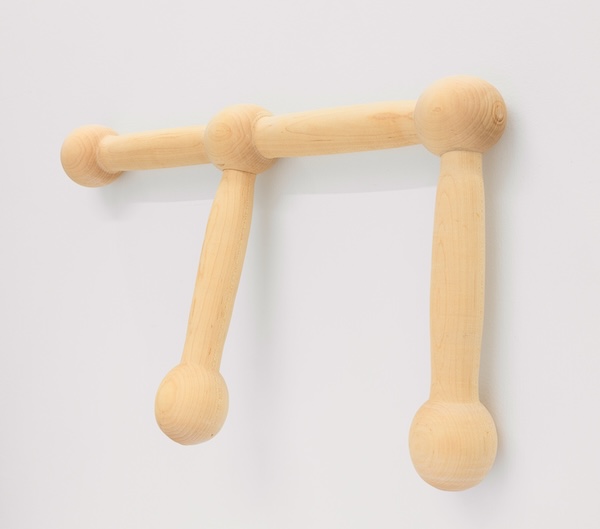
“Constellation” by Rosamunde Bordo. (photo by Sol Hashemi)

Every true artist at the start of their career undergoes a period of intense search: for their voices, for their themes, for their artistic expressions. Rosamunde Bordo is at that exciting stage now. She is searching. Her show at the Zack Gallery, Morning Star, reflects her creative explorations. 

A professional artist today, Bordo has always loved art.

“As a child, I went to a school with a strong art program. I painted. I played saxophone. My parents always encouraged my interest in art,” she said in an interview with the Independent. 

photo - Rosamunde Bordo’s solo exhibit, Morning Star, is at the Zack Gallery until Feb. 7
Rosamunde Bordo’s solo exhibit, Morning Star, is at the Zack Gallery until Feb. 7. (photo from Rosamunde Bordo)

After a bachelor’s in liberal arts and print media at Concordia University in Montreal (2014) and master of fine arts degree in visual art at the University of British Columbia (2020), Bordo teaches printmaking at UBC. But her artistic interests range much wider than printmaking. Her newly emerging passions include the creation of installations and woodworking. 

“I started woodworking last spring,” she said. “In this show, I use different woods: maple, cherry, walnut. I’m fascinated by the process of turning wood into sculptures. In a way, woodworking is similar to printmaking. Both use technology but, unlike two-dimensional printmaking, woodworking offers three dimensions. In woodworking, I try to find the story of the material, try to immerse in material-based research to investigate the self as a created subject.”

Bordo began woodworking when she started her ongoing installation project, The Denise File.

“It is almost a work of detective fiction, written through physical space,” she explained. Using found postcards written to someone named Denise, Bordo “wanted to reconstruct who the elusive Denise is, to figure out what the letters meant, to show her essence through objects, sculptures and drawings.”

She built some wooden furniture for The Denise File – a screen and a chair – and wanted to do more, to explore all she could do with wood. Her current show, comprised mostly of several sculptures, has its roots in a Jewish magic class she took at her synagogue in 2021.

“I wanted to understand Jewish history, its mysticism and its superstitions,” she said.

Each figure on the gallery wall could have originated from the ancient writings of many nations.

“It could be ancient Hebrew or Aramaic or even Greek,” Bordo mused. “All the cultures in that region were interconnected. I see the entire show as a healing amulet, but I didn’t want to assign my own meanings to the individual figures. I wanted them to be mysteries for my viewers to investigate. I wanted the viewers to be detectives and I didn’t want to influence them with my personal vision, didn’t want to limit their imagination.”

That’s why she titled every “Constellation” figure with a number. “They could be stick figures – they are very simple – but I see them as constellations, stars connected to each other,” she said. “That’s why the show is called Morning Star. The world is a difficult place right now, and the morning star is a symbol of renewal.”

Bordo’s constellations are deceptive, looking a bit like wooden hieroglyphs, or perhaps molecular structures, each with its own character.

“The one with a leg sticking out of the wall – it wanted to be playful, maybe escape from the wall,” she said. “I was looking for harmony when I worked on them, but I didn’t want to force them into locked shapes. I wanted to give them their own personalities. Besides, I try to respect the wood I work with. It is alive. There are many ways one could interpret a wooden sculpture.”  

In addition to the constellations on the gallery walls, there is also a video called Potion, which comprises four minutes of rotating green abstract patterns. Postcards with a single image from the video form another part of the installation. The text on the back of the postcards reveals the artist’s motto for this show: “Ideas are to objects as constellations are to stars.”  

There is also a small table with a slab of pink salt on it.

“Placing salt in your pockets and in the corners of rooms was a well-known Jewish superstition to ward off malevolent spirits,” Bordo said. The table with the salt stands in the corner of the gallery, hopefully repulsing malice. We all need that in our troubled times, she explained.

The show opened Jan. 5 and will be on display until Feb. 7. To learn more, go to the artist’s website, withoutimages.com. 

Olga Livshin is a Vancouver freelance writer. She can be reached at olgagodim@gmail.com.

Art sale for Israel

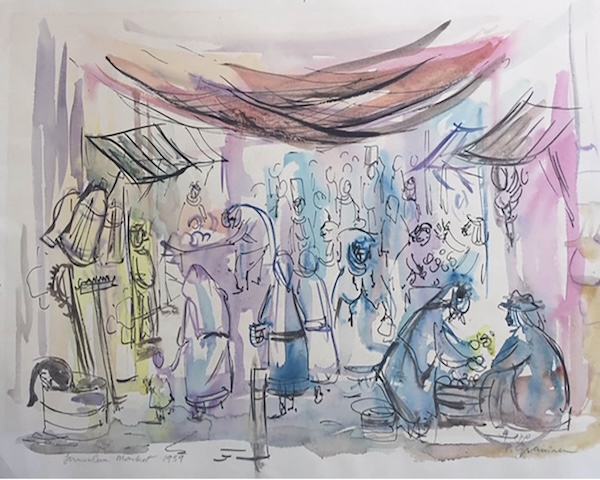
“Jerusalem Market, 1959,” watercolour and pencil, by artist Pnina Granirer, a graduate of Bezalel Academy of Art and Design in Jerusalem. Granirer will have a table of her artwork for sale in the atrium of the Jewish Community Centre of Greater Vancouver on Dec. 3, 10 a.m.-3 p.m., as part of the Chanukah Around the World party marketplace. The works will be unframed, priced from $100 to $500, with all proceeds being donated to Israel, in the hope that the donation will help it in its hour of need. For more on Granirer, go to pninagranirer.com.

The party is a joint event with multiple community partners: King David High School, Vancouver Talmud Torah, Richmond Jewish Day School, PJ Library, Camp Miriam, Jewish Museum and Archives of British Columbia, and the Kollel. In addition to the marketplace, it will feature games, iSTEAM activities, food, arts & crafts, museum displays, entertainment throughout, a community singalong and a JCC membership sale. Visit jccgv.com/jcc-chanukah-carnival.

Culture Crawl starts Nov. 16

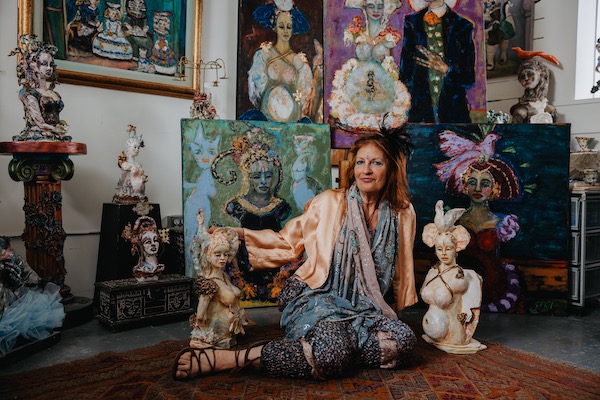
Suzy Birstein is one of the many Jewish community artists taking part in this year’s Eastside Culture Crawl Visual Arts, Design & Craft Festival, which runs Nov. 16-19. (photo by Britt Kwasney)

The 27th annual Eastside Culture Crawl Visual Arts, Design & Craft Festival takes place Nov. 16-19 and features almost 450 artists, including many from the Jewish community. Among the community members opening their studios to visitors are Suzy Birstein, Olga Campbell, Hope Forstenzer, penny eisenberg, Robert Friedman, Lori Goldberg, Lynna Goldhar Smith, Ideet Sharon, Stacey Lederman, Shevy Levy, Lauren Morris and Esther Rausenberg.

“We welcome the public to dive back into the Culture Crawl this fall to experience and be inspired by our artists’ growth and discovery. [The pandemic] has been a time of change for many of us and I believe art is a conduit for moving forward together,” says Rausenberg in the event’s press release. Rausenberg is a photo artist, as well as artistic and executive director of the Eastside Arts Society, which puts on the Crawl.

The Independent spoke with a few of the participating Jewish artists about what visitors to their studios can expect to see, and whether creativity is a place of refuge or if it is harder for them to create in times of conflict, including but not limited to the Israel-Hamas war and the war between Ukraine and Russia.

Visitors to Birstein’s studio will see her “figures from fired clay infused with aged and lustred surfaces, which inspire paintings in oil, cold wax and collage.”

The artist is currently working on two series, which will merge into the solo retrospective at Il Museo Gallery, curated by Dr. Angela Clarke for 2025.

“Both series evoke my art/travel adventures to Europe, Mexico and Cambodia,” said Birstein.

“‘Ladies-Not-Waiting’ reference the gazed-upon women by old master painters – Velasquez, Fouquet and Manet – alongside self-portraits painted by masterful female artists, Frida Kahlo, Leonora Carrington and Leonor Fini,” she said, while Tsipora (her Hebrew name, meaning Bird) is a series of loose self-portraits, which “embrace an exotic earthiness living within my poetic imagination.”

Both bodies of work, she said, “speak to nesting and transcendence, the mirror and reflection and celebrate the individual and universal.”

For Birstein, in times of conflict, “be it COVID, warfare, personal challenges – the only thing that centres me, coming directly from within me, is the creative refuge of my studio and making art. As I say this, I must stress that the love and compassion I feel for and receive from my family, friends, students and peers is the other half of that equation. I can’t imagine one without the other and I am extremely grateful.”

Friedman describes himself as “a muralist-styled stained glass artist.” He has worked in stained glass for more than 40 years and has recently added a blown glass dimension to his work, according to his website, which is also a recent addition.

“My studio is a great place and haven for creative thought and output,” he told the Independent. “[T]hese troubled times just [add] more impetus for me to have it reflected even more so in my artwork.”

Goldberg also finds herself more driven.

“My work is about vitality, life, vibration forging connections and bringing two opposing energies together as a way to find potential for resolution,” she said. “I have a responsibility as an artist to respond. I am more motivated. Expressing ‘Heaven on Earth’ is one way I respond to pain and suffering.”

Goldberg had a three-month residency on the North Shore, which she spent painting the forest – work that studio visitors will see.

“I was recently reading the book Speak for the Trees by Diana Beresford-Kroger about how the roots of the trees, the mycelium and plants and trees talk to each other,” said Goldberg. “By painting in the forest, I learnt how to listen, experience the tranquility, vitality and interconnectedness of the forest and to myself.”

Since the spring, Goldhar Smith has been “creating minimal colour-field style landscapes based on the idea of the shape of light and the colour of shadows,” she said. “The paintings are rendered in soft blues and pastels or deeper mysterious tones and suggest memories of places real and imagined.”

She acknowledged, “The conflict in Israel has, of course, been enormously upsetting and I find myself in despair for both sides of the conflict. My paintings do not yet reflect these emotions, but they will in coming months. I don’t yet know what I will be painting but I will be exploring more difficult terrain.”

For Forstenzer – a glass artist and director of the Sidney and Gertrude Zack Gallery – creativity can be a place of refuge, but also more challenging in times of conflict.

“Making work when I’m feeling the stress of all that’s going on personally and globally is truly healing,” she explained, “but when I’m feeling overrun with those things, it can be a lot harder to fully concentrate at times.”

Lately, Forstenzer has been making glass clocks, something she describes as “incredibly fun.”

“I can experiment with colour and pattern in the glass, and I’ve learned a lot about clockwork mechanisms, which is also an exciting thing to dive into – I’ve been down many rabbit holes online about clockmakers,” she said. “I’ll have a bunch of clocks on display and for sale at the Crawl.

“I also have spent a lot of the last year generally playing with colour and pattern,” she added. “I’ve made vessels – vases, bowls, cups – that experiment with a particular colour or look or pattern or stripe in glass. Once I have a colour process in place, I often go on to use those colours, patterns and processes in sculptural pieces. Since I’ve done so much experimenting this year, there will be a lot of pieces on display and for sale at the Crawl as well.”

In addition to opening their studios, Forstenzer and Birstein are part of the Crawl’s juried exhibition, which has the theme “Out of Control.”

“At a time when we start to celebrate our freedom from pandemic restrictions, it’s an opportunity to reclaim experiences that were denied for so long, a chance to think outside of the box and just let go,” says Rausenberg in the press release.

The exhibition features the work of 80-plus Eastside artists and takes place at multiple venues: Alternative Creations Gallery and Strange Fellows Gallery (both until Nov. 19), the Pendulum Gallery (until Nov. 24) and the Cultch (until Nov. 25).

For more information, visit culturecrawl.ca.

Share delight of letters

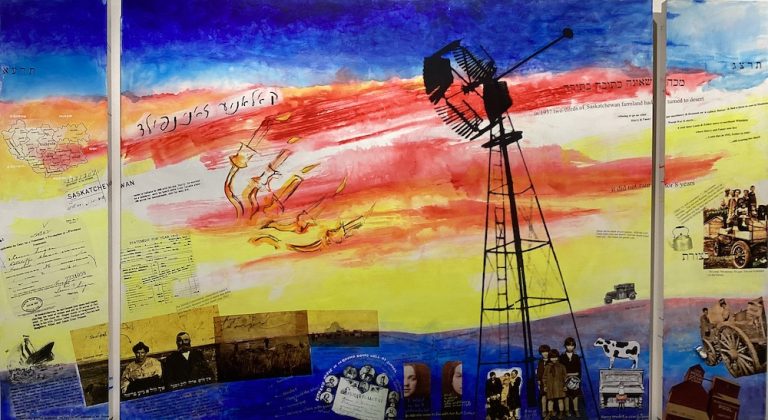
“Shabbat Saskatchewan,” by Esther Tennenhouse. Part of Otiyot (Letters), a joint exhibit with her son Joel Klassen, which is now at the Zack Gallery.

Colourful and playful, dark and ominous, Esther Tennenhouse’s artwork is engaging and thought-provoking, as she offers her take on Torah and midrash, immigration and language, orthodoxy and modernity. Otiyot (Letters), an exhibit she shares with her son Joel Klassen, opened at the Zack Gallery last week.

Tennenhouse’s sense of humour, curiosity, imagination and sincerity come through in the work on display, and in her responses to questions about the exhibit.

Ot means ‘letter’ (of the alphabet) – it also means ‘sign’ and ‘signal,’” she told the Independent. “It was my first choice of name for the show: Ot – Starring the Letter Shin. Sounds like ‘ought,’ as in ‘thought.’ Ot was visually terse (and sounds adorable). That was why it was Ot in [the] JCC program book – I had to provide that bit before these pieces were made! Yikes! But it got changed to the longer plural in Hebrew and lost its zap. More truthful, though, as I have so many (too many) words of explanation on the wall beside each piece.”

All the works were made specifically for the exhibit, said Tennenhouse, “only for this place, for anyone who happens to walk into the JCC,” where the Zack Gallery is located.

“I was driven by my own relationship to the alef-bet: me, a quite secular, second-generation, Winnipeg-born Jew living in Vancouver, of prairie-born parents, who learned my aleph-bet as a child, quite long ago. I think many like me, with my sort of education, walk by these gallery doors, so I thought they might wander in and relate.”

Born and raised in Winnipeg, Tennenhouse went to Talmud Torah there from age 4 to 11, then to public school. She earned a bachelor’s in English and, while working at the Winnipeg Free Press, majored in sculpture at the University of Manitoba School of Art.

She moved to Aklavik, in the Inuvik region of the Northwest Territories, and then to Yellowknife, where she learned about ceramics at the Yellowknife Guild of Arts and Crafts. She later worked with translucent clays.

Moving with her family – husband Ron, son Joel and daughter Timmi – to Vancouver in 1995, Tennenhouse found a home at Or Shalom, participating in the Talmud and Torah study offered there, reengaging in Jewish education after a break of some 45 years.

Klassen also attends Or Shalom. His art background includes having drawn at home and working with painter Sylvia Oates – who he describes as a mentor – in her Parker Street studio. Klassen has had a one-man show in artist Noel Hodnett’s Parker Street studio, and he was in the Kickstart Disability Arts and Culture’s 2019 group show Nothing Without Us at the Cultch. For the past four years, he has attended the JCC’s Art Hive, which is facilitated by Kim Almond.

Klassen’s Hebrew letters and drawings are in five of the pieces at the Zack Gallery, said Tennenhouse.

“Making letters as individuals, each with their own character, was the most fun to do,” she said. “Jan Wilson, a friend and quilter, offered to help if I drew out the correctly sized letters backwards for transfer and picked the fabrics.”

The letters comprise eight of the works on display, and offer much to think – and smile – about. Klassen’s aleph is filled in with leopard print fabric, surrounded in black with a flowered border. The word “wild” comes to mind as one looks at it, not just the wildness of animals and nature, but of human beings. The piece is called “Aleph in the Garden.”

photo - “Aleph in the Garden” by Esther Tennenhouse, Joel Klassen and Jan Wilson
“Aleph in the Garden” by Esther Tennenhouse, Joel Klassen and Jan Wilson.

“I did not shy away from diversity,” said Tennenhouse. “It’s sort of an underlying element. I felt the show had to offer something to any individual, whatever their history with the alef-bet, and it deals with very well-trodden themes. I felt a need for an element of surprise, which is one reason why Joel’s aleph became a leopard in the garden (of Eden?).”

A last-minute addition to the depictions is one of the 12 new letters for gender-neutral word endings that were created by Israelis graphic designer Michal Shomer a few years ago.

“They appeared in welcome signs outside schools and on IDF buildings, etc., but the kabbalist idea of the power of the alphabet lives on – the new letters were vigorously rejected by religious factions,” said Tennenhouse. “‘Changing the letters removes any kedusha (sanctity) the words have or any ability the words have of channeling God’s energy into the world,’ said sofer Rabbi Abraham Itzkowitz. ‘This project essentially makes Hebrew like any other language.’ Some of the signs were taken down. Religious schools were forbidden to use them.”

That said, Tennenhouse told the Independent, “What first tickled me into this aleph-bet project was the poetry and passion of the ideas of the early mystics. They conceived of letters of the alef-bet existing even before the creation of the world – all 22 were vessels of the divine, all things were created by their combinations. Meditative/ecstatic kabbalah taught that individual letters were something to meditate upon, which led to ecstasy, one of the steps to sense of union with G-d. American calligrapher Ben Shahn, who titled one of his books Love and Joy About Letters, quotes the 13th-century Rabbi Abulafia, who said the delight in combining letters is like being carried away by notes of music.”

Tennenhouse and Klassen’s “Shir” (song, poetry, chant, in Hebrew) is truly delightful, like a page out of a children’s book. A multimedia piece, it depicts several animals and the sounds they make, both in Hebrew and in transliteration, though the giraffe just “hum[s] at night.”

Two other works are striking, both on their own and in contrast to each other: Sinai 1 and Sinai 2.

photo - Detail of "Sinai 2" by Esther Tennenhouse and Joel Klassen
Detail of “Sinai 2” by Esther Tennenhouse and Joel Klassen.

The latter features three bright yellow flowers, surrounded by green. “It is a triangle canvas which is about the mountain bursting into bloom when Moses came down with the Ten Commandments – this was a midrash from the 1500s. The triangle has flowers by Joel. I asked him to put flowers on it, envisioning little flowers here and there – he just went swoosh woosh on it.”

Sinai 2 is a vertical rectangle with whites, greys and blacks depicting a furious ball of activity on top of the mountain that includes the Hebrew letters.

photo - "Sinai 1" by Esther Tennenhouse
“Sinai 1” by Esther Tennenhouse.

“The Torah tells of fear, awe, the shaking mountain, seeing sounds, lightning, Moses’ anger, the breaking tablets,” said Tennenhouse. “Looking back, I overburdened the canvas [with] anger, though laying on the 231 Gates – a diagram from the Sefer Yetzirah which shows each letter combining with each other letter of the alef-bet – because I see the story of the giving of the Torah as a sort of creation story for our intense embrace of literacy. The diagram relates to Rabbi Abulafia’s talk of combination of letters but distracts visually from the anger/violence, [the] mountain, fear.”

There is so much more in this exhibit.

“Cursive Handwriting: Kovno Testament” is a stark, unfinished work, featuring the words, written in his own hand, of Lithuanian writer Eliezer Heiman, who died in the Kovno ghetto during the Holocaust. It was to have three more samples of cursive, said Tennenhouse. “I left room for them before I put on the image of Heiman’s tablets. Those spaces stayed empty. Everything else edited themselves out because of what happened in Israel on Oct. 7.”

There is the multimedia triptych “Shabbat Saskatchewan,” which Tennenhouse said “is me trying to use real photos and documents to create some presence of my mother’s grandparents and parents.”

“It ended up being centred on great-grandmother Esther Dudelzak Singer, Baba Faige (Fanny) Singer and my mother with her sisters,” she said. “Yiddish was their mamaloshen (mother tongue) and the Sonnenfeld community was religiously observant.”

“The Owl and the Pussy Cat” adds colour and vibrancy to Edward Lear’s black and white drawing of his nonsense poem, the Yiddish translation of which – by the late Marie B. Jaffe – fills the two side panels of this triptych. Tennenhouse couldn’t find much information out about Jaffe, she said, “But, thanks to Eddie Pauls at the Jewish Public Library in Montreal, [I] learned she immigrated to New York in 1909 from Lithuania.”

Tennenhouse began to see the owl and the cat in their boat as sailors braving the rough seas, traveling around the world to find “Di Goldene Medine,” “the Golden Land,” America.

“You might say ‘Saskatchewan,’ too, is about leaving home, traveling across seas and finding a new place but keeping your language and culture,” said Tennenhouse.

Otiyot (Letters) is on display at Zack Gallery until Nov. 12.

Tzimmes helps close festival

Left to right, Tzimmes’s Saul Berson, Yona Bar Sever and Moshe Denburg perform in the Ukrainian Hall Community Concert and Social on Nov. 5. (photo from Heart of the City)

A festival favourite, Tzimmes, will perform at the 20th Annual Downtown Eastside Heart of the City Festival, taking part in the Nov. 5 Ukrainian Hall Community Concert and Social, which closes out the 100-plus live and online events that take place at more than 40 venues over 12 days.

Presented by Vancouver Moving Theatre with the Carnegie Community Centre, the Association of United Ukrainian Canadians and other community partners, this milestone year of the festival – with the theme “Grounded in Community, Carrying it Forward” – starts Oct. 25.

“We have performed at DTES Heart of the City Festival on several occasions over the years,” Tzimmes founder and band leader Moshe Denburg told the Independent.

“November 2008 was the first time and, two years later, in October 2010, we performed again. We were invited a few years ago, in the fall of 2020, but couldn’t make it due to a scheduling conflict.”

In addition, said Denburg, a small group from the Vancouver Inter-Cultural Orchestra (VICO), which Denburg founded, played the festival in 2011. “The repertoire was, of course, intercultural, but included klezmer and Hebraic pieces as well,” he said. “Every time we played the festival, there was a truly welcoming atmosphere, and I would like to say it is an honour to be part of the mitzvah (good deed) that Heart of the City is performing for the neediest amongst us.”

“For 20 years, the Heart of the City Festival has been grounded in the Downtown Eastside and focused on listening and learning from the cultural practices of the community,” notes the press release. “The festival works with, for and about the Downtown Eastside community to carry forward our community’s stories, ancestral memory, cultural traditions, lived experiences and artistic processes to illuminate pathways of resistance and resilience.” The festival’s mandate “is to promote, present and facilitate the development of artists, art forms, cultural traditions, history, activism, people and great stories about Vancouver’s Downtown Eastside.”

The closing event at which a trio of musicians from Tzimmes will play – Denburg (lead vocal/guitar), Yona Bar Sever (lead guitar/backup vocal) and Saul Berson (clarinet/flute/saxophone) – will also feature the Barvinok Choir, Dovbush Dancers and the Vancouver Ukrainian Folk Orchestra. The concert will be opened by cultural speaker Bob Baker of the Squamish Nation and DTES resident, artist, poet and community activist Diane Wood will read “100 Years of Struggle” by the late Sandy Cameron, an historian and poet, among other things, who was very involved in the Downtown Eastside.

About what the Tzimmes trio will play at the concert, Denburg said, “The Tzimmes repertoire is always made up of Jewish music in the larger world context. So, there will be aspects of klezmer and Yiddish song (European), Ladino (Judeo-Spanish/Mediterranean), and pieces in a more Middle Eastern style as well. If anyone wants a primer on our repertoire, they can visit our YouTube page: @BigTzimmesProductions. Have a look/listen to ‘Dror Yikra,’ ‘Cuando’ and ‘Moishe’s Freylakh,’ and you’ll get an idea of what’s to come.”

The Independent last spoke with Denburg in 2021 about Tzimmes’s then-new two-CD album The Road Never Travelled. Since that interview, the group released, in 2022, a remixed and remastered version of their first album, calling it Sweeter and Hotter.

“In 2020, as we were creating our fourth album, The Road Never Travelled, I realized that there was almost enough material for a second disc, but it needed a few more pieces,” said Denburg. “Around that time, my dear friend and band mate, Yona, suggested that I try to remix our debut recording. We always felt that we were constrained by a simpler technology back in 1993, and that certain aspects of the mix could be improved – vocals could be clearer, instruments brought into better relation and so on. Looking around, I found a fine facility in Red Bank, N.J., that specialized in transferring old reel-to-reels to a digital format. The tapes of Sweet and Hot were 27 years old, but they transferred wonderfully to digital tracks.

“On the second disc of The Road Never Travelled, we included several remixed liturgical pieces from Sweet and Hot,” Denburg said, noting that the group continued the process and worked on every track of their 1993 debut album. He said, “The result, we believe, is an enhanced version of Sweet and Hot that does not compromise the original at all; in fact, we humbly submit, the result of all this work is that the sweet parts are even sweeter, and the hot stuff even hotter!”

The closing concert/social of the Heart of the City Festival – called Building Community: 20 Years of Friendship – takes place at the Ukrainian Cultural Centre, with doors opening at 2 p.m. and the concert at 3 p.m. Tickets ($30/$20) are available at eventbrite.ca.

***

photo - Among the many Heart of the City events is a month-long exhibit at Carnegie Community Centre of photographer David Cooper’s work for the festival over its 20 years
Among the many Heart of the City events is a month-long exhibit at Carnegie Community Centre of photographer David Cooper’s work for the festival over its 20 years. (photo from Heart of the City)

Among the many other events taking place during Heart of the City is an exhibit of photographer David Cooper’s work for the festival over its 20-year history, curated by Vancouver Moving Theatre co-founder Terry Hunter. (For more on Cooper, see jewishindependent.ca/capturing-community-spirit.)

Cooper will attend the Nov. 1, 4 p.m., opening reception in the third-floor gallery at Carnegie Community Centre. The exhibit, which runs to Nov. 30, will feature two to four photos from each of the festival’s 20 years, displayed chronologically with the festival poster for each year.

Organizers said Cooper provided guidelines for selecting the images: “simple, elegant, expressive images with energy, movement and/or emotion that represent the cultural and social diversity of the festival’s programming and people.” The exhibit also will include photos of festival participants who have passed away.

For more information, visit heartofthecityfestival.com.

A land of contradictions

Sorour Abdollahi’s solo exhibit Intersecting Landscapes is now at Zack Gallery. (photo by Olga Livshin)

Over the years, Iranian-Canadian artist Sorour Abdollahi has participated in several group shows at Zack Gallery, but the current exhibition, Intersecting Landscapes, which opened on Sept. 7, is her first solo show here.

“Sorour is definitely not the first non-Jewish artist with a solo show at the Zack,” said gallery director Hope Forstenzer. For years, the mission of the Zack Gallery, which is in the Jewish Community Centre of Greater Vancouver, has been to showcase Jewish artists and art dedicated to Jewish themes, she said. Non-Jewish artists were not excluded, but they usually appeared in group shows.

“The big difference in the past few years,” said Forstenzer, “has been an expansion of the definition of a Jewish theme to include a wider variety of human universal experiences that reflect on Jewish cultural history and traditions.… Sorour’s work, while not as overtly Jewish as some, addresses the concept of diaspora and its impact on culture and memory. When we made the decision to show her work, it was based on the concept of a cultural nostalgia for home as an inherently Jewish theme. And the response to it, so far, has borne that out – it has had a very strong emotional impact on the community here at the JCC and has already engendered discussion of the Jewish diaspora.”

Abdollahi has been a professional artist all her life. “I’ve always painted, since I was a child,” she told the Independent.

She received her art education in Iran, and her first solo art show happened there in 1987. A successful artist, working in mixed media and acrylics, she regularly exhibited in Iran, participating in multiple group and solo shows in various cities, including Tehran and Isfahan. The only big gap in her exhibiting schedule occurred when she immigrated to Canada. “We came here in 2000,” she said. “We did it for the children.”

Like all immigrants, she struggled with the new language and new culture. “It was several years later, when my children grew older, that I enrolled in Emily Carr [University of Art + Design] part time,” she recalled. “I wanted to become familiar with the local art scene, with the educators and the artists. I wanted to become a part of the local artistic community. And it worked beautifully. My friendships with wonderful Vancouver artists Devora and Sidi Schaffer stem from those days.”

Five years after her immigration, Abdollahi felt immersed enough in the British Columbia art vista to open her own studio and gallery in Yaletown.

“People would pass my gallery on the street, and some would come in,” she said. “They asked questions. I felt that my art connected.”

That connection gave her the courage to join the Eastside Culture Crawl – the biggest visual art festival in Vancouver – 10 years ago.

Abdollahi’s current show at the Zack represents the scope of her art perfectly. It consists of old and new paintings from several different series. A blend of abstract and figurative art, her paintings are airy and bright. Most of them have vague architectural connotations and employ a predominantly blue and green palette reminiscent of spring and rebirth. The abstract forms, sometimes utterly modern, often reveal faint outlines of ruins, shimmering in the mist, in the background.

“I grew up in the land of contradictions, where a traditional way of living juxtaposed a modern, Western lifestyle,” she said. “Those contradictions manifested in the landscape surrounding me, the historical against the contemporary, with layers of change and transformation.”

Immigration to a new country profoundly impacts her imagery.

“In my paintings, I examine the relationship between memories and the external landscape,” she said. “My Iranian background and my Canadian experience have had an enormous influence on my works. They inspired a negotiation between the modern and the ancient, the old and the new, the West and the East. Ancient ruins and Persian architecture play a pivotal role, too. They have enabled me to express the conflict and the negotiation process that often exists between two different cultures or societies. While the ruins speak of a mysterious, pure and mystical past, they also illustrate the corrosive effect of time and modernity, the constant reconfiguration of a country’s landscape, architecture and culture. The dripping paint in many of my pictures also illuminates the process of renewal. The old slides down, while the new grows over it. My paintings attempt to form a bridge between the past and the present.”

Two of the paintings particularly stand out. “The Magical Carpet” is a collage, full of the whimsical patterns, warm hues and bright shapes of a traditional eastern bazaar, with the artist’s customary ruins in the background.

Another painting, “Letters from Beyond”, with its strong punch of red paint, uses fragments of writing that are wholly imaginary. “The language and the letters in that writing don’t belong to any nation,” Abdollahi said. “I created it because I believe that we are all the same people. We should have no borders and no different languages separating us. That’s why I wanted to have a show here, at the Jewish Community Centre. I feel like my art is a link that connects us all.”

Abdollahi’s works can be found in private collections in Canada, the United States, the United Kingdom, France, Australia, Saudi Arabia and Iran.

Intersecting Landscapes runs until Oct. 12. For more information, visit sorourart.wordpress.com.

Olga Livshin is a Vancouver freelance writer. She can be reached at olgagodim@gmail.com.